Visual cues of speech
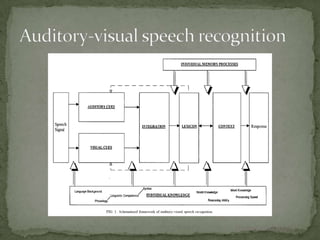
Auditory-visual speech recognition(Grant et al 1998)
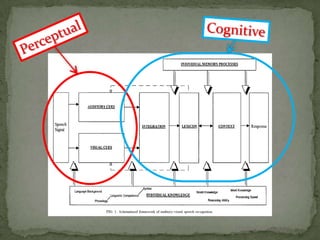
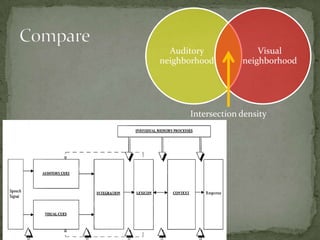
CognitivePerceptual(Grant et al 1998)
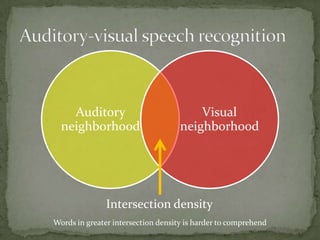
Auditory-visual speech recognitionIntersection densityWords in greater intersection density is harder to comprehend(Grant et al 1998)
CompareIntersection density
When BOTH auditory and visual information is available, individuals with hearing loss tend to do better on communication tasksExample (Auditory plus Vision):Speech Recognition Score = 50%Speechreading Score = 20%Combined Visual/Auditory Score = 90%Auditory plus Vision
Children are in a phase of skill acquisitionBy 5 months of age, infants already attend to visual cues, preferring synchronous facial/speech modulationsAbout 40% of speech sounds are visible on the face
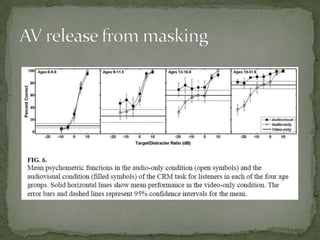
AV release from masking1  2  3  4  5  6  7  81  2  3  4  5  6  7  81  2  3  4  5  6  7  81  2  3  4  5  6  7  88 voices, 4♀ 4♂Target (65 dB SPL)“Ready, Baron, go to [color] [number] now.”Distractor (-35 - +15 SNR)“Ready, [call-sign], go to [color] [number] now.”(Wightman et al 2006)
AV release from masking
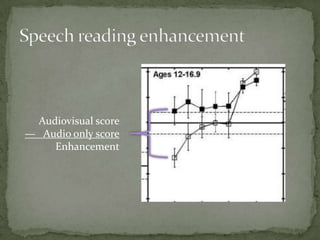
Speech reading enhancementAudiovisual score—   Audio only scoreEnhancement
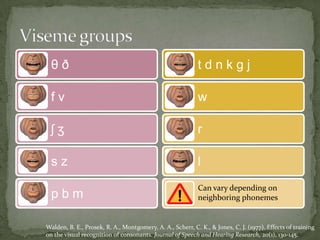
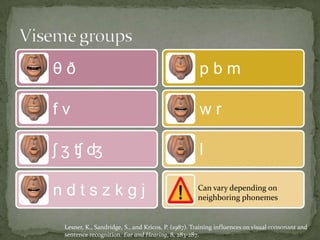
Viseme groupsCan vary depending on neighboring phonemesWalden, B. E., Prosek, R. A., Montgomery, A. A., Scherr, C. K., & Jones, C. J. (1977). Effects of training on the visual recognition of consonants. Journal of Speech and Hearing Research, 20(1), 130-145.
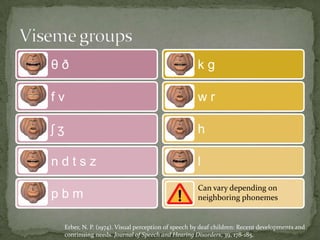
Viseme groupsCan vary depending on neighboring phonemesErber, N. P. (1974). Visual perception of speech by deaf children: Recent developments and continuing needs. Journal of Speech and Hearing Disorders, 39, 178-185.
Viseme groupsCan vary depending on neighboring phonemesLesner, K., Sandridge, S., and Kricos, P. (1987). Training influences on visual consonant and sentence recognition. Ear and Hearing, 8, 283-287.
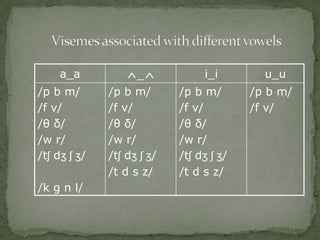
Visemes associated with different vowels
Place is visibleManner and voicing are invisible
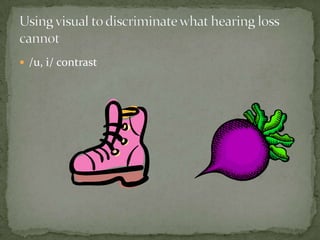
/u, i/ contrastUsing visual to discriminate what hearing loss cannot
SentencesUtley Sentence testDenver Quick testWords + SentencesCraig inventoryWords appropriate for Pre-K, KindergartenAssessing speechreading
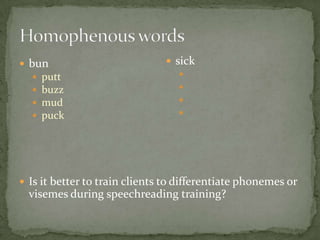
Homophenous wordsbunputtbuzzmudpuckIs it better to train clients to differentiate phonemes or visemes during speechreading training?sick
Differentiation of viseme groupsTraining
Differentiation of viseme groupsNot differentiation within viseme groupTraining
Analytic – phoneme levelfew cues apart from visualif this becomes automatic, then cognitive resources released for auditory processingSynthetic – sentence/conversational levelsentence topic provides cues“Put your shoes on your feet”Training
Factors enhancing visual cuesGood lightingNo obstructionsOptimal speech rateUnexaggerated articulationSpeaker familiarityClose proximity
Should children be trained in speechreading?
Perhaps at an age where they can benefit from training better than anyone.Can enhance understanding in situations where auditory signal is distorted by noise or reverberation.(~15 dB release from masking).Should we only focus on auditory process?Should children be trained in speechreading?
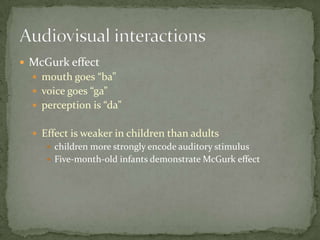
McGurk effectmouth goes “ba”voice goes “ga”perception is “da”Effect is weaker in children than adultschildren more strongly encode auditory stimulusFive-month-old infants demonstrate McGurk effectAudiovisual interactions
From close to birth, children processing language supramodally, attending to auditory and visual cues.
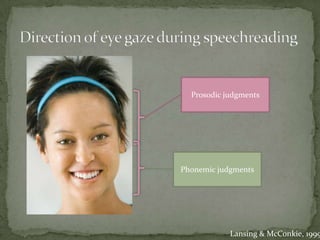
Direction of eye gaze during speechreadingProsodic judgmentsPhonemic judgmentsLansing & McConkie, 1999
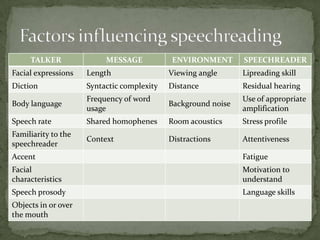
Factors influencing speechreading
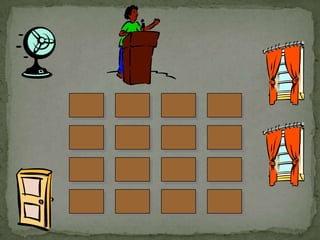
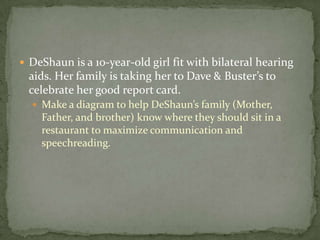
DeShaun is a 10-year-old girl fit with bilateral hearing aids. Her family is taking her to Dave & Buster’s to celebrate her good report card.Make a diagram to help DeShaun’s family (Mother, Father, and brother) know where they should sit in a restaurant to maximize communication and speechreading.

Speechreading

  • 1.
  • 2.
  • 3.
  • 4.
    Auditory-visual speech recognitionIntersectiondensityWords in greater intersection density is harder to comprehend(Grant et al 1998)
  • 5.
  • 6.
    When BOTH auditoryand visual information is available, individuals with hearing loss tend to do better on communication tasksExample (Auditory plus Vision):Speech Recognition Score = 50%Speechreading Score = 20%Combined Visual/Auditory Score = 90%Auditory plus Vision
  • 7.
    Children are ina phase of skill acquisitionBy 5 months of age, infants already attend to visual cues, preferring synchronous facial/speech modulationsAbout 40% of speech sounds are visible on the face
  • 8.
    AV release frommasking1 2 3 4 5 6 7 81 2 3 4 5 6 7 81 2 3 4 5 6 7 81 2 3 4 5 6 7 88 voices, 4♀ 4♂Target (65 dB SPL)“Ready, Baron, go to [color] [number] now.”Distractor (-35 - +15 SNR)“Ready, [call-sign], go to [color] [number] now.”(Wightman et al 2006)
  • 9.
  • 10.
    Speech reading enhancementAudiovisualscore— Audio only scoreEnhancement
  • 11.
    Viseme groupsCan varydepending on neighboring phonemesWalden, B. E., Prosek, R. A., Montgomery, A. A., Scherr, C. K., & Jones, C. J. (1977). Effects of training on the visual recognition of consonants. Journal of Speech and Hearing Research, 20(1), 130-145.
  • 12.
    Viseme groupsCan varydepending on neighboring phonemesErber, N. P. (1974). Visual perception of speech by deaf children: Recent developments and continuing needs. Journal of Speech and Hearing Disorders, 39, 178-185.
  • 13.
    Viseme groupsCan varydepending on neighboring phonemesLesner, K., Sandridge, S., and Kricos, P. (1987). Training influences on visual consonant and sentence recognition. Ear and Hearing, 8, 283-287.
  • 14.
    Visemes associated withdifferent vowels
  • 15.
    Place is visibleMannerand voicing are invisible
  • 16.
    /u, i/ contrastUsingvisual to discriminate what hearing loss cannot
  • 17.
    SentencesUtley Sentence testDenverQuick testWords + SentencesCraig inventoryWords appropriate for Pre-K, KindergartenAssessing speechreading
  • 18.
    Homophenous wordsbunputtbuzzmudpuckIs itbetter to train clients to differentiate phonemes or visemes during speechreading training?sick
  • 19.
  • 20.
    Differentiation of visemegroupsNot differentiation within viseme groupTraining
  • 21.
    Analytic – phonemelevelfew cues apart from visualif this becomes automatic, then cognitive resources released for auditory processingSynthetic – sentence/conversational levelsentence topic provides cues“Put your shoes on your feet”Training
  • 22.
    Factors enhancing visualcuesGood lightingNo obstructionsOptimal speech rateUnexaggerated articulationSpeaker familiarityClose proximity
  • 23.
    Should children betrained in speechreading?
  • 24.
    Perhaps at anage where they can benefit from training better than anyone.Can enhance understanding in situations where auditory signal is distorted by noise or reverberation.(~15 dB release from masking).Should we only focus on auditory process?Should children be trained in speechreading?
  • 25.
    McGurk effectmouth goes“ba”voice goes “ga”perception is “da”Effect is weaker in children than adultschildren more strongly encode auditory stimulusFive-month-old infants demonstrate McGurk effectAudiovisual interactions
  • 26.
    From close tobirth, children processing language supramodally, attending to auditory and visual cues.
  • 27.
    Direction of eyegaze during speechreadingProsodic judgmentsPhonemic judgmentsLansing & McConkie, 1999
  • 28.
  • 30.
    DeShaun is a10-year-old girl fit with bilateral hearing aids. Her family is taking her to Dave & Buster’s to celebrate her good report card.Make a diagram to help DeShaun’s family (Mother, Father, and brother) know where they should sit in a restaurant to maximize communication and speechreading.

Editor's Notes

  • #8 Get kids looking at the right place, even if not necessarily reading lips.
  • #18 Utley: 125 words in 31 sentencesDenver: 20 sentences (0.90 correlation to Utley)Craig: 33 words and 24 sentences.
  • #31 Pair, Share, Compare