INTRODUCTION
 In physics, sound is a vibration that propagates as a typically
audible mechanical wave of pressure and displacement,
through a medium such as air or water. In physiology and
psychology, sound is the reception of such waves and their
perception by the brain. Sound can propagate through
compressible media such as air, water and solids as
longitudinal waves and also as a transverse waves in solids
(see Longitudinal and transverse waves, below). The sound
waves are generated by a sound source, such as the vibrating
diaphragm of a stereo speaker. The sound source creates
vibrations in the surrounding medium.
Types of sound :
Audible
Inaudible
 Frequency is the number of occurrences of a repeating
event per unit time. It is also referred to as temporal
frequency, which emphasizes the contrast to spatial
frequency and angular frequency. The period is the duration
of one cycle in a repeating event, so the period is the
reciprocal of the frequency. For example, if a newborn
baby's heart beats at a frequency of 120 times a minute, its
period – the interval between beats – is half a second (60
seconds (i.e. a minute) divided by 120 beats). Frequency is
an important parameter used in science and engineering to
specify the rate of oscillatory and vibratory phenomena,
such as mechanical vibrations, audio (sound) signals, radio
waves, and light.
The human Ear
WAVE LENGTH
 In physics, the wavelength of a sinusoidal wave is the spatial period of the
wave—the distance over which the wave's shape repeats.[1] It is usually
determined by considering the distance between consecutive corresponding
points of the same phase, such as crests, troughs, or zero crossings and is a
characteristic of both traveling waves and standing waves, as well as other
spatial wave patterns. Wavelength is commonly designated by the Greek
letter lambda (λ). The concept can also be applied to periodic waves of non-
sinusoidal shape. The term wavelength is also sometimes applied to
modulated waves, and to the sinusoidal envelopes of modulated waves or
waves formed by interference of several sinusoids. The SI unit of wavelength
is the meter.
How does sound travels?
Sonar
ACOUSTICS
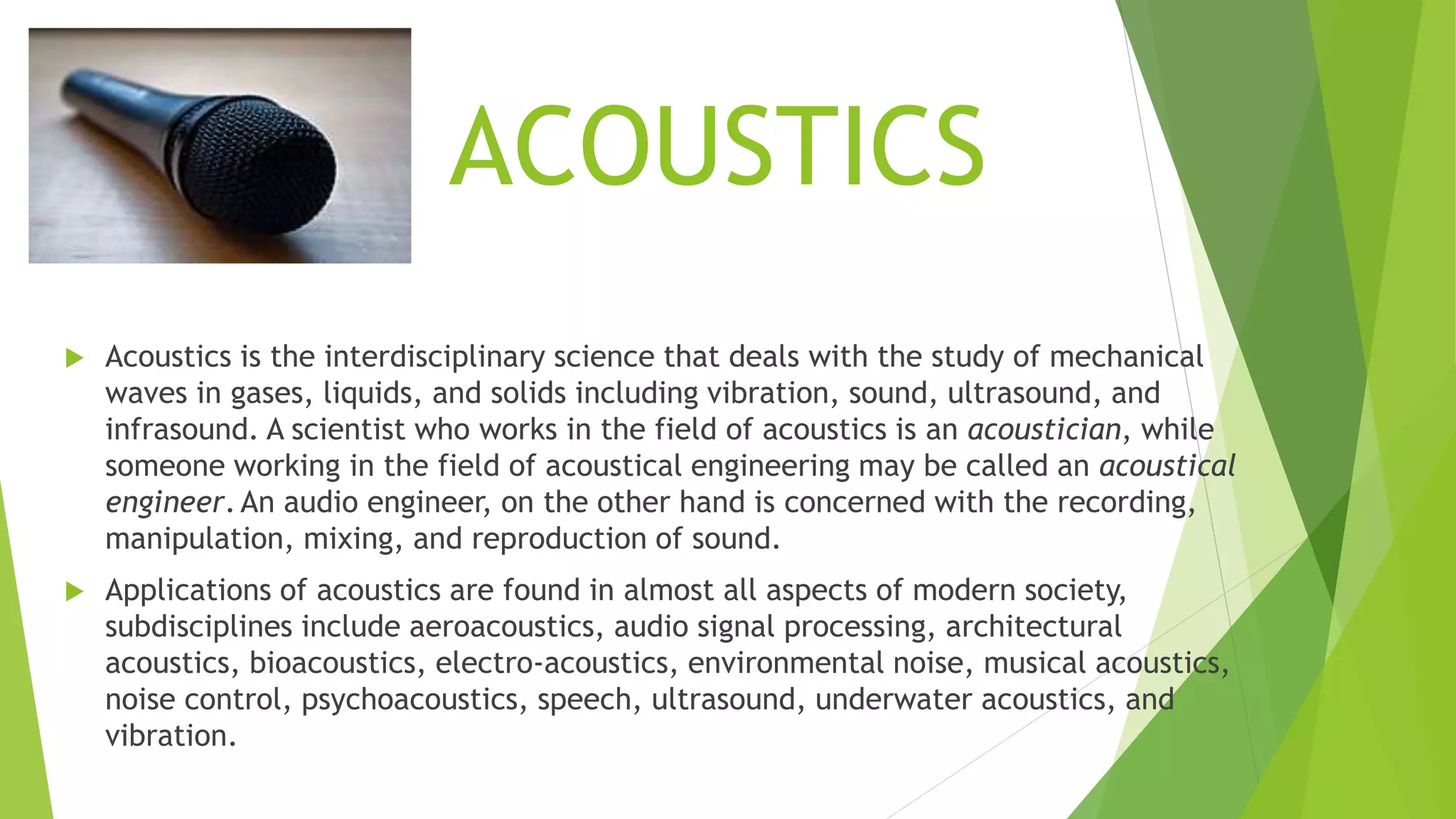
 Acoustics is the interdisciplinary science that deals with the study of mechanical
waves in gases, liquids, and solids including vibration, sound, ultrasound, and
infrasound. A scientist who works in the field of acoustics is an acoustician, while
someone working in the field of acoustical engineering may be called an acoustical
engineer.An audio engineer, on the other hand is concerned with the recording,
manipulation, mixing, and reproduction of sound.
 Applications of acoustics are found in almost all aspects of modern society,
subdisciplines include aeroacoustics, audio signal processing, architectural
acoustics, bioacoustics, electro-acoustics, environmental noise, musical acoustics,
noise control, psychoacoustics, speech, ultrasound, underwater acoustics, and
vibration.
SPEED OF
SOUND
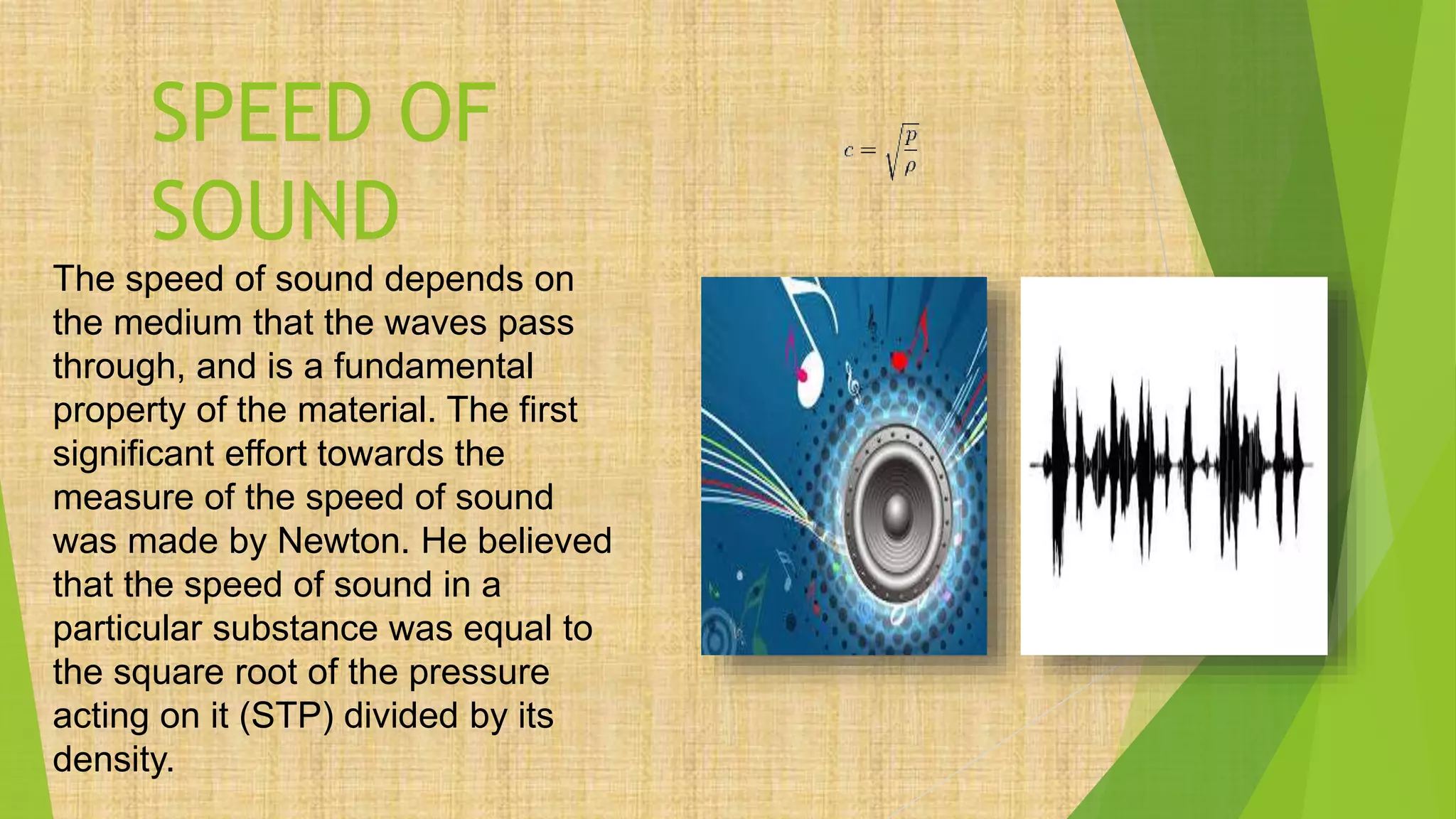
The speed of sound depends on
the medium that the waves pass
through, and is a fundamental
property of the material. The first
significant effort towards the
measure of the speed of sound
was made by Newton. He believed
that the speed of sound in a
particular substance was equal to
the square root of the pressure
acting on it (STP) divided by its
density.
NISCHAY
CLASS 9 B
Chiranjiv
Bharati School
THE END

Sound and wavelength

  • 2.
    INTRODUCTION  In physics,sound is a vibration that propagates as a typically audible mechanical wave of pressure and displacement, through a medium such as air or water. In physiology and psychology, sound is the reception of such waves and their perception by the brain. Sound can propagate through compressible media such as air, water and solids as longitudinal waves and also as a transverse waves in solids (see Longitudinal and transverse waves, below). The sound waves are generated by a sound source, such as the vibrating diaphragm of a stereo speaker. The sound source creates vibrations in the surrounding medium.
  • 3.
    Types of sound: Audible Inaudible
  • 4.
     Frequency isthe number of occurrences of a repeating event per unit time. It is also referred to as temporal frequency, which emphasizes the contrast to spatial frequency and angular frequency. The period is the duration of one cycle in a repeating event, so the period is the reciprocal of the frequency. For example, if a newborn baby's heart beats at a frequency of 120 times a minute, its period – the interval between beats – is half a second (60 seconds (i.e. a minute) divided by 120 beats). Frequency is an important parameter used in science and engineering to specify the rate of oscillatory and vibratory phenomena, such as mechanical vibrations, audio (sound) signals, radio waves, and light.
  • 5.
  • 6.
    WAVE LENGTH  Inphysics, the wavelength of a sinusoidal wave is the spatial period of the wave—the distance over which the wave's shape repeats.[1] It is usually determined by considering the distance between consecutive corresponding points of the same phase, such as crests, troughs, or zero crossings and is a characteristic of both traveling waves and standing waves, as well as other spatial wave patterns. Wavelength is commonly designated by the Greek letter lambda (λ). The concept can also be applied to periodic waves of non- sinusoidal shape. The term wavelength is also sometimes applied to modulated waves, and to the sinusoidal envelopes of modulated waves or waves formed by interference of several sinusoids. The SI unit of wavelength is the meter.
  • 7.
  • 8.
  • 9.
    ACOUSTICS  Acoustics isthe interdisciplinary science that deals with the study of mechanical waves in gases, liquids, and solids including vibration, sound, ultrasound, and infrasound. A scientist who works in the field of acoustics is an acoustician, while someone working in the field of acoustical engineering may be called an acoustical engineer.An audio engineer, on the other hand is concerned with the recording, manipulation, mixing, and reproduction of sound.  Applications of acoustics are found in almost all aspects of modern society, subdisciplines include aeroacoustics, audio signal processing, architectural acoustics, bioacoustics, electro-acoustics, environmental noise, musical acoustics, noise control, psychoacoustics, speech, ultrasound, underwater acoustics, and vibration.
  • 10.
    SPEED OF SOUND The speedof sound depends on the medium that the waves pass through, and is a fundamental property of the material. The first significant effort towards the measure of the speed of sound was made by Newton. He believed that the speed of sound in a particular substance was equal to the square root of the pressure acting on it (STP) divided by its density.
  • 11.