{SOUND}
MADE BY :
PRATIKSHA YADAV

Class : 9th
Contents
•

Introduction

•

propagation of sound

•

wave

•

types of wave

•

characteristics of sound wave

•

frequency

•

amplitude

•

speed

•

Reflection of sound

•

reverberation

•

Range of hearing

•

SONAR

•

Human ear
introduction
Sound is a form of energy which produces
a sensation of hearing in our ears.
Propagation of sound
 Sound is transmitted by particles (atoms or

molecules) in a solid, liquid or gas colliding
with each other. It is a wave which is created by
vibrating objects and propagated through a
medium (solid, liquid or gas) from one location to
another.
Wave
The disturbance created in a
medium ( solid , liquid , gas ) .
Types of wave
Longitudinal waves – the wave in which the
particles of medium vibrates to and fro in the
same direction in which wave is moving.
Transverse wave – the wave in which the particles of
medium vibrates up and down to the direction in
which the wave is moving .
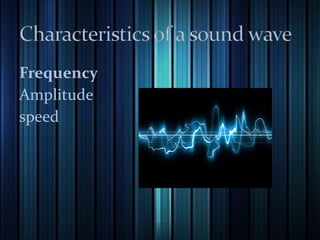
Frequency
Amplitude
speed
Frequency
• The frequency is the number of
wave created
Per second is called frequency .
Amplitude
Amplitude is the magnitude of change in the
oscillating variable with each oscillation within
an oscillating system.
Speed

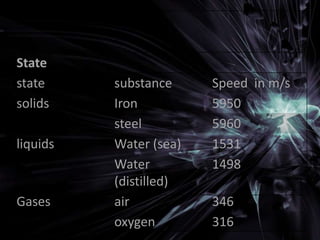
The speed of sound depends on the
medium the waves pass through .
State
state
solids

liquids

Gases

substance
Iron
steel
Water (sea)
Water
(distilled)
air
oxygen

Speed in m/s
5950
5960
1531
1498
346
316
Reflection of sound
• Multiple reflection of sound is the process in
which sound waves bounces off
obstacles and reflects many times before reaching the
destination. this is the
phenomena that occurs in a stethoscope. sound waves
reflect through the
tube many times before reaching the ears of the
doctor. It is very helpful in
detecting problems.
Reverberation
• Reverberation is the persistence of sound in a
particular space after
the original sound is removed. A reverberation,
or reverb, is created
when a sound is produced in an enclosed space
causing a large number
of echoes to build up and then slowly decay as the
sound is absorbed by
the walls and air.
Range of hearing
• Hearing range usually describes the range of
frequencies that can
be heard by an animal or human, though it can
also refer to the range of levels.
In humans the audible range of frequencies is
usually said to be 20 Hz (cycles per second) to
20 kHz (20,000 Hz) .
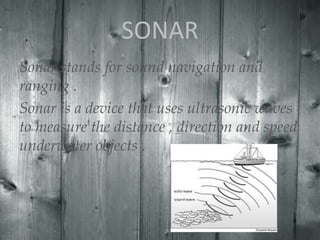
SONAR
Sonar stands for sound navigation and
ranging .
Sonar is a device that uses ultrasonic waves
to measure the distance , direction and speed
underwater objects .
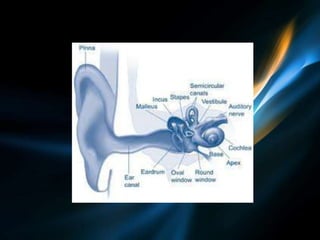
Human ear
The ear is the anatomical organ that
detects sound. It not only acts as a
receiver for sound, but also plays a major role
in the sense of balance and
body position. The ear is part of the auditory
system.
[MCQs]
A sound wave travels from east to west, in
which direction do the particles of air
move?
(A) East – west
(B) North - south
(C) Up and down
(D) None
. In which medium sound travels
faster ?
(A) Solid
(C) Gas

(B) Liquid
(D) None
What is the name of short duration
wave?
(A) Pulse
(C) Time period

(B) Frequency
(D) Velocity
What is the velocity of sound in
water at room temperature?
(A)1500 m/s
(B) (B) 330 m/s
(C) 1500 km/s
(D) 330 km/s
The unit of quantity on which pitch
of the sound depends is :
(A)Hertz
(B) meter
(C) meter/second
(D) second
The unit of quantity on which
loudness of found depends is :
(A) meter
(B) Hertz
(C) meter/second
(D) second
Nature of sound wave is :
(A) transverse
(B) longitudinal
(C) electromagnetic
(D) seism
Pitch of high frequency sound is :
(A) high
(C) zero

(B) low
(D) infinite
Voice of a friend is recognized by its :
(A) Pitch
(C) Intensity

(B) quality
(D) velocity
Sound waves in air are :
(A)Longitudinal waves
(B) Radio waves
(C) Transverse waves
(D) Electromagnetic waves
1-A
3-A
5-A
7-B
9-B

2-A
4-A
6-A
8-A
10-A
Sound by Pratiksha Yadav

Sound by Pratiksha Yadav

  • 1.
    {SOUND} MADE BY : PRATIKSHAYADAV Class : 9th
  • 2.
    Contents • Introduction • propagation of sound • wave • typesof wave • characteristics of sound wave • frequency • amplitude • speed • Reflection of sound • reverberation • Range of hearing • SONAR • Human ear
  • 3.
    introduction Sound is aform of energy which produces a sensation of hearing in our ears.
  • 4.
    Propagation of sound Sound is transmitted by particles (atoms or molecules) in a solid, liquid or gas colliding with each other. It is a wave which is created by vibrating objects and propagated through a medium (solid, liquid or gas) from one location to another.
  • 5.
    Wave The disturbance createdin a medium ( solid , liquid , gas ) .
  • 6.
    Types of wave Longitudinalwaves – the wave in which the particles of medium vibrates to and fro in the same direction in which wave is moving. Transverse wave – the wave in which the particles of medium vibrates up and down to the direction in which the wave is moving .
  • 7.
  • 8.
    Frequency • The frequencyis the number of wave created Per second is called frequency .
  • 9.
    Amplitude Amplitude is themagnitude of change in the oscillating variable with each oscillation within an oscillating system.
  • 10.
    Speed The speed ofsound depends on the medium the waves pass through .
  • 11.
  • 12.
    Reflection of sound •Multiple reflection of sound is the process in which sound waves bounces off obstacles and reflects many times before reaching the destination. this is the phenomena that occurs in a stethoscope. sound waves reflect through the tube many times before reaching the ears of the doctor. It is very helpful in detecting problems.
  • 13.
    Reverberation • Reverberation isthe persistence of sound in a particular space after the original sound is removed. A reverberation, or reverb, is created when a sound is produced in an enclosed space causing a large number of echoes to build up and then slowly decay as the sound is absorbed by the walls and air.
  • 14.
    Range of hearing •Hearing range usually describes the range of frequencies that can be heard by an animal or human, though it can also refer to the range of levels. In humans the audible range of frequencies is usually said to be 20 Hz (cycles per second) to 20 kHz (20,000 Hz) .
  • 15.
    SONAR Sonar stands forsound navigation and ranging . Sonar is a device that uses ultrasonic waves to measure the distance , direction and speed underwater objects .
  • 16.
    Human ear The earis the anatomical organ that detects sound. It not only acts as a receiver for sound, but also plays a major role in the sense of balance and body position. The ear is part of the auditory system.
  • 18.
  • 19.
    A sound wavetravels from east to west, in which direction do the particles of air move? (A) East – west (B) North - south (C) Up and down (D) None
  • 20.
    . In whichmedium sound travels faster ? (A) Solid (C) Gas (B) Liquid (D) None
  • 21.
    What is thename of short duration wave? (A) Pulse (C) Time period (B) Frequency (D) Velocity
  • 22.
    What is thevelocity of sound in water at room temperature? (A)1500 m/s (B) (B) 330 m/s (C) 1500 km/s (D) 330 km/s
  • 23.
    The unit ofquantity on which pitch of the sound depends is : (A)Hertz (B) meter (C) meter/second (D) second
  • 24.
    The unit ofquantity on which loudness of found depends is : (A) meter (B) Hertz (C) meter/second (D) second
  • 25.
    Nature of soundwave is : (A) transverse (B) longitudinal (C) electromagnetic (D) seism
  • 26.
    Pitch of highfrequency sound is : (A) high (C) zero (B) low (D) infinite
  • 27.
    Voice of afriend is recognized by its : (A) Pitch (C) Intensity (B) quality (D) velocity
  • 28.
    Sound waves inair are : (A)Longitudinal waves (B) Radio waves (C) Transverse waves (D) Electromagnetic waves
  • 29.