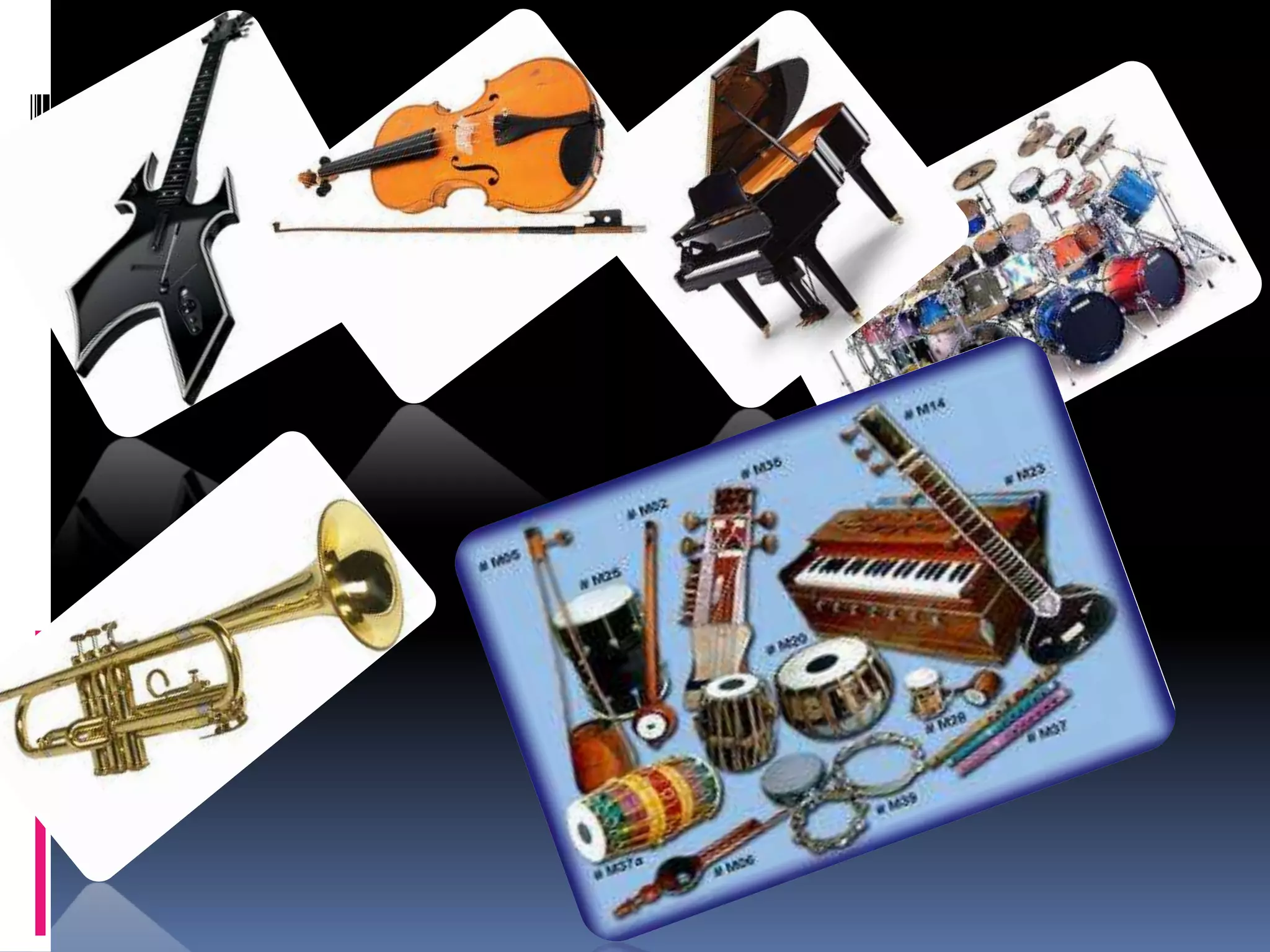
ARE YOU READY FOR
TONIGHT’S CONCERT?
CHARACTERISTICS OF SOUND


•Intensity and Loudness
•Pitch
•Quality
INTENSITY AND LOUDNESS
    Loudness is a physiological sensation. It depends
mainly on sound pressure but also on the spectrum of
the harmonics and the physical duration. The intensity of
sound, at a given distance, depends upon the amplitude
of the waves. Thus, a tuning fork gives out more energy
in the form of sound when struck hard than when struck
gently. You should remember that when a tuning fork is
struck, the sound is omnidirectional (heard in all
directions), because the sound waves spread out in all
directions.
                   www. personal.cityu.edu.hk/~bsapplec/characte.htm+characteristics+of+sound&cd=1&
                                            www.electriciantraining.tpub.com/14182/css/14182_32.htm
PITCH
    Pitch refers to how low or high a sound is.
The pitch of a sound depends on its frequency. A
high pitch sound has a high frequency and a low
pitch sound has a low frequency.
    The human ears can detect sounds between
frequencies of 20 and 20 000 Hz. Sounds above
this range are ultrasonic. Dogs can hear
frequencies up to 25 000 Hz.
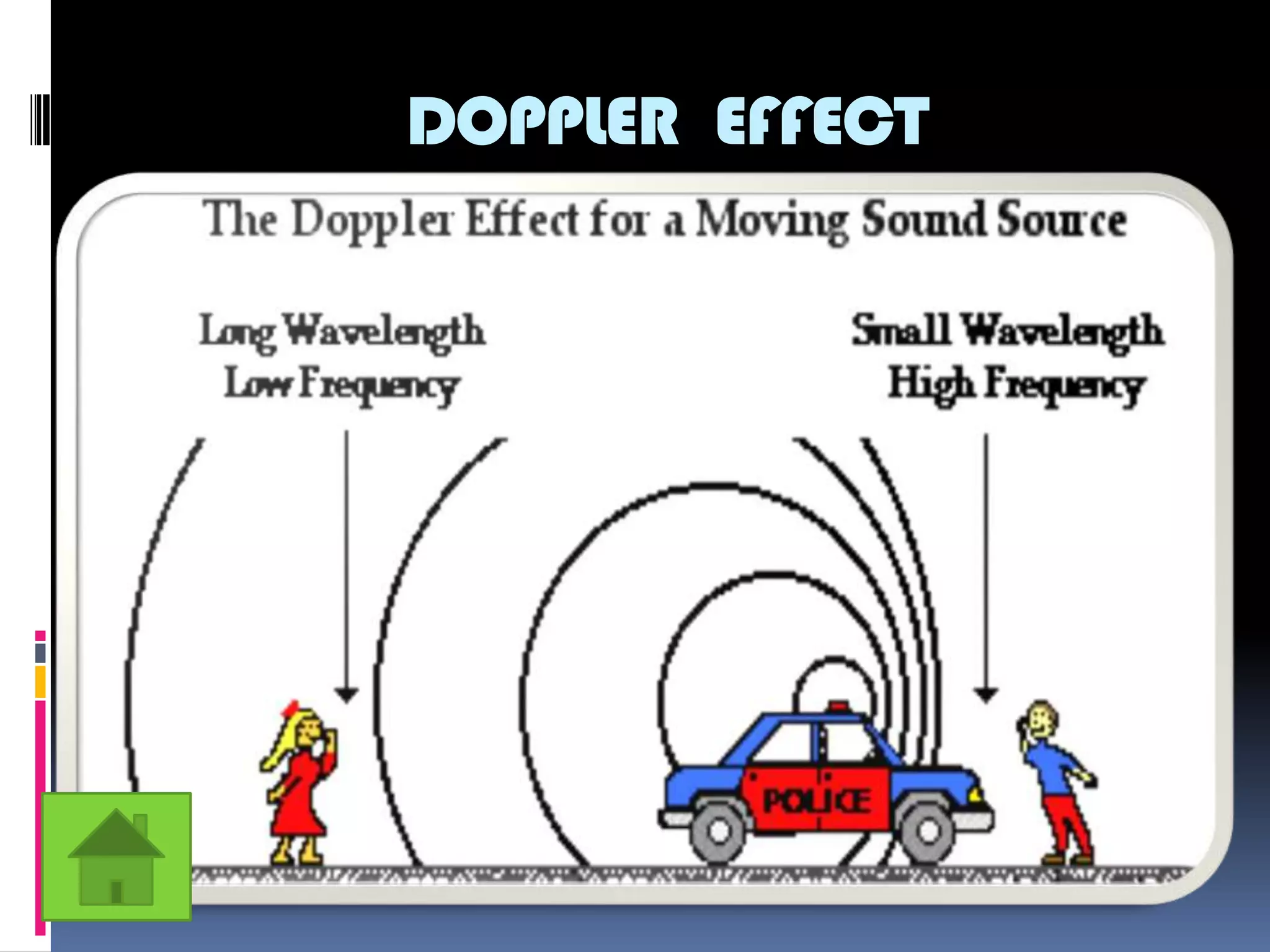
DOPPLER EFFECT
   Have you noticed how the pitch of the police
vehicle siren gradually drops as it moves away
from you? As the siren approaches, the distance
of the sound waves decreases or becomes
shorter. When the ambulance moves away, less
waves reach you each second, and the pitch
becomes lower. Any change in frequency when
you or wave source moves is known as Doppler
Effect, a phenomenon named after its
discoverer, Christian Doppler.
DOPPLER EFFECT
QUALITY OF SOUND
    Sound "quality" or "timbre" describes those
characteristics of sound which allow the ear to
distinguish sounds which have the same pitch
and loudness. Timbre is then a general term for
the distinguishable characteristics of a tone.
Timbre is mainly determined by the harmonic
content of a sound and the dynamic
characteristics of the sound such as vibrato and
the attack-decay envelope of the sound.
                http://hyperphysics.phy-astr.gsu.edu/hbase/sound/timbre.html
IN GENERAL……

   There         are        three
 characteristics of sound waves
 the intensity and loudness,
 pitch and the quality of sound.

Characteristics of sound

  • 2.
    ARE YOU READYFOR TONIGHT’S CONCERT?
  • 5.
    CHARACTERISTICS OF SOUND •Intensityand Loudness •Pitch •Quality
  • 6.
    INTENSITY AND LOUDNESS Loudness is a physiological sensation. It depends mainly on sound pressure but also on the spectrum of the harmonics and the physical duration. The intensity of sound, at a given distance, depends upon the amplitude of the waves. Thus, a tuning fork gives out more energy in the form of sound when struck hard than when struck gently. You should remember that when a tuning fork is struck, the sound is omnidirectional (heard in all directions), because the sound waves spread out in all directions. www. personal.cityu.edu.hk/~bsapplec/characte.htm+characteristics+of+sound&cd=1& www.electriciantraining.tpub.com/14182/css/14182_32.htm
  • 7.
    PITCH Pitch refers to how low or high a sound is. The pitch of a sound depends on its frequency. A high pitch sound has a high frequency and a low pitch sound has a low frequency. The human ears can detect sounds between frequencies of 20 and 20 000 Hz. Sounds above this range are ultrasonic. Dogs can hear frequencies up to 25 000 Hz.
  • 8.
    DOPPLER EFFECT Have you noticed how the pitch of the police vehicle siren gradually drops as it moves away from you? As the siren approaches, the distance of the sound waves decreases or becomes shorter. When the ambulance moves away, less waves reach you each second, and the pitch becomes lower. Any change in frequency when you or wave source moves is known as Doppler Effect, a phenomenon named after its discoverer, Christian Doppler.
  • 9.
  • 10.
    QUALITY OF SOUND Sound "quality" or "timbre" describes those characteristics of sound which allow the ear to distinguish sounds which have the same pitch and loudness. Timbre is then a general term for the distinguishable characteristics of a tone. Timbre is mainly determined by the harmonic content of a sound and the dynamic characteristics of the sound such as vibrato and the attack-decay envelope of the sound. http://hyperphysics.phy-astr.gsu.edu/hbase/sound/timbre.html
  • 11.
    IN GENERAL…… There are three characteristics of sound waves the intensity and loudness, pitch and the quality of sound.

Editor's Notes

  • #4 WHAT IS THEIR SIMILARITIES………. THEY ARE ALL MUSICIANS….
  • #5 WHAT ABOUT THIS WHAT IS ITS SIMILARITIES….. THEY ARE ALL SOUND INSTRUMENTS
  • #6 TODAY OUR TOPIC IS ALL ABOUT THE CHARACTERISTICS OF SOUND WAVES… AND THERE ARE THREE CHARATERISTICS OF SOUND WAVES……
  • #7 Lets her a different intensities and loudness of the sound…..okay let me play this sound…..What did you observed guys
  • #8 Let me play here a different type of sounds…..okay what did you observed guys
  • #9 Okay lets here a sound of the ambulance instead…. Coming in and going out
  • #10 The Doppler effect as produced by the siren of a moving police vechicle as it is approaching the boy and moving away from the girl.
  • #11 It is not difficult to identify the sounds produced by different musical instruments, even if they produce the same tone with equal intensity. There are differences in the quality of sounds. For this reason , a person could be identified by the quality of his or her voice. Very often, you can tell who is talking without seeing the person. This is due to the quality of the sound produced by the person.Examples: lets here different types of sound