


CENTRAL AND STATE
GOVERNMENT INDUSTRIAL
POLICIES AND REGULATIONS -
INTERNATIONAL BUSINESS
Telangana State government policy
• The Telangana government has announced a new
industrial policy, claiming it to be the world's first to
ensure the right to timely clearances through
legislation and holding officials responsible for delays.
• The policy prescribes a single common application
form for all clearances to be accorded by a nodal
agency within 15 days for mega projects akin to the
Singapore Economic Development Board.
•
• Telangana is rich in mineral resources and the industrial policy has to tap
the sector to create job opportunities for youth in districts.
• Most Telangana districts are rich in mineral resources like quartz, barytes,
manganese, laterite, dolomite etc.
• Government is trying to develop refineries and manufacturing industries
by utilizing these resources which lead to overall economic development
of Telangana and create a huge employment in the state.
Reach Us @ www.choice-india.com
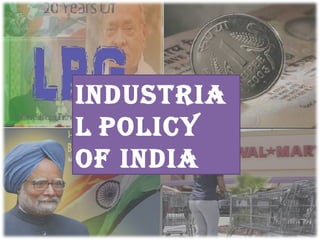
IndustrIa
l polIcy
of IndIa
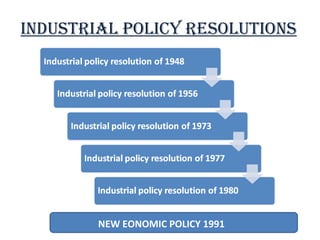
IndustrIal polIcy resolutIons
NEW EONOMIC POLICY 1991
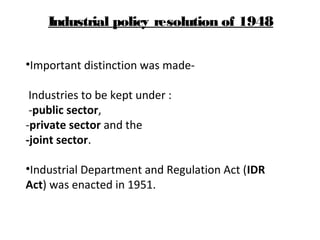
•Important distinction was made-
Industries to be kept under :
-public sector,
-private sector and the
-joint sector.
•Industrial Department and Regulation Act (IDR
Act) was enacted in 1951.
Industrial policy resolution of 1948
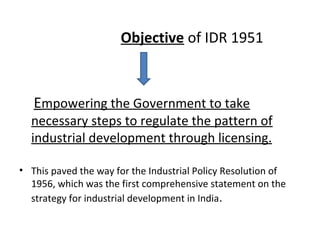
Objective of IDR 1951
Empowering the Government to take
necessary steps to regulate the pattern of
industrial development through licensing.
• This paved the way for the Industrial Policy Resolution of
1956, which was the first comprehensive statement on the
strategy for industrial development in India.
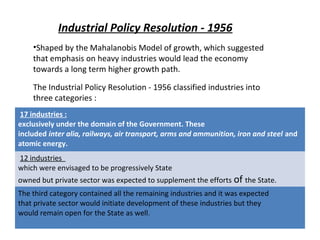
•Shaped by the Mahalanobis Model of growth, which suggested
that emphasis on heavy industries would lead the economy
towards a long term higher growth path.
The Industrial Policy Resolution - 1956 classified industries into
three categories :
Industrial Policy Resolution - 1956
17 industries :
exclusively under the domain of the Government. These
included inter alia, railways, air transport, arms and ammunition, iron and steel and
atomic energy.
12 industries
which were envisaged to be progressively State
owned but private sector was expected to supplement the efforts of the State.
The third category contained all the remaining industries and it was expected
that private sector would initiate development of these industries but they
would remain open for the State as well.
Objectives
• To accelerate economic growth and boost
the process of industrialization as a means to
achieving a socialistic pattern of society.
• Removal of regional disparities through
development of regions with low industrial
base.
INDUSTRIAL POLICY RESOLUTION, 1973
INDUSTRIAL POLICY RESOLUTION, 1977
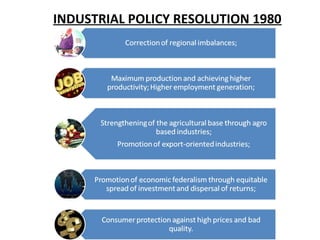
INDUSTRIAL POLICY RESOLUTION 1980
new IndustrIal
polIcy 1991
The spread of industrialization to backward areas of the
country will be actively promoted
through appropriate incentives, institutions and
infrastructure investments.
Foreign investment and technology collaboration will be
welcomed to obtain higher
technology, to increase exports and to expand the
production base.
Abolish monopoly
Workers’ participation in management will be
promoted
IndustrIal polIcy 1991
Issues
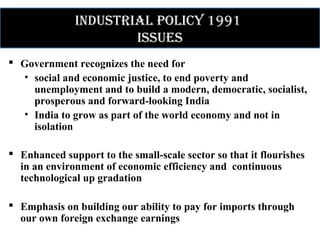
 Government recognizes the need for
• social and economic justice, to end poverty and
unemployment and to build a modern, democratic, socialist,
prosperous and forward-looking India
• India to grow as part of the world economy and not in
isolation
 Enhanced support to the small-scale sector so that it flourishes
in an environment of economic efficiency and continuous
technological up gradation
 Emphasis on building our ability to pay for imports through
our own foreign exchange earnings
IndustrIal polIcy 1991
oBJectIVes
In pursuit of the above objectives,
Government have decided to take a series
of initiatives in respect of the policies
relating to the following areas:
A. Industrial Licensing.
B. Foreign Investment.
C. Foreign Technology Agreements.
D. Public Sector Policy.
E. MRTP Act.
A.Industrial Licensing:
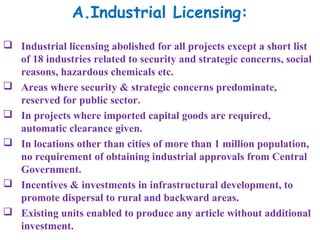
 Industrial licensing abolished for all projects except a short list
of 18 industries related to security and strategic concerns, social
reasons, hazardous chemicals etc.
 Areas where security & strategic concerns predominate,
reserved for public sector.
 In projects where imported capital goods are required,
automatic clearance given.
 In locations other than cities of more than 1 million population,
no requirement of obtaining industrial approvals from Central
Government.
 Incentives & investments in infrastructural development, to
promote dispersal to rural and backward areas.
 Existing units enabled to produce any article without additional
investment.
INDUSTRIAL POLICY
1991
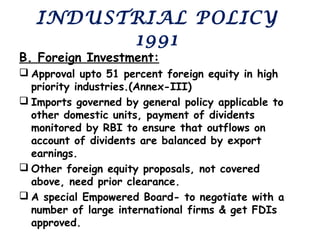
B. Foreign Investment:
 Approval upto 51 percent foreign equity in high
priority industries.(Annex-III)
 Imports governed by general policy applicable to
other domestic units, payment of dividents
monitored by RBI to ensure that outflows on
account of dividents are balanced by export
earnings.
 Other foreign equity proposals, not covered
above, need prior clearance.
 A special Empowered Board- to negotiate with a
number of large international firms & get FDIs
approved.
INDUSTRIAL POLICY
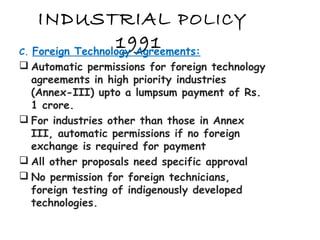
1991C. Foreign Technology Agreements:
 Automatic permissions for foreign technology
agreements in high priority industries
(Annex-III) upto a lumpsum payment of Rs.
1 crore.
 For industries other than those in Annex
III, automatic permissions if no foreign
exchange is required for payment
 All other proposals need specific approval
 No permission for foreign technicians,
foreign testing of indigenously developed
technologies.
INDUSTRIAL POLICY
1991
D. Public Sector Policy:
 Portfolio of public sector investments reviewed with a
view to focus public sector on strategic, high tech &
essential infrastructure.
 Chronically sick public enterprises, referred to Board
of Industrial & Financial Reconstruction (BIFR).
 A part of government’s shareholding in public sector
offered to mutual funds, financial institutions, public
& workers.
 Boards of public sector companies- more professional
& powerful.
 MOU system- managements would be granted greater
autonomy & held accountable.
INDUSTRIAL POLICY
1991
E. MRTP Act: (Monopolistic Restrictive Trade Practices):
 Removal of threshold limits of assets in respect of
MRTP Companies & dominant undertakings.
 Elimination of need of prior approval of Central
Government for establishment, expanding, merger,
amalgamation & takeover.
 Emphasis on controlling & regulating monopolistic,
restrictive & unfair trade practices.
 Enabling the MRTP Commission to exercise punitive &
compensatory powers.
POST 1991-
THE REFORM
PHASE
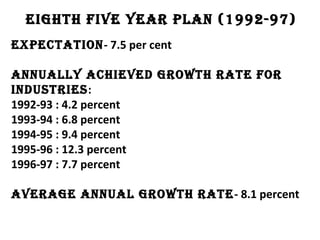
EIGHTH FIVE YEAR PLAN (1992-97)
ExPEcTATION- 7.5 per cent
ANNuALLY AcHIEVEd GROwTH RATE FOR
INduSTRIES:
1992-93 : 4.2 percent
1993-94 : 6.8 percent
1994-95 : 9.4 percent
1995-96 : 12.3 percent
1996-97 : 7.7 percent
AVERAGE ANNuAL GROwTH RATE- 8.1 percent
NINTH FIVE YEAR PLAN (1997-2002)
Industrial growth target: 3% p.a.
Achieved: 4.5% p.a.
In 1997-98 and 1998-99, industriesreported a
growth of 3.8 percent.
Such slow down wasdueto anumber of structural
and cyclical factors.
TENTH FIVE YEAR PLAN (2002-07)
Two major reformsthat took placefrom theyear
2002 were:
1)1. RISE IN INTERNATIONAL COMPETITION :
Removal of quantitativerestrictionson imports.
2)DECLINE IN ROLE OF PUBLIC SECTOR :
Disinvestment processconverted many of the
existing public sector enterprisesinto non-
governmental enterprises.
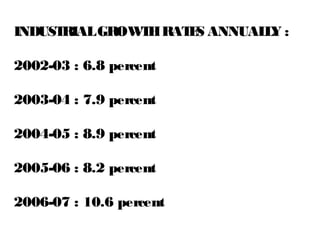
INDUSTRIALGROWTHRATES ANNUALLY :
2002-03 : 6.8 percent
2003-04 : 7.9 percent
2004-05 : 8.9 percent
2005-06 : 8.2 percent
2006-07 : 10.6 percent
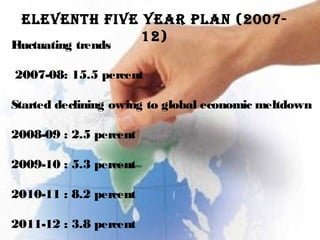
ELEVENTH FIVE YEAR PLAN (2007-
12)
Fluctuating trends
2007-08: 15.5 percent
Started declining owing to global economic meltdown
2008-09 : 2.5 percent
2009-10 : 5.3 percent
2010-11 : 8.2 percent
2011-12 : 3.8 percent
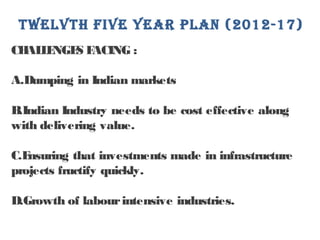
TwELVTH FIVE YEAR PLAN (2012-17)
CHALLENGES FACING :
A.Dumping in Indian markets
B.Indian Industry needs to be cost effective along
with delivering value.
C.Ensuring that investments made in infrastructure
projects fructify quickly.
D.Growth of labourintensive industries.
BUSINESS LAWS
• Business laws
are those laws which regulate the
conduct of the business.
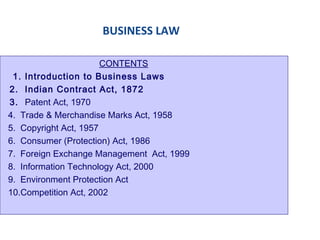
BUSINESS LAW
CONTENTS
1. Introduction to Business Laws
2. Indian Contract Act, 1872
3. Patent Act, 1970
4. Trade & Merchandise Marks Act, 1958
5. Copyright Act, 1957
6. Consumer (Protection) Act, 1986
7. Foreign Exchange Management Act, 1999
8. Information Technology Act, 2000
9. Environment Protection Act
10.Competition Act, 2002
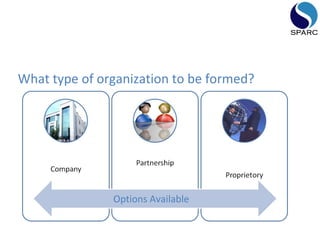
What type of organization to be formed?
Options Available
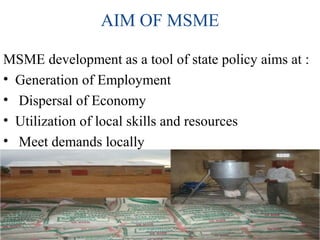
AIM OF MSME
MSME development as a tool of state policy aims at :
• Generation of Employment
• Dispersal of Economy
• Utilization of local skills and resources
• Meet demands locally
INTRODUCTION
MSME
Msme stands for micro, small and medium enterprises.
It plays a important role for economic development of our
country.
 The major advantage of the sector is its employment
potential at low capital cost. The labor intensity of the
MSME sector is much higher than that of the large
enterprises.
it satisfies the demand of local customer.
Brief idea about MSME
• In India, the enterprises have been classified broadly
into two categories
1.Manufacturing
2. services.
• Both categories have been further classified into
micro, small and medium enterprises based on their
investment in plant and machinery or on equipment.
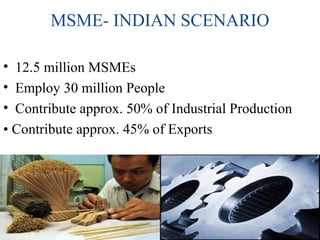
MSME- INDIAN SCENARIO
• 12.5 million MSMEs
• Employ 30 million People
• Contribute approx. 50% of Industrial Production
• Contribute approx. 45% of Exports
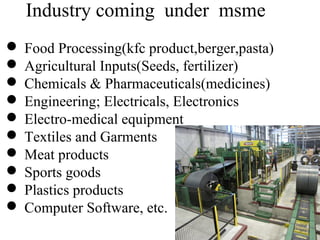
Industry coming under msme
 Food Processing(kfc product,berger,pasta)
 Agricultural Inputs(Seeds, fertilizer)
 Chemicals & Pharmaceuticals(medicines)
 Engineering; Electricals, Electronics
 Electro-medical equipment
 Textiles and Garments
 Meat products
 Sports goods
 Plastics products
 Computer Software, etc.
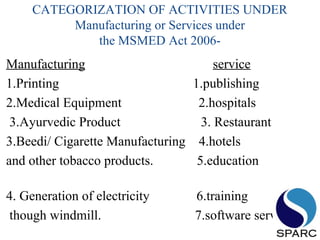
CATEGORIZATION OF ACTIVITIES UNDER
Manufacturing or Services under
the MSMED Act 2006-
Manufacturing service
1.Printing 1.publishing
2.Medical Equipment 2.hospitals
3.Ayurvedic Product 3. Restaurant
3.Beedi/ Cigarette Manufacturing 4.hotels
and other tobacco products. 5.education
4. Generation of electricity 6.training
though windmill. 7.software service
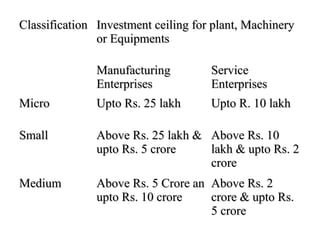
ClassificationClassification Investment ceiling for plant, MachineryInvestment ceiling for plant, Machinery
or Equipmentsor Equipments
ManufacturingManufacturing
EnterprisesEnterprises
ServiceService
EnterprisesEnterprises
MicroMicro Upto Rs. 25 lakhUpto Rs. 25 lakh Upto R. 10 lakhUpto R. 10 lakh
SmallSmall Above Rs. 25 lakh &Above Rs. 25 lakh &
upto Rs. 5 croreupto Rs. 5 crore
Above Rs. 10Above Rs. 10
lakh & upto Rs. 2lakh & upto Rs. 2
crorecrore
MediumMedium Above Rs. 5 Crore anAbove Rs. 5 Crore an
upto Rs. 10 croreupto Rs. 10 crore
Above Rs. 2Above Rs. 2
crore & upto Rs.crore & upto Rs.
5 crore5 crore
FISCAL BENEFITS
• following fiscal benefits covering the categories
of
(a) Micro/Small Enterprises (b) Medium
Enterprises & Large Industries (c)
Scheduled Caste & Scheduled Tribe
Entrepreneurs (d) Women Entrepreneurs
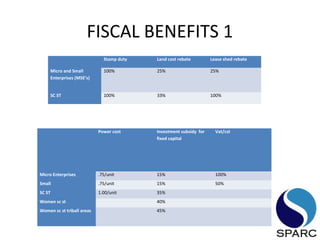
FISCAL BENEFITS 1
  Stamp duty Land cost rebate Lease shed rebate
Micro and Small 
Enterprises (MSE’s)
100% 25% 25%
SC ST 100% 33% 100%
  Power cost Investment subsidy  for 
fixed capital 
Vat/cst
Micro Enterprises .75/unit 15% 100%
Small .75/unit 15% 50%
SC ST 1.00/unit 35%
Women sc st 40%
Women sc st triball areas 45%
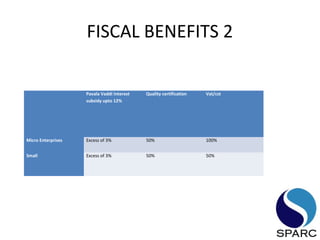
FISCAL BENEFITS 2
  Pavala Vaddi Interest 
subsidy upto 12%
Quality certification Vat/cst
Micro Enterprises Excess of 3% 50% 100%
Small Excess of 3% 50% 50%
ORDER 
(1) This Order is titled as ‘Public Procurement Policy for Micro and Small
Enterprises (MSEs) Order, 2012’.
(2) It shall come into force with effect from 1stApril 2012.
Public Procurement Policy for Micro and Small Enterprises (MSEs) Order
Whereas, the Central Government Ministries, Departments and Public
Sector Undertakings shall procure minimum of 20 per cent of their annual value of
goods or services from Micro and Small Enterprises;
s
Special provisions for Micro and Small Enterprises owned by Scheduled Castes or
Scheduled Tribes. Out of 20 per cent target of annual procurement from Micro─
and Small Enterprises, a sub-target of 20 per Cent (i.e., 4 per cent out of 20 per
cent) shall be earmarked for procurement from Micro and Small Enterprises
owned by the Scheduled Caste or the Scheduled Tribe entrepreneurs.
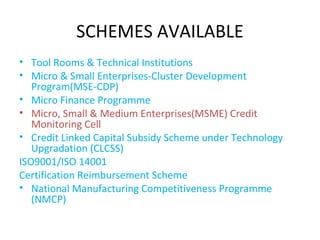
SCHEMES AVAILABLE
• Tool Rooms & Technical Institutions
• Micro & Small Enterprises-Cluster Development
Program(MSE-CDP)
• Micro Finance Programme
• Micro, Small & Medium Enterprises(MSME) Credit
Monitoring Cell
• Credit Linked Capital Subsidy Scheme under Technology
Upgradation (CLCSS)
ISO9001/ISO 14001
Certification Reimbursement Scheme
• National Manufacturing Competitiveness Programme
(NMCP)
• Interest subsidy under Pavala Vaddi Scheme on the term loan taken on
the fixed capital investment by New Micro and Small Enterprises in excess
of 3% per annum subject to a maximum reimbursement of 9% per annum
for a period of 5 years from the date of commencement of commercial
production.
• 50% subsidy on the expenses incurred for quality certification/ patent
registration limited to Rs. 2.00 Lakhs for MSE’s.
International Business
Environment
zignyas@gmail.com
International Business
• The buying and selling of the goods and
services across the border.
• The national border are crossed by the
enterprises to expand their business
activities like manufacturing, mining,
construction, agriculture, banking,
insurance, health, education,
transportation, communication and so on.
Trade
• Trade means exchange of goods and services
for the satisfaction of human wants.
• When trade is confined to the geographical
limits of a country, it is a domestic or national
trade.
• International or foreign trade refers to the
trade between two countries.
• Technically, domestic trade and International
trade are more or less identical and are based
on the same basic principles of trades.
Differences between Domestic and
International Business
• Difference in Currencies
• Difference in Natural and Geographical Conditions
• Mobility of Factors of Production
• Sovereign Political Entities
– Imposition of tariffs and customs duties on imports and
exports;
– Quantitative restrictions like quotas;
– Exchange control;
– Imposition of more local taxes etc.
• Different Legal Systems
Importance of IBE
• Helps in expansion: Geographic expansion may be used
as a business strategy. Even though companies may
expand their business at home.
• Helps in managing product life cycle: Every product has
to pass through different stages of product life cycle-
when the product reaches the last stages of life cycle in
present market, it may get proper response at other
markets.
• Technology advantages: Some companies have
outstanding technology advantages through which they
enjoy core competency. This technology helps the
company in capturing other markets.
Cont…
Importance of IBE
• New business opportunities: Business opportunities in
overseas markets help in expansion of many companies.
They might have reached a saturation point in domestic
market.
• Proper use of resources: Sometimes industrial resources
like labor, minerals etc. are available in a country but are
not productively utilized.
• Availability of quality products: When markets are open,
better quality goods will be available every where.
Foreign companies will market latest products at
reasonable prices. Good product will be available in the
markets.
Cont…
Importance of IBE
• Earning foreign exchange: International business
helps in earning foreign exchange which may be
used for strategic imports. India needs foreign
exchange to import crude oil, deface equipment,
raw material and machinery.
• Helps in mutual growth: Countries depend upon
each other for meeting their requirements. India
depends on gulf countries for its crude oil supplies.
• Investment in infrastructure: International
business necessitates proper development of
infrastructure.
Problems in International Business
• Controlling the market: Multinational try to control
the market of the host country. Whenever they enter
a new country, the first strategy is to eliminate the
competitors either by taking over their business or
forcing them out of market by following price
reduction policies.
• Exhausting natural resources: Multinational
corporations set up their production facilities in those
countries where natural resources are available in
sufficient quantities.
• Importance to luxuries: Multinational corporations
enter those areas where margin of profits is high.
Cont…
Problems in International Business
• Trade practices: Since multinational corporations have
their head office in one country and the trade practices
followed there are adhered to.
• Economic development: It is generally felt that the entry of
businessmen from outside may help in the economic
development of that country . The actual practice in many
countries is different.
• Shifting of investment: International business is related to
profitability of its operations. If a business is getting
sufficient profits in a particular country then the
investment remain there.
Need for International Business
– causes the flow of ideas, services, and capital across the
world
– offers consumers new choices
– permits the acquisition of a wider variety of products
– facilitates the mobility of labor, capital, and technology
– provides challenging employment opportunities
– reallocates resources, makes preferential choices, and
shifts activities to a global level
Intra-firm trade
• Intra-firm trade, i.e. trade within the same
company around one-third of world
merchandise trade, although aggregate data
are only available for a few countries.
• Intra-firm trade between high and middle-
income countries was directly related to the
internationalization of production.
• The affiliates in the middle-income countries
were mostly instructed to manufacture goods
destined for other markets, including the
country of the parent company.
E-commerce
• It has dominant factor in international trade and
business, although traditional methods of trade
and business continue to be utilized widely.
• It can reduce business costs in seeking potential
foreign business partners, as well as improve a
firm’s visibility in global marketing services, in
particular for SMEs.
• It enables firms to take more opportunities to
expand their business in global markets.
International Trade Theories
• Theory of Mercantilism
• Theory of Absolute Cost Advantage
• Theory of Comparative Cost Advantage
• Heckscher-Ohlin Model Leonief Paradox
Theory of Mercantilism
• This theory is during the sixteenth to the
three-fourths of the eighteenth centuries.
• It beliefs in nationalism and the welfare of
the nation alone, planning and regulation
of economic activities for achieving the
national goals, curbing imports and
promoting exports.
• It believed that the power of a nation lied
in its wealth, which grew by acquiring gold
from abroad.
Theory of Mercantilism
• Mercantilists failed to realize that simultaneous
export promotion and import regulation are not
possible in all countries, and the mere possession
of gold does not enhance the welfare of a people.
• Keeping the resources in the form of gold reduces
the production of goods and services and, thereby,
lowers welfare.
• It was rejected by Adam Smith and Ricardo by
stressing the importance of individuals, and
pointing out that their welfare was the welfare of
the nation.
Theory of Absolute Cost
Advantage
• This theory was propounded by Adam
Smith (1776), arguing that the countries
gain from trading, if they specialise
according to their production advantages.
• The pre-trade exchange ratio in Country I
would be 2A=1B and in Country II IA=2B.
Theory of Absolute Cost
Advantage
• If it is nearer to Country I domestic exchange
ratio then trade would be more beneficial to
Country II and vice versa.
• Assuming the international exchange ratio is
established IA=IB.
• The terms of trade between the trading partners
would depend upon their economic strength and
the bargaining power.
Theory of Comparative Cost
Advantage
• Ricardo (1817), though adhering to the absolute
cost advantage doctrine of Adam Smith, pointed
out that cost advantage to both the trade
partners was not a necessary condition for trade
to occur.
• According to Ricardo, so long as the other
country is not equally less productive in all lines
of production, measurable in terms of
opportunity cost of each commodity in the two
countries, it will still be mutually gainful for them
if they enter into trade.
Theory of Comparative Cost Advantage
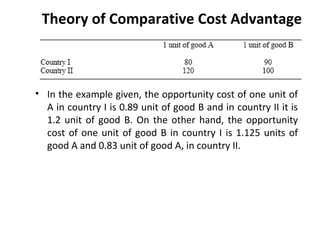
• In the example given, the opportunity cost of one unit of
A in country I is 0.89 unit of good B and in country II it is
1.2 unit of good B. On the other hand, the opportunity
cost of one unit of good B in country I is 1.125 units of
good A and 0.83 unit of good A, in country II.
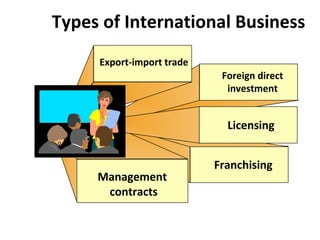
Types of International Business
Export-import trade
Foreign direct
investment
Licensing
Franchising
Management
contracts

Industrial policy

  • 1.
    CENTRAL AND STATE GOVERNMENTINDUSTRIAL POLICIES AND REGULATIONS - INTERNATIONAL BUSINESS
  • 2.
    Telangana State governmentpolicy • The Telangana government has announced a new industrial policy, claiming it to be the world's first to ensure the right to timely clearances through legislation and holding officials responsible for delays. • The policy prescribes a single common application form for all clearances to be accorded by a nodal agency within 15 days for mega projects akin to the Singapore Economic Development Board. •
  • 3.
    • Telangana isrich in mineral resources and the industrial policy has to tap the sector to create job opportunities for youth in districts. • Most Telangana districts are rich in mineral resources like quartz, barytes, manganese, laterite, dolomite etc. • Government is trying to develop refineries and manufacturing industries by utilizing these resources which lead to overall economic development of Telangana and create a huge employment in the state. Reach Us @ www.choice-india.com
  • 4.
  • 5.
  • 6.
    •Important distinction wasmade- Industries to be kept under : -public sector, -private sector and the -joint sector. •Industrial Department and Regulation Act (IDR Act) was enacted in 1951. Industrial policy resolution of 1948
  • 7.
    Objective of IDR1951 Empowering the Government to take necessary steps to regulate the pattern of industrial development through licensing. • This paved the way for the Industrial Policy Resolution of 1956, which was the first comprehensive statement on the strategy for industrial development in India.
  • 8.
    •Shaped by theMahalanobis Model of growth, which suggested that emphasis on heavy industries would lead the economy towards a long term higher growth path. The Industrial Policy Resolution - 1956 classified industries into three categories : Industrial Policy Resolution - 1956 17 industries : exclusively under the domain of the Government. These included inter alia, railways, air transport, arms and ammunition, iron and steel and atomic energy. 12 industries which were envisaged to be progressively State owned but private sector was expected to supplement the efforts of the State. The third category contained all the remaining industries and it was expected that private sector would initiate development of these industries but they would remain open for the State as well.
  • 9.
    Objectives • To accelerateeconomic growth and boost the process of industrialization as a means to achieving a socialistic pattern of society. • Removal of regional disparities through development of regions with low industrial base.
  • 11.
  • 12.
  • 13.
  • 14.
  • 15.
    The spread ofindustrialization to backward areas of the country will be actively promoted through appropriate incentives, institutions and infrastructure investments. Foreign investment and technology collaboration will be welcomed to obtain higher technology, to increase exports and to expand the production base. Abolish monopoly Workers’ participation in management will be promoted
  • 16.
    IndustrIal polIcy 1991 Issues Government recognizes the need for • social and economic justice, to end poverty and unemployment and to build a modern, democratic, socialist, prosperous and forward-looking India • India to grow as part of the world economy and not in isolation  Enhanced support to the small-scale sector so that it flourishes in an environment of economic efficiency and continuous technological up gradation  Emphasis on building our ability to pay for imports through our own foreign exchange earnings
  • 17.
    IndustrIal polIcy 1991 oBJectIVes Inpursuit of the above objectives, Government have decided to take a series of initiatives in respect of the policies relating to the following areas: A. Industrial Licensing. B. Foreign Investment. C. Foreign Technology Agreements. D. Public Sector Policy. E. MRTP Act.
  • 18.
    A.Industrial Licensing:  Industriallicensing abolished for all projects except a short list of 18 industries related to security and strategic concerns, social reasons, hazardous chemicals etc.  Areas where security & strategic concerns predominate, reserved for public sector.  In projects where imported capital goods are required, automatic clearance given.  In locations other than cities of more than 1 million population, no requirement of obtaining industrial approvals from Central Government.  Incentives & investments in infrastructural development, to promote dispersal to rural and backward areas.  Existing units enabled to produce any article without additional investment.
  • 19.
    INDUSTRIAL POLICY 1991 B. ForeignInvestment:  Approval upto 51 percent foreign equity in high priority industries.(Annex-III)  Imports governed by general policy applicable to other domestic units, payment of dividents monitored by RBI to ensure that outflows on account of dividents are balanced by export earnings.  Other foreign equity proposals, not covered above, need prior clearance.  A special Empowered Board- to negotiate with a number of large international firms & get FDIs approved.
  • 20.
    INDUSTRIAL POLICY 1991C. ForeignTechnology Agreements:  Automatic permissions for foreign technology agreements in high priority industries (Annex-III) upto a lumpsum payment of Rs. 1 crore.  For industries other than those in Annex III, automatic permissions if no foreign exchange is required for payment  All other proposals need specific approval  No permission for foreign technicians, foreign testing of indigenously developed technologies.
  • 21.
    INDUSTRIAL POLICY 1991 D. PublicSector Policy:  Portfolio of public sector investments reviewed with a view to focus public sector on strategic, high tech & essential infrastructure.  Chronically sick public enterprises, referred to Board of Industrial & Financial Reconstruction (BIFR).  A part of government’s shareholding in public sector offered to mutual funds, financial institutions, public & workers.  Boards of public sector companies- more professional & powerful.  MOU system- managements would be granted greater autonomy & held accountable.
  • 22.
    INDUSTRIAL POLICY 1991 E. MRTPAct: (Monopolistic Restrictive Trade Practices):  Removal of threshold limits of assets in respect of MRTP Companies & dominant undertakings.  Elimination of need of prior approval of Central Government for establishment, expanding, merger, amalgamation & takeover.  Emphasis on controlling & regulating monopolistic, restrictive & unfair trade practices.  Enabling the MRTP Commission to exercise punitive & compensatory powers.
  • 25.
  • 26.
    EIGHTH FIVE YEARPLAN (1992-97) ExPEcTATION- 7.5 per cent ANNuALLY AcHIEVEd GROwTH RATE FOR INduSTRIES: 1992-93 : 4.2 percent 1993-94 : 6.8 percent 1994-95 : 9.4 percent 1995-96 : 12.3 percent 1996-97 : 7.7 percent AVERAGE ANNuAL GROwTH RATE- 8.1 percent
  • 27.
    NINTH FIVE YEARPLAN (1997-2002) Industrial growth target: 3% p.a. Achieved: 4.5% p.a. In 1997-98 and 1998-99, industriesreported a growth of 3.8 percent. Such slow down wasdueto anumber of structural and cyclical factors.
  • 28.
    TENTH FIVE YEARPLAN (2002-07) Two major reformsthat took placefrom theyear 2002 were: 1)1. RISE IN INTERNATIONAL COMPETITION : Removal of quantitativerestrictionson imports. 2)DECLINE IN ROLE OF PUBLIC SECTOR : Disinvestment processconverted many of the existing public sector enterprisesinto non- governmental enterprises.
  • 29.
    INDUSTRIALGROWTHRATES ANNUALLY : 2002-03: 6.8 percent 2003-04 : 7.9 percent 2004-05 : 8.9 percent 2005-06 : 8.2 percent 2006-07 : 10.6 percent
  • 31.
    ELEVENTH FIVE YEARPLAN (2007- 12) Fluctuating trends 2007-08: 15.5 percent Started declining owing to global economic meltdown 2008-09 : 2.5 percent 2009-10 : 5.3 percent 2010-11 : 8.2 percent 2011-12 : 3.8 percent
  • 34.
    TwELVTH FIVE YEARPLAN (2012-17) CHALLENGES FACING : A.Dumping in Indian markets B.Indian Industry needs to be cost effective along with delivering value. C.Ensuring that investments made in infrastructure projects fructify quickly. D.Growth of labourintensive industries.
  • 35.
    BUSINESS LAWS • Businesslaws are those laws which regulate the conduct of the business.
  • 36.
    BUSINESS LAW CONTENTS 1. Introductionto Business Laws 2. Indian Contract Act, 1872 3. Patent Act, 1970 4. Trade & Merchandise Marks Act, 1958 5. Copyright Act, 1957 6. Consumer (Protection) Act, 1986 7. Foreign Exchange Management Act, 1999 8. Information Technology Act, 2000 9. Environment Protection Act 10.Competition Act, 2002
  • 37.
    What type oforganization to be formed? Options Available
  • 40.
    AIM OF MSME MSMEdevelopment as a tool of state policy aims at : • Generation of Employment • Dispersal of Economy • Utilization of local skills and resources • Meet demands locally
  • 41.
    INTRODUCTION MSME Msme stands formicro, small and medium enterprises. It plays a important role for economic development of our country.  The major advantage of the sector is its employment potential at low capital cost. The labor intensity of the MSME sector is much higher than that of the large enterprises. it satisfies the demand of local customer.
  • 42.
    Brief idea aboutMSME • In India, the enterprises have been classified broadly into two categories 1.Manufacturing 2. services. • Both categories have been further classified into micro, small and medium enterprises based on their investment in plant and machinery or on equipment.
  • 43.
    MSME- INDIAN SCENARIO •12.5 million MSMEs • Employ 30 million People • Contribute approx. 50% of Industrial Production • Contribute approx. 45% of Exports
  • 44.
    Industry coming undermsme  Food Processing(kfc product,berger,pasta)  Agricultural Inputs(Seeds, fertilizer)  Chemicals & Pharmaceuticals(medicines)  Engineering; Electricals, Electronics  Electro-medical equipment  Textiles and Garments  Meat products  Sports goods  Plastics products  Computer Software, etc.
  • 45.
    CATEGORIZATION OF ACTIVITIESUNDER Manufacturing or Services under the MSMED Act 2006- Manufacturing service 1.Printing 1.publishing 2.Medical Equipment 2.hospitals 3.Ayurvedic Product 3. Restaurant 3.Beedi/ Cigarette Manufacturing 4.hotels and other tobacco products. 5.education 4. Generation of electricity 6.training though windmill. 7.software service
  • 46.
    ClassificationClassification Investment ceilingfor plant, MachineryInvestment ceiling for plant, Machinery or Equipmentsor Equipments ManufacturingManufacturing EnterprisesEnterprises ServiceService EnterprisesEnterprises MicroMicro Upto Rs. 25 lakhUpto Rs. 25 lakh Upto R. 10 lakhUpto R. 10 lakh SmallSmall Above Rs. 25 lakh &Above Rs. 25 lakh & upto Rs. 5 croreupto Rs. 5 crore Above Rs. 10Above Rs. 10 lakh & upto Rs. 2lakh & upto Rs. 2 crorecrore MediumMedium Above Rs. 5 Crore anAbove Rs. 5 Crore an upto Rs. 10 croreupto Rs. 10 crore Above Rs. 2Above Rs. 2 crore & upto Rs.crore & upto Rs. 5 crore5 crore
  • 47.
    FISCAL BENEFITS • followingfiscal benefits covering the categories of (a) Micro/Small Enterprises (b) Medium Enterprises & Large Industries (c) Scheduled Caste & Scheduled Tribe Entrepreneurs (d) Women Entrepreneurs
  • 48.
    FISCAL BENEFITS 1  Stamp duty Land cost rebate Lease shed rebate Micro and Small  Enterprises (MSE’s) 100% 25% 25% SC ST 100% 33% 100%   Power cost Investment subsidy  for  fixed capital  Vat/cst Micro Enterprises .75/unit 15% 100% Small .75/unit 15% 50% SC ST 1.00/unit 35% Women sc st 40% Women sc st triball areas 45%
  • 49.
    FISCAL BENEFITS 2  Pavala Vaddi Interest  subsidy upto 12% Quality certification Vat/cst Micro Enterprises Excess of 3% 50% 100% Small Excess of 3% 50% 50%
  • 50.
    ORDER  (1) This Orderis titled as ‘Public Procurement Policy for Micro and Small Enterprises (MSEs) Order, 2012’. (2) It shall come into force with effect from 1stApril 2012. Public Procurement Policy for Micro and Small Enterprises (MSEs) Order Whereas, the Central Government Ministries, Departments and Public Sector Undertakings shall procure minimum of 20 per cent of their annual value of goods or services from Micro and Small Enterprises; s Special provisions for Micro and Small Enterprises owned by Scheduled Castes or Scheduled Tribes. Out of 20 per cent target of annual procurement from Micro─ and Small Enterprises, a sub-target of 20 per Cent (i.e., 4 per cent out of 20 per cent) shall be earmarked for procurement from Micro and Small Enterprises owned by the Scheduled Caste or the Scheduled Tribe entrepreneurs.
  • 51.
    SCHEMES AVAILABLE • ToolRooms & Technical Institutions • Micro & Small Enterprises-Cluster Development Program(MSE-CDP) • Micro Finance Programme • Micro, Small & Medium Enterprises(MSME) Credit Monitoring Cell • Credit Linked Capital Subsidy Scheme under Technology Upgradation (CLCSS) ISO9001/ISO 14001 Certification Reimbursement Scheme • National Manufacturing Competitiveness Programme (NMCP)
  • 52.
    • Interest subsidyunder Pavala Vaddi Scheme on the term loan taken on the fixed capital investment by New Micro and Small Enterprises in excess of 3% per annum subject to a maximum reimbursement of 9% per annum for a period of 5 years from the date of commencement of commercial production. • 50% subsidy on the expenses incurred for quality certification/ patent registration limited to Rs. 2.00 Lakhs for MSE’s.
  • 54.
  • 55.
    International Business • Thebuying and selling of the goods and services across the border. • The national border are crossed by the enterprises to expand their business activities like manufacturing, mining, construction, agriculture, banking, insurance, health, education, transportation, communication and so on.
  • 56.
    Trade • Trade meansexchange of goods and services for the satisfaction of human wants. • When trade is confined to the geographical limits of a country, it is a domestic or national trade. • International or foreign trade refers to the trade between two countries. • Technically, domestic trade and International trade are more or less identical and are based on the same basic principles of trades.
  • 57.
    Differences between Domesticand International Business • Difference in Currencies • Difference in Natural and Geographical Conditions • Mobility of Factors of Production • Sovereign Political Entities – Imposition of tariffs and customs duties on imports and exports; – Quantitative restrictions like quotas; – Exchange control; – Imposition of more local taxes etc. • Different Legal Systems
  • 58.
    Importance of IBE •Helps in expansion: Geographic expansion may be used as a business strategy. Even though companies may expand their business at home. • Helps in managing product life cycle: Every product has to pass through different stages of product life cycle- when the product reaches the last stages of life cycle in present market, it may get proper response at other markets. • Technology advantages: Some companies have outstanding technology advantages through which they enjoy core competency. This technology helps the company in capturing other markets. Cont…
  • 59.
    Importance of IBE •New business opportunities: Business opportunities in overseas markets help in expansion of many companies. They might have reached a saturation point in domestic market. • Proper use of resources: Sometimes industrial resources like labor, minerals etc. are available in a country but are not productively utilized. • Availability of quality products: When markets are open, better quality goods will be available every where. Foreign companies will market latest products at reasonable prices. Good product will be available in the markets. Cont…
  • 60.
    Importance of IBE •Earning foreign exchange: International business helps in earning foreign exchange which may be used for strategic imports. India needs foreign exchange to import crude oil, deface equipment, raw material and machinery. • Helps in mutual growth: Countries depend upon each other for meeting their requirements. India depends on gulf countries for its crude oil supplies. • Investment in infrastructure: International business necessitates proper development of infrastructure.
  • 61.
    Problems in InternationalBusiness • Controlling the market: Multinational try to control the market of the host country. Whenever they enter a new country, the first strategy is to eliminate the competitors either by taking over their business or forcing them out of market by following price reduction policies. • Exhausting natural resources: Multinational corporations set up their production facilities in those countries where natural resources are available in sufficient quantities. • Importance to luxuries: Multinational corporations enter those areas where margin of profits is high. Cont…
  • 62.
    Problems in InternationalBusiness • Trade practices: Since multinational corporations have their head office in one country and the trade practices followed there are adhered to. • Economic development: It is generally felt that the entry of businessmen from outside may help in the economic development of that country . The actual practice in many countries is different. • Shifting of investment: International business is related to profitability of its operations. If a business is getting sufficient profits in a particular country then the investment remain there.
  • 63.
    Need for InternationalBusiness – causes the flow of ideas, services, and capital across the world – offers consumers new choices – permits the acquisition of a wider variety of products – facilitates the mobility of labor, capital, and technology – provides challenging employment opportunities – reallocates resources, makes preferential choices, and shifts activities to a global level
  • 64.
    Intra-firm trade • Intra-firmtrade, i.e. trade within the same company around one-third of world merchandise trade, although aggregate data are only available for a few countries. • Intra-firm trade between high and middle- income countries was directly related to the internationalization of production. • The affiliates in the middle-income countries were mostly instructed to manufacture goods destined for other markets, including the country of the parent company.
  • 65.
    E-commerce • It hasdominant factor in international trade and business, although traditional methods of trade and business continue to be utilized widely. • It can reduce business costs in seeking potential foreign business partners, as well as improve a firm’s visibility in global marketing services, in particular for SMEs. • It enables firms to take more opportunities to expand their business in global markets.
  • 66.
    International Trade Theories •Theory of Mercantilism • Theory of Absolute Cost Advantage • Theory of Comparative Cost Advantage • Heckscher-Ohlin Model Leonief Paradox
  • 67.
    Theory of Mercantilism •This theory is during the sixteenth to the three-fourths of the eighteenth centuries. • It beliefs in nationalism and the welfare of the nation alone, planning and regulation of economic activities for achieving the national goals, curbing imports and promoting exports. • It believed that the power of a nation lied in its wealth, which grew by acquiring gold from abroad.
  • 68.
    Theory of Mercantilism •Mercantilists failed to realize that simultaneous export promotion and import regulation are not possible in all countries, and the mere possession of gold does not enhance the welfare of a people. • Keeping the resources in the form of gold reduces the production of goods and services and, thereby, lowers welfare. • It was rejected by Adam Smith and Ricardo by stressing the importance of individuals, and pointing out that their welfare was the welfare of the nation.
  • 69.
    Theory of AbsoluteCost Advantage • This theory was propounded by Adam Smith (1776), arguing that the countries gain from trading, if they specialise according to their production advantages. • The pre-trade exchange ratio in Country I would be 2A=1B and in Country II IA=2B.
  • 70.
    Theory of AbsoluteCost Advantage • If it is nearer to Country I domestic exchange ratio then trade would be more beneficial to Country II and vice versa. • Assuming the international exchange ratio is established IA=IB. • The terms of trade between the trading partners would depend upon their economic strength and the bargaining power.
  • 71.
    Theory of ComparativeCost Advantage • Ricardo (1817), though adhering to the absolute cost advantage doctrine of Adam Smith, pointed out that cost advantage to both the trade partners was not a necessary condition for trade to occur. • According to Ricardo, so long as the other country is not equally less productive in all lines of production, measurable in terms of opportunity cost of each commodity in the two countries, it will still be mutually gainful for them if they enter into trade.
  • 72.
    Theory of ComparativeCost Advantage • In the example given, the opportunity cost of one unit of A in country I is 0.89 unit of good B and in country II it is 1.2 unit of good B. On the other hand, the opportunity cost of one unit of good B in country I is 1.125 units of good A and 0.83 unit of good A, in country II.
  • 73.
    Types of InternationalBusiness Export-import trade Foreign direct investment Licensing Franchising Management contracts