Introduction
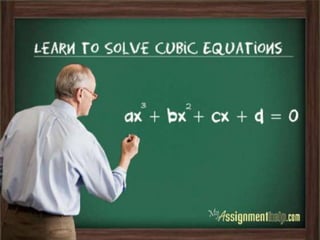
Learn to Solve Cubic Equations
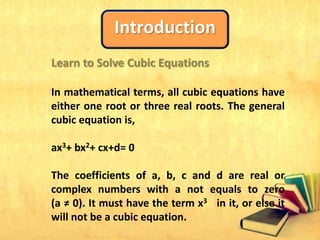
In mathematical terms, all cubic equations have
either one root or three real roots. The general
cubic equation is,
ax3+ bx2+ cx+d= 0
The coefficients of a, b, c and d are real or
complex numbers with a not equals to zero
(a ≠ 0). It must have the term x3 in it, or else it
will not be a cubic equation.
Introduction
The coefficients of a, b, c and d are real or
complex numbers with a not equals to zero
(a ≠ 0). It must have the term x3 in it, or else it
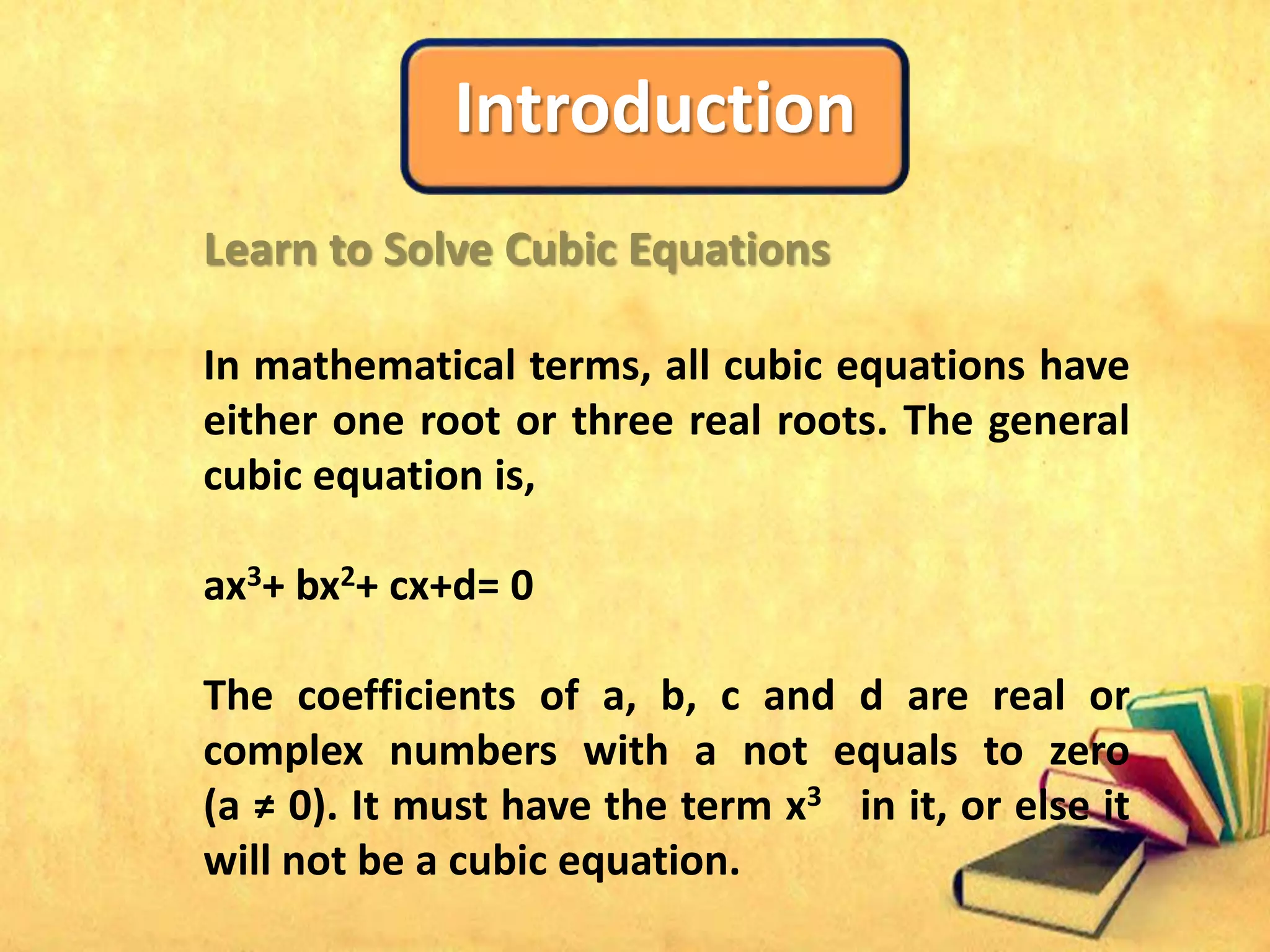
will not be a cubic equation. But any or all of b, c
and d can be zero.
The examples of cubic equations are,
No 1, x3+ 3a3+ 3 a2 + a3– b=0
No 2, 4x3+ 57=0
No 3, x3+ 9x=0
Strategy to Solve Cubic
Equation
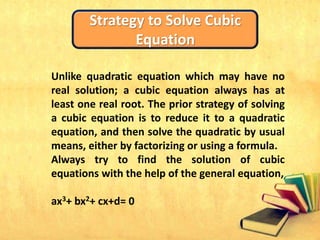
Unlike quadratic equation which may have no
real solution; a cubic equation always has at
least one real root. The prior strategy of solving
a cubic equation is to reduce it to a quadratic
equation, and then solve the quadratic by usual
means, either by factorizing or using a formula.
Always try to find the solution of cubic
equations with the help of the general equation,
ax3+ bx2+ cx+d= 0
Strategy to Solve Cubic
Equation
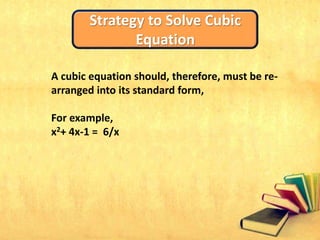
A cubic equation should, therefore, must be re-
arranged into its standard form,
For example,
x2+ 4x-1 = 6/x
Strategy to Solve Cubic
Equation
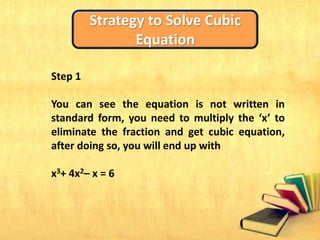
Step 1
You can see the equation is not written in
standard form, you need to multiply the ‘x’ to
eliminate the fraction and get cubic equation,
after doing so, you will end up with
x3+ 4x2– x = 6
Strategy to Solve Cubic
Equation
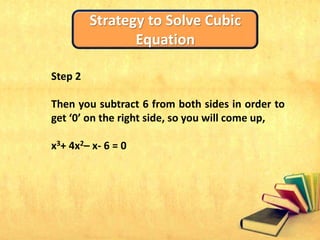
Step 2
Then you subtract 6 from both sides in order to
get ‘0’ on the right side, so you will come up,
x3+ 4x2– x- 6 = 0
Solving Cubic Equations with
the help of Factor Theorem
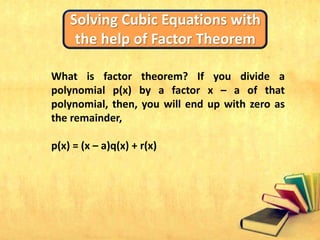
What is factor theorem? If you divide a
polynomial p(x) by a factor x – a of that
polynomial, then, you will end up with zero as
the remainder,
p(x) = (x – a)q(x) + r(x)
Solving Cubic Equations with
the help of Factor Theorem
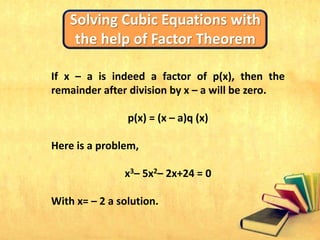
If x – a is indeed a factor of p(x), then the
remainder after division by x – a will be zero.
p(x) = (x – a)q (x)
Here is a problem,
x3– 5x2– 2x+24 = 0
With x= – 2 a solution.
Solving Cubic Equations with
the help of Factor Theorem
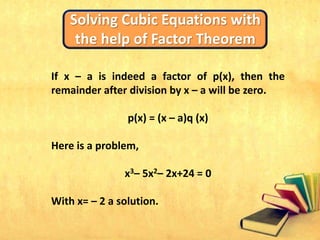
If x – a is indeed a factor of p(x), then the
remainder after division by x – a will be zero.
p(x) = (x – a)q (x)
Here is a problem,
x3– 5x2– 2x+24 = 0
With x= – 2 a solution.
Solving Cubic Equations with
the help of Factor Theorem
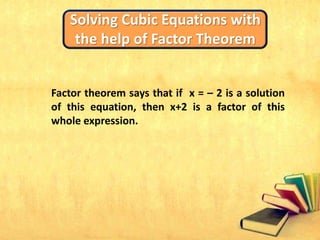
Factor theorem says that if x = – 2 is a solution
of this equation, then x+2 is a factor of this
whole expression.
Solving Cubic Equations with
the help of Factor Theorem
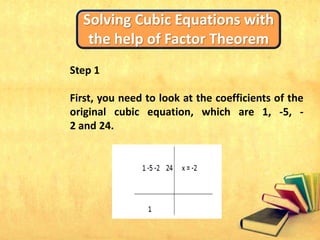
Step 1
First, you need to look at the coefficients of the
original cubic equation, which are 1, -5, -
2 and 24.
Solving Cubic Equations with
the help of Factor Theorem
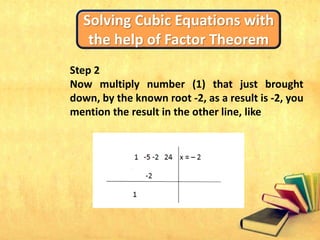
Step 2
Now multiply number (1) that just brought
down, by the known root -2, as a result is -2, you
mention the result in the other line, like
Solving Cubic Equations with
the help of Factor Theorem
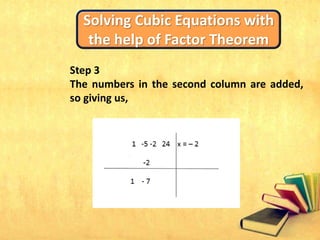
Step 3
The numbers in the second column are added,
so giving us,
Solving Cubic Equations with
the help of Factor Theorem
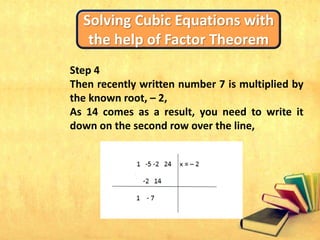
Step 4
Then recently written number 7 is multiplied by
the known root, – 2,
As 14 comes as a result, you need to write it
down on the second row over the line,
Solving Cubic Equations with
the help of Factor Theorem
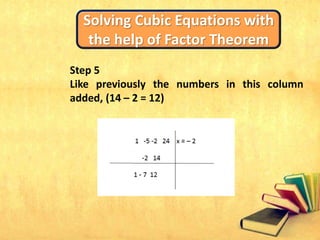
Step 5
Like previously the numbers in this column
added, (14 – 2 = 12)
Solving Cubic Equations with
the help of Factor Theorem
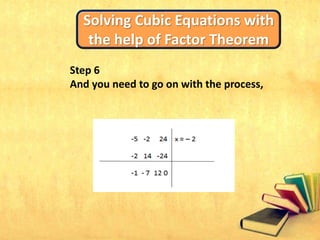
Step 6
And you need to go on with the process,
Solving Cubic Equations with
the help of Factor Theorem
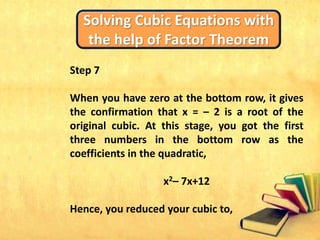
Step 7
When you have zero at the bottom row, it gives
the confirmation that x = – 2 is a root of the
original cubic. At this stage, you got the first
three numbers in the bottom row as the
coefficients in the quadratic,
x2– 7x+12
Hence, you reduced your cubic to,
Solving Cubic Equations with
the help of Factor Theorem
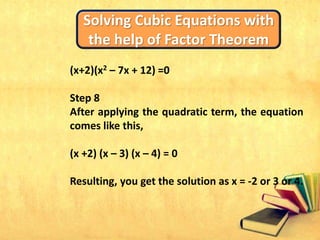
(x+2)(x2 – 7x + 12) =0
Step 8
After applying the quadratic term, the equation
comes like this,
(x +2) (x – 3) (x – 4) = 0
Resulting, you get the solution as x = -2 or 3 or 4.
Solving Cubic Equations with
the help of Factor Theorem
Another Example:
The equation is,
x3– 7x-6=0
Step 1 You can simply try x = – 1, after putting
the value of x, you will get,
(-1)3 – 7(-1) -6
Solving Cubic Equations with
the help of Factor Theorem
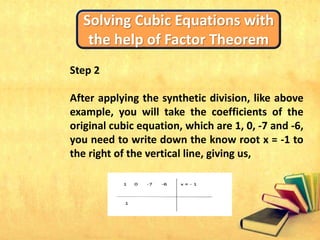
Step 2
After applying the synthetic division, like above
example, you will take the coefficients of the
original cubic equation, which are 1, 0, -7 and -6,
you need to write down the know root x = -1 to
the right of the vertical line, giving us,
Solving Cubic Equations with
the help of Factor Theorem
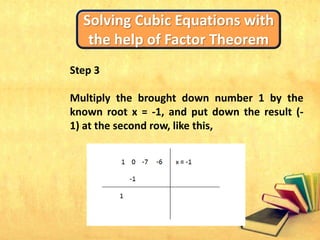
Step 3
Multiply the brought down number 1 by the
known root x = -1, and put down the result (-
1) at the second row, like this,
Solving Cubic Equations with
the help of Factor Theorem
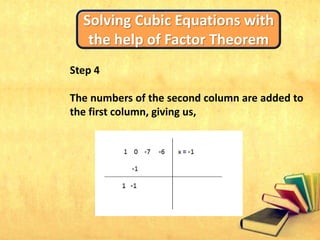
Step 4
The numbers of the second column are added to
the first column, giving us,
Solving Cubic Equations with
the help of Factor Theorem
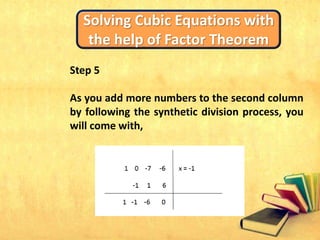
Step 5
As you add more numbers to the second column
by following the synthetic division process, you
will come with,
Solving Cubic Equations with
the help of Factor Theorem
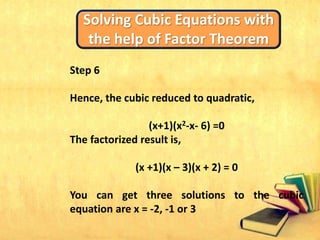
Step 6
Hence, the cubic reduced to quadratic,
(x+1)(x2-x- 6) =0
The factorized result is,
(x +1)(x – 3)(x + 2) = 0
You can get three solutions to the cubic
equation are x = -2, -1 or 3
Are you looking for Assignment
Help with 100% accuracy,
My assignment help .com have
3000+ Professional Writers are
here to help with your
Assignment Writing & also
provide 24×7 Online Support.
How MyAssignmenthelp.com can help students
in maths assignment?
MyAssignmenthelp.com has carefully evaluated and
assembled a highly-skilled team of in-house experts
who are capable of giving the finest maths homework
help you deserve. Your paper will be written by
experienced writers in a professional
manner. Assignment experts make sure that there are
no traces of plagiarism in your content, they only deliver
genuine work within the given time limit. If you think
sample assignments can help you in your assignment,
MyAssignmenthelp.com offers free samples. Our
customer support agents can guide you on how to get
free assignments quotes and place your orders.
Australia
+61-3-4000-0033
Dubai
+971-8000320360
United Kingdom
+44-121-285-4112
Mail Id
contact@myassignmenthelp.com
Contact Us

Solving cubic equations with the help of factor theorem

  • 1.
    Introduction Learn to SolveCubic Equations In mathematical terms, all cubic equations have either one root or three real roots. The general cubic equation is, ax3+ bx2+ cx+d= 0 The coefficients of a, b, c and d are real or complex numbers with a not equals to zero (a ≠ 0). It must have the term x3 in it, or else it will not be a cubic equation.
  • 2.
    Introduction The coefficients ofa, b, c and d are real or complex numbers with a not equals to zero (a ≠ 0). It must have the term x3 in it, or else it will not be a cubic equation. But any or all of b, c and d can be zero. The examples of cubic equations are, No 1, x3+ 3a3+ 3 a2 + a3– b=0 No 2, 4x3+ 57=0 No 3, x3+ 9x=0
  • 4.
    Strategy to SolveCubic Equation Unlike quadratic equation which may have no real solution; a cubic equation always has at least one real root. The prior strategy of solving a cubic equation is to reduce it to a quadratic equation, and then solve the quadratic by usual means, either by factorizing or using a formula. Always try to find the solution of cubic equations with the help of the general equation, ax3+ bx2+ cx+d= 0
  • 5.
    Strategy to SolveCubic Equation A cubic equation should, therefore, must be re- arranged into its standard form, For example, x2+ 4x-1 = 6/x
  • 6.
    Strategy to SolveCubic Equation Step 1 You can see the equation is not written in standard form, you need to multiply the ‘x’ to eliminate the fraction and get cubic equation, after doing so, you will end up with x3+ 4x2– x = 6
  • 7.
    Strategy to SolveCubic Equation Step 2 Then you subtract 6 from both sides in order to get ‘0’ on the right side, so you will come up, x3+ 4x2– x- 6 = 0
  • 8.
    Solving Cubic Equationswith the help of Factor Theorem What is factor theorem? If you divide a polynomial p(x) by a factor x – a of that polynomial, then, you will end up with zero as the remainder, p(x) = (x – a)q(x) + r(x)
  • 9.
    Solving Cubic Equationswith the help of Factor Theorem If x – a is indeed a factor of p(x), then the remainder after division by x – a will be zero. p(x) = (x – a)q (x) Here is a problem, x3– 5x2– 2x+24 = 0 With x= – 2 a solution.
  • 10.
    Solving Cubic Equationswith the help of Factor Theorem If x – a is indeed a factor of p(x), then the remainder after division by x – a will be zero. p(x) = (x – a)q (x) Here is a problem, x3– 5x2– 2x+24 = 0 With x= – 2 a solution.
  • 11.
    Solving Cubic Equationswith the help of Factor Theorem Factor theorem says that if x = – 2 is a solution of this equation, then x+2 is a factor of this whole expression.
  • 12.
    Solving Cubic Equationswith the help of Factor Theorem Step 1 First, you need to look at the coefficients of the original cubic equation, which are 1, -5, - 2 and 24.
  • 13.
    Solving Cubic Equationswith the help of Factor Theorem Step 2 Now multiply number (1) that just brought down, by the known root -2, as a result is -2, you mention the result in the other line, like
  • 14.
    Solving Cubic Equationswith the help of Factor Theorem Step 3 The numbers in the second column are added, so giving us,
  • 15.
    Solving Cubic Equationswith the help of Factor Theorem Step 4 Then recently written number 7 is multiplied by the known root, – 2, As 14 comes as a result, you need to write it down on the second row over the line,
  • 16.
    Solving Cubic Equationswith the help of Factor Theorem Step 5 Like previously the numbers in this column added, (14 – 2 = 12)
  • 17.
    Solving Cubic Equationswith the help of Factor Theorem Step 6 And you need to go on with the process,
  • 18.
    Solving Cubic Equationswith the help of Factor Theorem Step 7 When you have zero at the bottom row, it gives the confirmation that x = – 2 is a root of the original cubic. At this stage, you got the first three numbers in the bottom row as the coefficients in the quadratic, x2– 7x+12 Hence, you reduced your cubic to,
  • 19.
    Solving Cubic Equationswith the help of Factor Theorem (x+2)(x2 – 7x + 12) =0 Step 8 After applying the quadratic term, the equation comes like this, (x +2) (x – 3) (x – 4) = 0 Resulting, you get the solution as x = -2 or 3 or 4.
  • 20.
    Solving Cubic Equationswith the help of Factor Theorem Another Example: The equation is, x3– 7x-6=0 Step 1 You can simply try x = – 1, after putting the value of x, you will get, (-1)3 – 7(-1) -6
  • 21.
    Solving Cubic Equationswith the help of Factor Theorem Step 2 After applying the synthetic division, like above example, you will take the coefficients of the original cubic equation, which are 1, 0, -7 and -6, you need to write down the know root x = -1 to the right of the vertical line, giving us,
  • 22.
    Solving Cubic Equationswith the help of Factor Theorem Step 3 Multiply the brought down number 1 by the known root x = -1, and put down the result (- 1) at the second row, like this,
  • 23.
    Solving Cubic Equationswith the help of Factor Theorem Step 4 The numbers of the second column are added to the first column, giving us,
  • 24.
    Solving Cubic Equationswith the help of Factor Theorem Step 5 As you add more numbers to the second column by following the synthetic division process, you will come with,
  • 25.
    Solving Cubic Equationswith the help of Factor Theorem Step 6 Hence, the cubic reduced to quadratic, (x+1)(x2-x- 6) =0 The factorized result is, (x +1)(x – 3)(x + 2) = 0 You can get three solutions to the cubic equation are x = -2, -1 or 3
  • 26.
    Are you lookingfor Assignment Help with 100% accuracy, My assignment help .com have 3000+ Professional Writers are here to help with your Assignment Writing & also provide 24×7 Online Support.
  • 27.
    How MyAssignmenthelp.com canhelp students in maths assignment? MyAssignmenthelp.com has carefully evaluated and assembled a highly-skilled team of in-house experts who are capable of giving the finest maths homework help you deserve. Your paper will be written by experienced writers in a professional manner. Assignment experts make sure that there are no traces of plagiarism in your content, they only deliver genuine work within the given time limit. If you think sample assignments can help you in your assignment, MyAssignmenthelp.com offers free samples. Our customer support agents can guide you on how to get free assignments quotes and place your orders.
  • 28.