SOLUTIONS TO THE ALGEBRA OF SUMMATION NOTATION
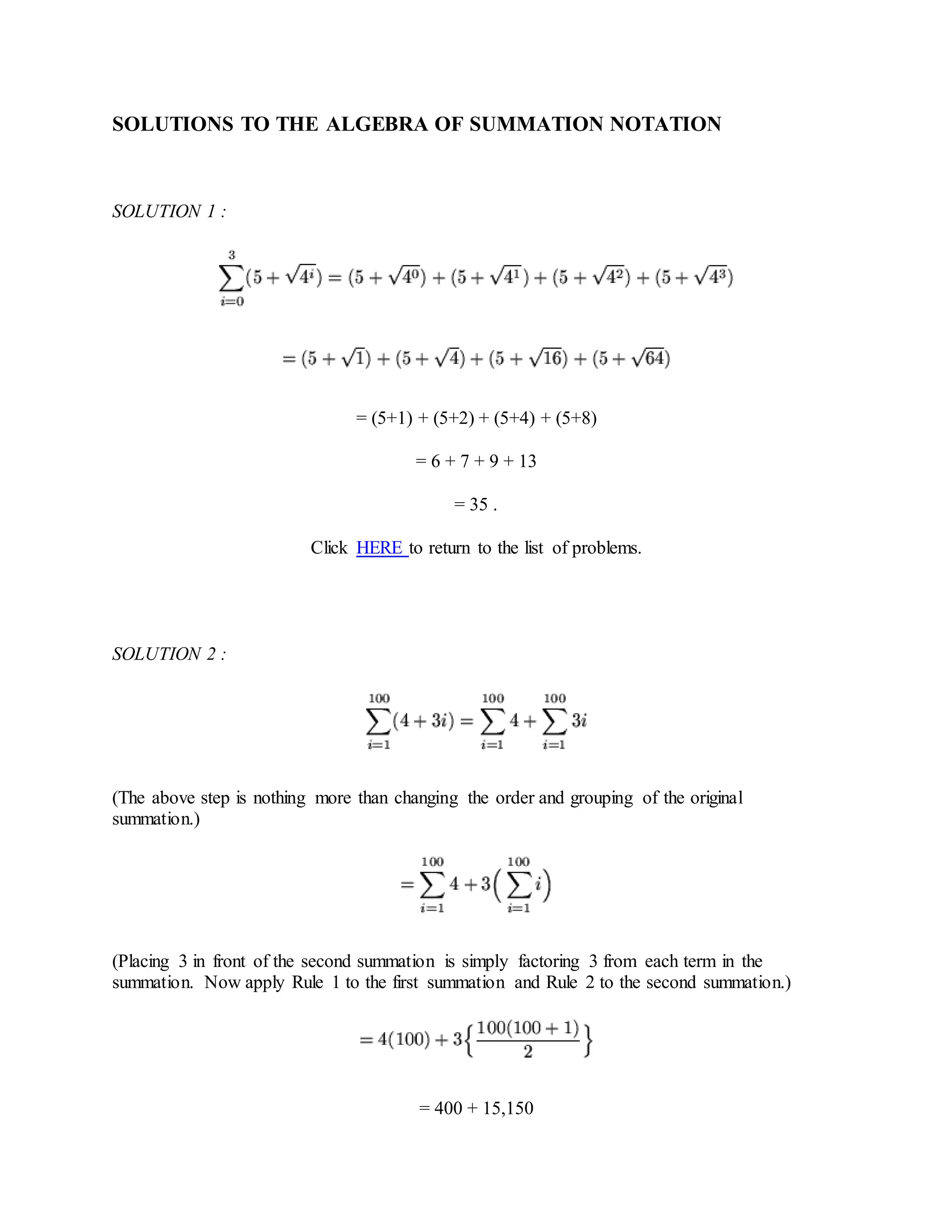
SOLUTION 1 :
= (5+1) + (5+2) + (5+4) + (5+8)
= 6 + 7 + 9 + 13
= 35 .
Click HERE to return to the list of problems.
SOLUTION 2 :
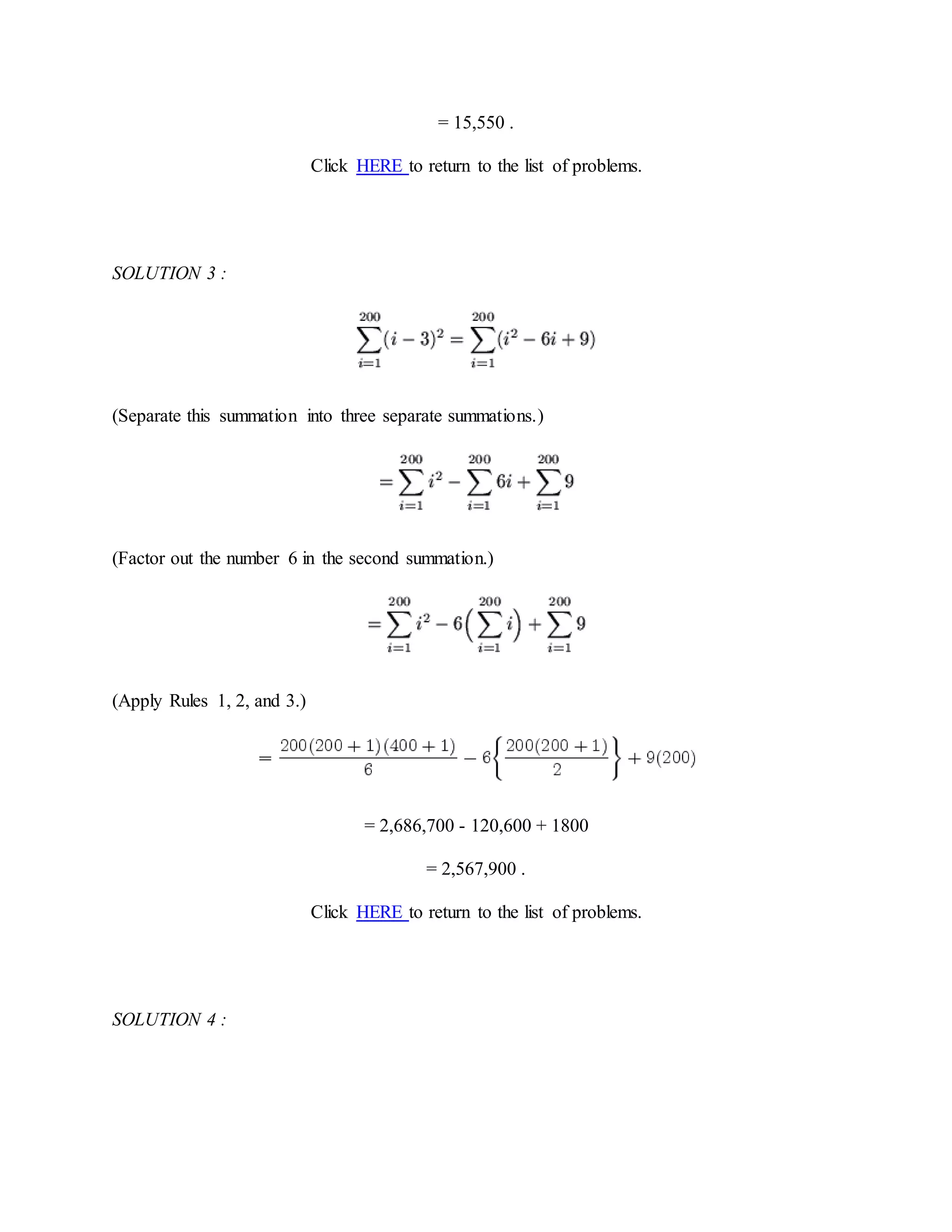
(The above step is nothing more than changing the order and grouping of the original
summation.)
(Placing 3 in front of the second summation is simply factoring 3 from each term in the
summation. Now apply Rule 1 to the first summation and Rule 2 to the second summation.)
= 400 + 15,150
= 15,550 .
Click HERE to return to the list of problems.
SOLUTION 3 :
(Separate this summation into three separate summations.)
(Factor out the number 6 in the second summation.)
(Apply Rules 1, 2, and 3.)
= 2,686,700 - 120,600 + 1800
= 2,567,900 .
Click HERE to return to the list of problems.
SOLUTION 4 :
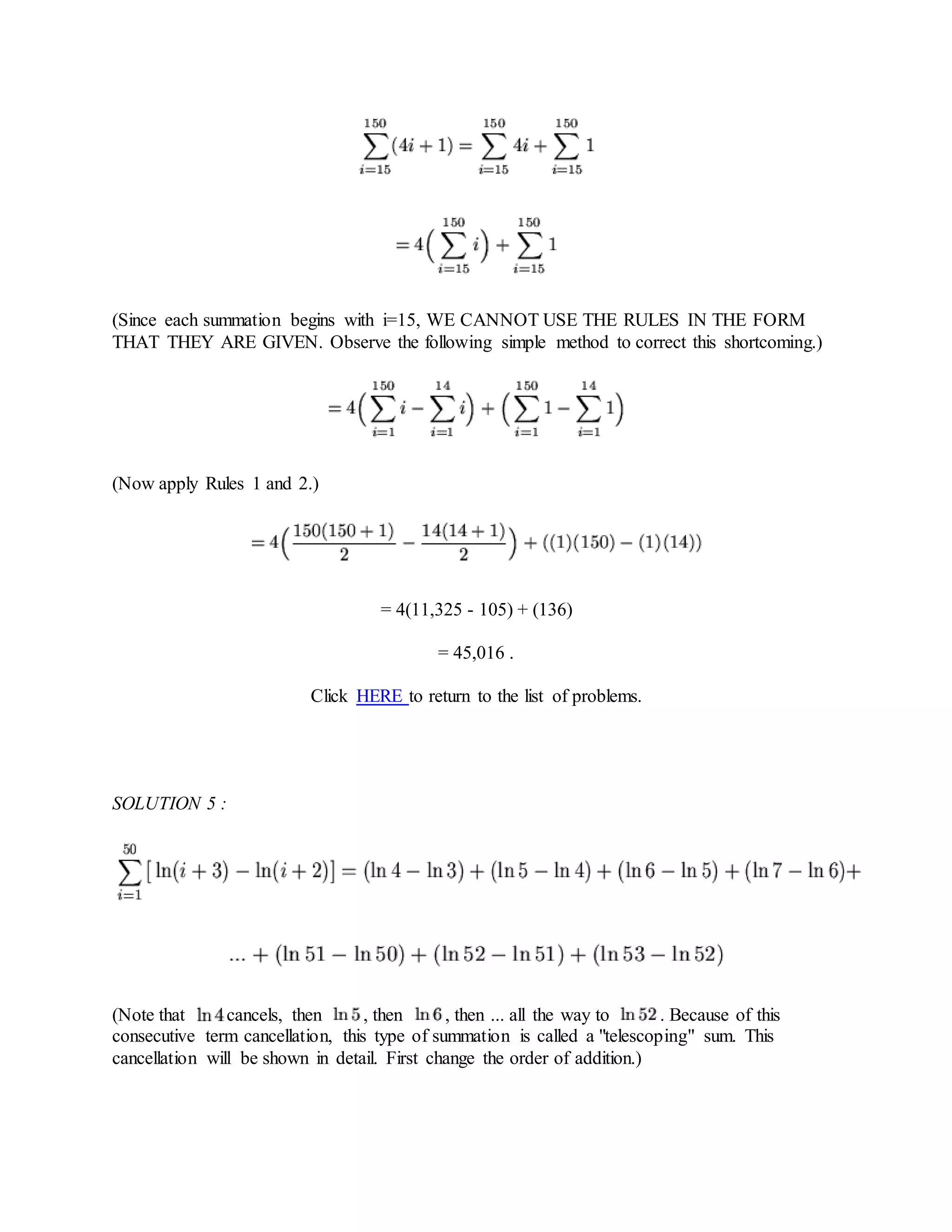
(Since each summation begins with i=15, WE CANNOT USE THE RULES IN THE FORM
THAT THEY ARE GIVEN. Observe the following simple method to correct this shortcoming.)
(Now apply Rules 1 and 2.)
= 4(11,325 - 105) + (136)
= 45,016 .
Click HERE to return to the list of problems.
SOLUTION 5 :
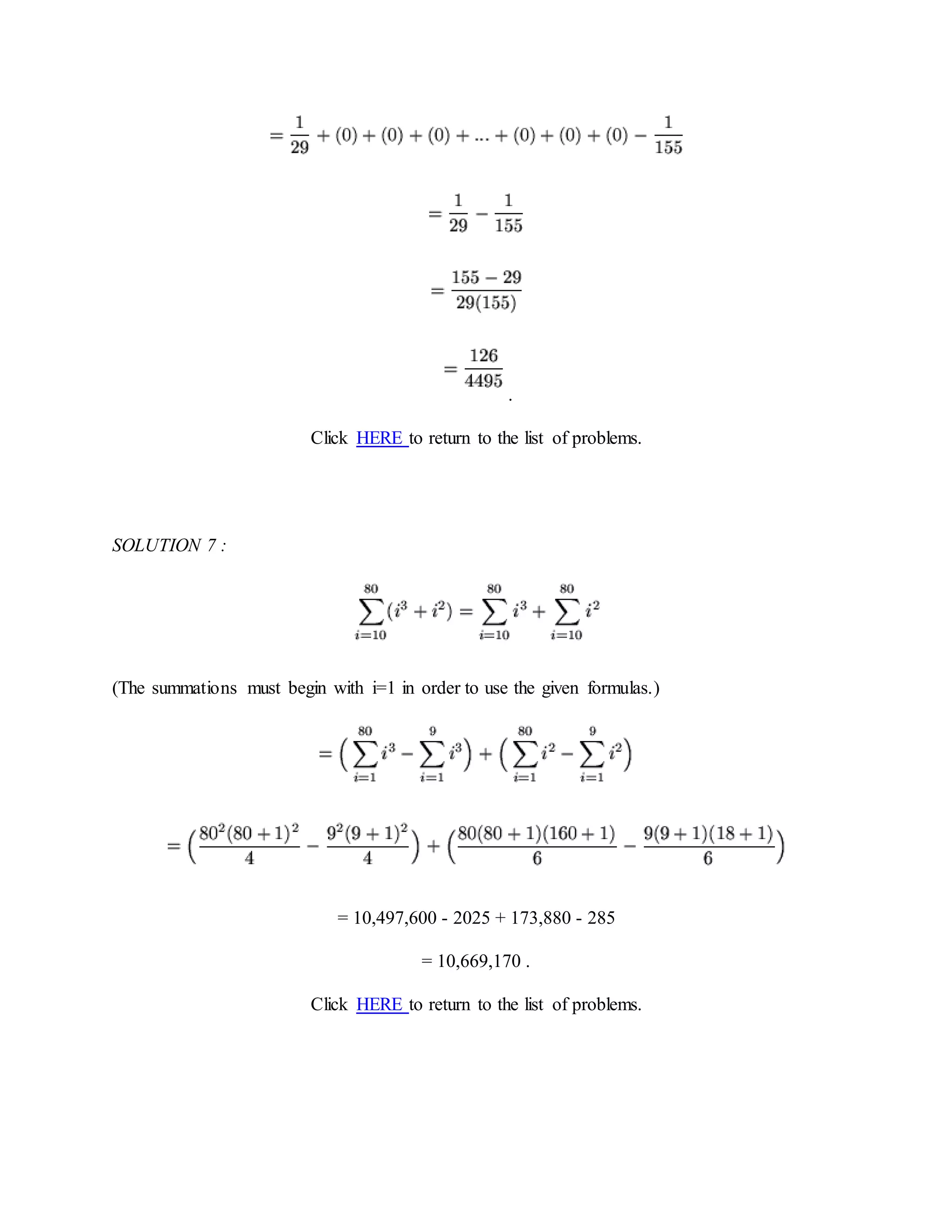
(Note that cancels, then , then , then ... all the way to . Because of this
consecutive term cancellation, this type of summation is called a "telescoping" sum. This
cancellation will be shown in detail. First change the order of addition.)
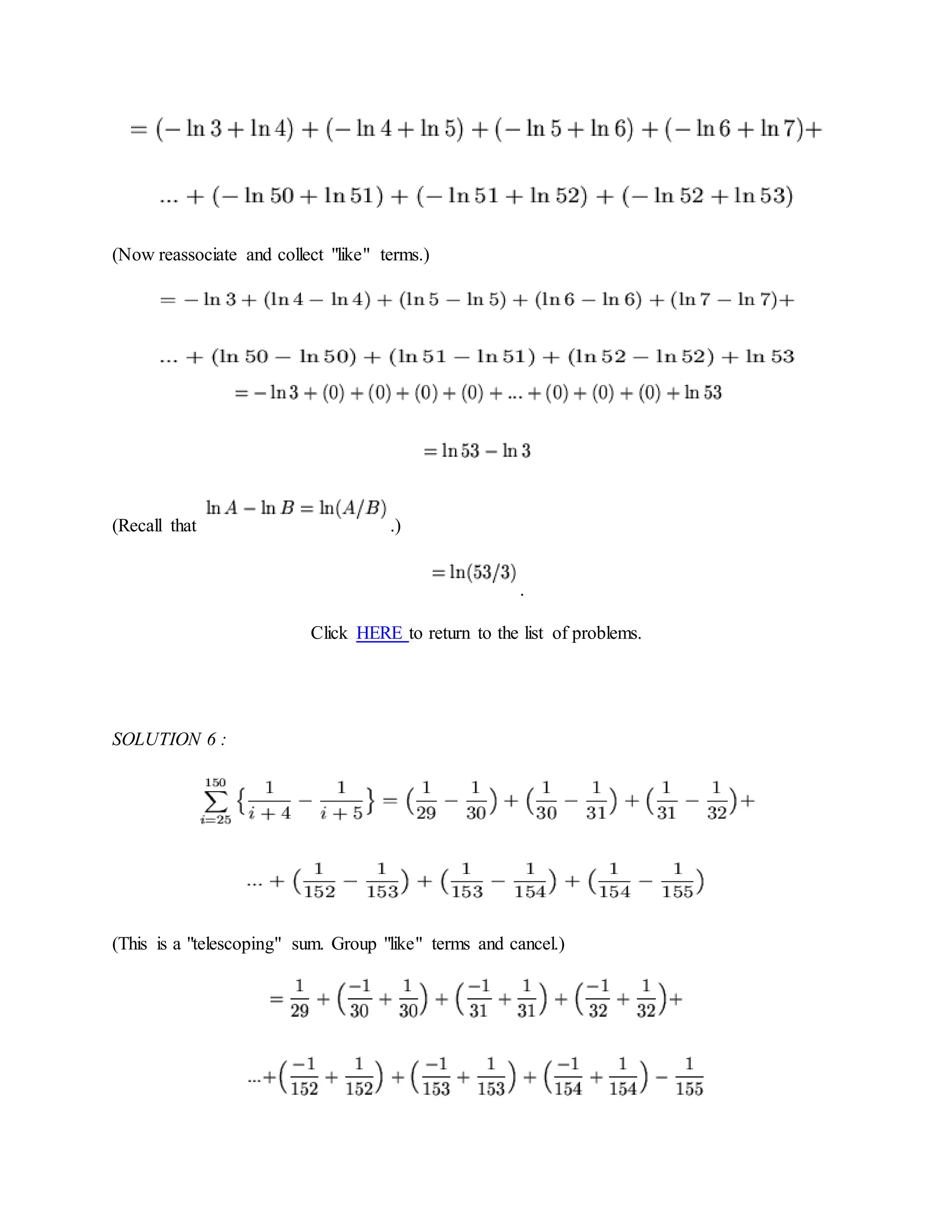
(Now reassociate and collect "like" terms.)
(Recall that .)
.
Click HERE to return to the list of problems.
SOLUTION 6 :
(This is a "telescoping" sum. Group "like" terms and cancel.)
.
Click HERE to return to the list of problems.
SOLUTION 7 :
(The summations must begin with i=1 in order to use the given formulas.)
= 10,497,600 - 2025 + 173,880 - 285
= 10,669,170 .
Click HERE to return to the list of problems.
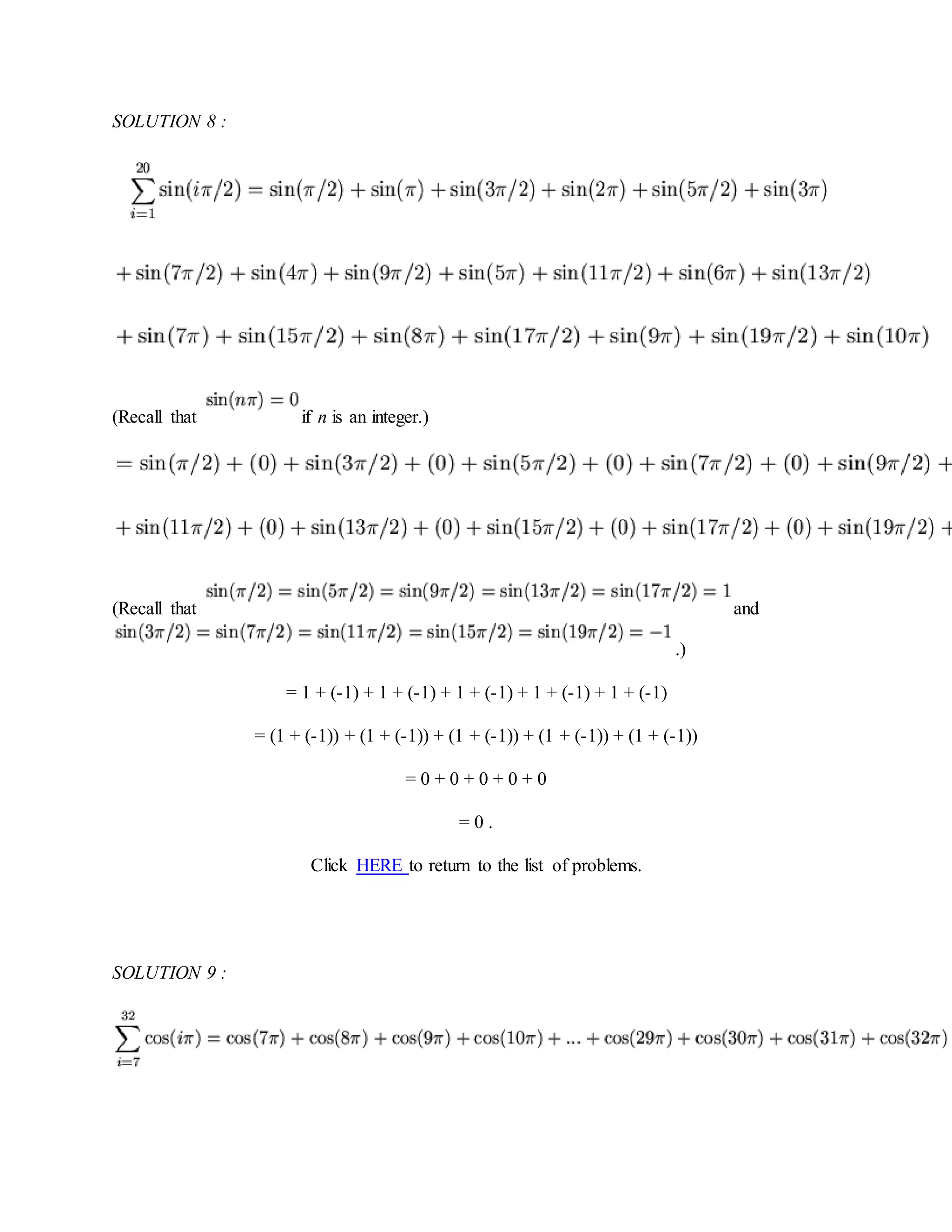
SOLUTION 8 :
(Recall that if n is an integer.)
(Recall that and
.)
= 1 + (-1) + 1 + (-1) + 1 + (-1) + 1 + (-1) + 1 + (-1)
= (1 + (-1)) + (1 + (-1)) + (1 + (-1)) + (1 + (-1)) + (1 + (-1))
= 0 + 0 + 0 + 0 + 0
= 0 .
Click HERE to return to the list of problems.
SOLUTION 9 :
= ( (-1) + 1 ) + ( (-1) + 1 ) + ... + ( (-1) + 1 ) + ( (-1) + 1 )
= 0 + 0 + ... + 0 + 0
= 0 .
Click HERE to return to the list of problems.
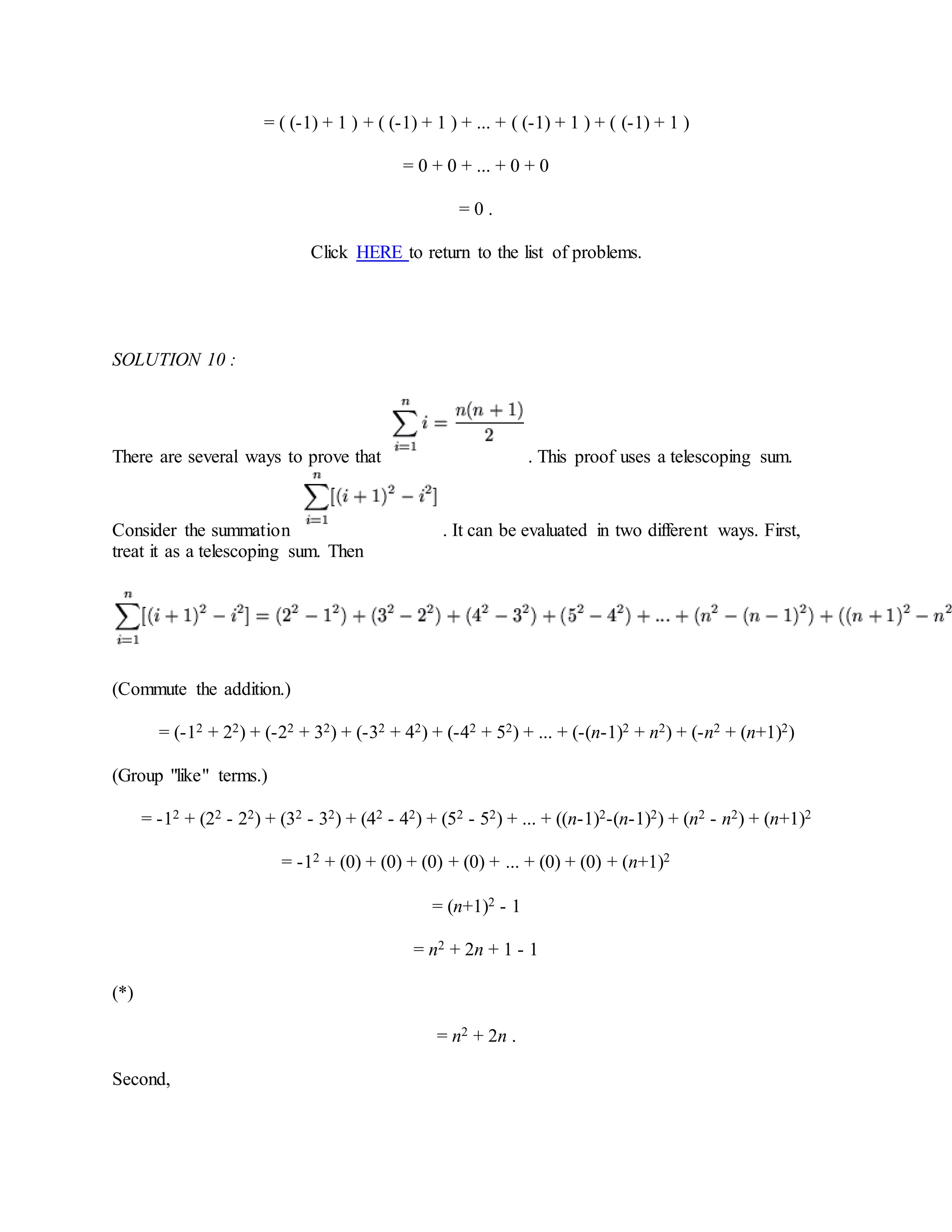
SOLUTION 10 :
There are several ways to prove that . This proof uses a telescoping sum.
Consider the summation . It can be evaluated in two different ways. First,
treat it as a telescoping sum. Then
(Commute the addition.)
= (-12 + 22) + (-22 + 32) + (-32 + 42) + (-42 + 52) + ... + (-(n-1)2 + n2) + (-n2 + (n+1)2)
(Group "like" terms.)
= -12 + (22 - 22) + (32 - 32) + (42 - 42) + (52 - 52) + ... + ((n-1)2-(n-1)2) + (n2 - n2) + (n+1)2
= -12 + (0) + (0) + (0) + (0) + ... + (0) + (0) + (n+1)2
= (n+1)2 - 1
= n2 + 2n + 1 - 1
(*)
= n2 + 2n .
Second,
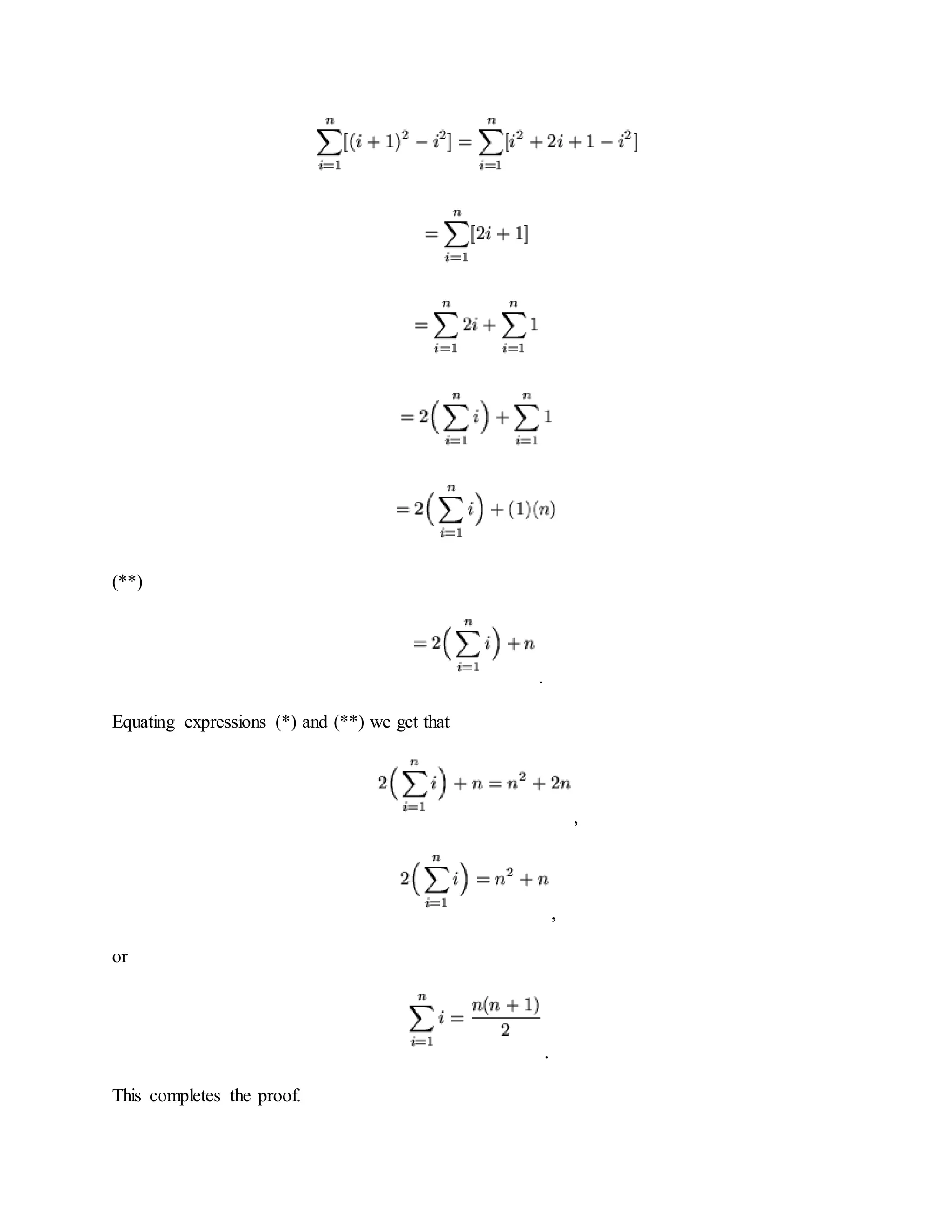
(**)
.
Equating expressions (*) and (**) we get that
,
,
or
.
This completes the proof.
Click HERE to return to the list of problems.
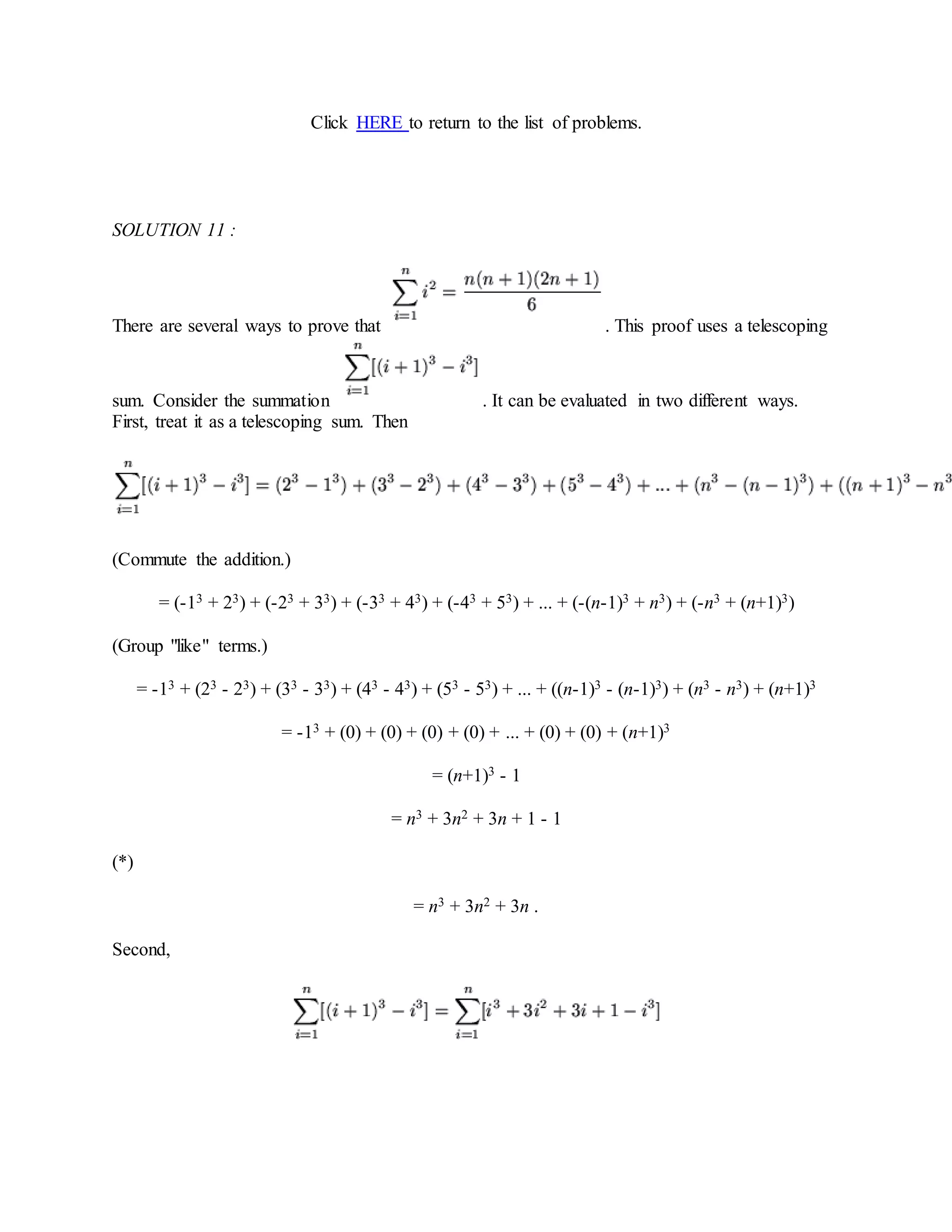
SOLUTION 11 :
There are several ways to prove that . This proof uses a telescoping
sum. Consider the summation . It can be evaluated in two different ways.
First, treat it as a telescoping sum. Then
(Commute the addition.)
= (-13 + 23) + (-23 + 33) + (-33 + 43) + (-43 + 53) + ... + (-(n-1)3 + n3) + (-n3 + (n+1)3)
(Group "like" terms.)
= -13 + (23 - 23) + (33 - 33) + (43 - 43) + (53 - 53) + ... + ((n-1)3 - (n-1)3) + (n3 - n3) + (n+1)3
= -13 + (0) + (0) + (0) + (0) + ... + (0) + (0) + (n+1)3
= (n+1)3 - 1
= n3 + 3n2 + 3n + 1 - 1
(*)
= n3 + 3n2 + 3n .
Second,
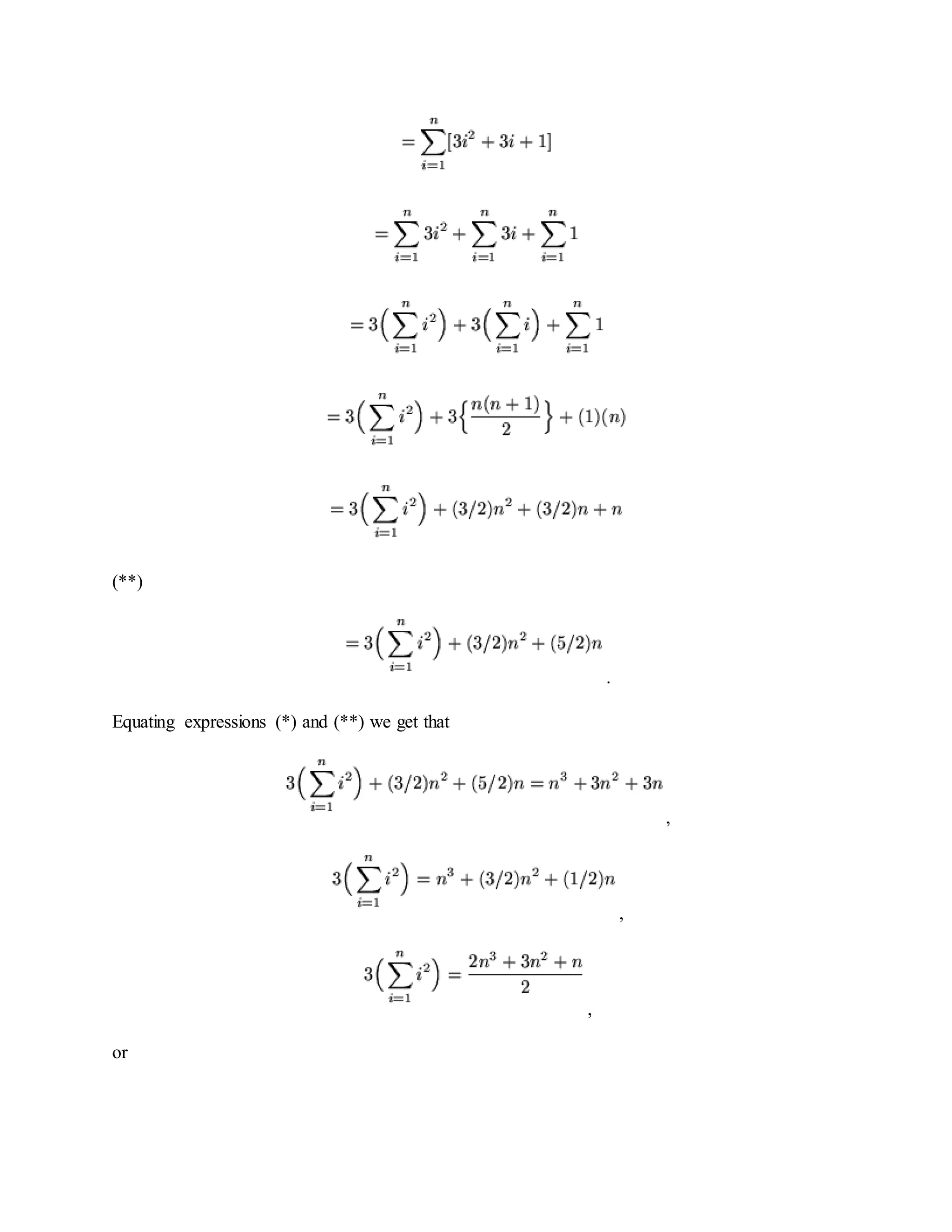
(**)
.
Equating expressions (*) and (**) we get that
,
,
,
or
.
This completes the proof.
Click HERE to return to the list of problems.
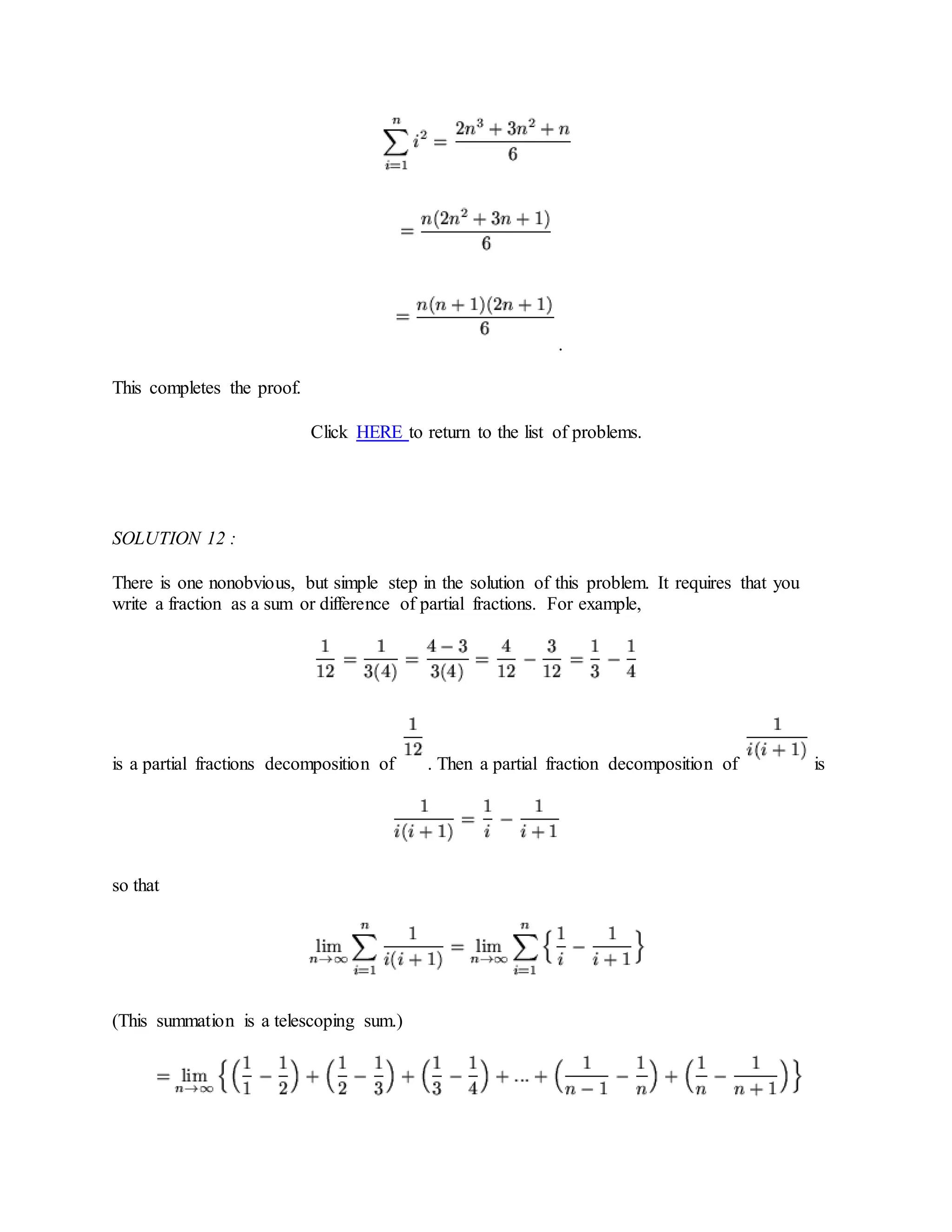
SOLUTION 12 :
There is one nonobvious, but simple step in the solution of this problem. It requires that you
write a fraction as a sum or difference of partial fractions. For example,
is a partial fractions decomposition of . Then a partial fraction decomposition of is
so that
(This summation is a telescoping sum.)
(Now evaluate the limit.)
= 1 - 0
= 1 .
Click HERE to return to the list of problems.
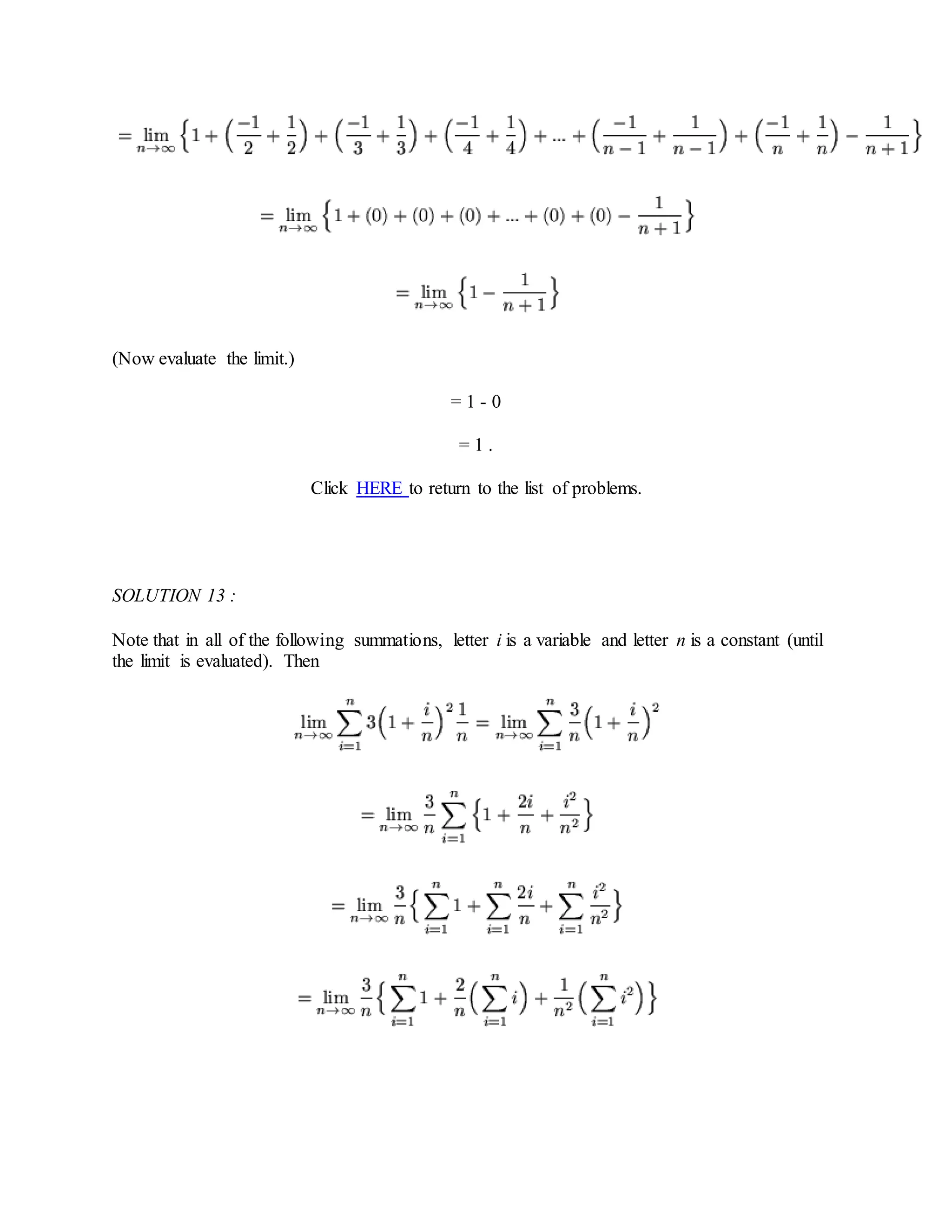
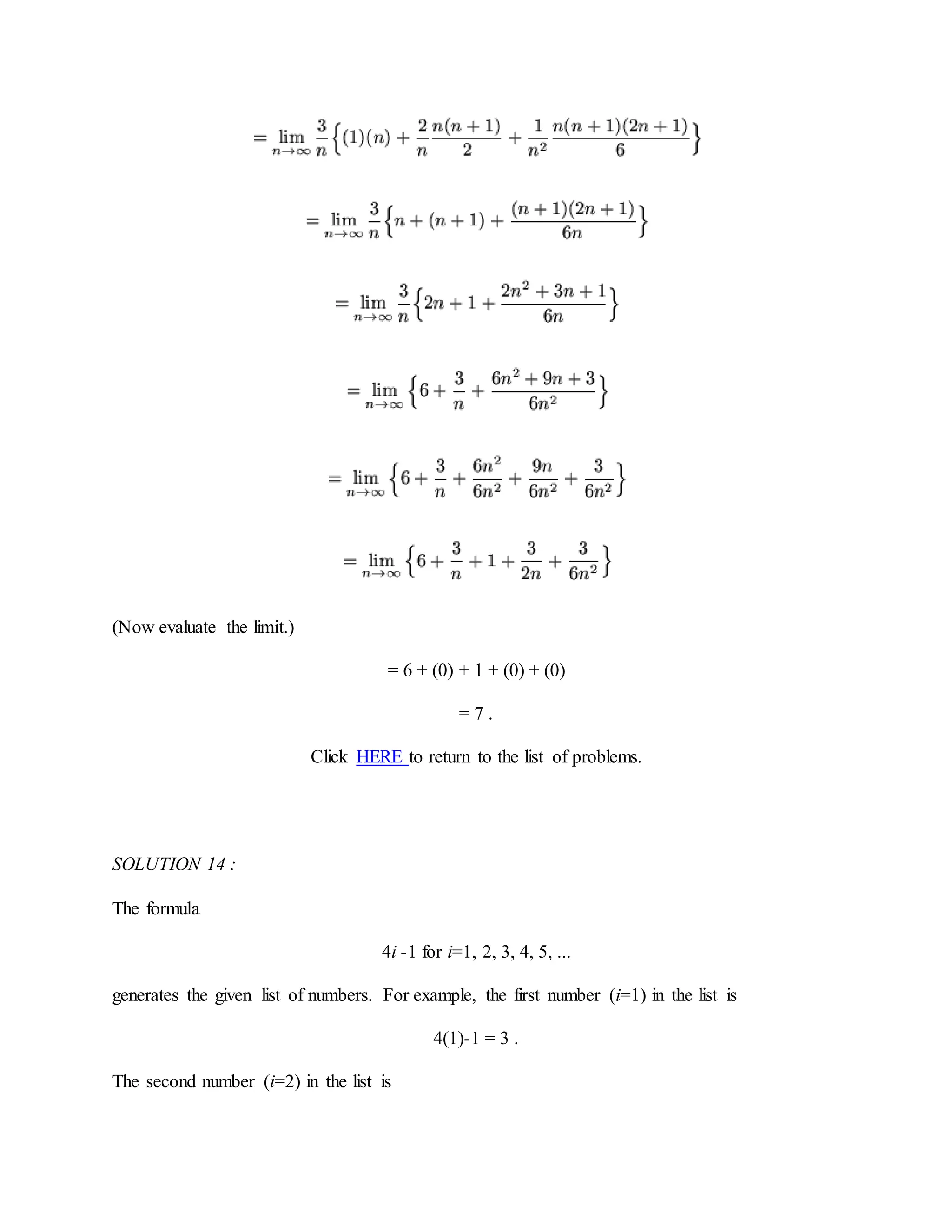
SOLUTION 13 :
Note that in all of the following summations, letter i is a variable and letter n is a constant (until
the limit is evaluated). Then
(Now evaluate the limit.)
= 6 + (0) + 1 + (0) + (0)
= 7 .
Click HERE to return to the list of problems.
SOLUTION 14 :
The formula
4i -1 for i=1, 2, 3, 4, 5, ...
generates the given list of numbers. For example, the first number (i=1) in the list is
4(1)-1 = 3 .
The second number (i=2) in the list is
4(2)-1 = 7 .
The 30th number (i=30) in the list is
4(30)-1 = 119 .
The 120th number (i=12) in the list is
4(120)-1 = 479 .
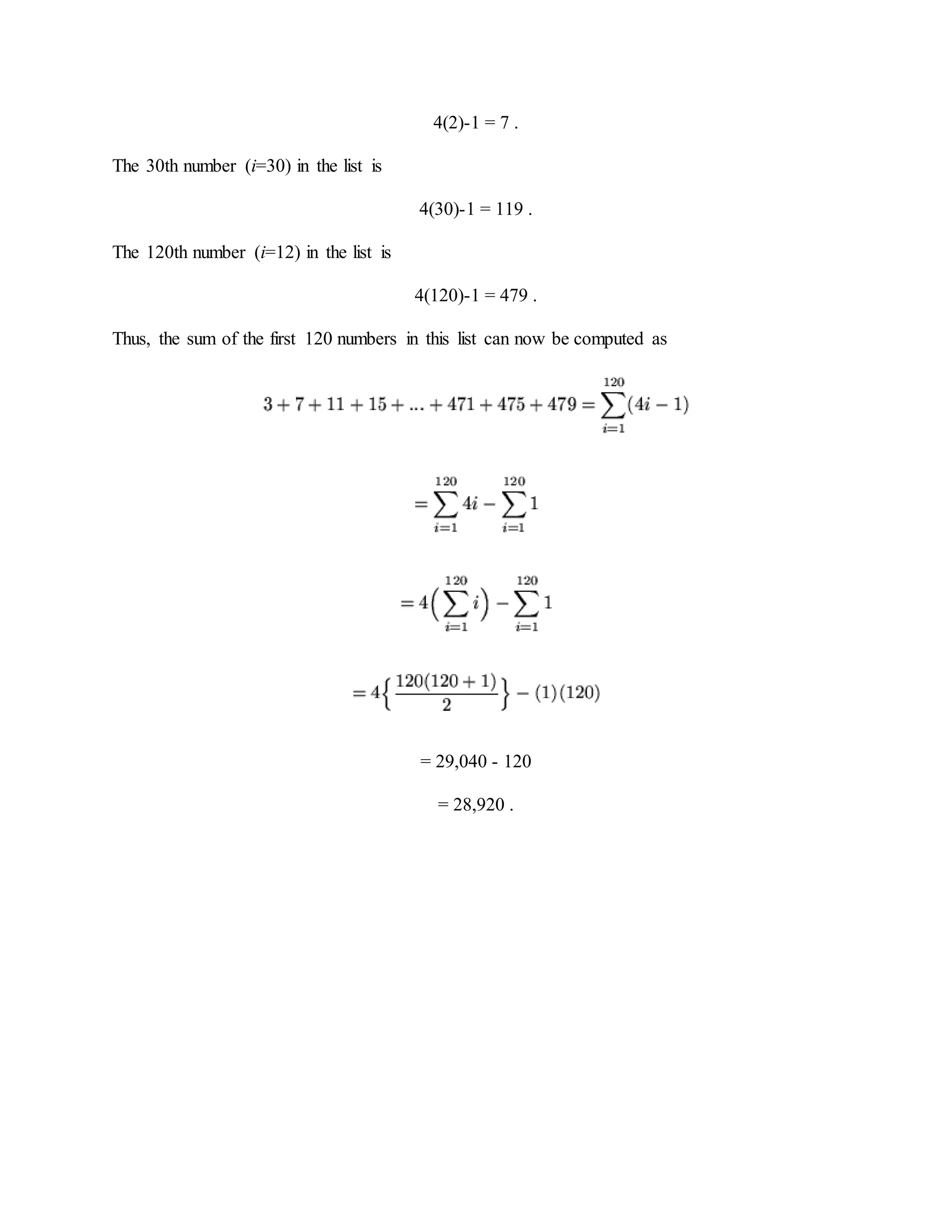
Thus, the sum of the first 120 numbers in this list can now be computed as
= 29,040 - 120
= 28,920 .

Solutions to the algebra of summation notation

  • 1.
    SOLUTIONS TO THEALGEBRA OF SUMMATION NOTATION SOLUTION 1 : = (5+1) + (5+2) + (5+4) + (5+8) = 6 + 7 + 9 + 13 = 35 . Click HERE to return to the list of problems. SOLUTION 2 : (The above step is nothing more than changing the order and grouping of the original summation.) (Placing 3 in front of the second summation is simply factoring 3 from each term in the summation. Now apply Rule 1 to the first summation and Rule 2 to the second summation.) = 400 + 15,150
  • 2.
    = 15,550 . ClickHERE to return to the list of problems. SOLUTION 3 : (Separate this summation into three separate summations.) (Factor out the number 6 in the second summation.) (Apply Rules 1, 2, and 3.) = 2,686,700 - 120,600 + 1800 = 2,567,900 . Click HERE to return to the list of problems. SOLUTION 4 :
  • 3.
    (Since each summationbegins with i=15, WE CANNOT USE THE RULES IN THE FORM THAT THEY ARE GIVEN. Observe the following simple method to correct this shortcoming.) (Now apply Rules 1 and 2.) = 4(11,325 - 105) + (136) = 45,016 . Click HERE to return to the list of problems. SOLUTION 5 : (Note that cancels, then , then , then ... all the way to . Because of this consecutive term cancellation, this type of summation is called a "telescoping" sum. This cancellation will be shown in detail. First change the order of addition.)
  • 4.
    (Now reassociate andcollect "like" terms.) (Recall that .) . Click HERE to return to the list of problems. SOLUTION 6 : (This is a "telescoping" sum. Group "like" terms and cancel.)
  • 5.
    . Click HERE toreturn to the list of problems. SOLUTION 7 : (The summations must begin with i=1 in order to use the given formulas.) = 10,497,600 - 2025 + 173,880 - 285 = 10,669,170 . Click HERE to return to the list of problems.
  • 6.
    SOLUTION 8 : (Recallthat if n is an integer.) (Recall that and .) = 1 + (-1) + 1 + (-1) + 1 + (-1) + 1 + (-1) + 1 + (-1) = (1 + (-1)) + (1 + (-1)) + (1 + (-1)) + (1 + (-1)) + (1 + (-1)) = 0 + 0 + 0 + 0 + 0 = 0 . Click HERE to return to the list of problems. SOLUTION 9 :
  • 7.
    = ( (-1)+ 1 ) + ( (-1) + 1 ) + ... + ( (-1) + 1 ) + ( (-1) + 1 ) = 0 + 0 + ... + 0 + 0 = 0 . Click HERE to return to the list of problems. SOLUTION 10 : There are several ways to prove that . This proof uses a telescoping sum. Consider the summation . It can be evaluated in two different ways. First, treat it as a telescoping sum. Then (Commute the addition.) = (-12 + 22) + (-22 + 32) + (-32 + 42) + (-42 + 52) + ... + (-(n-1)2 + n2) + (-n2 + (n+1)2) (Group "like" terms.) = -12 + (22 - 22) + (32 - 32) + (42 - 42) + (52 - 52) + ... + ((n-1)2-(n-1)2) + (n2 - n2) + (n+1)2 = -12 + (0) + (0) + (0) + (0) + ... + (0) + (0) + (n+1)2 = (n+1)2 - 1 = n2 + 2n + 1 - 1 (*) = n2 + 2n . Second,
  • 8.
    (**) . Equating expressions (*)and (**) we get that , , or . This completes the proof.
  • 9.
    Click HERE toreturn to the list of problems. SOLUTION 11 : There are several ways to prove that . This proof uses a telescoping sum. Consider the summation . It can be evaluated in two different ways. First, treat it as a telescoping sum. Then (Commute the addition.) = (-13 + 23) + (-23 + 33) + (-33 + 43) + (-43 + 53) + ... + (-(n-1)3 + n3) + (-n3 + (n+1)3) (Group "like" terms.) = -13 + (23 - 23) + (33 - 33) + (43 - 43) + (53 - 53) + ... + ((n-1)3 - (n-1)3) + (n3 - n3) + (n+1)3 = -13 + (0) + (0) + (0) + (0) + ... + (0) + (0) + (n+1)3 = (n+1)3 - 1 = n3 + 3n2 + 3n + 1 - 1 (*) = n3 + 3n2 + 3n . Second,
  • 10.
    (**) . Equating expressions (*)and (**) we get that , , , or
  • 11.
    . This completes theproof. Click HERE to return to the list of problems. SOLUTION 12 : There is one nonobvious, but simple step in the solution of this problem. It requires that you write a fraction as a sum or difference of partial fractions. For example, is a partial fractions decomposition of . Then a partial fraction decomposition of is so that (This summation is a telescoping sum.)
  • 12.
    (Now evaluate thelimit.) = 1 - 0 = 1 . Click HERE to return to the list of problems. SOLUTION 13 : Note that in all of the following summations, letter i is a variable and letter n is a constant (until the limit is evaluated). Then
  • 13.
    (Now evaluate thelimit.) = 6 + (0) + 1 + (0) + (0) = 7 . Click HERE to return to the list of problems. SOLUTION 14 : The formula 4i -1 for i=1, 2, 3, 4, 5, ... generates the given list of numbers. For example, the first number (i=1) in the list is 4(1)-1 = 3 . The second number (i=2) in the list is
  • 14.
    4(2)-1 = 7. The 30th number (i=30) in the list is 4(30)-1 = 119 . The 120th number (i=12) in the list is 4(120)-1 = 479 . Thus, the sum of the first 120 numbers in this list can now be computed as = 29,040 - 120 = 28,920 .