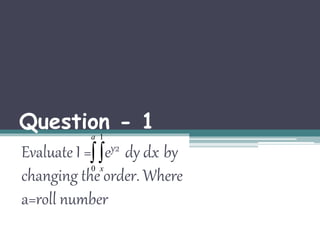
This document contains 5 calculus problems and their solutions. It evaluates definite integrals using techniques like changing the order of integration and applying to regions bounded by parametric curves. The solutions show the setup and evaluation of the integrals, including the limits of integration and final answers. The document was prepared by 4 students with the listed roll numbers used as variables in the integrals.
![Solution - 1
x=0 to x=2 and y=x to y=1
**Here, given strip is vertical strip so we’ll convert it into
the horizontal strips.
y=0 to y=2 and x=0 to x=y
2
y
2
I = ey2 dy dx
0 0
y
I = ey2 dy dx
0
0
2
I = ey2 dy [y-0]
0
](https://image.slidesharecdn.com/calculusproblemsoulution-141204031951-conversion-gate01/85/Calculus-problem-soulution-3-320.jpg)
![2
I = yey2 dy
0
2
1
2
I = 2y ey2 dy
I =
0
1
2
2
2 [ ] x e
0
1
I = [e4-1] , Answer
2](https://image.slidesharecdn.com/calculusproblemsoulution-141204031951-conversion-gate01/85/Calculus-problem-soulution-4-320.jpg)
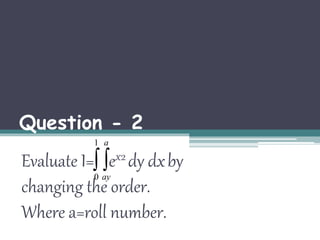
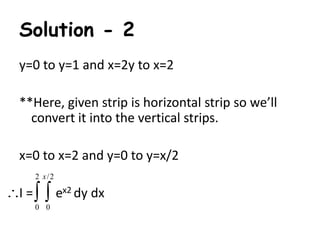
![2
x
/2
I = ex2 dx dy
0
0
2
I = ex2 dx x/2
0
2
I = ¼ 2x ex2 dx
I = ¼
0
2
2 [ ] x e
0
I = ¼ [e4-1] , Answer
](https://image.slidesharecdn.com/calculusproblemsoulution-141204031951-conversion-gate01/85/Calculus-problem-soulution-7-320.jpg)
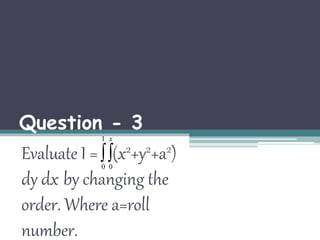
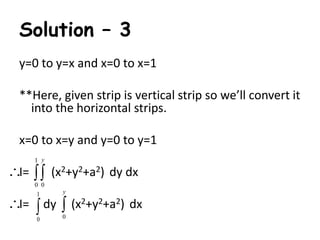
![1
3 [ ]
y
I = (1/3) + (y2+4) dy
0
x [
] 0
0I = (4/3y3+y) dy
I =
1 4 1 2
[ y y ]
3 2
I = , Answer
y
x
1
0
1
0
5
6
](https://image.slidesharecdn.com/calculusproblemsoulution-141204031951-conversion-gate01/85/Calculus-problem-soulution-10-320.jpg)
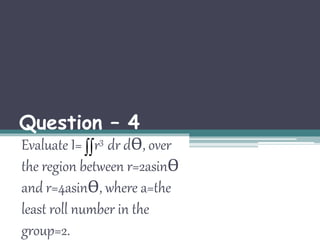
![Solution – 4
**The limit is derived from the cardioid of given
equation above the initial line. a=2
Ө=
to Ө= and r=4sinӨ to r=8sinӨ
4
I = r3 dr dӨ
I = dӨ
2
2 8sin
4sin
4
2
4
1
4
8sin
3 [r ]
4sin
](https://image.slidesharecdn.com/calculusproblemsoulution-141204031951-conversion-gate01/85/Calculus-problem-soulution-12-320.jpg)
![1
4
2
4 sin
I = 3840 dӨ
4
**By applying Reduction formula, we’ll get
31
16 4
I = 960 [
]
I = 180 +240 , Answer](https://image.slidesharecdn.com/calculusproblemsoulution-141204031951-conversion-gate01/85/Calculus-problem-soulution-13-320.jpg)
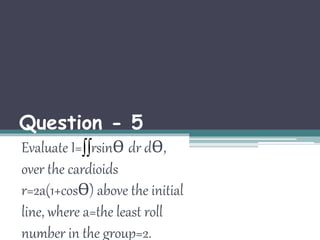
![Solution - 5
**The limit is derived from the cardioid of given
equation above the initial line. a=2
Ө=0 to Ө=
and r=0 to r=2a(1+cosӨ)
4(1 cos )
I = rsinӨ drdӨ
0 0
I = sinӨ dӨ ½
0
4(1 cos )
2 [r ]
0
](https://image.slidesharecdn.com/calculusproblemsoulution-141204031951-conversion-gate01/85/Calculus-problem-soulution-15-320.jpg)
![
I = sinӨ ½ (4a2) (1+cosӨ) 2 dӨ
0
I = (-2a2) (-sinӨ) (1+cosӨ)2 dӨ
0
I = (-2a2) (1/3)
3
I = 16a2/3 , Answer
0
[(1 cos ) ]
](https://image.slidesharecdn.com/calculusproblemsoulution-141204031951-conversion-gate01/85/Calculus-problem-soulution-16-320.jpg)