SOLUTIONS
CLASS 12
Introduction
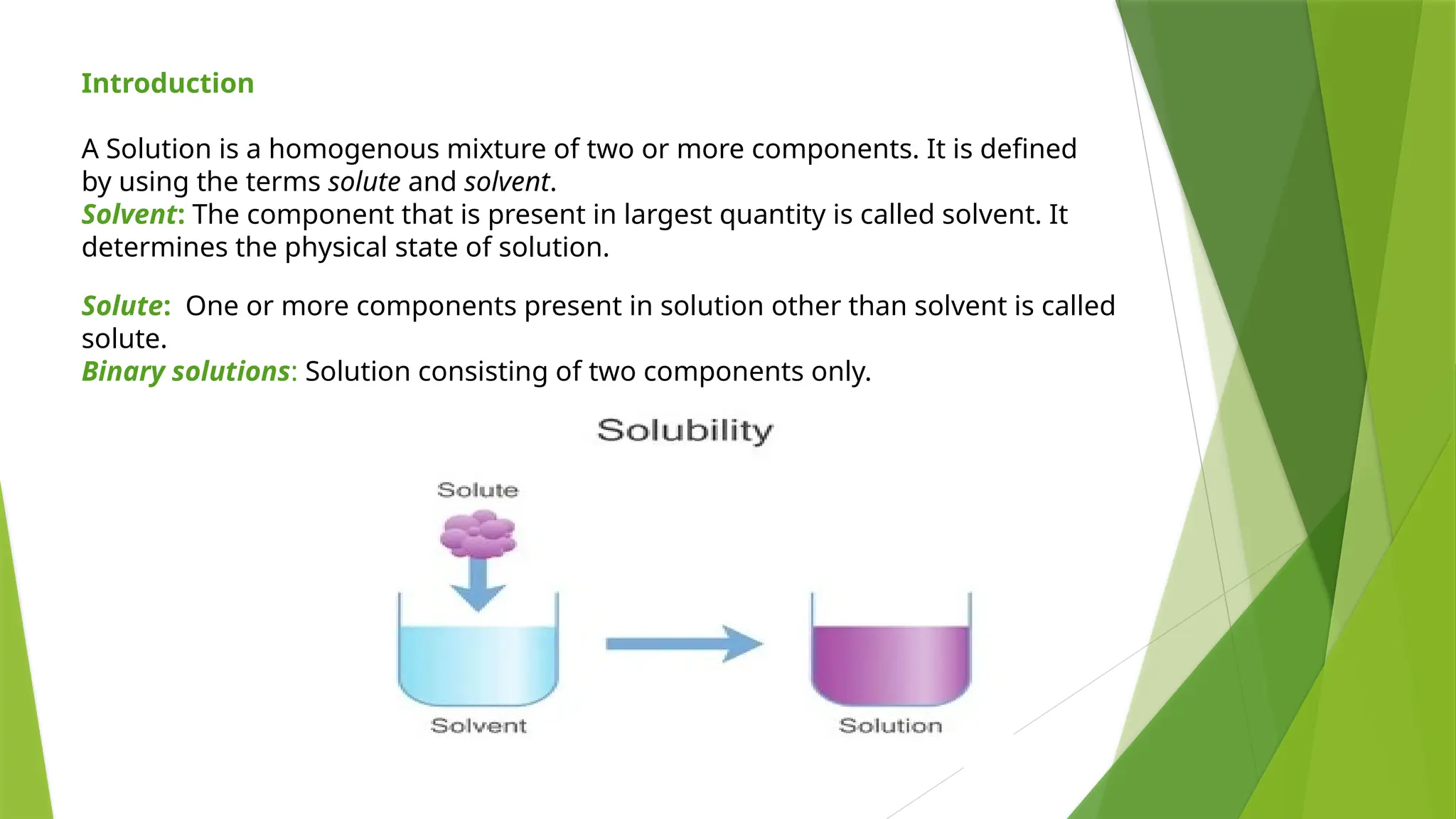
A Solution is a homogenous mixture of two or more components. It is defined
by using the terms solute and solvent.
Solvent: The component that is present in largest quantity is called solvent. It
determines the physical state of solution.
Solute: One or more components present in solution other than solvent is called
solute.
Binary solutions: Solution consisting of two components only.
Types of Solutions
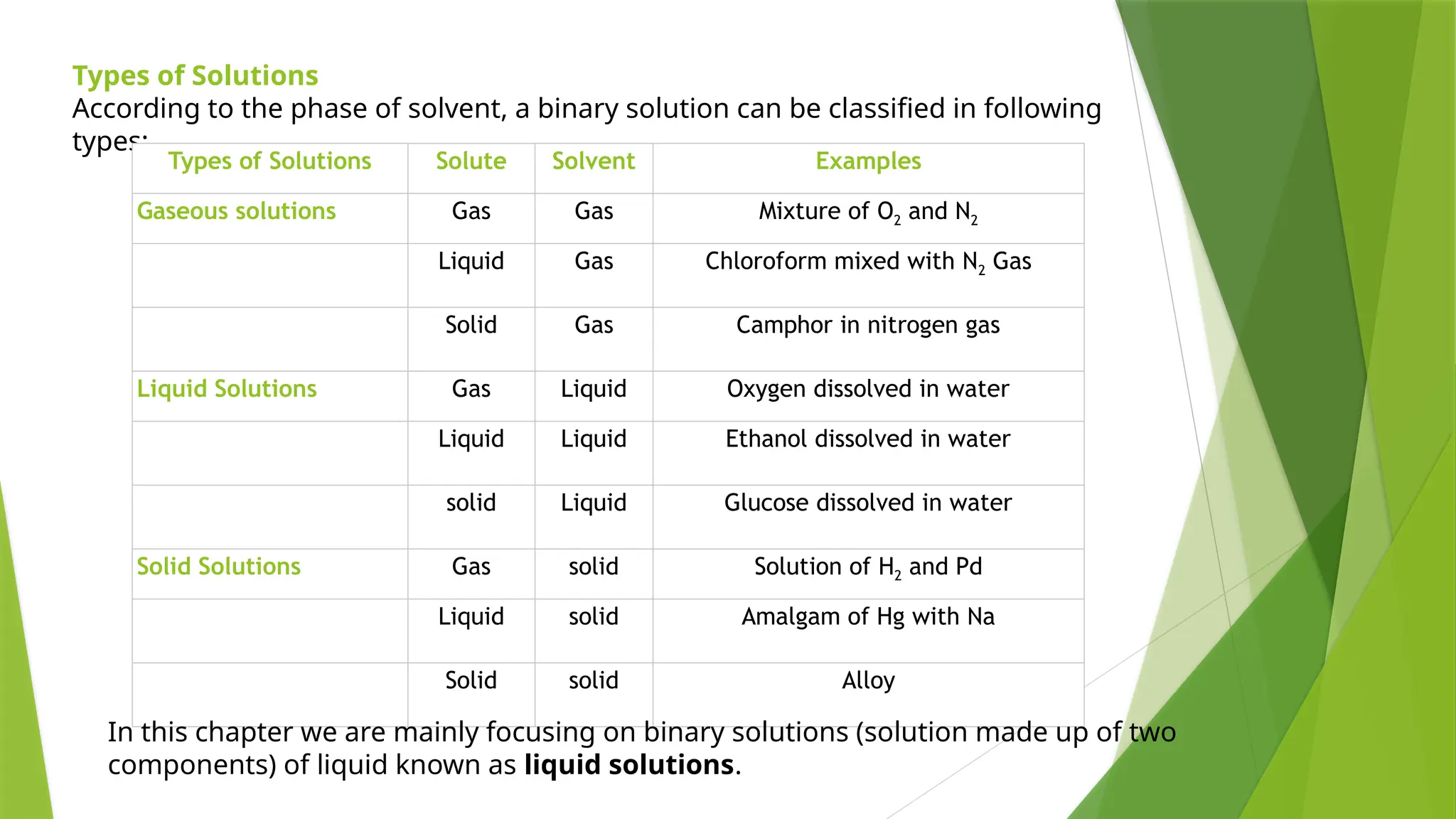
According to the phase of solvent, a binary solution can be classified in following
types:
Types of Solutions Solute Solvent Examples
Gaseous solutions Gas Gas Mixture of O2 and N2
Liquid Gas Chloroform mixed with N2 Gas
Solid Gas Camphor in nitrogen gas
Liquid Solutions Gas Liquid Oxygen dissolved in water
Liquid Liquid Ethanol dissolved in water
solid Liquid Glucose dissolved in water
Solid Solutions Gas solid Solution of H2 and Pd
Liquid solid Amalgam of Hg with Na
Solid solid Alloy
In this chapter we are mainly focusing on binary solutions (solution made up of two
components) of liquid known as liquid solutions.
Different Methods of Expressing Concentration of
Solutions
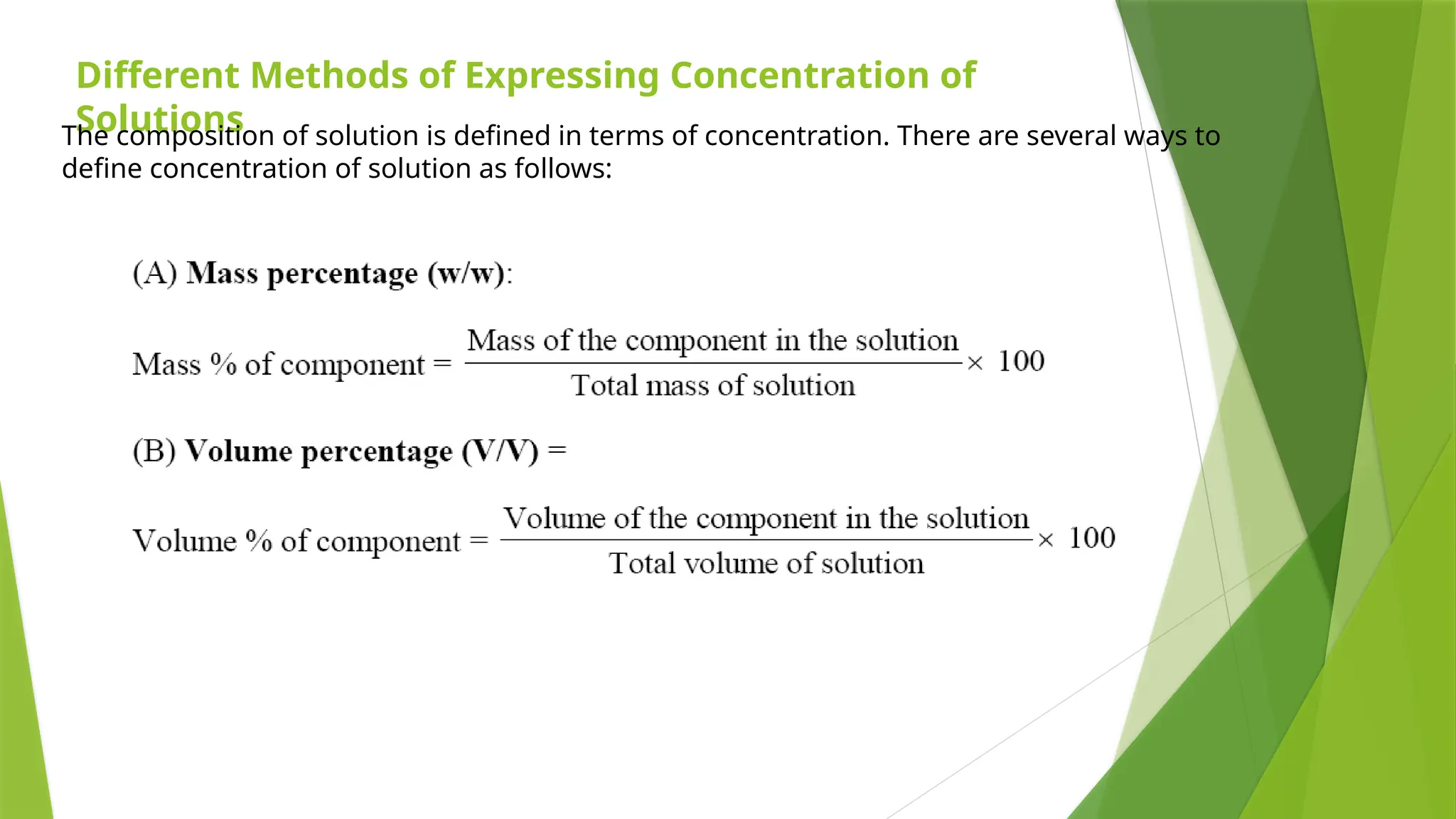
The composition of solution is defined in terms of concentration. There are several ways to
define concentration of solution as follows:
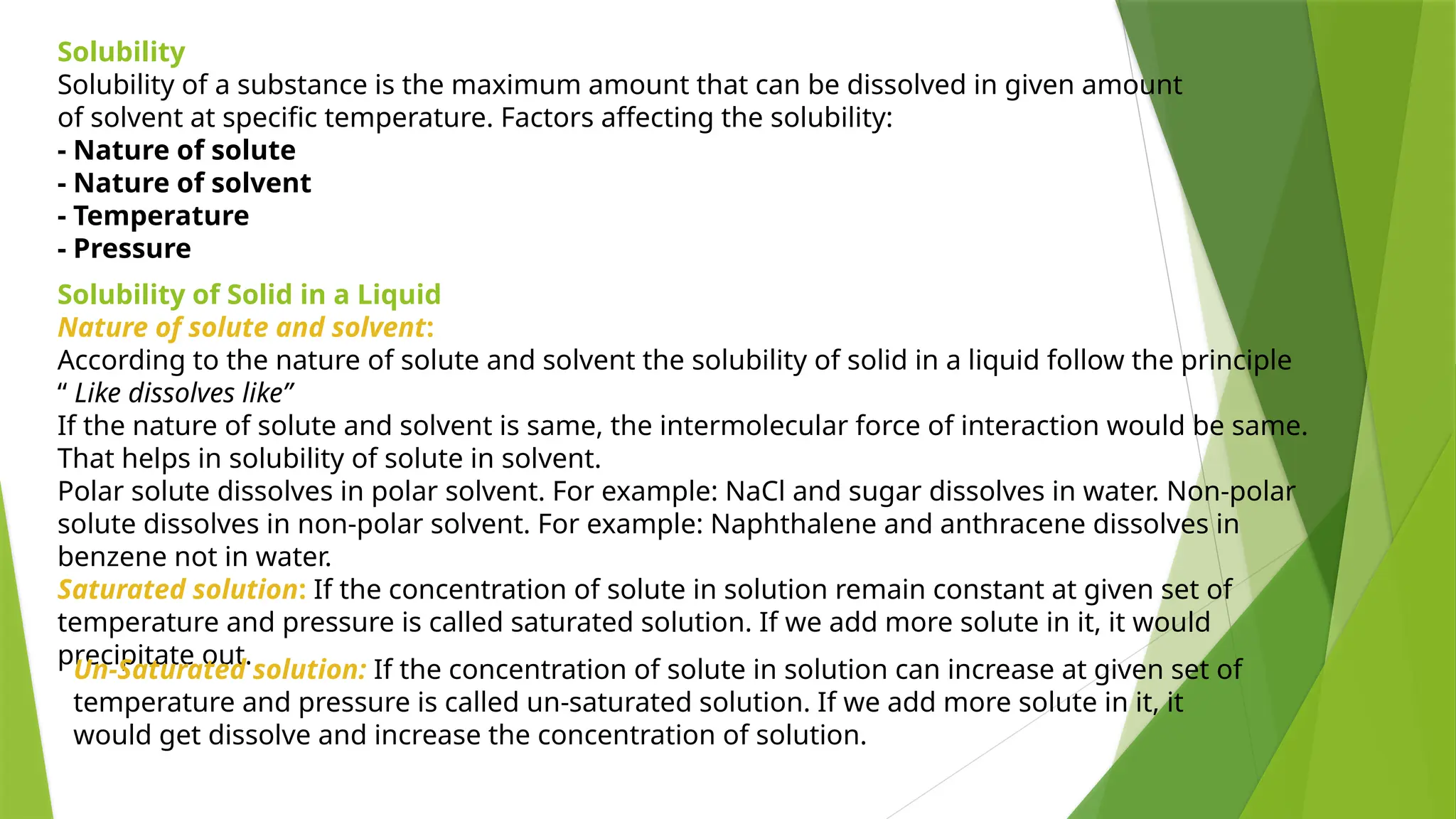
Solubility
Solubility of a substance is the maximum amount that can be dissolved in given amount
of solvent at specific temperature. Factors affecting the solubility:
- Nature of solute
- Nature of solvent
- Temperature
- Pressure
Solubility of Solid in a Liquid
Nature of solute and solvent:
According to the nature of solute and solvent the solubility of solid in a liquid follow the principle
“ Like dissolves like”
If the nature of solute and solvent is same, the intermolecular force of interaction would be same.
That helps in solubility of solute in solvent.
Polar solute dissolves in polar solvent. For example: NaCl and sugar dissolves in water. Non-polar
solute dissolves in non-polar solvent. For example: Naphthalene and anthracene dissolves in
benzene not in water.
Saturated solution: If the concentration of solute in solution remain constant at given set of
temperature and pressure is called saturated solution. If we add more solute in it, it would
precipitate out.
Un-Saturated solution: If the concentration of solute in solution can increase at given set of
temperature and pressure is called un-saturated solution. If we add more solute in it, it
would get dissolve and increase the concentration of solution.
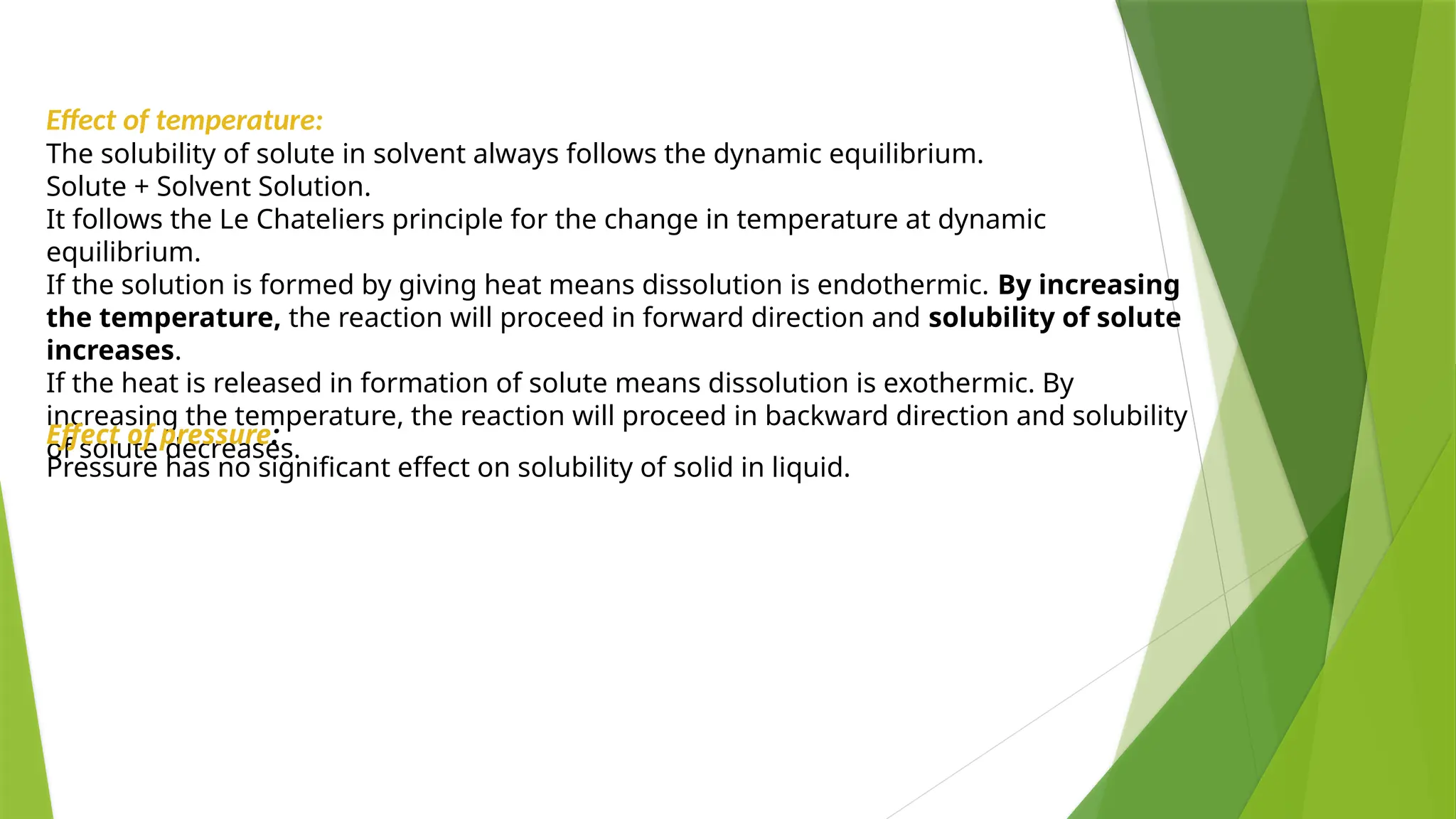
Effect of temperature:
The solubility of solute in solvent always follows the dynamic equilibrium.
Solute + Solvent Solution.
It follows the Le Chateliers principle for the change in temperature at dynamic
equilibrium.
If the solution is formed by giving heat means dissolution is endothermic. By increasing
the temperature, the reaction will proceed in forward direction and solubility of solute
increases.
If the heat is released in formation of solute means dissolution is exothermic. By
increasing the temperature, the reaction will proceed in backward direction and solubility
of solute decreases.
Effect of pressure:
Pressure has no significant effect on solubility of solid in liquid.
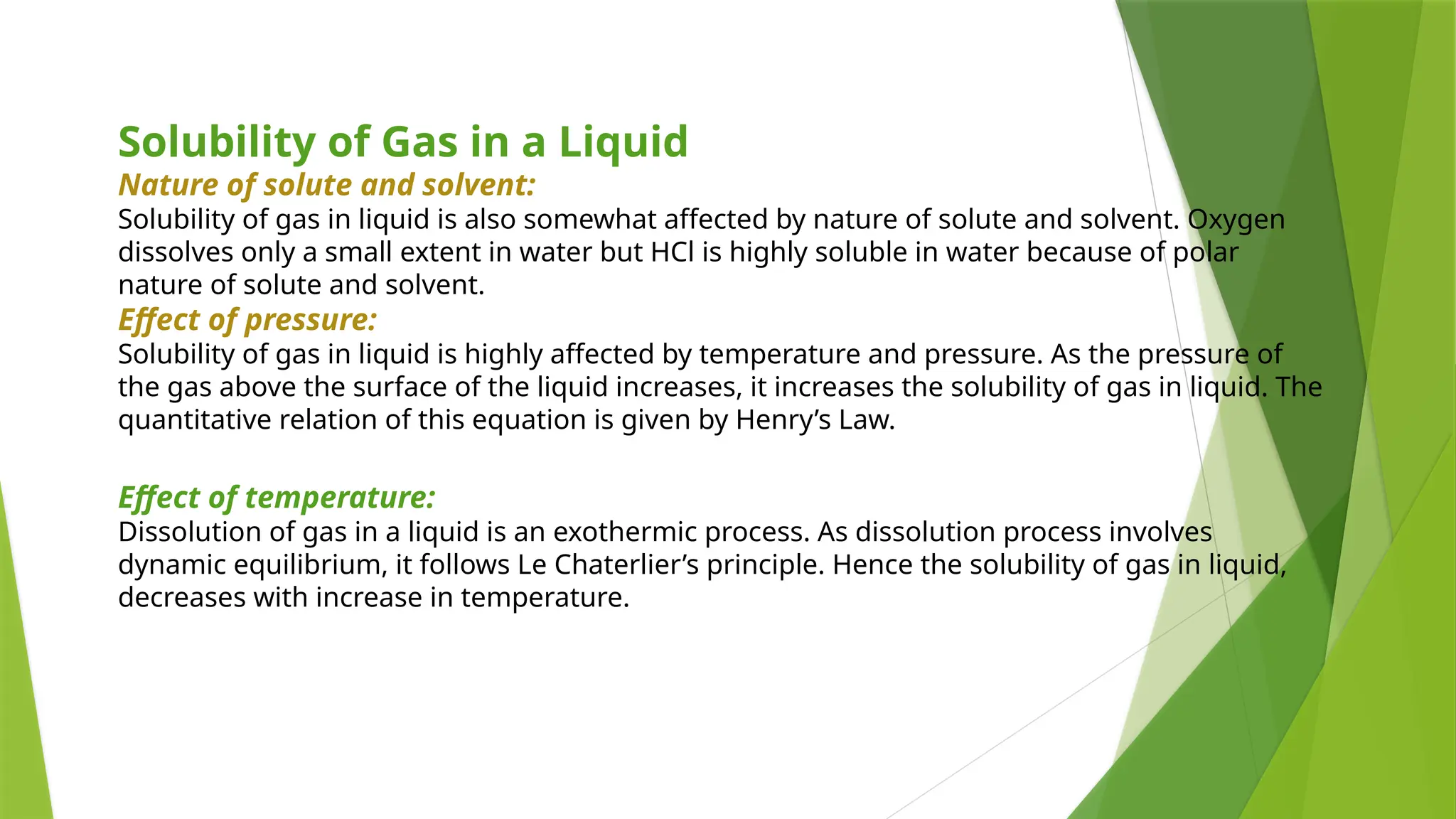
Solubility of Gas in a Liquid
Nature of solute and solvent:
Solubility of gas in liquid is also somewhat affected by nature of solute and solvent. Oxygen
dissolves only a small extent in water but HCl is highly soluble in water because of polar
nature of solute and solvent.
Effect of pressure:
Solubility of gas in liquid is highly affected by temperature and pressure. As the pressure of
the gas above the surface of the liquid increases, it increases the solubility of gas in liquid. The
quantitative relation of this equation is given by Henry’s Law.
Effect of temperature:
Dissolution of gas in a liquid is an exothermic process. As dissolution process involves
dynamic equilibrium, it follows Le Chaterlier’s principle. Hence the solubility of gas in liquid,
decreases with increase in temperature.
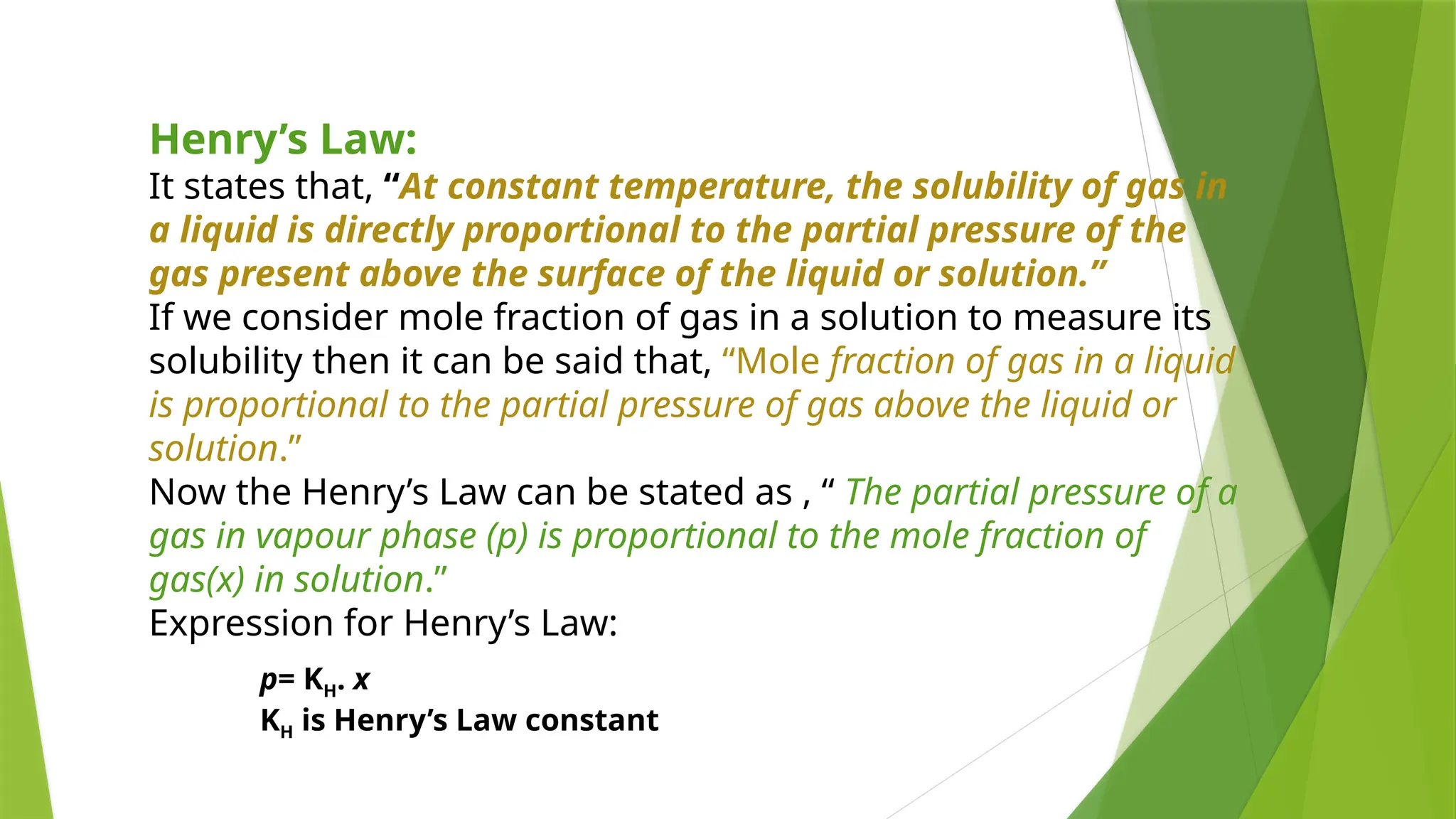
Henry’s Law:
It states that, “At constant temperature, the solubility of gas in
a liquid is directly proportional to the partial pressure of the
gas present above the surface of the liquid or solution.”
If we consider mole fraction of gas in a solution to measure its
solubility then it can be said that, “Mole fraction of gas in a liquid
is proportional to the partial pressure of gas above the liquid or
solution.”
Now the Henry’s Law can be stated as , “ The partial pressure of a
gas in vapour phase (p) is proportional to the mole fraction of
gas(x) in solution.”
Expression for Henry’s Law:
p= KH. x
KH is Henry’s Law constant
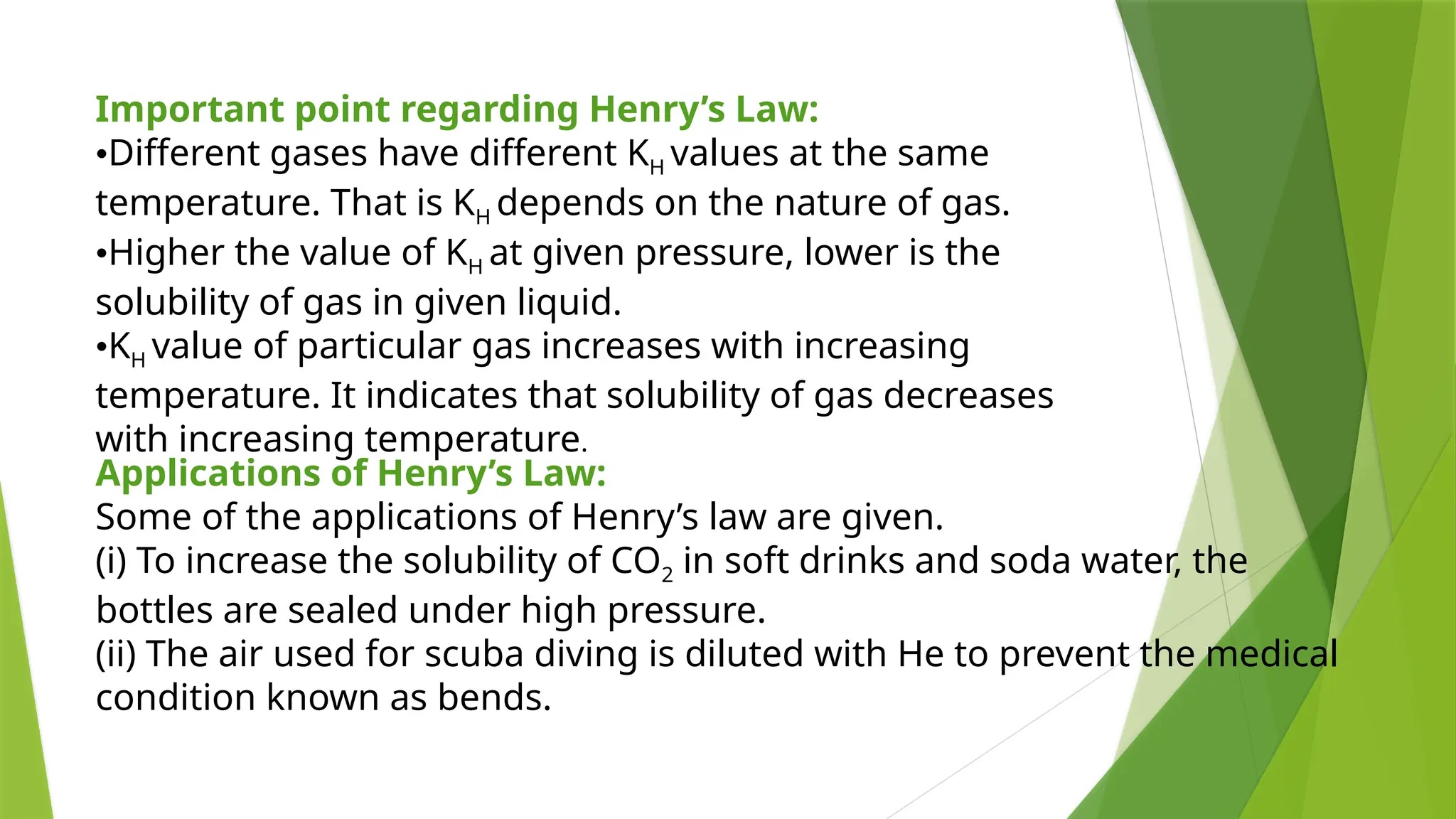
Important point regarding Henry’s Law:
•Different gases have different KH values at the same
temperature. That is KH depends on the nature of gas.
•Higher the value of KH at given pressure, lower is the
solubility of gas in given liquid.
•KH value of particular gas increases with increasing
temperature. It indicates that solubility of gas decreases
with increasing temperature.
Applications of Henry’s Law:
Some of the applications of Henry’s law are given.
(i) To increase the solubility of CO2 in soft drinks and soda water, the
bottles are sealed under high pressure.
(ii) The air used for scuba diving is diluted with He to prevent the medical
condition known as bends.
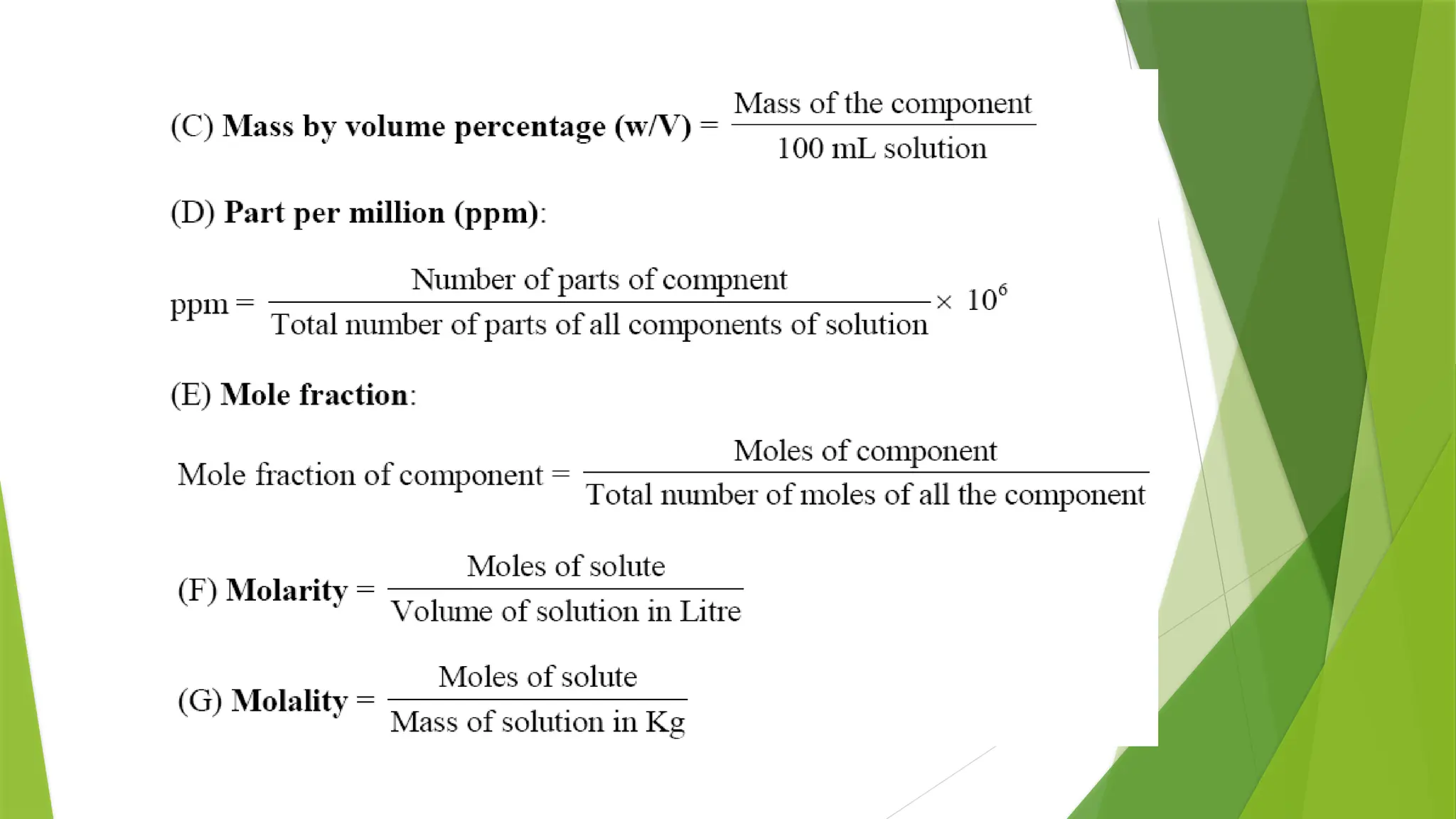
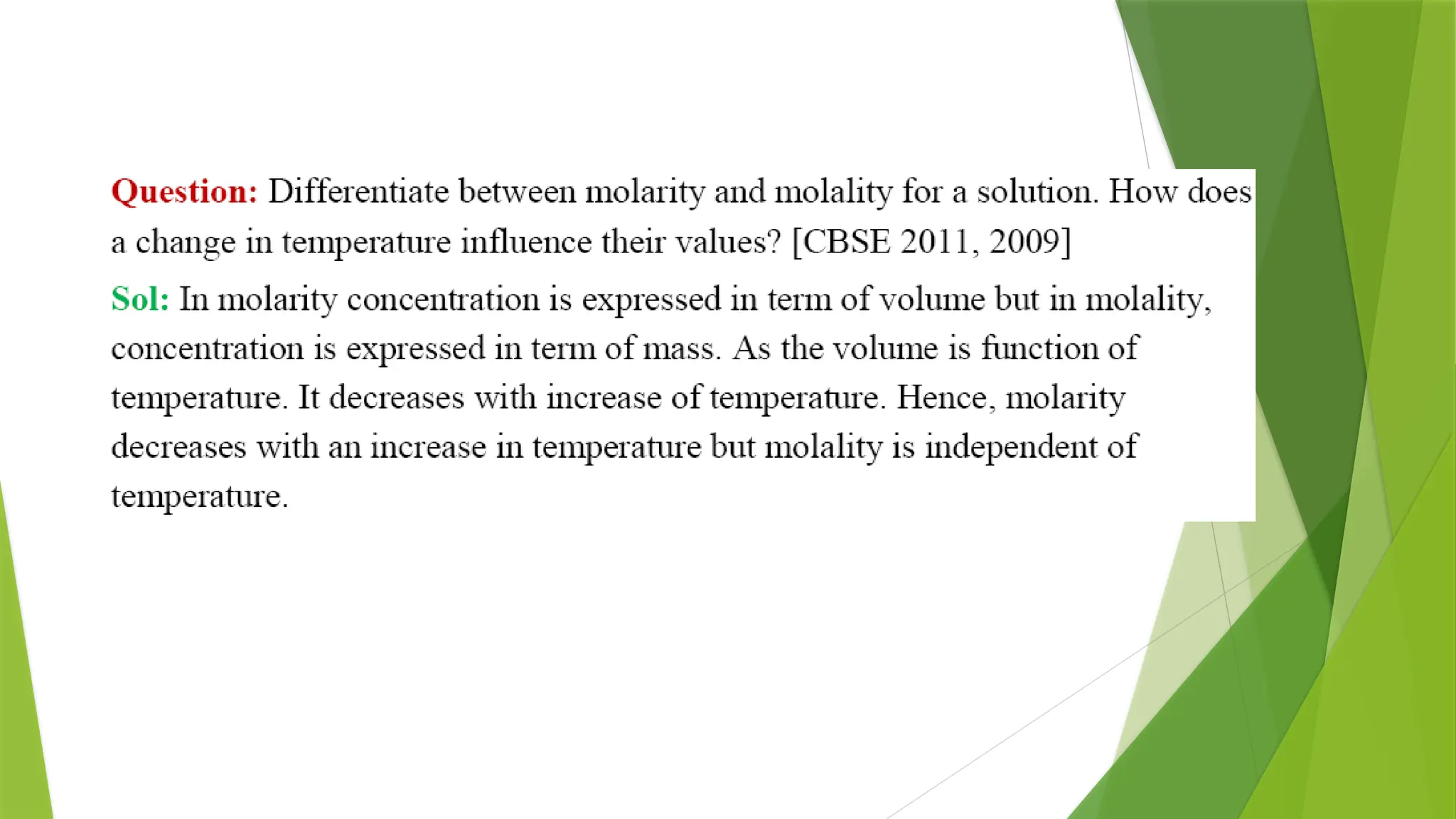
•Molality (m) is the number of moles of solute present in 1kg of
solvent.
•Molarity (M) is the number of moles of solute present in 1L of
solution.
•Normality is the number of gram equivalent of solute dissolved
per litre of solution.
•Solubility: It is the maximum amount that can be dissolved in a
specified amount of solvent at a specified temperature.
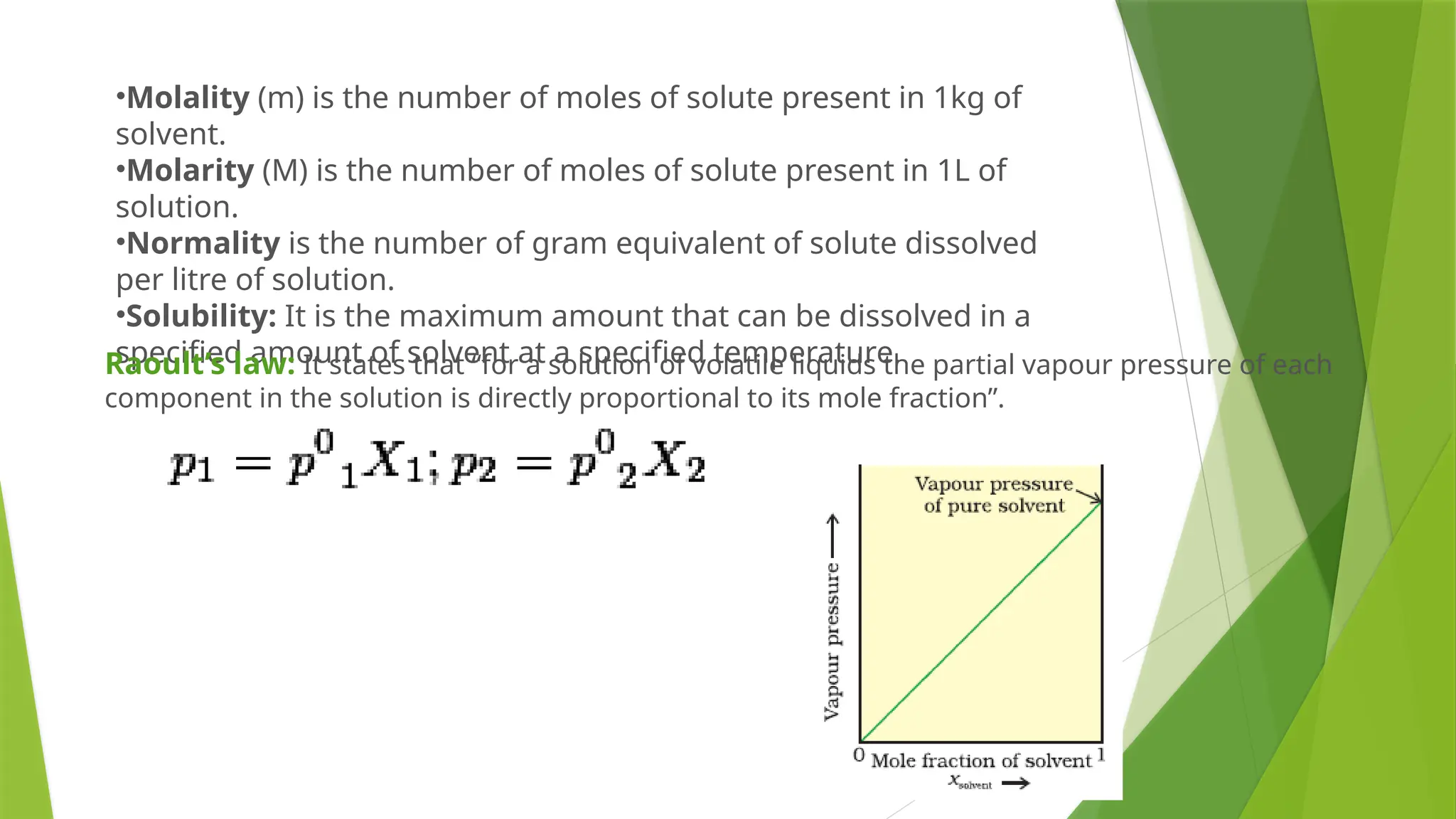
Raoult’s law: It states that “for a solution of volatile liquids the partial vapour pressure of each
component in the solution is directly proportional to its mole fraction”.
Answer. Skeltal chemical equation are unbalanced. We need to balance chemical equation
because of law of conservation of mass. It states that ‘matter can neither be created nor be
destroyed’. Therefore chemical equation must be balanced in each and every chemical
reaction.
1.“We need to balance a skeltal chemical equation.” Give reason to justify the
statement.
2. Name the reducing agent in the following reaction:
3MnO2 + 4Al———— > 3Mn + 2Al2O3
State which is more reactive, Mn or A1 and why?
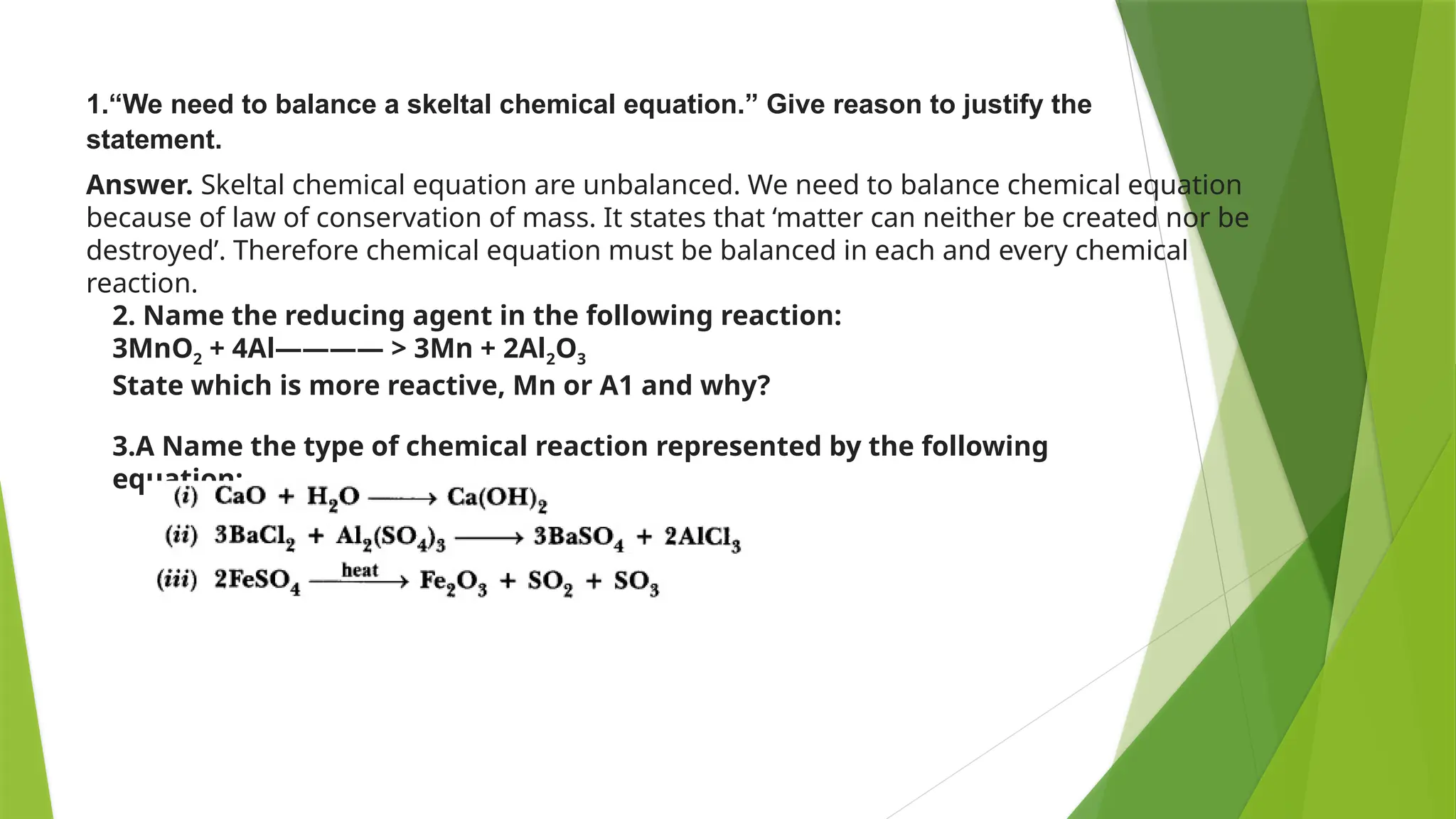
3.A Name the type of chemical reaction represented by the following
equation:
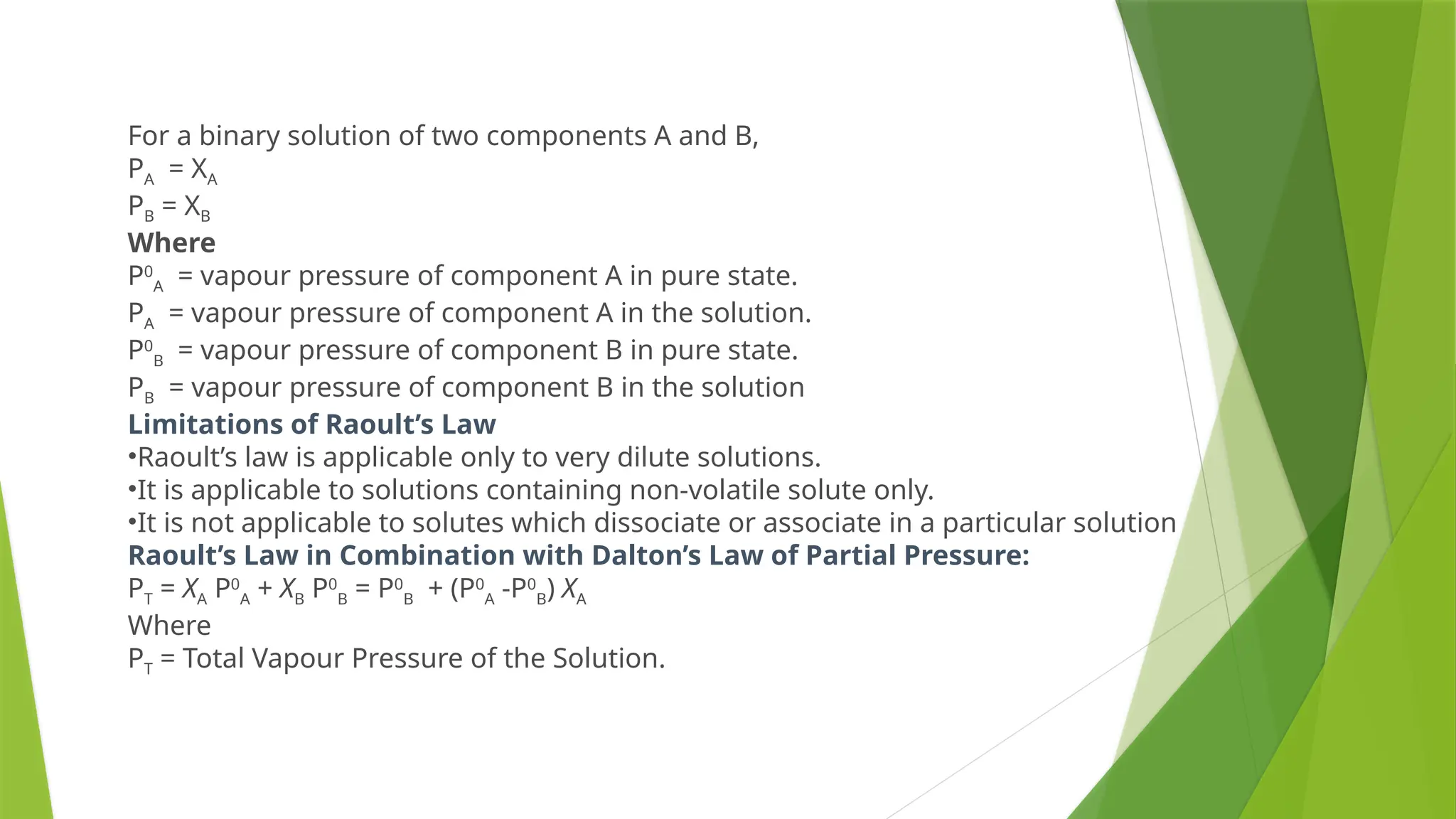
For a binary solution of two components A and B,
PA = XA
PB = XB
Where
P0
A = vapour pressure of component A in pure state.
PA = vapour pressure of component A in the solution.
P0
B = vapour pressure of component B in pure state.
PB = vapour pressure of component B in the solution
Limitations of Raoult’s Law
•Raoult’s law is applicable only to very dilute solutions.
•It is applicable to solutions containing non-volatile solute only.
•It is not applicable to solutes which dissociate or associate in a particular solution
Raoult’s Law in Combination with Dalton’s Law of Partial Pressure:
PT = XA P0
A + XB P0
B = P0
B + (P0
A -P0
B) XA
Where
PT = Total Vapour Pressure of the Solution.
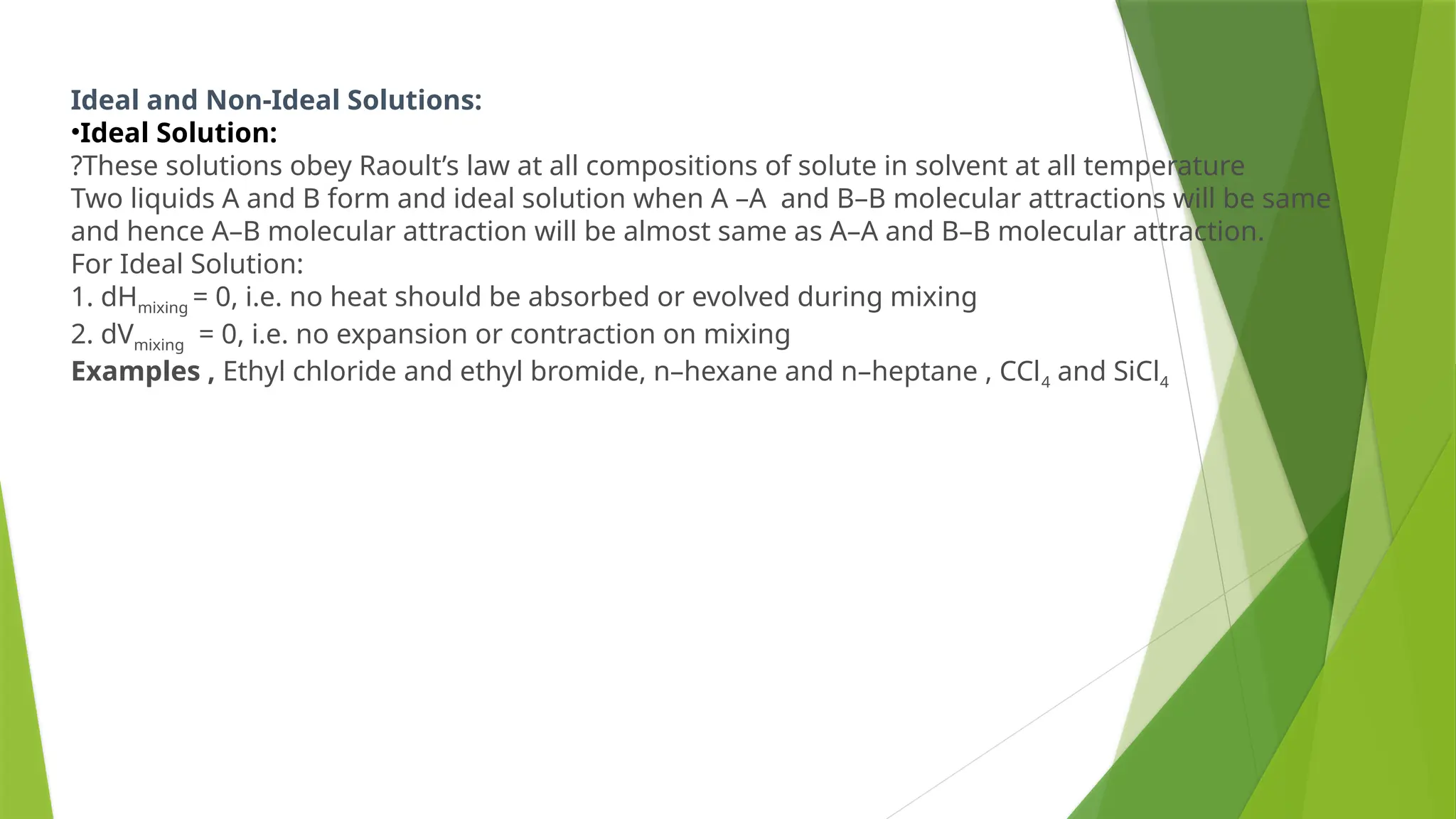
Ideal and Non-Ideal Solutions:
•Ideal Solution:
?These solutions obey Raoult’s law at all compositions of solute in solvent at all temperature
Two liquids A and B form and ideal solution when A –A and B–B molecular attractions will be same
and hence A–B molecular attraction will be almost same as A–A and B–B molecular attraction.
For Ideal Solution:
1. dHmixing = 0, i.e. no heat should be absorbed or evolved during mixing
2. dVmixing = 0, i.e. no expansion or contraction on mixing
Examples , Ethyl chloride and ethyl bromide, n–hexane and n–heptane , CCl4 and SiCl4
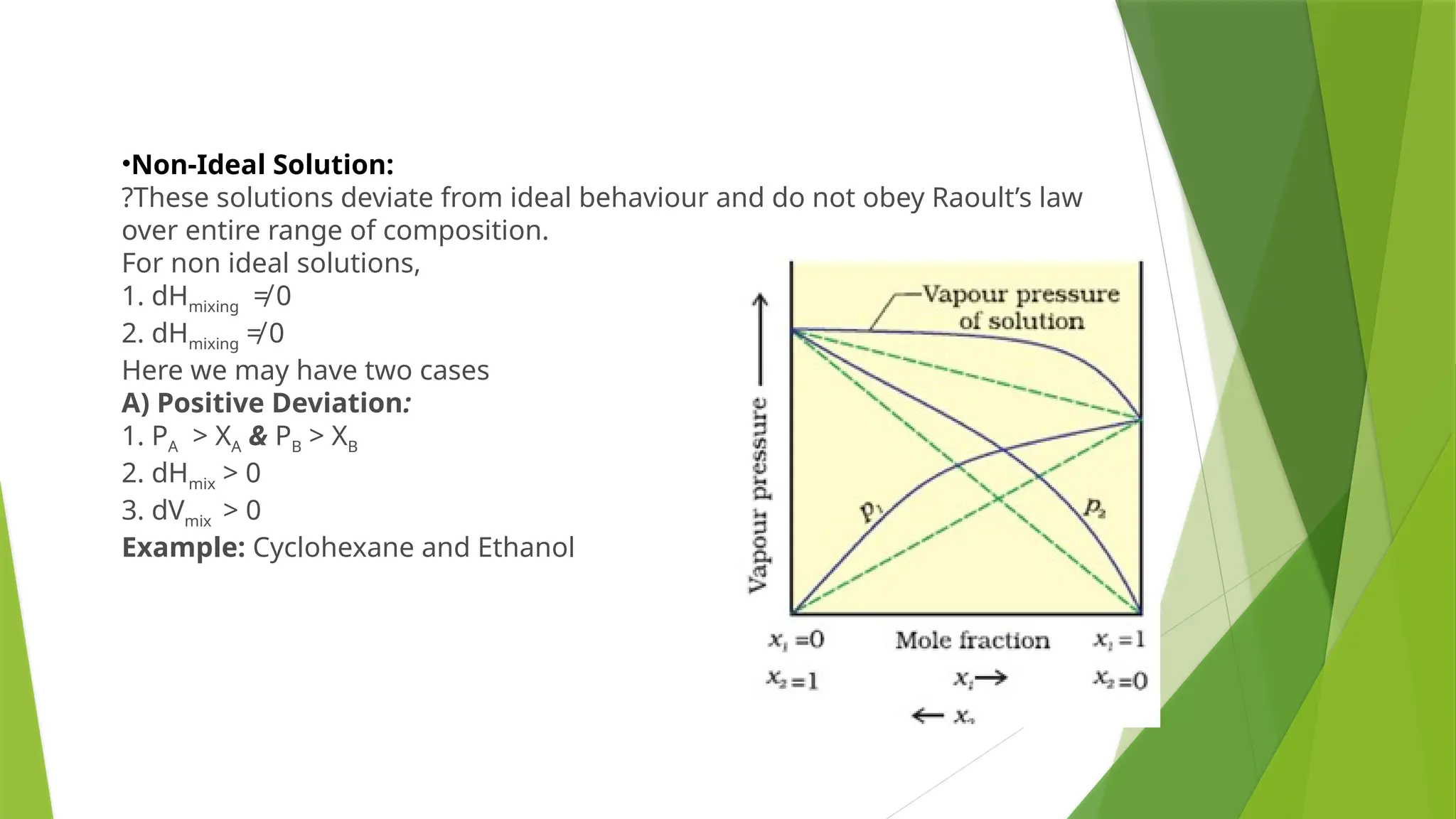
•Non-Ideal Solution:
?These solutions deviate from ideal behaviour and do not obey Raoult’s law
over entire range of composition.
For non ideal solutions,
1. dHmixing ≠ 0
2. dHmixing ≠ 0
Here we may have two cases
A) Positive Deviation:
1. PA > XA & PB > XB
2. dHmix > 0
3. dVmix > 0
Example: Cyclohexane and Ethanol
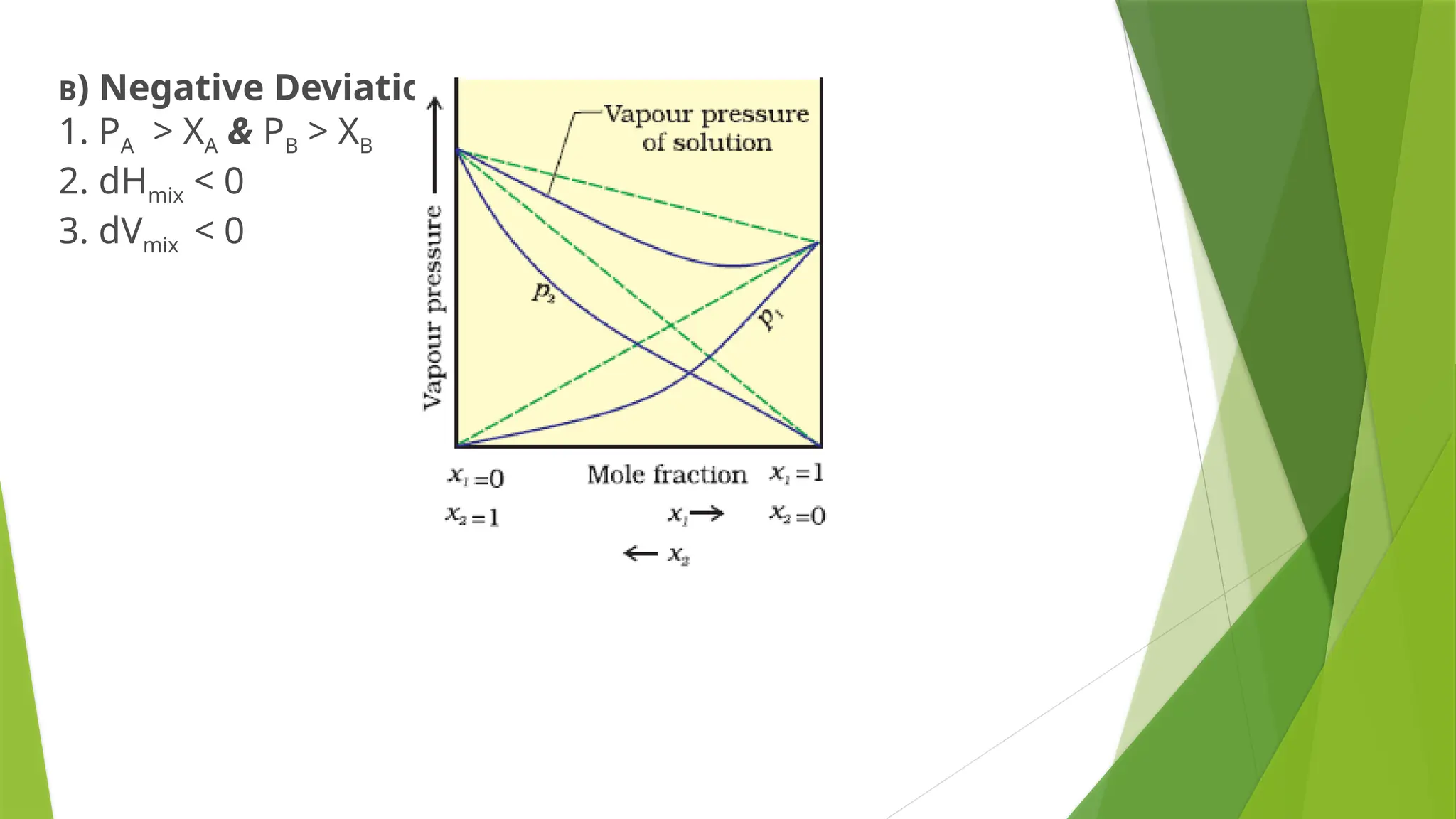
B) Negative Deviation:
1. PA > XA & PB > XB
2. dHmix < 0
3. dVmix < 0
The vapour pressures of pure liquids A and B are 450 mm and 700 mm of Hg respectively
at 350 K. Calculate the composition of the liquid mixture if total vapour pressure is 600
mm of Hg. Also find the composition in the vapour phase.
Vapour pressure of pure water at 298 K is 23.8 m m Hg. 50 g of urea (NH2CONH2) is
dissolved in 850 g of water. Calculate the vapour pressure of water for this
solution and its relative lowering.
Elevation in Boiling Point (ΔTb)
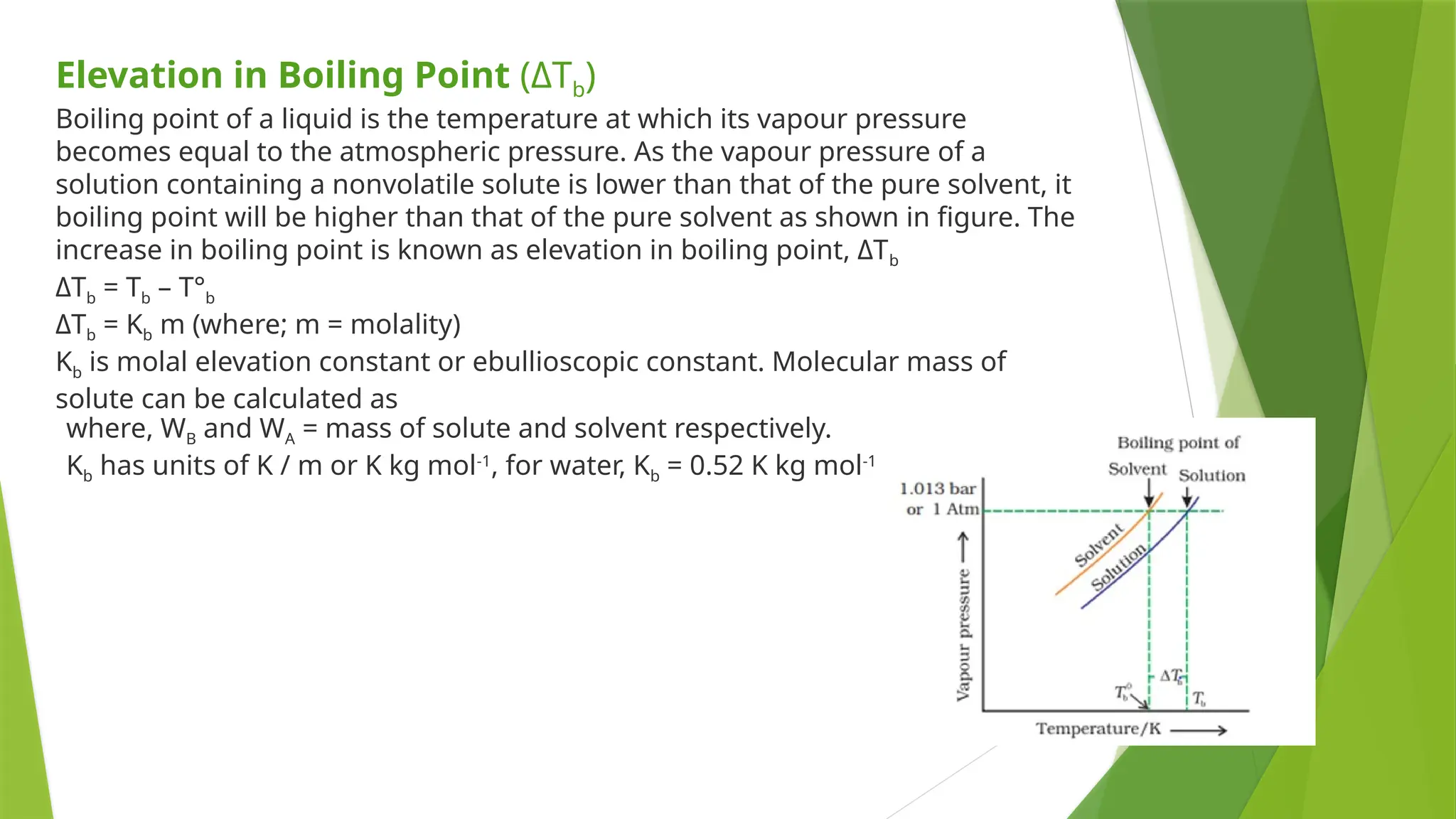
Boiling point of a liquid is the temperature at which its vapour pressure
becomes equal to the atmospheric pressure. As the vapour pressure of a
solution containing a nonvolatile solute is lower than that of the pure solvent, it
boiling point will be higher than that of the pure solvent as shown in figure. The
increase in boiling point is known as elevation in boiling point, ΔTb
ΔTb = Tb – T°b
ΔTb = Kb m (where; m = molality)
Kb is molal elevation constant or ebullioscopic constant. Molecular mass of
solute can be calculated as
where, WB and WA = mass of solute and solvent respectively.
Kb has units of K / m or K kg mol-1
, for water, Kb = 0.52 K kg mol-1
Osmotic Pressure (π)
Osmosis is the phenomenon of
spontaneous flow of the solvent
molecules through a
semipermeable membrane from
pure solvent to solution or from a
dilute solution to concentrated
solution. It was first observed by
Abbe Nollet.
Some natural semipermeable
membranes are animal bladder,
cell membrane etc.
CU2[Fe(CN)6],CELLULOSE AND
ACETATE is an artificial
semipermeable membrane which
does not work in non-aqueous
solutions as it dissolves in them.
.
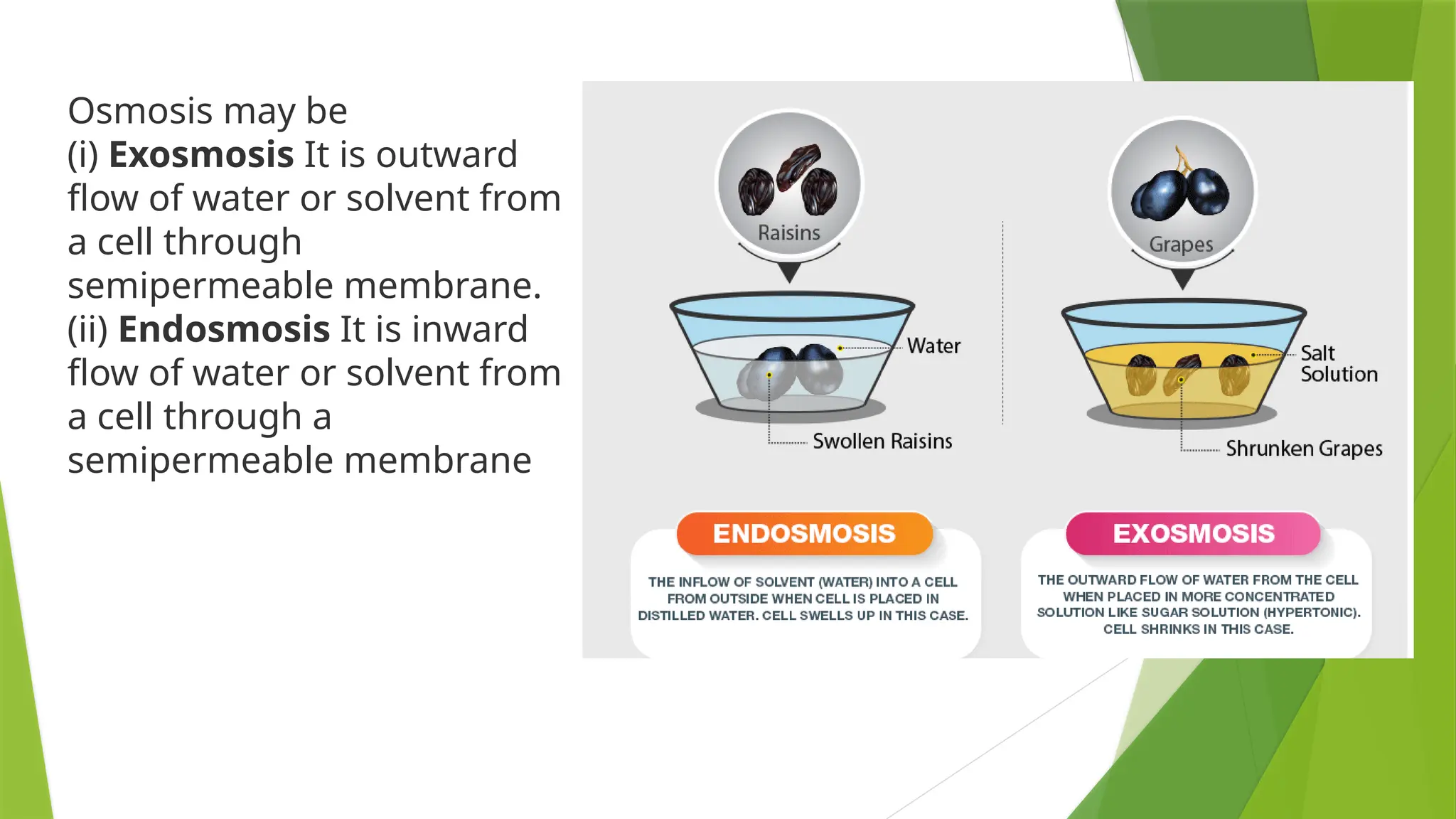
Osmosis may be
(i) Exosmosis It is outward
flow of water or solvent from
a cell through
semipermeable membrane.
(ii) Endosmosis It is inward
flow of water or solvent from
a cell through a
semipermeable membrane
Osmotic pressure of a solution is equal to the external pressure applied on
higher conc. side so as to just stop the process of osmosis. [External pressure
= ∏ ]
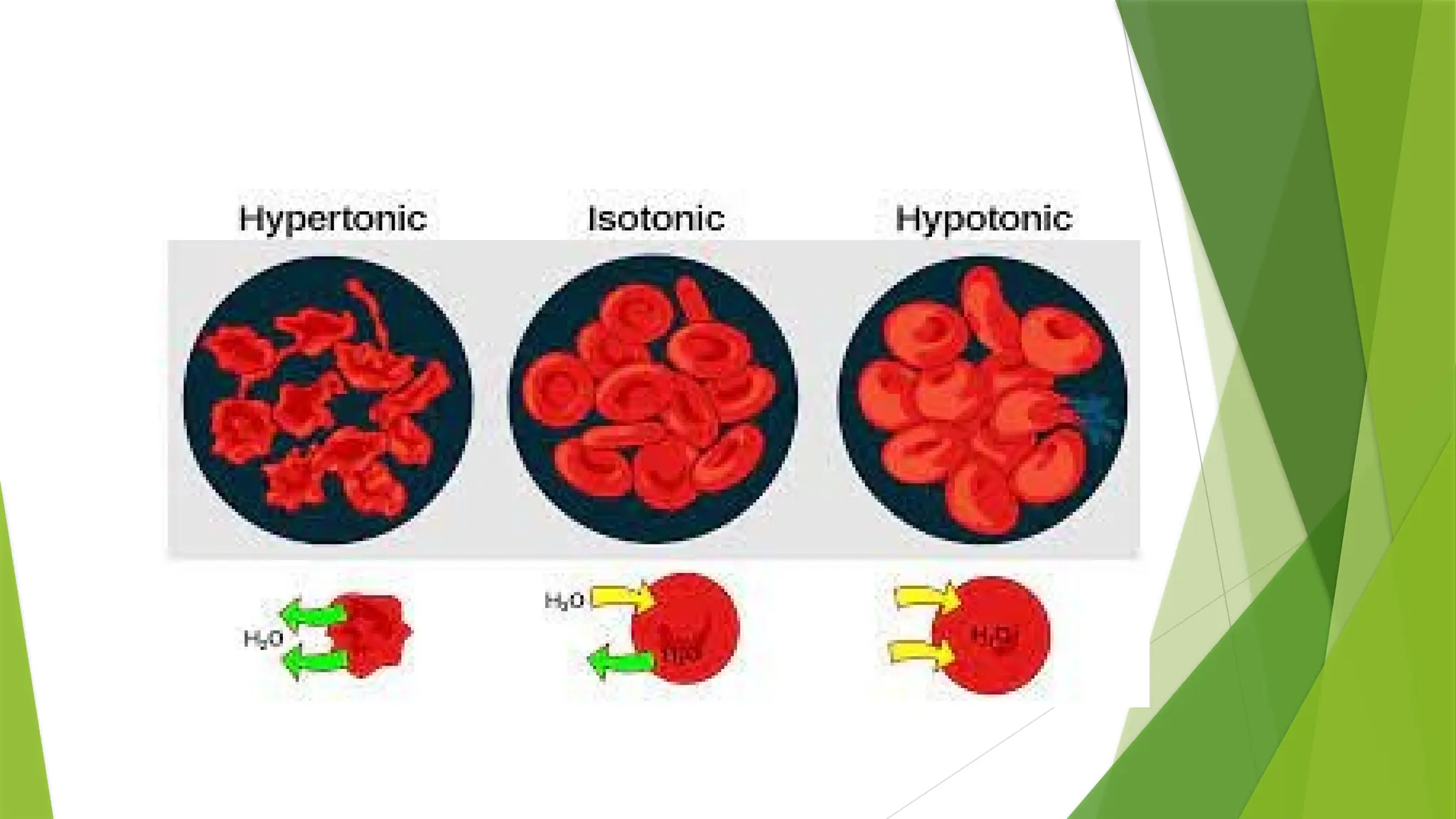
On the basis of osmotic pressure, -the solution can be
(i) Hypertonic solution A solution is called hypertonic if its
osmotic pressure is higher than that of the solution from which
it is separated by a semipermeable membrane.
When a plant cell is placed in a hypertonic solution, the fluid
from the plant cell comes out and cell shrinks, this
phenomenon is called plasmolysis.
(ii) Hypotonic solution A solution is called hypotonic if its
osmotic pressure is lower than that of the solution from which
it is separated by a semipermeable membrane.
(iii) Isotonic solution Two solutions are called isotonic if they
exert the same osmotic pressure. These solutions have same
molar concentration. 0.91% solution of pure NaCl is isotonic
with human RBC’s.
solution class.  12.pptx chemistry book 1 chapter 1

solution class. 12.pptx chemistry book 1 chapter 1

  • 1.
  • 2.
    Introduction A Solution isa homogenous mixture of two or more components. It is defined by using the terms solute and solvent. Solvent: The component that is present in largest quantity is called solvent. It determines the physical state of solution. Solute: One or more components present in solution other than solvent is called solute. Binary solutions: Solution consisting of two components only.
  • 3.
    Types of Solutions Accordingto the phase of solvent, a binary solution can be classified in following types: Types of Solutions Solute Solvent Examples Gaseous solutions Gas Gas Mixture of O2 and N2 Liquid Gas Chloroform mixed with N2 Gas Solid Gas Camphor in nitrogen gas Liquid Solutions Gas Liquid Oxygen dissolved in water Liquid Liquid Ethanol dissolved in water solid Liquid Glucose dissolved in water Solid Solutions Gas solid Solution of H2 and Pd Liquid solid Amalgam of Hg with Na Solid solid Alloy In this chapter we are mainly focusing on binary solutions (solution made up of two components) of liquid known as liquid solutions.
  • 5.
    Different Methods ofExpressing Concentration of Solutions The composition of solution is defined in terms of concentration. There are several ways to define concentration of solution as follows:
  • 11.
    Solubility Solubility of asubstance is the maximum amount that can be dissolved in given amount of solvent at specific temperature. Factors affecting the solubility: - Nature of solute - Nature of solvent - Temperature - Pressure Solubility of Solid in a Liquid Nature of solute and solvent: According to the nature of solute and solvent the solubility of solid in a liquid follow the principle “ Like dissolves like” If the nature of solute and solvent is same, the intermolecular force of interaction would be same. That helps in solubility of solute in solvent. Polar solute dissolves in polar solvent. For example: NaCl and sugar dissolves in water. Non-polar solute dissolves in non-polar solvent. For example: Naphthalene and anthracene dissolves in benzene not in water. Saturated solution: If the concentration of solute in solution remain constant at given set of temperature and pressure is called saturated solution. If we add more solute in it, it would precipitate out. Un-Saturated solution: If the concentration of solute in solution can increase at given set of temperature and pressure is called un-saturated solution. If we add more solute in it, it would get dissolve and increase the concentration of solution.
  • 12.
    Effect of temperature: Thesolubility of solute in solvent always follows the dynamic equilibrium. Solute + Solvent Solution. It follows the Le Chateliers principle for the change in temperature at dynamic equilibrium. If the solution is formed by giving heat means dissolution is endothermic. By increasing the temperature, the reaction will proceed in forward direction and solubility of solute increases. If the heat is released in formation of solute means dissolution is exothermic. By increasing the temperature, the reaction will proceed in backward direction and solubility of solute decreases. Effect of pressure: Pressure has no significant effect on solubility of solid in liquid.
  • 13.
    Solubility of Gasin a Liquid Nature of solute and solvent: Solubility of gas in liquid is also somewhat affected by nature of solute and solvent. Oxygen dissolves only a small extent in water but HCl is highly soluble in water because of polar nature of solute and solvent. Effect of pressure: Solubility of gas in liquid is highly affected by temperature and pressure. As the pressure of the gas above the surface of the liquid increases, it increases the solubility of gas in liquid. The quantitative relation of this equation is given by Henry’s Law. Effect of temperature: Dissolution of gas in a liquid is an exothermic process. As dissolution process involves dynamic equilibrium, it follows Le Chaterlier’s principle. Hence the solubility of gas in liquid, decreases with increase in temperature.
  • 14.
    Henry’s Law: It statesthat, “At constant temperature, the solubility of gas in a liquid is directly proportional to the partial pressure of the gas present above the surface of the liquid or solution.” If we consider mole fraction of gas in a solution to measure its solubility then it can be said that, “Mole fraction of gas in a liquid is proportional to the partial pressure of gas above the liquid or solution.” Now the Henry’s Law can be stated as , “ The partial pressure of a gas in vapour phase (p) is proportional to the mole fraction of gas(x) in solution.” Expression for Henry’s Law: p= KH. x KH is Henry’s Law constant
  • 15.
    Important point regardingHenry’s Law: •Different gases have different KH values at the same temperature. That is KH depends on the nature of gas. •Higher the value of KH at given pressure, lower is the solubility of gas in given liquid. •KH value of particular gas increases with increasing temperature. It indicates that solubility of gas decreases with increasing temperature. Applications of Henry’s Law: Some of the applications of Henry’s law are given. (i) To increase the solubility of CO2 in soft drinks and soda water, the bottles are sealed under high pressure. (ii) The air used for scuba diving is diluted with He to prevent the medical condition known as bends.
  • 16.
    •Molality (m) isthe number of moles of solute present in 1kg of solvent. •Molarity (M) is the number of moles of solute present in 1L of solution. •Normality is the number of gram equivalent of solute dissolved per litre of solution. •Solubility: It is the maximum amount that can be dissolved in a specified amount of solvent at a specified temperature. Raoult’s law: It states that “for a solution of volatile liquids the partial vapour pressure of each component in the solution is directly proportional to its mole fraction”.
  • 17.
    Answer. Skeltal chemicalequation are unbalanced. We need to balance chemical equation because of law of conservation of mass. It states that ‘matter can neither be created nor be destroyed’. Therefore chemical equation must be balanced in each and every chemical reaction. 1.“We need to balance a skeltal chemical equation.” Give reason to justify the statement. 2. Name the reducing agent in the following reaction: 3MnO2 + 4Al———— > 3Mn + 2Al2O3 State which is more reactive, Mn or A1 and why? 3.A Name the type of chemical reaction represented by the following equation:
  • 18.
    For a binarysolution of two components A and B, PA = XA PB = XB Where P0 A = vapour pressure of component A in pure state. PA = vapour pressure of component A in the solution. P0 B = vapour pressure of component B in pure state. PB = vapour pressure of component B in the solution Limitations of Raoult’s Law •Raoult’s law is applicable only to very dilute solutions. •It is applicable to solutions containing non-volatile solute only. •It is not applicable to solutes which dissociate or associate in a particular solution Raoult’s Law in Combination with Dalton’s Law of Partial Pressure: PT = XA P0 A + XB P0 B = P0 B + (P0 A -P0 B) XA Where PT = Total Vapour Pressure of the Solution.
  • 19.
    Ideal and Non-IdealSolutions: •Ideal Solution: ?These solutions obey Raoult’s law at all compositions of solute in solvent at all temperature Two liquids A and B form and ideal solution when A –A and B–B molecular attractions will be same and hence A–B molecular attraction will be almost same as A–A and B–B molecular attraction. For Ideal Solution: 1. dHmixing = 0, i.e. no heat should be absorbed or evolved during mixing 2. dVmixing = 0, i.e. no expansion or contraction on mixing Examples , Ethyl chloride and ethyl bromide, n–hexane and n–heptane , CCl4 and SiCl4
  • 20.
    •Non-Ideal Solution: ?These solutionsdeviate from ideal behaviour and do not obey Raoult’s law over entire range of composition. For non ideal solutions, 1. dHmixing ≠ 0 2. dHmixing ≠ 0 Here we may have two cases A) Positive Deviation: 1. PA > XA & PB > XB 2. dHmix > 0 3. dVmix > 0 Example: Cyclohexane and Ethanol
  • 21.
    B) Negative Deviation: 1.PA > XA & PB > XB 2. dHmix < 0 3. dVmix < 0
  • 22.
    The vapour pressuresof pure liquids A and B are 450 mm and 700 mm of Hg respectively at 350 K. Calculate the composition of the liquid mixture if total vapour pressure is 600 mm of Hg. Also find the composition in the vapour phase.
  • 23.
    Vapour pressure ofpure water at 298 K is 23.8 m m Hg. 50 g of urea (NH2CONH2) is dissolved in 850 g of water. Calculate the vapour pressure of water for this solution and its relative lowering.
  • 24.
    Elevation in BoilingPoint (ΔTb) Boiling point of a liquid is the temperature at which its vapour pressure becomes equal to the atmospheric pressure. As the vapour pressure of a solution containing a nonvolatile solute is lower than that of the pure solvent, it boiling point will be higher than that of the pure solvent as shown in figure. The increase in boiling point is known as elevation in boiling point, ΔTb ΔTb = Tb – T°b ΔTb = Kb m (where; m = molality) Kb is molal elevation constant or ebullioscopic constant. Molecular mass of solute can be calculated as where, WB and WA = mass of solute and solvent respectively. Kb has units of K / m or K kg mol-1 , for water, Kb = 0.52 K kg mol-1
  • 25.
    Osmotic Pressure (π) Osmosisis the phenomenon of spontaneous flow of the solvent molecules through a semipermeable membrane from pure solvent to solution or from a dilute solution to concentrated solution. It was first observed by Abbe Nollet. Some natural semipermeable membranes are animal bladder, cell membrane etc. CU2[Fe(CN)6],CELLULOSE AND ACETATE is an artificial semipermeable membrane which does not work in non-aqueous solutions as it dissolves in them. .
  • 26.
    Osmosis may be (i)Exosmosis It is outward flow of water or solvent from a cell through semipermeable membrane. (ii) Endosmosis It is inward flow of water or solvent from a cell through a semipermeable membrane
  • 27.
    Osmotic pressure ofa solution is equal to the external pressure applied on higher conc. side so as to just stop the process of osmosis. [External pressure = ∏ ]
  • 28.
    On the basisof osmotic pressure, -the solution can be (i) Hypertonic solution A solution is called hypertonic if its osmotic pressure is higher than that of the solution from which it is separated by a semipermeable membrane. When a plant cell is placed in a hypertonic solution, the fluid from the plant cell comes out and cell shrinks, this phenomenon is called plasmolysis. (ii) Hypotonic solution A solution is called hypotonic if its osmotic pressure is lower than that of the solution from which it is separated by a semipermeable membrane. (iii) Isotonic solution Two solutions are called isotonic if they exert the same osmotic pressure. These solutions have same molar concentration. 0.91% solution of pure NaCl is isotonic with human RBC’s.