UNIT-1: SOLUBILITY OF DRUGS
PHYSICAL PHARMACEUTICS – I
SecondYear B. Pharm
ABHISHEK JHA
Assistant Professor
Department of Pharmaceutics
DPU Dr. D.Y. Patil Institute of Pharmaceutical
Sciences and Research
Sant Tukaram Nagar, Pimpri, Pune-411018
08/13/2024
CONTENTS
 Solubility expressions
 Mechanism of solute solvent interactions
 Ideal solubility parameters
 Solvation & association
 Quantitative approach to the factors influencing solubility of drugs
 Diffusion principles in biological systems
 Solubility of solids in liquids
 Raoult’s law & real solutions
 Partially miscible liquids
 Distribution law
08/13/2024 3
SOLUBILITY
 The degree to which a substance dissolves in a solvent to make a solution is called
solubility
 A solution is a homogeneous mixture of one or more solutes dissolved in a solvent.
• solvent: the substance in which a solute dissolves to produce a homogeneous mixture
• solute: the substance that dissolves in a solvent to produce a homogeneous mixture
 Note that the solvent is the substance that is present in the greatest amount.
Many different kinds of solutions exist. For example, a solute can be a gas, a liquid or a solid. Solvents
can also be gases, liquids, or solids.
 Why solubility is important (application)
• Some separation methods (absorption, extraction) rely on differences in solubility, expressed as
the distribution coefficient (ratio of a material’s solubilities in two solvents). Generally, solubilities
of solids in liquids increase with temperature, and those of gases decrease with temperature and
increase with pressure. A solution in which no more solute can be dissolved at a given temperature
and pressure is said to be saturated.
08/13/2024 4
SOLUBILITY
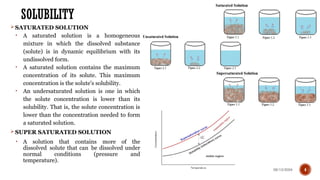
SATURATED SOLUTION
• A saturated solution is a homogeneous
mixture in which the dissolved substance
(solute) is in dynamic equilibrium with its
undissolved form.
• A saturated solution contains the maximum
concentration of its solute. This maximum
concentration is the solute's solubility.
• An undersaturated solution is one in which
the solute concentration is lower than its
solubility. That is, the solute concentration is
lower than the concentration needed to form
a saturated solution.
SUPER SATURATED SOLUTION
• A solution that contains more of the
dissolved solute that can be dissolved under
normal conditions (pressure and
temperature).
08/13/2024 5
HOW SOLUBILITY IS EXPRESSED
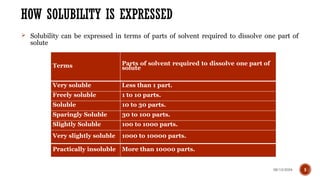
 Solubility can be expressed in terms of parts of solvent required to dissolve one part of
solute
Terms Parts of solvent required to dissolve one part of
solute
Very soluble Less than 1 part.
Freely soluble 1 to 10 parts.
Soluble 10 to 30 parts.
Sparingly Soluble 30 to 100 parts.
Slightly Soluble 100 to 1000 parts.
Very slightly soluble 1000 to 10000 parts.
Practically insoluble More than 10000 parts.
08/13/2024 6
SOLUBILITY EXPRESSIONS CONT.
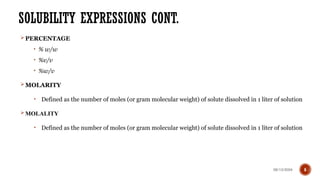
PERCENTAGE
• % w/w
• %v/v
• %w/v
MOLARITY
• Defined as the number of moles (or gram molecular weight) of solute dissolved in 1 liter of solution
MOLALITY
• Defined as the number of moles (or gram molecular weight) of solute dissolved in 1 liter of solution
08/13/2024 7
SOLUBILITY OF GASES IN LIQUIDS
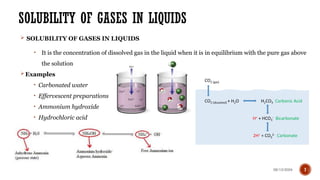
 SOLUBILITY OF GASES IN LIQUIDS
• It is the concentration of dissolved gas in the liquid when it is in equilibrium with the pure gas above
the solution
Examples
• Carbonated water
• Effervescent preparations
• Ammonium hydroxide
• Hydrochloric acid
08/13/2024 8
FACTORS AFFECTING SOLUBILITY
Pressure, Temperature, Presence of Salt, and Chemical reactions are a few of the major factors that
affect the solubility of gases in liquids
PRESSURE
 The effect of pressure on the solubility of gas in a liquid is explained by Henry’s law
 Henry’s law explains the solubility of a gas in a liquid solution by partial pressure and mole fraction of the
gas in the liquid. However, this only holds true for dilute solutions and low gas pressures.
 It states that “the partial pressure applied by any gas on a liquid surface is directly
proportional to its mole fraction present in a liquid solvent.”
 Henry’s law is found experimentally to hold for all dilute solutions in which the molecular species is the same
in the solution as in the gas. The most conspicuous, apparent exception is the class of electrolytic solutions.
08/13/2024 9
PRESSURE cont.
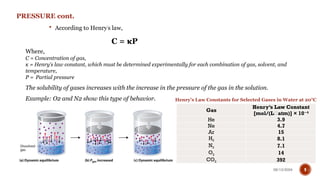
 According to Henry’
s law,
C = κP
Where,
C = Concentration of gas,
κ = Henry’s law constant, which must be determined experimentally for each combination of gas, solvent, and
temperature,
P = Partial pressure
The solubility of gases increases with the increase in the pressure of the gas in the solution.
Example: O2 and N2 show this type of behavior.
Gas
Henry’s Law Constant
[mol/(L·atm)] × 10 4
−
He 3.9
Ne 4.7
Ar 15
H2 8.1
N2 7.1
O2 14
CO2 392
Henry’s Law Constants for Selected Gases in Water at 20°C
08/13/2024 10
 Gases that react chemically with water, such as HCl and the other hydrogen halides, H2S,
and NH3, do not obey Henry’s law. They are much more soluble than predicted by Henry’s
law.
 For example, HCl reacts with water to give H+(aq) and Cl−(aq), not dissolved HCl molecules,
and its dissociation into ions results in a much higher solubility than expected for a neutral
molecule.
 Henry’s law has important applications. For example, bubbles of CO2 form as soon as
a carbonated beverage is opened because the drink was bottled under CO2 at a pressure
greater than 1 atm. When the bottle is opened, the pressure of CO2 above the solution drops
rapidly, and some of the dissolved gas escapes from the solution as bubbles.
 Henry’s law also explains why scuba divers have to be careful to ascend to the surface slowly
after a dive if they are breathing compressed air. At higher pressures underwater, more N2
from the air dissolves in the diver’s internal fluids. If the diver ascends too quickly, the rapid
pressure change causes small bubbles of N2 to form throughout the body, a condition known
as “the bends.” These bubbles can block the flow of blood through the small blood vessels,
causing great pain and even proving fatal in some cases.
08/13/2024 11
 Due to the low Henry’s law constant for O2 in water, the levels of dissolved oxygen in water
are too low to support the energy needs of multicellular organisms, including humans. To
increase the O2 concentration in internal fluids, organisms synthesize highly soluble carrier
molecules that bind to O2 reversibly called hemoglobin.
 Hemoglobin facilitates the transport of O2 from the lungs to the tissues.
 The concentration of hemoglobin in normal blood is about 2.2 mM, and each hemoglobin
molecule can bind four O2 molecules. Although the concentration of dissolved O2 in blood
serum at 37°C (normal body temperature) is only 0.010 mM, the total dissolved O2
concentration is 8.8 mM, almost a thousand times greater than would be possible without
hemoglobin.
 Synthetic oxygen carriers based on fluorinated alkanes have been developed for use as an
emergency replacement for whole blood. Unlike donated blood, these “blood substitutes” do
not require refrigeration and have a long shelf life.
 Their very high Henry’s law constants for O2 result in dissolved oxygen concentrations
comparable to those in normal blood.
08/13/2024 12
TEMPERATURE
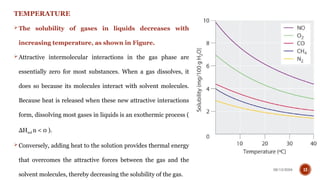
The solubility of gases in liquids decreases with
increasing temperature, as shown in Figure.
Attractive intermolecular interactions in the gas phase are
essentially zero for most substances. When a gas dissolves, it
does so because its molecules interact with solvent molecules.
Because heat is released when these new attractive interactions
form, dissolving most gases in liquids is an exothermic process (
ΔHsol n < 0 ).
Conversely, adding heat to the solution provides thermal energy
that overcomes the attractive forces between the gas and the
solvent molecules, thereby decreasing the solubility of the gas.
08/13/2024 13
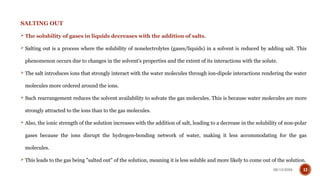
SALTING OUT
 The solubility of gases in liquids decreases with the addition of salts.
 Salting out is a process where the solubility of nonelectrolytes (gases/liquids) in a solvent is reduced by adding salt. This
phenomenon occurs due to changes in the solvent's properties and the extent of its interactions with the solute.
 The salt introduces ions that strongly interact with the water molecules through ion-dipole interactions rendering the water
molecules more ordered around the ions.
 Such rearrangement reduces the solvent availability to solvate the gas molecules. This is because water molecules are more
strongly attracted to the ions than to the gas molecules.
 Also, the ionic strength of the solution increases with the addition of salt, leading to a decrease in the solubility of non-polar
gases because the ions disrupt the hydrogen-bonding network of water, making it less accommodating for the gas
molecules.
 This leads to the gas being "salted out" of the solution, meaning it is less soluble and more likely to come out of the solution.
08/13/2024 14
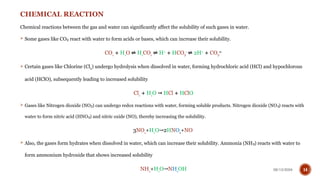
CHEMICAL REACTION
Chemical reactions between the gas and water can significantly affect the solubility of such gases in water.
 Some gases like CO react with water to form acids or bases, which can increase their solubility.
₂
CO₂ + H₂O ⇌ H₂CO₃ ⇌ H+
+ HCO3
-
⇌ 2H+
+ CO3
2-
 Certain gases like Chlorine (Cl2) undergo hydrolysis when dissolved in water, forming hydrochloric acid (HCl) and hypochlorous
acid (HClO), subsequently leading to increased solubility
Cl₂ + H₂O → HCl + HClO
 Gases like Nitrogen dioxide (NO ) can undergo redox reactions with water, forming soluble products. Nitrogen dioxide (NO ) reacts with
₂ ₂
water to form nitric acid (HNO ) and nitric oxide (NO), thereby increasing the solubility.
₃
3NO₂+H₂O 2
→ HNO₃+NO
 Also, the gases form hydrates when dissolved in water, which can increase their solubility. Ammonia (NH ) reacts with water to
₃
form ammonium hydroxide that shows increased solubility
NH₃+H₂O→NH₄OH
08/13/2024 15
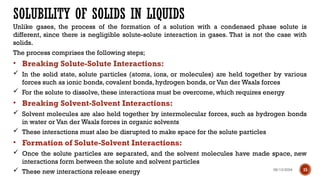
SOLUBILITY OF SOLIDS IN LIQUIDS
Unlike gases, the process of the formation of a solution with a condensed phase solute is
different, since there is negligible solute-solute interaction in gases. That is not the case with
solids.
The process comprises the following steps;
• Breaking Solute-Solute Interactions:
 In the solid state, solute particles (atoms, ions, or molecules) are held together by various
forces such as ionic bonds, covalent bonds, hydrogen bonds, or Van der Waals forces
 For the solute to dissolve, these interactions must be overcome, which requires energy
• Breaking Solvent-Solvent Interactions:
 Solvent molecules are also held together by intermolecular forces, such as hydrogen bonds
in water or Van der Waals forces in organic solvents
 These interactions must also be disrupted to make space for the solute particles
• Formation of Solute-Solvent Interactions:
 Once the solute particles are separated, and the solvent molecules have made space, new
interactions form between the solute and solvent particles
 These new interactions release energy
08/13/2024 16
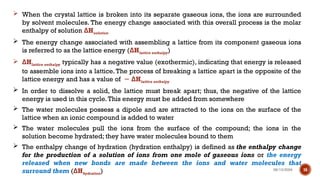
 When the crystal lattice is broken into its separate gaseous ions, the ions are surrounded
by solvent molecules. The energy change associated with this overall process is the molar
enthalpy of solution H
Δ solution
 The energy change associated with assembling a lattice from its component gaseous ions
is referred to as the lattice energy ( H
Δ lattice enthalpy)
 H
Δ lattice enthalpy typically has a negative value (exothermic), indicating that energy is released
to assemble ions into a lattice. The process of breaking a lattice apart is the opposite of the
lattice energy and has a value of − H
Δ lattice enthalpy
 In order to dissolve a solid, the lattice must break apart; thus, the negative of the lattice
energy is used in this cycle.This energy must be added from somewhere
 The water molecules possess a dipole and are attracted to the ions on the surface of the
lattice when an ionic compound is added to water
 The water molecules pull the ions from the surface of the compound; the ions in the
solution become hydrated; they have water molecules bound to them
 The enthalpy change of hydration (hydration enthalpy) is defined as the enthalpy change
for the production of a solution of ions from one mole of gaseous ions or the energy
released when new bonds are made between the ions and water molecules that
surround them ( H
Δ hydration)
08/13/2024 17
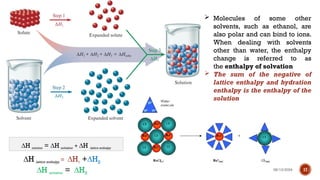
∆H solution = ∆H solvation + ∆H lattice enthalpy
∆H lattice enthalpy = ∆H1 +∆H2
∆H solvation = ∆H3
 Molecules of some other
solvents, such as ethanol, are
also polar and can bind to ions.
When dealing with solvents
other than water, the enthalpy
change is referred to as
the enthalpy of solvation
 The sum of the negative of
lattice enthalpy and hydration
enthalpy is the enthalpy of the
solution
08/13/2024 18
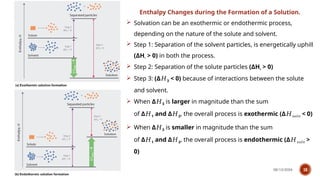
Enthalpy Changes during the Formation of a Solution.
 Solvation can be an exothermic or endothermic process,
depending on the nature of the solute and solvent.
 Step 1: Separation of the solvent particles, is energetically uphill
(ΔH1 > 0) in both the process.
 Step 2: Separation of the solute particles (ΔH2
> 0)
 Step 3: (Δ𝐻3 < 0) because of interactions between the solute
and solvent.
 When Δ𝐻3 is larger in magnitude than the sum
of Δ𝐻1 and Δ𝐻2, the overall process is exothermic (Δ𝐻𝑠𝑜𝑙𝑛 < 0)
 When Δ𝐻3 is smaller in magnitude than the sum
of Δ𝐻1 and Δ𝐻2, the overall process is endothermic (Δ𝐻𝑠𝑜𝑙𝑛 >
0)
08/13/2024 19
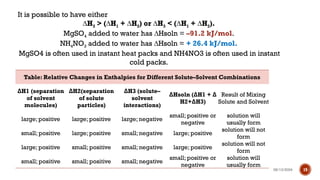
Table: Relative Changes in Enthalpies for Different Solute–Solvent Combinations
H1 (separation
Δ
of solvent
molecules)
H2(separation
Δ
of solute
particles)
H3 (solute–
Δ
solvent
interactions)
ΔHsoln (ΔH1 + Δ
H2+ΔH3)
Result of Mixing
Solute and Solvent
large; positive large; positive large; negative
small; positive or
negative
solution will
usually form
small; positive large; positive small; negative large; positive
solution will not
form
large; positive small; positive small; negative large; positive
solution will not
form
small; positive small; positive small; negative
small; positive or
negative
solution will
usually form
It is possible to have either
∆H3 > (∆H1 + ∆H2) or ∆H3 < (∆H1 + ∆H2).
MgSO4 added to water has ∆Hsoln = –91.2 kJ/mol.
NH4NO3 added to water has ∆Hsoln = + 26.4 kJ/mol.
MgSO4 is often used in instant heat packs and NH4NO3 is often used in instant
cold packs.
08/13/2024 20
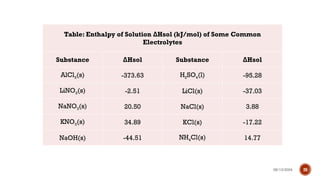
Table: Enthalpy of Solution Hsol (kJ/mol) of Some Common
Δ
Electrolytes
Substance ΔHsol Substance ΔHsol
AlCl3(s) -373.63 H2SO4(l) -95.28
LiNO3(s) -2.51 LiCl(s) -37.03
NaNO3(s) 20.50 NaCl(s) 3.88
KNO3(s) 34.89 KCl(s) -17.22
NaOH(s) -44.51 NH4Cl(s) 14.77
08/13/2024 21
 The enthalpy change that accompanies a process is important because processes that
release substantial amounts of energy tend to occur spontaneously.
 A second property of any system, its entropy, is also important in helping us determine
whether a given process occurs spontaneously
 The entropy ( )
𝑆 is a thermodynamic property of all substances that is proportional to
their degree of disorder.
 A perfect crystal at 0 K, whose atoms are regularly arranged in a perfect lattice and are
motionless, has an entropy of zero.
 In contrast, gases have large positive entropies because their molecules are highly
disordered and in constant motion at high speeds.
 The formation of a solution disperses molecules, atoms, or ions of one kind throughout
a second substance, which generally increases the disorder and results in an increase
in the entropy of the system.
 Thus, entropic factors almost always favor the formation of a solution.
 In contrast, a change in enthalpy may or may not favor solution formation.
ENTROPY AS A DRIVING FORCE FOR THE FORMATION OF THE SOLUTION
08/13/2024 22
 The entropy of a system increases when a solute dissolves, as it becomes more disordered
as the ions spread out through the solution.
 An increase in entropy favours dissolving- even if a small amount of energy is needed.
 So substances with a small positive enthalpy change of solution are still able to dissolve,
provided there is a sufficient increase in entropy.
 This can be used to explain why salt (NaCl) dissolves, but calcium carbonate (chalk) does
not.
 When salt dissolves there is a large increase in entropy, which counteracts the small
positive enthalpy change of solution value that it has.
 Calcium carbonate, on the other hand, has a small negative enthalpy change of solution;
however a decrease in entropy results from it dissolving and so it is insoluble in water.
 The decrease in entropy occurs because the solvent, water, is becoming more ordered as
the water molecules cluster around the doubly charged ions.
ENTROPY OF SOLUTIONS Cont.
08/13/2024 23
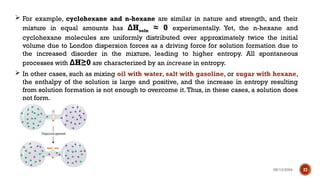
 For example, cyclohexane and n-hexane are similar in nature and strength, and their
mixture in equal amounts has H
Δ soln ≈ 0 experimentally. Yet, the n-hexane and
cyclohexane molecules are uniformly distributed over approximately twice the initial
volume due to London dispersion forces as a driving force for solution formation due to
the increased disorder in the mixture, leading to higher entropy. All spontaneous
processes with H≥0
Δ are characterized by an increase in entropy.
 In other cases, such as mixing oil with water, salt with gasoline, or sugar with hexane,
the enthalpy of the solution is large and positive, and the increase in entropy resulting
from solution formation is not enough to overcome it. Thus, in these cases, a solution does
not form.
08/13/2024 24
THE SOLVATION PROCESS
Ion-Dipole Interactions:
For ionic solutes (e.g., NaCl in water), the positive and negative ions are surrounded by solvent molecules. In
water, the negative oxygen ends of water molecules surround positive ions, and the positive hydrogen ends
surround negative ions.
Hydrogen Bonding:
For solutes that can form hydrogen bonds (e.g., sugar in water), the hydrogen bonding between solute
molecules and water molecules helps to pull the solute molecules into solution.
Van der Waals Forces:
For nonpolar solutes in nonpolar solvents (e.g., iodine in hexane), Van der Waals forces (induced dipole-
induced dipole interactions) facilitate the dissolution.
Dissolution Equilibrium:
The process of dissolution reaches a dynamic equilibrium where the rate of solute particles dissolving equals
the rate of solute particles re-precipitating from the solution.
The concentration of solute in the solvent at this point is referred to as the solubility of the solute
(SATURATION SOLUBILITY)
08/13/2024 25
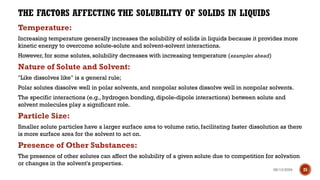
Temperature:
Increasing temperature generally increases the solubility of solids in liquids because it provides more
kinetic energy to overcome solute-solute and solvent-solvent interactions.
However, for some solutes, solubility decreases with increasing temperature (examples ahead)
Nature of Solute and Solvent:
"Like dissolves like" is a general rule;
Polar solutes dissolve well in polar solvents, and nonpolar solutes dissolve well in nonpolar solvents.
The specific interactions (e.g., hydrogen bonding, dipole-dipole interactions) between solute and
solvent molecules play a significant role.
Particle Size:
Smaller solute particles have a larger surface area to volume ratio, facilitating faster dissolution as there
is more surface area for the solvent to act on.
Presence of Other Substances:
The presence of other solutes can affect the solubility of a given solute due to competition for solvation
or changes in the solvent's properties.
THE FACTORS AFFECTING THE SOLUBILITY OF SOLIDS IN LIQUIDS
08/13/2024 26
TEMPERATURE
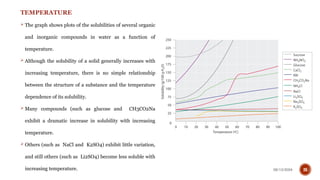
 The graph shows plots of the solubilities of several organic
and inorganic compounds in water as a function of
temperature.
 Although the solubility of a solid generally increases with
increasing temperature, there is no simple relationship
between the structure of a substance and the temperature
dependence of its solubility.
 Many compounds (such as glucose and CH3CO2Na
exhibit a dramatic increase in solubility with increasing
temperature.
 Others (such as NaCl and K2SO4) exhibit little variation,
and still others (such as Li2SO4) become less soluble with
increasing temperature.
08/13/2024 27
TEMPERATURE
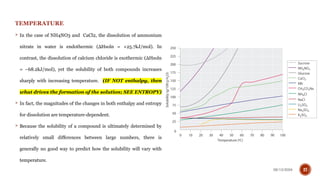
 In the case of NH4NO3 and CaCl2, the dissolution of ammonium
nitrate in water is endothermic (ΔHsoln = +25.7kJ/mol). In
contrast, the dissolution of calcium chloride is exothermic (ΔHsoln
= −68.2kJ/mol), yet the solubility of both compounds increases
sharply with increasing temperature. (IF NOT enthalpy, then
what drives the formation of the solution; SEE ENTROPY)
 In fact, the magnitudes of the changes in both enthalpy and entropy
for dissolution are temperature-dependent.
 Because the solubility of a compound is ultimately determined by
relatively small differences between large numbers, there is
generally no good way to predict how the solubility will vary with
temperature.
08/13/2024 28
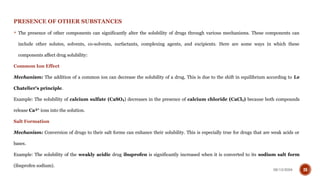
PRESENCE OF OTHER SUBSTANCES
 The presence of other components can significantly alter the solubility of drugs through various mechanisms. These components can
include other solutes, solvents, co-solvents, surfactants, complexing agents, and excipients. Here are some ways in which these
components affect drug solubility:
Common Ion Effect
Mechanism: The addition of a common ion can decrease the solubility of a drug. This is due to the shift in equilibrium according to Le
Chatelier's principle.
Example: The solubility of calcium sulfate (CaSO₄) decreases in the presence of calcium chloride (CaCl )
₂ because both compounds
release Ca²⁺ ions into the solution.
Salt Formation
Mechanism: Conversion of drugs to their salt forms can enhance their solubility. This is especially true for drugs that are weak acids or
bases.
Example: The solubility of the weakly acidic drug ibuprofen is significantly increased when it is converted to its sodium salt form
(ibuprofen sodium).
08/13/2024 29
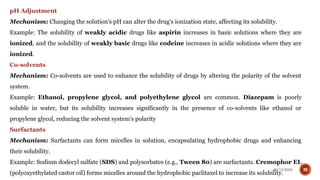
pH Adjustment
Mechanism: Changing the solution's pH can alter the drug's ionization state, affecting its solubility.
Example: The solubility of weakly acidic drugs like aspirin increases in basic solutions where they are
ionized, and the solubility of weakly basic drugs like codeine increases in acidic solutions where they are
ionized.
Co-solvents
Mechanism: Co-solvents are used to enhance the solubility of drugs by altering the polarity of the solvent
system.
Example: Ethanol, propylene glycol, and polyethylene glycol are common. Diazepam is poorly
soluble in water, but its solubility increases significantly in the presence of co-solvents like ethanol or
propylene glycol, reducing the solvent system’s polarity
Surfactants
Mechanism: Surfactants can form micelles in solution, encapsulating hydrophobic drugs and enhancing
their solubility.
Example: Sodium dodecyl sulfate (SDS) and polysorbates (e.g., Tween 80) are surfactants. Cremophor EL
(polyoxyethylated castor oil) forms micelles around the hydrophobic paclitaxel to increase its solubility.
08/13/2024 30
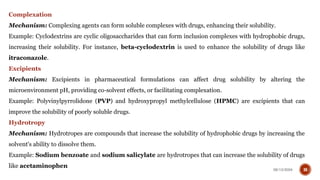
Complexation
Mechanism: Complexing agents can form soluble complexes with drugs, enhancing their solubility.
Example: Cyclodextrins are cyclic oligosaccharides that can form inclusion complexes with hydrophobic drugs,
increasing their solubility. For instance, beta-cyclodextrin is used to enhance the solubility of drugs like
itraconazole.
Excipients
Mechanism: Excipients in pharmaceutical formulations can affect drug solubility by altering the
microenvironment pH, providing co-solvent effects, or facilitating complexation.
Example: Polyvinylpyrrolidone (PVP) and hydroxypropyl methylcellulose (HPMC) are excipients that can
improve the solubility of poorly soluble drugs.
Hydrotropy
Mechanism: Hydrotropes are compounds that increase the solubility of hydrophobic drugs by increasing the
solvent's ability to dissolve them.
Example: Sodium benzoate and sodium salicylate are hydrotropes that can increase the solubility of drugs
like acetaminophen
08/13/2024 31
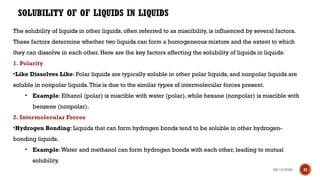
The solubility of liquids in other liquids, often referred to as miscibility, is influenced by several factors.
These factors determine whether two liquids can form a homogeneous mixture and the extent to which
they can dissolve in each other. Here are the key factors affecting the solubility of liquids in liquids:
1. Polarity
•Like Dissolves Like: Polar liquids are typically soluble in other polar liquids, and nonpolar liquids are
soluble in nonpolar liquids.This is due to the similar types of intermolecular forces present.
• Example: Ethanol (polar) is miscible with water (polar), while hexane (nonpolar) is miscible with
benzene (nonpolar).
2. Intermolecular Forces
•Hydrogen Bonding: Liquids that can form hydrogen bonds tend to be soluble in other hydrogen-
bonding liquids.
• Example:Water and methanol can form hydrogen bonds with each other, leading to mutual
solubility.
SOLUBILITY OF OF LIQUIDS IN LIQUIDS
08/13/2024 32
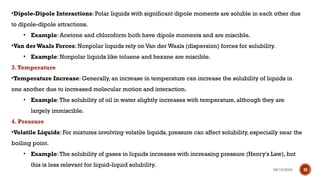
•Dipole-Dipole Interactions: Polar liquids with significant dipole moments are soluble in each other due
to dipole-dipole attractions.
• Example: Acetone and chloroform both have dipole moments and are miscible.
•Van der Waals Forces: Nonpolar liquids rely on Van der Waals (dispersion) forces for solubility.
• Example: Nonpolar liquids like toluene and hexane are miscible.
3.Temperature
•Temperature Increase: Generally, an increase in temperature can increase the solubility of liquids in
one another due to increased molecular motion and interaction.
• Example:The solubility of oil in water slightly increases with temperature, although they are
largely immiscible.
4. Pressure
•Volatile Liquids: For mixtures involving volatile liquids, pressure can affect solubility, especially near the
boiling point.
• Example:The solubility of gases in liquids increases with increasing pressure (Henry's Law), but
this is less relevant for liquid-liquid solubility.
08/13/2024 33
5. Nature of the Solvent and Solute
•Molecular Size and Shape: Similar-sized and shaped molecules are often more soluble in each other.
• Example: Ethylene glycol and glycerol are both polar and similarly structured, leading to high
mutual solubility.
•Functional Groups:The presence of functional groups that can interact (e.g., hydroxyl, carboxyl)
increases solubility.
• Example:The hydroxyl groups in ethanol and water enhance their miscibility through hydrogen
bonding.
6. Presence of Other Substances
•Co-solvents:The addition of a third component (co-solvent) can enhance solubility by altering the
solvent environment.
• Example:The solubility of phenol in water increases with the addition of acetone as a co-solvent.
7. Impurities: Impurities can either increase or decrease solubility, depending on their nature and
interaction with the primary liquids.
• Example: Adding a salt to a water-alcohol mixture can change the solubility dynamics due to
ion-dipole interactions.
08/13/2024 34
Examples and Applications
1.Ethanol and Water
1. Polarity and Hydrogen Bonding: Both ethanol and water are polar and can form hydrogen
bonds, making them completely miscible in all proportions.
2. Temperature Effect: The miscibility remains high across a wide range of temperatures,
demonstrating a strong hydrogen bonding network.
2.Oil and Water
1. Polarity: Oil is nonpolar, while water is polar, resulting in immiscibility due to the lack of
significant intermolecular interactions.
2. Temperature Effect: Temperature changes have minimal impact on their immiscibility because
the fundamental intermolecular force disparity remains.
3.Acetone and Water
1. Polarity: Acetone is polar and can form hydrogen bonds with water, making them miscible.
2. Co-solvent Addition: Adding a nonpolar solvent like hexane can decrease acetone’s solubility in
water by disrupting hydrogen bonding.
08/13/2024 35
Eutectic mixtures are homogeneous mixtures of two or more components that, at certain compositions,
exhibit a lower melting point than any of the individual components or any other mixture of the same
substances.This unique composition is known as the eutectic composition, and the temperature at which it
melts is called the eutectic temperature. Eutectic mixtures are characterized by the simultaneous
crystallization of all components at the eutectic temperature.
Characteristics of Eutectic Mixtures
1.Lower Melting Point: The eutectic mixture has a melting point lower than any of the pure components
or other mixtures of the same substances.
2.Simultaneous Crystallization: At the eutectic temperature, all components of the mixture crystallize
together from the liquid phase.
3.Definite Composition: The eutectic composition is fixed for a given mixture and is independent of the
initial proportions of the components.
EUTECTIC MIXTURES
08/13/2024 36
Examples of Eutectic Mixtures
1.Salt and Water (Freezing Point Depression)
1. A common example of a eutectic mixture is the combination of salt (sodium chloride, NaCl) and water.
The eutectic temperature for this mixture is -21.2°C, and it occurs at a specific concentration of salt in
water.
2. This principle is used for de-icing roads, where salt is spread to lower the melting point of ice, causing it
to melt at lower temperatures.
2.Bismuth and Tin (Solder)
1. Bismuth (Bi) and tin (Sn) can form a eutectic mixture that melts at 139°C, which is lower than the melting
points of either pure bismuth (271°C) or pure tin (232°C).
2. This eutectic mixture is used in soldering because it melts and solidifies at a relatively low temperature,
which is beneficial for joining metal components without damaging them.
3.Menthol and Camphor
1. Menthol and camphor can form a eutectic mixture that melts at a lower temperature than either
component alone.This mixture is used in topical formulations for its cooling and soothing properties.
08/13/2024 37
4. Ibuprofen and Paracetamol
In the pharmaceutical industry, a eutectic mixture of ibuprofen and paracetamol can be formed. This
mixture has a lower melting point than either of the individual drugs
5. Lidocaine and Prilocaine
Lidocaine and prilocaine form a eutectic mixture used in topical anesthetics (e.g., EMLA cream). The eutectic
mixture melts at a lower temperature, allowing the cream to be applied at room temperature and
providing effective local anesthesia.
Importance and Applications
•Pharmaceuticals: Eutectic mixtures can improve the solubility and bioavailability of drugs.
•Metallurgy: Eutectic alloys are used in applications requiring low melting points, such as soldering and
casting.
•Food Industry: Eutectic principles are used in the formulation of certain frozen desserts and in the
preservation of foods through freezing.
08/13/2024 38
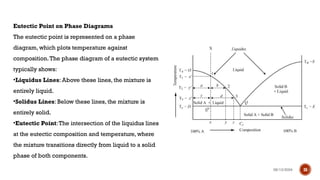
Eutectic Point on Phase Diagrams
The eutectic point is represented on a phase
diagram, which plots temperature against
composition.The phase diagram of a eutectic system
typically shows:
•Liquidus Lines: Above these lines, the mixture is
entirely liquid.
•Solidus Lines: Below these lines, the mixture is
entirely solid.
•Eutectic Point:The intersection of the liquidus lines
at the eutectic composition and temperature, where
the mixture transitions directly from liquid to a solid
phase of both components.
08/13/2024 39
When two or more liquids are mixed together, they can be
• completely miscible
• partially miscible, or
• practically immiscible.
1. Completely miscible liquids mix uniformly in all proportions and, hence, do not get
separated.
2. Partially miscible liquids form two immiscible liquid layers, each of which is a saturated
solution of one liquid in the other. Such liquid pairs are called conjugated liquid pairs.The
mutual solubility of partially miscible liquids, being temperature-specific, is affected by
changes in temperature.
For binary phase systems, such as the phenol-water system, the mutual solubility of two
conjugate liquid phases increases with an increase in temperature called conjugate
temperature, whereas above this temperature, they are soluble in any proportions.
Other examples of partial miscibility include conjugate liquid pair of nicotine and water, ether
and water, and triethanolamine and water.
3. Immiscibility refers to those systems which do not mix with each other at all such as water
and liquid paraffin or water and oil.
BINARY SOLUTIONS
08/13/2024 40
• It is a known fact that the polarity of solvent is dependent on the dielectric constant.
• Also, remember that LIKE DISSOLVES LIKE.
• The influence of a foreign substance on a liquid-liquid system is like the idea of the three-
component system in the phase rule.
• Ternary systems are produced by the addition of a third component to a pair of partially
miscible liquids to produce a solution.
• If the added component is soluble in only one of the two components or if its solubility in the
two liquids is markedly different, the mutual solubility of the liquid pair is decreased. If the
added solute is roughly soluble in both liquids approximately to the same extent, then the
mutual solubility of the liquid pair is increased.This is called blending.
• An example of this is when succinic acid is added to the phenol-water mixture. The succinic
acid is soluble or completely miscible in each phenol and water therefore, it causes a blending
of the liquids making the mixture one phase
TERNARY SOLUTIONS
08/13/2024 41
The solubility of drugs in a solvent, particularly in biological systems like the human body, is
influenced by several factors. These factors determine how effectively a drug can be absorbed,
distributed, metabolized, and excreted. Here are the key factors affecting drug solubility:
1. Chemical Structure of the Drug
•Polarity: Polar drugs dissolve better in polar solvents (like water), while nonpolar drugs dissolve
better in nonpolar solvents (like lipids).
•Functional Groups: Functional groups such as hydroxyl (–OH), amine (–NH ), and carboxyl (–
₂
COOH) can form hydrogen bonds with water, increasing solubility.
•Molecular Size and Shape: Smaller and more compact molecules are generally more soluble
than larger, bulkier ones.
2. pH and pKa of the Drug
•Ionization: The degree to which a drug ionizes depends on the pH of the solvent and the drug's
pKa. Ionized drugs are generally more soluble in water but less able to permeate cell
membranes.
•pH Adjustment: Adjusting the pH of the solution to favor the ionized form of the drug can
increase its solubility.
FACTORS AFFECTING SOLUBILITY OF DRUGS
08/13/2024 42
3.Temperature
• Endothermic Dissolution: For most drugs, solubility increases with temperature if the
dissolution process is endothermic.
• Exothermic Dissolution: If the dissolution process is exothermic, solubility may decrease
with increasing temperature.
4. Solvent Properties
• Solvent Polarity: The polarity of the solvent should match the polarity of the drug for better
solubility.
• Dielectric Constant: A higher dielectric constant generally means a better ability to dissolve
ionic and polar substances.
• Cosolvents: Using a mixture of solvents (e.g., water and ethanol) can enhance solubility.
5. Presence of Surfactants
• Micelle Formation: Surfactants can form micelles that encapsulate hydrophobic drugs,
increasing their apparent solubility in water.
6. Particle Size and Surface Area
• Particle Size Reduction: Smaller particles have a larger surface area to volume ratio, which
can enhance dissolution rates and solubility.
FACTORS AFFECTING SOLUBILITY OF DRUGS Cont.
08/13/2024 43
7. Complexation
•Cyclodextrins: These cyclic oligosaccharides can form inclusion complexes with drugs,
improving their solubility and stability.
•Metal Complexes: Forming complexes with metals can also enhance solubility.
8. Salt Formation
•Salts vs. Free Base/Acid: Converting a drug into its salt form (e.g., hydrochloride, sulfate) can
significantly enhance its solubility compared to its free base or acid form
9. Crystal Form (Polymorphism)
•Polymorphs: Different crystalline forms of a drug can have varying solubilities. Generally,
amorphous forms are more soluble than crystalline forms.
10. Hydration and Solvation
•Hydrated Forms: Drugs that form hydrates may have different solubilities compared to their
anhydrous forms.
•Solvation: The extent and nature of solvation (interaction with solvent molecules) can affect
solubility.
FACTORS AFFECTING SOLUBILITY OF DRUGS Cont.
08/13/2024 44
11. Presence of Other Solutes (Additives)
• Common Ion Effect:The presence of a common ion can reduce the solubility of a drug.
• Additives: Certain additives (e.g., sugars, buffers) can enhance solubility by interacting with
the drug or the solvent.
12. Physical and Chemical Stability
• Degradation: Drugs that degrade in solution can have lower effective solubility.
• Stability Enhancers: Additives that stabilize the drug in solution can improve solubility.
Understanding these factors is crucial for the effective formulation of drugs, ensuring they
are sufficiently soluble to be absorbed and exert their therapeutic effects.
FACTORS AFFECTING SOLUBILITY OF DRUGS Cont.
08/13/2024 45
• Although three types of liquid/liquid systems are commonly encountered, liquid-liquid systems
are mainly divided into two categories depending on the solubility of one substance in the other.
The categories are Miscible: mix in all proportions (water and ethyl alcohol or acetone )
• Immiscible: water and mercury
• Partially miscible: phenol and water
• The mutual solubility or miscibility of two liquids is a function of temperature and composition.
• When two liquids (liquid A and liquid B) are partially soluble in each other, two liquid phases can
be observed.
• At equilibrium, each phase contains liquid A and liquid B in amounts that reflect their mutual
solubility.
PARTIALLY MISCIBLE LIQUIDS
08/13/2024 46
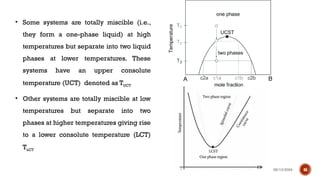
• Some systems are totally miscible (i.e.,
they form a one-phase liquid) at high
temperatures but separate into two liquid
phases at lower temperatures. These
systems have an upper consolute
temperature (UCT) denoted as TUCT
• Other systems are totally miscible at low
temperatures but separate into two
phases at higher temperatures giving rise
to a lower consolute temperature (LCT)
TLCT
08/13/2024 47
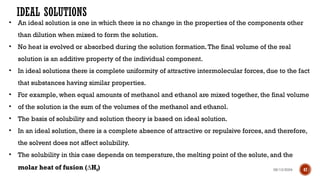
• An ideal solution is one in which there is no change in the properties of the components other
than dilution when mixed to form the solution.
• No heat is evolved or absorbed during the solution formation.The final volume of the real
solution is an additive property of the individual component.
• In ideal solutions there is complete uniformity of attractive intermolecular forces, due to the fact
that substances having similar properties.
• For example, when equal amounts of methanol and ethanol are mixed together, the final volume
• of the solution is the sum of the volumes of the methanol and ethanol.
• The basis of solubility and solution theory is based on ideal solution.
• In an ideal solution, there is a complete absence of attractive or repulsive forces, and therefore,
the solvent does not affect solubility.
• The solubility in this case depends on temperature, the melting point of the solute, and the
molar heat of fusion (∆Hf)
IDEAL SOLUTIONS
08/13/2024 48
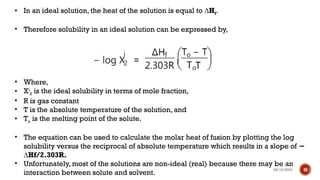
• In an ideal solution, the heat of the solution is equal to ∆Hf.
• Therefore solubility in an ideal solution can be expressed by,
• Where,
• Xi
2 is the ideal solubility in terms of mole fraction,
• R is gas constant
• T is the absolute temperature of the solution, and
• To is the melting point of the solute.
• The equation can be used to calculate the molar heat of fusion by plotting the log
solubility versus the reciprocal of absolute temperature which results in a slope of −
∆Hf/2.303R.
• Unfortunately, most of the solutions are non-ideal (real) because there may be an
interaction between solute and solvent.
08/13/2024 49
• In these solutions mixing of solute and solvent can release or absorb heat into or from
surroundings.
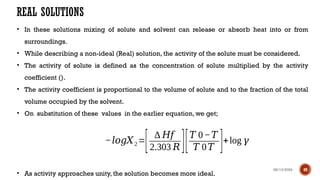
• While describing a non-ideal (Real) solution, the activity of the solute must be considered.
• The activity of solute is defined as the concentration of solute multiplied by the activity
coefficient ().
• The activity coefficient is proportional to the volume of solute and to the fraction of the total
volume occupied by the solvent.
• On substitution of these values in the earlier equation, we get;
• As activity approaches unity, the solution becomes more ideal.
REAL SOLUTIONS
−𝑙𝑜𝑔𝑋2=
[ ∆ 𝐻𝑓
2.303 𝑅 ][𝑇 0−𝑇
𝑇 0𝑇 ]+log 𝛾
08/13/2024 50
For example, as a solution becomes more dilute, the activity increases, and the solution
becomes ideal.
• The log of activity coefficient (log ) is the term that considers the work of solubilization, the
volume of solute, and the volume of solvent.
• The work of solubilization includes the intermolecular forces of attraction, removing
molecules from the solid and integrating them into the solvent.
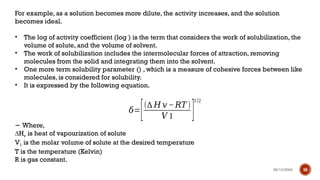
• One more term solubility parameter () , which is a measure of cohesive forces between like
molecules, is considered for solubility.
• It is expressed by the following equation.
− Where,
∆Hv is heat of vapourization of solute
V1 is the molar volume of solute at the desired temperature
T is the temperature (Kelvin)
R is gas constant.
𝛿=[(∆ 𝐻 𝑣 −𝑅𝑇)
𝑉 1 ]
1/2
08/13/2024 51
• In an ideal solution volume changes are negligible.
• Dilute solutions show colligative properties.
• These properties are the factors that determine how the properties of a bulk solution change
depending on the concentration of the solute in it.
• Colligative properties are properties of a solution that depend mainly on the relative numbers of
particles of solvent and solute molecules and not on the chemical properties of the molecules
themselves.
• These can almost be referred to as statistical properties because they can be understood solely
based on a relative number of different particles in a solution.
There are four types of colligative properties, namely:
1. Lowering of vapor pressure
2. Elevation of boiling point
3. Depression of freezing point
4. Osmotic pressure.
COLLIGATIVE PROPERTIES OF SOLUTIONS
08/13/2024 52
• Colligative properties of non-electrolyte solutions are regular.
• The values of colligative properties are approximately equal for equimolar concentrations of
drugs.
• It is possible to determine the number of solute particles present in the solution by
measuring these properties and comparing them with the corresponding properties of the
pure solvent.
• If the mass of the solute present is known, the number average molecular weight can be
calculated by dividing the mass of the solute by the number of particles present to obtain
the average mass of particles.
• Osmotic pressure is the most important colligative property since it is related to the
physiological compatibility of parenteral, ophthalmic, and nasal solutions.
• It is difficult and inconvenient to measure osmotic pressure, and therefore, other colligative
properties are determined and related to osmotic pressure.
08/13/2024 53
• The pressure brought by vapour in equilibrium with its liquid at constant temperature is known as
vapour pressure.
• It increases with temperature.
• The vapour pressure of the solvent is due to its escaping tendency.
• The temperature at which the vapour pressure of the liquid is equal to the atmospheric pressure is
called a normal boiling point.
• The vapour pressure of pure liquid solvent depends upon the rate of escape of the molecule from
the surface.
• Solvents with greater escaping tendencies have a significantly greater vapour pressure.
• Non-volatile solutes added to the solvent does not contribute directly to the vapour pressure of
the solution.
• The solute interferes and prevents solvent molecules from escaping into the atmosphere.
LOWERING OF VAPOUR PRESSURE
08/13/2024 54
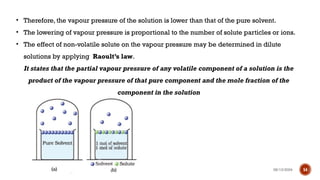
• Therefore, the vapour pressure of the solution is lower than that of the pure solvent.
• The lowering of vapour pressure is proportional to the number of solute particles or ions.
• The effect of non-volatile solute on the vapour pressure may be determined in dilute
solutions by applying Raoult’s law.
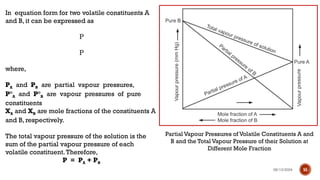
It states that the partial vapour pressure of any volatile component of a solution is the
product of the vapour pressure of that pure component and the mole fraction of the
component in the solution
08/13/2024 55
Partial Vapour Pressures of Volatile Constituents A and
B and the Total Vapour Pressure of their Solution at
Different Mole Fraction
In equation form for two volatile constituents A
and B, it can be expressed as
P
P
where,
PA and PB are partial vapour pressures,
P°A and P°B are vapour pressures of pure
constituents
XA and XB are mole fractions of the constituents A
and B, respectively.
The total vapour pressure of the solution is the
sum of the partial vapour pressure of each
volatile constituent.Therefore,
P = PA + PB
08/13/2024 56
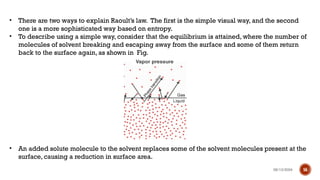
• There are two ways to explain Raoult’s law. The first is the simple visual way, and the second
one is a more sophisticated way based on entropy.
• To describe using a simple way, consider that the equilibrium is attained, where the number of
molecules of solvent breaking and escaping away from the surface and some of them return
back to the surface again, as shown in Fig.
• An added solute molecule to the solvent replaces some of the solvent molecules present at the
surface, causing a reduction in surface area.
08/13/2024 57
• A certain fraction of the solvent molecules have enough energy to escape from the surface.
• If these molecules are decreased due to the replacement on the surface by the addition of solute,
causing a reduction in the number of molecules escaping from the surface.
• The net result of this reduction in number is that the vapor pressure of the solvent is reduced.
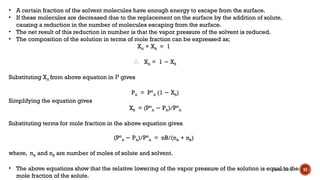
• The composition of the solution in terms of mole fraction can be expressed as;
XA + XB = 1
∴ XA = 1 X
− B
Substituting XA from above equation in P gives
PA = P°A (1 X
− B)
Simplifying the equation gives
XB = (P°A P
− A)/P°A
Substituting terms for mole fraction in the above equation gives
(P°A P
− A)/P°A = nB/(nA + nB)
where, nA and nB are number of moles of solute and solvent.
• The above equations show that the relative lowering of the vapor pressure of the solution is equal to the
mole fraction of the solute.
08/13/2024 58
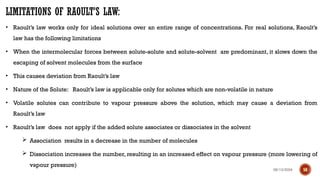
• Raoult’s law works only for ideal solutions over an entire range of concentrations. For real solutions, Raoult’s
law has the following limitations
• When the intermolecular forces between solute-solute and solute-solvent are predominant, it slows down the
escaping of solvent molecules from the surface
• This causes deviation from Raoult’s law
• Nature of the Solute: Raoult’s law is applicable only for solutes which are non-volatile in nature
• Volatile solutes can contribute to vapour pressure above the solution, which may cause a deviation from
Raoult’s law
• Raoult’s law does not apply if the added solute associates or dissociates in the solvent
 Association results in a decrease in the number of molecules
 Dissociation increases the number, resulting in an increased effect on vapour pressure (more lowering of
vapour pressure)
LIMITATIONS OF RAOULT’S LAW:
08/13/2024 59
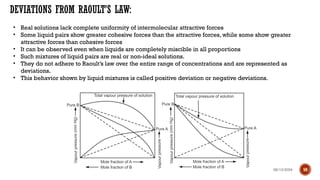
• Real solutions lack complete uniformity of intermolecular attractive forces
• Some liquid pairs show greater cohesive forces than the attractive forces, while some show greater
attractive forces than cohesive forces
• It can be observed even when liquids are completely miscible in all proportions
• Such mixtures of liquid pairs are real or non-ideal solutions.
• They do not adhere to Raoult’s law over the entire range of concentrations and are represented as
deviations.
• This behavior shown by liquid mixtures is called positive deviation or negative deviations.
DEVIATIONS FROM RAOULT’S LAW: