SOLUTION
• Homogeneous mixture that may contain two or more
components
• It contain a solute (component that is dispersed or dissolve), and
solvent (the dispersing medium.
Solutions are characterized by the following:
1. They have uniform composition all throughout.
2. Their components may be separated through physical means.
3. Different concentrations can be prepared from any given
solute and solvent.
4. They do not separate into its components on standing.
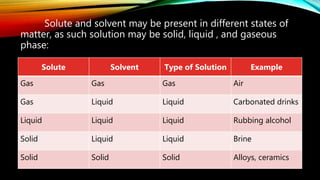
Solute and solvent may be present in different states of
matter, as such solution may be solid, liquid , and gaseous
phase:
Solute Solvent Type of Solution Example
Gas Gas Gas Air
Gas Liquid Liquid Carbonated drinks
Liquid Liquid Liquid Rubbing alcohol
Solid Liquid Liquid Brine
Solid Solid Solid Alloys, ceramics
Solutions are classified:
1. Saturated Solutions - contains the maximum amount of solute that
is capable of being dissolved. At 20°C, the maximum amount of
NaCl that will dissolve in 100. g of water is 36.0 g.
2. Unsaturated Solutions - contains the less of solute particles that is
capable of being dissolved.
3. Supersaturated Solutions – unstable solutions that may be prepared
by dissolving more solute at a higher temperature.
• Dissolution – process in which solutes dissolve in a solvent.
• Solubility – maximum amount of solute that may dissolve in a
given amount of solvent at a given temperature.
A. PARTICLE SIZE
• Coarse and bigger size dissolve more slowly compared to solute particles
that are smaller and fine texture.
• Larger particle size provides smaller surface area for solute to interact
with solvent making solubility slower
• Smaller particle size provides bigger surface area.
• EXAMPLE: dissolving the same amount of rock salt and iodized salt.
Iodized salt will dissolve faster compared to tock salt.
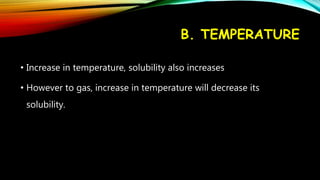
B. TEMPERATURE
• Increase in temperature, solubility also increases
• However to gas, increase in temperature will decrease its
solubility.
C. PRESSURE
• Has very little effect on solutions of solid and liquid
• However, for gas, applying the Henry’s Law states that “an
increase in pressure will likewise increase the solubility of gas.
D. CONCENTRATION UNIT
• Perfumes for instance has different types based on the percentage of
essential oils dissolve in solvent (ethanol, mixture of ethanol and water)
a. Eau de parfum – 10% - 30% aromatic compounds
b. Eau de toilette – 5% - 20% aromatic compounds
c. Eau de cologne – 2% - 5% aromatic compounds
• Amount of solute present in the solution can be expressed by:
a. Qualitatively solution - Using words such as like “dilute” or
“concentrated”
1. Dilute - contain relatively small amount of solute compared
with the amount of solute
2. Concentrated – contain large amount of solute as compared
with the solvent
b. Quantitatively solution - Using numbers.
Quantitative way of expressing solutions may be based on
relative amounts of solute and solvents. You will consider
percentage composition:
A. Percentage by Mass – mass in grams
Mass of solute + mass of solvent = mass of the solution.
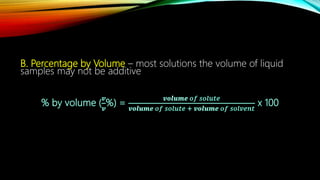
B. Percentage by Volume – most solutions the volume of liquid
samples may not be additive
B. Percentage by Mass-Volume
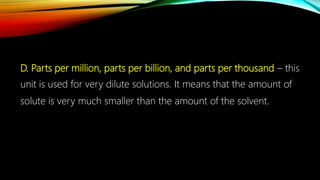
D. Parts per million, parts per billion, and parts per thousand – this
unit is used for very dilute solutions. It means that the amount of
solute is very much smaller than the amount of the solvent.
Concentration Unit Formula Unit
Parts per million (ppm)
ppm =
𝑚𝑎𝑠𝑠 𝑚𝑔 𝑜𝑓 𝑠𝑜𝑙𝑢𝑡𝑒
𝑣𝑜𝑙𝑢𝑚𝑒 𝐿 𝑠𝑜𝑙𝑢𝑡𝑖𝑜𝑛
mg/L
ppm =
𝑚𝑎𝑠𝑠 𝑚𝑔 𝑜𝑓 𝑠𝑜𝑙𝑢𝑡𝑒
𝑚𝑎𝑠𝑠 𝑘𝑔 𝑠𝑜𝑙𝑢𝑡𝑖𝑜𝑛
mg/kg
Parts per billion (ppb)
ppm =
𝑚𝑎𝑠𝑠 μ 𝑔 𝑜𝑓 𝑠𝑜𝑙𝑢𝑡𝑒
𝑣𝑜𝑙𝑢𝑚𝑒 𝐿 𝑠𝑜𝑙𝑢𝑡𝑖𝑜𝑛
μg/L
ppm =
𝑚𝑎𝑠𝑠 μ 𝑔 𝑜𝑓 𝑠𝑜𝑙𝑢𝑡𝑒
𝑚𝑎𝑠𝑠 𝑘𝑔 𝑠𝑜𝑙𝑢𝑡𝑖𝑜𝑛
μg/kg
Parts per thousand (ppt)
ppm =
𝑚𝑎𝑠𝑠 𝑛𝑔 𝑜𝑓 𝑠𝑜𝑙𝑢𝑡𝑒
𝑣𝑜𝑙𝑢𝑚𝑒 𝐿 𝑠𝑜𝑙𝑢𝑡𝑖𝑜𝑛
ng/L
ppm =
𝑚𝑎𝑠𝑠 𝑛𝑔 𝑜𝑓 𝑠𝑜𝑙𝑢𝑡𝑒
𝑚𝑎𝑠𝑠 𝑘𝑔 𝑠𝑜𝑙𝑢𝑡𝑖𝑜𝑛
ng/kg
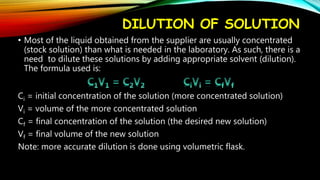
DILUTION OF SOLUTION
• Most of the liquid obtained from the supplier are usually concentrated
(stock solution) than what is needed in the laboratory. As such, there is a
need to dilute these solutions by adding appropriate solvent (dilution).
The formula used is:
Ci = initial concentration of the solution (more concentrated solution)
Vi = volume of the more concentrated solution
Cf = final concentration of the solution (the desired new solution)
Vf = final volume of the new solution
Note: more accurate dilution is done using volumetric flask.

Solution

  • 1.
  • 2.
    • Homogeneous mixturethat may contain two or more components • It contain a solute (component that is dispersed or dissolve), and solvent (the dispersing medium.
  • 3.
    Solutions are characterizedby the following: 1. They have uniform composition all throughout. 2. Their components may be separated through physical means. 3. Different concentrations can be prepared from any given solute and solvent. 4. They do not separate into its components on standing.
  • 4.
    Solute and solventmay be present in different states of matter, as such solution may be solid, liquid , and gaseous phase: Solute Solvent Type of Solution Example Gas Gas Gas Air Gas Liquid Liquid Carbonated drinks Liquid Liquid Liquid Rubbing alcohol Solid Liquid Liquid Brine Solid Solid Solid Alloys, ceramics
  • 5.
    Solutions are classified: 1.Saturated Solutions - contains the maximum amount of solute that is capable of being dissolved. At 20°C, the maximum amount of NaCl that will dissolve in 100. g of water is 36.0 g. 2. Unsaturated Solutions - contains the less of solute particles that is capable of being dissolved. 3. Supersaturated Solutions – unstable solutions that may be prepared by dissolving more solute at a higher temperature.
  • 7.
    • Dissolution –process in which solutes dissolve in a solvent. • Solubility – maximum amount of solute that may dissolve in a given amount of solvent at a given temperature.
  • 10.
    A. PARTICLE SIZE •Coarse and bigger size dissolve more slowly compared to solute particles that are smaller and fine texture. • Larger particle size provides smaller surface area for solute to interact with solvent making solubility slower • Smaller particle size provides bigger surface area. • EXAMPLE: dissolving the same amount of rock salt and iodized salt. Iodized salt will dissolve faster compared to tock salt.
  • 11.
    B. TEMPERATURE • Increasein temperature, solubility also increases • However to gas, increase in temperature will decrease its solubility.
  • 12.
    C. PRESSURE • Hasvery little effect on solutions of solid and liquid • However, for gas, applying the Henry’s Law states that “an increase in pressure will likewise increase the solubility of gas.
  • 13.
    D. CONCENTRATION UNIT •Perfumes for instance has different types based on the percentage of essential oils dissolve in solvent (ethanol, mixture of ethanol and water) a. Eau de parfum – 10% - 30% aromatic compounds b. Eau de toilette – 5% - 20% aromatic compounds c. Eau de cologne – 2% - 5% aromatic compounds
  • 14.
    • Amount ofsolute present in the solution can be expressed by: a. Qualitatively solution - Using words such as like “dilute” or “concentrated” 1. Dilute - contain relatively small amount of solute compared with the amount of solute 2. Concentrated – contain large amount of solute as compared with the solvent b. Quantitatively solution - Using numbers.
  • 16.
    Quantitative way ofexpressing solutions may be based on relative amounts of solute and solvents. You will consider percentage composition: A. Percentage by Mass – mass in grams Mass of solute + mass of solvent = mass of the solution.
  • 17.
    B. Percentage byVolume – most solutions the volume of liquid samples may not be additive
  • 18.
    B. Percentage byMass-Volume
  • 19.
    D. Parts permillion, parts per billion, and parts per thousand – this unit is used for very dilute solutions. It means that the amount of solute is very much smaller than the amount of the solvent.
  • 20.
    Concentration Unit FormulaUnit Parts per million (ppm) ppm = 𝑚𝑎𝑠𝑠 𝑚𝑔 𝑜𝑓 𝑠𝑜𝑙𝑢𝑡𝑒 𝑣𝑜𝑙𝑢𝑚𝑒 𝐿 𝑠𝑜𝑙𝑢𝑡𝑖𝑜𝑛 mg/L ppm = 𝑚𝑎𝑠𝑠 𝑚𝑔 𝑜𝑓 𝑠𝑜𝑙𝑢𝑡𝑒 𝑚𝑎𝑠𝑠 𝑘𝑔 𝑠𝑜𝑙𝑢𝑡𝑖𝑜𝑛 mg/kg Parts per billion (ppb) ppm = 𝑚𝑎𝑠𝑠 μ 𝑔 𝑜𝑓 𝑠𝑜𝑙𝑢𝑡𝑒 𝑣𝑜𝑙𝑢𝑚𝑒 𝐿 𝑠𝑜𝑙𝑢𝑡𝑖𝑜𝑛 μg/L ppm = 𝑚𝑎𝑠𝑠 μ 𝑔 𝑜𝑓 𝑠𝑜𝑙𝑢𝑡𝑒 𝑚𝑎𝑠𝑠 𝑘𝑔 𝑠𝑜𝑙𝑢𝑡𝑖𝑜𝑛 μg/kg Parts per thousand (ppt) ppm = 𝑚𝑎𝑠𝑠 𝑛𝑔 𝑜𝑓 𝑠𝑜𝑙𝑢𝑡𝑒 𝑣𝑜𝑙𝑢𝑚𝑒 𝐿 𝑠𝑜𝑙𝑢𝑡𝑖𝑜𝑛 ng/L ppm = 𝑚𝑎𝑠𝑠 𝑛𝑔 𝑜𝑓 𝑠𝑜𝑙𝑢𝑡𝑒 𝑚𝑎𝑠𝑠 𝑘𝑔 𝑠𝑜𝑙𝑢𝑡𝑖𝑜𝑛 ng/kg
  • 21.
    DILUTION OF SOLUTION •Most of the liquid obtained from the supplier are usually concentrated (stock solution) than what is needed in the laboratory. As such, there is a need to dilute these solutions by adding appropriate solvent (dilution). The formula used is: Ci = initial concentration of the solution (more concentrated solution) Vi = volume of the more concentrated solution Cf = final concentration of the solution (the desired new solution) Vf = final volume of the new solution Note: more accurate dilution is done using volumetric flask.