SOLUBILITY
Dr.J.Ramesh Babu, M.Pharm.,Ph.D
Professor & HOD
Department of Pharmaceutics
CHEBROLU HANUMAIAH INSTITUTE OF PHARMACEUTICAL SCIENCES
Chandramoulipuram,Chowdavaram,Guntur-522019
Andhra Pradesh, India.
CONTENTS
• Introduction
• Expression of solubility
• Mechanism of solubility
• Solvents for solubilisation
• Solubility system
• Factors affecting solubility
• Approaches of solubility enhancement
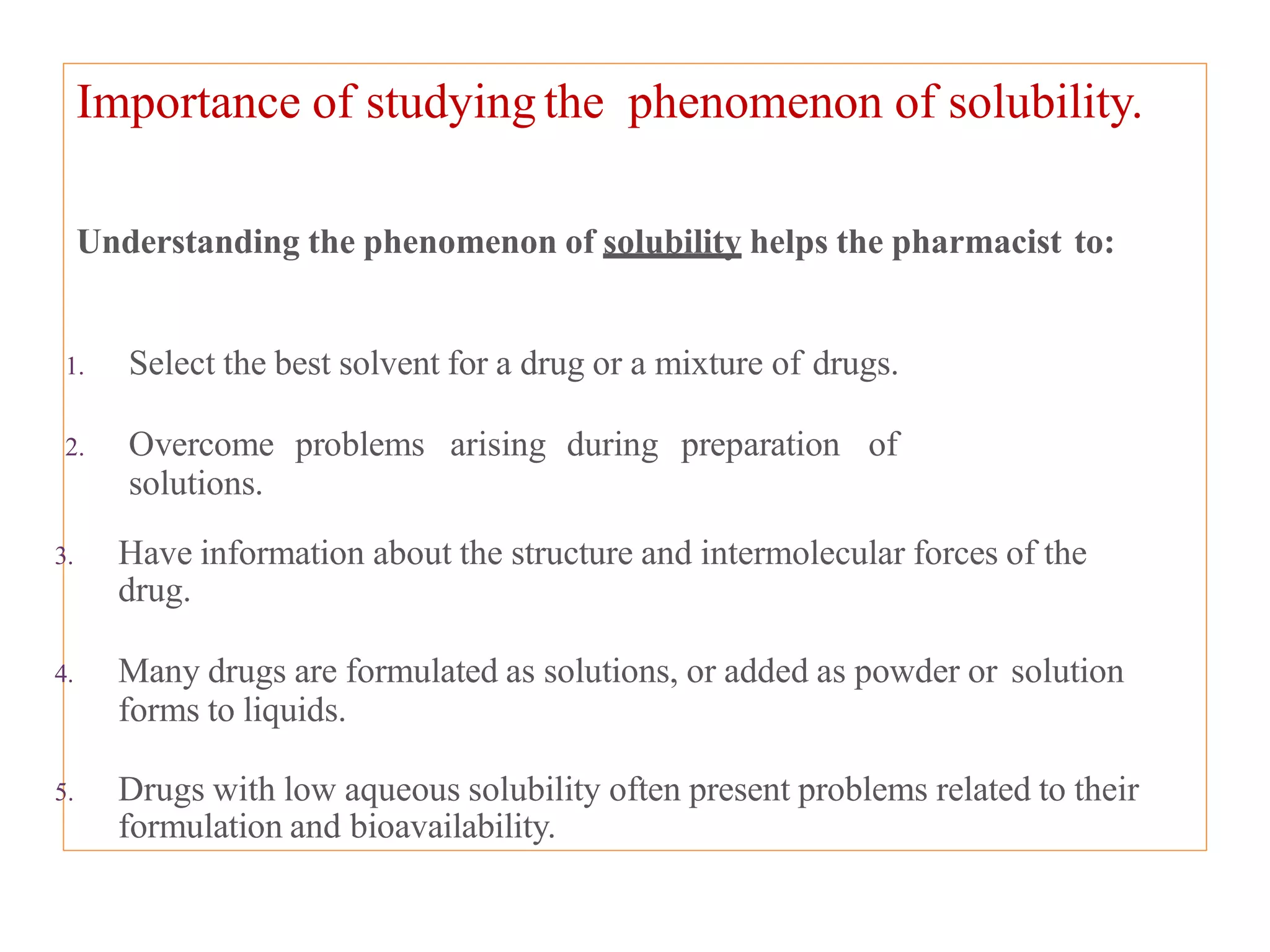
Importance of studying the phenomenon of solubility.
Understanding the phenomenon of solubility helps the pharmacist to:
1. Select the best solvent for a drug or a mixture of drugs.
2. Overcome problems arising during preparation of
solutions.
3. Have information about the structure and intermolecular forces of the
drug.
4. Many drugs are formulated as solutions, or added as powder or solution
forms to liquids.
5. Drugs with low aqueous solubility often present problems related to their
formulation and bioavailability.
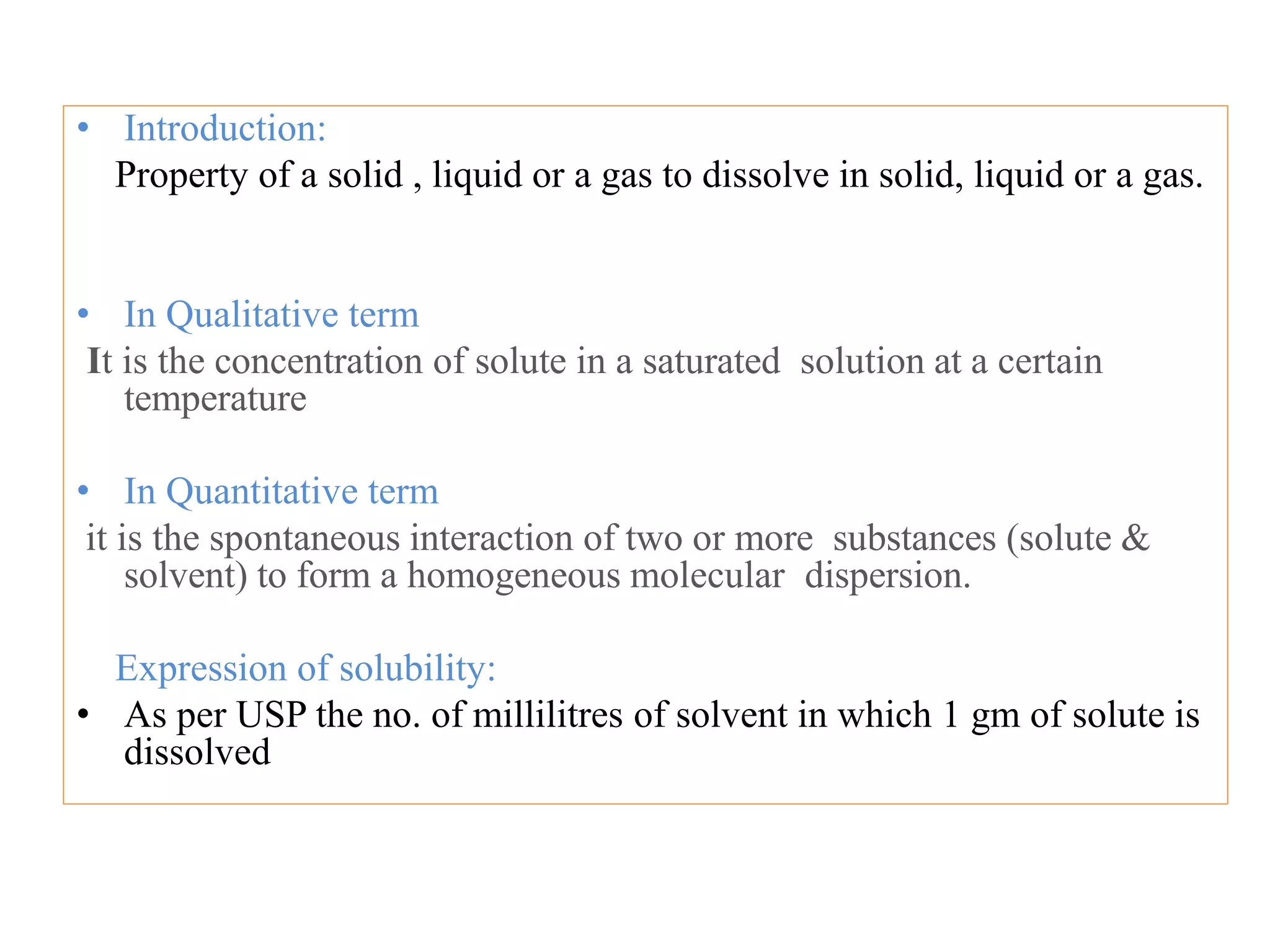
• Introduction:
Property of a solid , liquid or a gas to dissolve in solid, liquid or a gas.
• In Qualitative term
It is the concentration of solute in a saturated solution at a certain
temperature
• In Quantitative term
it is the spontaneous interaction of two or more substances (solute &
solvent) to form a homogeneous molecular dispersion.
Expression of solubility:
• As per USP the no. of millilitres of solvent in which 1 gm of solute is
dissolved
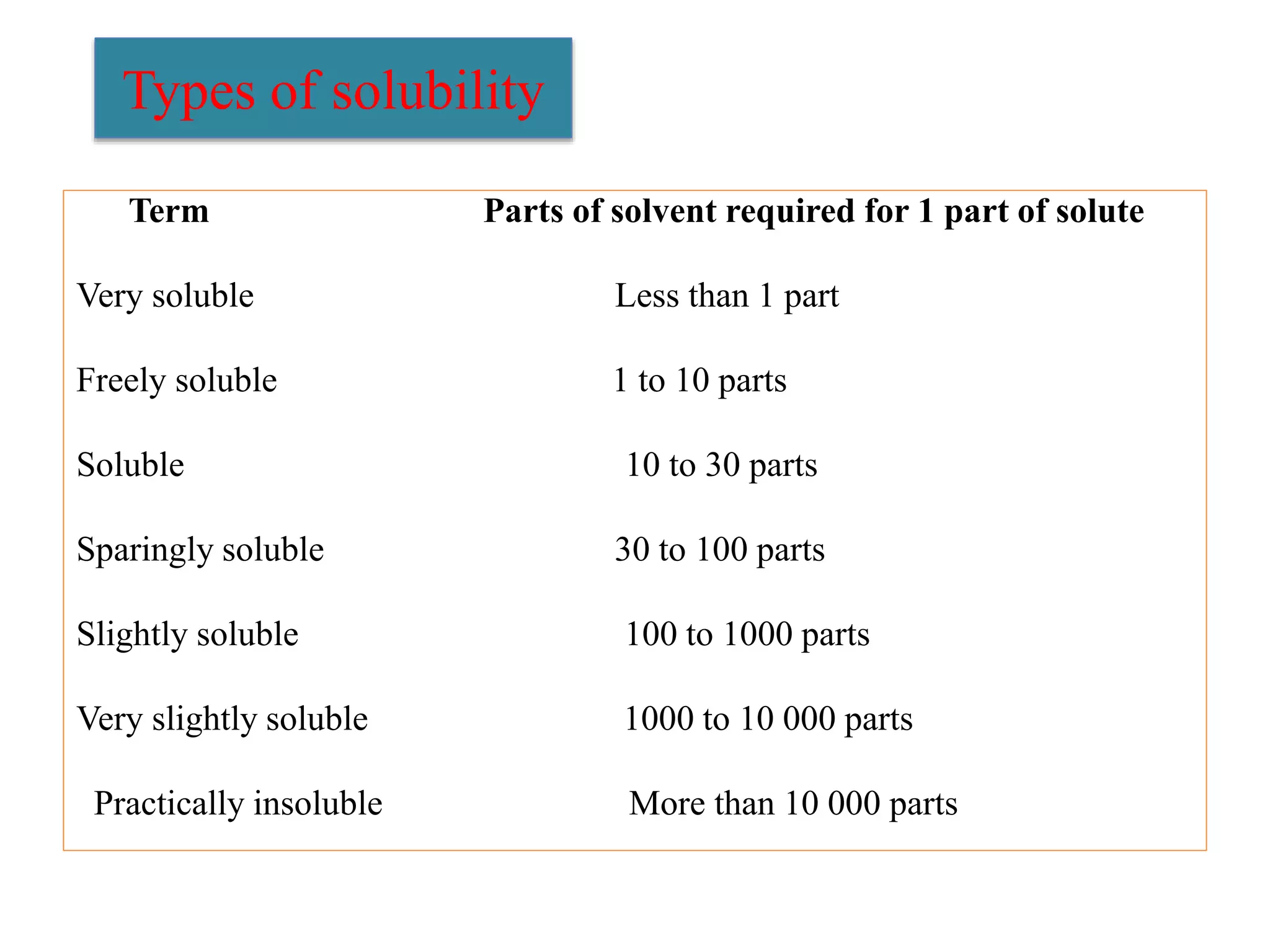
Types of solubility
Term Parts of solvent required for 1 part of solute
Very soluble Less than 1 part
Freely soluble 1 to 10 parts
Soluble 10 to 30 parts
Sparingly soluble 30 to 100 parts
Slightly soluble 100 to 1000 parts
Very slightly soluble 1000 to 10 000 parts
Practically insoluble More than 10 000 parts
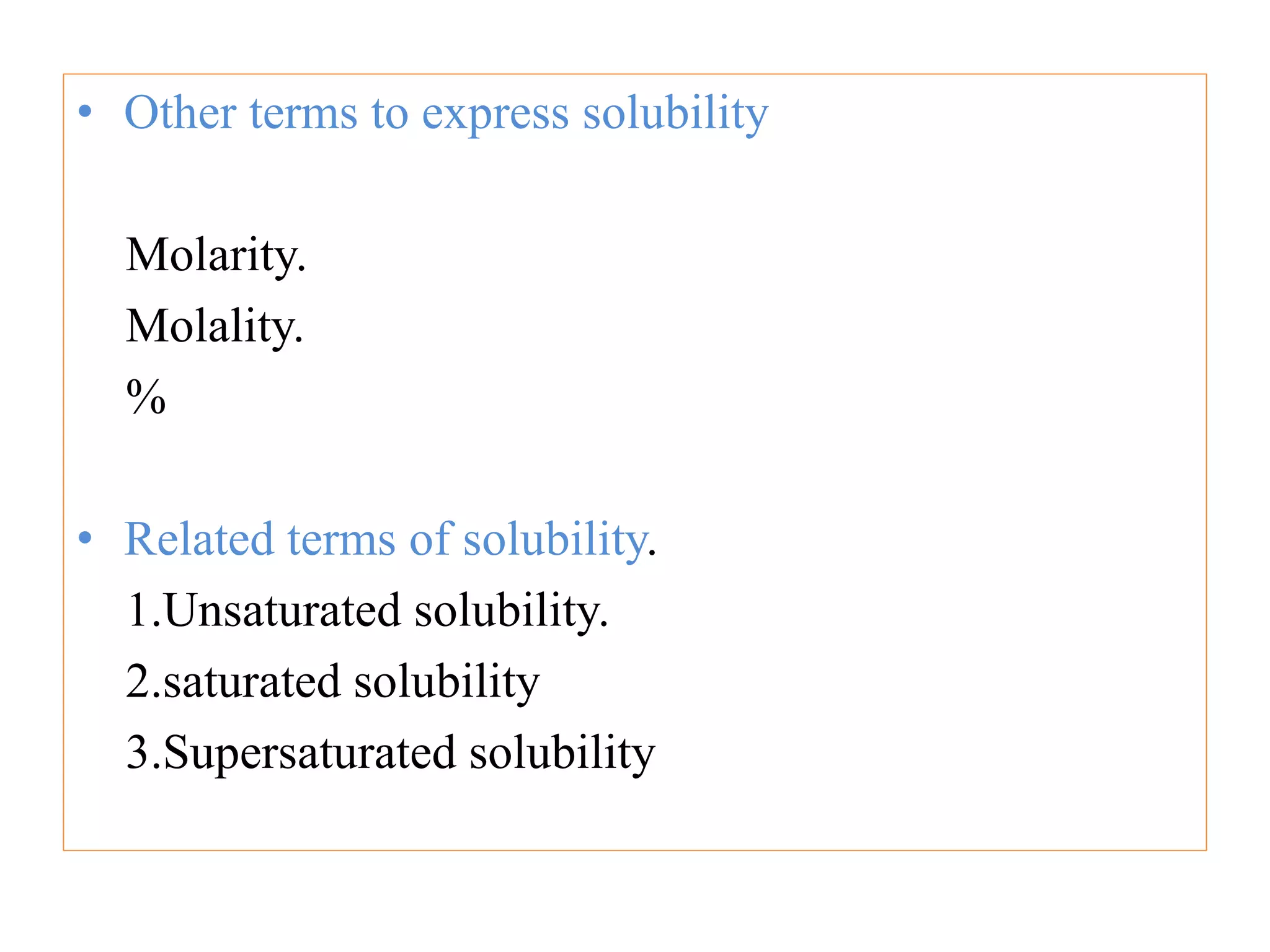
• Other terms to express solubility
Molarity.
Molality.
%
• Related terms of solubility.
1.Unsaturated solubility.
2.saturated solubility
3.Supersaturated solubility
 Solute: is the dissolved agent . (less abundant part of the solution )
 Solvent : is the component in which the solute is dissolved (more abundant
part of the solution).
 Solution: is a mixture of two or more components that form a homogenous
mixture. The components are referred to the solute and/or solutes & the
solvent and/or solvents .
 A saturated solution: is one in which an equilibrium is established between
dissolved and undissolved solute at a definite temperature. Or A solution that
contains the maximum amount of solute at a definite temperature
 An unsaturated solution: or subsaturated solution is one containing the
dissolved solute in a concentration below that necessary for complete
saturation at a definite temperature.
 A supersaturated solution: contains more of the dissolved solute than it
would normally contain in a saturated state at a definite temperature.
+
Degree of saturation
• Unsaturated, Saturated or Supersaturated?
•  How much solute can be dissolved in a solution?
+
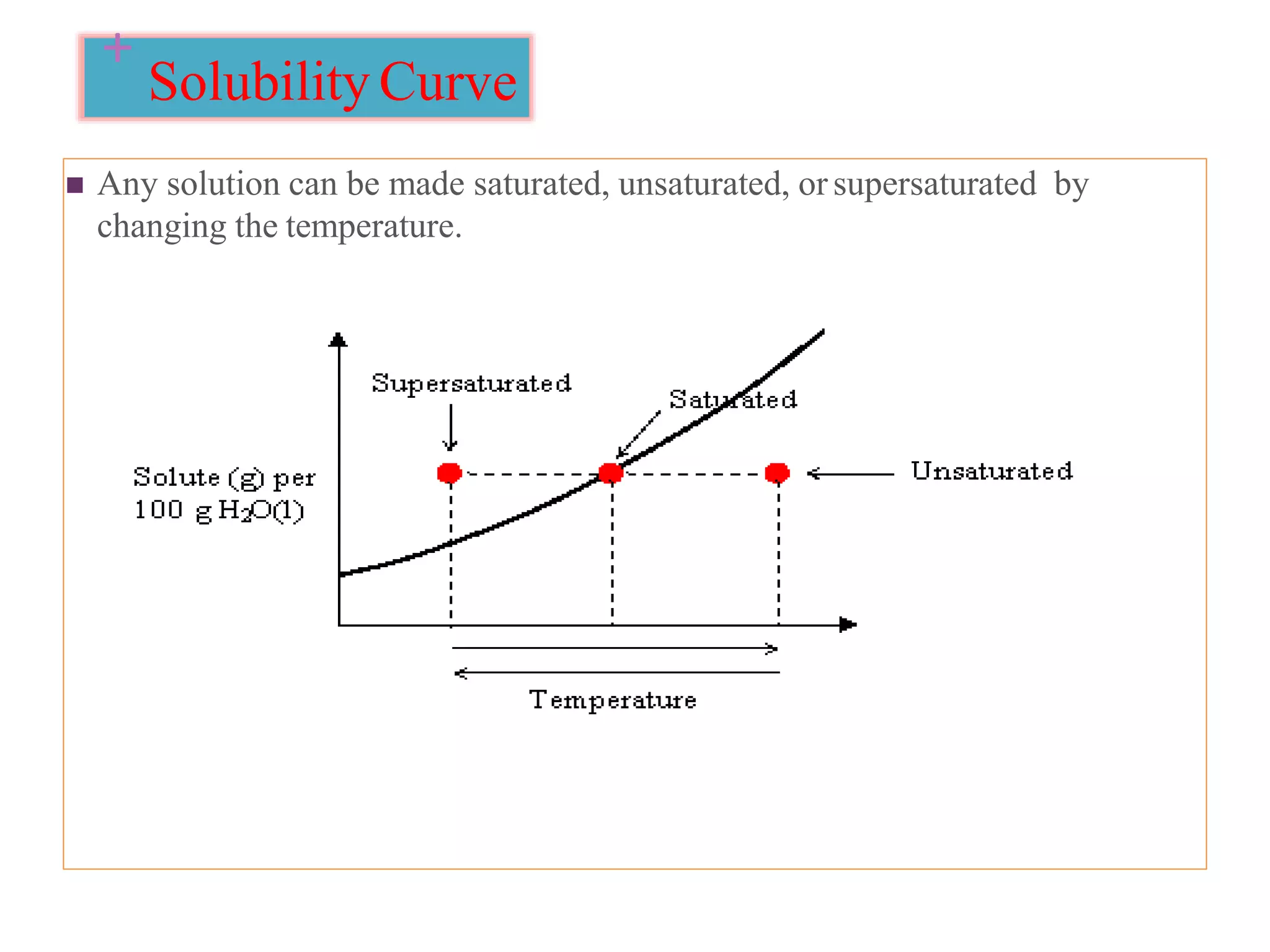
Solubility Curve
 Any solution can be made saturated, unsaturated, orsupersaturated by
changing the temperature.
+
Solubilityprocess
A mechanistic perspective of solubilization process for organic solute in
water involves the following steps:
1. Break up of solute-solute intermolecular bonds
2. Break up of solvent-solvent intermolecular bonds
3. Formation of cavity in solvent phase large enough to
accommodate solute molecule
4. Transfer of solute into the cavity of solvent phase
5. Formation of solute-solvent intermolecular bonds
Factors Influencing The Solubility
• Temparature
• Nature of the solvent
• Pressure pH
• Particle size
• Crystal structure
• Molecular structure
• Solute-Solvent Interactions
• Addition of substituents
• Common ion effect
• Solubilising agent
+
Types of interaction in the solution process
1. solvent – solvent interaction
2. solute – solute interaction
3. solvent solute interaction
+
Biopharmaceutics Classification System (BCS)
 BCS is a scientific framework for classifying Drug substances
• according to their aqueous solubility and their intestinal permeability
Solvent - Solute Interactions
 In pre - or early formulation, selection of the most suitable solvent is
• based on the principle of
• “like dissolves like”
 That is, a solute dissolves best in a solvent with similar chemical properties.
Or two substances with similar intermolecular forces are likely to be soluble in
each others
 Polar solutes dissolve in polar solvents. E.g salts & sugar dissolve in water .
 Non polar solutes dissolve in non polar solvents. Eg. naphtalene dissolves in
benzene.
Classification of solvents & their mechanism of action
1.Polar solvents
2. Non polar solvents
3. Semi polar solvents
Polar solvents
 The solubility of a drug is due in large measure to the polarity of the solvent,
that is, to its dipole moment. Polar solvents dissolve ionic solutes and other
polar substances.
 The ability of the solute to form hydrogen bonds is a far more significant
factor than is the polarity as reflected in a high dipole moment
• Water dissolves phenols, alcohols and other oxygen & nitrogen containing
compounds that can form hydrogen bonds with water.
+ Non polarsolvents
 Non-polar solvents are unable to reduce the attraction between the ions of
strong and weak electrolytes because of the solvents' low dielectric constants.
 They are unable to form hydrogen bonds with non electrolytes.
 Non polar solvents can dissolve non polar solutes through weak van der
• Waals forces
 Example: solutions of oils & fats in carbon tetrachloride or benzene.
• Polyethylene glycol 400
Castor oil
+ Semi polar solvents
 Semi polar solvents, such as ketones can induce a certain degree
of polarity in non polar solvent molecules. For example,
benzene, which is readily polarizable, becomes soluble in
alcohol
 They can act as intermediate solvents to bring about
miscibility of polar & non polar liquids.
• Example: acetone increases solubility of ether in water.
• Propylene glycol has been shown to increase the mutual
solubility of water and peppermint oil and of water and benzyl
benzoate
Types of solutions
Solutions of pharmaceutical importance include:
 Gases in liquids
 Liquids in liquids
 Solids in liquids
Solubility of gases in liquids
• When the pressure above the
solution is released (decreases), the
solubility of the gas decreases
• As the temperature increases the
solubility of gases decreases
+Solubility of liquids in liquids
 Preparation of pharmaceutical solutions involves mixing of 2 or more liquids
 Alcohol & water to form hydroalcoholic solutions
 volatile oils & water to form aromatic waters
 volatile oils & alcohols to form spirits , elixirs
• Liquid-liquid systems may be divided into 2 categories:
1. Systems showing complete miscibility such as alcohol & water, glycerin &
alcohol, benzene & carbon tetrachloride.
2.Systems showing Partial miscibility as phenol and water; two liquid layers are
formed each containing some of the other liquid in the dissolved state
.
The term miscibility refers to the mutual solubility of the components in liquid-liquid
systems.
+Solubility of liquids in liquids
 Complete miscibility occurs when: The adhesive forces between different
molecules (A-B) >> cohesive forces between like molecules (A-A or B-B).
 Polar and semipolar solvents, such as water and alcohol, glycerin and
alcohol, and alcohol and acetone, are said to be completely miscible
because they mix in all proportions.
 Nonpolar solvents such as benzene and carbon tetrachloride are
• also completely miscible.
+
Solubility of liquids inliquids
 Partial miscibility results when: Cohesive forces of the constituents of a
mixture
• are quite different, e.g. water (A) and hexane (B). A-A » B-B.
 When certain amounts of water and ether or water and phenol are mixed, two
liquid layers are formed, each containing some of the other liquid in the
dissolved state.
 The effect of temperature on the miscibility of two-component liquids is
expressed by phase diagrams.
 In the phase diagrams of two-component liquids, the mixture will have an
upper
• critical solution temperature, a lower critical solution temperature or both.
Solubility of solids in liquids
&
Factors influencing solubility
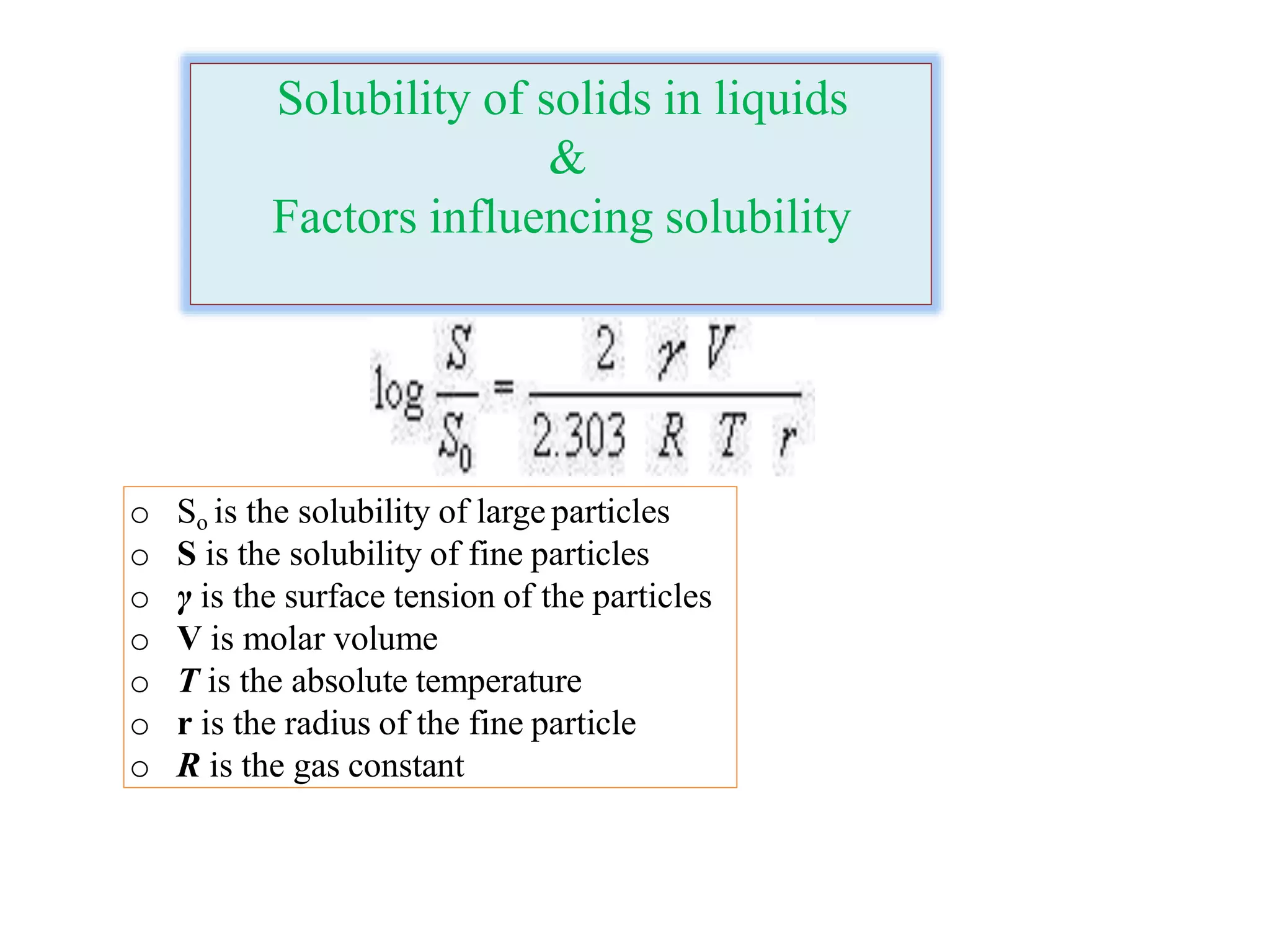
o So is the solubility of large particles
o S is the solubility of fine particles
o γ is the surface tension of the particles
o V is molar volume
o T is the absolute temperature
o r is the radius of the fine particle
o R is the gas constant
Solubility of solids in liquids
&
Factors influencing solubility
• 1- Molecular size
 Molecular size will affect the solubility.
 The larger the molecule or the higher its molecular weight the less
• soluble the substance.
 Larger molecules are more difficult to surround with solvent
molecules in order to solvate the substance.
 In the case of organic compounds the amount of carbon branching will
increase the solubility since more branching will reduce the size (or volume)
of the molecule and make it easier to solvate the molecules with solvent
• 2- The boiling point of liquids and the melting point of solids:
• Both reflect the strengths of interactions between the molecules in the pure
liquid or the solid state.
• In general, aqueous solubility decreases with increasing boiling
• point and melting point..
3-The influence of substituents on the solubility of molecules in water
can be due to their effect on the properties of the solid or liquid (for
example, on its molecular cohesion, or to the effect of the substituent
on its interaction with water molecules.
Substituents can be classified as either hydrophobic or hydrophilic,
depending on their polarity
• 4-Temperature
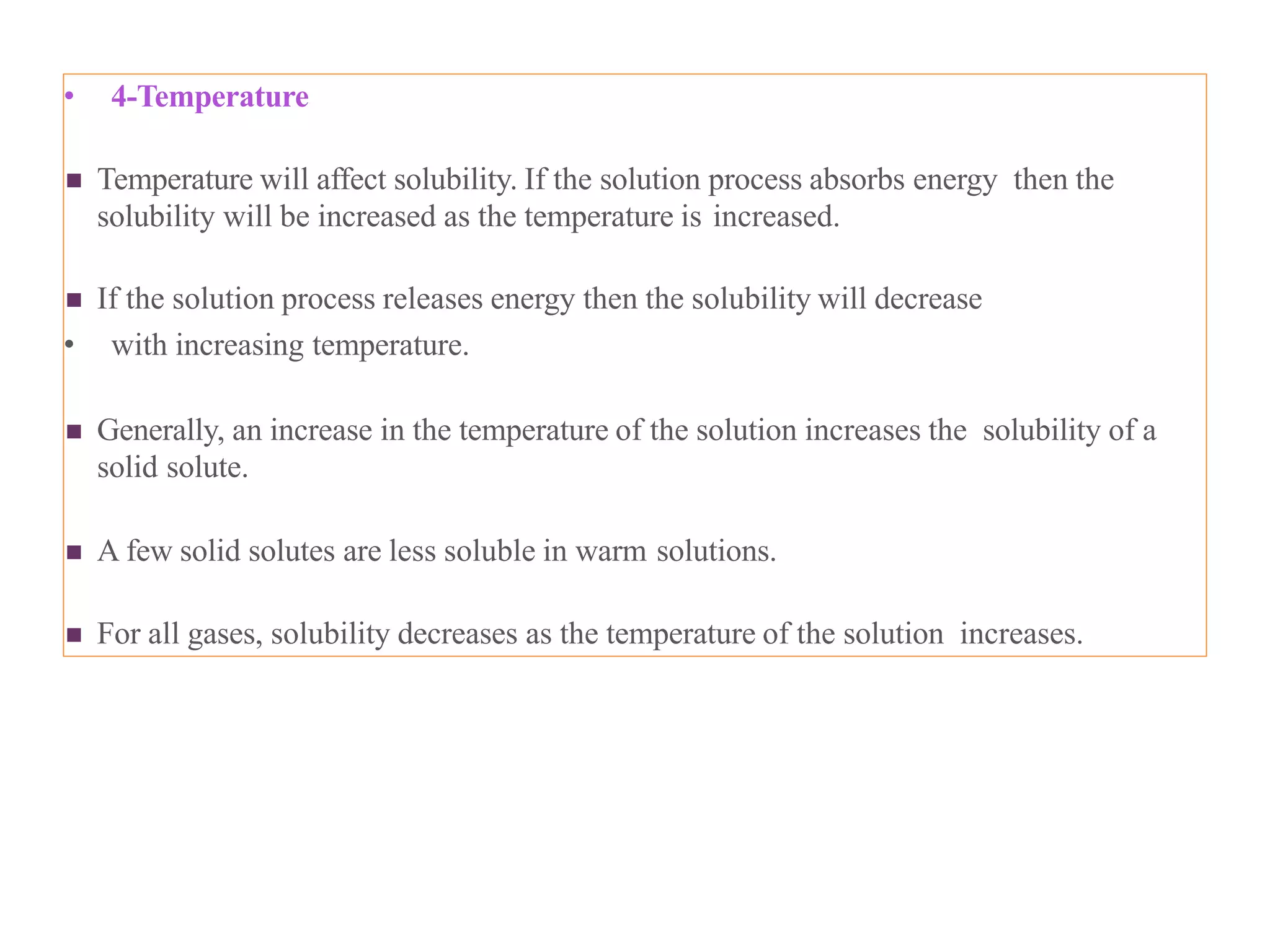
 Temperature will affect solubility. If the solution process absorbs energy then the

solubility will be increased as the temperature is increased.
 If the solution process releases energy then the solubility will decrease
• with increasing temperature.
 Generally, an increase in the temperature of the solution increases the solubility of a
solid solute.
 A few solid solutes are less soluble in warm solutions.
 For all gases, solubility decreases as the temperature of the solution increases.
• 5-Crystal properties
• Polymorphic Crystals, Solvates, Amorphous form
Polymorphs have the same chemical structure but different physical properties,
such as solubility, density, hardness, and compression characteristics
A drug that exists as an amorphous form (non crystalline form) generally
dissolves more rapidly than the same drug in crystalline form
• 6- PH
 is one of the primary influences on the solubility of most drugs that contain
ionizable groups
 Large number of drugs are weak acids or weak base.
 Solubility depends on the degree of ionization.
 Degree of ionization depends on the pH
Distribution of Solutes between Immiscible Solvents
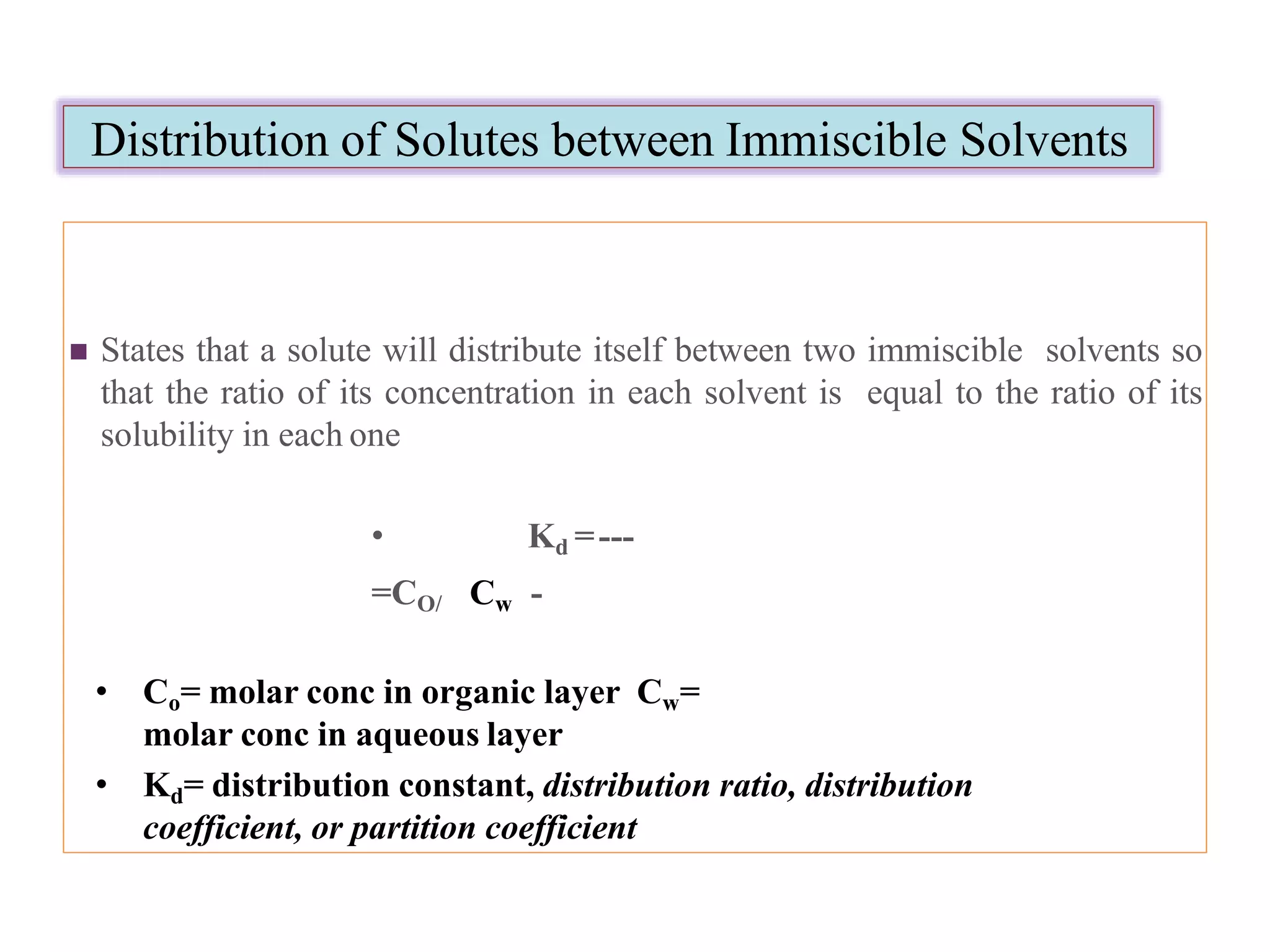
 States that a solute will distribute itself between two immiscible solvents so
that the ratio of its concentration in each solvent is equal to the ratio of its
solubility in each one
• Kd =---
=CO/ Cw -
• Co= molar conc in organic layer Cw=
molar conc in aqueous layer
• Kd= distribution constant, distribution ratio, distribution
coefficient, or partition coefficient
Application
• Extraction
 it is used to determine the efficiency with which one solvent
can extract a compound from a second solvent
 extract natural drugs from a solvent with several portions
of an immiscible solvent
Preservative action
 the concentration of preservative to be used in an emulsion can be
calculated from the distribution law to give the effective
antimicrobial concentration in the water phase
DrugAbsorption
 Hydrophobic drugs (high partition coefficients) are preferentially distributed to
hydrophobic compartments such as lipid bilayers of cells
 Hydrophilic drugs (low partition coefficients) preferentially are found in
hydrophilic compartments such as blood serum.
+
In general
 solubility increases exponentially as cosolvent fraction increases.
 need 5-10 volume % of cosolvent to see an effect.
 extent of solubility enhancement depends on type of cosolvent
and solute
 effect is greatest for large, nonpolar solutes
 more “organic” cosolvents have greater effect
propanol>ethanol>methanol
SOLUBILITY.pptx

SOLUBILITY.pptx

  • 1.
    SOLUBILITY Dr.J.Ramesh Babu, M.Pharm.,Ph.D Professor& HOD Department of Pharmaceutics CHEBROLU HANUMAIAH INSTITUTE OF PHARMACEUTICAL SCIENCES Chandramoulipuram,Chowdavaram,Guntur-522019 Andhra Pradesh, India.
  • 2.
    CONTENTS • Introduction • Expressionof solubility • Mechanism of solubility • Solvents for solubilisation • Solubility system • Factors affecting solubility • Approaches of solubility enhancement
  • 3.
    Importance of studyingthe phenomenon of solubility. Understanding the phenomenon of solubility helps the pharmacist to: 1. Select the best solvent for a drug or a mixture of drugs. 2. Overcome problems arising during preparation of solutions. 3. Have information about the structure and intermolecular forces of the drug. 4. Many drugs are formulated as solutions, or added as powder or solution forms to liquids. 5. Drugs with low aqueous solubility often present problems related to their formulation and bioavailability.
  • 4.
    • Introduction: Property ofa solid , liquid or a gas to dissolve in solid, liquid or a gas. • In Qualitative term It is the concentration of solute in a saturated solution at a certain temperature • In Quantitative term it is the spontaneous interaction of two or more substances (solute & solvent) to form a homogeneous molecular dispersion. Expression of solubility: • As per USP the no. of millilitres of solvent in which 1 gm of solute is dissolved
  • 5.
    Types of solubility TermParts of solvent required for 1 part of solute Very soluble Less than 1 part Freely soluble 1 to 10 parts Soluble 10 to 30 parts Sparingly soluble 30 to 100 parts Slightly soluble 100 to 1000 parts Very slightly soluble 1000 to 10 000 parts Practically insoluble More than 10 000 parts
  • 6.
    • Other termsto express solubility Molarity. Molality. % • Related terms of solubility. 1.Unsaturated solubility. 2.saturated solubility 3.Supersaturated solubility
  • 7.
     Solute: isthe dissolved agent . (less abundant part of the solution )  Solvent : is the component in which the solute is dissolved (more abundant part of the solution).  Solution: is a mixture of two or more components that form a homogenous mixture. The components are referred to the solute and/or solutes & the solvent and/or solvents .  A saturated solution: is one in which an equilibrium is established between dissolved and undissolved solute at a definite temperature. Or A solution that contains the maximum amount of solute at a definite temperature  An unsaturated solution: or subsaturated solution is one containing the dissolved solute in a concentration below that necessary for complete saturation at a definite temperature.  A supersaturated solution: contains more of the dissolved solute than it would normally contain in a saturated state at a definite temperature.
  • 8.
    + Degree of saturation •Unsaturated, Saturated or Supersaturated? •  How much solute can be dissolved in a solution?
  • 9.
    + Solubility Curve  Anysolution can be made saturated, unsaturated, orsupersaturated by changing the temperature.
  • 10.
    + Solubilityprocess A mechanistic perspectiveof solubilization process for organic solute in water involves the following steps: 1. Break up of solute-solute intermolecular bonds 2. Break up of solvent-solvent intermolecular bonds 3. Formation of cavity in solvent phase large enough to accommodate solute molecule 4. Transfer of solute into the cavity of solvent phase 5. Formation of solute-solvent intermolecular bonds
  • 11.
    Factors Influencing TheSolubility • Temparature • Nature of the solvent • Pressure pH • Particle size • Crystal structure • Molecular structure • Solute-Solvent Interactions • Addition of substituents • Common ion effect • Solubilising agent
  • 12.
    + Types of interactionin the solution process 1. solvent – solvent interaction 2. solute – solute interaction 3. solvent solute interaction
  • 13.
    + Biopharmaceutics Classification System(BCS)  BCS is a scientific framework for classifying Drug substances • according to their aqueous solubility and their intestinal permeability
  • 14.
    Solvent - SoluteInteractions  In pre - or early formulation, selection of the most suitable solvent is • based on the principle of • “like dissolves like”  That is, a solute dissolves best in a solvent with similar chemical properties. Or two substances with similar intermolecular forces are likely to be soluble in each others  Polar solutes dissolve in polar solvents. E.g salts & sugar dissolve in water .  Non polar solutes dissolve in non polar solvents. Eg. naphtalene dissolves in benzene.
  • 15.
    Classification of solvents& their mechanism of action 1.Polar solvents 2. Non polar solvents 3. Semi polar solvents
  • 16.
    Polar solvents  Thesolubility of a drug is due in large measure to the polarity of the solvent, that is, to its dipole moment. Polar solvents dissolve ionic solutes and other polar substances.  The ability of the solute to form hydrogen bonds is a far more significant factor than is the polarity as reflected in a high dipole moment • Water dissolves phenols, alcohols and other oxygen & nitrogen containing compounds that can form hydrogen bonds with water.
  • 17.
    + Non polarsolvents Non-polar solvents are unable to reduce the attraction between the ions of strong and weak electrolytes because of the solvents' low dielectric constants.  They are unable to form hydrogen bonds with non electrolytes.  Non polar solvents can dissolve non polar solutes through weak van der • Waals forces  Example: solutions of oils & fats in carbon tetrachloride or benzene. • Polyethylene glycol 400 Castor oil
  • 18.
    + Semi polarsolvents  Semi polar solvents, such as ketones can induce a certain degree of polarity in non polar solvent molecules. For example, benzene, which is readily polarizable, becomes soluble in alcohol  They can act as intermediate solvents to bring about miscibility of polar & non polar liquids. • Example: acetone increases solubility of ether in water. • Propylene glycol has been shown to increase the mutual solubility of water and peppermint oil and of water and benzyl benzoate
  • 19.
    Types of solutions Solutionsof pharmaceutical importance include:  Gases in liquids  Liquids in liquids  Solids in liquids
  • 20.
    Solubility of gasesin liquids • When the pressure above the solution is released (decreases), the solubility of the gas decreases • As the temperature increases the solubility of gases decreases
  • 21.
    +Solubility of liquidsin liquids  Preparation of pharmaceutical solutions involves mixing of 2 or more liquids  Alcohol & water to form hydroalcoholic solutions  volatile oils & water to form aromatic waters  volatile oils & alcohols to form spirits , elixirs • Liquid-liquid systems may be divided into 2 categories: 1. Systems showing complete miscibility such as alcohol & water, glycerin & alcohol, benzene & carbon tetrachloride. 2.Systems showing Partial miscibility as phenol and water; two liquid layers are formed each containing some of the other liquid in the dissolved state . The term miscibility refers to the mutual solubility of the components in liquid-liquid systems.
  • 22.
    +Solubility of liquidsin liquids  Complete miscibility occurs when: The adhesive forces between different molecules (A-B) >> cohesive forces between like molecules (A-A or B-B).  Polar and semipolar solvents, such as water and alcohol, glycerin and alcohol, and alcohol and acetone, are said to be completely miscible because they mix in all proportions.  Nonpolar solvents such as benzene and carbon tetrachloride are • also completely miscible.
  • 23.
    + Solubility of liquidsinliquids  Partial miscibility results when: Cohesive forces of the constituents of a mixture • are quite different, e.g. water (A) and hexane (B). A-A » B-B.  When certain amounts of water and ether or water and phenol are mixed, two liquid layers are formed, each containing some of the other liquid in the dissolved state.  The effect of temperature on the miscibility of two-component liquids is expressed by phase diagrams.  In the phase diagrams of two-component liquids, the mixture will have an upper • critical solution temperature, a lower critical solution temperature or both.
  • 24.
    Solubility of solidsin liquids & Factors influencing solubility o So is the solubility of large particles o S is the solubility of fine particles o γ is the surface tension of the particles o V is molar volume o T is the absolute temperature o r is the radius of the fine particle o R is the gas constant
  • 25.
    Solubility of solidsin liquids & Factors influencing solubility • 1- Molecular size  Molecular size will affect the solubility.  The larger the molecule or the higher its molecular weight the less • soluble the substance.  Larger molecules are more difficult to surround with solvent molecules in order to solvate the substance.  In the case of organic compounds the amount of carbon branching will increase the solubility since more branching will reduce the size (or volume) of the molecule and make it easier to solvate the molecules with solvent
  • 26.
    • 2- Theboiling point of liquids and the melting point of solids: • Both reflect the strengths of interactions between the molecules in the pure liquid or the solid state. • In general, aqueous solubility decreases with increasing boiling • point and melting point.. 3-The influence of substituents on the solubility of molecules in water can be due to their effect on the properties of the solid or liquid (for example, on its molecular cohesion, or to the effect of the substituent on its interaction with water molecules. Substituents can be classified as either hydrophobic or hydrophilic, depending on their polarity
  • 27.
    • 4-Temperature  Temperaturewill affect solubility. If the solution process absorbs energy then the solubility will be increased as the temperature is increased.  If the solution process releases energy then the solubility will decrease • with increasing temperature.  Generally, an increase in the temperature of the solution increases the solubility of a solid solute.  A few solid solutes are less soluble in warm solutions.  For all gases, solubility decreases as the temperature of the solution increases.
  • 28.
    • 5-Crystal properties •Polymorphic Crystals, Solvates, Amorphous form Polymorphs have the same chemical structure but different physical properties, such as solubility, density, hardness, and compression characteristics A drug that exists as an amorphous form (non crystalline form) generally dissolves more rapidly than the same drug in crystalline form • 6- PH  is one of the primary influences on the solubility of most drugs that contain ionizable groups  Large number of drugs are weak acids or weak base.  Solubility depends on the degree of ionization.  Degree of ionization depends on the pH
  • 29.
    Distribution of Solutesbetween Immiscible Solvents  States that a solute will distribute itself between two immiscible solvents so that the ratio of its concentration in each solvent is equal to the ratio of its solubility in each one • Kd =--- =CO/ Cw - • Co= molar conc in organic layer Cw= molar conc in aqueous layer • Kd= distribution constant, distribution ratio, distribution coefficient, or partition coefficient
  • 30.
    Application • Extraction  itis used to determine the efficiency with which one solvent can extract a compound from a second solvent  extract natural drugs from a solvent with several portions of an immiscible solvent Preservative action  the concentration of preservative to be used in an emulsion can be calculated from the distribution law to give the effective antimicrobial concentration in the water phase
  • 31.
    DrugAbsorption  Hydrophobic drugs(high partition coefficients) are preferentially distributed to hydrophobic compartments such as lipid bilayers of cells  Hydrophilic drugs (low partition coefficients) preferentially are found in hydrophilic compartments such as blood serum. + In general  solubility increases exponentially as cosolvent fraction increases.  need 5-10 volume % of cosolvent to see an effect.  extent of solubility enhancement depends on type of cosolvent and solute  effect is greatest for large, nonpolar solutes  more “organic” cosolvents have greater effect propanol>ethanol>methanol