SEMINAR REPORT ON
SOLID WASTE MANAGEMENT
SUBMITTED IN PARTIAL FULFILLMENT OF THE B.TECH
DEGREE PROGRAM
IN CIVIL ENGINEERING OF
BUNDELKHAND INSTITUTE OF ENGINEERING AND
TECHNOLOGY
SESSION: 2015-16
HEAD OF DEPARTMENT
DR. MUKESH SHUKLA
SUBMITTED TO
ER. ANUJ KUMAR
SUBMITTED BY
GULSHAN KUMAR
R.N.-1204300013
FINAL YEAR
STUDENT CIVIL
ENGINEERING
CERTIFICATE
Certified that the seminar report entitled “SOLID WASTE
MANAGEMENT” is a bonafied work carried out by
GULSHAN KUMAR (1204300013) for the award of
Bachelor in Technology in Civil Engineering of the BIET,
JHANSI during the year 2015-2016. The report has been
approved as it satisfies the academic requirements in
respect of seminar work prescribed for the Bachelor in
Technology Degree.
Head Of Department Guided By.
Dr. Mukesh Shukla Er. Anuj Kumar
ACKNOWLEDGEMENT
I would like to place on record my deep sense of gratitude to Dr.
MUKESH SHUKLA, HOD, Department of Civil Engineering, B.I.E.T.
Jhansi for his generous guidance, help and useful suggestions.
I express my sincere gratitude to Er. Anuj Kumar, Dept. of Civil
Engineering, B.I.E.T. Jhansi for his stimulating guidance,
continuous encouragement and supervision throughout the
course of present work.
I also wish to extend my thanks to my colleagues for
attending my seminars and for their insightful comments and
constructive suggestions to improve the quality of this report.
They are very motivative and creative, and I am sure I have
learnt a lot from them.
( GULSHAN KUMAR )
ABSTRACT
Solid waste management is one among the basic essential services
provided by municipal authorities in the country to keep urban centers
clean. However, it is among the most poorly rendered services in the
basket. The systems applied are unscientific, outdated and inefficient ;
population coverage is low ; and the poor are marginalized. Waste is
littered all over leading to insanitary living conditions. Municipal laws
governing the urban local bodies do not have adequate provisions to
deal effectively with the ever- growing problem of solid waste
management. With rapid urbanization, the situation is becoming
critical. The urban population has grown fivefold in the last six decades
with 285.35 million people living in urban areas as per the 2001 Census.
Content
NATURE OF SOLID WASTE
METHODS FOR PROCESSING, TREATMENT AND DISPOSAL OF
SOLID WASTE
DRAWBACKS IN PRESENT SOLID WASTE MANGEMENT SERVICES
CASE STUDY: INTIATIVE TAKEN BY STATE GOVERNMENTS TO
HANDLE SOLID WASTE
FUNDS REQUIRED AND SOURCES OF FUNDS FOR SOLID WASTE
MANAGEMENT
INTRODUCTION
The improper disposal of municipal waste has a serious and dangerous
impact on a wide range of areas. Garbage thrown in the street or in
open spaces creates a public health hazard, while waste dumped near
rivers, lakes and streams contaminates the water supply. Rubbish that
is burned in the open rather than disposed of properly creates
pollution and releases toxic fumes into the environment. Non-
biodegradable materials thrown into open drains make their way into
the sewerage system, clogging pipelines and damaging infrastructure.
The hazards posed by the dumping of untreated hospital and industrial
waste are even greater, with the release of pathogens and toxic
compounds posing a grave threat not just to human life but also to
plants and animals. Garbage dumped in the countryside is not simply
an eyesore; entire landscapes are ruined and unique habitats for flora
and fauna are lost.
All of these problems are common in India, where vast quantities of
solid waste remain uncollected in the streets, along major roads, in
empty plots of land, down hill slopes and in illegal dumps.
NATURE OF SOLID WASTE
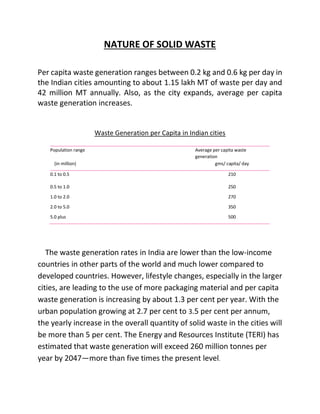
Per capita waste generation ranges between 0.2 kg and 0.6 kg per day in
the Indian cities amounting to about 1.15 lakh MT of waste per day and
42 million MT annually. Also, as the city expands, average per capita
waste generation increases.
Waste Generation per Capita in Indian cities
The waste generation rates in India are lower than the low-income
countries in other parts of the world and much lower compared to
developed countries. However, lifestyle changes, especially in the larger
cities, are leading to the use of more packaging material and per capita
waste generation is increasing by about 1.3 per cent per year. With the
urban population growing at 2.7 per cent to 3.5 per cent per annum,
the yearly increase in the overall quantity of solid waste in the cities will
be more than 5 per cent. The Energy and Resources Institute (TERI) has
estimated that waste generation will exceed 260 million tonnes per
year by 2047—more than five times the present level.
Population range Average per capita waste
generation
(in million) gms/ capita/ day
0.1 to 0.5 210
0.5 to 1.0 250
1.0 to 2.0 270
2.0 to 5.0 350
5.0 plus 500
Cities with 100,000 plus population contribute 72.5 per cent of the
waste generated in the country as compared to other 3955 urban
centers that produce only 17.5 per cent of the total waste and practices
continue to be outdated and inefficient. No serious efforts are made to
adapt latest methods and technologies of waste management,
treatment and disposal. Though a large portion of the municipal budget
is allotted for solid waste management, most of it is spent on the wages
of sanitation workers whose productivity is very low. There are no clear
plans to enhance their efficiency or improve working conditions
through the provision of modern equipment and protective gear.
Unionization of the workers, politicization of labour unions and the
consequent indiscipline among the workforce are all results of bad
working conditions and inept handling of labour issues.
METHODS FOR PROCESSING, TREATMENT AND
DISPOSAL OF SOLID WASTE
The main technological options available for processing/ treatment and
disposal of MSW are composting, vermicomposting, anaerobic
digestion/ biomethanation, incineration, gasification and pyrolysis,
plasma pyrolysis, production of Refuse Derived Fuel (RDF), also known
as pelletization and sanitary landfilling/landfill gas recovery. Not all
technologies are equally good. Each one of them has advantages and
limitations.
COMPOSTING :- Composting is a technology known in India
since times immemorial. Composting is the decomposition of organic
matter by microorganism in warm, moist, aerobic and anaerobic
environment. Farmers have been using compost made out of cow dung
and other agro-waste. The compost made out of urban heterogeneous
waste is found to be of higher nutrient value as compared to the
compost made out of cow dung and agro-waste. Composting of MSW
is, therefore, the most simple and cost effective technology for treating
the organic fraction of MSW. Full-scale commercially viable composting
technology is already demonstrated in India and is in use in several
cities and towns. Its application to farm land, tea gardens, fruit
orchards or its use as soil conditioner in parks, gardens, agricultural
lands, etc., is however, limited on account of poor marketing.
Main advantages of composting include improvement in soil texture
and augmenting of micronutrient deficiencies. It also increases
moisture-holding capacity of the soil and helps in maintaining soil
health. Moreover, it is an age-old established concept for recycling
nutrients to the soil. It is simple and straightforward to adopt, for
source separated MSW. It does not require large capital investment,
compared to other waste treatment options. The technology is scale
neutral. Composting is suitable for organic biodegradable fraction of
MSW, yard (or garden) waste/waste containing high proportion of
lignocelluloses materials, which do not readily degrade under anaerobic
conditions, waste from slaughterhouse and dairy waste.
This method, however, is not very suitable for wastes that may be
too wet and during heavy rains open compost plants have to be
stopped. Land required for open compost plants is relatively large. Also,
issues of methane emission, odour, and flies from badly managed open
properly carried out there is possibility of toxic material entering the
stream of MSW.
VERMI-COMPOSTING :- Vermi-compost is the natural organic
manure produced from the excreta of earthworms fed on scientifically
semi-decomposed organic waste. A few vermi composting plants
generally of small size have been set up in some cities and towns in
India, the largest plant being in Bangalore of about 100 MT/day
capacity. Normally, vermi-composting is preferred to microbial
composting in small towns as it requires less mechanization and it is
easy to operate. It is, however, to be ensured that toxic material does
not enter the chain which if present could kill the earthworms.
ANAEROBIC DIGESTION AND BIOMETHANATION :-
Biomethanation is a comparatively well-established technology for
disinfections, deodorization and stabilization of sewage sludge,
farmyard manures, animal slurries, and industrial sludge. Its application
to the organic fraction of MSW is more recent and less extensive. It
leads to bio-gas/power generation in addition to production of
compost (residual sludge). This method provides a value addition to the
aerobic (composting) process and also offers certain other clear
advantages over composting in terms of energy.
This method is suitable for kitchen wastes and, other putrescible
wastes, which may be too wet and lacking in structure for aerobic
composting. It is a net energy-producing process (100–150 kWh per
tonne of waste input). A totally enclosed system enables all the gas
produced to be collected for use. A modular construction of plant and
closed treatment needs less land area. This plant is free from bad
odour, rodent and fly menace, visible pollution, and social resistance. It
has potential for co-disposal with other organic waste streams from
agro-based industry. The plant can be scaled up depending on the
availability of the waste.
INCINERATION :- This method, commonly used in developed
countries is most suitable for high calorific value waste with a large
component of paper, plastic, packaging material, pathological wastes,
etc. It can reduce waste volumes by over 90 per cent and convert waste
to innocuous material, with energy recovery. The method is relatively
hygienic, noiseless, and odourless, and land requirements are minimal.
The plant can be located within city limits, reducing the cost of waste
transportation.
This method, however, is least suitable for disposal of chlorinated
waste and aqueous/high moisture content/low calorific value waste as
supplementary fuel may be needed to sustain combustion, adversely
affecting net energy recovery. The plant requires large capital and
entails substantial operation and maintenance costs. Skilled personnel
are required for plant operation and maintenance. Emission of
particulates, SOx , NOx, chlorinated compounds in air and toxic metals in
particulates concentrated in the ash have raised concerns.
PELLETIZATION :- It is basically a processing method for mixed
MSW, which can be very effective in preparing an enriched fuel feed for
thermal processes like incineration or industrial furnaces.
The RDF pellets can be conveniently stored and transported long
distances and can be used as a coal substitute at a lower price. As
pelletization involves significant MSW sorting operations, it provides a
greater opportunity to remove environmentally harmful materials from
the incoming waste prior to combustion.
The process, however, is energy intensive and not suitable for wet
MSW during rainy season. If RDF fluff/pellets are contaminated by
toxic/hazardous material, the pellets are not safe for burning in the
open or for domestic use.
SANITARY LANDFILLS AND LANDFILL GAS
RECOVERY :- Sanitary landfills are the ultimate means of
disposal of all types of residual, residential, commercial and
institutional waste as well as unutilized municipal solid waste from
waste processing facilities and other types of inorganic waste and inerts
that cannot be reused or recycled in the foreseeable future.
Its main advantage is that it is the least cost option for waste disposal
and has the potential for the recovery of landfill gas as a source of
energy, with net environmental gains if organic wastes are landfilled.
The gas after necessary cleaning, can be utilized for power generation
or as domestic fuel for direct thermal applications1
. Highly skilled
personnel are not required to operate a sanitary landfill.
Major limitation of this method is the costly transportation of MSW
to far away landfill sites. Down gradient surface water can be polluted
by surface run-off in the absence of proper drainage systems and
groundwater aquifers may get contaminated by polluted leacheate in
the absence of a proper leacheate collection and treatment system
DRAWBACKS IN PRESENT SOLID WASTE
MANGEMENT SERVICES
No Storage of Waste at Source :- There is no practice of
storing the waste at source in a scientifically segregated way. Citizens
have not been educated to keep domestic, trade, and institutional bins
for storage of waste at source and stop littering on the streets.
No System of Primary Collection from the Doorstep :-
There is no public system of primary collection from the source of
waste generation. The waste discharged here and there is later
collected by municipal sanitation workers through street sweeping,
drain cleaning, etc. Street sweeping has, thus become the principal
method of primary collection.
Irregular Street Sweeping :- Even street sweeping is not
carried out on a day-to-day basis in most cities and towns in India.
Generally commercial roads and important streets are prioritized and
rest of the streets are swept occasionally or not swept at all. Generally,
no sweeping is done on Sundays and public holidays and a back log is
created on the next working day.
The tools used for street sweeping are generally inefficient and out -
dated. For instance, the broom with a short handle is still in use forcing
sweepers to bend for hours resulting in fatigue and loss of productivity.
Traditional handcarts/tricycles are used for collection, which do not
synchronize with the secondary storage systems. Waste is deposited on
the ground necessitating multiple handling.
There are no uniform yardsticks adopted for street sweeping. Though,
some states/cities have prescribed work-norms, these are not very
scientific. Most of the cities allocate work to sanitation workers on ad
hoc basis. The work distribution ranges between 200 metres to 1000
metres of street sweeping each day. Some sanitation workers are found
under worked while some over burdened.
Waste Storage Depots :- As waste is collected through
traditional handcarts/tricycles that can carry only a small quantity of
waste at a time, there is a practice to set up depots for temporary
storage of waste to facilitate transportation through motorized
vehicles. Generally, open sites or round cement concrete bins, masonry
bins or concrete structures are used for temporary bulk storage, which
necessitates multiple handling of waste. Waste often spills over which
is both unsightly as well as unhygienic.
Transportation of Waste :- Transportation of waste from the
waste storage depots to the disposal site is done through a variety of
vehicles such as bullock carts, three-wheelers, tractors, and trucks. A
few cities use modern hydraulic vehicles as well. Most of the transport
vehicles are old and open. They are usually loaded manually. The fleet
is generally inadequate and utilization in optimal. Inefficient workshop
facilities do not do much to support this old and rumbling squad of
squalid vehicles. The traditional transportation system does not
synchronize with the system of primary collection and secondary waste
storage facilities and multiple manual handling of waste results.
Processing of Waste :- Generally no processing of municipal
solid waste is done in the country. Only a few cities have been
practising decentralized or centralized composting on a limited scale
using aerobic or anaerobic systems of composting. In some towns un-
segregated waste is put into the pits and allowed to decay for more
than six months and the semi-decomposed material is sold out as
compost. In some large cities aerobic compost plants of 100 MT to 700
MT capacities are set up but they are functioning much below installed
capacity. A few towns are practising vermi-composting on a limited
scale.
Disposal of Waste :- Disposal of waste is the most neglected
area of SWM services and the current practices are grossly unscientific.
Almost all municipal authorities deposit solid waste at a dump-yard
situated within or outside the city haphazardly and do not bother to
spread and cover the waste with inert material. These sites emanate
foul smell and become breeding grounds for flies, rodent, and pests.
Liquid seeping through the rotting organic waste called leachate
pollutes underground water and poses a serious threat to health and
environment.
Landfill sites also release landfill gas with 50 to 60 per cent methane by
volume. Methane is 21 times more potent than carbon dioxide
aggravating problems related to global warming. It is estimated by TERI
that in 1997 India released about 7 million tonnes of methane into the
atmosphere. This could increase to 39 million tonnes by 2047 if no
efforts are made to reduce the emission through composting, recycling,
etc.
CASE STUDY: INTIATIVE TAKEN BY STATE
GOVERNMENTS TO HANDLE SOLID WASTE
Karnataka :- Karnataka formulated the state policy for
implementation of Integrated Solid Waste Management (ISWM) based
on MSW Rules 2000 laying down guidelines for all the activities under
MSWM, defining roles and responsibilities of all the stakeholders
namely, ULBs, elected representatives, waste generators, NGOs, CBOs,
SHGs, etc. It created the post of Environmental Engineers in 123 local
bodies to build technical capability. SWM Action Plan and Management
Plans for 56 cities were prepared based on data pertaining to
concerned ULBs. The state also prepared technical manuals on (a)
design and specifications of the tools and equipment for SWM and (b)
treatment and landfill operations. To promote SWM practices at the
local level it prepared a short film and issued six short books on MSWM
for educating stakeholders. A series of workshops was conducted for
the local body officials, elected representatives, NGOs, etc., for
preparation of action plan, adoption of state policy, identification of
best practices, carrying out of Information, Education and
Communication (IEC) activities and identifying suitable landfill sites for
treatment and disposal of waste.
The state has issued orders for transfer of government land free of
cost to the 226 local bodies for sanitary landfills, issued guidelines for
identification and purchase of private land for this purpose and, if
required, provides 100 per cent financial assistance to purchase the
identified land from a budget allocation of Rs 16.1 crore. The
government initiated action to develop scientific landfill sites in eight
class 1 cities on BOT basis.
Gujarat :- Government of Gujarat has set up a state level
committee headed by the Principal Secretary, Urban Development and
Urban Housing Department and a sub-committee headed by a subject
expert to identify systems for solid waste management. All cities and
towns have been advised to implement the recommended systems.
Regional and state level workshops have been conducted to provide
training to all responsible officers of ULBs and action plans have been
prepared for almost all the cities through the Gujarat Municipal Finance
Board, a nodal agency of the state government and City Manager’s
Association, Gujarat. The state government has given Rs 22 crore since
2000 to ULBs of class I cities/towns for the procurement of tools and
equipment.
Government of Gujarat has passed a resolution to allot land to
municipal corporations at 25 per cent of the market value and to
smaller local bodies on a token lease rent for a period of 30 years for
treatment and disposal of waste. Thus, 147 out of 149 cities and towns
have been able to earmark appropriate land and these sites have been
duly authorized by the state pollution control board for treatment and
disposal of waste.
The year 2005 has been declared the Year for Urban Development.
Under this initiative, construction of treatment and disposal sites in all
the 141 municipalities, has been taken up centrally using expert
agencies, state government funds and central government grants. For
this purpose, the state government has formed a core committee of
administrative and technical experts and identified the Gujarat Urban
Development Company as a nodal agency to facilitate the construction
of treatment and disposal sites through qualified contractors. The work
is proposed to be taken up simultaneously in four regions of the
Gujarat state.
Besides bearing the full cost of construction of treatment and
disposal facilities, using 12th
Finance Commission grant and Urban
Renewal Mission fund the state government now proposes to give
financial support ranging between 50 and 90 per cent to municipalities
for tools and equipment for collection, secondary storage, and waste
transportation facilities. The entire venture is expected to cost the
government of Gujarat Rs 346 crore. The 141 urban local bodies in the
state (other than the corporations) have been grouped in four to six
categories and cost estimates have been prepared for the construction
of landfill sites and compost plants of standard designs for different
levels of cities/towns .
West Bengal :- The Government of West Bengal has launched a
‘West Bengal Solid Waste Management Mission’ registered under the
West Bengal Societies Registration Act 1961 on 18 May 2005. The
mission has been set up under the chairmanship of the Chief Secretary
to Government and a technical committee headed by the Secretary,
Department of Environment. Regulations have been framed and the
powers, duties and functions of the mission as well as technical
advisory committee have been laid down. The objective of the mission
is to promote modernization of collection and transportation of MSW
and facilitate development of cost-effective technology for treatment
and disposal of the same in the state. Provision of technical and
financial support to municipal bodies, PRIs, and authorities of the
statutory area for setting up of regional or common solid waste
management facilities is proposed.
The technical committee has prepared an action plan for
implementing MSW Rules 2000 in the state. It has been envisaged that
25 to 30 regional facilities would be constructed in the state to cover
126 ULBs including six corporations. One regional facility would serve
about five ULBs and each city would share the O&M cost in proportion
to the waste delivered for treatment and disposal.
The state government’s technical committee has prepared a
tentative estimate of over Rs 395 crore for supporting municipal
authorities in the state if they agree to enter into a cost sharing
arrangement of a little over Rs 15 crore (cost estimates in Table 8.7).
Upgrading SWM services would include provisions for public
awareness, capacity building of the municipal authorities, procurement
of tools, equipment, and vehicles for primary collection, secondary
storage and transportation of waste, construction of transfer stations,
procurement of large hauling vehicles for transportation, construction
of regional as well as individual compost plants and construction of
about 25 regional landfill facilities covering the entire state.
The state government proposes to use the funds allocated by the 12th
Finance Commission as well as from the urban renewal fund for this
purpose. The government of India has allocated Rs 393 crore to the
municipalities in the state out of which 50 per cent is earmarked for
solid waste management in urban areas. Besides another Rs 1271 crore
have been allotted to panchayats out of which the state expects to
spend at least 10 per cent on solid waste management making a total
Rs 323.60 crore. Some additional funds would be found from the urban
renewal grant to be allocated by the government of India and internal
resources of the state as well as local bodies.
FUNDS REQUIRED AND SOURCES OF
FUNDS FOR SOLID WASTE MANGEMENT
Operational Expenditure :- SWM constitutes up to 10 to 50
per cent of municipal budget expenditure depending on the income
sources of the municipal authorities. The main expenditure heads
under SWM are in salaries and allowances, consumables, vehicles
repair and maintenance, contingencies and others. A recent survey by
the National Institute of Urban Affairs shows ‘salaries of sanitation
workers’ for SWM in class I cities, constitute as much as 75 per cent of
total SWM expenditure. This is still higher at 85 per cent in class II
cities.
Capital Investments :- Capital costs for SWM in India are met
from the current revenue and borrowings. City level planning with
related budget estimates, is usually absent in most local bodies. Cities
borrow funds from financial institutions such as HUDCO and banks for
financing equipment and vehicles to the extent their financial health
permits.
SOURCES OF FUNDS
Conservancy Tax :- Traditionally, funding for solid waste
systems comes from the general fund. Most ULBs use a percentage of
the property tax to support the solid waste management system. This
tax, known as conservancy tax, is easy to administer since no separate
billing or collection system is needed. However, the disadvantage is
that in most Indian cities’ assessment and collection of property tax is
poor and this poor base provides for very little income.
User Charges :- Increased public awareness of solid waste issues
and public involvement in the decision-making process may provide the
opportunity to adjust user charges to reflect real costs of providing
solid waste services.
User charges if properly administered:
• are an equitable means of funding SWM services;
• can provide incentive to reduce waste generation; and encourage
recycling.
Revenue from Recovery and Treatment of Waste :-
Waste recycling, composting, waste-to-energy, may generate operating
revenues or at least reduce the cost of treatment of waste. Such
programmes provide tangible financial benefits from recovered
materials and conserved energy, and additional benefits from avoided
costs of land filling. Further, these help increase the life of a landfill
facility.
Investment by the Private Sector :- Role of the private
sector in financing resource recovery (composting, waste-to-energy)
facilities is growing in India. Many composting facilities and two power
plants have been set up in the country with private sector participation.
Pool Financing Mechanism :- Under this arrangement local
bodies can come together to develop/construct common facilities on a
cost sharing basis and access the capital market to raise funds for such
projects through a common lead agency that must be established by
the state government.
CONCLUSION
While SWM was completely neglected in past and is now receiving
some attention at the highest levels in several cities and states, many
are lagging behind and several have not bothered to make any
improvement at all. The national and state solid waste management
missions need to be created to ensure that municipal authorities
perform their obligatory duties regularly in compliance with MSW Rules
2000 within a predetermined time frame.
Though levels of SWM services in the country have started improving
on account of active monitoring by the Supreme Court of India, the
central and state pollution control boards and finance and technical
support from proactive state governments there still is a long way to
go. Save the formalization of the MSW Rules 2000, state action in this
regard at many levels has been fairly uninspiring thus far. While MSW
Rules 2000 is a watershed document in India’s history of effective
SWM, implementation issues still overwhelm the system.
A comprehensive nationwide programme needs to be actively
implemented keeping in mind possible future scenarios. Key
individuals within the governing system and the bureaucracy need to
be educated to the magnitude of the crisis and motivated to use their
power to influence the system and appropriately channelize resources
to actively promote effective and progressive SWM projects and
practices
REFERENCES
--- Akolkar, A.B. (2005). Status of Solid Waste Management in India,
Implementation Status of Municipal Solid Wastes, Management and Handling
Rules 2000, Central Pollution Control Board, New Delhi.
-- Asnani, P.U. (2004). United States Asia Environmental Partnership Report,
United States Agency for International Development, Centre for
Environmental Planning and Technology, Ahmedabad.
(2005). Technical Committee Report, West Bengal SWM Mission 2005,
Government of West Bengal, Kolkata.
CPCB (2000). Status of Municipal Solid Waste Generation, Collection Treatment,
and Disposal in Class 1 Cities, Central Pollution Control Board, Ministry
of Environment and Forests, Government of India, New Delhi.
GOI (2003). Report of the Technology Advisory Group on Solid Waste Management,
Government of India Publications, New Delhi.
MOUDPA (2000). Manual on Solid Waste Management, Ministry of Urban
Development and Poverty Alleviation, Government of India
Publications, New Delhi.

automatic mixture machine.pdf

  • 1.
    SEMINAR REPORT ON SOLIDWASTE MANAGEMENT SUBMITTED IN PARTIAL FULFILLMENT OF THE B.TECH DEGREE PROGRAM IN CIVIL ENGINEERING OF BUNDELKHAND INSTITUTE OF ENGINEERING AND TECHNOLOGY SESSION: 2015-16 HEAD OF DEPARTMENT DR. MUKESH SHUKLA SUBMITTED TO ER. ANUJ KUMAR SUBMITTED BY GULSHAN KUMAR R.N.-1204300013 FINAL YEAR STUDENT CIVIL ENGINEERING
  • 2.
    CERTIFICATE Certified that theseminar report entitled “SOLID WASTE MANAGEMENT” is a bonafied work carried out by GULSHAN KUMAR (1204300013) for the award of Bachelor in Technology in Civil Engineering of the BIET, JHANSI during the year 2015-2016. The report has been approved as it satisfies the academic requirements in respect of seminar work prescribed for the Bachelor in Technology Degree. Head Of Department Guided By. Dr. Mukesh Shukla Er. Anuj Kumar
  • 3.
    ACKNOWLEDGEMENT I would liketo place on record my deep sense of gratitude to Dr. MUKESH SHUKLA, HOD, Department of Civil Engineering, B.I.E.T. Jhansi for his generous guidance, help and useful suggestions. I express my sincere gratitude to Er. Anuj Kumar, Dept. of Civil Engineering, B.I.E.T. Jhansi for his stimulating guidance, continuous encouragement and supervision throughout the course of present work. I also wish to extend my thanks to my colleagues for attending my seminars and for their insightful comments and constructive suggestions to improve the quality of this report. They are very motivative and creative, and I am sure I have learnt a lot from them. ( GULSHAN KUMAR )
  • 4.
    ABSTRACT Solid waste managementis one among the basic essential services provided by municipal authorities in the country to keep urban centers clean. However, it is among the most poorly rendered services in the basket. The systems applied are unscientific, outdated and inefficient ; population coverage is low ; and the poor are marginalized. Waste is littered all over leading to insanitary living conditions. Municipal laws governing the urban local bodies do not have adequate provisions to deal effectively with the ever- growing problem of solid waste management. With rapid urbanization, the situation is becoming critical. The urban population has grown fivefold in the last six decades with 285.35 million people living in urban areas as per the 2001 Census.
  • 5.
    Content NATURE OF SOLIDWASTE METHODS FOR PROCESSING, TREATMENT AND DISPOSAL OF SOLID WASTE DRAWBACKS IN PRESENT SOLID WASTE MANGEMENT SERVICES CASE STUDY: INTIATIVE TAKEN BY STATE GOVERNMENTS TO HANDLE SOLID WASTE FUNDS REQUIRED AND SOURCES OF FUNDS FOR SOLID WASTE MANAGEMENT
  • 6.
    INTRODUCTION The improper disposalof municipal waste has a serious and dangerous impact on a wide range of areas. Garbage thrown in the street or in open spaces creates a public health hazard, while waste dumped near rivers, lakes and streams contaminates the water supply. Rubbish that is burned in the open rather than disposed of properly creates pollution and releases toxic fumes into the environment. Non- biodegradable materials thrown into open drains make their way into the sewerage system, clogging pipelines and damaging infrastructure. The hazards posed by the dumping of untreated hospital and industrial waste are even greater, with the release of pathogens and toxic compounds posing a grave threat not just to human life but also to plants and animals. Garbage dumped in the countryside is not simply an eyesore; entire landscapes are ruined and unique habitats for flora and fauna are lost. All of these problems are common in India, where vast quantities of solid waste remain uncollected in the streets, along major roads, in empty plots of land, down hill slopes and in illegal dumps.
  • 7.
    NATURE OF SOLIDWASTE Per capita waste generation ranges between 0.2 kg and 0.6 kg per day in the Indian cities amounting to about 1.15 lakh MT of waste per day and 42 million MT annually. Also, as the city expands, average per capita waste generation increases. Waste Generation per Capita in Indian cities The waste generation rates in India are lower than the low-income countries in other parts of the world and much lower compared to developed countries. However, lifestyle changes, especially in the larger cities, are leading to the use of more packaging material and per capita waste generation is increasing by about 1.3 per cent per year. With the urban population growing at 2.7 per cent to 3.5 per cent per annum, the yearly increase in the overall quantity of solid waste in the cities will be more than 5 per cent. The Energy and Resources Institute (TERI) has estimated that waste generation will exceed 260 million tonnes per year by 2047—more than five times the present level. Population range Average per capita waste generation (in million) gms/ capita/ day 0.1 to 0.5 210 0.5 to 1.0 250 1.0 to 2.0 270 2.0 to 5.0 350 5.0 plus 500
  • 8.
    Cities with 100,000plus population contribute 72.5 per cent of the waste generated in the country as compared to other 3955 urban centers that produce only 17.5 per cent of the total waste and practices continue to be outdated and inefficient. No serious efforts are made to adapt latest methods and technologies of waste management, treatment and disposal. Though a large portion of the municipal budget is allotted for solid waste management, most of it is spent on the wages of sanitation workers whose productivity is very low. There are no clear plans to enhance their efficiency or improve working conditions through the provision of modern equipment and protective gear. Unionization of the workers, politicization of labour unions and the consequent indiscipline among the workforce are all results of bad working conditions and inept handling of labour issues. METHODS FOR PROCESSING, TREATMENT AND DISPOSAL OF SOLID WASTE The main technological options available for processing/ treatment and disposal of MSW are composting, vermicomposting, anaerobic digestion/ biomethanation, incineration, gasification and pyrolysis, plasma pyrolysis, production of Refuse Derived Fuel (RDF), also known as pelletization and sanitary landfilling/landfill gas recovery. Not all technologies are equally good. Each one of them has advantages and limitations.
  • 9.
    COMPOSTING :- Compostingis a technology known in India since times immemorial. Composting is the decomposition of organic matter by microorganism in warm, moist, aerobic and anaerobic environment. Farmers have been using compost made out of cow dung and other agro-waste. The compost made out of urban heterogeneous waste is found to be of higher nutrient value as compared to the compost made out of cow dung and agro-waste. Composting of MSW is, therefore, the most simple and cost effective technology for treating the organic fraction of MSW. Full-scale commercially viable composting technology is already demonstrated in India and is in use in several cities and towns. Its application to farm land, tea gardens, fruit orchards or its use as soil conditioner in parks, gardens, agricultural lands, etc., is however, limited on account of poor marketing. Main advantages of composting include improvement in soil texture and augmenting of micronutrient deficiencies. It also increases moisture-holding capacity of the soil and helps in maintaining soil health. Moreover, it is an age-old established concept for recycling nutrients to the soil. It is simple and straightforward to adopt, for source separated MSW. It does not require large capital investment, compared to other waste treatment options. The technology is scale neutral. Composting is suitable for organic biodegradable fraction of MSW, yard (or garden) waste/waste containing high proportion of lignocelluloses materials, which do not readily degrade under anaerobic conditions, waste from slaughterhouse and dairy waste. This method, however, is not very suitable for wastes that may be too wet and during heavy rains open compost plants have to be stopped. Land required for open compost plants is relatively large. Also, issues of methane emission, odour, and flies from badly managed open
  • 10.
    properly carried outthere is possibility of toxic material entering the stream of MSW. VERMI-COMPOSTING :- Vermi-compost is the natural organic manure produced from the excreta of earthworms fed on scientifically semi-decomposed organic waste. A few vermi composting plants generally of small size have been set up in some cities and towns in India, the largest plant being in Bangalore of about 100 MT/day capacity. Normally, vermi-composting is preferred to microbial composting in small towns as it requires less mechanization and it is easy to operate. It is, however, to be ensured that toxic material does not enter the chain which if present could kill the earthworms. ANAEROBIC DIGESTION AND BIOMETHANATION :- Biomethanation is a comparatively well-established technology for disinfections, deodorization and stabilization of sewage sludge, farmyard manures, animal slurries, and industrial sludge. Its application to the organic fraction of MSW is more recent and less extensive. It leads to bio-gas/power generation in addition to production of compost (residual sludge). This method provides a value addition to the aerobic (composting) process and also offers certain other clear advantages over composting in terms of energy. This method is suitable for kitchen wastes and, other putrescible wastes, which may be too wet and lacking in structure for aerobic composting. It is a net energy-producing process (100–150 kWh per
  • 11.
    tonne of wasteinput). A totally enclosed system enables all the gas produced to be collected for use. A modular construction of plant and closed treatment needs less land area. This plant is free from bad odour, rodent and fly menace, visible pollution, and social resistance. It has potential for co-disposal with other organic waste streams from agro-based industry. The plant can be scaled up depending on the availability of the waste. INCINERATION :- This method, commonly used in developed countries is most suitable for high calorific value waste with a large component of paper, plastic, packaging material, pathological wastes, etc. It can reduce waste volumes by over 90 per cent and convert waste to innocuous material, with energy recovery. The method is relatively hygienic, noiseless, and odourless, and land requirements are minimal. The plant can be located within city limits, reducing the cost of waste transportation. This method, however, is least suitable for disposal of chlorinated waste and aqueous/high moisture content/low calorific value waste as supplementary fuel may be needed to sustain combustion, adversely affecting net energy recovery. The plant requires large capital and entails substantial operation and maintenance costs. Skilled personnel are required for plant operation and maintenance. Emission of particulates, SOx , NOx, chlorinated compounds in air and toxic metals in particulates concentrated in the ash have raised concerns.
  • 12.
    PELLETIZATION :- Itis basically a processing method for mixed MSW, which can be very effective in preparing an enriched fuel feed for thermal processes like incineration or industrial furnaces. The RDF pellets can be conveniently stored and transported long distances and can be used as a coal substitute at a lower price. As pelletization involves significant MSW sorting operations, it provides a greater opportunity to remove environmentally harmful materials from the incoming waste prior to combustion. The process, however, is energy intensive and not suitable for wet MSW during rainy season. If RDF fluff/pellets are contaminated by toxic/hazardous material, the pellets are not safe for burning in the open or for domestic use. SANITARY LANDFILLS AND LANDFILL GAS RECOVERY :- Sanitary landfills are the ultimate means of disposal of all types of residual, residential, commercial and institutional waste as well as unutilized municipal solid waste from waste processing facilities and other types of inorganic waste and inerts that cannot be reused or recycled in the foreseeable future. Its main advantage is that it is the least cost option for waste disposal and has the potential for the recovery of landfill gas as a source of energy, with net environmental gains if organic wastes are landfilled. The gas after necessary cleaning, can be utilized for power generation or as domestic fuel for direct thermal applications1 . Highly skilled personnel are not required to operate a sanitary landfill.
  • 13.
    Major limitation ofthis method is the costly transportation of MSW to far away landfill sites. Down gradient surface water can be polluted by surface run-off in the absence of proper drainage systems and groundwater aquifers may get contaminated by polluted leacheate in the absence of a proper leacheate collection and treatment system DRAWBACKS IN PRESENT SOLID WASTE MANGEMENT SERVICES No Storage of Waste at Source :- There is no practice of storing the waste at source in a scientifically segregated way. Citizens have not been educated to keep domestic, trade, and institutional bins for storage of waste at source and stop littering on the streets. No System of Primary Collection from the Doorstep :- There is no public system of primary collection from the source of waste generation. The waste discharged here and there is later collected by municipal sanitation workers through street sweeping, drain cleaning, etc. Street sweeping has, thus become the principal method of primary collection.
  • 14.
    Irregular Street Sweeping:- Even street sweeping is not carried out on a day-to-day basis in most cities and towns in India. Generally commercial roads and important streets are prioritized and rest of the streets are swept occasionally or not swept at all. Generally, no sweeping is done on Sundays and public holidays and a back log is created on the next working day. The tools used for street sweeping are generally inefficient and out - dated. For instance, the broom with a short handle is still in use forcing sweepers to bend for hours resulting in fatigue and loss of productivity. Traditional handcarts/tricycles are used for collection, which do not synchronize with the secondary storage systems. Waste is deposited on the ground necessitating multiple handling. There are no uniform yardsticks adopted for street sweeping. Though, some states/cities have prescribed work-norms, these are not very scientific. Most of the cities allocate work to sanitation workers on ad hoc basis. The work distribution ranges between 200 metres to 1000 metres of street sweeping each day. Some sanitation workers are found under worked while some over burdened. Waste Storage Depots :- As waste is collected through traditional handcarts/tricycles that can carry only a small quantity of waste at a time, there is a practice to set up depots for temporary storage of waste to facilitate transportation through motorized vehicles. Generally, open sites or round cement concrete bins, masonry bins or concrete structures are used for temporary bulk storage, which necessitates multiple handling of waste. Waste often spills over which is both unsightly as well as unhygienic.
  • 15.
    Transportation of Waste:- Transportation of waste from the waste storage depots to the disposal site is done through a variety of vehicles such as bullock carts, three-wheelers, tractors, and trucks. A few cities use modern hydraulic vehicles as well. Most of the transport vehicles are old and open. They are usually loaded manually. The fleet is generally inadequate and utilization in optimal. Inefficient workshop facilities do not do much to support this old and rumbling squad of squalid vehicles. The traditional transportation system does not synchronize with the system of primary collection and secondary waste storage facilities and multiple manual handling of waste results. Processing of Waste :- Generally no processing of municipal solid waste is done in the country. Only a few cities have been practising decentralized or centralized composting on a limited scale using aerobic or anaerobic systems of composting. In some towns un- segregated waste is put into the pits and allowed to decay for more than six months and the semi-decomposed material is sold out as compost. In some large cities aerobic compost plants of 100 MT to 700 MT capacities are set up but they are functioning much below installed capacity. A few towns are practising vermi-composting on a limited scale. Disposal of Waste :- Disposal of waste is the most neglected area of SWM services and the current practices are grossly unscientific. Almost all municipal authorities deposit solid waste at a dump-yard situated within or outside the city haphazardly and do not bother to spread and cover the waste with inert material. These sites emanate foul smell and become breeding grounds for flies, rodent, and pests. Liquid seeping through the rotting organic waste called leachate
  • 16.
    pollutes underground waterand poses a serious threat to health and environment. Landfill sites also release landfill gas with 50 to 60 per cent methane by volume. Methane is 21 times more potent than carbon dioxide aggravating problems related to global warming. It is estimated by TERI that in 1997 India released about 7 million tonnes of methane into the atmosphere. This could increase to 39 million tonnes by 2047 if no efforts are made to reduce the emission through composting, recycling, etc. CASE STUDY: INTIATIVE TAKEN BY STATE GOVERNMENTS TO HANDLE SOLID WASTE Karnataka :- Karnataka formulated the state policy for implementation of Integrated Solid Waste Management (ISWM) based on MSW Rules 2000 laying down guidelines for all the activities under MSWM, defining roles and responsibilities of all the stakeholders namely, ULBs, elected representatives, waste generators, NGOs, CBOs, SHGs, etc. It created the post of Environmental Engineers in 123 local bodies to build technical capability. SWM Action Plan and Management Plans for 56 cities were prepared based on data pertaining to concerned ULBs. The state also prepared technical manuals on (a) design and specifications of the tools and equipment for SWM and (b) treatment and landfill operations. To promote SWM practices at the
  • 17.
    local level itprepared a short film and issued six short books on MSWM for educating stakeholders. A series of workshops was conducted for the local body officials, elected representatives, NGOs, etc., for preparation of action plan, adoption of state policy, identification of best practices, carrying out of Information, Education and Communication (IEC) activities and identifying suitable landfill sites for treatment and disposal of waste. The state has issued orders for transfer of government land free of cost to the 226 local bodies for sanitary landfills, issued guidelines for identification and purchase of private land for this purpose and, if required, provides 100 per cent financial assistance to purchase the identified land from a budget allocation of Rs 16.1 crore. The government initiated action to develop scientific landfill sites in eight class 1 cities on BOT basis. Gujarat :- Government of Gujarat has set up a state level committee headed by the Principal Secretary, Urban Development and Urban Housing Department and a sub-committee headed by a subject expert to identify systems for solid waste management. All cities and towns have been advised to implement the recommended systems. Regional and state level workshops have been conducted to provide training to all responsible officers of ULBs and action plans have been prepared for almost all the cities through the Gujarat Municipal Finance Board, a nodal agency of the state government and City Manager’s Association, Gujarat. The state government has given Rs 22 crore since 2000 to ULBs of class I cities/towns for the procurement of tools and equipment.
  • 18.
    Government of Gujarathas passed a resolution to allot land to municipal corporations at 25 per cent of the market value and to smaller local bodies on a token lease rent for a period of 30 years for treatment and disposal of waste. Thus, 147 out of 149 cities and towns have been able to earmark appropriate land and these sites have been duly authorized by the state pollution control board for treatment and disposal of waste. The year 2005 has been declared the Year for Urban Development. Under this initiative, construction of treatment and disposal sites in all the 141 municipalities, has been taken up centrally using expert agencies, state government funds and central government grants. For this purpose, the state government has formed a core committee of administrative and technical experts and identified the Gujarat Urban Development Company as a nodal agency to facilitate the construction of treatment and disposal sites through qualified contractors. The work is proposed to be taken up simultaneously in four regions of the Gujarat state. Besides bearing the full cost of construction of treatment and disposal facilities, using 12th Finance Commission grant and Urban Renewal Mission fund the state government now proposes to give financial support ranging between 50 and 90 per cent to municipalities for tools and equipment for collection, secondary storage, and waste transportation facilities. The entire venture is expected to cost the government of Gujarat Rs 346 crore. The 141 urban local bodies in the state (other than the corporations) have been grouped in four to six categories and cost estimates have been prepared for the construction of landfill sites and compost plants of standard designs for different levels of cities/towns .
  • 19.
    West Bengal :-The Government of West Bengal has launched a ‘West Bengal Solid Waste Management Mission’ registered under the West Bengal Societies Registration Act 1961 on 18 May 2005. The mission has been set up under the chairmanship of the Chief Secretary to Government and a technical committee headed by the Secretary, Department of Environment. Regulations have been framed and the powers, duties and functions of the mission as well as technical advisory committee have been laid down. The objective of the mission is to promote modernization of collection and transportation of MSW and facilitate development of cost-effective technology for treatment and disposal of the same in the state. Provision of technical and financial support to municipal bodies, PRIs, and authorities of the statutory area for setting up of regional or common solid waste management facilities is proposed. The technical committee has prepared an action plan for implementing MSW Rules 2000 in the state. It has been envisaged that 25 to 30 regional facilities would be constructed in the state to cover 126 ULBs including six corporations. One regional facility would serve about five ULBs and each city would share the O&M cost in proportion to the waste delivered for treatment and disposal. The state government’s technical committee has prepared a tentative estimate of over Rs 395 crore for supporting municipal authorities in the state if they agree to enter into a cost sharing arrangement of a little over Rs 15 crore (cost estimates in Table 8.7). Upgrading SWM services would include provisions for public awareness, capacity building of the municipal authorities, procurement of tools, equipment, and vehicles for primary collection, secondary
  • 20.
    storage and transportationof waste, construction of transfer stations, procurement of large hauling vehicles for transportation, construction of regional as well as individual compost plants and construction of about 25 regional landfill facilities covering the entire state. The state government proposes to use the funds allocated by the 12th Finance Commission as well as from the urban renewal fund for this purpose. The government of India has allocated Rs 393 crore to the municipalities in the state out of which 50 per cent is earmarked for solid waste management in urban areas. Besides another Rs 1271 crore have been allotted to panchayats out of which the state expects to spend at least 10 per cent on solid waste management making a total Rs 323.60 crore. Some additional funds would be found from the urban renewal grant to be allocated by the government of India and internal resources of the state as well as local bodies. FUNDS REQUIRED AND SOURCES OF FUNDS FOR SOLID WASTE MANGEMENT Operational Expenditure :- SWM constitutes up to 10 to 50 per cent of municipal budget expenditure depending on the income sources of the municipal authorities. The main expenditure heads under SWM are in salaries and allowances, consumables, vehicles repair and maintenance, contingencies and others. A recent survey by the National Institute of Urban Affairs shows ‘salaries of sanitation workers’ for SWM in class I cities, constitute as much as 75 per cent of
  • 21.
    total SWM expenditure.This is still higher at 85 per cent in class II cities. Capital Investments :- Capital costs for SWM in India are met from the current revenue and borrowings. City level planning with related budget estimates, is usually absent in most local bodies. Cities borrow funds from financial institutions such as HUDCO and banks for financing equipment and vehicles to the extent their financial health permits. SOURCES OF FUNDS Conservancy Tax :- Traditionally, funding for solid waste systems comes from the general fund. Most ULBs use a percentage of the property tax to support the solid waste management system. This tax, known as conservancy tax, is easy to administer since no separate billing or collection system is needed. However, the disadvantage is that in most Indian cities’ assessment and collection of property tax is poor and this poor base provides for very little income. User Charges :- Increased public awareness of solid waste issues and public involvement in the decision-making process may provide the opportunity to adjust user charges to reflect real costs of providing solid waste services. User charges if properly administered: • are an equitable means of funding SWM services;
  • 22.
    • can provideincentive to reduce waste generation; and encourage recycling. Revenue from Recovery and Treatment of Waste :- Waste recycling, composting, waste-to-energy, may generate operating revenues or at least reduce the cost of treatment of waste. Such programmes provide tangible financial benefits from recovered materials and conserved energy, and additional benefits from avoided costs of land filling. Further, these help increase the life of a landfill facility. Investment by the Private Sector :- Role of the private sector in financing resource recovery (composting, waste-to-energy) facilities is growing in India. Many composting facilities and two power plants have been set up in the country with private sector participation. Pool Financing Mechanism :- Under this arrangement local bodies can come together to develop/construct common facilities on a cost sharing basis and access the capital market to raise funds for such projects through a common lead agency that must be established by the state government.
  • 23.
    CONCLUSION While SWM wascompletely neglected in past and is now receiving some attention at the highest levels in several cities and states, many are lagging behind and several have not bothered to make any improvement at all. The national and state solid waste management missions need to be created to ensure that municipal authorities perform their obligatory duties regularly in compliance with MSW Rules 2000 within a predetermined time frame. Though levels of SWM services in the country have started improving on account of active monitoring by the Supreme Court of India, the central and state pollution control boards and finance and technical support from proactive state governments there still is a long way to go. Save the formalization of the MSW Rules 2000, state action in this regard at many levels has been fairly uninspiring thus far. While MSW Rules 2000 is a watershed document in India’s history of effective SWM, implementation issues still overwhelm the system. A comprehensive nationwide programme needs to be actively implemented keeping in mind possible future scenarios. Key individuals within the governing system and the bureaucracy need to be educated to the magnitude of the crisis and motivated to use their power to influence the system and appropriately channelize resources to actively promote effective and progressive SWM projects and practices
  • 24.
    REFERENCES --- Akolkar, A.B.(2005). Status of Solid Waste Management in India, Implementation Status of Municipal Solid Wastes, Management and Handling Rules 2000, Central Pollution Control Board, New Delhi. -- Asnani, P.U. (2004). United States Asia Environmental Partnership Report, United States Agency for International Development, Centre for Environmental Planning and Technology, Ahmedabad. (2005). Technical Committee Report, West Bengal SWM Mission 2005, Government of West Bengal, Kolkata. CPCB (2000). Status of Municipal Solid Waste Generation, Collection Treatment, and Disposal in Class 1 Cities, Central Pollution Control Board, Ministry of Environment and Forests, Government of India, New Delhi. GOI (2003). Report of the Technology Advisory Group on Solid Waste Management, Government of India Publications, New Delhi. MOUDPA (2000). Manual on Solid Waste Management, Ministry of Urban Development and Poverty Alleviation, Government of India Publications, New Delhi.