MERCUR
Y
The Planet
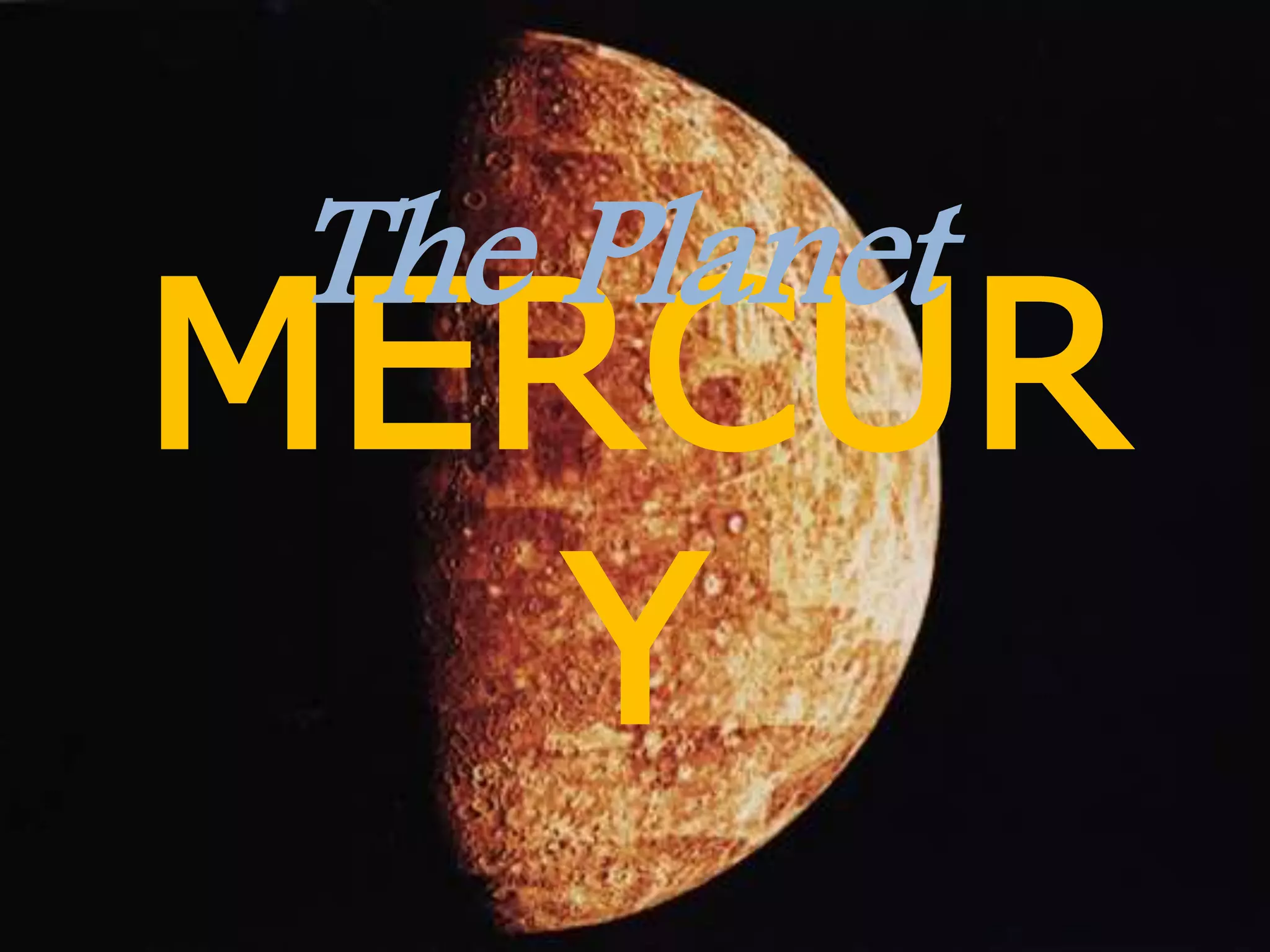
MERCURY
• 1ST inner planet
• 2nd hottest planet
• Named after the
fleet-footed
messenger god of
Romans (Gr. Hermes)
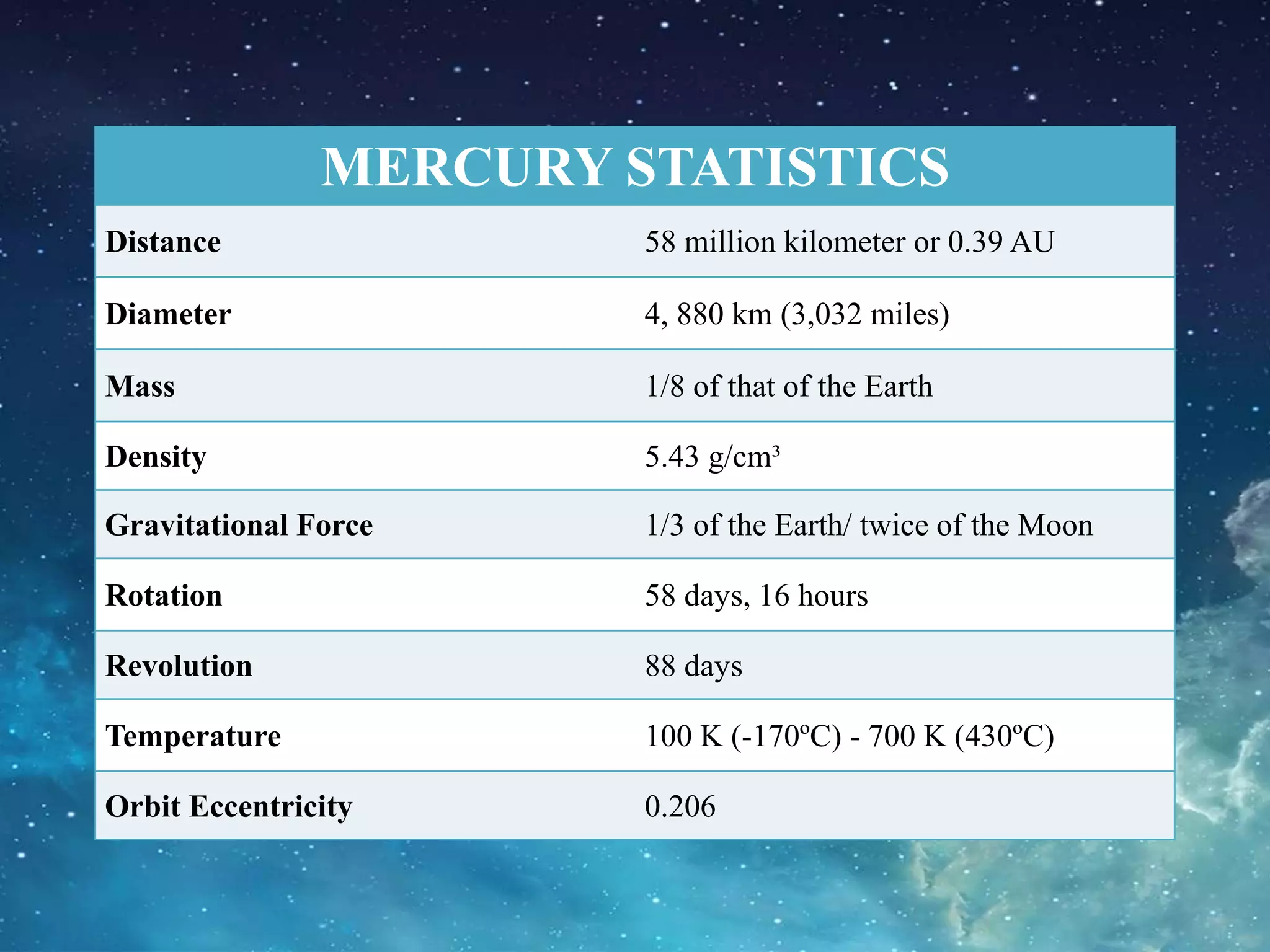
MERCURY STATISTICS
Distance 58 million kilometer or 0.39 AU
Diameter 4, 880 km (3,032 miles)
Mass 1/8 of that of the Earth
Density 5.43 g/cm³
Gravitational Force 1/3 of the Earth/ twice of the Moon
Rotation 58 days, 16 hours
Revolution 88 days
Temperature 100 K (-170ºC) - 700 K (430ºC)
Orbit Eccentricity 0.206
MERCURY’S ORBIT
• Its distance from the
Sun is 58, 000, 000 km
• Because of its orbit’s
eccentricity (its
distance from the Sun
varies significantly), its
perihelion is
46,000,000 km and
70,000,000 km at
aphelion.
COMPOSITION AND
STRUCTURE
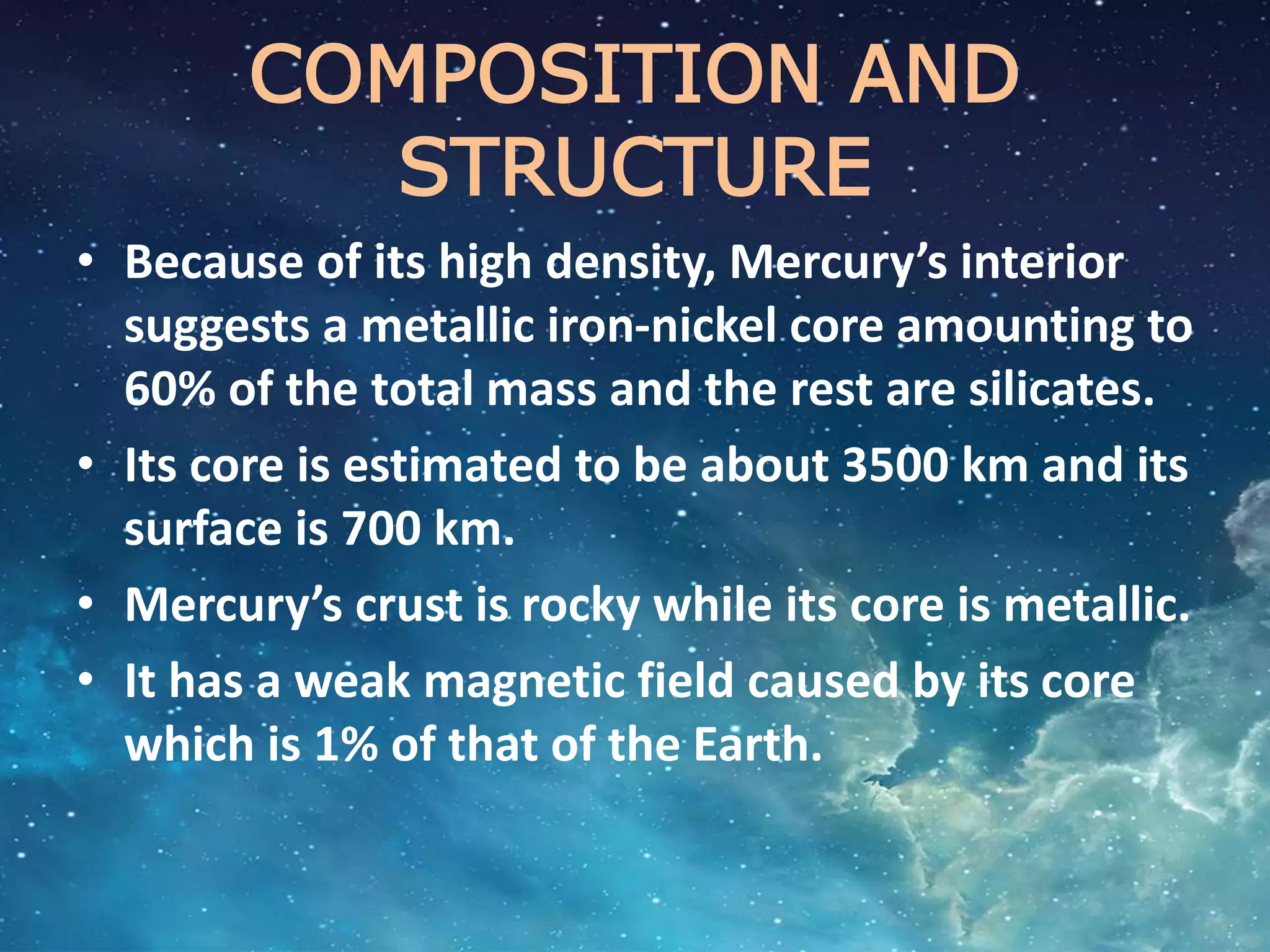
• Because of its high density, Mercury’s interior
suggests a metallic iron-nickel core amounting to
60% of the total mass and the rest are silicates.
• Its core is estimated to be about 3500 km and its
surface is 700 km.
• Mercury’s crust is rocky while its core is metallic.
• It has a weak magnetic field caused by its core
which is 1% of that of the Earth.
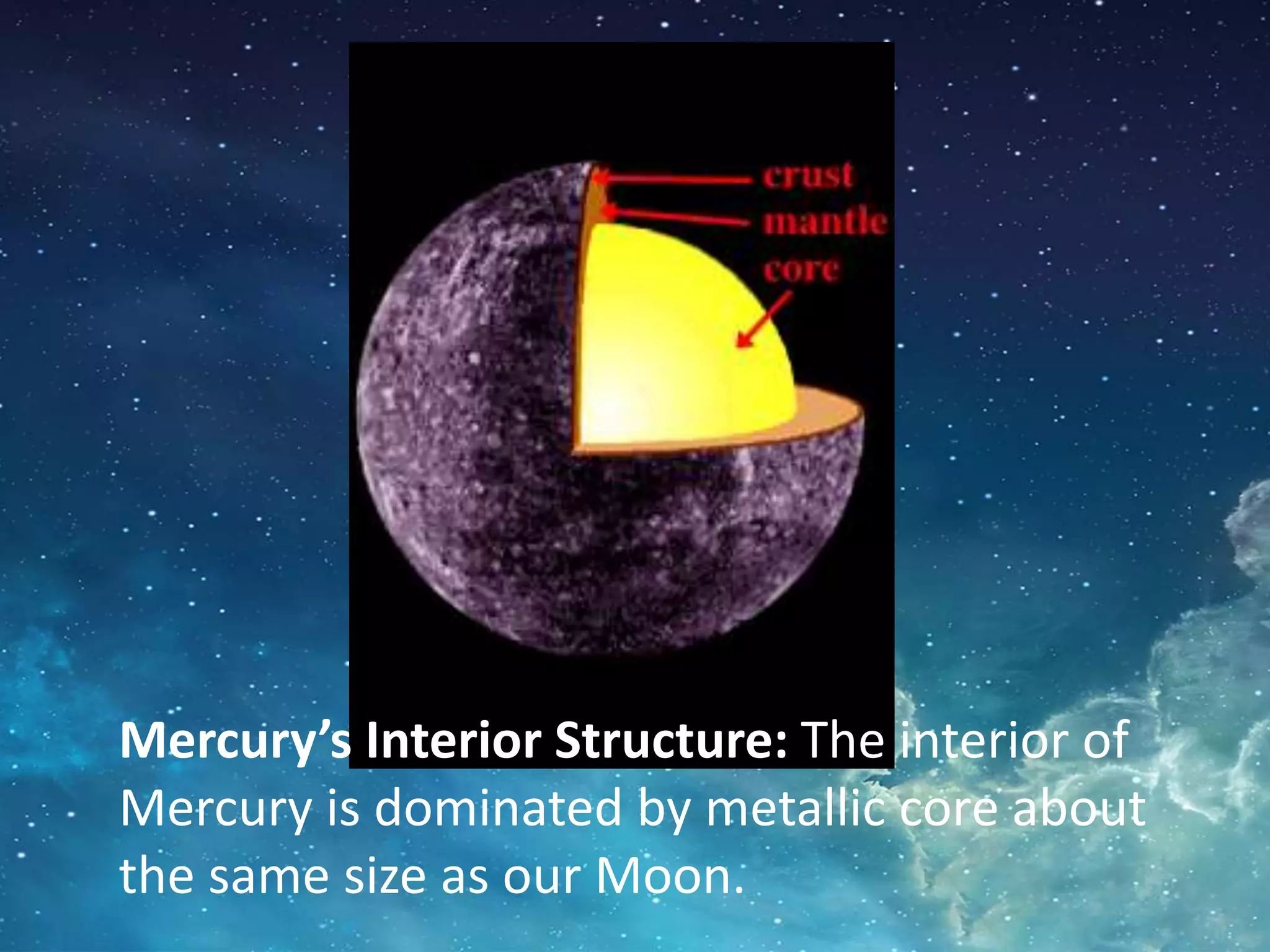
Mercury’s Interior Structure: The interior of
Mercury is dominated by metallic core about
the same size as our Moon.
MERCURY’S STRANGE
ROTATION
• For many years, it was thought that the
planet kept one face to the Sun ( as the
Moon does to Earth).
• It was believed that it has the same
rotation and revolution, making one
side perpetually hot while the other
was always cold.
MERCURY’S STRANGE
ROTATION
• Radar observations in mid-1960’s,
showed conclusively that Mercury does
not keep one side fixed toward the Sun.
• While Mercury rotates in 59 earth days,
the time for the sun to return to the
same place in Mercury’s sky turns out to
be two (2) Mercury years, or 176 Earth
days.
MERCURY’S SURFACE
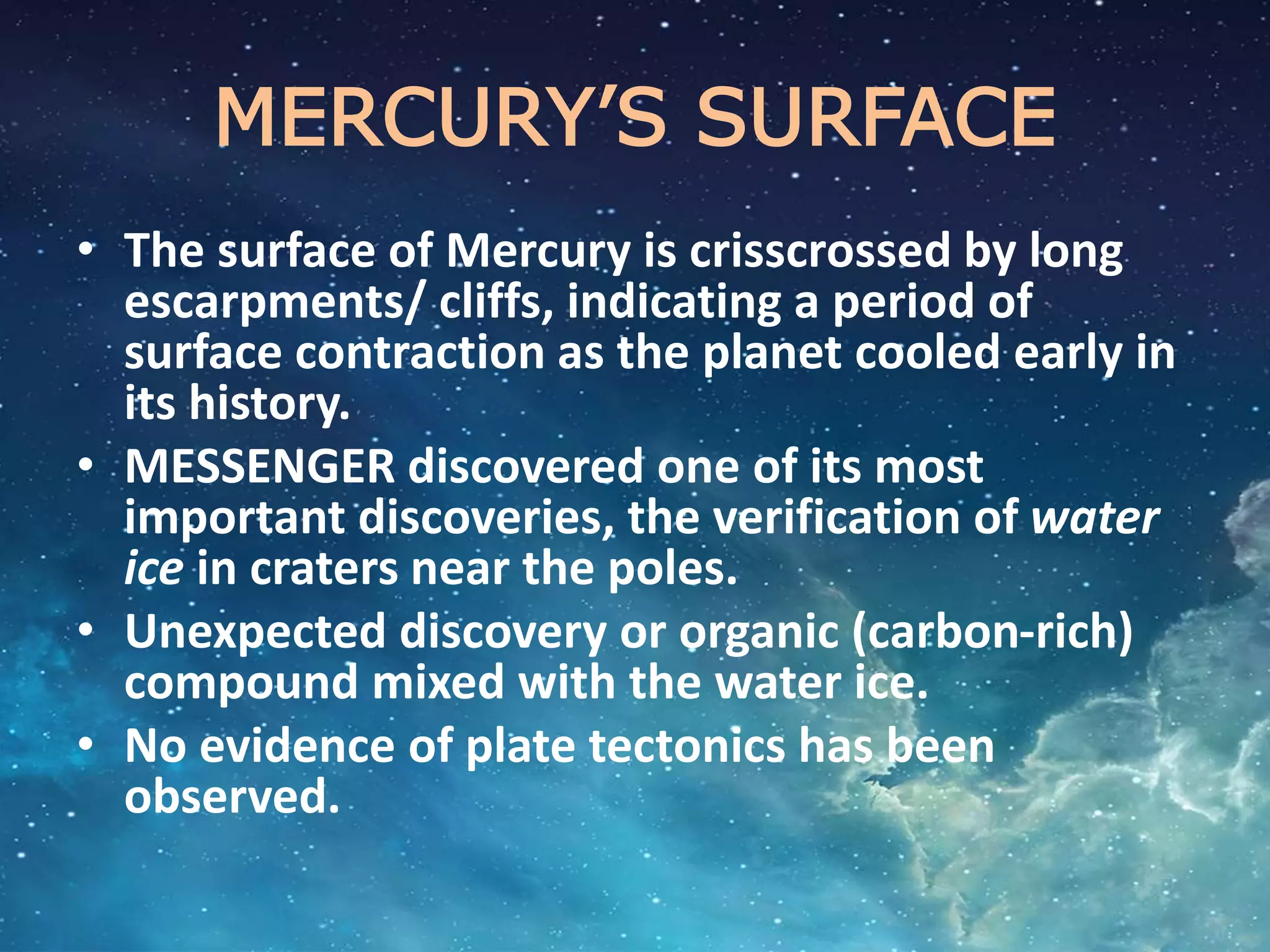
• Heavily cratered
surface.
• It is a poor reflector
because its surface
consists of dark, dry
soil called regolith.
• It has smooth, lava-
like plains (unlike
Moon).
MERCURY’S SURFACE
• The surface of Mercury is crisscrossed by long
escarpments/ cliffs, indicating a period of
surface contraction as the planet cooled early in
its history.
• MESSENGER discovered one of its most
important discoveries, the verification of water
ice in craters near the poles.
• Unexpected discovery or organic (carbon-rich)
compound mixed with the water ice.
• No evidence of plate tectonics has been
observed.
Mercury’s
Topography: the
topography of
Mercury’s norther
hemisphere is mapped
in great detail form
MESSENGER data. The
lowest regions are
shown in purple and
blue, and the highest
regions are shown in
red. The difference in
elevation in between
the lowest and highest
regions are shown
roughly 10km. The
permanently
shadowed low-lying
craters near the North
pole contain radar-
bright water ice.
MERCURY’S SURFACE
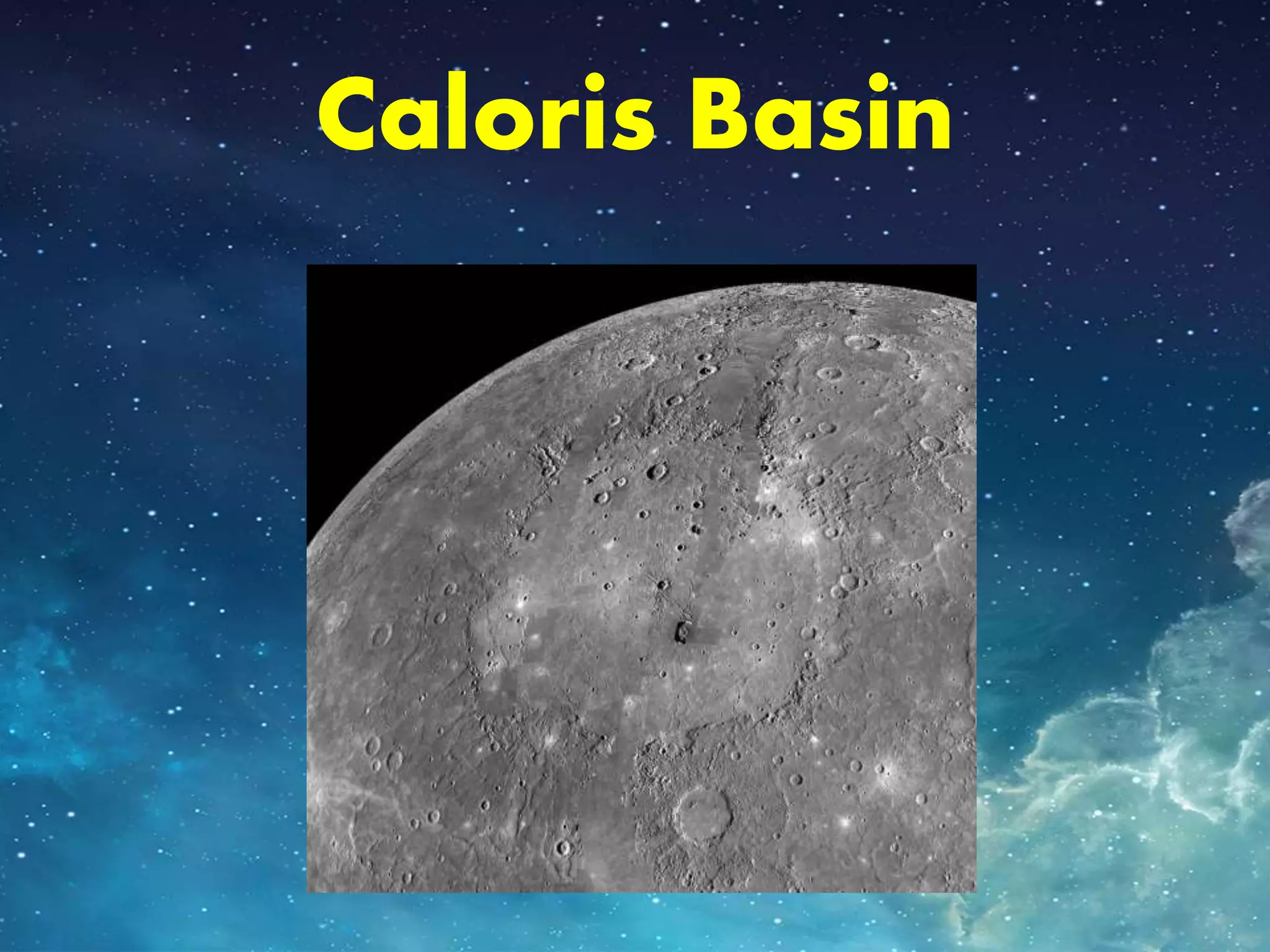
CALORIS BASIN
–largest known structural
feature of the planet.
–One of the hottest spot in
Mercury.
–Came from the Latin word
“calor” which means
heat.
Caloris Basin
THE PLANET’S ALBEDO
ALBEDO
– the amount of sunlight an object
reflects.
• Mercury only reflects about
12%, almost similar with our
Moon.
ATMOSPHERE
Spectroscopy
– a technique used in conducting studies of the
light that an object reflects.
• The study indicates that Mercury has an
extremely thin atmosphere, containing
sodium and potassium which slowly escape
as gases.
SPACE FLIGHTS
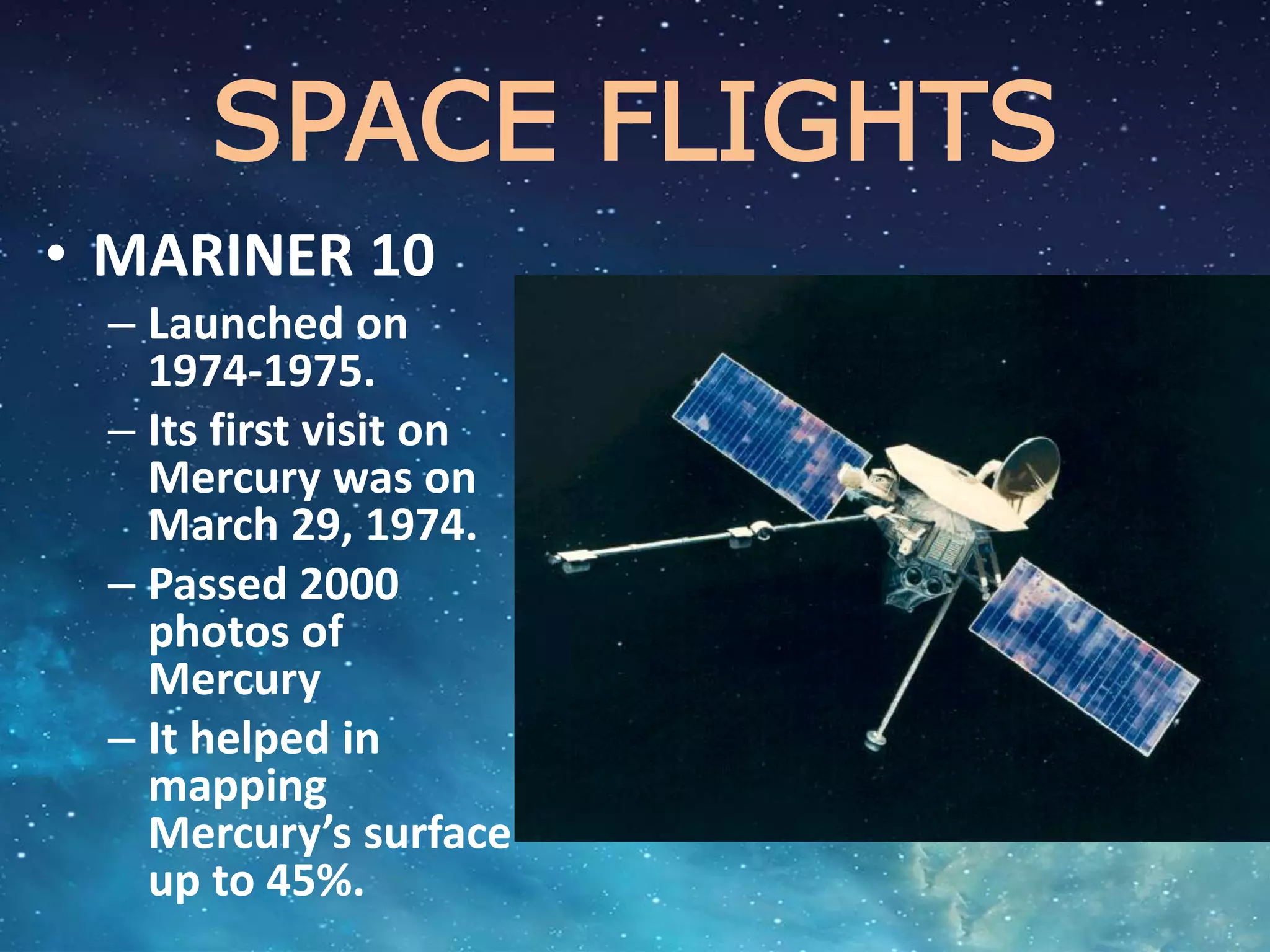
• MARINER 10
– Launched on
1974-1975.
– Its first visit on
Mercury was on
March 29, 1974.
– Passed 2000
photos of
Mercury
– It helped in
mapping
Mercury’s surface
up to 45%.
SPACE FLIGHTS
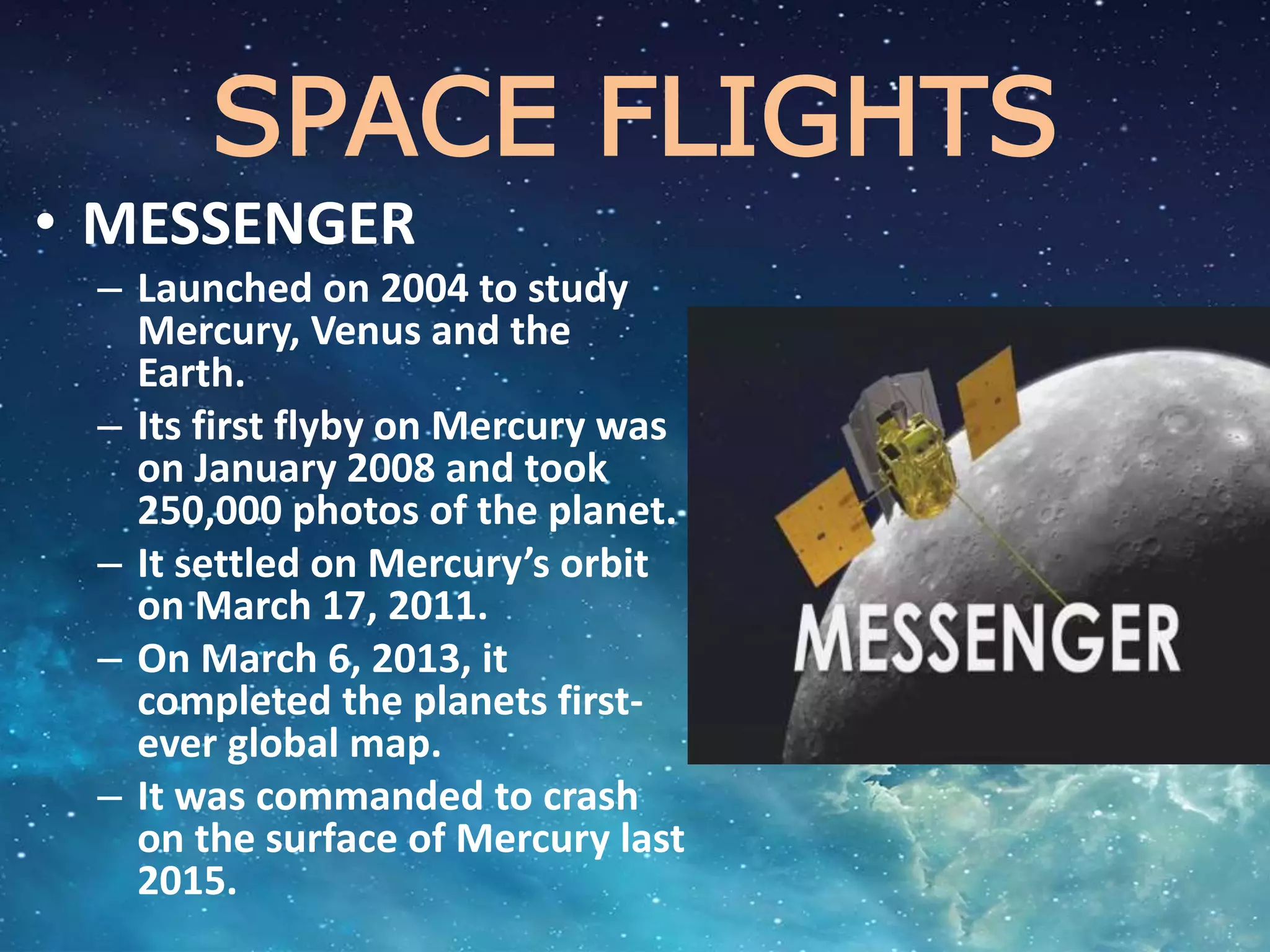
• MESSENGER
– Launched on 2004 to study
Mercury, Venus and the
Earth.
– Its first flyby on Mercury was
on January 2008 and took
250,000 photos of the planet.
– It settled on Mercury’s orbit
on March 17, 2011.
– On March 6, 2013, it
completed the planets first-
ever global map.
– It was commanded to crash
on the surface of Mercury last
2015.
ORIGIN OF
MERCURY• Astronomers think that mercury should have
formed with roughly the same ratio of metal
to silicate (which was found on Earth and
Venus).
• Its rocky material/silicate loss was caused by
several giant impacts during its youth on its
surface with the small magnetic field, making
one or more of these may have torn away a
fraction of its mantle and crust.

Mercury[1]

  • 1.
  • 2.
    MERCURY • 1ST innerplanet • 2nd hottest planet • Named after the fleet-footed messenger god of Romans (Gr. Hermes)
  • 3.
    MERCURY STATISTICS Distance 58million kilometer or 0.39 AU Diameter 4, 880 km (3,032 miles) Mass 1/8 of that of the Earth Density 5.43 g/cm³ Gravitational Force 1/3 of the Earth/ twice of the Moon Rotation 58 days, 16 hours Revolution 88 days Temperature 100 K (-170ºC) - 700 K (430ºC) Orbit Eccentricity 0.206
  • 4.
    MERCURY’S ORBIT • Itsdistance from the Sun is 58, 000, 000 km • Because of its orbit’s eccentricity (its distance from the Sun varies significantly), its perihelion is 46,000,000 km and 70,000,000 km at aphelion.
  • 5.
    COMPOSITION AND STRUCTURE • Becauseof its high density, Mercury’s interior suggests a metallic iron-nickel core amounting to 60% of the total mass and the rest are silicates. • Its core is estimated to be about 3500 km and its surface is 700 km. • Mercury’s crust is rocky while its core is metallic. • It has a weak magnetic field caused by its core which is 1% of that of the Earth.
  • 6.
    Mercury’s Interior Structure:The interior of Mercury is dominated by metallic core about the same size as our Moon.
  • 7.
    MERCURY’S STRANGE ROTATION • Formany years, it was thought that the planet kept one face to the Sun ( as the Moon does to Earth). • It was believed that it has the same rotation and revolution, making one side perpetually hot while the other was always cold.
  • 8.
    MERCURY’S STRANGE ROTATION • Radarobservations in mid-1960’s, showed conclusively that Mercury does not keep one side fixed toward the Sun. • While Mercury rotates in 59 earth days, the time for the sun to return to the same place in Mercury’s sky turns out to be two (2) Mercury years, or 176 Earth days.
  • 9.
    MERCURY’S SURFACE • Heavilycratered surface. • It is a poor reflector because its surface consists of dark, dry soil called regolith. • It has smooth, lava- like plains (unlike Moon).
  • 10.
    MERCURY’S SURFACE • Thesurface of Mercury is crisscrossed by long escarpments/ cliffs, indicating a period of surface contraction as the planet cooled early in its history. • MESSENGER discovered one of its most important discoveries, the verification of water ice in craters near the poles. • Unexpected discovery or organic (carbon-rich) compound mixed with the water ice. • No evidence of plate tectonics has been observed.
  • 11.
    Mercury’s Topography: the topography of Mercury’snorther hemisphere is mapped in great detail form MESSENGER data. The lowest regions are shown in purple and blue, and the highest regions are shown in red. The difference in elevation in between the lowest and highest regions are shown roughly 10km. The permanently shadowed low-lying craters near the North pole contain radar- bright water ice.
  • 12.
    MERCURY’S SURFACE CALORIS BASIN –largestknown structural feature of the planet. –One of the hottest spot in Mercury. –Came from the Latin word “calor” which means heat.
  • 13.
  • 14.
    THE PLANET’S ALBEDO ALBEDO –the amount of sunlight an object reflects. • Mercury only reflects about 12%, almost similar with our Moon.
  • 15.
    ATMOSPHERE Spectroscopy – a techniqueused in conducting studies of the light that an object reflects. • The study indicates that Mercury has an extremely thin atmosphere, containing sodium and potassium which slowly escape as gases.
  • 16.
    SPACE FLIGHTS • MARINER10 – Launched on 1974-1975. – Its first visit on Mercury was on March 29, 1974. – Passed 2000 photos of Mercury – It helped in mapping Mercury’s surface up to 45%.
  • 17.
    SPACE FLIGHTS • MESSENGER –Launched on 2004 to study Mercury, Venus and the Earth. – Its first flyby on Mercury was on January 2008 and took 250,000 photos of the planet. – It settled on Mercury’s orbit on March 17, 2011. – On March 6, 2013, it completed the planets first- ever global map. – It was commanded to crash on the surface of Mercury last 2015.
  • 18.
    ORIGIN OF MERCURY• Astronomersthink that mercury should have formed with roughly the same ratio of metal to silicate (which was found on Earth and Venus). • Its rocky material/silicate loss was caused by several giant impacts during its youth on its surface with the small magnetic field, making one or more of these may have torn away a fraction of its mantle and crust.