Introduction
Introduction
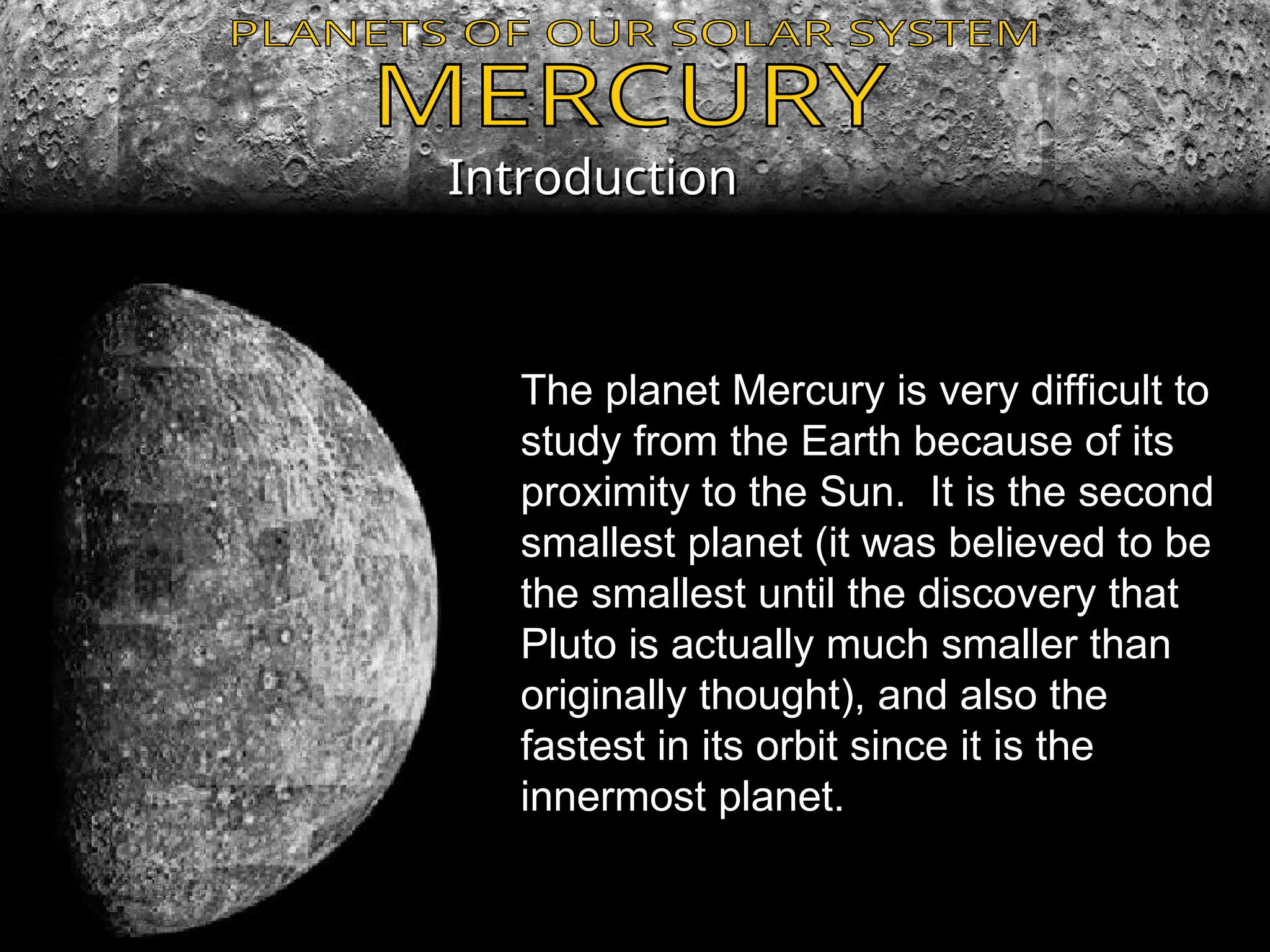
The planet Mercury is very difficult to
study from the Earth because of its
proximity to the Sun. It is the second
smallest planet (it was believed to be
the smallest until the discovery that
Pluto is actually much smaller than
originally thought), and also the
fastest in its orbit since it is the
innermost planet.
Mercury Orbit
Mercury Orbit
Earth
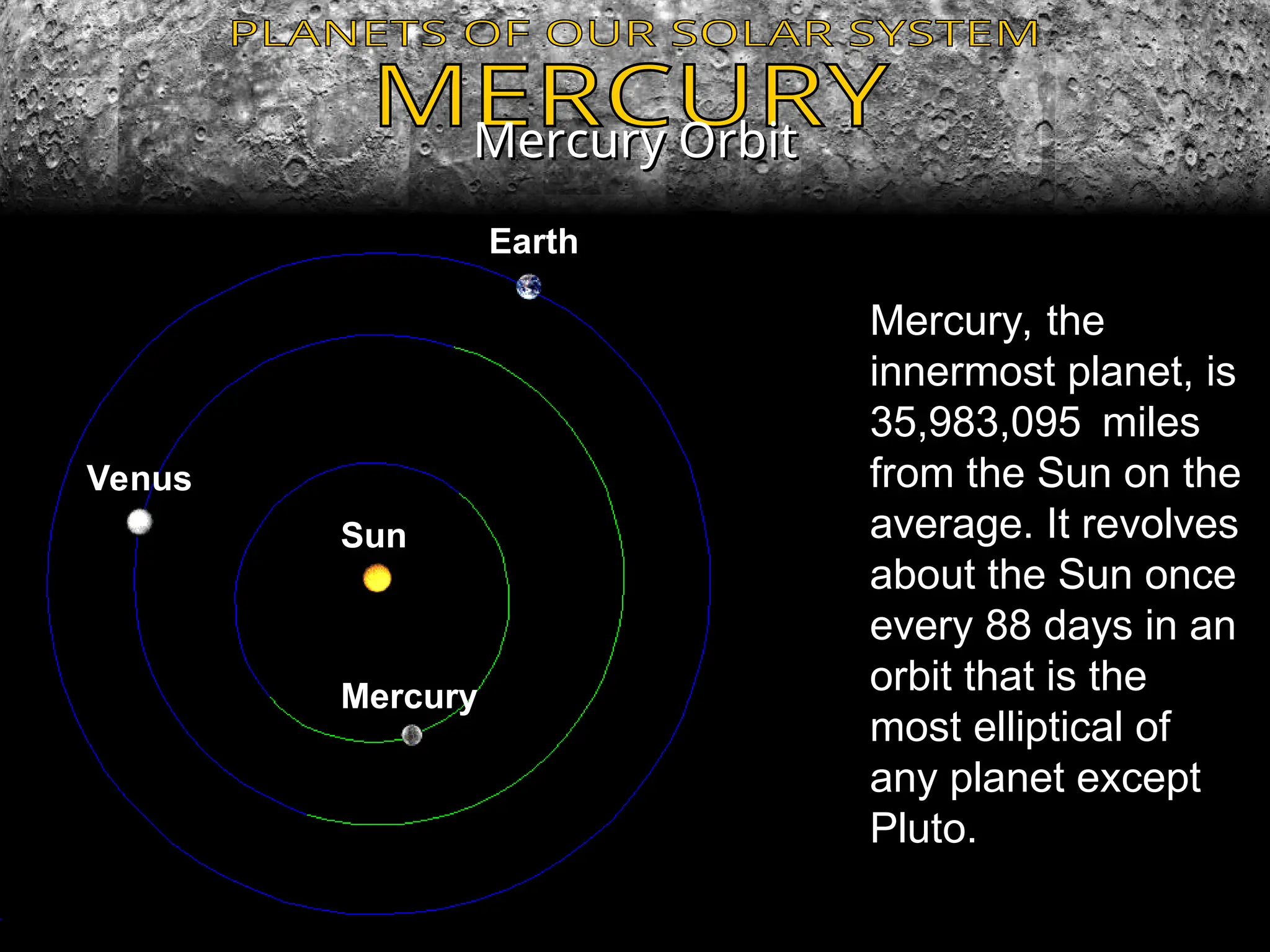
Mercury, the
innermost planet, is
35,983,095 miles
from the Sun on the
average. It revolves
about the Sun once
every 88 days in an
orbit that is the
most elliptical of
any planet except
Pluto.
Venus
Mercury
Sun
Mercury
Sun
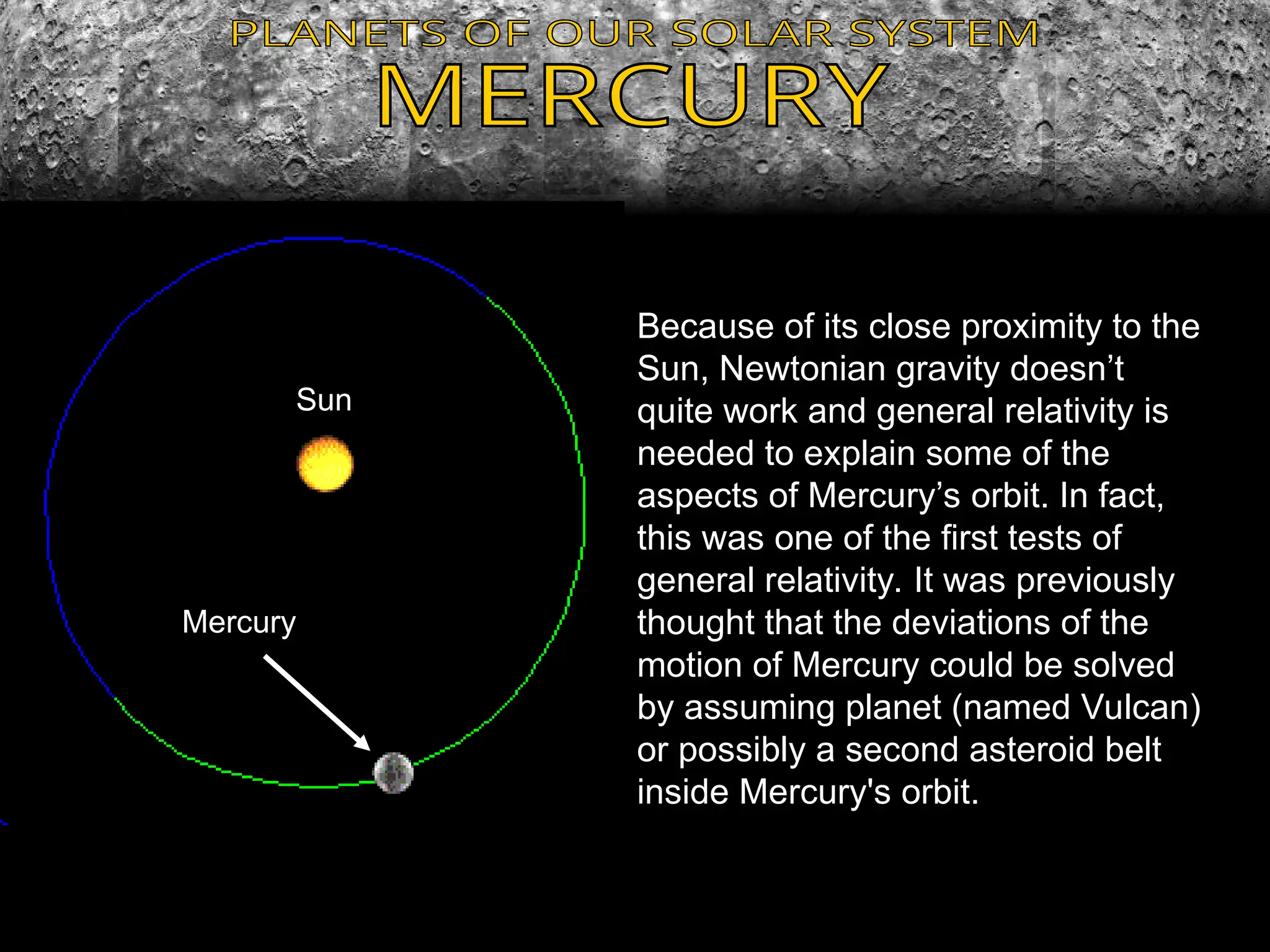
Because of its close proximity to the
Sun, Newtonian gravity doesn’t
quite work and general relativity is
needed to explain some of the
aspects of Mercury’s orbit. In fact,
this was one of the first tests of
general relativity. It was previously
thought that the deviations of the
motion of Mercury could be solved
by assuming planet (named Vulcan)
or possibly a second asteroid belt
inside Mercury's orbit.
A closer look at Mercury
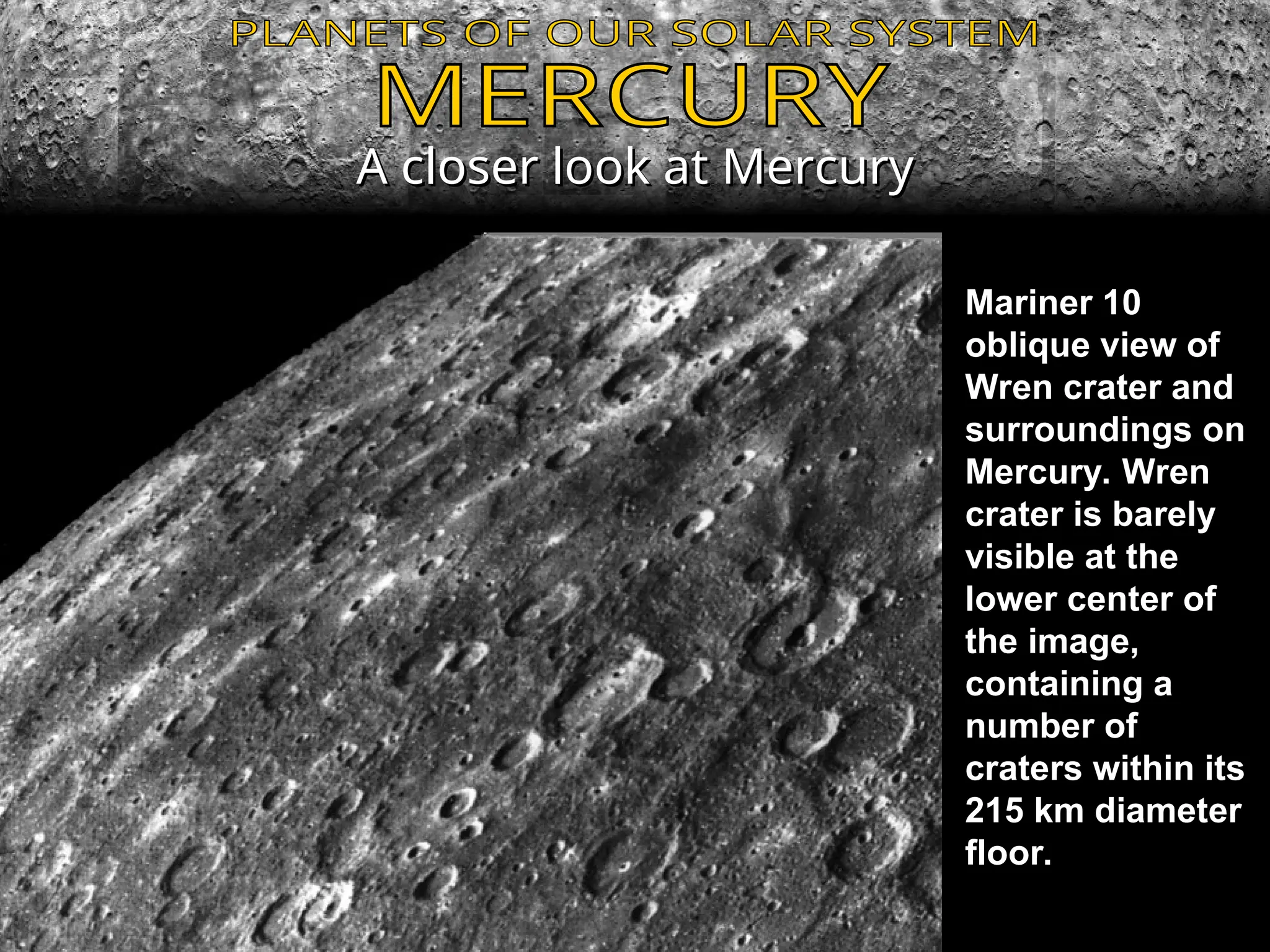
Mariner 10
oblique view of
Wren crater and
surroundings on
Mercury. Wren
crater is barely
visible at the
lower center of
the image,
containing a
number of
craters within its
215 km diameter
floor.
Mariner 10
Mariner 10
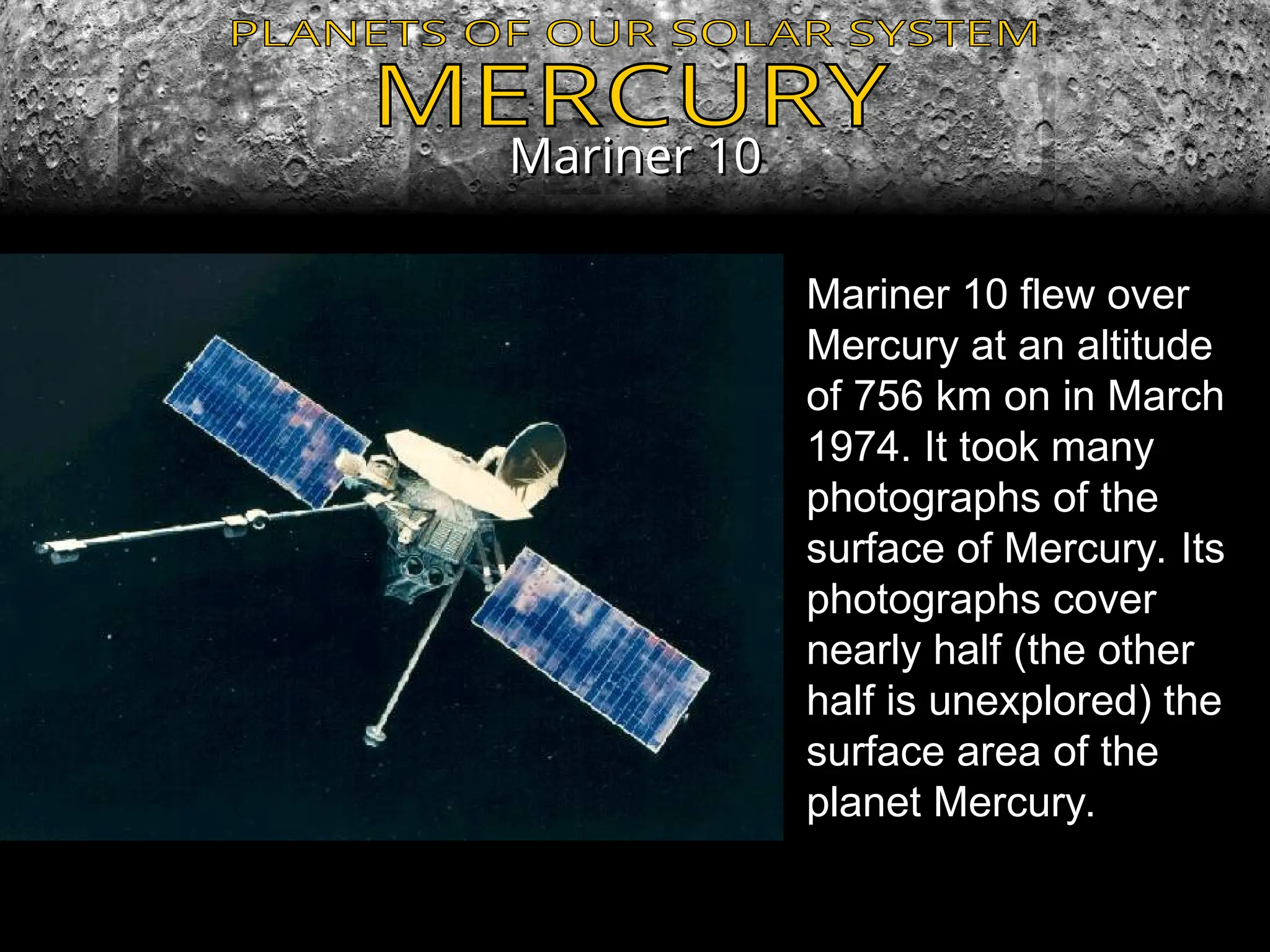
Mariner 10 flew over
Mercury at an altitude
of 756 km on in March
1974. It took many
photographs of the
surface of Mercury. Its
photographs cover
nearly half (the other
half is unexplored) the
surface area of the
planet Mercury.
Mercury Statistics
Mercury Statistics
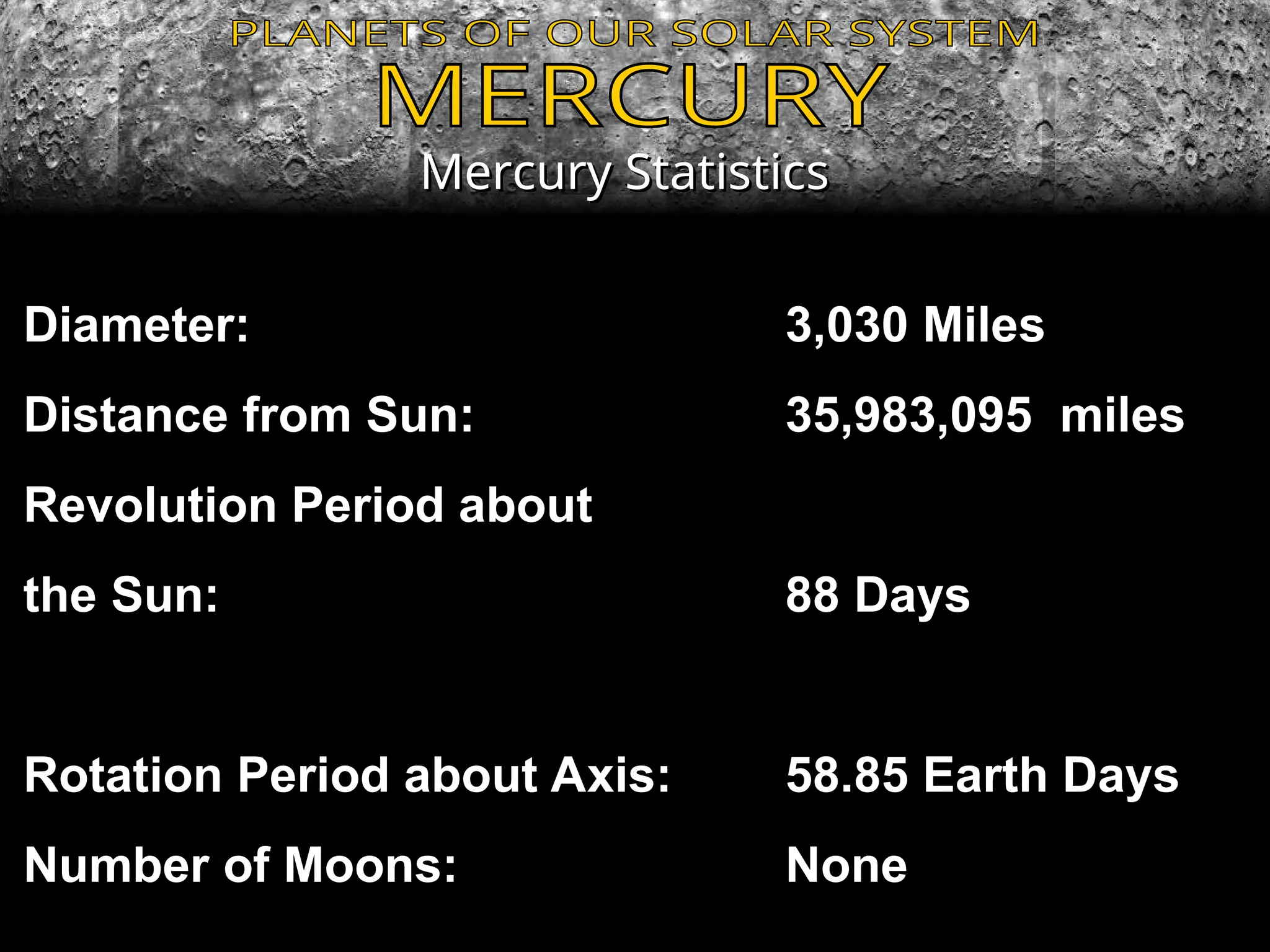
Diameter: 3,030 Miles
Distance from Sun: 35,983,095 miles
Revolution Period about
the Sun: 88 Days
Rotation Period about Axis: 58.85 Earth Days
Number of Moons: None
Information on Mercury
Mercury
A planet of extremes
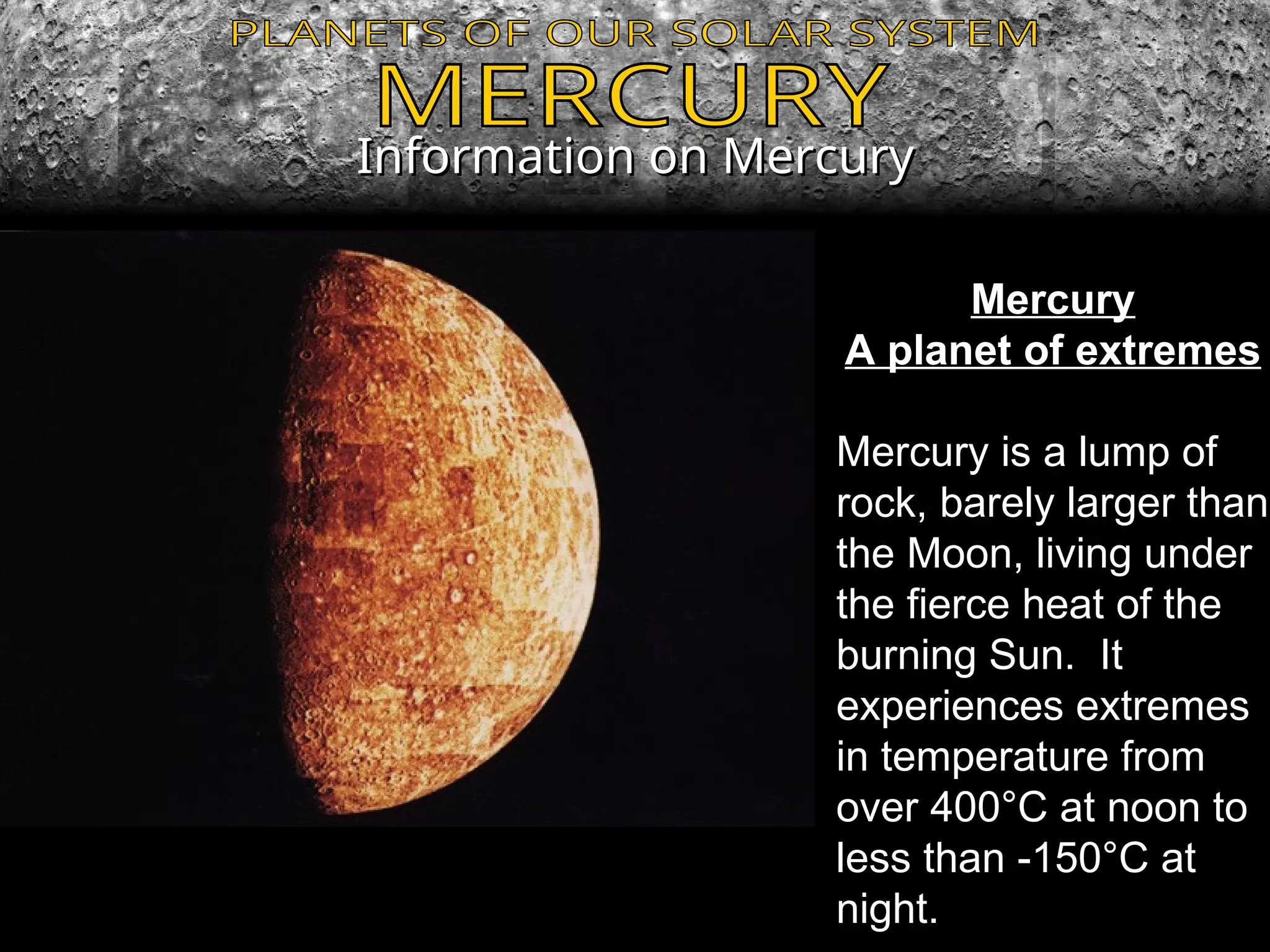
Mercury is a lump of
rock, barely larger than
the Moon, living under
the fierce heat of the
burning Sun. It
experiences extremes
in temperature from
over 400°C at noon to
less than -150°C at
night.
Information on Mercury
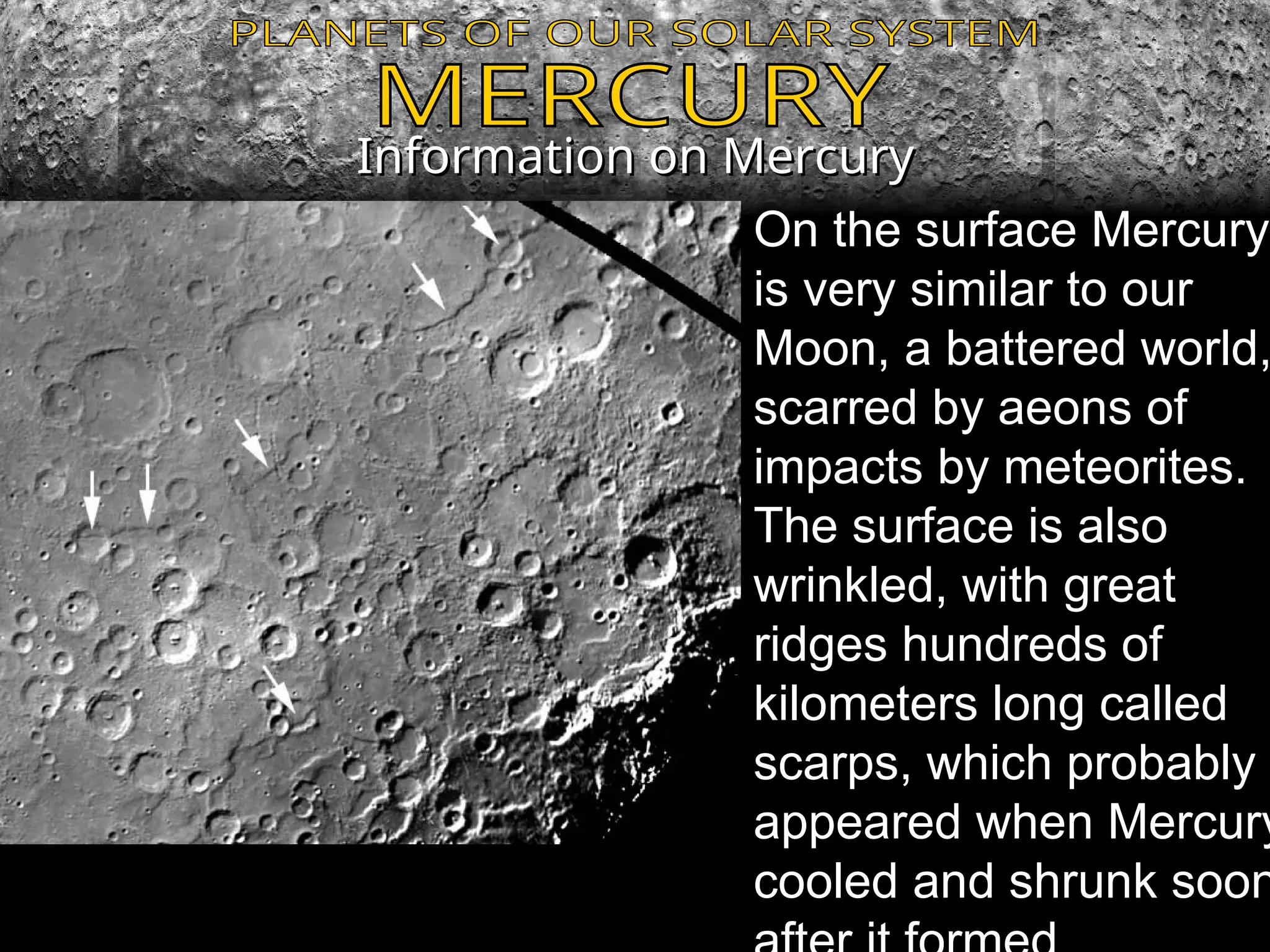
On the surface Mercury
is very similar to our
Moon, a battered world,
scarred by aeons of
impacts by meteorites.
The surface is also
wrinkled, with great
ridges hundreds of
kilometers long called
scarps, which probably
appeared when Mercury
cooled and shrunk soon
The inside of
Mercury is
more like the
Earth. It has a
core made of
iron, and the
centre may be
molten, kept
hot by
radiation deep
within the
core.
Roman God
Roman God
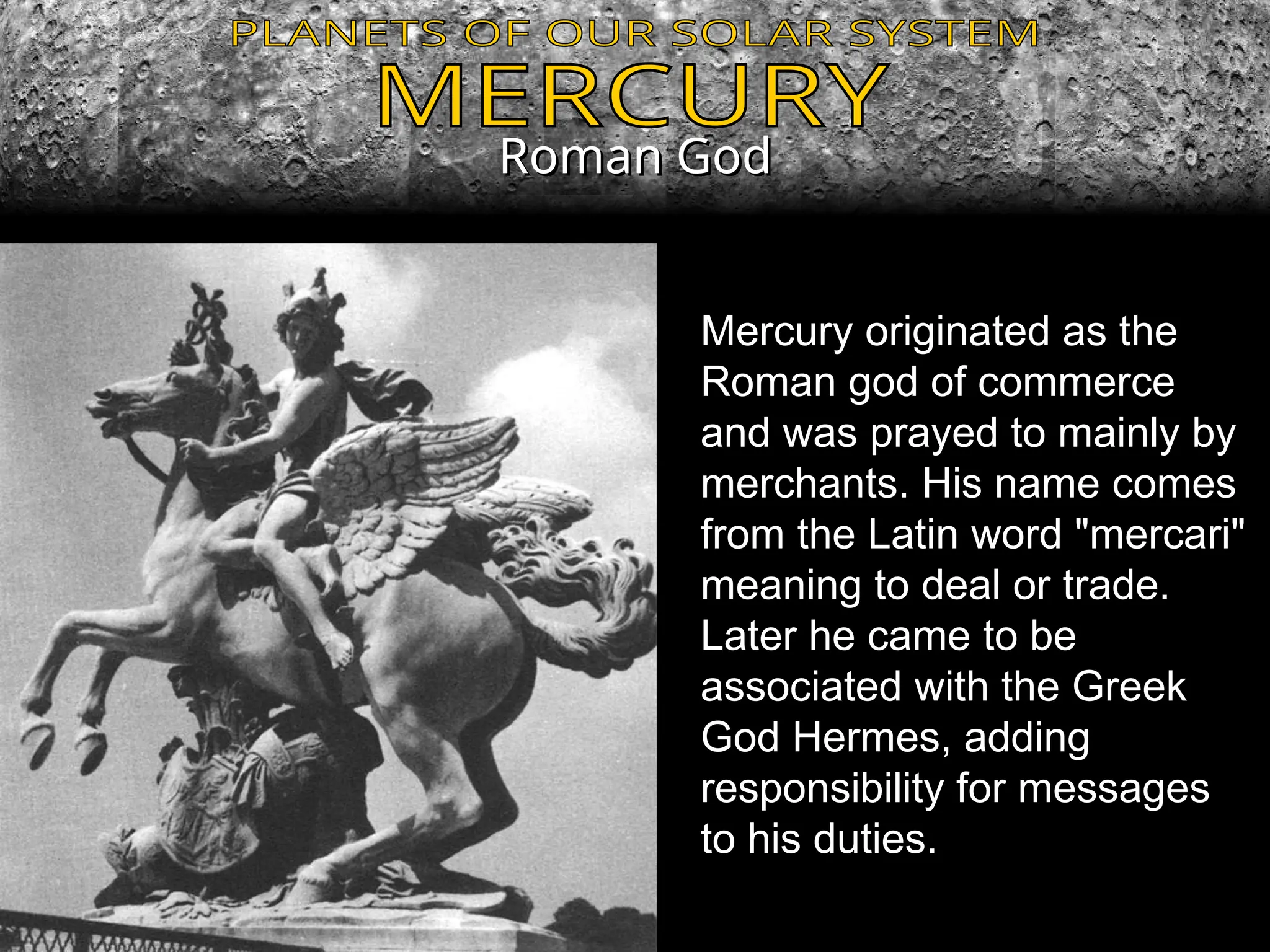
Mercury originated as the
Roman god of commerce
and was prayed to mainly by
merchants. His name comes
from the Latin word "mercari"
meaning to deal or trade.
Later he came to be
associated with the Greek
God Hermes, adding
responsibility for messages
to his duties.
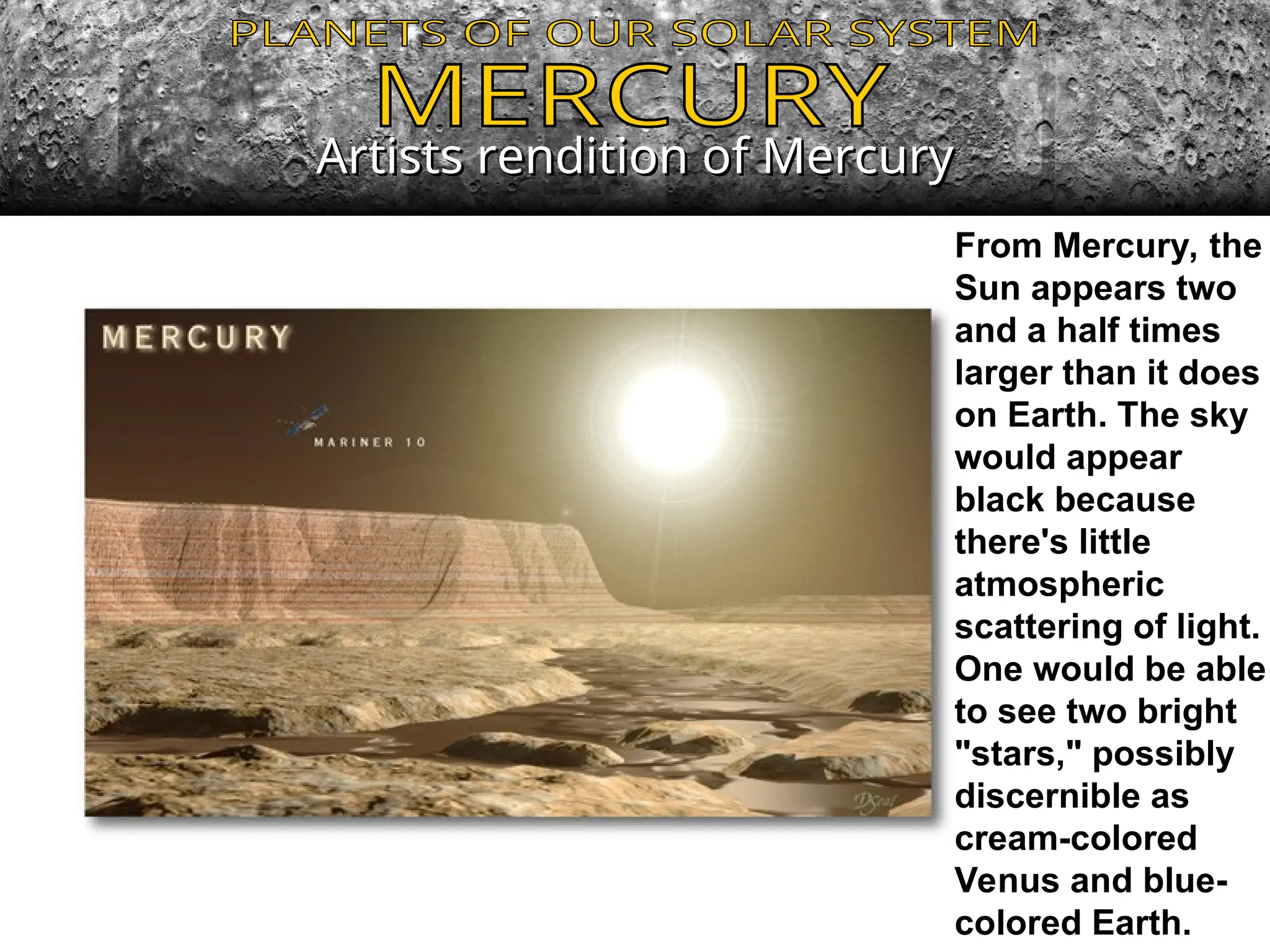
Artists rendition of Mercury
From Mercury, the
Sun appears two
and a half times
larger than it does
on Earth. The sky
would appear
black because
there's little
atmospheric
scattering of light.
One would be able
to see two bright
"stars," possibly
discernible as
cream-colored
Venus and blue-
colored Earth.
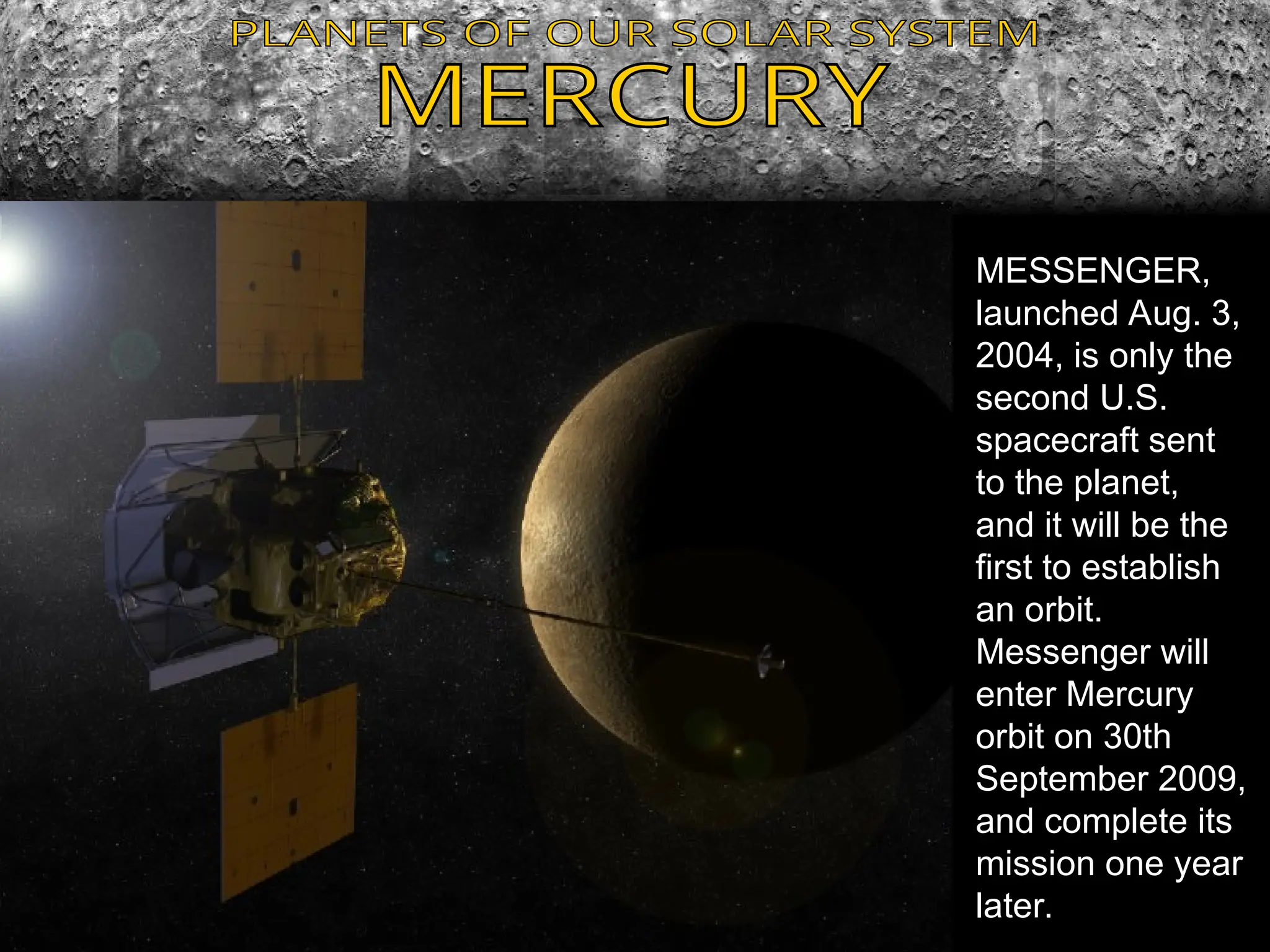
MESSENGER,
launched Aug. 3,
2004, is only the
second U.S.
spacecraft sent
to the planet,
and it will be the
first to establish
an orbit.
Messenger will
enter Mercury
orbit on 30th
September 2009,
and complete its
mission one year
later.

mercury as a planet and other things.ppt

  • 1.
    Introduction Introduction The planet Mercuryis very difficult to study from the Earth because of its proximity to the Sun. It is the second smallest planet (it was believed to be the smallest until the discovery that Pluto is actually much smaller than originally thought), and also the fastest in its orbit since it is the innermost planet.
  • 2.
    Mercury Orbit Mercury Orbit Earth Mercury,the innermost planet, is 35,983,095 miles from the Sun on the average. It revolves about the Sun once every 88 days in an orbit that is the most elliptical of any planet except Pluto. Venus Mercury Sun
  • 3.
    Mercury Sun Because of itsclose proximity to the Sun, Newtonian gravity doesn’t quite work and general relativity is needed to explain some of the aspects of Mercury’s orbit. In fact, this was one of the first tests of general relativity. It was previously thought that the deviations of the motion of Mercury could be solved by assuming planet (named Vulcan) or possibly a second asteroid belt inside Mercury's orbit.
  • 4.
    A closer lookat Mercury A closer look at Mercury Mariner 10 oblique view of Wren crater and surroundings on Mercury. Wren crater is barely visible at the lower center of the image, containing a number of craters within its 215 km diameter floor.
  • 5.
    Mariner 10 Mariner 10 Mariner10 flew over Mercury at an altitude of 756 km on in March 1974. It took many photographs of the surface of Mercury. Its photographs cover nearly half (the other half is unexplored) the surface area of the planet Mercury.
  • 6.
    Mercury Statistics Mercury Statistics Diameter:3,030 Miles Distance from Sun: 35,983,095 miles Revolution Period about the Sun: 88 Days Rotation Period about Axis: 58.85 Earth Days Number of Moons: None
  • 7.
    Information on Mercury Informationon Mercury Mercury A planet of extremes Mercury is a lump of rock, barely larger than the Moon, living under the fierce heat of the burning Sun. It experiences extremes in temperature from over 400°C at noon to less than -150°C at night.
  • 8.
    Information on Mercury Informationon Mercury On the surface Mercury is very similar to our Moon, a battered world, scarred by aeons of impacts by meteorites. The surface is also wrinkled, with great ridges hundreds of kilometers long called scarps, which probably appeared when Mercury cooled and shrunk soon
  • 9.
    The inside of Mercuryis more like the Earth. It has a core made of iron, and the centre may be molten, kept hot by radiation deep within the core.
  • 10.
    Roman God Roman God Mercuryoriginated as the Roman god of commerce and was prayed to mainly by merchants. His name comes from the Latin word "mercari" meaning to deal or trade. Later he came to be associated with the Greek God Hermes, adding responsibility for messages to his duties.
  • 11.
    Artists rendition ofMercury Artists rendition of Mercury From Mercury, the Sun appears two and a half times larger than it does on Earth. The sky would appear black because there's little atmospheric scattering of light. One would be able to see two bright "stars," possibly discernible as cream-colored Venus and blue- colored Earth.
  • 12.
    MESSENGER, launched Aug. 3, 2004,is only the second U.S. spacecraft sent to the planet, and it will be the first to establish an orbit. Messenger will enter Mercury orbit on 30th September 2009, and complete its mission one year later.

Editor's Notes

  • #1 http://csep10.phys.utk.edu/astr161/lect/mercury/mercury.html
  • #2 http://csep10.phys.utk.edu/astr161/lect/mercury/features.html Because of its close proximity to the Sun, Newtonian gravity doesn’t quite work and general relativity is needed to explain some of the aspects of Mercury’s orbit. In fact, this was one of the first tests of general relativity. Previously and second planet (Vulcan) was thought to explain the discrepancy. Anyway, this is an interesting aspect that should be included in this presentation.
  • #3 http://www.nineplanets.org/hypo.html#vulcan ???????
  • #4 http://nssdc.gsfc.nasa.gov/imgcat/html/object_page/m10_aom_2_10.html It is not clear to me which one is Wren crater
  • #5 http://www.the-solar-system.net/spacecraft/Mariner-spacecraft.html
  • #6 http://www.windows.ucar.edu/tour/link=/mercury/statistics.html Bold text here and any other places it is not bolded.
  • #7 http://starchild.gsfc.nasa.gov/docs/StarChild/solar_system_level2/mercury.html http://www.solarsystem.org.uk/mercury Need to find some graphics for this text.
  • #8 http://www.solarsystem.org.uk/mercury/ We should find graphics to pair with this text. An image pointing out a scarp would be a place to start.
  • #9 http://www.solarviews.com/cap/merc/mercint.htm http://www.solarsystem.org.uk/mercury/
  • #10 http://www.wga.hu/frames-e.html?/html/c/coysevox/mercury.html http://www.calgarycoin.com/reference/myth/mymercur.htm
  • #11 http://www.solstation.com/stars/mercury.htm We need to have a slide on the current mission to Mercury.
  • #12 http://www.spacetoday.org/SolSys/Mercury/MercuryMessenger.html http://www.zgdream.com/blog/index.php?cat=11