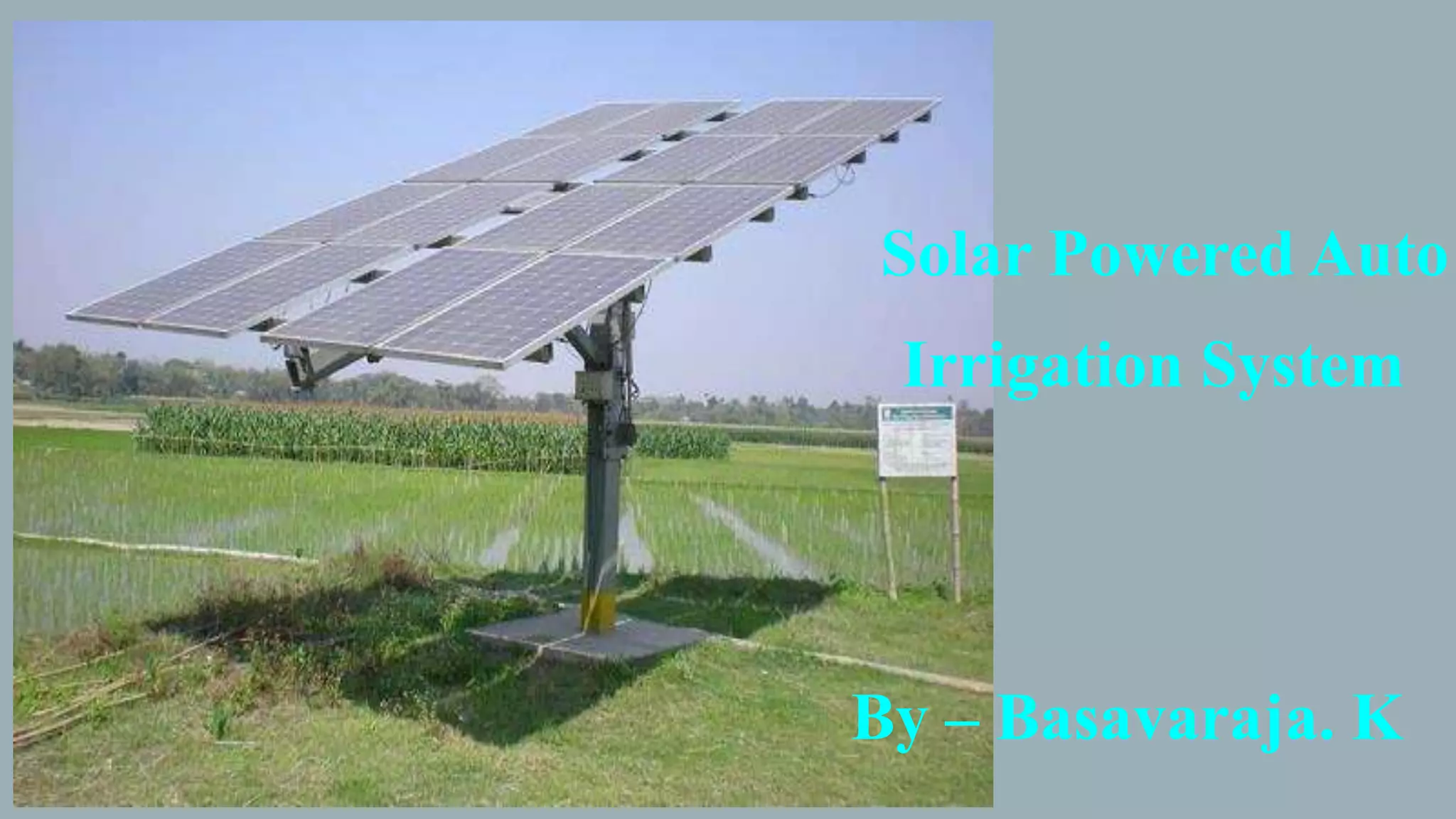


Solar Powered Auto
Irrigation System
By – Basavaraja. K
Introduction
• The supply of electricity is not reached up to every villages.
• Solar energy is the most abundant source of energy in the world.
• Solar based irrigation system: a suitable alternative for farmers in the
present state of energy crisis in India (also it is an eco-friendly – green
for energy production)
• Provides free energy after an initial investment is made.
• An automatic irrigation system using solar power, controller and moisture
sensor is used to pump water from bore well to a tank, to control the
rate of water from the tank to the irrigation field. Thus optimizes the use
water.
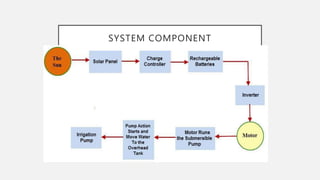
SYSTEM COMPONENT
How the system works?
This system mainly consists of two modules
• Solar pumping module.
• Automatic irrigation module.
I. Solar pumping module:
Solar Panel:
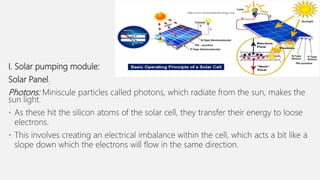
Photons: Miniscule particles called photons, which radiate from the sun, makes the
sun light.
• As these hit the silicon atoms of the solar cell, they transfer their energy to loose
electrons.
• This involves creating an electrical imbalance within the cell, which acts a bit like a
slope down which the electrons will flow in the same direction.
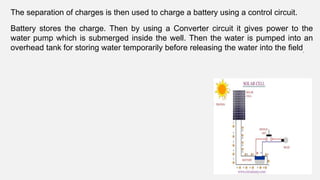
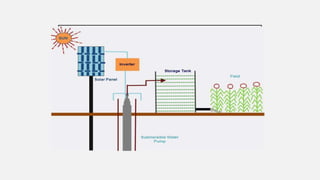
The separation of charges is then used to charge a battery using a control circuit.
Battery stores the charge. Then by using a Converter circuit it gives power to the
water pump which is submerged inside the well. Then the water is pumped into an
overhead tank for storing water temporarily before releasing the water into the field.
A moisture sensor is used to sense the level of moisture content present in the soil. It has a
level detection module in which we can set a reference value.
With the help of moisture sensor signaling a controller, a
Control pulse is given to the driver circuit that excites the motor.
So the pump starts working and moves water to the irrigation field as per the soil moisture
content.
When the soil moisture content reaches the required value, the motor is stopped and power to
driver circuit is stopped and controller is put into sleep mode for low power consumption.
When the moisture in soil is dried and reaches a minimum cutoff value, the controller comes out
of sleep mode and flow of water is regulated. This way the whole system works automatically.
II. Irrigation module:
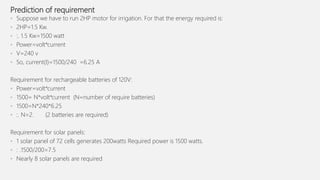
Prediction of requirement
• Suppose we have to run 2HP motor for irrigation. For that the energy required is:
• 2HP=1.5 Kw.
• :. 1.5 Kw=1500 watt
• Power=volt*current
• V=240 v
• So, current(I)=1500/240 =6.25 A
Requirement for rechargeable batteries of 120V:
• Power=volt*current
• 1500= N*volt*current (N=number of require batteries)
• 1500=N*240*6.25
• :. N=2. (2 batteries are required)
Requirement for solar panels:
• 1 solar panel of 72 cells generates 200watts Required power is 1500 watts.
• : .1500/200=7.5
• Nearly 8 solar panels are required
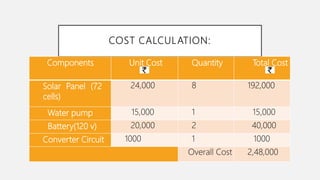
COST CALCULATION:
Components Unit Cost Quantity Total Cost
Solar Panel (72
cells)
24,000 8 192,000
Water pump 15,000 1 15,000
Battery(120 v) 20,000 2 40,000
Converter Circuit 1000 1 1000
Overall Cost 2,48,000
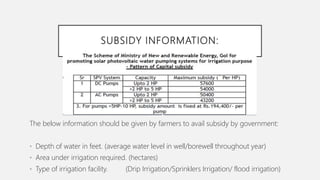
SUBSIDY INFORMATION:
The below information should be given by farmers to avail subsidy by government:
• Depth of water in feet. (average water level in well/borewell throughout year)
• Area under irrigation required. (hectares)
• Type of irrigation facility. (Drip Irrigation/Sprinklers Irrigation/ flood irrigation)
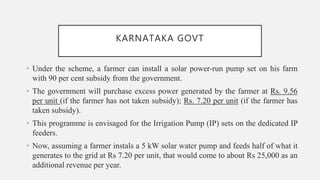
KARNATAKA GOVT
• Under the scheme, a farmer can install a solar power-run pump set on his farm
with 90 per cent subsidy from the government.
• The government will purchase excess power generated by the farmer at Rs. 9.56
per unit (if the farmer has not taken subsidy); Rs. 7.20 per unit (if the farmer has
taken subsidy).
• This programme is envisaged for the Irrigation Pump (IP) sets on the dedicated IP
feeders.
• Now, assuming a farmer instals a 5 kW solar water pump and feeds half of what it
generates to the grid at Rs 7.20 per unit, that would come to about Rs 25,000 as an
additional revenue per year.
Advantages:
• It helps in saving Energy.
• There is no fuel cost - as it uses available free sun light.
• No electricity required.
• Can be operated lifelong.
• It works everywhere.
• It is also useful for clean, drinking water sanitation and also
irrigation.
• The dependence on rain is reduced.
• It creates wealth for farmers by increasing no of crops.
Conclusion
• Easy to implement system and environment friendly solution
irrigating fields.
• Found successful for bore holes as they can pump over the
whole day.
• Minimal maintenance, manual interaction and attention as
are self-starting.
• In long run this system is economical.
RELATED VIDEO
• https://youtu.be/F8jZpw638Wg
Solar Power Auto Irrigation System

Solar Power Auto Irrigation System

  • 1.
    Solar Powered Auto IrrigationSystem By – Basavaraja. K
  • 2.
    Introduction • The supplyof electricity is not reached up to every villages. • Solar energy is the most abundant source of energy in the world. • Solar based irrigation system: a suitable alternative for farmers in the present state of energy crisis in India (also it is an eco-friendly – green for energy production) • Provides free energy after an initial investment is made. • An automatic irrigation system using solar power, controller and moisture sensor is used to pump water from bore well to a tank, to control the rate of water from the tank to the irrigation field. Thus optimizes the use water.
  • 3.
  • 4.
    How the systemworks? This system mainly consists of two modules • Solar pumping module. • Automatic irrigation module.
  • 5.
    I. Solar pumpingmodule: Solar Panel: Photons: Miniscule particles called photons, which radiate from the sun, makes the sun light. • As these hit the silicon atoms of the solar cell, they transfer their energy to loose electrons. • This involves creating an electrical imbalance within the cell, which acts a bit like a slope down which the electrons will flow in the same direction.
  • 6.
    The separation ofcharges is then used to charge a battery using a control circuit. Battery stores the charge. Then by using a Converter circuit it gives power to the water pump which is submerged inside the well. Then the water is pumped into an overhead tank for storing water temporarily before releasing the water into the field.
  • 8.
    A moisture sensoris used to sense the level of moisture content present in the soil. It has a level detection module in which we can set a reference value. With the help of moisture sensor signaling a controller, a Control pulse is given to the driver circuit that excites the motor. So the pump starts working and moves water to the irrigation field as per the soil moisture content. When the soil moisture content reaches the required value, the motor is stopped and power to driver circuit is stopped and controller is put into sleep mode for low power consumption. When the moisture in soil is dried and reaches a minimum cutoff value, the controller comes out of sleep mode and flow of water is regulated. This way the whole system works automatically. II. Irrigation module:
  • 9.
    Prediction of requirement •Suppose we have to run 2HP motor for irrigation. For that the energy required is: • 2HP=1.5 Kw. • :. 1.5 Kw=1500 watt • Power=volt*current • V=240 v • So, current(I)=1500/240 =6.25 A Requirement for rechargeable batteries of 120V: • Power=volt*current • 1500= N*volt*current (N=number of require batteries) • 1500=N*240*6.25 • :. N=2. (2 batteries are required) Requirement for solar panels: • 1 solar panel of 72 cells generates 200watts Required power is 1500 watts. • : .1500/200=7.5 • Nearly 8 solar panels are required
  • 10.
    COST CALCULATION: Components UnitCost Quantity Total Cost Solar Panel (72 cells) 24,000 8 192,000 Water pump 15,000 1 15,000 Battery(120 v) 20,000 2 40,000 Converter Circuit 1000 1 1000 Overall Cost 2,48,000
  • 11.
    SUBSIDY INFORMATION: The belowinformation should be given by farmers to avail subsidy by government: • Depth of water in feet. (average water level in well/borewell throughout year) • Area under irrigation required. (hectares) • Type of irrigation facility. (Drip Irrigation/Sprinklers Irrigation/ flood irrigation)
  • 12.
    KARNATAKA GOVT • Underthe scheme, a farmer can install a solar power-run pump set on his farm with 90 per cent subsidy from the government. • The government will purchase excess power generated by the farmer at Rs. 9.56 per unit (if the farmer has not taken subsidy); Rs. 7.20 per unit (if the farmer has taken subsidy). • This programme is envisaged for the Irrigation Pump (IP) sets on the dedicated IP feeders. • Now, assuming a farmer instals a 5 kW solar water pump and feeds half of what it generates to the grid at Rs 7.20 per unit, that would come to about Rs 25,000 as an additional revenue per year.
  • 13.
    Advantages: • It helpsin saving Energy. • There is no fuel cost - as it uses available free sun light. • No electricity required. • Can be operated lifelong. • It works everywhere. • It is also useful for clean, drinking water sanitation and also irrigation. • The dependence on rain is reduced. • It creates wealth for farmers by increasing no of crops.
  • 14.
    Conclusion • Easy toimplement system and environment friendly solution irrigating fields. • Found successful for bore holes as they can pump over the whole day. • Minimal maintenance, manual interaction and attention as are self-starting. • In long run this system is economical.
  • 15.