PARKING
PROBLEMS
Presented By
8086918147 Ubaid.P
Roll no:56
MPTC
Cherpulassery
Introduction
One of the problems created by road traffic is parking. Not only do vehicles require
street space to move about, but also do they require space to park where the occupants
can be loaded and unloaded. The period over which a car is parked is very great
compared with the time it is in motion. The size of average parking space is 14 m2. It is
roughly estimated that out of 8760 hours in a year, the car runs on an average for only
400 hours, leaving 8360 hours when it is parked. Every car owner would wish to park
the car as closely as possible to his destination so as to minimize his walking.
Effect of parking
 Congestion
 Accidents
 Obstruction to fire fighting operations
 Effect on environment
Objectives
 To study the parking characteristics in Pattambi-Cherpulassery road and to assess
whether the demand is met with.
 Identification of the problems in traffic and parking in Pattambi-Cherpulassery road
 To project the present traffic scenario in Pattambi-Cherpulassery road.
 To improve the parking facilities utilizing the available infrastructure for meeting the
parking demand of various categories of vehicles.
 To smoothen the vehicular traffic flow by conducting relevant traffic studies
General Terms of Parking
Facilities
1. Parking Accumulation :-The total number of vehicles parked in an area at a
specified moment.
2. Parking volume:-The number of vehicles parked in a particular area over a
given period of time. It is usually measured in vehicles per day.

3. Parking load:-The area under the parking accumulation curve during a specified
period.
4. Parking duration:-The length of time spent in a parking space.
5. Parking index:-Percentage of parking bays actually occupied by parked vehicles
as compared to the theoretical number available.
6. Parking turn over:-Rate of the usage of the available parking space. Thus if
there were 10 parking spaces used by 100 vehicles in a period of say 12 hours then
the parking turnover would be
Parking facilities
 On – street or Kerb Parking
 Off – street Parking
On – street or Kerb Parking
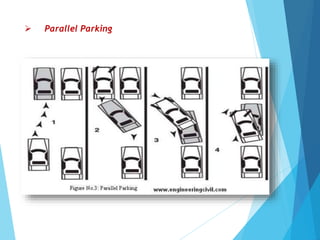
1. Parallel Parking
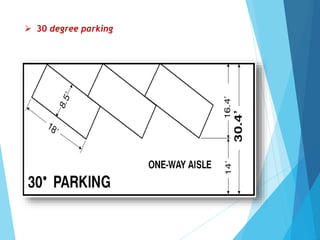
2. 30 degree parking
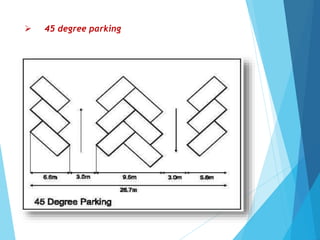
3. 45 degree parking
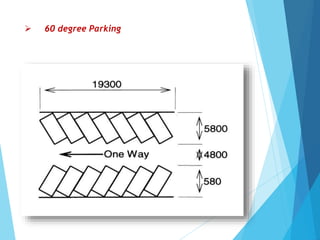
4. 60 degree Parking
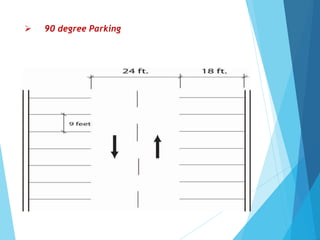
5. 90 degree Parking
 Parallel Parking
 30 degree parking
 45 degree parking
 60 degree Parking
 90 degree Parking
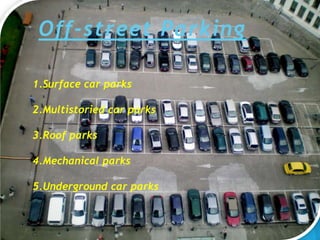
Off-street Parking
1.Surface car parks
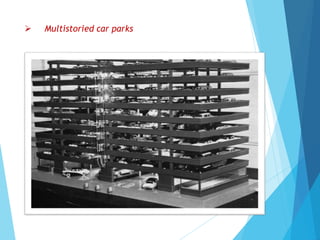
2.Multistoried car parks
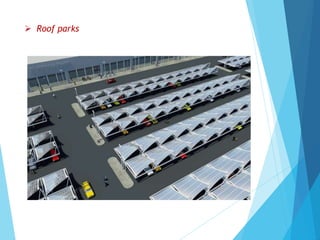
3.Roof parks
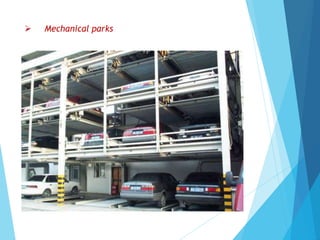
4.Mechanical parks
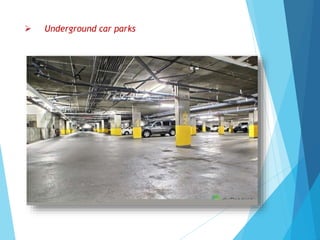
5.Underground car parks
Off-street Parking
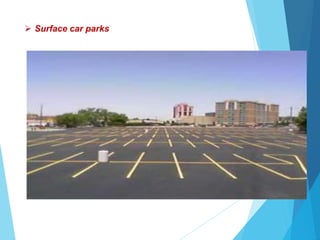
 Surface car parks
 Multistoried car parks
 Roof parks
 Mechanical parks
 Underground car parks
Peripheral Parking Schemes
1. Park and walk
Under this scheme the motorists are
included to park at the outskirts of the town and
walk down to the town.
2. Park and ride
This scheme provide for peripheral parking
facilities and public transport side to the destinations
in the town.
Parking studies
 Inventory of existing parking space supply and measure current
levels of space usage (accumulation and space turn over).
 Identify salient parking characteristics (duration, purpose, trip
destination and walking distances to destination).
 Qualify demands and needs.
 Estimate facility capital and operating costs, usage and revenues.
Types of Parking Surveys
 Parking Space in inventory
 Parking Usage Survey by Patrol
 Questionnaire Type Parking Usage Survey
 Cordon Count
Comprehensive Parking
Studies
 Location where parked
 Trip purpose and frequency
 Primary trip destination
 Length of time parked
 Parking fees paid and
 Distance walked from primary space to primary destination
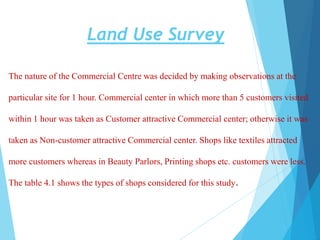
Land Use Survey
The nature of the Commercial Centre was decided by making observations at the
particular site for 1 hour. Commercial center in which more than 5 customers visited
within 1 hour was taken as Customer attractive Commercial center; otherwise it was
taken as Non-customer attractive Commercial center. Shops like textiles attracted
more customers whereas in Beauty Parlors, Printing shops etc. customers were less.
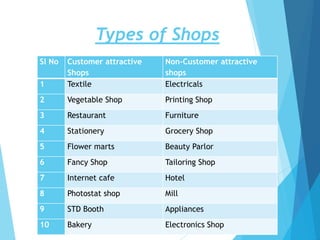
The table 4.1 shows the types of shops considered for this study.
Types of Shops
Sl No Customer attractive
Shops
Non-Customer attractive
shops
1 Textile Electricals
2 Vegetable Shop Printing Shop
3 Restaurant Furniture
4 Stationery Grocery Shop
5 Flower marts Beauty Parlor
6 Fancy Shop Tailoring Shop
7 Internet cafe Hotel
8 Photostat shop Mill
9 STD Booth Appliances
10 Bakery Electronics Shop
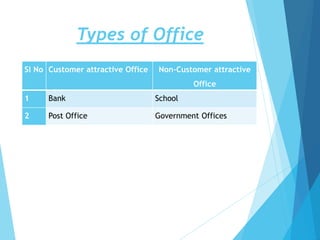
Types of Office
Sl No Customer attractive Office Non-Customer attractive
Office
1 Bank School
2 Post Office Government Offices
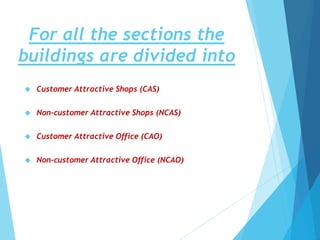
For all the sections the
buildings are divided into
 Customer Attractive Shops (CAS)
 Non-customer Attractive Shops (NCAS)
 Customer Attractive Office (CAO)
 Non-customer Attractive Office (NCAO)
Kerala Municipality
Building Rules
for off-street parking space
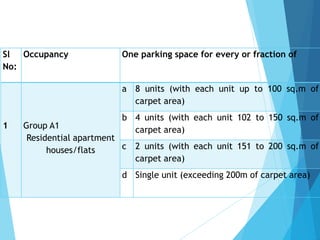
Sl
No:
Occupancy One parking space for every or fraction of
1 Group A1
Residential apartment
houses/flats
a 8 units (with each unit up to 100 sq.m of
carpet area)
b 4 units (with each unit 102 to 150 sq.m of
carpet area)
c 2 units (with each unit 151 to 200 sq.m of
carpet area)
d Single unit (exceeding 200m of carpet area)
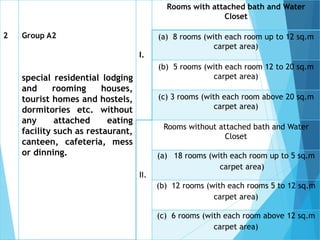
2 Group A2
special residential lodging
and rooming houses,
tourist homes and hostels,
dormitories etc. without
any attached eating
facility such as restaurant,
canteen, cafeteria, mess
or dinning.
I.
Rooms with attached bath and Water
Closet
(a) 8 rooms (with each room up to 12 sq.m
carpet area)
(b) 5 rooms (with each room 12 to 20 sq.m
carpet area)
(c) 3 rooms (with each room above 20 sq.m
carpet area)
II.
Rooms without attached bath and Water
Closet
(a) 18 rooms (with each room up to 5 sq.m
carpet area)
(b) 12 rooms (with each rooms 5 to 12 sq.m
carpet area)
(c) 6 rooms (with each room above 12 sq.m
carpet area)
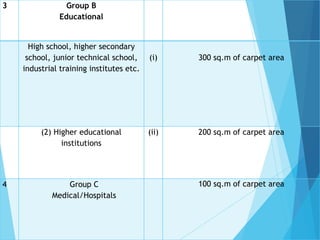
3 Group B
Educational
High school, higher secondary
school, junior technical school,
industrial training institutes etc.
(i) 300 sq.m of carpet area
(2) Higher educational
institutions
(ii) 200 sq.m of carpet area
4 Group C
Medical/Hospitals
100 sq.m of carpet area
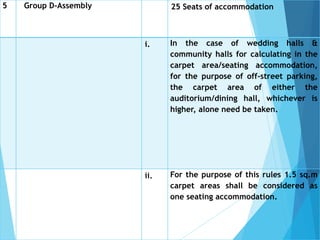
5 Group D-Assembly 25 Seats of accommodation
i. In the case of wedding halls &
community halls for calculating in the
carpet area/seating accommodation,
for the purpose of off-street parking,
the carpet area of either the
auditorium/dining hall, whichever is
higher, alone need be taken.
ii. For the purpose of this rules 1.5 sq.m
carpet areas shall be considered as
one seating accommodation.
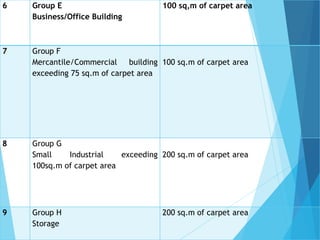
6 Group E
Business/Office Building
100 sq,m of carpet area
7 Group F
Mercantile/Commercial building
exceeding 75 sq.m of carpet area
100 sq.m of carpet area
8 Group G
Small Industrial exceeding
100sq.m of carpet area
200 sq.m of carpet area
9 Group H
Storage
200 sq.m of carpet area
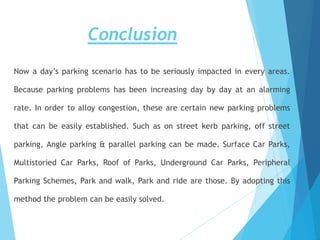
Conclusion
Now a day’s parking scenario has to be seriously impacted in every areas.
Because parking problems has been increasing day by day at an alarming
rate. In order to alloy congestion, these are certain new parking problems
that can be easily established. Such as on street kerb parking, off street
parking, Angle parking & parallel parking can be made. Surface Car Parks,
Multistoried Car Parks, Roof of Parks, Underground Car Parks, Peripheral
Parking Schemes, Park and walk, Park and ride are those. By adopting this
method the problem can be easily solved.
8086918147If you are satisfied pls call me
Parking problems
Parking problems

Parking problems

  • 2.
  • 3.
    Introduction One of theproblems created by road traffic is parking. Not only do vehicles require street space to move about, but also do they require space to park where the occupants can be loaded and unloaded. The period over which a car is parked is very great compared with the time it is in motion. The size of average parking space is 14 m2. It is roughly estimated that out of 8760 hours in a year, the car runs on an average for only 400 hours, leaving 8360 hours when it is parked. Every car owner would wish to park the car as closely as possible to his destination so as to minimize his walking.
  • 4.
    Effect of parking Congestion  Accidents  Obstruction to fire fighting operations  Effect on environment
  • 5.
    Objectives  To studythe parking characteristics in Pattambi-Cherpulassery road and to assess whether the demand is met with.  Identification of the problems in traffic and parking in Pattambi-Cherpulassery road  To project the present traffic scenario in Pattambi-Cherpulassery road.  To improve the parking facilities utilizing the available infrastructure for meeting the parking demand of various categories of vehicles.  To smoothen the vehicular traffic flow by conducting relevant traffic studies
  • 6.
    General Terms ofParking Facilities 1. Parking Accumulation :-The total number of vehicles parked in an area at a specified moment. 2. Parking volume:-The number of vehicles parked in a particular area over a given period of time. It is usually measured in vehicles per day. 3. Parking load:-The area under the parking accumulation curve during a specified period. 4. Parking duration:-The length of time spent in a parking space. 5. Parking index:-Percentage of parking bays actually occupied by parked vehicles as compared to the theoretical number available. 6. Parking turn over:-Rate of the usage of the available parking space. Thus if there were 10 parking spaces used by 100 vehicles in a period of say 12 hours then the parking turnover would be
  • 7.
    Parking facilities  On– street or Kerb Parking  Off – street Parking
  • 8.
    On – streetor Kerb Parking 1. Parallel Parking 2. 30 degree parking 3. 45 degree parking 4. 60 degree Parking 5. 90 degree Parking
  • 9.
  • 10.
  • 11.
  • 12.
  • 13.
  • 14.
    Off-street Parking 1.Surface carparks 2.Multistoried car parks 3.Roof parks 4.Mechanical parks 5.Underground car parks Off-street Parking
  • 15.
  • 16.
  • 17.
  • 18.
  • 19.
  • 20.
    Peripheral Parking Schemes 1.Park and walk Under this scheme the motorists are included to park at the outskirts of the town and walk down to the town. 2. Park and ride This scheme provide for peripheral parking facilities and public transport side to the destinations in the town.
  • 21.
    Parking studies  Inventoryof existing parking space supply and measure current levels of space usage (accumulation and space turn over).  Identify salient parking characteristics (duration, purpose, trip destination and walking distances to destination).  Qualify demands and needs.  Estimate facility capital and operating costs, usage and revenues.
  • 22.
    Types of ParkingSurveys  Parking Space in inventory  Parking Usage Survey by Patrol  Questionnaire Type Parking Usage Survey  Cordon Count
  • 23.
    Comprehensive Parking Studies  Locationwhere parked  Trip purpose and frequency  Primary trip destination  Length of time parked  Parking fees paid and  Distance walked from primary space to primary destination
  • 24.
    Land Use Survey Thenature of the Commercial Centre was decided by making observations at the particular site for 1 hour. Commercial center in which more than 5 customers visited within 1 hour was taken as Customer attractive Commercial center; otherwise it was taken as Non-customer attractive Commercial center. Shops like textiles attracted more customers whereas in Beauty Parlors, Printing shops etc. customers were less. The table 4.1 shows the types of shops considered for this study.
  • 25.
    Types of Shops SlNo Customer attractive Shops Non-Customer attractive shops 1 Textile Electricals 2 Vegetable Shop Printing Shop 3 Restaurant Furniture 4 Stationery Grocery Shop 5 Flower marts Beauty Parlor 6 Fancy Shop Tailoring Shop 7 Internet cafe Hotel 8 Photostat shop Mill 9 STD Booth Appliances 10 Bakery Electronics Shop
  • 26.
    Types of Office SlNo Customer attractive Office Non-Customer attractive Office 1 Bank School 2 Post Office Government Offices
  • 27.
    For all thesections the buildings are divided into  Customer Attractive Shops (CAS)  Non-customer Attractive Shops (NCAS)  Customer Attractive Office (CAO)  Non-customer Attractive Office (NCAO)
  • 28.
  • 29.
    Sl No: Occupancy One parkingspace for every or fraction of 1 Group A1 Residential apartment houses/flats a 8 units (with each unit up to 100 sq.m of carpet area) b 4 units (with each unit 102 to 150 sq.m of carpet area) c 2 units (with each unit 151 to 200 sq.m of carpet area) d Single unit (exceeding 200m of carpet area)
  • 30.
    2 Group A2 specialresidential lodging and rooming houses, tourist homes and hostels, dormitories etc. without any attached eating facility such as restaurant, canteen, cafeteria, mess or dinning. I. Rooms with attached bath and Water Closet (a) 8 rooms (with each room up to 12 sq.m carpet area) (b) 5 rooms (with each room 12 to 20 sq.m carpet area) (c) 3 rooms (with each room above 20 sq.m carpet area) II. Rooms without attached bath and Water Closet (a) 18 rooms (with each room up to 5 sq.m carpet area) (b) 12 rooms (with each rooms 5 to 12 sq.m carpet area) (c) 6 rooms (with each room above 12 sq.m carpet area)
  • 31.
    3 Group B Educational Highschool, higher secondary school, junior technical school, industrial training institutes etc. (i) 300 sq.m of carpet area (2) Higher educational institutions (ii) 200 sq.m of carpet area 4 Group C Medical/Hospitals 100 sq.m of carpet area
  • 32.
    5 Group D-Assembly25 Seats of accommodation i. In the case of wedding halls & community halls for calculating in the carpet area/seating accommodation, for the purpose of off-street parking, the carpet area of either the auditorium/dining hall, whichever is higher, alone need be taken. ii. For the purpose of this rules 1.5 sq.m carpet areas shall be considered as one seating accommodation.
  • 33.
    6 Group E Business/OfficeBuilding 100 sq,m of carpet area 7 Group F Mercantile/Commercial building exceeding 75 sq.m of carpet area 100 sq.m of carpet area 8 Group G Small Industrial exceeding 100sq.m of carpet area 200 sq.m of carpet area 9 Group H Storage 200 sq.m of carpet area
  • 34.
    Conclusion Now a day’sparking scenario has to be seriously impacted in every areas. Because parking problems has been increasing day by day at an alarming rate. In order to alloy congestion, these are certain new parking problems that can be easily established. Such as on street kerb parking, off street parking, Angle parking & parallel parking can be made. Surface Car Parks, Multistoried Car Parks, Roof of Parks, Underground Car Parks, Peripheral Parking Schemes, Park and walk, Park and ride are those. By adopting this method the problem can be easily solved.
  • 35.
    8086918147If you aresatisfied pls call me