A Seminar Presentation
ON
BUILDING INTEGRATED PHOTOVOLTAICS
(BIPV)
SUBMITTED TO: SUBMITTED BY:
Prof . A. SWARUP ANISH MALAN
Roll no: 31510121
M.TECH 2015 -17
SCHOOL OF RENEWABLE ENERGY AND EFFICIENCY
1
CONTENTS
1. Introduction
2. BIPV Technology
3. Design Considerations of BIPV System
4. Types BIPV Systems
5. Building Integrated Photovoltaic Products
6. Future Research Opportunities
7. Application of BIPV
8. Case studies
9. Advantages and Disadvantages
10. Conclusions
References
2
Introduction
As the world’s demand and focus on zero energy and zero emission buildings are
rapidly drawing attention.
Solar cells are integrated within the climate envelopes of buildings and utilizing
solar radiation to produce electricity,
It replace parts of the conventional building materials and systems in the climate
envelope of buildings, such as the roofs and facades.
The BIPV system serves as a building envelope material and power generator
simultaneously
3
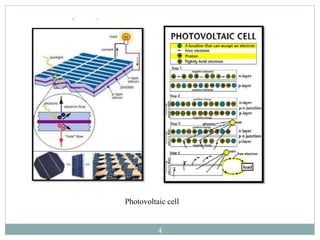
Photovoltaic cell
4
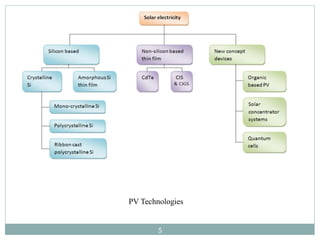
PV Technologies
5
6
7
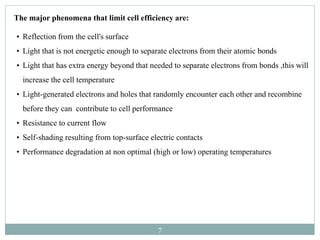
• Reflection from the cell's surface
• Light that is not energetic enough to separate electrons from their atomic bonds
• Light that has extra energy beyond that needed to separate electrons from bonds ,this will
increase the cell temperature
• Light-generated electrons and holes that randomly encounter each other and recombine
before they can contribute to cell performance
• Resistance to current flow
• Self-shading resulting from top-surface electric contacts
• Performance degradation at non optimal (high or low) operating temperatures
The major phenomena that limit cell efficiency are:
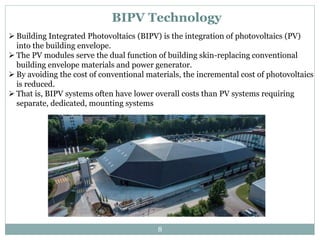
BIPV Technology
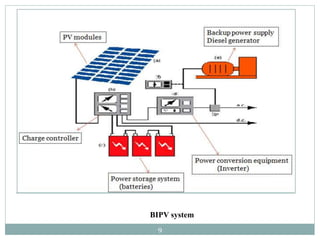
 Building Integrated Photovoltaics (BIPV) is the integration of photovoltaics (PV)
into the building envelope.
 The PV modules serve the dual function of building skin-replacing conventional
building envelope materials and power generator.
 By avoiding the cost of conventional materials, the incremental cost of photovoltaics
is reduced.
 That is, BIPV systems often have lower overall costs than PV systems requiring
separate, dedicated, mounting systems
8
BIPV system
9
Design Considerations of BIPV System
 Choose Between a Utility-Interactive PV System and a Stand-alone PV System
 Provide Adequate Ventilation
 Consider Integrating Day lighting and Photovoltaic Collection
 Design for the Local Climate and Environment;
 Arrays must be designed for potential snow and wind loading conditions;
 Arrays in dry, dusty environments or environments with heavy industrial or traffic
(auto, airline) pollution will require washing to limit efficiency losses.
 Early in the design phase, ensure that solar array will receive maximum exposure to the
sun and will not be shaded by site obstructions such as nearby buildings or trees.
 Different array orientation can have a significant impact on the annual energy output of
a system, with tilted arrays generating 50%-70% more electricity than a vertical façade.
10
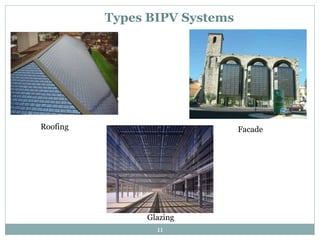
Types BIPV Systems
11
Roofing Facade
Glazing
Building Integrated Photovoltaic Products
 BIPV foil products
• Lightweight and flexible,
• Made from thin-film cells
• Low efficiency
• Large solar cell resistances of thin-film cells(amorphous silicon cells).
 BIPV tile products
• Good option for retrofitting of roofs.
• Esthetically pleasing.
• Module has an integrated panel of poly
or monocrystalline cells.
BIPV module products
• Similar to conventional PV modules.
• They are made with weather skin solutions
Building attached photovoltaic products
BAPV products are added on rather than integrated in the roof or facade.
12
 Solar cell glazing products
• Variety of options for windows, glassed or tiled facades and roofs.
• Different colors and transparencies can make many different esthetically
pleasing.
• The modules transmit daylight
• Serve as water and sun protection.
• Spraying a coating of silicon nano particles on to the window, which work as
solar cells..
• The producers also offer customized modules regarding shape, cell material,
color and transparency level
13
Future Research Opportunities
New materials and technologies
•Ultra-low cost, low-medium efficiency organic based modules,
• Ultra-high efficiency modules,
• Solar concentrator and/or solar trapping systems embedded in solar cell surface
• Flexible lightweight inorganic thin film solar cells.
New solutions
• Regarding ventilation rate,
• Positioning,
• Removing of snow
Long-term durability of new materials and solutions
The long-term durability v/s the various climate exposure factors need to be considered e.g.
•Solar radiation
•High and low temperatures
•Water, e.g. moisture and wind-driven rain
•Physical strains, e.g. snow loads
•Wind
•Pollutions, e.g. gases and particles in air
14
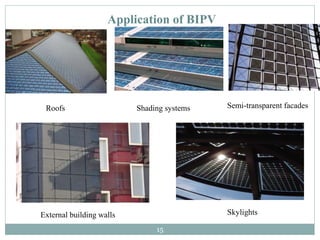
Application of BIPV
15
Roofs
External building walls
Semi-transparent facades
Skylights
Shading systems
16
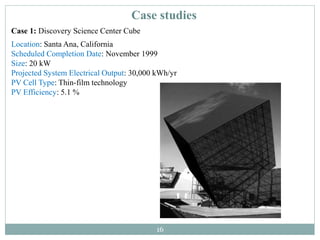
Case studies
Case 1: Discovery Science Center Cube
Location: Santa Ana, California
Scheduled Completion Date: November 1999
Size: 20 kW
Projected System Electrical Output: 30,000 kWh/yr
PV Cell Type: Thin-film technology
PV Efficiency: 5.1 %
17
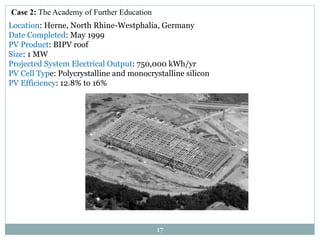
Case 2: The Academy of Further Education
Location: Herne, North Rhine-Westphalia, Germany
Date Completed: May 1999
PV Product: BIPV roof
Size: 1 MW
Projected System Electrical Output: 750,000 kWh/yr
PV Cell Type: Polycrystalline and monocrystalline silicon
PV Efficiency: 12.8% to 16%
18
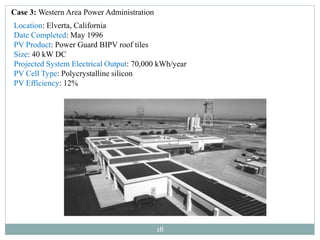
Case 3: Western Area Power Administration
Location: Elverta, California
Date Completed: May 1996
PV Product: Power Guard BIPV roof tiles
Size: 40 kW DC
Projected System Electrical Output: 70,000 kWh/year
PV Cell Type: Polycrystalline silicon
PV Efficiency: 12%
19
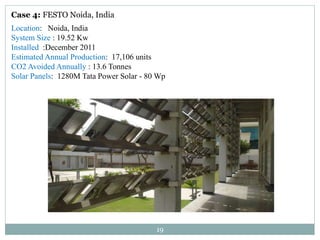
Case 4: FESTO Noida, India
Location: Noida, India
System Size : 19.52 Kw
Installed :December 2011
Estimated Annual Production: 17,106 units
CO2 Avoided Annually : 13.6 Tonnes
Solar Panels: 1280M Tata Power Solar - 80 Wp
20
Advantages of BIPV
• Cost effective
• Reduced Energy Bills
• Generate Income
• Design benefit from innovative and moderns designs
• No harmful greenhouse gas emissions thus solar PV is environmentally friendly
• Solar energy is energy supplied by nature – it is thus free and abundant!
• Solar energy can be made available almost anywhere there is sunlight
• Low Operating and maintenance costs
• PV panels have no mechanically moving parts, less maintenance than other
renewable energy systems (e.g. wind turbines)
• Silent, producing no noise at all
Disadvantages of BIPV
• High making cost
• The cost of making power by solar system is more costlier than other common ways
• Influenced by weather
• Low efficiency(between 14%-25%) compared to the efficiency levels of other
renewable energy systems
Advantages and Disadvantages
Conclusions
21
• Building Integrated Photovoltaic (BIPV) System is a Architecturally Clean.
• The initial installation cost offsets by reducing the amount of building materials
and labour work.
• Building integrated photovoltaic (BIPV) installation in offices or commercial
buildings which reduce energy bills and make the buildings more energy
efficient.
• PV panels have no mechanically moving parts, except in cases of sun-tracking
mechanical bases; consequently they have far less breakages or require less
maintenance than other renewable energy systems (e.g. wind turbines).
• PV panels are totally silent, producing no noise at all; consequently, they are a
perfect solution for urban areas and for residential applications.
22
REFERENCES
[1] McKinsey & Company, Pathways to a Low-Carbon Economy. Version 2 of the Global
Greenhouse Gas Abatement Cost Curve, McKinsey & Company, 2009.
[2] C. Peng, Y. Huang, Z. Wu, Building-integrated photovoltaics (BIPV) in architectural
design in China, Energy and Buildings 43 (2011) 3592–3598.
[3] Green, M. A. (1998). Solar cells: Operating principles, technology and system
applications. Kensington: The University of New South Wales.
[4] M. Raugei, P. Frankl, Life cycle impacts and costs of photovoltaic systems: current state
of the art and future outlooks, Energy 34 (3) (2009) 392–399.
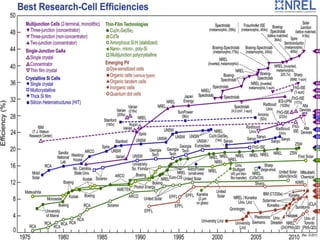
[5]National Renewable Energy Laboratory (NREL), Best Research-Cell Efficiencies, Rev.
12-2011,/http://www.nrel.gov/ncpv/images/efficiency_vchart.jpgS
[6] A.W. Smith, A. Rohatgi, Ray tracing analysis of the inverted pyramid texturing geometry
for high efficiency silicon solar cells, Solar Energy Materials and Solar Cells 29 (1993)
37–49.
[7] J. Neuwald, All You Need to Know About Building Integrated Photo- voltaics Part 2
(not dated), Roofconsult, /http://www.roofconsult.co. uk/articles/kalzip2.htmS.
23
[8] K. Farkas, I. Andresen, A.G. Hestnes, Architectural integration of photovoltaic cells
overview of materials and products from an architectural point of view, in: Proceedings
of the 3rd CIB International Conference on Smart and Sustainable Built Environments
(SASBE), Delft, The Netherlands, June 15–19, 2009.
[9] European Comitee for Electrotechnical Standarization, Crystalline Silicon Terrestrial
Photovoltaic (PV) Modules—Design Qualification and Type Approval, EN 61215,
European Standard, 2005.
[10] B.P. Jelle, A. Hynd, A. Gustavsen, D. Arasteh, H. Goudey, R. Hart, Fenestration of
today and tomorrow: a state-of-the-art review and future research opportunities, Solar
Energy Materials and Solar Cells 96 (1) (2012) 1–28.
[11] B.P. Jelle, T.-N. Nilsen, P.J. Hovde, A. Gustavsen, Accelerated climate aging of building
materials and characterization by Fourier transform infrared radiation analysis, Journal
of Building Physics, doi: 10.1177/1744259111423367,n press.
24
Queries??

seminar ppt

  • 1.
    A Seminar Presentation ON BUILDINGINTEGRATED PHOTOVOLTAICS (BIPV) SUBMITTED TO: SUBMITTED BY: Prof . A. SWARUP ANISH MALAN Roll no: 31510121 M.TECH 2015 -17 SCHOOL OF RENEWABLE ENERGY AND EFFICIENCY 1
  • 2.
    CONTENTS 1. Introduction 2. BIPVTechnology 3. Design Considerations of BIPV System 4. Types BIPV Systems 5. Building Integrated Photovoltaic Products 6. Future Research Opportunities 7. Application of BIPV 8. Case studies 9. Advantages and Disadvantages 10. Conclusions References 2
  • 3.
    Introduction As the world’sdemand and focus on zero energy and zero emission buildings are rapidly drawing attention. Solar cells are integrated within the climate envelopes of buildings and utilizing solar radiation to produce electricity, It replace parts of the conventional building materials and systems in the climate envelope of buildings, such as the roofs and facades. The BIPV system serves as a building envelope material and power generator simultaneously 3
  • 4.
  • 5.
  • 6.
  • 7.
    7 • Reflection fromthe cell's surface • Light that is not energetic enough to separate electrons from their atomic bonds • Light that has extra energy beyond that needed to separate electrons from bonds ,this will increase the cell temperature • Light-generated electrons and holes that randomly encounter each other and recombine before they can contribute to cell performance • Resistance to current flow • Self-shading resulting from top-surface electric contacts • Performance degradation at non optimal (high or low) operating temperatures The major phenomena that limit cell efficiency are:
  • 8.
    BIPV Technology  BuildingIntegrated Photovoltaics (BIPV) is the integration of photovoltaics (PV) into the building envelope.  The PV modules serve the dual function of building skin-replacing conventional building envelope materials and power generator.  By avoiding the cost of conventional materials, the incremental cost of photovoltaics is reduced.  That is, BIPV systems often have lower overall costs than PV systems requiring separate, dedicated, mounting systems 8
  • 9.
  • 10.
    Design Considerations ofBIPV System  Choose Between a Utility-Interactive PV System and a Stand-alone PV System  Provide Adequate Ventilation  Consider Integrating Day lighting and Photovoltaic Collection  Design for the Local Climate and Environment;  Arrays must be designed for potential snow and wind loading conditions;  Arrays in dry, dusty environments or environments with heavy industrial or traffic (auto, airline) pollution will require washing to limit efficiency losses.  Early in the design phase, ensure that solar array will receive maximum exposure to the sun and will not be shaded by site obstructions such as nearby buildings or trees.  Different array orientation can have a significant impact on the annual energy output of a system, with tilted arrays generating 50%-70% more electricity than a vertical façade. 10
  • 11.
  • 12.
    Building Integrated PhotovoltaicProducts  BIPV foil products • Lightweight and flexible, • Made from thin-film cells • Low efficiency • Large solar cell resistances of thin-film cells(amorphous silicon cells).  BIPV tile products • Good option for retrofitting of roofs. • Esthetically pleasing. • Module has an integrated panel of poly or monocrystalline cells. BIPV module products • Similar to conventional PV modules. • They are made with weather skin solutions Building attached photovoltaic products BAPV products are added on rather than integrated in the roof or facade. 12
  • 13.
     Solar cellglazing products • Variety of options for windows, glassed or tiled facades and roofs. • Different colors and transparencies can make many different esthetically pleasing. • The modules transmit daylight • Serve as water and sun protection. • Spraying a coating of silicon nano particles on to the window, which work as solar cells.. • The producers also offer customized modules regarding shape, cell material, color and transparency level 13
  • 14.
    Future Research Opportunities Newmaterials and technologies •Ultra-low cost, low-medium efficiency organic based modules, • Ultra-high efficiency modules, • Solar concentrator and/or solar trapping systems embedded in solar cell surface • Flexible lightweight inorganic thin film solar cells. New solutions • Regarding ventilation rate, • Positioning, • Removing of snow Long-term durability of new materials and solutions The long-term durability v/s the various climate exposure factors need to be considered e.g. •Solar radiation •High and low temperatures •Water, e.g. moisture and wind-driven rain •Physical strains, e.g. snow loads •Wind •Pollutions, e.g. gases and particles in air 14
  • 15.
    Application of BIPV 15 Roofs Externalbuilding walls Semi-transparent facades Skylights Shading systems
  • 16.
    16 Case studies Case 1:Discovery Science Center Cube Location: Santa Ana, California Scheduled Completion Date: November 1999 Size: 20 kW Projected System Electrical Output: 30,000 kWh/yr PV Cell Type: Thin-film technology PV Efficiency: 5.1 %
  • 17.
    17 Case 2: TheAcademy of Further Education Location: Herne, North Rhine-Westphalia, Germany Date Completed: May 1999 PV Product: BIPV roof Size: 1 MW Projected System Electrical Output: 750,000 kWh/yr PV Cell Type: Polycrystalline and monocrystalline silicon PV Efficiency: 12.8% to 16%
  • 18.
    18 Case 3: WesternArea Power Administration Location: Elverta, California Date Completed: May 1996 PV Product: Power Guard BIPV roof tiles Size: 40 kW DC Projected System Electrical Output: 70,000 kWh/year PV Cell Type: Polycrystalline silicon PV Efficiency: 12%
  • 19.
    19 Case 4: FESTONoida, India Location: Noida, India System Size : 19.52 Kw Installed :December 2011 Estimated Annual Production: 17,106 units CO2 Avoided Annually : 13.6 Tonnes Solar Panels: 1280M Tata Power Solar - 80 Wp
  • 20.
    20 Advantages of BIPV •Cost effective • Reduced Energy Bills • Generate Income • Design benefit from innovative and moderns designs • No harmful greenhouse gas emissions thus solar PV is environmentally friendly • Solar energy is energy supplied by nature – it is thus free and abundant! • Solar energy can be made available almost anywhere there is sunlight • Low Operating and maintenance costs • PV panels have no mechanically moving parts, less maintenance than other renewable energy systems (e.g. wind turbines) • Silent, producing no noise at all Disadvantages of BIPV • High making cost • The cost of making power by solar system is more costlier than other common ways • Influenced by weather • Low efficiency(between 14%-25%) compared to the efficiency levels of other renewable energy systems Advantages and Disadvantages
  • 21.
    Conclusions 21 • Building IntegratedPhotovoltaic (BIPV) System is a Architecturally Clean. • The initial installation cost offsets by reducing the amount of building materials and labour work. • Building integrated photovoltaic (BIPV) installation in offices or commercial buildings which reduce energy bills and make the buildings more energy efficient. • PV panels have no mechanically moving parts, except in cases of sun-tracking mechanical bases; consequently they have far less breakages or require less maintenance than other renewable energy systems (e.g. wind turbines). • PV panels are totally silent, producing no noise at all; consequently, they are a perfect solution for urban areas and for residential applications.
  • 22.
    22 REFERENCES [1] McKinsey &Company, Pathways to a Low-Carbon Economy. Version 2 of the Global Greenhouse Gas Abatement Cost Curve, McKinsey & Company, 2009. [2] C. Peng, Y. Huang, Z. Wu, Building-integrated photovoltaics (BIPV) in architectural design in China, Energy and Buildings 43 (2011) 3592–3598. [3] Green, M. A. (1998). Solar cells: Operating principles, technology and system applications. Kensington: The University of New South Wales. [4] M. Raugei, P. Frankl, Life cycle impacts and costs of photovoltaic systems: current state of the art and future outlooks, Energy 34 (3) (2009) 392–399. [5]National Renewable Energy Laboratory (NREL), Best Research-Cell Efficiencies, Rev. 12-2011,/http://www.nrel.gov/ncpv/images/efficiency_vchart.jpgS [6] A.W. Smith, A. Rohatgi, Ray tracing analysis of the inverted pyramid texturing geometry for high efficiency silicon solar cells, Solar Energy Materials and Solar Cells 29 (1993) 37–49. [7] J. Neuwald, All You Need to Know About Building Integrated Photo- voltaics Part 2 (not dated), Roofconsult, /http://www.roofconsult.co. uk/articles/kalzip2.htmS.
  • 23.
    23 [8] K. Farkas,I. Andresen, A.G. Hestnes, Architectural integration of photovoltaic cells overview of materials and products from an architectural point of view, in: Proceedings of the 3rd CIB International Conference on Smart and Sustainable Built Environments (SASBE), Delft, The Netherlands, June 15–19, 2009. [9] European Comitee for Electrotechnical Standarization, Crystalline Silicon Terrestrial Photovoltaic (PV) Modules—Design Qualification and Type Approval, EN 61215, European Standard, 2005. [10] B.P. Jelle, A. Hynd, A. Gustavsen, D. Arasteh, H. Goudey, R. Hart, Fenestration of today and tomorrow: a state-of-the-art review and future research opportunities, Solar Energy Materials and Solar Cells 96 (1) (2012) 1–28. [11] B.P. Jelle, T.-N. Nilsen, P.J. Hovde, A. Gustavsen, Accelerated climate aging of building materials and characterization by Fourier transform infrared radiation analysis, Journal of Building Physics, doi: 10.1177/1744259111423367,n press.
  • 24.
  • 25.