1
A Seminar on
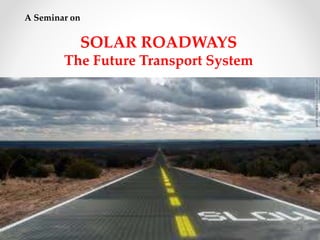
SOLAR ROADWAYS
The Future Transport System
Submitted By :-
Daanish Zama
8th Sem.,CE
Reg.No:- 1201341043
Submitted To :-
Er.Ashutosh Rath
Asst.Professor
Civil Engineering Dept.
S I L I C O N I N S T I T U T E O F T E C H N O L O G Y
Sambalpur, Odisha
2
A Seminar on
SOLAR ROADWAYS
The Future Transport System
CONTENTS
• Introduction
• Solar energy
• Solar road construction
• Features of solar roads
• Advantages & Disadvantages
• Road Survey of India
• Case study
• Conclusion
• References
3
INTRODUCTION
• Hearing the concerns about global warming and knowing
our dependency on fossil fuels the Solar Roadways
imagined to develop roadways with solar panels.
• Solar roadways technology will replace all current
petroleum-based asphalt roads, parking lots, and driveways.
• The Solar Roadways consists of structurally engineered
solar panels that we drive on.
• The Solar Roadway generates electrical power from the sun
and becomes a nation’s decentralized, intelligent, self-
healing power grid, replacing our current deteriorating
power distribution infrastructure.
4
TM
WHAT IS SOLAR ENERGY?
Solar energy is the light and radiant heat from the Sun
that influences Earth's climate and weather and sustains
life. By using this energy electricity can be produced with
help of solar technology.
Solar technologies are broadly characterized as:
Active solar technology
Passive solar technology
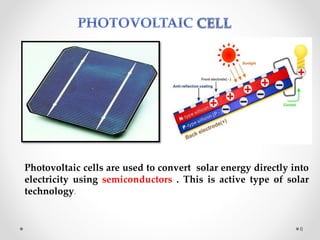
Photovoltaic cells are used to convert solar energy directly into
electricity using semiconductors . This is active type of solar
technology.
6
Solar energy is preferable as compared to another energy
sources due to following reasons
Reduced Dependence on Fossil Fuels
Environment friendly
Matching Peak Time Output with Peak Time Demand
Flexible Locations
Modularity and Scalability
7
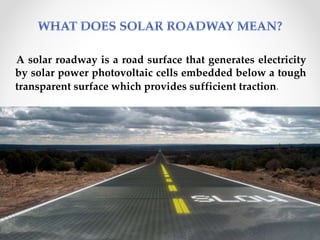
A solar roadway is a road surface that generates electricity
by solar power photovoltaic cells embedded below a tough
transparent surface which provides sufficient traction.
8
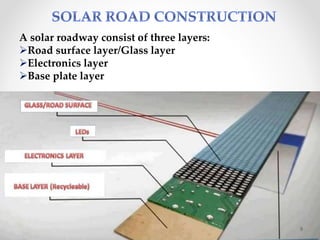
A solar roadway consist of three layers:
Road surface layer/Glass layer
Electronics layer
Base plate layer
9
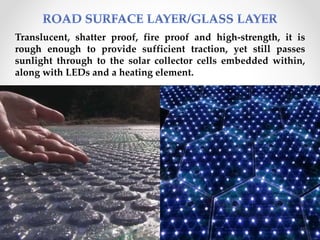
Translucent, shatter proof, fire proof and high-strength, it is
rough enough to provide sufficient traction, yet still passes
sunlight through to the solar collector cells embedded within,
along with LEDs and a heating element.
10
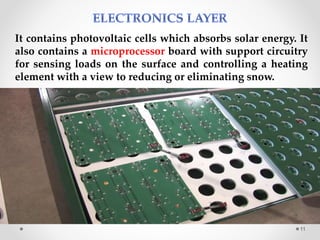
It contains photovoltaic cells which absorbs solar energy. It
also contains a microprocessor board with support circuitry
for sensing loads on the surface and controlling a heating
element with a view to reducing or eliminating snow.
11
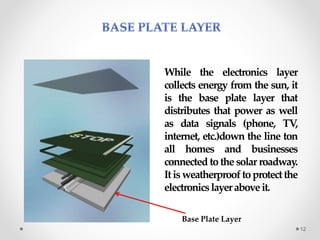
While the electronics layer
collects energy from the sun, it
is the base plate layer that
distributes that power as well
as data signals (phone, TV,
internet, etc.)down the line ton
all homes and businesses
connected to the solar roadway.
Itisweatherprooftoprotectthe
electronicslayeraboveit.
12
Base Plate Layer
13
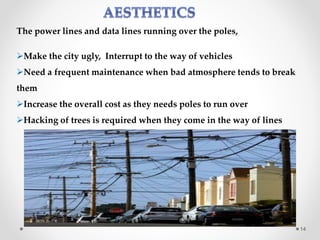
The power lines and data lines running over the poles,
Make the city ugly, Interrupt to the way of vehicles
Need a frequent maintenance when bad atmosphere tends to break
them
Increase the overall cost as they needs poles to run over
Hacking of trees is required when they come in the way of lines
14
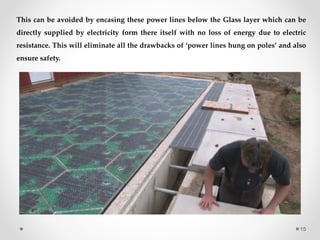
This can be avoided by encasing these power lines below the Glass layer which can be
directly supplied by electricity form there itself with no loss of energy due to electric
resistance. This will eliminate all the drawbacks of ‘power lines hung on poles’ and also
ensure safety.
15
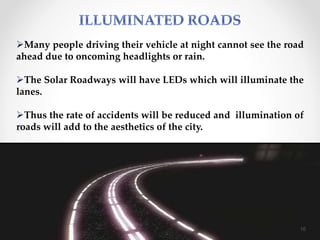
Many people driving their vehicle at night cannot see the road
ahead due to oncoming headlights or rain.
The Solar Roadways will have LEDs which will illuminate the
lanes.
Thus the rate of accidents will be reduced and illumination of
roads will add to the aesthetics of the city.
16
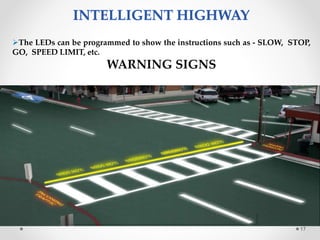
The LEDs can be programmed to show the instructions such as - SLOW, STOP,
GO, SPEED LIMIT, etc.
WARNING SIGNS
17
18
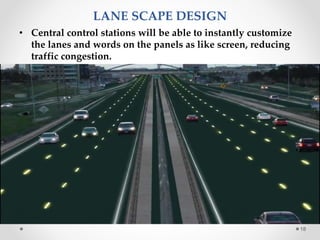
LANE SCAPE DESIGN
• Central control stations will be able to instantly customize
the lanes and words on the panels as like screen, reducing
traffic congestion.
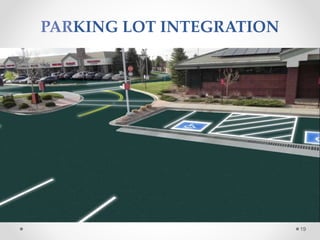
PARKING LOT INTEGRATION
19
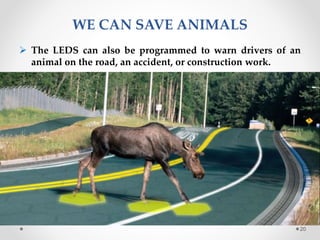
WE CAN SAVE ANIMALS
 The LEDS can also be programmed to warn drivers of an
animal on the road, an accident, or construction work.
20
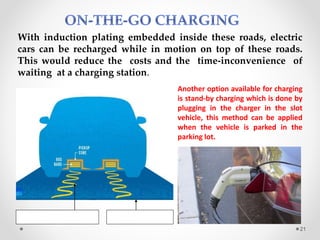
With induction plating embedded inside these roads, electric
cars can be recharged while in motion on top of these roads.
This would reduce the costs and the time-inconvenience of
waiting at a charging station.
Glass panelInduction plating
Another option available for charging
is stand-by charging which is done by
plugging in the charger in the slot
vehicle, this method can be applied
when the vehicle is parked in the
parking lot.
21
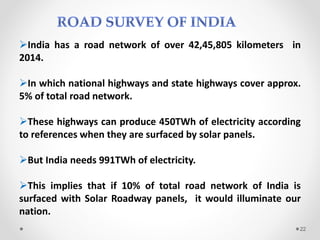
India has a road network of over 42,45,805 kilometers in
2014.
In which national highways and state highways cover approx.
5% of total road network.
These highways can produce 450TWh of electricity according
to references when they are surfaced by solar panels.
But India needs 991TWh of electricity.
This implies that if 10% of total road network of India is
surfaced with Solar Roadway panels, it would illuminate our
nation.
22
23
24
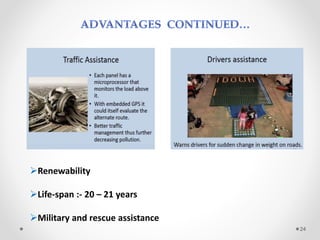
Renewability
Life-span :- 20 – 21 years
Military and rescue assistance
Maintenance costs
Seasonal efficiency
Needs a town planning
High initial startup cost
$16 per square feet – Asphalt road
One panel size 12 ft x 12 ft = 144 sq ft
One panel costs about $6912
$6912 / 144 sq ft = $48 per sq ft - Solar road
Road surfaces deposits salt, rubber and dirt, which reduces its
efficiency.
25
CASE STUDY
26
Solar Roadways™ is a company based in Idaho that is working to perfect
and implement the idea of solar panels embedded within road surfaces,
sidewalks and parking lots. The company was started by Scott and Julie
Brusaw.
 Phase I Prototype:
The United States Department of Transportation awarded the company Solar
Roadways Incorporated a $100,000 research contract in 2009. This Small
Business Innovation Research (SBIR) contract enabled Solar Roadways to
prototype solar road panels. The concept has been used for lighting as well.
 Phase II Prototype:
After successful completion of the Phase I SBIR contract, Solar Roadways Inc.
announced that the Federal Highway Administration awarded it a follow-up
$750,000 Phase II SBIR contract to take it to the next step: a solar parking lot.
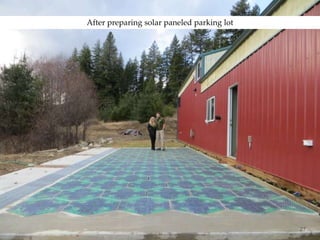
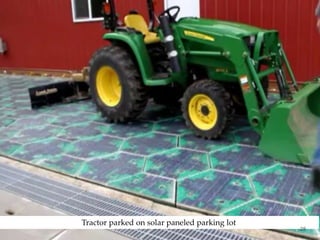
The lot was finished in April of 2014. The following pictures are of prototype
II.
After preparing solar paneled parking lot
27
Tractor parked on solar paneled parking lot
28
29
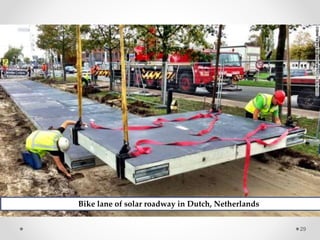
Bike lane of solar roadway in Dutch, Netherlands
For roughly the 3 times the cost of the current systems
(asphalt roads and fossil fuel burning electricity generation
plants), the Solar Roadways can be implemented.
No more Global Warming.
Safer driving conditions.
Far less pollution.
A new secure highway infrastructure that pays for itself.
A decentralized, secure power grid.
No more dependency on foreign oil.
30
• Our Hon’ble Prime minister Narendra Modi has made
promise to built 100 smart cities across the nation. If
we provide solar roadways in those 100 smart cities, we
can at least overcome the problem of load shedding.
So let’s start with 100 smart cities.
31
REFERENCES
• Alark A. Kulkarni, Director, Orbit Consultants Pvt. Ltd.,
Pune Solar Roadways – Rebuilding our Infrastructure and
Economy
• International Journal of Engineering Research and
Applications (IJERA) www.ijera.com
• Scott Brusaw - Solar roadway at TEDx – Ideas worth
spreading.
• Andrew Northmore, MSc Candidate & Dr. Susan Tighe,
Professor, Dept. of Civil and Environmental Engineering
University of Waterloo.
• Innovative Pavement Design: Are Solar Roads Feasible?
32
Thank You
33
Questions Please…

Solar roads seminar

  • 1.
    1 A Seminar on SOLARROADWAYS The Future Transport System Submitted By :- Daanish Zama 8th Sem.,CE Reg.No:- 1201341043 Submitted To :- Er.Ashutosh Rath Asst.Professor Civil Engineering Dept. S I L I C O N I N S T I T U T E O F T E C H N O L O G Y Sambalpur, Odisha
  • 2.
    2 A Seminar on SOLARROADWAYS The Future Transport System
  • 3.
    CONTENTS • Introduction • Solarenergy • Solar road construction • Features of solar roads • Advantages & Disadvantages • Road Survey of India • Case study • Conclusion • References 3
  • 4.
    INTRODUCTION • Hearing theconcerns about global warming and knowing our dependency on fossil fuels the Solar Roadways imagined to develop roadways with solar panels. • Solar roadways technology will replace all current petroleum-based asphalt roads, parking lots, and driveways. • The Solar Roadways consists of structurally engineered solar panels that we drive on. • The Solar Roadway generates electrical power from the sun and becomes a nation’s decentralized, intelligent, self- healing power grid, replacing our current deteriorating power distribution infrastructure. 4 TM
  • 5.
    WHAT IS SOLARENERGY? Solar energy is the light and radiant heat from the Sun that influences Earth's climate and weather and sustains life. By using this energy electricity can be produced with help of solar technology. Solar technologies are broadly characterized as: Active solar technology Passive solar technology
  • 6.
    Photovoltaic cells areused to convert solar energy directly into electricity using semiconductors . This is active type of solar technology. 6
  • 7.
    Solar energy ispreferable as compared to another energy sources due to following reasons Reduced Dependence on Fossil Fuels Environment friendly Matching Peak Time Output with Peak Time Demand Flexible Locations Modularity and Scalability 7
  • 8.
    A solar roadwayis a road surface that generates electricity by solar power photovoltaic cells embedded below a tough transparent surface which provides sufficient traction. 8
  • 9.
    A solar roadwayconsist of three layers: Road surface layer/Glass layer Electronics layer Base plate layer 9
  • 10.
    Translucent, shatter proof,fire proof and high-strength, it is rough enough to provide sufficient traction, yet still passes sunlight through to the solar collector cells embedded within, along with LEDs and a heating element. 10
  • 11.
    It contains photovoltaiccells which absorbs solar energy. It also contains a microprocessor board with support circuitry for sensing loads on the surface and controlling a heating element with a view to reducing or eliminating snow. 11
  • 12.
    While the electronicslayer collects energy from the sun, it is the base plate layer that distributes that power as well as data signals (phone, TV, internet, etc.)down the line ton all homes and businesses connected to the solar roadway. Itisweatherprooftoprotectthe electronicslayeraboveit. 12 Base Plate Layer
  • 13.
  • 14.
    The power linesand data lines running over the poles, Make the city ugly, Interrupt to the way of vehicles Need a frequent maintenance when bad atmosphere tends to break them Increase the overall cost as they needs poles to run over Hacking of trees is required when they come in the way of lines 14
  • 15.
    This can beavoided by encasing these power lines below the Glass layer which can be directly supplied by electricity form there itself with no loss of energy due to electric resistance. This will eliminate all the drawbacks of ‘power lines hung on poles’ and also ensure safety. 15
  • 16.
    Many people drivingtheir vehicle at night cannot see the road ahead due to oncoming headlights or rain. The Solar Roadways will have LEDs which will illuminate the lanes. Thus the rate of accidents will be reduced and illumination of roads will add to the aesthetics of the city. 16
  • 17.
    The LEDs canbe programmed to show the instructions such as - SLOW, STOP, GO, SPEED LIMIT, etc. WARNING SIGNS 17
  • 18.
    18 LANE SCAPE DESIGN •Central control stations will be able to instantly customize the lanes and words on the panels as like screen, reducing traffic congestion.
  • 19.
  • 20.
    WE CAN SAVEANIMALS  The LEDS can also be programmed to warn drivers of an animal on the road, an accident, or construction work. 20
  • 21.
    With induction platingembedded inside these roads, electric cars can be recharged while in motion on top of these roads. This would reduce the costs and the time-inconvenience of waiting at a charging station. Glass panelInduction plating Another option available for charging is stand-by charging which is done by plugging in the charger in the slot vehicle, this method can be applied when the vehicle is parked in the parking lot. 21
  • 22.
    India has aroad network of over 42,45,805 kilometers in 2014. In which national highways and state highways cover approx. 5% of total road network. These highways can produce 450TWh of electricity according to references when they are surfaced by solar panels. But India needs 991TWh of electricity. This implies that if 10% of total road network of India is surfaced with Solar Roadway panels, it would illuminate our nation. 22
  • 23.
  • 24.
    24 Renewability Life-span :- 20– 21 years Military and rescue assistance
  • 25.
    Maintenance costs Seasonal efficiency Needsa town planning High initial startup cost $16 per square feet – Asphalt road One panel size 12 ft x 12 ft = 144 sq ft One panel costs about $6912 $6912 / 144 sq ft = $48 per sq ft - Solar road Road surfaces deposits salt, rubber and dirt, which reduces its efficiency. 25
  • 26.
    CASE STUDY 26 Solar Roadways™is a company based in Idaho that is working to perfect and implement the idea of solar panels embedded within road surfaces, sidewalks and parking lots. The company was started by Scott and Julie Brusaw.  Phase I Prototype: The United States Department of Transportation awarded the company Solar Roadways Incorporated a $100,000 research contract in 2009. This Small Business Innovation Research (SBIR) contract enabled Solar Roadways to prototype solar road panels. The concept has been used for lighting as well.  Phase II Prototype: After successful completion of the Phase I SBIR contract, Solar Roadways Inc. announced that the Federal Highway Administration awarded it a follow-up $750,000 Phase II SBIR contract to take it to the next step: a solar parking lot. The lot was finished in April of 2014. The following pictures are of prototype II.
  • 27.
    After preparing solarpaneled parking lot 27
  • 28.
    Tractor parked onsolar paneled parking lot 28
  • 29.
    29 Bike lane ofsolar roadway in Dutch, Netherlands
  • 30.
    For roughly the3 times the cost of the current systems (asphalt roads and fossil fuel burning electricity generation plants), the Solar Roadways can be implemented. No more Global Warming. Safer driving conditions. Far less pollution. A new secure highway infrastructure that pays for itself. A decentralized, secure power grid. No more dependency on foreign oil. 30
  • 31.
    • Our Hon’blePrime minister Narendra Modi has made promise to built 100 smart cities across the nation. If we provide solar roadways in those 100 smart cities, we can at least overcome the problem of load shedding. So let’s start with 100 smart cities. 31
  • 32.
    REFERENCES • Alark A.Kulkarni, Director, Orbit Consultants Pvt. Ltd., Pune Solar Roadways – Rebuilding our Infrastructure and Economy • International Journal of Engineering Research and Applications (IJERA) www.ijera.com • Scott Brusaw - Solar roadway at TEDx – Ideas worth spreading. • Andrew Northmore, MSc Candidate & Dr. Susan Tighe, Professor, Dept. of Civil and Environmental Engineering University of Waterloo. • Innovative Pavement Design: Are Solar Roads Feasible? 32
  • 33.