2
A Seminar on
SOLAR ROADWAYS
By: Vikas s. Jadhav
Under the Guidance of
Mr. R.P.Patil
CONTENTS
• Introduction
• Features of solar roads
• Advantages & Disadvantages
• Conclusion
3
INTRODUCTION
• Hearing the concerns about global warming and
knowing our dependency on fossil fuels the solar
roadways imagined to develop roadways with solar
panels.
• Solar roadways technology will replace all current
petroleum-based asphalt roads, parking lots, and
driveways.
• Solar Roadways system would might at present, cost
about three times what it costs to install an asphalt
road.
• Important element of the Solar Roadways technology
is that its power-generation capacity demonstrates
the base load viability of renewable energy sources.
4
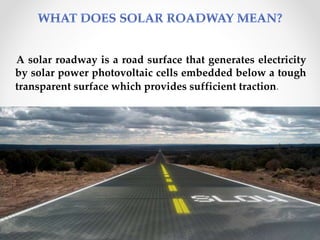
A solar roadway is a road surface that generates electricity
by solar power photovoltaic cells embedded below a tough
transparent surface which provides sufficient traction.
5
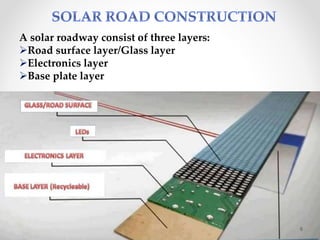
A solar roadway consist of three layers:
Road surface layer/Glass layer
Electronics layer
Base plate layer
6
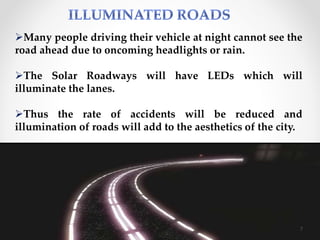
Many people driving their vehicle at night cannot see the
road ahead due to oncoming headlights or rain.
The Solar Roadways will have LEDs which will
illuminate the lanes.
Thus the rate of accidents will be reduced and
illumination of roads will add to the aesthetics of the city.
7
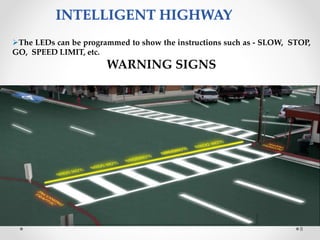
The LEDs can be programmed to show the instructions such as - SLOW, STOP,
GO, SPEED LIMIT, etc.
WARNING SIGNS
8
9
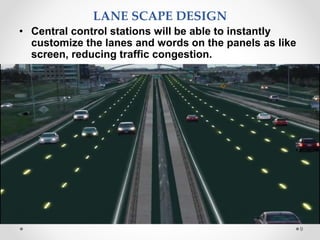
LANE SCAPE DESIGN
• Central control stations will be able to instantly
customize the lanes and words on the panels as like
screen, reducing traffic congestion.
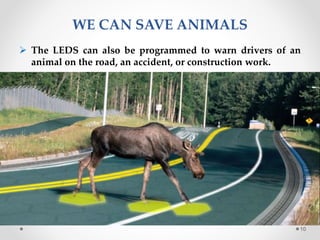
WE CAN SAVE ANIMALS
 The LEDS can also be programmed to warn drivers of an
animal on the road, an accident, or construction work.
10
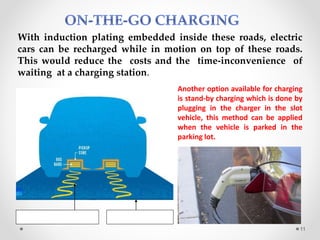
With induction plating embedded inside these roads, electric
cars can be recharged while in motion on top of these roads.
This would reduce the costs and the time-inconvenience of
waiting at a charging station.
Glass panelInduction plating
Another option available for charging
is stand-by charging which is done by
plugging in the charger in the slot
vehicle, this method can be applied
when the vehicle is parked in the
parking lot.
11
Renewability
Life-span – 20-21 years
Road Illumination
Intelligent Highway system
Military and rescue assistance
12
Maintenance costs
Seasonal efficiency
Needs a town planning
13
Initial Cost
$16 per square feet – Asphalt road
One panel size 12 ft x 12 ft = 144 sq ft
One panel costs about $6912
$6912 / 144 sq ft = $48 per sq ft - Solar
road
14
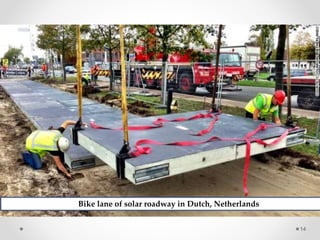
Bike lane of solar roadway in Dutch, Netherlands
For roughly the same cost of the current systems (asphalt
roads and fossil fuel burning electricity generation plants), the
Solar Roadways can be implemented.
No more Global Warming.
Safer driving conditions.
Far less pollution.
A new secure highway infrastructure that pays for itself.
A decentralized, self-healing, secure power grid.
No more dependency on foreign oil.
15
Thank You
16

Solar road pavement

  • 2.
    2 A Seminar on SOLARROADWAYS By: Vikas s. Jadhav Under the Guidance of Mr. R.P.Patil
  • 3.
    CONTENTS • Introduction • Featuresof solar roads • Advantages & Disadvantages • Conclusion 3
  • 4.
    INTRODUCTION • Hearing theconcerns about global warming and knowing our dependency on fossil fuels the solar roadways imagined to develop roadways with solar panels. • Solar roadways technology will replace all current petroleum-based asphalt roads, parking lots, and driveways. • Solar Roadways system would might at present, cost about three times what it costs to install an asphalt road. • Important element of the Solar Roadways technology is that its power-generation capacity demonstrates the base load viability of renewable energy sources. 4
  • 5.
    A solar roadwayis a road surface that generates electricity by solar power photovoltaic cells embedded below a tough transparent surface which provides sufficient traction. 5
  • 6.
    A solar roadwayconsist of three layers: Road surface layer/Glass layer Electronics layer Base plate layer 6
  • 7.
    Many people drivingtheir vehicle at night cannot see the road ahead due to oncoming headlights or rain. The Solar Roadways will have LEDs which will illuminate the lanes. Thus the rate of accidents will be reduced and illumination of roads will add to the aesthetics of the city. 7
  • 8.
    The LEDs canbe programmed to show the instructions such as - SLOW, STOP, GO, SPEED LIMIT, etc. WARNING SIGNS 8
  • 9.
    9 LANE SCAPE DESIGN •Central control stations will be able to instantly customize the lanes and words on the panels as like screen, reducing traffic congestion.
  • 10.
    WE CAN SAVEANIMALS  The LEDS can also be programmed to warn drivers of an animal on the road, an accident, or construction work. 10
  • 11.
    With induction platingembedded inside these roads, electric cars can be recharged while in motion on top of these roads. This would reduce the costs and the time-inconvenience of waiting at a charging station. Glass panelInduction plating Another option available for charging is stand-by charging which is done by plugging in the charger in the slot vehicle, this method can be applied when the vehicle is parked in the parking lot. 11
  • 12.
    Renewability Life-span – 20-21years Road Illumination Intelligent Highway system Military and rescue assistance 12
  • 13.
    Maintenance costs Seasonal efficiency Needsa town planning 13 Initial Cost $16 per square feet – Asphalt road One panel size 12 ft x 12 ft = 144 sq ft One panel costs about $6912 $6912 / 144 sq ft = $48 per sq ft - Solar road
  • 14.
    14 Bike lane ofsolar roadway in Dutch, Netherlands
  • 15.
    For roughly thesame cost of the current systems (asphalt roads and fossil fuel burning electricity generation plants), the Solar Roadways can be implemented. No more Global Warming. Safer driving conditions. Far less pollution. A new secure highway infrastructure that pays for itself. A decentralized, self-healing, secure power grid. No more dependency on foreign oil. 15
  • 16.