Issues in QM in language
education
EAQUALS Workshop
November 2013
Frank Heyworth
The background
• More than 20 years of development of QM
/ QA procedures and practice by
EAQUALS and others has led to:
– A consensus on the importance of QM in
language education
– Established and recognised practice of
inspections and audits
Good practice
• Aspects of good practice which promote
commitment to quality, to innovation and
continuous improvement, to enlightened
leadership and teamwork;
– regular observation of classes with peer observation
as a feature of self-assessment,
– the institutionalization of reflective practice and
commitment to continuous professional development.
– basing action on fact gathering with regard to practice
and reflective analysis of what is done
Some issues
• A study of the «state of the art» of QM raised
questions:
– Is practice backed by valid principles?
– Is there a good fit between the aims of QM and the methodology
we use to implement and assess it?
– How can we give real added value to repeat inspections?
– Eliminating defects v. positive encouragement of quality
– Is there proper research into its applications and effects?
– Does it work?
Some Objections
• (a) it doesn’t work – practically all institutions are
accepted in the long run;
• (b) the cost-benefit ratio is unsatisfactory – it takes
time and resources which could more profitably be
devoted to research and teaching;
• (c) it encourages institutions to be bureaucratic –
the need for objective criteria causes them to
concentrate on measurable and observable
details, rather than the important ones;
• (d) the spread of quality assurance and pressure
to comply to it is turning QA itself into a nonproductive business. (Weber 2007)
Some more objections
• “if standards are based on specific measurable
competences rather than a more holistic inter-personal
view of communication and culture , the potential
educative richness of language education may be lost.
(Böttcher 2008)”
• “the price to be paid for injecting market pressure into
secondary school education, for turning foreign language
classrooms into arenas of competition for the best test results,
for coating instruction with more and more layers of
assessment, for reducing educational “quality” to a limited
number of measurable performance indicators , and
for conceiving of output or outcome as the linchpin of quality
development, may be hefty and unacceptable.” (Kurtz 2011)
Models of quality 1
The EAQUALS QM procedures are based
implicitly on:
•Viewing quality as a feature of the relationship with the client ,
whose satisfaction is the measure of the quality achieved, and
‘exceeding clients’ expectations’ as the goal – the charters are
promises made to clients.
•Detailed management of processes in the three phases of design,
implementation and outcome, with the aim of achieving ‘zero defect’
(i.e. fault-free operations) through inspection and control.
•zero defects – everything in the charters must be achieved:
identified defects lead to “requirements”.
Models of quality 2
• Cheng & Tam (1997) cite seven models of
quality in education:
–
–
–
–
–
–
–

the goals and specifications model;
the resources input model;
the process model;
the satisfaction model;
the legitimacy model;
the absence of problems model;
and the organizational learning model
Models of quality 3
• Fitness of purpose
– Doing the right things

• Fitness for purpose
– Doing things right
Can all these models be valid?
• There are good (and less good)
arguments for all of them, but it’s
unsatisfactory to bundle so many different
concepts into the same term «quality»
Client satisfaction
• There are problems in applying notions of client
satisfaction to education. It is

– an ‘experience’ good, one whose quality can only be
assessed after it has been experienced.
– a ‘credence’ good – one whose long-term value cannot
be immediately identified even after it has been
experienced.
– In most educational settings there is relatively little choice
of institution for learners (except in the case of language
schools and even here courses are paid for in advance).
– a fundamental mismatch between the concept of students
as customers, requiring short-term satisfaction, and the
long-term aims of education.
Fitness of and for purpose
Quality, process and
procedures
• Process approaches are effective for
eliminating defects, less so for generating
creativity, originality..
– Tends to be topdown
– Applying systems can be rigid
– They don’t always reflect the complexity of
learning and teaching, human differences…
A new paradigm?
• Quality based on a combination of trust
and legitimacy
– Procedures and practices which contribute to
establishing trust between stakeholders
– Systems, tools, resources which provide
evidence to legitimate the trust
Trust & Legitimacy
• ‘normative legitimacy’ - an activity
generates trust because it conforms to an
accepted set of standards
• ‘empirical legitimacy’ - trust is based on
people’s belief that implicit standards
underlie practice.
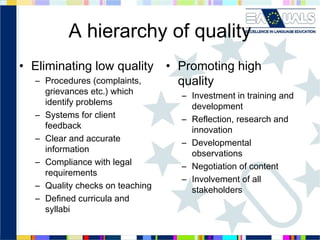
A hierarchy of quality
• Eliminating low quality • Promoting high
– Procedures (complaints,
quality
–
–
–
–
–

grievances etc.) which
identify problems
Systems for client
feedback
Clear and accurate
information
Compliance with legal
requirements
Quality checks on teaching
Defined curricula and
syllabi

– Investment in training and
development
– Reflection, research and
innovation
– Developmental
observations
– Negotiation of content
– Involvement of all
stakeholders
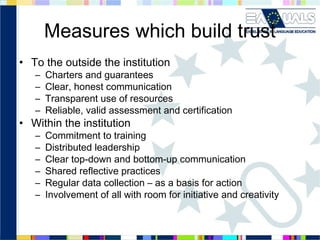
Measures which build trust
• To the outside the institution
–
–
–
–

Charters and guarantees
Clear, honest communication
Transparent use of resources
Reliable, valid assessment and certification

–
–
–
–
–
–

Commitment to training
Distributed leadership
Clear top-down and bottom-up communication
Shared reflective practices
Regular data collection – as a basis for action
Involvement of all with room for initiative and creativity

• Within the institution
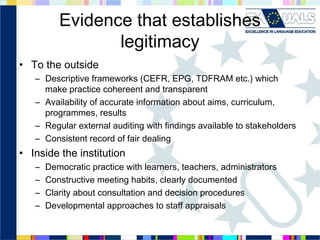
Evidence that establishes
legitimacy
• To the outside
– Descriptive frameworks (CEFR, EPG, TDFRAM etc.) which
make practice cohereent and transparent
– Availability of accurate information about aims, curriculum,
programmes, results
– Regular external auditing with findings available to stakeholders
– Consistent record of fair dealing

• Inside the institution
–
–
–
–

Democratic practice with learners, teachers, administrators
Constructive meeting habits, clearly documented
Clarity about consultation and decision procedures
Developmental approaches to staff appraisals
Creating a culture of quality
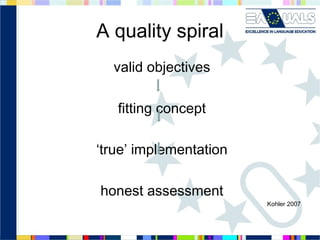
A quality spiral
valid objectives
fitting concept
‘true’ implementation
honest assessment
Kohler 2007
Issues for EAQUALS
• Unpicking what is assessed
–
–
–
–

Identification of defects?
Processes which develop trust?
Results of measures taken?
Evidence of impact?

• What do indicators indicate?
– Avoiding lamination, wet paint syndrome
– Recognising what is behind the indicators
– Description and interpretation rather than checklists
Areas for audits / inspections
• Should the inspection continue to be
“requirements” led?
• How should first and subsequent
inspections differ?
• Can we develop descriptive frameworks
which stress the positive aspects of
quality…. P
4 of DEMING’S 14 points
3 Cease dependence on inspections
5. Continually seek out problems
10. Eliminate exhortations
12. Institute education

Questions and Challenges for Quality Management in Language Education

  • 1.
    Issues in QMin language education EAQUALS Workshop November 2013 Frank Heyworth
  • 2.
    The background • Morethan 20 years of development of QM / QA procedures and practice by EAQUALS and others has led to: – A consensus on the importance of QM in language education – Established and recognised practice of inspections and audits
  • 3.
    Good practice • Aspectsof good practice which promote commitment to quality, to innovation and continuous improvement, to enlightened leadership and teamwork; – regular observation of classes with peer observation as a feature of self-assessment, – the institutionalization of reflective practice and commitment to continuous professional development. – basing action on fact gathering with regard to practice and reflective analysis of what is done
  • 4.
    Some issues • Astudy of the «state of the art» of QM raised questions: – Is practice backed by valid principles? – Is there a good fit between the aims of QM and the methodology we use to implement and assess it? – How can we give real added value to repeat inspections? – Eliminating defects v. positive encouragement of quality – Is there proper research into its applications and effects? – Does it work?
  • 5.
    Some Objections • (a)it doesn’t work – practically all institutions are accepted in the long run; • (b) the cost-benefit ratio is unsatisfactory – it takes time and resources which could more profitably be devoted to research and teaching; • (c) it encourages institutions to be bureaucratic – the need for objective criteria causes them to concentrate on measurable and observable details, rather than the important ones; • (d) the spread of quality assurance and pressure to comply to it is turning QA itself into a nonproductive business. (Weber 2007)
  • 6.
    Some more objections •“if standards are based on specific measurable competences rather than a more holistic inter-personal view of communication and culture , the potential educative richness of language education may be lost. (Böttcher 2008)” • “the price to be paid for injecting market pressure into secondary school education, for turning foreign language classrooms into arenas of competition for the best test results, for coating instruction with more and more layers of assessment, for reducing educational “quality” to a limited number of measurable performance indicators , and for conceiving of output or outcome as the linchpin of quality development, may be hefty and unacceptable.” (Kurtz 2011)
  • 7.
    Models of quality1 The EAQUALS QM procedures are based implicitly on: •Viewing quality as a feature of the relationship with the client , whose satisfaction is the measure of the quality achieved, and ‘exceeding clients’ expectations’ as the goal – the charters are promises made to clients. •Detailed management of processes in the three phases of design, implementation and outcome, with the aim of achieving ‘zero defect’ (i.e. fault-free operations) through inspection and control. •zero defects – everything in the charters must be achieved: identified defects lead to “requirements”.
  • 8.
    Models of quality2 • Cheng & Tam (1997) cite seven models of quality in education: – – – – – – – the goals and specifications model; the resources input model; the process model; the satisfaction model; the legitimacy model; the absence of problems model; and the organizational learning model
  • 9.
    Models of quality3 • Fitness of purpose – Doing the right things • Fitness for purpose – Doing things right
  • 10.
    Can all thesemodels be valid? • There are good (and less good) arguments for all of them, but it’s unsatisfactory to bundle so many different concepts into the same term «quality»
  • 11.
    Client satisfaction • Thereare problems in applying notions of client satisfaction to education. It is – an ‘experience’ good, one whose quality can only be assessed after it has been experienced. – a ‘credence’ good – one whose long-term value cannot be immediately identified even after it has been experienced. – In most educational settings there is relatively little choice of institution for learners (except in the case of language schools and even here courses are paid for in advance). – a fundamental mismatch between the concept of students as customers, requiring short-term satisfaction, and the long-term aims of education.
  • 12.
    Fitness of andfor purpose
  • 13.
    Quality, process and procedures •Process approaches are effective for eliminating defects, less so for generating creativity, originality.. – Tends to be topdown – Applying systems can be rigid – They don’t always reflect the complexity of learning and teaching, human differences…
  • 14.
    A new paradigm? •Quality based on a combination of trust and legitimacy – Procedures and practices which contribute to establishing trust between stakeholders – Systems, tools, resources which provide evidence to legitimate the trust
  • 15.
    Trust & Legitimacy •‘normative legitimacy’ - an activity generates trust because it conforms to an accepted set of standards • ‘empirical legitimacy’ - trust is based on people’s belief that implicit standards underlie practice.
  • 16.
    A hierarchy ofquality • Eliminating low quality • Promoting high – Procedures (complaints, quality – – – – – grievances etc.) which identify problems Systems for client feedback Clear and accurate information Compliance with legal requirements Quality checks on teaching Defined curricula and syllabi – Investment in training and development – Reflection, research and innovation – Developmental observations – Negotiation of content – Involvement of all stakeholders
  • 17.
    Measures which buildtrust • To the outside the institution – – – – Charters and guarantees Clear, honest communication Transparent use of resources Reliable, valid assessment and certification – – – – – – Commitment to training Distributed leadership Clear top-down and bottom-up communication Shared reflective practices Regular data collection – as a basis for action Involvement of all with room for initiative and creativity • Within the institution
  • 18.
    Evidence that establishes legitimacy •To the outside – Descriptive frameworks (CEFR, EPG, TDFRAM etc.) which make practice cohereent and transparent – Availability of accurate information about aims, curriculum, programmes, results – Regular external auditing with findings available to stakeholders – Consistent record of fair dealing • Inside the institution – – – – Democratic practice with learners, teachers, administrators Constructive meeting habits, clearly documented Clarity about consultation and decision procedures Developmental approaches to staff appraisals
  • 19.
  • 20.
    A quality spiral validobjectives fitting concept ‘true’ implementation honest assessment Kohler 2007
  • 21.
    Issues for EAQUALS •Unpicking what is assessed – – – – Identification of defects? Processes which develop trust? Results of measures taken? Evidence of impact? • What do indicators indicate? – Avoiding lamination, wet paint syndrome – Recognising what is behind the indicators – Description and interpretation rather than checklists
  • 22.
    Areas for audits/ inspections • Should the inspection continue to be “requirements” led? • How should first and subsequent inspections differ? • Can we develop descriptive frameworks which stress the positive aspects of quality…. P
  • 23.
    4 of DEMING’S14 points 3 Cease dependence on inspections 5. Continually seek out problems 10. Eliminate exhortations 12. Institute education