Types, effects
and sources of
soil pollution
 Soil pollution is defined as, “contamination of soil by
human and natural activities which may cause
harmful effect on living organisms”. Composition of
soil is listed below:
 COMPONENT %
 Organic mineral matter 45
 Organic matter 05
 Soil water 25
 Soil air 25
TYPES OF SOIL POLLUTION
 Soil pollution mainly occurs due to the following:
 Industrial wastes
 Urban wastes
 Agricultural practices
 Radioactive pollutants
 Biological agents
INDUSTRIAL WASTES
 Disposal of Industrial wastes is the major problem
for soil pollution
 Is the waste produced by industrial activity which
includes any material that is rendered useless
during a manufacturing process such as that
of factories, industries, mills, and mining operations.
It has existed since the start of the Industrial
Revolution.
SOURCES INDUSTRIAL POLLUTANTS
 Industrial pollutants are mainly discharged from
various origins such as pulp and paper mills,
chemical fertilizers, oil refineries, sugar factories,
tanneries, textiles, steel, distilleries, fertilizers,
pesticides, coal and mineral mining industries,
drugs, glass, cement, petroleum and engineering
industries etc.
EFFECTS OF INDUSTRIAL POLLUTANTS
 These pollutants affect and alter the chemical and
biological properties of soil. As a result, hazardous
chemicals can enter into human food chain from the
soil or water, disturb the biochemical process and
finally lead to serious effects on living organisms.
 Urban wastes comprise of both commercial and
domestic wastes consisting of dried sludge and
sewage.
 Commonly known as trash or garbage in
the United States and
as refuse or rubbish in Britain, is a waste
type consisting of everyday items that are
discarded by the public. "Garbage" can also refer
specifically to food waste, as in a garbage disposal;
the two are sometimes collected separately.
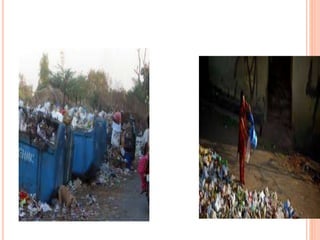
 All the urban solid wastes are commonly referred to as
refuse. Constituents of urban refuse: This refuse consists
of garbage and rubbish materials like plastics, glasses,
metallic cans, fibres, paper, rubbers, street sweepings,
fuel residues, leaves, containers, abandoned vehicles
and other discarded manufactured products.
 Urban domestic wastes though disposed off separately
from industrial wastes, can still be dangerous. This
happens because they are not easily degraded.
 Waste can be classified in several ways but the following
list represents a typical classification:
 Biodegradable waste: food and kitchen waste, green
waste, paper (most can be recycled although some
difficult to compost plant material may be excluded)
 Recyclable materials: paper, cardboard, glass, bottles, jar
s, tin cans, aluminum cans, aluminum foil, metals,
certain plastics, fabrics, clothes, tires, batteries, etc.
 Inert waste: construction and demolition
waste, dirt, rocks, debris
 Electrical and electronic waste (WEEE) - electrical
appliances, light bulbs, washing
machines, TVs, computers, screens, mobile
phones, alarm clocks, watches, etc.
 Waste clothing, Tetra Packs, waste plastics such as
toys
 Hazardous waste including
most paints, chemicals, tires, batteries, light bulbs,
electrical appliances, fluorescent lamps, aerosol
spray cans, and fertilizers
 Toxic waste including pesticides, herbicides,
and fungicides
 Biomedical waste, expired pharmaceutical drugs, etc.
 Modern agricultural practices pollute the soil to a large
extent. With the advancing agro-technology, huge
quantities of fertilizers, pesticides, herbicides and
weedicides are added to increase the crop yield. Apart
from these farm wastes, manure, slurry, debris, soil
erosion containing mostly inorganic chemicals are
reported to cause soil pollution
 Radioactive substances resulting from explosions
of nuclear testing laboratories and industries giving
rise to nuclear dust radioactive wastes, penetrate
the soil and accumulate giving rise to land/soil
pollution.
 The radioactive pollution is defined as the physical
pollution of air, water and the other radioactive
materials. The ability of certain materials to emit the
proton, gamma rays and electrons by their nuclei is
known as the radioactivity.
 1. Radio nuclides of Radium, Thorium, Uranium, isotopes
of Potassium (K-40) and Carbon (C-14) are commonly
found in soil, rock, water and air.
 2. Explosion of hydrogen weapons and cosmic radiations
include neutron, proton reactions by which Nitrogen (N-
15) produces C-14. This C-14 participates in Carbon
metabolism of plants which is then into animals and
human beings.
Examples
 3. Radioactive waste contains several radio nuclides
such as Strontium90, Iodine- 129, Cesium-137 and
isotopes of Iron which are most injurious. Strontium get
deposited in bones and tissues instead of calcium.
 4. Nuclear reactors produce waste containing
Ruthenium-106, Iodine-131, Barium- 140, Cesium-144
and Lanthanum-140 along with primary nuclides Sr-90
with a half life 28 years and Cs-137 with a half life 30
years. Rain water carries Sr-90 and Cs-137 to be
deposited on the soil where they are held firmly with the
soil particles by electrostatic forces. All the radio nuclides
deposited on the soil emit gamma radiations.
Examples
The following list of radioactive pollution could give an insight
into what usually causes these radioactive bio hazards.
 Dumping of solid and liquid radioactive wastes.
 Pollution due to underwater nuclear weapon testing and explosions.
 Radioactive pollution caused due to water streams and other water
run offs from nuclear testing sites.
 The atmospheric radioactive fallout mainly due to cosmic particle
shower or due to entry of extra-terrestrial materials from deep space.
 Radioactive pollution that are caused due to the accidents in deep
sea weapon testing, nuclear tipped weapon loss, radioactive
emission from thermos-electrical generators, falling satellites with
radioactive materials on board, and finally aircrafts and ships
carrying nuclear materials.
 The sources of radioactive pollution could either be natural
or man-made.
 The cosmic rays which reach our planet from outer space
carry lot of intense limits of rays which usually are radiating
in nature and cause pollution
 The quantity of cosmic rays depends on the altitude as well
as the geographical location
 Emission which emanate from radioactive materials from
deep inside Earth core
 Areas which has deposits of radioactive substances could
cause pollution in the surroundings and living organisms of
the area may get exposed to such radiations. Eg. The sea
beach in Kerala, India has thorium deposits
Sources of Radioactive Pollution
 Multifactorial diseases
 Various disease initiation and their progression depends
upon multiple factors such as birth defects, and adult
onset diseases which are both chronic as well as acute in
nature.
 The birth defects could range from neural tube defects,
cleft lip or genital heart defects while the adult onset
diseases could range from diabetes, hypertension, and
coronary problems.
Effects of Radioactive
Pollution
 When a person gets exposed to high level of radioactive
material dose, it becomes a reproductive hazard. Effects
like disfigured birth, physical impairment at birth and
other such things lead to reproductive defects.
 Exposure to nuclear radiation by any of the parents could
lead to defects at birth as these causes’ mutations at
genetic level and lead to variations which usually result in
abnormality. Problems like low birth weight, physical
impairment or variation and damages in chromosome
numbers could result in birth defects.
 Individuals who get exposed to radiation pollution could
face cells and tissue damages leading to hair loss, mouth
ulceration, haemorrhage, skin discoloration and lower
blood count or platelets. Some of them might face
problems of cardiovascular disorders, leukaemia, sterility
and premature aging.
Somatic Effects
 These could lead to chromosomal aberrations and
mutations where radiations could cause damage to DNA
strands, adverse effects to genetic break up which are
either immediate or delayed over a period of time
Genetic effects
 Soil gets a large amount of human, animal and bird
excreta which constitute a major source of land pollution
by biological agents.
 Ex: 1. Heavy application of manures and digested sludge
can cause serious damage to plants within a few years
Biological Agents Of Soil
Pollution
 Also called bio-agent, biological threat
agent, biological warfare agent, biological weapon,
or bioweapon—is
a bacterium, virus, protozoan, parasite, or fungus that
can be used purposefully as a weapon
in bioterrorism or biological warfare (BW). In addition to
these living and or replicating pathogens, biological
toxins are also included among the bio-agents. More than
1,200 different kinds of potentially weaponizable bio-
agents have been described and studied to date.
Biological Agents
1. Organic wastes enter the soil pores and decompose.
Pathogenic bacteria spread
infection.
2. 2. Compounds containing As, Hg, Cr, Ni, Zn and Fe are
toxic to life.
3. 3. Fluorides affect plant development
4. 4. Water logging and salinity increase the dissolved salt
content in the soil. Some plants are very sensitive to
soil PH and salinity.
If you want to gift something to our new
generation than Please
Keep Our Earth Clean And Green
Reduce
Reuse
And
Recycle
GROUP MEMBERS

soil pollution

  • 1.
    Types, effects and sourcesof soil pollution
  • 2.
     Soil pollutionis defined as, “contamination of soil by human and natural activities which may cause harmful effect on living organisms”. Composition of soil is listed below:  COMPONENT %  Organic mineral matter 45  Organic matter 05  Soil water 25  Soil air 25
  • 3.
    TYPES OF SOILPOLLUTION  Soil pollution mainly occurs due to the following:  Industrial wastes  Urban wastes  Agricultural practices  Radioactive pollutants  Biological agents
  • 4.
    INDUSTRIAL WASTES  Disposalof Industrial wastes is the major problem for soil pollution  Is the waste produced by industrial activity which includes any material that is rendered useless during a manufacturing process such as that of factories, industries, mills, and mining operations. It has existed since the start of the Industrial Revolution.
  • 6.
    SOURCES INDUSTRIAL POLLUTANTS Industrial pollutants are mainly discharged from various origins such as pulp and paper mills, chemical fertilizers, oil refineries, sugar factories, tanneries, textiles, steel, distilleries, fertilizers, pesticides, coal and mineral mining industries, drugs, glass, cement, petroleum and engineering industries etc.
  • 7.
    EFFECTS OF INDUSTRIALPOLLUTANTS  These pollutants affect and alter the chemical and biological properties of soil. As a result, hazardous chemicals can enter into human food chain from the soil or water, disturb the biochemical process and finally lead to serious effects on living organisms.
  • 8.
     Urban wastescomprise of both commercial and domestic wastes consisting of dried sludge and sewage.  Commonly known as trash or garbage in the United States and as refuse or rubbish in Britain, is a waste type consisting of everyday items that are discarded by the public. "Garbage" can also refer specifically to food waste, as in a garbage disposal; the two are sometimes collected separately.
  • 9.
     All theurban solid wastes are commonly referred to as refuse. Constituents of urban refuse: This refuse consists of garbage and rubbish materials like plastics, glasses, metallic cans, fibres, paper, rubbers, street sweepings, fuel residues, leaves, containers, abandoned vehicles and other discarded manufactured products.  Urban domestic wastes though disposed off separately from industrial wastes, can still be dangerous. This happens because they are not easily degraded.
  • 11.
     Waste canbe classified in several ways but the following list represents a typical classification:  Biodegradable waste: food and kitchen waste, green waste, paper (most can be recycled although some difficult to compost plant material may be excluded)  Recyclable materials: paper, cardboard, glass, bottles, jar s, tin cans, aluminum cans, aluminum foil, metals, certain plastics, fabrics, clothes, tires, batteries, etc.  Inert waste: construction and demolition waste, dirt, rocks, debris  Electrical and electronic waste (WEEE) - electrical appliances, light bulbs, washing machines, TVs, computers, screens, mobile phones, alarm clocks, watches, etc.
  • 12.
     Waste clothing,Tetra Packs, waste plastics such as toys  Hazardous waste including most paints, chemicals, tires, batteries, light bulbs, electrical appliances, fluorescent lamps, aerosol spray cans, and fertilizers  Toxic waste including pesticides, herbicides, and fungicides  Biomedical waste, expired pharmaceutical drugs, etc.
  • 13.
     Modern agriculturalpractices pollute the soil to a large extent. With the advancing agro-technology, huge quantities of fertilizers, pesticides, herbicides and weedicides are added to increase the crop yield. Apart from these farm wastes, manure, slurry, debris, soil erosion containing mostly inorganic chemicals are reported to cause soil pollution
  • 15.
     Radioactive substancesresulting from explosions of nuclear testing laboratories and industries giving rise to nuclear dust radioactive wastes, penetrate the soil and accumulate giving rise to land/soil pollution.  The radioactive pollution is defined as the physical pollution of air, water and the other radioactive materials. The ability of certain materials to emit the proton, gamma rays and electrons by their nuclei is known as the radioactivity.
  • 16.
     1. Radionuclides of Radium, Thorium, Uranium, isotopes of Potassium (K-40) and Carbon (C-14) are commonly found in soil, rock, water and air.  2. Explosion of hydrogen weapons and cosmic radiations include neutron, proton reactions by which Nitrogen (N- 15) produces C-14. This C-14 participates in Carbon metabolism of plants which is then into animals and human beings. Examples
  • 17.
     3. Radioactivewaste contains several radio nuclides such as Strontium90, Iodine- 129, Cesium-137 and isotopes of Iron which are most injurious. Strontium get deposited in bones and tissues instead of calcium.  4. Nuclear reactors produce waste containing Ruthenium-106, Iodine-131, Barium- 140, Cesium-144 and Lanthanum-140 along with primary nuclides Sr-90 with a half life 28 years and Cs-137 with a half life 30 years. Rain water carries Sr-90 and Cs-137 to be deposited on the soil where they are held firmly with the soil particles by electrostatic forces. All the radio nuclides deposited on the soil emit gamma radiations. Examples
  • 19.
    The following listof radioactive pollution could give an insight into what usually causes these radioactive bio hazards.  Dumping of solid and liquid radioactive wastes.  Pollution due to underwater nuclear weapon testing and explosions.  Radioactive pollution caused due to water streams and other water run offs from nuclear testing sites.  The atmospheric radioactive fallout mainly due to cosmic particle shower or due to entry of extra-terrestrial materials from deep space.  Radioactive pollution that are caused due to the accidents in deep sea weapon testing, nuclear tipped weapon loss, radioactive emission from thermos-electrical generators, falling satellites with radioactive materials on board, and finally aircrafts and ships carrying nuclear materials.
  • 20.
     The sourcesof radioactive pollution could either be natural or man-made.  The cosmic rays which reach our planet from outer space carry lot of intense limits of rays which usually are radiating in nature and cause pollution  The quantity of cosmic rays depends on the altitude as well as the geographical location  Emission which emanate from radioactive materials from deep inside Earth core  Areas which has deposits of radioactive substances could cause pollution in the surroundings and living organisms of the area may get exposed to such radiations. Eg. The sea beach in Kerala, India has thorium deposits Sources of Radioactive Pollution
  • 21.
     Multifactorial diseases Various disease initiation and their progression depends upon multiple factors such as birth defects, and adult onset diseases which are both chronic as well as acute in nature.  The birth defects could range from neural tube defects, cleft lip or genital heart defects while the adult onset diseases could range from diabetes, hypertension, and coronary problems. Effects of Radioactive Pollution
  • 22.
     When aperson gets exposed to high level of radioactive material dose, it becomes a reproductive hazard. Effects like disfigured birth, physical impairment at birth and other such things lead to reproductive defects.  Exposure to nuclear radiation by any of the parents could lead to defects at birth as these causes’ mutations at genetic level and lead to variations which usually result in abnormality. Problems like low birth weight, physical impairment or variation and damages in chromosome numbers could result in birth defects.
  • 23.
     Individuals whoget exposed to radiation pollution could face cells and tissue damages leading to hair loss, mouth ulceration, haemorrhage, skin discoloration and lower blood count or platelets. Some of them might face problems of cardiovascular disorders, leukaemia, sterility and premature aging. Somatic Effects
  • 24.
     These couldlead to chromosomal aberrations and mutations where radiations could cause damage to DNA strands, adverse effects to genetic break up which are either immediate or delayed over a period of time Genetic effects
  • 25.
     Soil getsa large amount of human, animal and bird excreta which constitute a major source of land pollution by biological agents.  Ex: 1. Heavy application of manures and digested sludge can cause serious damage to plants within a few years Biological Agents Of Soil Pollution
  • 26.
     Also calledbio-agent, biological threat agent, biological warfare agent, biological weapon, or bioweapon—is a bacterium, virus, protozoan, parasite, or fungus that can be used purposefully as a weapon in bioterrorism or biological warfare (BW). In addition to these living and or replicating pathogens, biological toxins are also included among the bio-agents. More than 1,200 different kinds of potentially weaponizable bio- agents have been described and studied to date. Biological Agents
  • 27.
    1. Organic wastesenter the soil pores and decompose. Pathogenic bacteria spread infection. 2. 2. Compounds containing As, Hg, Cr, Ni, Zn and Fe are toxic to life. 3. 3. Fluorides affect plant development 4. 4. Water logging and salinity increase the dissolved salt content in the soil. Some plants are very sensitive to soil PH and salinity.
  • 28.
    If you wantto gift something to our new generation than Please Keep Our Earth Clean And Green Reduce Reuse And Recycle
  • 30.