SOIL
POLLUTION
CONTENT
• Introduction
• Soil pollutants
• Sources of Soil pollution
• Effects of soil Pollution
• Control of Soil Pollution
INTRODUCTION:
•Soil contains organic,
inorganic constituents &
microbes which makes it
suitable for production of
food.
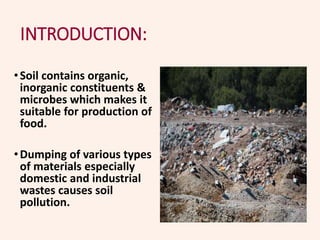
•Dumping of various types
of materials especially
domestic and industrial
wastes causes soil
pollution.
SOIL POLLUTANTS
•Plastics
•Agro chemicals
•Fertilizers
•Biological Agents
•Industrial Wastes
•Radioactive substances
Plastics :
Major part of global domestic and industrial waste
Not easily biodegraded.
Waste plastic accumulates much thus adds to severe
pollution problem.
Takes several years to disintegrate – 400 years to degrade
mineral water bottles.
Use of biodegradable plastic solves the problem of
pollution.
Agrochemical pollution
•Include pesticides, herbicides, fungicides
•Pesticides applied reach the soil ultimately
•Accumulation of pesticide residues in biosphere
creates ecological stress causing soil, water and food
contamination .
•Persisting chemicals are hazardous to human health.
•Reduction of residue levels through redeeming
technology (desirable)
Fertilizer pollution
• Continuous application – Deterioration in soil properties,
cultivated soils lose their characteristics.
• Application of Amm. sulphate, Amm. chloride & Urea
reduce soil pH.
• Crops – potato, grapes, citrus, beans – sensitive to chloride
toxicity.
• While , Application of organic manures and biofertilizers
reduce the soil from pollution.
Biological Agents:
•Soil gets a large amount of human, animal and bird
excreta which constitute a major source of land
pollution by biological agents.
Industrial Wastes:
•Industrial wastes are the effluents discharged from
chemical industries, paper and pulp mills, tanneries,
textile mills, steel industries, distilleries, refineries,
pesticides and fertilizer industries, pharmaceutical
industries, food processing industries, cement
industries, thermal and nuclear power plants, mining
industries etc.
Industrial Wastes:
•Industrial wastes also contain some organic and
inorganic compounds that are refractory and non-
biodegradable. Industrial sludge may contain
various salts, toxic substances, metals like mercury,
lead, cadmium, arsenic etc.
Radioactive Substances:
•The Toxic metals , radioactive substances in soil are
wastes discharged from nuclear activities and
laboratories, aerial fall out etc.
• Isotopes of radium, uranium, thorium, strontium,
iodine, and of many other elements reach the soil
and persist there for a long time and keep on
emitting radiations.
Solid waste composition
Effects of Soil Pollution
Impacts of soil pollution are not confined to soil and
its biota but it carried over to every aspect of the
environment and affect every organism.
Some of the adverse effects are as follows:
• Human Health , Since we are dependent on the land
for our food, pollution from the soil is transferred to
us in this manner. Bio accumulation of toxins occurs
in our bodies, causing chronic poisoning, and leading
to various diseases. Reproductive health, birth and
developmental defects, neurologic effects.
Effects of Soil Pollution
•Growth of Plants , plants will not be able to adapt to
sudden changes occurring in the soil.
•Fungi and bacteria found in the soils cannot bind the
soil due to chemical changes and this causes soil
erosion.
•The fertility slowly diminishes, making land unsuitable
for agriculture and any local vegetation to survive.
Effects of Soil Pollution
• Large tracts of land become barren; unable to support
any life on it. Even the plants that do grow on these
lands will absorb the toxins and transfer to the food
chain.
•Effect on Ecosystem and Biodiversity , Soil pollution can
lead to the lack of biodiversity in an ecosystem. The life
of bird, insect, mammal and reptile species that live in
the soil can get affected by pollution.
Effects of Soil Pollution
•Air pollution , Toxic dust rises from landfills along
with foul odour , pollutes the air and causes adverse
effects to the people who live near them.
• Contamination of Water Sources , When it rains,
surface run-off carries contaminated soil into water
sources causing water pollution.
Control on soil pollution :::::
• Solid wastes should be properly collected and
disposed off by appropriate method.
• From the wastes, recovery of useful products should
be done.
• Biodegradable organic waste should be used for
generation of biogas.
•Cattle dung should be used in the biogas plant to
produce inflammable methane gas.
•Effluents should be properly treated before
discharging them on the soil.
Control methods :
 Agronomic practices
 Contour farming
 Mulching
 crop rotation
 Strip cropping
 Afforestation
soil pollution.ppt

soil pollution.ppt

  • 1.
  • 2.
    CONTENT • Introduction • Soilpollutants • Sources of Soil pollution • Effects of soil Pollution • Control of Soil Pollution
  • 3.
    INTRODUCTION: •Soil contains organic, inorganicconstituents & microbes which makes it suitable for production of food. •Dumping of various types of materials especially domestic and industrial wastes causes soil pollution.
  • 5.
    SOIL POLLUTANTS •Plastics •Agro chemicals •Fertilizers •BiologicalAgents •Industrial Wastes •Radioactive substances
  • 6.
    Plastics : Major partof global domestic and industrial waste Not easily biodegraded. Waste plastic accumulates much thus adds to severe pollution problem. Takes several years to disintegrate – 400 years to degrade mineral water bottles. Use of biodegradable plastic solves the problem of pollution.
  • 7.
    Agrochemical pollution •Include pesticides,herbicides, fungicides •Pesticides applied reach the soil ultimately •Accumulation of pesticide residues in biosphere creates ecological stress causing soil, water and food contamination . •Persisting chemicals are hazardous to human health. •Reduction of residue levels through redeeming technology (desirable)
  • 8.
    Fertilizer pollution • Continuousapplication – Deterioration in soil properties, cultivated soils lose their characteristics. • Application of Amm. sulphate, Amm. chloride & Urea reduce soil pH. • Crops – potato, grapes, citrus, beans – sensitive to chloride toxicity. • While , Application of organic manures and biofertilizers reduce the soil from pollution.
  • 9.
    Biological Agents: •Soil getsa large amount of human, animal and bird excreta which constitute a major source of land pollution by biological agents.
  • 10.
    Industrial Wastes: •Industrial wastesare the effluents discharged from chemical industries, paper and pulp mills, tanneries, textile mills, steel industries, distilleries, refineries, pesticides and fertilizer industries, pharmaceutical industries, food processing industries, cement industries, thermal and nuclear power plants, mining industries etc.
  • 11.
    Industrial Wastes: •Industrial wastesalso contain some organic and inorganic compounds that are refractory and non- biodegradable. Industrial sludge may contain various salts, toxic substances, metals like mercury, lead, cadmium, arsenic etc.
  • 12.
    Radioactive Substances: •The Toxicmetals , radioactive substances in soil are wastes discharged from nuclear activities and laboratories, aerial fall out etc. • Isotopes of radium, uranium, thorium, strontium, iodine, and of many other elements reach the soil and persist there for a long time and keep on emitting radiations.
  • 13.
  • 14.
    Effects of SoilPollution Impacts of soil pollution are not confined to soil and its biota but it carried over to every aspect of the environment and affect every organism. Some of the adverse effects are as follows: • Human Health , Since we are dependent on the land for our food, pollution from the soil is transferred to us in this manner. Bio accumulation of toxins occurs in our bodies, causing chronic poisoning, and leading to various diseases. Reproductive health, birth and developmental defects, neurologic effects.
  • 15.
    Effects of SoilPollution •Growth of Plants , plants will not be able to adapt to sudden changes occurring in the soil. •Fungi and bacteria found in the soils cannot bind the soil due to chemical changes and this causes soil erosion. •The fertility slowly diminishes, making land unsuitable for agriculture and any local vegetation to survive.
  • 16.
    Effects of SoilPollution • Large tracts of land become barren; unable to support any life on it. Even the plants that do grow on these lands will absorb the toxins and transfer to the food chain. •Effect on Ecosystem and Biodiversity , Soil pollution can lead to the lack of biodiversity in an ecosystem. The life of bird, insect, mammal and reptile species that live in the soil can get affected by pollution.
  • 17.
    Effects of SoilPollution •Air pollution , Toxic dust rises from landfills along with foul odour , pollutes the air and causes adverse effects to the people who live near them. • Contamination of Water Sources , When it rains, surface run-off carries contaminated soil into water sources causing water pollution.
  • 18.
    Control on soilpollution ::::: • Solid wastes should be properly collected and disposed off by appropriate method. • From the wastes, recovery of useful products should be done. • Biodegradable organic waste should be used for generation of biogas. •Cattle dung should be used in the biogas plant to produce inflammable methane gas. •Effluents should be properly treated before discharging them on the soil.
  • 19.
    Control methods : Agronomic practices  Contour farming  Mulching  crop rotation  Strip cropping  Afforestation