Six Feet Under
Rattan Lal
Carbon Management and Sequestration Center
The Ohio State University
Columbus, OH 43210 USA
2
Carbon Management and
Sequestration Center
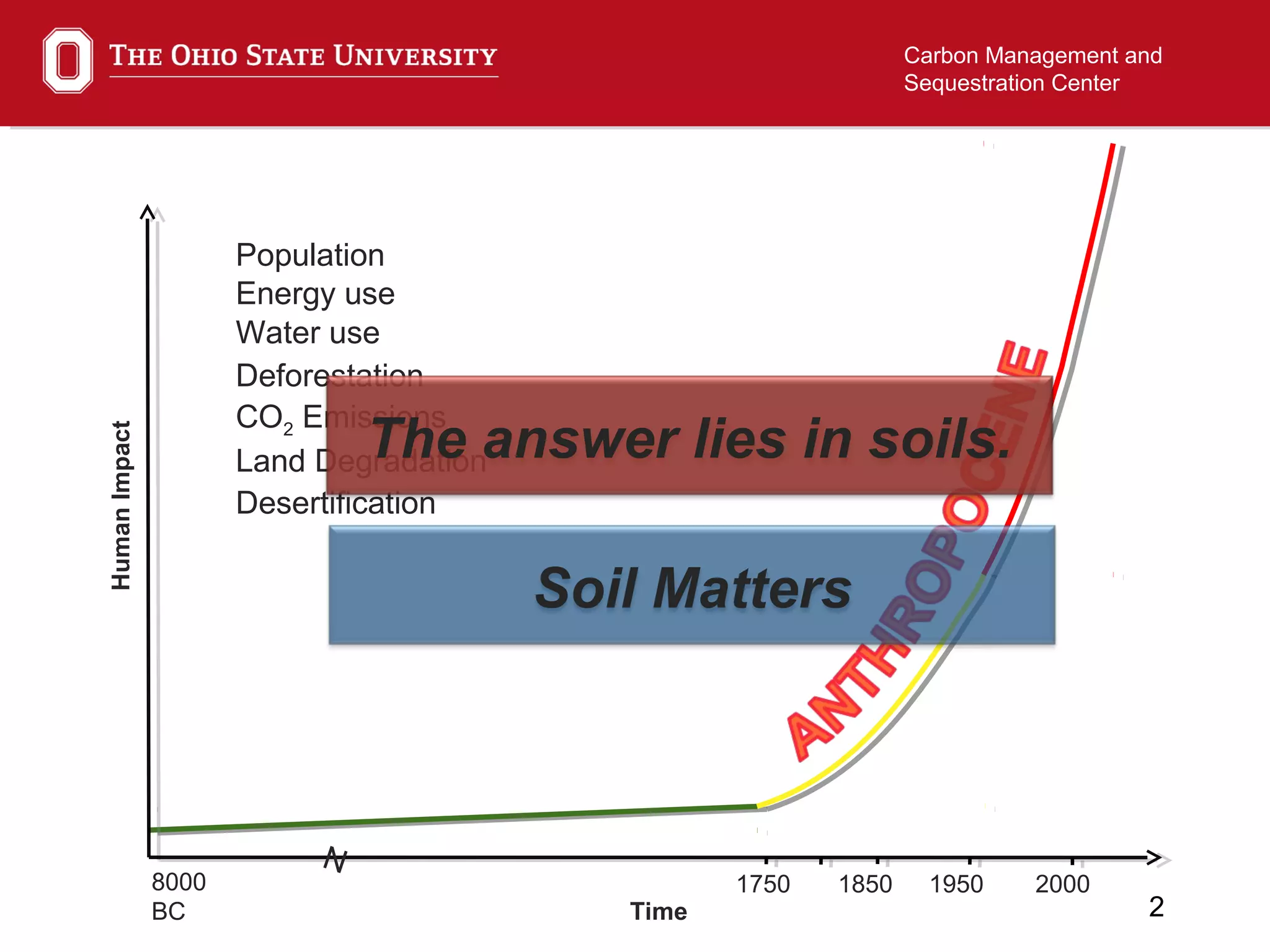
Population
Energy use
Deforestation
CO2 Emissions
Land Degradation
Desertification
Water use
8000
BC
N
1750 1850 1950 2000
Time
HumanImpact
The answer lies in soils.
Soil Matters
3
Carbon Management and
Sequestration Center
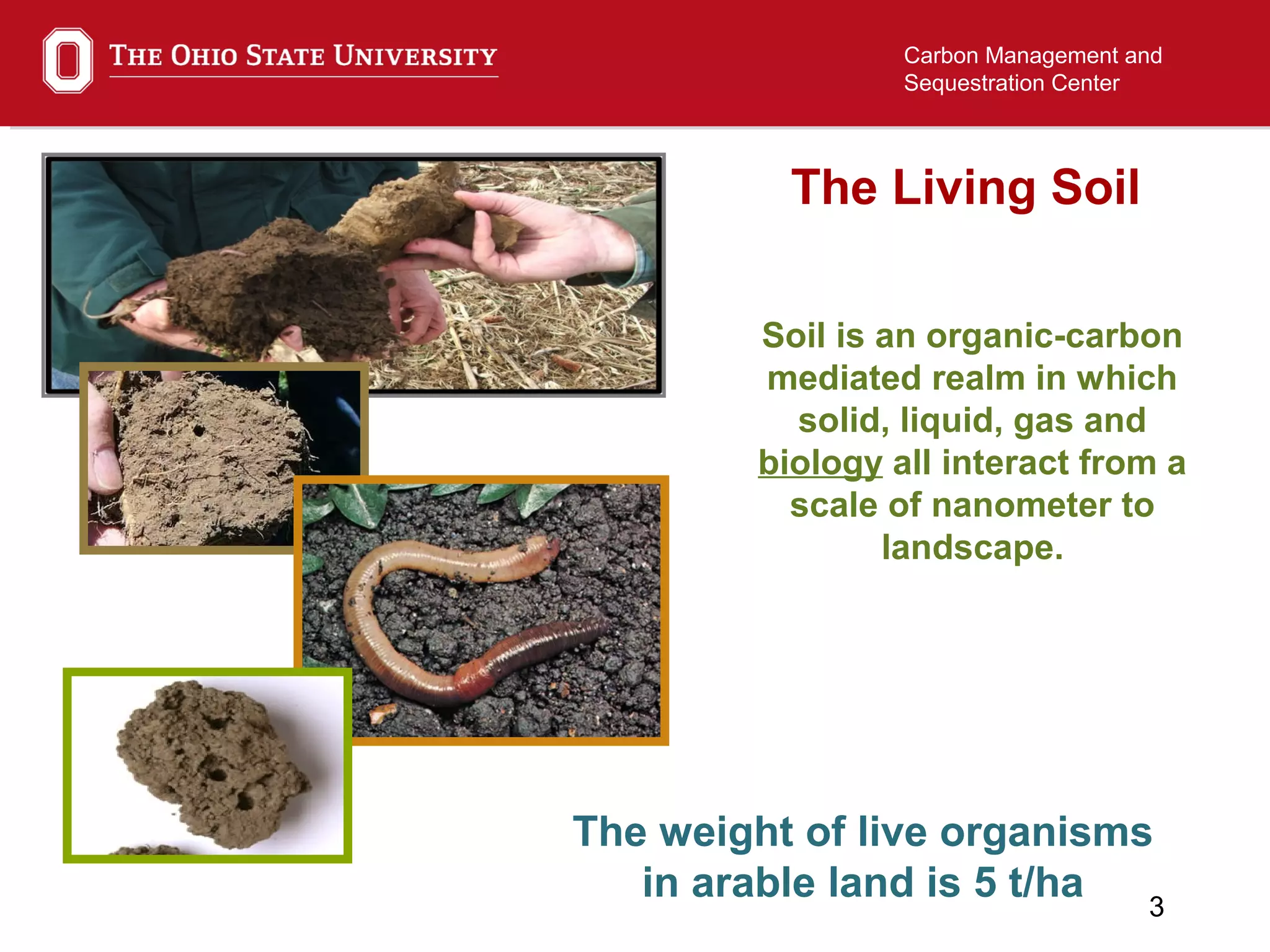
Soil is an organic-carbon
mediated realm in which
solid, liquid, gas and
biology all interact from a
scale of nanometer to
landscape.
The Living Soil
The weight of live organisms
in arable land is 5 t/ha
4
Carbon Management and
Sequestration Center
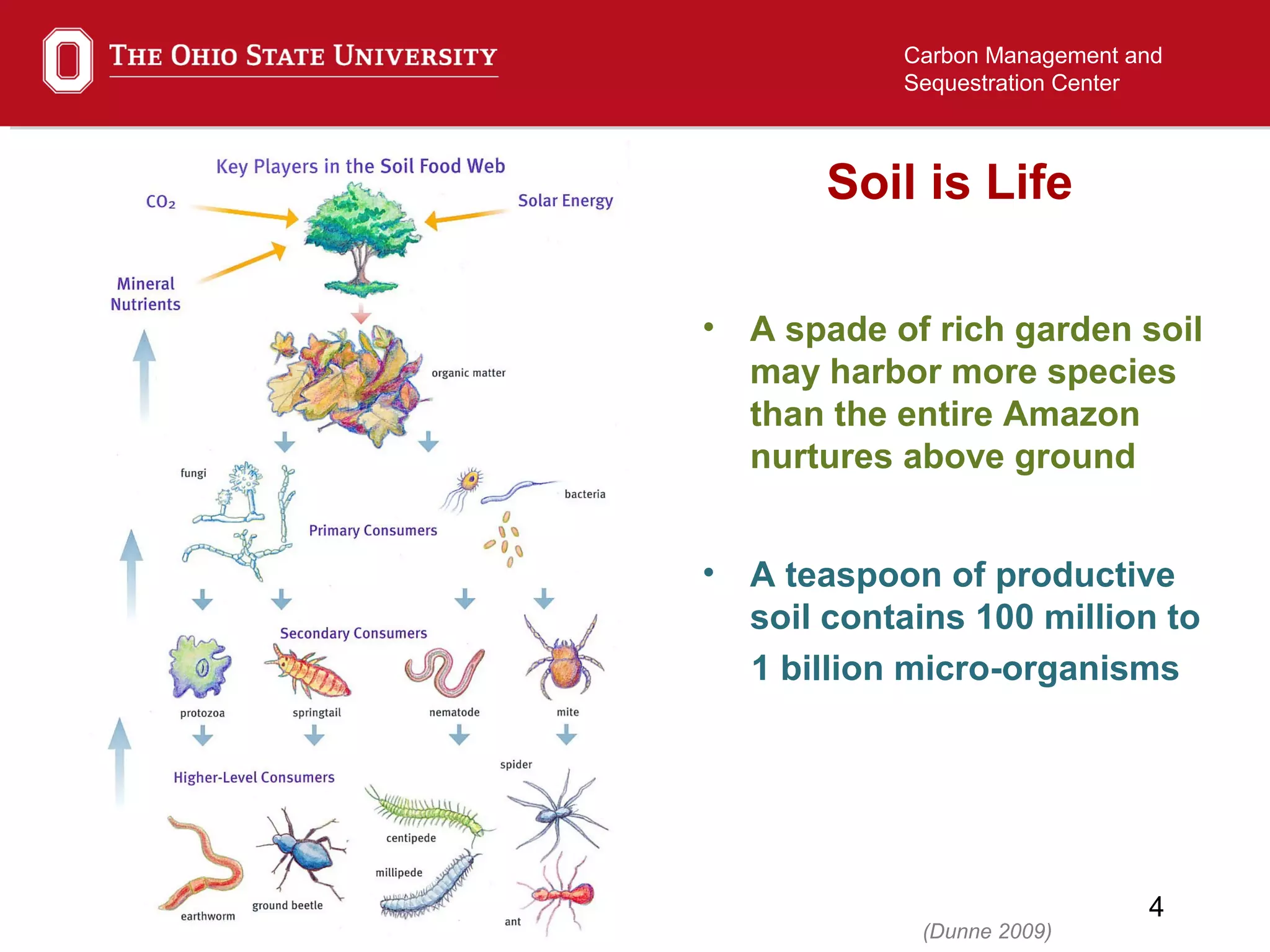
• A spade of rich garden soil
may harbor more species
than the entire Amazon
nurtures above ground
• A teaspoon of productive
soil contains 100 million to
1 billion micro-organisms
(Dunne 2009)
Soil is Life
5
Carbon Management and
Sequestration Center
I = P x A x T
P = Population
A = Affluence
T = Technology
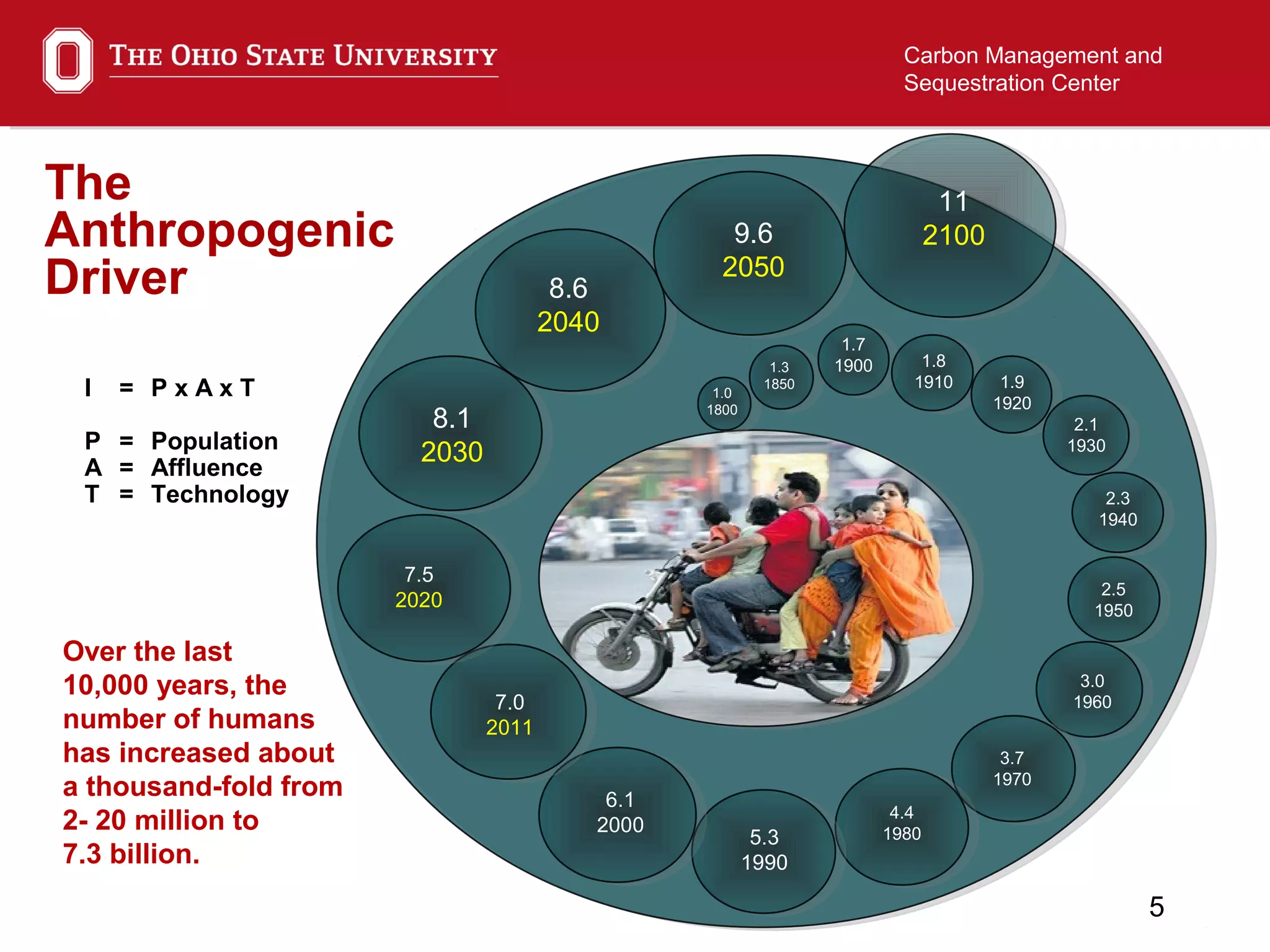
Over the last
10,000 years, the
number of humans
has increased about
a thousand-fold from
2- 20 million to
7.3 billion.
1.0
1800
1.3
1850
1.7
1900 1.8
1910 1.9
1920
2.1
1930
2.3
1940
2.5
1950
3.0
1960
3.7
1970
4.4
19805.3
1990
6.1
2000
7.0
2011
7.5
2020
8.1
2030
8.6
2040
9.6
2050
11
2100
The
Anthropogenic
Driver
6
Carbon Management and
Sequestration Center
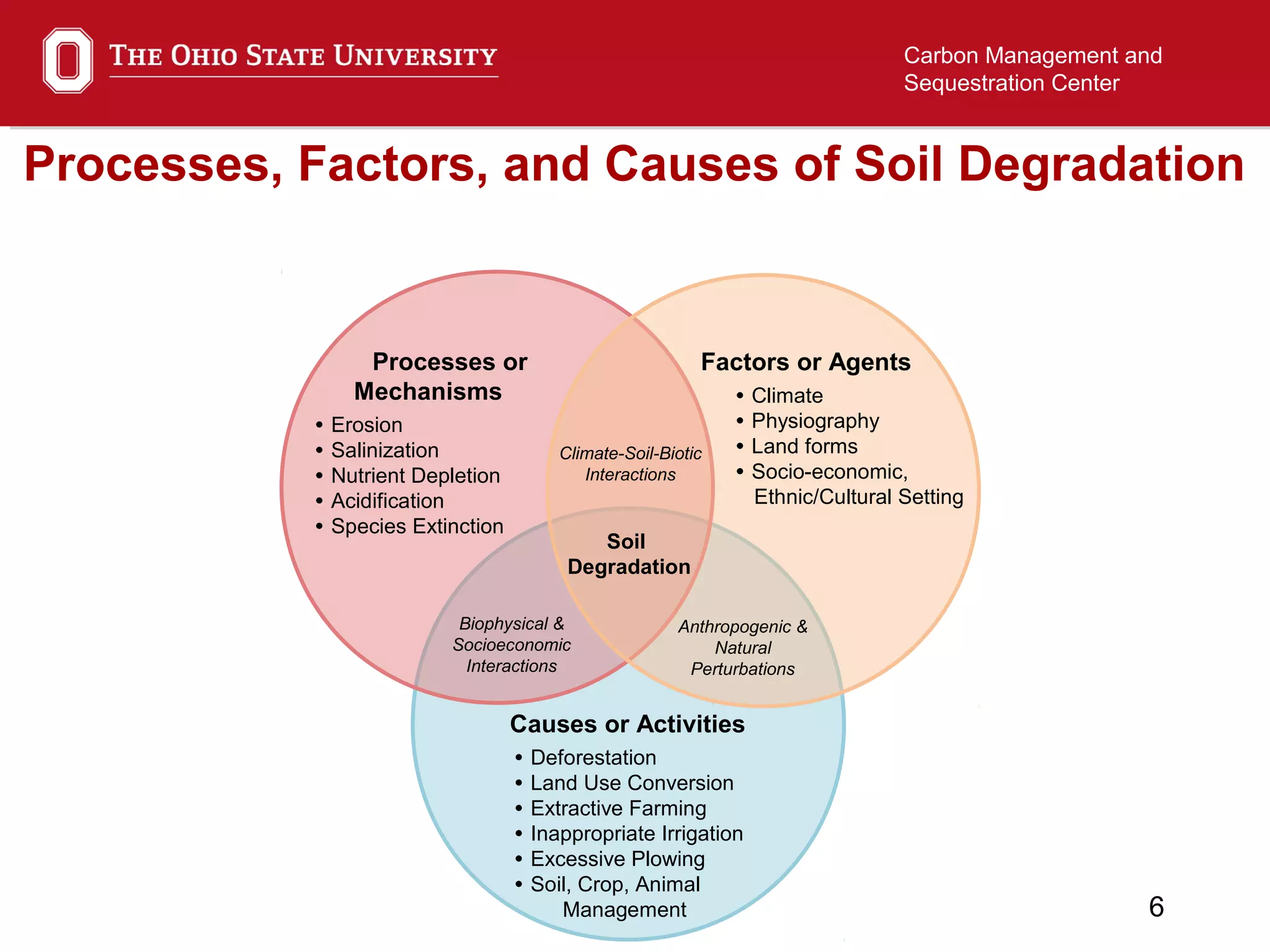
Causes or Activities
 Deforestation
 Land Use Conversion
 Extractive Farming
 Inappropriate Irrigation
 Excessive Plowing
 Soil, Crop, Animal
Management
Processes or
Mechanisms
 Erosion
 Salinization
 Nutrient Depletion
 Acidification
 Species Extinction
Factors or Agents
 Climate
 Physiography
 Land forms
 Socio-economic,
Ethnic/Cultural Setting
Soil
Degradation
Anthropogenic &
Natural
Perturbations
Biophysical &
Socioeconomic
Interactions
Climate-Soil-Biotic
Interactions
Processes, Factors, and Causes of Soil Degradation
7
Carbon Management and
Sequestration Center
Resilience of Soil-Ecological Systems
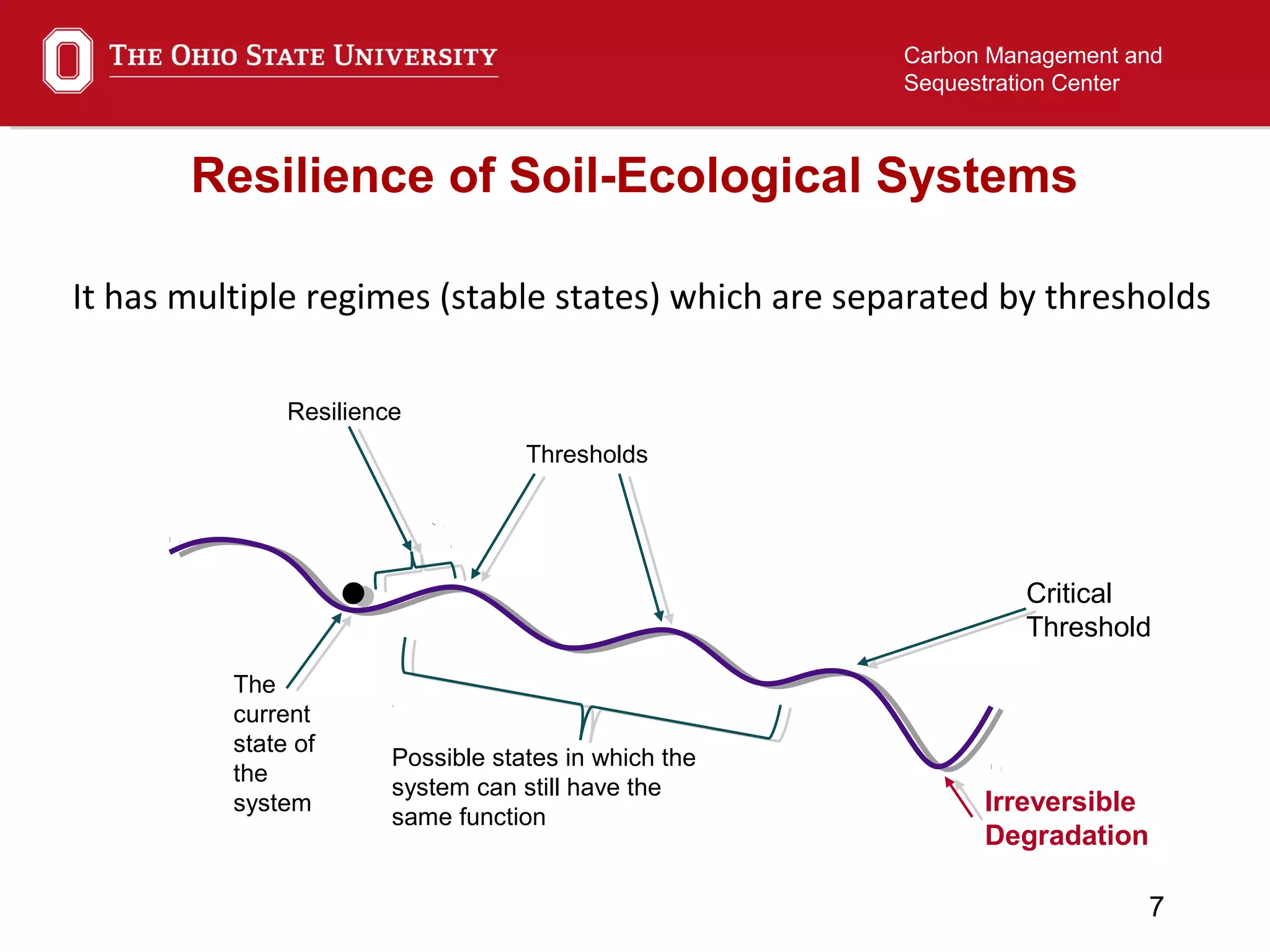
It has multiple regimes (stable states) which are separated by thresholds
Thresholds
Critical
Threshold
The
current
state of
the
system
Possible states in which the
system can still have the
same function
Irreversible
Degradation
Resilience
8
Carbon Management and
Sequestration Center
Threshold/Critical Level
Threshold/Critical Level/Tipping Point: Soil processes and
properties have threshold levels (1.1% SOC concentration
in soils of the tropics). Beyond threshold level, there is a
drastic regime change.
9
Carbon Management and
Sequestration Center
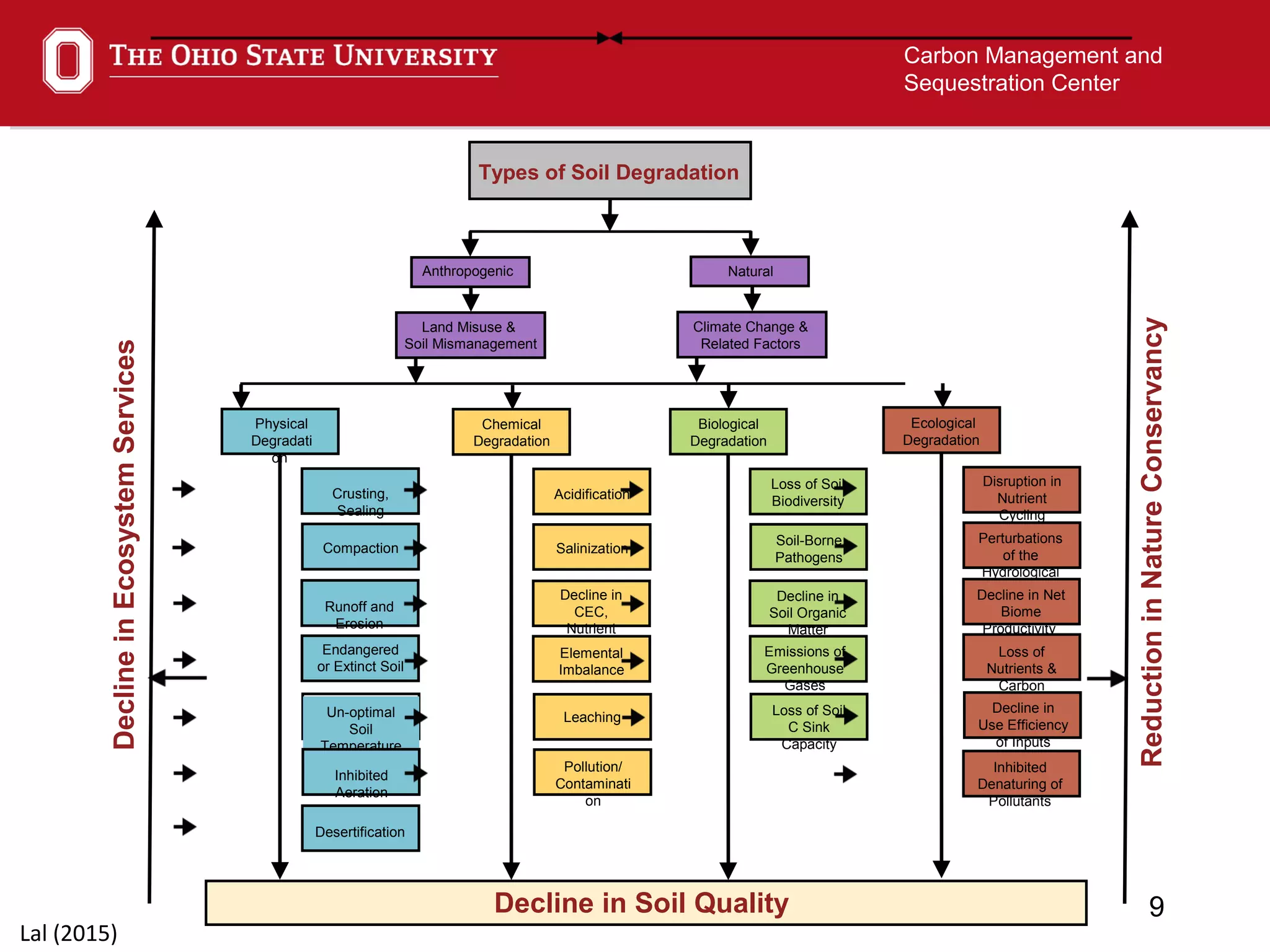
Types of Soil Degradation
Anthropogenic Natural
Land Misuse &
Soil Mismanagement
Climate Change &
Related Factors
Crusting,
Sealing
Compaction
Runoff and
Erosion
Endangered
or Extinct Soil
Un-optimal
Soil
Temperature
Inhibited
Aeration
Desertification
Physical
Degradati
on
Acidification
Salinization
Decline in
CEC,
Nutrient
Depletion
Elemental
Imbalance
Leaching
Pollution/
Contaminati
on
Chemical
Degradation
Loss of Soil
Biodiversity
Soil-Borne
Pathogens
Decline in
Soil Organic
Matter
Emissions of
Greenhouse
Gases
Loss of Soil
C Sink
Capacity
Biological
Degradation
Decline in Soil Quality
DeclineinEcosystemServices
ReductioninNatureConservancy
Disruption in
Nutrient
Cycling
Perturbations
of the
Hydrological
CycleDecline in Net
Biome
Productivity
Loss of
Nutrients &
Carbon
Decline in
Use Efficiency
of Inputs
Ecological
Degradation
Inhibited
Denaturing of
Pollutants
Lal (2015)
10
Carbon Management and
Sequestration Center
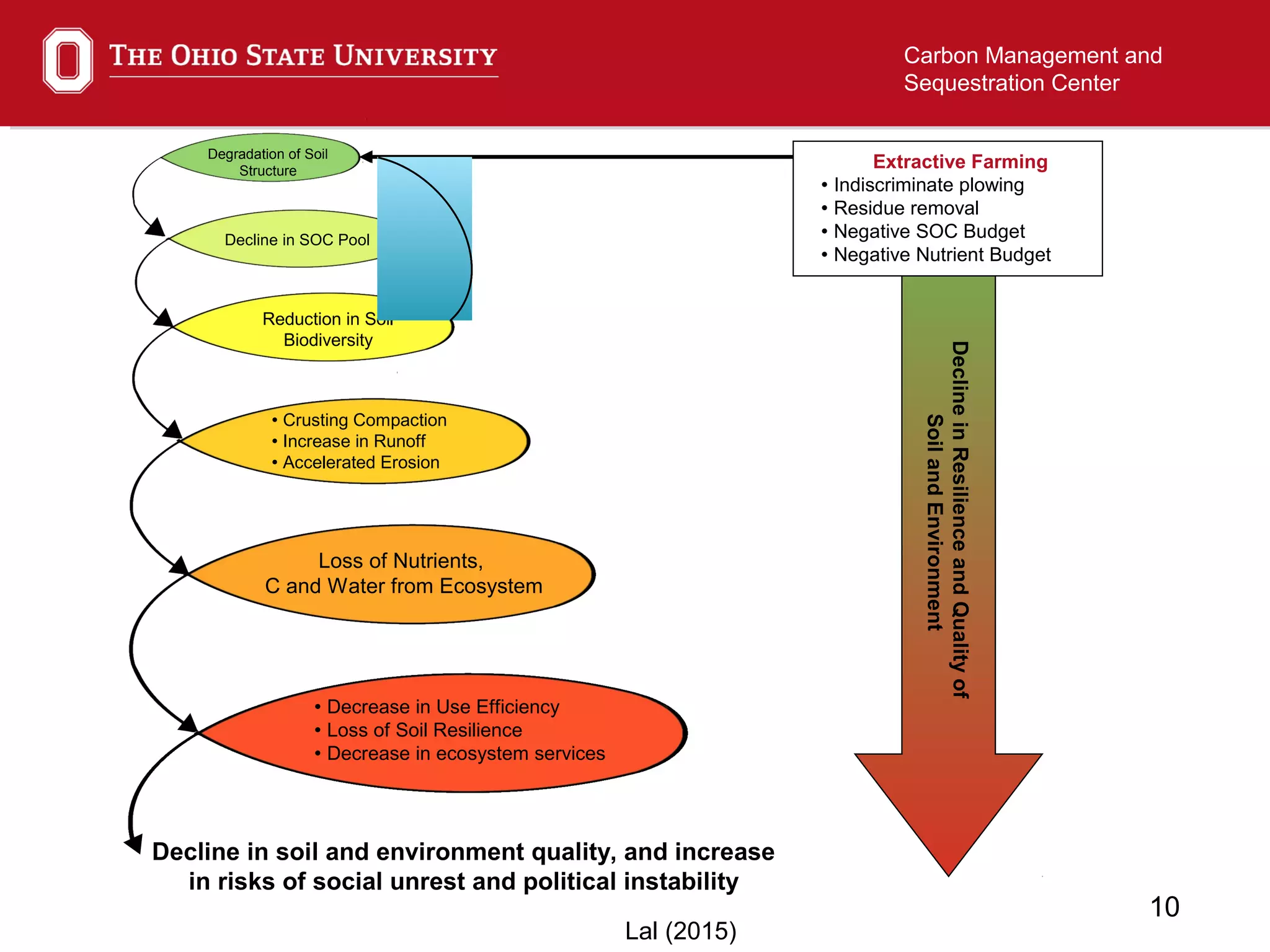
DeclineinResilienceandQualityof
SoilandEnvironment
Decline in SOC Pool
Reduction in Soil
Biodiversity
 Crusting Compaction
 Increase in Runoff
 Accelerated Erosion
Loss of Nutrients,
C and Water from Ecosystem
Degradation of Soil
Structure
Decline in soil and environment quality, and increase
in risks of social unrest and political instability
Extractive Farming
 Indiscriminate plowing
 Residue removal
 Negative SOC Budget
 Negative Nutrient Budget
 Decrease in Use Efficiency
 Loss of Soil Resilience
 Decrease in ecosystem services
Lal (2015)
11
Carbon Management and
Sequestration Center
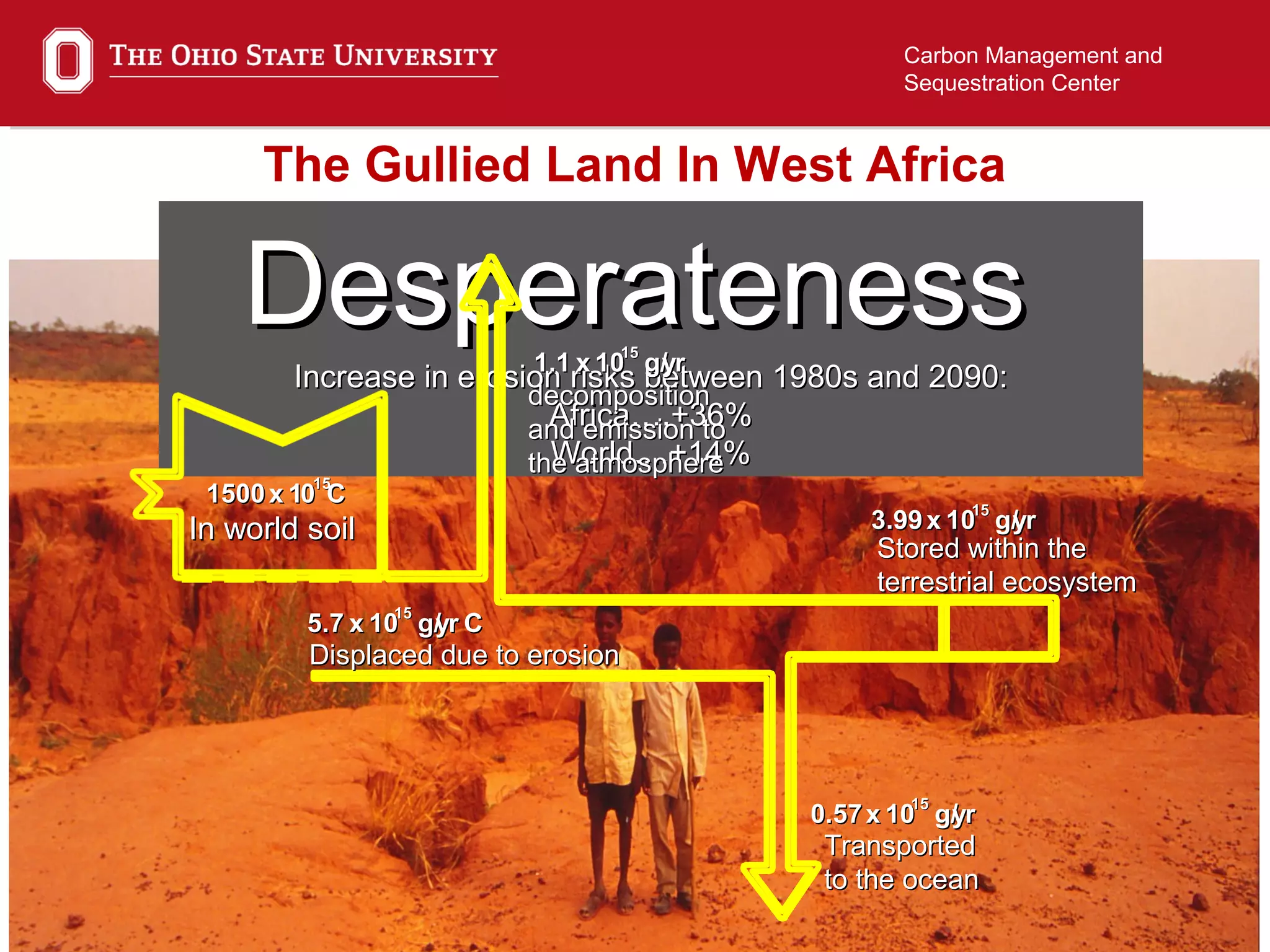
The Gullied Land In West Africa
DesperatenessDesperateness
Increase in erosion risks between 1980s and 2090:Increase in erosion risks between 1980s and 2090:
Africa….+36%Africa….+36%
World....+14%World....+14%
15001500 xx 11001515
CC
1.11.1 xx 10101515
g/g/yyrr
5.75.7 xx 10101515
g/g/yyrr CC
3.993.99 xx 10101515
g/g/yyrr
0.570.57 xx 10101515
g/g/yyrr
decompositiondecomposition
and emission toand emission to
the atmospherethe atmosphere
Stored within theStored within the
terrestrial ecosystemterrestrial ecosystem
Displaced due to erosionDisplaced due to erosion
TransportedTransported
to the oceanto the ocean
In world soilIn world soil
12
Carbon Management and
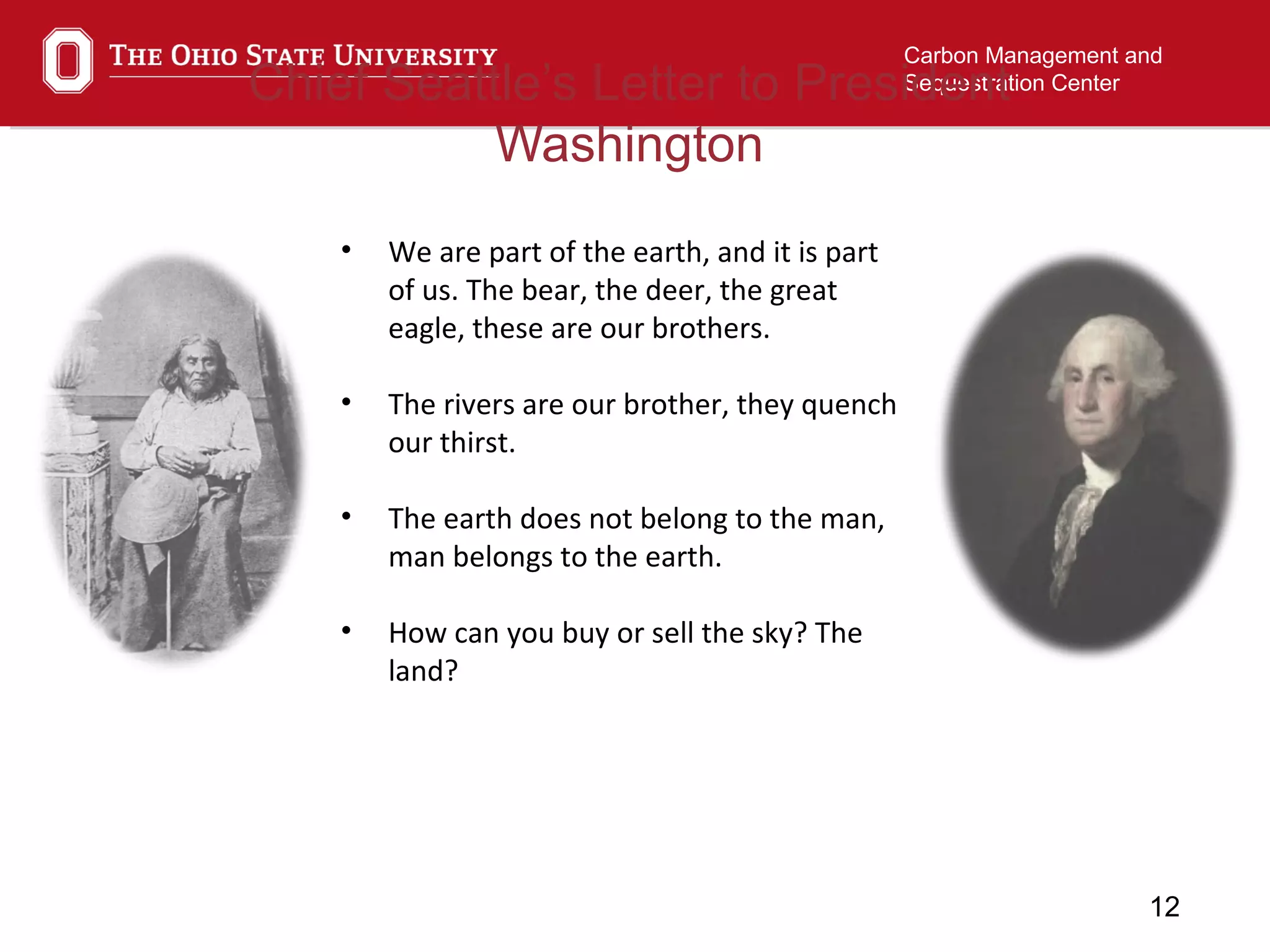
Sequestration CenterChief Seattle’s Letter to President
Washington
• We are part of the earth, and it is part
of us. The bear, the deer, the great
eagle, these are our brothers.
• The rivers are our brother, they quench
our thirst.
• The earth does not belong to the man,
man belongs to the earth.
• How can you buy or sell the sky? The
land?
13
Carbon Management and
Sequestration Center
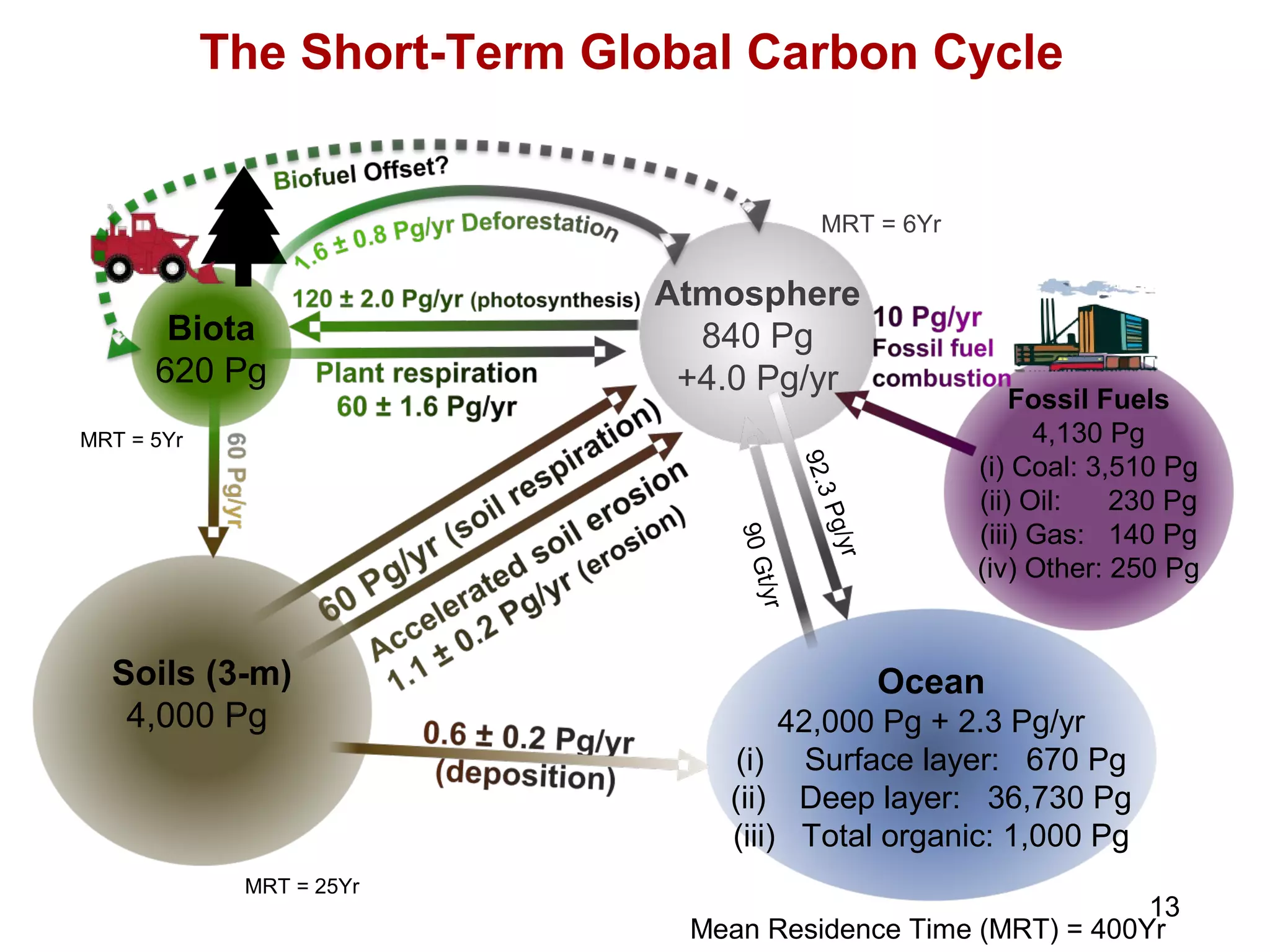
Biota
620 Pg
Atmosphere
840 Pg
+4.0 Pg/yr
Soils (3-m)
4,000 Pg
Ocean
42,000 Pg + 2.3 Pg/yr
(i) Surface layer: 670 Pg
(ii) Deep layer: 36,730 Pg
(iii) Total organic: 1,000 Pg
Fossil Fuels
4,130 Pg
(i) Coal: 3,510 Pg
(ii) Oil: 230 Pg
(iii) Gas: 140 Pg
(iv) Other: 250 Pg
90Gt/yr
MRT = 5Yr
MRT = 25Yr
Mean Residence Time (MRT) = 400Yr
MRT = 6Yr
92.3Pg/yr
The Short-Term Global Carbon Cycle
14
Carbon Management and
Sequestration Center
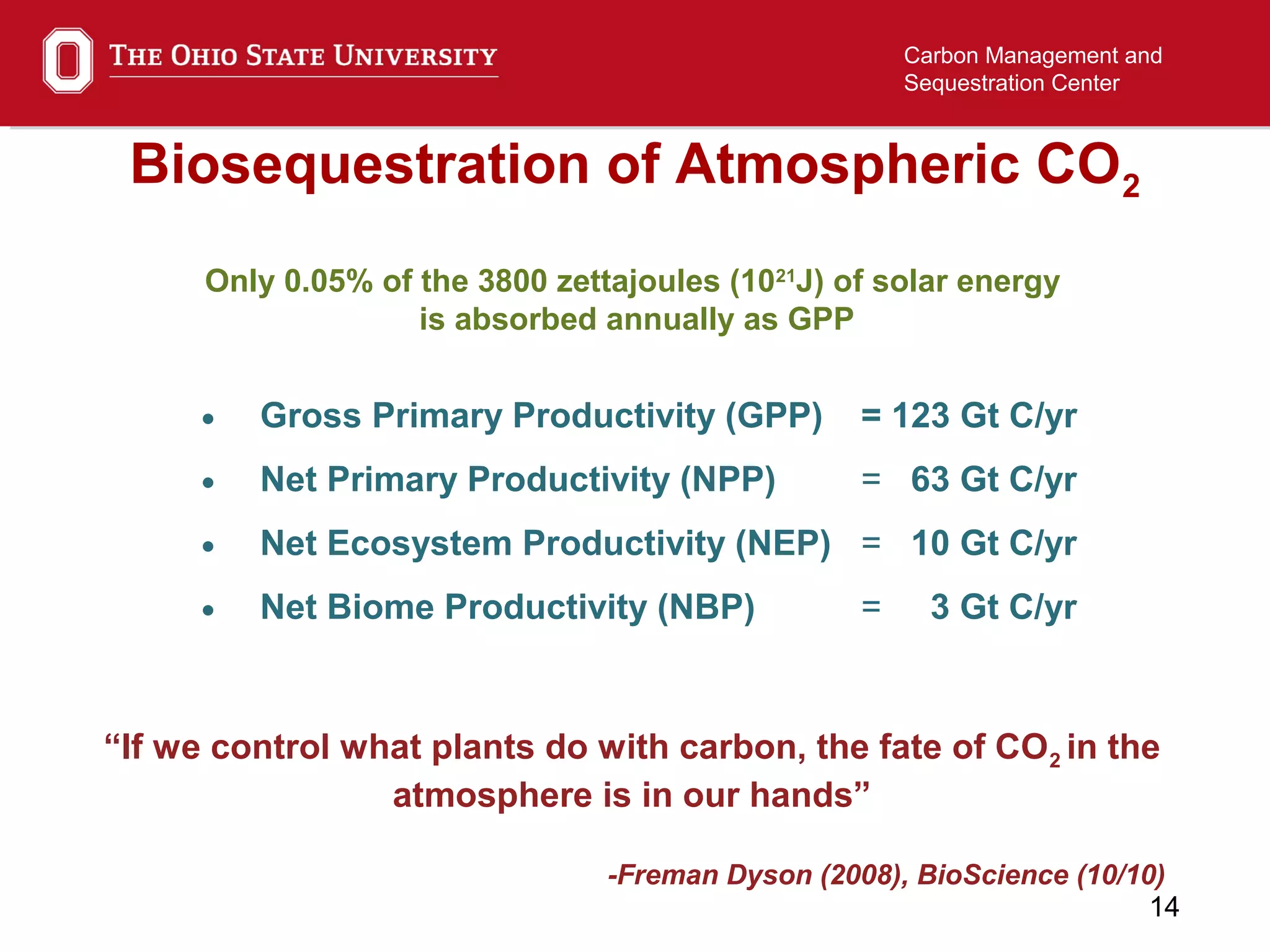
• Gross Primary Productivity (GPP) = 123 Gt C/yr
• Net Primary Productivity (NPP) = 63 Gt C/yr
• Net Ecosystem Productivity (NEP) = 10 Gt C/yr
• Net Biome Productivity (NBP) = 3 Gt C/yr
“If we control what plants do with carbon, the fate of CO2 in the
atmosphere is in our hands”
-Freman Dyson (2008), BioScience (10/10)
Only 0.05% of the 3800 zettajoules (1021
J) of solar energy
is absorbed annually as GPP
Biosequestration of Atmospheric CO2
15
Carbon Management and
Sequestration Center
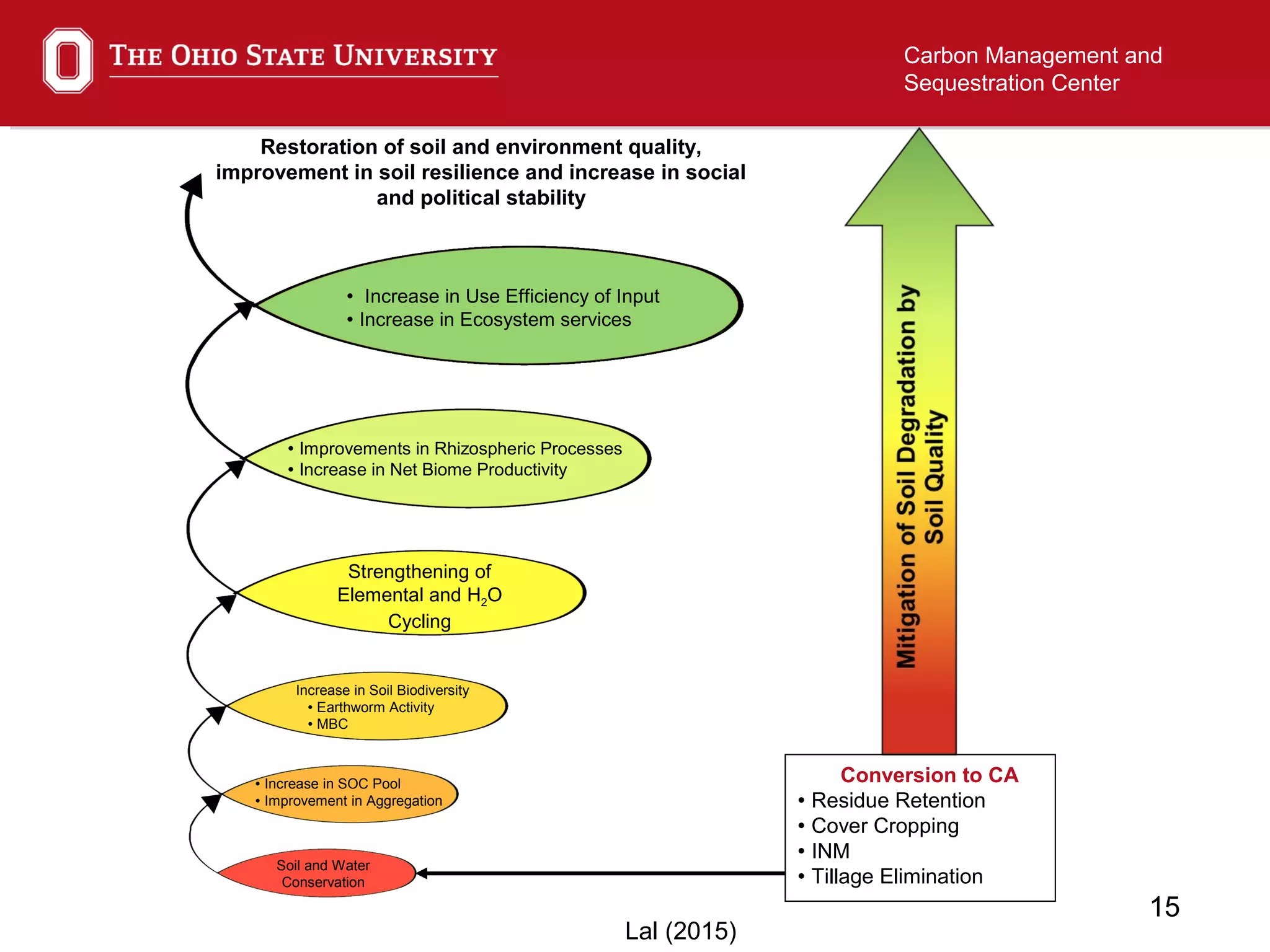
Strengthening of
Elemental and H2O
Cycling
Soil and Water
Conservation
 Improvements in Rhizospheric Processes
 Increase in Net Biome Productivity
Increase in Soil Biodiversity
 Earthworm Activity
 MBC
 Increase in SOC Pool
 Improvement in Aggregation
Restoration of soil and environment quality,
improvement in soil resilience and increase in social
and political stability
Conversion to CA
 Residue Retention
 Cover Cropping
 INM
 Tillage Elimination
 Increase in Use Efficiency of Input
 Increase in Ecosystem services
Lal (2015)
16
Carbon Management and
Sequestration Center
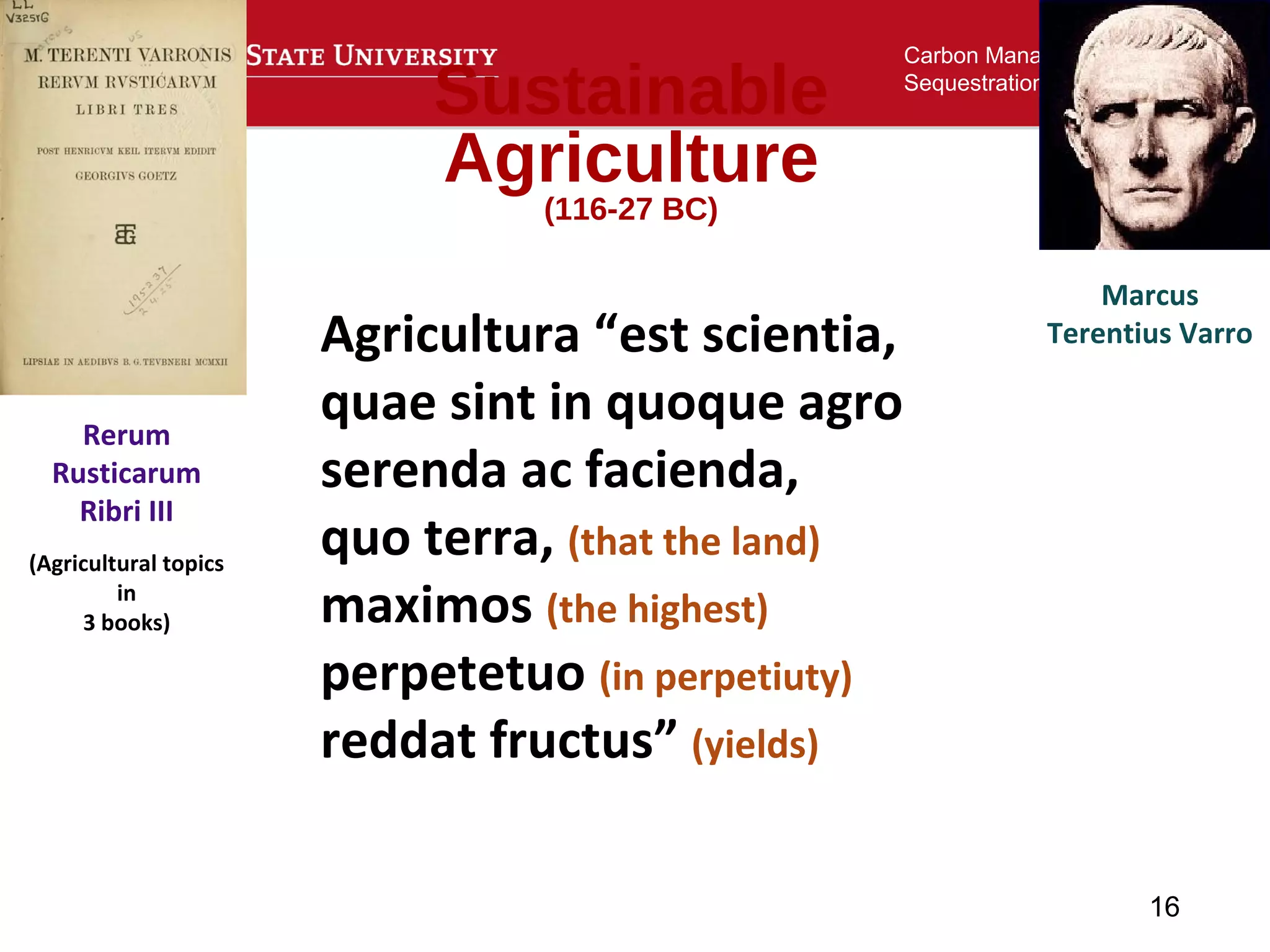
Sustainable
Agriculture
(116-27 BC)
Agricultura “est scientia,
quae sint in quoque agro
serenda ac facienda,
quo terra, (that the land)
maximos (the highest)
perpetetuo (in perpetiuty)
reddat fructus” (yields)
Marcus
Terentius Varro
Rerum
Rusticarum
Ribri III
(Agricultural topics
in
3 books)
17
Carbon Management and
Sequestration Center
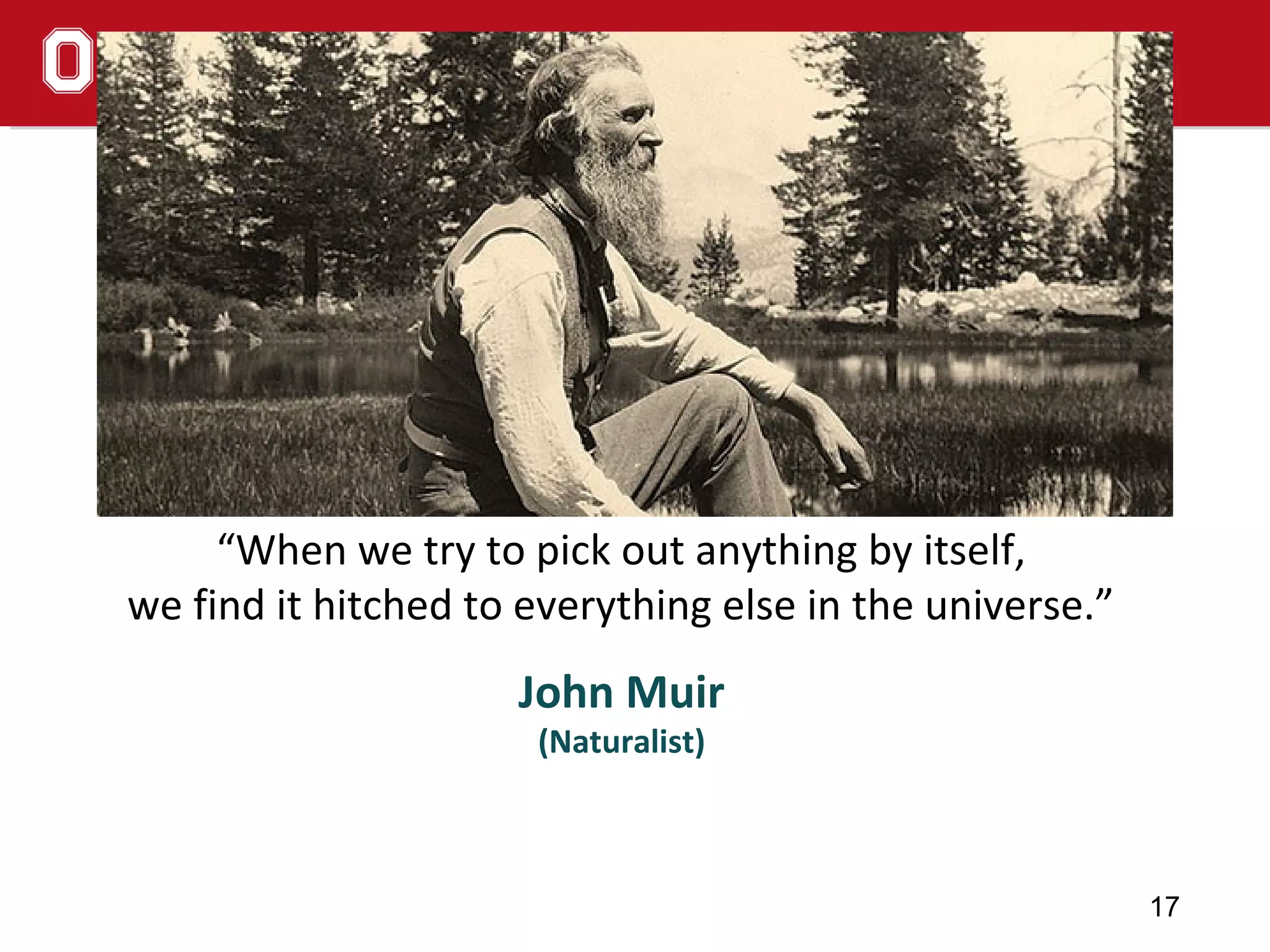
“When we try to pick out anything by itself,
we find it hitched to everything else in the universe.”
John Muir
(Naturalist)
18
Carbon Management and
Sequestration Center
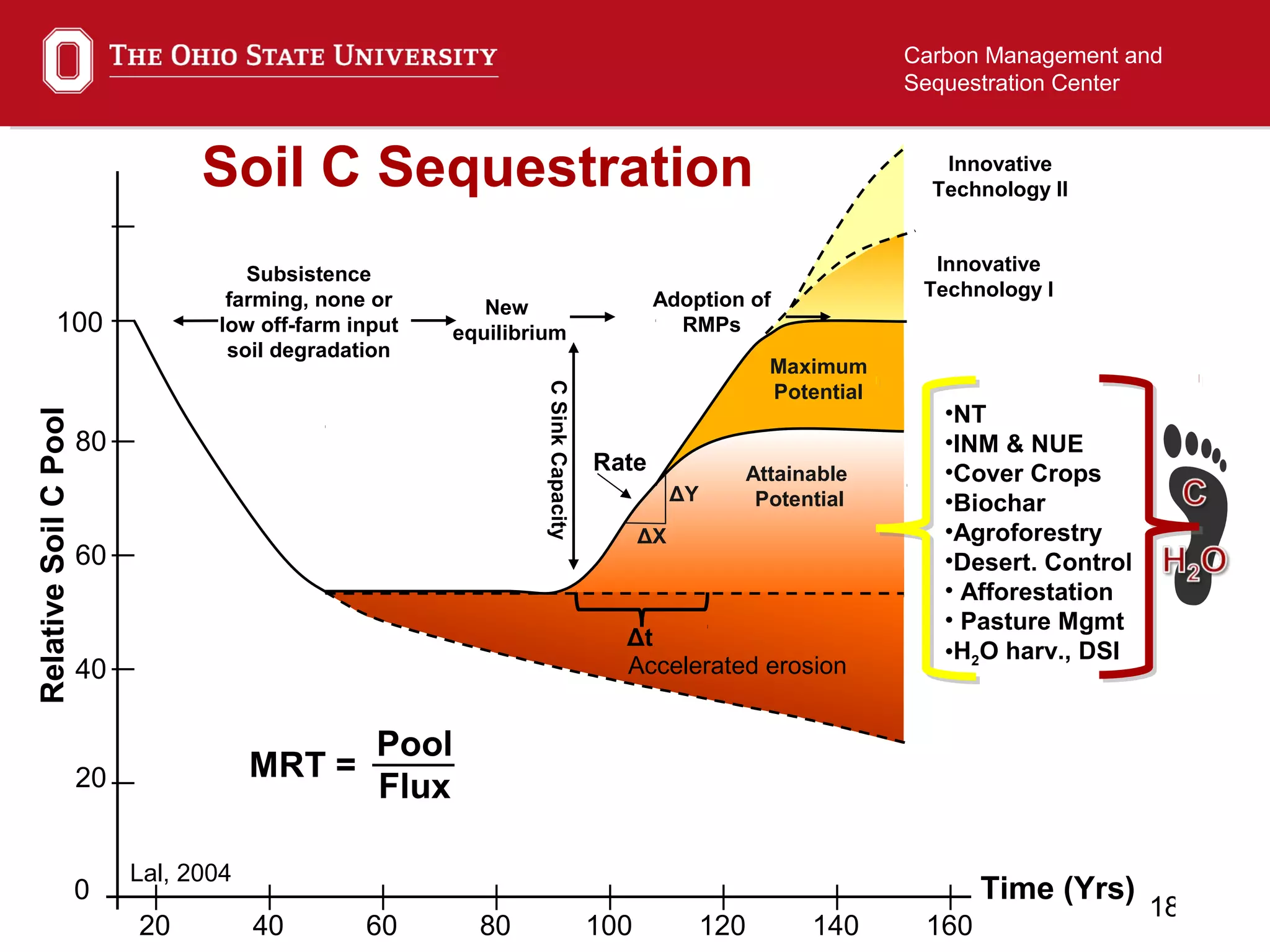
Accelerated erosion
Innovative
Technology II
Innovative
Technology I
Subsistence
farming, none or
low off-farm input
soil degradation
New
equilibrium
Adoption of
RMPs
Time (Yrs)
Lal, 2004
80
100
20
40 60 80 100 120 140 160
40
60
20
RelativeSoilCPool
0
Maximum
Potential
Rate
ΔY
ΔX
Attainable
Potential
CSinkCapacity
Δt
•NT
•INM & NUE
•Cover Crops
•Biochar
•Agroforestry
•Desert. Control
• Afforestation
• Pasture Mgmt
•H2O harv., DSI
MRT =
Pool
Flux
Soil C Sequestration
19
Carbon Management and
Sequestration Center
Sustainable Soil Management
• Replace what is removed,
• Respond wisely to what is changed, and
• Predict what will happen from anthropogenic
and natural perturbations
•Enhance soil resilience
20
Carbon Management and
Sequestration Center
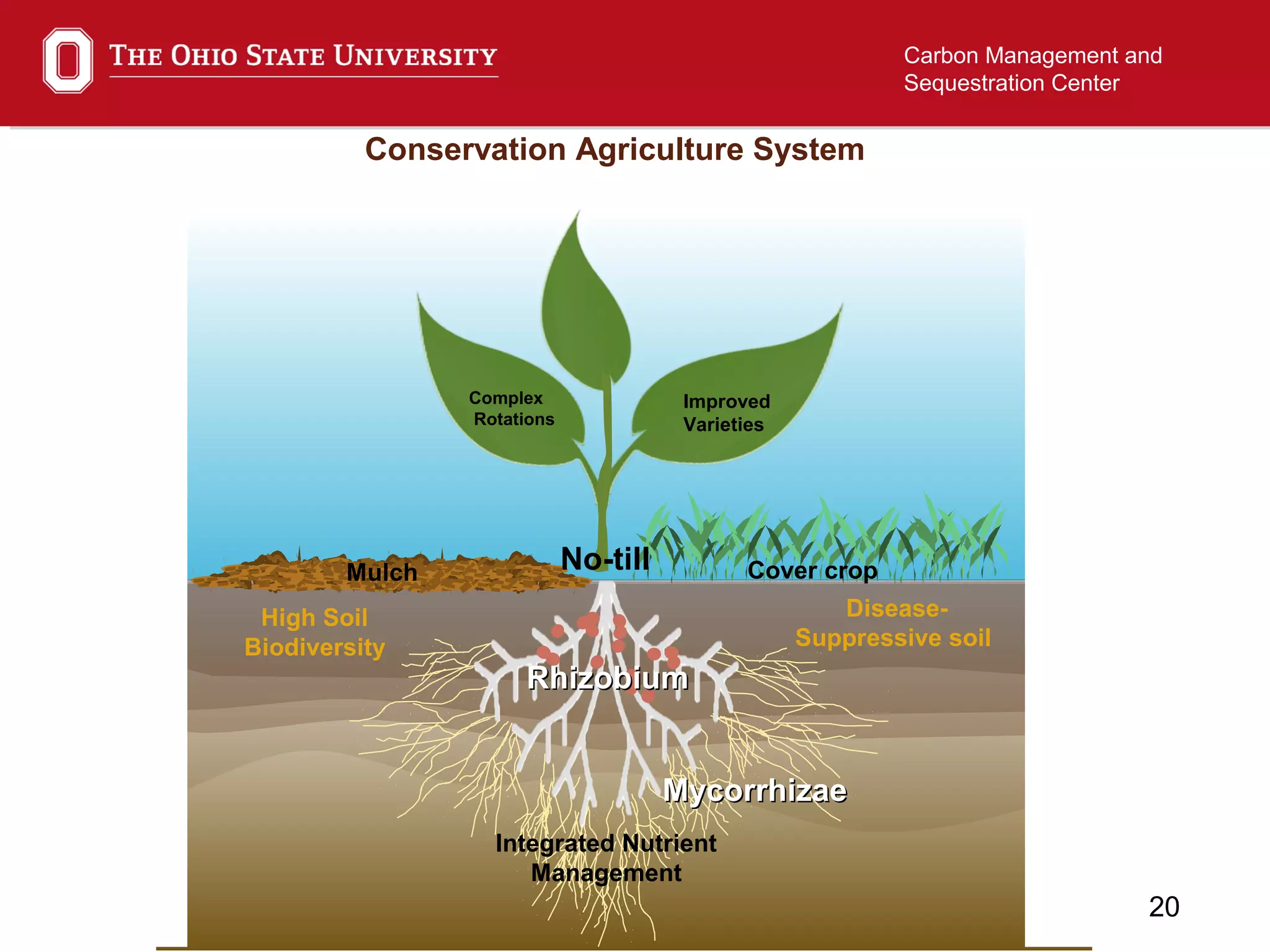
Disease-
Suppressive soil
High Soil
Biodiversity
Improved
Varieties
Complex
Rotations
Conservation Agriculture System
Mulch Cover cropNo-till
MycorrhizaeMycorrhizae
RhizobiumRhizobium
Integrated Nutrient
Management
21
Carbon Management and
Sequestration Center
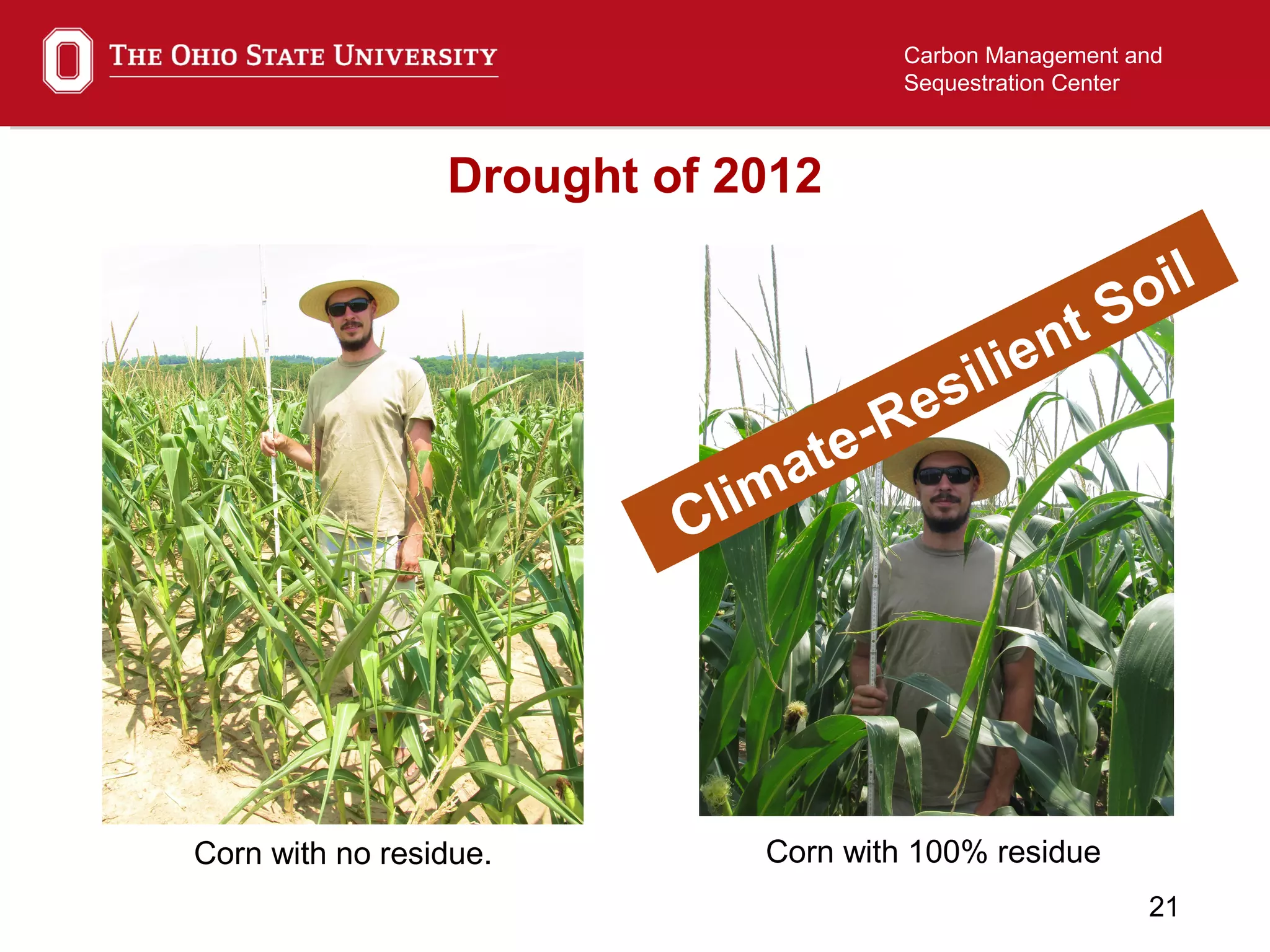
Corn with no residue. Corn with 100% residue
Drought of 2012
Climate-Resilient Soil
22
Carbon Management and
Sequestration Center
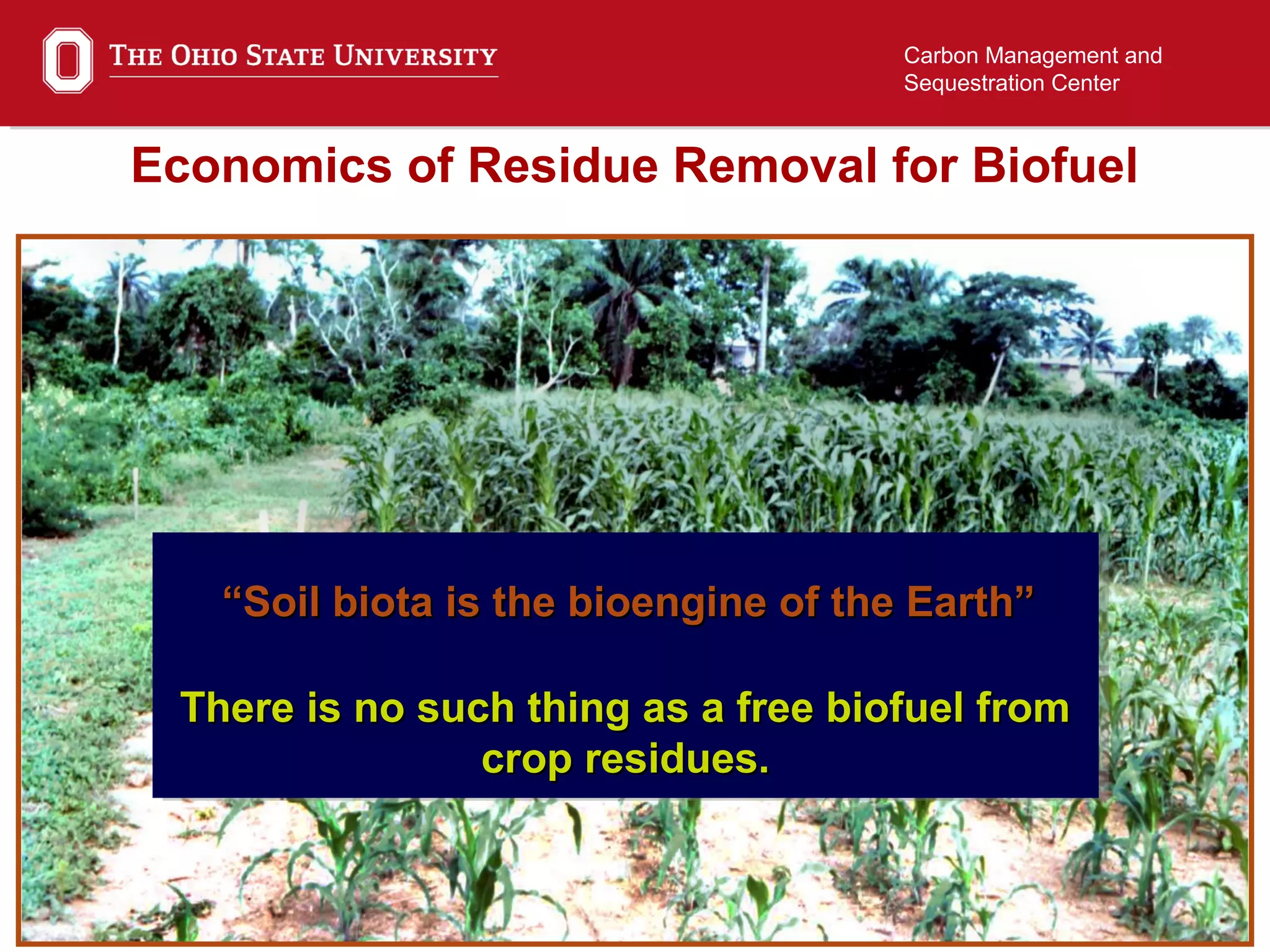
““Soil biota is the bioengine of the Earth”Soil biota is the bioengine of the Earth”
There is no such thing as a free biofuel fromThere is no such thing as a free biofuel from
crop residues.crop residues.
There is no such thing as a free biofuel fromThere is no such thing as a free biofuel from
crop residues.crop residues.
Economics of Residue Removal for Biofuel
23
Carbon Management and
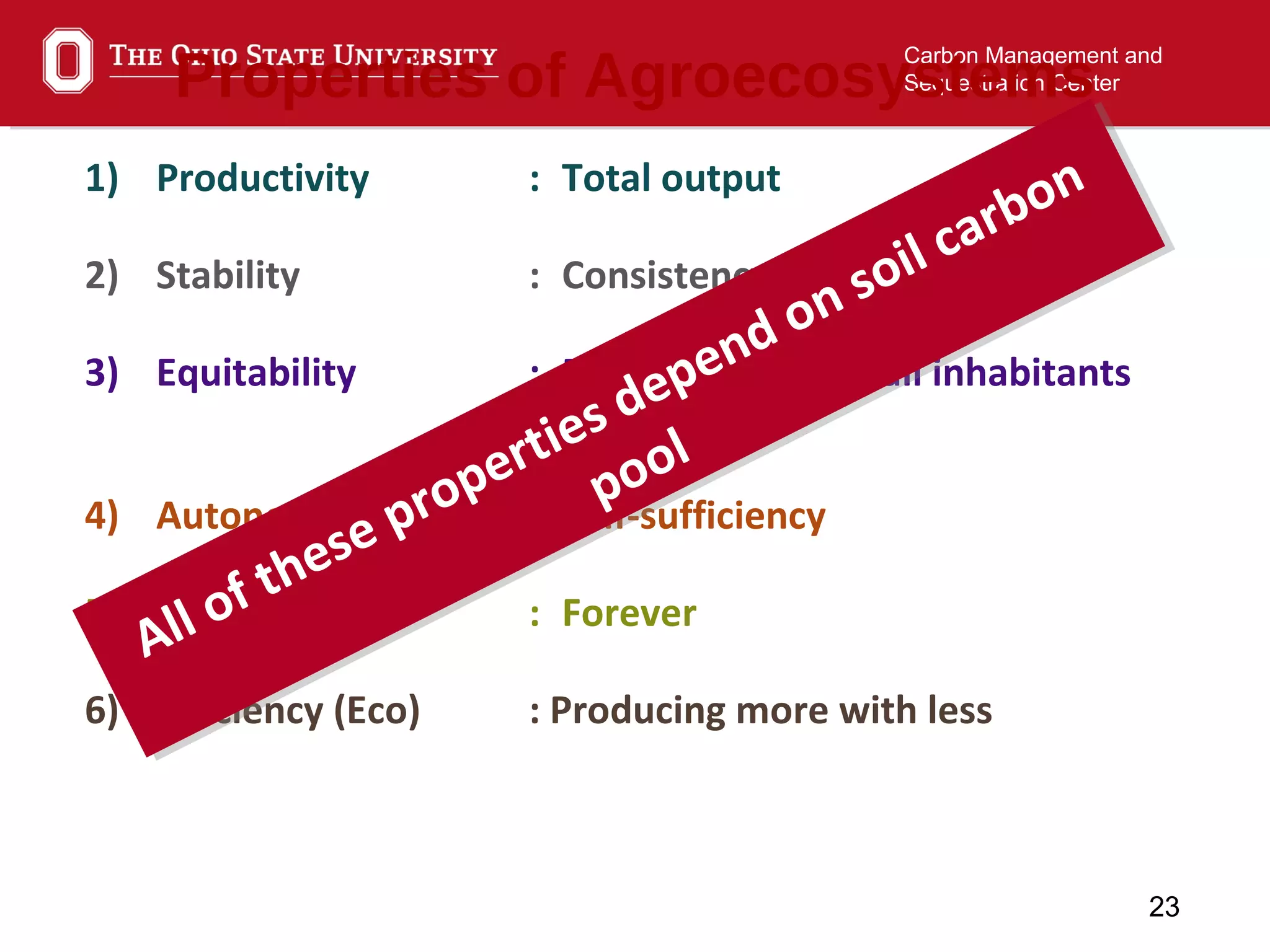
Sequestration CenterProperties of Agroecosystems
1) Productivity : Total output
2) Stability : Consistency of production
3) Equitability : Fair allocation for all inhabitants
of Earth
4) Autonomy : Self-sufficiency
5) Sustainability : Forever
6) Efficiency (Eco) : Producing more with less
All of these properties depend on soil carbon
pool
24
Carbon Management and
Sequestration Center
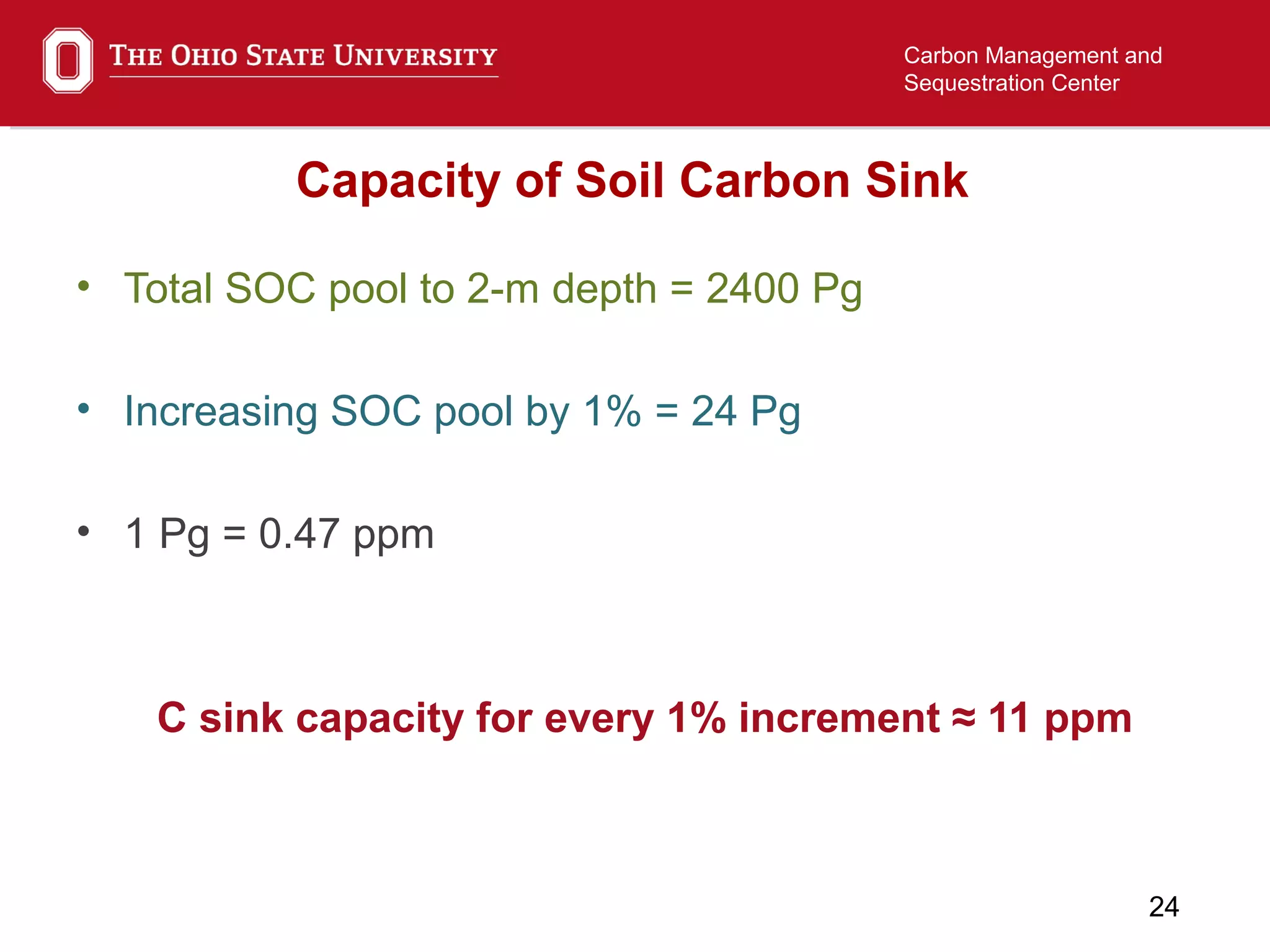
• Total SOC pool to 2-m depth = 2400 Pg
• Increasing SOC pool by 1% = 24 Pg
• 1 Pg = 0.47 ppm
C sink capacity for every 1% increment ≈ 11 ppm
Capacity of Soil Carbon Sink
25
Carbon Management and
Sequestration Center
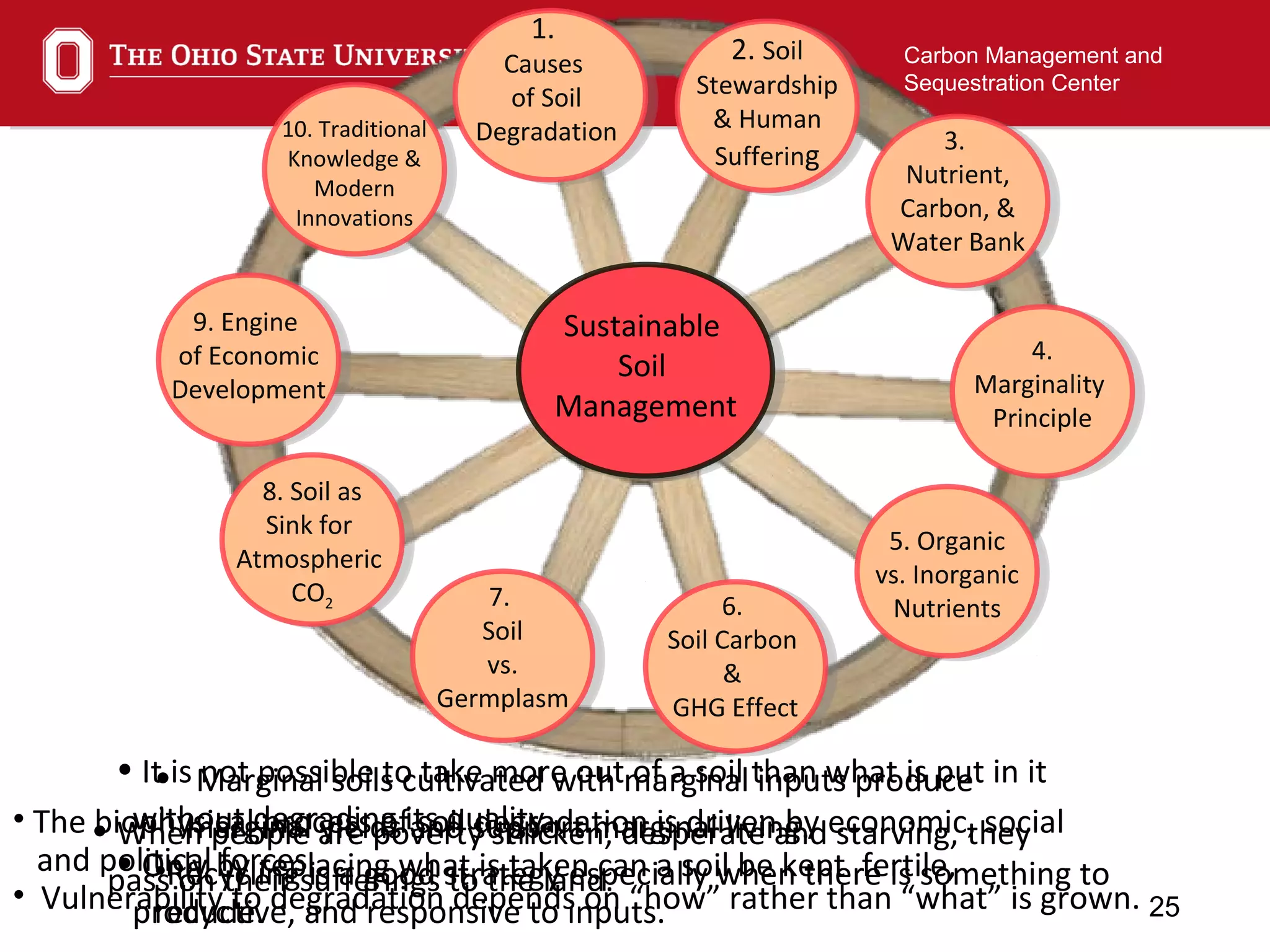
Sustainable
Soil
Management
1.
Causes
of Soil
Degradation
• The biophysical process of soil degradation is driven by economic, social
and political forces.
• Vulnerability to degradation depends on “how” rather than “what” is grown.
2. Soil
Stewardship
& Human
Suffering 3.
Nutrient,
Carbon, &
Water Bank
4.
Marginality
Principle
5. Organic
vs. Inorganic
Nutrients6.
Soil Carbon
&
GHG Effect
8. Soil as
Sink for
Atmospheric
CO2 7.
Soil
vs.
Germplasm
9. Engine
of Economic
Development
10. Traditional
Knowledge &
Modern
Innovations
• When people are poverty stricken, desperate and starving, they
pass on their sufferings to the land.
• It is not possible to take more out of a soil than what is put in it
without degrading its quality.
• Only by replacing what is taken can a soil be kept fertile,
productive, and responsive to inputs.
• Marginal soils cultivated with marginal inputs produce
marginal yields and support marginal living.
•Recycling is a good strategy especially when there is something to
recycle.
26
Carbon Management and
Sequestration Center
en.wikipedia.orgwww.worldwildlife.org
www.seeturtles.org
HANDOUT / Reuters
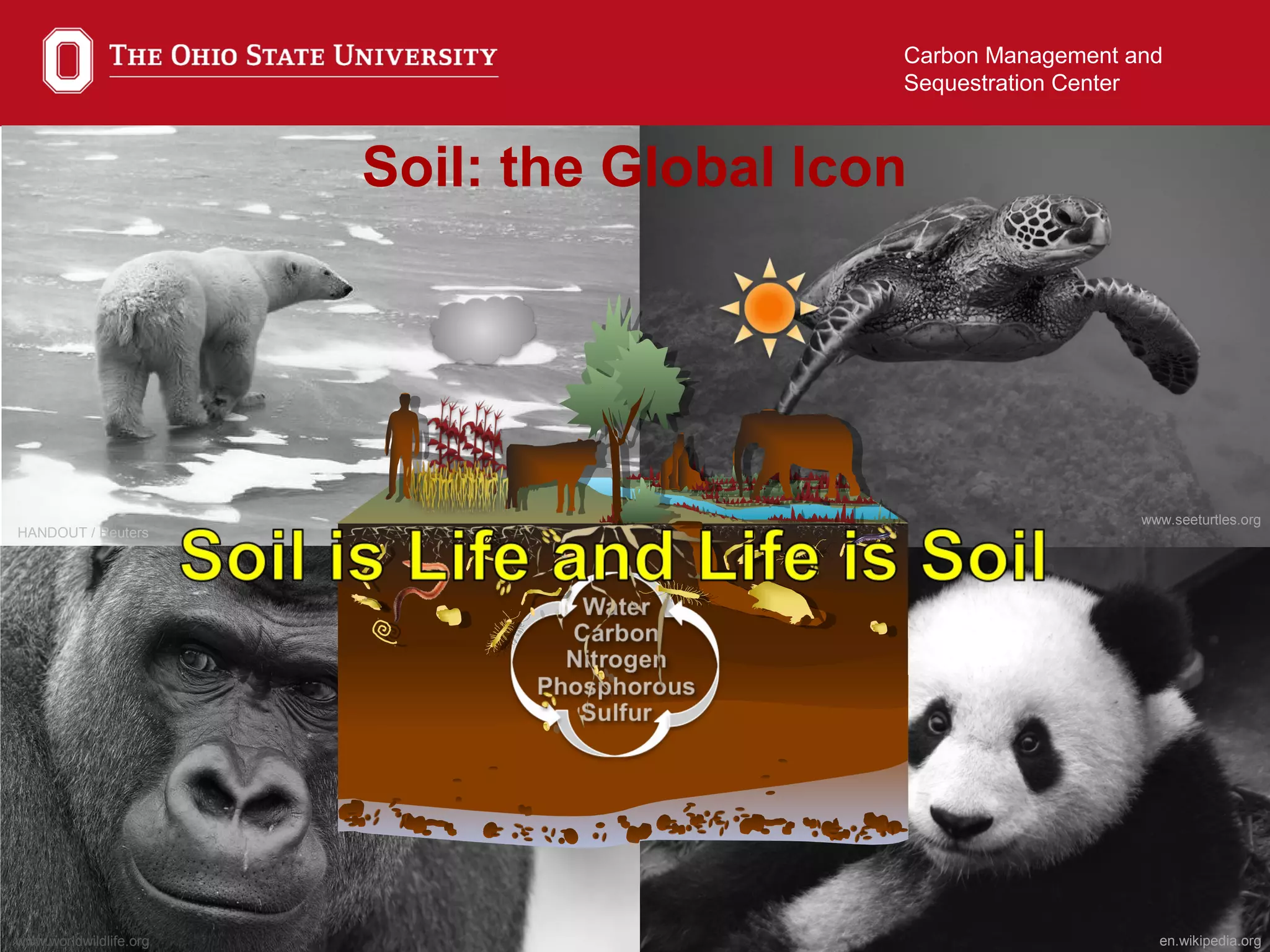
Soil: the Global Icon

Six feet under. How soil microbial life works to bury atmospheric carbon – and how management can make them sequester more carbon - Rattan Lal

  • 1.
    Six Feet Under RattanLal Carbon Management and Sequestration Center The Ohio State University Columbus, OH 43210 USA
  • 2.
    2 Carbon Management and SequestrationCenter Population Energy use Deforestation CO2 Emissions Land Degradation Desertification Water use 8000 BC N 1750 1850 1950 2000 Time HumanImpact The answer lies in soils. Soil Matters
  • 3.
    3 Carbon Management and SequestrationCenter Soil is an organic-carbon mediated realm in which solid, liquid, gas and biology all interact from a scale of nanometer to landscape. The Living Soil The weight of live organisms in arable land is 5 t/ha
  • 4.
    4 Carbon Management and SequestrationCenter • A spade of rich garden soil may harbor more species than the entire Amazon nurtures above ground • A teaspoon of productive soil contains 100 million to 1 billion micro-organisms (Dunne 2009) Soil is Life
  • 5.
    5 Carbon Management and SequestrationCenter I = P x A x T P = Population A = Affluence T = Technology Over the last 10,000 years, the number of humans has increased about a thousand-fold from 2- 20 million to 7.3 billion. 1.0 1800 1.3 1850 1.7 1900 1.8 1910 1.9 1920 2.1 1930 2.3 1940 2.5 1950 3.0 1960 3.7 1970 4.4 19805.3 1990 6.1 2000 7.0 2011 7.5 2020 8.1 2030 8.6 2040 9.6 2050 11 2100 The Anthropogenic Driver
  • 6.
    6 Carbon Management and SequestrationCenter Causes or Activities  Deforestation  Land Use Conversion  Extractive Farming  Inappropriate Irrigation  Excessive Plowing  Soil, Crop, Animal Management Processes or Mechanisms  Erosion  Salinization  Nutrient Depletion  Acidification  Species Extinction Factors or Agents  Climate  Physiography  Land forms  Socio-economic, Ethnic/Cultural Setting Soil Degradation Anthropogenic & Natural Perturbations Biophysical & Socioeconomic Interactions Climate-Soil-Biotic Interactions Processes, Factors, and Causes of Soil Degradation
  • 7.
    7 Carbon Management and SequestrationCenter Resilience of Soil-Ecological Systems It has multiple regimes (stable states) which are separated by thresholds Thresholds Critical Threshold The current state of the system Possible states in which the system can still have the same function Irreversible Degradation Resilience
  • 8.
    8 Carbon Management and SequestrationCenter Threshold/Critical Level Threshold/Critical Level/Tipping Point: Soil processes and properties have threshold levels (1.1% SOC concentration in soils of the tropics). Beyond threshold level, there is a drastic regime change.
  • 9.
    9 Carbon Management and SequestrationCenter Types of Soil Degradation Anthropogenic Natural Land Misuse & Soil Mismanagement Climate Change & Related Factors Crusting, Sealing Compaction Runoff and Erosion Endangered or Extinct Soil Un-optimal Soil Temperature Inhibited Aeration Desertification Physical Degradati on Acidification Salinization Decline in CEC, Nutrient Depletion Elemental Imbalance Leaching Pollution/ Contaminati on Chemical Degradation Loss of Soil Biodiversity Soil-Borne Pathogens Decline in Soil Organic Matter Emissions of Greenhouse Gases Loss of Soil C Sink Capacity Biological Degradation Decline in Soil Quality DeclineinEcosystemServices ReductioninNatureConservancy Disruption in Nutrient Cycling Perturbations of the Hydrological CycleDecline in Net Biome Productivity Loss of Nutrients & Carbon Decline in Use Efficiency of Inputs Ecological Degradation Inhibited Denaturing of Pollutants Lal (2015)
  • 10.
    10 Carbon Management and SequestrationCenter DeclineinResilienceandQualityof SoilandEnvironment Decline in SOC Pool Reduction in Soil Biodiversity  Crusting Compaction  Increase in Runoff  Accelerated Erosion Loss of Nutrients, C and Water from Ecosystem Degradation of Soil Structure Decline in soil and environment quality, and increase in risks of social unrest and political instability Extractive Farming  Indiscriminate plowing  Residue removal  Negative SOC Budget  Negative Nutrient Budget  Decrease in Use Efficiency  Loss of Soil Resilience  Decrease in ecosystem services Lal (2015)
  • 11.
    11 Carbon Management and SequestrationCenter The Gullied Land In West Africa DesperatenessDesperateness Increase in erosion risks between 1980s and 2090:Increase in erosion risks between 1980s and 2090: Africa….+36%Africa….+36% World....+14%World....+14% 15001500 xx 11001515 CC 1.11.1 xx 10101515 g/g/yyrr 5.75.7 xx 10101515 g/g/yyrr CC 3.993.99 xx 10101515 g/g/yyrr 0.570.57 xx 10101515 g/g/yyrr decompositiondecomposition and emission toand emission to the atmospherethe atmosphere Stored within theStored within the terrestrial ecosystemterrestrial ecosystem Displaced due to erosionDisplaced due to erosion TransportedTransported to the oceanto the ocean In world soilIn world soil
  • 12.
    12 Carbon Management and SequestrationCenterChief Seattle’s Letter to President Washington • We are part of the earth, and it is part of us. The bear, the deer, the great eagle, these are our brothers. • The rivers are our brother, they quench our thirst. • The earth does not belong to the man, man belongs to the earth. • How can you buy or sell the sky? The land?
  • 13.
    13 Carbon Management and SequestrationCenter Biota 620 Pg Atmosphere 840 Pg +4.0 Pg/yr Soils (3-m) 4,000 Pg Ocean 42,000 Pg + 2.3 Pg/yr (i) Surface layer: 670 Pg (ii) Deep layer: 36,730 Pg (iii) Total organic: 1,000 Pg Fossil Fuels 4,130 Pg (i) Coal: 3,510 Pg (ii) Oil: 230 Pg (iii) Gas: 140 Pg (iv) Other: 250 Pg 90Gt/yr MRT = 5Yr MRT = 25Yr Mean Residence Time (MRT) = 400Yr MRT = 6Yr 92.3Pg/yr The Short-Term Global Carbon Cycle
  • 14.
    14 Carbon Management and SequestrationCenter • Gross Primary Productivity (GPP) = 123 Gt C/yr • Net Primary Productivity (NPP) = 63 Gt C/yr • Net Ecosystem Productivity (NEP) = 10 Gt C/yr • Net Biome Productivity (NBP) = 3 Gt C/yr “If we control what plants do with carbon, the fate of CO2 in the atmosphere is in our hands” -Freman Dyson (2008), BioScience (10/10) Only 0.05% of the 3800 zettajoules (1021 J) of solar energy is absorbed annually as GPP Biosequestration of Atmospheric CO2
  • 15.
    15 Carbon Management and SequestrationCenter Strengthening of Elemental and H2O Cycling Soil and Water Conservation  Improvements in Rhizospheric Processes  Increase in Net Biome Productivity Increase in Soil Biodiversity  Earthworm Activity  MBC  Increase in SOC Pool  Improvement in Aggregation Restoration of soil and environment quality, improvement in soil resilience and increase in social and political stability Conversion to CA  Residue Retention  Cover Cropping  INM  Tillage Elimination  Increase in Use Efficiency of Input  Increase in Ecosystem services Lal (2015)
  • 16.
    16 Carbon Management and SequestrationCenter Sustainable Agriculture (116-27 BC) Agricultura “est scientia, quae sint in quoque agro serenda ac facienda, quo terra, (that the land) maximos (the highest) perpetetuo (in perpetiuty) reddat fructus” (yields) Marcus Terentius Varro Rerum Rusticarum Ribri III (Agricultural topics in 3 books)
  • 17.
    17 Carbon Management and SequestrationCenter “When we try to pick out anything by itself, we find it hitched to everything else in the universe.” John Muir (Naturalist)
  • 18.
    18 Carbon Management and SequestrationCenter Accelerated erosion Innovative Technology II Innovative Technology I Subsistence farming, none or low off-farm input soil degradation New equilibrium Adoption of RMPs Time (Yrs) Lal, 2004 80 100 20 40 60 80 100 120 140 160 40 60 20 RelativeSoilCPool 0 Maximum Potential Rate ΔY ΔX Attainable Potential CSinkCapacity Δt •NT •INM & NUE •Cover Crops •Biochar •Agroforestry •Desert. Control • Afforestation • Pasture Mgmt •H2O harv., DSI MRT = Pool Flux Soil C Sequestration
  • 19.
    19 Carbon Management and SequestrationCenter Sustainable Soil Management • Replace what is removed, • Respond wisely to what is changed, and • Predict what will happen from anthropogenic and natural perturbations •Enhance soil resilience
  • 20.
    20 Carbon Management and SequestrationCenter Disease- Suppressive soil High Soil Biodiversity Improved Varieties Complex Rotations Conservation Agriculture System Mulch Cover cropNo-till MycorrhizaeMycorrhizae RhizobiumRhizobium Integrated Nutrient Management
  • 21.
    21 Carbon Management and SequestrationCenter Corn with no residue. Corn with 100% residue Drought of 2012 Climate-Resilient Soil
  • 22.
    22 Carbon Management and SequestrationCenter ““Soil biota is the bioengine of the Earth”Soil biota is the bioengine of the Earth” There is no such thing as a free biofuel fromThere is no such thing as a free biofuel from crop residues.crop residues. There is no such thing as a free biofuel fromThere is no such thing as a free biofuel from crop residues.crop residues. Economics of Residue Removal for Biofuel
  • 23.
    23 Carbon Management and SequestrationCenterProperties of Agroecosystems 1) Productivity : Total output 2) Stability : Consistency of production 3) Equitability : Fair allocation for all inhabitants of Earth 4) Autonomy : Self-sufficiency 5) Sustainability : Forever 6) Efficiency (Eco) : Producing more with less All of these properties depend on soil carbon pool
  • 24.
    24 Carbon Management and SequestrationCenter • Total SOC pool to 2-m depth = 2400 Pg • Increasing SOC pool by 1% = 24 Pg • 1 Pg = 0.47 ppm C sink capacity for every 1% increment ≈ 11 ppm Capacity of Soil Carbon Sink
  • 25.
    25 Carbon Management and SequestrationCenter Sustainable Soil Management 1. Causes of Soil Degradation • The biophysical process of soil degradation is driven by economic, social and political forces. • Vulnerability to degradation depends on “how” rather than “what” is grown. 2. Soil Stewardship & Human Suffering 3. Nutrient, Carbon, & Water Bank 4. Marginality Principle 5. Organic vs. Inorganic Nutrients6. Soil Carbon & GHG Effect 8. Soil as Sink for Atmospheric CO2 7. Soil vs. Germplasm 9. Engine of Economic Development 10. Traditional Knowledge & Modern Innovations • When people are poverty stricken, desperate and starving, they pass on their sufferings to the land. • It is not possible to take more out of a soil than what is put in it without degrading its quality. • Only by replacing what is taken can a soil be kept fertile, productive, and responsive to inputs. • Marginal soils cultivated with marginal inputs produce marginal yields and support marginal living. •Recycling is a good strategy especially when there is something to recycle.
  • 26.
    26 Carbon Management and SequestrationCenter en.wikipedia.orgwww.worldwildlife.org www.seeturtles.org HANDOUT / Reuters Soil: the Global Icon