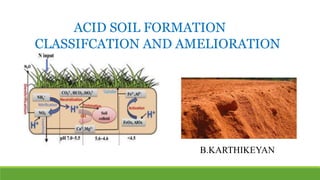
ACID SOIL FORMATION
CLASSIFCATION AND AMELIORATION
B.KARTHIKEYAN
 ACID SOIL FORMING FACTORS
 ACID SOIL FORMING PEDOGENIC PROCESS
 ACID SOIL CLASSIFICATION
 AMELIORATION OF SOIL ACIDITY
 RESEARCH ARTICLES
 REFERENCES
NUT SHELL
• In humid regions where evaporation is less than precipitation, chances for the
development of acid soils are good.
• In India, it is believed that the regions with acid soils must receive more than 750
mm annual rainfall.
• The regions with annual rainfall 1350 mm may have acid soils with pH value 5.0
or even less than that.
• In hilly regions where the loss of water through evaporation is very slow due to
very low temperature the conditions for the development of acid soils are very
favourable, although the rainfall is scanty there.
• Excessive rainfall leaches the soil profile's basic elements (calcium, magnesium,
sodium, and potassium)
1)Climate:
I. ACID SOIL FORMING FACTORS
2)Vegetation cover:
• According to Bloomfield (1953), the foliage leaves of conifers lack alkali elements and
their mineralization process is very slow When the leaf-litter on the ground is degraded
organic acids are released which gradually make the soils acidic.
• In temperate regions or hilly areas covered with conifers the acid soils can develop
easily.
• Plants found in the coastal regions and marshy places after death and decay produce
acids which render the soils acidic.
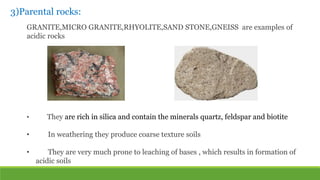
GRANITE,MICRO GRANITE,RHYOLITE,SAND STONE,GNEISS are examples of
acidic rocks
• They are rich in silica and contain the minerals quartz, feldspar and biotite
• In weathering they produce coarse texture soils
• They are very much prone to leaching of bases , which results in formation of
acidic soils
3)Parental rocks:
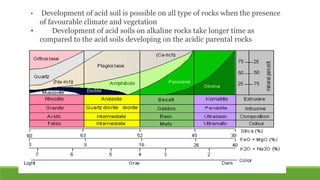
• Development of acid soil is possible on all type of rocks when the presence
of favourable climate and vegetation
• Development of acid soils on alkaline rocks take longer time as
compared to the acid soils developing on the acidic parental rocks
• Sloppy places with good drainage conditions are supposed to be good for the
development of acid soils. On hill slopes, the development of acid soils is easy.
• Acid soils do not develop generally in river basins. The plains with good drainage
may also develop acid soils in due course of time.
4)Topography:
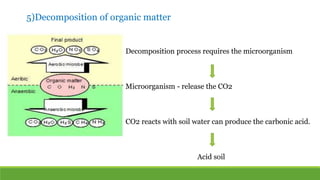
Decomposition process requires the microorganism
Microorganism - release the CO2
CO2 reacts with soil water can produce the carbonic acid.
Acid soil
5)Decomposition of organic matter
• This carbon dioxide reacts with water to form carbonic acid
• That reacts with the insoluble primary minerals present in the soil as well as
the clay and humic micelle.
• Suppose the clay and humic micelle have absorbed Ca++, Mg++, K+, Na+ and
H+ ions in the ratio of 60:15:5:10:10.
Carbonic acid reacts with clay micelle as shown below:
• These soluble bicarbonates of calcium, magnesium, potassium and sodium are
washed down by high rainfall in humid regions. So the above reversible reactions
proceed in the forward direction.
• Ammonium-based fertilizers are the major contributors to soil acidification,
especially if the nitrogen is leached rather than taken up by plants
• Ammonium nitrogen from fertilizer or soil organic matter is readily converted to
nitrate and hydrogen ions by bacteria in the soil. This contributes different amounts
of hydrogen ions to the soil, depending on the fertilizer
• When nitrate, which is negatively charged, is taken up by plants, a hydroxide ion,
also negatively charged, is released from the plant to maintain electrical balance.
• This hydroxide ion combines with a hydrogen ion in the soil to form water (the
hydrogen ion is no longer contributing to soil acidity).
• If nitrate is not taken up by plants, it can leach away from the root zone, meaning
that no hydroxide ion is released from the plant to bind with a hydrogen ion.
6)Application of N fertilizer :
If nitrate leaches, a positively charged cation is also leached to maintain electrical
balance.
The cations that leach are usually sodium, potassium or calcium rather than
hydrogen, because hydrogen ions are more strongly held by the soil
- https ://www.agric.wa.gov.au/soil-acidity/causes-soil-acidity
Application of P fertilizers
Application of S fertilizers
Fertilizer Eq.acidity
Anhydrous Ammonia 148
NH4Cl 128
(NH4)2SO4 110
Urea 80-84
(NH4)2SO4.NH4 NO3 93
DAP 77
Ammonium Nitrate 60
Mono-ammonium Phosphate 55
EQUIVALENT ACIDITY
7)ACID RAIN
1)LATERIZATION
Climate :tropical and sub tropical
Parent material: Basalts, schist, basic parent
material having ferromagnesium minerals
Vegetation: tropical rain forest
High rainfall favours intense leaching of basic
cations (Na, K, Ca).
Laterites soils are rich in Al & Fe- Acidic in
nature
Oxisol, Ultisol
Ⅱ) ACID SOIL FORMING PEDOGENIC
PROCESS
Orders:
2)PODZOLIZATION
Climate: A cold and humid climate is most favorable
for podzolization
Parent material: Siliceous (Sandy) material
Vegetation: Acid producing vegetation such as
coniferous pines is essential.
Decomposition of coniferous litter and siliceous
material create a soil solution that is strongly acidic.
This acidic soil solution enhances the processes
of eluviation and leaching causing the removal of
soluble base cations and aluminum and iron
compounds from the A horizon
Order: Spodosol
1)According to the intensity of acidity, the acid soils are of
the following five types:
(1) Slight acidic (pH range 6.6 to 6.1)
(2) Medium acidic (pH 6.0 to 5.6)
(3) Strong acidic (pH 5.5 to 5.1)
(4) Very strong acidic (pH 5.0 to 4.6)
(5) Extremely strong acidic (pH 4.5 or lower)
Ⅲ) CLASSIFICATION OF ACID SOIL
• Acid soils of india – A.K Maji, G.P Omi Reddy, Dipak Sarkar (NBSS&LUP)
2)CLASSIFICATION BASED ON ORGANIC CONTENT Mishra, S.G.
(1976)
(1) Acid mineral soils (organic matter less than 20%)
(2) Acid organic soils (organic matter 20% or more)
1. Acid mineral soils:
Such soils are further classified into the following three subgroups:
(i) Acid mineral soils rich in organic matter in upper layer
(ii) Acid mineral soils devoid of organic layer
(iii)Degraded alkali soils
2. Acid organic soils:
(i) Peaty Soils
(ii) Mucky Soils
(i)Acid mineral soils rich in organic matter in upper layer:
• Found in temperate and sub-temperate regions and develop by podsolization
process
• These regions are covered with thick forest vegetation
• The degradation of organic matter results in the organic acids, such as citric acid,
acetic acid, oxalic acid and so on.
• Along with these acids and rain water sesqui oxides are also leached out from the
upper horizons
• This depletion of sesqui oxides from the top layer and their accumulation in lower
sub layers is referred to as Podsolization and such soils are called Podzols.
(ii) Acid mineral soils devoid of organic layer:
• Such soils originate mainly as a result of laterisation and part due to podzolisation
process. Laterite soils, Red soils, and hydromorphic acid soils found in India belong to
this category.
a) CO2 of atmosphere as well as of soil dissolves in water to form carbonic
acid (H2CO3) which, when percolates down the soil profiles, degrades carbonates and
primary minerals present in the soils and make the soil acidic.
b)In tropics, at high temperatures maximum degradation of silica takes place and in
top soil layer the quantity of sesqui oxides increases.
• This process is referred to as laterisation. Laterite and Red loam soils found in
India have probably originated through this process.
• At low temperatures Yellow red Podzolic and Grey Podzolic soils originate which
are less acidic.
(iii) Degraded alkali soils:
The top layer of some alkali soils shows a pH value less than 7 due to
desalinisation or dealkalization. Such soils are referred to as degraded
alkali soils. In this process.
The alkali salts are washed by irrigation or rain water and exchangeable Na
ions of soils are displaced by H+ ions of water.
2. Acid organic soils:
(i) Peaty soils:
Peaty soil are characterised by presence of poorly degraded organic matter In India,
peaty soils occur in Kashmir, Himachal Pradesh, Assam and other Hill states.
(ii) Mucky soils:
Such soils contain highly degraded organic matter. They have relatively higher pH values
than the peaty soils. Thus they are less acidic. Mucky soils are also found in Kashmir,
Himachal Pradesh, Assam, and some other states.
3)Mandal (1974) has classified acid soils of India into the following
seven groups:
S.
No
Soil group pH Character Area
(M.ha)
States
1 Laterite soil 4.8-7.0 Sub soil has a compact to vestibular
mass containing compounds of
sesquioxide
12.65 Karnataka, WB, Kerala,
Bihar, M.P, Maharstra
2 Laterite and
lateritic red soil
5.0-7.0 Top soil deep& gravelly.subsoil
immature, clay &iron compounds
leached down to B horizon
11.80 Kerala, orissa, Assam,
santhal paraganas &
singhbhum in Bihar
3 Mixed red and
black soil
5.5-6.5 Free of lime concrete is found on
surface.color varies according to
moisture& iron compound
23.66 Karnataka,Bihar,M.P,U
.P
4 Ferruginous red
soil
5.0-6.8 Sesquioxide is deposited in
spots.limi concretions are
found,stony some times gravelly
8.9 Tamil Nadu, parts of
Karnataka, south east
Maharastra, Goa, A.P,
Bihar, Orissa
S.
No
Soil group pH Character Area
(M.ha)
States
5 Podzolic and brown
forest soil
4.5-6.5 Formed in temperate zones
under coniferous vegetation.
Humus, iron aluminium leach
down and deposit in B horizon
of soil
22.47 J&K,U.P, W.B,
Assam,
M.P, H.P, Orissa
6 Foot hill soil 4.5-4.6 Formed by alluvial particles
brought down by rivers from
hills mostly sandy
8.0 J&K, U.P, W.B,
Bihar
7 Peat and muck soil 3.5-4.5 Undecomposed & decomposed
organic matter (>20%)
0.2 Kerala, J&K, H.P,
U.P
Ⅳ) AMELIORATION OF SOIL ACIDITY
Lime as reclaiming agent :
 Lime is added to neutralize acidity and to increase the pH, so that the availability of
nutrients will be increased.
 Basic slag obtained from Iron and steel industry can be substituted for lime. It contains
about 48-54% of CaO and 3-4% MgO.
 Ammonium sulphate and Ammonium chloride should not be applied to acid soils but
urea can be applied.
 Calcium Ammonium Nitrate (CAN) is suitable to acid soils.
Any citrate soluble phosphate fertilizer is good source of phosphorous for acid soils.
Eg. Dicalcium phosphate (DCP), Tricalcium phosphate (TCP)
Potassium sulphate is a suitable source of 'K' for acid soils. But MOP is better than K2SO4
because Cl of MOP replaces -OH ions, their by release of -OH ions tends to increase the pH.
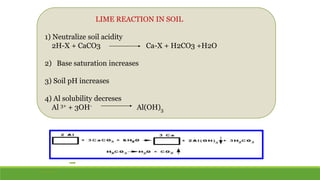
LIME REACTION IN SOIL
1) Neutralize soil acidity
2H-X + CaCO3 Ca-X + H2CO3 +H2O
2) Base saturation increases
3) Soil pH increases
4) Al solubility decreses
Al 3+ + 3OH- Al(OH)3
LIMING REACTIONS IN SOIL
Oxides of lime
2CaO + SOIL(H+ + Al 3+ ) + H2O SOIL(Ca) + Al(OH)3
Hydroxides of lime
Ca(OH)2 + SOIL(H+ + Al 3+ ) SOIL(Ca) + Al(OH)3
Silicates of calcium
2CaSiO3 +3H20+ SOIL(H+ + Al 3+ ) 2 H2SiO3 + SOIL(Ca) + Al(OH)3
Neutralizing value
The ability to neutralize acids expressed in terms of calcium carbonate equivalent.
Calcium carbonate is the standard by which other materials are measured ( 100%)
pH Level Acidic Soils
4.5 Citrus, Blue berries
5.0
Tobacco, Apple, Grapes, Plum,
watermelon
5.5
Cowpea, Soybean, Cotton,
Wheat, Oat, Peas, Tomato,
Sorghum.
6.0
Peanut, Cabbage, Carrot, Onion,
Radish, Spinach, Cauliflower.
6.5 Alfalfa, Sugarbeet
Crops Suitable For Cultivation in Acid Soils
The Role of Biochar on Acid Soil Reclamation and Yield of Teff (Eragrostis tef [Zucc] Trotter) in
Northwestern Ethiopia Anteneh Abewa1 , Birru Yitaferu1 , Yihenew G.Selassie2 & Tadele Amare1
Application of biochar at a level of 12 t/ ha recorded high yield in acid soil
EFFECT OF LIME AND PHOSPHORUS FERTILIZER ON ACID SOILS AND BARLEY (HORDEUM
VULGARE L.) PERFORMANCE IN THE CENTRAL HIGHLANDS OF ETHIOPIA
By TEMESGEN DESALEGN†‡§, GETACHEW ALEMU
Soil pH generally increased in a linear fashion with increasing lime rate. The increase
was highest with applications of the maximum rate (2.2 t ha−1) of lime.
Application of lime at 2.2 t/ha and P at a rate of 30 kg/ha increase soil pH and
recorded high yield
Neutralization of soil acidity by animal manures: mechanism of reaction
A. O. Ano1 and C. I. Ubochi2
Application of poultry manure significantly increase the soil pH and reduce the soil acidity
effectively
REFERENCES:
• Introductory soil science –D.K.das
• Soil genesis and classification –S.K Singh, P Chandran
• Acid soils of india – A.K Maji, G.P Omi Reddy, Dipak Sarkar (NBSS&LUP)
• The Chemistry of Soil Acidity -GRANT W. THOMAS WILLIAM L. HARGROVE
• POTENTIAL EFFECTS OF ACID PRECIPITATION ON SOILS IN THE HUMID
TEMPERATE ZONE - C. R. FRINK AND G. K. VOIGT
• Acid Rain on Acid Soil: A New Perspective -Edward C. Krug and Charles R. Frink
• https://www.soilmanagementindia.com/soil-properties/acid-soils-formation-
characteristics-and-lime-requirement/3672
• https://www.agric.wa.gov.au/soil-acidity/causes-soil-acidity
• http://www.biologydiscussion.com/soil/acid-soils-origin-classification-effects-and-
reclamation/7189
• Geographic relationships between soil and water acidity, soil-forming factors and
acid rain - EDWARD C. KRUG
• The Role of Biochar on Acid Soil Reclamation and Yield of Teff (Eragrostis tef [Zucc]
Trotter) in Northwestern Ethiopia Anteneh Abewa1 , Birru Yitaferu1 , Yihenew
G.Selassie2 & Tadele Amare1
• Effect of lime and phosphorus fertilizer on acid soils and barley (hordeum vulgare
l.) performance in the central highlands of ethiopia
By temesgen desalegn†‡§, getachew alemu
• Neutralization of soil acidity by animal manures: mechanism of reaction
A. O. Ano1 and C. I. Ubochi2
Acid soil formation and classification of acid soil in india

Acid soil formation and classification of acid soil in india

  • 1.
    ACID SOIL FORMATION CLASSIFCATIONAND AMELIORATION B.KARTHIKEYAN
  • 2.
     ACID SOILFORMING FACTORS  ACID SOIL FORMING PEDOGENIC PROCESS  ACID SOIL CLASSIFICATION  AMELIORATION OF SOIL ACIDITY  RESEARCH ARTICLES  REFERENCES NUT SHELL
  • 3.
    • In humidregions where evaporation is less than precipitation, chances for the development of acid soils are good. • In India, it is believed that the regions with acid soils must receive more than 750 mm annual rainfall. • The regions with annual rainfall 1350 mm may have acid soils with pH value 5.0 or even less than that. • In hilly regions where the loss of water through evaporation is very slow due to very low temperature the conditions for the development of acid soils are very favourable, although the rainfall is scanty there. • Excessive rainfall leaches the soil profile's basic elements (calcium, magnesium, sodium, and potassium) 1)Climate: I. ACID SOIL FORMING FACTORS
  • 4.
    2)Vegetation cover: • Accordingto Bloomfield (1953), the foliage leaves of conifers lack alkali elements and their mineralization process is very slow When the leaf-litter on the ground is degraded organic acids are released which gradually make the soils acidic. • In temperate regions or hilly areas covered with conifers the acid soils can develop easily. • Plants found in the coastal regions and marshy places after death and decay produce acids which render the soils acidic.
  • 5.
    GRANITE,MICRO GRANITE,RHYOLITE,SAND STONE,GNEISSare examples of acidic rocks • They are rich in silica and contain the minerals quartz, feldspar and biotite • In weathering they produce coarse texture soils • They are very much prone to leaching of bases , which results in formation of acidic soils 3)Parental rocks:
  • 6.
    • Development ofacid soil is possible on all type of rocks when the presence of favourable climate and vegetation • Development of acid soils on alkaline rocks take longer time as compared to the acid soils developing on the acidic parental rocks
  • 7.
    • Sloppy placeswith good drainage conditions are supposed to be good for the development of acid soils. On hill slopes, the development of acid soils is easy. • Acid soils do not develop generally in river basins. The plains with good drainage may also develop acid soils in due course of time. 4)Topography:
  • 8.
    Decomposition process requiresthe microorganism Microorganism - release the CO2 CO2 reacts with soil water can produce the carbonic acid. Acid soil 5)Decomposition of organic matter
  • 9.
    • This carbondioxide reacts with water to form carbonic acid • That reacts with the insoluble primary minerals present in the soil as well as the clay and humic micelle. • Suppose the clay and humic micelle have absorbed Ca++, Mg++, K+, Na+ and H+ ions in the ratio of 60:15:5:10:10. Carbonic acid reacts with clay micelle as shown below: • These soluble bicarbonates of calcium, magnesium, potassium and sodium are washed down by high rainfall in humid regions. So the above reversible reactions proceed in the forward direction.
  • 10.
    • Ammonium-based fertilizersare the major contributors to soil acidification, especially if the nitrogen is leached rather than taken up by plants • Ammonium nitrogen from fertilizer or soil organic matter is readily converted to nitrate and hydrogen ions by bacteria in the soil. This contributes different amounts of hydrogen ions to the soil, depending on the fertilizer • When nitrate, which is negatively charged, is taken up by plants, a hydroxide ion, also negatively charged, is released from the plant to maintain electrical balance. • This hydroxide ion combines with a hydrogen ion in the soil to form water (the hydrogen ion is no longer contributing to soil acidity). • If nitrate is not taken up by plants, it can leach away from the root zone, meaning that no hydroxide ion is released from the plant to bind with a hydrogen ion. 6)Application of N fertilizer :
  • 11.
    If nitrate leaches,a positively charged cation is also leached to maintain electrical balance. The cations that leach are usually sodium, potassium or calcium rather than hydrogen, because hydrogen ions are more strongly held by the soil - https ://www.agric.wa.gov.au/soil-acidity/causes-soil-acidity
  • 12.
    Application of Pfertilizers
  • 13.
    Application of Sfertilizers
  • 14.
    Fertilizer Eq.acidity Anhydrous Ammonia148 NH4Cl 128 (NH4)2SO4 110 Urea 80-84 (NH4)2SO4.NH4 NO3 93 DAP 77 Ammonium Nitrate 60 Mono-ammonium Phosphate 55 EQUIVALENT ACIDITY
  • 15.
  • 17.
    1)LATERIZATION Climate :tropical andsub tropical Parent material: Basalts, schist, basic parent material having ferromagnesium minerals Vegetation: tropical rain forest High rainfall favours intense leaching of basic cations (Na, K, Ca). Laterites soils are rich in Al & Fe- Acidic in nature Oxisol, Ultisol Ⅱ) ACID SOIL FORMING PEDOGENIC PROCESS Orders:
  • 18.
    2)PODZOLIZATION Climate: A coldand humid climate is most favorable for podzolization Parent material: Siliceous (Sandy) material Vegetation: Acid producing vegetation such as coniferous pines is essential. Decomposition of coniferous litter and siliceous material create a soil solution that is strongly acidic. This acidic soil solution enhances the processes of eluviation and leaching causing the removal of soluble base cations and aluminum and iron compounds from the A horizon Order: Spodosol
  • 19.
    1)According to theintensity of acidity, the acid soils are of the following five types: (1) Slight acidic (pH range 6.6 to 6.1) (2) Medium acidic (pH 6.0 to 5.6) (3) Strong acidic (pH 5.5 to 5.1) (4) Very strong acidic (pH 5.0 to 4.6) (5) Extremely strong acidic (pH 4.5 or lower) Ⅲ) CLASSIFICATION OF ACID SOIL
  • 21.
    • Acid soilsof india – A.K Maji, G.P Omi Reddy, Dipak Sarkar (NBSS&LUP)
  • 22.
    2)CLASSIFICATION BASED ONORGANIC CONTENT Mishra, S.G. (1976) (1) Acid mineral soils (organic matter less than 20%) (2) Acid organic soils (organic matter 20% or more) 1. Acid mineral soils: Such soils are further classified into the following three subgroups: (i) Acid mineral soils rich in organic matter in upper layer (ii) Acid mineral soils devoid of organic layer (iii)Degraded alkali soils 2. Acid organic soils: (i) Peaty Soils (ii) Mucky Soils
  • 23.
    (i)Acid mineral soilsrich in organic matter in upper layer: • Found in temperate and sub-temperate regions and develop by podsolization process • These regions are covered with thick forest vegetation • The degradation of organic matter results in the organic acids, such as citric acid, acetic acid, oxalic acid and so on. • Along with these acids and rain water sesqui oxides are also leached out from the upper horizons • This depletion of sesqui oxides from the top layer and their accumulation in lower sub layers is referred to as Podsolization and such soils are called Podzols.
  • 24.
    (ii) Acid mineralsoils devoid of organic layer: • Such soils originate mainly as a result of laterisation and part due to podzolisation process. Laterite soils, Red soils, and hydromorphic acid soils found in India belong to this category. a) CO2 of atmosphere as well as of soil dissolves in water to form carbonic acid (H2CO3) which, when percolates down the soil profiles, degrades carbonates and primary minerals present in the soils and make the soil acidic. b)In tropics, at high temperatures maximum degradation of silica takes place and in top soil layer the quantity of sesqui oxides increases. • This process is referred to as laterisation. Laterite and Red loam soils found in India have probably originated through this process. • At low temperatures Yellow red Podzolic and Grey Podzolic soils originate which are less acidic.
  • 25.
    (iii) Degraded alkalisoils: The top layer of some alkali soils shows a pH value less than 7 due to desalinisation or dealkalization. Such soils are referred to as degraded alkali soils. In this process. The alkali salts are washed by irrigation or rain water and exchangeable Na ions of soils are displaced by H+ ions of water.
  • 26.
    2. Acid organicsoils: (i) Peaty soils: Peaty soil are characterised by presence of poorly degraded organic matter In India, peaty soils occur in Kashmir, Himachal Pradesh, Assam and other Hill states. (ii) Mucky soils: Such soils contain highly degraded organic matter. They have relatively higher pH values than the peaty soils. Thus they are less acidic. Mucky soils are also found in Kashmir, Himachal Pradesh, Assam, and some other states.
  • 27.
    3)Mandal (1974) hasclassified acid soils of India into the following seven groups: S. No Soil group pH Character Area (M.ha) States 1 Laterite soil 4.8-7.0 Sub soil has a compact to vestibular mass containing compounds of sesquioxide 12.65 Karnataka, WB, Kerala, Bihar, M.P, Maharstra 2 Laterite and lateritic red soil 5.0-7.0 Top soil deep& gravelly.subsoil immature, clay &iron compounds leached down to B horizon 11.80 Kerala, orissa, Assam, santhal paraganas & singhbhum in Bihar 3 Mixed red and black soil 5.5-6.5 Free of lime concrete is found on surface.color varies according to moisture& iron compound 23.66 Karnataka,Bihar,M.P,U .P 4 Ferruginous red soil 5.0-6.8 Sesquioxide is deposited in spots.limi concretions are found,stony some times gravelly 8.9 Tamil Nadu, parts of Karnataka, south east Maharastra, Goa, A.P, Bihar, Orissa
  • 28.
    S. No Soil group pHCharacter Area (M.ha) States 5 Podzolic and brown forest soil 4.5-6.5 Formed in temperate zones under coniferous vegetation. Humus, iron aluminium leach down and deposit in B horizon of soil 22.47 J&K,U.P, W.B, Assam, M.P, H.P, Orissa 6 Foot hill soil 4.5-4.6 Formed by alluvial particles brought down by rivers from hills mostly sandy 8.0 J&K, U.P, W.B, Bihar 7 Peat and muck soil 3.5-4.5 Undecomposed & decomposed organic matter (>20%) 0.2 Kerala, J&K, H.P, U.P
  • 29.
    Ⅳ) AMELIORATION OFSOIL ACIDITY Lime as reclaiming agent :  Lime is added to neutralize acidity and to increase the pH, so that the availability of nutrients will be increased.  Basic slag obtained from Iron and steel industry can be substituted for lime. It contains about 48-54% of CaO and 3-4% MgO.  Ammonium sulphate and Ammonium chloride should not be applied to acid soils but urea can be applied.  Calcium Ammonium Nitrate (CAN) is suitable to acid soils. Any citrate soluble phosphate fertilizer is good source of phosphorous for acid soils. Eg. Dicalcium phosphate (DCP), Tricalcium phosphate (TCP) Potassium sulphate is a suitable source of 'K' for acid soils. But MOP is better than K2SO4 because Cl of MOP replaces -OH ions, their by release of -OH ions tends to increase the pH.
  • 30.
    LIME REACTION INSOIL 1) Neutralize soil acidity 2H-X + CaCO3 Ca-X + H2CO3 +H2O 2) Base saturation increases 3) Soil pH increases 4) Al solubility decreses Al 3+ + 3OH- Al(OH)3
  • 31.
    LIMING REACTIONS INSOIL Oxides of lime 2CaO + SOIL(H+ + Al 3+ ) + H2O SOIL(Ca) + Al(OH)3 Hydroxides of lime Ca(OH)2 + SOIL(H+ + Al 3+ ) SOIL(Ca) + Al(OH)3 Silicates of calcium 2CaSiO3 +3H20+ SOIL(H+ + Al 3+ ) 2 H2SiO3 + SOIL(Ca) + Al(OH)3
  • 32.
    Neutralizing value The abilityto neutralize acids expressed in terms of calcium carbonate equivalent. Calcium carbonate is the standard by which other materials are measured ( 100%)
  • 33.
    pH Level AcidicSoils 4.5 Citrus, Blue berries 5.0 Tobacco, Apple, Grapes, Plum, watermelon 5.5 Cowpea, Soybean, Cotton, Wheat, Oat, Peas, Tomato, Sorghum. 6.0 Peanut, Cabbage, Carrot, Onion, Radish, Spinach, Cauliflower. 6.5 Alfalfa, Sugarbeet Crops Suitable For Cultivation in Acid Soils
  • 34.
    The Role ofBiochar on Acid Soil Reclamation and Yield of Teff (Eragrostis tef [Zucc] Trotter) in Northwestern Ethiopia Anteneh Abewa1 , Birru Yitaferu1 , Yihenew G.Selassie2 & Tadele Amare1 Application of biochar at a level of 12 t/ ha recorded high yield in acid soil
  • 35.
    EFFECT OF LIMEAND PHOSPHORUS FERTILIZER ON ACID SOILS AND BARLEY (HORDEUM VULGARE L.) PERFORMANCE IN THE CENTRAL HIGHLANDS OF ETHIOPIA By TEMESGEN DESALEGN†‡§, GETACHEW ALEMU Soil pH generally increased in a linear fashion with increasing lime rate. The increase was highest with applications of the maximum rate (2.2 t ha−1) of lime.
  • 36.
    Application of limeat 2.2 t/ha and P at a rate of 30 kg/ha increase soil pH and recorded high yield
  • 37.
    Neutralization of soilacidity by animal manures: mechanism of reaction A. O. Ano1 and C. I. Ubochi2 Application of poultry manure significantly increase the soil pH and reduce the soil acidity effectively
  • 38.
    REFERENCES: • Introductory soilscience –D.K.das • Soil genesis and classification –S.K Singh, P Chandran • Acid soils of india – A.K Maji, G.P Omi Reddy, Dipak Sarkar (NBSS&LUP) • The Chemistry of Soil Acidity -GRANT W. THOMAS WILLIAM L. HARGROVE • POTENTIAL EFFECTS OF ACID PRECIPITATION ON SOILS IN THE HUMID TEMPERATE ZONE - C. R. FRINK AND G. K. VOIGT • Acid Rain on Acid Soil: A New Perspective -Edward C. Krug and Charles R. Frink
  • 39.
    • https://www.soilmanagementindia.com/soil-properties/acid-soils-formation- characteristics-and-lime-requirement/3672 • https://www.agric.wa.gov.au/soil-acidity/causes-soil-acidity •http://www.biologydiscussion.com/soil/acid-soils-origin-classification-effects-and- reclamation/7189 • Geographic relationships between soil and water acidity, soil-forming factors and acid rain - EDWARD C. KRUG • The Role of Biochar on Acid Soil Reclamation and Yield of Teff (Eragrostis tef [Zucc] Trotter) in Northwestern Ethiopia Anteneh Abewa1 , Birru Yitaferu1 , Yihenew G.Selassie2 & Tadele Amare1
  • 40.
    • Effect oflime and phosphorus fertilizer on acid soils and barley (hordeum vulgare l.) performance in the central highlands of ethiopia By temesgen desalegn†‡§, getachew alemu • Neutralization of soil acidity by animal manures: mechanism of reaction A. O. Ano1 and C. I. Ubochi2