

Presented By
A.Bharat kumar
Soil exploration
Site investigation (or) subsurface explorations are
done for obtaining. The information about sub
surface conditions at the site of proposed
construction. Information about the surface and
sub surface features is essential for the design of
structure and for planning construction
techniques.
Con……
Soil exploration consists of determining:-
 soil and rock profile.
Geological features of the region.
Position and variation of ground water table.
Physical properties of soil and rock.
Contamination
General data of adjacent structure , hydrology data
, topography soil maps , seismicity etc.
Site investigation
Site investigation are generally done to obtain the
information that is useful for one (or) more of the
following purposes.
A. To select the type and depth of foundation for a
given structure.
B. To determine the bearing capacity of soil.
C. To estimate the probable maximum and
differential settlement.
Con……
D . To establish the ground water level and to
determine the properties of water.
E. To predict the lateral earth pressure against
retaining walls and abutments.
F. To select suitable construction techniques.
G. To as certain the suitability of soil as a
construction material.
H. To investigate the safety of existing structure and
to suggest the remedial measures.
Aspects
Aspects of soil exploration
1. Planning
2. Execution
3. Report writing
Planning a subsurface
exploration program me
A surface exploration program me depends upon
the type of the structure to be built and the
variability of strata at proposed site and also upon
the location of project.
A small house in an already build up are a would
not require much exploration.
If a house is to be build in a newly developed area a
detailed investigation would be required.
If a multi strayed building is to be constructed
extensive sub-surface exploration would be
necessary.
These buildings improve very heavy loads and the
zone of influence is also very deep.
Planning of a sub surface exploration program me
is a difficult task.
Some times the exploration program me has to be
changed of the investigation progresses.
Variability of soil strata found to increase the
extent of investigation also increase.
If the site is found to be uniform , the extent of
investigation is decreased.
Main aim of investigation should be to get
maximum information of project at a minimum
cost.
The cost of site investigation generally varies
between 0.05 % to 0.2% of the total cost of the
entire structure, for some in usual conditions, the
cost may be even upto 1%.
Execution
The depth of exploration is governed by the depth
of influence zone , which depends upon the type
of structure, intensity of loading shape and
disposition of the loaded area, the soil profile and
the physical characteristics of the soil.
The depth upto which the stress increment due to
super imposed loads can produce significant
settlement and shear stress is known as the
significant depth . The depth of exploration should
be atleast equal to the significant depth.
The significant depth is generally taken as the
depth at which the vertical stress is 20% of the
load intensity.
The depth of exploration should be about 1.5 times
the width of square footing, and about 3.0 times
the width of strip footing . In case of a raft
foundation, the depth of boring should at least 1.5
times the width of the entire loaded area . In case
of pile foundation, the depth of imploration below
the tip of bearing piles is kept atleast 1.5 times the
width of the pile group for frictional piles, the
DOE is taken the width of the pile DOE is taken
1.5 times the width of the pile group measured
from the lower third point(c).
The depth of exploration is usually taken upto the
level at which the increase in stress is 1/20th of the
insitu stress before the application of load.
When foundations are taken upto rock, it should
be ensured that large boulders are not mistaken as
bed rock min depth of core boring into bed rock
should be 3M to establish it as a rock.
In case of multi storyed buildings, depth of
exploration can be taken from following formula.
D=c(s)^0.7
D=DOE
C=constant
C=3, for light steel and narrow concrete building.
C=6, for heavy steel and wide concrete buildings.
S= No. Of storey's.
In case of road cuts DOE at least equal to width of cut.
For small fills, DOE (min) =2m below ground level or
equal to height of the fill, which is greater.
Gravity dams,
Min depth = 2 times height of dam.
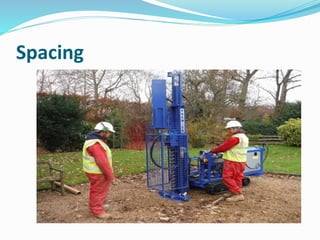
Spacing
Depends on variation of strata in horizontal
direction.
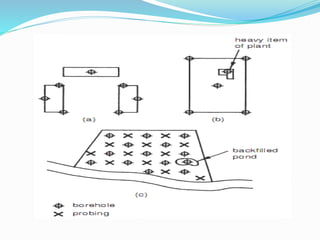
For small and less important buildings even one
bore hole or a trial pit in the center may be
sufficient.
For compact buildings of area 0.4 hectares there
should be at least 5 bore holes one at center and
four near corners.
For large multi storeyed buildings, BH should be
drilled at all corners and also at important locations.
The spacing between bore holes in generally kept
between 10 to 30m depending upon variation in sub
surface conditions and loading.
For high ways sub surface exploration are usually
carried out along propose of center line or along ditch
line spacing 150m-300m.
If sub surface strata is enteric, the spacing may be
reduced to 30m.
Concrete dams spacing 40m – 80m.
Spacing
Report writing
 Each group will submit one report per lab
 Reports are due one day before the class at 9am
(EX:- for wed. class, submit report on tuesday
at9am)
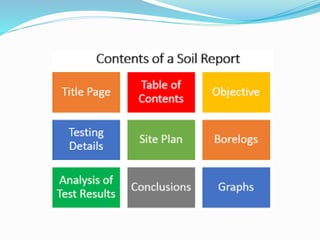
• All reports should follow the report format
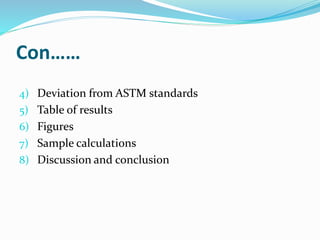
1) Title and table of contents
2) Purpose & objective
3) Apparatus & procedures
Con……
4) Deviation from ASTM standards
5) Table of results
6) Figures
7) Sample calculations
8) Discussion and conclusion
Soil exploration
Soil exploration

Soil exploration

  • 1.
  • 2.
    Soil exploration Site investigation(or) subsurface explorations are done for obtaining. The information about sub surface conditions at the site of proposed construction. Information about the surface and sub surface features is essential for the design of structure and for planning construction techniques.
  • 3.
    Con…… Soil exploration consistsof determining:-  soil and rock profile. Geological features of the region. Position and variation of ground water table. Physical properties of soil and rock. Contamination General data of adjacent structure , hydrology data , topography soil maps , seismicity etc.
  • 5.
    Site investigation Site investigationare generally done to obtain the information that is useful for one (or) more of the following purposes. A. To select the type and depth of foundation for a given structure. B. To determine the bearing capacity of soil. C. To estimate the probable maximum and differential settlement.
  • 6.
    Con…… D . Toestablish the ground water level and to determine the properties of water. E. To predict the lateral earth pressure against retaining walls and abutments. F. To select suitable construction techniques. G. To as certain the suitability of soil as a construction material. H. To investigate the safety of existing structure and to suggest the remedial measures.
  • 7.
    Aspects Aspects of soilexploration 1. Planning 2. Execution 3. Report writing
  • 8.
    Planning a subsurface explorationprogram me A surface exploration program me depends upon the type of the structure to be built and the variability of strata at proposed site and also upon the location of project. A small house in an already build up are a would not require much exploration. If a house is to be build in a newly developed area a detailed investigation would be required.
  • 9.
    If a multistrayed building is to be constructed extensive sub-surface exploration would be necessary. These buildings improve very heavy loads and the zone of influence is also very deep. Planning of a sub surface exploration program me is a difficult task. Some times the exploration program me has to be changed of the investigation progresses. Variability of soil strata found to increase the extent of investigation also increase.
  • 10.
    If the siteis found to be uniform , the extent of investigation is decreased. Main aim of investigation should be to get maximum information of project at a minimum cost. The cost of site investigation generally varies between 0.05 % to 0.2% of the total cost of the entire structure, for some in usual conditions, the cost may be even upto 1%.
  • 11.
    Execution The depth ofexploration is governed by the depth of influence zone , which depends upon the type of structure, intensity of loading shape and disposition of the loaded area, the soil profile and the physical characteristics of the soil. The depth upto which the stress increment due to super imposed loads can produce significant settlement and shear stress is known as the significant depth . The depth of exploration should be atleast equal to the significant depth.
  • 12.
    The significant depthis generally taken as the depth at which the vertical stress is 20% of the load intensity. The depth of exploration should be about 1.5 times the width of square footing, and about 3.0 times the width of strip footing . In case of a raft foundation, the depth of boring should at least 1.5 times the width of the entire loaded area . In case of pile foundation, the depth of imploration below the tip of bearing piles is kept atleast 1.5 times the width of the pile group for frictional piles, the DOE is taken the width of the pile DOE is taken
  • 13.
    1.5 times thewidth of the pile group measured from the lower third point(c). The depth of exploration is usually taken upto the level at which the increase in stress is 1/20th of the insitu stress before the application of load. When foundations are taken upto rock, it should be ensured that large boulders are not mistaken as bed rock min depth of core boring into bed rock should be 3M to establish it as a rock. In case of multi storyed buildings, depth of exploration can be taken from following formula.
  • 14.
    D=c(s)^0.7 D=DOE C=constant C=3, for lightsteel and narrow concrete building. C=6, for heavy steel and wide concrete buildings. S= No. Of storey's. In case of road cuts DOE at least equal to width of cut. For small fills, DOE (min) =2m below ground level or equal to height of the fill, which is greater. Gravity dams, Min depth = 2 times height of dam.
  • 16.
    Spacing Depends on variationof strata in horizontal direction. For small and less important buildings even one bore hole or a trial pit in the center may be sufficient. For compact buildings of area 0.4 hectares there should be at least 5 bore holes one at center and four near corners. For large multi storeyed buildings, BH should be
  • 17.
    drilled at allcorners and also at important locations. The spacing between bore holes in generally kept between 10 to 30m depending upon variation in sub surface conditions and loading. For high ways sub surface exploration are usually carried out along propose of center line or along ditch line spacing 150m-300m. If sub surface strata is enteric, the spacing may be reduced to 30m. Concrete dams spacing 40m – 80m.
  • 18.
  • 20.
    Report writing  Eachgroup will submit one report per lab  Reports are due one day before the class at 9am (EX:- for wed. class, submit report on tuesday at9am) • All reports should follow the report format 1) Title and table of contents 2) Purpose & objective 3) Apparatus & procedures
  • 21.
    Con…… 4) Deviation fromASTM standards 5) Table of results 6) Figures 7) Sample calculations 8) Discussion and conclusion