Presented By
A.Bharat kumar
 Rice husk is an agricultural residue which
accounts for 20% of the 649.7 million tons of rice
produced annually worldwide.The produced
partially burnt husk from the milling plants when
used as a fuel also contributes to pollution and
efforts are being made to overcome this
environmental issue by utilizing this material as
a supplementary cementing material.The
chemical composition of rice husk ash is found to
vary from one sample to another due to the
differences in the type of paddy, crop year,
climate and geographical conditions.Burning the
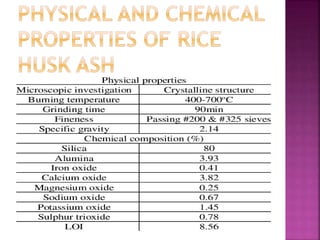
husk under controlled temperature below 800 °C
can produce ash with silica mainly in amorphous
form. Recently, Nair et al. reported an
investigation on the pozzolanic activity of RHA by
using various techniques in order to verify the
effect of incineration temperature and burning
duration. He stated that the samples burnt at
5000C or 700°C and burned for more than 12 hours
produced ashes with high reactivity with no
significant amount of crystalline material. The
short burning durations (15 - 360 minutes) resulted
in high carbon content for the produced RHA even
with high incinerating temperatures of 5000C to
700 °C. A state-of-the-art report on rice husk ash
(RHA) was published by Mehta in 1992, and contain
a review of physical and chemical properties of
RHA, the effect of incineration conditions on the
pozzolanic characteristics of the ash, and a
summary of the research findings from several
countries on the use of RHA as a
supplementary cementing pozzolanic material.
According to the author's literature,
RHA has not been utilized in the construction
industry yet, the reason for that may be due to
the lack of understanding of the RHA blended
concrete characteristics.
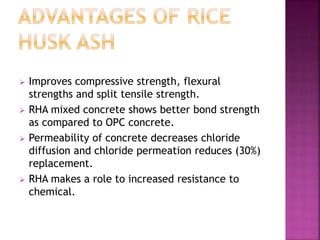
 Improves compressive strength, flexural
strengths and split tensile strength.
 RHA mixed concrete shows better bond strength
as compared to OPC concrete.
 Permeability of concrete decreases chloride
diffusion and chloride permeation reduces (30%)
replacement.
 RHA makes a role to increased resistance to
chemical.
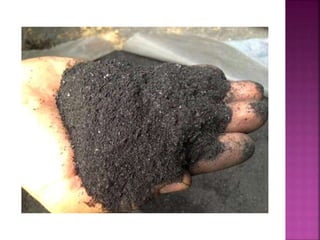
Rice husk ash

Rice husk ash

  • 1.
  • 2.
     Rice huskis an agricultural residue which accounts for 20% of the 649.7 million tons of rice produced annually worldwide.The produced partially burnt husk from the milling plants when used as a fuel also contributes to pollution and efforts are being made to overcome this environmental issue by utilizing this material as a supplementary cementing material.The chemical composition of rice husk ash is found to vary from one sample to another due to the differences in the type of paddy, crop year, climate and geographical conditions.Burning the husk under controlled temperature below 800 °C
  • 3.
    can produce ashwith silica mainly in amorphous form. Recently, Nair et al. reported an investigation on the pozzolanic activity of RHA by using various techniques in order to verify the effect of incineration temperature and burning duration. He stated that the samples burnt at 5000C or 700°C and burned for more than 12 hours produced ashes with high reactivity with no significant amount of crystalline material. The short burning durations (15 - 360 minutes) resulted in high carbon content for the produced RHA even with high incinerating temperatures of 5000C to 700 °C. A state-of-the-art report on rice husk ash (RHA) was published by Mehta in 1992, and contain
  • 4.
    a review ofphysical and chemical properties of RHA, the effect of incineration conditions on the pozzolanic characteristics of the ash, and a summary of the research findings from several countries on the use of RHA as a supplementary cementing pozzolanic material. According to the author's literature, RHA has not been utilized in the construction industry yet, the reason for that may be due to the lack of understanding of the RHA blended concrete characteristics.
  • 7.
     Improves compressivestrength, flexural strengths and split tensile strength.  RHA mixed concrete shows better bond strength as compared to OPC concrete.  Permeability of concrete decreases chloride diffusion and chloride permeation reduces (30%) replacement.  RHA makes a role to increased resistance to chemical.