P R E S E N T E D B Y
A . B H A R AT K U M A R
B . T E C H , M . T E C H
SHALLOW
FOUNDATIONS
SHALLOW FOUNDATIONS
 Spread footings
 Square
 Rectangular
 Circular
 Continuous
 Mat (Raft) foundations
SPREAD FOOTINGS
 Made from reinforced concrete
 Square (B x B)-Usually one column
 Rectangular (B x L)-When large M is needed
 Circular (D/B<3, Rounded)-Flagpoles, transmission
lines
 Continuous (Strip)-Support of bearing walls
 Combined (Cantilever)-Provides necessary M to
prevent failure. Desirable when load is eccentric and
construction close to property line.
MAT (RAFT) FOUNDATIONS
 Necessary when the soil is weaker and more
compressible
 Since large area is needed from a spread footing, mat
foundation is more economic.
 Advantages
 Spread the load in a larger area-Increase bearing
pressure
 Provides more structural rigidity-Reduce settlement
 Heavier-More resistant to uplift
 Distributes loads more evenly
DEEP FOUNDATIONS
 When shallow foundations cannot carry the loads
 Due to poor soils conditions
 When upper soils are subject to scour
 Piles-prefabricated small-size (usually < 2 ft or 0.6 m
diameter or side) poles made from steel (H or pipe
piles), wood or concrete and installed by a variety of
methods (driving, hydraulic jacking, jetting, vibration,
boring)
 Drilled shafts-Drilled cylindrical holes (usually > 2ft or
0.60 m in diameter) and filled with concrete and steel
reinforcement
SHALLOW FOUNDATIONS
Bearing Capacity
 Gross Bearing pressure
q = (P+Wf)/A – u
where Wf =gc*D*A, u = pore water pressure
 Net Bearing pressure = Gross Bearing pressure –
Effective stress
 q = P/A + gc*D– u SQUARE FOOTINGS
 q = P/(B*b) + gc*D– u CONTINUOUS FOOTINGS
SHALLOW FOUNDATIONS
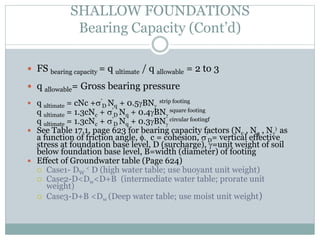
Bearing Capacity (Cont’d)
 FS bearing capacity = q ultimate / q allowable = 2 to 3
 q allowable= Gross bearing pressure
 q ultimate = cNc +s’
D Nq + 0.5gBNg
strip footing
q ultimate = 1.3cNc + s’
D Nq + 0.4gBNg
square footing
q ultimate = 1.3cNc + s’
D Nq + 0.3gBNg
circular footingf
 See Table 17.1, page 623 for bearing capacity factors (Nc , Nq , Ng
) as
a function of friction angle, f. c = cohesion, s’
D= vertical effective
stress at foundation base level, D (surcharge), g=unit weight of soil
below foundation base level, B=width (diameter) of footing
 Effect of Groundwater table (Page 624)
 Case1- DW
< D (high water table; use buoyant unit weight)
 Case2-D<Dw<D+B (intermediate water table; prorate unit
weight)
 Case3-D+B <Dw (Deep water table; use moist unit weight)
SHALLOW FOUNDATIONS
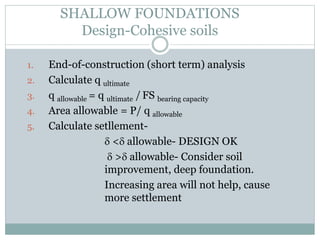
Design-Cohesive soils
1. End-of-construction (short term) analysis
2. Calculate q ultimate
3. q allowable = q ultimate / FS bearing capacity
4. Area allowable = P/ q allowable
5. Calculate setllement-
d <d allowable- DESIGN OK
d >d allowable- Consider soil
improvement, deep foundation.
Increasing area will not help, cause
more settlement
SHALLOW FOUNDATIONS
Design-Cohesionless soils
1. Drained (long term) analysis
2. Calculate q ultimate
Assume B to calculate q ultimate
3. q allowable = q ultimate / FS bearing capacity
4. Area allowable = P/ q allowable will give you B.
Iterate until B assumed = B computed
5. Check if q allowable is OK for settlement case (usually
at most 1 inch)
Deep Foundations Design
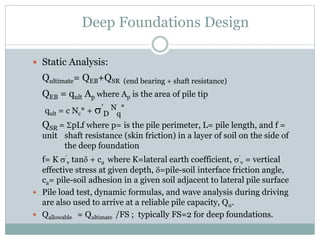
 Static Analysis:
Qultimate= QEB+QSR (end bearing + shaft resistance)
QEB = qult Ap where Ap is the area of pile tip
qult = c Nc* + s’
D
N
q
*
QSR = SpLf where p= is the pile perimeter, L= pile length, and f =
unit shaft resistance (skin friction) in a layer of soil on the side of
the deep foundation
f= K s’
v tand + ca where K=lateral earth coefficient, s’
v = vertical
effective stress at given depth, d=pile-soil interface friction angle,
ca= pile-soil adhesion in a given soil adjacent to lateral pile surface
 Pile load test, dynamic formulas, and wave analysis during driving
are also used to arrive at a reliable pile capacity, Qu.
 Qallowable = Qultimate /FS ; typically FS=2 for deep foundations.
Bearing Capacity Factors for Deep Foundations (Meyerhof, 1976)
foundations

foundations

  • 1.
    P R ES E N T E D B Y A . B H A R AT K U M A R B . T E C H , M . T E C H SHALLOW FOUNDATIONS
  • 2.
    SHALLOW FOUNDATIONS  Spreadfootings  Square  Rectangular  Circular  Continuous  Mat (Raft) foundations
  • 3.
    SPREAD FOOTINGS  Madefrom reinforced concrete  Square (B x B)-Usually one column  Rectangular (B x L)-When large M is needed  Circular (D/B<3, Rounded)-Flagpoles, transmission lines  Continuous (Strip)-Support of bearing walls  Combined (Cantilever)-Provides necessary M to prevent failure. Desirable when load is eccentric and construction close to property line.
  • 4.
    MAT (RAFT) FOUNDATIONS Necessary when the soil is weaker and more compressible  Since large area is needed from a spread footing, mat foundation is more economic.  Advantages  Spread the load in a larger area-Increase bearing pressure  Provides more structural rigidity-Reduce settlement  Heavier-More resistant to uplift  Distributes loads more evenly
  • 5.
    DEEP FOUNDATIONS  Whenshallow foundations cannot carry the loads  Due to poor soils conditions  When upper soils are subject to scour  Piles-prefabricated small-size (usually < 2 ft or 0.6 m diameter or side) poles made from steel (H or pipe piles), wood or concrete and installed by a variety of methods (driving, hydraulic jacking, jetting, vibration, boring)  Drilled shafts-Drilled cylindrical holes (usually > 2ft or 0.60 m in diameter) and filled with concrete and steel reinforcement
  • 6.
    SHALLOW FOUNDATIONS Bearing Capacity Gross Bearing pressure q = (P+Wf)/A – u where Wf =gc*D*A, u = pore water pressure  Net Bearing pressure = Gross Bearing pressure – Effective stress  q = P/A + gc*D– u SQUARE FOOTINGS  q = P/(B*b) + gc*D– u CONTINUOUS FOOTINGS
  • 7.
    SHALLOW FOUNDATIONS Bearing Capacity(Cont’d)  FS bearing capacity = q ultimate / q allowable = 2 to 3  q allowable= Gross bearing pressure  q ultimate = cNc +s’ D Nq + 0.5gBNg strip footing q ultimate = 1.3cNc + s’ D Nq + 0.4gBNg square footing q ultimate = 1.3cNc + s’ D Nq + 0.3gBNg circular footingf  See Table 17.1, page 623 for bearing capacity factors (Nc , Nq , Ng ) as a function of friction angle, f. c = cohesion, s’ D= vertical effective stress at foundation base level, D (surcharge), g=unit weight of soil below foundation base level, B=width (diameter) of footing  Effect of Groundwater table (Page 624)  Case1- DW < D (high water table; use buoyant unit weight)  Case2-D<Dw<D+B (intermediate water table; prorate unit weight)  Case3-D+B <Dw (Deep water table; use moist unit weight)
  • 8.
    SHALLOW FOUNDATIONS Design-Cohesive soils 1.End-of-construction (short term) analysis 2. Calculate q ultimate 3. q allowable = q ultimate / FS bearing capacity 4. Area allowable = P/ q allowable 5. Calculate setllement- d <d allowable- DESIGN OK d >d allowable- Consider soil improvement, deep foundation. Increasing area will not help, cause more settlement
  • 9.
    SHALLOW FOUNDATIONS Design-Cohesionless soils 1.Drained (long term) analysis 2. Calculate q ultimate Assume B to calculate q ultimate 3. q allowable = q ultimate / FS bearing capacity 4. Area allowable = P/ q allowable will give you B. Iterate until B assumed = B computed 5. Check if q allowable is OK for settlement case (usually at most 1 inch)
  • 10.
    Deep Foundations Design Static Analysis: Qultimate= QEB+QSR (end bearing + shaft resistance) QEB = qult Ap where Ap is the area of pile tip qult = c Nc* + s’ D N q * QSR = SpLf where p= is the pile perimeter, L= pile length, and f = unit shaft resistance (skin friction) in a layer of soil on the side of the deep foundation f= K s’ v tand + ca where K=lateral earth coefficient, s’ v = vertical effective stress at given depth, d=pile-soil interface friction angle, ca= pile-soil adhesion in a given soil adjacent to lateral pile surface  Pile load test, dynamic formulas, and wave analysis during driving are also used to arrive at a reliable pile capacity, Qu.  Qallowable = Qultimate /FS ; typically FS=2 for deep foundations.
  • 11.
    Bearing Capacity Factorsfor Deep Foundations (Meyerhof, 1976)