Soil erosion assessment using RUSLE and
Projection Augmented Landscape Model
(PALM) as a participatory tool in a Mexican
peasant community
José María León Villalobos, José Manuel Madrigal Gómez, Nirani
Corona Romero, Joaliné Pardo Nuñez; Mario González Stefanoni.
Centro de Investigación en Ciencias de Información
Geoespacial (Centro Geo) A.C., Mexico
1
2
Introduction
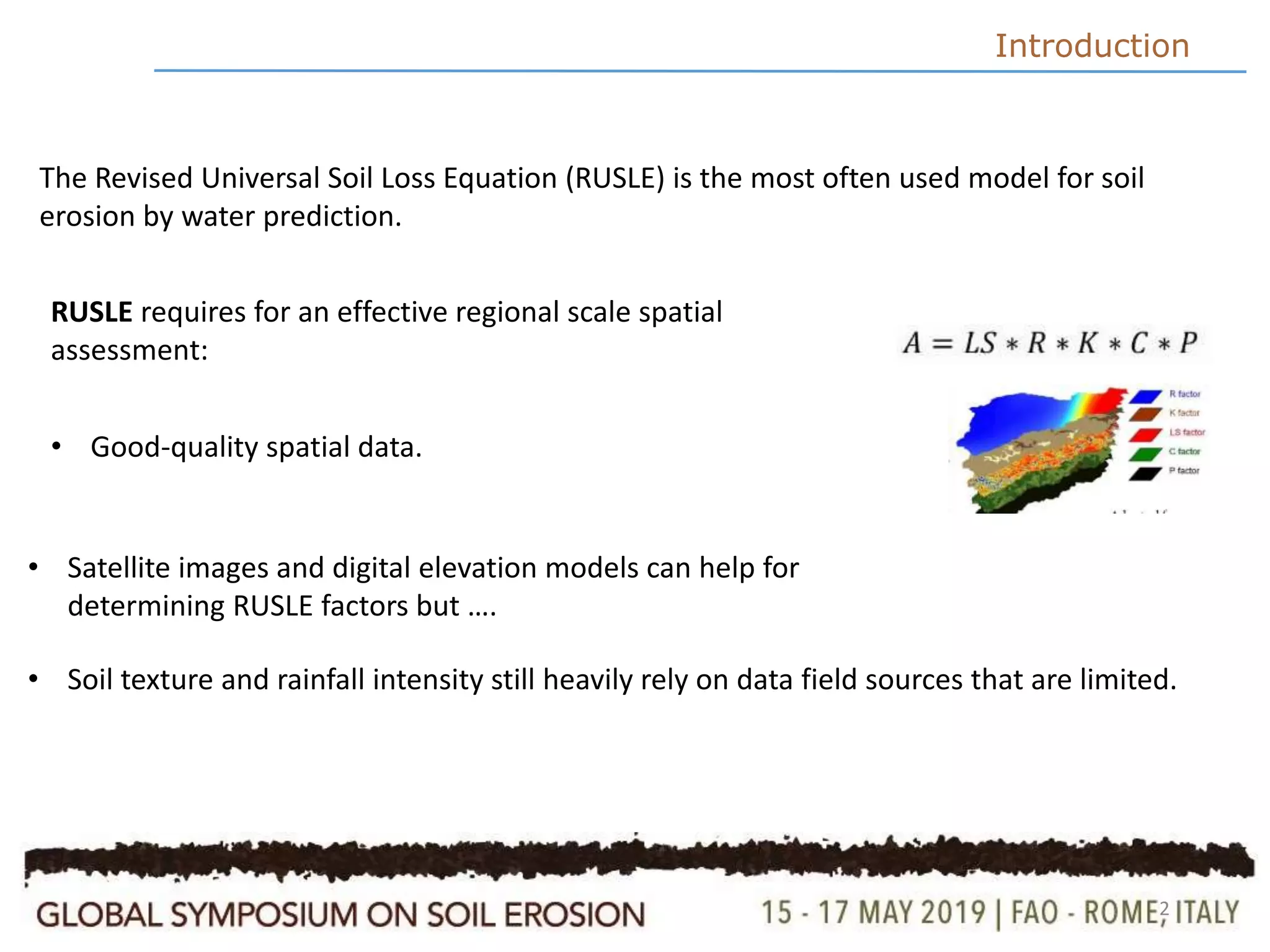
The Revised Universal Soil Loss Equation (RUSLE) is the most often used model for soil
erosion by water prediction.
RUSLE requires for an effective regional scale spatial
assessment:
• Good-quality spatial data.
• Satellite images and digital elevation models can help for
determining RUSLE factors but ….
• Soil texture and rainfall intensity still heavily rely on data field sources that are limited.
3
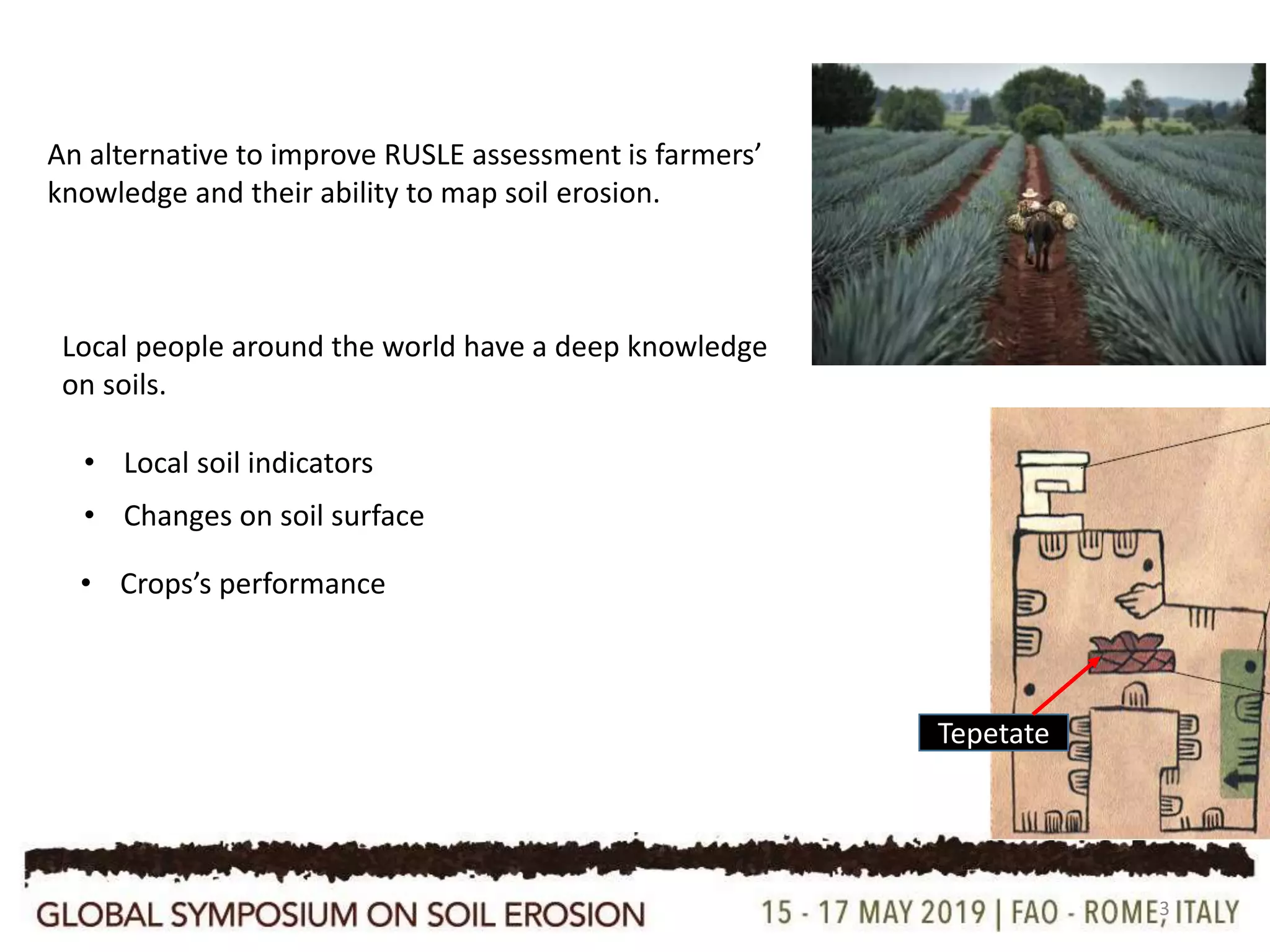
Tepetate
Local people around the world have a deep knowledge
on soils.
An alternative to improve RUSLE assessment is farmers’
knowledge and their ability to map soil erosion.
• Local soil indicators
• Crops’s performance
• Changes on soil surface
4
This research aimed at
Objectives
a) Identify areas where erosion by water has taken place based on local farmers’s
knowledge by means of participatory mapping.
c) Produce a refined RUSLE map including local knowledge / perceptions on soil erosion by
water.
b) Collectively explore the underlying causes and consequences of soil erosion in Costa
Grande south, Mexico;
5
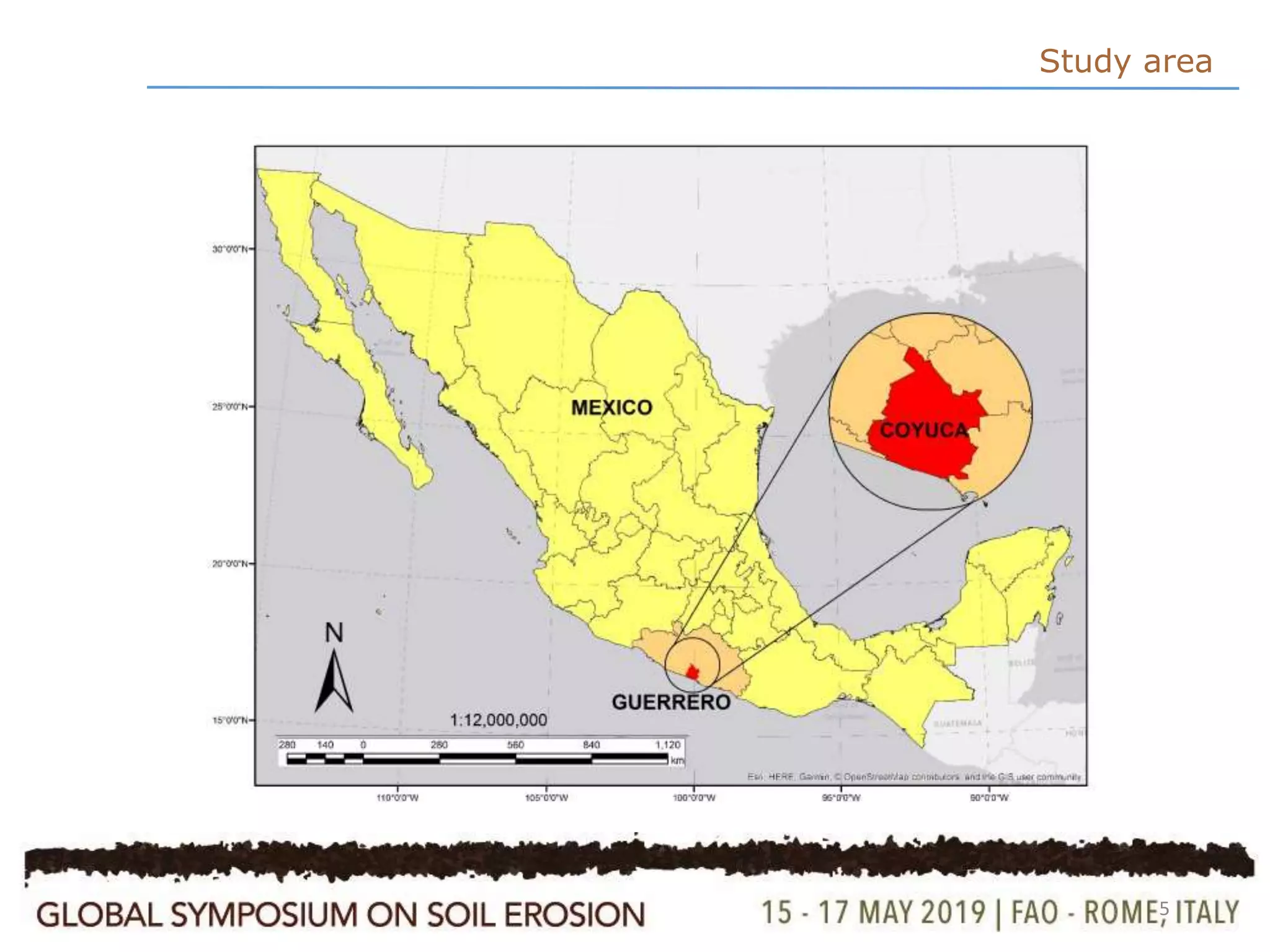
Study area
6
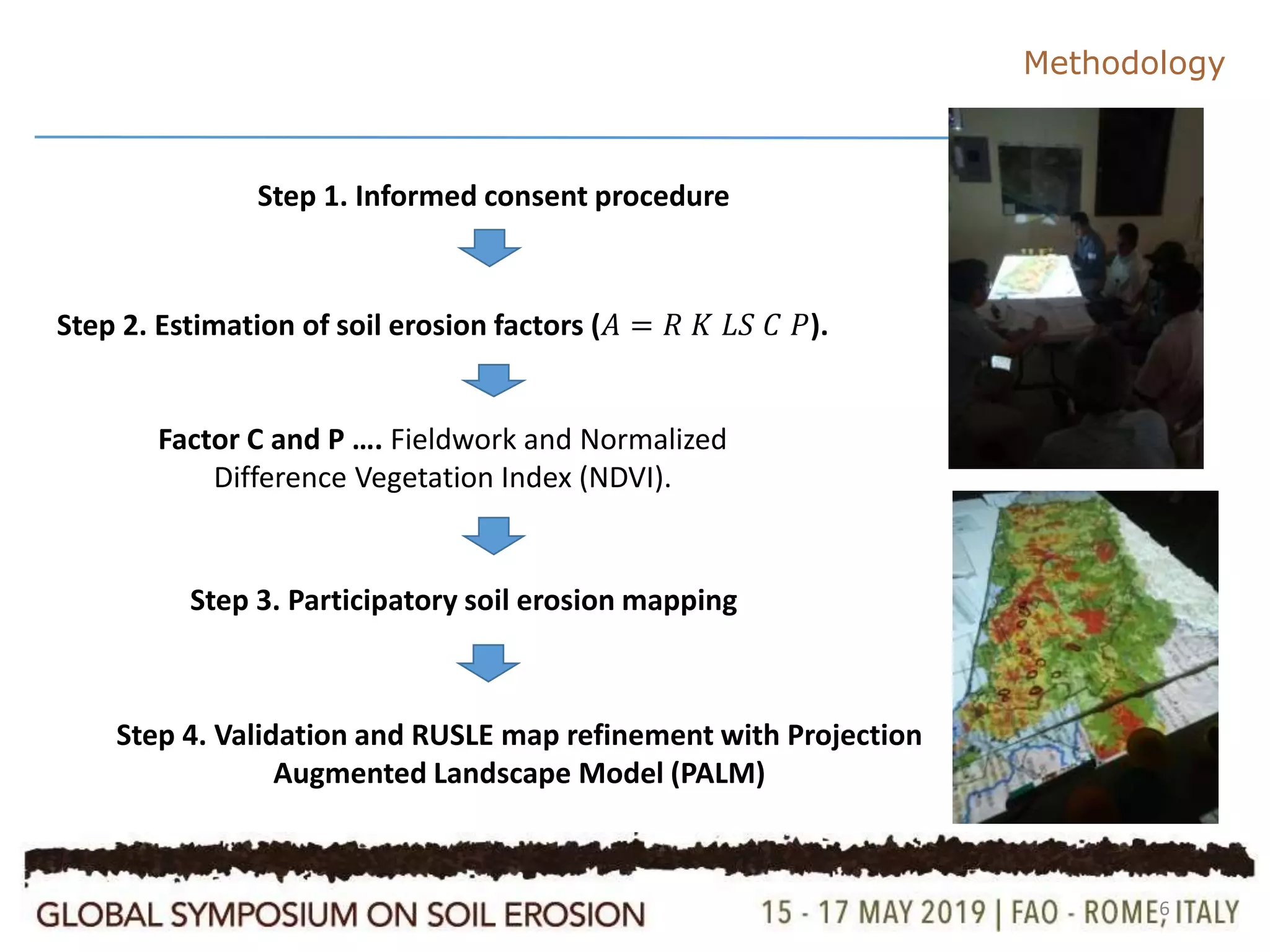
Methodology
Step 1. Informed consent procedure
Step 2. Estimation of soil erosion factors (𝐴 = 𝑅 𝐾 𝐿𝑆 𝐶 𝑃).
Factor C and P …. Fieldwork and Normalized
Difference Vegetation Index (NDVI).
Step 3. Participatory soil erosion mapping
Step 4. Validation and RUSLE map refinement with Projection
Augmented Landscape Model (PALM)
7
Results
Identification of erosion soil units
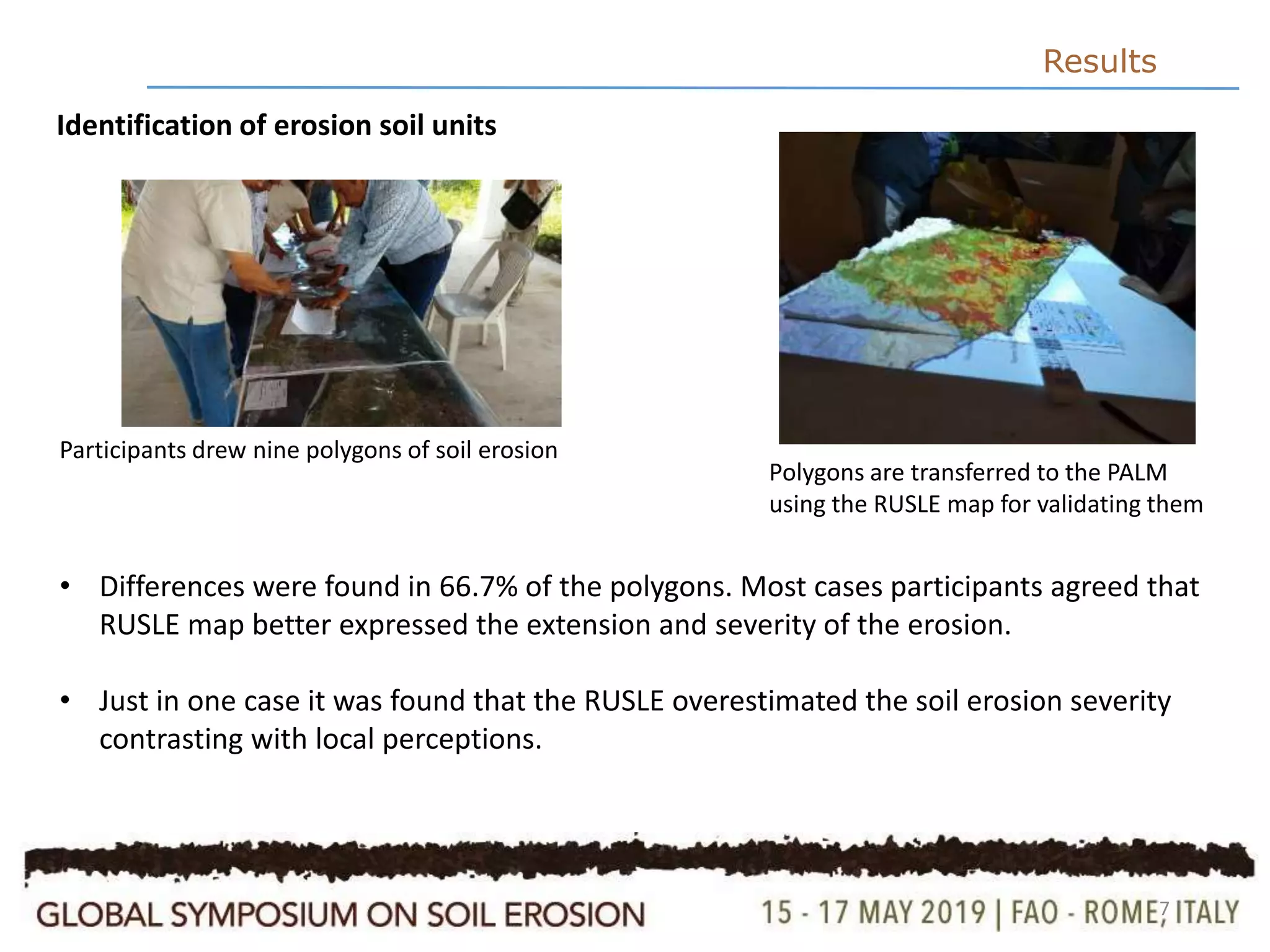
Participants drew nine polygons of soil erosion
Polygons are transferred to the PALM
using the RUSLE map for validating them
• Differences were found in 66.7% of the polygons. Most cases participants agreed that
RUSLE map better expressed the extension and severity of the erosion.
• Just in one case it was found that the RUSLE overestimated the soil erosion severity
contrasting with local perceptions.
8
Results
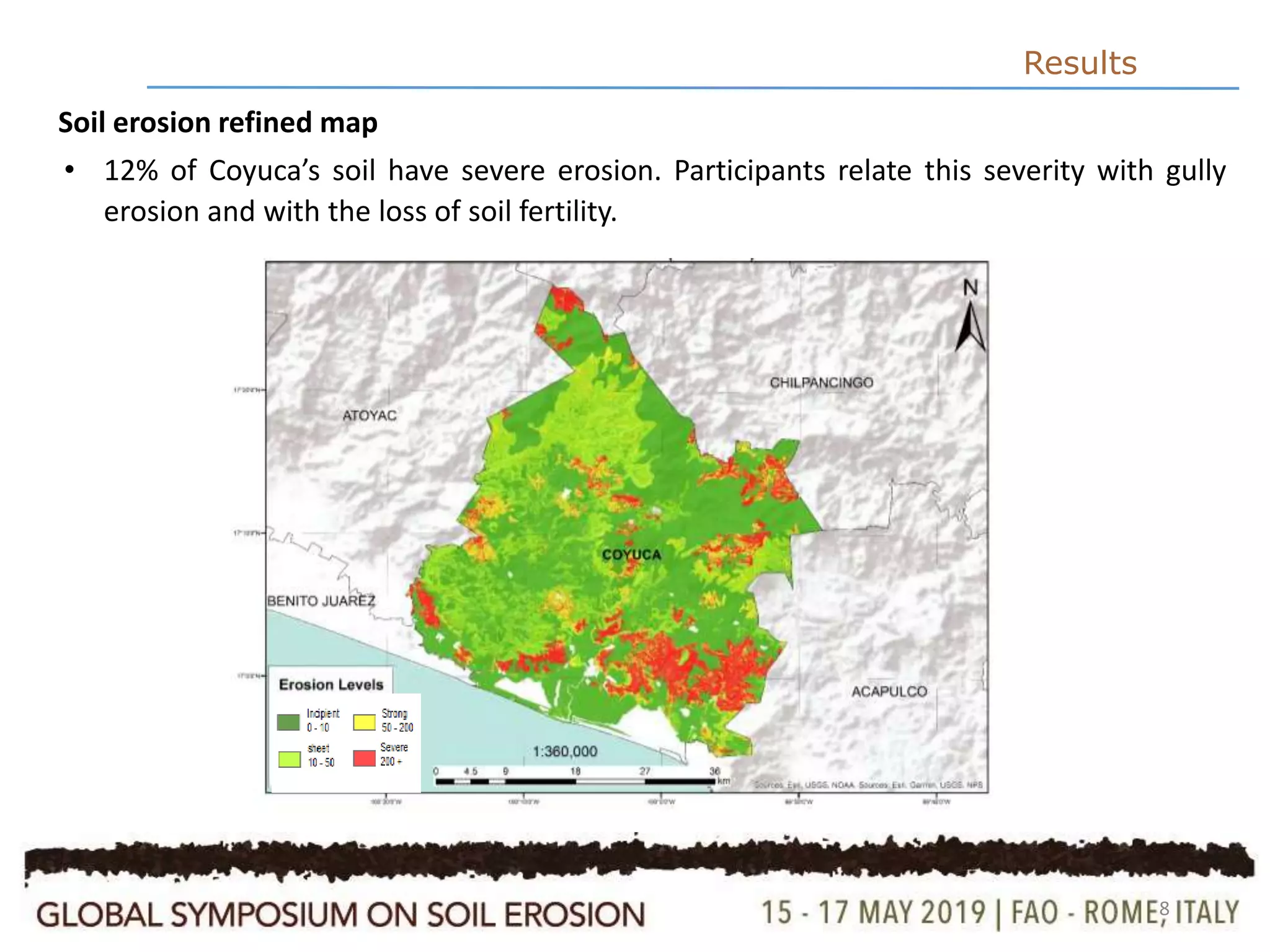
• 12% of Coyuca’s soil have severe erosion. Participants relate this severity with gully
erosion and with the loss of soil fertility.
Soil erosion refined map
9
Results
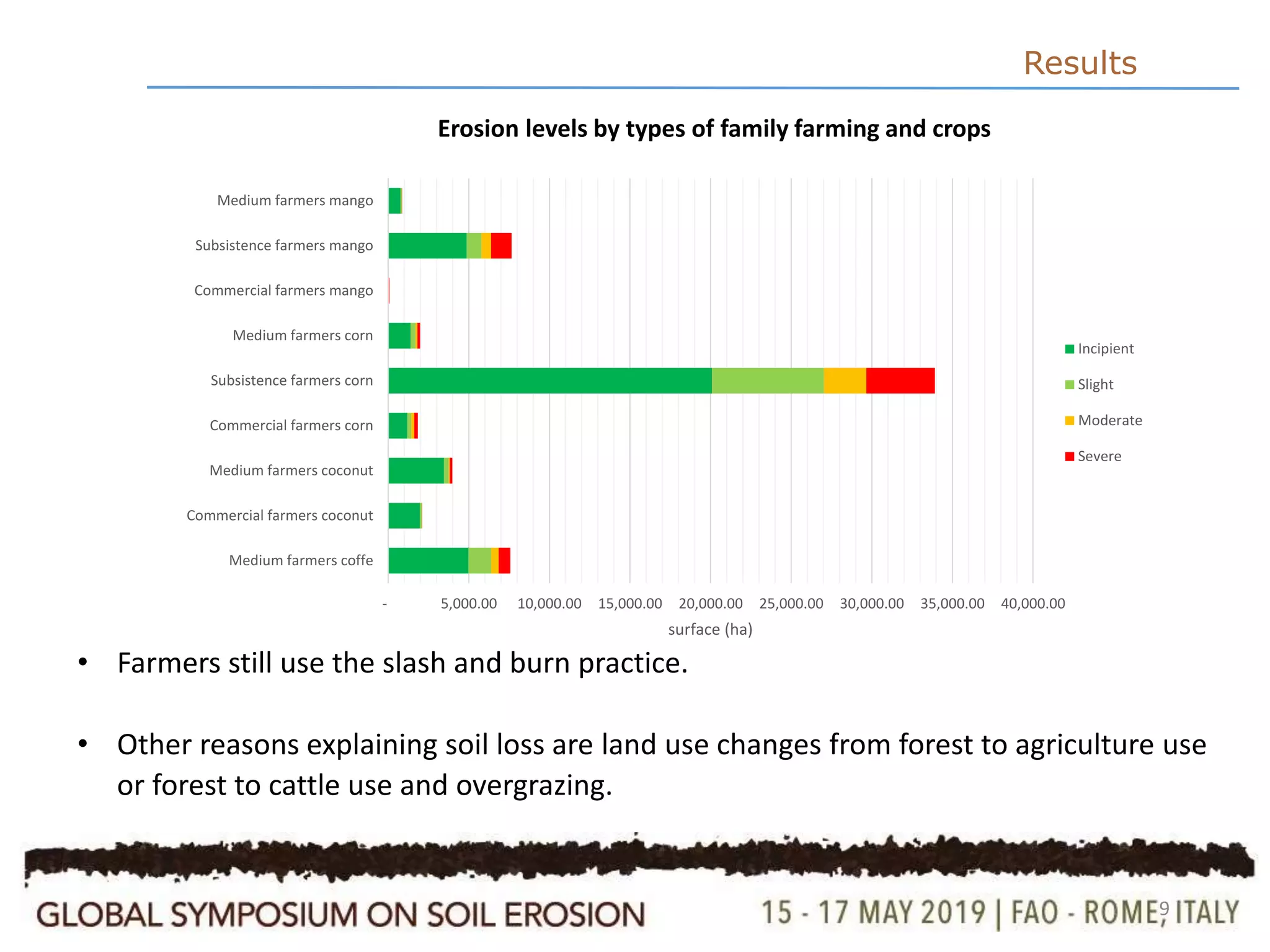
• Farmers still use the slash and burn practice.
• Other reasons explaining soil loss are land use changes from forest to agriculture use
or forest to cattle use and overgrazing.
- 5,000.00 10,000.00 15,000.00 20,000.00 25,000.00 30,000.00 35,000.00 40,000.00
Medium farmers coffe
Commercial farmers coconut
Medium farmers coconut
Commercial farmers corn
Subsistence farmers corn
Medium farmers corn
Commercial farmers mango
Subsistence farmers mango
Medium farmers mango
surface (ha)
Incipient
Slight
Moderate
Severe
Erosion levels by types of family farming and crops
10
Conclusions
• The study demonstrates that a combination of spatially-distributed models with local
perceptions of soil erosion is an effective methodology for providing a reasonable
guide for assessing soil erosion and identifying solutions while engaging the local
people.
• It helped to spread awareness among participants about soil erosion and build a
common view on the impact it has on their practices.
• PALM demonstrated to be a useful and user-friendly boundary object in the workshop
facilitating spatial learning and the co-creation of new knowledge.
Muchas gracias
jleon@centrogeo.edu.mx
13
Results
• Participants were able to easily recreate their cognitive process to recognize their
landscape.
• PALM was also a useful tool for integrating both regional an local perspectives
regarding soil erosion.
• The projection of RUSLE map informed participants about the extent and spatial
variation of soil erosion in Coyuca, while local knowledge helped to validate it and
qualify them in terms of the severity and soil erosion indicators.
Assessment of the usefulness of the approach.

Soil erosion assessment using RUSLE and Projection Augmented Landscape Model (PALM) as participatory tool in a mexican peasant community

  • 1.
    Soil erosion assessmentusing RUSLE and Projection Augmented Landscape Model (PALM) as a participatory tool in a Mexican peasant community José María León Villalobos, José Manuel Madrigal Gómez, Nirani Corona Romero, Joaliné Pardo Nuñez; Mario González Stefanoni. Centro de Investigación en Ciencias de Información Geoespacial (Centro Geo) A.C., Mexico 1
  • 2.
    2 Introduction The Revised UniversalSoil Loss Equation (RUSLE) is the most often used model for soil erosion by water prediction. RUSLE requires for an effective regional scale spatial assessment: • Good-quality spatial data. • Satellite images and digital elevation models can help for determining RUSLE factors but …. • Soil texture and rainfall intensity still heavily rely on data field sources that are limited.
  • 3.
    3 Tepetate Local people aroundthe world have a deep knowledge on soils. An alternative to improve RUSLE assessment is farmers’ knowledge and their ability to map soil erosion. • Local soil indicators • Crops’s performance • Changes on soil surface
  • 4.
    4 This research aimedat Objectives a) Identify areas where erosion by water has taken place based on local farmers’s knowledge by means of participatory mapping. c) Produce a refined RUSLE map including local knowledge / perceptions on soil erosion by water. b) Collectively explore the underlying causes and consequences of soil erosion in Costa Grande south, Mexico;
  • 5.
  • 6.
    6 Methodology Step 1. Informedconsent procedure Step 2. Estimation of soil erosion factors (𝐴 = 𝑅 𝐾 𝐿𝑆 𝐶 𝑃). Factor C and P …. Fieldwork and Normalized Difference Vegetation Index (NDVI). Step 3. Participatory soil erosion mapping Step 4. Validation and RUSLE map refinement with Projection Augmented Landscape Model (PALM)
  • 7.
    7 Results Identification of erosionsoil units Participants drew nine polygons of soil erosion Polygons are transferred to the PALM using the RUSLE map for validating them • Differences were found in 66.7% of the polygons. Most cases participants agreed that RUSLE map better expressed the extension and severity of the erosion. • Just in one case it was found that the RUSLE overestimated the soil erosion severity contrasting with local perceptions.
  • 8.
    8 Results • 12% ofCoyuca’s soil have severe erosion. Participants relate this severity with gully erosion and with the loss of soil fertility. Soil erosion refined map
  • 9.
    9 Results • Farmers stilluse the slash and burn practice. • Other reasons explaining soil loss are land use changes from forest to agriculture use or forest to cattle use and overgrazing. - 5,000.00 10,000.00 15,000.00 20,000.00 25,000.00 30,000.00 35,000.00 40,000.00 Medium farmers coffe Commercial farmers coconut Medium farmers coconut Commercial farmers corn Subsistence farmers corn Medium farmers corn Commercial farmers mango Subsistence farmers mango Medium farmers mango surface (ha) Incipient Slight Moderate Severe Erosion levels by types of family farming and crops
  • 10.
    10 Conclusions • The studydemonstrates that a combination of spatially-distributed models with local perceptions of soil erosion is an effective methodology for providing a reasonable guide for assessing soil erosion and identifying solutions while engaging the local people. • It helped to spread awareness among participants about soil erosion and build a common view on the impact it has on their practices. • PALM demonstrated to be a useful and user-friendly boundary object in the workshop facilitating spatial learning and the co-creation of new knowledge.
  • 11.
  • 13.
    13 Results • Participants wereable to easily recreate their cognitive process to recognize their landscape. • PALM was also a useful tool for integrating both regional an local perspectives regarding soil erosion. • The projection of RUSLE map informed participants about the extent and spatial variation of soil erosion in Coyuca, while local knowledge helped to validate it and qualify them in terms of the severity and soil erosion indicators. Assessment of the usefulness of the approach.

Editor's Notes

  • #3 The Revised Universal Soil Loss Equation (RUSLE) are by far the most often used models for soil erosion prediction. However, in order to get an effective regional-scale assessment, RUSLE requires good-quality spatial data. It is true that in nowadays the wide variety of satellite images and digital elevation models (DEMs) can help us for determining some RUSLE factors. However some factors such as soil texture and rainfall intensity still heavily rely on data sources that are limited or available as coarse data, especially in regions like south Mexico. This makes the RUSLE outcomes limited for predictions purposes or providing effective recommendations.
  • #4 An alternative to improve RUSLE assessment is farmers’ knowledge and their ability to map soil erosion. The farmers around the world, based on their productive experiences, are able to distinguish when soil erosion has taken place and can identify its underlying causes and its effects by observing changes on the soil surface characteristics and performance of their crops. ,
  • #6 This research took place in Coyuca, Costa Grande, Guerrero, in south Mexico, where people live mostly from agriculture. In upper parts, peasant economy relies on maiz and shaded coffee. In lower parts, they crop coconuts and mango. Half of soils of Coyuca are shallows and limited in fertility.
  • #7 Since rainfall intensity data is not always available we used the annual rain fall in a model developed by Cortés; While local management practices and the relative similarities between grazing areas and cultivated fields were solved by performing different enhancements based on fieldwork and applying the Normalized Difference Vegetation Index (NDVI). Based on a common understanding of the soil erosion and its severity rakings and on indicators that farmers know and associate with visual soil erosion, a participatory mapping activity took place by using a high-resolution satellite base map to delineate boundaries of the areas where soil erosion has taken place and simultaneously define severity levels (no erosion, emerging, strong and severe) using colored markes. Once this activity was completed, the RUSLE map was projected on a 3D model of coyuca, then Participants were asked to transfer the polygons from the base map to the 3D in order to compare and validate the RUSLE model by annotating in a specific format both the coincidences and disagreements.
  • #8 22.2% of the polygons of soil erosion coincided with the RUSLE map Differences were found in 66.7% of the polygons, which people ranked in lower levels of severity. In such cases participants agreed that RUSLE map better expressed the extension and severity of the erosion, so they changed they preeliminary assessment. Just in one case it was found that the RUSLE overestimated the soil erosion severity contrasting with local perceptions and because people was explained how the RUSLE map was produced, they were able to suggests some improvents, mainly foucused on the extension of the erosion process, the type of land cover, managaement practices.
  • #9  12% of Coyuca’s soil have severe erosion. Participants relate this severity with gully erosion and with the loss of soil fertility.
  • #10 Findings also suggest that more soil is lost in areas under maize. Evidence suggest that most maiz farmers still use the slash and burn practices in lands with more than 15% of slope inclination. Other reasons explaining soil loss are changes from forest to agriculture use or forest to cattle use and overgrazing. However, the absence of effective public policies to support peasant agriculture and promote sustainable management practices seems to be the underlying factor explaining the ultimately cause soil erosion.
  • #11 Casusas y análisis de ellas …