ARJUN GANGADHARAN
  arkarjun@gmail.com
  3rd year Civil Engineering
 RVS Faculty of Engineering
         Coimbatore
The Art or Technique or Science of obtaining reliable
   information about the physical objects and the
   environment through the process of recording,
 measuring and interpreting imagery and the digital
 representation of energy pattern derived from non
               contact sensor system
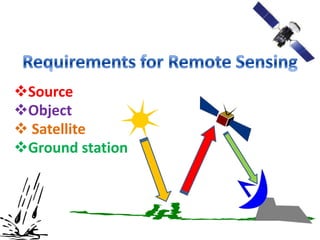
Source
Object
 Satellite
Ground station
As you view an object, you are
actively engaged in remote sensing. A
physical quantity (light) emanates
from the object, which is a source of
radiation. The radiated light passes
over a distance, and thus is "remote"
to some extent, until it encounters
and is captured by a sensor (your
eyes). Each eye sends a signal to a
processor (your brain) which records
the data and interprets this into
information.
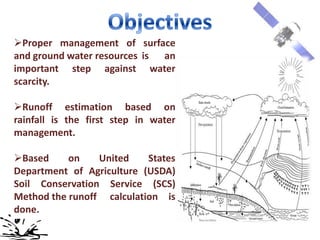
Proper management of surface
and ground water resources is an
important step against water
scarcity.

Runoff estimation based on
rainfall is the first step in water
management.

Based     on    United    States
Department of Agriculture (USDA)
Soil Conservation Service (SCS)
Method the runoff calculation is
done.
The Survey of India (SOI) Topographic maps for the
      demarcation of the watershed line.
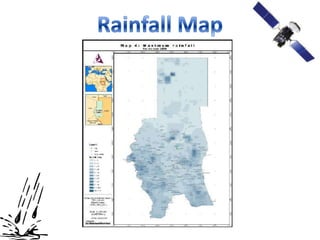
The rainfall data from Meteorological Department.
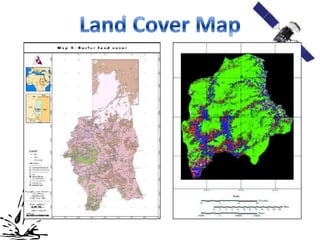
The land use and land cover map prepared from
      satellite imagery.
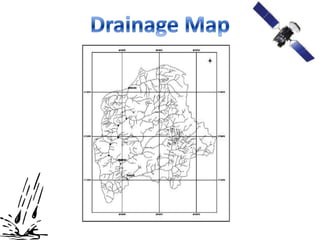
The drainage map prepared from SOI Topographic
      sheet
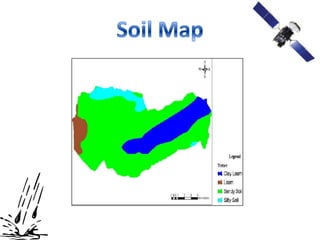
The soil information was collected from the Soil
      Survey of India
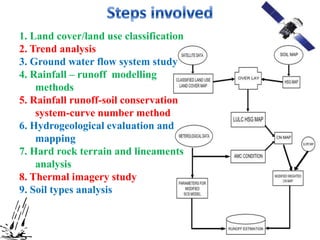
1. Land cover/land use classification
2. Trend analysis
3. Ground water flow system study
4. Rainfall – runoff modelling
    methods
5. Rainfall runoff-soil conservation
    system-curve number method
6. Hydrogeological evaluation and
    mapping
7. Hard rock terrain and lineaments
    analysis
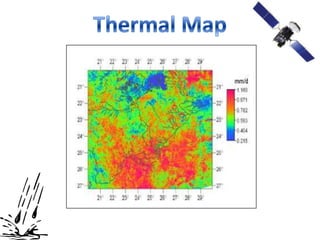
8. Thermal imagery study
9. Soil types analysis
 SCS-CN theory is based on the fact that direct runoff
  depends on land cover, land use, soil type and antecedent
  moisture conditions of surface soil. Several accompanying
  tables had been developed in association with empirical
  equations

 Applying SCS method on a large area, with variant
  specifications, would be almost impossible if done manually.
  Regarding this matter, an automated computer model is
  needed to achieve desired accuracy.
 SCS rainfall runoff model, developed by United States
  Department of Agriculture (USDA) provides an empirical
  relationship estimating initial abstraction and runoff as a
  function of soil type and landuse.
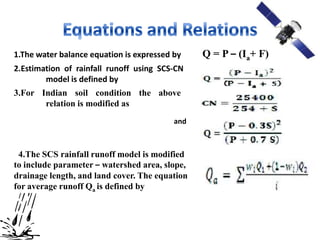
1.The water balance equation is expressed by    Q = P – (Ia+ F)
2.Estimation of rainfall runoff using SCS-CN
        model is defined by
3.For Indian soil condition the above
       relation is modified as
                                          and


 4.The SCS rainfall runoff model is modified
to include parameter – watershed area, slope,
drainage length, and land cover. The equation
for average runoff Qa is defined by
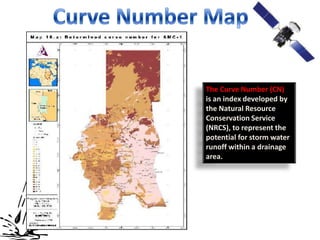
The Curve Number (CN)
is an index developed by
the Natural Resource
Conservation Service
(NRCS), to represent the
potential for storm water
runoff within a drainage
area.
The data and analysis reports can be used in modelling.
It gives a clear picture of the nature of runoff in the study area.
The study report can be made use for the feasibility studies for the
construction on reservoirs or dams.
The method can be employed in the efficiency study of the
catchment.
With results we can estimate the total volume of runoff volume the
area, which is employed in many other studies such as predicting the
flood areas during monsoon.
The water scarcity of the area can be minimized by the
construction of rain water sheds/tanks.
The suitable locations for dams and reservoirs can be obtained in
such a way that the maximum runoff volume is collected by it.
Remote sensing and GIS techniques allow such analysis to
performed in a short time, at high accuracy and low costs.
Thank You !
    

Surface Water modelling using Remote Sensing

  • 1.
    ARJUN GANGADHARAN arkarjun@gmail.com 3rd year Civil Engineering RVS Faculty of Engineering Coimbatore
  • 2.
    The Art orTechnique or Science of obtaining reliable information about the physical objects and the environment through the process of recording, measuring and interpreting imagery and the digital representation of energy pattern derived from non contact sensor system
  • 3.
  • 4.
    As you viewan object, you are actively engaged in remote sensing. A physical quantity (light) emanates from the object, which is a source of radiation. The radiated light passes over a distance, and thus is "remote" to some extent, until it encounters and is captured by a sensor (your eyes). Each eye sends a signal to a processor (your brain) which records the data and interprets this into information.
  • 5.
    Proper management ofsurface and ground water resources is an important step against water scarcity. Runoff estimation based on rainfall is the first step in water management. Based on United States Department of Agriculture (USDA) Soil Conservation Service (SCS) Method the runoff calculation is done.
  • 6.
    The Survey ofIndia (SOI) Topographic maps for the demarcation of the watershed line. The rainfall data from Meteorological Department. The land use and land cover map prepared from satellite imagery. The drainage map prepared from SOI Topographic sheet The soil information was collected from the Soil Survey of India
  • 7.
    1. Land cover/landuse classification 2. Trend analysis 3. Ground water flow system study 4. Rainfall – runoff modelling methods 5. Rainfall runoff-soil conservation system-curve number method 6. Hydrogeological evaluation and mapping 7. Hard rock terrain and lineaments analysis 8. Thermal imagery study 9. Soil types analysis
  • 13.
     SCS-CN theoryis based on the fact that direct runoff depends on land cover, land use, soil type and antecedent moisture conditions of surface soil. Several accompanying tables had been developed in association with empirical equations  Applying SCS method on a large area, with variant specifications, would be almost impossible if done manually. Regarding this matter, an automated computer model is needed to achieve desired accuracy.  SCS rainfall runoff model, developed by United States Department of Agriculture (USDA) provides an empirical relationship estimating initial abstraction and runoff as a function of soil type and landuse.
  • 14.
    1.The water balanceequation is expressed by Q = P – (Ia+ F) 2.Estimation of rainfall runoff using SCS-CN model is defined by 3.For Indian soil condition the above relation is modified as and 4.The SCS rainfall runoff model is modified to include parameter – watershed area, slope, drainage length, and land cover. The equation for average runoff Qa is defined by
  • 15.
    The Curve Number(CN) is an index developed by the Natural Resource Conservation Service (NRCS), to represent the potential for storm water runoff within a drainage area.
  • 16.
    The data andanalysis reports can be used in modelling. It gives a clear picture of the nature of runoff in the study area. The study report can be made use for the feasibility studies for the construction on reservoirs or dams. The method can be employed in the efficiency study of the catchment. With results we can estimate the total volume of runoff volume the area, which is employed in many other studies such as predicting the flood areas during monsoon. The water scarcity of the area can be minimized by the construction of rain water sheds/tanks. The suitable locations for dams and reservoirs can be obtained in such a way that the maximum runoff volume is collected by it. Remote sensing and GIS techniques allow such analysis to performed in a short time, at high accuracy and low costs.
  • 17.