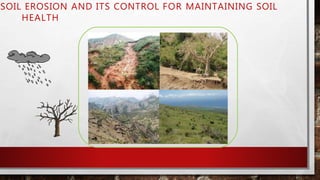
SOIL EROSION AND ITS CONTROL FOR MAINTAINING SOIL
HEALTH
INTRODUCTION TO SOIL EROSION
Definition :
 Soil erosion is the detachment, transport & deposition of soil particle on land
surface - termed as loss of soil.
 Measured as mass /unit area - tonne/ha or Kg/sq.m
Soil loss is of interest primarily On-site effect of erosion such as loss of crop
productivity.
Off site effect of erosion are siltation in ditches, streams , reservoirs.
Sediment generated by erosion processes are prime carrier of agricultural
chemicals that pollutes stream or lakes.
SOIL EROSION PROBLEM
 Soil is the most precious gift of nature –Prime resource -for food,
fodder etc. -Soil mismanaged = less productivity.
 In India, more than 100 million hectares -soil degraded.
 Ab ou t 17 tones/ha soil detached annually->20% of this is transported
by river to sea -10% deposited in reservoir results 1 to 2% loss off
storage capacity.
 Soil erosion deteriorates soil quality & reduces productivity of natural,
agricultural & forest ecosystem.
 Soil erosion deteriorates quality of water.
 Increased sedimentation causes reduction of carrying capacity of
water bodies.
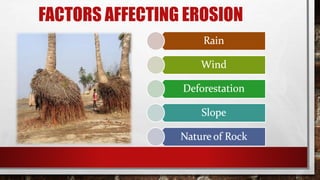
FACTORS AFFECTING EROSION
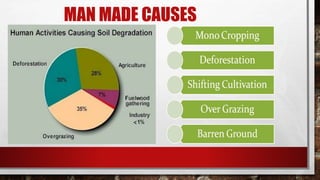
MAN MADE CAUSES
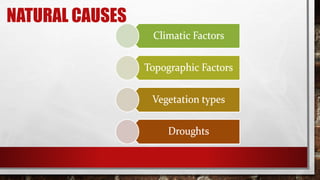
NATURAL CAUSES
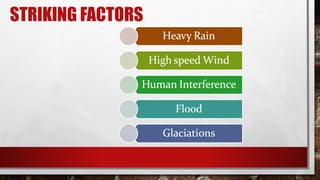
STRIKING FACTORS
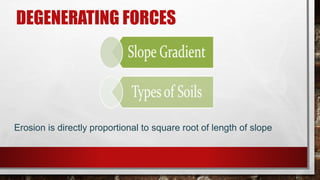
DEGENERATING FORCES
Erosion is directly proportional to square root of length of slope
FACTORS AFFECTING EROSION
MECHANISM OF EROSION
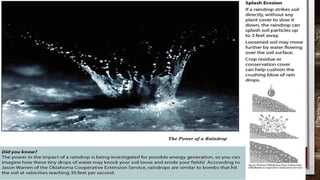
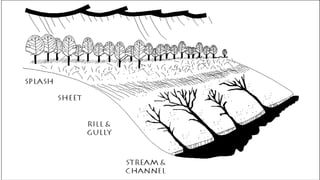
 Begins with raindrops striking bare soil dislodging particles.
 Intense rains seal surface.
 W H E N r a i n f a l l exceeds infiltration water is stored in small depressions.
 O N C E depressions are filled, runoff begins.
 INITIALLY water flows in a discontinuous sheet.
 Eventually it concentrates into small channels or rills.
 T h e runoff now has energy to break off particles and cut deeper.
 T h e amount of erosion caused by sheet and rill erosion increases with
slope and distance.
 Rills may eventually form gullies.
SOIL EROSION PARAMETERS
 S o i l erosion – function of:
Erosivity – ability to erode : depends on rainfall.
Erodibility – Resistance offered to restrict erosion
(property of soil)
Topography – property of land.
Management – contributed by man.
 Erodibility: Detachability & transportability.
 Topography: Slope, length, relation to other land
Management: Land use & crop management.
TYPES OF SOIL EROSION
 Geological erosion, Natural erosion & Erosion from activities of
human & animals.
 Geological erosion: -Soil forming anddistribution-Long time process
 H u m a n and animal: Tillage, removal of plants and Tillage, removal
of plants and other vegetation- accelerated erosion
 Stream bank erosion
 Landslide, Volcanic eruption, flooding
 W a t e r and wind: major factors of soil erosion
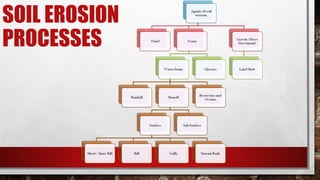
SOIL EROSION
PROCESSES
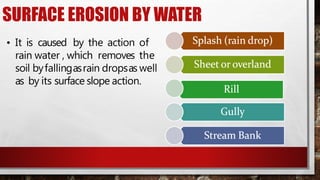
SURFACE EROSION BY WATER
• It is caused by the action of
rain water , which removes the
soil byfallingasrain dropsas well
as by its surface slope action.
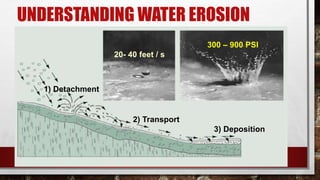
UNDERSTANDING WATER EROSION
20- 40 feet / s
300 – 900 PSI
1) Detachment
2) Transport
3) Deposition
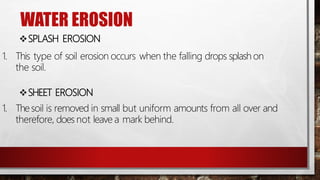
WATER EROSION
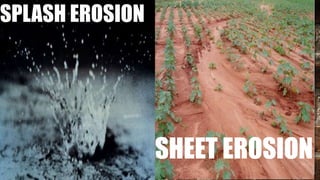
SPLASH EROSION
1. This type of soil erosion occurs when the falling drops splash on
the soil.
SHEET EROSION
1. Thesoil is removed in small but uniform amounts from all over and
therefore, does not leave a mark behind.
SPLASH EROSION
SHEET EROSION
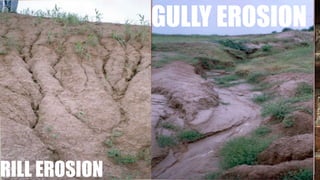
 RILL EROSION
1. Therun off water moves rapidly & cuts small stream like structure
 GULLY EROSION
1. Several rills converge towards the steep slopes & join to form board channels of
water called gullies.
 STREAM BANK EROSION
1. The rivers during floods splash their water against the banks &
through them.
RILL EROSION
Rills result from concentrated flow and can
be filled by normal tillage operations
RILL EROSION
GULLY EROSION
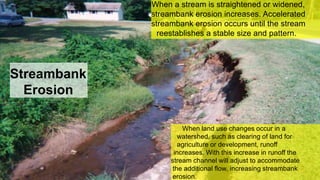
Streambank
Erosion
When a stream is straightened or widened,
streambank erosion increases. Accelerated
streambank erosion occurs until the stream
reestablishes a stable size and pattern.
When land use changes occur in a
watershed, such as clearing of land for
agriculture or development, runoff
increases. With this increase in runoff the
stream channel will adjust to accommodate
the additional flow, increasing streambank
erosion.
PRINCIPLE OF SOIL & MOISTURE CONSERVATION
• Ridge to valley treatment.
• Maximum possible rain water should be conserved where it falls.
• Adequate vegetal cover during rainy season.
• Storage/ disposal of excess water with safe velocity.
• Checks/ barriers along the contour to control soil erosion &
ground water recharge.
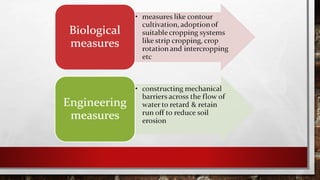
• Integration of biological and mechanical measures.
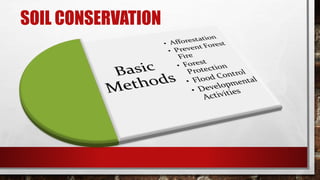
SOIL CONSERVATION
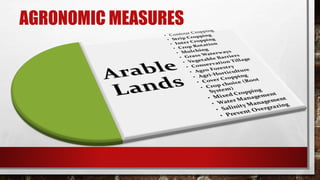
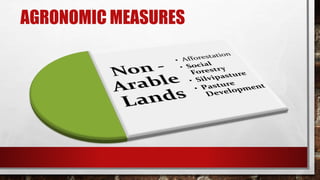
AGRONOMIC MEASURES
AGRONOMIC MEASURES
EROSION CONTROL
Erosion control is the practice of preventing or controlling wind or water
erosion in agricultural land development, river banks ,coastal areas, and
construction
 Thethreemainprinciples:
Use land according to itscapability.
Protectthesoilsurfacewith some form of cover.
Controlrunoff before it develops by an erosiveforce.
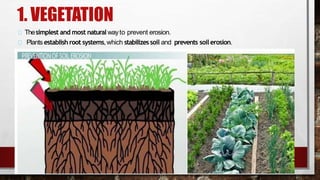
1. VEGETATION
Thesimplest and most natural wayto prevent erosion.
Plants establish root systems,which stabilizessoil and prevents soilerosion.
SOILSTABILIZATION:
 THEPLANT ROOT SYSTEMBINDTHESOILAT THE SURFACE.
 INCREASE STRENGTH OF THE SOIL.
 SOIL EROSION BY RUNOFF WATER AND WIND IS DECREASED.
 Water managementmechanisms:
 The root system abstract water from the soil which decreases erosion bywater
FOR SLOPPY
LAND
For Gully Treatment
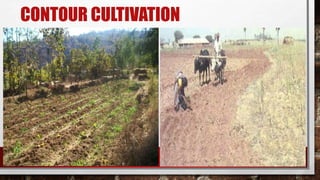
2. CONTOUR FARMING
Contour farming or Contour plowing or Contour bunding
is the farming practice of level rows around a hill, as
opposed to farming up and down onthe hill.
CONTOUR CULTIVATION
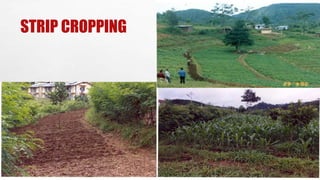
STRIP CROPPING
It reduces :-
1)Amount and
2) Velocity of water moving acrossthesoil surface
or hill surface
 The water break allows more time for moving the water by
infiltration into the soil.
 Can reduce soil erosion by as much as 50% as compared to
uphill/downhill farming.
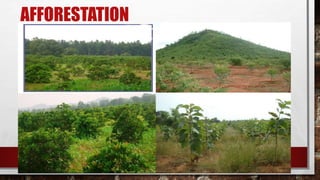
AFFORESTATION
COVER CROPPING
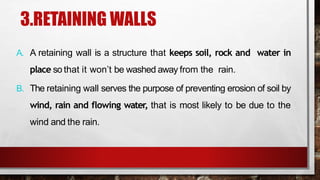
3.RETAINING WALLS
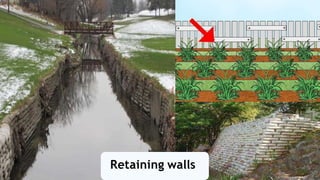
A. A retaining wall is a structure that keeps soil, rock and water in
place so that it won’t be washed away from the rain.
B. The retaining wall serves the purpose of preventing erosion of soil by
wind, rain and flowing water, that is most likely to be due to the
wind and the rain.
Retaining walls
4. WIND BREAKS
Field windbreaks are linear planting of trees/plant
designed to reduce wind speed in open fields, preventing soil
erosion and protecting crops from wind damage.
Field wind breaks are typically planted in multiple rows
perpendicular to prevailingwinds.
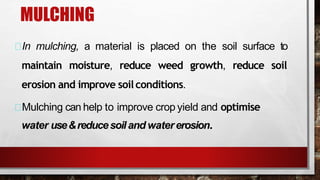
MULCHING
In mulching, a material is placed on the soil surface to
maintain moisture, reduce weed growth, reduce soil
erosion and improve soilconditions.
Mulching can help to improve crop yield and optimise
water use&reducesoiland watererosion.
EXAMPLES OF ORGANIC MULCHES
GrassClippings,
SmallLeaves, Wood
Chips, PineNeedles,
BananaLeaves, Palm
Fronds, Coconut
Husks, Branches.
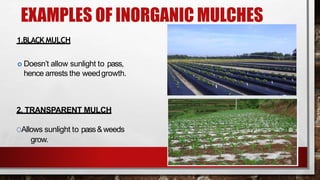
EXAMPLES OF INORGANIC MULCHES
1.BLACK MULCH
 Doesn’t allow sunlight to pass,
hence arrests the weedgrowth.
2. TRANSPARENT MULCH
OAllows sunlight to pass&weeds
grow.
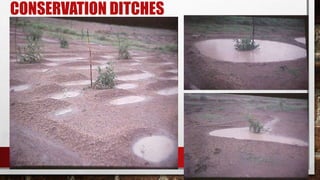
CONSERVATION DITCHES
AGRI-HORTI SYSTEM ( MANGO+ G.NUT)
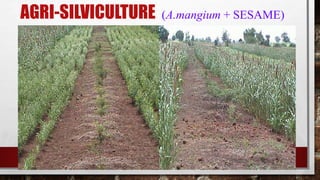
AGRI-SILVICULTURE (A.mangium + SESAME)
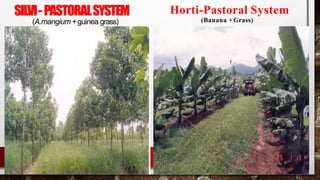
SILVI-PASTORALSYSTEM
(A.mangium +guinea grass)
Horti-Pastoral System
(Banana +Grass)
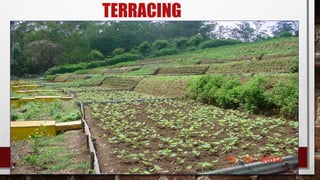
TERRACING
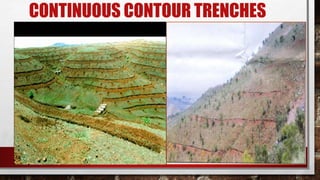
CONTINUOUS CONTOUR TRENCHES
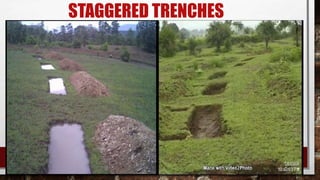
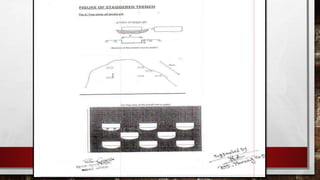
STAGGERED TRENCHES
WATER ABSORPTION TRENCH (WAT)
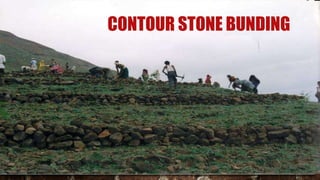
CONTOUR STONE BUNDING
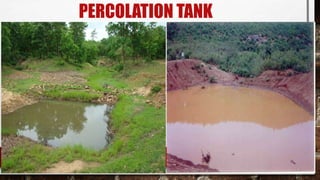
PERCOLATION TANK
SUNKEN GULLY PIT
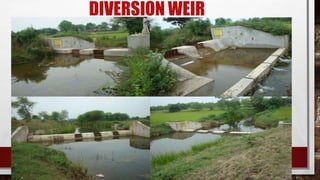
DIVERSION WEIR
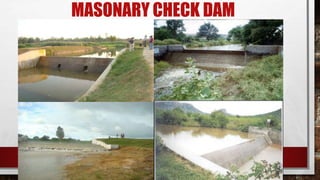
MASONARY CHECK DAM
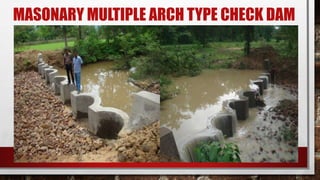
MASONARY MULTIPLE ARCH TYPE CHECK DAM
WATER HARVESTING STRUCTURE
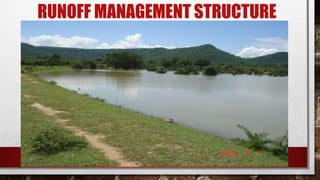
RUNOFF MANAGEMENT STRUCTURE
FARM POND IN LOWER REACHES
Methods to control soil erosion and water run off

Methods to control soil erosion and water run off

  • 2.
    SOIL EROSION ANDITS CONTROL FOR MAINTAINING SOIL HEALTH
  • 3.
    INTRODUCTION TO SOILEROSION Definition :  Soil erosion is the detachment, transport & deposition of soil particle on land surface - termed as loss of soil.  Measured as mass /unit area - tonne/ha or Kg/sq.m Soil loss is of interest primarily On-site effect of erosion such as loss of crop productivity. Off site effect of erosion are siltation in ditches, streams , reservoirs. Sediment generated by erosion processes are prime carrier of agricultural chemicals that pollutes stream or lakes.
  • 4.
    SOIL EROSION PROBLEM Soil is the most precious gift of nature –Prime resource -for food, fodder etc. -Soil mismanaged = less productivity.  In India, more than 100 million hectares -soil degraded.  Ab ou t 17 tones/ha soil detached annually->20% of this is transported by river to sea -10% deposited in reservoir results 1 to 2% loss off storage capacity.  Soil erosion deteriorates soil quality & reduces productivity of natural, agricultural & forest ecosystem.  Soil erosion deteriorates quality of water.  Increased sedimentation causes reduction of carrying capacity of water bodies.
  • 5.
  • 6.
  • 7.
  • 8.
  • 9.
    DEGENERATING FORCES Erosion isdirectly proportional to square root of length of slope
  • 10.
  • 11.
    MECHANISM OF EROSION Begins with raindrops striking bare soil dislodging particles.  Intense rains seal surface.  W H E N r a i n f a l l exceeds infiltration water is stored in small depressions.  O N C E depressions are filled, runoff begins.  INITIALLY water flows in a discontinuous sheet.  Eventually it concentrates into small channels or rills.  T h e runoff now has energy to break off particles and cut deeper.  T h e amount of erosion caused by sheet and rill erosion increases with slope and distance.  Rills may eventually form gullies.
  • 12.
    SOIL EROSION PARAMETERS S o i l erosion – function of: Erosivity – ability to erode : depends on rainfall. Erodibility – Resistance offered to restrict erosion (property of soil) Topography – property of land. Management – contributed by man.  Erodibility: Detachability & transportability.  Topography: Slope, length, relation to other land Management: Land use & crop management.
  • 13.
    TYPES OF SOILEROSION  Geological erosion, Natural erosion & Erosion from activities of human & animals.  Geological erosion: -Soil forming anddistribution-Long time process  H u m a n and animal: Tillage, removal of plants and Tillage, removal of plants and other vegetation- accelerated erosion  Stream bank erosion  Landslide, Volcanic eruption, flooding  W a t e r and wind: major factors of soil erosion
  • 14.
  • 15.
    SURFACE EROSION BYWATER • It is caused by the action of rain water , which removes the soil byfallingasrain dropsas well as by its surface slope action.
  • 16.
    UNDERSTANDING WATER EROSION 20-40 feet / s 300 – 900 PSI 1) Detachment 2) Transport 3) Deposition
  • 17.
    WATER EROSION SPLASH EROSION 1.This type of soil erosion occurs when the falling drops splash on the soil. SHEET EROSION 1. Thesoil is removed in small but uniform amounts from all over and therefore, does not leave a mark behind.
  • 18.
  • 21.
     RILL EROSION 1.Therun off water moves rapidly & cuts small stream like structure  GULLY EROSION 1. Several rills converge towards the steep slopes & join to form board channels of water called gullies.  STREAM BANK EROSION 1. The rivers during floods splash their water against the banks & through them.
  • 22.
    RILL EROSION Rills resultfrom concentrated flow and can be filled by normal tillage operations
  • 23.
  • 24.
    Streambank Erosion When a streamis straightened or widened, streambank erosion increases. Accelerated streambank erosion occurs until the stream reestablishes a stable size and pattern. When land use changes occur in a watershed, such as clearing of land for agriculture or development, runoff increases. With this increase in runoff the stream channel will adjust to accommodate the additional flow, increasing streambank erosion.
  • 27.
    PRINCIPLE OF SOIL& MOISTURE CONSERVATION • Ridge to valley treatment. • Maximum possible rain water should be conserved where it falls. • Adequate vegetal cover during rainy season. • Storage/ disposal of excess water with safe velocity. • Checks/ barriers along the contour to control soil erosion & ground water recharge. • Integration of biological and mechanical measures.
  • 29.
  • 30.
  • 31.
  • 33.
    EROSION CONTROL Erosion controlis the practice of preventing or controlling wind or water erosion in agricultural land development, river banks ,coastal areas, and construction  Thethreemainprinciples: Use land according to itscapability. Protectthesoilsurfacewith some form of cover. Controlrunoff before it develops by an erosiveforce.
  • 34.
    1. VEGETATION Thesimplest andmost natural wayto prevent erosion. Plants establish root systems,which stabilizessoil and prevents soilerosion.
  • 36.
    SOILSTABILIZATION:  THEPLANT ROOTSYSTEMBINDTHESOILAT THE SURFACE.  INCREASE STRENGTH OF THE SOIL.  SOIL EROSION BY RUNOFF WATER AND WIND IS DECREASED.  Water managementmechanisms:  The root system abstract water from the soil which decreases erosion bywater
  • 37.
  • 38.
    2. CONTOUR FARMING Contourfarming or Contour plowing or Contour bunding is the farming practice of level rows around a hill, as opposed to farming up and down onthe hill.
  • 39.
  • 40.
  • 41.
    It reduces :- 1)Amountand 2) Velocity of water moving acrossthesoil surface or hill surface  The water break allows more time for moving the water by infiltration into the soil.  Can reduce soil erosion by as much as 50% as compared to uphill/downhill farming.
  • 42.
  • 43.
  • 44.
    3.RETAINING WALLS A. Aretaining wall is a structure that keeps soil, rock and water in place so that it won’t be washed away from the rain. B. The retaining wall serves the purpose of preventing erosion of soil by wind, rain and flowing water, that is most likely to be due to the wind and the rain.
  • 45.
  • 46.
    4. WIND BREAKS Fieldwindbreaks are linear planting of trees/plant designed to reduce wind speed in open fields, preventing soil erosion and protecting crops from wind damage. Field wind breaks are typically planted in multiple rows perpendicular to prevailingwinds.
  • 48.
    MULCHING In mulching, amaterial is placed on the soil surface to maintain moisture, reduce weed growth, reduce soil erosion and improve soilconditions. Mulching can help to improve crop yield and optimise water use&reducesoiland watererosion.
  • 49.
    EXAMPLES OF ORGANICMULCHES GrassClippings, SmallLeaves, Wood Chips, PineNeedles, BananaLeaves, Palm Fronds, Coconut Husks, Branches.
  • 50.
    EXAMPLES OF INORGANICMULCHES 1.BLACK MULCH  Doesn’t allow sunlight to pass, hence arrests the weedgrowth. 2. TRANSPARENT MULCH OAllows sunlight to pass&weeds grow.
  • 51.
  • 52.
    AGRI-HORTI SYSTEM (MANGO+ G.NUT)
  • 53.
  • 54.
  • 55.
  • 56.
  • 57.
  • 59.
  • 60.
  • 61.
  • 62.
  • 63.
  • 64.
  • 65.
    MASONARY MULTIPLE ARCHTYPE CHECK DAM
  • 66.
  • 67.
  • 68.
    FARM POND INLOWER REACHES