SOIL CLASSIFICATION
BASICS:
This test is performed to determine the percentage of different grain sizes contained within a
soil. The mechanical or sieve analysis is performed to determine the distribution of the
coarser, larger-sized particles, and the hydrometer method is used to determine the distribution
of the finer particles.
Standardreference:
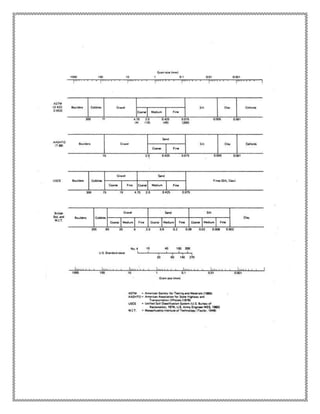
Commonly based on grain size and soil consistency. Several classification systems exist:
1. Unified Soil Classification System (USCS)(ASTM D2487-11).
2. American Association of State Highway and Transportation Officials (AASHTO)
(ASTM D3282-09).
3. U.S. Department of Agriculture (USDA).
4. Massachusetts Institute of Technology (MIT).
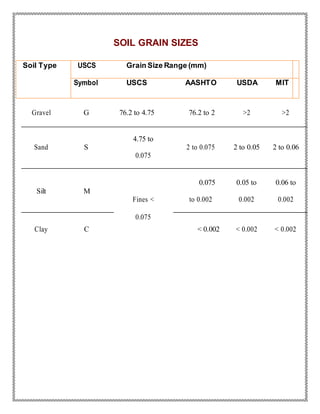
SOIL GRAIN SIZES
Soil Type USCS Grain Size Range (mm)
Symbol USCS AASHTO USDA MIT
Gravel G 76.2 to 4.75 76.2 to 2 >2 >2
Sand S
4.75 to
2 to 0.075 2 to 0.05 2 to 0.06
0.075
Silt M
0.075 0.05 to 0.06 to
Fines < to 0.002 0.002 0.002
0.075
Clay C < 0.002 < 0.002 < 0.002
1.SPECIFIC GRAVITY OF SOIL SOLIDS
1-1 APPLICABLE STANDARD
ASTM D854: Standard Test Method for Specific Gravity of Soils.
1-2 PURPOSE OF MEASUREMENT
Specific gravity of soil solids is used for performing weight-volume calculations in
soils.
1-3 EQUIPMENT AND MATERIALS
The following equipment and materials are required for specific gravity of soil
solids measurements:-
 Oven-dried soil sample.
 Scale capable of measuring to the nearest 0.01 g.
 500-ml etched flask.
 Distilled or demineralized water.
 Squeeze bottle.
 Thermometer capable of reading to the nearest 0.5o C.
 Funnel.
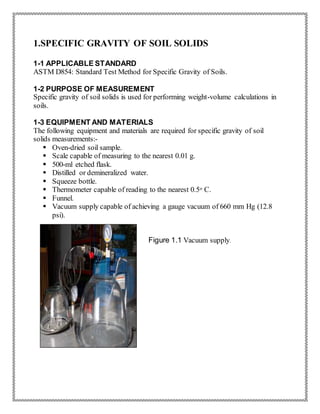
 Vacuum supply capable of achieving a gauge vacuum of 660 mm Hg (12.8
psi).
Figure 1.1 Vacuum supply.
1-4 PROCEDURE
The procedurepresented herein is consistent with ASTM D854 TestMethod A is
as follows:
1) Weight approximately 10 g of dry soil to obtain Ms.2) Fill the Pycnometer to the
etch line with distilled or demineralized water and take four reading in different
temperature by making cold bath and hot bath to obtain Mpw,C.
3) Pour half of the water out of the Pycnometer and place the soil in the
Pycnometer with a funnel.
4) Wash the soil down the inside neck of the Pycnometer.
5) Connect the Pycnometer to the vacuum sourceand apply vacuum for 30
minutes, occasionally agitating the mixture.
6) Fill the Pycnometer to the etch line with distilled water and weigh it to obtain
Mpws,C.
7) Record the water temperature in the Pycnometer and use Table 1-2 to obtain K.
1-5 MEASUREMENTS AND CALCULATIONS
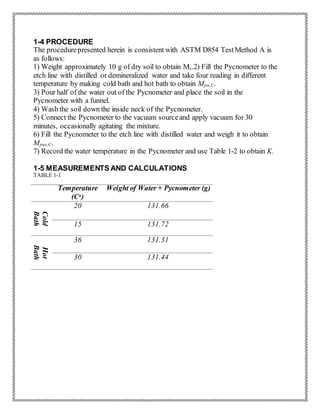
TABLE 1-1
Temperature
(Co)
Weight of Water + Pycnometer (g)
Cold
Bath
20 131.66
15 131.72
Hot
Bath
36 131.31
30 131.44
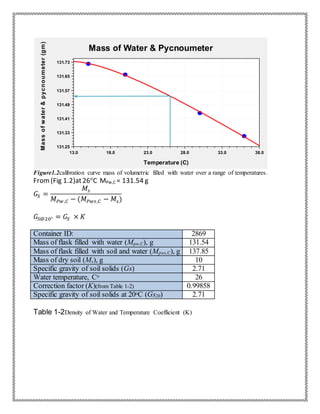
Figure1.2calibration curve mass of volumetric filled with water over a range of temperatures.
From(Fig 1.2)at26o
C MPw,C = 131.54 g
𝐺𝑆 =
𝑀𝑠
𝑀 𝑃𝑤,𝐶 − (𝑀 𝑃𝑤𝑠,𝐶 − 𝑀𝑠)
𝐺𝑆@20° = 𝐺𝑆 × 𝐾
Container ID: 2869
Mass of flask filled with water (Mpw,C), g 131.54
Mass of flask filled with soil and water (Mpws,C), g 137.85
Mass of dry soil (Ms), g 10
Specific gravity of soil solids (Gs) 2.71
Water temperature, Co 26
Correction factor (K)(from Table 1-2) 0.99858
Specific gravity of soil solids at 20oC (Gs20) 2.71
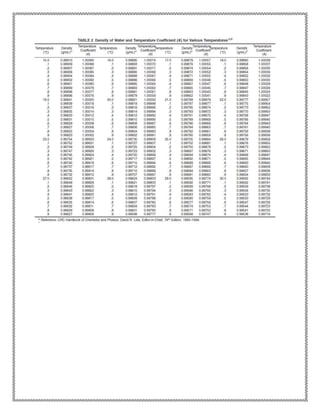
Table 1-2Density of Water and Temperature Coefficient (K)
Mass of Water & Pycnoumeter
Temperature (C)
Massofwater&pycnoumeter(gm)
13.0 18.0 23.0 28.0 33.0 38.0
131.25
131.33
131.41
131.49
131.57
131.65
131.73
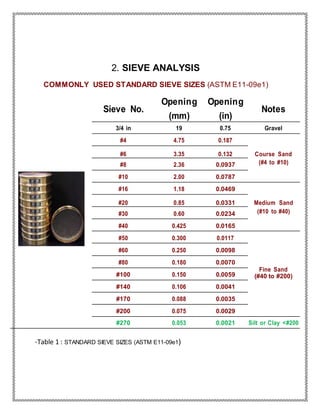
2. SIEVE ANALYSIS
COMMONLY USED STANDARD SIEVE SIZES (ASTM E11-09e1)
Sieve No.
Opening Opening
Notes
(mm) (in)
3/4 in 19 0.75 Gravel
#4 4.75 0.187
#6 3.35 0.132 Course Sand
#8 2.36 0.0937 (#4 to #10)
#10 2.00 0.0787
#16 1.18 0.0469
#20 0.85 0.0331 Medium Sand
#30 0.60 0.0234 (#10 to #40)
#40 0.425 0.0165
#50 0.300 0.0117
#60 0.250 0.0098
#80 0.180 0.0070
Fine Sand
#100 0.150 0.0059 (#40 to #200)
#140 0.106 0.0041
#170 0.088 0.0035
#200 0.075 0.0029
#270 0.053 0.0021 Silt or Clay <#200
-Table 1 : STANDARD SIEVE SIZES (ASTM E11-09e1)
2.1. Purpose:
In this test determine the distribution of the coarsersoil and find the percentage of coarser
soil and fain soil .
So we make this test to classify soil , this test performed to coarser soil .
2.2. Standard Reference:
ASTM D 422 - Standard Test Method for Particle-Size Analysis of Soils
2.3. Significance:
The distribution of different grain sizes affects on engineering properties of soil. Grain size
analysis provides the grain size distribution, and it is required in classifying the soil.
2.4. Equipment:
Balance, Set of sieves, Cleaning brush, Sieve shaker.
2.5.TestProcedure:
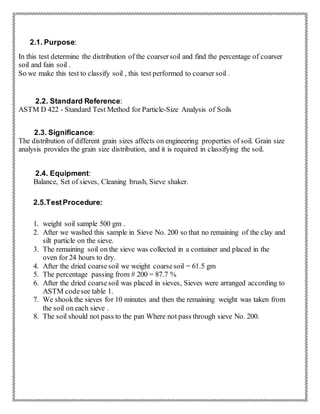
1. weight soil sample 500 gm .
2. After we washed this sample in Sieve No. 200 so that no remaining of the clay and
silt particle on the sieve.
3. The remaining soil on the sieve was collected in a container and placed in the
oven for 24 hours to dry.
4. After the dried coarsesoil we weight coarsesoil = 61.5 gm
5. The percentage passing from # 200 = 87.7 %
6. After the dried coarsesoil was placed in sieves, Sieves were arranged according to
ASTM codesee table 1.
7. We shookthe sieves for 10 minutes and then the remaining weight was taken from
the soil on each sieve .
8. The soil should not pass to the pan Where not pass through sieve No. 200.
2.6.Data Analysis:
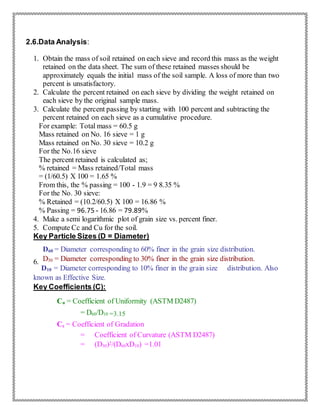
1. Obtain the mass of soil retained on each sieve and record this mass as the weight
retained on the data sheet. The sum of these retained masses should be
approximately equals the initial mass of the soil sample. A loss of more than two
percent is unsatisfactory.
2. Calculate the percent retained on each sieve by dividing the weight retained on
each sieve by the original sample mass.
3. Calculate the percent passing by starting with 100 percent and subtracting the
percent retained on each sieve as a cumulative procedure.
For example: Total mass = 60.5 g
Mass retained on No. 16 sieve = 1 g
Mass retained on No. 30 sieve = 10.2 g
For the No.16 sieve
The percent retained is calculated as;
% retained = Mass retained/Total mass
= (1/60.5) X 100 = 1.65 %
From this, the % passing = 100 - 1.9 = 9 8.35 %
For the No. 30 sieve:
% Retained = (10.2/60.5) X 100 = 16.86 %
% Passing = 96.75 - 16.86 = 79.89%
4. Make a semi logarithmic plot of grain size vs. percent finer.
5. Compute Cc and Cu for the soil.
Key Particle Sizes (D = Diameter)
D60 = Diameter corresponding to 60% finer in the grain size distribution.
D30 = Diameter corresponding to 30% finer in the grain size distribution.6.
D10 = Diameter corresponding to 10% finer in the grain size distribution. Also
known as Effective Size.
Key Coefficients (C):
Cu = Coefficient of Uniformity (ASTM D2487)
= D60/D10 =3.15
Cc = Coefficient of Gradation
= Coefficient of Curvature (ASTM D2487)
= (D30)2/(D60xD10) =1.01
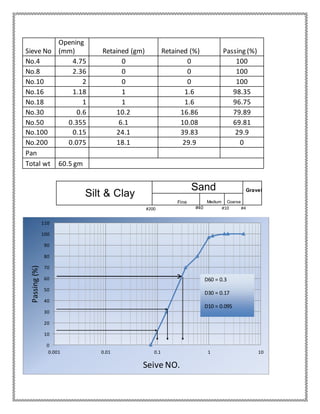
Sieve No
Opening
(mm) Retained (gm) Retained (%) Passing (%)
No.4 4.75 0 0 100
No.8 2.36 0 0 100
No.10 2 0 0 100
No.16 1.18 1 1.6 98.35
No.18 1 1 1.6 96.75
No.30 0.6 10.2 16.86 79.89
No.50 0.355 6.1 10.08 69.81
No.100 0.15 24.1 39.83 29.9
No.200 0.075 18.1 29.9 0
Pan
Total wt 60.5 gm
Silt & Clay
Sand Gravel
Fine Medium Coarse
0
10
20
30
40
50
60
70
80
90
100
110
0.001 0.01 0.1 1 10
Passing(%)
Seive NO.
D60 = 0.3
D30 = 0.17
D10 = 0.095
#200 #40 #10 #4
2.7.Some errorsand problems:
1. After weighing the remaining on each sieve, after weight was collected there was
a total weight loss from the original weight This is due to the survival of parts
stuck in the sieves that caused this loss.
2. We must weigh all the sieves before work and it is empty and then weighed after
working with the soil remaining on it and from the difference in weight we find
the weight of the soil remaining to reduce the percentage of error
3. LIQUID AND PLASTIC LIMIT TESTING
3.1. APPLICABLE ASTM STANDARD
ASTM D4318: Standard Test Methods for Liquid Limit, Plastic Limit, and Plasticity
Index of Soils.
3.2. PURPOSE OF MEASUREMENT
The liquid limit and plastic limit tests provide information regarding the effect of
water content (w) on the mechanical properties of soil. Specifically, the effects of
water content on volume change and soil consistencyare addressed. The results of
this test are used to classify soil in accordancewith ASTM D2487, AASHTO and
to estimate the swell potential of soil.
3.3. EQUIPMENT
3.3.1. Liquid Limit Test
The following equipment and materials are required for liquid limit testing:
 Fine-grained soil.
 #40 sieve (0.425-mm opening).
 Distilled water.
 Balance to the nearest 0.01 g.
 Glass to soil mixing.
 Soil drying oven set at 110o ± 5 o C.
 Spatula.
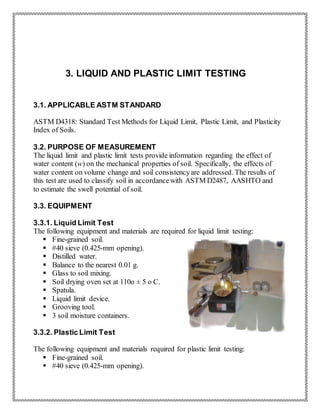
 Liquid limit device.
 Grooving tool.
 3 soil moisture containers.
3.3.2. Plastic Limit Test
The following equipment and materials required for plastic limit testing:
 Fine-grained soil.
 #40 sieve (0.425-mm opening).
 Distilled water.
 Balance to the nearest 0.01 g.
 Glass to soil mixing.
 Soil drying oven set at 110o ± 5 o C.
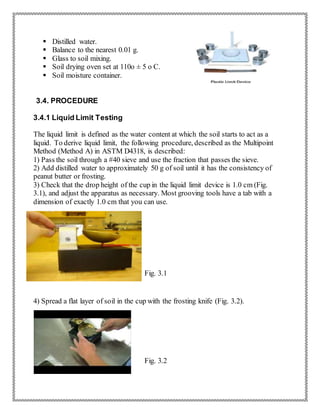
 Soil moisture container.
3.4. PROCEDURE
3.4.1 Liquid Limit Testing
The liquid limit is defined as the water content at which the soil starts to act as a
liquid. To derive liquid limit, the following procedure, described as the Multipoint
Method (Method A) in ASTM D4318, is described:
1) Pass the soil through a #40 sieve and use the fraction that passes the sieve.
2) Add distilled water to approximately 50 g of soil until it has the consistency of
peanut butter or frosting.
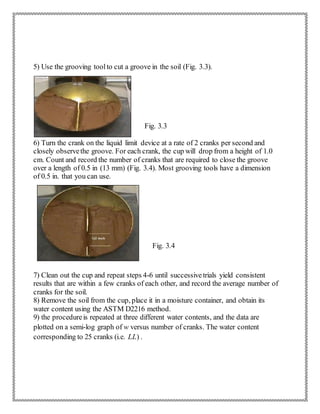
3) Check that the drop height of the cup in the liquid limit device is 1.0 cm (Fig.
3.1), and adjust the apparatus as necessary. Most grooving tools have a tab with a
dimension of exactly 1.0 cm that you can use.
Fig. 3.1
4) Spread a flat layer of soil in the cup with the frosting knife (Fig. 3.2).
Fig. 3.2
5) Use the grooving toolto cut a groove in the soil (Fig. 3.3).
Fig. 3.3
6) Turn the crank on the liquid limit device at a rate of 2 cranks per second and
closely observethe groove. For each crank, the cup will drop from a height of 1.0
cm. Count and record the number of cranks that are required to close the groove
over a length of 0.5 in (13 mm) (Fig. 3.4). Most grooving tools have a dimension
of 0.5 in. that you can use.
Fig. 3.4
7) Clean out the cup and repeat steps 4-6 until successivetrials yield consistent
results that are within a few cranks of each other, and record the average number of
cranks for the soil.
8) Remove the soil from the cup, place it in a moisture container, and obtain its
water content using the ASTM D2216 method.
9) the procedureis repeated at three different water contents, and the data are
plotted on a semi-log graph of w versus number of cranks. The water content
corresponding to 25 cranks (i.e. LL) .
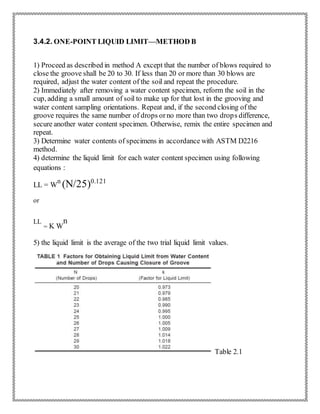
3.4.2. ONE-POINT LIQUID LIMIT—METHOD B
1) Proceed as described in method A except that the number of blows required to
close the groove shall be 20 to 30. If less than 20 or more than 30 blows are
required, adjust the water content of the soil and repeat the procedure.
2) Immediately after removing a water content specimen, reform the soil in the
cup, adding a small amount of soil to make up for that lost in the grooving and
water content sampling orientations. Repeat and, if the second closing of the
groove requires the same number of drops orno more than two drops difference,
secure another water content specimen. Otherwise, remix the entire specimen and
repeat.
3) Determine water contents of specimens in accordance with ASTM D2216
method.
4) determine the liquid limit for each water content specimen using following
equations :
LL = W
n
(N/25)0.121
or
LL
= K W
n
5) the liquid limit is the average of the two trial liquid limit values.
Table 2.1
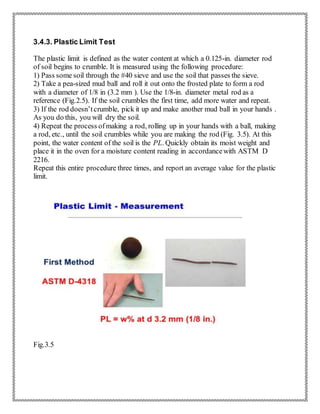
3.4.3. Plastic Limit Test
The plastic limit is defined as the water content at which a 0.125-in. diameter rod
of soil begins to crumble. It is measured using the following procedure:
1) Pass some soil through the #40 sieve and use the soil that passes the sieve.
2) Take a pea-sized mud ball and roll it out onto the frosted plate to form a rod
with a diameter of 1/8 in (3.2 mm ). Use the 1/8-in. diameter metal rod as a
reference (Fig.2.5). If the soil crumbles the first time, add more water and repeat.
3) If the rod doesn’tcrumble, pick it up and make another mud ball in your hands .
As you do this, you will dry the soil.
4) Repeat the process ofmaking a rod, rolling up in your hands with a ball, making
a rod, etc., until the soil crumbles while you are making the rod (Fig. 3.5). At this
point, the water content of the soil is the PL. Quickly obtain its moist weight and
place it in the oven for a moisture content reading in accordancewith ASTM D
2216.
Repeat this entire procedure three times, and report an average value for the plastic
limit.
Fig.3.5
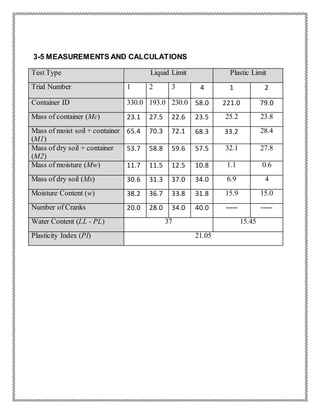
3-5 MEASUREMENTS AND CALCULATIONS
Test Type Liquid Limit Plastic Limit
Trial Number 1 2 3 4 1 2
Container ID 330.0 193.0 230.0 58.0 221.0 79.0
Mass of container (Mc) 23.1 27.5 22.6 23.5 25.2 23.8
Mass of moist soil + container
(M1)
65.4 70.3 72.1 68.3 33.2 28.4
Mass of dry soil + container
(M2)
53.7 58.8 59.6 57.5 32.1 27.8
Mass of moisture (Mw) 11.7 11.5 12.5 10.8 1.1 0.6
Mass of dry soil (Ms) 30.6 31.3 37.0 34.0 6.9 4
Moisture Content (w) 38.2 36.7 33.8 31.8 15.9 15.0
Number of Cranks 20.0 28.0 34.0 40.0 ----- -----
Water Content (LL - PL) 37 15.45
Plasticity Index (PI) 21.05
𝑃𝐿 =
𝑀1 − 𝑀2
𝑀2 − 𝑀𝑐
× 100
𝐿𝐿 =
𝑀1 − 𝑀2
𝑀2 − 𝑀𝑐
× 100
𝑃𝐼 = 𝐿𝐿 − 𝑃𝐿
Liquid Limit by METHOD B:
N = 28, W = 36.7 %, tan β = (0.121 ASTM), (0.092 BS)
k = 1.014 (from Table 2-1)
𝐿𝐿 𝑛
= 𝑤 𝑛
(
𝑁
25
)
tan 𝛽
= 36.7(
28
25
)
0.121
= 37.2%,
𝑜𝑟 = 40.22(
27
25
)
0.092
= 37.08%
𝐿𝐿 𝑛
= 𝑘. 𝑤 𝑛
= 1.009 × 40.22 = 37.21%
0
10
20
30
40
50
5 50
Watercontent[%]
Nr. of Blows
LL Expon. (LL)
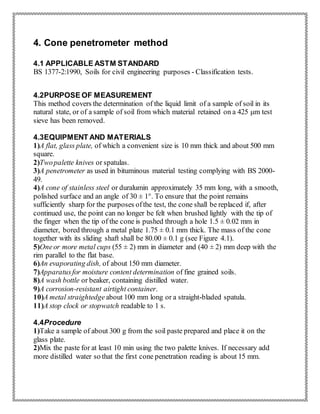
4. Cone penetrometer method
4.1 APPLICABLE ASTM STANDARD
BS 1377-2:1990, Soils for civil engineering purposes - Classification tests.
4.2PURPOSE OF MEASUREMENT
This method covers the determination of the liquid limit of a sample of soil in its
natural state, or of a sample of soil from which material retained on a 425 μm test
sieve has been removed.
4.3EQUIPMENT AND MATERIALS
1)A flat, glass plate, of which a convenient size is 10 mm thick and about 500 mm
square.
2)Twopalette knives or spatulas.
3)A penetrometer as used in bituminous material testing complying with BS 2000-
49.
4)A cone of stainless steel or duralumin approximately 35 mm long, with a smooth,
polished surface and an angle of 30 ± 1°. To ensure that the point remains
sufficiently sharp for the purposes ofthe test, the cone shall be replaced if, after
continued use, the point can no longer be felt when brushed lightly with the tip of
the finger when the tip of the cone is pushed through a hole 1.5 ± 0.02 mm in
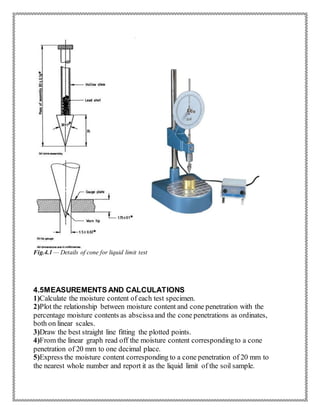
diameter, bored through a metal plate 1.75 ± 0.1 mm thick. The mass of the cone
together with its sliding shaft shall be 80.00 ± 0.1 g (see Figure 4.1).
5)Oneor more metal cups (55 ± 2) mm in diameter and (40 ± 2) mm deep with the
rim parallel to the flat base.
6)An evaporating dish, of about 150 mm diameter.
7)Apparatusfor moisture content determination of fine grained soils.
8)A wash bottle or beaker, containing distilled water.
9)A corrosion-resistant airtight container.
10)A metal straightedge about 100 mm long or a straight-bladed spatula.
11)A stop clock or stopwatch readable to 1 s.
4.4Procedure
1)Take a sample of about 300 g from the soil paste prepared and place it on the
glass plate.
2)Mix the paste for at least 10 min using the two palette knives. If necessary add
more distilled water so that the first cone penetration reading is about 15 mm.
3)Push a portion of the mixed soil into the cup with a palette knife taking care not
to trap air. Strike off excess soil with the straightedge to give a smooth level
surface.
4)With the penetration cone locked in the raised position lower the supporting
assembly so that the tip of the cone just touches the surface of the soil. When the
cone is in the correctposition a slight movement of the cup will just mark the soil
surface. Lower the stem of the dial gauge to contact the cone shaft and record the
reading of the dial gauge to the nearest 0.1 mm.
5)Release the cone for a period of 5 ± 1 s. If the apparatus is not fitted with an
automatic release and locking device take care not to jerk the apparatus during this
operation. After locking the cone in position lower the stem of the dial gauge to
contact the cone shaft and record the reading of the dial gauge to the nearest 0.1
mm. Record the difference between the beginning and end of the drop as the cone
penetration.
6)Lift out the cone and clean it carefully to avoid scratching.
7)Add a little more wet soil to the cup, taking care not to trap air, make the surface
smooth as in 3 and repeat 4 to 6.
8)If the difference between the first and second penetration readings is not more
than 0.5 mm record the average of the two penetrations and proceed to 9. If the
second penetration is more than 0.5 mm and less than 1 mm different from the
first, carry out a third test. If the overall range is then not more than 1 mm record
the average of the three penetrations and proceed to 9. If the overall range is more
than 1 mm remove the soil from the cup, remix and repeat 3 to 8 until consistent
results are obtained and then proceed to 9.
9)Take a moisture content sample of about 10 g from the area penetrated by the
cone and determine the moisture content.
10)Repeat3 to 9 at least three more times using the same sample of soil to which
further increments of distilled water have been added. Proceed from the drier to the
wetter condition of the soil. The amount of water added shall be such that a range
of penetration values of approximately 15 mm to 25 mm is covered by the four or
more test runs and is evenly distributed. Each time soil is removed from the cup for
the addition of water, wash and dry the cup.
11)If at any time during the above procedurethe soil has to be left for a while on
the glass plate cover the soil with the evaporating dish or a damp cloth to prevent
the soil drying out.
Fig.4.1 — Details of cone for liquid limit test
4.5MEASUREMENTS AND CALCULATIONS
1)Calculate the moisture content of each test specimen.
2)Plot the relationship between moisture content and cone penetration with the
percentage moisture contents as abscissaand the cone penetrations as ordinates,
both on linear scales.
3)Draw the best straight line fitting the plotted points.
4)From the linear graph read off the moisture content correspondingto a cone
penetration of 20 mm to one decimal place.
5)Express the moisture content corresponding to a cone penetration of 20 mm to
the nearest whole number and report it as the liquid limit of the soil sample.
4.6MEASUREMENTS AND CALCULATIONS
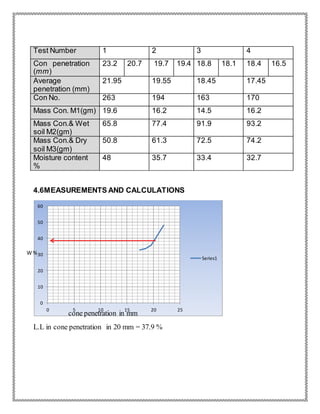
L.L in cone penetration in 20 mm = 37.9 %
0
10
20
30
40
50
60
0 5 10 15 20 25
Series1
Test Number 1 2 3 4
Con penetration
(mm)
23.2 20.7 19.7 19.4 18.8 18.1 18.4 16.5
Average
penetration (mm)
21.95 19.55 18.45 17.45
Con No. 263 194 163 170
Mass Con. M1(gm) 19.6 16.2 14.5 16.2
Mass Con.& Wet
soil M2(gm)
65.8 77.4 91.9 93.2
Mass Con.& Dry
soil M3(gm)
50.8 61.3 72.5 74.2
Moisture content
%
48 35.7 33.4 32.7
cone penetration in mm
W %
5. Hydrometer Analysis (ASTM D422)
Hydrometer—An ASTM hydrometer, graduated to reading either specific gravity
of the suspensionor grams per liter of suspension, and conforming to the
requirements for hydrometers 151H or 152H in Specifications E 100. Dimensions
of both hydrometers are the same, the scale being the only item of difference.
The hydrometer D152_H based on the principle of sedimentation of soil grains in
water.
5.1. Application :
Hydrometer analysis is done to measure the proportion of particles smaller than
0.075 mm NO. #200.
5.2. Equipment :
ASTM 152 H & 151 H Hydrometer
Mixer cup
Two 1000 cc graduated cylinder
Thermometer
Constant Temperature Bath
Sodium hexametaphosphate
Spatula
Beaker
Balance
Squeeze bottle
5.3.Procedure:
1) Combine approximately 50.0 g (Md) of the soil that passed the #200 sieve
after dried in oven with 125 ml of the sodium hexametaphospahte solution in a
250-ml glass beaker. Allow the mixture to soak for at least 16 hours in accordance
with ASTM D422 procedures
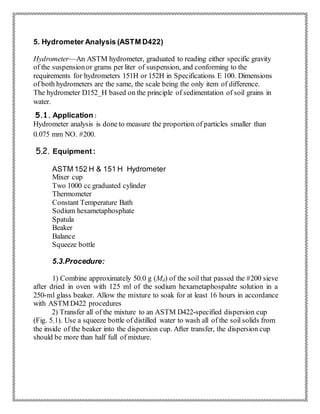
2) Transfer all of the mixture to an ASTM D422-specified dispersion cup
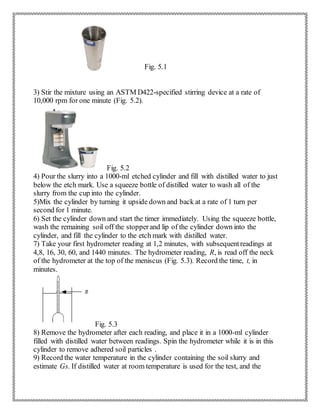
(Fig. 5.1). Use a squeeze bottle of distilled water to wash all of the soil solids from
the inside of the beaker into the dispersion cup. After transfer, the dispersion cup
should be more than half full of mixture.
Fig. 5.1
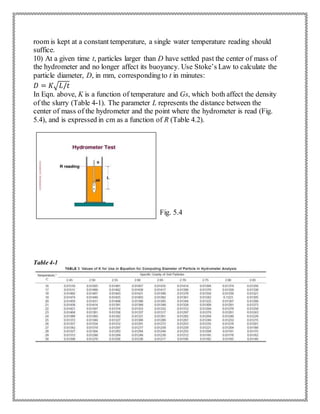
3) Stir the mixture using an ASTM D422-specified stirring device at a rate of
10,000 rpm for one minute (Fig. 5.2).
Fig. 5.2
4) Pour the slurry into a 1000-ml etched cylinder and fill with distilled water to just
below the etch mark. Use a squeeze bottle of distilled water to wash all of the
slurry from the cup into the cylinder.
5)Mix the cylinder by turning it upside down and back at a rate of 1 turn per
second for 1 minute.
6) Set the cylinder down and start the timer immediately. Using the squeeze bottle,
wash the remaining soil off the stopperand lip of the cylinder down into the
cylinder, and fill the cylinder to the etch mark with distilled water.
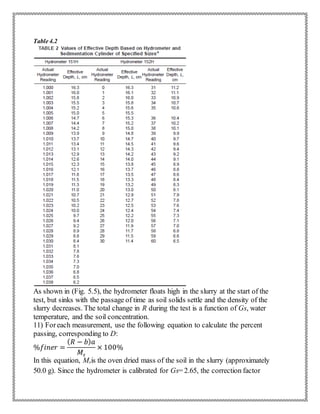
7) Take your first hydrometer reading at 1,2 minutes, with subsequentreadings at
4,8, 16, 30, 60, and 1440 minutes. The hydrometer reading, R, is read off the neck
of the hydrometer at the top of the meniscus (Fig. 5.3). Record the time, t, in
minutes.
Fig. 5.3
8) Remove the hydrometer after each reading, and place it in a 1000-ml cylinder
filled with distilled water between readings. Spin the hydrometer while it is in this
cylinder to remove adhered soil particles .
9) Record the water temperature in the cylinder containing the soil slurry and
estimate Gs. If distilled water at room temperature is used for the test, and the
room is kept at a constant temperature, a single water temperature reading should
suffice.
10) At a given time t, particles larger than D have settled past the center of mass of
the hydrometer and no longer affect its buoyancy. Use Stoke’s Law to calculate the
particle diameter, D, in mm, correspondingto t in minutes:
𝐷 = 𝐾√ 𝐿/𝑡
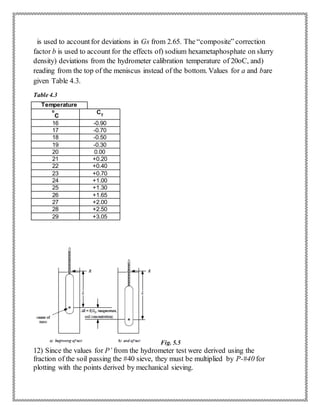
In Eqn. above, K is a function of temperature and Gs, which both affect the density
of the slurry (Table 4-1). The parameter L represents the distance between the
center of mass of the hydrometer and the point where the hydrometer is read (Fig.
5.4), and is expressed in cm as a function of R (Table 4.2).
Fig. 5.4
Table 4-1
Table 4.2
As shown in (Fig. 5.5), the hydrometer floats high in the slurry at the start of the
test, but sinks with the passage of time as soil solids settle and the density of the
slurry decreases. The total change in R during the test is a function of Gs, water
temperature, and the soil concentration.
11) Foreach measurement, use the following equation to calculate the percent
passing, corresponding to D:
%𝑓𝑖𝑛𝑒𝑟 =
( 𝑅 − 𝑏) 𝑎
𝑀𝑠
× 100%
In this equation, Msis the oven dried mass of the soil in the slurry (approximately
50.0 g). Since the hydrometer is calibrated for Gs= 2.65, the correction factor
is used to accountfor deviations in Gs from 2.65. The “composite” correction
factor b is used to account for the effects of) sodium hexametaphosphate on slurry
density) deviations from the hydrometer calibration temperature of 20oC, and)
reading from the top of the meniscus instead of the bottom. Values for a and bare
given Table 4.3.
Table 4.3
Fig. 5.5
12) Since the values for P’ from the hydrometer test were derived using the
fraction of the soil passing the #40 sieve, they must be multiplied by P-#40 for
plotting with the points derived by mechanical sieving.
Temperature
o
C
CT
16 -0.90
17 -0.70
18 -0.50
19 -0.30
20 0.00
21 +0.20
22 +0.40
23 +0.70
24 +1.00
25 +1.30
26 +1.65
27 +2.00
28 +2.50
29 +3.05
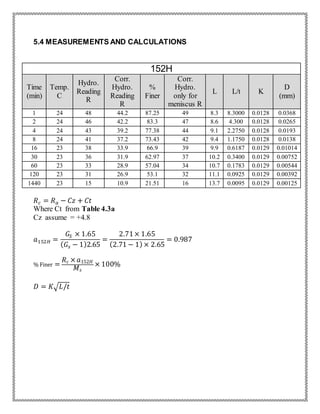
5.4 MEASUREMENTS AND CALCULATIONS
152H
Time
(min)
Temp.
C
Hydro.
Reading
R
Corr.
Hydro.
Reading
R
%
Finer
Corr.
Hydro.
only for
meniscus R
L L/t K
D
(mm)
1 24 48 44.2 87.25 49 8.3 8.3000 0.0128 0.0368
2 24 46 42.2 83.3 47 8.6 4.300 0.0128 0.0265
4 24 43 39.2 77.38 44 9.1 2.2750 0.0128 0.0193
8 24 41 37.2 73.43 42 9.4 1.1750 0.0128 0.0138
16 23 38 33.9 66.9 39 9.9 0.6187 0.0129 0.01014
30 23 36 31.9 62.97 37 10.2 0.3400 0.0129 0.00752
60 23 33 28.9 57.04 34 10.7 0.1783 0.0129 0.00544
120 23 31 26.9 53.1 32 11.1 0.0925 0.0129 0.00392
1440 23 15 10.9 21.51 16 13.7 0.0095 0.0129 0.00125
𝑅 𝑐 = 𝑅 𝑎 − 𝐶𝑧 + 𝐶𝑡
Where Ct from Table 4.3a
Cz assume = +4.8
𝑎152𝐻 =
𝐺𝑆 × 1.65
( 𝐺𝑠 − 1)2.65
=
2.71× 1.65
(2.71 − 1) × 2.65
= 0.987
% Finer =
𝑅 𝑐 × 𝑎152𝐻
𝑀𝑠
× 100%
𝐷 = 𝐾√ 𝐿/𝑡
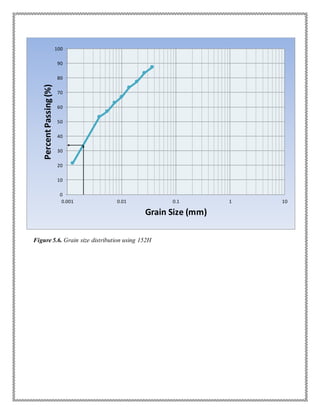
Figure 5.6. Grain size distribution using 152H
0
10
20
30
40
50
60
70
80
90
100
0.001 0.01 0.1 1 10
PercentPassing(%)
Grain Size (mm)
𝑅 𝑐 = 𝑅 𝑎 − 0.001∗ 𝑇
𝑎151𝐻 =
𝐺𝑆
( 𝐺𝑠 − 1)
=
2.71
(2.71 − 1)
= 1.59
% Finer =
100000∗𝑎151𝐻
𝑀 𝑠
× (𝑅𝑐−1 )……….. eq1 in ASTM D 422 – 63
L = L1 + 1 / 2 [L2 - VB/A] ……………eq5in ASTM D 422 – 63
L = effective depth, cm,
L1 = distance along the stem of the hydrometer from the top of the bulb to
the mark for a hydrometer reading,cm,
L 2 = overall length of the hydrometer bulb,cm,
VB = volume of hydrometer bulb,cm3, and
A = cross-sectional area ofsedimentation cylinder,cm2
Values used in calculating the values in Table 2 are as follows:
For both hydrometers,151H and 152H:
L2 = 14.0 cm
VB = 67.0 cm3
A = 27.8 cm2
For hydrometer 151H:
L1 = 10.5 cm for a reading of1.000
= 2.3 cm for a reading of 1.031
L1 =10.5 - n * 0.264516129032258 # n =( Rm – 1) *1000
𝐷 = 𝐾√ 𝐿/𝑡
151H
Time
(min)
Temp.
C
Hydro.
Reading
R
Corr.
Hydro.
Reading
Rc
%
Finer
Corr.
Hydro.
only for
meniscus
Rm
L L/t K
D
(mm)
1 24 1.044 1.0416 132.2 1.045 4.4 4.4 0.0128 0.02684
2 24 1.040 1.0376 119.56 1.041 5.44 2.72 0.0128 0.02111
4 24 1.039 1.0366 116.38 1.040 5.7 1.425 0.0128 0.01527
8 24 1.037 1.0346 110.02 1.038 6.2 0.775 0.0128 0.01126
15 23 1.036 1.0337 107.16 1.037 6.5 0.433 0.0129 0.00848
30 23 1.031 1.0287 91.266 1.032 7.8 0.26 0.0129 0.00657
60 23 1.028 1.0257 81.726 1.029 8.6 0.1433 0.0129 0.00488
120 23 1.027 1.0247 78.546 1.028 8.9 0.0741 0.0129 0.00351
1440 23 1.014 1.0117 37.206 1.015 12.3 0.0085 0.0129 0.00118
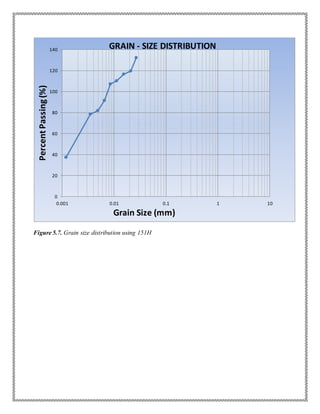
Figure 5.7. Grain size distribution using 151H
0
20
40
60
80
100
120
140
0.001 0.01 0.1 1 10
PercentPassing(%)
Grain Size (mm)
GRAIN - SIZE DISTRIBUTION
6. CLASSIFICATION OF SOIL
6-1 CLASSIFICATIONBY USCS
6-1-1APPLICABLE STANDARDS
ASTM D2487: Standard Practice for Classificationof Soils for Engineering
Purposes (Unified Soil ClassificationSystem).
Percent of Passing sieve #200 = [(500-61.5)/500]x100 = 87.7% > 50%
Classified as fine grained soil
Liquid Limit = 37 %
Plastic Limit = 15.45 %
Plastic Index = 21.05%
From Plasticity Chart CL (Clay low plasticity ) (Fig 6.1)
Percent Remains on sieve #200 = 100-87.7=12.3% < 30%
Percent Remains on sieve #200 = 12.3% < 15%
Group Name: Lean Clay (Fig 6.2)
Fig 6.1
0
10
20
30
40
50
60
0 10 20 30 40 50 60 70 80 90 100
PlasticityIndex(PI)
Liquid Limit (LL or wL)
ML
MH
CL
CH
A Line
CL-ML
Fig 6.2
6-2 CLASSIFICATIONBY AASHTO
6-2-1APPLICABLE STANDARDS
 AASHTO M145-91(2003) Standard Specificationsfor Classification of
Soils and Soil-AggregateMixtures for HighwayConstruction Purposes.
 ASTM D3282-09 StandardPractice for Classification of Soils and Soil-
AggregateMixtures for HighwayConstruction Purposes.
Percent of Passing sieve #200 (F200) = 87.7% > 36%
Classified as fine grained soil
Liquid Limit = 37 %< 40%
Plastic Limit = 15.45 %
Plastic Index = 21.05%> 11%
Percent of Passing sieve #200 = 87.7 > 30
The soil Group Name A-6
Group Index : G1
𝐺𝐼 = ( 𝐹200 − 36)[0.2 + 0.005( 𝐿𝐿 − 40)]+ 0.1(𝐹200 − 15)(𝑃𝐼 − 10)
𝐺𝐼 = (87.7− 36)[0.2+ 0.005(37− 40)]+ 0.1(87.7 − 15)(21.05− 10)
𝐺𝐼 = 79.953 ≈ 80
Group Name: A-6(80)
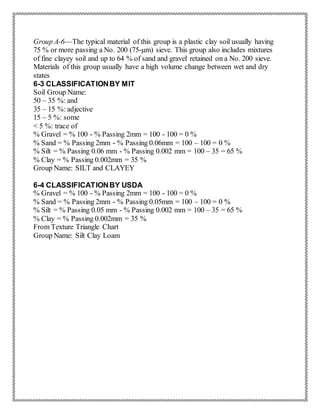
Group A-6—The typical material of this group is a plastic clay soil usually having
75 % or more passing a No. 200 (75-μm) sieve. This group also includes mixtures
of fine clayey soil and up to 64 % of sand and gravel retained on a No. 200 sieve.
Materials of this group usually have a high volume change between wet and dry
states
6-3 CLASSIFICATIONBY MIT
Soil Group Name:
50 – 35 %: and
35 – 15 %: adjective
15 – 5 %: some
< 5 %: trace of
% Gravel = % 100 - % Passing 2mm = 100 - 100 = 0 %
% Sand = % Passing 2mm - % Passing 0.06mm = 100 – 100 = 0 %
% Silt = % Passing 0.06 mm - % Passing 0.002 mm = 100 – 35 = 65 %
% Clay = % Passing 0.002mm = 35 %
Group Name: SILT and CLAYEY
6-4 CLASSIFICATIONBY USDA
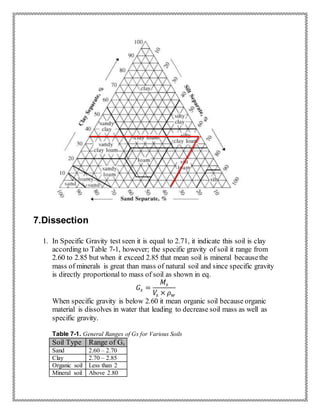
% Gravel = % 100 - % Passing 2mm = 100 - 100 = 0 %
% Sand = % Passing 2mm - % Passing 0.05mm = 100 – 100 = 0 %
% Silt = % Passing 0.05 mm - % Passing 0.002 mm = 100 – 35 = 65 %
% Clay = % Passing 0.002mm = 35 %
From Texture Triangle Chart
Group Name: Silt Clay Loam
7.Dissection
1. In Specific Gravity test seen it is equal to 2.71, it indicate this soil is clay
according to Table 7-1, however; the specific gravity of soil it range from
2.60 to 2.85 but when it exceed 2.85 that mean soil is mineral becausethe
mass of minerals is great than mass of natural soil and since specific gravity
is directly proportional to mass of soil as shown in eq.
𝐺𝑠 =
𝑀𝑠
𝑉𝑠 × 𝜌 𝑤
When specific gravity is below 2.60 it mean organic soil because organic
material is dissolves in water that leading to decrease soil mass as well as
specific gravity.
Table 7-1. General Ranges of Gs for Various Soils
Soil Type Range of Gs
Sand 2.60 – 2.70
Clay 2.70 – 2.85
Organic soil Less than 2
Mineral soil Above 2.80
2. In the analysis of sieves, there are no granules diameter smaller than
diameter # 200 becausewe washed all the soil on this sieve and the analysis
did not contain most gradients where the grains begin to appear from sieve #
16 This indicates that there is a gap in the soil gradient .
3. The liquid limit define as the percent of water in soil when it start to behave
like water. In order to find liquid limit there are two major approachthe fall
cone method and the Casagrande method, the main difference between them
in the fundamental works that the first method is depend directly on the
static shear strength of soil, while the other method introduce a dynamic
component not related to shear strength in the same way for all soils.
The difference in values between the two methods is due to errors
resulting from the examiner, for example a 13 mm estimate in a method
Casagrande or not to dry the sample completely and that the sample did not
remain in the oven for 24 hours where the oven is separated from the energy
after the end of the official working hoursthe fall cone method provides
more consistent results since it is subject to fewer experimental and operator
errors. However, the presence of large particles in the soil matrix can cause
erroneous readings when using the cone method A comparison between the
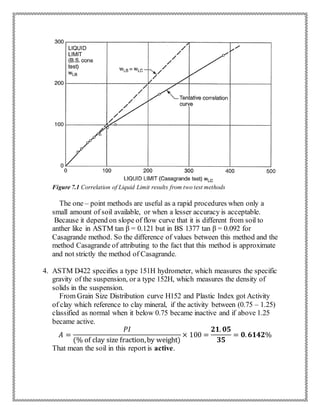
Casagrande method and the fall cone method, shown in (Fig.7.1).For liquid
limit values of up to 100% there is little difference between the results
obtained by eachmethod .Above 100%the cone method tends to give
slightly lowervalues. The relationship betweenresults obtained from
the casagrande andcone method base on evidence available is shown
graphically from head.
Figure 7.1 Correlation of Liquid Limit results from two test methods
The one – point methods are useful as a rapid procedures when only a
small amount of soil available, or when a lesser accuracy is acceptable.
Because it depend on slope of flow curve that it is different from soil to
anther like in ASTM tan β = 0.121 but in BS 1377 tan β = 0.092 for
Casagrande method. So the difference of values between this method and the
method Casagrande of attributing to the fact that this method is approximate
and not strictly the method of Casagrande.
4. ASTM D422 specifies a type 151H hydrometer, which measures the specific
gravity of the suspension, or a type 152H, which measures the density of
solids in the suspension.
From Grain Size Distribution curve H152 and Plastic Index got Activity
of clay which reference to clay mineral, if the activity between (0.75 – 1.25)
classified as normal when it below 0.75 became inactive and if above 1.25
became active.
𝐴 =
𝑃𝐼
(% of clay size fraction,by weight)
× 100 =
𝟐𝟏. 𝟎𝟓
𝟑𝟓
= 𝟎. 𝟔𝟏𝟒𝟐%
That mean the soil in this report is active.
5. In classification of soil there are mean difference between AASHTO and
USCS from MIT and USDA because the first two methods it take in
consideration Atterberg limit (LL, PI) with percent of passing, on other hand
MIT & USDA it depend on percent of passing only.
The difference between AASHTO and USCS methods seen in treatment of
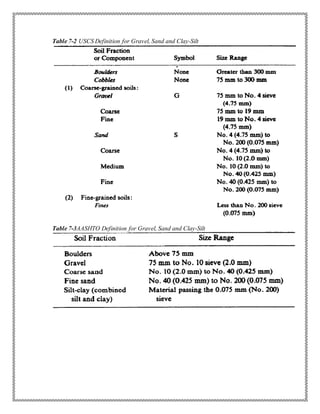
course– grained soils as shown in (Table 7-2&7-3), and for fine – grained
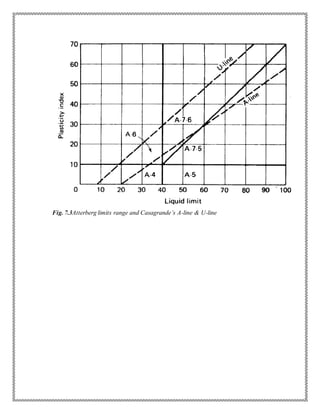
soils the major difference is shown in Fig. 7.3 were line A & U on chart LL-
PI for AASHTO, Also use PI = 10 as a dividing line between silty and
clayey soils seems rather arbitrary and probably does not relate to
engineering properties for fine – grain soils.
Table 7-2 USCS Definition for Gravel, Sand and Clay-Silt
Table 7-3AASHTO Definition for Gravel, Sand and Clay-Silt
Fig. 7.3Atterberg limits range and Casagrande’s A-line & U-line

soil classification lab

  • 1.
    SOIL CLASSIFICATION BASICS: This testis performed to determine the percentage of different grain sizes contained within a soil. The mechanical or sieve analysis is performed to determine the distribution of the coarser, larger-sized particles, and the hydrometer method is used to determine the distribution of the finer particles. Standardreference: Commonly based on grain size and soil consistency. Several classification systems exist: 1. Unified Soil Classification System (USCS)(ASTM D2487-11). 2. American Association of State Highway and Transportation Officials (AASHTO) (ASTM D3282-09). 3. U.S. Department of Agriculture (USDA). 4. Massachusetts Institute of Technology (MIT).
  • 2.
    SOIL GRAIN SIZES SoilType USCS Grain Size Range (mm) Symbol USCS AASHTO USDA MIT Gravel G 76.2 to 4.75 76.2 to 2 >2 >2 Sand S 4.75 to 2 to 0.075 2 to 0.05 2 to 0.06 0.075 Silt M 0.075 0.05 to 0.06 to Fines < to 0.002 0.002 0.002 0.075 Clay C < 0.002 < 0.002 < 0.002
  • 4.
    1.SPECIFIC GRAVITY OFSOIL SOLIDS 1-1 APPLICABLE STANDARD ASTM D854: Standard Test Method for Specific Gravity of Soils. 1-2 PURPOSE OF MEASUREMENT Specific gravity of soil solids is used for performing weight-volume calculations in soils. 1-3 EQUIPMENT AND MATERIALS The following equipment and materials are required for specific gravity of soil solids measurements:-  Oven-dried soil sample.  Scale capable of measuring to the nearest 0.01 g.  500-ml etched flask.  Distilled or demineralized water.  Squeeze bottle.  Thermometer capable of reading to the nearest 0.5o C.  Funnel.  Vacuum supply capable of achieving a gauge vacuum of 660 mm Hg (12.8 psi). Figure 1.1 Vacuum supply.
  • 5.
    1-4 PROCEDURE The procedurepresentedherein is consistent with ASTM D854 TestMethod A is as follows: 1) Weight approximately 10 g of dry soil to obtain Ms.2) Fill the Pycnometer to the etch line with distilled or demineralized water and take four reading in different temperature by making cold bath and hot bath to obtain Mpw,C. 3) Pour half of the water out of the Pycnometer and place the soil in the Pycnometer with a funnel. 4) Wash the soil down the inside neck of the Pycnometer. 5) Connect the Pycnometer to the vacuum sourceand apply vacuum for 30 minutes, occasionally agitating the mixture. 6) Fill the Pycnometer to the etch line with distilled water and weigh it to obtain Mpws,C. 7) Record the water temperature in the Pycnometer and use Table 1-2 to obtain K. 1-5 MEASUREMENTS AND CALCULATIONS TABLE 1-1 Temperature (Co) Weight of Water + Pycnometer (g) Cold Bath 20 131.66 15 131.72 Hot Bath 36 131.31 30 131.44
  • 6.
    Figure1.2calibration curve massof volumetric filled with water over a range of temperatures. From(Fig 1.2)at26o C MPw,C = 131.54 g 𝐺𝑆 = 𝑀𝑠 𝑀 𝑃𝑤,𝐶 − (𝑀 𝑃𝑤𝑠,𝐶 − 𝑀𝑠) 𝐺𝑆@20° = 𝐺𝑆 × 𝐾 Container ID: 2869 Mass of flask filled with water (Mpw,C), g 131.54 Mass of flask filled with soil and water (Mpws,C), g 137.85 Mass of dry soil (Ms), g 10 Specific gravity of soil solids (Gs) 2.71 Water temperature, Co 26 Correction factor (K)(from Table 1-2) 0.99858 Specific gravity of soil solids at 20oC (Gs20) 2.71 Table 1-2Density of Water and Temperature Coefficient (K) Mass of Water & Pycnoumeter Temperature (C) Massofwater&pycnoumeter(gm) 13.0 18.0 23.0 28.0 33.0 38.0 131.25 131.33 131.41 131.49 131.57 131.65 131.73
  • 8.
    2. SIEVE ANALYSIS COMMONLYUSED STANDARD SIEVE SIZES (ASTM E11-09e1) Sieve No. Opening Opening Notes (mm) (in) 3/4 in 19 0.75 Gravel #4 4.75 0.187 #6 3.35 0.132 Course Sand #8 2.36 0.0937 (#4 to #10) #10 2.00 0.0787 #16 1.18 0.0469 #20 0.85 0.0331 Medium Sand #30 0.60 0.0234 (#10 to #40) #40 0.425 0.0165 #50 0.300 0.0117 #60 0.250 0.0098 #80 0.180 0.0070 Fine Sand #100 0.150 0.0059 (#40 to #200) #140 0.106 0.0041 #170 0.088 0.0035 #200 0.075 0.0029 #270 0.053 0.0021 Silt or Clay <#200 -Table 1 : STANDARD SIEVE SIZES (ASTM E11-09e1)
  • 9.
    2.1. Purpose: In thistest determine the distribution of the coarsersoil and find the percentage of coarser soil and fain soil . So we make this test to classify soil , this test performed to coarser soil . 2.2. Standard Reference: ASTM D 422 - Standard Test Method for Particle-Size Analysis of Soils 2.3. Significance: The distribution of different grain sizes affects on engineering properties of soil. Grain size analysis provides the grain size distribution, and it is required in classifying the soil. 2.4. Equipment: Balance, Set of sieves, Cleaning brush, Sieve shaker. 2.5.TestProcedure: 1. weight soil sample 500 gm . 2. After we washed this sample in Sieve No. 200 so that no remaining of the clay and silt particle on the sieve. 3. The remaining soil on the sieve was collected in a container and placed in the oven for 24 hours to dry. 4. After the dried coarsesoil we weight coarsesoil = 61.5 gm 5. The percentage passing from # 200 = 87.7 % 6. After the dried coarsesoil was placed in sieves, Sieves were arranged according to ASTM codesee table 1. 7. We shookthe sieves for 10 minutes and then the remaining weight was taken from the soil on each sieve . 8. The soil should not pass to the pan Where not pass through sieve No. 200.
  • 10.
    2.6.Data Analysis: 1. Obtainthe mass of soil retained on each sieve and record this mass as the weight retained on the data sheet. The sum of these retained masses should be approximately equals the initial mass of the soil sample. A loss of more than two percent is unsatisfactory. 2. Calculate the percent retained on each sieve by dividing the weight retained on each sieve by the original sample mass. 3. Calculate the percent passing by starting with 100 percent and subtracting the percent retained on each sieve as a cumulative procedure. For example: Total mass = 60.5 g Mass retained on No. 16 sieve = 1 g Mass retained on No. 30 sieve = 10.2 g For the No.16 sieve The percent retained is calculated as; % retained = Mass retained/Total mass = (1/60.5) X 100 = 1.65 % From this, the % passing = 100 - 1.9 = 9 8.35 % For the No. 30 sieve: % Retained = (10.2/60.5) X 100 = 16.86 % % Passing = 96.75 - 16.86 = 79.89% 4. Make a semi logarithmic plot of grain size vs. percent finer. 5. Compute Cc and Cu for the soil. Key Particle Sizes (D = Diameter) D60 = Diameter corresponding to 60% finer in the grain size distribution. D30 = Diameter corresponding to 30% finer in the grain size distribution.6. D10 = Diameter corresponding to 10% finer in the grain size distribution. Also known as Effective Size. Key Coefficients (C): Cu = Coefficient of Uniformity (ASTM D2487) = D60/D10 =3.15 Cc = Coefficient of Gradation = Coefficient of Curvature (ASTM D2487) = (D30)2/(D60xD10) =1.01
  • 11.
    Sieve No Opening (mm) Retained(gm) Retained (%) Passing (%) No.4 4.75 0 0 100 No.8 2.36 0 0 100 No.10 2 0 0 100 No.16 1.18 1 1.6 98.35 No.18 1 1 1.6 96.75 No.30 0.6 10.2 16.86 79.89 No.50 0.355 6.1 10.08 69.81 No.100 0.15 24.1 39.83 29.9 No.200 0.075 18.1 29.9 0 Pan Total wt 60.5 gm Silt & Clay Sand Gravel Fine Medium Coarse 0 10 20 30 40 50 60 70 80 90 100 110 0.001 0.01 0.1 1 10 Passing(%) Seive NO. D60 = 0.3 D30 = 0.17 D10 = 0.095 #200 #40 #10 #4
  • 12.
    2.7.Some errorsand problems: 1.After weighing the remaining on each sieve, after weight was collected there was a total weight loss from the original weight This is due to the survival of parts stuck in the sieves that caused this loss. 2. We must weigh all the sieves before work and it is empty and then weighed after working with the soil remaining on it and from the difference in weight we find the weight of the soil remaining to reduce the percentage of error
  • 13.
    3. LIQUID ANDPLASTIC LIMIT TESTING 3.1. APPLICABLE ASTM STANDARD ASTM D4318: Standard Test Methods for Liquid Limit, Plastic Limit, and Plasticity Index of Soils. 3.2. PURPOSE OF MEASUREMENT The liquid limit and plastic limit tests provide information regarding the effect of water content (w) on the mechanical properties of soil. Specifically, the effects of water content on volume change and soil consistencyare addressed. The results of this test are used to classify soil in accordancewith ASTM D2487, AASHTO and to estimate the swell potential of soil. 3.3. EQUIPMENT 3.3.1. Liquid Limit Test The following equipment and materials are required for liquid limit testing:  Fine-grained soil.  #40 sieve (0.425-mm opening).  Distilled water.  Balance to the nearest 0.01 g.  Glass to soil mixing.  Soil drying oven set at 110o ± 5 o C.  Spatula.  Liquid limit device.  Grooving tool.  3 soil moisture containers. 3.3.2. Plastic Limit Test The following equipment and materials required for plastic limit testing:  Fine-grained soil.  #40 sieve (0.425-mm opening).
  • 14.
     Distilled water. Balance to the nearest 0.01 g.  Glass to soil mixing.  Soil drying oven set at 110o ± 5 o C.  Soil moisture container. 3.4. PROCEDURE 3.4.1 Liquid Limit Testing The liquid limit is defined as the water content at which the soil starts to act as a liquid. To derive liquid limit, the following procedure, described as the Multipoint Method (Method A) in ASTM D4318, is described: 1) Pass the soil through a #40 sieve and use the fraction that passes the sieve. 2) Add distilled water to approximately 50 g of soil until it has the consistency of peanut butter or frosting. 3) Check that the drop height of the cup in the liquid limit device is 1.0 cm (Fig. 3.1), and adjust the apparatus as necessary. Most grooving tools have a tab with a dimension of exactly 1.0 cm that you can use. Fig. 3.1 4) Spread a flat layer of soil in the cup with the frosting knife (Fig. 3.2). Fig. 3.2
  • 15.
    5) Use thegrooving toolto cut a groove in the soil (Fig. 3.3). Fig. 3.3 6) Turn the crank on the liquid limit device at a rate of 2 cranks per second and closely observethe groove. For each crank, the cup will drop from a height of 1.0 cm. Count and record the number of cranks that are required to close the groove over a length of 0.5 in (13 mm) (Fig. 3.4). Most grooving tools have a dimension of 0.5 in. that you can use. Fig. 3.4 7) Clean out the cup and repeat steps 4-6 until successivetrials yield consistent results that are within a few cranks of each other, and record the average number of cranks for the soil. 8) Remove the soil from the cup, place it in a moisture container, and obtain its water content using the ASTM D2216 method. 9) the procedureis repeated at three different water contents, and the data are plotted on a semi-log graph of w versus number of cranks. The water content corresponding to 25 cranks (i.e. LL) .
  • 16.
    3.4.2. ONE-POINT LIQUIDLIMIT—METHOD B 1) Proceed as described in method A except that the number of blows required to close the groove shall be 20 to 30. If less than 20 or more than 30 blows are required, adjust the water content of the soil and repeat the procedure. 2) Immediately after removing a water content specimen, reform the soil in the cup, adding a small amount of soil to make up for that lost in the grooving and water content sampling orientations. Repeat and, if the second closing of the groove requires the same number of drops orno more than two drops difference, secure another water content specimen. Otherwise, remix the entire specimen and repeat. 3) Determine water contents of specimens in accordance with ASTM D2216 method. 4) determine the liquid limit for each water content specimen using following equations : LL = W n (N/25)0.121 or LL = K W n 5) the liquid limit is the average of the two trial liquid limit values. Table 2.1
  • 17.
    3.4.3. Plastic LimitTest The plastic limit is defined as the water content at which a 0.125-in. diameter rod of soil begins to crumble. It is measured using the following procedure: 1) Pass some soil through the #40 sieve and use the soil that passes the sieve. 2) Take a pea-sized mud ball and roll it out onto the frosted plate to form a rod with a diameter of 1/8 in (3.2 mm ). Use the 1/8-in. diameter metal rod as a reference (Fig.2.5). If the soil crumbles the first time, add more water and repeat. 3) If the rod doesn’tcrumble, pick it up and make another mud ball in your hands . As you do this, you will dry the soil. 4) Repeat the process ofmaking a rod, rolling up in your hands with a ball, making a rod, etc., until the soil crumbles while you are making the rod (Fig. 3.5). At this point, the water content of the soil is the PL. Quickly obtain its moist weight and place it in the oven for a moisture content reading in accordancewith ASTM D 2216. Repeat this entire procedure three times, and report an average value for the plastic limit. Fig.3.5
  • 18.
    3-5 MEASUREMENTS ANDCALCULATIONS Test Type Liquid Limit Plastic Limit Trial Number 1 2 3 4 1 2 Container ID 330.0 193.0 230.0 58.0 221.0 79.0 Mass of container (Mc) 23.1 27.5 22.6 23.5 25.2 23.8 Mass of moist soil + container (M1) 65.4 70.3 72.1 68.3 33.2 28.4 Mass of dry soil + container (M2) 53.7 58.8 59.6 57.5 32.1 27.8 Mass of moisture (Mw) 11.7 11.5 12.5 10.8 1.1 0.6 Mass of dry soil (Ms) 30.6 31.3 37.0 34.0 6.9 4 Moisture Content (w) 38.2 36.7 33.8 31.8 15.9 15.0 Number of Cranks 20.0 28.0 34.0 40.0 ----- ----- Water Content (LL - PL) 37 15.45 Plasticity Index (PI) 21.05
  • 19.
    𝑃𝐿 = 𝑀1 −𝑀2 𝑀2 − 𝑀𝑐 × 100 𝐿𝐿 = 𝑀1 − 𝑀2 𝑀2 − 𝑀𝑐 × 100 𝑃𝐼 = 𝐿𝐿 − 𝑃𝐿 Liquid Limit by METHOD B: N = 28, W = 36.7 %, tan β = (0.121 ASTM), (0.092 BS) k = 1.014 (from Table 2-1) 𝐿𝐿 𝑛 = 𝑤 𝑛 ( 𝑁 25 ) tan 𝛽 = 36.7( 28 25 ) 0.121 = 37.2%, 𝑜𝑟 = 40.22( 27 25 ) 0.092 = 37.08% 𝐿𝐿 𝑛 = 𝑘. 𝑤 𝑛 = 1.009 × 40.22 = 37.21% 0 10 20 30 40 50 5 50 Watercontent[%] Nr. of Blows LL Expon. (LL)
  • 20.
    4. Cone penetrometermethod 4.1 APPLICABLE ASTM STANDARD BS 1377-2:1990, Soils for civil engineering purposes - Classification tests. 4.2PURPOSE OF MEASUREMENT This method covers the determination of the liquid limit of a sample of soil in its natural state, or of a sample of soil from which material retained on a 425 μm test sieve has been removed. 4.3EQUIPMENT AND MATERIALS 1)A flat, glass plate, of which a convenient size is 10 mm thick and about 500 mm square. 2)Twopalette knives or spatulas. 3)A penetrometer as used in bituminous material testing complying with BS 2000- 49. 4)A cone of stainless steel or duralumin approximately 35 mm long, with a smooth, polished surface and an angle of 30 ± 1°. To ensure that the point remains sufficiently sharp for the purposes ofthe test, the cone shall be replaced if, after continued use, the point can no longer be felt when brushed lightly with the tip of the finger when the tip of the cone is pushed through a hole 1.5 ± 0.02 mm in diameter, bored through a metal plate 1.75 ± 0.1 mm thick. The mass of the cone together with its sliding shaft shall be 80.00 ± 0.1 g (see Figure 4.1). 5)Oneor more metal cups (55 ± 2) mm in diameter and (40 ± 2) mm deep with the rim parallel to the flat base. 6)An evaporating dish, of about 150 mm diameter. 7)Apparatusfor moisture content determination of fine grained soils. 8)A wash bottle or beaker, containing distilled water. 9)A corrosion-resistant airtight container. 10)A metal straightedge about 100 mm long or a straight-bladed spatula. 11)A stop clock or stopwatch readable to 1 s. 4.4Procedure 1)Take a sample of about 300 g from the soil paste prepared and place it on the glass plate. 2)Mix the paste for at least 10 min using the two palette knives. If necessary add more distilled water so that the first cone penetration reading is about 15 mm.
  • 21.
    3)Push a portionof the mixed soil into the cup with a palette knife taking care not to trap air. Strike off excess soil with the straightedge to give a smooth level surface. 4)With the penetration cone locked in the raised position lower the supporting assembly so that the tip of the cone just touches the surface of the soil. When the cone is in the correctposition a slight movement of the cup will just mark the soil surface. Lower the stem of the dial gauge to contact the cone shaft and record the reading of the dial gauge to the nearest 0.1 mm. 5)Release the cone for a period of 5 ± 1 s. If the apparatus is not fitted with an automatic release and locking device take care not to jerk the apparatus during this operation. After locking the cone in position lower the stem of the dial gauge to contact the cone shaft and record the reading of the dial gauge to the nearest 0.1 mm. Record the difference between the beginning and end of the drop as the cone penetration. 6)Lift out the cone and clean it carefully to avoid scratching. 7)Add a little more wet soil to the cup, taking care not to trap air, make the surface smooth as in 3 and repeat 4 to 6. 8)If the difference between the first and second penetration readings is not more than 0.5 mm record the average of the two penetrations and proceed to 9. If the second penetration is more than 0.5 mm and less than 1 mm different from the first, carry out a third test. If the overall range is then not more than 1 mm record the average of the three penetrations and proceed to 9. If the overall range is more than 1 mm remove the soil from the cup, remix and repeat 3 to 8 until consistent results are obtained and then proceed to 9. 9)Take a moisture content sample of about 10 g from the area penetrated by the cone and determine the moisture content. 10)Repeat3 to 9 at least three more times using the same sample of soil to which further increments of distilled water have been added. Proceed from the drier to the wetter condition of the soil. The amount of water added shall be such that a range of penetration values of approximately 15 mm to 25 mm is covered by the four or more test runs and is evenly distributed. Each time soil is removed from the cup for the addition of water, wash and dry the cup. 11)If at any time during the above procedurethe soil has to be left for a while on the glass plate cover the soil with the evaporating dish or a damp cloth to prevent the soil drying out.
  • 22.
    Fig.4.1 — Detailsof cone for liquid limit test 4.5MEASUREMENTS AND CALCULATIONS 1)Calculate the moisture content of each test specimen. 2)Plot the relationship between moisture content and cone penetration with the percentage moisture contents as abscissaand the cone penetrations as ordinates, both on linear scales. 3)Draw the best straight line fitting the plotted points. 4)From the linear graph read off the moisture content correspondingto a cone penetration of 20 mm to one decimal place. 5)Express the moisture content corresponding to a cone penetration of 20 mm to the nearest whole number and report it as the liquid limit of the soil sample.
  • 23.
    4.6MEASUREMENTS AND CALCULATIONS L.Lin cone penetration in 20 mm = 37.9 % 0 10 20 30 40 50 60 0 5 10 15 20 25 Series1 Test Number 1 2 3 4 Con penetration (mm) 23.2 20.7 19.7 19.4 18.8 18.1 18.4 16.5 Average penetration (mm) 21.95 19.55 18.45 17.45 Con No. 263 194 163 170 Mass Con. M1(gm) 19.6 16.2 14.5 16.2 Mass Con.& Wet soil M2(gm) 65.8 77.4 91.9 93.2 Mass Con.& Dry soil M3(gm) 50.8 61.3 72.5 74.2 Moisture content % 48 35.7 33.4 32.7 cone penetration in mm W %
  • 24.
    5. Hydrometer Analysis(ASTM D422) Hydrometer—An ASTM hydrometer, graduated to reading either specific gravity of the suspensionor grams per liter of suspension, and conforming to the requirements for hydrometers 151H or 152H in Specifications E 100. Dimensions of both hydrometers are the same, the scale being the only item of difference. The hydrometer D152_H based on the principle of sedimentation of soil grains in water. 5.1. Application : Hydrometer analysis is done to measure the proportion of particles smaller than 0.075 mm NO. #200. 5.2. Equipment : ASTM 152 H & 151 H Hydrometer Mixer cup Two 1000 cc graduated cylinder Thermometer Constant Temperature Bath Sodium hexametaphosphate Spatula Beaker Balance Squeeze bottle 5.3.Procedure: 1) Combine approximately 50.0 g (Md) of the soil that passed the #200 sieve after dried in oven with 125 ml of the sodium hexametaphospahte solution in a 250-ml glass beaker. Allow the mixture to soak for at least 16 hours in accordance with ASTM D422 procedures 2) Transfer all of the mixture to an ASTM D422-specified dispersion cup (Fig. 5.1). Use a squeeze bottle of distilled water to wash all of the soil solids from the inside of the beaker into the dispersion cup. After transfer, the dispersion cup should be more than half full of mixture.
  • 25.
    Fig. 5.1 3) Stirthe mixture using an ASTM D422-specified stirring device at a rate of 10,000 rpm for one minute (Fig. 5.2). Fig. 5.2 4) Pour the slurry into a 1000-ml etched cylinder and fill with distilled water to just below the etch mark. Use a squeeze bottle of distilled water to wash all of the slurry from the cup into the cylinder. 5)Mix the cylinder by turning it upside down and back at a rate of 1 turn per second for 1 minute. 6) Set the cylinder down and start the timer immediately. Using the squeeze bottle, wash the remaining soil off the stopperand lip of the cylinder down into the cylinder, and fill the cylinder to the etch mark with distilled water. 7) Take your first hydrometer reading at 1,2 minutes, with subsequentreadings at 4,8, 16, 30, 60, and 1440 minutes. The hydrometer reading, R, is read off the neck of the hydrometer at the top of the meniscus (Fig. 5.3). Record the time, t, in minutes. Fig. 5.3 8) Remove the hydrometer after each reading, and place it in a 1000-ml cylinder filled with distilled water between readings. Spin the hydrometer while it is in this cylinder to remove adhered soil particles . 9) Record the water temperature in the cylinder containing the soil slurry and estimate Gs. If distilled water at room temperature is used for the test, and the
  • 26.
    room is keptat a constant temperature, a single water temperature reading should suffice. 10) At a given time t, particles larger than D have settled past the center of mass of the hydrometer and no longer affect its buoyancy. Use Stoke’s Law to calculate the particle diameter, D, in mm, correspondingto t in minutes: 𝐷 = 𝐾√ 𝐿/𝑡 In Eqn. above, K is a function of temperature and Gs, which both affect the density of the slurry (Table 4-1). The parameter L represents the distance between the center of mass of the hydrometer and the point where the hydrometer is read (Fig. 5.4), and is expressed in cm as a function of R (Table 4.2). Fig. 5.4 Table 4-1
  • 27.
    Table 4.2 As shownin (Fig. 5.5), the hydrometer floats high in the slurry at the start of the test, but sinks with the passage of time as soil solids settle and the density of the slurry decreases. The total change in R during the test is a function of Gs, water temperature, and the soil concentration. 11) Foreach measurement, use the following equation to calculate the percent passing, corresponding to D: %𝑓𝑖𝑛𝑒𝑟 = ( 𝑅 − 𝑏) 𝑎 𝑀𝑠 × 100% In this equation, Msis the oven dried mass of the soil in the slurry (approximately 50.0 g). Since the hydrometer is calibrated for Gs= 2.65, the correction factor
  • 28.
    is used toaccountfor deviations in Gs from 2.65. The “composite” correction factor b is used to account for the effects of) sodium hexametaphosphate on slurry density) deviations from the hydrometer calibration temperature of 20oC, and) reading from the top of the meniscus instead of the bottom. Values for a and bare given Table 4.3. Table 4.3 Fig. 5.5 12) Since the values for P’ from the hydrometer test were derived using the fraction of the soil passing the #40 sieve, they must be multiplied by P-#40 for plotting with the points derived by mechanical sieving. Temperature o C CT 16 -0.90 17 -0.70 18 -0.50 19 -0.30 20 0.00 21 +0.20 22 +0.40 23 +0.70 24 +1.00 25 +1.30 26 +1.65 27 +2.00 28 +2.50 29 +3.05
  • 29.
    5.4 MEASUREMENTS ANDCALCULATIONS 152H Time (min) Temp. C Hydro. Reading R Corr. Hydro. Reading R % Finer Corr. Hydro. only for meniscus R L L/t K D (mm) 1 24 48 44.2 87.25 49 8.3 8.3000 0.0128 0.0368 2 24 46 42.2 83.3 47 8.6 4.300 0.0128 0.0265 4 24 43 39.2 77.38 44 9.1 2.2750 0.0128 0.0193 8 24 41 37.2 73.43 42 9.4 1.1750 0.0128 0.0138 16 23 38 33.9 66.9 39 9.9 0.6187 0.0129 0.01014 30 23 36 31.9 62.97 37 10.2 0.3400 0.0129 0.00752 60 23 33 28.9 57.04 34 10.7 0.1783 0.0129 0.00544 120 23 31 26.9 53.1 32 11.1 0.0925 0.0129 0.00392 1440 23 15 10.9 21.51 16 13.7 0.0095 0.0129 0.00125 𝑅 𝑐 = 𝑅 𝑎 − 𝐶𝑧 + 𝐶𝑡 Where Ct from Table 4.3a Cz assume = +4.8 𝑎152𝐻 = 𝐺𝑆 × 1.65 ( 𝐺𝑠 − 1)2.65 = 2.71× 1.65 (2.71 − 1) × 2.65 = 0.987 % Finer = 𝑅 𝑐 × 𝑎152𝐻 𝑀𝑠 × 100% 𝐷 = 𝐾√ 𝐿/𝑡
  • 30.
    Figure 5.6. Grainsize distribution using 152H 0 10 20 30 40 50 60 70 80 90 100 0.001 0.01 0.1 1 10 PercentPassing(%) Grain Size (mm)
  • 31.
    𝑅 𝑐 =𝑅 𝑎 − 0.001∗ 𝑇 𝑎151𝐻 = 𝐺𝑆 ( 𝐺𝑠 − 1) = 2.71 (2.71 − 1) = 1.59 % Finer = 100000∗𝑎151𝐻 𝑀 𝑠 × (𝑅𝑐−1 )……….. eq1 in ASTM D 422 – 63 L = L1 + 1 / 2 [L2 - VB/A] ……………eq5in ASTM D 422 – 63 L = effective depth, cm, L1 = distance along the stem of the hydrometer from the top of the bulb to the mark for a hydrometer reading,cm, L 2 = overall length of the hydrometer bulb,cm, VB = volume of hydrometer bulb,cm3, and A = cross-sectional area ofsedimentation cylinder,cm2 Values used in calculating the values in Table 2 are as follows: For both hydrometers,151H and 152H: L2 = 14.0 cm VB = 67.0 cm3 A = 27.8 cm2 For hydrometer 151H: L1 = 10.5 cm for a reading of1.000 = 2.3 cm for a reading of 1.031 L1 =10.5 - n * 0.264516129032258 # n =( Rm – 1) *1000 𝐷 = 𝐾√ 𝐿/𝑡 151H Time (min) Temp. C Hydro. Reading R Corr. Hydro. Reading Rc % Finer Corr. Hydro. only for meniscus Rm L L/t K D (mm) 1 24 1.044 1.0416 132.2 1.045 4.4 4.4 0.0128 0.02684 2 24 1.040 1.0376 119.56 1.041 5.44 2.72 0.0128 0.02111 4 24 1.039 1.0366 116.38 1.040 5.7 1.425 0.0128 0.01527 8 24 1.037 1.0346 110.02 1.038 6.2 0.775 0.0128 0.01126 15 23 1.036 1.0337 107.16 1.037 6.5 0.433 0.0129 0.00848 30 23 1.031 1.0287 91.266 1.032 7.8 0.26 0.0129 0.00657 60 23 1.028 1.0257 81.726 1.029 8.6 0.1433 0.0129 0.00488 120 23 1.027 1.0247 78.546 1.028 8.9 0.0741 0.0129 0.00351 1440 23 1.014 1.0117 37.206 1.015 12.3 0.0085 0.0129 0.00118
  • 32.
    Figure 5.7. Grainsize distribution using 151H 0 20 40 60 80 100 120 140 0.001 0.01 0.1 1 10 PercentPassing(%) Grain Size (mm) GRAIN - SIZE DISTRIBUTION
  • 33.
    6. CLASSIFICATION OFSOIL 6-1 CLASSIFICATIONBY USCS 6-1-1APPLICABLE STANDARDS ASTM D2487: Standard Practice for Classificationof Soils for Engineering Purposes (Unified Soil ClassificationSystem). Percent of Passing sieve #200 = [(500-61.5)/500]x100 = 87.7% > 50% Classified as fine grained soil Liquid Limit = 37 % Plastic Limit = 15.45 % Plastic Index = 21.05% From Plasticity Chart CL (Clay low plasticity ) (Fig 6.1) Percent Remains on sieve #200 = 100-87.7=12.3% < 30% Percent Remains on sieve #200 = 12.3% < 15% Group Name: Lean Clay (Fig 6.2) Fig 6.1 0 10 20 30 40 50 60 0 10 20 30 40 50 60 70 80 90 100 PlasticityIndex(PI) Liquid Limit (LL or wL) ML MH CL CH A Line CL-ML
  • 34.
    Fig 6.2 6-2 CLASSIFICATIONBYAASHTO 6-2-1APPLICABLE STANDARDS  AASHTO M145-91(2003) Standard Specificationsfor Classification of Soils and Soil-AggregateMixtures for HighwayConstruction Purposes.  ASTM D3282-09 StandardPractice for Classification of Soils and Soil- AggregateMixtures for HighwayConstruction Purposes. Percent of Passing sieve #200 (F200) = 87.7% > 36% Classified as fine grained soil Liquid Limit = 37 %< 40% Plastic Limit = 15.45 % Plastic Index = 21.05%> 11% Percent of Passing sieve #200 = 87.7 > 30 The soil Group Name A-6 Group Index : G1 𝐺𝐼 = ( 𝐹200 − 36)[0.2 + 0.005( 𝐿𝐿 − 40)]+ 0.1(𝐹200 − 15)(𝑃𝐼 − 10)
  • 35.
    𝐺𝐼 = (87.7−36)[0.2+ 0.005(37− 40)]+ 0.1(87.7 − 15)(21.05− 10) 𝐺𝐼 = 79.953 ≈ 80 Group Name: A-6(80)
  • 36.
    Group A-6—The typicalmaterial of this group is a plastic clay soil usually having 75 % or more passing a No. 200 (75-μm) sieve. This group also includes mixtures of fine clayey soil and up to 64 % of sand and gravel retained on a No. 200 sieve. Materials of this group usually have a high volume change between wet and dry states 6-3 CLASSIFICATIONBY MIT Soil Group Name: 50 – 35 %: and 35 – 15 %: adjective 15 – 5 %: some < 5 %: trace of % Gravel = % 100 - % Passing 2mm = 100 - 100 = 0 % % Sand = % Passing 2mm - % Passing 0.06mm = 100 – 100 = 0 % % Silt = % Passing 0.06 mm - % Passing 0.002 mm = 100 – 35 = 65 % % Clay = % Passing 0.002mm = 35 % Group Name: SILT and CLAYEY 6-4 CLASSIFICATIONBY USDA % Gravel = % 100 - % Passing 2mm = 100 - 100 = 0 % % Sand = % Passing 2mm - % Passing 0.05mm = 100 – 100 = 0 % % Silt = % Passing 0.05 mm - % Passing 0.002 mm = 100 – 35 = 65 % % Clay = % Passing 0.002mm = 35 % From Texture Triangle Chart Group Name: Silt Clay Loam
  • 37.
    7.Dissection 1. In SpecificGravity test seen it is equal to 2.71, it indicate this soil is clay according to Table 7-1, however; the specific gravity of soil it range from 2.60 to 2.85 but when it exceed 2.85 that mean soil is mineral becausethe mass of minerals is great than mass of natural soil and since specific gravity is directly proportional to mass of soil as shown in eq. 𝐺𝑠 = 𝑀𝑠 𝑉𝑠 × 𝜌 𝑤 When specific gravity is below 2.60 it mean organic soil because organic material is dissolves in water that leading to decrease soil mass as well as specific gravity. Table 7-1. General Ranges of Gs for Various Soils Soil Type Range of Gs Sand 2.60 – 2.70 Clay 2.70 – 2.85 Organic soil Less than 2 Mineral soil Above 2.80
  • 38.
    2. In theanalysis of sieves, there are no granules diameter smaller than diameter # 200 becausewe washed all the soil on this sieve and the analysis did not contain most gradients where the grains begin to appear from sieve # 16 This indicates that there is a gap in the soil gradient . 3. The liquid limit define as the percent of water in soil when it start to behave like water. In order to find liquid limit there are two major approachthe fall cone method and the Casagrande method, the main difference between them in the fundamental works that the first method is depend directly on the static shear strength of soil, while the other method introduce a dynamic component not related to shear strength in the same way for all soils. The difference in values between the two methods is due to errors resulting from the examiner, for example a 13 mm estimate in a method Casagrande or not to dry the sample completely and that the sample did not remain in the oven for 24 hours where the oven is separated from the energy after the end of the official working hoursthe fall cone method provides more consistent results since it is subject to fewer experimental and operator errors. However, the presence of large particles in the soil matrix can cause erroneous readings when using the cone method A comparison between the Casagrande method and the fall cone method, shown in (Fig.7.1).For liquid limit values of up to 100% there is little difference between the results obtained by eachmethod .Above 100%the cone method tends to give slightly lowervalues. The relationship betweenresults obtained from the casagrande andcone method base on evidence available is shown graphically from head.
  • 39.
    Figure 7.1 Correlationof Liquid Limit results from two test methods The one – point methods are useful as a rapid procedures when only a small amount of soil available, or when a lesser accuracy is acceptable. Because it depend on slope of flow curve that it is different from soil to anther like in ASTM tan β = 0.121 but in BS 1377 tan β = 0.092 for Casagrande method. So the difference of values between this method and the method Casagrande of attributing to the fact that this method is approximate and not strictly the method of Casagrande. 4. ASTM D422 specifies a type 151H hydrometer, which measures the specific gravity of the suspension, or a type 152H, which measures the density of solids in the suspension. From Grain Size Distribution curve H152 and Plastic Index got Activity of clay which reference to clay mineral, if the activity between (0.75 – 1.25) classified as normal when it below 0.75 became inactive and if above 1.25 became active. 𝐴 = 𝑃𝐼 (% of clay size fraction,by weight) × 100 = 𝟐𝟏. 𝟎𝟓 𝟑𝟓 = 𝟎. 𝟔𝟏𝟒𝟐% That mean the soil in this report is active.
  • 40.
    5. In classificationof soil there are mean difference between AASHTO and USCS from MIT and USDA because the first two methods it take in consideration Atterberg limit (LL, PI) with percent of passing, on other hand MIT & USDA it depend on percent of passing only. The difference between AASHTO and USCS methods seen in treatment of course– grained soils as shown in (Table 7-2&7-3), and for fine – grained soils the major difference is shown in Fig. 7.3 were line A & U on chart LL- PI for AASHTO, Also use PI = 10 as a dividing line between silty and clayey soils seems rather arbitrary and probably does not relate to engineering properties for fine – grain soils.
  • 41.
    Table 7-2 USCSDefinition for Gravel, Sand and Clay-Silt Table 7-3AASHTO Definition for Gravel, Sand and Clay-Silt
  • 42.
    Fig. 7.3Atterberg limitsrange and Casagrande’s A-line & U-line