The document provides an overview of software licensing, highlighting its definition, benefits, and the current situation concerning software piracy. It explains the legal rights associated with licensed software and the implications of proprietary software, including the enforcement of copyright laws and penalties for infringement. In the Philippines, initiatives led by the Business Software Alliance and the Pilipinas Anti-Piracy Team aim to reduce software piracy and promote respect for intellectual property rights.
In this document
Powered by AI
Definition and importance of software licensing, highlighting benefits and current situation.
Software licensing is the legal right to use software, governed by license agreements.
Definition and importance of software licensing, highlighting benefits and current situation.
Promotes development, supports economy, and provides support. Discusses risks of using unlicensed software.
Discussion on the prevalence of software piracy and its implications on legality and ethics.
Insights into software license laws and the impact of copyright on usage and legal obligations.
Insights into software license laws and the impact of copyright on usage and legal obligations.
Definition of proprietary software, its ownership rights, and notable examples; implications of piracy.
Efforts by the BSA and PAPT to combat software piracy and uphold intellectual property rights.
Efforts by the BSA and PAPT to combat software piracy and uphold intellectual property rights.
Final thoughts, questions, and links for further information on software licensing and anti-piracy efforts.
Introduction to Software
Licensing
• What is Software Licensing?
• Benefits of using Licensed Software
• Current Situation
2.
Introduction to Software
Licensing
• What is Software Licensing?
• Benefits of using Licensed Software
• Current Situation
3.
What is SoftwareLicensing?
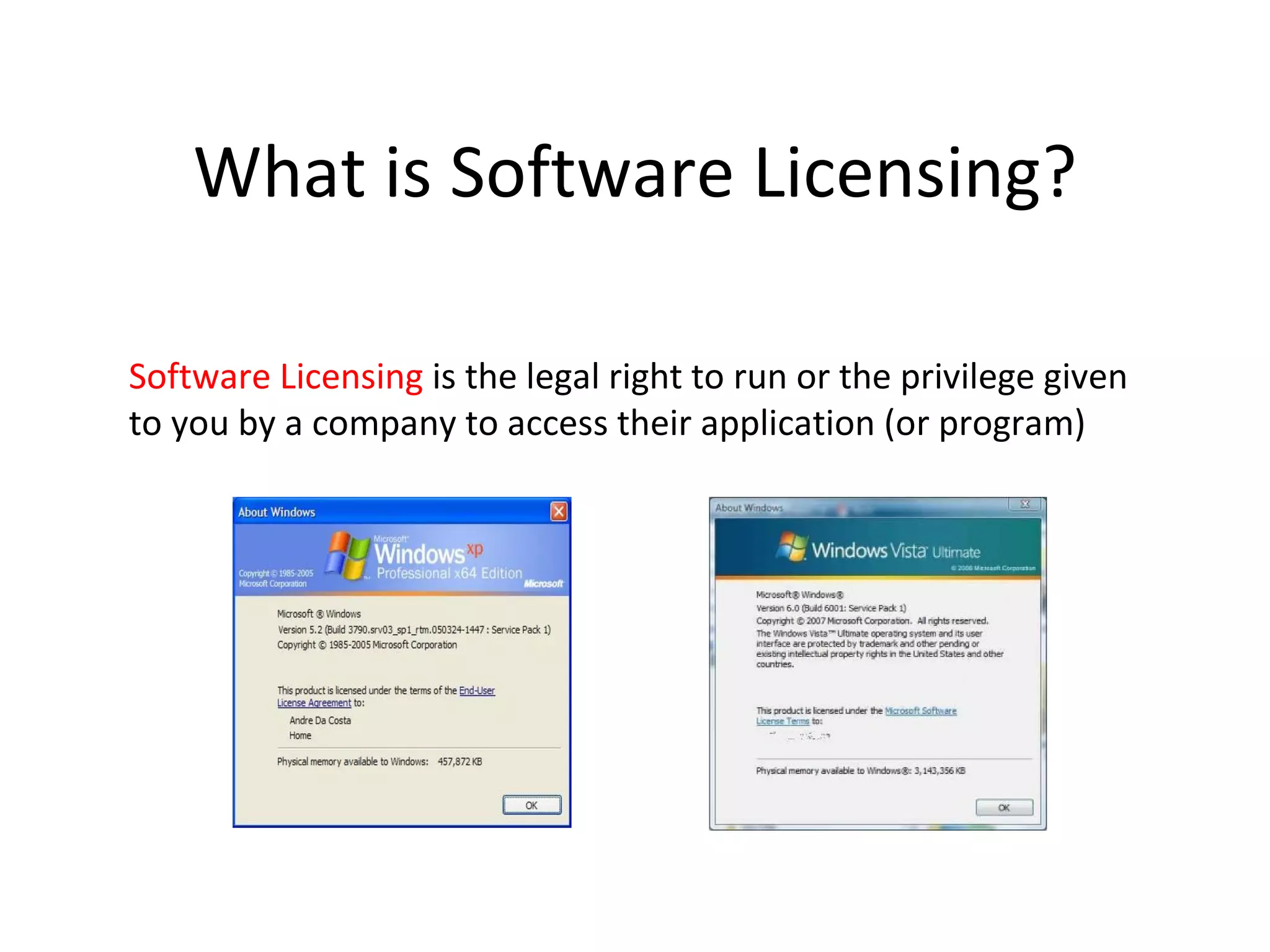
Software Licensing is the legal right to run or the privilege given
to you by a company to access their application (or program)
4.
What is SoftwareLicensing?
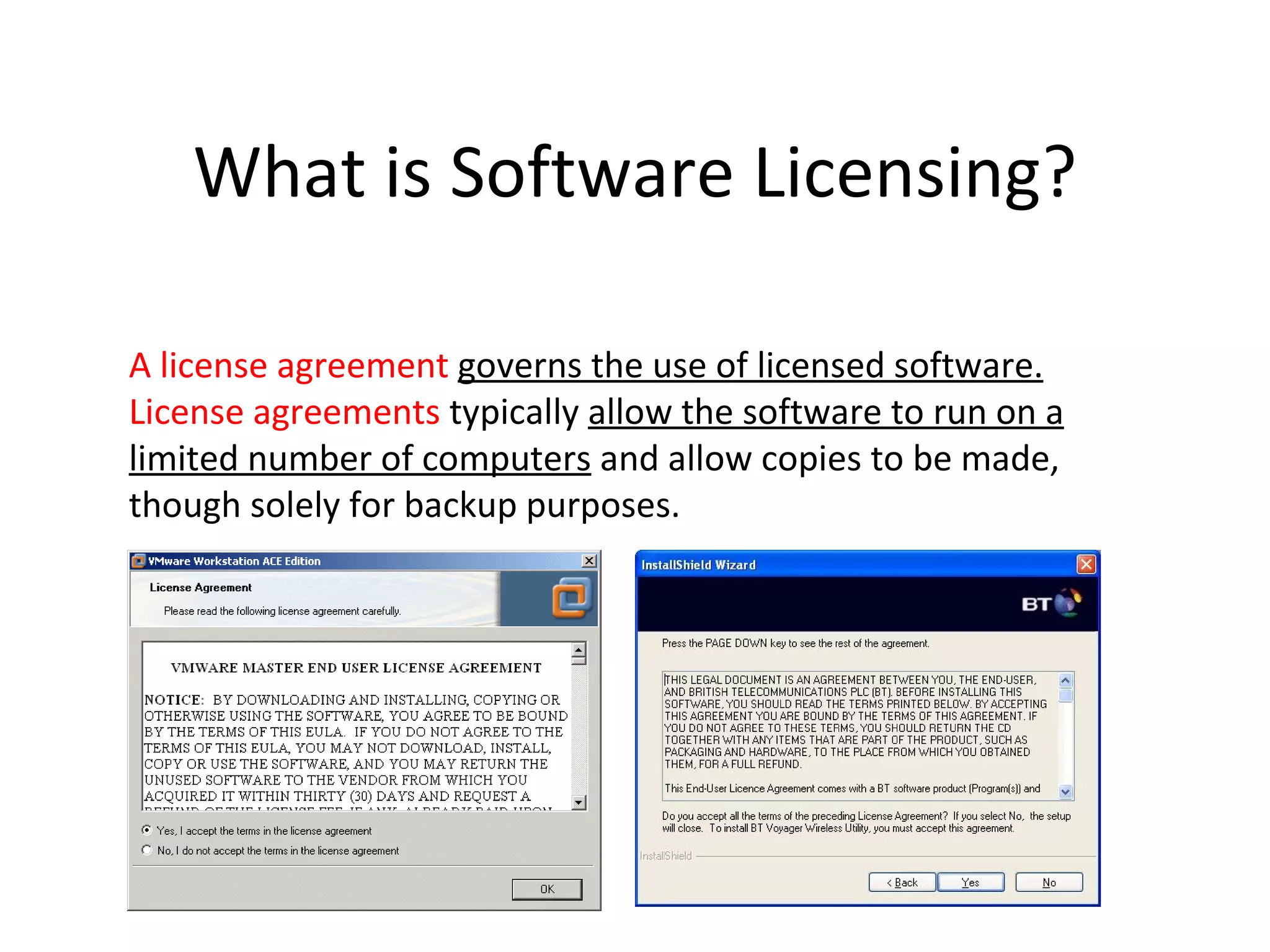
A license agreement governs the use of licensed software.
License agreements typically allow the software to run on a
limited number of computers and allow copies to be made,
though solely for backup purposes.
5.
Introduction to Software
Licensing
• What is Software Licensing?
• Benefits of using Licensed Software
• Current Situation
6.
Benefits of usingLicensed
Software
By using Licensed Software, you are able to contribute to the further
development of the program you are using. It also helps the economy
generate not just computer related jobs, but opportunities for other
people / businesses who’s work is much dependent on “written”
technology.
7.
Benefits of usingLicensed
Software
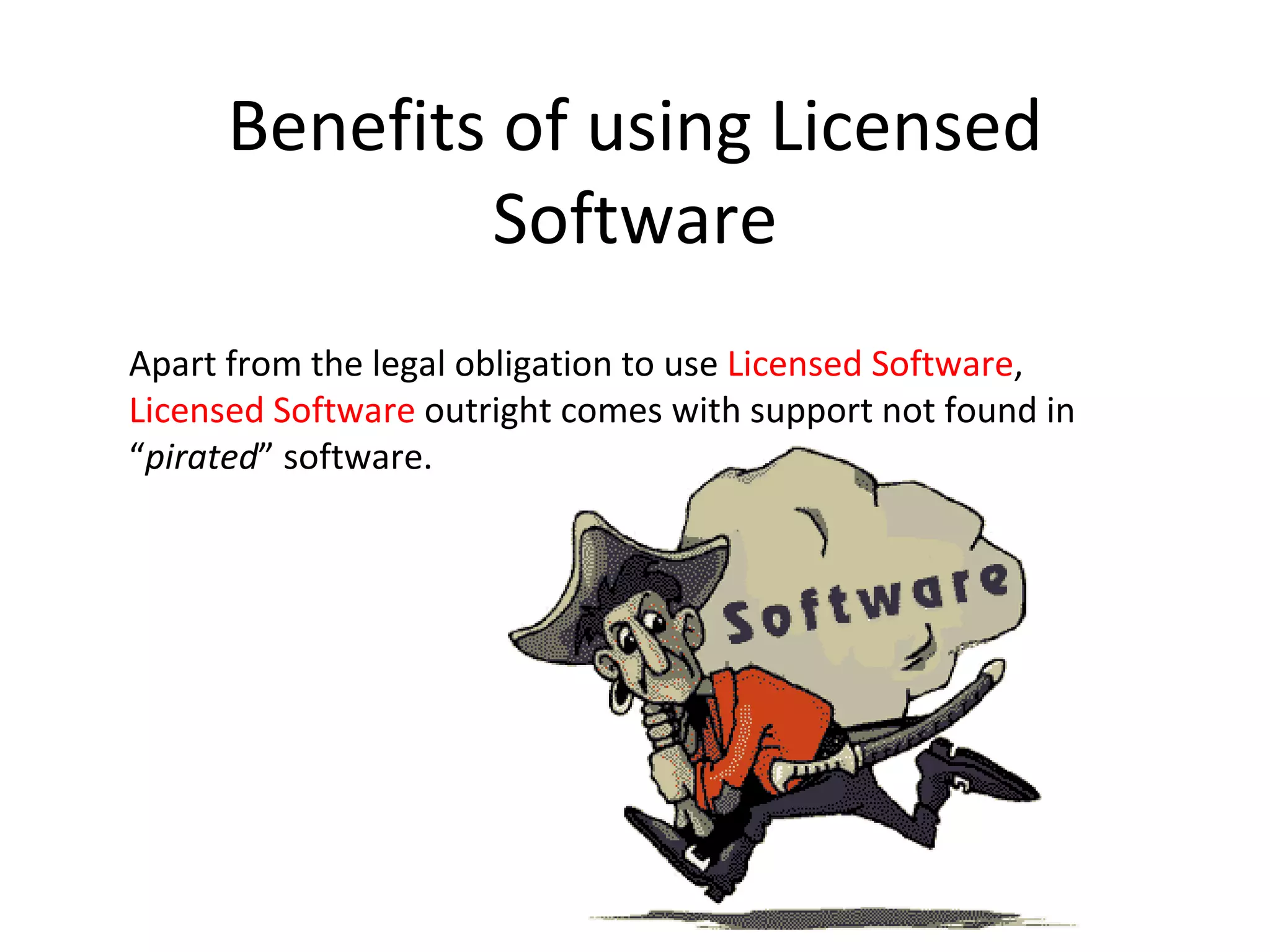
Apart from the legal obligation to use Licensed Software,
Licensed Software outright comes with support not found in
“pirated” software.
8.
Benefits of usingLicensed
Software
Things to ponder about…
How would you feel if your hospital test results were taken using
pirated syringes? Or you didn’t know you purchased fake Vitamin C’s?
9.
Benefits of usingLicensed
Software
Things to ponder about…
If you’re a driver – are you sure you’re not using fake license?
How about your birth or marriage certificate? What benefit can it
help you if you discovered one day that they’re all fake? Or
somebody owns these licenses or certificates other than you?
10.
Introduction to Software
Licensing
• What is Software Licensing?
• Benefits of using Licensed Software
• Current Situation
Current Situation
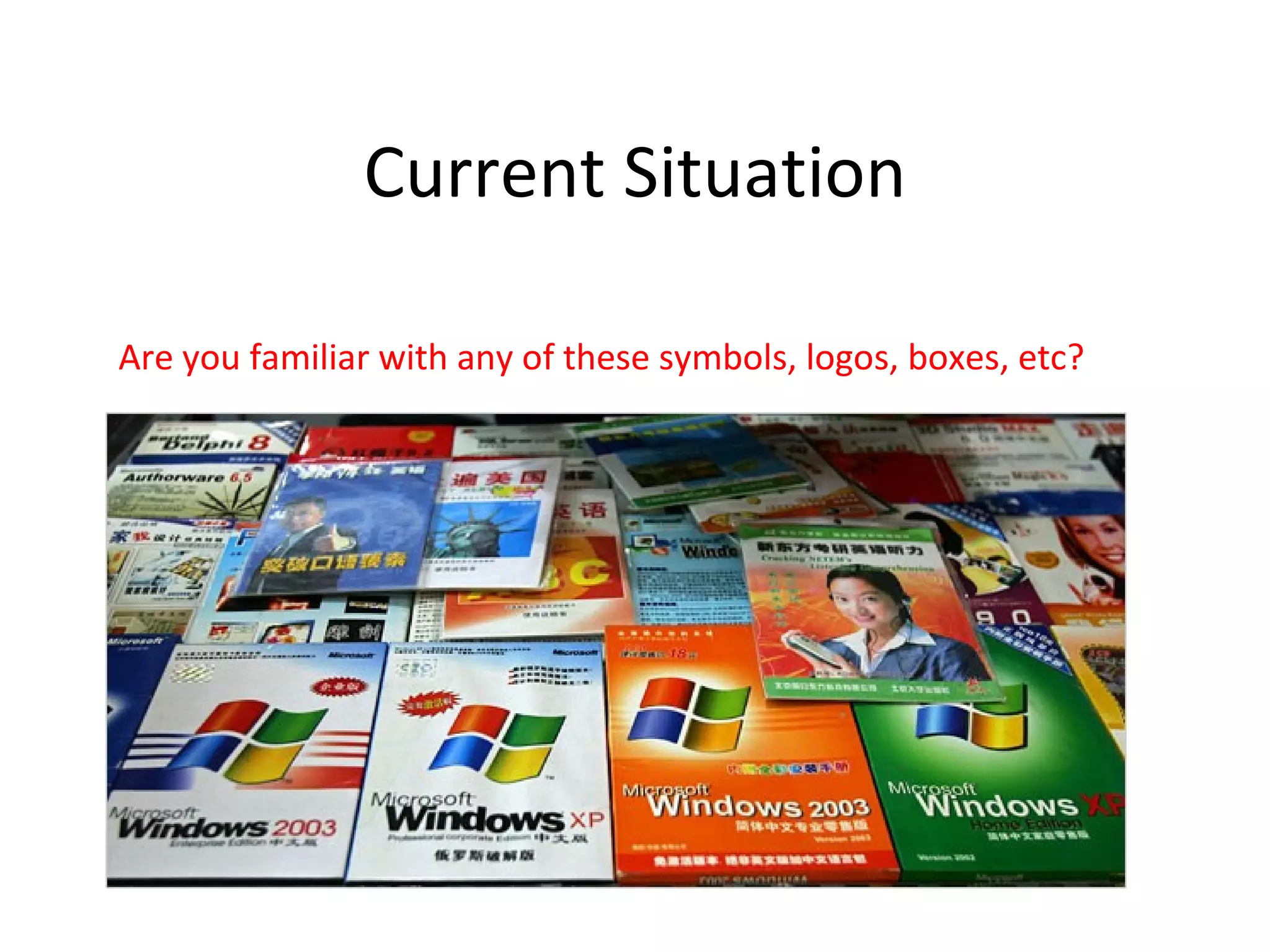
Clearly visible,Microsoft programs that are sold in sidewalks
seems to always be a good buy.
Likewise you can expect, McDonalds products to support you if
you buy BigMuck and Apol Pie – just in case you got into trouble.
13.
Current Situation
You mightthink that everything mentioned here is just about software
(or Microsoft). The tendency is that if you extract MP3 from CD’s (or
download them from the Internet), or use Torrent to be able to
download the latest movies and other “rights-own” media – you are
simply contributing to the rate of piracy worldwide.
14.
Introduction to Software
Licensing
• Software License and Copyright Law
• Proprietary Software
• In the Philippines
15.
Introduction to Software
Licensing
• Software License and Copyright Law
• Proprietary Software
• In the Philippines
16.
Software License andCopyright
Law
In the United States, Section 117 of the Copyright Act gives the owner
of a particular copy of software the explicit right to use the software
with a computer, even if use of the software with a computer requires
the making of incidental copies or adaptations (acts which could
otherwise potentially constitute copyright infringement). Therefore,
the owner of a copy of computer software is legally entitled to use that
copy of software. Hence, if the end-user of software is the owner of the
respective copy, then the end-user may legally use the software
without a license from the software publisher.
Accordingly, proprietary software licenses attempt to give software
publishers more control over the way their software is used by keeping
ownership of each copy of software with the software publisher. By
doing so, Section 117 does not apply to the end-user and the software
publisher may then compel the end-user to accept all of the terms of
the license agreement, many of which may be more restrictive than
copyright law alone.
17.
Introduction to Software
Licensing
• Software License and Copyright Law
• Proprietary Software
• In the Philippines
18.
Proprietary Software
Proprietary softwareis computer software which is the legal property
of one party. The terms of use for other parties is defined by contracts
or licensing agreements. These terms may include various privileges to
share, alter, dissemble, and use the software and its code.
Well known examples of proprietary software include Microsoft
Windows, Adobe Photoshop, Corel Draw, Quickbooks, SAP, etc.
19.
Proprietary Software
For example,the rights to develop Windows XP or Microsoft Office
2003 and their release protocols are held by Microsoft. They have the
proprietary rights to sell the license to use their products. The code on
how Windows XP was developed from step zero to step one hundred is
theirs exclusively.
20.
Proprietary Software
In thePhilippines, all the software (and hardware) development
members of the Business Software Alliance (BSA) are encouraging the
legal use and licensing of their softwares.
Its members represent one of the fastest growing industries in the
world. BSA programs foster technology innovation through education
and policy initiatives that promote copyright protection, cyber security,
trade and e-commerce.
Under US copyright laws, software piracy can result in fines of up to
$150,000 for each software title copied. In addition, the government
can criminally prosecute for copyright infringement. If convicted,
violators can be fined up to $250,000 or given a jail term of up to five
years, or both.
21.
Introduction to Software
Licensing
• Software License and Copyright Law
• Proprietary Software
• In the Philippines
22.
In the Philippines
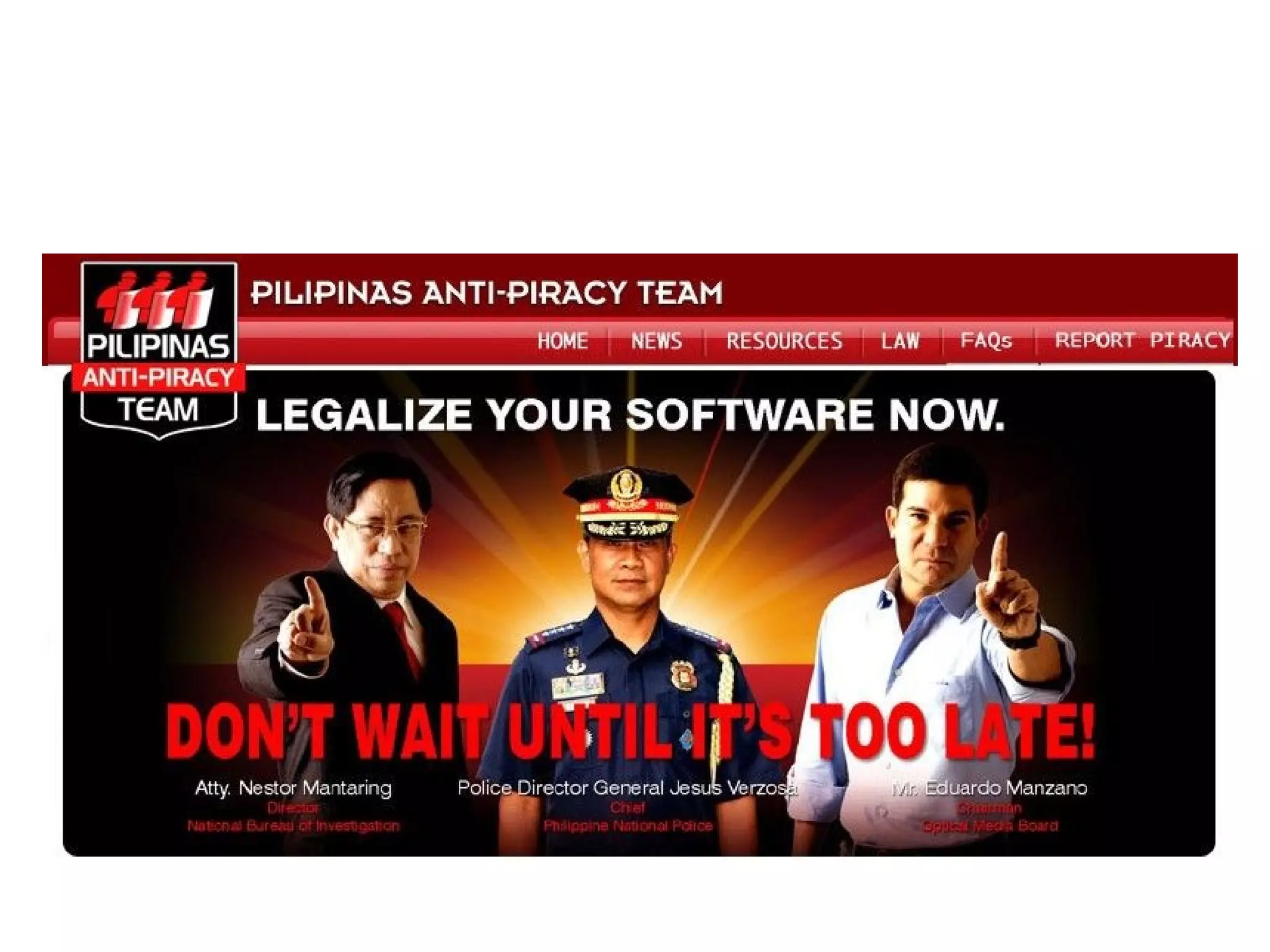
Inthe Philippines, the Business Software Alliance (BSA) together with
The Pilipinas Anti-Piracy Team (PAPT) leads the government-initiated
campaign which aims to significantly reduce software piracy in the
country and promote respect for Intellectual Property Rights (IPR).
PAPT combines BSA, NBI, PNP and Optical Media Board (OMB) in
ensuring compliance to software licensing and no to piracy.
25.
In the Philippines
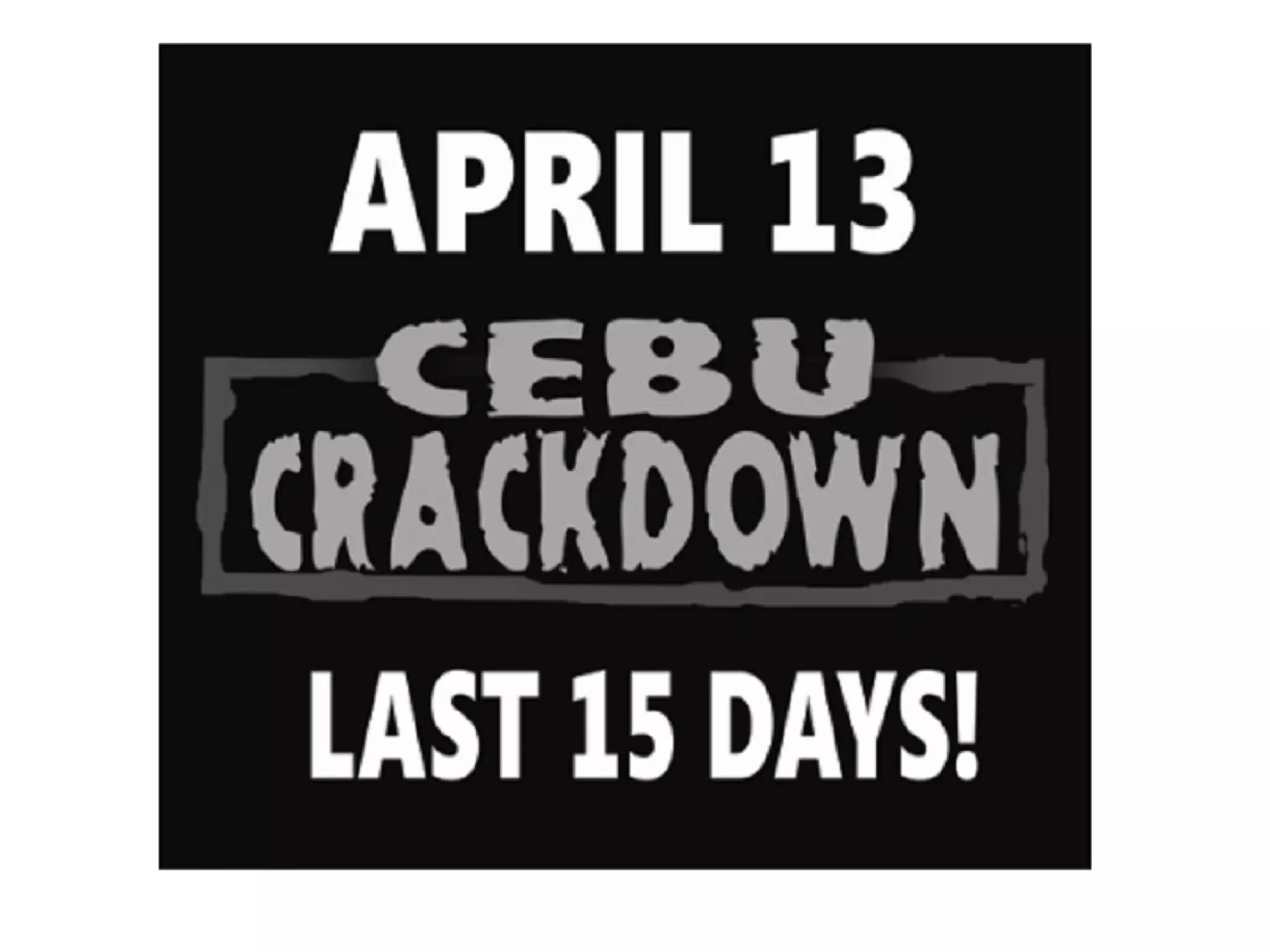
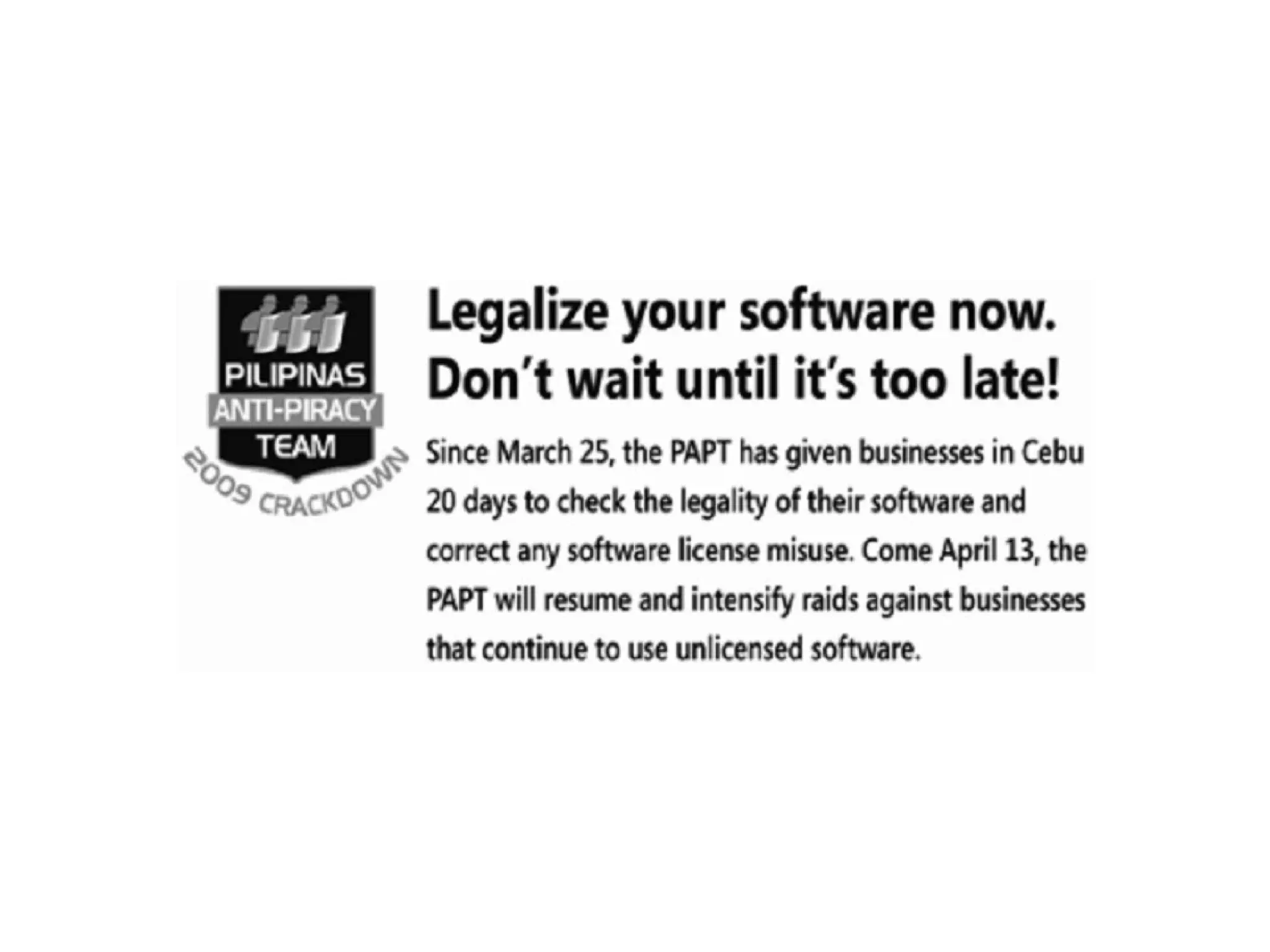
DON'TFORGET that even though The Pilipinas Anti-Piracy Team
(PAPT) is mandated to resume their search after the Cebu 2009
countdown, require them to present a search warrant, authorization or
mission order. Organizations must present the end-user licensing
agreements, certificates of authenticity, invoices and receipts.