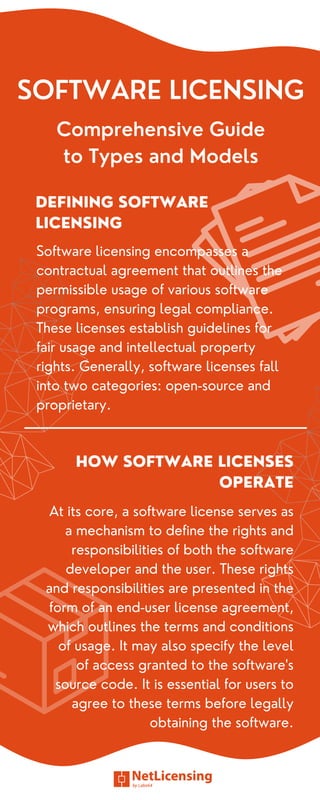
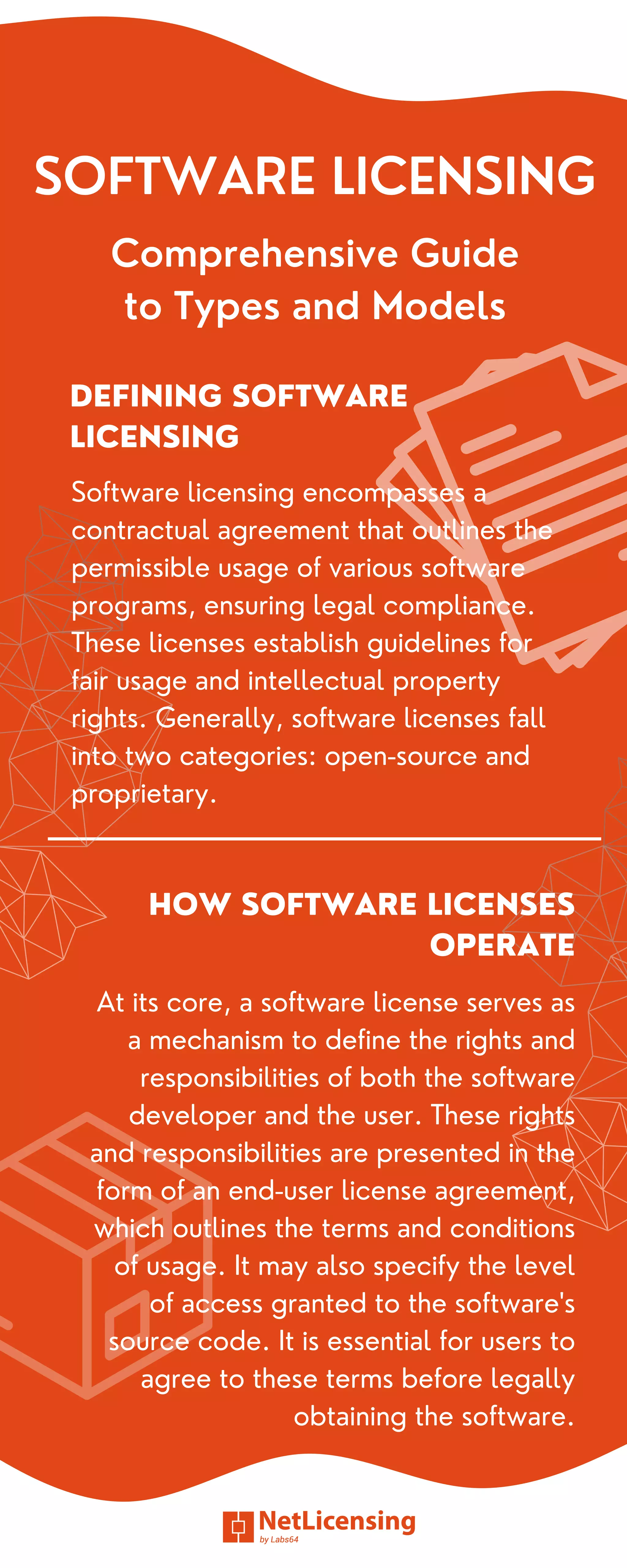
Software licensing encompasses a
contractual agreement that outlines the
permissible usage of various software
programs, ensuring legal compliance.
These licenses establish guidelines for
fair usage and intellectual property
rights. Generally, software licenses fall
into two categories: open-source and
proprietary.
SOFTWARE LICENSING
Comprehensive Guide
to Types and Models
DEFINING SOFTWARE
LICENSING
HOW SOFTWARE LICENSES
OPERATE
At its core, a software license serves as
a mechanism to define the rights and
responsibilities of both the software
developer and the user. These rights
and responsibilities are presented in the
form of an end-user license agreement,
which outlines the terms and conditions
of usage. It may also specify the level
of access granted to the software's
source code. It is essential for users to
agree to these terms before legally
obtaining the software.
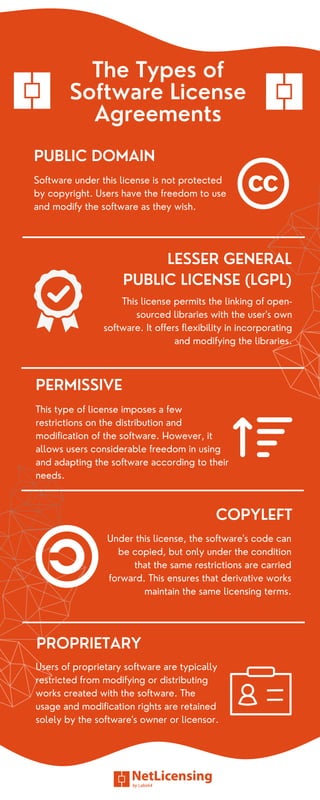
This type of license imposes a few
restrictions on the distribution and
modification of the software. However, it
allows users considerable freedom in using
and adapting the software according to their
needs.
The Types of
Software License
Agreements
PUBLIC DOMAIN
PERMISSIVE
LESSER GENERAL
PUBLIC LICENSE (LGPL)
COPYLEFT
PROPRIETARY
Software under this license is not protected
by copyright. Users have the freedom to use
and modify the software as they wish.
This license permits the linking of open-
sourced libraries with the user's own
software. It offers flexibility in incorporating
and modifying the libraries.
Under this license, the software's code can
be copied, but only under the condition
that the same restrictions are carried
forward. This ensures that derivative works
maintain the same licensing terms.
Users of proprietary software are typically
restricted from modifying or distributing
works created with the software. The
usage and modification rights are retained
solely by the software's owner or licensor.
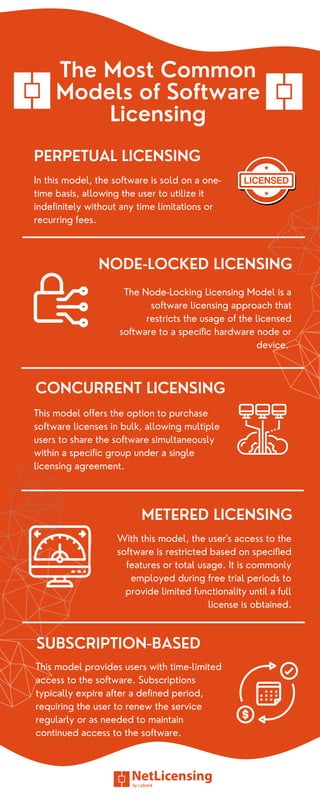
This model offers the option to purchase
software licenses in bulk, allowing multiple
users to share the software simultaneously
within a specific group under a single
licensing agreement.
The Most Common
Models of Software
Licensing
PERPETUAL LICENSING
CONCURRENT LICENSING
NODE-LOCKED LICENSING
METERED LICENSING
SUBSCRIPTION-BASED
In this model, the software is sold on a one-
time basis, allowing the user to utilize it
indefinitely without any time limitations or
recurring fees.
The Node-Locking Licensing Model is a
software licensing approach that
restricts the usage of the licensed
software to a specific hardware node or
device.
With this model, the user's access to the
software is restricted based on specified
features or total usage. It is commonly
employed during free trial periods to
provide limited functionality until a full
license is obtained.
This model provides users with time-limited
access to the software. Subscriptions
typically expire after a defined period,
requiring the user to renew the service
regularly or as needed to maintain
continued access to the software.
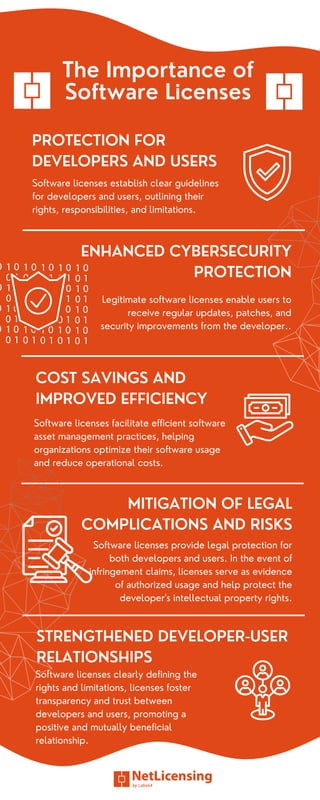
Software licenses facilitate efficient software
asset management practices, helping
organizations optimize their software usage
and reduce operational costs.
The Importance of
Software Licenses
PROTECTION FOR
DEVELOPERS AND USERS
COST SAVINGS AND
IMPROVED EFFICIENCY
ENHANCED CYBERSECURITY
PROTECTION
MITIGATION OF LEGAL
COMPLICATIONS AND RISKS
STRENGTHENED DEVELOPER-USER
RELATIONSHIPS
Software licenses establish clear guidelines
for developers and users, outlining their
rights, responsibilities, and limitations.
Legitimate software licenses enable users to
receive regular updates, patches, and
security improvements from the developer..
Software licenses provide legal protection for
both developers and users. In the event of
infringement claims, licenses serve as evidence
of authorized usage and help protect the
developer's intellectual property rights.
Software licenses clearly defining the
rights and limitations, licenses foster
transparency and trust between
developers and users, promoting a
positive and mutually beneficial
relationship.

Software Licensing - Comprehensive Guide to Types and Models

  • 1.
    Software licensing encompassesa contractual agreement that outlines the permissible usage of various software programs, ensuring legal compliance. These licenses establish guidelines for fair usage and intellectual property rights. Generally, software licenses fall into two categories: open-source and proprietary. SOFTWARE LICENSING Comprehensive Guide to Types and Models DEFINING SOFTWARE LICENSING HOW SOFTWARE LICENSES OPERATE At its core, a software license serves as a mechanism to define the rights and responsibilities of both the software developer and the user. These rights and responsibilities are presented in the form of an end-user license agreement, which outlines the terms and conditions of usage. It may also specify the level of access granted to the software's source code. It is essential for users to agree to these terms before legally obtaining the software.
  • 2.
    This type oflicense imposes a few restrictions on the distribution and modification of the software. However, it allows users considerable freedom in using and adapting the software according to their needs. The Types of Software License Agreements PUBLIC DOMAIN PERMISSIVE LESSER GENERAL PUBLIC LICENSE (LGPL) COPYLEFT PROPRIETARY Software under this license is not protected by copyright. Users have the freedom to use and modify the software as they wish. This license permits the linking of open- sourced libraries with the user's own software. It offers flexibility in incorporating and modifying the libraries. Under this license, the software's code can be copied, but only under the condition that the same restrictions are carried forward. This ensures that derivative works maintain the same licensing terms. Users of proprietary software are typically restricted from modifying or distributing works created with the software. The usage and modification rights are retained solely by the software's owner or licensor.
  • 3.
    This model offersthe option to purchase software licenses in bulk, allowing multiple users to share the software simultaneously within a specific group under a single licensing agreement. The Most Common Models of Software Licensing PERPETUAL LICENSING CONCURRENT LICENSING NODE-LOCKED LICENSING METERED LICENSING SUBSCRIPTION-BASED In this model, the software is sold on a one- time basis, allowing the user to utilize it indefinitely without any time limitations or recurring fees. The Node-Locking Licensing Model is a software licensing approach that restricts the usage of the licensed software to a specific hardware node or device. With this model, the user's access to the software is restricted based on specified features or total usage. It is commonly employed during free trial periods to provide limited functionality until a full license is obtained. This model provides users with time-limited access to the software. Subscriptions typically expire after a defined period, requiring the user to renew the service regularly or as needed to maintain continued access to the software.
  • 4.
    Software licenses facilitateefficient software asset management practices, helping organizations optimize their software usage and reduce operational costs. The Importance of Software Licenses PROTECTION FOR DEVELOPERS AND USERS COST SAVINGS AND IMPROVED EFFICIENCY ENHANCED CYBERSECURITY PROTECTION MITIGATION OF LEGAL COMPLICATIONS AND RISKS STRENGTHENED DEVELOPER-USER RELATIONSHIPS Software licenses establish clear guidelines for developers and users, outlining their rights, responsibilities, and limitations. Legitimate software licenses enable users to receive regular updates, patches, and security improvements from the developer.. Software licenses provide legal protection for both developers and users. In the event of infringement claims, licenses serve as evidence of authorized usage and help protect the developer's intellectual property rights. Software licenses clearly defining the rights and limitations, licenses foster transparency and trust between developers and users, promoting a positive and mutually beneficial relationship.