Open Source Software
Licenses
Risks and Best Practices
Student Lawyers:
Brian Keil, Matt Klahre, Stanford Ponson, & Angie Yannaris
Director:
Steve Rosard
Overview
● Copyright Principles
● Open Source Software
● Most widely-used Open Source Licenses
● Panel Discussion – Best Practices for using OSS
The Software Developer’s Property
Property is not the thing itself but the “rights among people concerning things”
A Software Developer’s property is known as Intellectual Property.
3 Main Types:
1. Patents
2. Trademarks
3. Copyrights
Software Ownership
Software ownership refers to copyrights.
- Apple Computer, Inc. v. Franklin Computer Corp. (3d Cir. 1983).
Copyrights are vested in the author of a work (code) at the moment of “fixation”
- The author of a software is the writer of the code (programmer or developer).
- Registration is not necessary but encouraged.
What Are A Programmer’s Copyrights?
The authors of code enjoy the rights to:
1. Reproduce (copy)
2. Distribute
3. Prepare derivative works (modify)
4. Publically display
These rights are divisible!
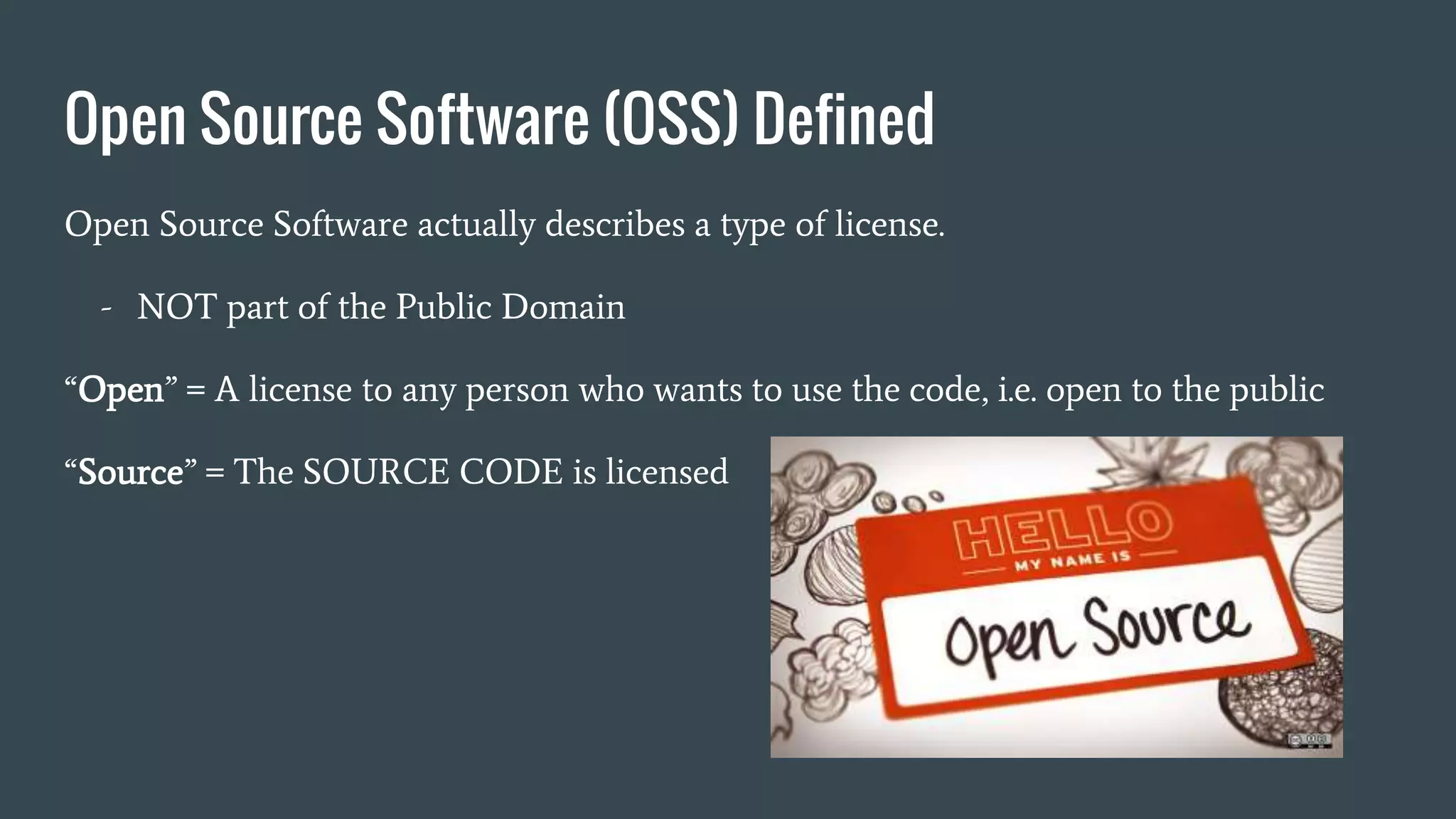
Open Source Software (OSS) Defined
Open Source Software actually describes a type of license.
- NOT part of the Public Domain
“Open” = A license to any person who wants to use the code, i.e. open to the public
“Source” = The SOURCE CODE is licensed
OSS Licenses vs. Non-Open Source Licenses
OSS Licenses
- Public license.
- Rights to use, modify, distribute
and copy.
- Source code is provided and
covered by license
- Does not terminate
Non-Open Source Licenses
- Particular to one licensee.
- No right to modify.
- New or improved versions belong
to the owner.
- Source code is not provided to the
licensee.
- May be durational.
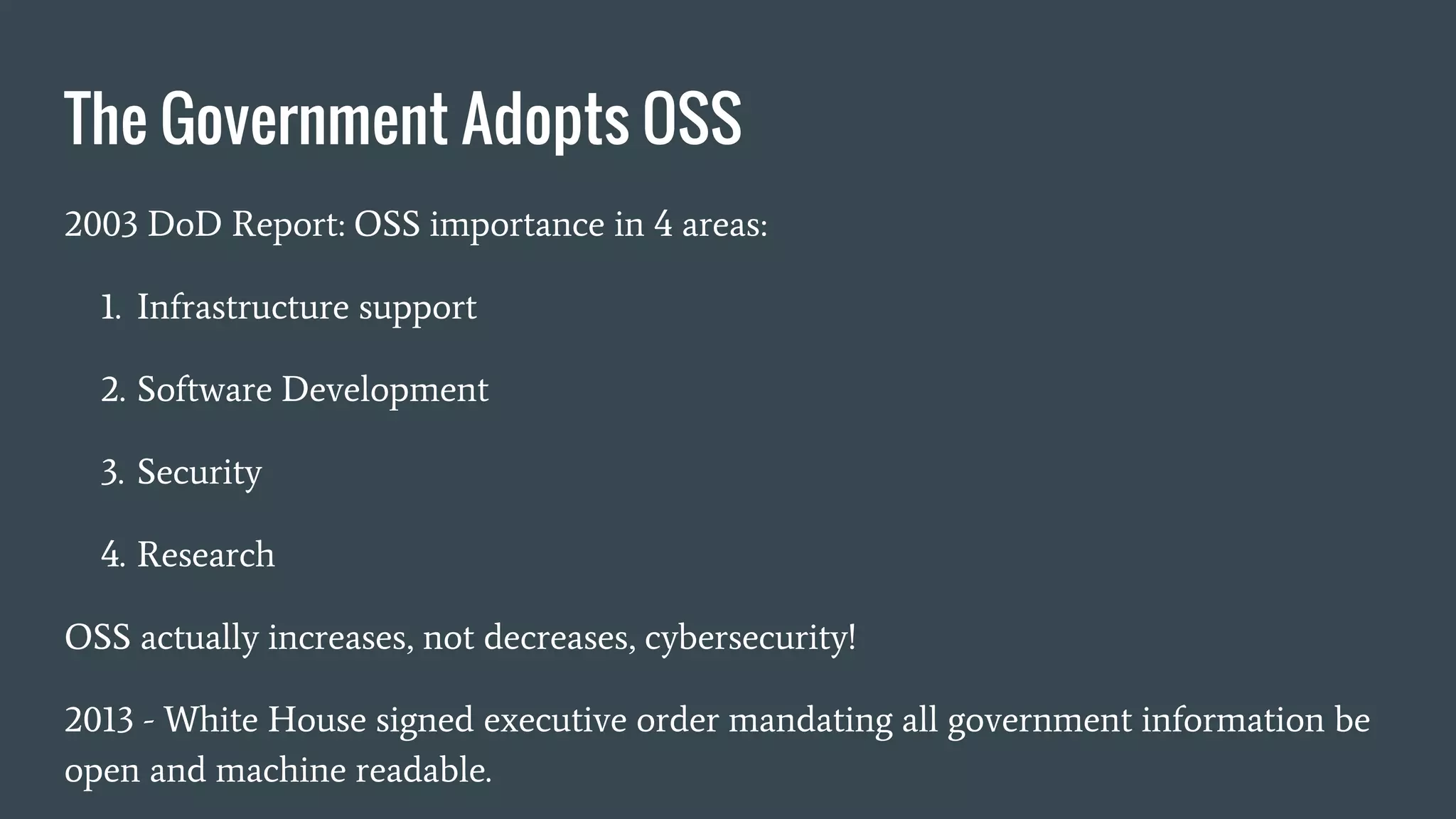
The Government Adopts OSS
2003 DoD Report: OSS importance in 4 areas:
1. Infrastructure support
2. Software Development
3. Security
4. Research
OSS actually increases, not decreases, cybersecurity!
2013 - White House signed executive order mandating all government information be
open and machine readable.
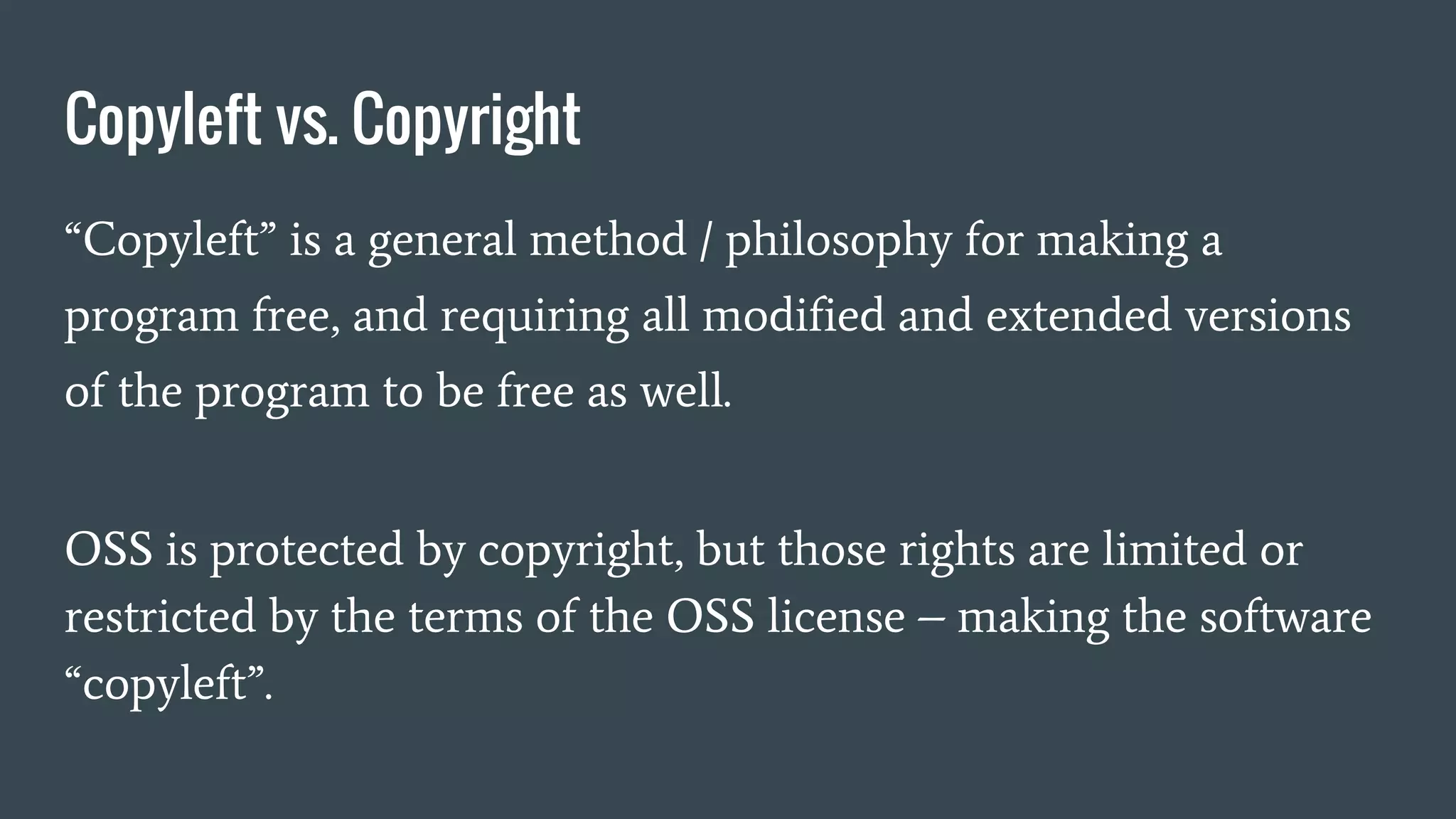
Copyleft vs. Copyright
“Copyleft” is a general method / philosophy for making a
program free, and requiring all modified and extended versions
of the program to be free as well.
OSS is protected by copyright, but those rights are limited or
restricted by the terms of the OSS license – making the software
“copyleft”.
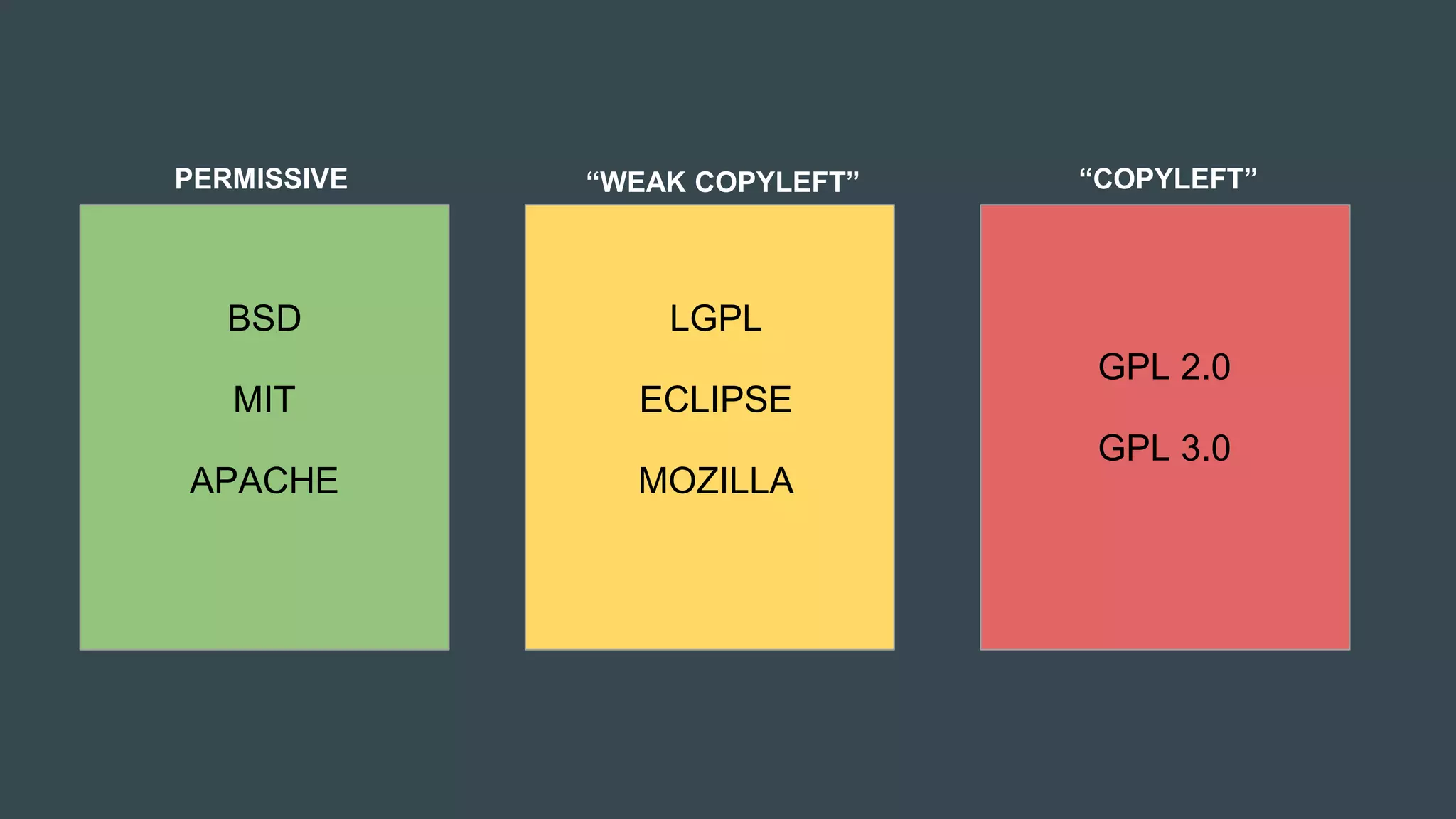
PERMISSIVE “WEAK COPYLEFT” “COPYLEFT”
BSD
MIT
APACHE
LGPL
ECLIPSE
MOZILLA
GPL 2.0
GPL 3.0
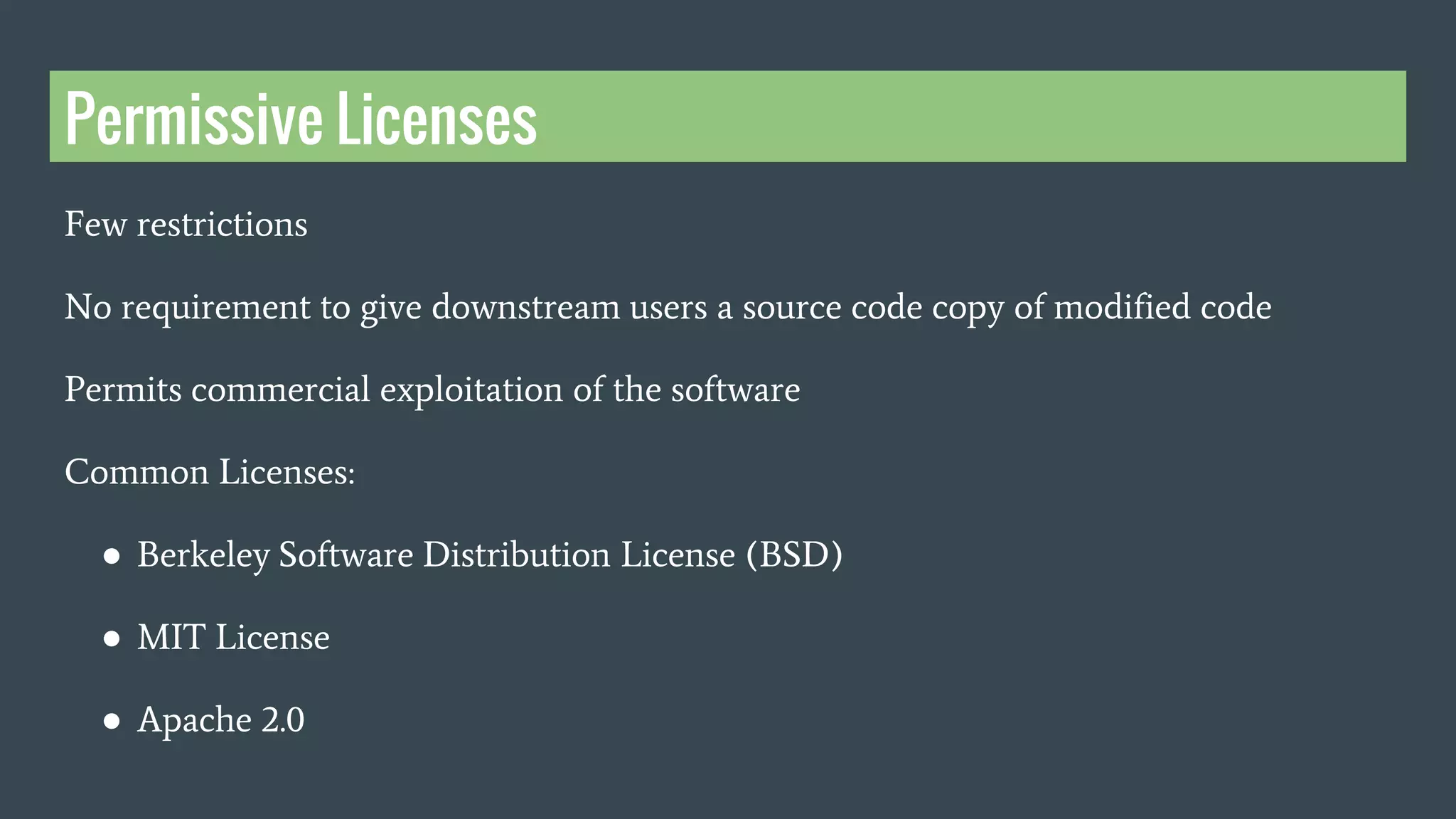
Permissive Licenses
Few restrictions
No requirement to give downstream users a source code copy of modified code
Permits commercial exploitation of the software
Common Licenses:
● Berkeley Software Distribution License (BSD)
● MIT License
● Apache 2.0
“Copyleft” Licenses
Four “Essential Freedoms” of Copyleft Licenses
Licensees must grant downstream users the same privileges and accessibility of the
licensee’s derivative works under the same terms of the license.
Licensee must [should?] publish and make available the source code for any derivative
works.
Common Licenses:
● GPL 2.0
● GPL 3.0
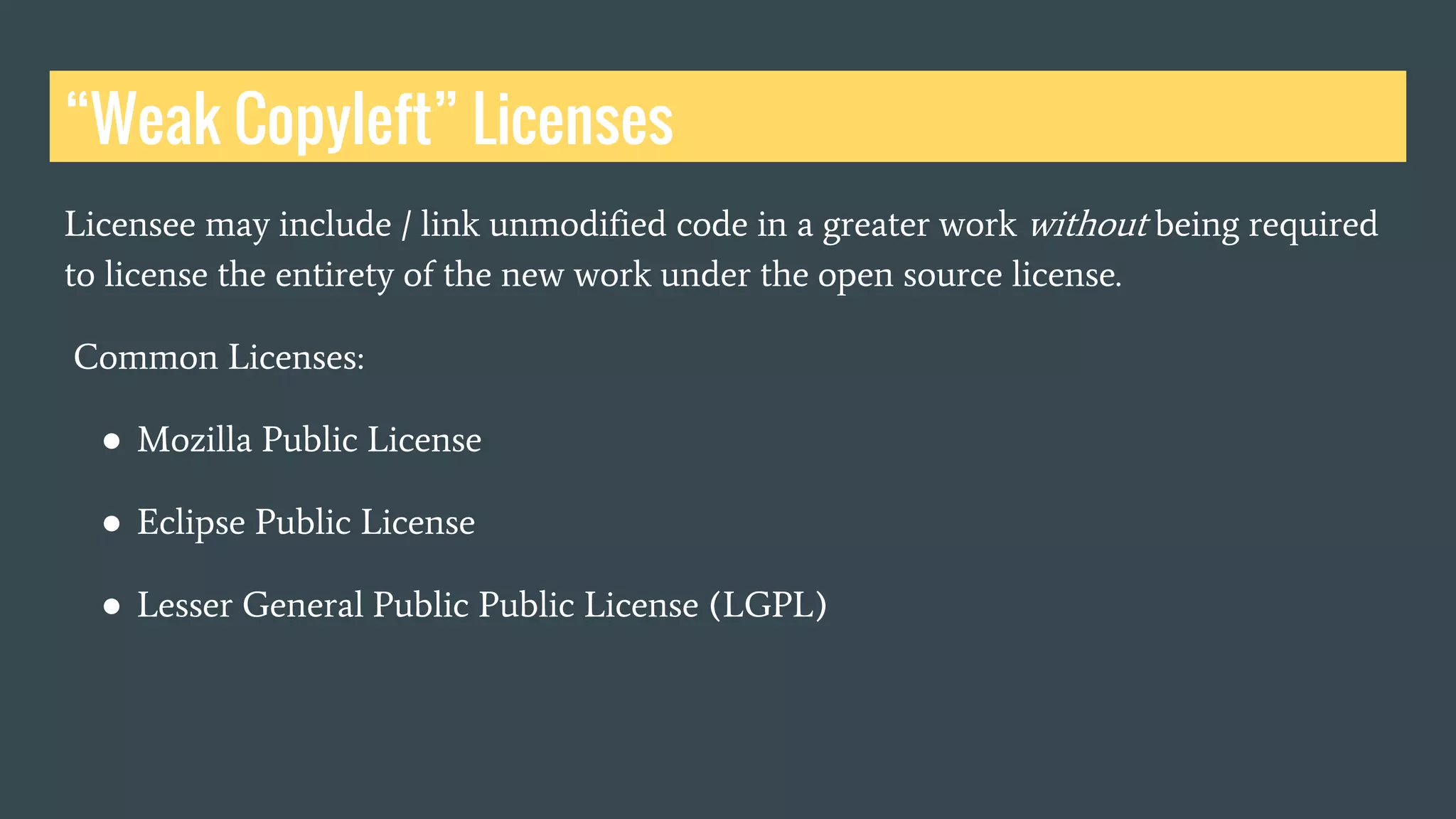
Licensee may include / link unmodified code in a greater work without being required
to license the entirety of the new work under the open source license.
Common Licenses:
● Mozilla Public License
● Eclipse Public License
● Lesser General Public Public License (LGPL)
“Weak Copyleft” Licenses
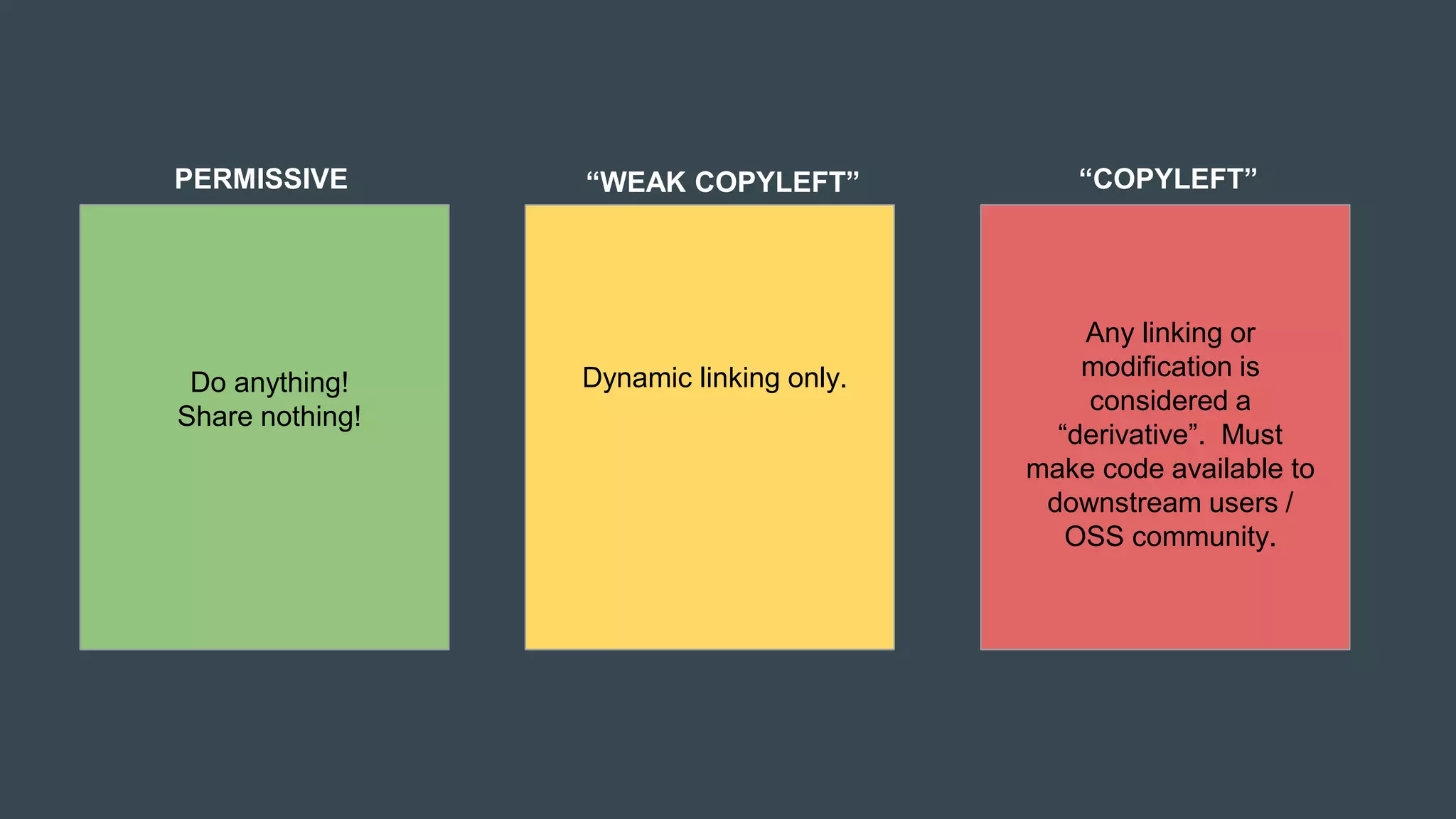
PERMISSIVE “WEAK COPYLEFT” “COPYLEFT”
Do anything!
Share nothing!
Dynamic linking only.
Any linking or
modification is
considered a
“derivative”. Must
make code available to
downstream users /
OSS community.
Panel Discussion –- OSS Best Practices
Joseph Holovachuk, Pepper Hamilton
Alex Urevick-Ackelsberg, Zivtech
Fred Wilf, Wilftek
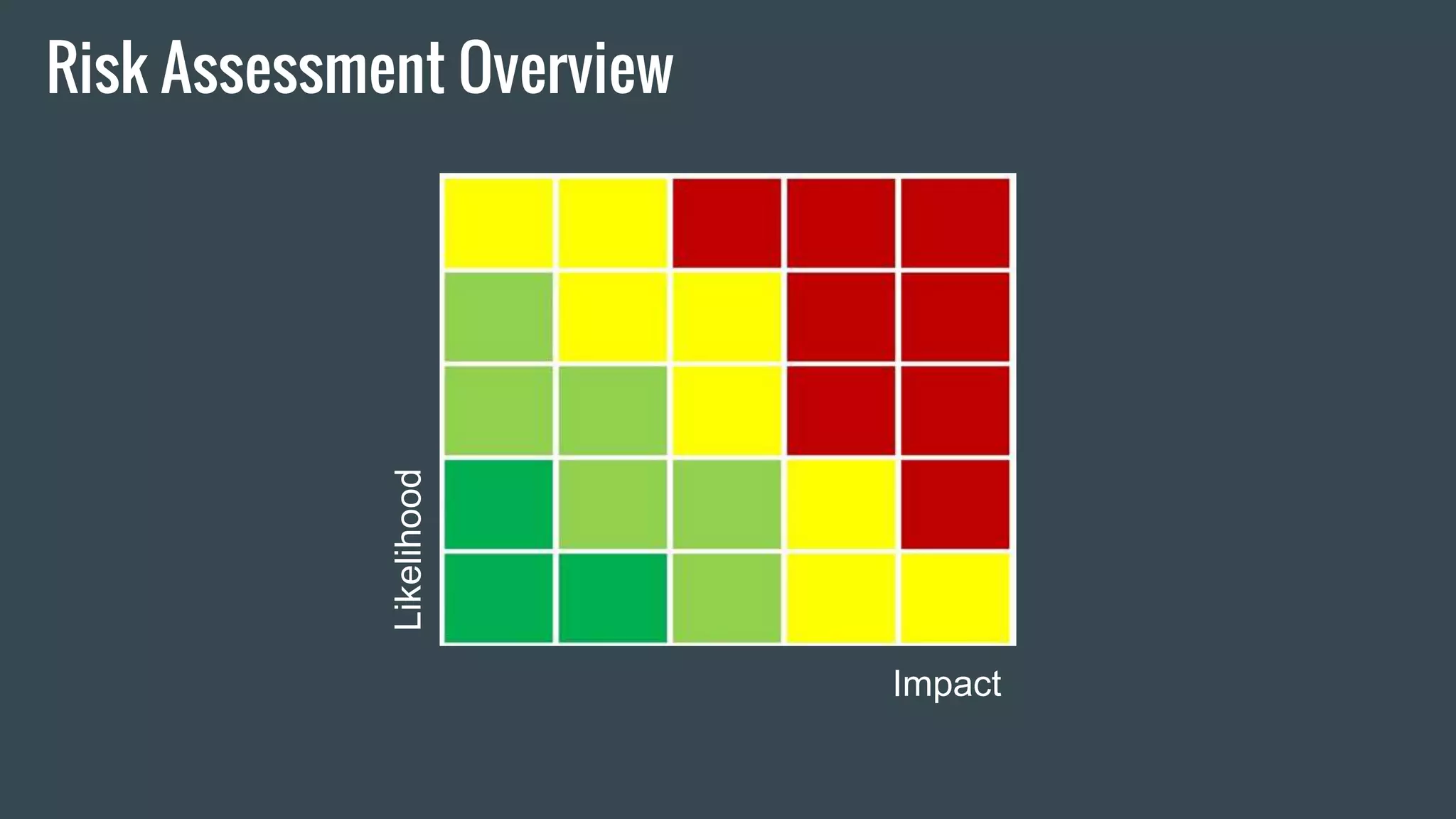
Risk Assessment Overview
Likelihood
Impact
Risk Assessment Overview
Likelihood
Impact
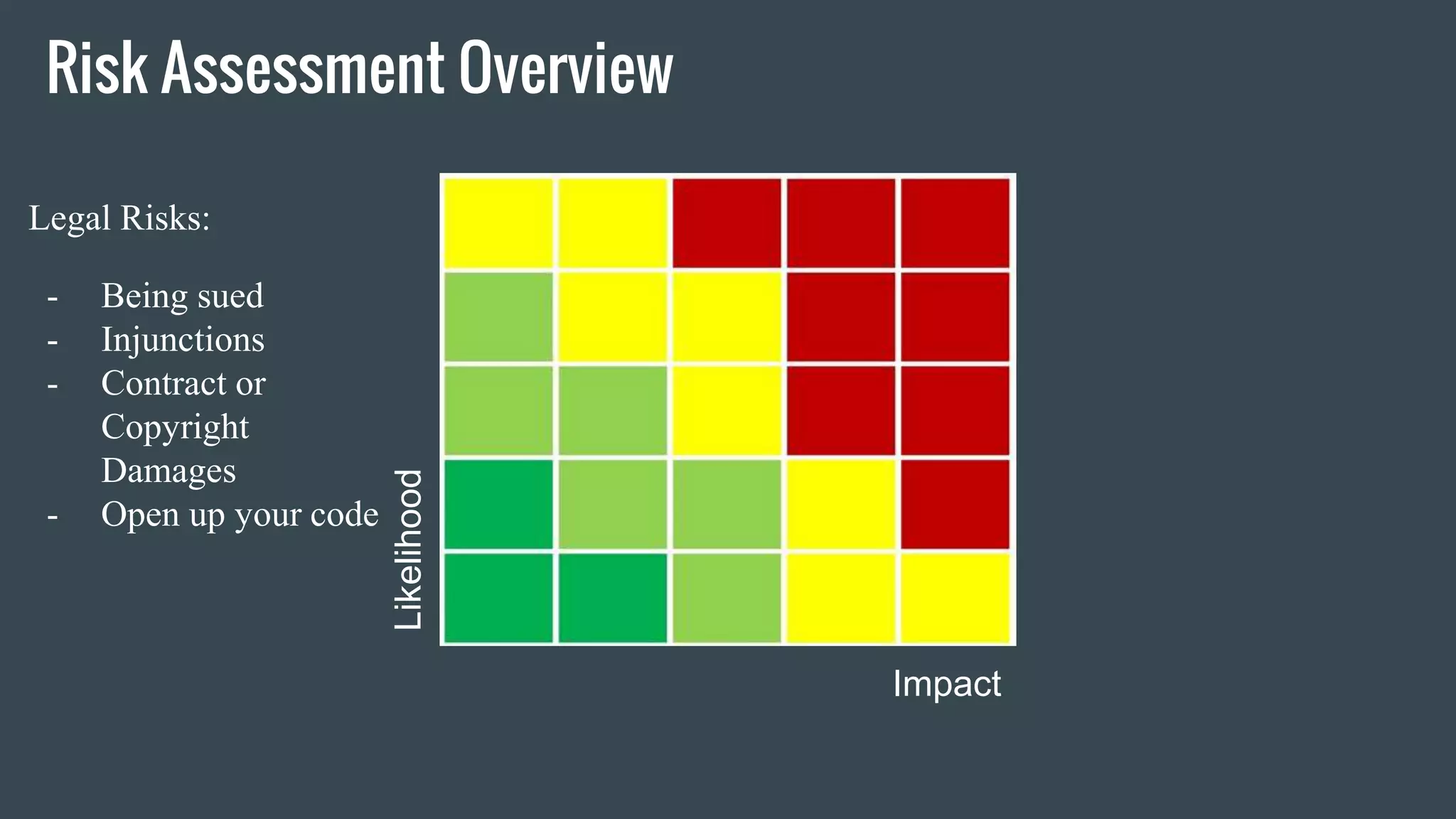
Legal Risks:
- Being sued
- Injunctions
- Contract or
Copyright
Damages
- Open up your code
Risk Assessment Overview
Likelihood
Impact
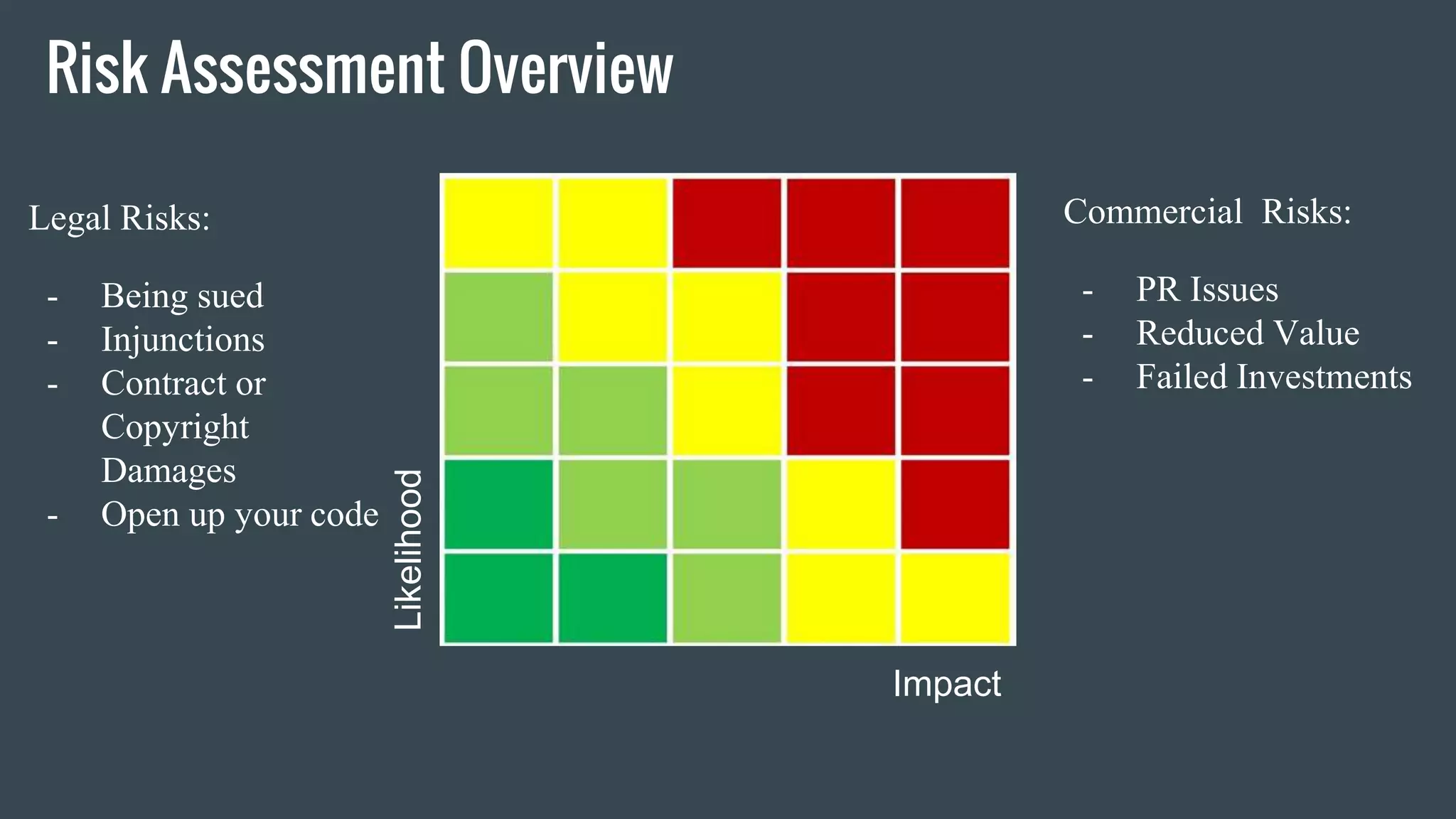
Legal Risks:
- Being sued
- Injunctions
- Contract or
Copyright
Damages
- Open up your code
Commercial Risks:
- PR Issues
- Reduced Value
- Failed Investments
Risk Assessment Overview
Likelihood
Impact
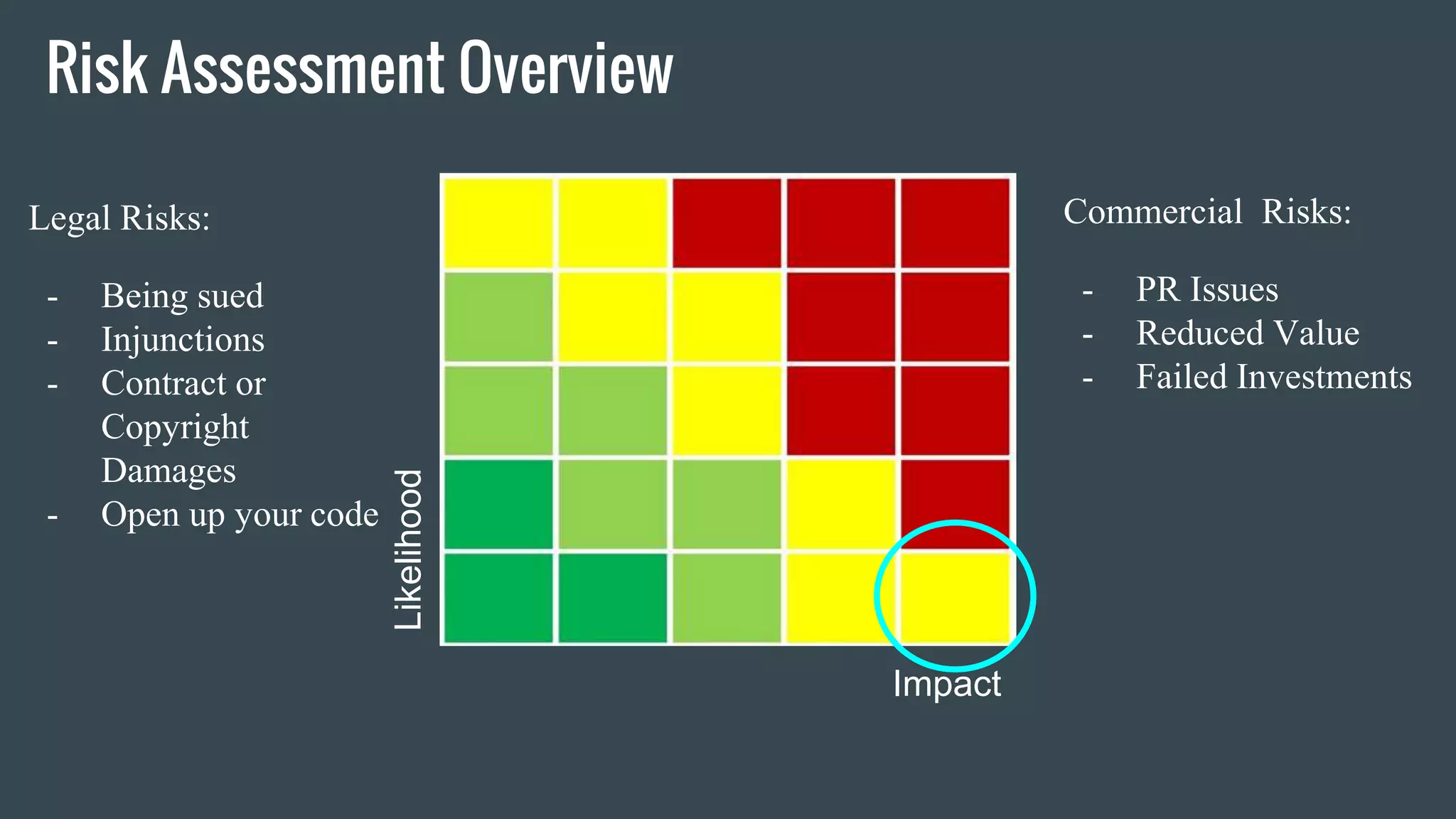
Legal Risks:
- Being sued
- Injunctions
- Contract or
Copyright
Damages
- Open up your code
Commercial Risks:
- PR Issues
- Reduced Value
- Failed Investments
Panel Discussion —- OSS Best Practices
● How do we comply with an OSS license?
● Should we establish an OSS policy?
● How do we prevent non-OSS from being “infected” by a GPL license?
● We’re being acquired in an M&A deal. What can we expect?
● How do we deal with distribution in a world of cloud computing and
SaaS?
● Should we make all of our code open source?
Thank You!
Visit our website to view these slides and the
handout, and apply to be a client at
drexel.edu/law/ELC
2016.phillytechweek.com
Please complete a survey at
www.surveymonkey.com/r/ptw16attendee

Open source software licenses

  • 1.
  • 2.
    Student Lawyers: Brian Keil,Matt Klahre, Stanford Ponson, & Angie Yannaris Director: Steve Rosard
  • 3.
    Overview ● Copyright Principles ●Open Source Software ● Most widely-used Open Source Licenses ● Panel Discussion – Best Practices for using OSS
  • 4.
    The Software Developer’sProperty Property is not the thing itself but the “rights among people concerning things” A Software Developer’s property is known as Intellectual Property. 3 Main Types: 1. Patents 2. Trademarks 3. Copyrights
  • 5.
    Software Ownership Software ownershiprefers to copyrights. - Apple Computer, Inc. v. Franklin Computer Corp. (3d Cir. 1983). Copyrights are vested in the author of a work (code) at the moment of “fixation” - The author of a software is the writer of the code (programmer or developer). - Registration is not necessary but encouraged.
  • 6.
    What Are AProgrammer’s Copyrights? The authors of code enjoy the rights to: 1. Reproduce (copy) 2. Distribute 3. Prepare derivative works (modify) 4. Publically display These rights are divisible!
  • 7.
    Open Source Software(OSS) Defined Open Source Software actually describes a type of license. - NOT part of the Public Domain “Open” = A license to any person who wants to use the code, i.e. open to the public “Source” = The SOURCE CODE is licensed
  • 8.
    OSS Licenses vs.Non-Open Source Licenses OSS Licenses - Public license. - Rights to use, modify, distribute and copy. - Source code is provided and covered by license - Does not terminate Non-Open Source Licenses - Particular to one licensee. - No right to modify. - New or improved versions belong to the owner. - Source code is not provided to the licensee. - May be durational.
  • 9.
    The Government AdoptsOSS 2003 DoD Report: OSS importance in 4 areas: 1. Infrastructure support 2. Software Development 3. Security 4. Research OSS actually increases, not decreases, cybersecurity! 2013 - White House signed executive order mandating all government information be open and machine readable.
  • 10.
    Copyleft vs. Copyright “Copyleft”is a general method / philosophy for making a program free, and requiring all modified and extended versions of the program to be free as well. OSS is protected by copyright, but those rights are limited or restricted by the terms of the OSS license – making the software “copyleft”.
  • 12.
    PERMISSIVE “WEAK COPYLEFT”“COPYLEFT” BSD MIT APACHE LGPL ECLIPSE MOZILLA GPL 2.0 GPL 3.0
  • 13.
    Permissive Licenses Few restrictions Norequirement to give downstream users a source code copy of modified code Permits commercial exploitation of the software Common Licenses: ● Berkeley Software Distribution License (BSD) ● MIT License ● Apache 2.0
  • 14.
    “Copyleft” Licenses Four “EssentialFreedoms” of Copyleft Licenses Licensees must grant downstream users the same privileges and accessibility of the licensee’s derivative works under the same terms of the license. Licensee must [should?] publish and make available the source code for any derivative works. Common Licenses: ● GPL 2.0 ● GPL 3.0
  • 15.
    Licensee may include/ link unmodified code in a greater work without being required to license the entirety of the new work under the open source license. Common Licenses: ● Mozilla Public License ● Eclipse Public License ● Lesser General Public Public License (LGPL) “Weak Copyleft” Licenses
  • 16.
    PERMISSIVE “WEAK COPYLEFT”“COPYLEFT” Do anything! Share nothing! Dynamic linking only. Any linking or modification is considered a “derivative”. Must make code available to downstream users / OSS community.
  • 17.
    Panel Discussion –-OSS Best Practices Joseph Holovachuk, Pepper Hamilton Alex Urevick-Ackelsberg, Zivtech Fred Wilf, Wilftek
  • 18.
  • 19.
    Risk Assessment Overview Likelihood Impact LegalRisks: - Being sued - Injunctions - Contract or Copyright Damages - Open up your code
  • 20.
    Risk Assessment Overview Likelihood Impact LegalRisks: - Being sued - Injunctions - Contract or Copyright Damages - Open up your code Commercial Risks: - PR Issues - Reduced Value - Failed Investments
  • 21.
    Risk Assessment Overview Likelihood Impact LegalRisks: - Being sued - Injunctions - Contract or Copyright Damages - Open up your code Commercial Risks: - PR Issues - Reduced Value - Failed Investments
  • 22.
    Panel Discussion —-OSS Best Practices ● How do we comply with an OSS license? ● Should we establish an OSS policy? ● How do we prevent non-OSS from being “infected” by a GPL license? ● We’re being acquired in an M&A deal. What can we expect? ● How do we deal with distribution in a world of cloud computing and SaaS? ● Should we make all of our code open source?
  • 23.
    Thank You! Visit ourwebsite to view these slides and the handout, and apply to be a client at drexel.edu/law/ELC
  • 24.
    2016.phillytechweek.com Please complete asurvey at www.surveymonkey.com/r/ptw16attendee

Editor's Notes

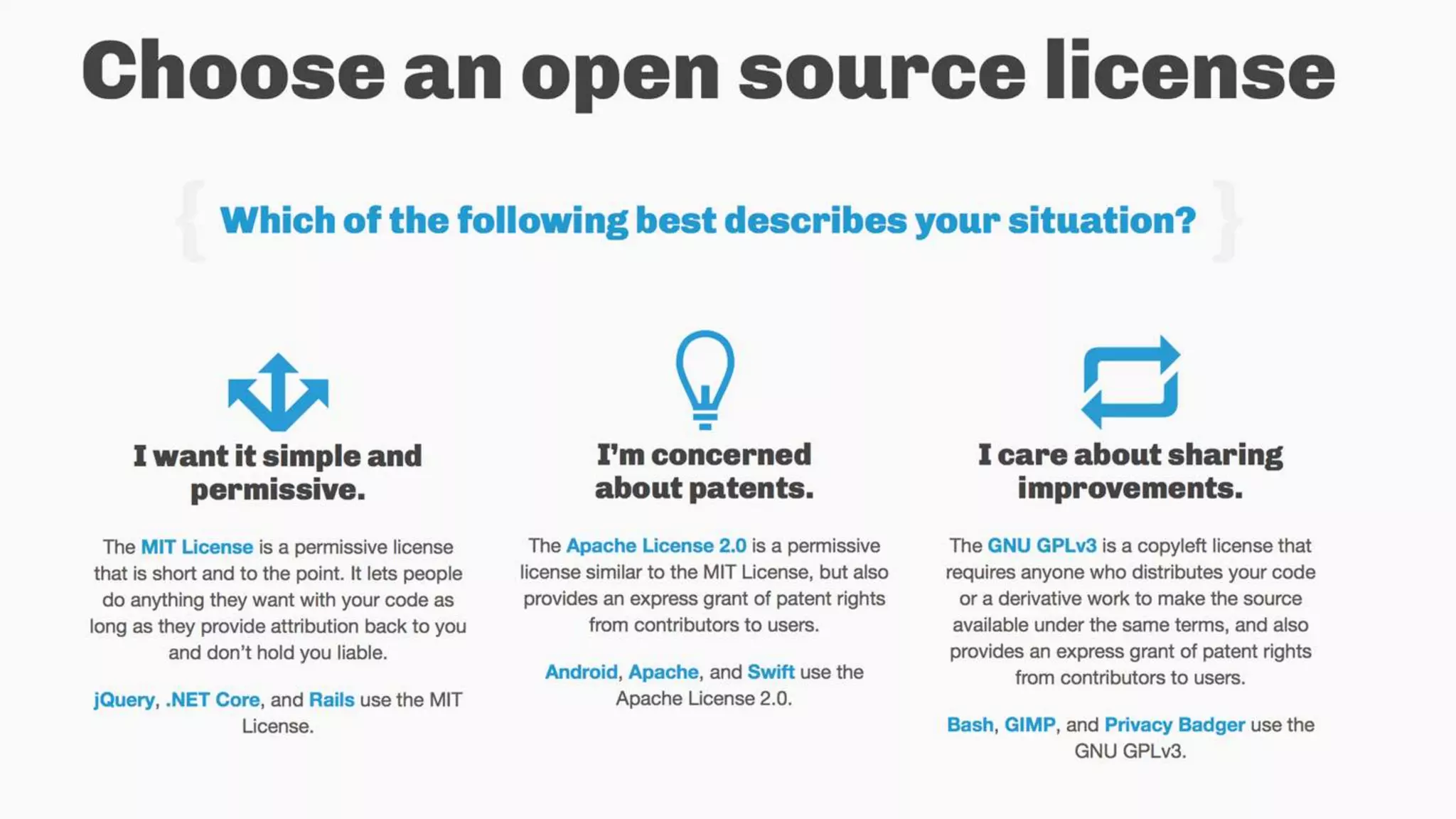
  • #12 The terms of open-source licenses vary dramatically Choice of License – driven by: · How permissive a license you desire? · Whether you are concerned about patent rights? · Whether you care about sharing your improvements and subsequent improvement for the benefit of the software community?
  • #13 Licenses fall into three general categories: Flexible / Permissive Restrictive / “Copyleft” licenses Middle ground
  • #14 Most flexible licenses allow user to license, distribute, and modify the subject code: · Essentially without limitation o Provided that the applicable copyright notices are included with distribution § License templates are provided with each license § Includes a disclaimer of warranties that protects the original author · Most importantly: o No requirement to give downstream users a copy of the “derivative work” § The modifications made to the original code covered by this license · The private sector very much favors these types of licenses because it allows commercial exploitation of the software o So long as the licensee abides by what are very reasonable documentation requirements. These Licenses Include: · Berkley Software Distribution License (“BSD”) · MIT License · Apache License 2.0 o Also provides an express grant of patent rights from contributors to users § for anyone [still] concerned with software patent rights) § Unless licensee triggers the “Patent Retaliation Clause” – by alleging that the software infringes its patent rights
  • #15 Second Camp / School of Thought- “Copyleft” licenses: · Premise is that in consideration for use of the subject work – o Aka in exchange for the ability to copy, modify, and distribute the code § Licensee must afford downstream users the same privileges of accessibility and use of the licensee’s derivative works · “Pure Copyleft” license provides four essential freedoms: o run the program for any purpose o study how the program works and change it to suit your needs o copy the program and share it with others o share modifications with others · Most popular and well-known “copyleft” licenses are the GNU’s General Public Licenses o Requires licensee must publish or make available the source code for any works based on or derived from the original software § Must send the sponsoring open source community a copy of all versions of the derivative software created using the software · Although most do not require a specific place § Make the documentation available at no charge. · [“Free Software Definition” – from GNU] These licenses include: · GPL 2.0 · GPL 3.0 Interesting Note: Little to no litigation where these licenses have been interpreted by a court. Many read specific language of the GPLs in conjunction with the GNU’s definition of “free software” and other commentary to better interpret the terms of the GPLs. · While the literal language of the GPLs are not as specific or explicit (in terms of derivatives works and distributions), GNU materials provide some guidance on how the GNU may seek to enforce such a license Even if the explicit language of the GPL would ultimately carry the day in an infringement lawsuit. Does the GPL have different requirements for statically vs dynamically linked modules with a covered work? (#GPLStaticVsDynamic) No. Linking a GPL covered work statically or dynamically with other modules is making a combined work based on the GPL covered work. Thus, the terms and conditions of the GNU General Public License cover the whole combination. See also What legal issues come up if I use GPL-incompatible libraries with GPL software?
  • #16 Middle Ground Between “Copyleft” and the “Flexible” licenses: · Referred to “weak copyleft” licenses o Permit the licensee to include or link the original, unmodified code in a greater work without being required to license the entirety of the new work under the same open source license These licenses include: · Mozilla Public License · Eclipse Public License · GNU Lesser General Public License (“LGPL”) o To some extent – § Diverse interpretations about how to link safely to LGPL-licensed code § Safe harbor of the LGPL is much narrower than the Mozilla + Eclipse