
GROUP MEMBERS
• Ali Hassan 13054119-
081
• Mohsin-Ali 13054119-082
• Khaqan Sahi 13054119-085
TOPIC:
Open Source Software
Shareware Software
Commercial Software
Freeware Software
Proprietary Software
Software ?
SOFTWARE
• Organized information in the form of operating systems, utilities,
programs, and applications that enable computers to work.
Software consists of carefully-organized instructions and code written by
programmers in any of various special computer languages. Software is
divided commonly into two main categories:
• (1) System software: controls the basic (and invisible to the user)
functions of a computer and comes usually preinstalled with the
machine. See also BIOS and Operating System.
• (2) Application software: handles multitudes of common and specialized
tasks a user wants to perform, such as accounting, communicating, data
processing, word processing.
WHAT IS OPEN SOURCE?
• When a software program is open source, it means the
program's source code is freely available to the public . open
source programs can be modified and distributed by anyone
and are often developed as a community rather than by a
single organization.
• Its authors make its source code available to others who would
like to view that code, copy it, learn from it, alter it, or share
it. LibreOffice and the GNU Image Management Program are
examples of open source software
COUNT…
• if you have problems using the software, you will most likely
not be able to obtain technical support from the developer
SO WHAT DOES THAT MEAN?
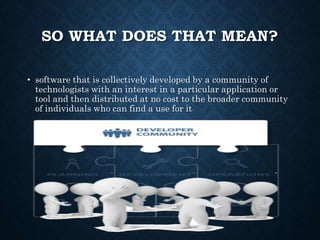
• software that is collectively developed by a community of
technologists with an interest in a particular application or
tool and then distributed at no cost to the broader community
of individuals who can find a use for it
• Since open source software is free to use, there is typically no
technical support included with the software. Instead, users
may need to rely on Web forums and user discussions to report
bugs or get answers to their questions. Fortunately, the most
popular open source programs have an abundance of helpful
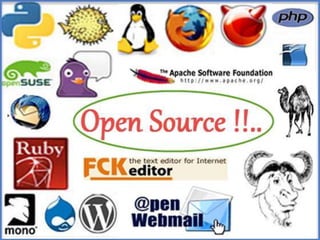
resources available on the Web. Some of the most well-known
open source projects include the Linux operating system the
Mozilla Firefox Web browser, and the OpenOffice.org
WHAT IS OPEN SOURCE?
REALLY?
• Free to use
• Free to change
• Free to distribute
• An alternative to commercial software
SHAREWARE SOFTWARE
• Shareware "Free Trials", "Free to Try", "Try before you buy"
• Shareware is software that you can use on a trial basis before
paying for it. Unlike freeware, shareware often has limited
functionality or may only be used for a limited time before
requiring payment and registration. Once you pay for a
shareware program, the program is fully functional and the
time limit is removed.
• In the 1980s and 1990s, shareware was a popular way for
small developers to distribute software. The arrival of CDs
allowed multiple developers to deliver their software programs
as a collection, such as "Top 100 Mac Games." Other
shareware collections included utilities graphics programs,
and productivity applications In many cases, these programs
were fully functional and simply requested a donation from
users. Programs that continually reminded users to register
and pay for the software become known as "nagware."
• Today, the most common type of shareware programs are trial
programs, which are also called "trialware" or "demoware."
These programs are provided as demos that you can try for a
limited time, such as two weeks or one month. Once the trial
period expires, you must pay for the software in order to
continue using it. Most shareware demos can
be downloaded directly from the software publisher's website.
FREEWARE
• Freeware is software that is free to use. Unlike commercial
software it does not require any payment or licensing fee. It is
similar to shareware, but will not eventually ask you for
payment to continue using the software. You can
legally download and use freeware for as long as you want
without having to pay for it.
• Many types of software programs are offered as freeware,
including games, utilities and productivity applications. Since
the software is free, you might wonder what
incentive developers have to create freeware programs.
BELOW ARE A FEW REASONS A
PROGRAM MIGHT BE OFFERED AS
FREEWARE
• To offer a program developed by a non-profit or educational
institution to the public
• To promote a brand or drive traffic to a company's website
• To generate revenue through advertisements or in-app purchases
within the program
• To generate revenue by offering other programs during the
installation process
• To provide a "lite" version of a program that may lead users to
upgrade to the full-featured version
• While freeware is free to use, it is still copyrighted and may
include a license agreement that restricts usage or distribution of
the software. It is also not the same thing as open source software
(or "free software"), which allows you to edit and redistribute the
program's source code.
COMMERCIAL SOFTWARE
• Commercial software is any software or program that is
designed and developed for licensing or sale to end users or
that serves a commercial purpose. Commercial software was
once considered to be proprietary software, but now a number
of free and open-source software applications are licensed or
sold to end users
COUNT…
• . Off-the-shelf software programs, such as games or those sold
in computer specialty stores or even music stores and grocery
stores, are some examples of commercial software.
• Microsoft products such as the Windows Operating System
and MS Office are some of the most well-known examples of
commercial software.
SHAREWARE SOFTWARE
• Shareware is a type of proprietary software which is initially
provided free of charge to users, who are allowed and
encouraged to make and share copies of the program.
Shareware is often offered as a download from a website or as
a compact disc included with a magazine. Shareware is
available with most computer software. The term shareware is
used in contrast to open-source software, in which the source
code is available for anyone to inspect and alter; and freeware,
which is software distributed at no cost to the user but
without source code being made available
COUNT…
• There are many types of shareware, and while they may not
require an initial up-front payment, all are intended to
generate revenue in one way or another. Some limit use to
personal non-commercial purposes only, with purchase of a
license required for use in a business enterprise. The software
itself may be limited in functionality or be time-limited, or it
may remind the user that payment would be appreciated.
PROPRIETARY SOFTWARE
• Proprietary software is software that is owned by an individual or a
company (usually the one that developed it). There are almost always
major restrictions on its use, and its source code is almost always kept
secret.
• These restrictions vary somewhat according to the license, but a typical
requirement is that they include a copy of the original license. The most
commonly used license, the GNU Public License (GPL), additionally
requires that if a modified version of the software is distributed, the
source code for such modified version must be made freely available. The
best known example of software licensed under the GPL is Linux
COUNT…
• The restrictions on the use of proprietary software are usually
enumerated in the end user license agreements (EULAs) that
users must consent to. For software provided by large
companies, EULAs are generally long and complex contracts.
Among the most common of the prohibitions for such
programs are making unauthorized copies, using it on more
than a certain number of computers and reverse engineering
it
• Some Unix-like operating systems are also proprietary. Among
the most popular are AIX (developed by IBM), HP-UX (developed
by Hewlett-Packard), QNX (developed by QNX Software Systems)
and Solaris (developed by Sun Microsystems). Others are free
software, including Linux and the BSD systems (the most widely
used of which is FreeBSD).
• Virtually all Microsoft software is proprietary, including the
Windows family of operating systems and Microsoft Office. This
includes software that is given away at no charge, such as
Internet Explorer. Other major producers of proprietary software
include Adobe, Borland, IBM, Macromedia, Sun Microsystems
and Oracle
CONT..
•
• Proprietary (or closed source) software does not let people see or change source code of the computersoftware. It is
the opposite of Free software. Proprietary software is usually created by businesses who want to sell their
software, but some programs that are free to use are still proprietary because the user is not allowed to change
them. With proprietary software, only the people that make the software can see and change the code.
• Even if the people who make the program give the source code to other people, the program will be proprietary if
they do not allow to do important things like these:
• change the code,
• give the code to other people,
• give the changed code to other people,
• use the code on a different computer,
• change it to work on a different operating system and give that to other people.
• Most companies who sell their software for money (and even some who do not charge money for it) make it
proprietary source. This makes it harder for people to copy or change the software, or to use the source code to
make similar software.

Softwares open source shareware commercial Proprietary By Mohsin Iftikhar

  • 2.
    GROUP MEMBERS • AliHassan 13054119- 081 • Mohsin-Ali 13054119-082 • Khaqan Sahi 13054119-085
  • 3.
    TOPIC: Open Source Software SharewareSoftware Commercial Software Freeware Software Proprietary Software
  • 4.
  • 5.
    SOFTWARE • Organized informationin the form of operating systems, utilities, programs, and applications that enable computers to work. Software consists of carefully-organized instructions and code written by programmers in any of various special computer languages. Software is divided commonly into two main categories: • (1) System software: controls the basic (and invisible to the user) functions of a computer and comes usually preinstalled with the machine. See also BIOS and Operating System. • (2) Application software: handles multitudes of common and specialized tasks a user wants to perform, such as accounting, communicating, data processing, word processing.
  • 6.
    WHAT IS OPENSOURCE? • When a software program is open source, it means the program's source code is freely available to the public . open source programs can be modified and distributed by anyone and are often developed as a community rather than by a single organization. • Its authors make its source code available to others who would like to view that code, copy it, learn from it, alter it, or share it. LibreOffice and the GNU Image Management Program are examples of open source software
  • 7.
    COUNT… • if youhave problems using the software, you will most likely not be able to obtain technical support from the developer
  • 8.
    SO WHAT DOESTHAT MEAN? • software that is collectively developed by a community of technologists with an interest in a particular application or tool and then distributed at no cost to the broader community of individuals who can find a use for it
  • 9.
    • Since opensource software is free to use, there is typically no technical support included with the software. Instead, users may need to rely on Web forums and user discussions to report bugs or get answers to their questions. Fortunately, the most popular open source programs have an abundance of helpful resources available on the Web. Some of the most well-known open source projects include the Linux operating system the Mozilla Firefox Web browser, and the OpenOffice.org
  • 10.
    WHAT IS OPENSOURCE? REALLY? • Free to use • Free to change • Free to distribute • An alternative to commercial software
  • 12.
    SHAREWARE SOFTWARE • Shareware"Free Trials", "Free to Try", "Try before you buy" • Shareware is software that you can use on a trial basis before paying for it. Unlike freeware, shareware often has limited functionality or may only be used for a limited time before requiring payment and registration. Once you pay for a shareware program, the program is fully functional and the time limit is removed.
  • 13.
    • In the1980s and 1990s, shareware was a popular way for small developers to distribute software. The arrival of CDs allowed multiple developers to deliver their software programs as a collection, such as "Top 100 Mac Games." Other shareware collections included utilities graphics programs, and productivity applications In many cases, these programs were fully functional and simply requested a donation from users. Programs that continually reminded users to register and pay for the software become known as "nagware."
  • 14.
    • Today, themost common type of shareware programs are trial programs, which are also called "trialware" or "demoware." These programs are provided as demos that you can try for a limited time, such as two weeks or one month. Once the trial period expires, you must pay for the software in order to continue using it. Most shareware demos can be downloaded directly from the software publisher's website.
  • 16.
    FREEWARE • Freeware issoftware that is free to use. Unlike commercial software it does not require any payment or licensing fee. It is similar to shareware, but will not eventually ask you for payment to continue using the software. You can legally download and use freeware for as long as you want without having to pay for it. • Many types of software programs are offered as freeware, including games, utilities and productivity applications. Since the software is free, you might wonder what incentive developers have to create freeware programs.
  • 17.
    BELOW ARE AFEW REASONS A PROGRAM MIGHT BE OFFERED AS FREEWARE • To offer a program developed by a non-profit or educational institution to the public • To promote a brand or drive traffic to a company's website • To generate revenue through advertisements or in-app purchases within the program • To generate revenue by offering other programs during the installation process • To provide a "lite" version of a program that may lead users to upgrade to the full-featured version • While freeware is free to use, it is still copyrighted and may include a license agreement that restricts usage or distribution of the software. It is also not the same thing as open source software (or "free software"), which allows you to edit and redistribute the program's source code.
  • 19.
    COMMERCIAL SOFTWARE • Commercialsoftware is any software or program that is designed and developed for licensing or sale to end users or that serves a commercial purpose. Commercial software was once considered to be proprietary software, but now a number of free and open-source software applications are licensed or sold to end users
  • 20.
    COUNT… • . Off-the-shelfsoftware programs, such as games or those sold in computer specialty stores or even music stores and grocery stores, are some examples of commercial software. • Microsoft products such as the Windows Operating System and MS Office are some of the most well-known examples of commercial software.
  • 21.
    SHAREWARE SOFTWARE • Sharewareis a type of proprietary software which is initially provided free of charge to users, who are allowed and encouraged to make and share copies of the program. Shareware is often offered as a download from a website or as a compact disc included with a magazine. Shareware is available with most computer software. The term shareware is used in contrast to open-source software, in which the source code is available for anyone to inspect and alter; and freeware, which is software distributed at no cost to the user but without source code being made available
  • 22.
    COUNT… • There aremany types of shareware, and while they may not require an initial up-front payment, all are intended to generate revenue in one way or another. Some limit use to personal non-commercial purposes only, with purchase of a license required for use in a business enterprise. The software itself may be limited in functionality or be time-limited, or it may remind the user that payment would be appreciated.
  • 23.
    PROPRIETARY SOFTWARE • Proprietarysoftware is software that is owned by an individual or a company (usually the one that developed it). There are almost always major restrictions on its use, and its source code is almost always kept secret. • These restrictions vary somewhat according to the license, but a typical requirement is that they include a copy of the original license. The most commonly used license, the GNU Public License (GPL), additionally requires that if a modified version of the software is distributed, the source code for such modified version must be made freely available. The best known example of software licensed under the GPL is Linux
  • 24.
    COUNT… • The restrictionson the use of proprietary software are usually enumerated in the end user license agreements (EULAs) that users must consent to. For software provided by large companies, EULAs are generally long and complex contracts. Among the most common of the prohibitions for such programs are making unauthorized copies, using it on more than a certain number of computers and reverse engineering it
  • 25.
    • Some Unix-likeoperating systems are also proprietary. Among the most popular are AIX (developed by IBM), HP-UX (developed by Hewlett-Packard), QNX (developed by QNX Software Systems) and Solaris (developed by Sun Microsystems). Others are free software, including Linux and the BSD systems (the most widely used of which is FreeBSD). • Virtually all Microsoft software is proprietary, including the Windows family of operating systems and Microsoft Office. This includes software that is given away at no charge, such as Internet Explorer. Other major producers of proprietary software include Adobe, Borland, IBM, Macromedia, Sun Microsystems and Oracle
  • 26.
    CONT.. • • Proprietary (orclosed source) software does not let people see or change source code of the computersoftware. It is the opposite of Free software. Proprietary software is usually created by businesses who want to sell their software, but some programs that are free to use are still proprietary because the user is not allowed to change them. With proprietary software, only the people that make the software can see and change the code. • Even if the people who make the program give the source code to other people, the program will be proprietary if they do not allow to do important things like these: • change the code, • give the code to other people, • give the changed code to other people, • use the code on a different computer, • change it to work on a different operating system and give that to other people. • Most companies who sell their software for money (and even some who do not charge money for it) make it proprietary source. This makes it harder for people to copy or change the software, or to use the source code to make similar software.