By: Rohit Sinha
Estimation and its Categories
• ESTIMATION - “Estimation is the process of finding an estimate,
or approximation”.
• Software Estimation Techniques-
1) Delphi Technique.
2) Work Breakdown Structure (WBS).
3) Three Point Estimation.
4) Functional Point Method.
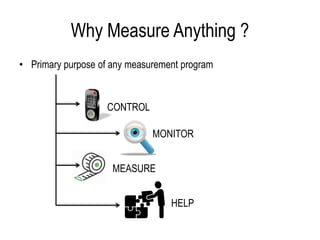
Why Measure Anything ?
• Primary purpose of any measurement program
CONTROL
MONITOR
MEASURE
HELP
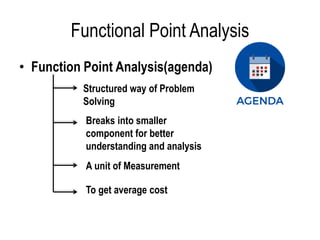
Functional Point Analysis
• Function Point Analysis(agenda)
Structured way of Problem
Solving
Breaks into smaller
component for better
understanding and analysis
A unit of Measurement
To get average cost
Definition
• Function Point Analysis is a structured technique of problem
solving. It is a method to break systems into smaller components, so
they can be better understood and analyzed, and ultimately helps
the project people with a unit of measurement which is nothing but
“AVERAGE COST” .
How to count Function Point
5 step counting process
• Determine the type of count.
• Identify the scope and boundary of the count.
• Determine the unadjusted FP count.
• Determine the Value Adjustment Factor.
• Calculate the Adjusted FP Count.
Terms to understand
• User identifiable – It means defined requirements for processes
and/or groups of data that are agreed upon, and understood by, both
the users and software developers.
• Control information – It means the data that influences and
elementary process of the application being counted. It tells us what,
when, or how data is to be processed.
• Elementary process - An elementary process is the smallest unit of
activity that is meaningful to the user.
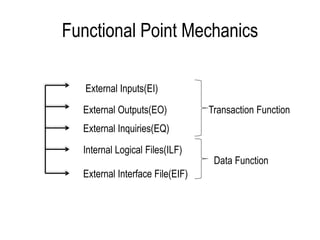
Functional Point Mechanics
External Inputs(EI)
External Outputs(EO)
External Inquiries(EQ)
Internal Logical Files(ILF)
External Interface File(EIF)
Transaction Function
Data Function
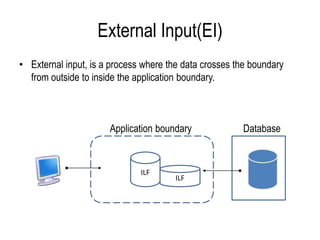
External Input(EI)
• External input, is a process where the data crosses the boundary
from outside to inside the application boundary.
ILF
ILF
Application boundary Database
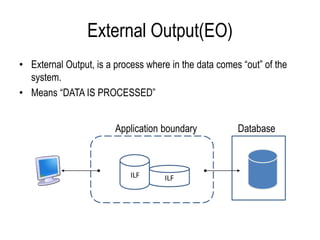
External Output(EO)
• External Output, is a process where in the data comes “out” of the
system.
• Means “DATA IS PROCESSED”
ILF ILF
Application boundary Database
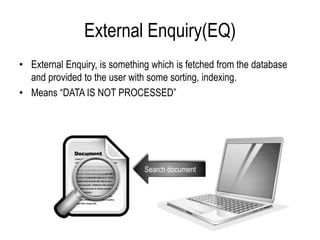
External Enquiry(EQ)
• External Enquiry, is something which is fetched from the database
and provided to the user with some sorting, indexing.
• Means “DATA IS NOT PROCESSED”
Search document
Internal Logical Files(ILF)
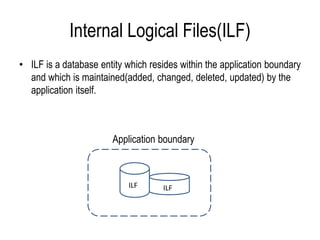
• ILF is a database entity which resides within the application boundary
and which is maintained(added, changed, deleted, updated) by the
application itself.
Application boundary
ILF ILF
External Interface File(EIF)
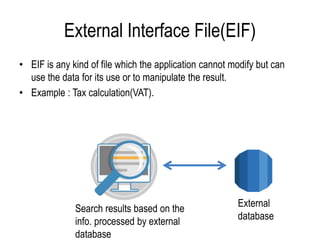
• EIF is any kind of file which the application cannot modify but can
use the data for its use or to manipulate the result.
• Example : Tax calculation(VAT).
External
database
Search results based on the
info. processed by external
database
Record Element Type(RET)
• A Record Element Type (RET) is the largest user identifiable
subgroup of elements within an ILF or an EIF.
• The RET is calculated for the Data Functions.
File Type Reference(FTR)
• File Type Referenced (FTR) is the largest user identifiable subgroup
within the EI, EO, or EQ.
• The transaction functions EI, EO, EQ are measured by counting
FTRs and DETs that they contain.
Data element Type(DET)
• A data element type is a unique, user recognizable, non-repeated
field.
• The DET concept need to apply when the analysis of data function
and transaction function is carried out.
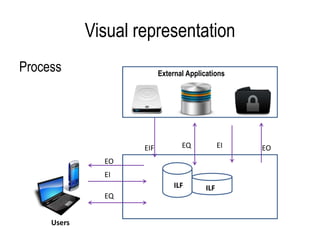
Visual representation
Process
ILF ILF
External Applications
Users
EO
EI
EQ
EIF EQ EI EO
Benefits
• Estimation(Functional point)
Reduced cost by 15-20% by
just measuring
Improves the communication of
workloads
Improves the understanding of
Business Function
Improves the allocation of
Resources
Conclusion
• Function Points are becoming widely accepted as the
standard metric for measuring software size.
Now that Function Points have made
adequate sizing possible, it can now be anticipated that the
overall rate of progress in software productivity and software
quality will improve. Understanding software size is the key to
understanding both productivity and quality.
Thanks for reading

Software estimation using fp analysis

  • 1.
  • 2.
    Estimation and itsCategories • ESTIMATION - “Estimation is the process of finding an estimate, or approximation”. • Software Estimation Techniques- 1) Delphi Technique. 2) Work Breakdown Structure (WBS). 3) Three Point Estimation. 4) Functional Point Method.
  • 3.
    Why Measure Anything? • Primary purpose of any measurement program CONTROL MONITOR MEASURE HELP
  • 4.
    Functional Point Analysis •Function Point Analysis(agenda) Structured way of Problem Solving Breaks into smaller component for better understanding and analysis A unit of Measurement To get average cost
  • 5.
    Definition • Function PointAnalysis is a structured technique of problem solving. It is a method to break systems into smaller components, so they can be better understood and analyzed, and ultimately helps the project people with a unit of measurement which is nothing but “AVERAGE COST” .
  • 6.
    How to countFunction Point
  • 7.
    5 step countingprocess • Determine the type of count. • Identify the scope and boundary of the count. • Determine the unadjusted FP count. • Determine the Value Adjustment Factor. • Calculate the Adjusted FP Count.
  • 8.
    Terms to understand •User identifiable – It means defined requirements for processes and/or groups of data that are agreed upon, and understood by, both the users and software developers. • Control information – It means the data that influences and elementary process of the application being counted. It tells us what, when, or how data is to be processed. • Elementary process - An elementary process is the smallest unit of activity that is meaningful to the user.
  • 9.
    Functional Point Mechanics ExternalInputs(EI) External Outputs(EO) External Inquiries(EQ) Internal Logical Files(ILF) External Interface File(EIF) Transaction Function Data Function
  • 10.
    External Input(EI) • Externalinput, is a process where the data crosses the boundary from outside to inside the application boundary. ILF ILF Application boundary Database
  • 11.
    External Output(EO) • ExternalOutput, is a process where in the data comes “out” of the system. • Means “DATA IS PROCESSED” ILF ILF Application boundary Database
  • 12.
    External Enquiry(EQ) • ExternalEnquiry, is something which is fetched from the database and provided to the user with some sorting, indexing. • Means “DATA IS NOT PROCESSED” Search document
  • 13.
    Internal Logical Files(ILF) •ILF is a database entity which resides within the application boundary and which is maintained(added, changed, deleted, updated) by the application itself. Application boundary ILF ILF
  • 14.
    External Interface File(EIF) •EIF is any kind of file which the application cannot modify but can use the data for its use or to manipulate the result. • Example : Tax calculation(VAT). External database Search results based on the info. processed by external database
  • 15.
    Record Element Type(RET) •A Record Element Type (RET) is the largest user identifiable subgroup of elements within an ILF or an EIF. • The RET is calculated for the Data Functions.
  • 16.
    File Type Reference(FTR) •File Type Referenced (FTR) is the largest user identifiable subgroup within the EI, EO, or EQ. • The transaction functions EI, EO, EQ are measured by counting FTRs and DETs that they contain.
  • 17.
    Data element Type(DET) •A data element type is a unique, user recognizable, non-repeated field. • The DET concept need to apply when the analysis of data function and transaction function is carried out.
  • 18.
    Visual representation Process ILF ILF ExternalApplications Users EO EI EQ EIF EQ EI EO
  • 19.
    Benefits • Estimation(Functional point) Reducedcost by 15-20% by just measuring Improves the communication of workloads Improves the understanding of Business Function Improves the allocation of Resources
  • 20.
    Conclusion • Function Pointsare becoming widely accepted as the standard metric for measuring software size. Now that Function Points have made adequate sizing possible, it can now be anticipated that the overall rate of progress in software productivity and software quality will improve. Understanding software size is the key to understanding both productivity and quality.
  • 21.