Privacy and the Car of the
          Future
Consideration for the coming connected vehicle
whoami
•   BSEE, digital communications

•   Many years as a network engineer

•   Santa Clara University Law student

•   Research assistant providing technical expertise on privacy
    audits and reviews

•   Contracted by auto consortium to review privacy of
    proposed vehicle to vehicle safety network
Standard Disclaimer


                IANAL (Yet)
But if you know anyone looking for summer interns....
Non-Standard Disclaimer


A current NDA covers some of my work here (but not very
                           much)
 The focus will be on published information and standards.
What is This Project?

• DSRC: Dedicated Short Range Communications
    •   (Where “short” == 380m)

•   Vehicle to Vehicle

•   Vehicle to infrastructure in Europe
    - Not having to wait for a light on an empty street again.
    - Better traffic planning for better cities and roadways.
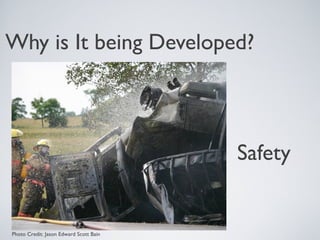
Why is It being Developed?


                                        Safety


Photo Credit: Jason Edward Scott Bain
Non-trivial Impact on Auto
                  Deaths
•   World Health Organization
    estimates 25% of vehicle
    deaths each year can be
    prevented.

•   Fatigue and distracted driving
    accidents reduced.

•   Blind Corners, fog and
    limited visibility accidents
    reduced.
                                     Photo: Public Domain
Will This really Happen?


    IT ALREADY IS
How Soon?
•   Hardware is already being shipped.

•   Software issues still entirely in the air

    •   More is being done in software these days.

•   The US Dept. of Transportation is considering mandating
    this for all new cars. (Decision to come later this year.)

•   Has already deployed in trucks in Europe
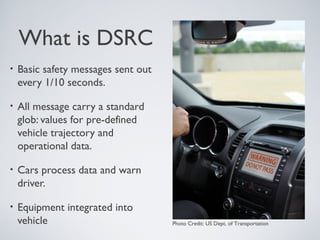
What is DSRC
•   Basic safety messages sent out
    every 1/10 seconds.

•   All message carry a standard
    glob: values for pre-defined
    vehicle trajectory and
    operational data.

•   Cars process data and warn
    driver.

•   Equipment integrated into
    vehicle                          Photo Credit: US Dept. of Transportation
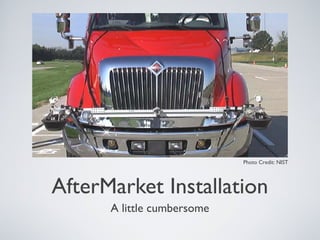
Photo Credit: NIST


AfterMarket Installation
      A little cumbersome
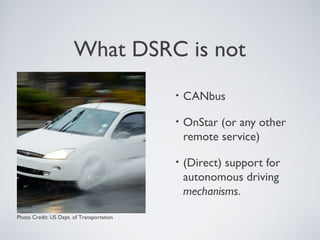
What DSRC is not
                                           •   CANbus

                                           •   OnStar (or any other
                                               remote service)

                                           •   (Direct) support for
                                               autonomous driving
                                               mechanisms.

Photo Credit: US Dept. of Transportation
Technical details
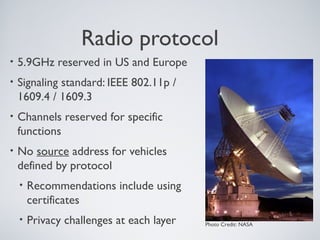
Radio protocol
•   5.9GHz reserved in US and Europe
•   Signaling standard: IEEE 802.11p /
    1609.4 / 1609.3
•   Channels reserved for specific
    functions
•   No source address for vehicles
    defined by protocol
    •   Recommendations include using
        certificates
    •   Privacy challenges at each layer   Photo Credit: NASA
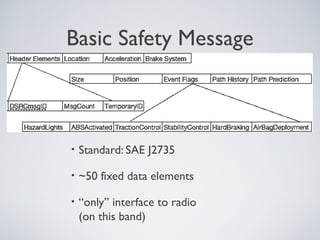
Basic Safety Message


•   Standard: SAE J2735

•   ~50 fixed data elements

•   “only” interface to radio
    (on this band)
Parameters for effectiveness
•   Density

    •   Benefit derived from other vehicles’ use

    •   Greater usage means greater effectiveness

•   Confidence

    •   Most messages must be trustworthy

    •   People must trust information broadcast
Validity?
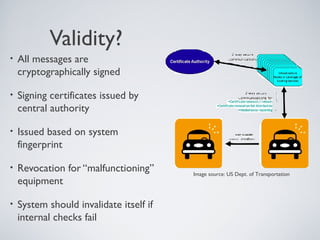
•   All messages are
    cryptographically signed

•   Signing certificates issued by
    central authority

•   Issued based on system
    fingerprint

•   Revocation for “malfunctioning”      Image source: US Dept. of Transportation
    equipment

•   System should invalidate itself if
    internal checks fail
Certificates
•   Limited time use to prevent tracking

    •   Reused?

•   Periodically refreshed (and malefactors reported)

    •   How often?

•   Permanent blacklist
Privacy?
MAC Layer

•   Changeable source (for vehicles) / no destination

•   Unrouteable! (mostly)

•   No significant privacy concern as is.

•   Any algorithm to make network routeable will make
    vehicles trackable.
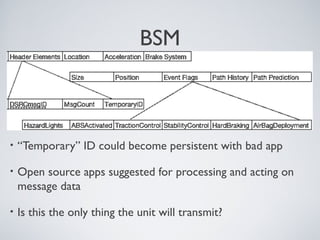
BSM


•   “Temporary” ID could become persistent with bad app

•   Open source apps suggested for processing and acting on
    message data

•   Is this the only thing the unit will transmit?
Certificates


•   Identity/Validity conflict

    •   Solution: constantly changing certificates

    •   Revocation by fingerprint

•   Issuing authority?
Fingerprints


•   “No” correspondence
    between fingerprint and car

•   “hard coded” into device

•   If revoked, entire unit must
    be replaced to function


                                   Photo Credit: NIST
Certificate Delivery

         •   Haven’t figured out how
             certificates are delivered to
             vehicle

         •   Proposals include cellular,
             wifi, infrastructure links

         •   So many opportunities for
             failure
Worrisome Noise


•   Manufacturers want to use this system for commercial apps

•   Advertising and other “funding” schemes to pay for CA

•   Fixed infrastructure potentially operated by data brokers
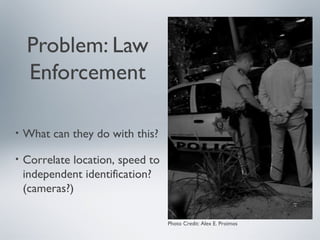
Problem: Law
    Enforcement

•   What can they do with this?

•   Correlate location, speed to
    independent identification?
    (cameras?)

                                   Photo Credit: Alex E. Proimos
What you Can Do
•   Hack the radios
    •   Commercially available now

•   Hack the protocols

•   Become politically engaged

    •   Most decisions are not being made by elected officials

    •   Help find a way to fund the infrastructure without selling
        out!
Thank you
Acknowledgements


•   Professor Dorothy Glancy, who requested my help on this
    project

•   DC 650 (especially Charles Blas) who gave me a reality
    check with current security and privacy capabilities
Contact

•   Christie Dudley

•   @longobord

•   c.dudley@ieee.org

Connected vehicles

  • 1.
    Privacy and theCar of the Future Consideration for the coming connected vehicle
  • 2.
    whoami • BSEE, digital communications • Many years as a network engineer • Santa Clara University Law student • Research assistant providing technical expertise on privacy audits and reviews • Contracted by auto consortium to review privacy of proposed vehicle to vehicle safety network
  • 3.
    Standard Disclaimer IANAL (Yet) But if you know anyone looking for summer interns....
  • 4.
    Non-Standard Disclaimer A currentNDA covers some of my work here (but not very much) The focus will be on published information and standards.
  • 5.
    What is ThisProject? • DSRC: Dedicated Short Range Communications • (Where “short” == 380m) • Vehicle to Vehicle • Vehicle to infrastructure in Europe - Not having to wait for a light on an empty street again. - Better traffic planning for better cities and roadways.
  • 6.
    Why is Itbeing Developed? Safety Photo Credit: Jason Edward Scott Bain
  • 7.
    Non-trivial Impact onAuto Deaths • World Health Organization estimates 25% of vehicle deaths each year can be prevented. • Fatigue and distracted driving accidents reduced. • Blind Corners, fog and limited visibility accidents reduced. Photo: Public Domain
  • 8.
    Will This reallyHappen? IT ALREADY IS
  • 9.
    How Soon? • Hardware is already being shipped. • Software issues still entirely in the air • More is being done in software these days. • The US Dept. of Transportation is considering mandating this for all new cars. (Decision to come later this year.) • Has already deployed in trucks in Europe
  • 10.
    What is DSRC • Basic safety messages sent out every 1/10 seconds. • All message carry a standard glob: values for pre-defined vehicle trajectory and operational data. • Cars process data and warn driver. • Equipment integrated into vehicle Photo Credit: US Dept. of Transportation
  • 11.
    Photo Credit: NIST AfterMarketInstallation A little cumbersome
  • 12.
    What DSRC isnot • CANbus • OnStar (or any other remote service) • (Direct) support for autonomous driving mechanisms. Photo Credit: US Dept. of Transportation
  • 13.
  • 14.
    Radio protocol • 5.9GHz reserved in US and Europe • Signaling standard: IEEE 802.11p / 1609.4 / 1609.3 • Channels reserved for specific functions • No source address for vehicles defined by protocol • Recommendations include using certificates • Privacy challenges at each layer Photo Credit: NASA
  • 15.
    Basic Safety Message • Standard: SAE J2735 • ~50 fixed data elements • “only” interface to radio (on this band)
  • 16.
    Parameters for effectiveness • Density • Benefit derived from other vehicles’ use • Greater usage means greater effectiveness • Confidence • Most messages must be trustworthy • People must trust information broadcast
  • 17.
    Validity? • All messages are cryptographically signed • Signing certificates issued by central authority • Issued based on system fingerprint • Revocation for “malfunctioning” Image source: US Dept. of Transportation equipment • System should invalidate itself if internal checks fail
  • 18.
    Certificates • Limited time use to prevent tracking • Reused? • Periodically refreshed (and malefactors reported) • How often? • Permanent blacklist
  • 19.
  • 20.
    MAC Layer • Changeable source (for vehicles) / no destination • Unrouteable! (mostly) • No significant privacy concern as is. • Any algorithm to make network routeable will make vehicles trackable.
  • 21.
    BSM • “Temporary” ID could become persistent with bad app • Open source apps suggested for processing and acting on message data • Is this the only thing the unit will transmit?
  • 22.
    Certificates • Identity/Validity conflict • Solution: constantly changing certificates • Revocation by fingerprint • Issuing authority?
  • 23.
    Fingerprints • “No” correspondence between fingerprint and car • “hard coded” into device • If revoked, entire unit must be replaced to function Photo Credit: NIST
  • 24.
    Certificate Delivery • Haven’t figured out how certificates are delivered to vehicle • Proposals include cellular, wifi, infrastructure links • So many opportunities for failure
  • 25.
    Worrisome Noise • Manufacturers want to use this system for commercial apps • Advertising and other “funding” schemes to pay for CA • Fixed infrastructure potentially operated by data brokers
  • 26.
    Problem: Law Enforcement • What can they do with this? • Correlate location, speed to independent identification? (cameras?) Photo Credit: Alex E. Proimos
  • 27.
    What you CanDo • Hack the radios • Commercially available now • Hack the protocols • Become politically engaged • Most decisions are not being made by elected officials • Help find a way to fund the infrastructure without selling out!
  • 28.
  • 29.
    Acknowledgements • Professor Dorothy Glancy, who requested my help on this project • DC 650 (especially Charles Blas) who gave me a reality check with current security and privacy capabilities
  • 30.
    Contact • Christie Dudley • @longobord • c.dudley@ieee.org

Editor's Notes

  • #3 Current law student. Privacy professor needed help
  • #4 should not matter But I’m working on that whole “lawyer” thing.
  • #5 little information to complete the audit. can talk about most published standards
  • #6 DSRC is a series of protocols. Has changed over the years of development. Black Hat talk: protocols are no longer relevant
  • #7 collision early warning system. - prevent accidents. - Save lives NHTSA “ distracted ” 2009 (US) stats: Almost 5,000 deaths, est 448,000 injuries Not including other inattention involving physical/emotional state of driver
  • #8 Good Work - want it to happen . Anecdote: driving in pouring rain too afraid to slow down, too afraid not to.
  • #9 Large scale testing in Ann Arbor Michigan started last August. Auto makers have already invested heavily in this technology. A few startups here in Silicon Valley to implement this.
  • #10 American government won’t spend money on infrastructure May be related to “black box” recent US mandate. Trucks have no privacy concerns as they are commercial vehicles.
  • #11 A system of protocols Not like asn.1 - not data pairs - Map of data
  • #12 Designed claimed as a “sealed” system, with sensor integrity and accuracy checks.
  • #13 Automakers lesson from CANbus: insecurity caused no real problems No new tech to mech tech - needs human intervention. “ sealed” sensor system with integrity checks.
  • #14 HOW it works
  • #15 Japan doesn’t have the same spectrum available ETSI and FCC approved operating parameters (Biggest difference: US allows more power.) 33 vs 44.7 dBm
  • #16 Minimum requirement for system. Additional protocols considered in Europe. illustrates general and some specific fields data = whatever’s useful in avoiding collisions
  • #17 More use = more effective People must trust the system Not just received, but what is sent about them Privacy is important or people will disable it Technological trust is better than laws
  • #18 Signature and certificate management - on radio Sensor validation (beyond scope here)
  • #19 Still not nailed down Ann Arbor test: came pre-loaded
  • #20 This is where we start talking about the FUD
  • #21 Already pressure for other apps - that need routing. Tension between routing and identifiability
  • #22 F/OSS Apps kind of neat. Closer to autonomy... Fun: someone in blind spot: “I wouldn’t do that, Dave” - give your vehicle too much power? This is too neat a toy to not use for other things.
  • #23 Permanent Blacklist? - may not be problem as internet - must replace entire blacklisted unit.
  • #24 Another problem for anonymity Many schemes to deal with this. Current solution is “no paper trail” We already have certain mistrust of CAs
  • #26 IEEE 1609 family beyond scope, won’t work - raises many more privacy concerns By the way 9 data brokers took the 5th before Congress in 2006 when asked to reveal the sources of their data.
  • #27 Tracking, ticketing, whatever else they may want to do.
  • #28 Fund certificate authority - funding has power.