THE ORGANICALLY SECURE
VEHICLE OF TOMORROWAutonomy, the leading use case of the connected vehicle, promises to be one of the most significant automotive safety
mechanisms ever developed. But success depends on autonomy and trust existing in equal measure. It’s time to
rearchitect the vehicle, putting cybersecurity first, and organically securing connected cars today and beyond.
The vehicles of the future will have greatly expanded cyberattack surfaces, making
security an increasingly critical focal point for industry and government alike. FASTR is
at the forefront of efforts to address emerging threats to automotive security.
250 MILLION CONNECTED CARS FORECASTED
TO BE ON ROADS BY THE YEAR 2020
100 MILLION
Today’s modern luxury vehicle contains
L I N E S O F C O D E
100 ELECTRONIC
Within the vehicle, we expect there to soon be
C O N T R O L U N I T S ( E C U s )
THE TRANSITION TO
THE FULLY CONNECTED VEHICLE
MOVING
FORWARD
The world is moving from today’s limited-but-
expanding vehicle connectivity to a complex,fully
connected environment including vehicle-to-vehicle
(V2V),vehicle-to-infrastructure (V2I),and
vehicle-to-everything (V2X).
V2V V2I V2X
T R U S T I N DATA C O N F I D E N T I A L I T Y
Seismic shifts in the automotive
ecosystem are creating new,
interdependent requirements for
greater trust in security.
TRUST IN SECURITY
T R U S T I N DATA A N D S Y S T E M I N T E G R I T Y
T R U S T I N DATA A N D S Y S T E M AVA I L A B I L I T Y
FASTR is enabling the future of automotive security
innovation. By facilitating industry-wide collaboration on
actionable applied and theoretical R&D needed to drive
cybersecurity across the entire supply chain, FASTR is building
trust in the connected and autonomous vehicles of the future.
SM
Sources: IEEE Spectrum, Gartner
VISIT FASTR.ORG TO JOIN US AND LEARN MORE
FASTRFuture of Automotive Security Technology Research
OEMs
TIER 1s AND 2s
AUTOMOTIVE SECURITY EXPERTS
FASTR is a vendor-neutral,nonprofit consortium uniting like-minded
organizations and individuals worldwide,including OEMs,Tier 1 and 2
suppliers,software,hardware and security experts.FASTR members are
not casual observers – they’re in the vanguard of next-generation
automotive security technology R&D. FASTR members are the
visionaries driving advanced cybersecurity innovations that will reshape
the automotive industry. To learn more about the vision behind FASTR,
read our manifesto at bit.ly/FASTRmanifesto
HARDWARE/SOFTWARE SUPPLIERS
HELP CREATE TOMORROW’S
ORGANICALLY SECURE VEHICLES
Your expertise,participation and perspective are needed! Connect
with us @FASTR_org and email to learn more:info@fastr.org
FASTR APPROACH
TO DEFENSE IN DEPTH
Threat modeling,vulnerability assessment,security
architecture,trusted supply chains and cybersecurity
assurance are needed at every level of vehicle infrastructure.
IN-VEHICLE SYSTEMS
CONNECTIVITY
AND THE CLOUD
END-TO-END USE
CASES
HARDWARE
SECURITY
FEATURES
VEHICLE
SECURITY
DESIGN
LIFECYCLE
THREAT
INTELLIGENCE
Multi-layered
defense in depth
demands security
features in the
silicon. These
items are critical
to the overall
security integrity
of the vehicle
architecture
An intentional and
proactive
approach to
interconnection of
vehicle systems
must be present
from the design
stages and through
production and
operation stages
Risk assessment
must be continual;
threat intelligence
can help prioritize
cybersecurity
threats by
associated risk
and illuminate
appropriate
incident response
(AUTONOMOUS DRIVING)
ADDED TO IN-VEHICLE SYSTEMS
WITH MORE ATTACK SURFACES, MORE COMPLEXITY
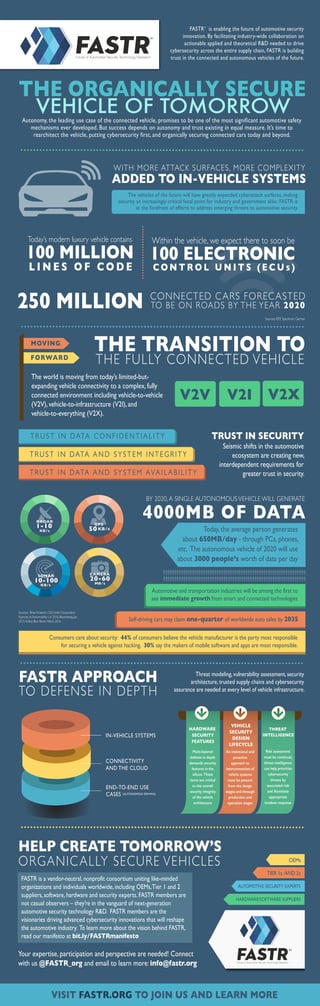
Today,the average person generates
about 650MB/day - through PCs,phones,
etc. The autonomous vehicle of 2020 will use
about 3000 people’s worth of data per day
GPS
50KB/s
CAMERA
20-60
MB/s
Sources: Brian Krzanich, CEO, Intel Corporation.
Keynote at Automobility LA 2016, Bloomberg, Jan.
2015, Kelley Blue Book, March 2016 Self-driving cars may claim one-quarter of worldwide auto sales by 2035
Consumers care about security: 44% of consumers believe the vehicle manufacturer is the party most responsible
for securing a vehicle against hacking. 30% say the makers of mobile software and apps are most responsible.
Automotive and transportation industries will be among the first to
see immediate growth from smart and connected technologies
4000MB OF DATA
BY 2020, A SINGLE AUTONOMOUS VEHICLE WILL GENERATE
RADAR
1-10
KB/s
SONAR
10-100
KB/s
FASTRFuture of Automotive Security Technology Research
SM
SM

FASTRInfographic2017

  • 1.
    THE ORGANICALLY SECURE VEHICLEOF TOMORROWAutonomy, the leading use case of the connected vehicle, promises to be one of the most significant automotive safety mechanisms ever developed. But success depends on autonomy and trust existing in equal measure. It’s time to rearchitect the vehicle, putting cybersecurity first, and organically securing connected cars today and beyond. The vehicles of the future will have greatly expanded cyberattack surfaces, making security an increasingly critical focal point for industry and government alike. FASTR is at the forefront of efforts to address emerging threats to automotive security. 250 MILLION CONNECTED CARS FORECASTED TO BE ON ROADS BY THE YEAR 2020 100 MILLION Today’s modern luxury vehicle contains L I N E S O F C O D E 100 ELECTRONIC Within the vehicle, we expect there to soon be C O N T R O L U N I T S ( E C U s ) THE TRANSITION TO THE FULLY CONNECTED VEHICLE MOVING FORWARD The world is moving from today’s limited-but- expanding vehicle connectivity to a complex,fully connected environment including vehicle-to-vehicle (V2V),vehicle-to-infrastructure (V2I),and vehicle-to-everything (V2X). V2V V2I V2X T R U S T I N DATA C O N F I D E N T I A L I T Y Seismic shifts in the automotive ecosystem are creating new, interdependent requirements for greater trust in security. TRUST IN SECURITY T R U S T I N DATA A N D S Y S T E M I N T E G R I T Y T R U S T I N DATA A N D S Y S T E M AVA I L A B I L I T Y FASTR is enabling the future of automotive security innovation. By facilitating industry-wide collaboration on actionable applied and theoretical R&D needed to drive cybersecurity across the entire supply chain, FASTR is building trust in the connected and autonomous vehicles of the future. SM Sources: IEEE Spectrum, Gartner VISIT FASTR.ORG TO JOIN US AND LEARN MORE FASTRFuture of Automotive Security Technology Research OEMs TIER 1s AND 2s AUTOMOTIVE SECURITY EXPERTS FASTR is a vendor-neutral,nonprofit consortium uniting like-minded organizations and individuals worldwide,including OEMs,Tier 1 and 2 suppliers,software,hardware and security experts.FASTR members are not casual observers – they’re in the vanguard of next-generation automotive security technology R&D. FASTR members are the visionaries driving advanced cybersecurity innovations that will reshape the automotive industry. To learn more about the vision behind FASTR, read our manifesto at bit.ly/FASTRmanifesto HARDWARE/SOFTWARE SUPPLIERS HELP CREATE TOMORROW’S ORGANICALLY SECURE VEHICLES Your expertise,participation and perspective are needed! Connect with us @FASTR_org and email to learn more:info@fastr.org FASTR APPROACH TO DEFENSE IN DEPTH Threat modeling,vulnerability assessment,security architecture,trusted supply chains and cybersecurity assurance are needed at every level of vehicle infrastructure. IN-VEHICLE SYSTEMS CONNECTIVITY AND THE CLOUD END-TO-END USE CASES HARDWARE SECURITY FEATURES VEHICLE SECURITY DESIGN LIFECYCLE THREAT INTELLIGENCE Multi-layered defense in depth demands security features in the silicon. These items are critical to the overall security integrity of the vehicle architecture An intentional and proactive approach to interconnection of vehicle systems must be present from the design stages and through production and operation stages Risk assessment must be continual; threat intelligence can help prioritize cybersecurity threats by associated risk and illuminate appropriate incident response (AUTONOMOUS DRIVING) ADDED TO IN-VEHICLE SYSTEMS WITH MORE ATTACK SURFACES, MORE COMPLEXITY Today,the average person generates about 650MB/day - through PCs,phones, etc. The autonomous vehicle of 2020 will use about 3000 people’s worth of data per day GPS 50KB/s CAMERA 20-60 MB/s Sources: Brian Krzanich, CEO, Intel Corporation. Keynote at Automobility LA 2016, Bloomberg, Jan. 2015, Kelley Blue Book, March 2016 Self-driving cars may claim one-quarter of worldwide auto sales by 2035 Consumers care about security: 44% of consumers believe the vehicle manufacturer is the party most responsible for securing a vehicle against hacking. 30% say the makers of mobile software and apps are most responsible. Automotive and transportation industries will be among the first to see immediate growth from smart and connected technologies 4000MB OF DATA BY 2020, A SINGLE AUTONOMOUS VEHICLE WILL GENERATE RADAR 1-10 KB/s SONAR 10-100 KB/s FASTRFuture of Automotive Security Technology Research SM SM