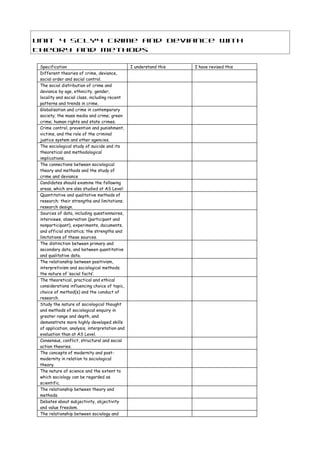
Unit 4 SCLY4 Crime and Deviance with
Theory and Methods

 Specification                                  I understand this   I have revised this
 Different theories of crime, deviance,
 social order and social control.
 The social distribution of crime and
 deviance by age, ethnicity, gender,
 locality and social class, including recent
 patterns and trends in crime.
 Globalisation and crime in contemporary
 society; the mass media and crime; green
 crime; human rights and state crimes.
 Crime control, prevention and punishment,
 victims, and the role of the criminal
 justice system and other agencies.
 The sociological study of suicide and its
 theoretical and methodological
 implications.
 The connections between sociological
 theory and methods and the study of
 crime and deviance
 Candidates should examine the following
 areas, which are also studied at AS Level:
 Quantitative and qualitative methods of
 research; their strengths and limitations;
 research design.
 Sources of data, including questionnaires,
 interviews, observation (participant and
 nonparticipant), experiments, documents,
 and official statistics; the strengths and
 limitations of these sources.
 The distinction between primary and
 secondary data, and between quantitative
 and qualitative data.
 The relationship between positivism,
 interpretivism and sociological methods;
 the nature of ‘social facts’.
 The theoretical, practical and ethical
 considerations influencing choice of topic,
 choice of method(s) and the conduct of
 research.
 Study the nature of sociological thought
 and methods of sociological enquiry in
 greater range and depth, and
 demonstrate more highly developed skills
 of application, analysis, interpretation and
 evaluation than at AS Level.
 Consensus, conflict, structural and social
 action theories.
 The concepts of modernity and post-
 modernity in relation to sociological
 theory.
 The nature of science and the extent to
 which sociology can be regarded as
 scientific.
 The relationship between theory and
 methods.
 Debates about subjectivity, objectivity
 and value freedom.
 The relationship between sociology and
social policy.

SociologyExchange.co.uk Shared Resource

  • 1.
    Unit 4 SCLY4Crime and Deviance with Theory and Methods Specification I understand this I have revised this Different theories of crime, deviance, social order and social control. The social distribution of crime and deviance by age, ethnicity, gender, locality and social class, including recent patterns and trends in crime. Globalisation and crime in contemporary society; the mass media and crime; green crime; human rights and state crimes. Crime control, prevention and punishment, victims, and the role of the criminal justice system and other agencies. The sociological study of suicide and its theoretical and methodological implications. The connections between sociological theory and methods and the study of crime and deviance Candidates should examine the following areas, which are also studied at AS Level: Quantitative and qualitative methods of research; their strengths and limitations; research design. Sources of data, including questionnaires, interviews, observation (participant and nonparticipant), experiments, documents, and official statistics; the strengths and limitations of these sources. The distinction between primary and secondary data, and between quantitative and qualitative data. The relationship between positivism, interpretivism and sociological methods; the nature of ‘social facts’. The theoretical, practical and ethical considerations influencing choice of topic, choice of method(s) and the conduct of research. Study the nature of sociological thought and methods of sociological enquiry in greater range and depth, and demonstrate more highly developed skills of application, analysis, interpretation and evaluation than at AS Level. Consensus, conflict, structural and social action theories. The concepts of modernity and post- modernity in relation to sociological theory. The nature of science and the extent to which sociology can be regarded as scientific. The relationship between theory and methods. Debates about subjectivity, objectivity and value freedom. The relationship between sociology and
  • 2.