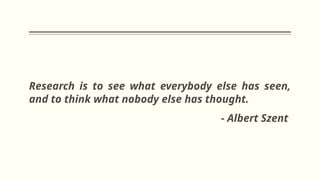
Research is tosee what everybody else has seen,
and to think what nobody else has thought.
- Albert Szent
3.
Research: Meaning
▪Research canbe defined as the scientific and systematic search for pertinent
information on a specific topic.
▪Research is one of the ways to find answers to your questions, and it is a way
of thinking, more than a set of skills.
▪Research is an integral part of many professional practice.
▪Research as a way to gather evidence for your practice.
▪Application of research in practice development and policy formulation.
▪Research aims at contributing to the existing stock of knowledge or deriving
solutions to problems.
▪Research can be seen a movement from the known to the unknown and can
be broadly defined “as a systematic inquiry towards understanding a complex
social phenomenon or a process”.
4.
Research: Definitions
▪Research isa structured inquiry that utilises acceptable scientific
methodology to solve problems and creates new knowledge that is
generally applicable (Grinnell, 1993: 4).
▪Burns (1994: 2) defines research as ‘a systematic investigation to find
answers to a problem’.
▪According to Kothari and Garg (2020: 1), research refers to the
systematic method consisting of enunciating the problem, formulating a
hypothesis, collecting the facts or data, analyzing the facts and reaching
certain conclusions either in the form of solution(s) towards the
concerned problem or in certain generalisations for some theoretical
formulation.
▪Emory defines ‘research as any organized inquiry designed and carried
out to provide information for solving a problem’.
5.
Research: Definitions
▪For CliffordWoody, research comprises of defining and redefining problems,
formulating hypothesis or suggested solutions, collecting, organizing and
evaluating data; making deductions and reaching conclusions; and at last
carefully testing the conclusions to determine whether they fit the formulating
hypothesis.
▪Research refers to the systematic method consisting of enunciating the
problem, formulating a hypothesis, collecting the facts or data, analyzing the
facts and reaching certain conclusions either in the form of solution(s) towards
the concerned problem or in certain generalisations for some theoretical
formulation.
6.
Social Research: Definitions
▪Bulmer(1977: 5) looks at sociological research as research that is
primarily committed to establishing systematic, reliable and valid
knowledge about the social world.
▪P.V. Young defines social research as the systematic method of
discovering new facts or verifying old facts, their sequences, inter-
relationship, causal explanations and the natural laws which govern
them.
▪Social research deals with the social phenomena.
▪Social research is carried on both for discovering new facts and verification
of the old ones.
▪Social research tries to establish causal connection between various
human activities.
7.
Research: Underlying Principles
▪Inits pursuit of finding answers to a question, research needs to follow
certain rules and regulations:
▪it is being undertaken within a framework of a set of philosophies;
▪it uses procedures, methods and techniques that have been tested for their
validity and reliability;
▪it is designed to be unbiased and objective.
▪The degree to which these criteria are expected to be fulfilled varies
from discipline to discipline.
8.
Objectives of Research
▪Togain familiarity with a phenomenon or to achieve new insights into it.
▪To portray accurately the characteristics of a particular individual,
phenomena, or a group.
▪To determine the frequency with which an event occurs or with which it
is associated with something else.
▪To test a hypothesis of causal relationship between variables.
Significance of Research
▪Researchinculcates scientific and inductive thinking and it promotes the
development of logical habits of thinking and organization.
▪Research provides the basis for nearly all government policies.
▪Research has its special significance in solving various operational and
planning problems of business and industry.
▪Research is important for social scientists in studying social relationships and
seeking answers to various social problems.
▪To philosophers and thinkers, research may mean the outlet for new ideas and
insights.
11.
Significance of Research
▪Toliterary people, research may mean the development of new styles and
creative work.
▪To analysts and intellectuals, research may mean the development of new
theories.
▪To professionals in research methodology, research may mean a source of
livelihood.
▪The need for research is to build up an infrastructure for creating new
knowledge to develop a knowledge reservoir.
▪Research aims to analyze inter-relationship between variables and to derive
causal explanations.
12.
Significance of Research
▪Researchaims to finding solutions to the problem.
▪General laws developed through research may enable us to make
reliable predictions of events.
▪Research also aims at developing new tools, concepts and theories for
better understanding to unknown phenomena.
▪Research provides functional data for rational decision making and
formulation of strategies and policies.
13.
Approaches to SociologicalResearch: Scientific Method
▪Close relationship between research and scientific method.
▪Scientific method is a common factor in research across the discipline.
▪The Scientific method is a systematic and empirical approach to
sociological research, rooted in the principles of observation,
experimentation, and evidence-based conclusions.
▪Sociologists use this method to ensure objectivity and validity while
studying social phenomena.
▪Scientific method is an objective, rigorous, rational, and systematic method
of determining the merits of a verifiable phenomenon that is free of
personal bias or prejudice.
▪Scientificity is achieved through surveys, observation, experimentation, etc.
14.
Basic Postulates ofScientific Method
▪It relies on empirical evidence;
▪It utilizes relevant concepts;
▪It is committed to only objective considerations;
▪It presupposes ethical neutrality, i.e., it aims at nothing but making only
adequate and correct statements about population objects;
▪It results into probabilistic predictions;
▪Its methodology is made known to all concerned for critical scrutiny are for use
in testing the conclusions through replication;
▪It aims at formulating most general axioms or what can be termed as scientific
theories.
15.
Challenges in Applyingthe Scientific Method to Sociology
▪Complexity of human behavior: Unlike natural sciences, human actions are
influenced by emotions, culture, and context.
▪Ethical considerations: Researchers must respect participants' rights, privacy,
and consent.
▪Operationalizing abstract concepts: Concepts like "social inequality" or "cultural
norms" are harder to define and measure.
16.
References
▪Ranjit Kumar (2016),Research Methodology, Sage publications New Delhi.
▪Kothari C R (2018 4th Ed.), Research Methodology, New Age International
Publishers, New Delhi.
Alternatives to SocialScience Research
▪ The four commonly used alternatives to social science research that many people rely on to acquire
knowledge and make decisions:
▪ Knowledge from Personal Experience and Common Sense
▪ Erroneous “common sense” misperceptions have real consequences.
▪ Overgeneralization: Statement that goes far beyond what can be justified based on the data or empirical
observations that one has.
▪ Selective observation: Process of examination in a way that reinforces preexisting thinking rather than in a neutral
and balanced manner.
▪ Premature closure: Act of making a judgment or reaching a decision and ending an investigation before gathering the
amount or depth of evidence required by scientific standards.
▪ Halo effect: Occurrence that allows the prior reputation of persons, places, or things to color one’s evaluations rather
than evaluating all in a neutral, equal manner.
▪ False consensus: A tendency to project one’s way of thinking onto other people. In other words, the person assumes
that everyone else thinks like he or she does.
▪ Experts and authorities: Relying on experts has limitations, and it is easy to overestimate someone’s
expertise.
▪ Popular and media messages: Mass media often echoes mass opinion without serious evaluation.
▪ Ideological beliefs and values
Editor's Notes
#1 NOTE:
To change the image on this slide, select the picture and delete it. Then click the Pictures icon in the placeholder to insert your own image.