ADA University
 ‘Research is…’ and ‘Research is carried out in order to…’
 An activity which critically evaluates some problem;
 Undertaking structured investigation which hopefully results in greater
understanding of the chosen interest area. Usually, this investigation becomes
available to the ‘public’;
 To collect and analyze the data in a specific field with the purposes of proving your
theory.
 Get a result with scientific methods,“objectively”, not “subjectively”;
 Solve problems,
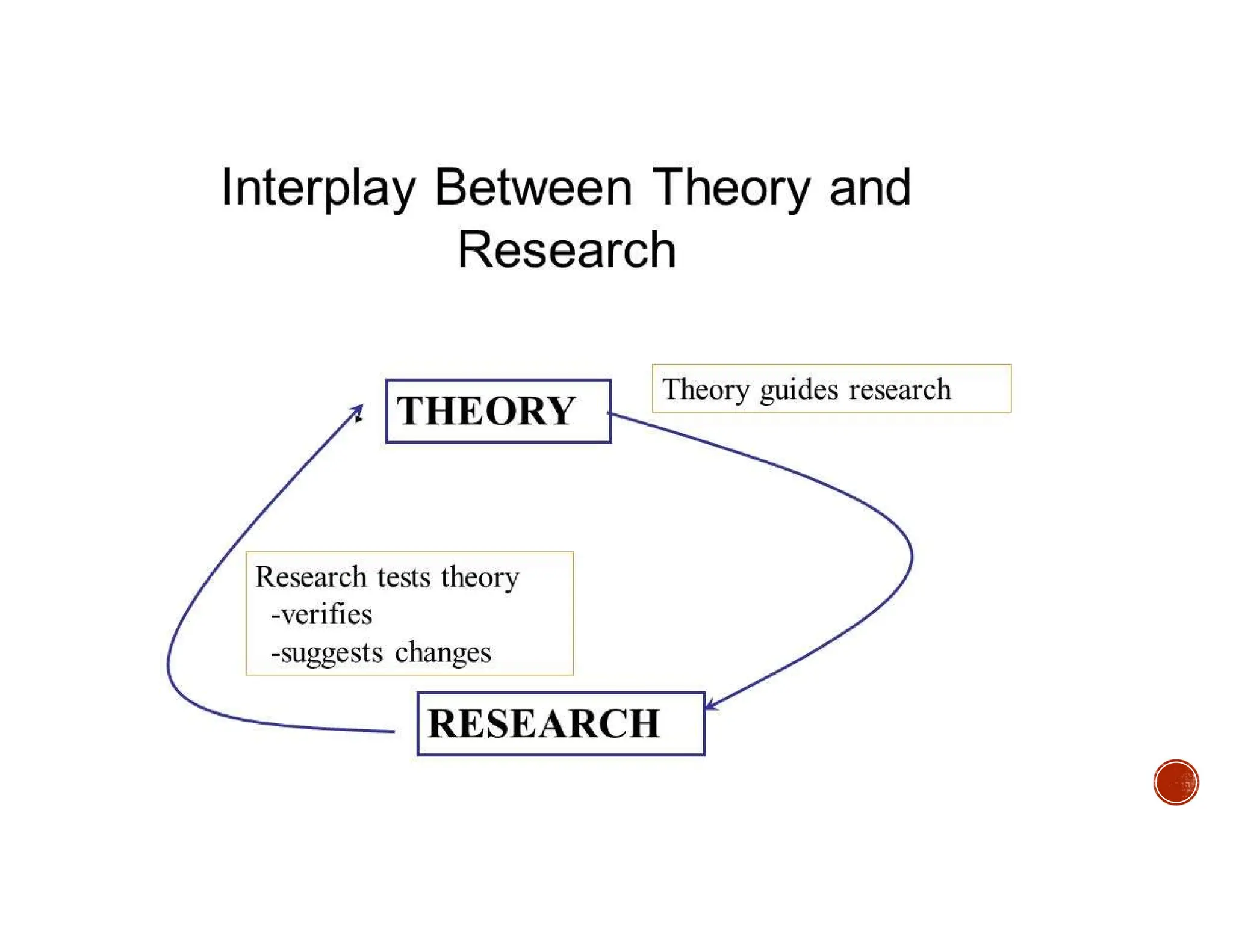
 Verify the application of theories,and lead on to new insights;
 Enlighten both researcher and any interested readers.
 Scientific research can be expressed by concepts such as:
 organized,
 structured,
 methodical,
 systematic,
 testable,
 ‘disciplinary inquiry’.
 The context of social research methods
 The elements of the research process
 The messiness of social research
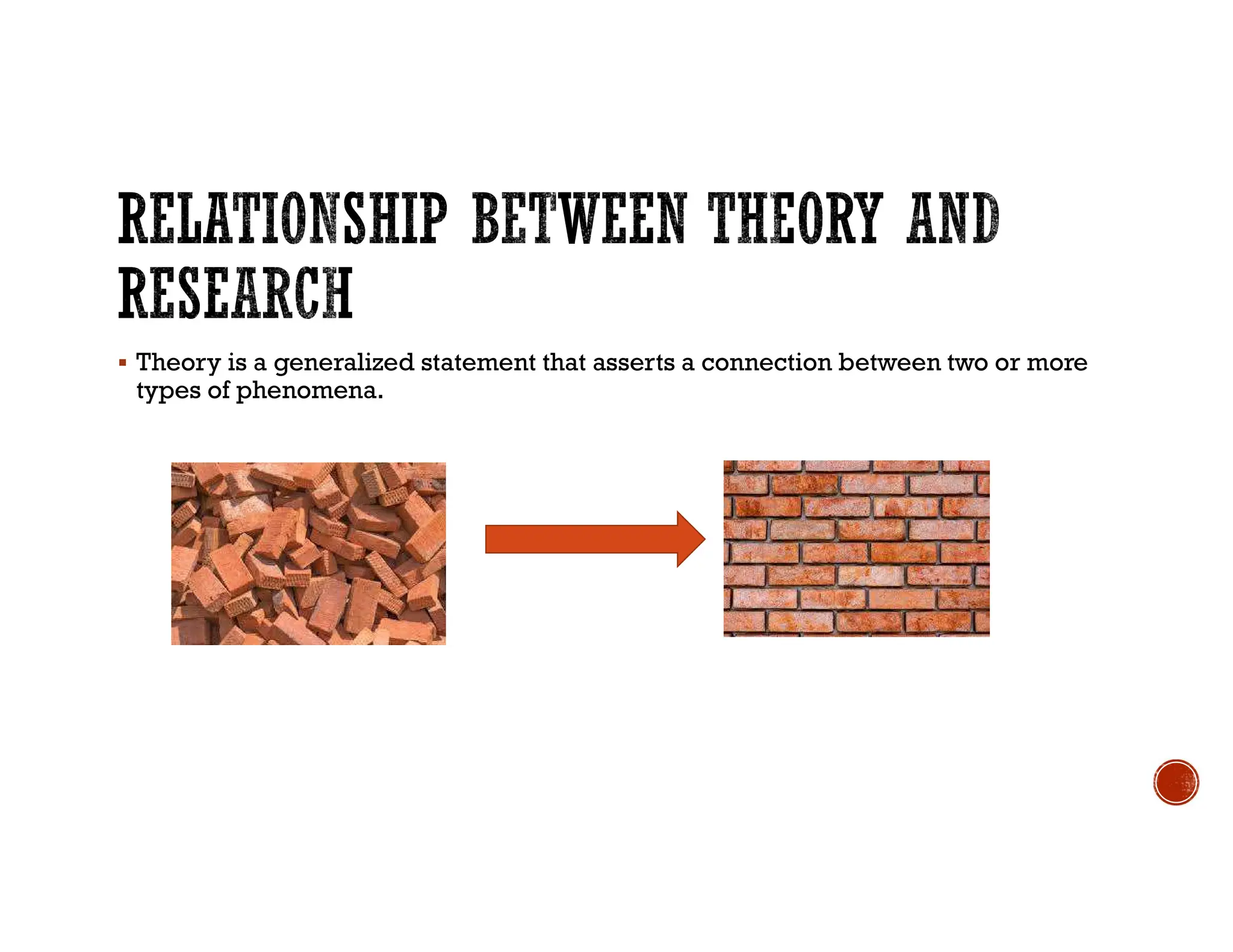
 Theory is a generalized statement that asserts a connection between two or more
types of phenomena.
 Some characteristics of ‘theory’:
 Theory guides research and organizes its ideas.
 ‘Facts’ of different shapes and sizes have no meaning unless they are drawn
together in a theoretical or conceptual framework.
 Theory becomes stronger as more supporting evidence is gathered; and it
provides a context for predictions.
 Theory has the capacity to generate new research.
 Theory is empirically relevant and always tentative.
 Theory is rooted in research paradigm:
 Ontological and Epistemological considerations
 The values of the research community have significant implications for researchers.
 Ethical issues – are prominent, but are often point of discussion
 Special provision with regard to ethics, such as research involving children or
vulnerable adults.
 Social science research should have a practical purpose;
 It should make a difference to the world around us (have implications for practice).
 In social policy - investigations should have demonstrable implications for practice.
 Evaluation research and action research are designed to explore issues that will
have implications for people’s everyday lives.
 Social research is influenced by wider political context;
 Social research might be funded by government bodies, and these tend to reflect
the orientation of the government of the day.
 Certain research issues are somewhat more likely to receive attention/financial
support than others (GBV, women entrepreneurship, SME development,
innovations, etc.…)
 Training and personal values of the researcher influence the research area, the
research questions,and the methods employed to investigate these.
 Our experiences and our interests frequently have some influence on the issues we
research.
 Training and sometimes personal preferences develop attachments to, or at least
preferences for, certain research methods and approaches.
 what is already known about the topic;
 what concepts and theories have been applied to the topic;
 what research methods have been applied to the topic;
 what controversies about the topic and how it is studied exist;
 what clashes of evidence (if any) exist;
 who the key contributors to research on the topic are.
 Literature review is not simply a summary of the literature that has been read, BUT
is expected to be critical
 Concepts are the way that we make sense of the social world.
 They are labels that we give to aspects of the social world that seem to have
common features that strike us as significant
 Concepts are such as bureaucracy,power, social control, status,charisma, labour
process, cultural capital, alienation, etc.
 Concepts are a key ingredient of theories.
 There are deductive and inductive approaches to the relationship between theory
and research
 A research question is a question that provides an explicit statement of what it is
the researcher wants to know about.
 A research purpose can be presented as a statement (for example,‘I want to find
out whether (or why) . . .’), but a question forces the researcher to be more explicit
about what is to be investigated.
 A research question must have a question mark at the end.
 The following types of research question are proposed by Denscombe:
 1. Predicting an outcome (does y happen under circumstances a and b?).
 2. Explaining causes and consequences of a phenomenon (is y affected by x or is y
a consequence of x?).
 3. Evaluating a phenomenon (does y exhibit the benefits that it is claimed to
have?).
 4. Describing a phenomenon (what is y like or what forms does y assume?).
 5. Developing good practice (how can we improve y?).
 6. Empowerment (how can we enhance the lives of those we research?) or
 Comparison (do a and b differ in respect of x?).
 Having no research questions or poorly formulated research questions will lead to
poor research.
 Question need to be specific, focused and feasible.
 Developing research questions is a matter of narrowing down and focusing more
precisely on what it is that you want to know about.
 Research questions are crucial because they will:
 guide your literature search;
 guide your decisions about the kind of research design to employ;
 guide your decisions about what data to collect and from whom;
 guide your analysis of your data;
 guide your writing-up of your data;
 stop you from going off in unnecessary directions;
 provide your readers with a clearer sense of what your research is about.
 ‘Sampling case’ stands for the wide variety of objects on whom or from whom data
will be collected (people, newspaper articles,TV programs, etc.)
 Sampling with surveys - representative samples - a sample that can represent (and
therefore act as a microcosm of) a wider population. Number of sampling cases
might be 2 000 – 5 000, etc.
 In case study research the goal is to understand the selected case or cases in
depth.The case or cases have to be selected according to criteria relevant to the
research (there may be just one or two units of analysis)
 Data collection techniques:
 Structured interview (questionnaire)
 Participant observation,
 Semi-structured interview
 Focus group discussion, etc.
 Primary Data vs Secondary Data
 Coding
 Thematic analysis
 Data reduction
 Introduction. Here the research area and its significance are outlined.The research
questions are also likely to be introduced here.
 Literature review.What is already known about the research area is sketched out
and examined critically.
 Research methods. Here the research methods employed (sampling, methods of
data collection, methods of data analysis) are presented and justified.
 Results.The findings are presented.
 Discussion.The findings are discussed in relation to their implications for the
literature and for the research questions previously introduced.
 Conclusion.The significance of the research is reinforced for the reader.
 Don’t be shy! Share your results!
 Peer-reviewed publications – What does that mean?
 Peer-reviewed (academic or scholarly) journals - Articles are reviewed by several
experts in the field before it is published in the journal in order to ensure the
article’s quality.
 Although we can attempt to formulate general principles for conducting social
research, we have to recognize that things do not always go entirely to plan.
 Please consider what kind of limitations your research project can face before
starting it (unwillingness of the respondents to cooperate, bad weather conditions,
limited access to the area, etc.)
 Present in your paper unexpected issues that you have encountered, which forced
you to change the course of some portions of your research.
ADA University
Research Methods I
 Theory is important to the social researcher because it provides a backcloth and
rationale for the research that is being conducted.
 It also provides a framework within which social phenomena can be understood
and the research findings can be interpreted.
 Question # 1:What type of theory is used in research?
 Question # 2: Is data collected to test or to build theories?
 Grand Theories vs Middle-Range Theories
 Robert Merton Introduced these differences.
 Grand Theory - the form of highly abstract theorizing in which the formal
organization and arrangement of concepts takes priority over understanding the
social reality. Grand theory is more or less separate from concrete concerns of
everyday life and its variety in time and space.
 Macro-level, apply to broad social phenomenon, provide ‘general sociological
orientation’,“they facilitate process of arriving at determinate hypothesis”.
 Examples of Grand Theory:
 Structural functionalism by T. Parsons, one universal scheme to understand the
unity of social structures.
 Social Class theory associated with Marxism
 Social Capital theory by P. Bourdieu
 R. Merton:
 “Middle-range theory is principally used in sociology to guide empirical inquiry.
It is intermediate to general theories of social systems which are too remote from
particular classes of social behavior, organization, and change to account for what
is observed and to those detailed orderly descriptions of particulars that are not
generalized at all”.
 “Middle-range theory involves abstractions, of course, but they are close enough
to observed data to be incorporated in propositions that permit empirical testing”.
 Examples: a theory of reference groups, social mobility, role-conflict, formation of
social norms etc.
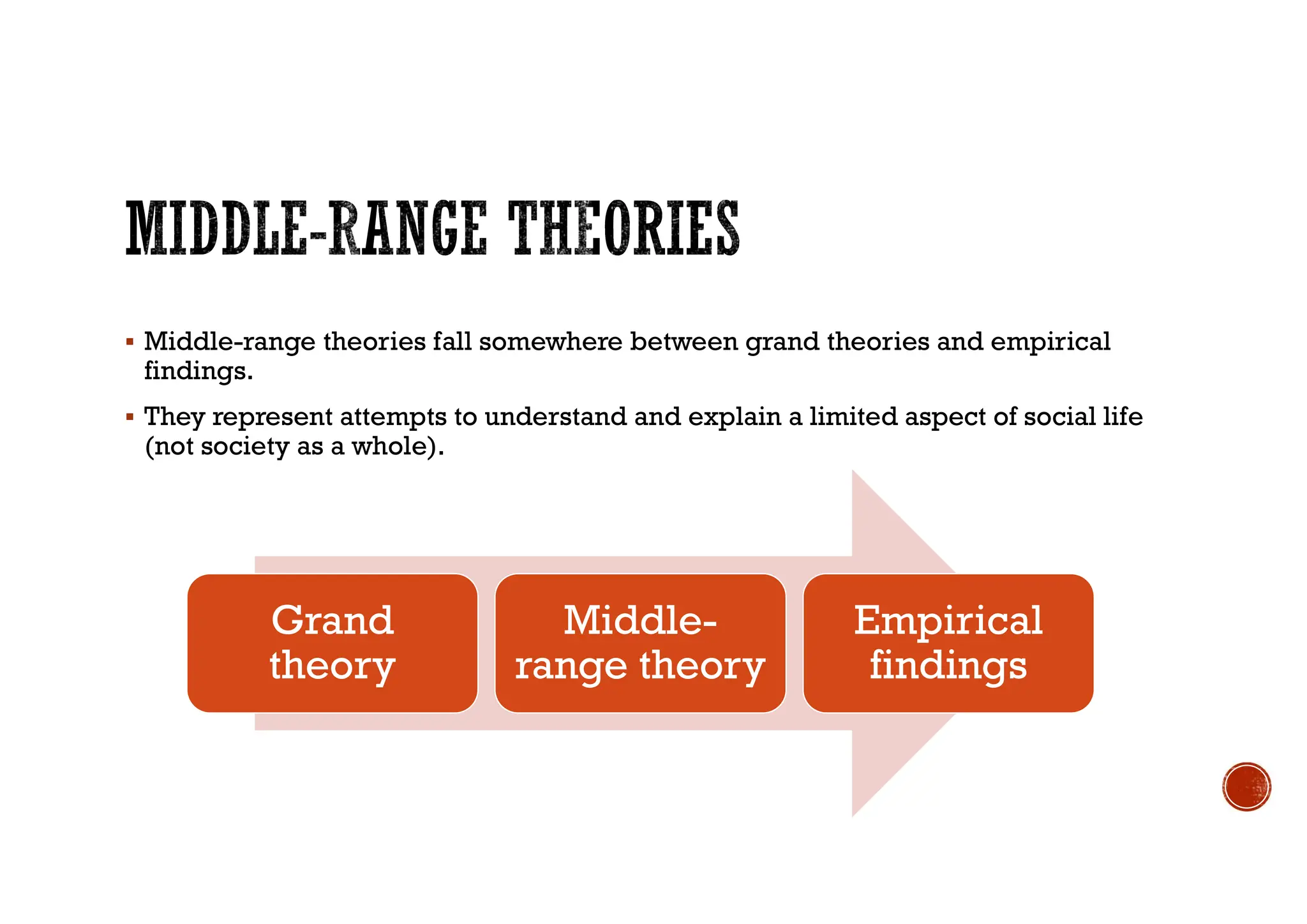
 Middle-range theories fall somewhere between grand theories and empirical
findings.
 They represent attempts to understand and explain a limited aspect of social life
(not society as a whole).
Grand
theory
Middle-
range theory
Empirical
findings
 “Publications-as-theory strategy” (Bryman) - the absence of a clear over-arching
theoretical framework within which to ground all the aspects of a particular study.
 The background literature in a field, rather than specific theories, inform a
researcher’s work.
 Research is not motivated by theoretical considerations, but rather empirical and
methodological knowledge gaps or societal challenges.
 Deductive theory – top-down approach
 On the basis of what is known (theory) researcher
deduces a hypothesis (or hypotheses)
 Hypothesis is translated into measurable terms
 It is tested through the collected data, confirmed
or rejected
 Theory is revised based on the findings
 Process is rather linear—one step follows the
other in a clear, logical sequence
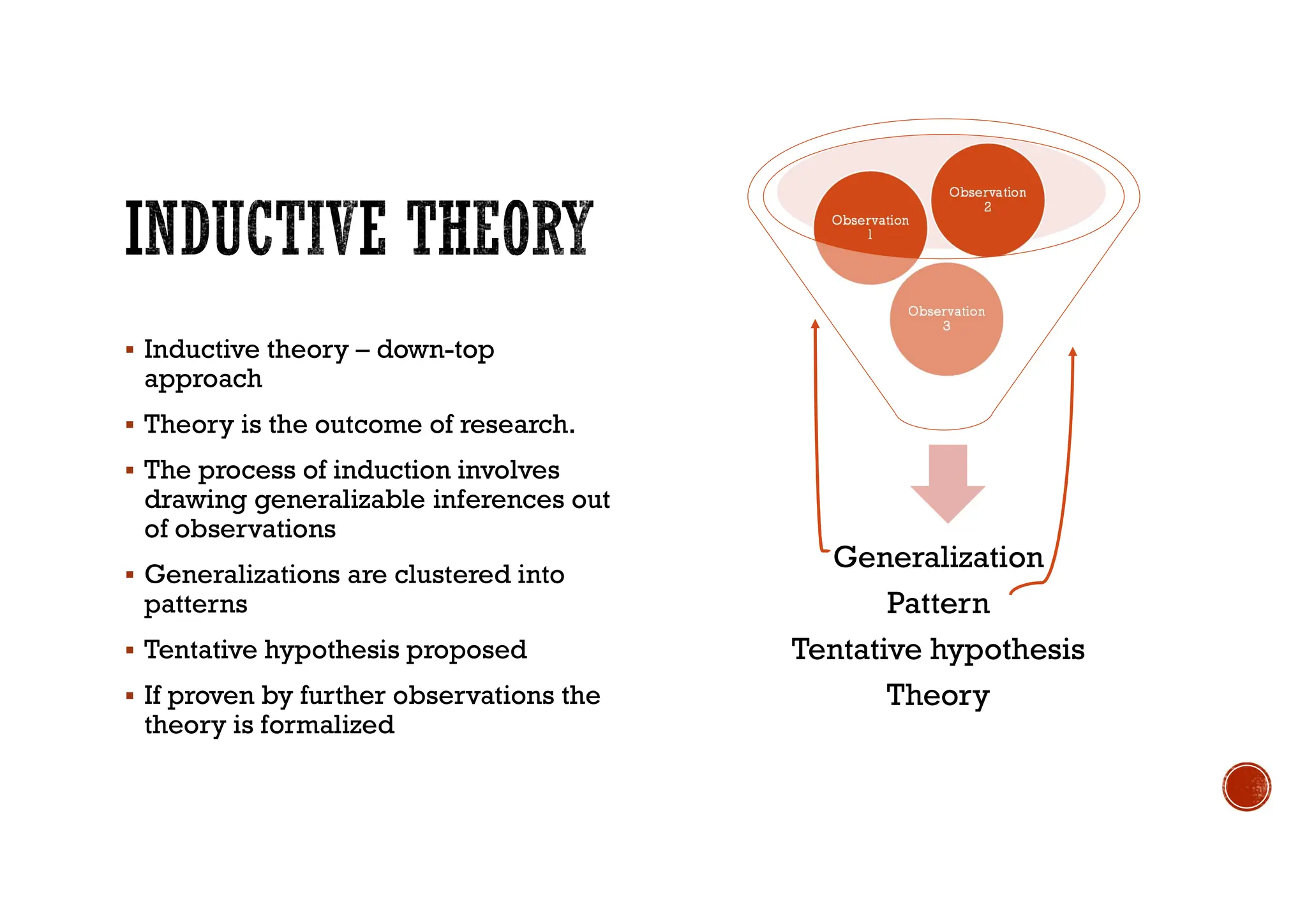
 Inductive theory – down-top
approach
 Theory is the outcome of research.
 The process of induction involves
drawing generalizable inferences out
of observations
 Generalizations are clustered into
patterns
 Tentative hypothesis proposed
 If proven by further observations the
theory is formalized
Generalization
Pattern
Tentative hypothesis
Theory
Observation
3
Observation
1
Observation
2
 Gender Advertisements was published in 1979.
 Observations of the advertisements published in the North
America in 1970th.
 Book shares hundreds of advertisements as illustrations;
 Generalizations are drawn based on provided observations;
 Generalizations are grouped into patterns and ‘named’
(‘Feminine touch’,‘Relative size’,‘Man as an expert’,Woman
as a child’etc.)
 Advertisements do not depict how men and women actually behave (reality);
rather, they serve the social purpose of convincing us that this is how women and
men are, want to be, or should be (“pseudo-reality”)
 The advertisements are depicting the gender expectations and roles that are
associated with masculine and feminine status and behavior.
 Advertisements - clear representation of the socially defined and constructed
nature of gender relations.
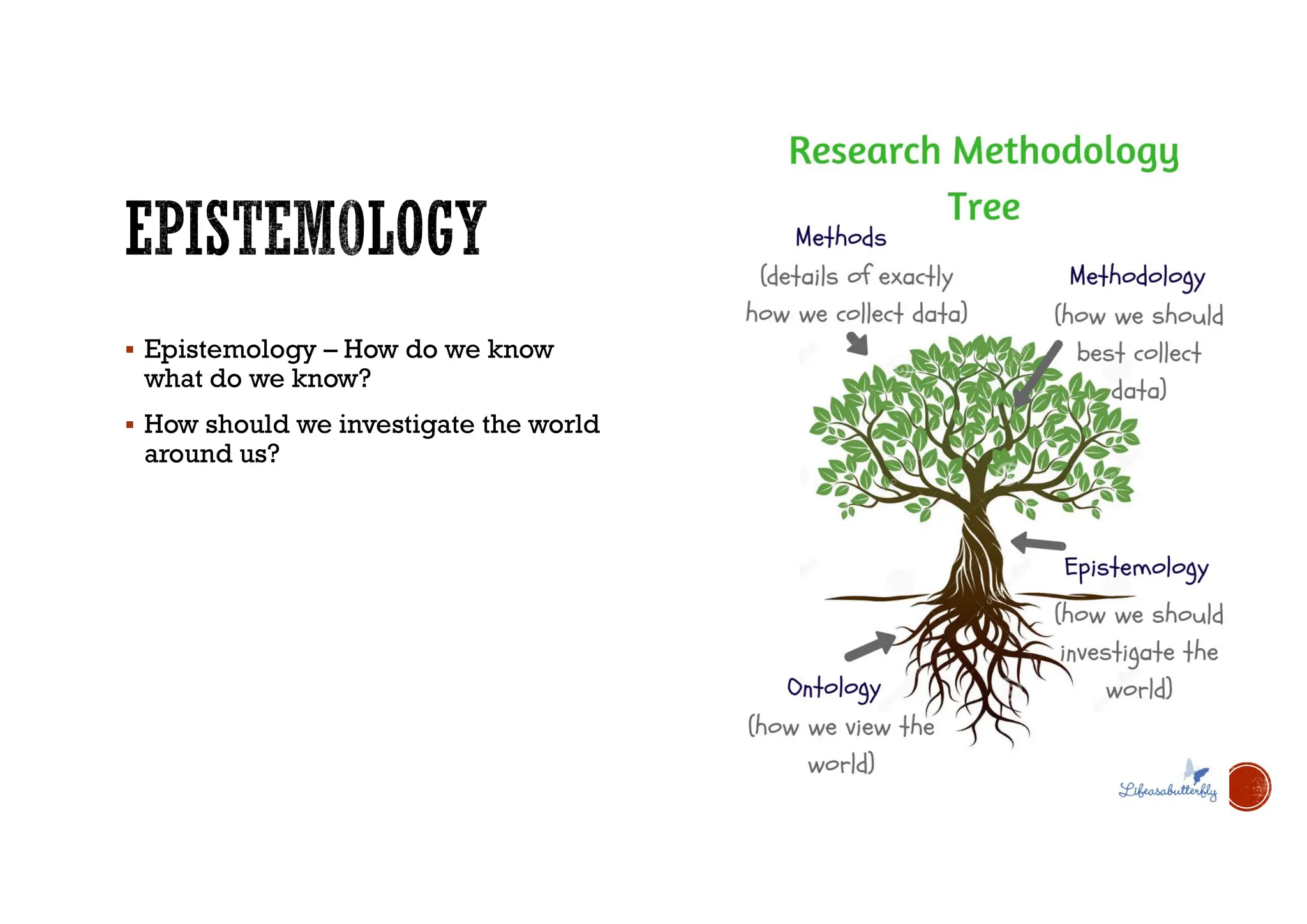
 Epistemology – How do we know
what do we know?
 How should we investigate the world
around us?
 Central issue is the question of whether the social world can and should be studied
according to the same principles, procedures, and ethos as the natural sciences.
 Positivism Vs. Interpretivism
 Positivism - the role of research is to test theories and to provide material for the
development of laws.
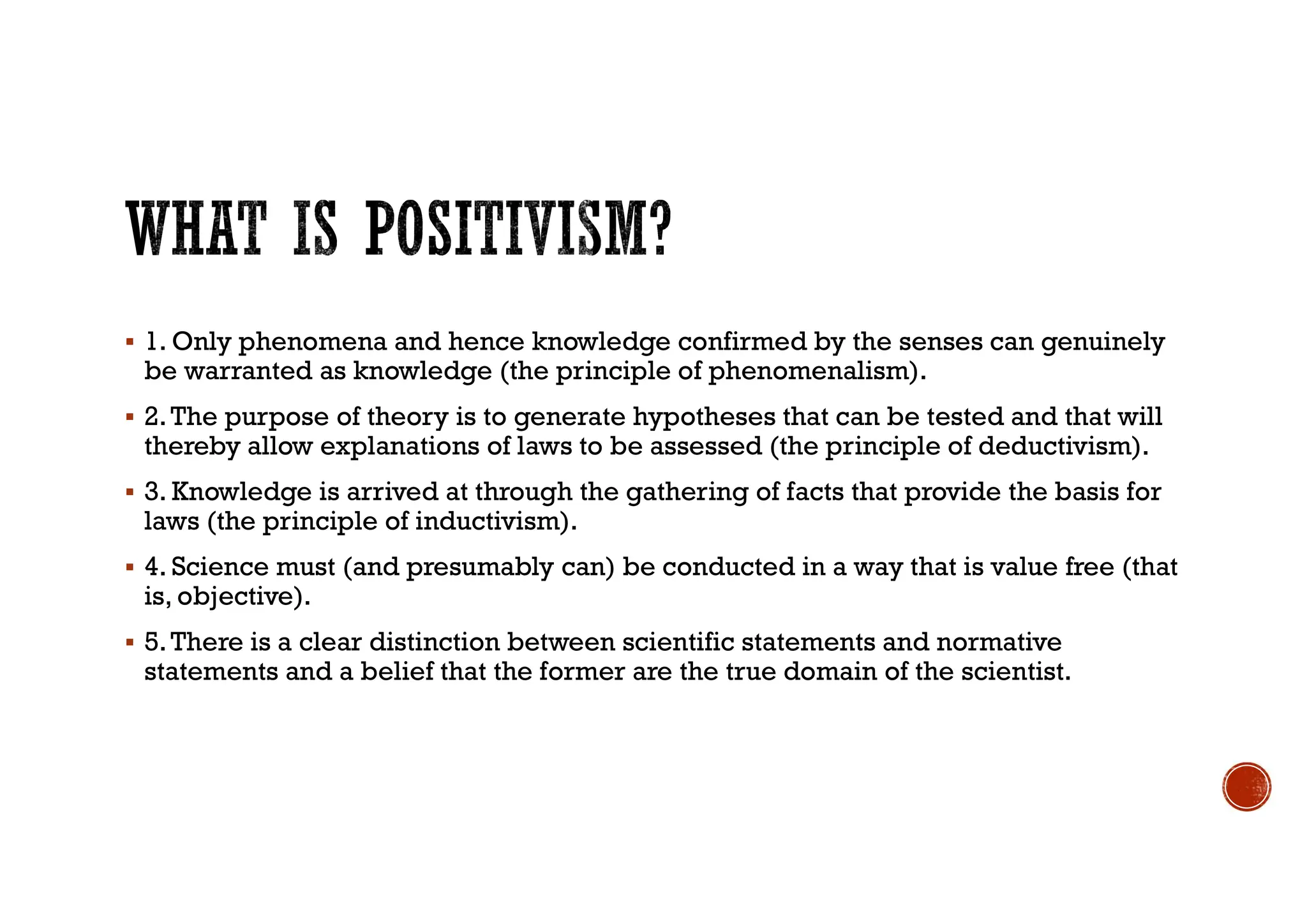
 1. Only phenomena and hence knowledge confirmed by the senses can genuinely
be warranted as knowledge (the principle of phenomenalism).
 2.The purpose of theory is to generate hypotheses that can be tested and that will
thereby allow explanations of laws to be assessed (the principle of deductivism).
 3. Knowledge is arrived at through the gathering of facts that provide the basis for
laws (the principle of inductivism).
 4. Science must (and presumably can) be conducted in a way that is value free (that
is, objective).
 5.There is a clear distinction between scientific statements and normative
statements and a belief that the former are the true domain of the scientist.
 Interpretivism - The subject matter of the social sciences —people and their
institutions—is fundamentally different from that of the natural sciences.
 Thus, epistemological approach to the study of the social world requires a different
logic of research procedure
 Max Weber – Verstehen – interpretive understanding of social action
 Intellectual traditions:
 Hermeneutics - understanding is the interpretive act of integrating particular
things such as words, signs, and events into a meaningful whole.We only really
understand an object, word, or fact when it makes sense within our own life context
and thus speaks to us meaningfully.
 Phenomenology - its aim is to describe an experience as it is actually lived by the
person.The job of the social scientist to gain access to people’s ‘common-sense
thinking’ and hence to interpret their actions and their social world from their point
of view.
 Symbolic interactionists argue that interaction takes place in such a way that the
individual is continually interpreting the symbolic meaning of his or her
environment (which includes the actions of others) and acts on the basis of this
imputed meaning.
 Ontology - is the study or concern about what kinds of things exist - what entities
are there in the universe.
 Ontological consideration - the question of whether social entities can and
should be considered objective entities that have a reality external to social actors,
or whether they can and should be considered social constructions built up from
the perceptions and actions of social actors.
 Objectivism vs Constructivism
 Objectivism is an ontological position that asserts that social phenomena and their
meanings have an existence that is independent of social actors.
 It implies that social phenomena and the categories that we use in everyday
discourse have an existence that is independent or separate from actors.
 Constructivism asserts that social phenomena and categories are not only
produced through social interaction but that they are in a constant state of revision.
 Another related reading:The researcher always presents a specific version of
social reality, rather than one that can be regarded as definitive.
 Working definition: Constructionism is presented as an ontological position in
relating to social objects and categories—that is, one that views them as socially
constructed.
 Research strategy - a general orientation to the conduct of social research.
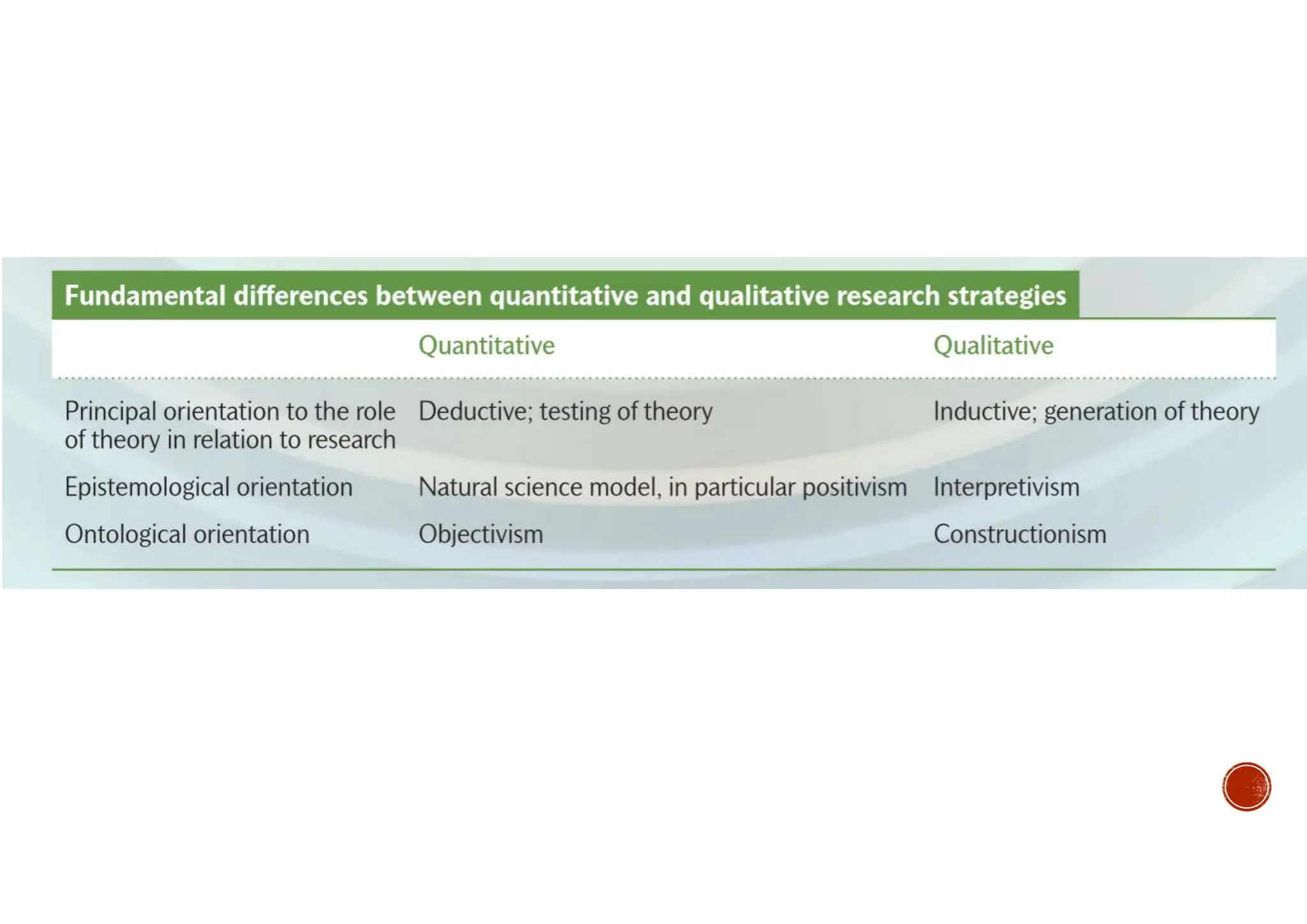
 Quantitative vs qualitative research
• entails a deductive approach to the relationship between theory and research, in
which the accent is placed on the testing of theories;
• has incorporated the practices and norms of the natural scientific model and of
positivism in particular;
• embodies a view of social reality as an external, objective reality.
• predominantly emphasizes an inductive approach to the relationship between
theory and research, in which the emphasis is placed on the generation of theories;
• has rejected the practices and norms of the natural scientific model and of
positivism in particular in preference for an emphasis on the ways in which
individuals interpret their social world;
• embodies a view of social reality as a constantly shifting emergent property of
individuals’ creation.
 Mixed methods research - research that combines methods associated with both
quantitative and qualitative research.
 The quantitative and qualitative research should not be seen as contrasted and
incompatible.
 They can be fruitfully combined within a single project.
 Example: Lale Yalchin Heckmann’s study of Land Privatization in Tezekend
(Shamkir), (Book:The Return of Private Property : Rural Life After Agrarian Reforms
in the Republic of Azerbaijan, 2011)
 Values - it is not feasible to keep the values that a researcher holds totally in check.
 Mies (1993: 68) has argued that ‘postulate of value free research, of neutrality and
indifference towards the research objects, has to be replaced by conscious
partiality, which is achieved through partial identification with the research
objects’.
 Researchers nowadays is encouraged to recognize and acknowledge that research
cannot be value free and to be self-reflective.
 Practical considerations – nature of topic; prior research; target group.
ADA University
Research Methods I
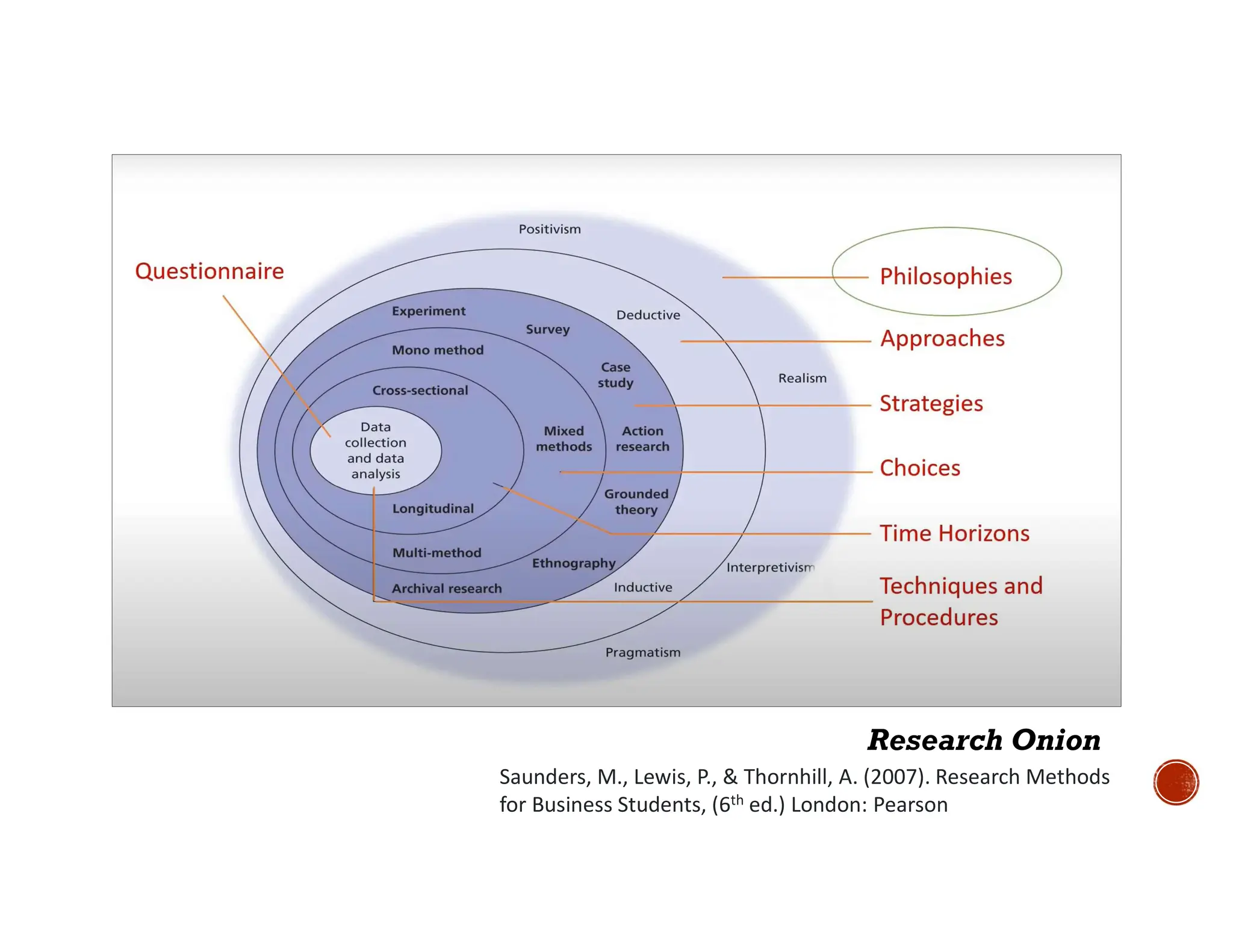
Research Onion
Saunders, M., Lewis, P., & Thornhill, A. (2007). Research Methods
for Business Students, (6th ed.) London: Pearson
 By the end of the course you (in your groups) are expected to finalize and present
projects with a component of empirical research
 What means your project should be based on data, which you will collect (primary,
new data)
 You can conduct a secondary analysis of existing data, if that will strengthen your
point.
 Follow the requirements,instructions,and information you are given in Syllabus!
How to identify topic or interesting a researchable area?
 Look around! Choose a topic that you are interested in! The research process is
more relevant, if you care about your topic.
 Narrow your topic to something manageable.
 Background reading can help you choose and limit the scope of your topic.
 Review the guidelines on topic selection outlined in your assignment.
 Brainstorm in your groups.
 Remember the project needs to be manageable given limited resources (time and
space).
 First deadline: October 6th – submission of your research proposals!
 Other deadlines:
 Submission of the questionnaire (mid-November)
 Presentation of the Research Findings (end of December)
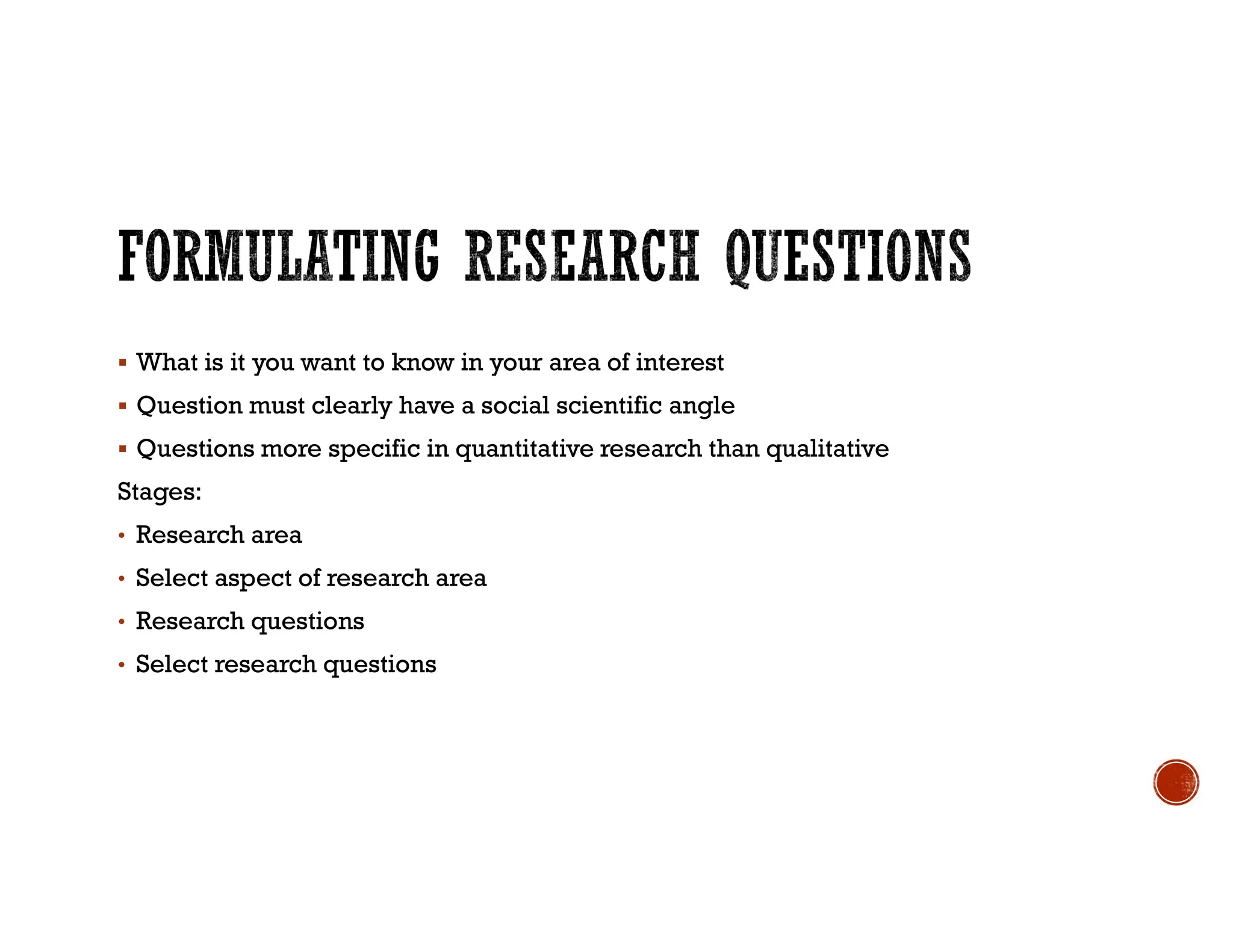
 What is it you want to know in your area of interest
 Question must clearly have a social scientific angle
 Questions more specific in quantitative research than qualitative
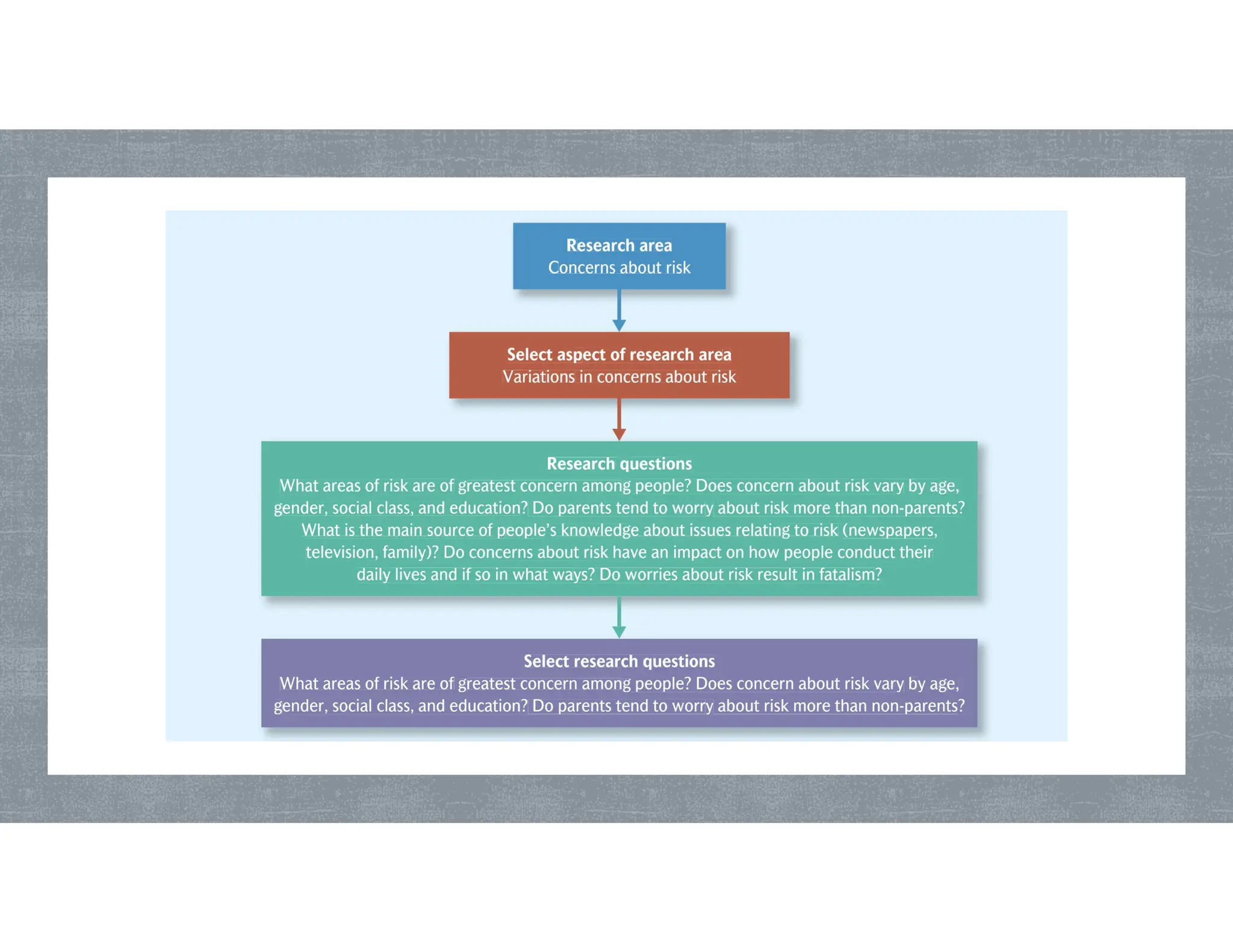
Stages:
• Research area
• Select aspect of research area
• Research questions
• Select research questions
Intellectual
puzzles and
contradictions
Existing literature Replication
Structures and
functions
Opposition
A social problem
Gaps between
official reality and
facts at ground
level
The counter-
intuitive (anti
common sense)
Deviant cases and
atypical events
New methods and
theories
New social and
technical
developments
and social trends
Personal
experience
Sponsors and
teachers
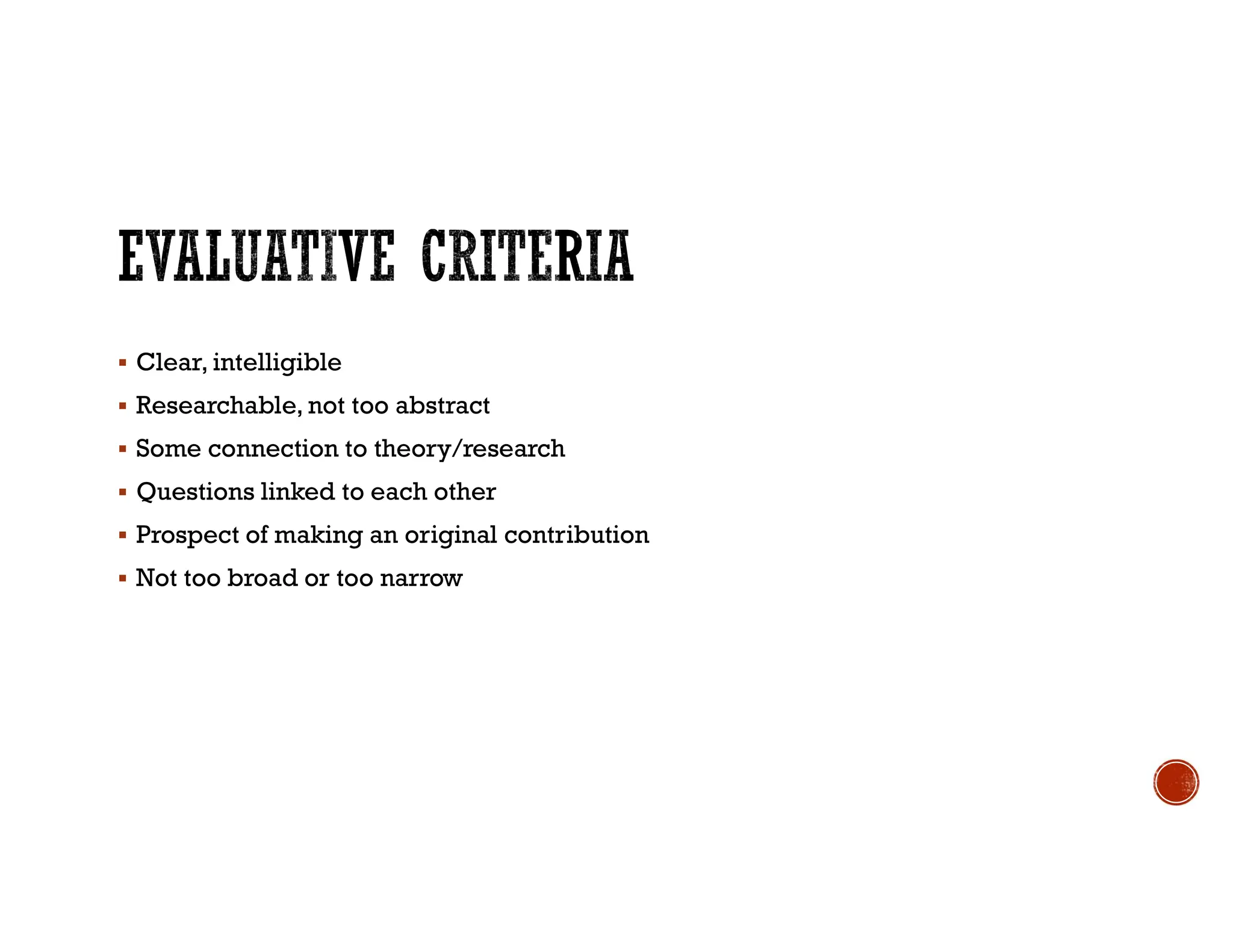
 Clear, intelligible
 Researchable, not too abstract
 Some connection to theory/research
 Questions linked to each other
 Prospect of making an original contribution
 Not too broad or too narrow
 Topics are broad but research questions definitive and narrow.
 O’Leary suggests finding an ‘angle’ on the topic.
 What commentators/friends/instructors are saying about it?
 What ‘hot issues’ are generating argument and debate?
 A gap in the literature?
 A researcher has recommended further themes worthy of research at the end of an
article.
Question A: What is the 2014 rate of juvenile delinquency in Azerbaijan?
Question B:What can we do to reduce juvenile delinquency in Azerbaijan?
Question C: Does education play a role in reducing juvenile delinquents' return to
crime?
 Question A:What marketing strategies does the Coca-Cola company currently
apply?
 Question B:What is the Coca-Cola company's future marketing plan?
 Question C:What marketing strategies has the Coca-Cola company used in the
past?
 Question A:Which eating disorders are most widely spread in Eastern Europe?
 Question B:What is the relationship between women's fashion magazines and
dieting?
 Question C:What are the causes of anorexia?
 Question A: Do children sent to day care or kindergarten start school with more
developed skills?
 Question B: Do children sent to day care or kindergarten start school with more
highly-developed language skills?
 Question C: Do children sent to day care or kindergarten start school with larger
vocabularies?
 Question A:Who makes better burger: MacDonald's or Burger King?
 Question B:What are the eating habits and preferences among the student
population of the ADA University?
 Question C: Do ADA students follow healthy eating habits?
 What is your research topic? Why it is important?
 What is your research question or what are your research questions?
 What does the literature have to say about your research topic and question(s)?
 How are you planning to collect data relevant to your research question?
 What resources will you need to conduct your research (for example, printing,
travel, software)?
 What problems do you anticipate in doing the research (for example, access to
organizations, respondents)?
 What are the possible ethical problems associated with your research?
 Physical risks
 Emotional risks
ADA University
Research Methods I
 What is already known about this area?
 What concepts and theories are relevant to this area?
 What research methods and research strategies have been employed in studying
this area?
 Are there any significant controversies?
 Are there any inconsistencies in findings relating to this area?
 Take good notes
 Develop critical reading skills
 Active (critical/analytical) vs passive (descriptive) review:
 Active:
- although a lot of research has been done on X (a general topic or area), little or no
research has been done on X1
- there are two competing positions with regard to X1 (in what way are they different,
which one you would prefer using and why)
 Passive: summaries of the artciles
 Think about the research question.
 Locate books, articles and documents with relevant information regarding your topic.
 Write the bibliographic citation for the source using MLA or APA style.
 Write a concise annotation that includes the following:
 summarize the main argument
 Evaluate the background of the author
 Critique with 2-3 sentences and compare or contrast the work with others.
 Waite, Linda J., Frances Kobrin Goldscheider, and Christina Witsberger. "Nonfamily
Living and the Erosion of Traditional Family Orientations AmongYoung Adults."
American Sociological Review 51 (1986): 541-554.
 The authors,researchers at the Rand Corporation and Brown University, use data
from the National Longitudinal Surveys ofYoung Women and Young Men to test
their hypothesis that nonfamily living by young adults alters their attitudes,values,
plans, and expectations, moving them away from their belief in traditional sex
roles.They find their hypothesis strongly supported in young females, while the
effects were fewer in studies of young males. Increasing the time away from parents
before marrying increased individualism, self-sufficiency, and changes in attitudes
about families. In contrast,an earlier study by Williams cited below shows no
significant gender differences in sex role attitudes as a result of nonfamily living.
 A literature review discusses published works (e.g., books, articles) in a particular
subject area.
How to write literature review?
 Narrow the central topic
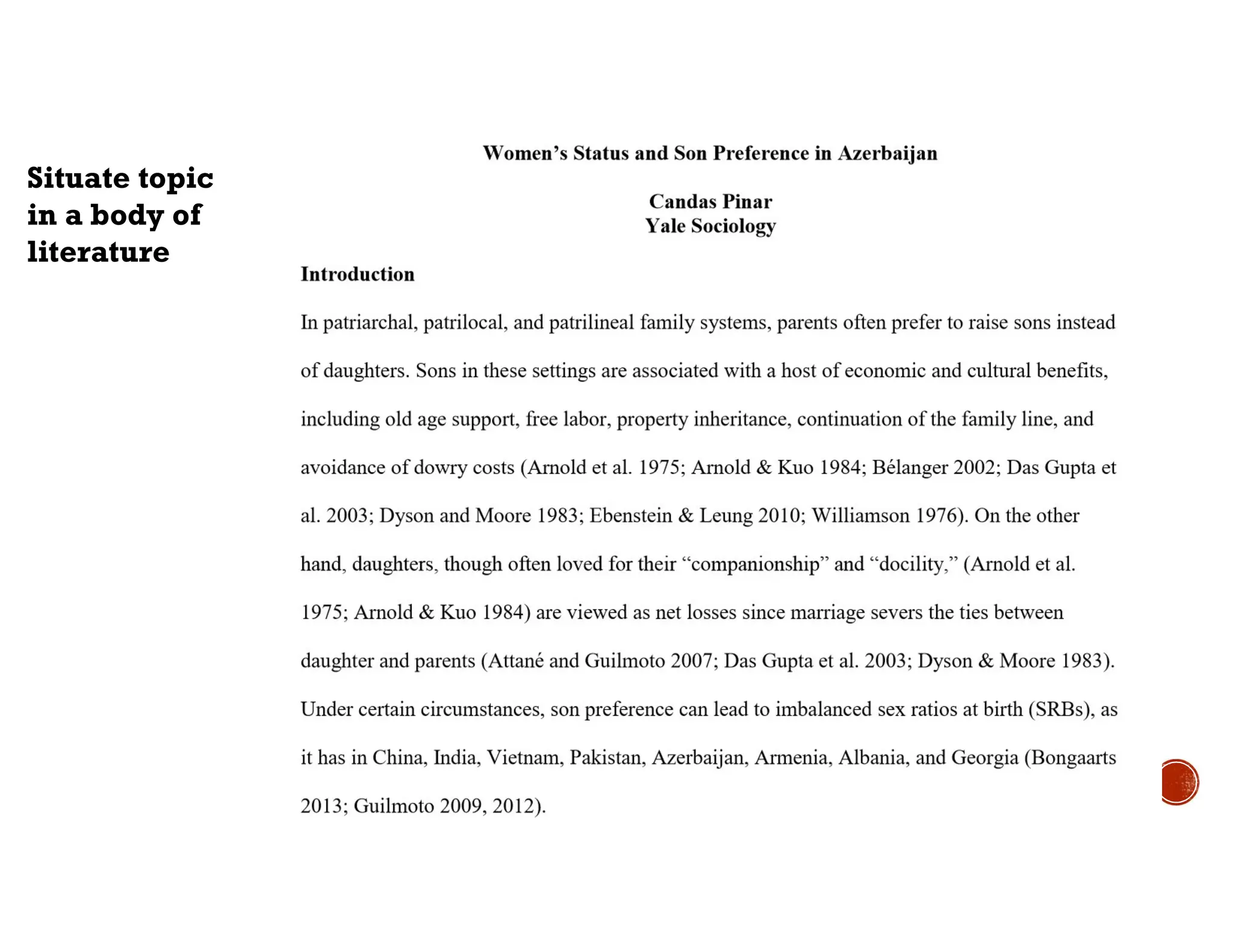
 Situate topic in a body of literature
 Identify main debates
 Critique and synthesize
 Use relevant sources and be sure to stop!
Situate topic
in a body of
literature
Situate topic
in a body of
literature
Debates,
contested
views
Critique and
synthesize
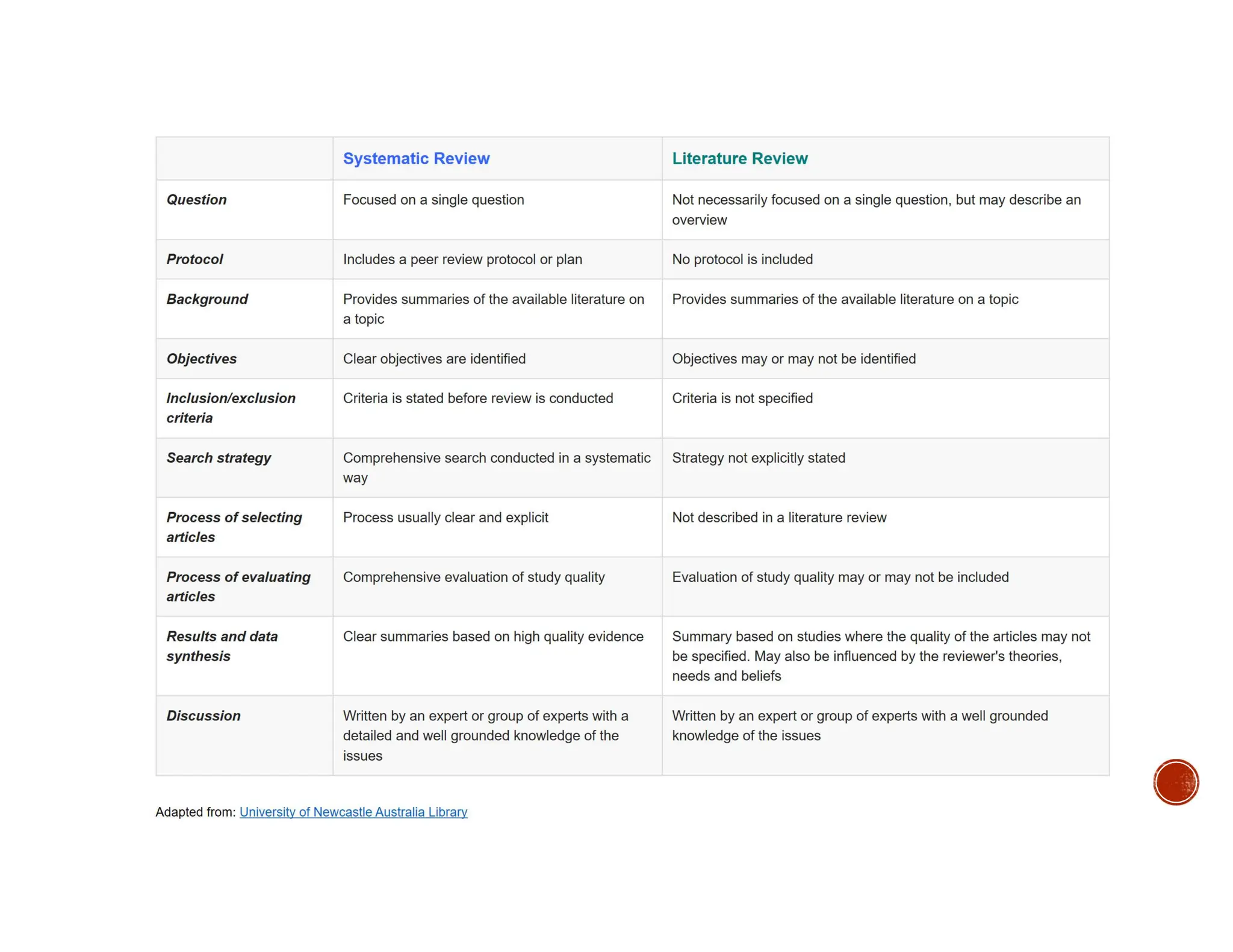
 A systematic review is a review of a clearly formulated question that uses
systematic and reproducible methods to identify, select and critically appraise all
relevant research, and to collect and analyse data from the studies that are included
in the review.
 A systematic review can be either quantitative or qualitative.
 A quantitative systematic review will include studies that have numerical data.
 A qualitative systematic review derives data from observation, interviews, or
verbal interactions and focuses on the meanings and interpretations of the
participants. It will include focus groups, interviews, observations and diaries
 A systematic review:
 Answers a focused research question
 Employs a comprehensive, reproducible search strategy
 Identifies ALL relevant studies (both published and
unpublished)
 Assesses all results for inclusion/exclusion, and for quality
 Presents an unbiased, balanced summary of findings
 Involves a team of researchers looking at a complex research question
 Can take months, or even years, to complete.
 Meta-analysis involves summarizing the results of a large number of quantitative
studies
 The aim of this approach is to establish whether or not a particular variable has a
certain effect by comparing the results of different studies.
 Literature Review ---------- Analyses of the secondary data produced by other
researchers
 Narrative reviews tend to be less focused and more wide-ranging in scope than
systematic reviews.
 They are less explicit about the criteria for exclusion or inclusion of studies.
 Narrative reviews are expected in all social science publications (books, chapters,
articles, thesis) and include review of the literature relevant to the researcher’s area
of interest.
ADA University
Research Methods I
 Research methods - are the strategies,processes or techniques utilized in the
collection of data or evidence for analysis
 Research design – structure (a plan) that guides the execution of a research
method(s) and the analysis of the subsequent data.
 Research design for pre-election poll:
 Research methods: face-to-face surveys,internet surveys, in-depth interviews with
experts, etc.
 Reliability:
 If a research tool is consistent and stable hence predictable and accurate.
 The greater the degree of consistency and stability in a research instrument, the
greater the reliability.
 Reliability is the degree of accuracy or precision in the measurements made by a
research instrument.
 Often relates to whether formulated measures of concepts (eg. poverty, racial
prejudice, religious orthodoxy) are consistent (eg., the wording of questions);
 In focus particularly in quantitative research – stability of the measure.
 “Do you consider yourself a religious person?”
 “Have you ever faced domestic violence?”
 IQ level
 Replication
 Requires detailed recording of procedures on the part of the researcher
 Relating back to measuring the reliability of a measure of a concept,the
procedures which embody the method must be replicable (scales and
measurements replicated)
 Replication in qualitative studies quite rare
 Replicability is valued in social research with a quantitative focus
 Validity is concerned with the integrity of the conclusions that are generated
from a piece of research.
 Might be considered as the most important criteria
 Concerned with the integrity of conclusions drawn
 Main types are:
 Measurement validity or construct validity.Does the measurement reflect the
concept effectively? Related to reliability – if the measure is not stable it is
unreliable and hence not a valid measure of the concept.Assessment of
measurement validity assumes that the measure is reliable.
 Internal validity mainly relates to causality. Does a conclusion involving a causal
relationship between variables hold up? The factor that has the causal impact is
identified as the independent variable and the effects are the dependent
variable.Does the independent variable actually cause the variation identified in
the dependent variable?
 For ex.:“Do teaching styles influences students’GPAs?”;“Do people who get
higher salaries work harder compared to others or they get higher salaries
because they are inherently hard workers?”
 A variable is simply an attribute on which cases (individuals, households, schools,
cities, etc.) vary.
 It is common to distinguish between different types of variable.
 The most basic distinction is between independent variables and dependent
variables.The former are deemed to have a causal influence on the latter.
 An important issue in the context of quantitative data analysis - measurement
properties of the variables (will be covered later)
 External validity examines whether study results can be generalised beyond the
particular research context
 For instance, do the findings apply to other people, settings, situations, and time
periods?
 Ex: Nation-wide Survey – how can finding be generalized to a whole country?
 Ex: Restful sleep App usage – measuring impact of two groups of people – users
and not-users. Strict protocol to follow.The results prove if the app is or is not
effective and for which groups.
 Ecological validity examines if findings apply to everyday and natural social
context.With intervention in settings or creation of artificial settings, ecological
validity can be lost
 Ethnographic research vs Structured Surveys
 Are criteria mainly applicable to quantitative research or qualitative research?
 Reliability, External and Internal validity – mostly quantitative research
 Ecological validity – both
 BUT!
 Different views on applicability to qualitative study
 Trustworthiness proposed as a key criteria
 Aspects of trustworthiness parallel with quantitative research criteria:
 Credibility = internal validity
 Transferability = external validity
 Dependability = reliability
 Confirmability = objectivity
 and Relevance (contribution to the field/literature)
 experimental design;
 cross-sectional or survey design;
 longitudinal design;
 case study design;
 comparative design
 Random assignment of subjects to experimental and control groups,
 Pre-testing of both groups,
 Independent variable manipulated; all other variables held constant,
 Post-testing of both groups,
 Computation and analysis of group differences
 Randomized experiment or randomized controlled trial (RCT)
 Two groups are established
 Experimental manipulation with the independent variable (teacher expectations)
 Two groups: experimental group and control group
 The experimental group receives the experimental treatment
 The dependent variable (student performance) is measured before and after the
experimental manipulation
 Random assignment to the experimental and control groups
 Key: Obs = observation
 Exp = experimental treatment (manipulation of the independent variable)
 T = timing
Do special equipment and
exercises enhance students’
health and abilities?
 Measurement validity (IQ test)
 Did the experimental manipulation worked?
 Are the findings ecologically valid? (field experiment vs laboratory experiment)
 Ethical concerns (deception)
 Replicability
 Other (non-experimental) events may have caused the changes observed
(‘history’)
 Subjects may become sensitized to ‘testing’
 People change over time in any event (‘maturation’)
 Non-random ‘selection’ could explain differences ‘
 Ambiguity about the direction of causal influence’ because sometimes the
temporal sequence is unclear
 Based on Campbell (1957) and Cook and Campbell (1979)
 Interaction of selection and treatment.This threat raises the question: to what social
and psychological groups can a finding be generalized? Can it be generalized to a
wide variety of individuals who might be differentiated by ethnicity, social class,
region, gender, and type of personality?
 Interaction of setting and treatment.This threat relates to the issue of how confident
we can be that the results of a study can be applied to other settings.
 Interaction of history and treatment.This threat raises the question of whether the
findings can be generalized to the past and to the future.
 Interaction effects of pre-testing. As a result of being pre-tested, subjects in an
experiment may become sensitized to the experimental treatment.
 Reactive effects of experimental arrangements.People’s awareness may influence
how they respond to the experiment
 Advantages:
 High level of control;
 Easier to assign subjects randomly to different experimental conditions;
 High internal validity of the study;
 Easy to replicate.
 Limitations:
 External validity (extension to real life);
 Ecological validity of the study is poor.
 Variation of experimental designs with low internal validity requirements.
 Occur in ‘natural settings’; random assignment or control groups are not possible
 Conducted in field settings in which random assignment is difficult or impossible.
 Evaluate the effectiveness of a treatment (psychotherapy or an educational
intervention).
 Evaluation research - evaluation of social and organizational programmes or
interventions.
 The essential question: Has a new policy initiative achieved its anticipated goals?
 One group that is exposed to the treatment,a control group that is not – but
assignment is not random.
 But sometimes evaluation focuses on one group and can be based on quantitative
or qualitative data, or both
 “A cross-sectional design entails the collection of data on more than one case
(usually quite a lot more than one) and at a single point in time in order to collect
a body of quantitative or quantifiable data in connection with two or more
variables (usually many more than two), which are then examined to detect
patterns of association.”
 “Survey research comprises a cross-sectional design in relation to which data are
collected predominantly by questionnaire or by structured interview on more
than one case (usually quite a lot more than one) and at a single point in time in
order to collect a body of quantitative or quantifiable data in connection with two
or more variables (usually many more than two), which are then examined to
detect patterns of association.”
 Also includes:
 structured observation,
 content analysis,
 official statistics,
 diaries.
 Evaluating cross-sectional research
 Reliability and Measurement Validity are not connected to the design, as such,but
concepts used by researcher;
 Replicability will be high as long as the researcher specifies all the procedures;
 Internal Validity is weak, because co-relations are much more likely to be found
than causality;
 External Validity will be strong if the sample is truly random;
 Ecological Validity may be compromised by the instruments used.
 Survey of the same sample on more than one occasion
 Typically used to map change in social research
 In a panel study (e.g. BHPS – British Household Panel Survey – annual survey since
1991)
 Or a cohort study (e.g. NCDS – National Child Development Study – sample of
children born in 1958)
 Regular Surveys (Caucasus Barometer) are not truly longitudinal, different people
are being interviewed. ???
 A repeated cross-sectional design or trend design
 Basic issues similar to cross-sectional research designs.
 Special problems:
 Attrition,because people die, or move home, or withdraw from the study.
 Knowing when is the right time for the next wave of data collection.
 The first round may have been badly thought out, which leaves the later rounds in a
bit of a mess.
 A panel conditioning effect – people may start to act in accordance with the
expectations of the research
 Case study design detailed and intensive analysis of one case:
 e.g. a single community,
 school,
 family,
 person,
 event,
 organization
 etc.
 Focus: location; setting
 Often qualitative: participant observation and unstructured interviewing
 But quantitative data might also be useful
 Types of cases identified byYin (2009):
 critical,
 unique,
 exemplifying,
 revelatory,
 longitudinal
 The biggest issue concerns external validity, because it is impossible to generalize
the findings.
 Many case-writers argue that the point of the research is to examine particulars
rather than attempt to generalize.
 Cases may be extended longitudinally or through a comparative design.
 Using the same methods to compare two or more meaningfully contrasting cases
 Can be qualitative or quantitative
 Often cross-cultural comparisons –Gallie’s (1978) study of the impact of automation
on industrial workers in England and France
 Problem of translating research instruments and findings into comparable samples
 Includes multiple case studies
 Identical to those of cross-sectional design, because the comparative design is
essentially two or more cross-sectional studies carried out at the same point in
time.
 Comparing two or more cases can show circumstances in which a particular theory
will or will not hold.
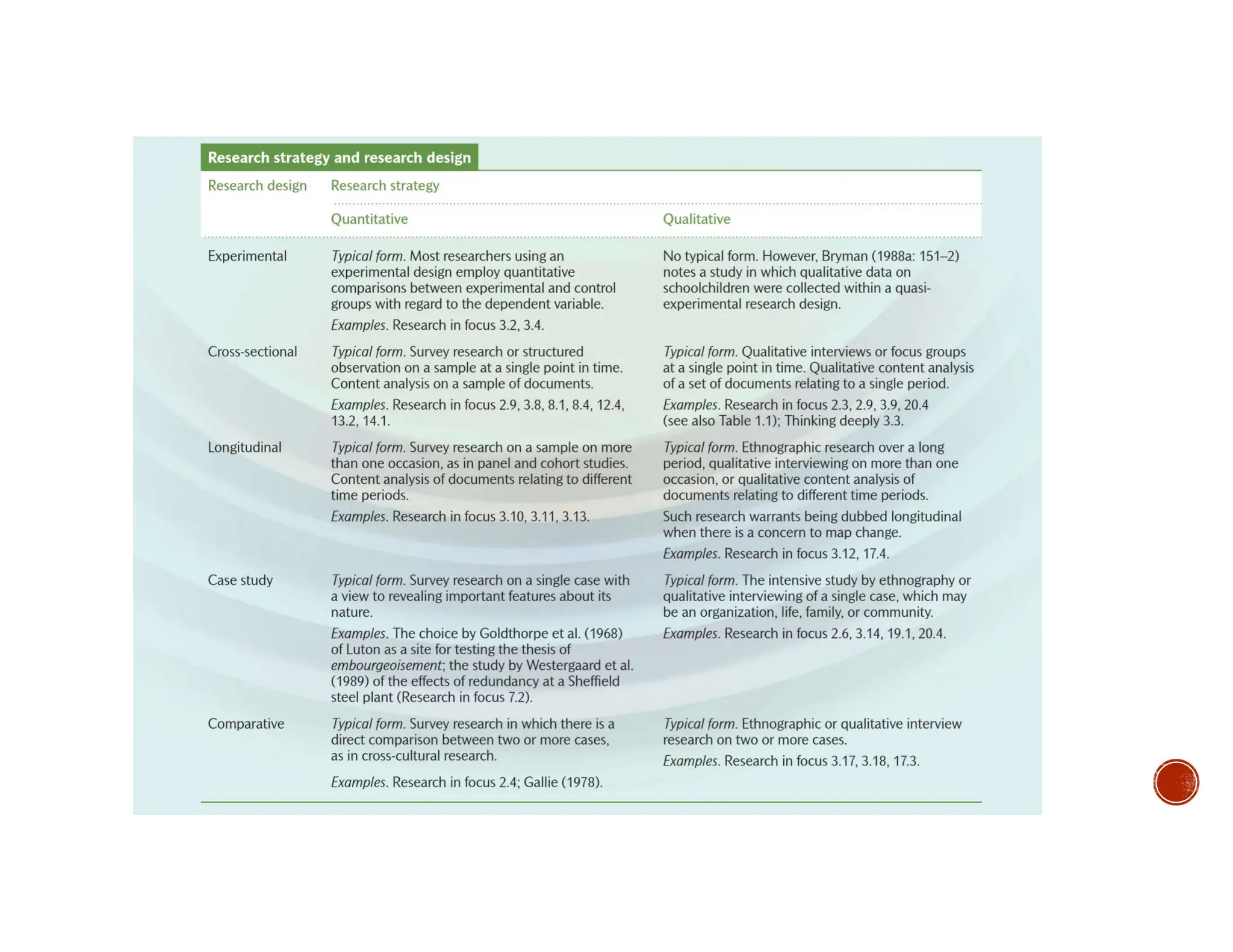
 Bringing research strategy and research design together
 Both quantitative and qualitative strategies can be executed through any of the
research designs covered in this chapter – although experimentation is rarely used
in qualitative research.
 Survey research is the most typical form for quantitative strategies
 Ethnographic studies are most typical of qualitative strategies.
ADA University
Research Methods I
 How should we treat the people on whom we conduct research?
 Are there activities in which we should or should not engage in our relations with
them?
 Ethical issues are nowadays more central to discussions about research than ever
before.
 Greater concern among representatives of universities, research funding bodies,
and professional associations to exhibit good ethical credentials.
 Greater significance of ethical guidelines and research ethics committees
nowadays
Institutional Review Boards
 Law to protect subjects/respondents
 Review research proposals involving humans so they can guarantee the rights and
interests are protected
Professional Codes of Ethics
– Most professional associations have formal codes of conduct that describe
acceptable and unacceptable professional behavior.
 Tea Room Trade by Humphreys described research into the lives of “part-time”
homosexuals
– Lied to participants by telling them he was a voyeur-participant.
– Traced participants to their home and interviewed them under false pretenses.
Was Humphreys ethical in doing what he did?
Are there parts of the research that you believe were acceptable and other parts that
were not?
 Voluntary participation (intrusion into people’s lives)
 No harm to participants (emotional stress, embarrassment,danger of being
identified)
 Informed Consent
 Anonymity and confidentiality (can’t be identified vs only researchers know
identify)
1.Whether there is harm to participants;
2.Whether there is a lack of informed consent;
3.Whether there is an invasion of privacy;
4.Whether deception is involved
 The issue of confidentiality
Quantitative vs Qualitative research
 Data protection
 Holmes (2004) on protection of confidentiality and participants’data:
• not storing participants’names and addresses or letter correspondence on hard drives;
 using identifier codes on data files and storing the list of participants and their
identifier codes separately in a locked cabinet;
 ensuring that transcribers sign a letter saying they will conform to the Data Protection
Act;
 ensuring transcripts do not include participants’names;
 keeping copies of transcripts in a locked cabinet.
 Major issue: how to identify harm to participants beforehand?
 Most hotly debated field
 The principle means that prospective research participants should be given as
much information as might be needed to make an informed decision about
whether or not they wish to participate in a study.
 Covert observation transgresses that principle, because participants are not given
the opportunity to refuse to cooperate
 Major problems:
 It is extremely difficult to present prospective participants with absolutely all the
information that might be required for them to make an informed decision about
their involvement.
 In ethnographic research, the researcher is likely to come into contact with a wide
spectrum of people, and ensuring that absolutely everyone has the opportunity for
informed consent is not practicable, because it would be extremely disruptive in
everyday contexts.

 Linked to the notion of informed consent
 Informed consent is given on the basis of a detailed understanding of what the
research participant’s involvement is likely to entail, he or she in a sense
acknowledges that the right to privacy has been surrendered for that limited
domain
 Raising issues about ensuring anonymity and confi dentiality in relation to the
recording of information and the maintenance of records relates to all methods of
social research
 Needs to be justified by compelling scientific or administrative concerns.
 ‘It remains the duty of social researchers and their collaborators, however, not to
pursue methods of inquiry that are likely to infringe human values and sensibilities.
To do so, whatever the methodological advantages, would be to endanger the
reputation of social research and the mutual trust between social researchers and
society which is a prerequisite for much research.’
SRA Guidelines
 May try to embellish findings
 Researchers must be honest about their findings and research
 Science is not untouched by politics.
 The use made of findings by others can be the focus of political
machinations/manipulations.
 Awareness of ideologies enriches the study and practice of social research
methods.
 Gaining access to the field/funding/publishing
ADA University
Research Methods I
 Quantitative research - an approach that has been the dominant strategy for
conducting social research till mid-1970s
 Was informed by the positivistic paradigm
 Continues to exert a powerful influence in many researchers
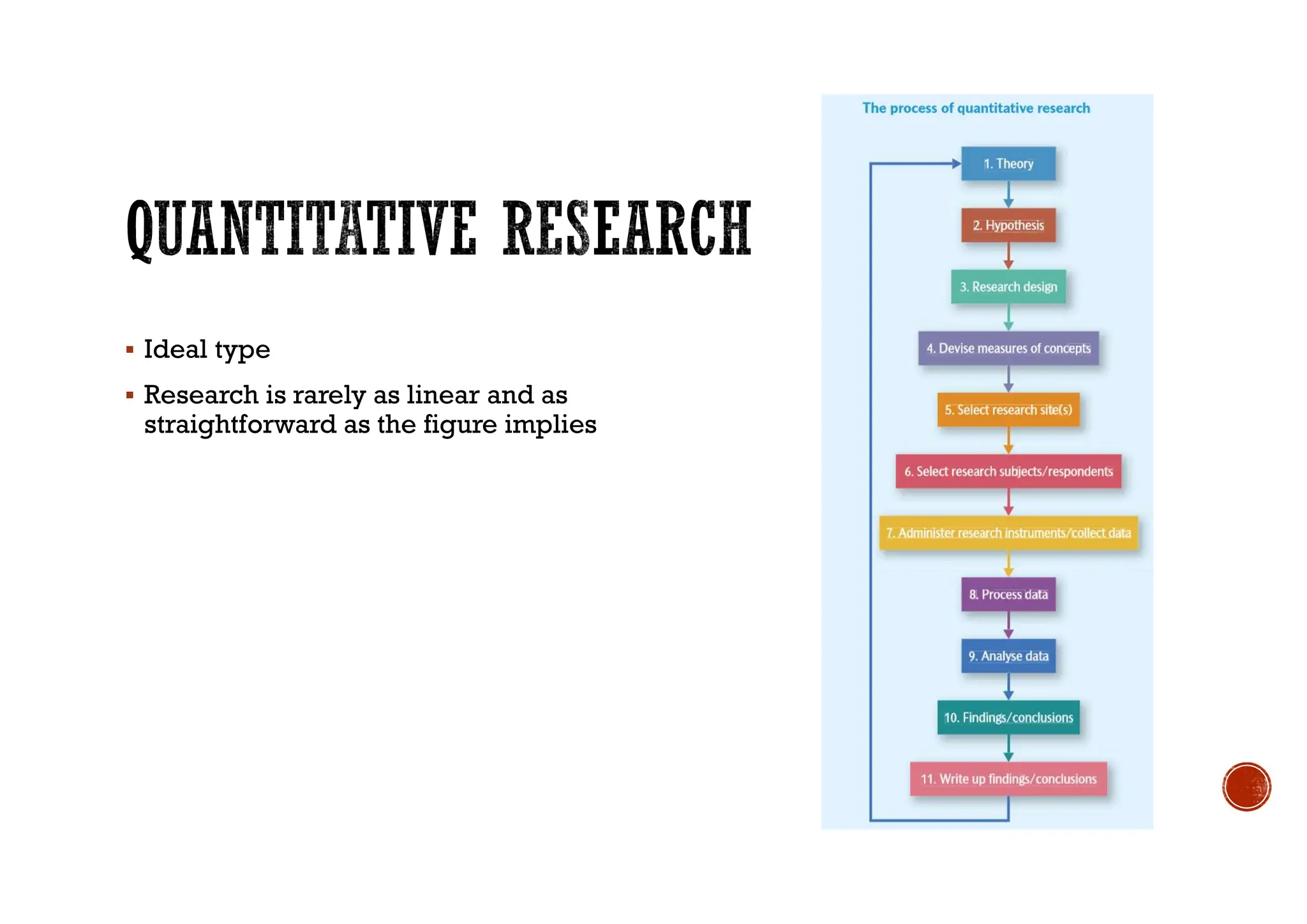
 Ideal type
 Research is rarely as linear and as
straightforward as the figure implies
 Concepts are the building blocks of theory and represent the points around which
social research is conducted.
 If a concept is to be employed in quantitative research, it will have to be measured
1. Allows us to delineate fine differences between people in terms of the
characteristic in question (small differences are hard to detect)
2. Gives us a consistent device or yardstick for making such distinctions
3. Provides the basis for more precise estimates of the degree of relationship
between concepts (for example, correlation analysis)
 In order to provide a measure of a concept (operationalization), it is necessary to
have an indicator or indicators that will stand for the concept
 Operationalization is the process where we specify how we will measure concepts
of interest unambiguously
 Example of operationalization
 We will measure education with four mutually exclusive categories
A. LESS THAN HIGH SCHOOL
B. HIGH SCHOOL GRADUATE / GED
C. SOME COLLEGE
D. COLLEGE GRADUATE OR HIGHER
 Indicators can be devised:
 through a question (or series of questions) that is part of a structured interview
schedule or self-completion questionnaire; for ex. report of an attitude (for
example, job satisfaction);
 through the recording of individuals’ behaviour using a structured observation
schedule (for example, pupil behaviour in a classroom);
 through official statistics (crime statistics to measure criminal behavior);
 through an examination of mass media content through content analysis
 Indicators may be direct or indirect in their relationship to the concepts for which
they stand.
 direct indicator - indicator of marital status
 indirect indicator – indicator of job satisfaction
 has a much more direct relationship to its concept than an indicator (or set of
indicators) relating to job satisfaction. Sets of attitudes always need to be measured
by batteries of indirect indicators.
 Likert scale - a multiple-indicator or multiple-item measure of a set of attitudes
relating to a particular area.
 The goal of the Likert scale is to measure intensity of feelings about the area in
question.
 The items must be statements and not questions.
 The items must all relate to the same object (job, organization, ethnic groups,
unemployment, sentencing of offenders, etc.).
 The items that make up the scale should be interrelated (see the discussion of
internal reliability
 The concept might have different dimensions
 Religious belief – how to measure?
 Reliability refers to the consistency of a measure of a concept
 Stability.This consideration entails asking whether a measure is stable over time, so
that we can be confident that the results relating to that measure for a sample of
respondents do not fluctuate.
 Internal reliability. The key issue is whether the indicators that make up the scale or
index are consistent (use of Cronbach’s alpha)
 Inter-observer consistency.Subjective judgement, if more than one ‘observer’ is
involved (a lack of consistency in their decisions).
 Measurement Validity presumes reliability
 Any flaws in validity (issue with the scales) bring up issues of reliability;
 Face validity – established by asking ‘experts’ if the measure seems to reflect the
concept in attention
 Skip pp. 171-174
 Measurement
 Causality
 Generalization
 Replication
 Quantitative researchers fail to distinguish people and social institutions from ‘the
world of nature’
 The measurement process possesses an artificial and spurious sense of precision
and accuracy
 The reliance on instruments and procedures hinders the connection between
research and everyday life
 The analysis of relationships between variables creates a static view of social life
that is independent of people’s lives
1. Creation of hypothesis
2. Operationalization of the concept (development of indicators for non-
quantifiable concepts)
Sampling
ADA University
Research Methods I
Sampling key terms:
• Population: the universe of units from which the sample is to be
selected
• The Sample: the segment of population that is selected for
investigation
• Sampling frame: list of all units
• Representative sample: a sample that reflects the population
accurately
• Sample bias: distortion in the representativeness of the sample
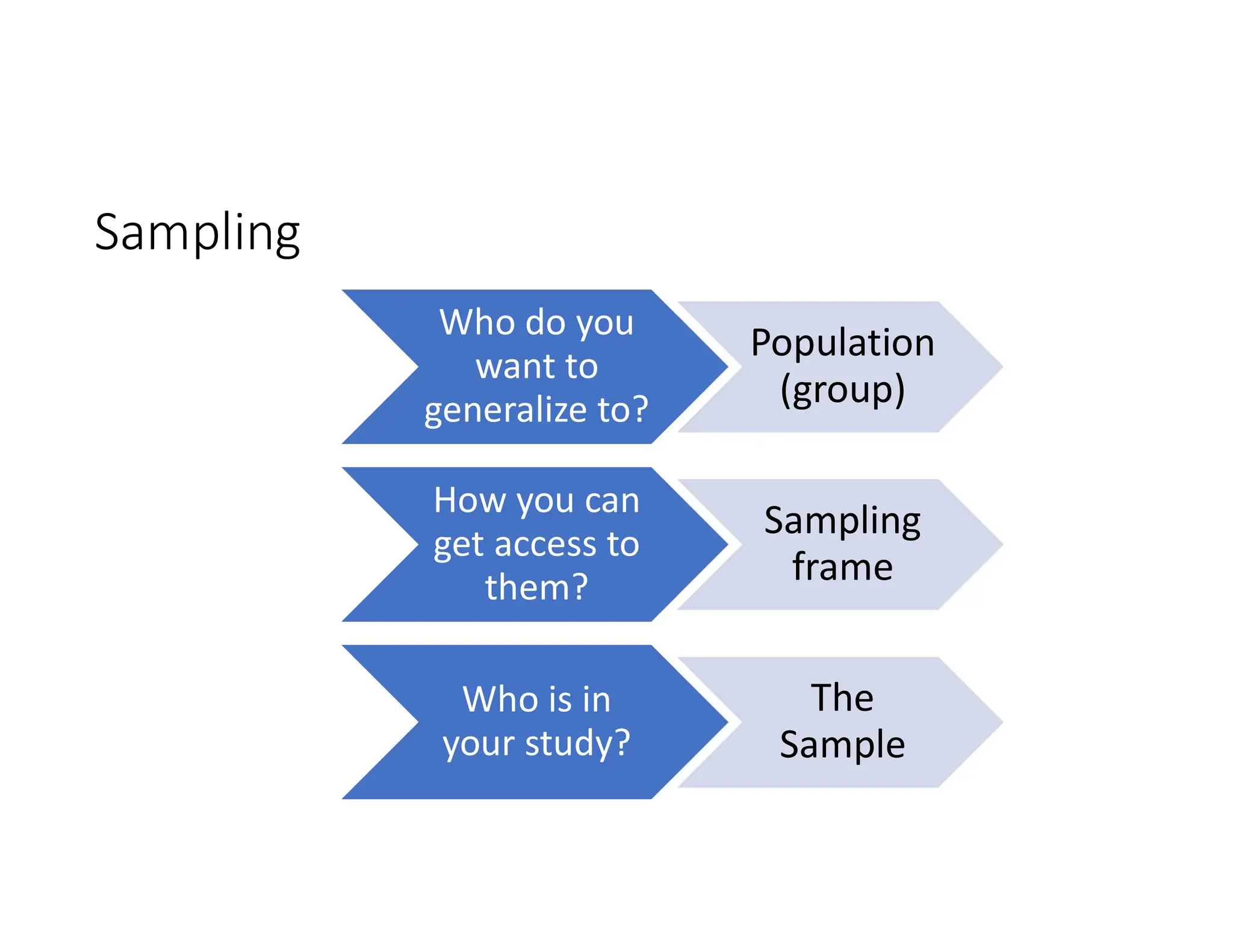
Sampling
Who do you
want to
generalize to?
Population
(group)
How you can
get access to
them?
Sampling
frame
Who is in
your study?
The
Sample
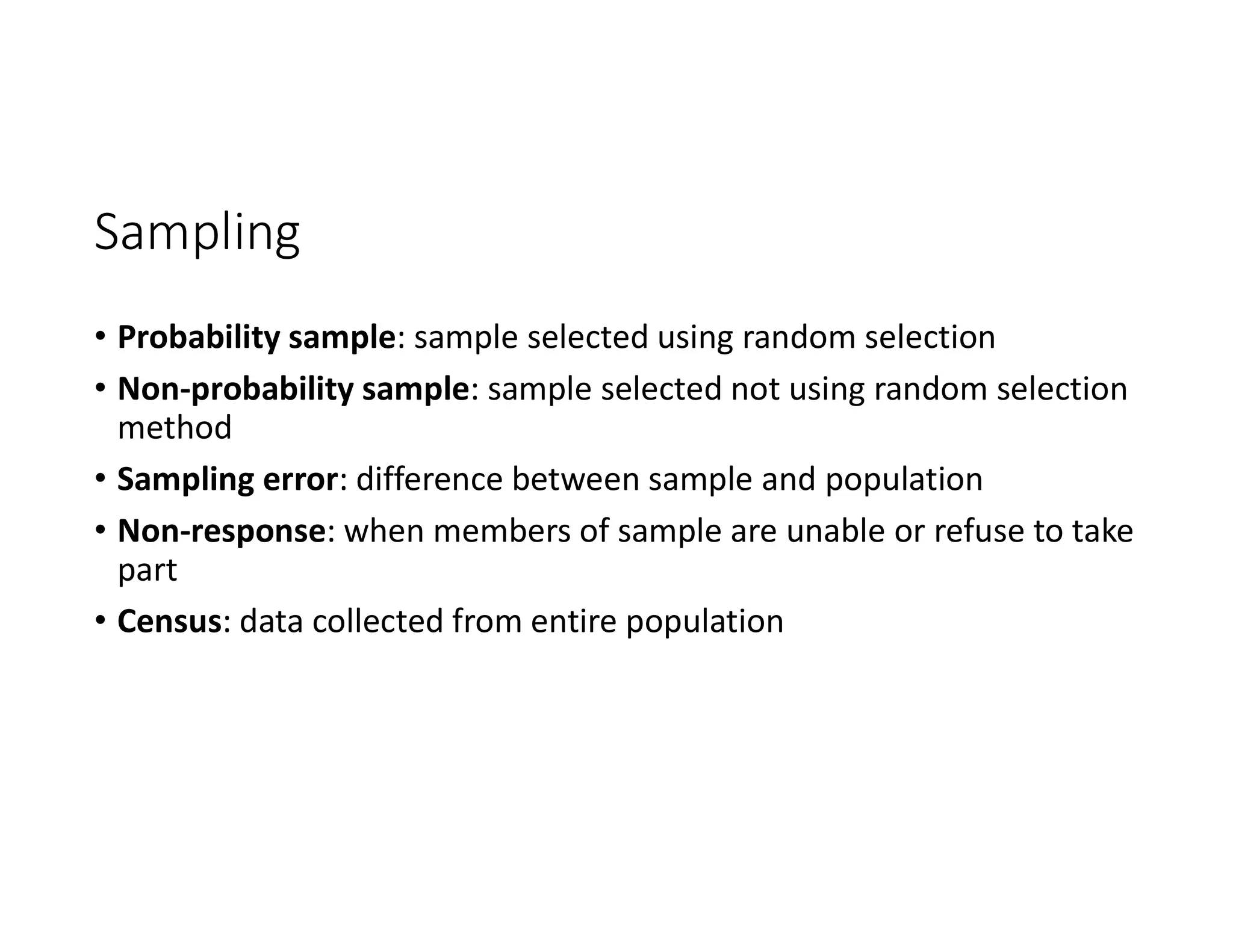
Sampling
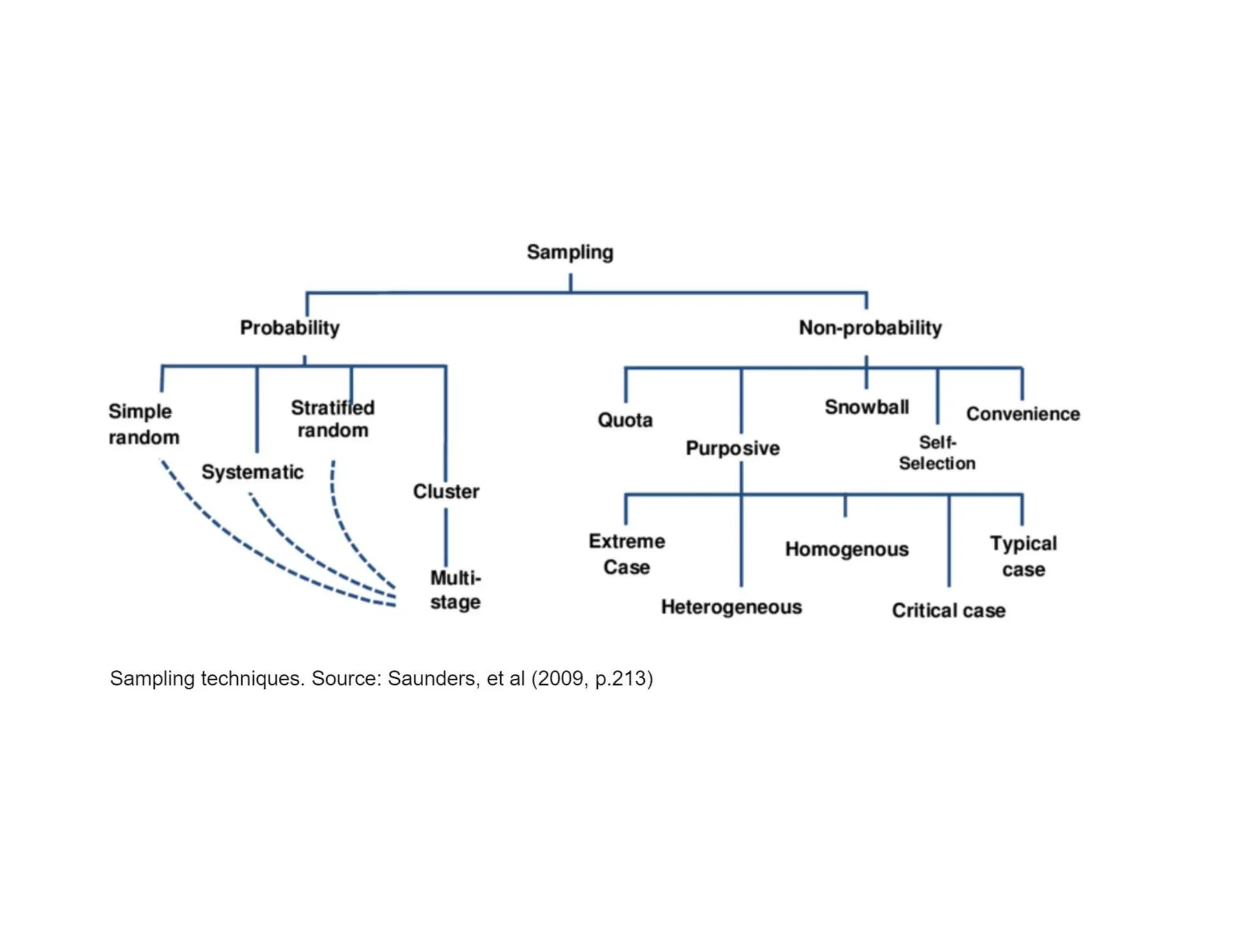
• Probability sample: sample selected using random selection
• Non-probability sample: sample selected not using random selection
method
• Sampling error: difference between sample and population
• Non-response: when members of sample are unable or refuse to take
part
• Census: data collected from entire population
Sampling error
• Sampling error - difference between sample and population
• Biased sample does not represent population –some groups are over-
represented; others are under- represented
• Sources of bias:
1. non-probability sampling,
2. inadequate sample frame,
3. non-response
• Probability sampling reduces sampling error and allows for
inferential statistics
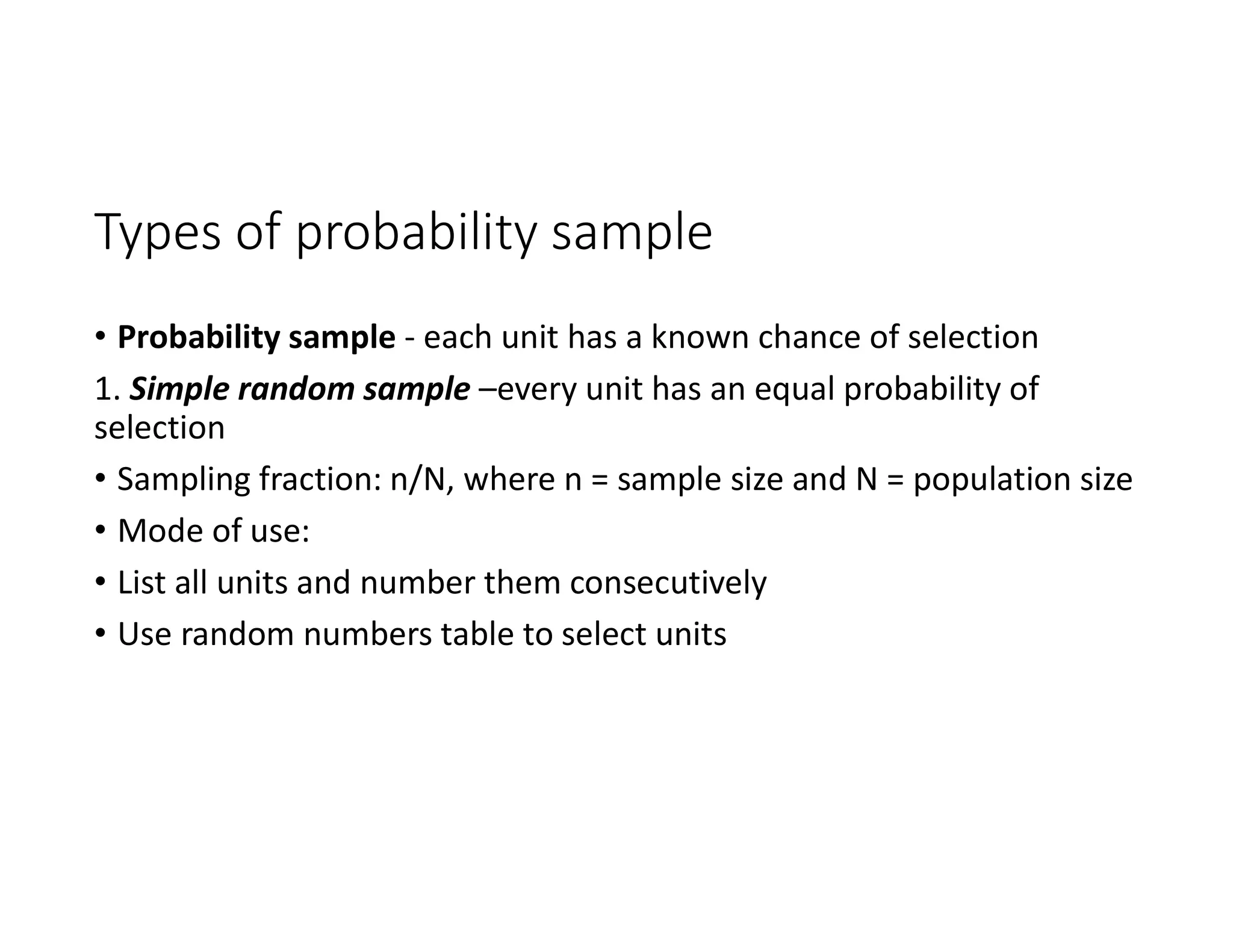
Types of probability sample
• Probability sample - each unit has a known chance of selection
1. Simple random sample –every unit has an equal probability of
selection
• Sampling fraction: n/N, where n = sample size and N = population size
• Mode of use:
• List all units and number them consecutively
• Use random numbers table to select units
Types of probability sample
2. Systematic sample –select units
directly from sampling frame –
from a random starting point,
choose every ‘n’th unit (e.g. every
10th name)
• Ensure sampling frame has no
inherent ordering
Types of probability sample
3. Stratified random sample –proportionately representative of each
stratum
• Stratify population by appropriate criteria –randomly select within
each category
• For ex, sample divided proportionally to the number of people in
each group: Doctors, Nurses, Administrative personnel then select
randomly
Types of probability sample
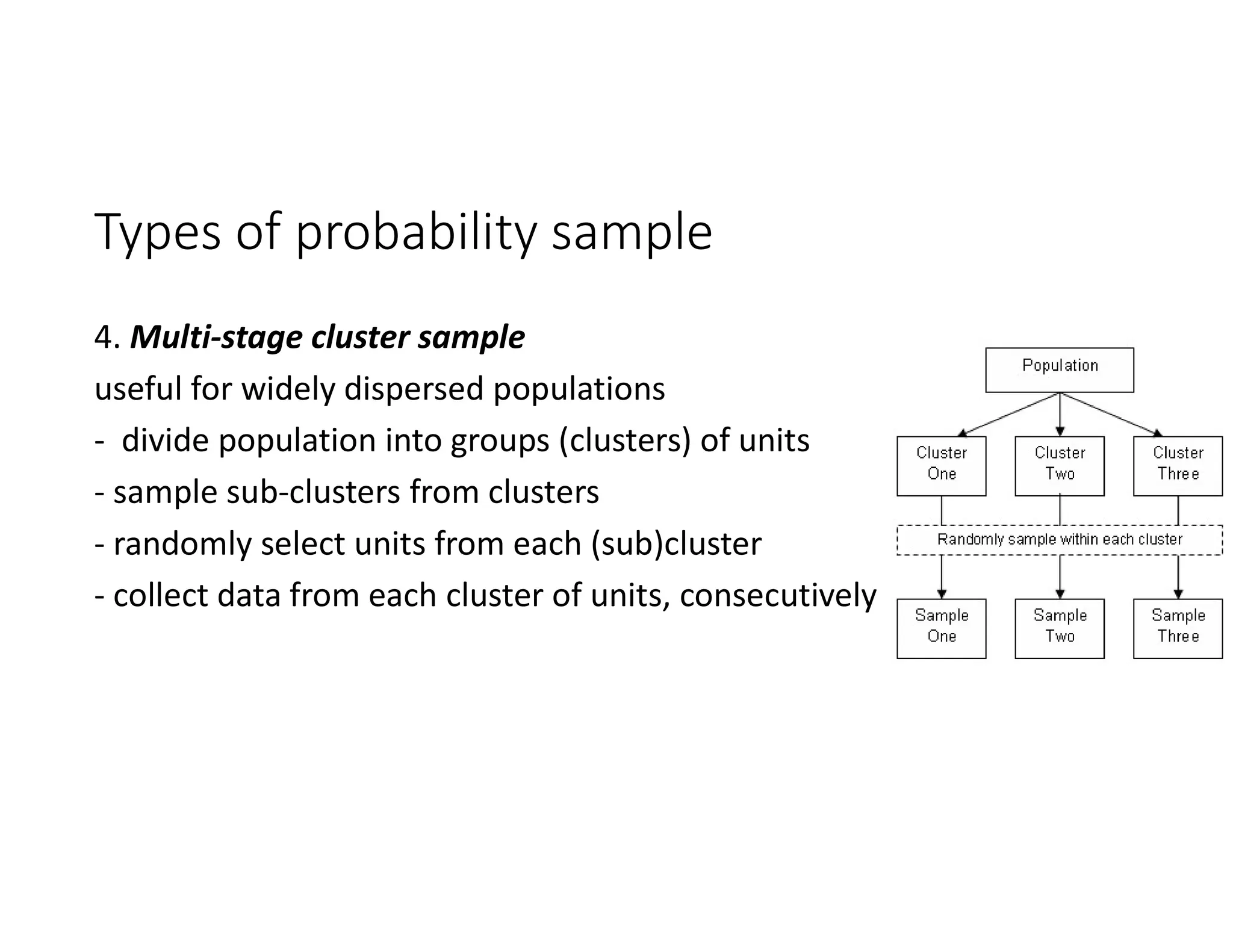
4. Multi-stage cluster sample
useful for widely dispersed populations
- divide population into groups (clusters) of units
- sample sub-clusters from clusters
- randomly select units from each (sub)cluster
- collect data from each cluster of units, consecutively
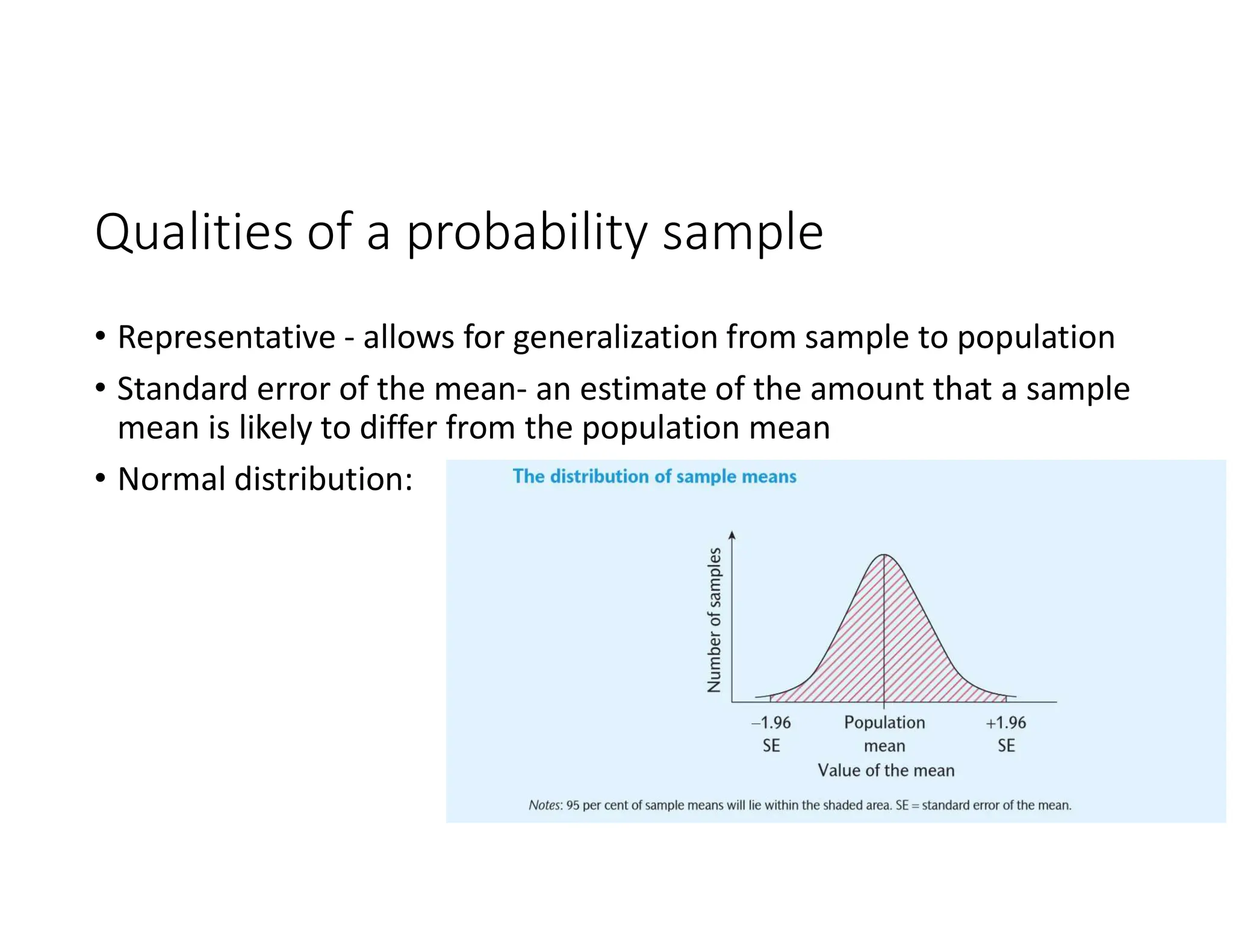
Qualities of a probability sample
• Representative - allows for generalization from sample to population
• Standard error of the mean- an estimate of the amount that a sample
mean is likely to differ from the population mean
• Normal distribution:
Sample size
• absolute size matters more than relative size
• the larger the sample, the more precise and representative it is likely
to be
• as sample size increases, sampling error decreases
• It is important to be honest about the limitations of your sample
Factors affecting sample size
Time and cost
• after a certain point (n=1000), increasing sample size produces less
noticeable gains in precision
• very large samples are decreasingly cost-efficient (Hazelrigg, 2004)
Non-response
–response rate = % of sample who agree to participate (or % who
provide usable data)
• responders and non-responders may differ on a crucial variable
Factors affecting sample size
Heterogeneity of the population:
• the more varied the population is, the larger the sample will have to
be
Kind of analysis to be carried out:
• some techniques require large sample (e.g. contingency table;
inferential statistics)
Types of non-probability sampling
1. Convenience/opportunity sampling
–the most easily accessible individuals
–useful when piloting a research instrument
–may be a chance to collect data that is too good to miss
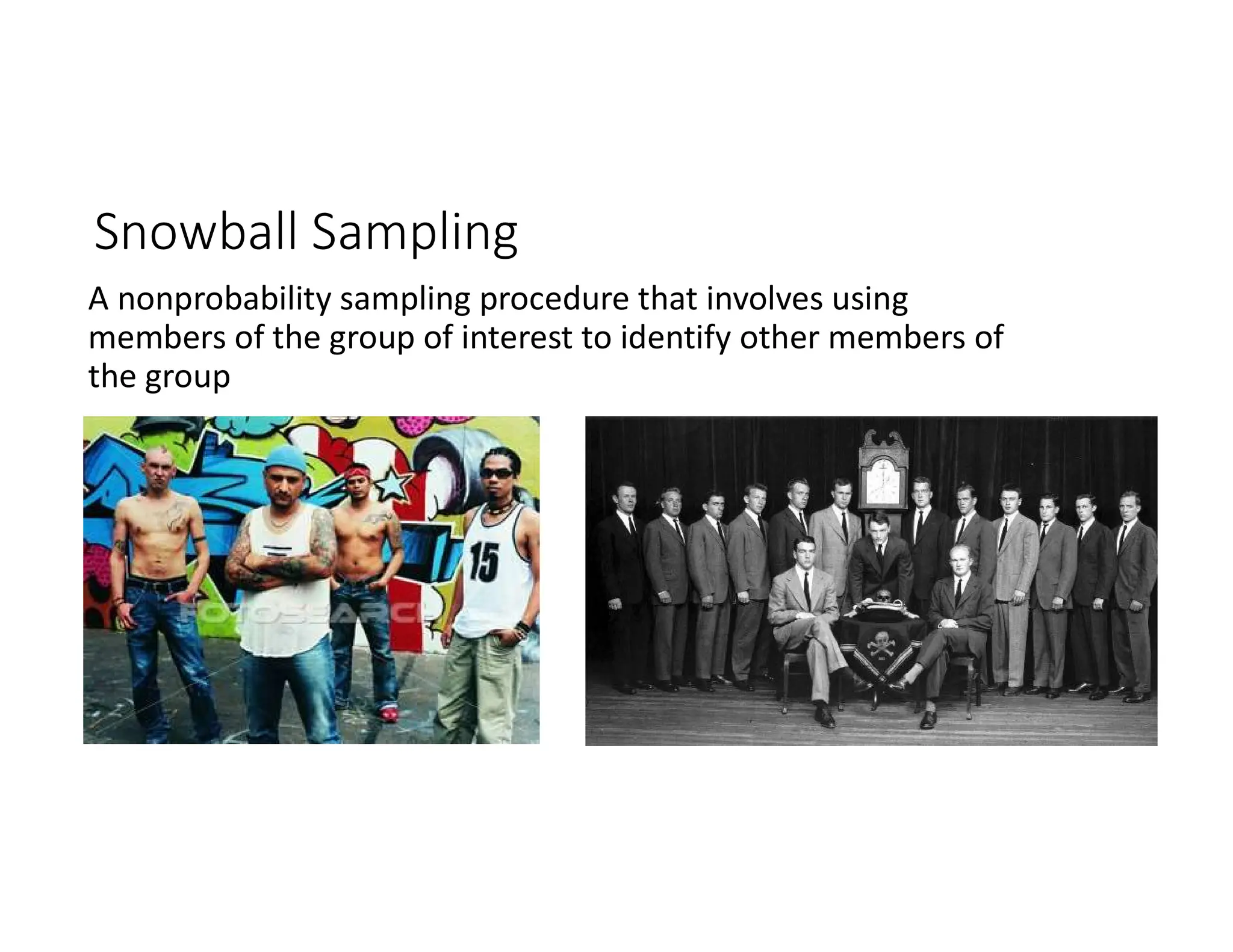
2. Snowball sampling
–researcher makes initial contact with a small group
–these informants lead you to others in their network
–useful for qualitative studies of deviant groups (e.g. Becker (1963)
marijuana users)
A nonprobability sampling procedure that involves using
members of the group of interest to identify other members of
the group
Snowball Sampling
Types of non-probability sampling
3. Quota sampling
–often used in market research and opinion polls
–relatively cheap, quick and easy to manage
–proportionately representative of a population’s social categories
(strata)
–but non-random sampling of each stratum’s units
–interviewers select people to fit their quota for each category
- sample biased towards those who appear friendly and accessible (e.g.
in the street), under-representation of less accessible groups
Limits to generalization
• Findings can only be generalized to the population from which the
sample was selected
• Be wary of over-generalizing in terms of locality, time, historical
events and cohort effects
• Results may no longer be relevant and so require updating
(replication)
Error in survey research
• sampling error –unavoidable difference between sample and
population
• sampling-related error –inadequate sampling frame;
• non-response –makes it difficult to generalize findings
• data collection error –implementation of research instruments –e.g.
poor question wording in surveys
• data processing error –faulty management of data
Questions?
ADA University
Research Methods I
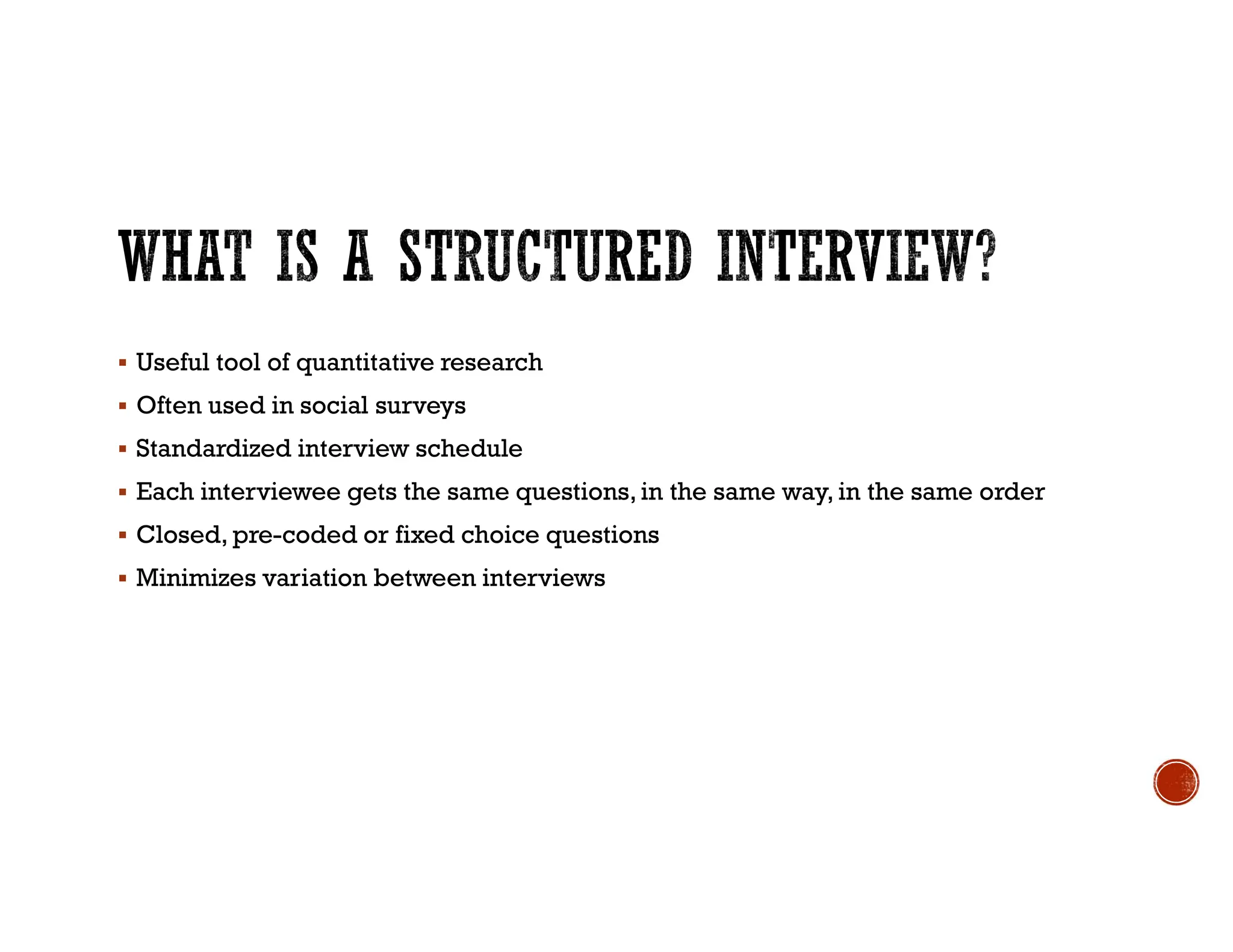
 Useful tool of quantitative research
 Often used in social surveys
 Standardized interview schedule
 Each interviewee gets the same questions,in the same way, in the same order
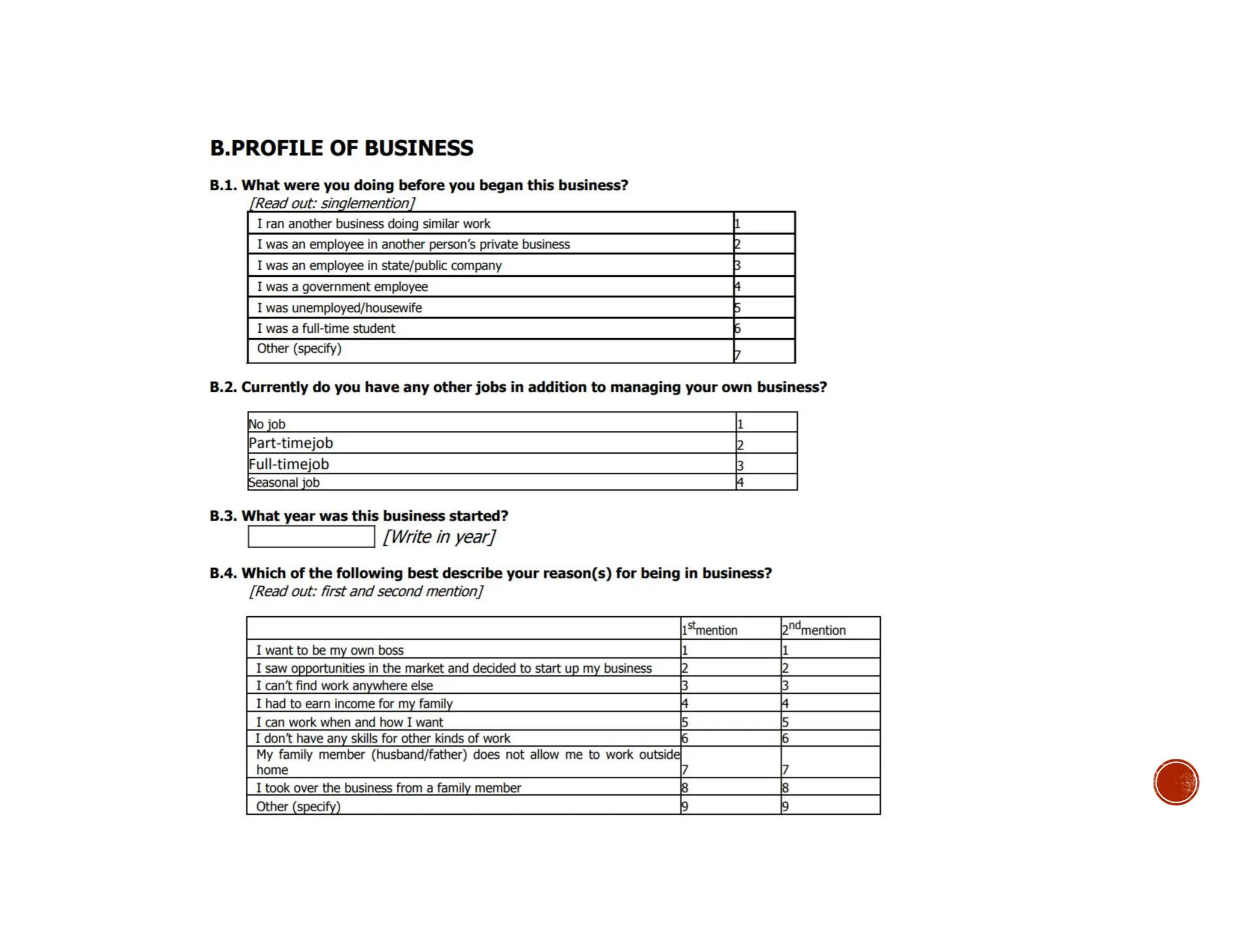
 Closed, pre-coded or fixed choice questions
 Minimizes variation between interviews
1. Reduces error due to interviewer variability:
– differences in responses are due to ‘true variation’, not inconsistencies in the
conduct of interviews
– potential sources of error are reduced by standardization (question wording,
memory, misunderstanding)
– reduces intra-interviewer and inter-interviewer variability
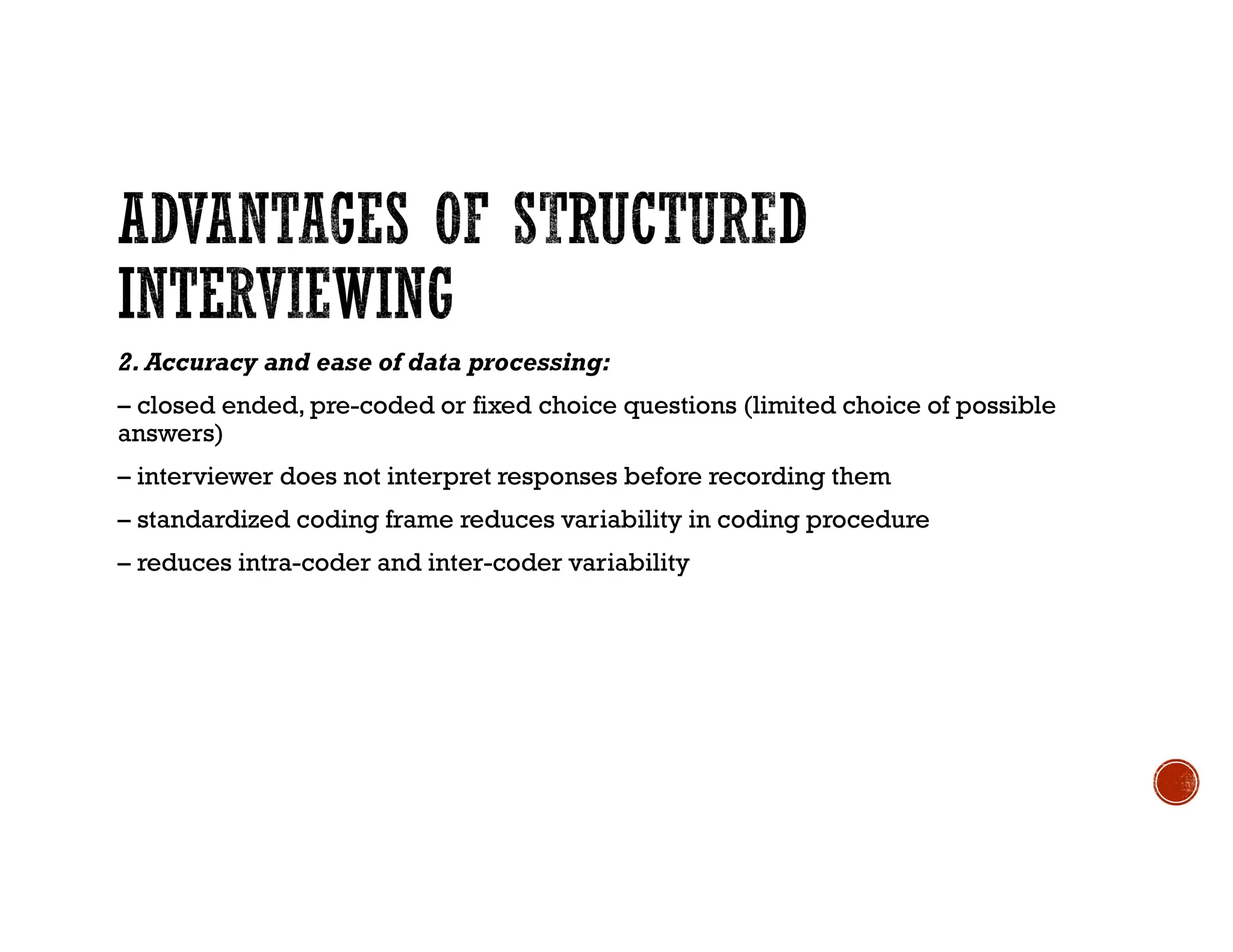
2. Accuracy and ease of data processing:
– closed ended, pre-coded or fixed choice questions (limited choice of possible
answers)
– interviewer does not interpret responses before recording them
– standardized coding frame reduces variability in coding procedure
– reduces intra-coder and inter-coder variability
Category Code
Mother (Mom, Mama, etc.) 1
Father (Dad, Papa, etc) 2
Husband, spouse, partner 3
Sister 4
Brother 5
Friend, girlfriend, mate 6
Son 7
Daughter 8
Grandmother 9
Grandfather 10
Cousin 11
 Only one interviewee (exception: group interviews, focus groups)
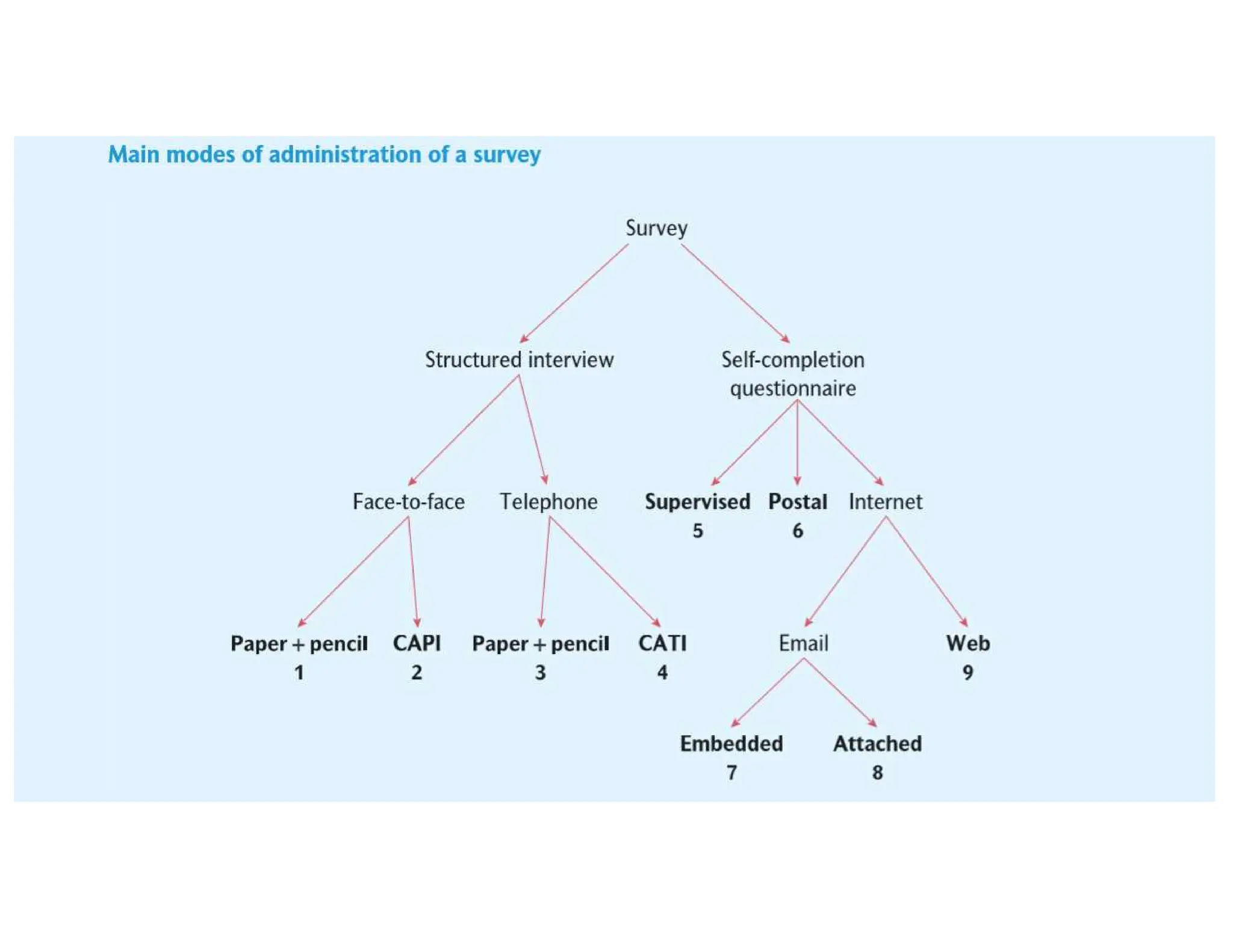
 More than one interviewer
 In person or by telephone?
Computer-assisted personal interviewing (CAPI) and telephone interviewing (CATI)
 –more efficient filtering of questions
 –immediate data entry
 It’s quicker and cheaper (no travel required) easier to monitor/evaluate reduces
interviewer effect (no non-verbal cues)
 But problems:
– some people do not own a telephone, are not contactable
– limited time and high non-response
– cannot respond to non-verbal signs of confusion
– less satisfying experience for interviewee
1 Know your way around the schedule
Introduce the research
–spoken or written rationale
–identify yourself, your employer, purposes of research and procedure of interview
–ethical issues: anonymity, confidentiality, right to withdraw
–opportunity for interviewee to ask questions
2 Building rapport
–can be difficult if limited time and little opportunity for discussion (closed
questions)
3 Asking questions
–keep to the schedule: even small variations in wording can affect responses
4 Recording answers
–write exact words used by interviewee, or use fixed choice questions
5 Clear instructions
–some questions are not relevant to every interviewee
–filter questions help interviewer navigate the schedule
6 Question order
–every interviewee must get questions in the same order
–general questions before specific questions
–earlier questions may affect salience of later ones
–first questions should be directly related to the topic
–potentially embarrassing or sensitive questions towards the end
7 Probing
–when respondent does not understand question or gives insufficient answer
–non-directive probes:“mmm”,“can you say a bit more about that?”
–repeat fixed choice alternatives
8 Prompting
–interviewer suggests possible answers
–show cards (for ex Likert scale)
9 Leaving the interview
–thank the interviewee
–debriefing should be minimal
10 Training and supervision
–necessary if researcher hires interviewer(s)
–to ensure that interviewers know the schedule and follow standardized procedures
–assessment: examine completed forms, tape record a sample of interviews, call-
back some respondents (10%)
1 Characteristics of interviewers
–gender, age, ethnicity, class (rapport)
–can evoke socially desirable responses
2 Response sets
–people may respond in consistent but irrelevant ways, by acquiescence (agreeing
or disagreeing to all questions) or for reasons of social desirability (interviewees
reflect on the way their answers might be perceived)
3 The problem of meaning
–Interpretivist critique
–Interviewer and respondent may not attribute the same meanings to concepts
–The meaning of questions is not pre-given but rather constructed in the interview
–This problem is ‘side-stepped’ in structured interview research
4 The feminist critique (Oakley,‘Interviewing women: A contradiction in terms?’,1981)
–Structured interviews epitomize the imbalance of power between researcher and
informant
–Interviewers extract information from passive ‘respondents’ and give nothing in
return
–Alternative of non-hierarchical relationship based on reciprocity and empathy
(unstructured interviews)
–Researcher’s values and personal involvement are a strength,not a weakness

ilovepdf_merged.pdf- about Media and communication

  • 1.
  • 2.
     ‘Research is…’and ‘Research is carried out in order to…’
  • 3.
     An activitywhich critically evaluates some problem;  Undertaking structured investigation which hopefully results in greater understanding of the chosen interest area. Usually, this investigation becomes available to the ‘public’;  To collect and analyze the data in a specific field with the purposes of proving your theory.
  • 4.
     Get aresult with scientific methods,“objectively”, not “subjectively”;  Solve problems,  Verify the application of theories,and lead on to new insights;  Enlighten both researcher and any interested readers.
  • 5.
     Scientific researchcan be expressed by concepts such as:  organized,  structured,  methodical,  systematic,  testable,  ‘disciplinary inquiry’.
  • 6.
     The contextof social research methods  The elements of the research process  The messiness of social research
  • 7.
     Theory isa generalized statement that asserts a connection between two or more types of phenomena.
  • 8.
     Some characteristicsof ‘theory’:  Theory guides research and organizes its ideas.  ‘Facts’ of different shapes and sizes have no meaning unless they are drawn together in a theoretical or conceptual framework.  Theory becomes stronger as more supporting evidence is gathered; and it provides a context for predictions.  Theory has the capacity to generate new research.  Theory is empirically relevant and always tentative.
  • 11.
     Theory isrooted in research paradigm:  Ontological and Epistemological considerations
  • 12.
     The valuesof the research community have significant implications for researchers.  Ethical issues – are prominent, but are often point of discussion  Special provision with regard to ethics, such as research involving children or vulnerable adults.
  • 13.
     Social scienceresearch should have a practical purpose;  It should make a difference to the world around us (have implications for practice).  In social policy - investigations should have demonstrable implications for practice.  Evaluation research and action research are designed to explore issues that will have implications for people’s everyday lives.
  • 14.
     Social researchis influenced by wider political context;  Social research might be funded by government bodies, and these tend to reflect the orientation of the government of the day.  Certain research issues are somewhat more likely to receive attention/financial support than others (GBV, women entrepreneurship, SME development, innovations, etc.…)
  • 15.
     Training andpersonal values of the researcher influence the research area, the research questions,and the methods employed to investigate these.  Our experiences and our interests frequently have some influence on the issues we research.  Training and sometimes personal preferences develop attachments to, or at least preferences for, certain research methods and approaches.
  • 17.
     what isalready known about the topic;  what concepts and theories have been applied to the topic;  what research methods have been applied to the topic;  what controversies about the topic and how it is studied exist;  what clashes of evidence (if any) exist;  who the key contributors to research on the topic are.  Literature review is not simply a summary of the literature that has been read, BUT is expected to be critical
  • 18.
     Concepts arethe way that we make sense of the social world.  They are labels that we give to aspects of the social world that seem to have common features that strike us as significant  Concepts are such as bureaucracy,power, social control, status,charisma, labour process, cultural capital, alienation, etc.  Concepts are a key ingredient of theories.  There are deductive and inductive approaches to the relationship between theory and research
  • 19.
     A researchquestion is a question that provides an explicit statement of what it is the researcher wants to know about.  A research purpose can be presented as a statement (for example,‘I want to find out whether (or why) . . .’), but a question forces the researcher to be more explicit about what is to be investigated.  A research question must have a question mark at the end.
  • 20.
     The followingtypes of research question are proposed by Denscombe:  1. Predicting an outcome (does y happen under circumstances a and b?).  2. Explaining causes and consequences of a phenomenon (is y affected by x or is y a consequence of x?).  3. Evaluating a phenomenon (does y exhibit the benefits that it is claimed to have?).  4. Describing a phenomenon (what is y like or what forms does y assume?).  5. Developing good practice (how can we improve y?).  6. Empowerment (how can we enhance the lives of those we research?) or  Comparison (do a and b differ in respect of x?).
  • 21.
     Having noresearch questions or poorly formulated research questions will lead to poor research.  Question need to be specific, focused and feasible.  Developing research questions is a matter of narrowing down and focusing more precisely on what it is that you want to know about.
  • 22.
     Research questionsare crucial because they will:  guide your literature search;  guide your decisions about the kind of research design to employ;  guide your decisions about what data to collect and from whom;  guide your analysis of your data;  guide your writing-up of your data;  stop you from going off in unnecessary directions;  provide your readers with a clearer sense of what your research is about.
  • 23.
     ‘Sampling case’stands for the wide variety of objects on whom or from whom data will be collected (people, newspaper articles,TV programs, etc.)  Sampling with surveys - representative samples - a sample that can represent (and therefore act as a microcosm of) a wider population. Number of sampling cases might be 2 000 – 5 000, etc.  In case study research the goal is to understand the selected case or cases in depth.The case or cases have to be selected according to criteria relevant to the research (there may be just one or two units of analysis)
  • 24.
     Data collectiontechniques:  Structured interview (questionnaire)  Participant observation,  Semi-structured interview  Focus group discussion, etc.
  • 25.
     Primary Datavs Secondary Data  Coding  Thematic analysis  Data reduction
  • 26.
     Introduction. Herethe research area and its significance are outlined.The research questions are also likely to be introduced here.  Literature review.What is already known about the research area is sketched out and examined critically.  Research methods. Here the research methods employed (sampling, methods of data collection, methods of data analysis) are presented and justified.  Results.The findings are presented.  Discussion.The findings are discussed in relation to their implications for the literature and for the research questions previously introduced.  Conclusion.The significance of the research is reinforced for the reader.
  • 27.
     Don’t beshy! Share your results!  Peer-reviewed publications – What does that mean?  Peer-reviewed (academic or scholarly) journals - Articles are reviewed by several experts in the field before it is published in the journal in order to ensure the article’s quality.
  • 28.
     Although wecan attempt to formulate general principles for conducting social research, we have to recognize that things do not always go entirely to plan.  Please consider what kind of limitations your research project can face before starting it (unwillingness of the respondents to cooperate, bad weather conditions, limited access to the area, etc.)  Present in your paper unexpected issues that you have encountered, which forced you to change the course of some portions of your research.
  • 30.
  • 31.
     Theory isimportant to the social researcher because it provides a backcloth and rationale for the research that is being conducted.  It also provides a framework within which social phenomena can be understood and the research findings can be interpreted.
  • 32.
     Question #1:What type of theory is used in research?  Question # 2: Is data collected to test or to build theories?
  • 33.
     Grand Theoriesvs Middle-Range Theories  Robert Merton Introduced these differences.  Grand Theory - the form of highly abstract theorizing in which the formal organization and arrangement of concepts takes priority over understanding the social reality. Grand theory is more or less separate from concrete concerns of everyday life and its variety in time and space.  Macro-level, apply to broad social phenomenon, provide ‘general sociological orientation’,“they facilitate process of arriving at determinate hypothesis”.
  • 34.
     Examples ofGrand Theory:  Structural functionalism by T. Parsons, one universal scheme to understand the unity of social structures.  Social Class theory associated with Marxism  Social Capital theory by P. Bourdieu
  • 35.
     R. Merton: “Middle-range theory is principally used in sociology to guide empirical inquiry. It is intermediate to general theories of social systems which are too remote from particular classes of social behavior, organization, and change to account for what is observed and to those detailed orderly descriptions of particulars that are not generalized at all”.  “Middle-range theory involves abstractions, of course, but they are close enough to observed data to be incorporated in propositions that permit empirical testing”.  Examples: a theory of reference groups, social mobility, role-conflict, formation of social norms etc.
  • 36.
     Middle-range theoriesfall somewhere between grand theories and empirical findings.  They represent attempts to understand and explain a limited aspect of social life (not society as a whole). Grand theory Middle- range theory Empirical findings
  • 37.
     “Publications-as-theory strategy”(Bryman) - the absence of a clear over-arching theoretical framework within which to ground all the aspects of a particular study.  The background literature in a field, rather than specific theories, inform a researcher’s work.  Research is not motivated by theoretical considerations, but rather empirical and methodological knowledge gaps or societal challenges.
  • 39.
     Deductive theory– top-down approach  On the basis of what is known (theory) researcher deduces a hypothesis (or hypotheses)  Hypothesis is translated into measurable terms  It is tested through the collected data, confirmed or rejected  Theory is revised based on the findings  Process is rather linear—one step follows the other in a clear, logical sequence
  • 40.
     Inductive theory– down-top approach  Theory is the outcome of research.  The process of induction involves drawing generalizable inferences out of observations  Generalizations are clustered into patterns  Tentative hypothesis proposed  If proven by further observations the theory is formalized Generalization Pattern Tentative hypothesis Theory Observation 3 Observation 1 Observation 2
  • 45.
     Gender Advertisementswas published in 1979.  Observations of the advertisements published in the North America in 1970th.  Book shares hundreds of advertisements as illustrations;  Generalizations are drawn based on provided observations;  Generalizations are grouped into patterns and ‘named’ (‘Feminine touch’,‘Relative size’,‘Man as an expert’,Woman as a child’etc.)
  • 46.
     Advertisements donot depict how men and women actually behave (reality); rather, they serve the social purpose of convincing us that this is how women and men are, want to be, or should be (“pseudo-reality”)  The advertisements are depicting the gender expectations and roles that are associated with masculine and feminine status and behavior.  Advertisements - clear representation of the socially defined and constructed nature of gender relations.
  • 49.
     Epistemology –How do we know what do we know?  How should we investigate the world around us?
  • 50.
     Central issueis the question of whether the social world can and should be studied according to the same principles, procedures, and ethos as the natural sciences.  Positivism Vs. Interpretivism  Positivism - the role of research is to test theories and to provide material for the development of laws.
  • 51.
     1. Onlyphenomena and hence knowledge confirmed by the senses can genuinely be warranted as knowledge (the principle of phenomenalism).  2.The purpose of theory is to generate hypotheses that can be tested and that will thereby allow explanations of laws to be assessed (the principle of deductivism).  3. Knowledge is arrived at through the gathering of facts that provide the basis for laws (the principle of inductivism).  4. Science must (and presumably can) be conducted in a way that is value free (that is, objective).  5.There is a clear distinction between scientific statements and normative statements and a belief that the former are the true domain of the scientist.
  • 52.
     Interpretivism -The subject matter of the social sciences —people and their institutions—is fundamentally different from that of the natural sciences.  Thus, epistemological approach to the study of the social world requires a different logic of research procedure  Max Weber – Verstehen – interpretive understanding of social action
  • 53.
     Intellectual traditions: Hermeneutics - understanding is the interpretive act of integrating particular things such as words, signs, and events into a meaningful whole.We only really understand an object, word, or fact when it makes sense within our own life context and thus speaks to us meaningfully.  Phenomenology - its aim is to describe an experience as it is actually lived by the person.The job of the social scientist to gain access to people’s ‘common-sense thinking’ and hence to interpret their actions and their social world from their point of view.  Symbolic interactionists argue that interaction takes place in such a way that the individual is continually interpreting the symbolic meaning of his or her environment (which includes the actions of others) and acts on the basis of this imputed meaning.
  • 55.
     Ontology -is the study or concern about what kinds of things exist - what entities are there in the universe.  Ontological consideration - the question of whether social entities can and should be considered objective entities that have a reality external to social actors, or whether they can and should be considered social constructions built up from the perceptions and actions of social actors.  Objectivism vs Constructivism
  • 56.
     Objectivism isan ontological position that asserts that social phenomena and their meanings have an existence that is independent of social actors.  It implies that social phenomena and the categories that we use in everyday discourse have an existence that is independent or separate from actors.
  • 57.
     Constructivism assertsthat social phenomena and categories are not only produced through social interaction but that they are in a constant state of revision.  Another related reading:The researcher always presents a specific version of social reality, rather than one that can be regarded as definitive.  Working definition: Constructionism is presented as an ontological position in relating to social objects and categories—that is, one that views them as socially constructed.
  • 58.
     Research strategy- a general orientation to the conduct of social research.  Quantitative vs qualitative research
  • 59.
    • entails adeductive approach to the relationship between theory and research, in which the accent is placed on the testing of theories; • has incorporated the practices and norms of the natural scientific model and of positivism in particular; • embodies a view of social reality as an external, objective reality.
  • 60.
    • predominantly emphasizesan inductive approach to the relationship between theory and research, in which the emphasis is placed on the generation of theories; • has rejected the practices and norms of the natural scientific model and of positivism in particular in preference for an emphasis on the ways in which individuals interpret their social world; • embodies a view of social reality as a constantly shifting emergent property of individuals’ creation.
  • 62.
     Mixed methodsresearch - research that combines methods associated with both quantitative and qualitative research.  The quantitative and qualitative research should not be seen as contrasted and incompatible.  They can be fruitfully combined within a single project.  Example: Lale Yalchin Heckmann’s study of Land Privatization in Tezekend (Shamkir), (Book:The Return of Private Property : Rural Life After Agrarian Reforms in the Republic of Azerbaijan, 2011)
  • 63.
     Values -it is not feasible to keep the values that a researcher holds totally in check.  Mies (1993: 68) has argued that ‘postulate of value free research, of neutrality and indifference towards the research objects, has to be replaced by conscious partiality, which is achieved through partial identification with the research objects’.  Researchers nowadays is encouraged to recognize and acknowledge that research cannot be value free and to be self-reflective.  Practical considerations – nature of topic; prior research; target group.
  • 66.
  • 67.
    Research Onion Saunders, M.,Lewis, P., & Thornhill, A. (2007). Research Methods for Business Students, (6th ed.) London: Pearson
  • 68.
     By theend of the course you (in your groups) are expected to finalize and present projects with a component of empirical research  What means your project should be based on data, which you will collect (primary, new data)  You can conduct a secondary analysis of existing data, if that will strengthen your point.  Follow the requirements,instructions,and information you are given in Syllabus!
  • 69.
    How to identifytopic or interesting a researchable area?  Look around! Choose a topic that you are interested in! The research process is more relevant, if you care about your topic.  Narrow your topic to something manageable.  Background reading can help you choose and limit the scope of your topic.  Review the guidelines on topic selection outlined in your assignment.  Brainstorm in your groups.  Remember the project needs to be manageable given limited resources (time and space).
  • 70.
     First deadline:October 6th – submission of your research proposals!  Other deadlines:  Submission of the questionnaire (mid-November)  Presentation of the Research Findings (end of December)
  • 71.
     What isit you want to know in your area of interest  Question must clearly have a social scientific angle  Questions more specific in quantitative research than qualitative Stages: • Research area • Select aspect of research area • Research questions • Select research questions
  • 73.
    Intellectual puzzles and contradictions Existing literatureReplication Structures and functions Opposition A social problem Gaps between official reality and facts at ground level The counter- intuitive (anti common sense) Deviant cases and atypical events New methods and theories New social and technical developments and social trends Personal experience Sponsors and teachers
  • 74.
     Clear, intelligible Researchable, not too abstract  Some connection to theory/research  Questions linked to each other  Prospect of making an original contribution  Not too broad or too narrow
  • 75.
     Topics arebroad but research questions definitive and narrow.  O’Leary suggests finding an ‘angle’ on the topic.  What commentators/friends/instructors are saying about it?  What ‘hot issues’ are generating argument and debate?  A gap in the literature?  A researcher has recommended further themes worthy of research at the end of an article.
  • 77.
    Question A: Whatis the 2014 rate of juvenile delinquency in Azerbaijan? Question B:What can we do to reduce juvenile delinquency in Azerbaijan? Question C: Does education play a role in reducing juvenile delinquents' return to crime?
  • 78.
     Question A:Whatmarketing strategies does the Coca-Cola company currently apply?  Question B:What is the Coca-Cola company's future marketing plan?  Question C:What marketing strategies has the Coca-Cola company used in the past?
  • 79.
     Question A:Whicheating disorders are most widely spread in Eastern Europe?  Question B:What is the relationship between women's fashion magazines and dieting?  Question C:What are the causes of anorexia?
  • 80.
     Question A:Do children sent to day care or kindergarten start school with more developed skills?  Question B: Do children sent to day care or kindergarten start school with more highly-developed language skills?  Question C: Do children sent to day care or kindergarten start school with larger vocabularies?
  • 81.
     Question A:Whomakes better burger: MacDonald's or Burger King?  Question B:What are the eating habits and preferences among the student population of the ADA University?  Question C: Do ADA students follow healthy eating habits?
  • 82.
     What isyour research topic? Why it is important?  What is your research question or what are your research questions?  What does the literature have to say about your research topic and question(s)?  How are you planning to collect data relevant to your research question?  What resources will you need to conduct your research (for example, printing, travel, software)?  What problems do you anticipate in doing the research (for example, access to organizations, respondents)?  What are the possible ethical problems associated with your research?
  • 83.
     Physical risks Emotional risks
  • 84.
  • 85.
     What isalready known about this area?  What concepts and theories are relevant to this area?  What research methods and research strategies have been employed in studying this area?  Are there any significant controversies?  Are there any inconsistencies in findings relating to this area?
  • 86.
     Take goodnotes  Develop critical reading skills  Active (critical/analytical) vs passive (descriptive) review:  Active: - although a lot of research has been done on X (a general topic or area), little or no research has been done on X1 - there are two competing positions with regard to X1 (in what way are they different, which one you would prefer using and why)  Passive: summaries of the artciles
  • 87.
     Think aboutthe research question.  Locate books, articles and documents with relevant information regarding your topic.  Write the bibliographic citation for the source using MLA or APA style.  Write a concise annotation that includes the following:  summarize the main argument  Evaluate the background of the author  Critique with 2-3 sentences and compare or contrast the work with others.
  • 88.
     Waite, LindaJ., Frances Kobrin Goldscheider, and Christina Witsberger. "Nonfamily Living and the Erosion of Traditional Family Orientations AmongYoung Adults." American Sociological Review 51 (1986): 541-554.  The authors,researchers at the Rand Corporation and Brown University, use data from the National Longitudinal Surveys ofYoung Women and Young Men to test their hypothesis that nonfamily living by young adults alters their attitudes,values, plans, and expectations, moving them away from their belief in traditional sex roles.They find their hypothesis strongly supported in young females, while the effects were fewer in studies of young males. Increasing the time away from parents before marrying increased individualism, self-sufficiency, and changes in attitudes about families. In contrast,an earlier study by Williams cited below shows no significant gender differences in sex role attitudes as a result of nonfamily living.
  • 90.
     A literaturereview discusses published works (e.g., books, articles) in a particular subject area. How to write literature review?  Narrow the central topic  Situate topic in a body of literature  Identify main debates  Critique and synthesize  Use relevant sources and be sure to stop!
  • 91.
    Situate topic in abody of literature
  • 92.
    Situate topic in abody of literature
  • 93.
  • 94.
  • 95.
     A systematicreview is a review of a clearly formulated question that uses systematic and reproducible methods to identify, select and critically appraise all relevant research, and to collect and analyse data from the studies that are included in the review.  A systematic review can be either quantitative or qualitative.  A quantitative systematic review will include studies that have numerical data.  A qualitative systematic review derives data from observation, interviews, or verbal interactions and focuses on the meanings and interpretations of the participants. It will include focus groups, interviews, observations and diaries
  • 96.
     A systematicreview:  Answers a focused research question  Employs a comprehensive, reproducible search strategy  Identifies ALL relevant studies (both published and unpublished)  Assesses all results for inclusion/exclusion, and for quality  Presents an unbiased, balanced summary of findings  Involves a team of researchers looking at a complex research question  Can take months, or even years, to complete.
  • 97.
     Meta-analysis involvessummarizing the results of a large number of quantitative studies  The aim of this approach is to establish whether or not a particular variable has a certain effect by comparing the results of different studies.  Literature Review ---------- Analyses of the secondary data produced by other researchers
  • 99.
     Narrative reviewstend to be less focused and more wide-ranging in scope than systematic reviews.  They are less explicit about the criteria for exclusion or inclusion of studies.  Narrative reviews are expected in all social science publications (books, chapters, articles, thesis) and include review of the literature relevant to the researcher’s area of interest.
  • 103.
  • 104.
     Research methods- are the strategies,processes or techniques utilized in the collection of data or evidence for analysis  Research design – structure (a plan) that guides the execution of a research method(s) and the analysis of the subsequent data.  Research design for pre-election poll:  Research methods: face-to-face surveys,internet surveys, in-depth interviews with experts, etc.
  • 105.
     Reliability:  Ifa research tool is consistent and stable hence predictable and accurate.  The greater the degree of consistency and stability in a research instrument, the greater the reliability.  Reliability is the degree of accuracy or precision in the measurements made by a research instrument.  Often relates to whether formulated measures of concepts (eg. poverty, racial prejudice, religious orthodoxy) are consistent (eg., the wording of questions);  In focus particularly in quantitative research – stability of the measure.
  • 106.
     “Do youconsider yourself a religious person?”  “Have you ever faced domestic violence?”  IQ level
  • 107.
     Replication  Requiresdetailed recording of procedures on the part of the researcher  Relating back to measuring the reliability of a measure of a concept,the procedures which embody the method must be replicable (scales and measurements replicated)  Replication in qualitative studies quite rare  Replicability is valued in social research with a quantitative focus
  • 108.
     Validity isconcerned with the integrity of the conclusions that are generated from a piece of research.  Might be considered as the most important criteria  Concerned with the integrity of conclusions drawn
  • 109.
     Main typesare:  Measurement validity or construct validity.Does the measurement reflect the concept effectively? Related to reliability – if the measure is not stable it is unreliable and hence not a valid measure of the concept.Assessment of measurement validity assumes that the measure is reliable.  Internal validity mainly relates to causality. Does a conclusion involving a causal relationship between variables hold up? The factor that has the causal impact is identified as the independent variable and the effects are the dependent variable.Does the independent variable actually cause the variation identified in the dependent variable?  For ex.:“Do teaching styles influences students’GPAs?”;“Do people who get higher salaries work harder compared to others or they get higher salaries because they are inherently hard workers?”
  • 110.
     A variableis simply an attribute on which cases (individuals, households, schools, cities, etc.) vary.  It is common to distinguish between different types of variable.  The most basic distinction is between independent variables and dependent variables.The former are deemed to have a causal influence on the latter.  An important issue in the context of quantitative data analysis - measurement properties of the variables (will be covered later)
  • 111.
     External validityexamines whether study results can be generalised beyond the particular research context  For instance, do the findings apply to other people, settings, situations, and time periods?  Ex: Nation-wide Survey – how can finding be generalized to a whole country?  Ex: Restful sleep App usage – measuring impact of two groups of people – users and not-users. Strict protocol to follow.The results prove if the app is or is not effective and for which groups.
  • 112.
     Ecological validityexamines if findings apply to everyday and natural social context.With intervention in settings or creation of artificial settings, ecological validity can be lost  Ethnographic research vs Structured Surveys
  • 113.
     Are criteriamainly applicable to quantitative research or qualitative research?  Reliability, External and Internal validity – mostly quantitative research  Ecological validity – both  BUT!
  • 114.
     Different viewson applicability to qualitative study  Trustworthiness proposed as a key criteria
  • 115.
     Aspects oftrustworthiness parallel with quantitative research criteria:  Credibility = internal validity  Transferability = external validity  Dependability = reliability  Confirmability = objectivity  and Relevance (contribution to the field/literature)
  • 116.
     experimental design; cross-sectional or survey design;  longitudinal design;  case study design;  comparative design
  • 117.
     Random assignmentof subjects to experimental and control groups,  Pre-testing of both groups,  Independent variable manipulated; all other variables held constant,  Post-testing of both groups,  Computation and analysis of group differences
  • 118.
     Randomized experimentor randomized controlled trial (RCT)  Two groups are established  Experimental manipulation with the independent variable (teacher expectations)  Two groups: experimental group and control group  The experimental group receives the experimental treatment  The dependent variable (student performance) is measured before and after the experimental manipulation  Random assignment to the experimental and control groups
  • 120.
     Key: Obs= observation  Exp = experimental treatment (manipulation of the independent variable)  T = timing
  • 121.
    Do special equipmentand exercises enhance students’ health and abilities?
  • 122.
     Measurement validity(IQ test)  Did the experimental manipulation worked?  Are the findings ecologically valid? (field experiment vs laboratory experiment)  Ethical concerns (deception)  Replicability
  • 123.
     Other (non-experimental)events may have caused the changes observed (‘history’)  Subjects may become sensitized to ‘testing’  People change over time in any event (‘maturation’)  Non-random ‘selection’ could explain differences ‘  Ambiguity about the direction of causal influence’ because sometimes the temporal sequence is unclear  Based on Campbell (1957) and Cook and Campbell (1979)
  • 124.
     Interaction ofselection and treatment.This threat raises the question: to what social and psychological groups can a finding be generalized? Can it be generalized to a wide variety of individuals who might be differentiated by ethnicity, social class, region, gender, and type of personality?  Interaction of setting and treatment.This threat relates to the issue of how confident we can be that the results of a study can be applied to other settings.  Interaction of history and treatment.This threat raises the question of whether the findings can be generalized to the past and to the future.  Interaction effects of pre-testing. As a result of being pre-tested, subjects in an experiment may become sensitized to the experimental treatment.  Reactive effects of experimental arrangements.People’s awareness may influence how they respond to the experiment
  • 125.
     Advantages:  Highlevel of control;  Easier to assign subjects randomly to different experimental conditions;  High internal validity of the study;  Easy to replicate.
  • 126.
     Limitations:  Externalvalidity (extension to real life);  Ecological validity of the study is poor.
  • 127.
     Variation ofexperimental designs with low internal validity requirements.  Occur in ‘natural settings’; random assignment or control groups are not possible  Conducted in field settings in which random assignment is difficult or impossible.  Evaluate the effectiveness of a treatment (psychotherapy or an educational intervention).
  • 128.
     Evaluation research- evaluation of social and organizational programmes or interventions.  The essential question: Has a new policy initiative achieved its anticipated goals?  One group that is exposed to the treatment,a control group that is not – but assignment is not random.  But sometimes evaluation focuses on one group and can be based on quantitative or qualitative data, or both
  • 129.
     “A cross-sectionaldesign entails the collection of data on more than one case (usually quite a lot more than one) and at a single point in time in order to collect a body of quantitative or quantifiable data in connection with two or more variables (usually many more than two), which are then examined to detect patterns of association.”
  • 130.
     “Survey researchcomprises a cross-sectional design in relation to which data are collected predominantly by questionnaire or by structured interview on more than one case (usually quite a lot more than one) and at a single point in time in order to collect a body of quantitative or quantifiable data in connection with two or more variables (usually many more than two), which are then examined to detect patterns of association.”
  • 131.
     Also includes: structured observation,  content analysis,  official statistics,  diaries.
  • 132.
     Evaluating cross-sectionalresearch  Reliability and Measurement Validity are not connected to the design, as such,but concepts used by researcher;  Replicability will be high as long as the researcher specifies all the procedures;  Internal Validity is weak, because co-relations are much more likely to be found than causality;  External Validity will be strong if the sample is truly random;  Ecological Validity may be compromised by the instruments used.
  • 133.
     Survey ofthe same sample on more than one occasion  Typically used to map change in social research  In a panel study (e.g. BHPS – British Household Panel Survey – annual survey since 1991)  Or a cohort study (e.g. NCDS – National Child Development Study – sample of children born in 1958)  Regular Surveys (Caucasus Barometer) are not truly longitudinal, different people are being interviewed. ???  A repeated cross-sectional design or trend design
  • 134.
     Basic issuessimilar to cross-sectional research designs.  Special problems:  Attrition,because people die, or move home, or withdraw from the study.  Knowing when is the right time for the next wave of data collection.  The first round may have been badly thought out, which leaves the later rounds in a bit of a mess.  A panel conditioning effect – people may start to act in accordance with the expectations of the research
  • 135.
     Case studydesign detailed and intensive analysis of one case:  e.g. a single community,  school,  family,  person,  event,  organization  etc.
  • 136.
     Focus: location;setting  Often qualitative: participant observation and unstructured interviewing  But quantitative data might also be useful
  • 137.
     Types ofcases identified byYin (2009):  critical,  unique,  exemplifying,  revelatory,  longitudinal
  • 138.
     The biggestissue concerns external validity, because it is impossible to generalize the findings.  Many case-writers argue that the point of the research is to examine particulars rather than attempt to generalize.  Cases may be extended longitudinally or through a comparative design.
  • 139.
     Using thesame methods to compare two or more meaningfully contrasting cases  Can be qualitative or quantitative  Often cross-cultural comparisons –Gallie’s (1978) study of the impact of automation on industrial workers in England and France  Problem of translating research instruments and findings into comparable samples  Includes multiple case studies
  • 140.
     Identical tothose of cross-sectional design, because the comparative design is essentially two or more cross-sectional studies carried out at the same point in time.  Comparing two or more cases can show circumstances in which a particular theory will or will not hold.
  • 141.
     Bringing researchstrategy and research design together  Both quantitative and qualitative strategies can be executed through any of the research designs covered in this chapter – although experimentation is rarely used in qualitative research.  Survey research is the most typical form for quantitative strategies  Ethnographic studies are most typical of qualitative strategies.
  • 144.
  • 145.
     How shouldwe treat the people on whom we conduct research?  Are there activities in which we should or should not engage in our relations with them?
  • 146.
     Ethical issuesare nowadays more central to discussions about research than ever before.  Greater concern among representatives of universities, research funding bodies, and professional associations to exhibit good ethical credentials.  Greater significance of ethical guidelines and research ethics committees nowadays
  • 147.
    Institutional Review Boards Law to protect subjects/respondents  Review research proposals involving humans so they can guarantee the rights and interests are protected Professional Codes of Ethics – Most professional associations have formal codes of conduct that describe acceptable and unacceptable professional behavior.
  • 148.
     Tea RoomTrade by Humphreys described research into the lives of “part-time” homosexuals – Lied to participants by telling them he was a voyeur-participant. – Traced participants to their home and interviewed them under false pretenses. Was Humphreys ethical in doing what he did? Are there parts of the research that you believe were acceptable and other parts that were not?
  • 149.
     Voluntary participation(intrusion into people’s lives)  No harm to participants (emotional stress, embarrassment,danger of being identified)  Informed Consent  Anonymity and confidentiality (can’t be identified vs only researchers know identify)
  • 150.
    1.Whether there isharm to participants; 2.Whether there is a lack of informed consent; 3.Whether there is an invasion of privacy; 4.Whether deception is involved
  • 151.
     The issueof confidentiality Quantitative vs Qualitative research  Data protection  Holmes (2004) on protection of confidentiality and participants’data: • not storing participants’names and addresses or letter correspondence on hard drives;  using identifier codes on data files and storing the list of participants and their identifier codes separately in a locked cabinet;  ensuring that transcribers sign a letter saying they will conform to the Data Protection Act;  ensuring transcripts do not include participants’names;  keeping copies of transcripts in a locked cabinet.
  • 152.
     Major issue:how to identify harm to participants beforehand?
  • 153.
     Most hotlydebated field  The principle means that prospective research participants should be given as much information as might be needed to make an informed decision about whether or not they wish to participate in a study.  Covert observation transgresses that principle, because participants are not given the opportunity to refuse to cooperate
  • 154.
     Major problems: It is extremely difficult to present prospective participants with absolutely all the information that might be required for them to make an informed decision about their involvement.  In ethnographic research, the researcher is likely to come into contact with a wide spectrum of people, and ensuring that absolutely everyone has the opportunity for informed consent is not practicable, because it would be extremely disruptive in everyday contexts.
  • 155.
     Linked tothe notion of informed consent  Informed consent is given on the basis of a detailed understanding of what the research participant’s involvement is likely to entail, he or she in a sense acknowledges that the right to privacy has been surrendered for that limited domain  Raising issues about ensuring anonymity and confi dentiality in relation to the recording of information and the maintenance of records relates to all methods of social research
  • 156.
     Needs tobe justified by compelling scientific or administrative concerns.  ‘It remains the duty of social researchers and their collaborators, however, not to pursue methods of inquiry that are likely to infringe human values and sensibilities. To do so, whatever the methodological advantages, would be to endanger the reputation of social research and the mutual trust between social researchers and society which is a prerequisite for much research.’ SRA Guidelines
  • 157.
     May tryto embellish findings  Researchers must be honest about their findings and research
  • 158.
     Science isnot untouched by politics.  The use made of findings by others can be the focus of political machinations/manipulations.  Awareness of ideologies enriches the study and practice of social research methods.  Gaining access to the field/funding/publishing


  • 159.
  • 160.
     Quantitative research- an approach that has been the dominant strategy for conducting social research till mid-1970s  Was informed by the positivistic paradigm  Continues to exert a powerful influence in many researchers
  • 161.
     Ideal type Research is rarely as linear and as straightforward as the figure implies
  • 162.
     Concepts arethe building blocks of theory and represent the points around which social research is conducted.  If a concept is to be employed in quantitative research, it will have to be measured
  • 163.
    1. Allows usto delineate fine differences between people in terms of the characteristic in question (small differences are hard to detect) 2. Gives us a consistent device or yardstick for making such distinctions 3. Provides the basis for more precise estimates of the degree of relationship between concepts (for example, correlation analysis)
  • 164.
     In orderto provide a measure of a concept (operationalization), it is necessary to have an indicator or indicators that will stand for the concept
  • 165.
     Operationalization isthe process where we specify how we will measure concepts of interest unambiguously  Example of operationalization  We will measure education with four mutually exclusive categories A. LESS THAN HIGH SCHOOL B. HIGH SCHOOL GRADUATE / GED C. SOME COLLEGE D. COLLEGE GRADUATE OR HIGHER
  • 166.
     Indicators canbe devised:  through a question (or series of questions) that is part of a structured interview schedule or self-completion questionnaire; for ex. report of an attitude (for example, job satisfaction);  through the recording of individuals’ behaviour using a structured observation schedule (for example, pupil behaviour in a classroom);  through official statistics (crime statistics to measure criminal behavior);  through an examination of mass media content through content analysis
  • 167.
     Indicators maybe direct or indirect in their relationship to the concepts for which they stand.  direct indicator - indicator of marital status  indirect indicator – indicator of job satisfaction  has a much more direct relationship to its concept than an indicator (or set of indicators) relating to job satisfaction. Sets of attitudes always need to be measured by batteries of indirect indicators.
  • 168.
     Likert scale- a multiple-indicator or multiple-item measure of a set of attitudes relating to a particular area.  The goal of the Likert scale is to measure intensity of feelings about the area in question.
  • 171.
     The itemsmust be statements and not questions.  The items must all relate to the same object (job, organization, ethnic groups, unemployment, sentencing of offenders, etc.).  The items that make up the scale should be interrelated (see the discussion of internal reliability
  • 173.
     The conceptmight have different dimensions  Religious belief – how to measure?
  • 176.
     Reliability refersto the consistency of a measure of a concept  Stability.This consideration entails asking whether a measure is stable over time, so that we can be confident that the results relating to that measure for a sample of respondents do not fluctuate.  Internal reliability. The key issue is whether the indicators that make up the scale or index are consistent (use of Cronbach’s alpha)  Inter-observer consistency.Subjective judgement, if more than one ‘observer’ is involved (a lack of consistency in their decisions).
  • 177.
     Measurement Validitypresumes reliability  Any flaws in validity (issue with the scales) bring up issues of reliability;  Face validity – established by asking ‘experts’ if the measure seems to reflect the concept in attention  Skip pp. 171-174
  • 178.
     Measurement  Causality Generalization  Replication
  • 179.
     Quantitative researchersfail to distinguish people and social institutions from ‘the world of nature’  The measurement process possesses an artificial and spurious sense of precision and accuracy  The reliance on instruments and procedures hinders the connection between research and everyday life  The analysis of relationships between variables creates a static view of social life that is independent of people’s lives
  • 180.
    1. Creation ofhypothesis 2. Operationalization of the concept (development of indicators for non- quantifiable concepts)
  • 181.
  • 183.
    Sampling key terms: •Population: the universe of units from which the sample is to be selected • The Sample: the segment of population that is selected for investigation • Sampling frame: list of all units • Representative sample: a sample that reflects the population accurately • Sample bias: distortion in the representativeness of the sample
  • 184.
    Sampling Who do you wantto generalize to? Population (group) How you can get access to them? Sampling frame Who is in your study? The Sample
  • 185.
    Sampling • Probability sample:sample selected using random selection • Non-probability sample: sample selected not using random selection method • Sampling error: difference between sample and population • Non-response: when members of sample are unable or refuse to take part • Census: data collected from entire population
  • 186.
    Sampling error • Samplingerror - difference between sample and population • Biased sample does not represent population –some groups are over- represented; others are under- represented • Sources of bias: 1. non-probability sampling, 2. inadequate sample frame, 3. non-response • Probability sampling reduces sampling error and allows for inferential statistics
  • 187.
    Types of probabilitysample • Probability sample - each unit has a known chance of selection 1. Simple random sample –every unit has an equal probability of selection • Sampling fraction: n/N, where n = sample size and N = population size • Mode of use: • List all units and number them consecutively • Use random numbers table to select units
  • 188.
    Types of probabilitysample 2. Systematic sample –select units directly from sampling frame – from a random starting point, choose every ‘n’th unit (e.g. every 10th name) • Ensure sampling frame has no inherent ordering
  • 189.
    Types of probabilitysample 3. Stratified random sample –proportionately representative of each stratum • Stratify population by appropriate criteria –randomly select within each category • For ex, sample divided proportionally to the number of people in each group: Doctors, Nurses, Administrative personnel then select randomly
  • 190.
    Types of probabilitysample 4. Multi-stage cluster sample useful for widely dispersed populations - divide population into groups (clusters) of units - sample sub-clusters from clusters - randomly select units from each (sub)cluster - collect data from each cluster of units, consecutively
  • 191.
    Qualities of aprobability sample • Representative - allows for generalization from sample to population • Standard error of the mean- an estimate of the amount that a sample mean is likely to differ from the population mean • Normal distribution:
  • 193.
    Sample size • absolutesize matters more than relative size • the larger the sample, the more precise and representative it is likely to be • as sample size increases, sampling error decreases • It is important to be honest about the limitations of your sample
  • 194.
    Factors affecting samplesize Time and cost • after a certain point (n=1000), increasing sample size produces less noticeable gains in precision • very large samples are decreasingly cost-efficient (Hazelrigg, 2004) Non-response –response rate = % of sample who agree to participate (or % who provide usable data) • responders and non-responders may differ on a crucial variable
  • 195.
    Factors affecting samplesize Heterogeneity of the population: • the more varied the population is, the larger the sample will have to be Kind of analysis to be carried out: • some techniques require large sample (e.g. contingency table; inferential statistics)
  • 196.
    Types of non-probabilitysampling 1. Convenience/opportunity sampling –the most easily accessible individuals –useful when piloting a research instrument –may be a chance to collect data that is too good to miss 2. Snowball sampling –researcher makes initial contact with a small group –these informants lead you to others in their network –useful for qualitative studies of deviant groups (e.g. Becker (1963) marijuana users)
  • 197.
    A nonprobability samplingprocedure that involves using members of the group of interest to identify other members of the group Snowball Sampling
  • 198.
    Types of non-probabilitysampling 3. Quota sampling –often used in market research and opinion polls –relatively cheap, quick and easy to manage –proportionately representative of a population’s social categories (strata) –but non-random sampling of each stratum’s units –interviewers select people to fit their quota for each category - sample biased towards those who appear friendly and accessible (e.g. in the street), under-representation of less accessible groups
  • 199.
    Limits to generalization •Findings can only be generalized to the population from which the sample was selected • Be wary of over-generalizing in terms of locality, time, historical events and cohort effects • Results may no longer be relevant and so require updating (replication)
  • 200.
    Error in surveyresearch • sampling error –unavoidable difference between sample and population • sampling-related error –inadequate sampling frame; • non-response –makes it difficult to generalize findings • data collection error –implementation of research instruments –e.g. poor question wording in surveys • data processing error –faulty management of data
  • 202.
  • 203.
  • 204.
     Useful toolof quantitative research  Often used in social surveys  Standardized interview schedule  Each interviewee gets the same questions,in the same way, in the same order  Closed, pre-coded or fixed choice questions  Minimizes variation between interviews
  • 205.
    1. Reduces errordue to interviewer variability: – differences in responses are due to ‘true variation’, not inconsistencies in the conduct of interviews – potential sources of error are reduced by standardization (question wording, memory, misunderstanding) – reduces intra-interviewer and inter-interviewer variability
  • 206.
    2. Accuracy andease of data processing: – closed ended, pre-coded or fixed choice questions (limited choice of possible answers) – interviewer does not interpret responses before recording them – standardized coding frame reduces variability in coding procedure – reduces intra-coder and inter-coder variability
  • 209.
    Category Code Mother (Mom,Mama, etc.) 1 Father (Dad, Papa, etc) 2 Husband, spouse, partner 3 Sister 4 Brother 5 Friend, girlfriend, mate 6 Son 7 Daughter 8 Grandmother 9 Grandfather 10 Cousin 11
  • 210.
     Only oneinterviewee (exception: group interviews, focus groups)  More than one interviewer  In person or by telephone? Computer-assisted personal interviewing (CAPI) and telephone interviewing (CATI)  –more efficient filtering of questions  –immediate data entry
  • 211.
     It’s quickerand cheaper (no travel required) easier to monitor/evaluate reduces interviewer effect (no non-verbal cues)  But problems: – some people do not own a telephone, are not contactable – limited time and high non-response – cannot respond to non-verbal signs of confusion – less satisfying experience for interviewee
  • 212.
    1 Know yourway around the schedule Introduce the research –spoken or written rationale –identify yourself, your employer, purposes of research and procedure of interview –ethical issues: anonymity, confidentiality, right to withdraw –opportunity for interviewee to ask questions
  • 214.
    2 Building rapport –canbe difficult if limited time and little opportunity for discussion (closed questions) 3 Asking questions –keep to the schedule: even small variations in wording can affect responses 4 Recording answers –write exact words used by interviewee, or use fixed choice questions
  • 215.
    5 Clear instructions –somequestions are not relevant to every interviewee –filter questions help interviewer navigate the schedule 6 Question order –every interviewee must get questions in the same order –general questions before specific questions –earlier questions may affect salience of later ones –first questions should be directly related to the topic –potentially embarrassing or sensitive questions towards the end
  • 216.
    7 Probing –when respondentdoes not understand question or gives insufficient answer –non-directive probes:“mmm”,“can you say a bit more about that?” –repeat fixed choice alternatives 8 Prompting –interviewer suggests possible answers –show cards (for ex Likert scale)
  • 217.
    9 Leaving theinterview –thank the interviewee –debriefing should be minimal 10 Training and supervision –necessary if researcher hires interviewer(s) –to ensure that interviewers know the schedule and follow standardized procedures –assessment: examine completed forms, tape record a sample of interviews, call- back some respondents (10%)
  • 218.
    1 Characteristics ofinterviewers –gender, age, ethnicity, class (rapport) –can evoke socially desirable responses 2 Response sets –people may respond in consistent but irrelevant ways, by acquiescence (agreeing or disagreeing to all questions) or for reasons of social desirability (interviewees reflect on the way their answers might be perceived)
  • 219.
    3 The problemof meaning –Interpretivist critique –Interviewer and respondent may not attribute the same meanings to concepts –The meaning of questions is not pre-given but rather constructed in the interview –This problem is ‘side-stepped’ in structured interview research
  • 220.
    4 The feministcritique (Oakley,‘Interviewing women: A contradiction in terms?’,1981) –Structured interviews epitomize the imbalance of power between researcher and informant –Interviewers extract information from passive ‘respondents’ and give nothing in return –Alternative of non-hierarchical relationship based on reciprocity and empathy (unstructured interviews) –Researcher’s values and personal involvement are a strength,not a weakness