SOCIALIZATION


SOCIAL PROCESS   SOCIAL PROCESS   1
SOCIALIZATION
                      Presented by:
     •   Kalpana Gurung
     •   Purnima Timilsina
     •   Rajesh Kumar Yadav
     •   SAgun PAudel
          Public Health Students @LA grandee
                  International college

SOCIAL PROCESS        SOCIAL PROCESS           2
SOCIALIZATION
• It is the process of learning ,one’s own culture
  values &norms.

• It is a kind of social & cultural training given by
  society & culture to an individual so that he or
  she may develop a balance personality in future.
CONT……..
Different definition
• According to Bogardus”socialization is the
  process of working together of developing group
  responsibility, or being guided by the welfare
  needs of others.

• W.F Ogburn”socialization is the process by
  which the individual learns to conform to the
  norms of the group.
• According to Peter Worsely “socialization as the
  process of transmission of culture the process
  where by men learn the rules and practice of
  social group.
Agent or agencies of
            socialization
1. Family & Parents :socialization process begins
   from the family. The parental &maternal
   influence in the is very great.

2. Peers group:peers begin to be an influence at a
   very young age, as children form friendship
   with other children.
• The peer culture becomes more important &
  effective than the parental culture in the
  adolescent year of child.

3. Teachers :it is in the school that the culture is
   formally transmitted & acquired .
• The learning ,the science and art, of one
   generation is passed on to the next.
4. Literature & mass media of communication:
    The civilization that we share is constructed of
   words or literature.
•    The media radio,TV,magazine newspaper
   gives the message in capsule form the premises
   of our culture its attitude & ideologies.
Stage of socialization
1. The oral stage:
• This stage begins with the birth of the child &
   continuous up to the completion of 1year .
• Before the birth the child in the mother’s womb
   is in the foetal forms &is warm & comfortable.
• By means of crying the child establishes its oral
   dependency . The child learns to give signals for
   his felt needs &involved in himself & his
   mother.
• The Anal stage:
• This stage begins soon after 1 year of age of the child &
  continues up to the completion of 3 years.

• The child is taught to do some tasks such as toileting,
  keeping clothes clean e.t.c

• In this stage the mother plays the dual role which helps
  the child to participate in a more complex social system.
• The oedipal stage:
• This stage mostly starts from the 4th year of child
  &extends up to the age of 12-13 years.
• It is the stage the child becomes the member of the family
  .
• The child has to identify himself with the social role
  ascribed to him on the basis of his sex.
• According to Freud
 The boy develops the Oedipus complex
 The girl develops the Electra complex.
• The Adolescence stage:
• This stage starts with the period of adolescence

• During this stage the boys & girls try to becomes free
  from parental control but can’t completely escape from
  the dependence on their parents.

• The parents encourage them to select their line of
  education their occupation &their life partners.
• The Adolescence stage:
• This stage starts with the period of adolescence

• During this stage the boys & girls try to becomes free
  from parental control but can’t completely escape from
  the dependence on their parents.

• The parents encourage them to select their line of
  education their occupation &their life partners.
ACCULTURATION


SOCIAL PROCESS   SOCIAL PROCESS   14
ACCULTURATION
• When a cultural group or individuals adopt some
  parts of others culture, it is called acculturation.
• According to Redfield “ acculturation
  comprehense those phenomenon which results
  when groups of individual having different
  cultures come into continuous first hand contact
  with subsequent changes in the original cultural
  pattern of either one or both groups.
Characteristics of acculturation
1. Two way process
2. Acculturation is both optional or force
3. Cultural transmission process
4.  Based on the theory of selectivity
5. Cultural contact or begins with cultural
   contact
6. Process of cultural diffusion
For example
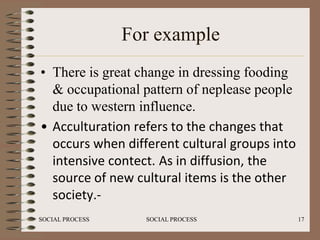
• There is great change in dressing fooding
  & occupational pattern of neplease people
  due to western influence.
• Acculturation refers to the changes that
  occurs when different cultural groups into
  intensive contect. As in diffusion, the
  source of new cultural items is the other
  society.-
SOCIAL PROCESS     SOCIAL PROCESS              17
ASSIMILATION
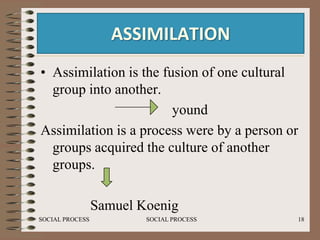
• Assimilation is the fusion of one cultural
  group into another.
                        yound
Assimilation is a process were by a person or
  groups acquired the culture of another
  groups.

                 Samuel Koenig
SOCIAL PROCESS           SOCIAL PROCESS     18
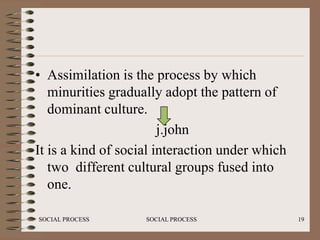
• Assimilation is the process by which
   minurities gradually adopt the pattern of
   dominant culture.
                        j.john
It is a kind of social interaction under which
   two different cultural groups fused into
   one.

SOCIAL PROCESS      SOCIAL PROCESS               19
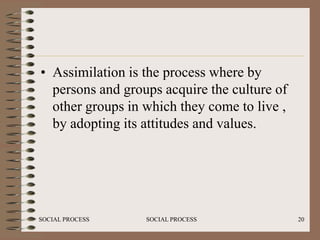
• Assimilation is the process where by
  persons and groups acquire the culture of
  other groups in which they come to live ,
  by adopting its attitudes and values.


SOCIAL PROCESS    SOCIAL PROCESS              20
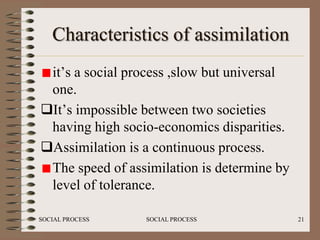
Characteristics of assimilation
 it’s a social process ,slow but universal
 one.
It’s impossible between two societies
 having high socio-economics disparities.
Assimilation is a continuous process.
 The speed of assimilation is determine by
 level of tolerance.

SOCIAL PROCESS   SOCIAL PROCESS              21
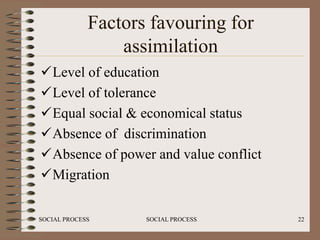
Factors favouring for
                 assimilation
Level of education
Level of tolerance
Equal social & economical status
Absence of discrimination
Absence of power and value conflict
Migration

SOCIAL PROCESS      SOCIAL PROCESS     22
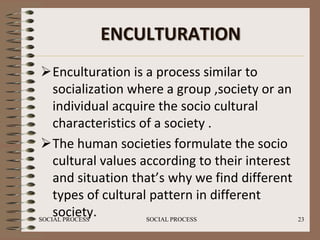
ENCULTURATION
 Enculturation is a process similar to
    socialization where a group ,society or an
    individual acquire the socio cultural
    characteristics of a society .
 The human societies formulate the socio
    cultural values according to their interest
    and situation that’s why we find different
    types of cultural pattern in different
    society.
SOCIAL PROCESS       SOCIAL PROCESS               23
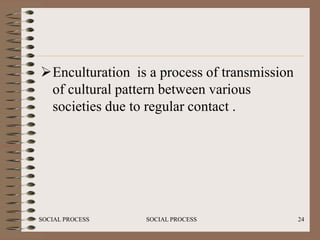
Enculturation is a process of transmission
 of cultural pattern between various
 societies due to regular contact .


SOCIAL PROCESS   SOCIAL PROCESS               24
“Enculturation refers to the process where
  by individual members of a society acquire
  the characteristics of a give culture
  learning language and generally acquiring
  competence in the culture”
                                   miller


SOCIAL PROCESS    SOCIAL PROCESS            25
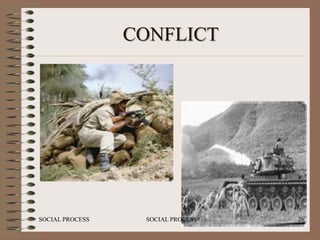
CONFLICT


SOCIAL PROCESS    SOCIAL PROCESS   26
• Conflict means struggle between the two
  persons or groups having opposite
  ideology and interest.
• Conflict is social process in which
  individual or group seek their ends by
  directly challenging the antagonist by
  violence or threat of violence .-
                              Gillin &Gillin
SOCIAL PROCESS    SOCIAL PROCESS               27
• Conflict mostly brings negative results. Its
  negative results outweigh its positive
  results.

• Conflict is universal but not continuous .it
  is intermittent.


SOCIAL PROCESS     SOCIAL PROCESS                28
• Conflict is a competition in its more
  occasional, personnel and hostile forms. It
  is a process of seeking to obtain rewards by
  eliminating or weakening the competitors.


SOCIAL PROCESS    SOCIAL PROCESS             29
Causes of conflict
Social and culture differences.
Group differences.
Class of interest.
Individual differences or interest.
Social change &technology .


SOCIAL PROCESS        SOCIAL PROCESS   30
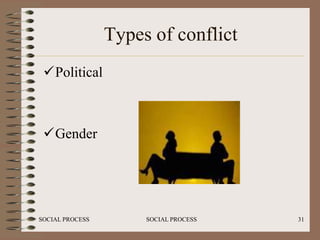
Types of conflict
 Political


 Gender


SOCIAL PROCESS        SOCIAL PROCESS   31
caste:
   a sense of “highness” and “lowness” of
 “superiority” and “inferiority” of “holy”
 and “unholy” which some caste group
 have developed have been responsible for
 caste conflict


SOCIAL PROCESS   SOCIAL PROCESS              32
Racial : racial conflict is mostly due to the
 physiological differences which are
 apparently seen among people .(e.g. conflict
 between whites &negroes)

 International conflict : it refers to conflict
    between two or more nation and group of
    nations .it may take place for politics
    ,religious, economics so on.
SOCIAL PROCESS       SOCIAL PROCESS                33
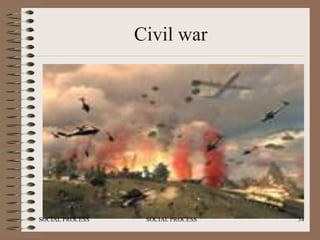
Civil war


SOCIAL PROCESS    SOCIAL PROCESS   34
Characteristics

    conflict is universal.
   Conflict is conscious action as its guided by
   strong human emotions and passions.
   Cast conflict in neplease societies where
   as racial conflict in USA.
    conflict may be personal or impersonal.
   Frustration and insecurity always
   promotes conflict.
SOCIAL PROCESS       SOCIAL PROCESS            35
SOCIAL PROCESS   SOCIAL PROCESS   36
Difference between human
             &animal
     their activities and interests, humans and
    animals have several characteristics in
    common:
  Animals eat. Human beings also have to
    eat.
  Animals sleep. Human beings also need
    sleep.
  Animals have sex to procreate. Humans
    also have
SOCIAL PROCESS         SOCIAL PROCESS           37
There are many differences between
 human and animals.
Language : language is the great thing that
 human being have but animals do not
 have their language through some
 symbolic signs were recognized by
 biologists.

SOCIAL PROCESS   SOCIAL PROCESS            38
Civilization &culture :human beings are
    civilized and they do have culture but
    animals are neither civilized not they do
    have any sort of culture.
 Social awareness : man is a social animal
    and he is always aware of the society and
    culture .he obeys norms, values and
    traditions if his culture but animals do not
    have social awareness.
SOCIAL PROCESS         SOCIAL PROCESS            39
Rights &duties : human beings have their
    certain rights and duties to perform .but
    animals do not have any rights and duties.
 Consciousnesss : human being is always
    conscious. they think and do . They do not
    only “do”. But animals do not have high
    brain to be attractive and conscious.
    Human beings brain is flexible but animals
    do not have flexible PROCESS
SOCIAL PROCESS       SOCIAL
                            brain.             40
• The distinction between the human form of
  life and the animal form of life is not that
  humans sleep on beds and animals sleep on
  the ground.
• humans walk on two legs and many
  animals walk on four legs or many animal
  and almost all birds walk on two legs ( e.g.
  “animal "kangaroos ,”bird "parrots )
SOCIAL PROCESS    SOCIAL PROCESS             41
REFERENCE
• C.N shanker Rao,
A text book of sociology
• Google search


SOCIAL PROCESS   SOCIAL PROCESS     42
SOCIAL PROCESS   SOCIAL PROCESS   43

Sociology presentation

  • 1.
  • 2.
    SOCIALIZATION Presented by: • Kalpana Gurung • Purnima Timilsina • Rajesh Kumar Yadav • SAgun PAudel Public Health Students @LA grandee International college SOCIAL PROCESS SOCIAL PROCESS 2
  • 3.
    SOCIALIZATION • It isthe process of learning ,one’s own culture values &norms. • It is a kind of social & cultural training given by society & culture to an individual so that he or she may develop a balance personality in future.
  • 4.
    CONT…….. Different definition • Accordingto Bogardus”socialization is the process of working together of developing group responsibility, or being guided by the welfare needs of others. • W.F Ogburn”socialization is the process by which the individual learns to conform to the norms of the group.
  • 5.
    • According toPeter Worsely “socialization as the process of transmission of culture the process where by men learn the rules and practice of social group.
  • 6.
    Agent or agenciesof socialization 1. Family & Parents :socialization process begins from the family. The parental &maternal influence in the is very great. 2. Peers group:peers begin to be an influence at a very young age, as children form friendship with other children.
  • 7.
    • The peerculture becomes more important & effective than the parental culture in the adolescent year of child. 3. Teachers :it is in the school that the culture is formally transmitted & acquired . • The learning ,the science and art, of one generation is passed on to the next.
  • 8.
    4. Literature &mass media of communication: The civilization that we share is constructed of words or literature. • The media radio,TV,magazine newspaper gives the message in capsule form the premises of our culture its attitude & ideologies.
  • 9.
    Stage of socialization 1.The oral stage: • This stage begins with the birth of the child & continuous up to the completion of 1year . • Before the birth the child in the mother’s womb is in the foetal forms &is warm & comfortable. • By means of crying the child establishes its oral dependency . The child learns to give signals for his felt needs &involved in himself & his mother.
  • 10.
    • The Analstage: • This stage begins soon after 1 year of age of the child & continues up to the completion of 3 years. • The child is taught to do some tasks such as toileting, keeping clothes clean e.t.c • In this stage the mother plays the dual role which helps the child to participate in a more complex social system.
  • 11.
    • The oedipalstage: • This stage mostly starts from the 4th year of child &extends up to the age of 12-13 years. • It is the stage the child becomes the member of the family . • The child has to identify himself with the social role ascribed to him on the basis of his sex. • According to Freud  The boy develops the Oedipus complex  The girl develops the Electra complex.
  • 12.
    • The Adolescencestage: • This stage starts with the period of adolescence • During this stage the boys & girls try to becomes free from parental control but can’t completely escape from the dependence on their parents. • The parents encourage them to select their line of education their occupation &their life partners.
  • 13.
    • The Adolescencestage: • This stage starts with the period of adolescence • During this stage the boys & girls try to becomes free from parental control but can’t completely escape from the dependence on their parents. • The parents encourage them to select their line of education their occupation &their life partners.
  • 14.
  • 15.
    ACCULTURATION • When acultural group or individuals adopt some parts of others culture, it is called acculturation. • According to Redfield “ acculturation comprehense those phenomenon which results when groups of individual having different cultures come into continuous first hand contact with subsequent changes in the original cultural pattern of either one or both groups.
  • 16.
    Characteristics of acculturation 1.Two way process 2. Acculturation is both optional or force 3. Cultural transmission process 4. Based on the theory of selectivity 5. Cultural contact or begins with cultural contact 6. Process of cultural diffusion
  • 17.
    For example • Thereis great change in dressing fooding & occupational pattern of neplease people due to western influence. • Acculturation refers to the changes that occurs when different cultural groups into intensive contect. As in diffusion, the source of new cultural items is the other society.- SOCIAL PROCESS SOCIAL PROCESS 17
  • 18.
    ASSIMILATION • Assimilation isthe fusion of one cultural group into another. yound Assimilation is a process were by a person or groups acquired the culture of another groups. Samuel Koenig SOCIAL PROCESS SOCIAL PROCESS 18
  • 19.
    • Assimilation isthe process by which minurities gradually adopt the pattern of dominant culture. j.john It is a kind of social interaction under which two different cultural groups fused into one. SOCIAL PROCESS SOCIAL PROCESS 19
  • 20.
    • Assimilation isthe process where by persons and groups acquire the culture of other groups in which they come to live , by adopting its attitudes and values. SOCIAL PROCESS SOCIAL PROCESS 20
  • 21.
    Characteristics of assimilation it’s a social process ,slow but universal one. It’s impossible between two societies having high socio-economics disparities. Assimilation is a continuous process. The speed of assimilation is determine by level of tolerance. SOCIAL PROCESS SOCIAL PROCESS 21
  • 22.
    Factors favouring for assimilation Level of education Level of tolerance Equal social & economical status Absence of discrimination Absence of power and value conflict Migration SOCIAL PROCESS SOCIAL PROCESS 22
  • 23.
    ENCULTURATION Enculturation isa process similar to socialization where a group ,society or an individual acquire the socio cultural characteristics of a society . The human societies formulate the socio cultural values according to their interest and situation that’s why we find different types of cultural pattern in different society. SOCIAL PROCESS SOCIAL PROCESS 23
  • 24.
    Enculturation is aprocess of transmission of cultural pattern between various societies due to regular contact . SOCIAL PROCESS SOCIAL PROCESS 24
  • 25.
    “Enculturation refers tothe process where by individual members of a society acquire the characteristics of a give culture learning language and generally acquiring competence in the culture” miller SOCIAL PROCESS SOCIAL PROCESS 25
  • 26.
    CONFLICT SOCIAL PROCESS SOCIAL PROCESS 26
  • 27.
    • Conflict meansstruggle between the two persons or groups having opposite ideology and interest. • Conflict is social process in which individual or group seek their ends by directly challenging the antagonist by violence or threat of violence .- Gillin &Gillin SOCIAL PROCESS SOCIAL PROCESS 27
  • 28.
    • Conflict mostlybrings negative results. Its negative results outweigh its positive results. • Conflict is universal but not continuous .it is intermittent. SOCIAL PROCESS SOCIAL PROCESS 28
  • 29.
    • Conflict isa competition in its more occasional, personnel and hostile forms. It is a process of seeking to obtain rewards by eliminating or weakening the competitors. SOCIAL PROCESS SOCIAL PROCESS 29
  • 30.
    Causes of conflict Socialand culture differences. Group differences. Class of interest. Individual differences or interest. Social change &technology . SOCIAL PROCESS SOCIAL PROCESS 30
  • 31.
    Types of conflict Political Gender SOCIAL PROCESS SOCIAL PROCESS 31
  • 32.
    caste: a sense of “highness” and “lowness” of “superiority” and “inferiority” of “holy” and “unholy” which some caste group have developed have been responsible for caste conflict SOCIAL PROCESS SOCIAL PROCESS 32
  • 33.
    Racial : racialconflict is mostly due to the physiological differences which are apparently seen among people .(e.g. conflict between whites &negroes) International conflict : it refers to conflict between two or more nation and group of nations .it may take place for politics ,religious, economics so on. SOCIAL PROCESS SOCIAL PROCESS 33
  • 34.
    Civil war SOCIAL PROCESS SOCIAL PROCESS 34
  • 35.
    Characteristics conflict is universal. Conflict is conscious action as its guided by strong human emotions and passions. Cast conflict in neplease societies where as racial conflict in USA. conflict may be personal or impersonal. Frustration and insecurity always promotes conflict. SOCIAL PROCESS SOCIAL PROCESS 35
  • 36.
    SOCIAL PROCESS SOCIAL PROCESS 36
  • 37.
    Difference between human &animal their activities and interests, humans and animals have several characteristics in common:  Animals eat. Human beings also have to eat.  Animals sleep. Human beings also need sleep.  Animals have sex to procreate. Humans also have SOCIAL PROCESS SOCIAL PROCESS 37
  • 38.
    There are manydifferences between human and animals. Language : language is the great thing that human being have but animals do not have their language through some symbolic signs were recognized by biologists. SOCIAL PROCESS SOCIAL PROCESS 38
  • 39.
    Civilization &culture :humanbeings are civilized and they do have culture but animals are neither civilized not they do have any sort of culture. Social awareness : man is a social animal and he is always aware of the society and culture .he obeys norms, values and traditions if his culture but animals do not have social awareness. SOCIAL PROCESS SOCIAL PROCESS 39
  • 40.
    Rights &duties :human beings have their certain rights and duties to perform .but animals do not have any rights and duties. Consciousnesss : human being is always conscious. they think and do . They do not only “do”. But animals do not have high brain to be attractive and conscious. Human beings brain is flexible but animals do not have flexible PROCESS SOCIAL PROCESS SOCIAL brain. 40
  • 41.
    • The distinctionbetween the human form of life and the animal form of life is not that humans sleep on beds and animals sleep on the ground. • humans walk on two legs and many animals walk on four legs or many animal and almost all birds walk on two legs ( e.g. “animal "kangaroos ,”bird "parrots ) SOCIAL PROCESS SOCIAL PROCESS 41
  • 42.
    REFERENCE • C.N shankerRao, A text book of sociology • Google search SOCIAL PROCESS SOCIAL PROCESS 42
  • 43.
    SOCIAL PROCESS SOCIAL PROCESS 43