Bataan Peninsula State University
Balanga City
Graduate School
Culture Change
Prepared by:
YOLANDA D. REYES
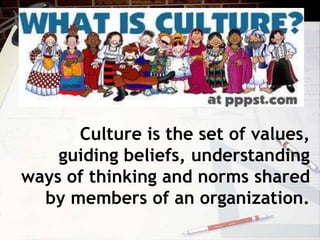
Culture is the set of values,
guiding beliefs, understanding
ways of thinking and norms shared
by members of an organization.
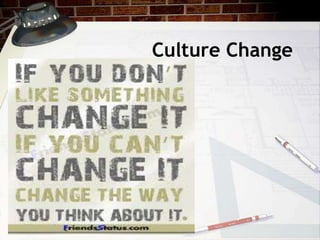
Culture Change
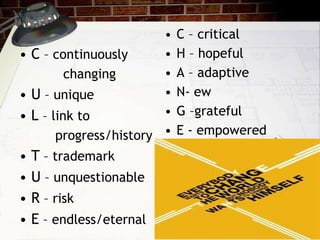
• C – continuously
changing
• U – unique
• L – link to
progress/history
• T – trademark
• U – unquestionable
• R – risk
• E – endless/eternal
• C – critical
• H – hopeful
• A – adaptive
• N- ew
• G –grateful
• E - empowered
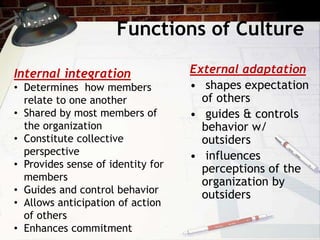
Functions of Culture
External adaptation
• shapes expectation
of others
• guides & controls
behavior w/
outsiders
• influences
perceptions of the
organization by
outsiders
Internal integration
• Determines how members
relate to one another
• Shared by most members of
the organization
• Constitute collective
perspective
• Provides sense of identity for
members
• Guides and control behavior
• Allows anticipation of action
of others
• Enhances commitment
Societies continually experience
cultural change both material
and non material level
• Material culture – computers and electronic
coding have made it possible to create a
unique health identifier for each person in
Canada. This would enable us to make a data
base that included everyone’s individual
medical records from birth to death-it could
be used by health providers and insurance
companies to transfer medical records
anywhere quickly BUT
Societies continually experience
cultural change both material
and non material level
• The available tech does not mean that it
will be accepted by the people who
believe (non-material culture) that such a
national data bank would be an invasion
of privacy that could be abused by other.
Culture change is a
process
• Cultures change in 3 ways:
• Discovery – the process of learning
about something previously unknown or
recognized
• Invention – the process of reshaping
existing cultural items into a new form
Items of material culture are more likely candidates
for diffusion than ideas or behavior patterns.
• Diffusion – the transmission of cultural
items or social practices from one group
or society to another.
• How does diffusion occur?
• exploration
• Media
• Tourism
• immigration
Other causes of cultural
change
• Pressure arising from:
• Political ideas
• Environmental concerns
• Health concerns
• Social issues
Cultural lag – a gap between the
technical development of a
society and its moral and legal
institution.
• This happens when material culture
changes faster than non material culture,
and it creates a lag (space) between the
2 cultural components.
Cultural lag is present
when:
• One generation of the culture may
adapt to change quickly while another
does not.
• Computers, ipod, e mail, chatting etc,
most young people have mastered this
technology while parents/grandparents
are unable to operate or understand
this technology.
Cultural diffusion or
cultural confusion?
• Kentucky Fried Chicken
• “Finger lickin’ good”
• In China: “Eat your fingers off”
• Pepsi
• “Come alive with the Pepsi Generation”
• Translated into Tawainese as:
• “Pepsi will bring your ancestors back from the
dead”
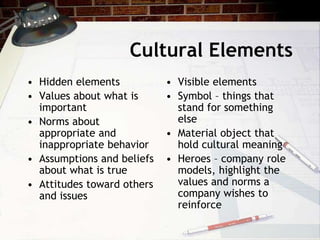
Cultural Elements
• Hidden elements
• Values about what is
important
• Norms about
appropriate and
inappropriate behavior
• Assumptions and beliefs
about what is true
• Attitudes toward others
and issues
• Visible elements
• Symbol – things that
stand for something
else
• Material object that
hold cultural meaning
• Heroes – company role
models, highlight the
values and norms a
company wishes to
reinforce
Tools for change
• Information
• Support
• resources
"Unless you are prepared to give up
something valuable you will never be able
to truly change at all, because you'll be
forever in the control of things you can't
give up."
— Andy Law
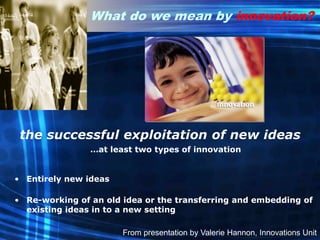
What do we mean by innovation?
the successful exploitation of new ideas
…at least two types of innovation
• Entirely new ideas
• Re-working of an old idea or the transferring and embedding of
existing ideas in to a new setting
From presentation by Valerie Hannon, Innovations Unit
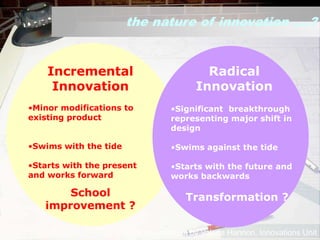
the nature of innovation ….?
Incremental
Innovation
•Minor modifications to
existing product
•Swims with the tide
•Starts with the present
and works forward
School
improvement ?
Radical
Innovation
•Significant breakthrough
representing major shift in
design
•Swims against the tide
•Starts with the future and
works backwards
Transformation ?
From presentation by Valerie Hannon, Innovations Unit
• Social change is the transformation of
culture and social organisation/structure
over time.
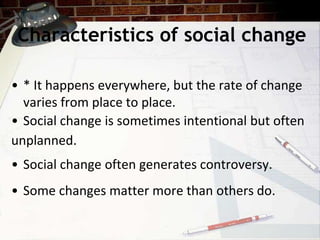
Characteristics of social change
• * It happens everywhere, but the rate of change
varies from place to place.
• Social change is sometimes intentional but often
unplanned.
• Social change often generates controversy.
• Some changes matter more than others do.
What causes social change?
• 1. culture
• 2. conflict
• 3. idealistic power
• 4.The need for adaptation
• 5. environmental factor
• 6. economic and political advantage
• 7.demographic factor
• 8.social movement and change
Teacher as a culture
broker
• Culture broking – act of bridging, linking or
mediating between groups or persons of
differing cultural backgrounds on the
purpose of reducing conflicts or producing
change .
• In teaching, emphasis is on the teacher
becoming the culture broker between
themselves and their students at a
personal level but also as facilitating
Cultural broker – person who facilitates
the border crossing of another person or
group of people from one culture to
another culture. (Jezewski,2001)
• Skills necessary for teachers to become
culture brokers:
• 1. acquiring cultural knowledge
• 2. becoming change agents
• 3. translating knowledge into practice
Roles of Teachers
• 1. cultural organizers – who facilitate
strategic ways of accomplishing tasks
so that the learning process involves
varied ways of knowing, experiencing,
thinking and behaving.
• 2. cultural mediators – who create
opportunities for critical dialogues and
behaving.
• 3. orchestrators of social contexts –
who provide several learning
configurations including interpersonal
and intrapersonal opportunities for
seeking, accessing and evaluating
knowledge
As managers,principals, and soon to
be principals we need to be a culture
broker and as a culture broker we
need to be sensitive to look for
symbols that we can use to bridge the
gap. It’s not difficult to be a culture
broker only if we know how.
© Blood and Thorsborne, 2005
Culture is the result of messages that are
received about what is really valued. People
align their behaviour to these messages in
order to fit in. Changing culture requires a
systematic and planned change to these
messages, whose sources are behaviour,
symbols and systems.
Taylor, 2004

Culture change

  • 1.
    Bataan Peninsula StateUniversity Balanga City Graduate School Culture Change Prepared by: YOLANDA D. REYES
  • 2.
    Culture is theset of values, guiding beliefs, understanding ways of thinking and norms shared by members of an organization.
  • 4.
  • 5.
    • C –continuously changing • U – unique • L – link to progress/history • T – trademark • U – unquestionable • R – risk • E – endless/eternal • C – critical • H – hopeful • A – adaptive • N- ew • G –grateful • E - empowered
  • 6.
    Functions of Culture Externaladaptation • shapes expectation of others • guides & controls behavior w/ outsiders • influences perceptions of the organization by outsiders Internal integration • Determines how members relate to one another • Shared by most members of the organization • Constitute collective perspective • Provides sense of identity for members • Guides and control behavior • Allows anticipation of action of others • Enhances commitment
  • 7.
    Societies continually experience culturalchange both material and non material level • Material culture – computers and electronic coding have made it possible to create a unique health identifier for each person in Canada. This would enable us to make a data base that included everyone’s individual medical records from birth to death-it could be used by health providers and insurance companies to transfer medical records anywhere quickly BUT
  • 8.
    Societies continually experience culturalchange both material and non material level • The available tech does not mean that it will be accepted by the people who believe (non-material culture) that such a national data bank would be an invasion of privacy that could be abused by other.
  • 9.
    Culture change isa process • Cultures change in 3 ways: • Discovery – the process of learning about something previously unknown or recognized • Invention – the process of reshaping existing cultural items into a new form
  • 10.
    Items of materialculture are more likely candidates for diffusion than ideas or behavior patterns. • Diffusion – the transmission of cultural items or social practices from one group or society to another. • How does diffusion occur? • exploration • Media • Tourism • immigration
  • 11.
    Other causes ofcultural change • Pressure arising from: • Political ideas • Environmental concerns • Health concerns • Social issues
  • 12.
    Cultural lag –a gap between the technical development of a society and its moral and legal institution. • This happens when material culture changes faster than non material culture, and it creates a lag (space) between the 2 cultural components.
  • 13.
    Cultural lag ispresent when: • One generation of the culture may adapt to change quickly while another does not. • Computers, ipod, e mail, chatting etc, most young people have mastered this technology while parents/grandparents are unable to operate or understand this technology.
  • 14.
    Cultural diffusion or culturalconfusion? • Kentucky Fried Chicken • “Finger lickin’ good” • In China: “Eat your fingers off” • Pepsi • “Come alive with the Pepsi Generation” • Translated into Tawainese as: • “Pepsi will bring your ancestors back from the dead”
  • 15.
    Cultural Elements • Hiddenelements • Values about what is important • Norms about appropriate and inappropriate behavior • Assumptions and beliefs about what is true • Attitudes toward others and issues • Visible elements • Symbol – things that stand for something else • Material object that hold cultural meaning • Heroes – company role models, highlight the values and norms a company wishes to reinforce
  • 16.
    Tools for change •Information • Support • resources "Unless you are prepared to give up something valuable you will never be able to truly change at all, because you'll be forever in the control of things you can't give up." — Andy Law
  • 17.
    What do wemean by innovation? the successful exploitation of new ideas …at least two types of innovation • Entirely new ideas • Re-working of an old idea or the transferring and embedding of existing ideas in to a new setting From presentation by Valerie Hannon, Innovations Unit
  • 18.
    the nature ofinnovation ….? Incremental Innovation •Minor modifications to existing product •Swims with the tide •Starts with the present and works forward School improvement ? Radical Innovation •Significant breakthrough representing major shift in design •Swims against the tide •Starts with the future and works backwards Transformation ? From presentation by Valerie Hannon, Innovations Unit
  • 19.
    • Social changeis the transformation of culture and social organisation/structure over time.
  • 20.
    Characteristics of socialchange • * It happens everywhere, but the rate of change varies from place to place. • Social change is sometimes intentional but often unplanned. • Social change often generates controversy. • Some changes matter more than others do.
  • 21.
    What causes socialchange? • 1. culture • 2. conflict • 3. idealistic power • 4.The need for adaptation • 5. environmental factor • 6. economic and political advantage • 7.demographic factor • 8.social movement and change
  • 23.
    Teacher as aculture broker • Culture broking – act of bridging, linking or mediating between groups or persons of differing cultural backgrounds on the purpose of reducing conflicts or producing change . • In teaching, emphasis is on the teacher becoming the culture broker between themselves and their students at a personal level but also as facilitating
  • 24.
    Cultural broker –person who facilitates the border crossing of another person or group of people from one culture to another culture. (Jezewski,2001) • Skills necessary for teachers to become culture brokers: • 1. acquiring cultural knowledge • 2. becoming change agents • 3. translating knowledge into practice
  • 25.
    Roles of Teachers •1. cultural organizers – who facilitate strategic ways of accomplishing tasks so that the learning process involves varied ways of knowing, experiencing, thinking and behaving. • 2. cultural mediators – who create opportunities for critical dialogues and behaving.
  • 26.
    • 3. orchestratorsof social contexts – who provide several learning configurations including interpersonal and intrapersonal opportunities for seeking, accessing and evaluating knowledge
  • 29.
    As managers,principals, andsoon to be principals we need to be a culture broker and as a culture broker we need to be sensitive to look for symbols that we can use to bridge the gap. It’s not difficult to be a culture broker only if we know how.
  • 30.
    © Blood andThorsborne, 2005 Culture is the result of messages that are received about what is really valued. People align their behaviour to these messages in order to fit in. Changing culture requires a systematic and planned change to these messages, whose sources are behaviour, symbols and systems. Taylor, 2004