SocialSensor: Sensing User Generated Input for
Improved Media Discovery and Experience
Topic discovery in tweeter streams


Dr. Yiannis Kompatsiaris, Project Coordinator
International Workshop on Search Computing, Brussels, 25 September 2012
Overview

•   Motivation
•   Objectives
•   Architecture
•   Use Cases and Requirements
    – News
    – Infotainment
• Research Activities and Results
    – Topic Discovery in Tweeter Streams
• Conclusions


                                 #2
What is SocialSensor?

• 3-year FP7 European Integrated Project
   – http://www.socialsensor.eu

• Members: CERTH, ATC (Greece), Deutsche Welle,
  University Koblenz, Research Center for Artificial
  Intelligence (Germany), The City University London,
  Alcatel – Lucent Bell Labs, JCP Consult (France),
  University of Klagenfurt (Austria), IBM Israel, Yahoo
  Iberia

• 1 year into the project (Development of user
  requirements, use case scenarios, architecture study and
  implementation and first R&D prototypes)


                                  #3
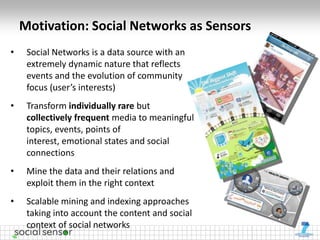
Motivation: Social Networks as Sensors
•    Social Networks is a data source with an
     extremely dynamic nature that reflects
     events and the evolution of community
     focus (user’s interests)
•    Transform individually rare but
     collectively frequent media to meaningful
     topics, events, points of
     interest, emotional states and social
     connections
•    Mine the data and their relations and
     exploit them in the right context
•    Scalable mining and indexing approaches
     taking into account the content and social
     context of social networks
Relevant Applications
Xin Jin, Andrew Gallagher, Liangliang Cao, Jiebo Luo, and
Jiawei Han. The wisdom of social multimedia:
using flickr for prediction and
forecast, International conference on Multimedia (MM
'10). ACM.


                                                                      Federal Emergency Management Agency plans to
                                                                      engage the public more in disaster response by
                                                                      sharing data and leveraging reports from mobile
                                                                      phones and social media


                                                            “…if you're more than 100 km away from the epicenter
                                                                [of an earthquake] you can read about the quake on
                                                                twitter before it hits you…”


                                                                       5
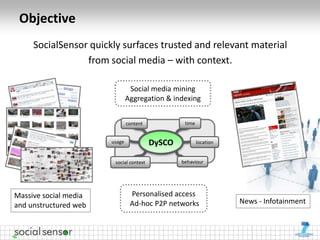
Objective
     SocialSensor quickly surfaces trusted and relevant material
                 from social media – with context.

                                Social media mining
                               Aggregation & indexing


                               content            time


                       usage             DySCO           location


                        social context           behaviour


Massive social media            Personalised access
and unstructured web            Ad-hoc P2P networks                 News - Infotainment
The SocialSensor Vision

  SocialSensor quickly surfaces trusted and relevant
      material from social media – with context.

•“quickly”: in real time
•“surfaces”: automatically discovers, clusters and searches
•“trusted”: automatic support in verification process
•“relevant”: to the users, personalized
•“material”: any material (text, image, audio, video =
multimedia), aggregated with other sources (e.g. web)
•“social media”: across all relevant social media platforms
•“with context”: location, time, sentiment, influence

                                  #7
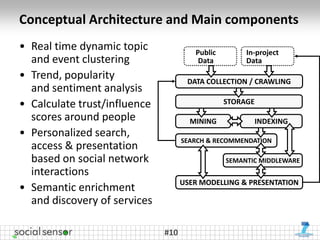
Conceptual Architecture and Main components
• Real time dynamic topic              Public        In-project
  and event clustering                  Data         Data
• Trend, popularity                  DATA COLLECTION / CRAWLING
  and sentiment analysis
• Calculate trust/influence                     STORAGE

  scores around people                MINING              INDEXING
• Personalized search,
                                    SEARCH & RECOMMENDATION
  access & presentation
  based on social network                       SEMANTIC MIDDLEWARE
  interactions
                                    USER MODELLING & PRESENTATION
• Semantic enrichment
  and discovery of services

                              #10
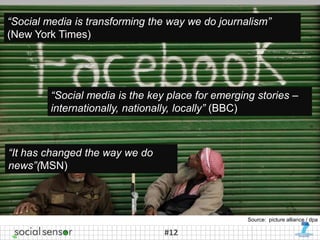
“Social media is transforming the way we do journalism”
(New York Times)


         “Social media is the key place for emerging stories –
         internationally, nationally, locally” (BBC)


“It has changed the way we do
news”(MSN)


                                                   Source: picture alliance / dpa

                                 #12
#13
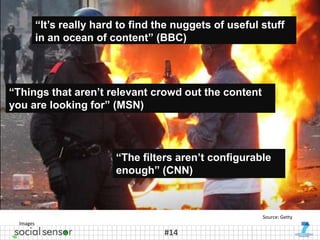
“It’s really hard to find the nuggets of useful stuff
           in an ocean of content” (BBC)


“Things that aren’t relevant crowd out the content
you are looking for” (MSN)


                            “The filters aren’t configurable
                            enough” (CNN)


                                                           Source: Getty
  Images
                                      #14
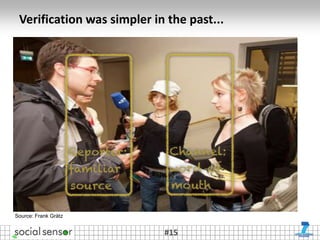
Verification was simpler in the past...


Source: Frank Grätz


                            #15
An example: BBC Verification Procedure: Arab
Spring Coverage
• Referencing locations against maps and existing images
  from, in particular, geo-located ones.
• Working with our colleagues in BBC Arabic and BBC
  Monitoring to ascertain that accents and language are
  correct for the location.
• Searching for the original source of the
  upload/sequences as an indicator of date.
• Examining weather reports and shadows to confirm that
  the conditions shown fit with the claimed date and time.
• Maintaining lists of previously verified material to act as
  reference for colleagues covering the stories.
• Checking scenery, weaponry, vehicles and licence plates
  against those known for the given country.

                               #16
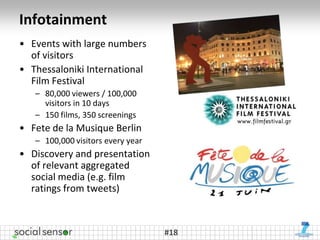
Infotainment
• Events with large numbers
  of visitors
• Thessaloniki International
  Film Festival
   – 80,000 viewers / 100,000
     visitors in 10 days
   – 150 films, 350 screenings
• Fete de la Musique Berlin
   – 100,000 visitors every year
• Discovery and presentation
  of relevant aggregated
  social media (e.g. film
  ratings from tweets)


                                   #18
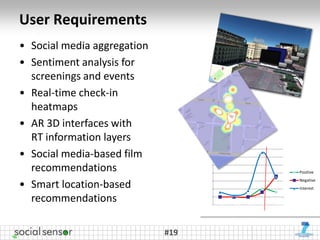
User Requirements
• Social media aggregation
• Sentiment analysis for
  screenings and events
• Real-time check-in
  heatmaps
• AR 3D interfaces with
  RT information layers
                                   30
• Social media-based film          25

  recommendations                  20
                                   15                                             Positive
                                   10                                             Negative
• Smart location-based              5                                             Interest

  recommendations                   0
                                   -5   Fri Mar Fri Mar Fri Mar Fri Mar Fri Mar
                                           06      07      08      09      10


                             #19
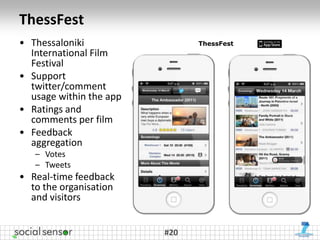
ThessFest
• Thessaloniki                 ThessFest
  International Film
  Festival
• Support
  twitter/comment
  usage within the app
• Ratings and
  comments per film
• Feedback
  aggregation
   – Votes
   – Tweets
• Real-time feedback
  to the organisation
  and visitors


                         #20
ThessFest

• Gather “realistic” user requirements
• Early showcase and evaluation of SocialSensor
  technologies in real-world event scale
• Engage users and create an informed user basis
• TDF14: 9-18 March 2012
   – 400+ users
   – 6500+ user sessions
   – positive response to social media
• Next version
   – Updated features
   – Android version

                                #21
Topic Discovery in Tweeter Streams
Giorgos Petkos, Symeon Papadopoulos, Yiannis Kompatsiaris,
Carlos Martin, David Corney, Ryan Skraba, Luca Aiello, Alex Jaimes, Yosi Mass


                                            #22
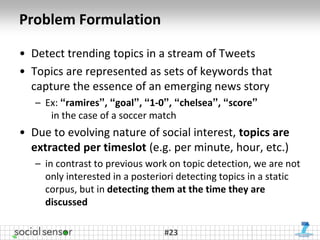
Problem Formulation

• Detect trending topics in a stream of Tweets
• Topics are represented as sets of keywords that
  capture the essence of an emerging news story
   – Ex: “ramires”, “goal”, “1-0”, “chelsea”, “score”
      in the case of a soccer match
• Due to evolving nature of social interest, topics are
  extracted per timeslot (e.g. per minute, hour, etc.)
   – in contrast to previous work on topic detection, we are not
     only interested in a posteriori detecting topics in a static
     corpus, but in detecting them at the time they are
     discussed

                                 #23
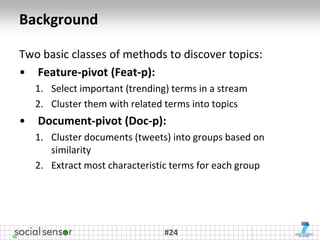
Background

Two basic classes of methods to discover topics:
• Feature-pivot (Feat-p):
    1. Select important (trending) terms in a stream
    2. Cluster them with related terms into topics
•   Document-pivot (Doc-p):
    1. Cluster documents (tweets) into groups based on
       similarity
    2. Extract most characteristic terms for each group


                                 #24
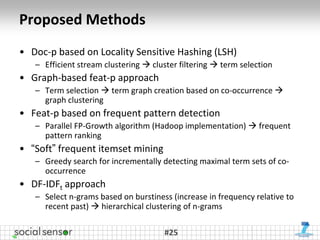
Proposed Methods
• Doc-p based on Locality Sensitive Hashing (LSH)
   – Efficient stream clustering  cluster filtering  term selection
• Graph-based feat-p approach
   – Term selection  term graph creation based on co-occurrence 
     graph clustering
• Feat-p based on frequent pattern detection
   – Parallel FP-Growth algorithm (Hadoop implementation)  frequent
     pattern ranking
• “Soft” frequent itemset mining
   – Greedy search for incrementally detecting maximal term sets of co-
     occurrence
• DF-IDFt approach
   – Select n-grams based on burstiness (increase in frequency relative to
     recent past)  hierarchical clustering of n-grams

                                      #25
Leveraging Influence
• Exploiting social context in the analysis procedure
• Assumption: Tweets coming from influential users
  are expected to be more relevant / less noisy
• Extract a first set of topics with previous TD methods
• Identify a set of influencers for each of those topics
   – Create content citation graph [nodes: users, edges:
     retweets], term profile for each edge based on RT text
   – Term- and topic-based subgraphs
   – Influence computation based on random walks
     (distributed computation on top of Hadoop)
• Filter original stream of Tweets taking into account
  only Tweets coming from influencers

                                #26
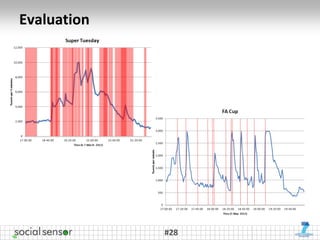
Evaluation

• Two datasets
   – Super Tuesday (ST): event in presidential nomination race for US
     Republican party [3.5M tweets, average 131 tweets/min]
   – FA Cup (FA): Chelsea vs. Liverpool [444K tweets, av. 148 tweets/min]
• Manual ground truth construction of set of interesting topics
   – Source: mainstream media reports
   – Representation: Set of topics (keywords + short headline) per timeslot
     [1-hour timeslot for ST, 1-minute for FA]
• Metrics
   – Topic recall (number of found target topics) [TRec]
   – Keyword-level recall [KRec] & precision [KPrec]
• Baseline
   – Latent Dirichlet Allocation (LDA)

                                         #27
Evaluation


             #28
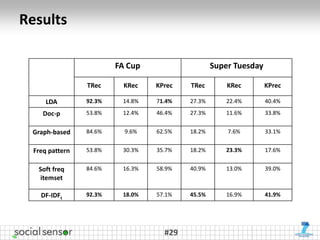
Results

                         FA Cup                   Super Tuesday

                 TRec      KRec   KPrec   TRec        KRec        KPrec

      LDA        92.3%    14.8%   71.4%   27.3%      22.4%        40.4%

     Doc-p       53.8%    12.4%   46.4%   27.3%      11.6%        33.8%


 Graph-based     84.6%     9.6%   62.5%   18.2%       7.6%        33.1%


  Freq pattern   53.8%    30.3%   35.7%   18.2%      23.3%        17.6%


   Soft freq     84.6%    16.3%   58.9%   40.9%      13.0%        39.0%
   itemset

    DF-IDFt      92.3%    18.0%   57.1%   45.5%      16.9%        41.9%


                                    #29
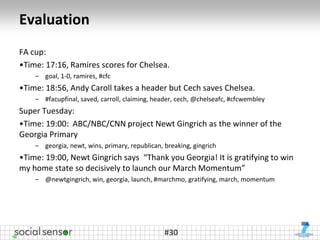
Evaluation
FA cup:
•Time: 17:16, Ramires scores for Chelsea.
    – goal, 1-0, ramires, #cfc
•Time: 18:56, Andy Caroll takes a header but Cech saves Chelsea.
    – #facupfinal, saved, carroll, claiming, header, cech, @chelseafc, #cfcwembley
Super Tuesday:
•Time: 19:00: ABC/NBC/CNN project Newt Gingrich as the winner of the
Georgia Primary
    – georgia, newt, wins, primary, republican, breaking, gingrich
•Time: 19:00, Newt Gingrich says “Thank you Georgia! It is gratifying to win
my home state so decisively to launch our March Momentum”
    – @newtgingrich, win, georgia, launch, #marchmo, gratifying, march, momentum


                                                #30
Mobile browsing of large image
collections on a smart phone


                  #31
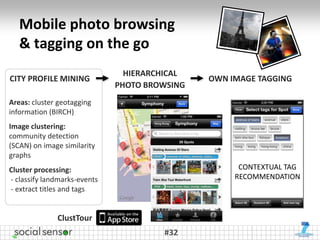
Mobile photo browsing
   & tagging on the go
                                HIERARCHICAL
CITY PROFILE MINING                            OWN IMAGE TAGGING
                              PHOTO BROWSING
Areas: cluster geotagging
information (BIRCH)
Image clustering:
community detection
(SCAN) on image similarity
graphs
Cluster processing:                                  CONTEXTUAL TAG
- classify landmarks-events                         RECOMMENDATION
- extract titles and tags


              ClustTour
                                       #32
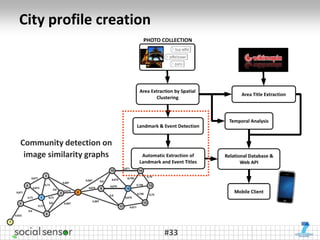
City profile creation


Community detection on
 image similarity graphs


                           #33
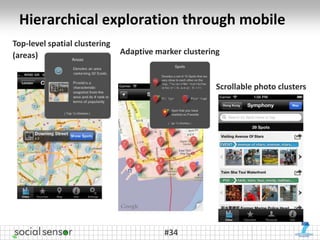
Hierarchical exploration through mobile
Top-level spatial clustering
(areas)                        Adaptive marker clustering


                                                        Scrollable photo clusters


                                          #34
Conclusions
• Great interest in both use cases
   • In news social media have transformed both news generation and
     consumption
• Social media data mining can provide interesting results in
  many applications
• Not all data always available (e.g. User queries, fb)
   – Infrastructure, Policy issues
• Technical challenges
   – Fusion (multi-modality, context), real-time, noise, big data,
     aggregation (web, Linked Open Data)
• Applications challenges
   • User engagement, privacy, copyright, commercialization
Thank you!

Socialsensor project overview and topic discovery in tweeter streams

  • 1.
    SocialSensor: Sensing UserGenerated Input for Improved Media Discovery and Experience Topic discovery in tweeter streams Dr. Yiannis Kompatsiaris, Project Coordinator International Workshop on Search Computing, Brussels, 25 September 2012
  • 2.
    Overview • Motivation • Objectives • Architecture • Use Cases and Requirements – News – Infotainment • Research Activities and Results – Topic Discovery in Tweeter Streams • Conclusions #2
  • 3.
    What is SocialSensor? •3-year FP7 European Integrated Project – http://www.socialsensor.eu • Members: CERTH, ATC (Greece), Deutsche Welle, University Koblenz, Research Center for Artificial Intelligence (Germany), The City University London, Alcatel – Lucent Bell Labs, JCP Consult (France), University of Klagenfurt (Austria), IBM Israel, Yahoo Iberia • 1 year into the project (Development of user requirements, use case scenarios, architecture study and implementation and first R&D prototypes) #3
  • 4.
    Motivation: Social Networksas Sensors • Social Networks is a data source with an extremely dynamic nature that reflects events and the evolution of community focus (user’s interests) • Transform individually rare but collectively frequent media to meaningful topics, events, points of interest, emotional states and social connections • Mine the data and their relations and exploit them in the right context • Scalable mining and indexing approaches taking into account the content and social context of social networks
  • 5.
    Relevant Applications Xin Jin,Andrew Gallagher, Liangliang Cao, Jiebo Luo, and Jiawei Han. The wisdom of social multimedia: using flickr for prediction and forecast, International conference on Multimedia (MM '10). ACM. Federal Emergency Management Agency plans to engage the public more in disaster response by sharing data and leveraging reports from mobile phones and social media “…if you're more than 100 km away from the epicenter [of an earthquake] you can read about the quake on twitter before it hits you…” 5
  • 6.
    Objective SocialSensor quickly surfaces trusted and relevant material from social media – with context. Social media mining Aggregation & indexing content time usage DySCO location social context behaviour Massive social media Personalised access and unstructured web Ad-hoc P2P networks News - Infotainment
  • 7.
    The SocialSensor Vision SocialSensor quickly surfaces trusted and relevant material from social media – with context. •“quickly”: in real time •“surfaces”: automatically discovers, clusters and searches •“trusted”: automatic support in verification process •“relevant”: to the users, personalized •“material”: any material (text, image, audio, video = multimedia), aggregated with other sources (e.g. web) •“social media”: across all relevant social media platforms •“with context”: location, time, sentiment, influence #7
  • 8.
    Conceptual Architecture andMain components • Real time dynamic topic Public In-project and event clustering Data Data • Trend, popularity DATA COLLECTION / CRAWLING and sentiment analysis • Calculate trust/influence STORAGE scores around people MINING INDEXING • Personalized search, SEARCH & RECOMMENDATION access & presentation based on social network SEMANTIC MIDDLEWARE interactions USER MODELLING & PRESENTATION • Semantic enrichment and discovery of services #10
  • 9.
    “Social media istransforming the way we do journalism” (New York Times) “Social media is the key place for emerging stories – internationally, nationally, locally” (BBC) “It has changed the way we do news”(MSN) Source: picture alliance / dpa #12
  • 10.
  • 11.
    “It’s really hardto find the nuggets of useful stuff in an ocean of content” (BBC) “Things that aren’t relevant crowd out the content you are looking for” (MSN) “The filters aren’t configurable enough” (CNN) Source: Getty Images #14
  • 12.
    Verification was simplerin the past... Source: Frank Grätz #15
  • 13.
    An example: BBCVerification Procedure: Arab Spring Coverage • Referencing locations against maps and existing images from, in particular, geo-located ones. • Working with our colleagues in BBC Arabic and BBC Monitoring to ascertain that accents and language are correct for the location. • Searching for the original source of the upload/sequences as an indicator of date. • Examining weather reports and shadows to confirm that the conditions shown fit with the claimed date and time. • Maintaining lists of previously verified material to act as reference for colleagues covering the stories. • Checking scenery, weaponry, vehicles and licence plates against those known for the given country. #16
  • 14.
    Infotainment • Events withlarge numbers of visitors • Thessaloniki International Film Festival – 80,000 viewers / 100,000 visitors in 10 days – 150 films, 350 screenings • Fete de la Musique Berlin – 100,000 visitors every year • Discovery and presentation of relevant aggregated social media (e.g. film ratings from tweets) #18
  • 15.
    User Requirements • Socialmedia aggregation • Sentiment analysis for screenings and events • Real-time check-in heatmaps • AR 3D interfaces with RT information layers 30 • Social media-based film 25 recommendations 20 15 Positive 10 Negative • Smart location-based 5 Interest recommendations 0 -5 Fri Mar Fri Mar Fri Mar Fri Mar Fri Mar 06 07 08 09 10 #19
  • 16.
    ThessFest • Thessaloniki ThessFest International Film Festival • Support twitter/comment usage within the app • Ratings and comments per film • Feedback aggregation – Votes – Tweets • Real-time feedback to the organisation and visitors #20
  • 17.
    ThessFest • Gather “realistic”user requirements • Early showcase and evaluation of SocialSensor technologies in real-world event scale • Engage users and create an informed user basis • TDF14: 9-18 March 2012 – 400+ users – 6500+ user sessions – positive response to social media • Next version – Updated features – Android version #21
  • 18.
    Topic Discovery inTweeter Streams Giorgos Petkos, Symeon Papadopoulos, Yiannis Kompatsiaris, Carlos Martin, David Corney, Ryan Skraba, Luca Aiello, Alex Jaimes, Yosi Mass #22
  • 19.
    Problem Formulation • Detecttrending topics in a stream of Tweets • Topics are represented as sets of keywords that capture the essence of an emerging news story – Ex: “ramires”, “goal”, “1-0”, “chelsea”, “score” in the case of a soccer match • Due to evolving nature of social interest, topics are extracted per timeslot (e.g. per minute, hour, etc.) – in contrast to previous work on topic detection, we are not only interested in a posteriori detecting topics in a static corpus, but in detecting them at the time they are discussed #23
  • 20.
    Background Two basic classesof methods to discover topics: • Feature-pivot (Feat-p): 1. Select important (trending) terms in a stream 2. Cluster them with related terms into topics • Document-pivot (Doc-p): 1. Cluster documents (tweets) into groups based on similarity 2. Extract most characteristic terms for each group #24
  • 21.
    Proposed Methods • Doc-pbased on Locality Sensitive Hashing (LSH) – Efficient stream clustering  cluster filtering  term selection • Graph-based feat-p approach – Term selection  term graph creation based on co-occurrence  graph clustering • Feat-p based on frequent pattern detection – Parallel FP-Growth algorithm (Hadoop implementation)  frequent pattern ranking • “Soft” frequent itemset mining – Greedy search for incrementally detecting maximal term sets of co- occurrence • DF-IDFt approach – Select n-grams based on burstiness (increase in frequency relative to recent past)  hierarchical clustering of n-grams #25
  • 22.
    Leveraging Influence • Exploitingsocial context in the analysis procedure • Assumption: Tweets coming from influential users are expected to be more relevant / less noisy • Extract a first set of topics with previous TD methods • Identify a set of influencers for each of those topics – Create content citation graph [nodes: users, edges: retweets], term profile for each edge based on RT text – Term- and topic-based subgraphs – Influence computation based on random walks (distributed computation on top of Hadoop) • Filter original stream of Tweets taking into account only Tweets coming from influencers #26
  • 23.
    Evaluation • Two datasets – Super Tuesday (ST): event in presidential nomination race for US Republican party [3.5M tweets, average 131 tweets/min] – FA Cup (FA): Chelsea vs. Liverpool [444K tweets, av. 148 tweets/min] • Manual ground truth construction of set of interesting topics – Source: mainstream media reports – Representation: Set of topics (keywords + short headline) per timeslot [1-hour timeslot for ST, 1-minute for FA] • Metrics – Topic recall (number of found target topics) [TRec] – Keyword-level recall [KRec] & precision [KPrec] • Baseline – Latent Dirichlet Allocation (LDA) #27
  • 24.
  • 25.
    Results FA Cup Super Tuesday TRec KRec KPrec TRec KRec KPrec LDA 92.3% 14.8% 71.4% 27.3% 22.4% 40.4% Doc-p 53.8% 12.4% 46.4% 27.3% 11.6% 33.8% Graph-based 84.6% 9.6% 62.5% 18.2% 7.6% 33.1% Freq pattern 53.8% 30.3% 35.7% 18.2% 23.3% 17.6% Soft freq 84.6% 16.3% 58.9% 40.9% 13.0% 39.0% itemset DF-IDFt 92.3% 18.0% 57.1% 45.5% 16.9% 41.9% #29
  • 26.
    Evaluation FA cup: •Time: 17:16,Ramires scores for Chelsea. – goal, 1-0, ramires, #cfc •Time: 18:56, Andy Caroll takes a header but Cech saves Chelsea. – #facupfinal, saved, carroll, claiming, header, cech, @chelseafc, #cfcwembley Super Tuesday: •Time: 19:00: ABC/NBC/CNN project Newt Gingrich as the winner of the Georgia Primary – georgia, newt, wins, primary, republican, breaking, gingrich •Time: 19:00, Newt Gingrich says “Thank you Georgia! It is gratifying to win my home state so decisively to launch our March Momentum” – @newtgingrich, win, georgia, launch, #marchmo, gratifying, march, momentum #30
  • 27.
    Mobile browsing oflarge image collections on a smart phone #31
  • 28.
    Mobile photo browsing & tagging on the go HIERARCHICAL CITY PROFILE MINING OWN IMAGE TAGGING PHOTO BROWSING Areas: cluster geotagging information (BIRCH) Image clustering: community detection (SCAN) on image similarity graphs Cluster processing: CONTEXTUAL TAG - classify landmarks-events RECOMMENDATION - extract titles and tags ClustTour #32
  • 29.
    City profile creation Communitydetection on image similarity graphs #33
  • 30.
    Hierarchical exploration throughmobile Top-level spatial clustering (areas) Adaptive marker clustering Scrollable photo clusters #34
  • 31.
    Conclusions • Great interestin both use cases • In news social media have transformed both news generation and consumption • Social media data mining can provide interesting results in many applications • Not all data always available (e.g. User queries, fb) – Infrastructure, Policy issues • Technical challenges – Fusion (multi-modality, context), real-time, noise, big data, aggregation (web, Linked Open Data) • Applications challenges • User engagement, privacy, copyright, commercialization
  • 32.