


Business Friendly
                    Data Mining


James Taylor
       CEO
Your presenter – James Taylor
 CEO of Decision Management Solutions
 Works with clients to improve their
 business by applying analytic technology
 to automate & improve decisions
 Spent the last 9 years championing
 Decision Management and developing
 Decision Management Systems


                                   ©2012 Decision Management Solutions   1
Data Mining and Predictive
     Analytics WORK


                 ©2012 Decision Management Solutions   2
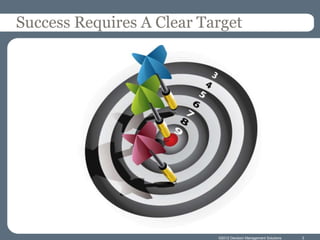
Success Requires A Clear Target


                           ©2012 Decision Management Solutions   3
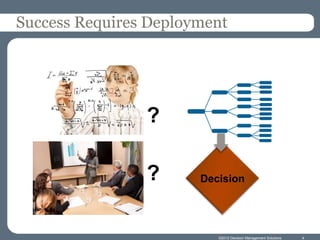
Success Requires Deployment


                ?

                ?      Decision


                          ©2012 Decision Management Solutions   4
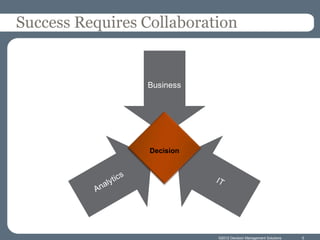
Success Requires Collaboration


                 Business


                  Decision


                             ©2012 Decision Management Solutions   5
Business-Friendly
     Data Mining
Decision Management is the
 proven approach used to
manage decisions, set goals
   for predictive analytic
 efforts, apply and deploy
    predictive analytics
          effectively
                  ©2012 Decision Management Solutions   7
Step 1


Be clear which decisions
   you are improving


                 ©2012 Decision Management Solutions   8
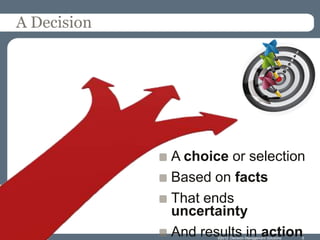
A Decision


             A choice or selection
             Based on facts
             That ends
             uncertainty
             And results in action
                    ©2012 Decision Management Solutions   9
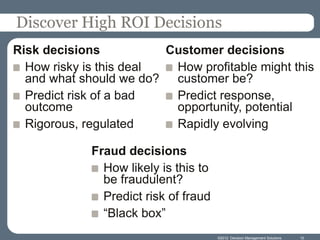
Discover High ROI Decisions
Risk decisions           Customer decisions
  How risky is this deal  How profitable might this
  and what should we do? customer be?
  Predict risk of a bad   Predict response,
  outcome                 opportunity, potential
  Rigorous, regulated     Rapidly evolving

             Fraud decisions
               How likely is this to
               be fraudulent?
               Predict risk of fraud
               “Black box”
                                       ©2012 Decision Management Solutions   10
Use Questions to Define Decisions
 For each decision
  Name
  Description
  Question and a defined set of allowable answers
  Any other results to be returned with the answer


                                  ©2012 Decision Management Solutions   11
Step 2


Understand how those
 decisions impact the
       business

                ©2012 Decision Management Solutions   12
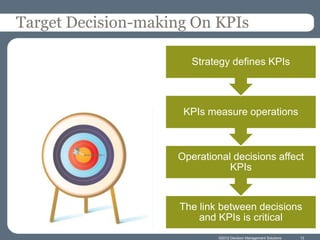
Target Decision-making On KPIs

                       Strategy defines KPIs


                     KPIs measure operations


                    Operational decisions affect
                               KPIs


                     The link between decisions
                         and KPIs is critical
                             ©2012 Decision Management Solutions   13
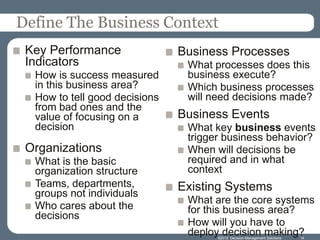
Define The Business Context
 Key Performance               Business Processes
 Indicators                     What processes does this
  How is success measured       business execute?
  in this business area?        Which business processes
  How to tell good decisions    will need decisions made?
  from bad ones and the
  value of focusing on a       Business Events
  decision                      What key business events
                                trigger business behavior?
 Organizations                  When will decisions be
  What is the basic             required and in what
  organization structure        context
  Teams, departments,          Existing Systems
  groups not individuals
                                What are the core systems
  Who cares about the           for this business area?
  decisions
                                How will you have to
                                deploy decision making?
                                      ©2012 Decision Management Solutions   14
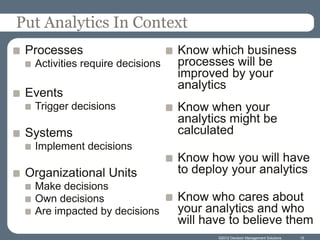
Put Analytics In Context
 Processes                       Know which business
  Activities require decisions   processes will be
                                 improved by your
                                 analytics
 Events
  Trigger decisions              Know when your
                                 analytics might be
 Systems                         calculated
  Implement decisions
                                 Know how you will have
 Organizational Units            to deploy your analytics
  Make decisions
  Own decisions                  Know who cares about
  Are impacted by decisions      your analytics and who
                                 will have to believe them
                                        ©2012 Decision Management Solutions   15
Step 3


Decompose decisions to
   understand them


                 ©2012 Decision Management Solutions   16
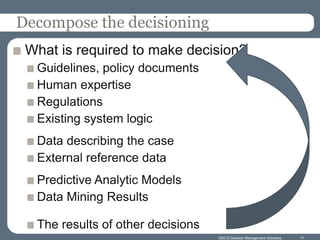
Decompose the decisioning
 What is required to make decision?
  Guidelines, policy documents
  Human expertise
  Regulations
  Existing system logic
  Data describing the case
  External reference data
  Predictive Analytic Models
  Data Mining Results

  The results of other decisions
                                   ©2012 Decision Management Solutions   17
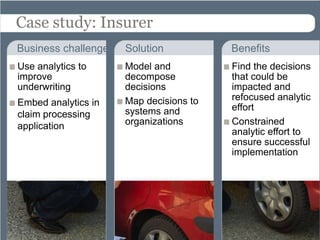
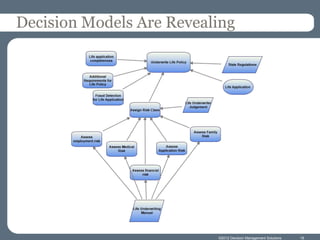
Case study: Insurer
Business challenges   Solution           Benefits
Use analytics to      Model and          Find the decisions
improve               decompose          that could be
underwriting          decisions          impacted and
                      Map decisions to   refocused analytic
Embed analytics in                       effort
claim processing      systems and
application           organizations      Constrained
                                         analytic effort to
                                         ensure successful
                                         implementation
Decision Models Are Revealing


                          ©2012 Decision Management Solutions   19
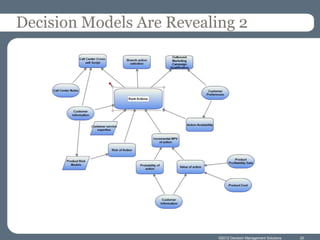
Decision Models Are Revealing 2


                           ©2012 Decision Management Solutions   20
Step 4


Deploy analytical decisions
   to the systems and
processes that need them

                   ©2012 Decision Management Solutions   21
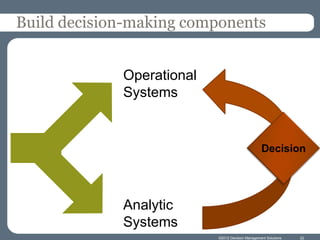
Build decision-making components


             Operational
             Systems


                                                  Decision


             Analytic
             Systems
                           ©2012 Decision Management Solutions   22
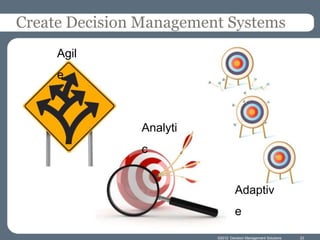
Create Decision Management Systems
     Agil
     e


               Analyti
               c


                                  Adaptiv
                                  e

                         ©2012 Decision Management Solutions   23
Questions?
Takeaways
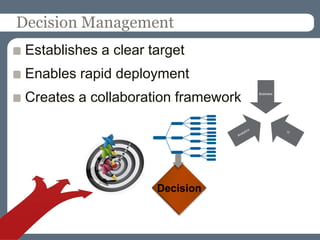
Decision Management
 Establishes a clear target
 Enables rapid deployment
 Creates a collaboration framework   Business


                      Decision
Thank You
             James Taylor, CEO
jtaylor@decisionmanagementsolutions.c
                                  om

Business Friendly Data Mining

  • 1.
    Business Friendly Data Mining James Taylor CEO
  • 2.
    Your presenter –James Taylor CEO of Decision Management Solutions Works with clients to improve their business by applying analytic technology to automate & improve decisions Spent the last 9 years championing Decision Management and developing Decision Management Systems ©2012 Decision Management Solutions 1
  • 3.
    Data Mining andPredictive Analytics WORK ©2012 Decision Management Solutions 2
  • 4.
    Success Requires AClear Target ©2012 Decision Management Solutions 3
  • 5.
    Success Requires Deployment ? ? Decision ©2012 Decision Management Solutions 4
  • 6.
    Success Requires Collaboration Business Decision ©2012 Decision Management Solutions 5
  • 7.
    Business-Friendly Data Mining
  • 8.
    Decision Management isthe proven approach used to manage decisions, set goals for predictive analytic efforts, apply and deploy predictive analytics effectively ©2012 Decision Management Solutions 7
  • 9.
    Step 1 Be clearwhich decisions you are improving ©2012 Decision Management Solutions 8
  • 10.
    A Decision A choice or selection Based on facts That ends uncertainty And results in action ©2012 Decision Management Solutions 9
  • 11.
    Discover High ROIDecisions Risk decisions Customer decisions How risky is this deal How profitable might this and what should we do? customer be? Predict risk of a bad Predict response, outcome opportunity, potential Rigorous, regulated Rapidly evolving Fraud decisions How likely is this to be fraudulent? Predict risk of fraud “Black box” ©2012 Decision Management Solutions 10
  • 12.
    Use Questions toDefine Decisions For each decision Name Description Question and a defined set of allowable answers Any other results to be returned with the answer ©2012 Decision Management Solutions 11
  • 13.
    Step 2 Understand howthose decisions impact the business ©2012 Decision Management Solutions 12
  • 14.
    Target Decision-making OnKPIs Strategy defines KPIs KPIs measure operations Operational decisions affect KPIs The link between decisions and KPIs is critical ©2012 Decision Management Solutions 13
  • 15.
    Define The BusinessContext Key Performance Business Processes Indicators What processes does this How is success measured business execute? in this business area? Which business processes How to tell good decisions will need decisions made? from bad ones and the value of focusing on a Business Events decision What key business events trigger business behavior? Organizations When will decisions be What is the basic required and in what organization structure context Teams, departments, Existing Systems groups not individuals What are the core systems Who cares about the for this business area? decisions How will you have to deploy decision making? ©2012 Decision Management Solutions 14
  • 16.
    Put Analytics InContext Processes Know which business Activities require decisions processes will be improved by your analytics Events Trigger decisions Know when your analytics might be Systems calculated Implement decisions Know how you will have Organizational Units to deploy your analytics Make decisions Own decisions Know who cares about Are impacted by decisions your analytics and who will have to believe them ©2012 Decision Management Solutions 15
  • 17.
    Step 3 Decompose decisionsto understand them ©2012 Decision Management Solutions 16
  • 18.
    Decompose the decisioning What is required to make decision? Guidelines, policy documents Human expertise Regulations Existing system logic Data describing the case External reference data Predictive Analytic Models Data Mining Results The results of other decisions ©2012 Decision Management Solutions 17
  • 19.
    Case study: Insurer Businesschallenges Solution Benefits Use analytics to Model and Find the decisions improve decompose that could be underwriting decisions impacted and Map decisions to refocused analytic Embed analytics in effort claim processing systems and application organizations Constrained analytic effort to ensure successful implementation
  • 20.
    Decision Models AreRevealing ©2012 Decision Management Solutions 19
  • 21.
    Decision Models AreRevealing 2 ©2012 Decision Management Solutions 20
  • 22.
    Step 4 Deploy analyticaldecisions to the systems and processes that need them ©2012 Decision Management Solutions 21
  • 23.
    Build decision-making components Operational Systems Decision Analytic Systems ©2012 Decision Management Solutions 22
  • 24.
    Create Decision ManagementSystems Agil e Analyti c Adaptiv e ©2012 Decision Management Solutions 23
  • 25.
  • 26.
  • 27.
    Decision Management Establishesa clear target Enables rapid deployment Creates a collaboration framework Business Decision
  • 28.
    Thank You James Taylor, CEO jtaylor@decisionmanagementsolutions.c om

Editor's Notes

  • #4 The power of predictive analytics is their ability to turn uncertainty about the future into usable probability
  • #5 Goals and measures of success are clear
  • #6 Business, IT and Analytics team can collaborate effectively
  • #23 [twitter]#decisionmgt systems link analytic systems to operational systems[/twitter]
  • #24 AgileChanging CircumstancesComplianceProcess ImprovementAnalyticManaging RiskReducing FraudTargeting and RetainingFocusing ResourcesAdaptiveFinding New ApproachesTesting and LearningManaging Trade-offs