2
imagine
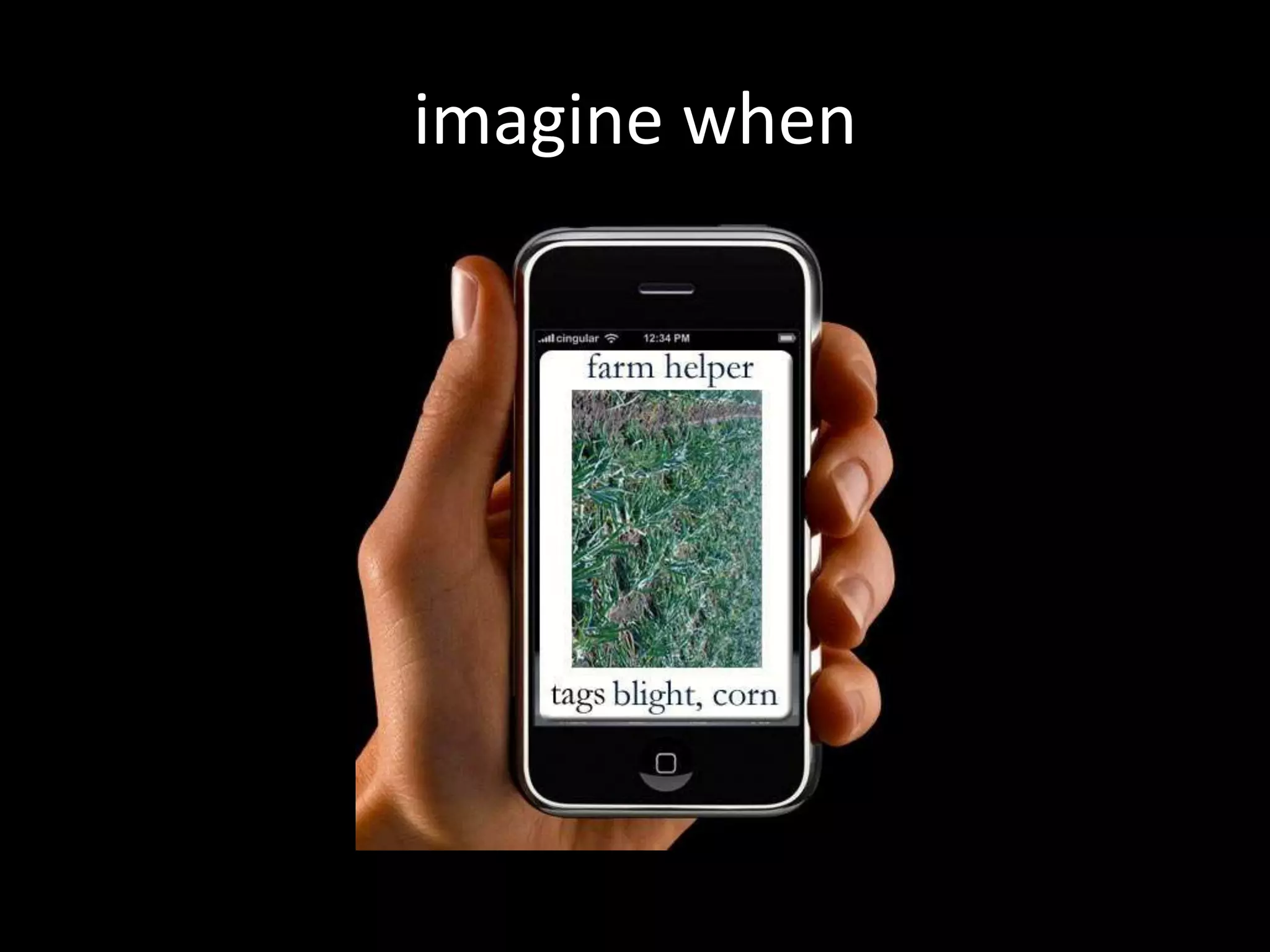
imagine when
meets Farm Helper
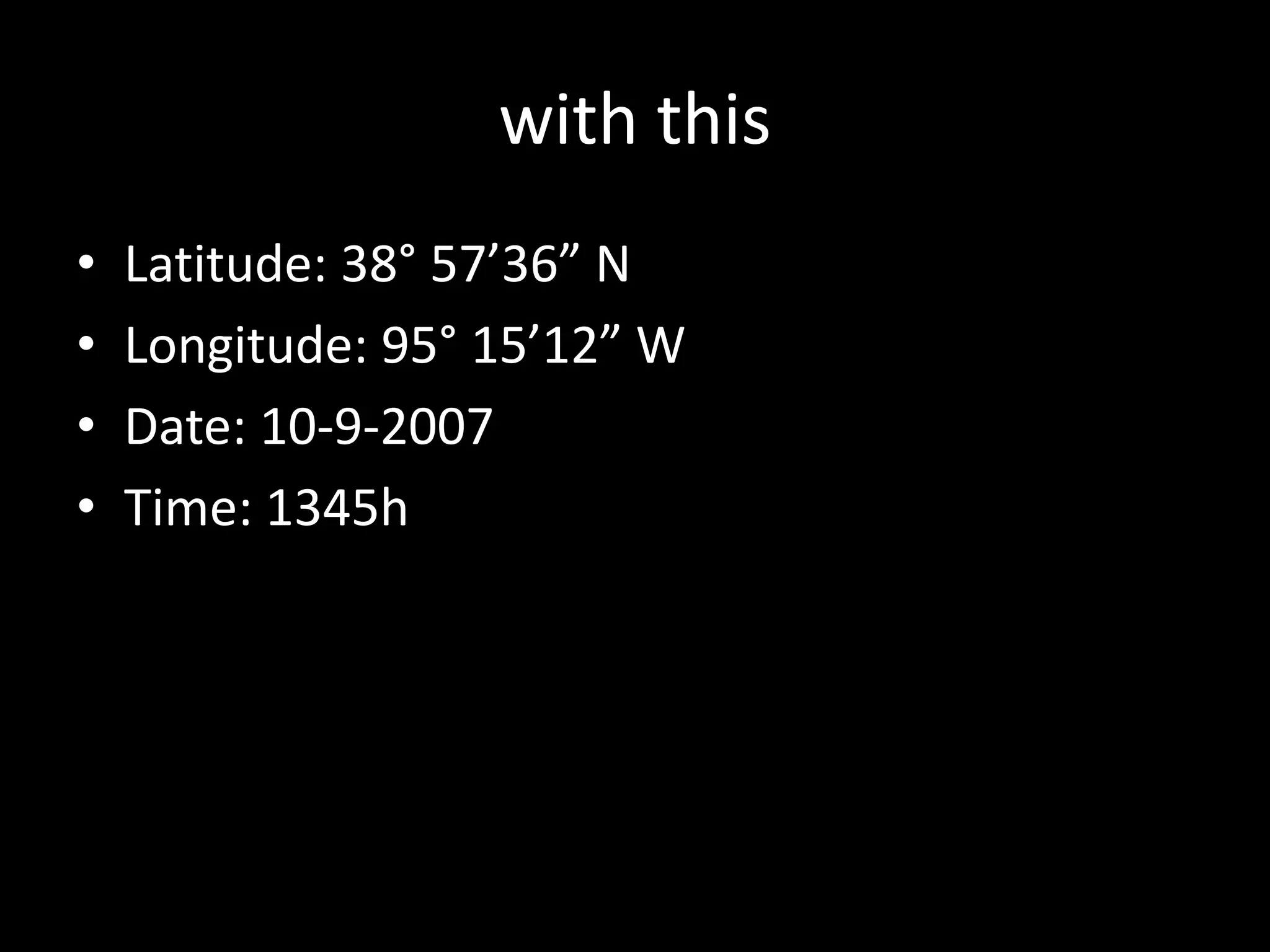
with thisLatitude: 38° 57’36” NLongitude: 95° 15’12” WDate: 10-9-2007Time: 1345h
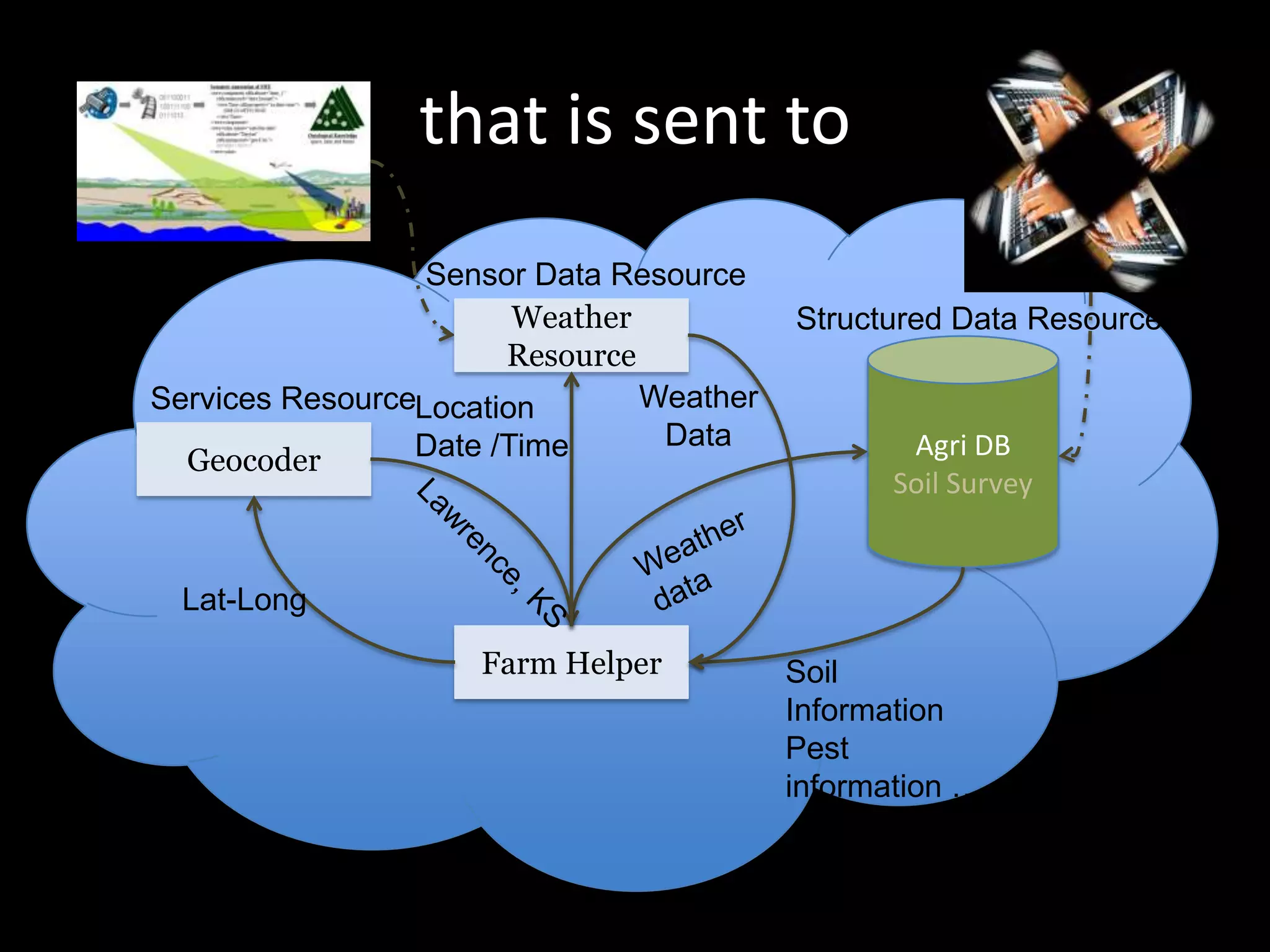
that is sent to Sensor Data ResourceStructured Data ResourceWeather ResourceAgri DBSoil Survey Weather DataServices ResourceLocationDate /TimeGeocoderWeather dataLawrence, KSLat-LongFarm HelperSoil InformationPest information …
and
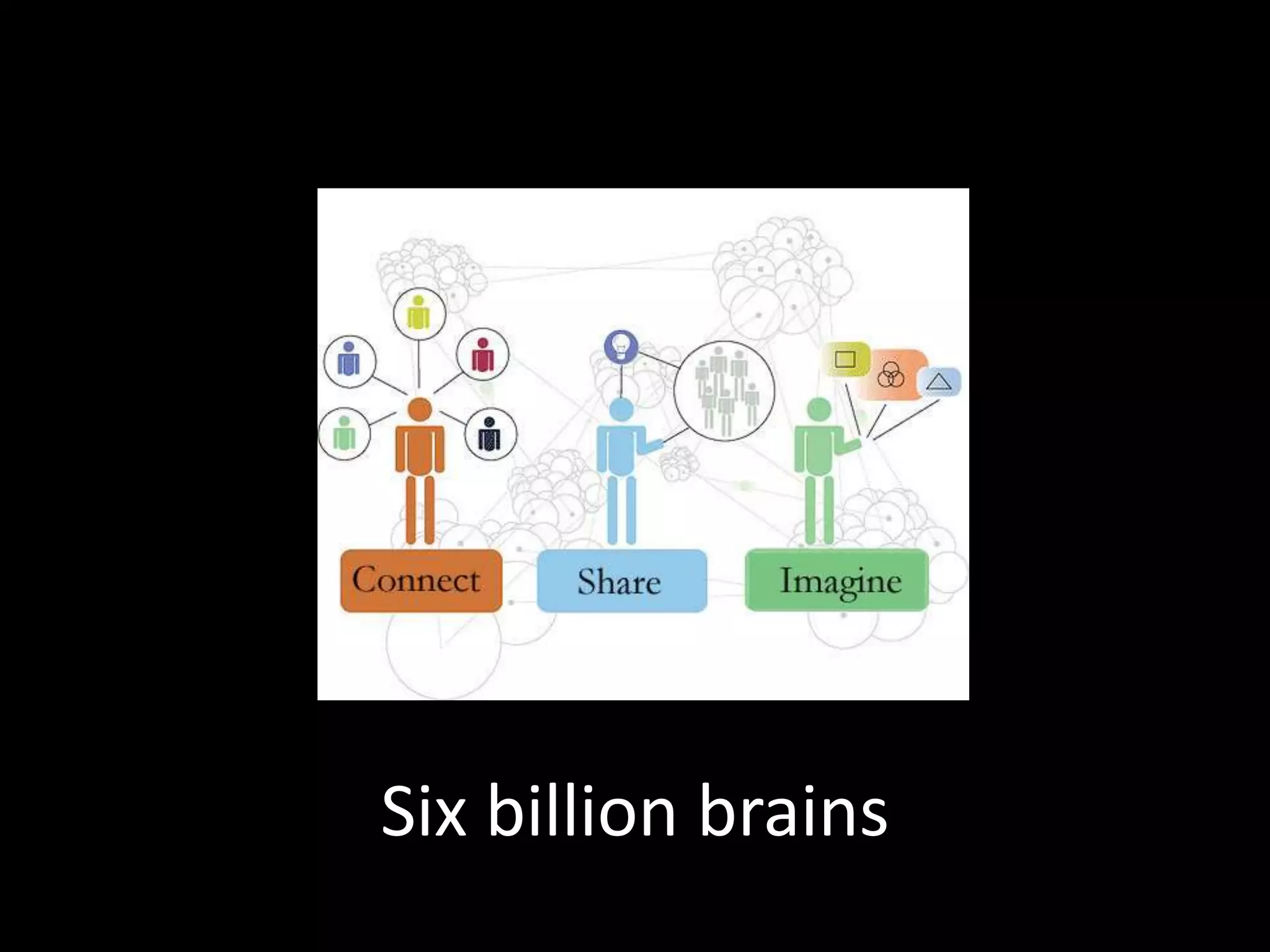
Six billion brains
imagination today
impacts our experience tomorrow
Computing For Human ExperienceASWC 2008 KeynoteAmit P. Sheth,Lexis Nexis Eminent Scholar and Director, kno.e.sis centerKnoesis.org
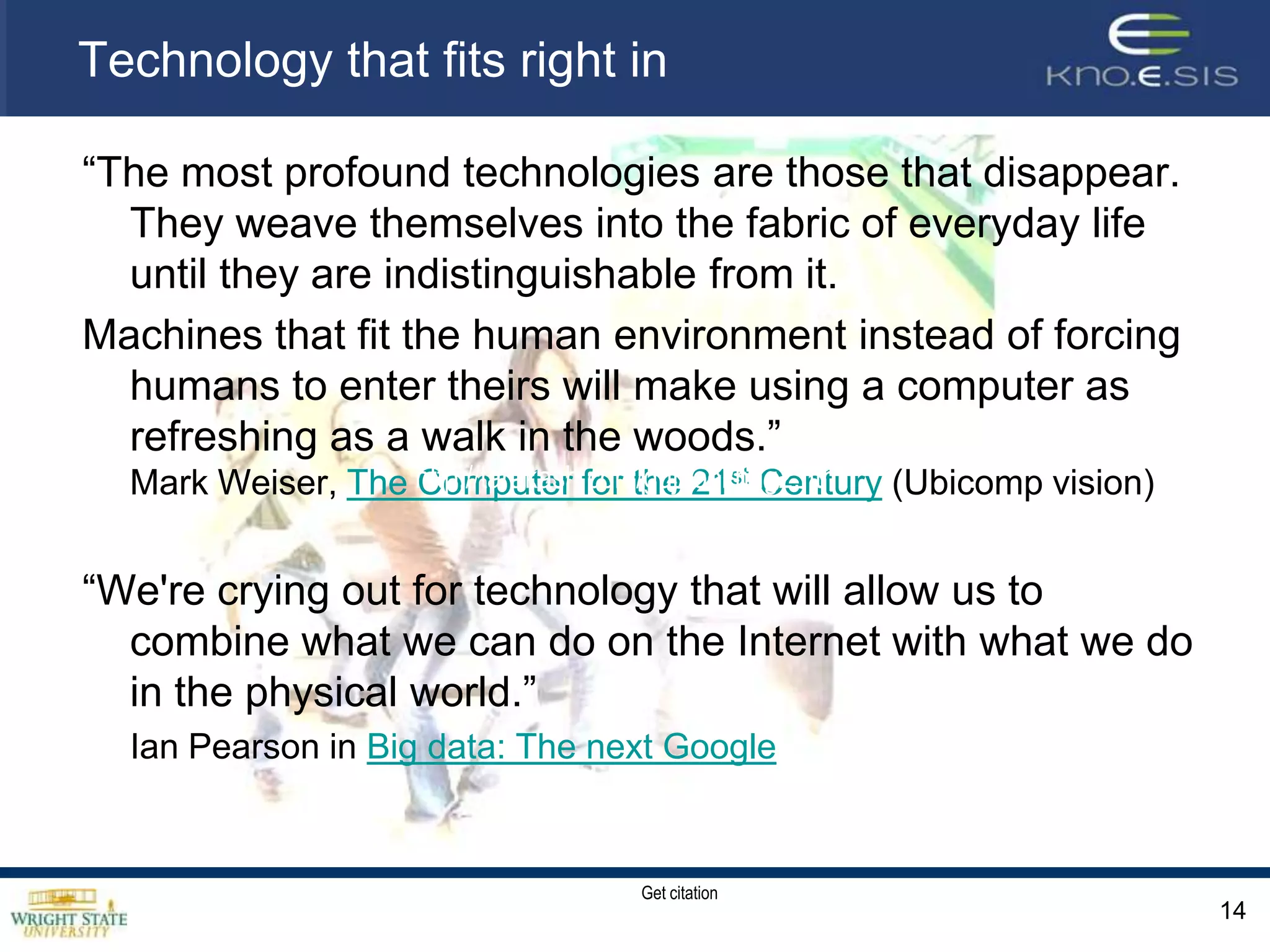
Technology that fits right in“The most profound technologies are those that disappear. They weave themselves into the fabric of everyday life until they are indistinguishable from it. Machines that fit the human environment instead of forcing humans to enter theirs will make using a computer as refreshing as a walk in the woods.” Mark Weiser, The Computer for the 21st Century (Ubicomp vision)“We're crying out for technology that will allow us to combine what we can do on the Internet with what we do in the physical world.” 	Ian Pearson in Big data: The next Google 14http://tarakash.com/guj/tool/hug2.htmlGet citation
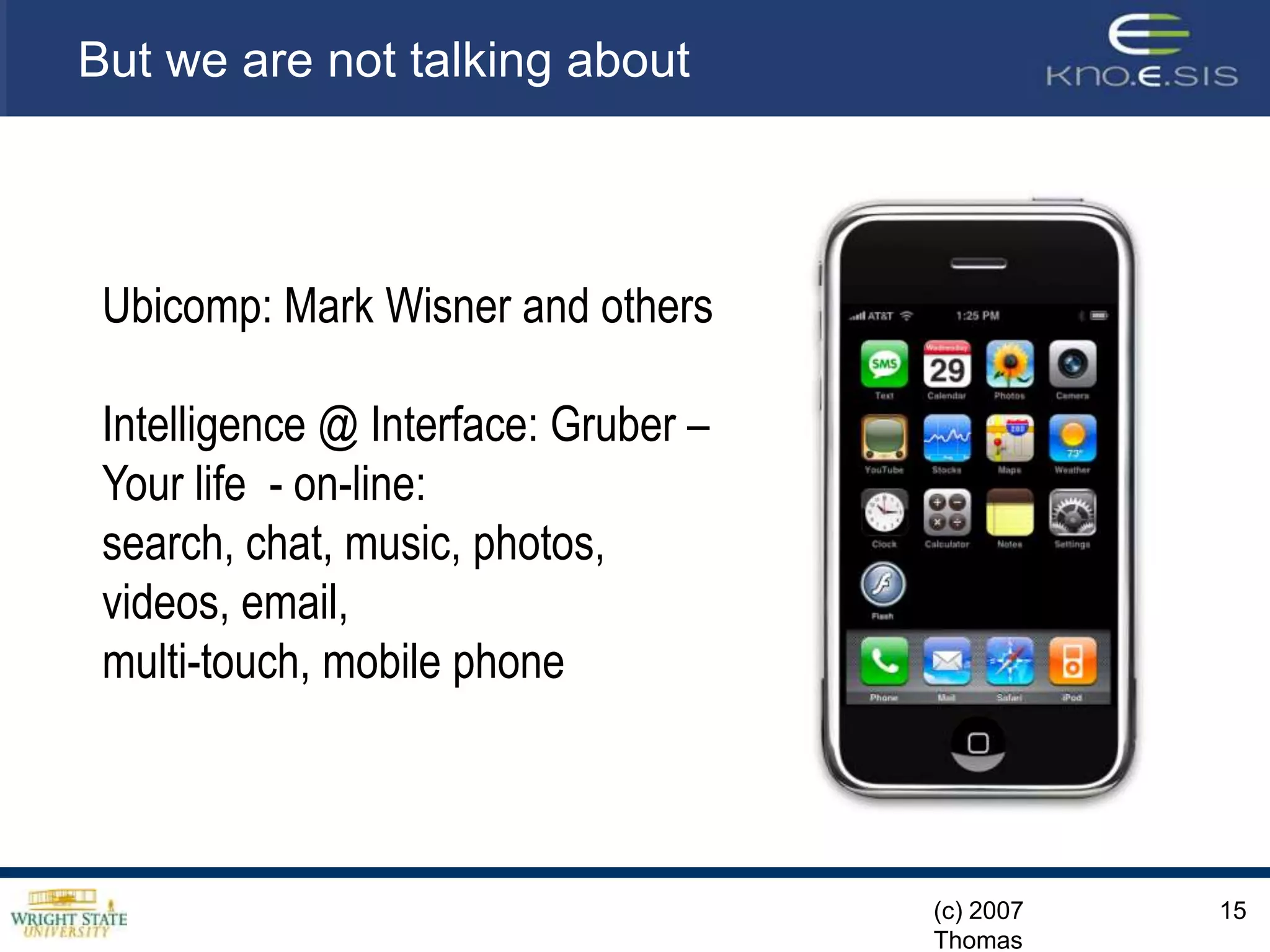
(c) 2007 Thomas Gruber15But we are not talking aboutIntelligent DesignUbicomp: Mark Wisner and othersIntelligence @ Interface: Gruber –Your life  - on-line: search, chat, music, photos, videos, email, multi-touch, mobile phone
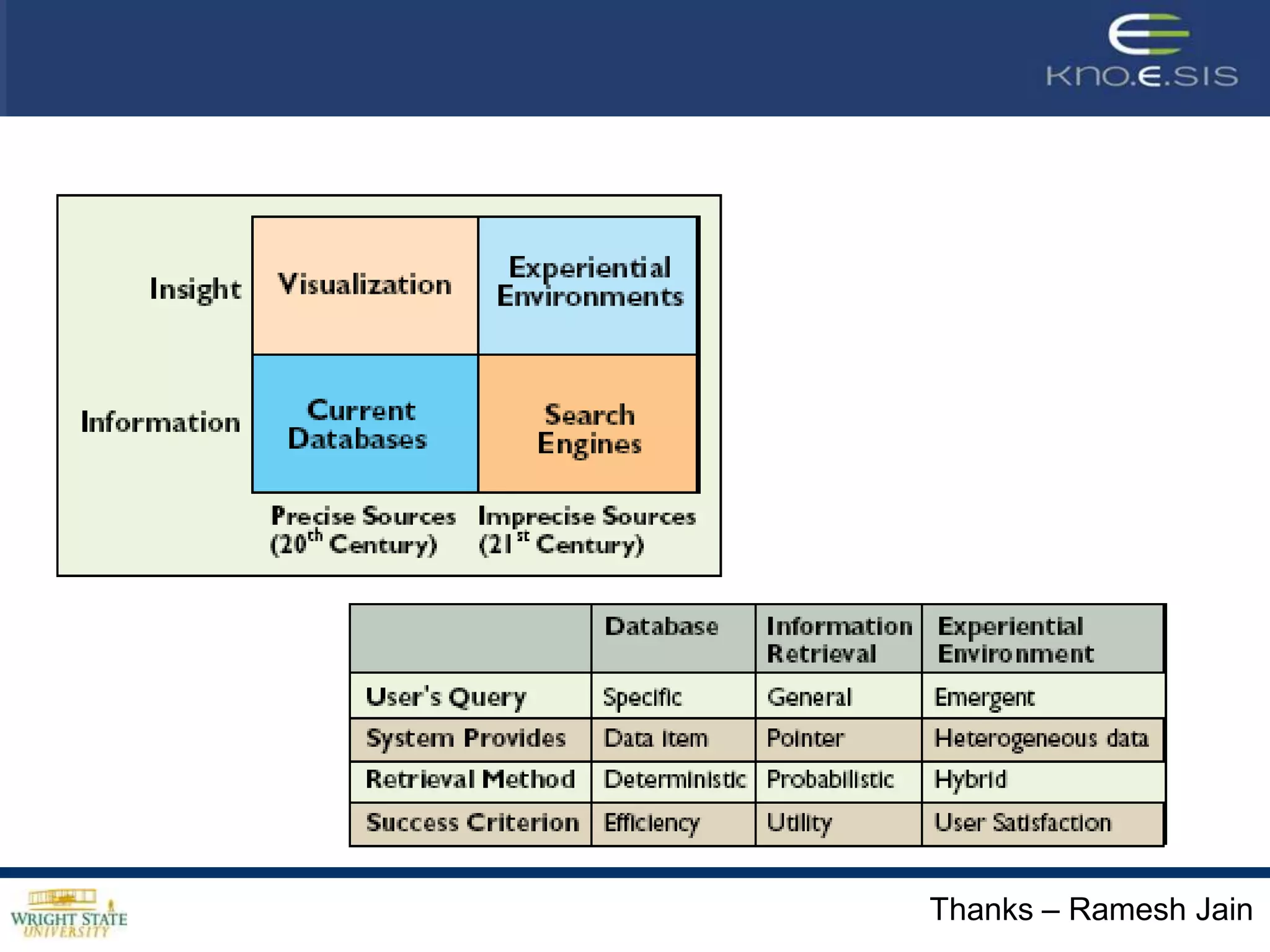
What is CHE? Beyond better human interactionFocus in the past (egUbicomp): How humans interact with the system (computer, Internet)Our focus—almost the reverse of the past (and both are needed)Computing for Human Experience is about:How computing serves, assists and collaborates with humans to complement and enrich their normal activities nondestructively and unobtrusively, with minimal explicit concern or effort on part of humansanticipatory, knowledgeable, intelligent, ubiquitousComputing that encompasses semantic, social, service, sensor and mobile Web16
Principals of CHEHuman is the master, system is the slaveHuman sees minimal changes to normal behavior and activity, system is there to serve/assist/support in human’s natural conditionSearch, browsing, etc are  not primary; HCI is not the focusGetting the assistance  and answers are important, improving experience is keyMultimodal and multisensory environmentIntegrated and contextual application of (not just access to) sensor data, databases, collective intelligence, wisdom of the crowd, conceptual models, reasoning17
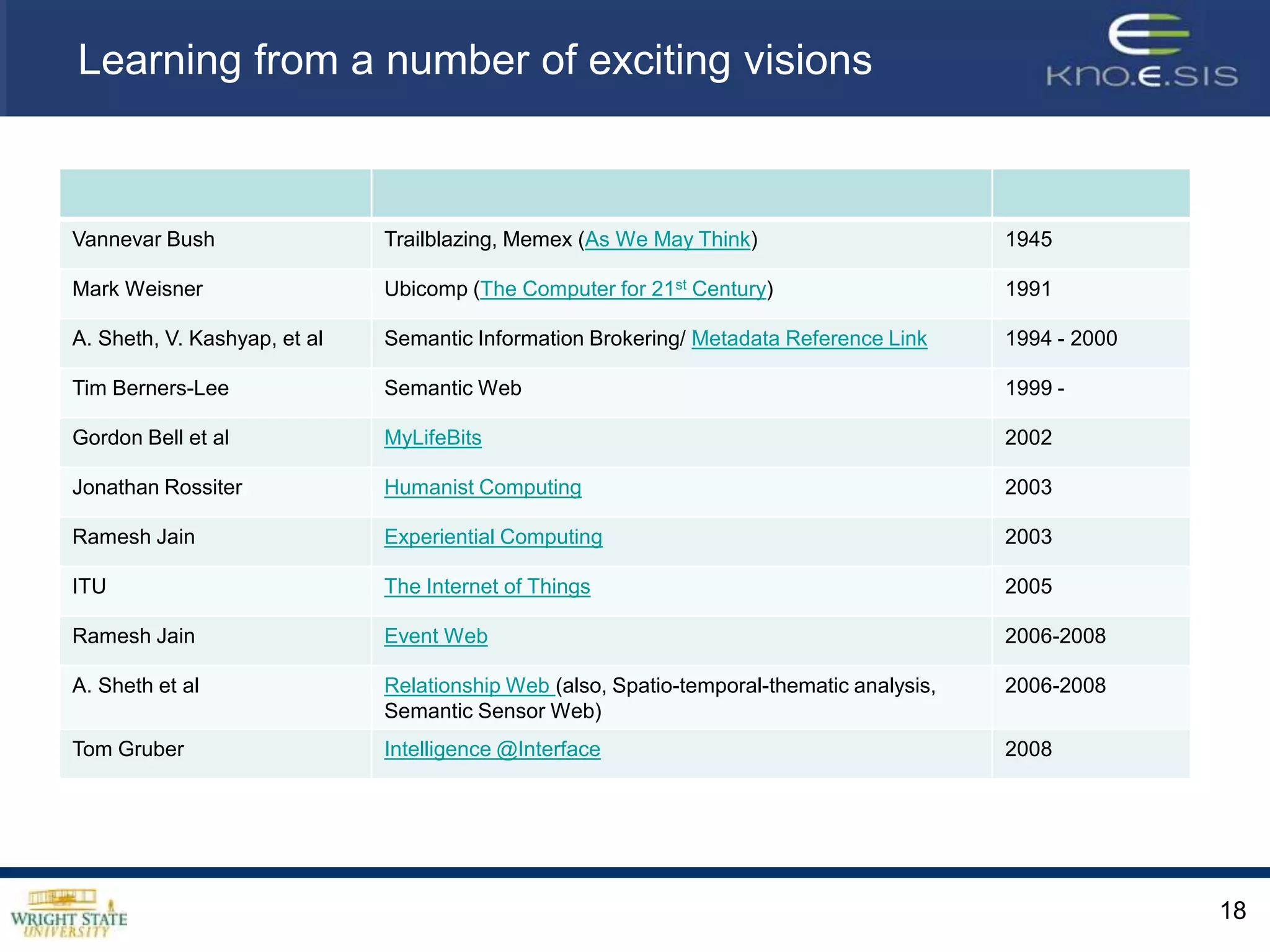
Learning from a number of exciting visions18
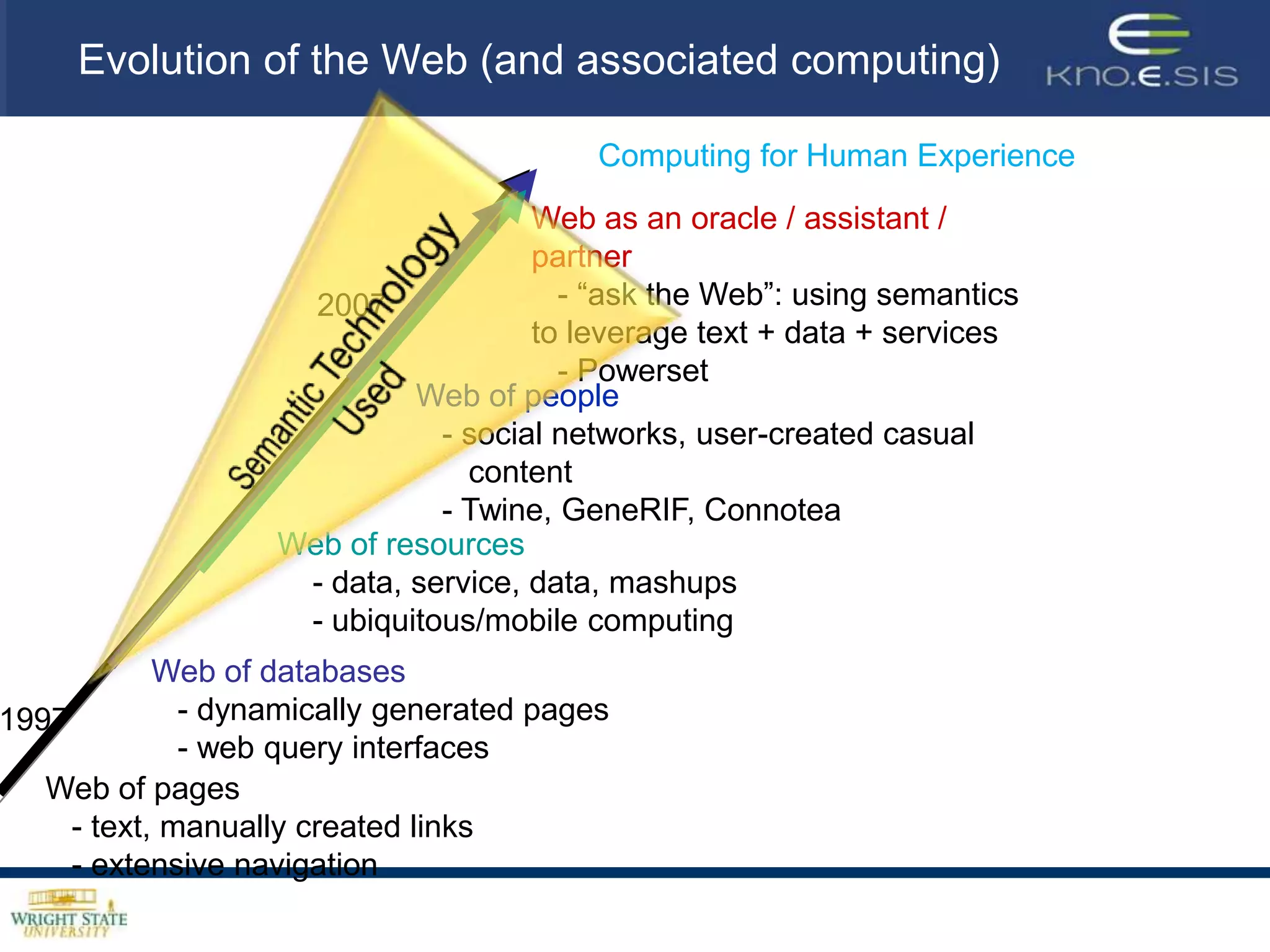
Evolution of the Web (and associated computing)Web of people   - social networks, user-created casual      content   - Twine, GeneRIF, ConnoteaWeb of resources    - data, service, data, mashups    - ubiquitous/mobile computingWeb of databases   - dynamically generated pages   - web query interfacesWeb of pages   - text, manually created links   - extensive navigationComputing for Human ExperienceWeb as an oracle / assistant / partner   - “ask the Web”: using semantics to leverage text + data + services    - Powerset 2007Semantic TechnologyUsed1997
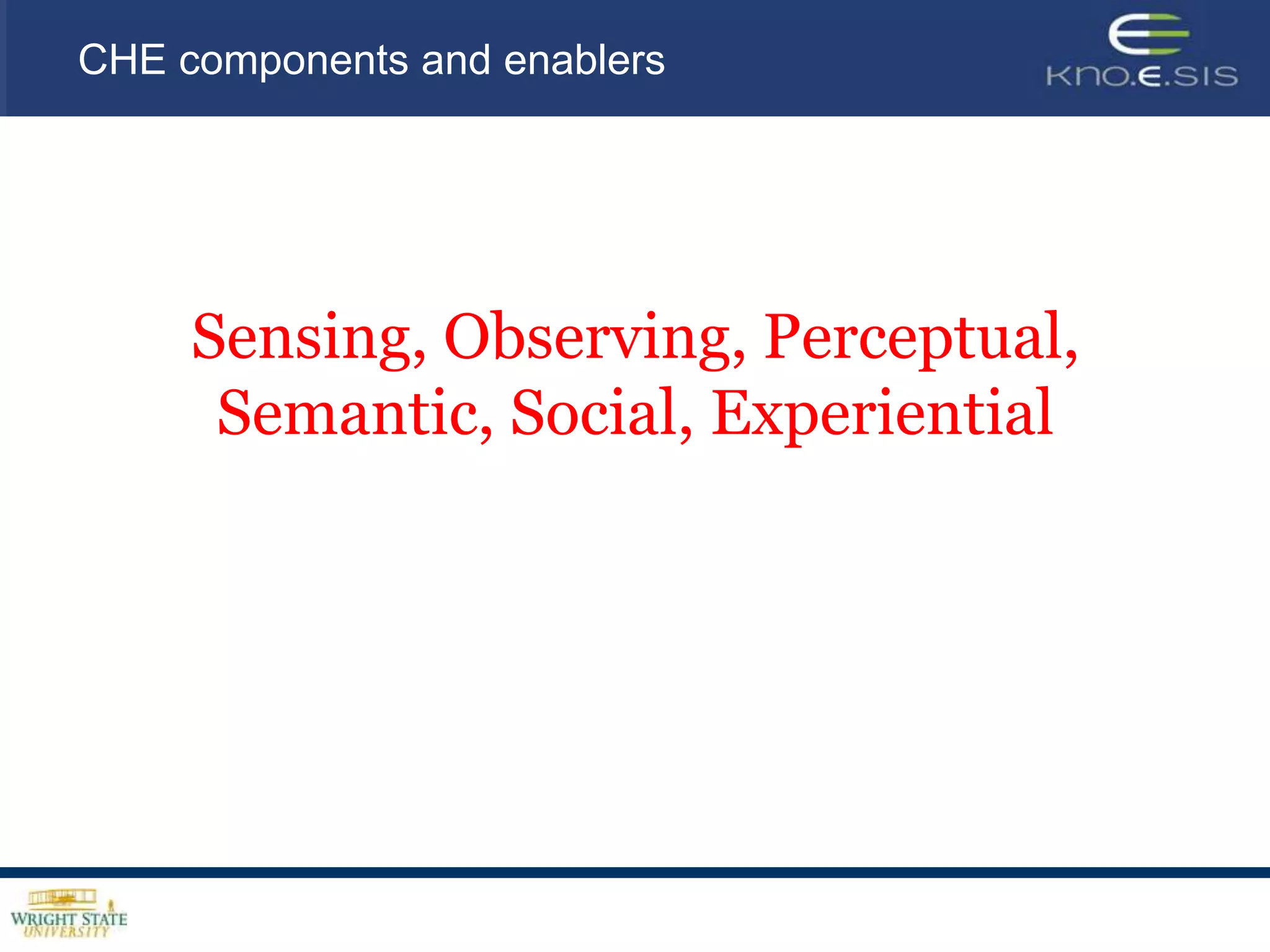
Sensing, Observing, Perceptual, Semantic, Social, ExperientialCHE components and enablers
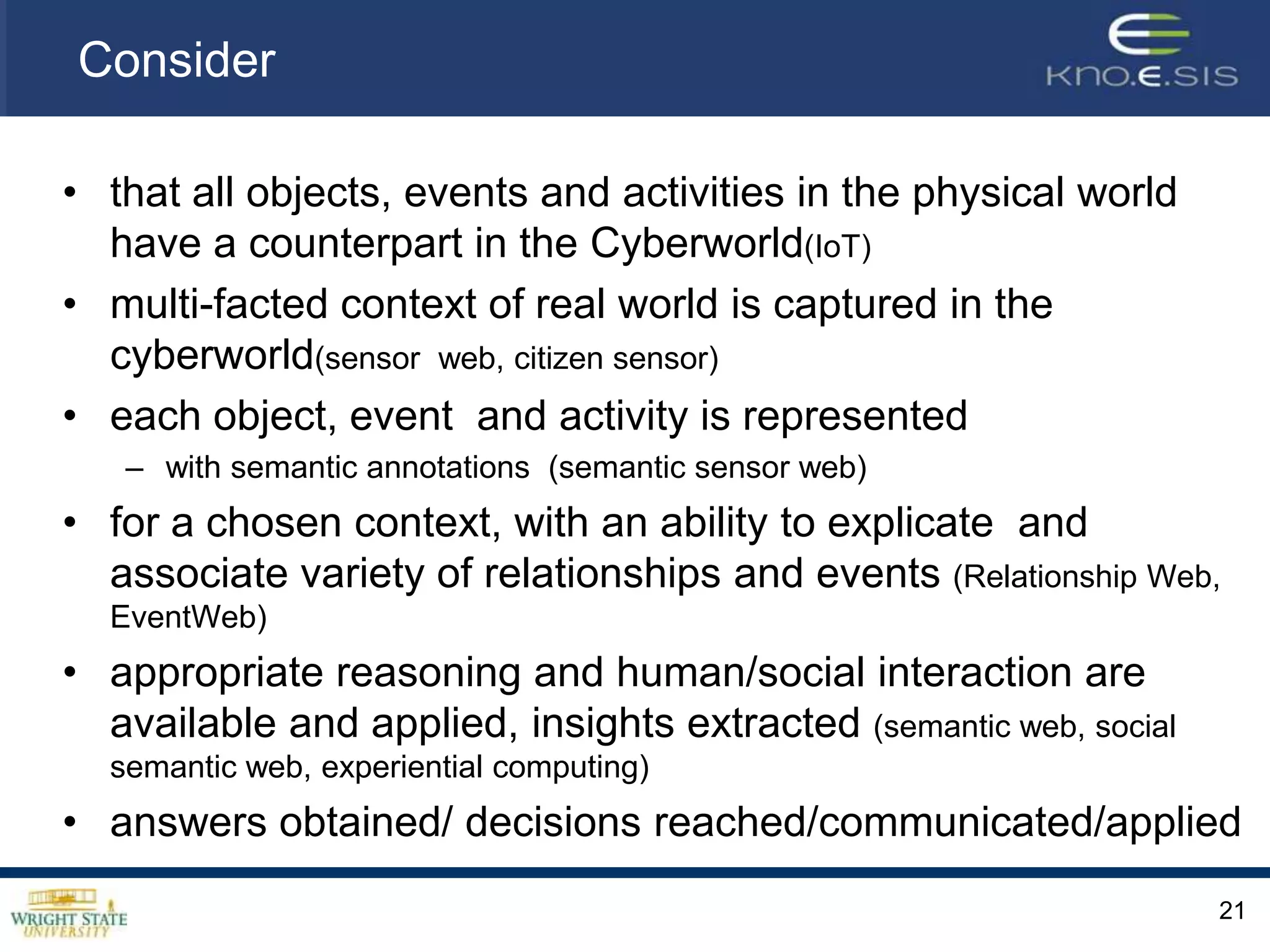
Consider that all objects, events and activities in the physical world have a counterpart in the Cyberworld(IoT)multi-facted context of real world is captured in the cyberworld(sensor  web, citizen sensor)each object, event  and activity is represented with semantic annotations  (semantic sensor web)for a chosen context, with an ability to explicate  and associate variety of relationships and events (Relationship Web, EventWeb)
appropriate reasoning and human/social interaction are available and applied, insights extracted (semantic web, social semantic web, experiential computing)
answers obtained/ decisions reached/communicated/applied21
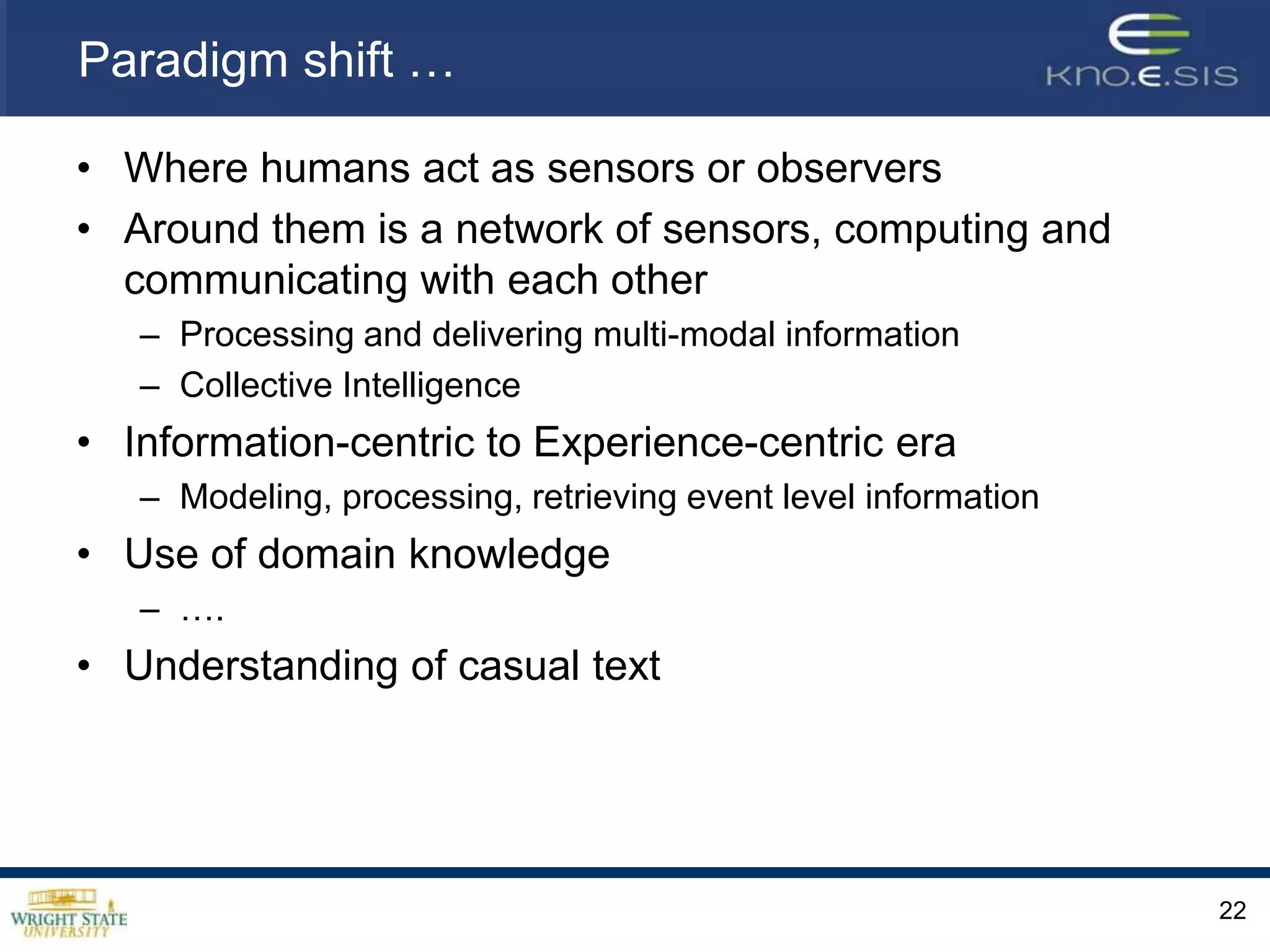
Paradigm shift …Where humans act as sensors or observersAround them is a network of sensors, computing and communicating with each otherProcessing and delivering multi-modal information Collective IntelligenceInformation-centric to Experience-centric eraModeling, processing, retrieving event level informationUse of domain knowledge ….Understanding of casual text22
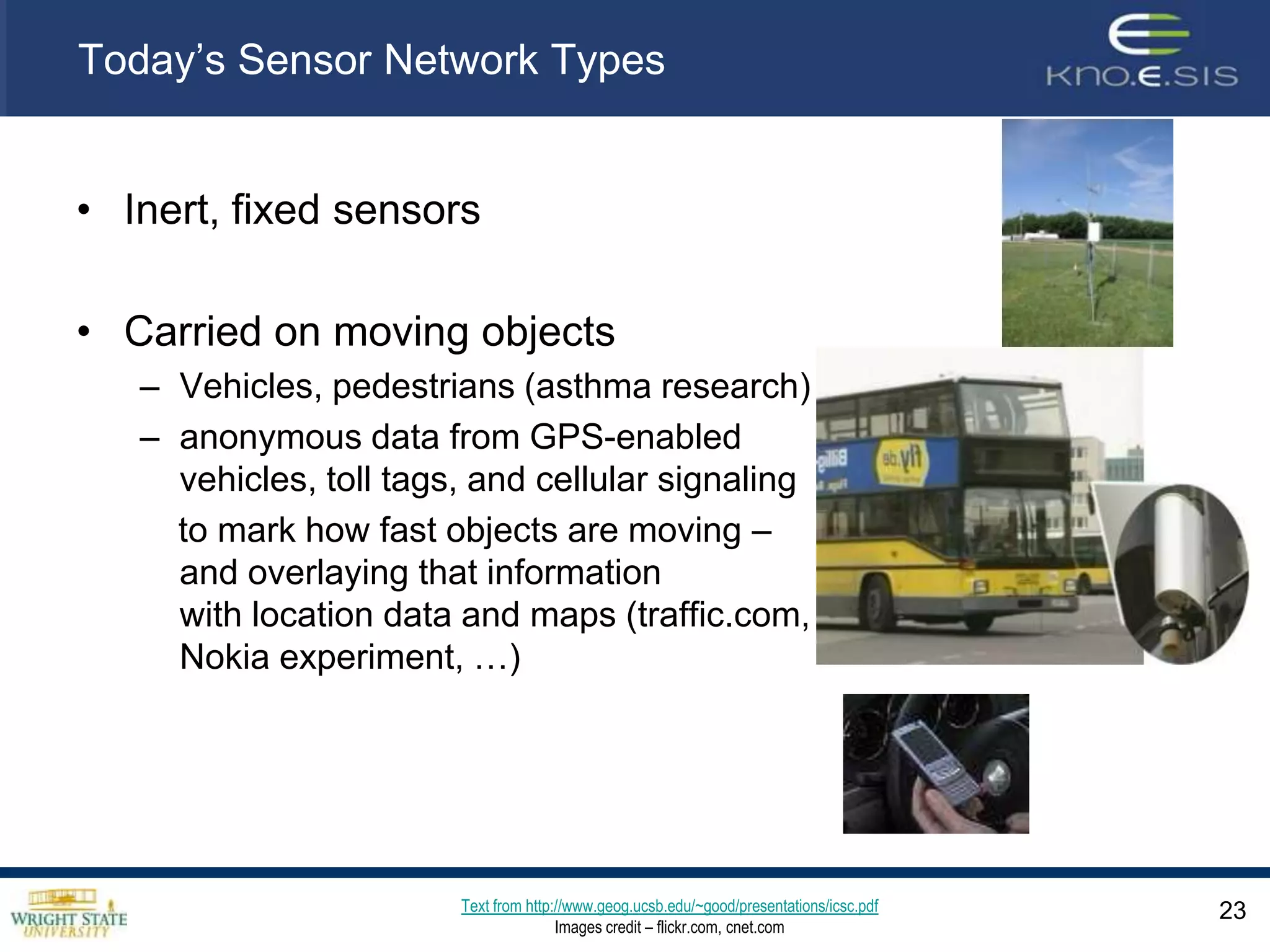
Today’s Sensor Network TypesInert, fixed sensorsCarried on moving objectsVehicles, pedestrians (asthma research)anonymous data from GPS-enabled vehicles, toll tags, and cellular signaling    to mark how fast objects are moving – and overlaying that information with location data and maps (traffic.com, Nokia experiment, …)23Text from http://www.geog.ucsb.edu/~good/presentations/icsc.pdfImages credit – flickr.com, cnet.com
Today’s Network of SensorsAre sensing, computing, transmitting Are acting in concert Sharing data Processing them into meaningful digital representations of the world Researchers using 'sensor webs' to ask new questions or test hypotheses24
Machine sensing25
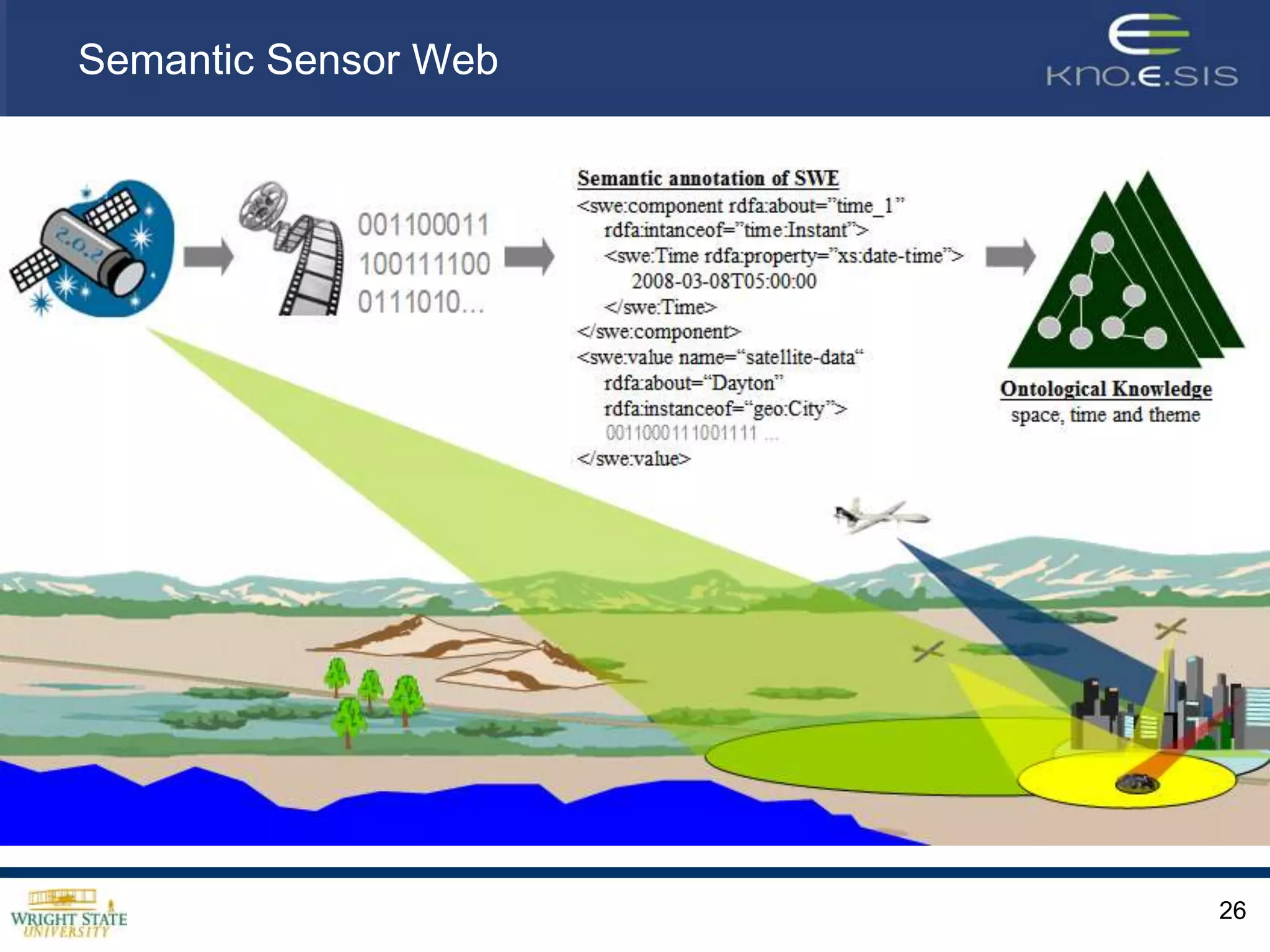
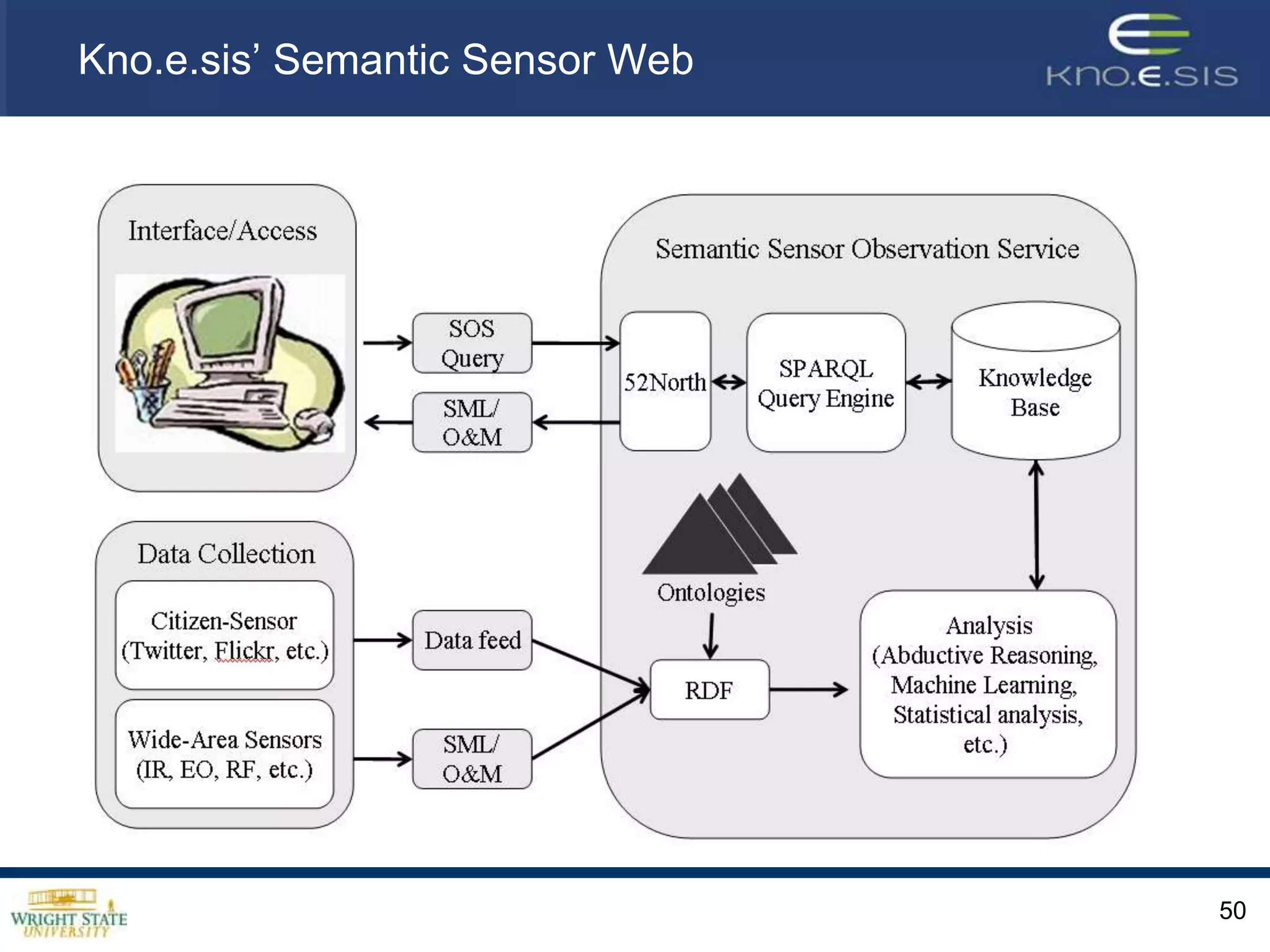
26Semantic Sensor Web
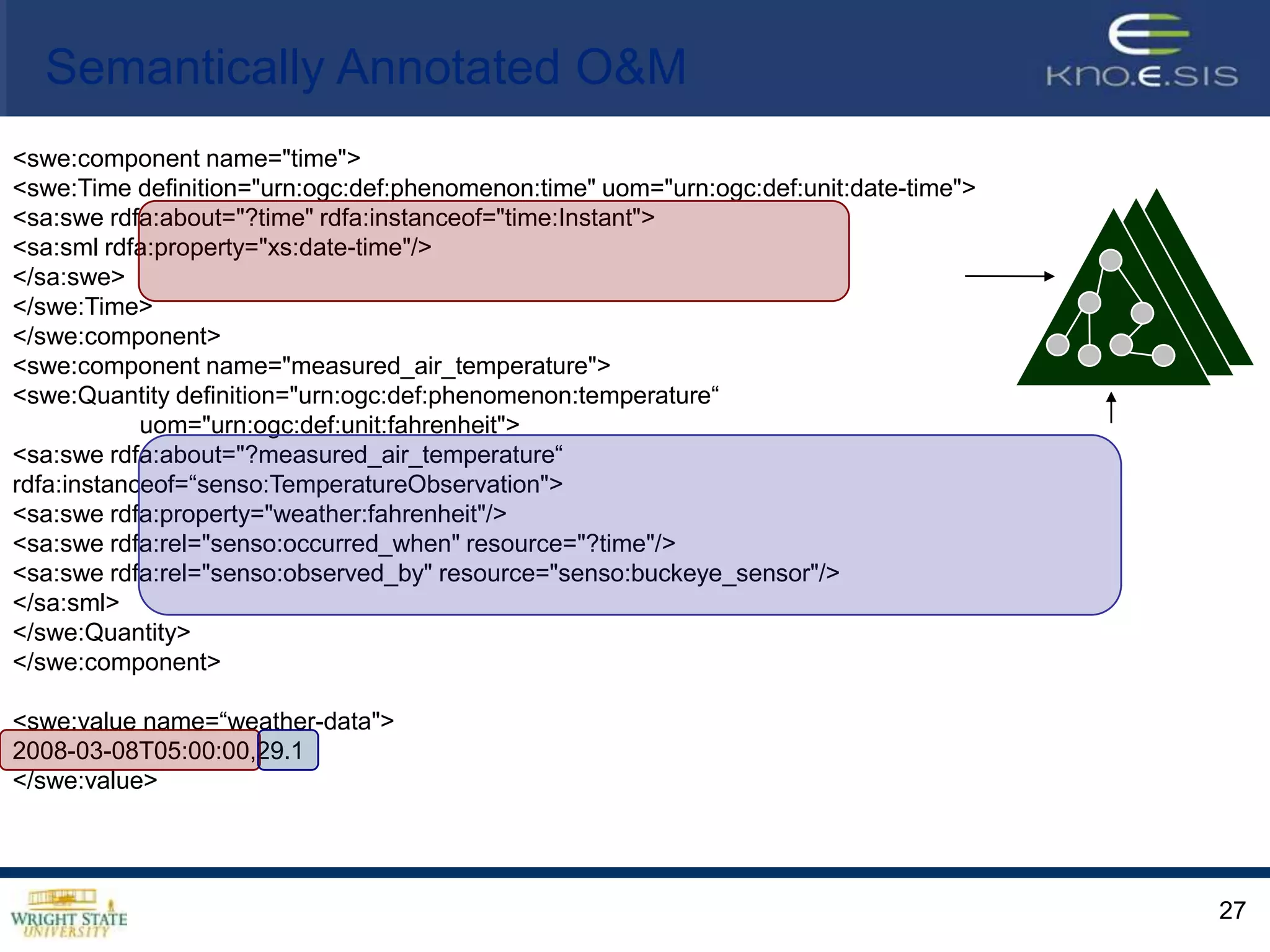
<swe:component name="time">	<swe:Time definition="urn:ogc:def:phenomenon:time" uom="urn:ogc:def:unit:date-time">		<sa:swe rdfa:about="?time" rdfa:instanceof="time:Instant">			<sa:sml rdfa:property="xs:date-time"/>		</sa:swe>	</swe:Time></swe:component><swe:component name="measured_air_temperature">	<swe:Quantity definition="urn:ogc:def:phenomenon:temperature“ 			           		uom="urn:ogc:def:unit:fahrenheit">		<sa:swe rdfa:about="?measured_air_temperature“              			rdfa:instanceof=“senso:TemperatureObservation">			<sa:swe rdfa:property="weather:fahrenheit"/>			<sa:swe rdfa:rel="senso:occurred_when" resource="?time"/>			<sa:swe rdfa:rel="senso:observed_by" resource="senso:buckeye_sensor"/>		</sa:sml>					</swe:Quantity></swe:component><swe:value name=“weather-data">	2008-03-08T05:00:00,29.1</swe:value>Semantically Annotated O&M27
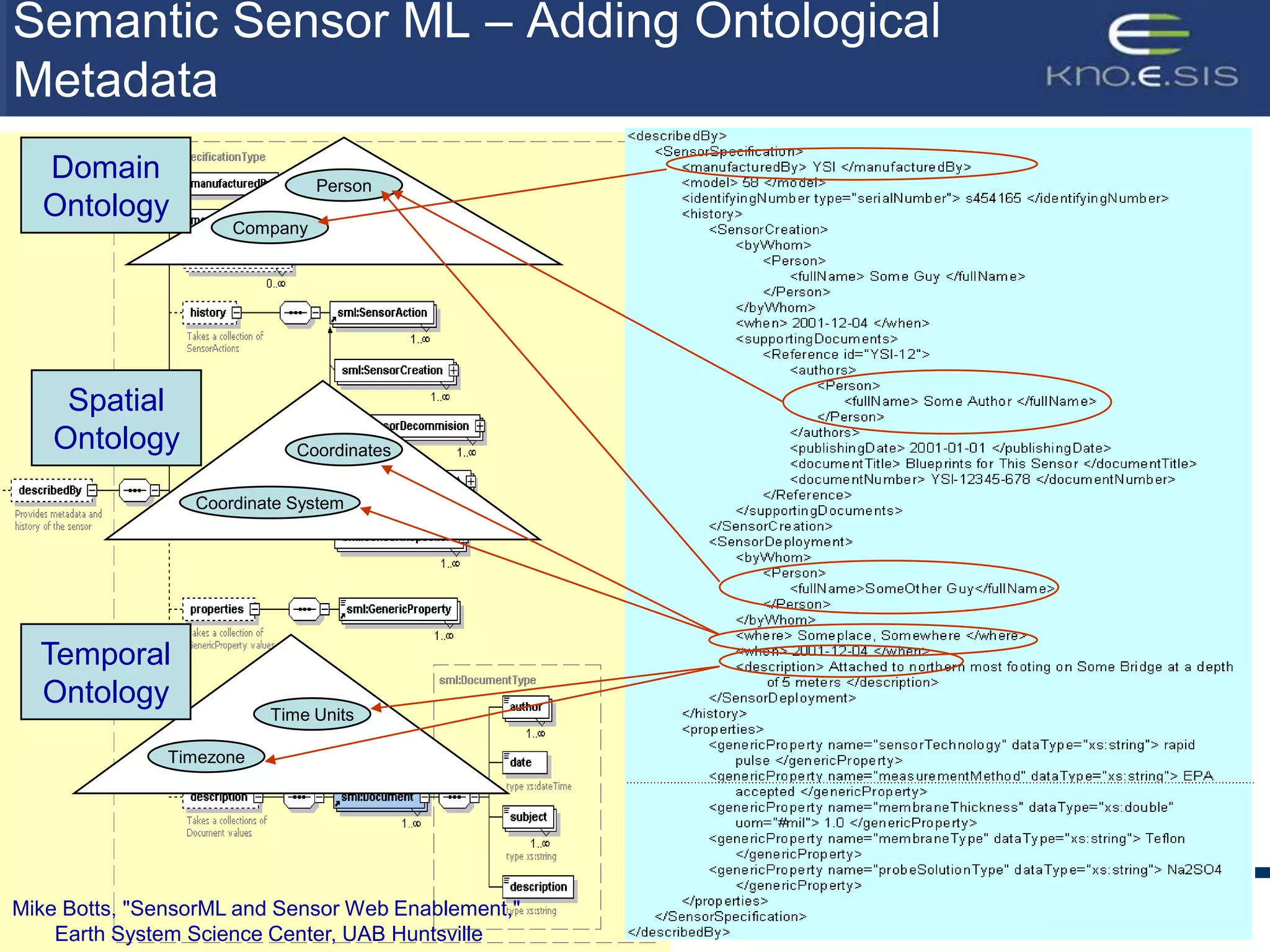
Semantic Sensor ML – Adding Ontological MetadataDomainOntologyPersonCompanySpatialOntologyCoordinatesCoordinate SystemTemporalOntologyTime UnitsTimezone28Mike Botts, "SensorML and Sensor Web Enablement," Earth System Science Center, UAB Huntsville
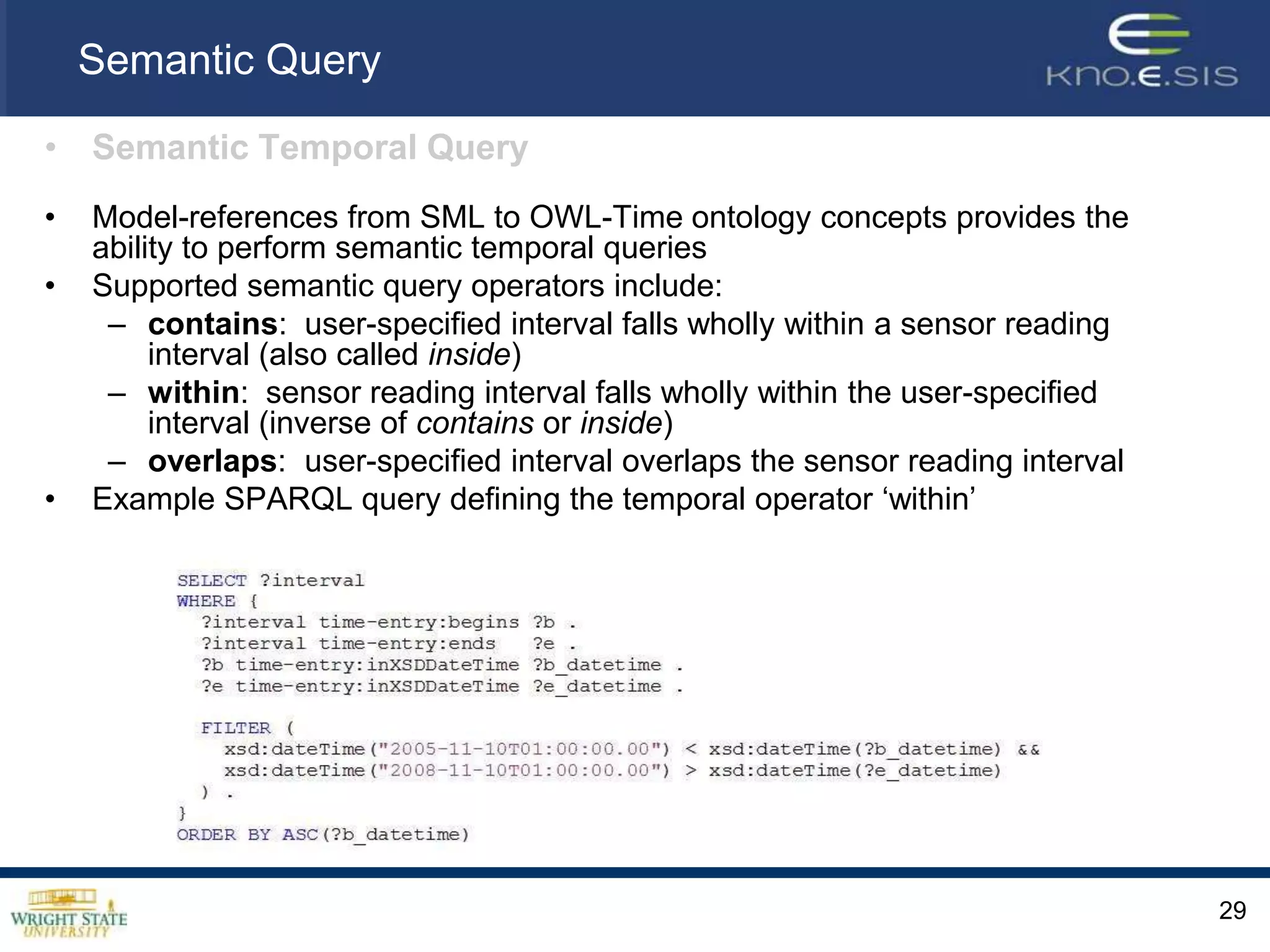
29Semantic QuerySemantic Temporal QueryModel-references from SML to OWL-Time ontology concepts provides the ability to perform semantic temporal queriesSupported semantic query operators include:contains:  user-specified interval falls wholly within a sensor reading interval (also called inside)within:  sensor reading interval falls wholly within the user-specified interval (inverse of contains or inside)overlaps:  user-specified interval overlaps the sensor reading intervalExample SPARQL query defining the temporal operator ‘within’
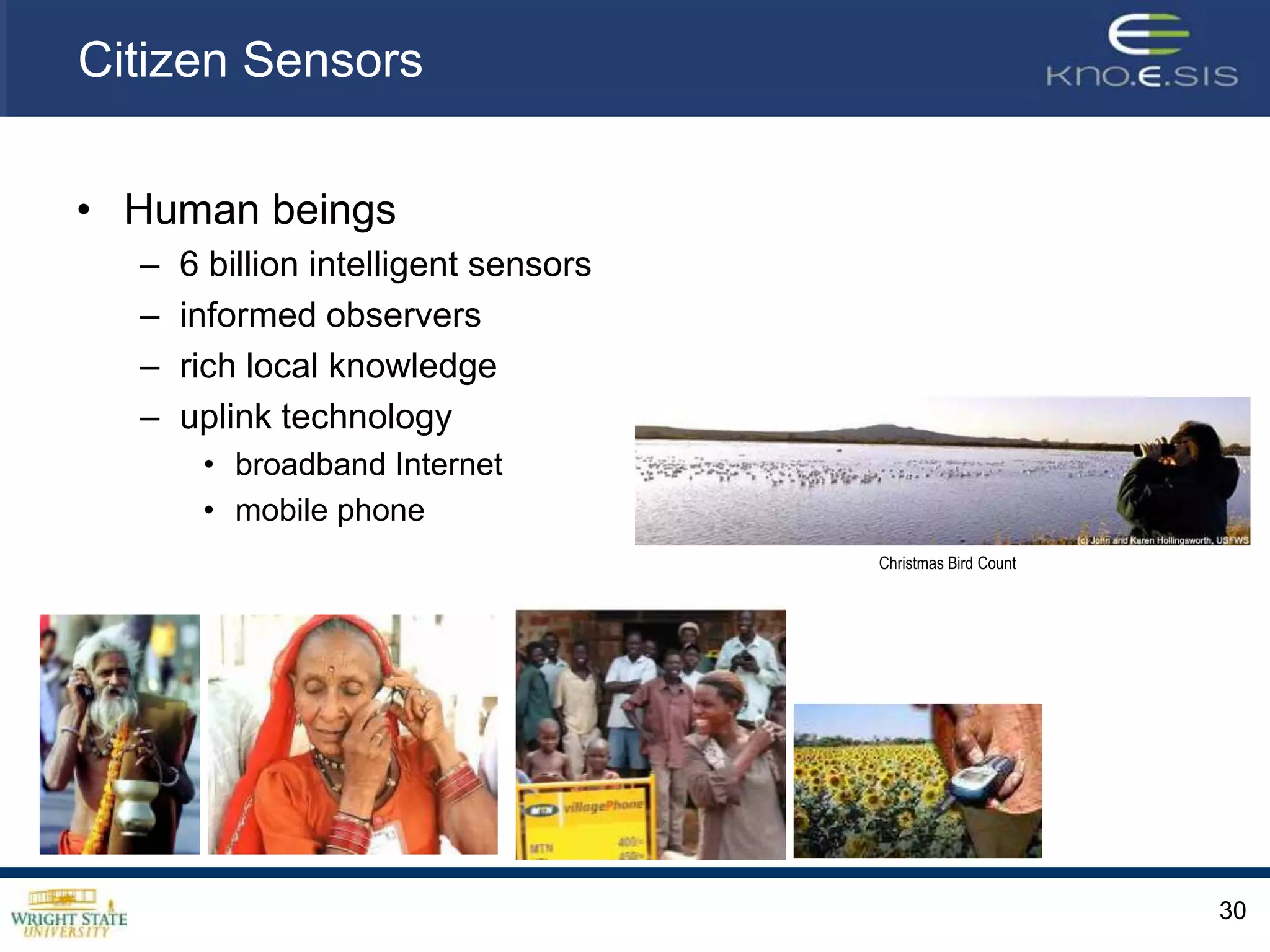
Citizen SensorsHuman beings6 billion intelligent sensorsinformed observersrich local knowledgeuplink technologybroadband Internetmobile phone30Christmas Bird Count
Citizen ScienceNetworks of amateur observerspossibly trained, skilledChristmas Bird Count http://www.audubon.org/bird/citizen/index.html , http://www.audubon.org/bird/cbc/index.htmlthousands of volunteer participantsProtocolsProject GLOBEan international network of school childrenreporting environmental conditionscentral integration and redistribution31
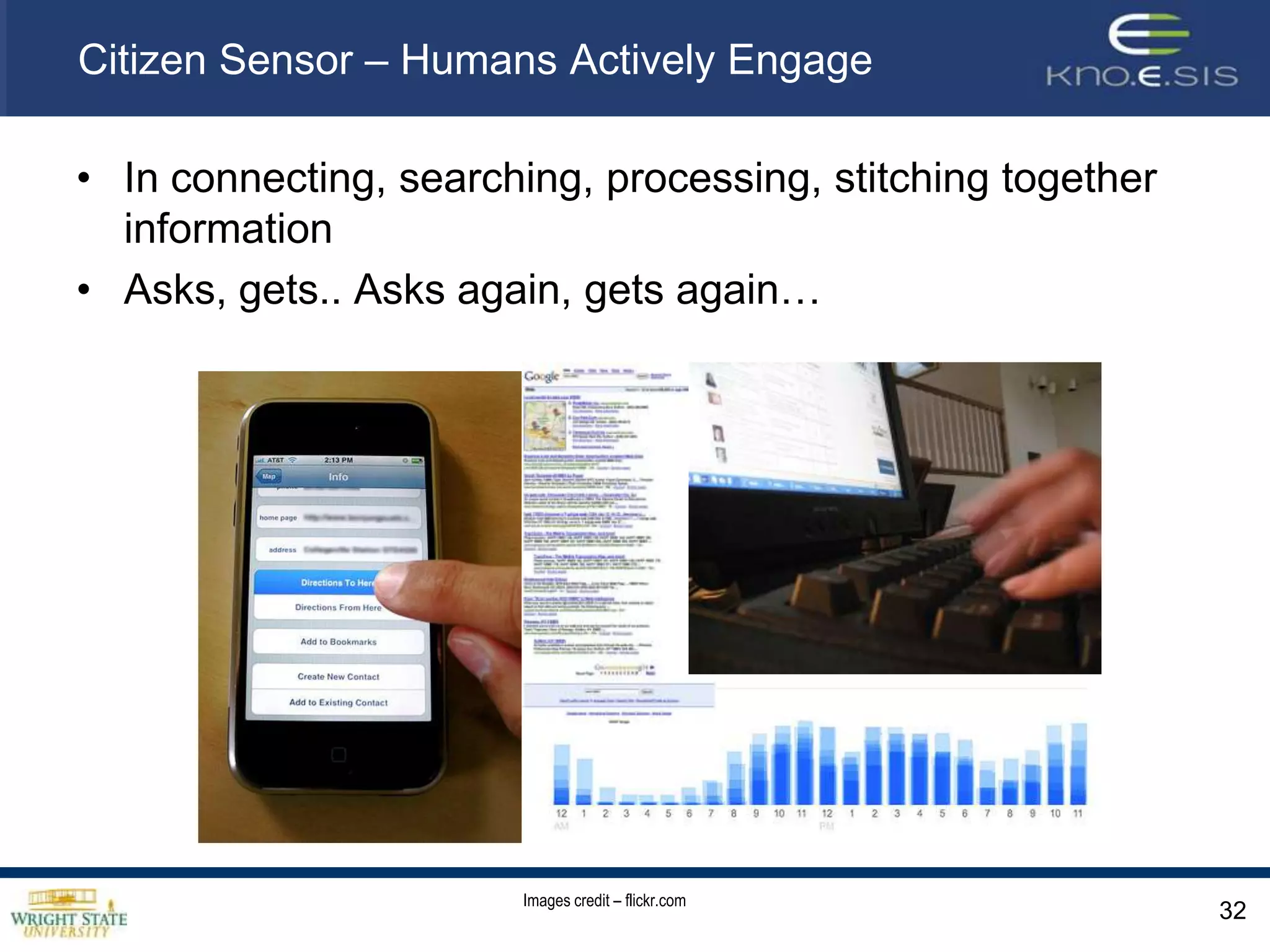
Citizen Sensor – Humans Actively EngageIn connecting, searching, processing, stitching together informationAsks, gets.. Asks again, gets again…32Images credit – flickr.com
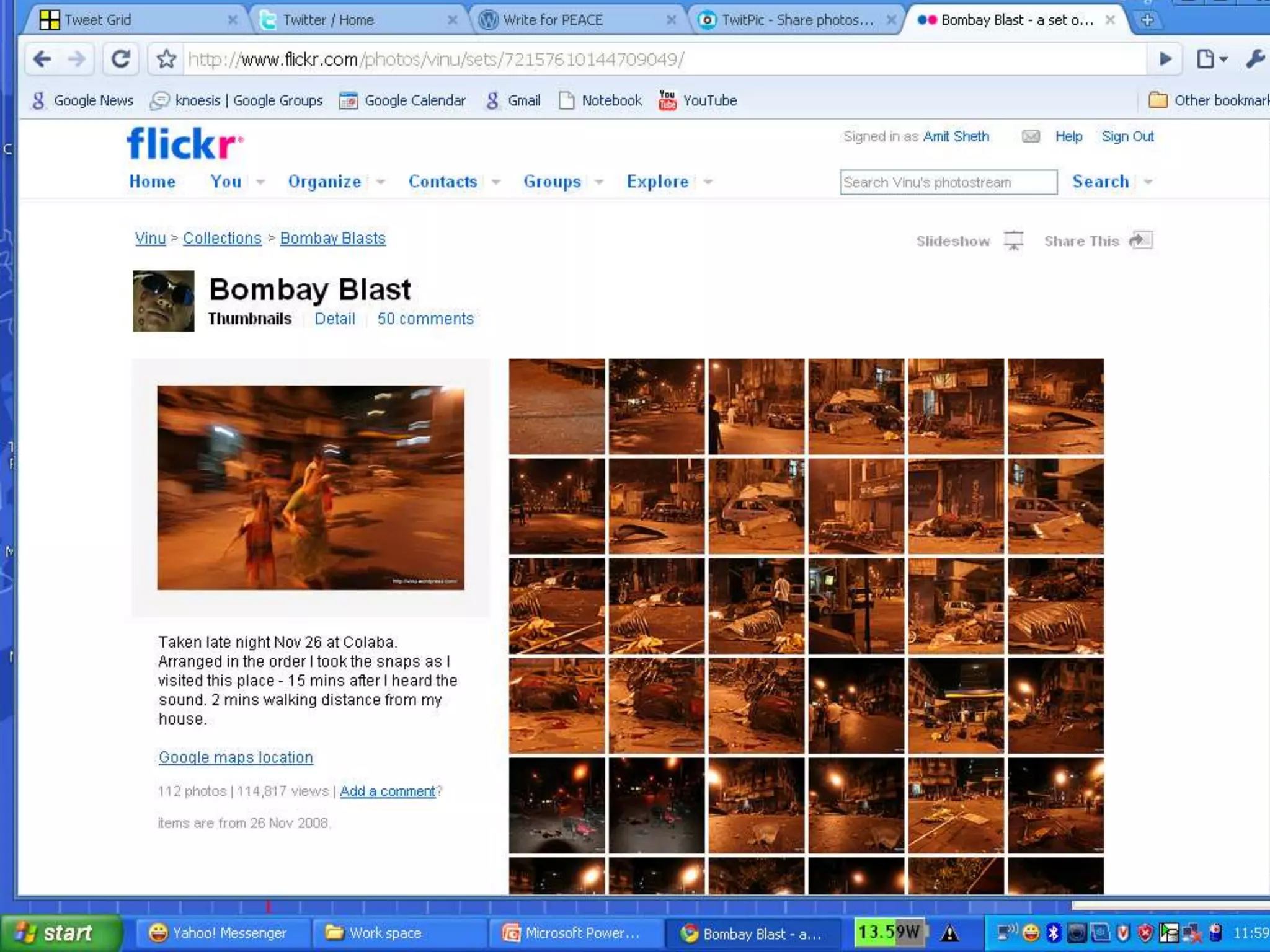
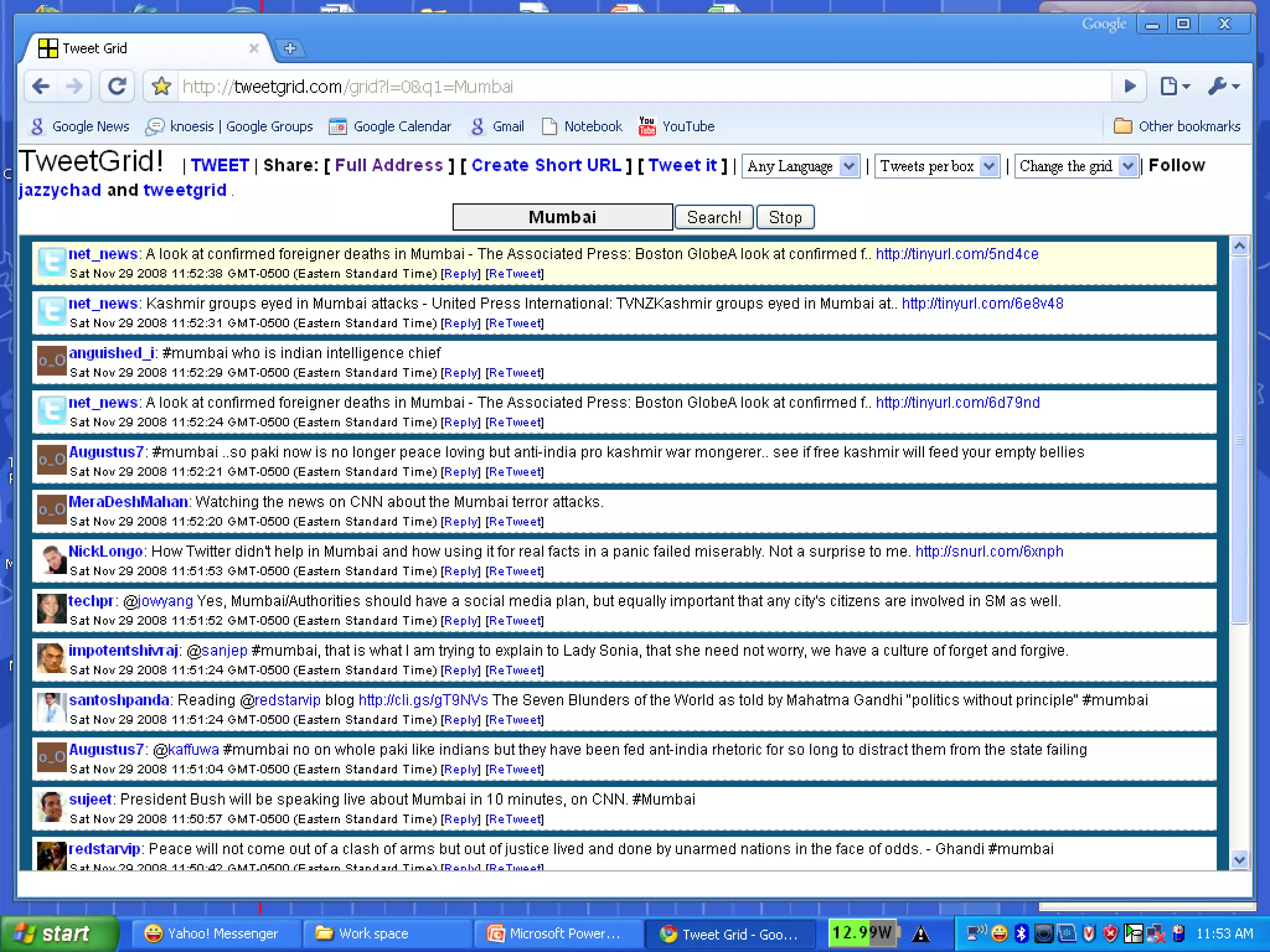
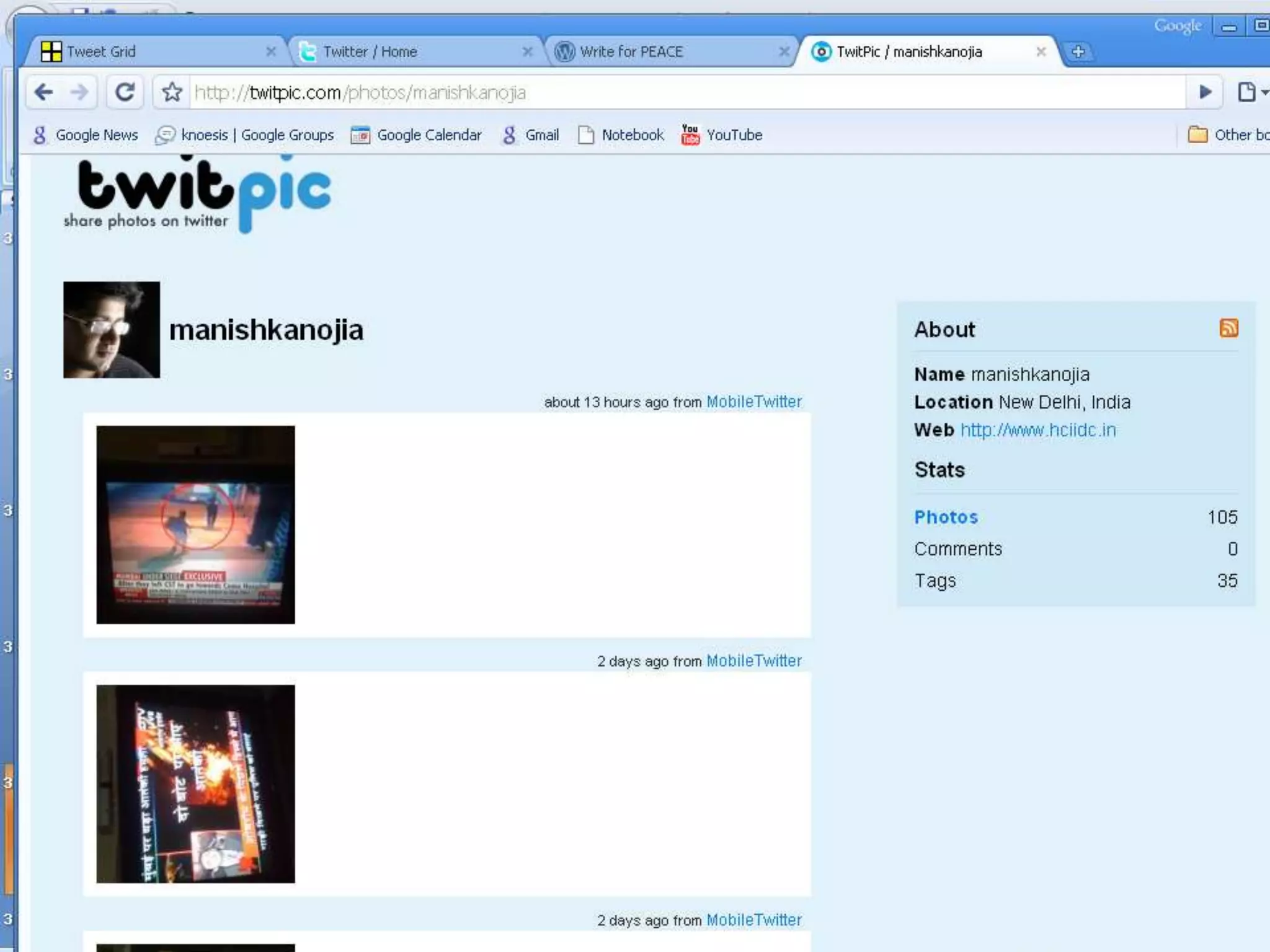
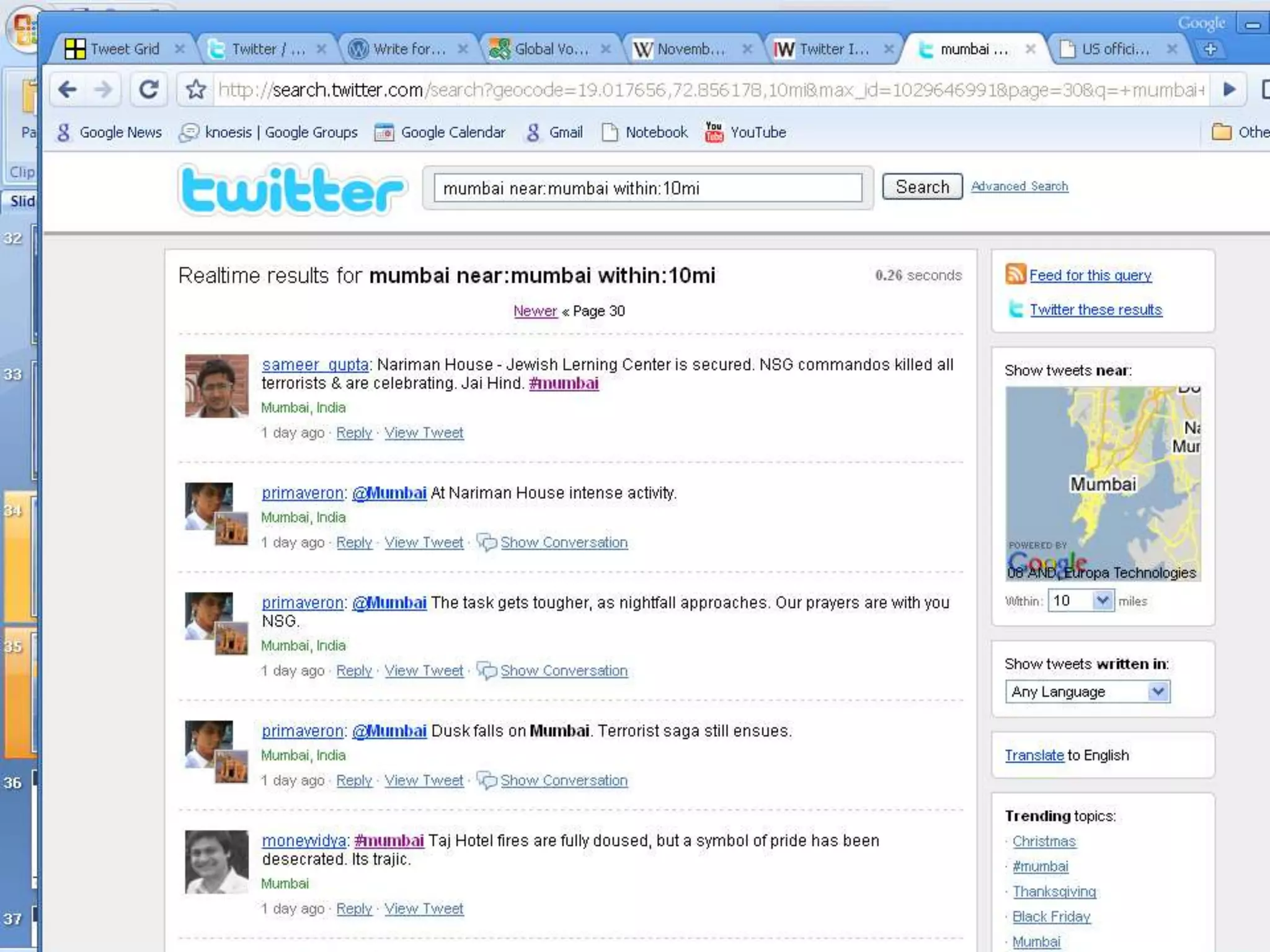
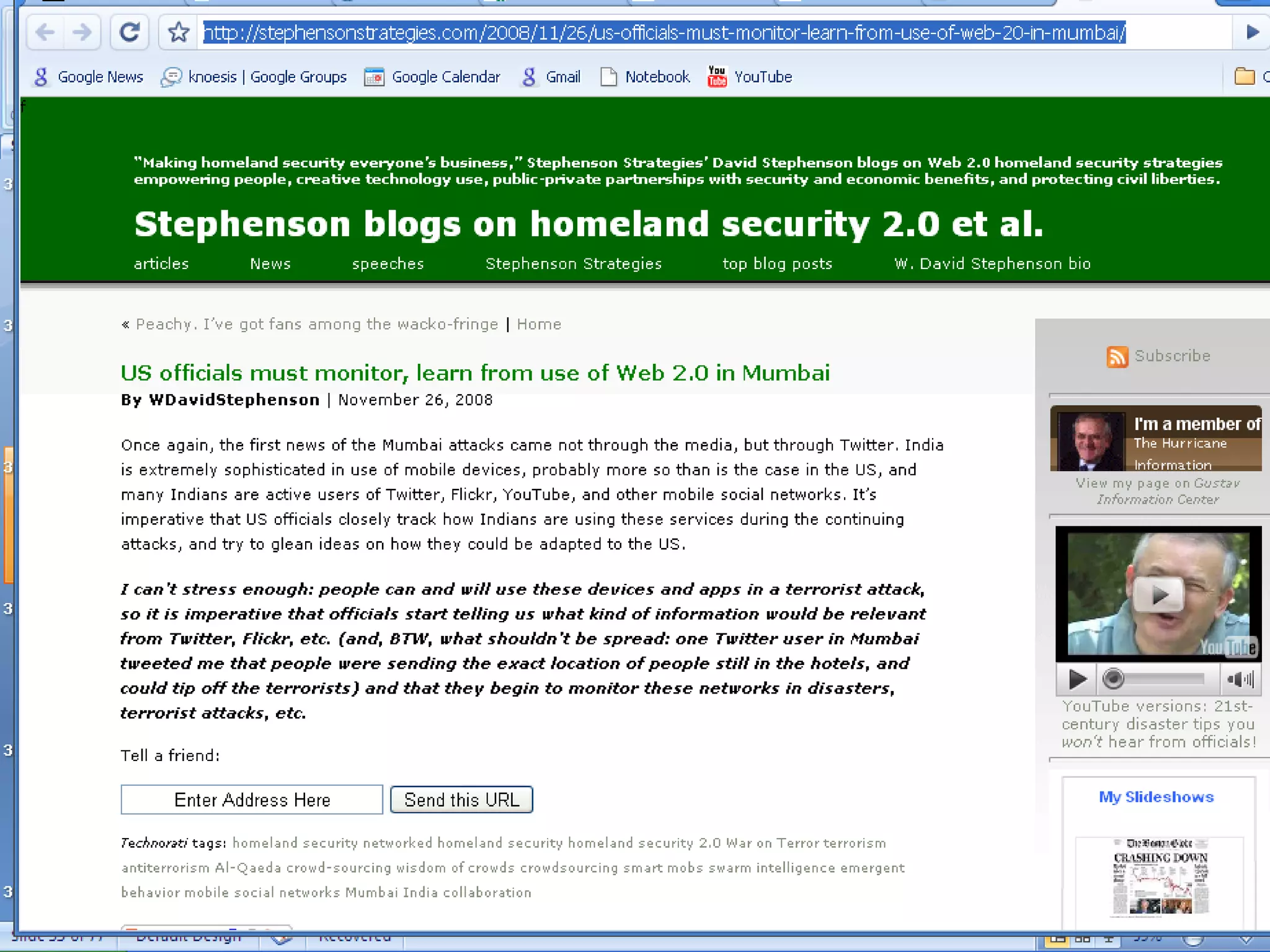
Recent example - #Mumbai33
34
35
36
37
38
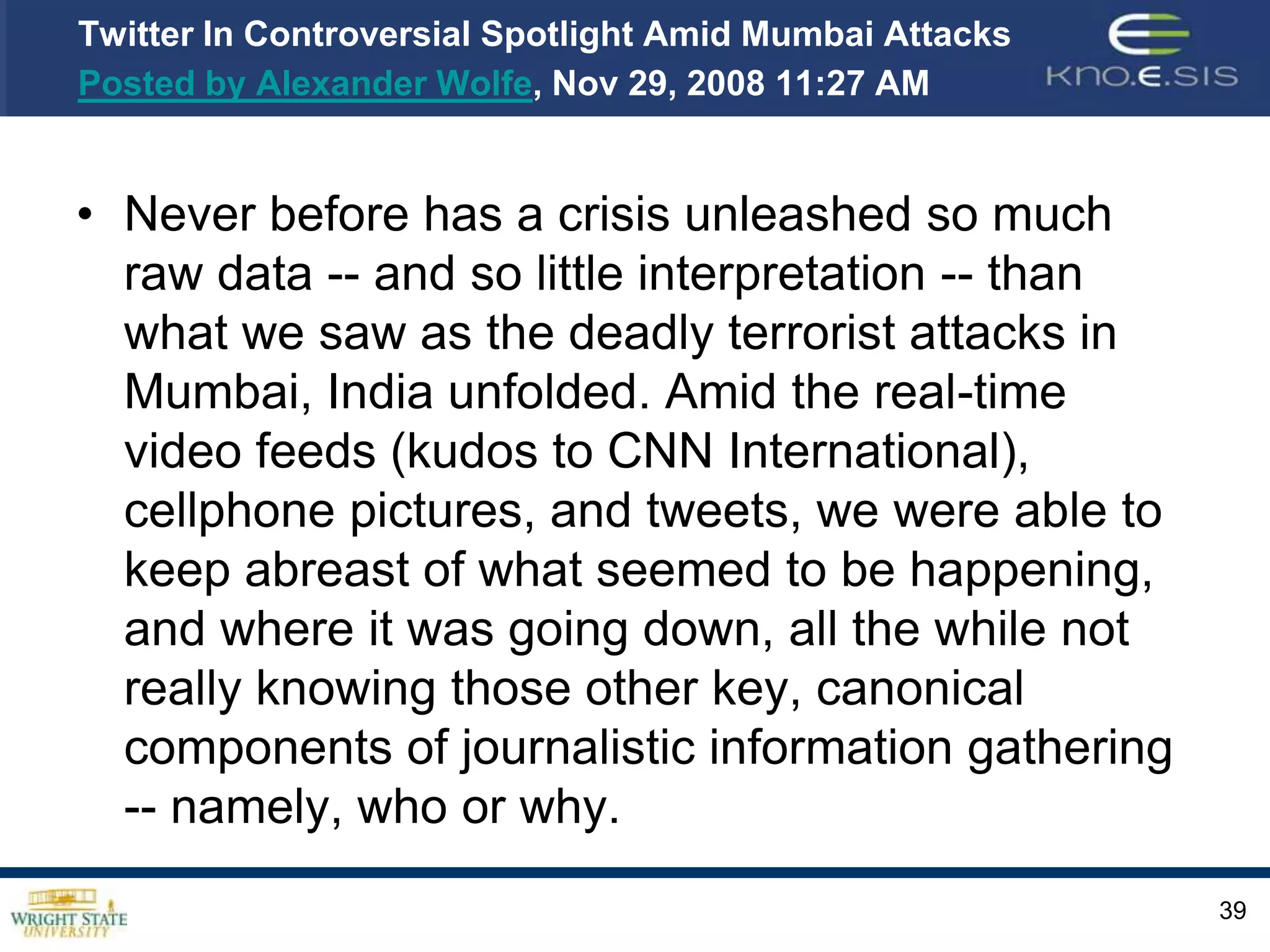
Twitter In Controversial Spotlight Amid Mumbai Attacks Posted by Alexander Wolfe, Nov 29, 2008 11:27 AM Never before has a crisis unleashed so much raw data -- and so little interpretation -- than what we saw as the deadly terrorist attacks in Mumbai, India unfolded. Amid the real-time video feeds (kudos to CNN International), cellphone pictures, and tweets, we were able to keep abreast of what seemed to be happening, and where it was going down, all the while not really knowing those other key, canonical components of journalistic information gathering -- namely, who or why.39
In fairness, no one did. There were so many tentacles to these heinous attacks, and multiple hot spots (the Taj and Oberoi hotels and the Chabad Jewish center, to name the three most prominent), that even the Indian government likely didn't have a handle on things until late in the game. My point here is not criticize, but simply to note that I was struck, as never before, by the ability of data to outstrip information.40
Alexander Wolfe continues …I'd add that Mumbai is likely to be viewed in hindsight as the first instance of the paradigmatic shift in crisis coverage: namely, journalists will henceforth no longer be the first to bring us information. Rather, they will be a conduit for the stream of images and video shot by a mix of amateurs and professionals on scene.You've got to add to this the immense influence of Twitter. In the past few days, I've seen a slew of stories pointing out how Twitter was a key source of real-time updates on the attacks, to the point that Indian authorities asked people to stop posting to the microblogging service (for fear that they might be giving away strategic information to the terrorists).41
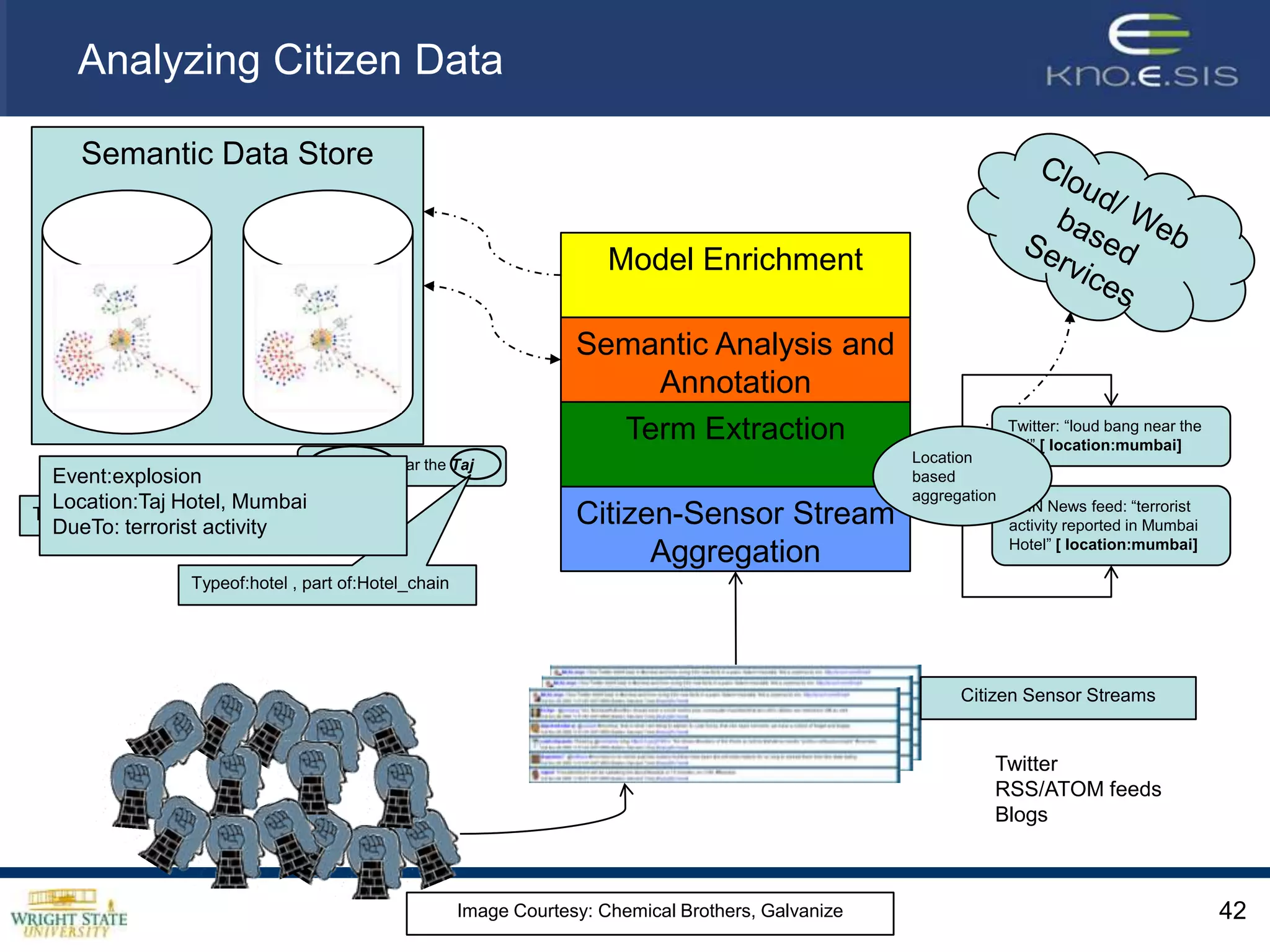
Analyzing Citizen Data42Semantic Data StoreCloud/ Web based ServicesModel EnrichmentSemantic Analysis and AnnotationTerm ExtractionTwitter: “loud bang near the Taj” [ location:mumbai]Location based aggregationloud bangnear the TajEvent:explosionLocation:Taj Hotel, MumbaiDueTo: terrorist activityCNN News feed: “terrorist activity reported in Mumbai Hotel” [ location:mumbai]Citizen-Sensor Stream AggregationTypeof:noise, relatedto:explosionTypeof:hotel , part of:Hotel_chainCitizen Sensor StreamsTwitter RSS/ATOM feedsBlogsImage Courtesy: Chemical Brothers, Galvanize
Online and offline worldsComputational abstractions to represent the physical world’s dynamic nature Merging online and offline activitiesConnecting the physical world naturally with the online worldWhat are natural operations on these abstractions? How do we detect these abstractions based on other abstractions and multimodal data sources?43
Enriching Human ExperienceRecognition of objects (IOT) and models of objectUnderstanding of objects and contentMultimodal interfacesMulti(level) sensing and perceptionFrom keywords and entities to events and rich sets of relationships; spatio-temporal-thematic computingModels (ontologies, folkonomies, taxonomies, classification, nomenclature)– time, location, sensors, domain More powerful reasoning: paths, patterns, subgraphs that connect related things; deductive and abductive reasoning, ….44
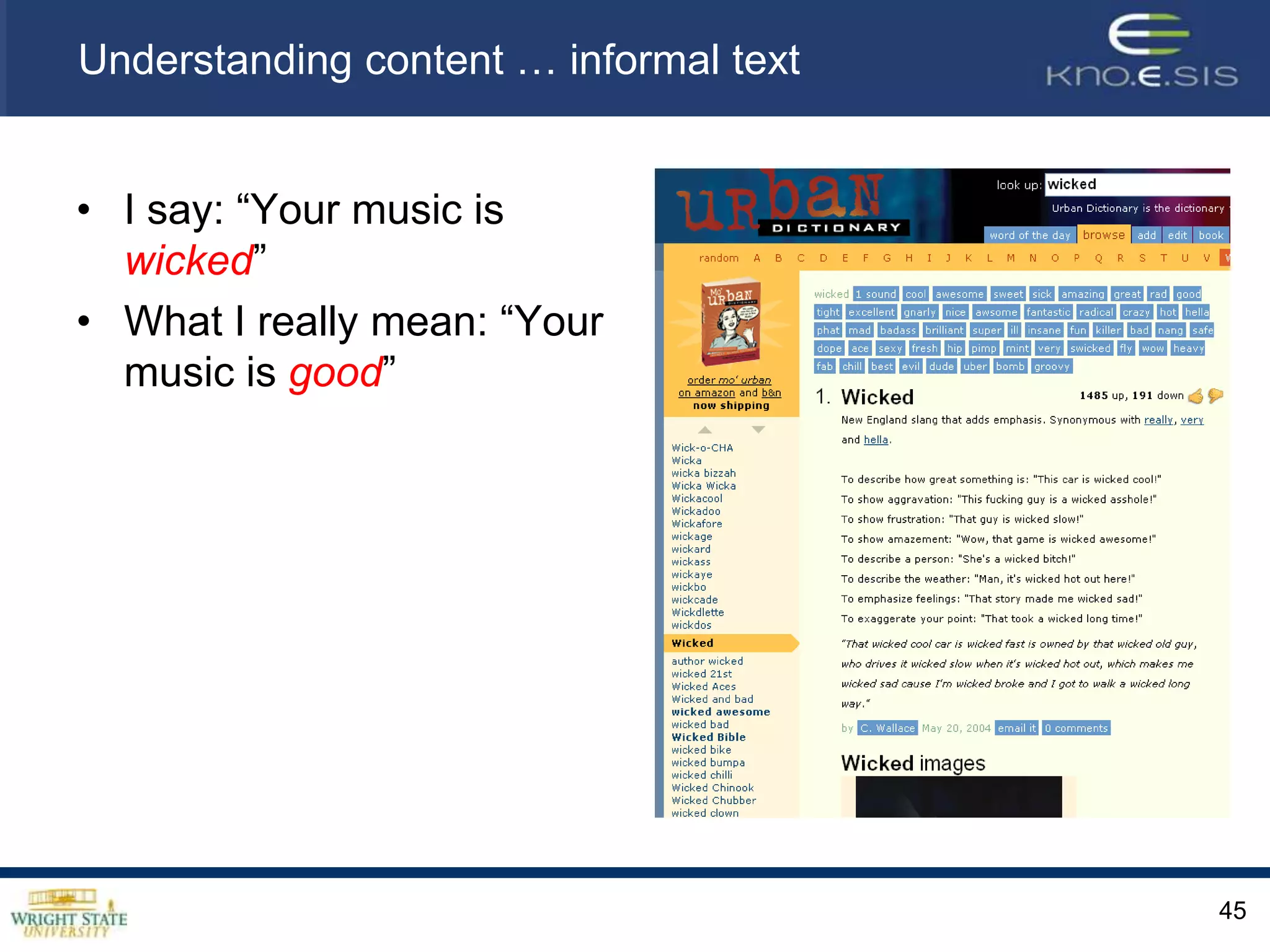
Understanding content … informal textI say: “Your music is wicked” What I really mean: “Your music is good” 45
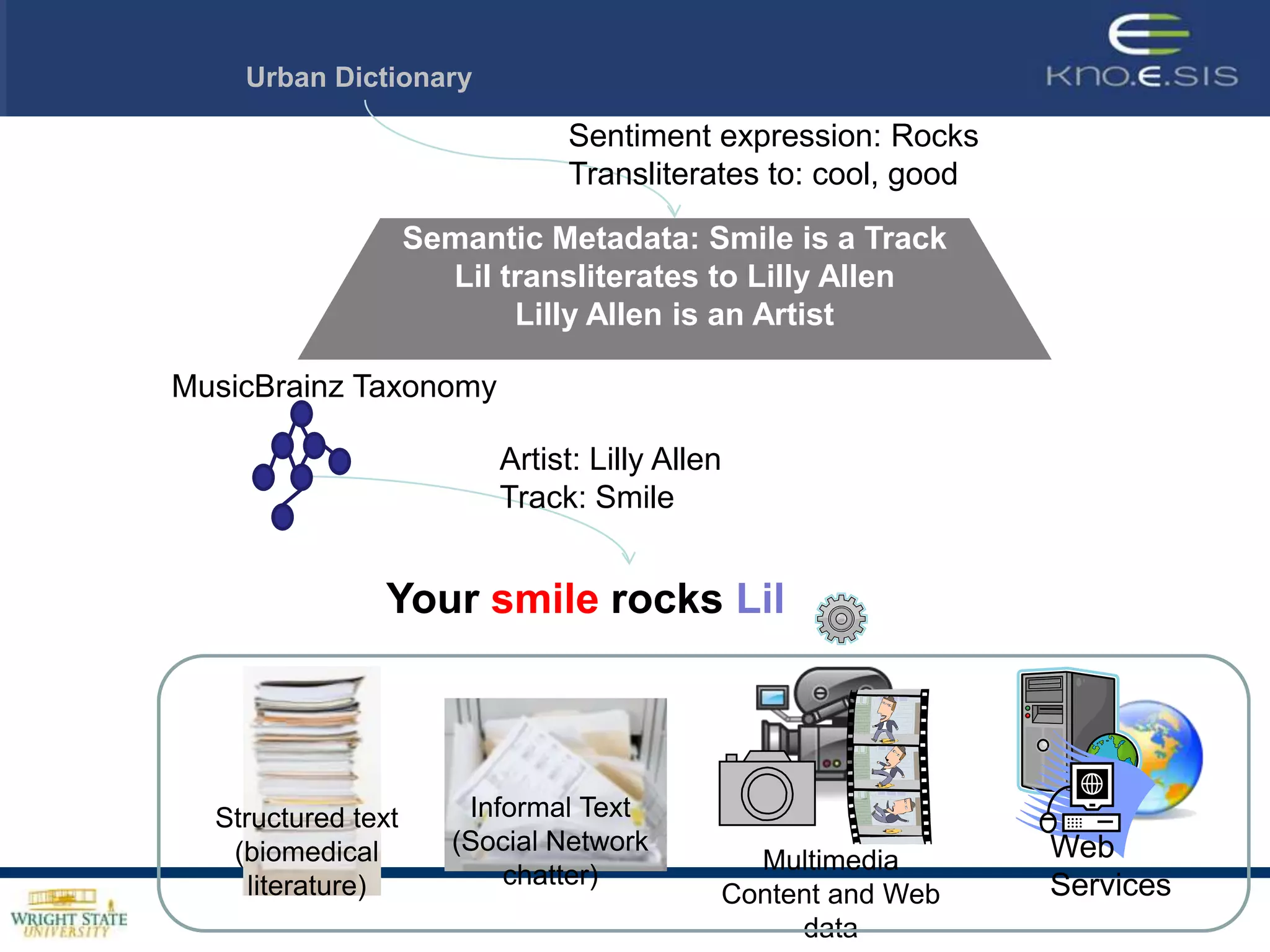
Urban DictionarySentiment expression: Rocks Transliterates to: cool, goodStructured text (biomedical literature)Semantic Metadata: Smile is a TrackLil transliterates to Lilly AllenLilly Allen is an ArtistMusicBrainz TaxonomyInformal Text (Social Network chatter)Artist: Lilly AllenTrack: Smile    Your smile rocks LilMultimedia Content and Web dataWeb Services
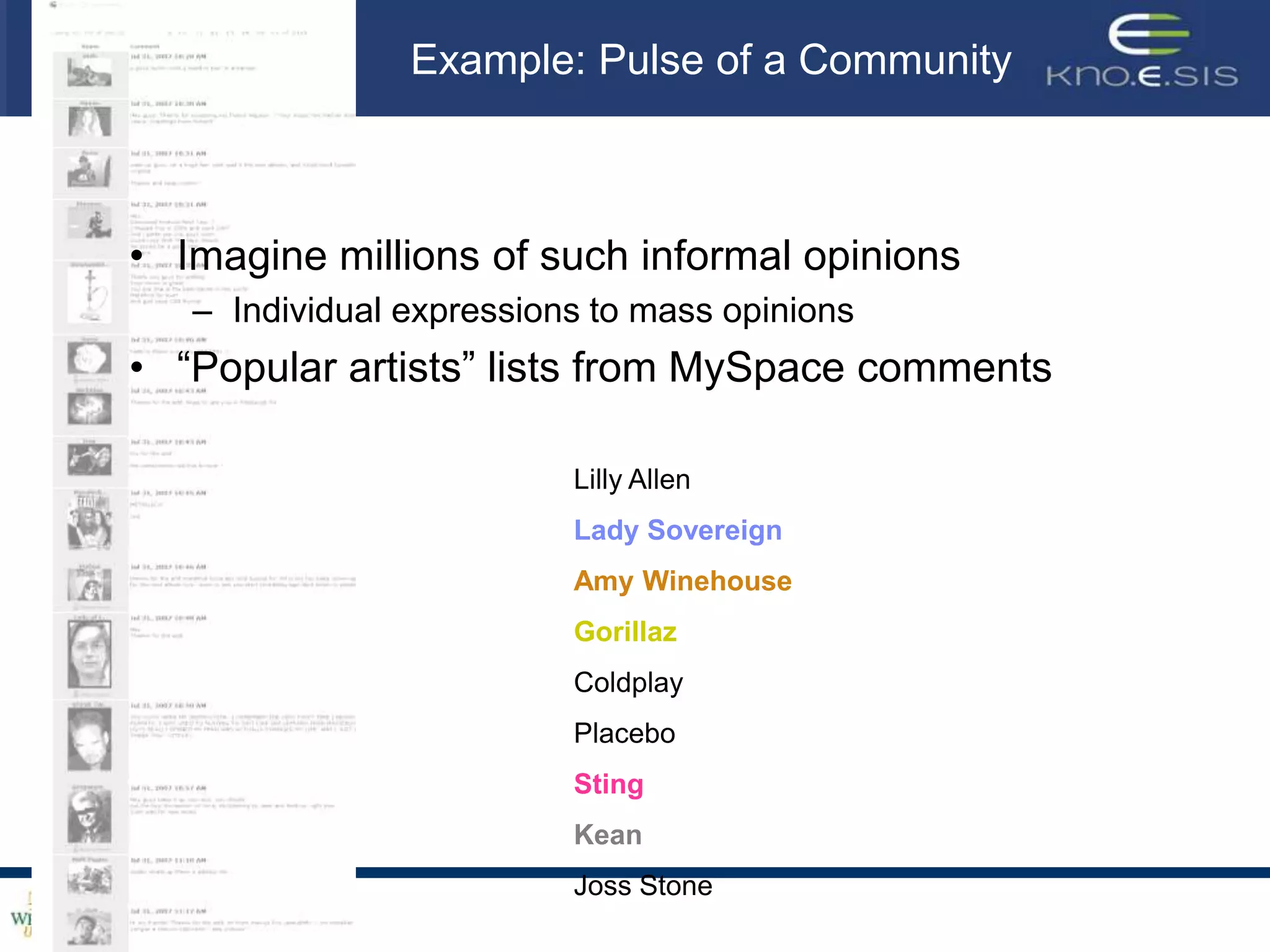
Example: Pulse of a CommunityImagine millions of such informal opinionsIndividual expressions to mass opinions“Popular artists” lists from MySpace commentsLilly Allen	Lady Sovereign	Amy WinehouseGorillazColdplayPlaceboStingKeanJoss Stone
How  do you get comprehensive situational awareness by merging “human sensing” and “machine sensing”?48
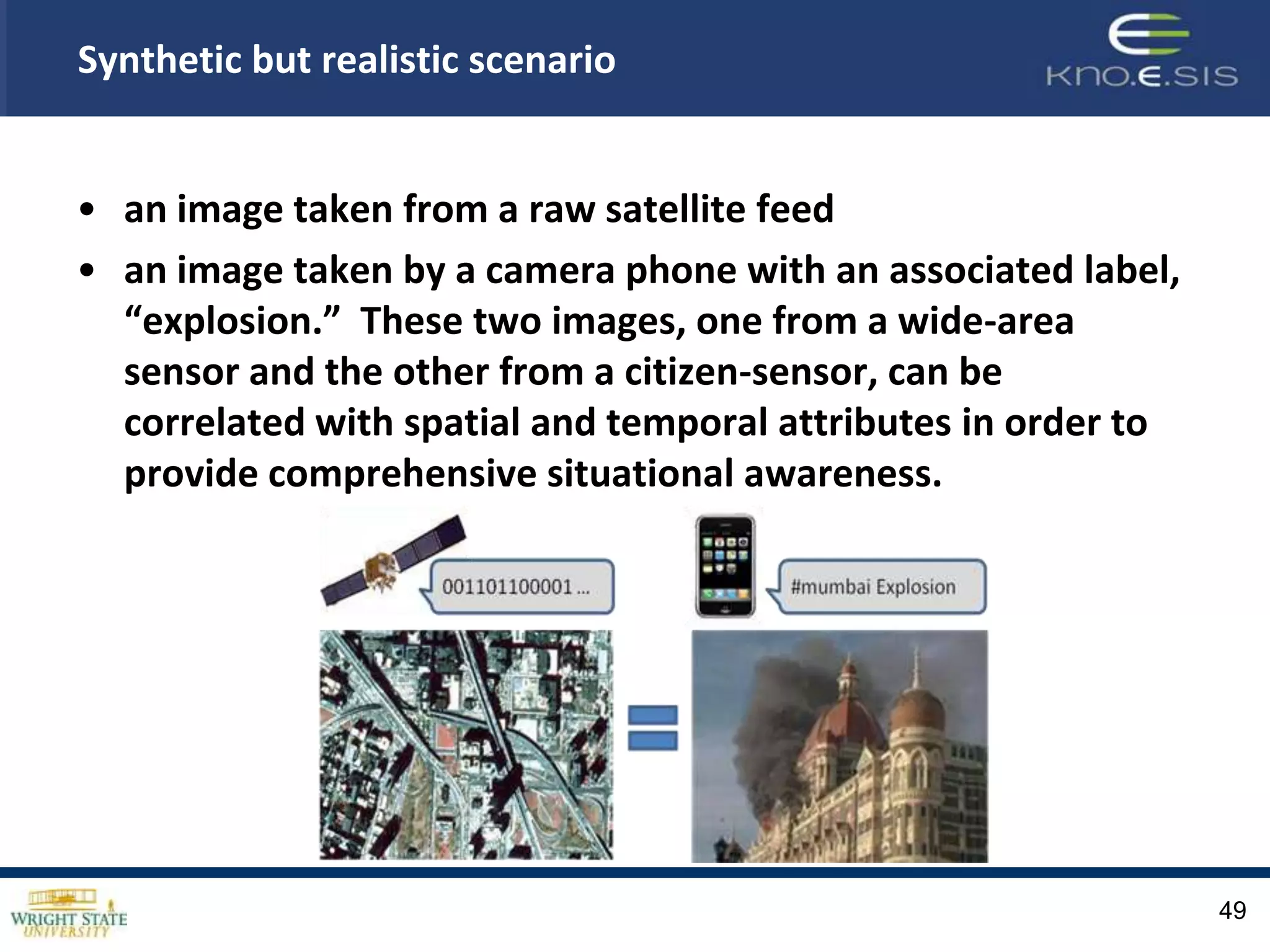
Synthetic but realistic scenarioan image taken from a raw satellite feedan image taken by a camera phone with an associated label, “explosion.”  These two images, one from a wide-area sensor and the other from a citizen-sensor, can be correlated with spatial and temporal attributes in order to provide comprehensive situational awareness.49
Kno.e.sis’ Semantic Sensor Web50
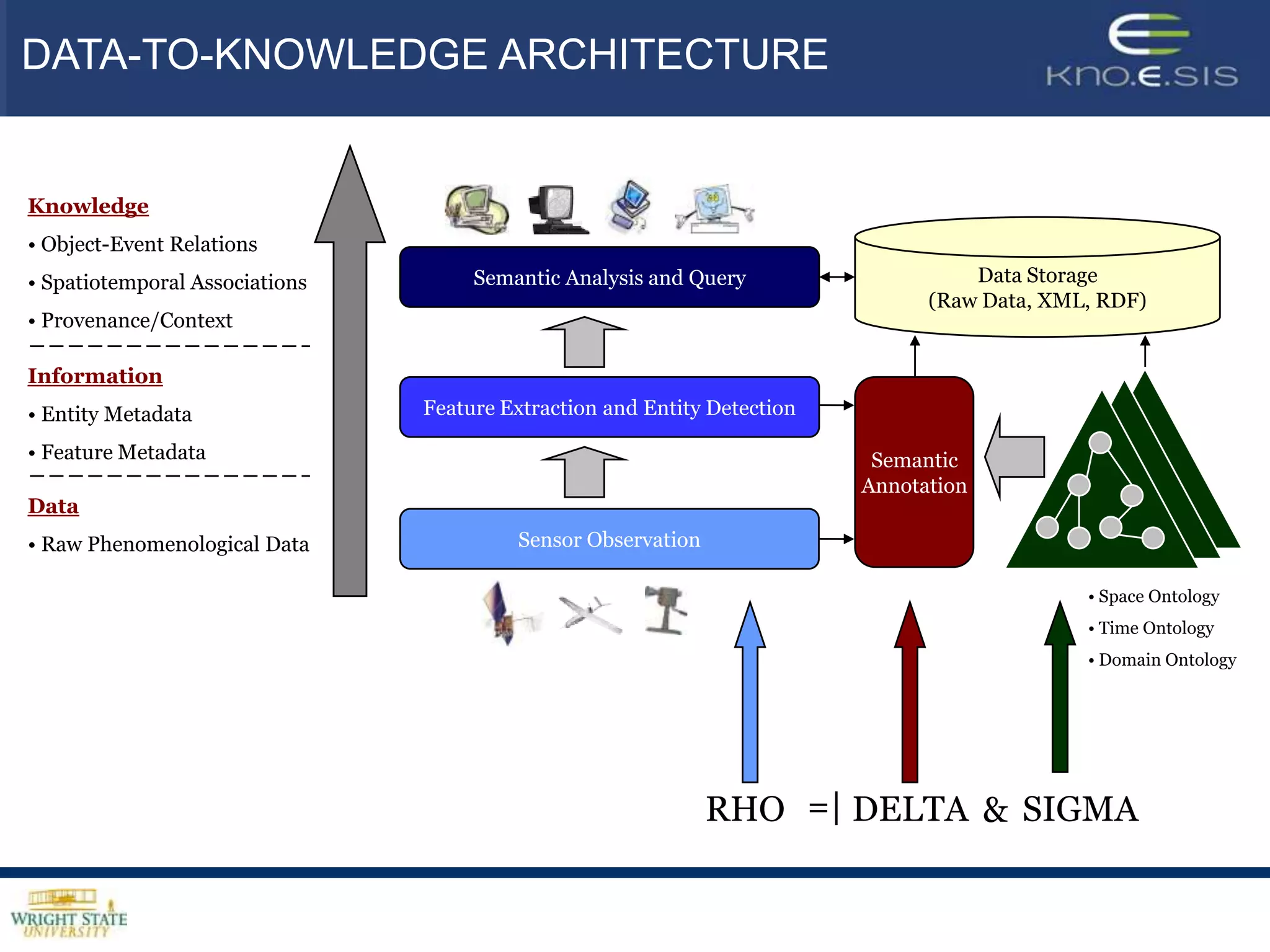
DATA-TO-KNOWLEDGE ARCHITECTUREKnowledge Object-Event Relations
 Spatiotemporal Associations
 Provenance/ContextData Storage(Raw Data, XML, RDF)Semantic Analysis and QueryInformation Entity Metadata
 Feature MetadataFeature Extraction and Entity DetectionSemanticAnnotationData Raw Phenomenological DataSensor ObservationOntologies Space Ontology
 Time Ontology
 Domain Ontology=|RHODELTASIGMA&51
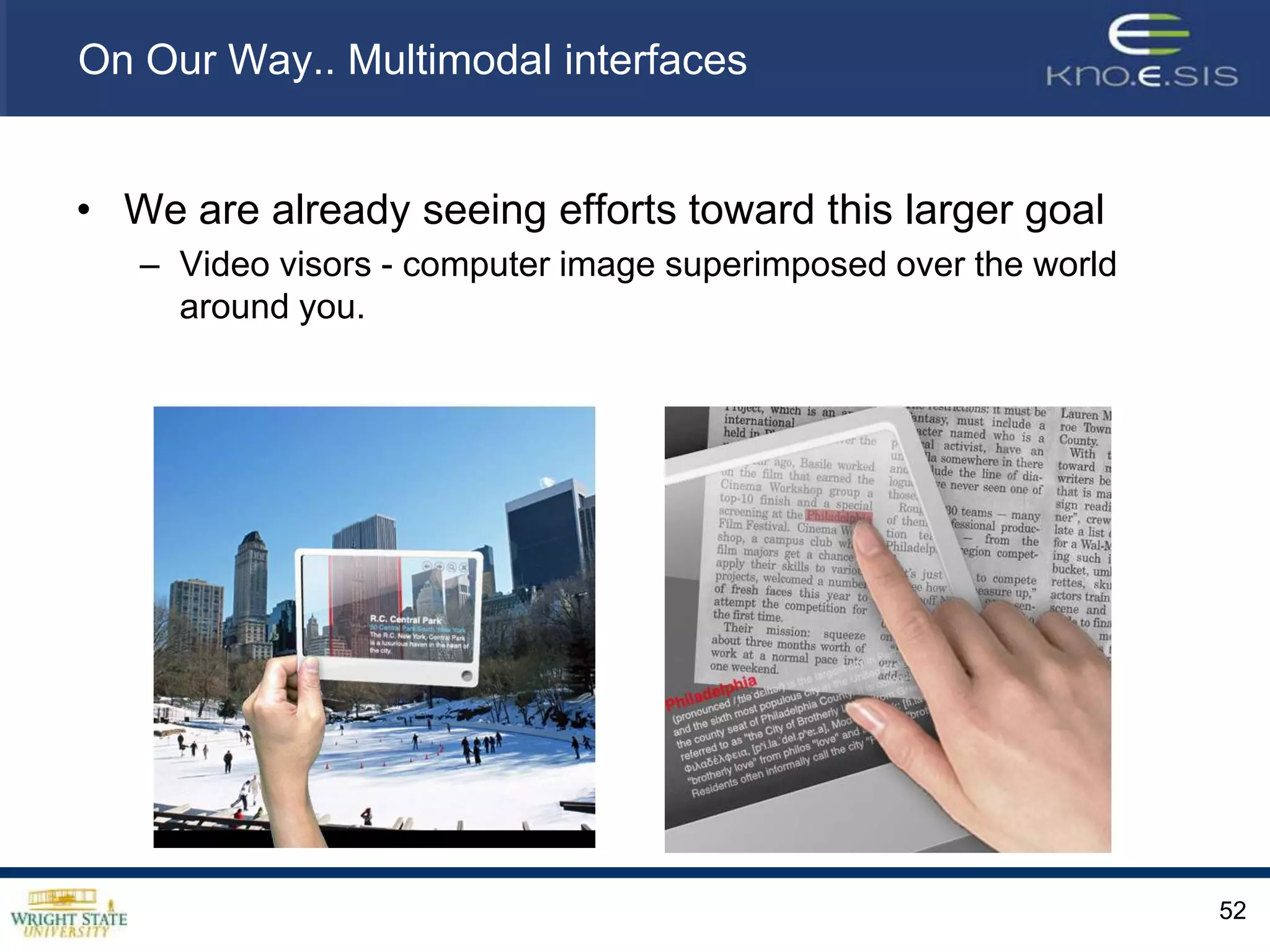
On Our Way.. Multimodal interfacesWe are already seeing efforts toward this larger goalVideo visors - computer image superimposed over the world around you. 52
Challenges – Multiple ModalitiesMultiple modalities of objects and eventsHow do we organize and access multimodal data? How do we organize, index, search and aggregate events and multimedia experiences as effectively as modern search engines do for text using keywords?  53
Objects to EventsIf we move from this object mode to an event modeA single user action or request or sensory observation could act as a cue for getting all (multi-modal) information associated with an eventIf conditions change, systems could even modify their behavior to suit their changing view of the world Today text is most prevalent, with increasing but disparate (non-integrated) image and video data, but human experience is event based (at higher levels of abstractions) formed based on multi-sensory, multi-perception (at lower level of abstraction) observations54
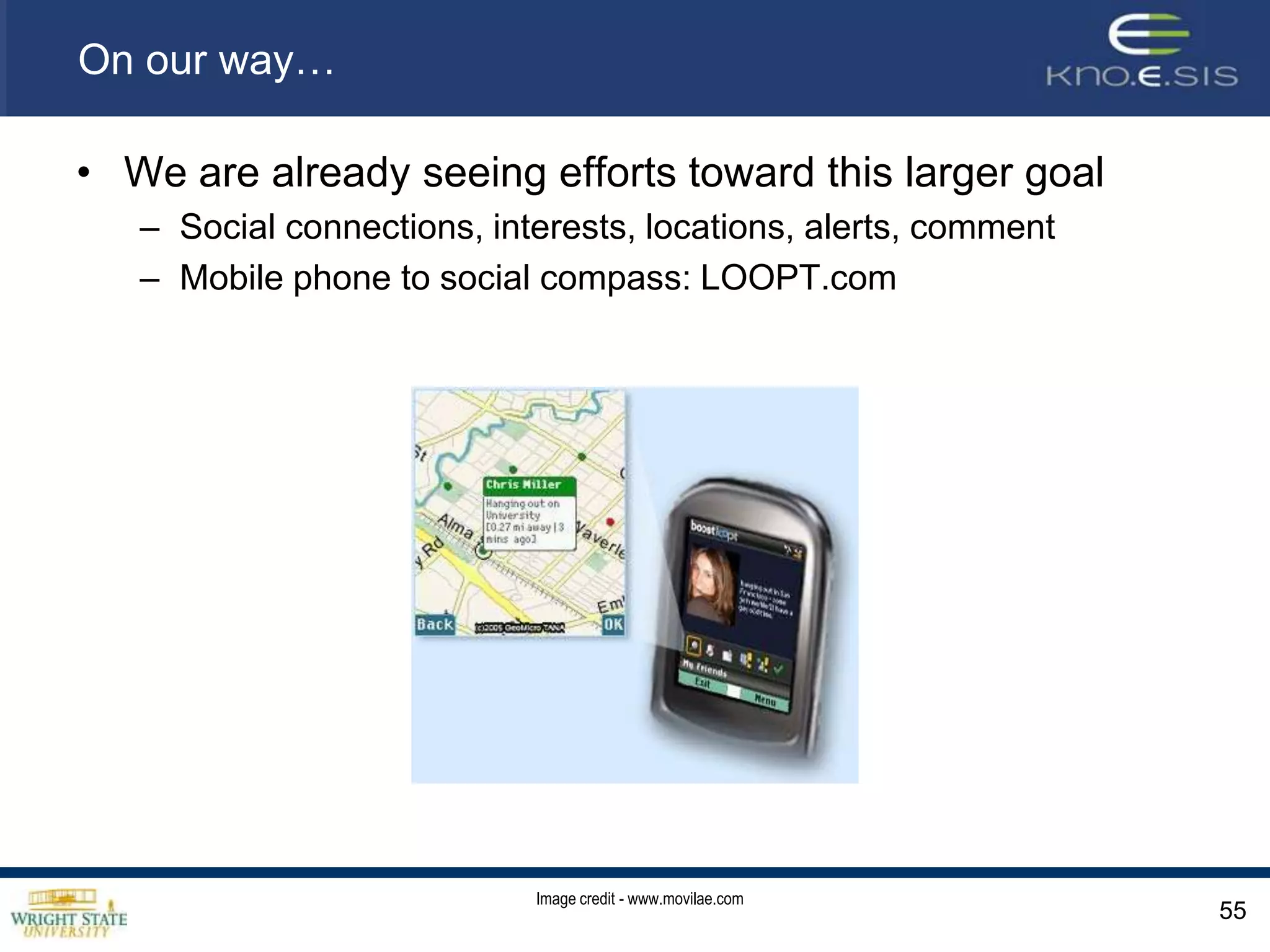
We are already seeing efforts toward this larger goalSocial connections, interests, locations, alerts, commentMobile phone to social compass: LOOPT.com55Image credit - www.movilae.com On our way…
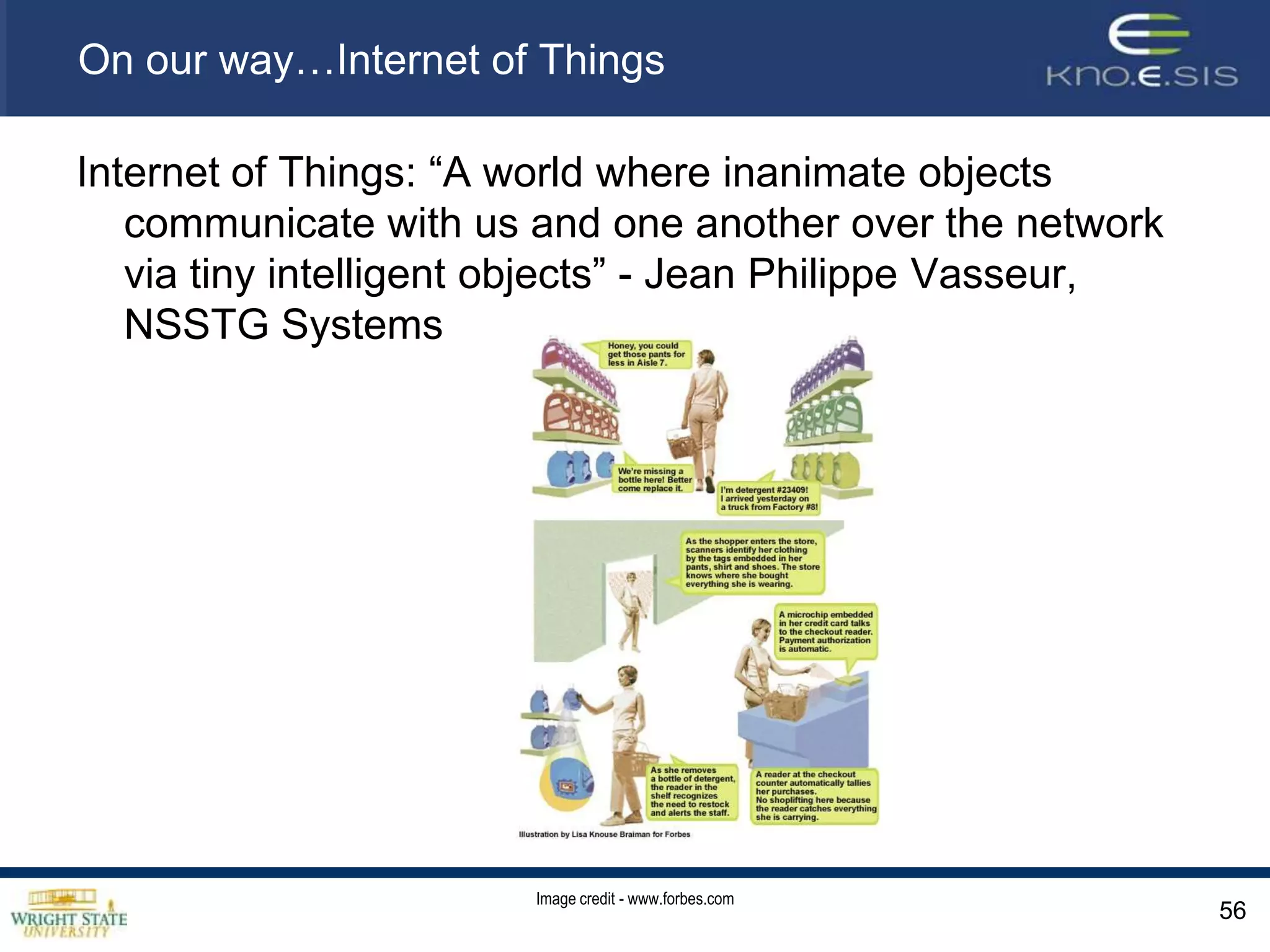
On our way…Internet of ThingsInternet of Things: “A world where inanimate objects communicate with us and one another over the network via tiny intelligent objects” - Jean Philippe Vasseur, NSSTG Systems56Image credit - www.forbes.com
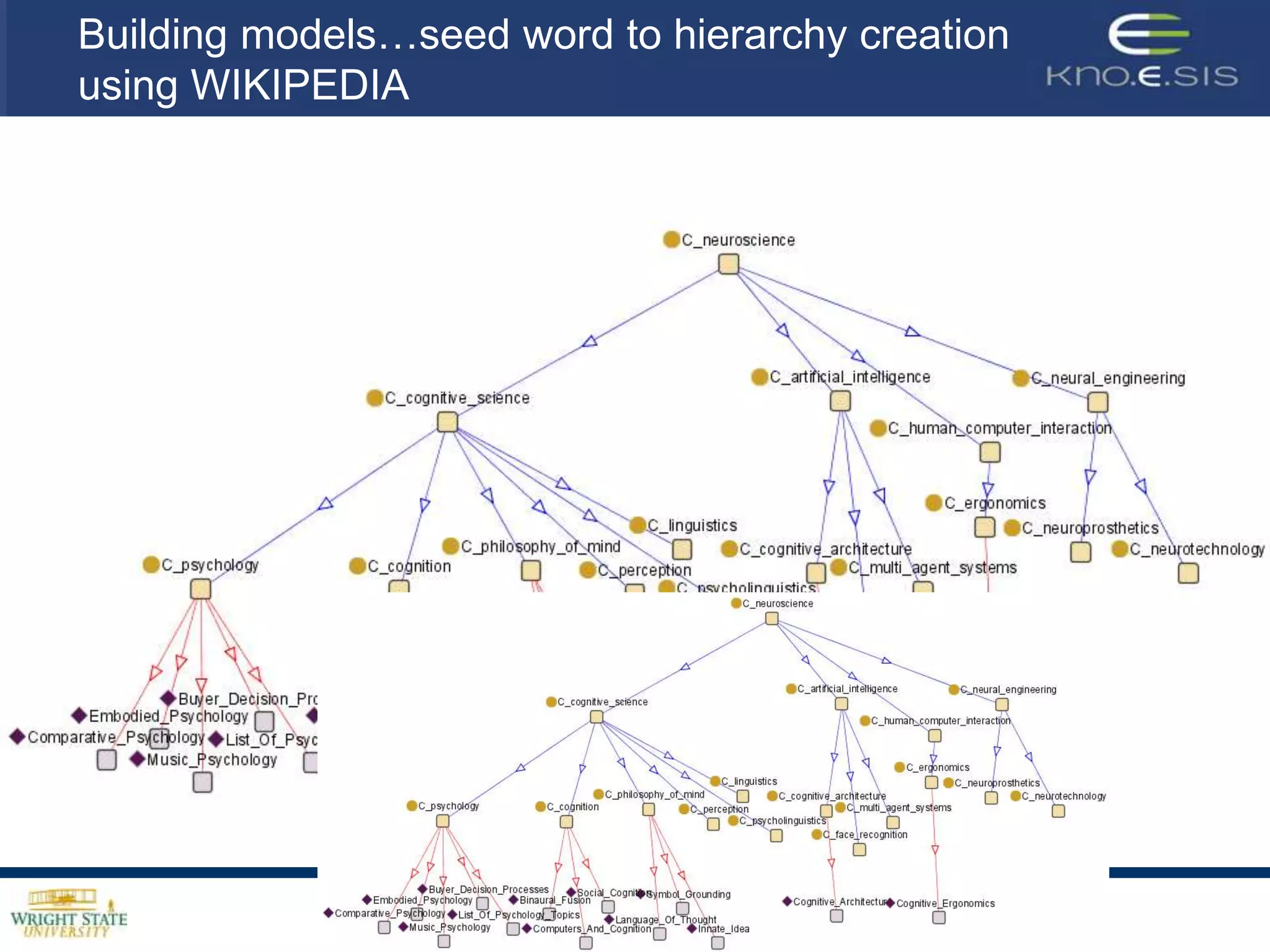
Building models…seed word to hierarchy creation using WIKIPEDIAQuery: “cognition”
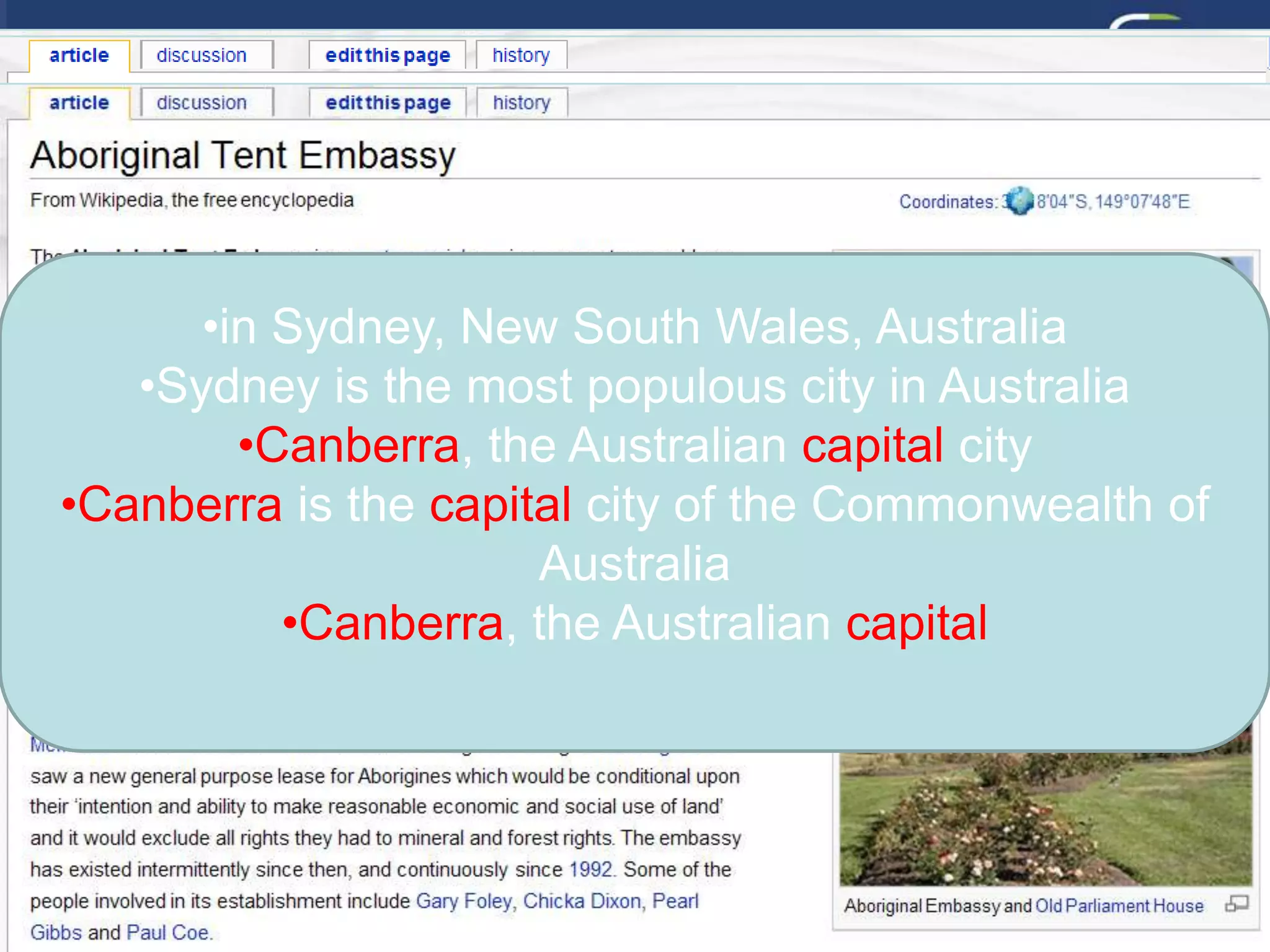
Learn Patterns that indicate RelationshipsQuery:Australia  SidneyAustralia  Canberrain Sydney, New South Wales, Australia
Sydney is the most populous city in Australia
Canberra, the Australian capital city
Canberra is the capital city of the Commonwealth of Australia
Canberra, the Australian capital
in Sydney, New South Wales, Australia
Sydney is the most populous city in Australia
Canberra, the Australian capital city
Canberra is the capital city of the Commonwealth of Australia
Canberra, the Australian capitalWe know that countries have capitals.Which one is Australia’s?
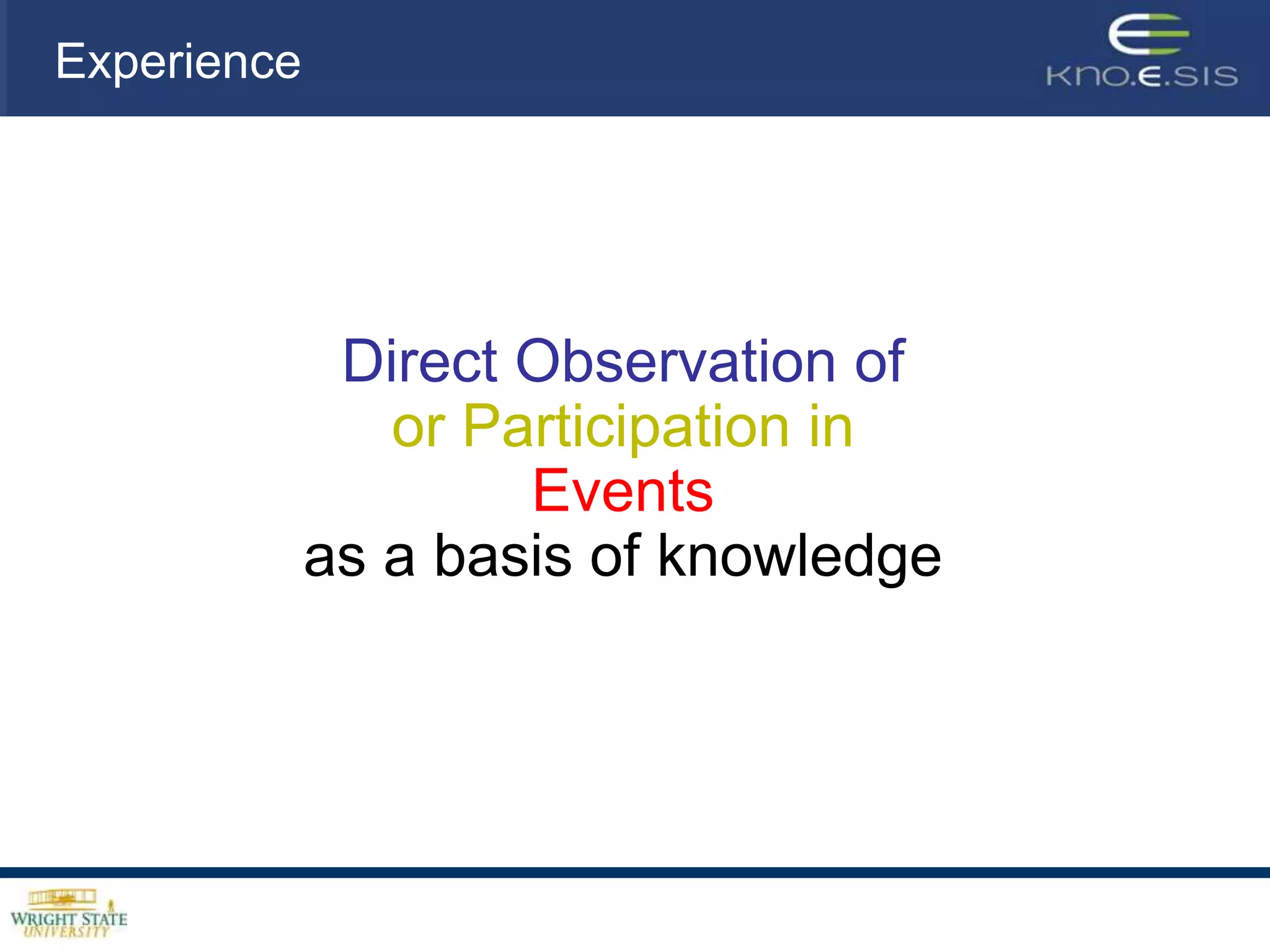
ExperienceDirect Observation ofor Participation inEvents as a basis of knowledge
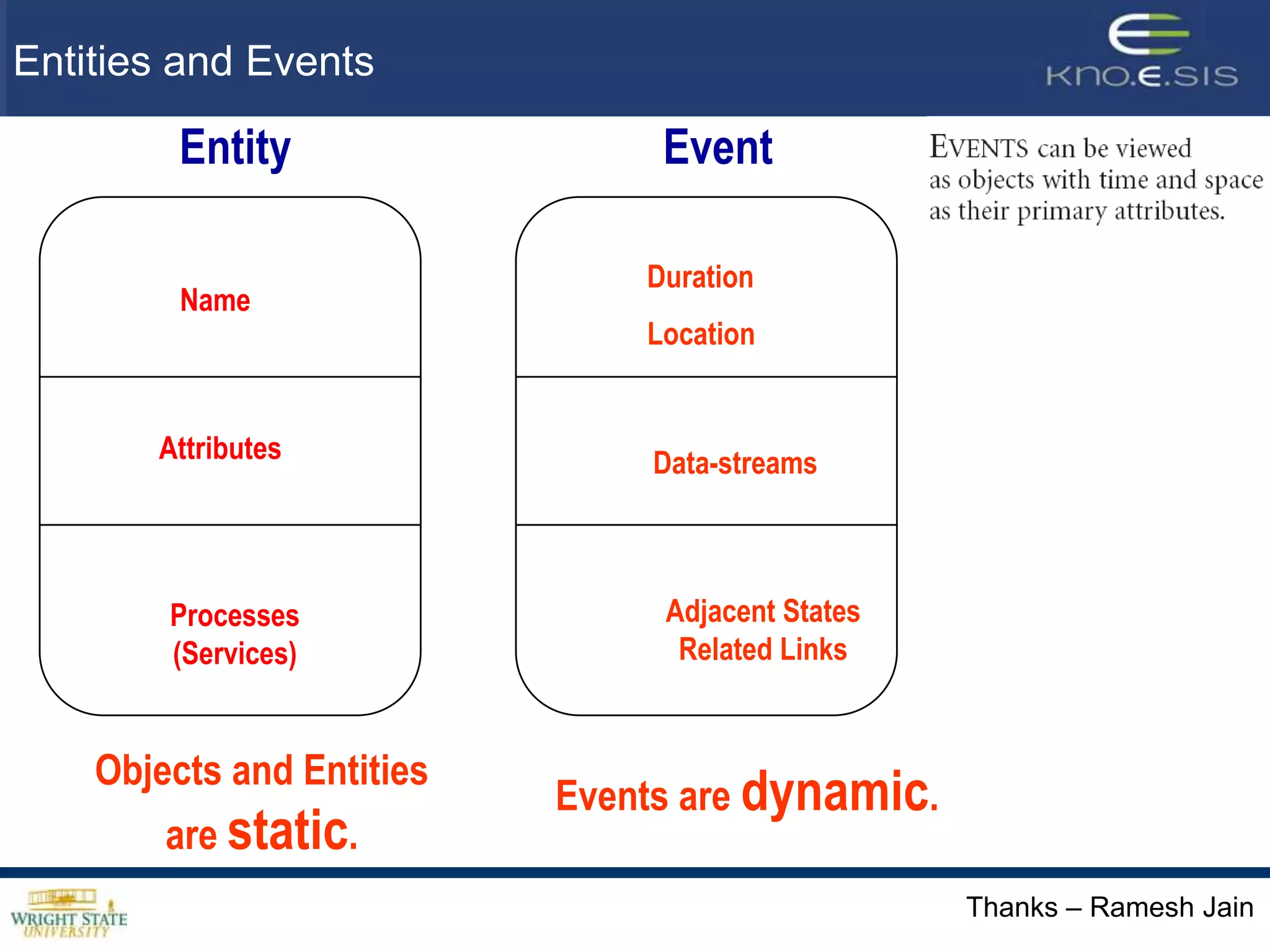
Entities and EventsEvent Entity NameDurationNameLocationAttributesData-streamsAttributesProcessesAdjacent StatesRelated LinksProcesses(Services)Objects and Entitiesare static.Events are dynamic.Thanks – Ramesh Jain
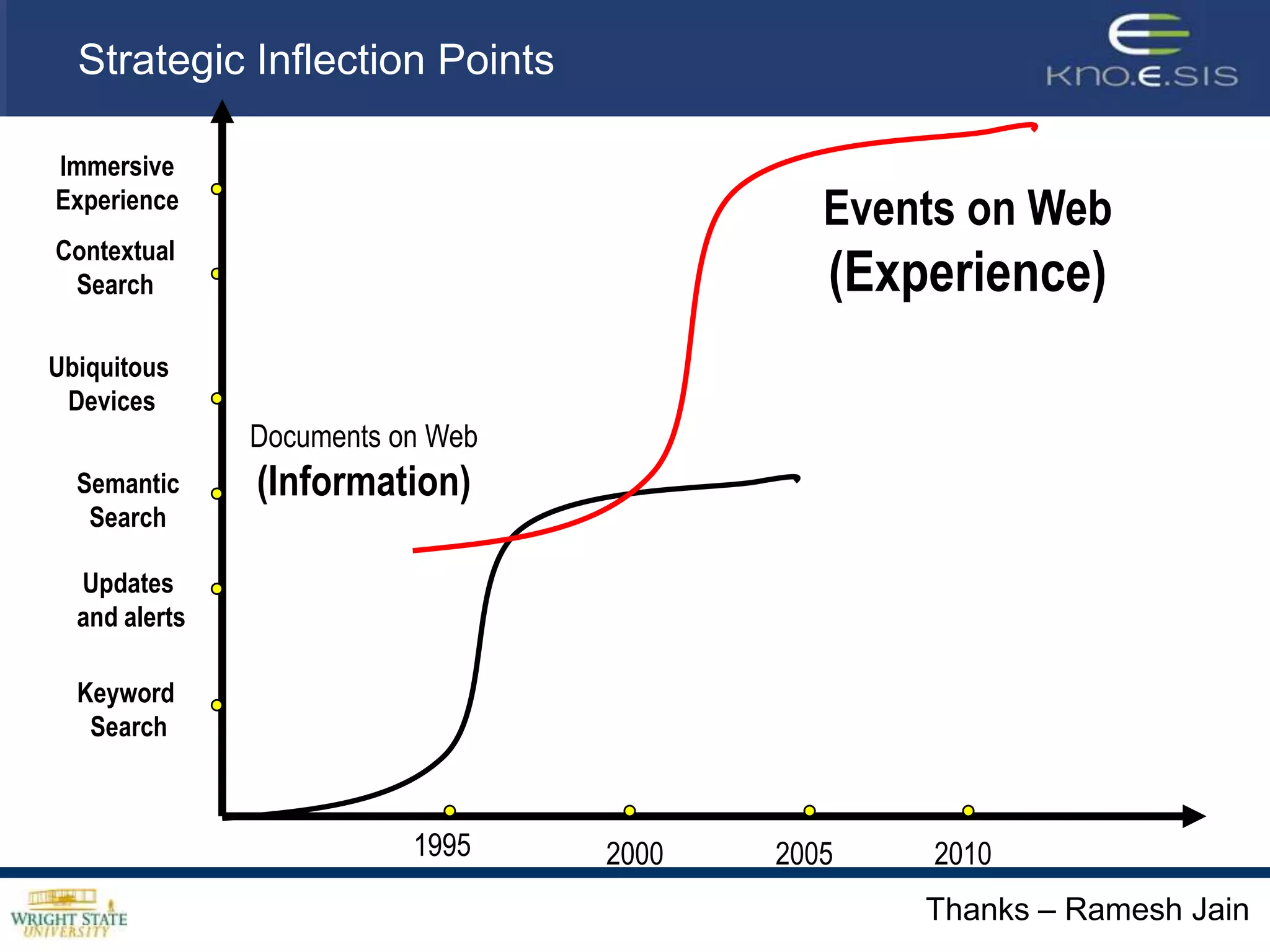
Strategic Inflection PointsEvents on Web(Experience)Documents on Web(Information)ImmersiveExperienceContextualSearchUbiquitous DevicesSemanticSearchUpdates and alertsKeyword Search1995200020052010Thanks – Ramesh Jain
Thanks – Ramesh Jain
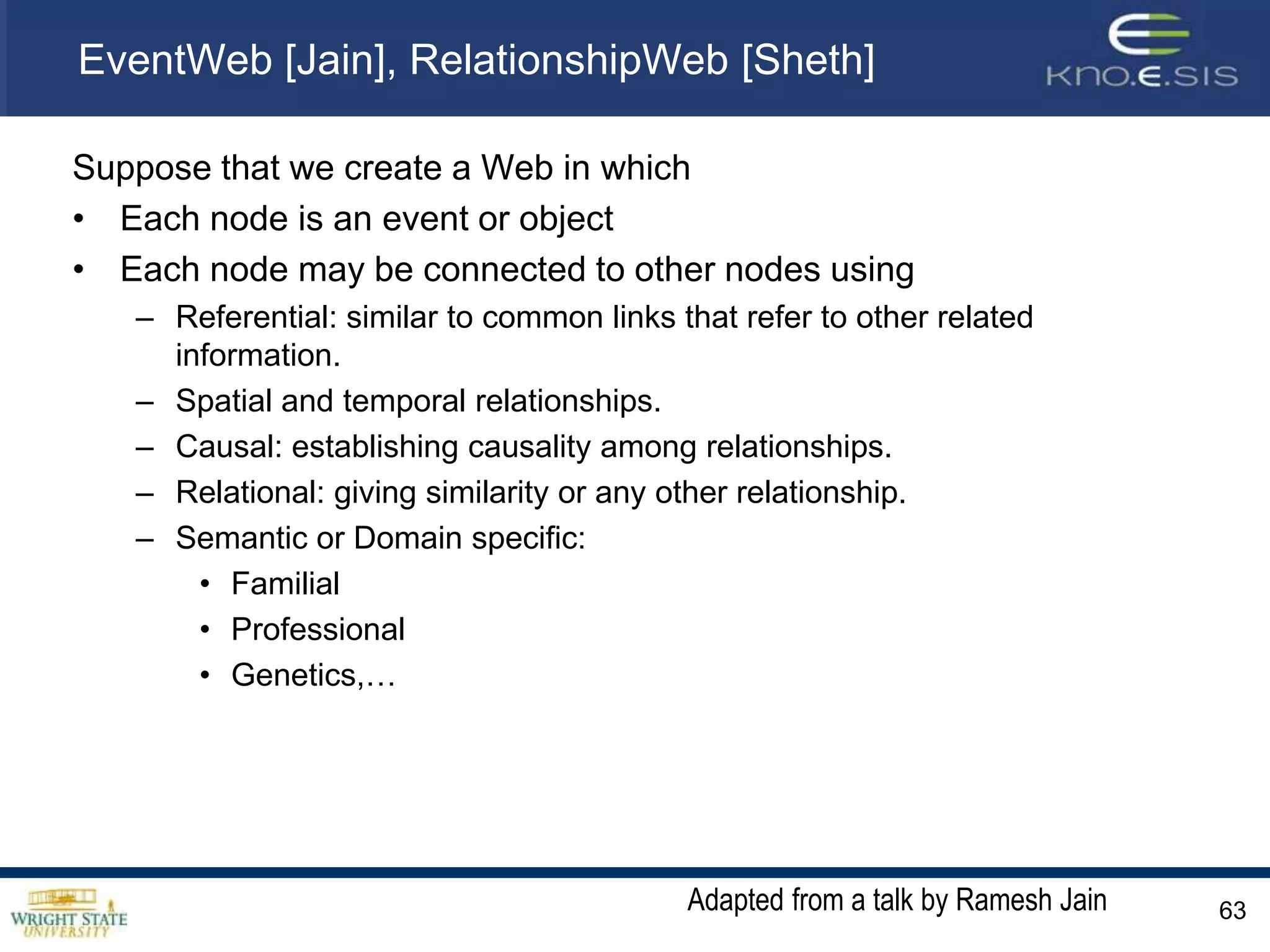
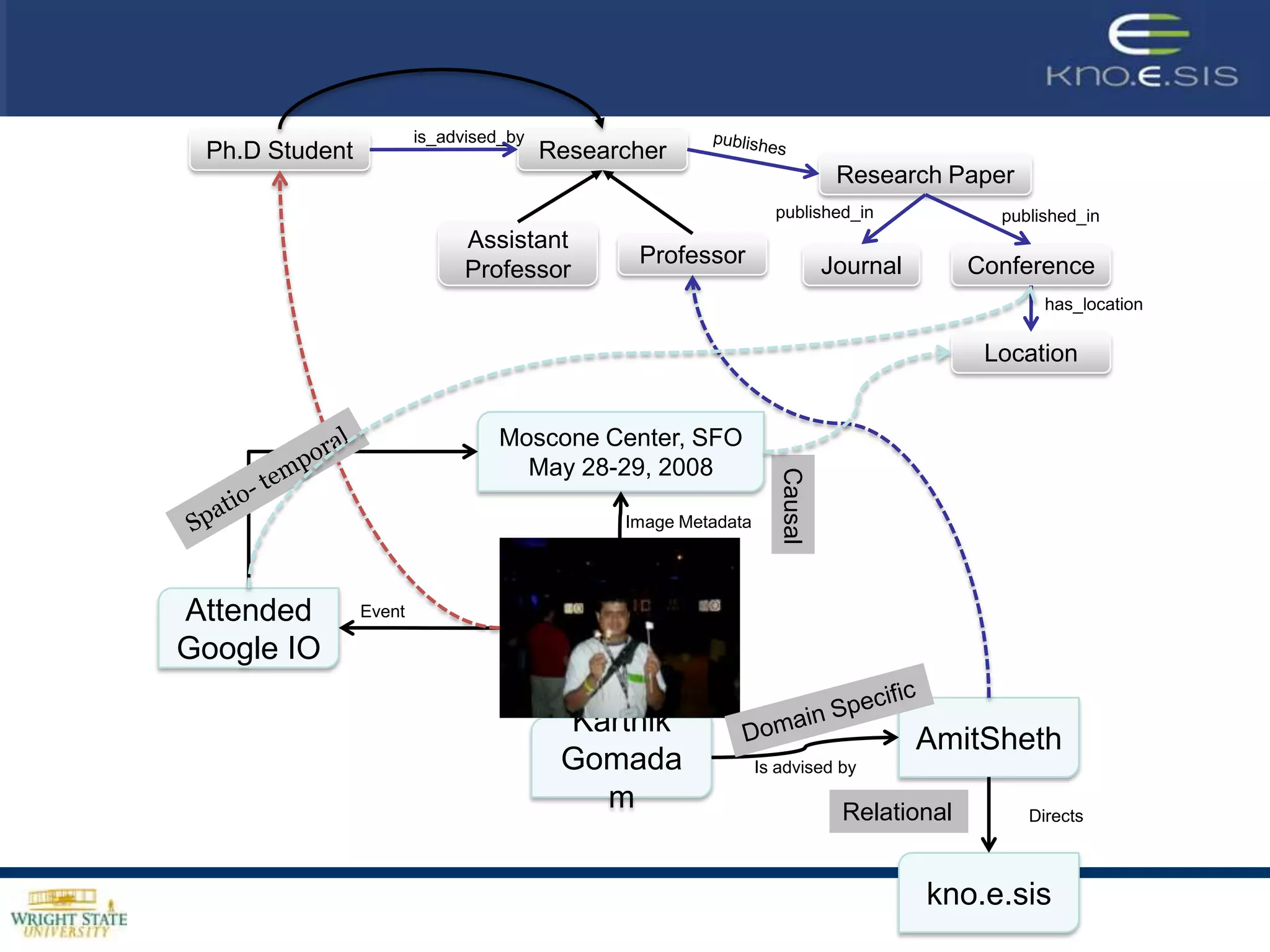
EventWeb [Jain], RelationshipWeb [Sheth]Suppose that we create a Web in whichEach node is an event or object Each node may be connected to other nodes using Referential: similar to common links that refer to other related information. Spatial and temporal relationships.Causal: establishing causality among relationships. Relational: giving similarity or any other relationship. Semantic or Domain specific:Familial ProfessionalGenetics,…63Adapted from a talk by Ramesh Jain
is_advised_bypublishesResearcherPh.D StudentResearch Paperpublished_inpublished_inAssistant ProfessorProfessorJournalConferencehas_locationLocationMoscone Center, SFOMay 28-29, 2008Spatio- temporalCausalImage MetadataAttended Google IOEventDomain SpecificAmitShethKarthik GomadamIs advised byRelationalDirectskno.e.sis
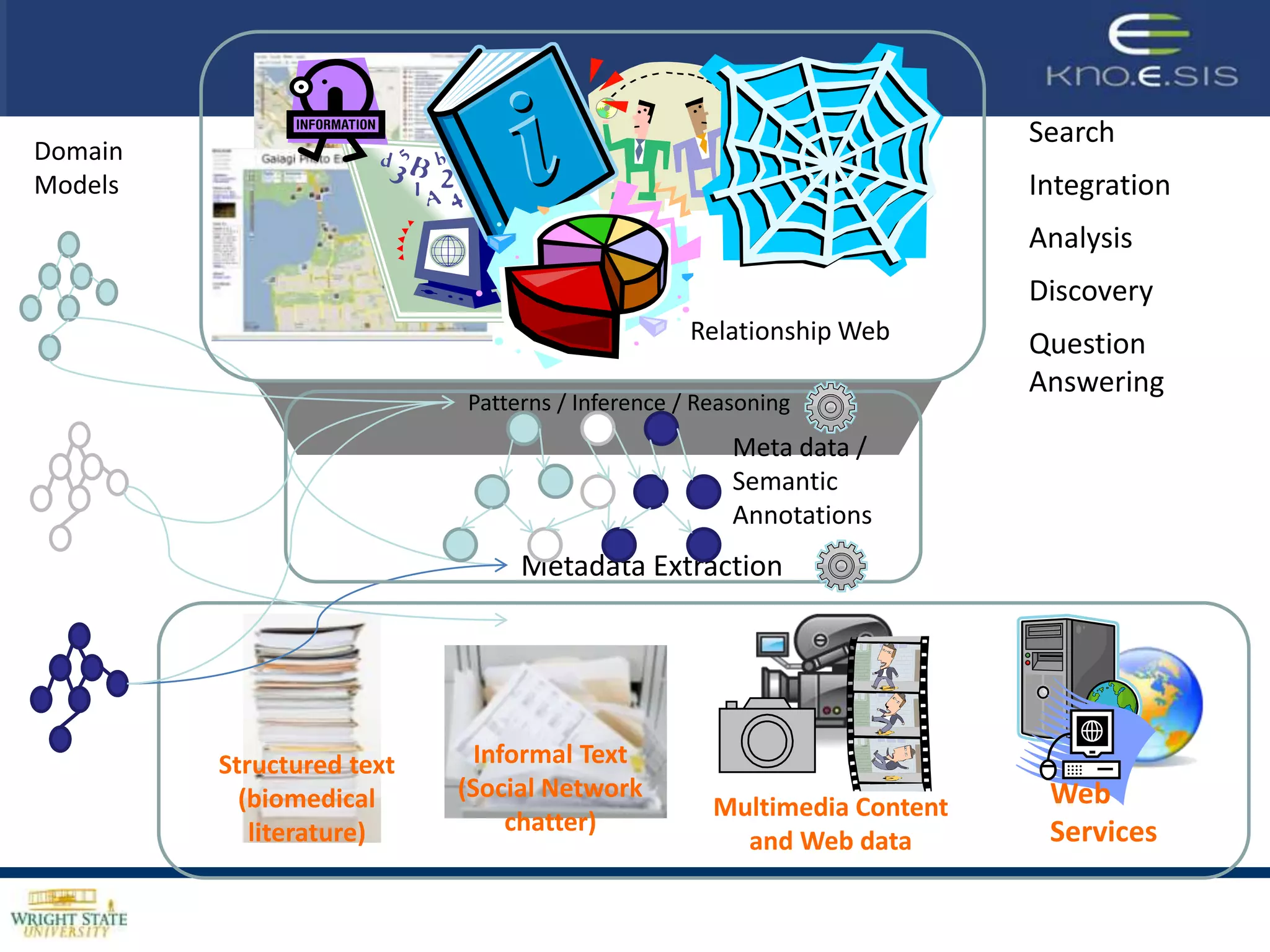
SearchIntegrationDomain ModelsStructured text (biomedical literature)AnalysisDiscoveryQuestion AnsweringPatterns / Inference / ReasoningInformal Text (Social Network chatter)Relationship WebMeta data / Semantic AnnotationsMetadata ExtractionMultimedia Content and Web dataWeb Services
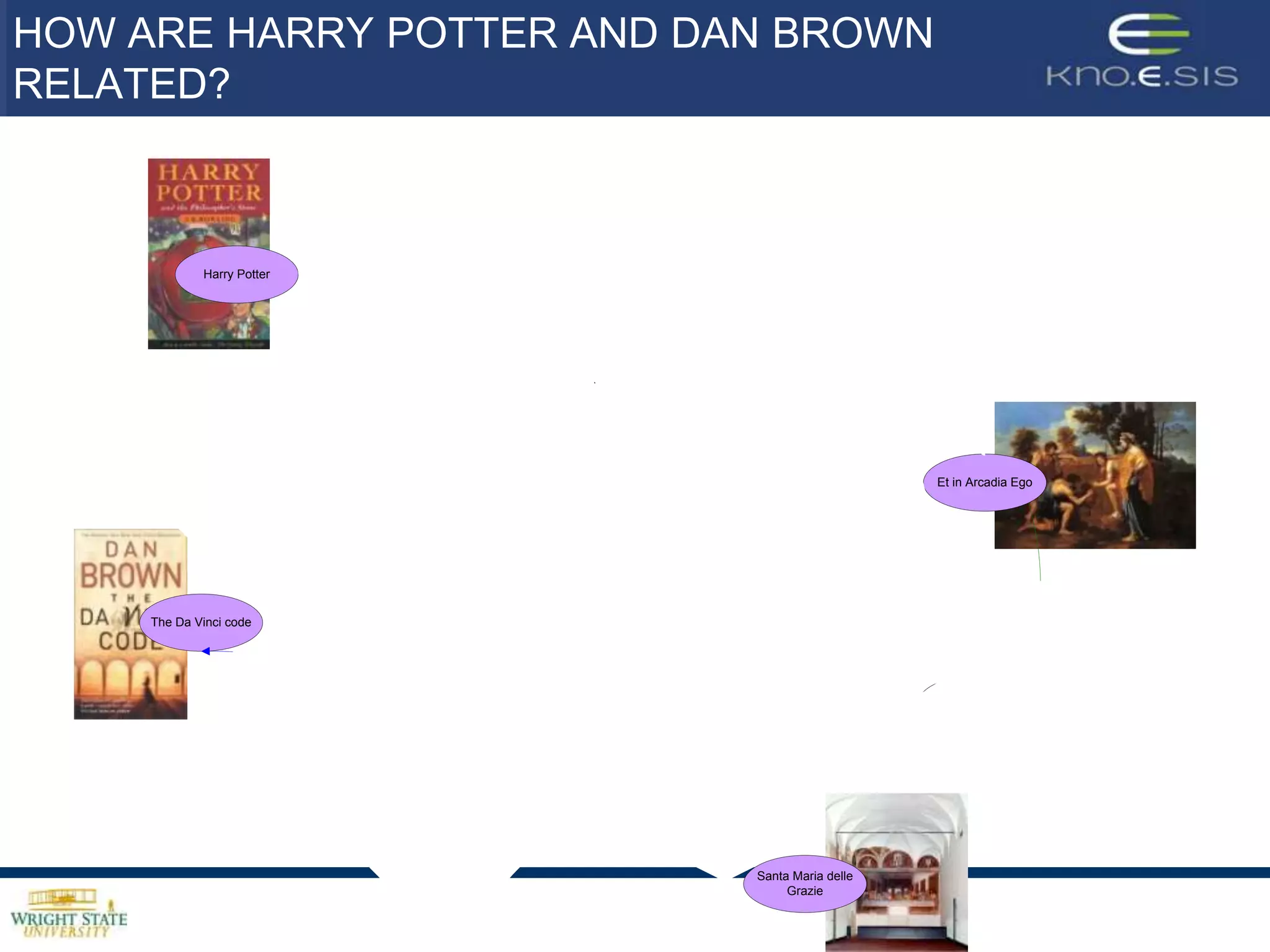
HOw are Harry Potter and Dan Brown related?
Challenges – Complex EventsFormal framework to model complex situations and composite events Those consisting of interrelated events of varying spatial and temporal granularity, together with their multimodal experiencesWhat computational approaches will help to compute and reason with events and their associated experiences and objects ?67
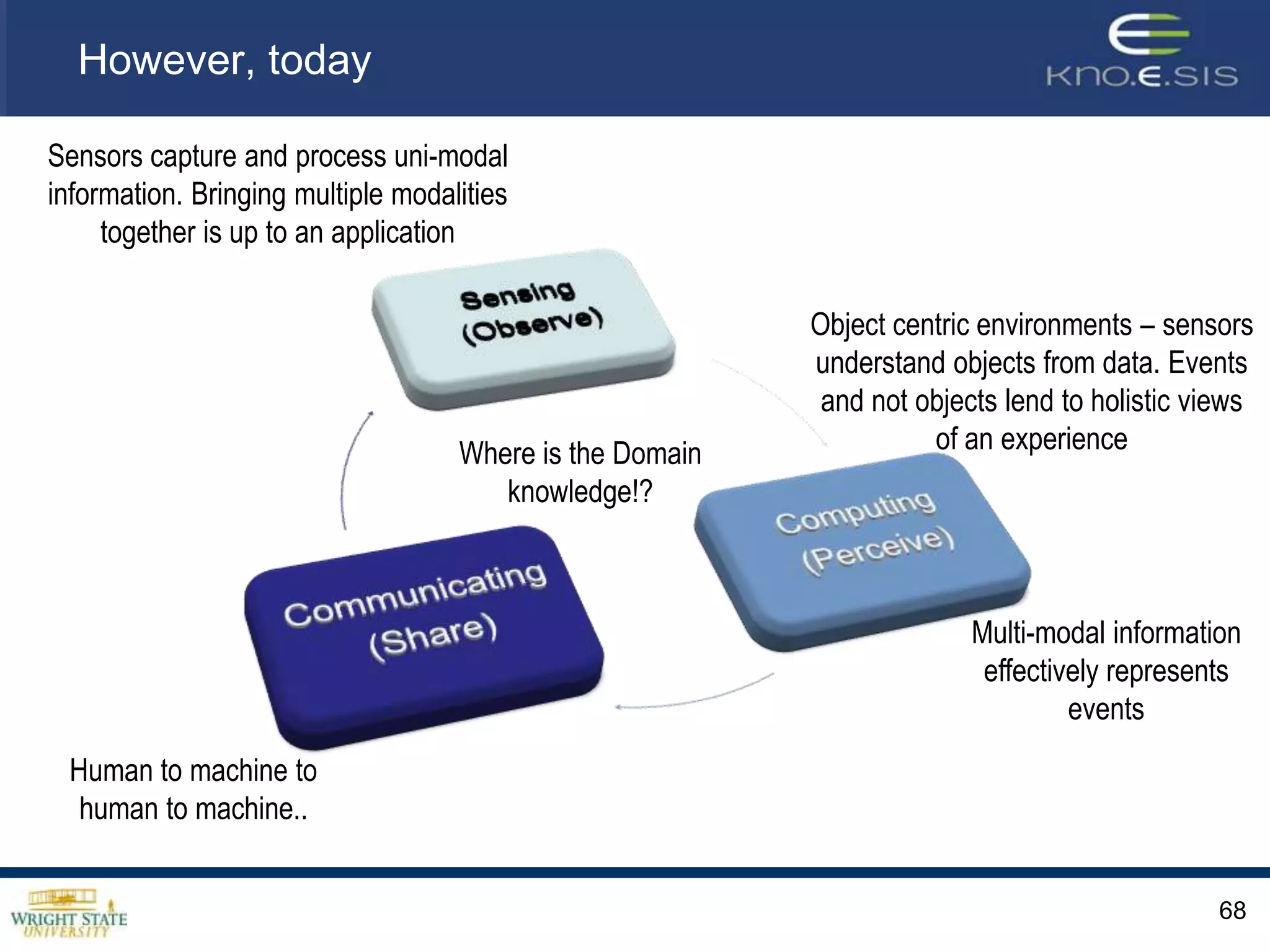
However, today68Sensors capture and process uni-modal information. Bringing multiple modalities together is up to an applicationObject centric environments – sensors understand objects from data. Events and not objects lend to holistic views of an experience Where is the Domain knowledge!?Multi-modal information effectively represents eventsHuman to machine to human to machine..
THE SEMANTICS OF OBSERVATIONObservation is about capturing (or measuring) phenomena.Perception is about explaining the observations.When the human mind perceives what it observesIt uses what it already knows in addition to the context surrounding the observationCause-effect relationships play a vital role in how we reach conclusions69
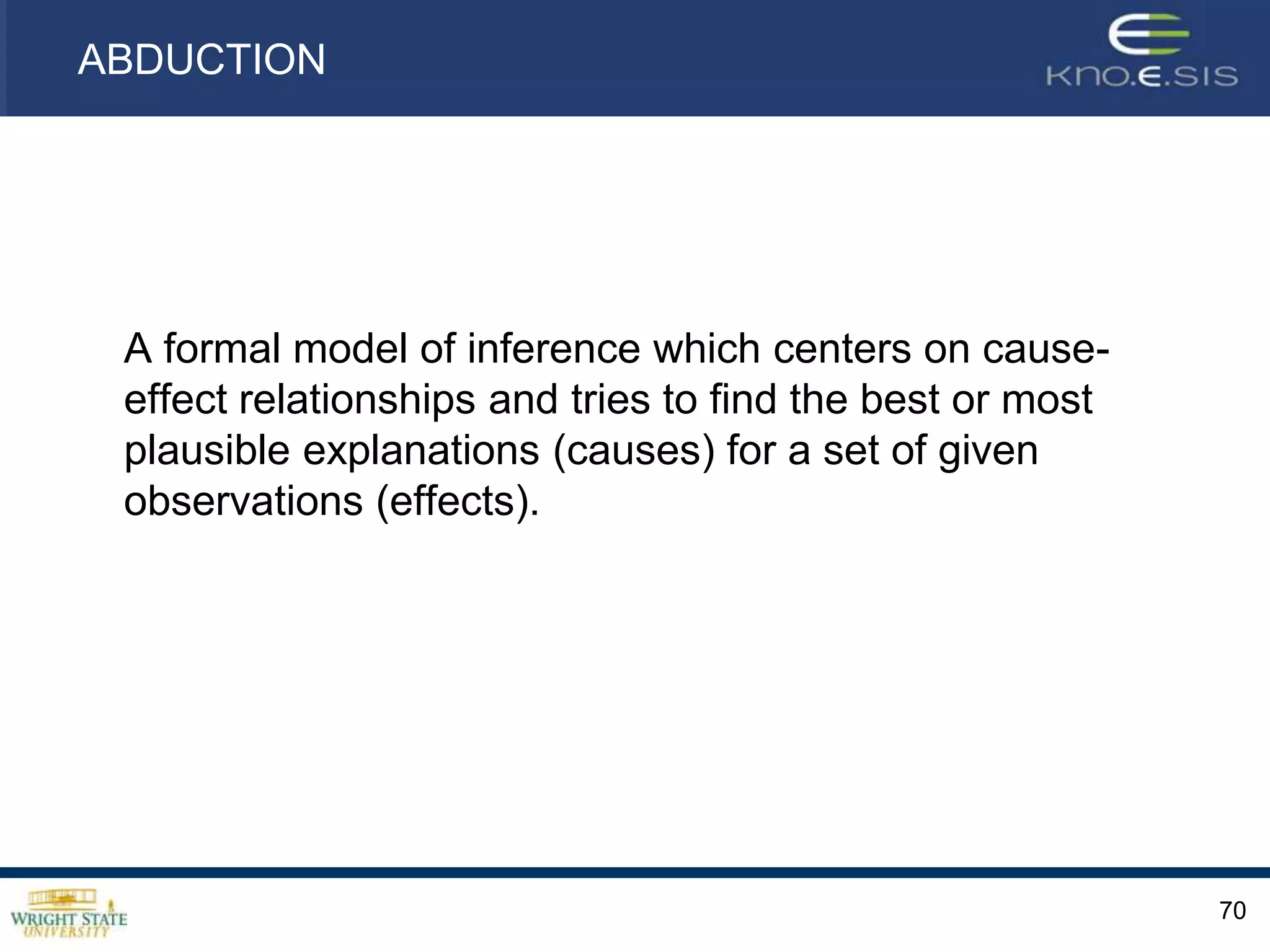
ABDUCTION	A formal model of inference which centers on cause-effect relationships and tries to find the best or most plausible explanations (causes) for a set of given observations (effects).70
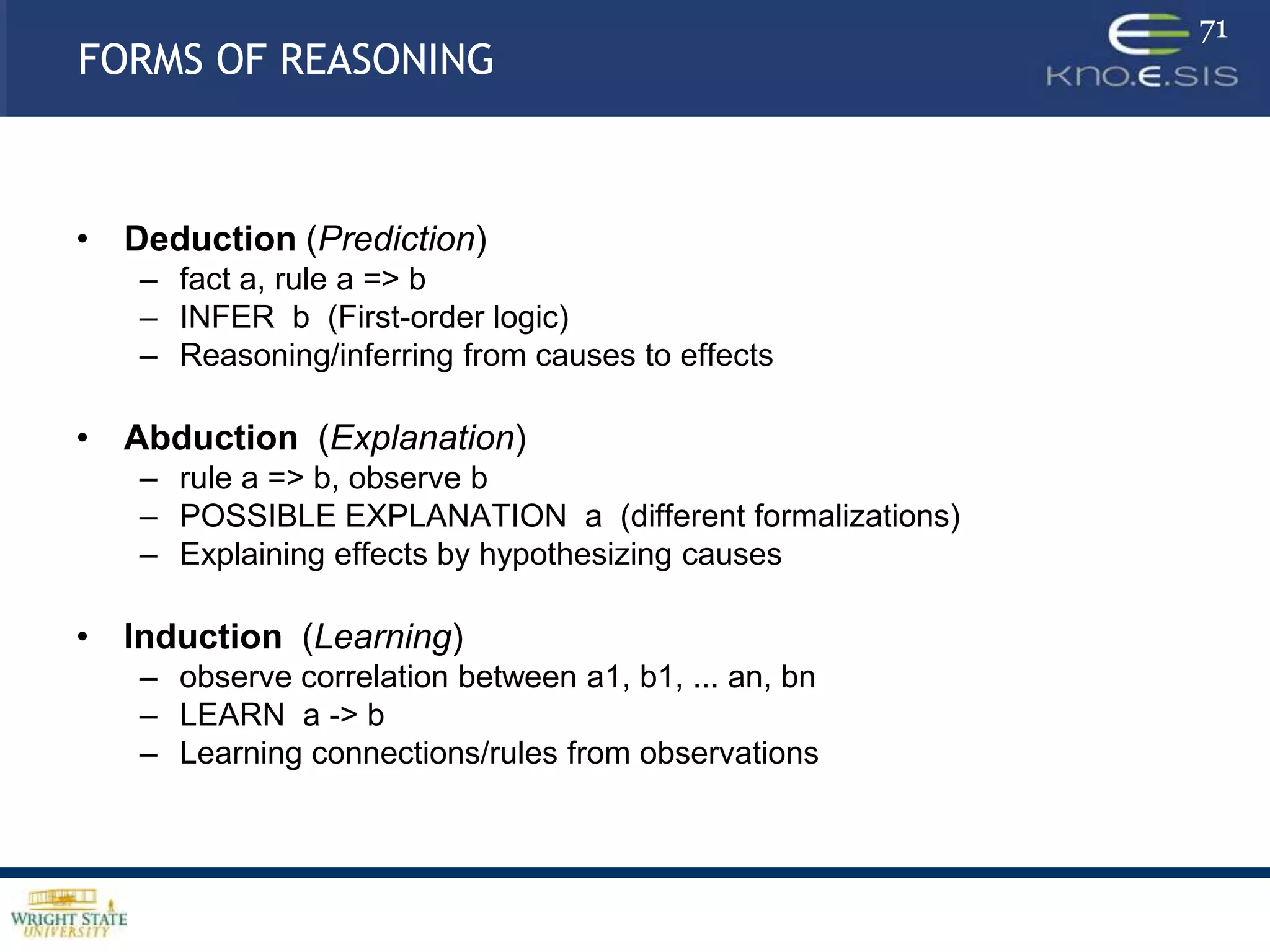
FORMS OF REASONINGDeduction (Prediction)fact a, rule a => b  INFER  b  (First-order logic)Reasoning/inferring from causes to effectsAbduction  (Explanation)rule a => b, observe b  POSSIBLE EXPLANATION  a  (different formalizations)Explaining effects by hypothesizing causesInduction  (Learning)observe correlation between a1, b1, ... an, bnLEARN  a -> bLearning connections/rules from observations71
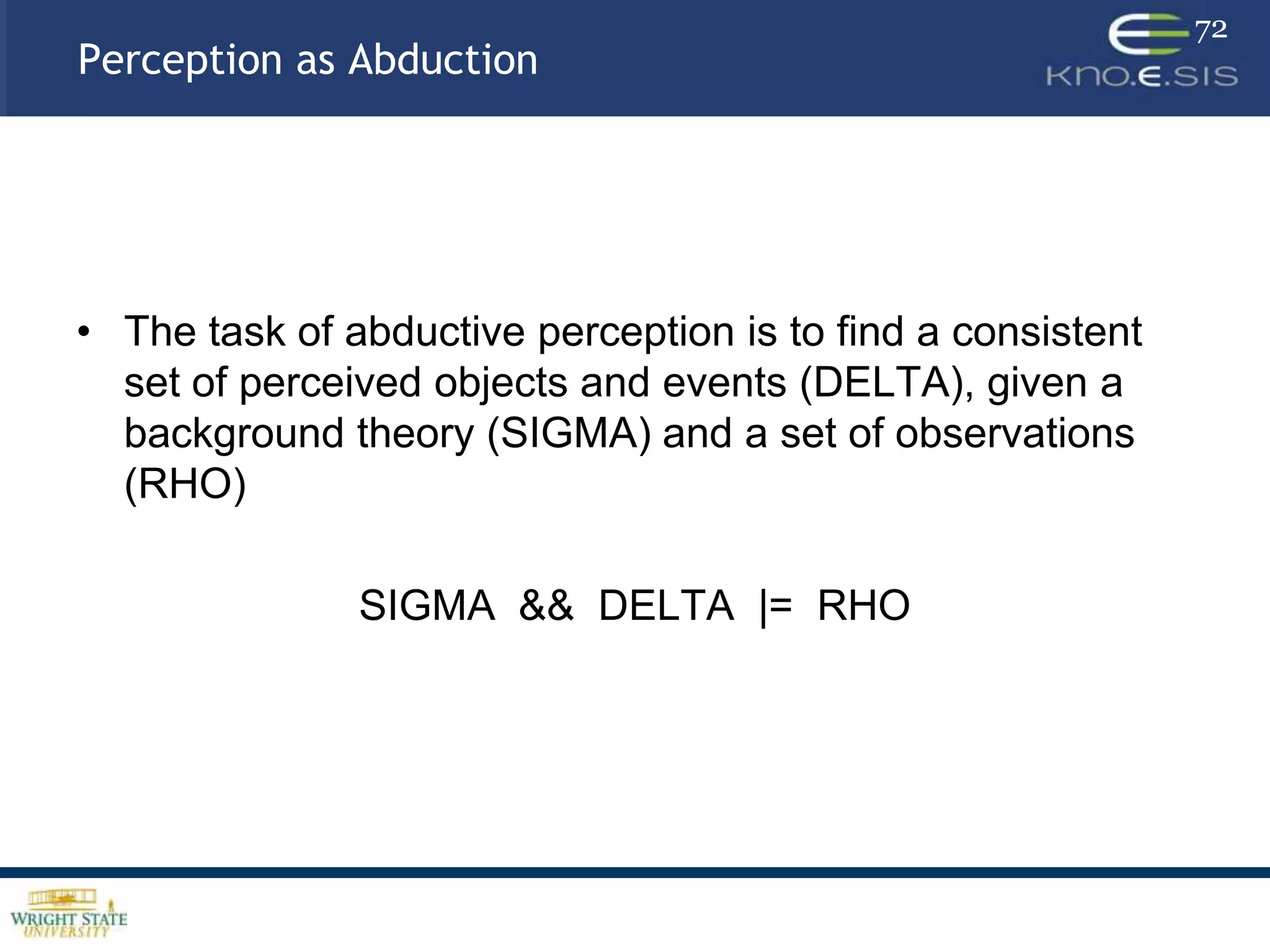
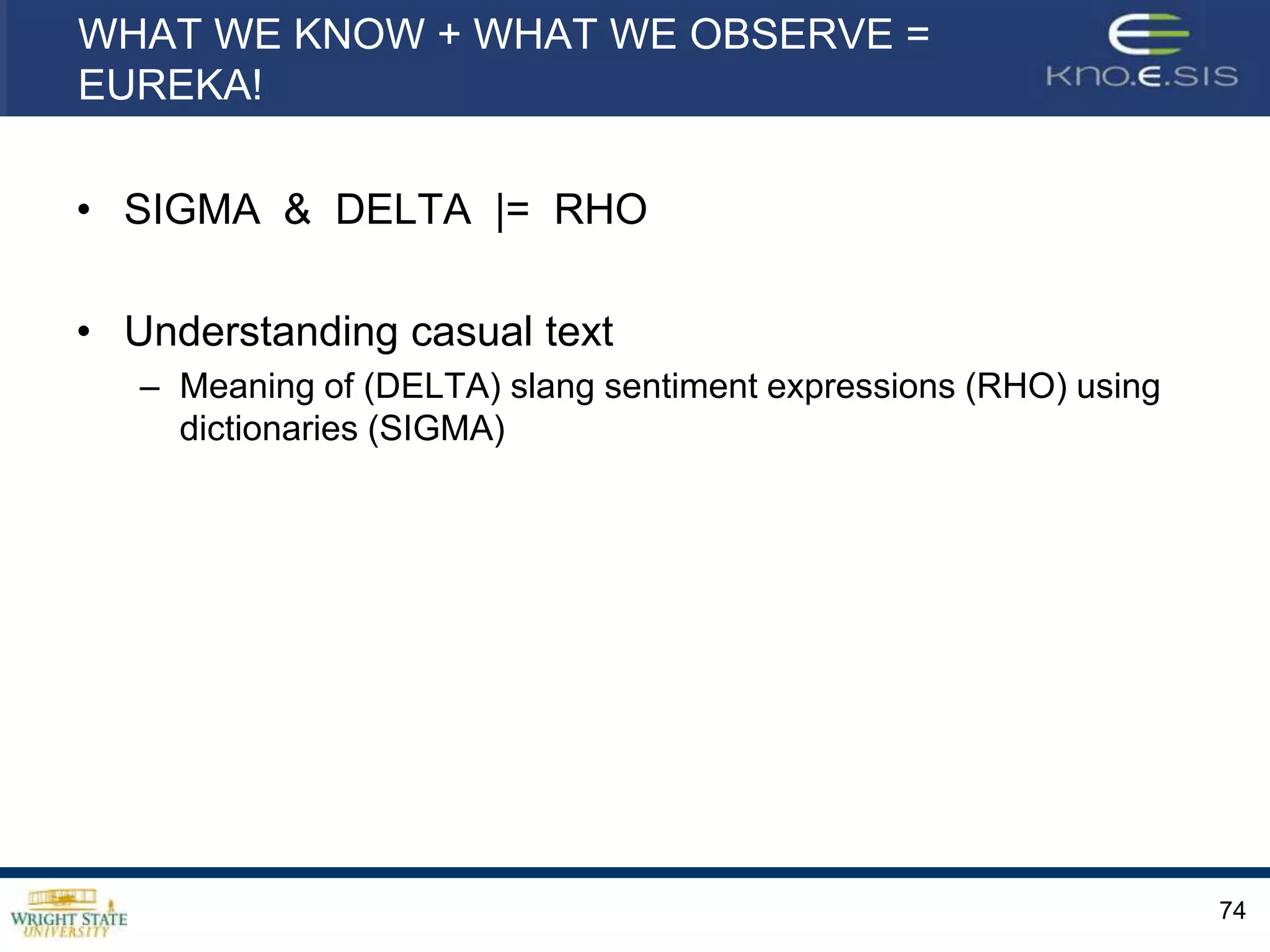
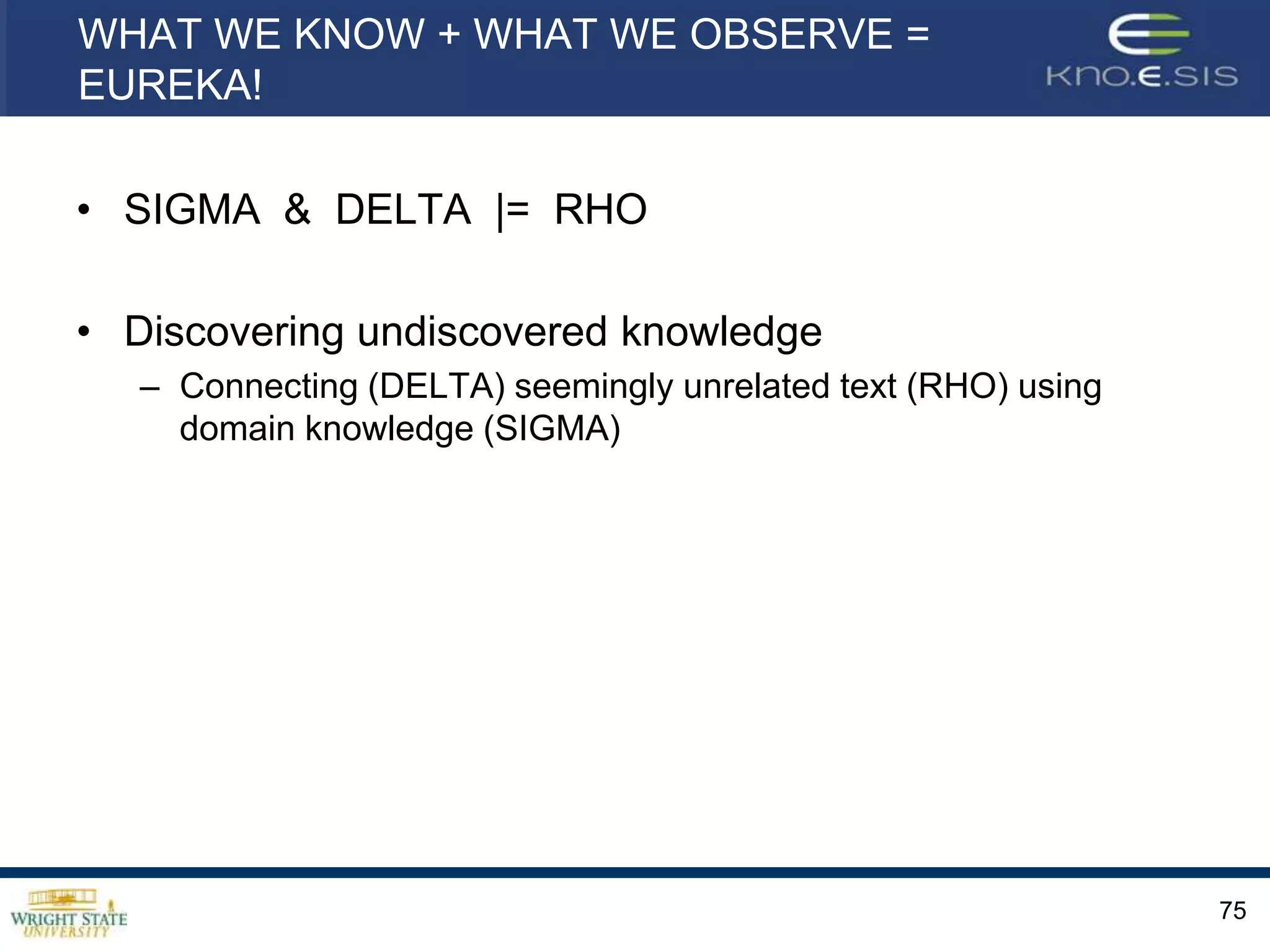
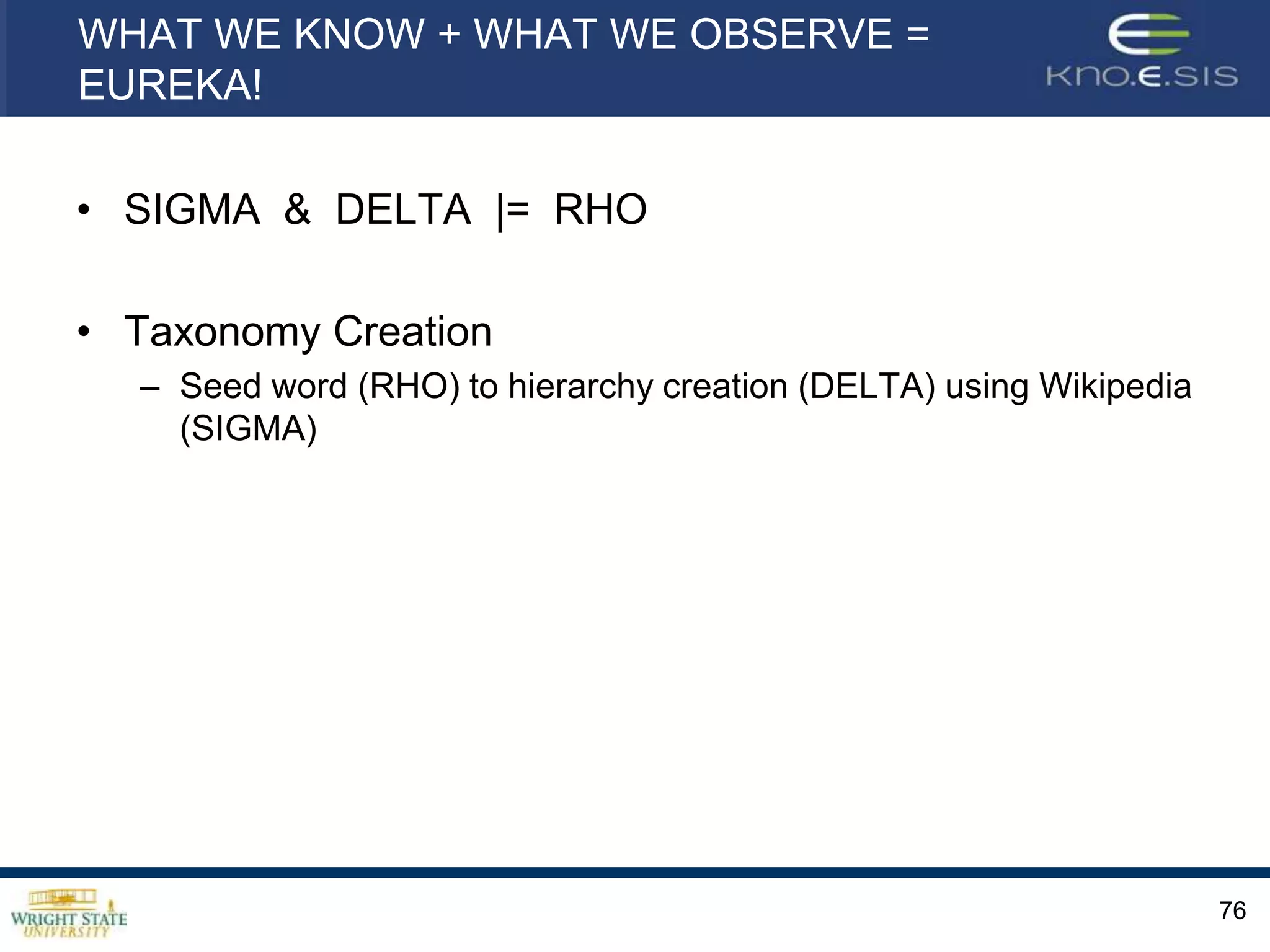
Perception as AbductionThe task of abductive perception is to find a consistent set of perceived objects and events (DELTA), given a background theory (SIGMA) and a set of observations (RHO)SIGMA  &&  DELTA  |=  RHO72Murray Shanahan, "Perception as Abduction: Turning Sensor Data Into Meaningful Representation"

Computing for Human Experience: Sensors, Perception, Semantics, Social Computing, Web N.0, and beyond

  • 2.
  • 3.
  • 4.
  • 5.
  • 6.
    with thisLatitude: 38°57’36” NLongitude: 95° 15’12” WDate: 10-9-2007Time: 1345h
  • 7.
    that is sentto Sensor Data ResourceStructured Data ResourceWeather ResourceAgri DBSoil Survey Weather DataServices ResourceLocationDate /TimeGeocoderWeather dataLawrence, KSLat-LongFarm HelperSoil InformationPest information …
  • 8.
  • 9.
  • 10.
  • 11.
  • 13.
    Computing For HumanExperienceASWC 2008 KeynoteAmit P. Sheth,Lexis Nexis Eminent Scholar and Director, kno.e.sis centerKnoesis.org
  • 14.
    Technology that fitsright in“The most profound technologies are those that disappear. They weave themselves into the fabric of everyday life until they are indistinguishable from it. Machines that fit the human environment instead of forcing humans to enter theirs will make using a computer as refreshing as a walk in the woods.” Mark Weiser, The Computer for the 21st Century (Ubicomp vision)“We're crying out for technology that will allow us to combine what we can do on the Internet with what we do in the physical world.” Ian Pearson in Big data: The next Google 14http://tarakash.com/guj/tool/hug2.htmlGet citation
  • 15.
    (c) 2007 ThomasGruber15But we are not talking aboutIntelligent DesignUbicomp: Mark Wisner and othersIntelligence @ Interface: Gruber –Your life - on-line: search, chat, music, photos, videos, email, multi-touch, mobile phone
  • 16.
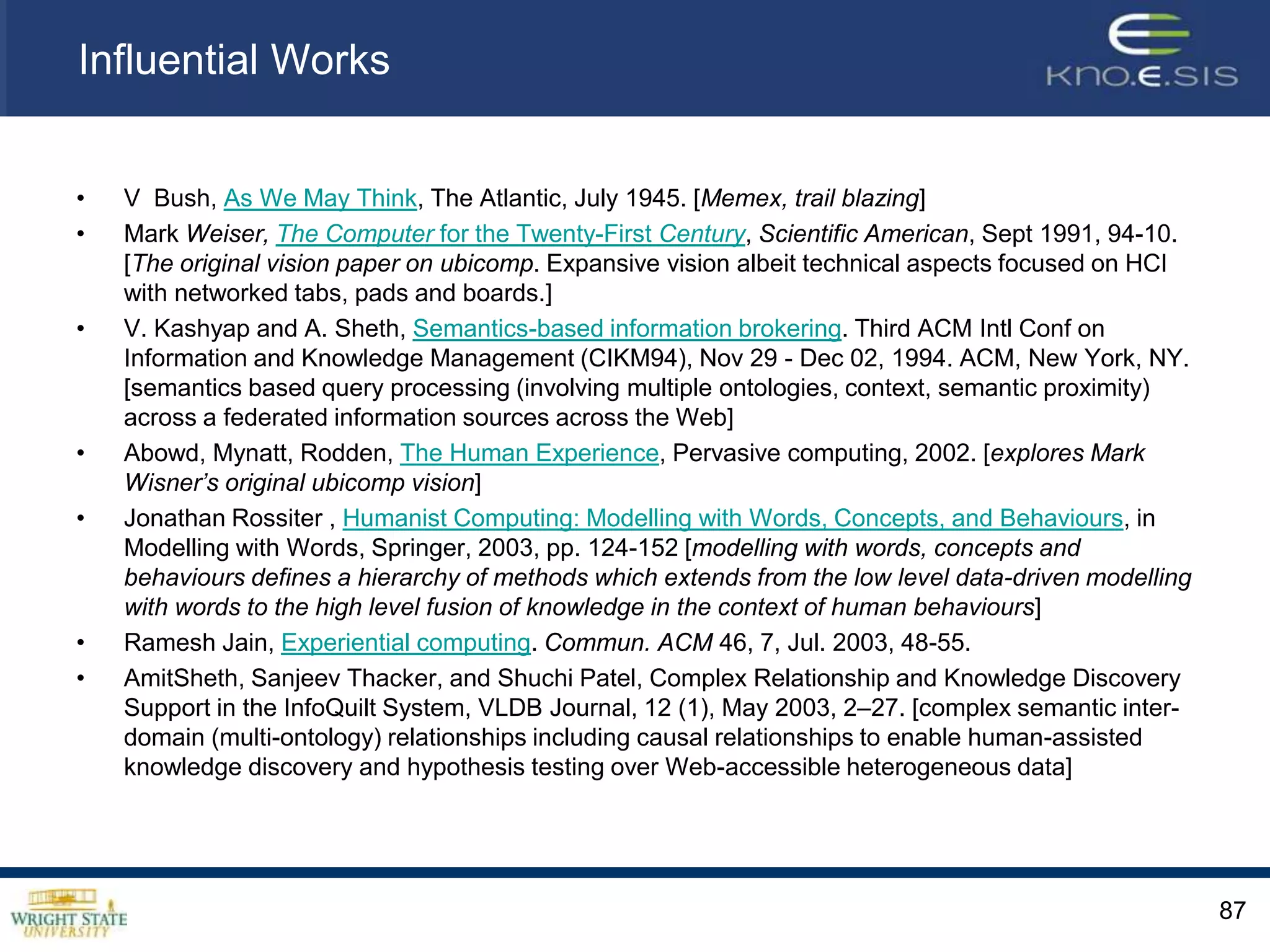
    What is CHE?Beyond better human interactionFocus in the past (egUbicomp): How humans interact with the system (computer, Internet)Our focus—almost the reverse of the past (and both are needed)Computing for Human Experience is about:How computing serves, assists and collaborates with humans to complement and enrich their normal activities nondestructively and unobtrusively, with minimal explicit concern or effort on part of humansanticipatory, knowledgeable, intelligent, ubiquitousComputing that encompasses semantic, social, service, sensor and mobile Web16
  • 17.
    Principals of CHEHumanis the master, system is the slaveHuman sees minimal changes to normal behavior and activity, system is there to serve/assist/support in human’s natural conditionSearch, browsing, etc are not primary; HCI is not the focusGetting the assistance and answers are important, improving experience is keyMultimodal and multisensory environmentIntegrated and contextual application of (not just access to) sensor data, databases, collective intelligence, wisdom of the crowd, conceptual models, reasoning17
  • 18.
    Learning from anumber of exciting visions18
  • 19.
    Evolution of theWeb (and associated computing)Web of people - social networks, user-created casual content - Twine, GeneRIF, ConnoteaWeb of resources - data, service, data, mashups - ubiquitous/mobile computingWeb of databases - dynamically generated pages - web query interfacesWeb of pages - text, manually created links - extensive navigationComputing for Human ExperienceWeb as an oracle / assistant / partner - “ask the Web”: using semantics to leverage text + data + services - Powerset 2007Semantic TechnologyUsed1997
  • 20.
    Sensing, Observing, Perceptual,Semantic, Social, ExperientialCHE components and enablers
  • 21.
    Consider that allobjects, events and activities in the physical world have a counterpart in the Cyberworld(IoT)multi-facted context of real world is captured in the cyberworld(sensor web, citizen sensor)each object, event and activity is represented with semantic annotations (semantic sensor web)for a chosen context, with an ability to explicate and associate variety of relationships and events (Relationship Web, EventWeb)
  • 22.
    appropriate reasoning andhuman/social interaction are available and applied, insights extracted (semantic web, social semantic web, experiential computing)
  • 23.
    answers obtained/ decisionsreached/communicated/applied21
  • 24.
    Paradigm shift …Wherehumans act as sensors or observersAround them is a network of sensors, computing and communicating with each otherProcessing and delivering multi-modal information Collective IntelligenceInformation-centric to Experience-centric eraModeling, processing, retrieving event level informationUse of domain knowledge ….Understanding of casual text22
  • 25.
    Today’s Sensor NetworkTypesInert, fixed sensorsCarried on moving objectsVehicles, pedestrians (asthma research)anonymous data from GPS-enabled vehicles, toll tags, and cellular signaling to mark how fast objects are moving – and overlaying that information with location data and maps (traffic.com, Nokia experiment, …)23Text from http://www.geog.ucsb.edu/~good/presentations/icsc.pdfImages credit – flickr.com, cnet.com
  • 26.
    Today’s Network ofSensorsAre sensing, computing, transmitting Are acting in concert Sharing data Processing them into meaningful digital representations of the world Researchers using 'sensor webs' to ask new questions or test hypotheses24
  • 27.
  • 28.
  • 29.
    <swe:component name="time"> <swe:Time definition="urn:ogc:def:phenomenon:time"uom="urn:ogc:def:unit:date-time"> <sa:swe rdfa:about="?time" rdfa:instanceof="time:Instant"> <sa:sml rdfa:property="xs:date-time"/> </sa:swe> </swe:Time></swe:component><swe:component name="measured_air_temperature"> <swe:Quantity definition="urn:ogc:def:phenomenon:temperature“ uom="urn:ogc:def:unit:fahrenheit"> <sa:swe rdfa:about="?measured_air_temperature“ rdfa:instanceof=“senso:TemperatureObservation"> <sa:swe rdfa:property="weather:fahrenheit"/> <sa:swe rdfa:rel="senso:occurred_when" resource="?time"/> <sa:swe rdfa:rel="senso:observed_by" resource="senso:buckeye_sensor"/> </sa:sml> </swe:Quantity></swe:component><swe:value name=“weather-data"> 2008-03-08T05:00:00,29.1</swe:value>Semantically Annotated O&M27
  • 30.
    Semantic Sensor ML– Adding Ontological MetadataDomainOntologyPersonCompanySpatialOntologyCoordinatesCoordinate SystemTemporalOntologyTime UnitsTimezone28Mike Botts, "SensorML and Sensor Web Enablement," Earth System Science Center, UAB Huntsville
  • 31.
    29Semantic QuerySemantic TemporalQueryModel-references from SML to OWL-Time ontology concepts provides the ability to perform semantic temporal queriesSupported semantic query operators include:contains: user-specified interval falls wholly within a sensor reading interval (also called inside)within: sensor reading interval falls wholly within the user-specified interval (inverse of contains or inside)overlaps: user-specified interval overlaps the sensor reading intervalExample SPARQL query defining the temporal operator ‘within’
  • 32.
    Citizen SensorsHuman beings6billion intelligent sensorsinformed observersrich local knowledgeuplink technologybroadband Internetmobile phone30Christmas Bird Count
  • 33.
    Citizen ScienceNetworks ofamateur observerspossibly trained, skilledChristmas Bird Count http://www.audubon.org/bird/citizen/index.html , http://www.audubon.org/bird/cbc/index.htmlthousands of volunteer participantsProtocolsProject GLOBEan international network of school childrenreporting environmental conditionscentral integration and redistribution31
  • 34.
    Citizen Sensor –Humans Actively EngageIn connecting, searching, processing, stitching together informationAsks, gets.. Asks again, gets again…32Images credit – flickr.com
  • 35.
  • 36.
  • 37.
  • 38.
  • 39.
  • 40.
  • 41.
    Twitter In ControversialSpotlight Amid Mumbai Attacks Posted by Alexander Wolfe, Nov 29, 2008 11:27 AM Never before has a crisis unleashed so much raw data -- and so little interpretation -- than what we saw as the deadly terrorist attacks in Mumbai, India unfolded. Amid the real-time video feeds (kudos to CNN International), cellphone pictures, and tweets, we were able to keep abreast of what seemed to be happening, and where it was going down, all the while not really knowing those other key, canonical components of journalistic information gathering -- namely, who or why.39
  • 42.
    In fairness, noone did. There were so many tentacles to these heinous attacks, and multiple hot spots (the Taj and Oberoi hotels and the Chabad Jewish center, to name the three most prominent), that even the Indian government likely didn't have a handle on things until late in the game. My point here is not criticize, but simply to note that I was struck, as never before, by the ability of data to outstrip information.40
  • 43.
    Alexander Wolfe continues…I'd add that Mumbai is likely to be viewed in hindsight as the first instance of the paradigmatic shift in crisis coverage: namely, journalists will henceforth no longer be the first to bring us information. Rather, they will be a conduit for the stream of images and video shot by a mix of amateurs and professionals on scene.You've got to add to this the immense influence of Twitter. In the past few days, I've seen a slew of stories pointing out how Twitter was a key source of real-time updates on the attacks, to the point that Indian authorities asked people to stop posting to the microblogging service (for fear that they might be giving away strategic information to the terrorists).41
  • 44.
    Analyzing Citizen Data42SemanticData StoreCloud/ Web based ServicesModel EnrichmentSemantic Analysis and AnnotationTerm ExtractionTwitter: “loud bang near the Taj” [ location:mumbai]Location based aggregationloud bangnear the TajEvent:explosionLocation:Taj Hotel, MumbaiDueTo: terrorist activityCNN News feed: “terrorist activity reported in Mumbai Hotel” [ location:mumbai]Citizen-Sensor Stream AggregationTypeof:noise, relatedto:explosionTypeof:hotel , part of:Hotel_chainCitizen Sensor StreamsTwitter RSS/ATOM feedsBlogsImage Courtesy: Chemical Brothers, Galvanize
  • 45.
    Online and offlineworldsComputational abstractions to represent the physical world’s dynamic nature Merging online and offline activitiesConnecting the physical world naturally with the online worldWhat are natural operations on these abstractions? How do we detect these abstractions based on other abstractions and multimodal data sources?43
  • 46.
    Enriching Human ExperienceRecognitionof objects (IOT) and models of objectUnderstanding of objects and contentMultimodal interfacesMulti(level) sensing and perceptionFrom keywords and entities to events and rich sets of relationships; spatio-temporal-thematic computingModels (ontologies, folkonomies, taxonomies, classification, nomenclature)– time, location, sensors, domain More powerful reasoning: paths, patterns, subgraphs that connect related things; deductive and abductive reasoning, ….44
  • 47.
    Understanding content …informal textI say: “Your music is wicked” What I really mean: “Your music is good” 45
  • 48.
    Urban DictionarySentiment expression:Rocks Transliterates to: cool, goodStructured text (biomedical literature)Semantic Metadata: Smile is a TrackLil transliterates to Lilly AllenLilly Allen is an ArtistMusicBrainz TaxonomyInformal Text (Social Network chatter)Artist: Lilly AllenTrack: Smile Your smile rocks LilMultimedia Content and Web dataWeb Services
  • 49.
    Example: Pulse ofa CommunityImagine millions of such informal opinionsIndividual expressions to mass opinions“Popular artists” lists from MySpace commentsLilly Allen Lady Sovereign Amy WinehouseGorillazColdplayPlaceboStingKeanJoss Stone
  • 50.
    How doyou get comprehensive situational awareness by merging “human sensing” and “machine sensing”?48
  • 51.
    Synthetic but realisticscenarioan image taken from a raw satellite feedan image taken by a camera phone with an associated label, “explosion.” These two images, one from a wide-area sensor and the other from a citizen-sensor, can be correlated with spatial and temporal attributes in order to provide comprehensive situational awareness.49
  • 52.
  • 53.
  • 54.
  • 55.
    Provenance/ContextData Storage(RawData, XML, RDF)Semantic Analysis and QueryInformation Entity Metadata
  • 56.
    Feature MetadataFeatureExtraction and Entity DetectionSemanticAnnotationData Raw Phenomenological DataSensor ObservationOntologies Space Ontology
  • 57.
  • 58.
  • 59.
    On Our Way..Multimodal interfacesWe are already seeing efforts toward this larger goalVideo visors - computer image superimposed over the world around you. 52
  • 60.
    Challenges – MultipleModalitiesMultiple modalities of objects and eventsHow do we organize and access multimodal data? How do we organize, index, search and aggregate events and multimedia experiences as effectively as modern search engines do for text using keywords? 53
  • 61.
    Objects to EventsIfwe move from this object mode to an event modeA single user action or request or sensory observation could act as a cue for getting all (multi-modal) information associated with an eventIf conditions change, systems could even modify their behavior to suit their changing view of the world Today text is most prevalent, with increasing but disparate (non-integrated) image and video data, but human experience is event based (at higher levels of abstractions) formed based on multi-sensory, multi-perception (at lower level of abstraction) observations54
  • 62.
    We are alreadyseeing efforts toward this larger goalSocial connections, interests, locations, alerts, commentMobile phone to social compass: LOOPT.com55Image credit - www.movilae.com On our way…
  • 63.
    On our way…Internetof ThingsInternet of Things: “A world where inanimate objects communicate with us and one another over the network via tiny intelligent objects” - Jean Philippe Vasseur, NSSTG Systems56Image credit - www.forbes.com
  • 64.
    Building models…seed wordto hierarchy creation using WIKIPEDIAQuery: “cognition”
  • 65.
    Learn Patterns thatindicate RelationshipsQuery:Australia  SidneyAustralia  Canberrain Sydney, New South Wales, Australia
  • 66.
    Sydney is themost populous city in Australia
  • 67.
  • 68.
    Canberra is thecapital city of the Commonwealth of Australia
  • 69.
  • 70.
    in Sydney, NewSouth Wales, Australia
  • 71.
    Sydney is themost populous city in Australia
  • 72.
  • 73.
    Canberra is thecapital city of the Commonwealth of Australia
  • 74.
    Canberra, the AustraliancapitalWe know that countries have capitals.Which one is Australia’s?
  • 75.
    ExperienceDirect Observation oforParticipation inEvents as a basis of knowledge
  • 76.
    Entities and EventsEventEntity NameDurationNameLocationAttributesData-streamsAttributesProcessesAdjacent StatesRelated LinksProcesses(Services)Objects and Entitiesare static.Events are dynamic.Thanks – Ramesh Jain
  • 77.
    Strategic Inflection PointsEventson Web(Experience)Documents on Web(Information)ImmersiveExperienceContextualSearchUbiquitous DevicesSemanticSearchUpdates and alertsKeyword Search1995200020052010Thanks – Ramesh Jain
  • 78.
  • 79.
    EventWeb [Jain], RelationshipWeb[Sheth]Suppose that we create a Web in whichEach node is an event or object Each node may be connected to other nodes using Referential: similar to common links that refer to other related information. Spatial and temporal relationships.Causal: establishing causality among relationships. Relational: giving similarity or any other relationship. Semantic or Domain specific:Familial ProfessionalGenetics,…63Adapted from a talk by Ramesh Jain
  • 80.
    is_advised_bypublishesResearcherPh.D StudentResearch Paperpublished_inpublished_inAssistantProfessorProfessorJournalConferencehas_locationLocationMoscone Center, SFOMay 28-29, 2008Spatio- temporalCausalImage MetadataAttended Google IOEventDomain SpecificAmitShethKarthik GomadamIs advised byRelationalDirectskno.e.sis
  • 81.
    SearchIntegrationDomain ModelsStructured text(biomedical literature)AnalysisDiscoveryQuestion AnsweringPatterns / Inference / ReasoningInformal Text (Social Network chatter)Relationship WebMeta data / Semantic AnnotationsMetadata ExtractionMultimedia Content and Web dataWeb Services
  • 82.
    HOw are HarryPotter and Dan Brown related?
  • 83.
    Challenges – ComplexEventsFormal framework to model complex situations and composite events Those consisting of interrelated events of varying spatial and temporal granularity, together with their multimodal experiencesWhat computational approaches will help to compute and reason with events and their associated experiences and objects ?67
  • 84.
    However, today68Sensors captureand process uni-modal information. Bringing multiple modalities together is up to an applicationObject centric environments – sensors understand objects from data. Events and not objects lend to holistic views of an experience Where is the Domain knowledge!?Multi-modal information effectively represents eventsHuman to machine to human to machine..
  • 85.
    THE SEMANTICS OFOBSERVATIONObservation is about capturing (or measuring) phenomena.Perception is about explaining the observations.When the human mind perceives what it observesIt uses what it already knows in addition to the context surrounding the observationCause-effect relationships play a vital role in how we reach conclusions69
  • 86.
    ABDUCTION A formal modelof inference which centers on cause-effect relationships and tries to find the best or most plausible explanations (causes) for a set of given observations (effects).70
  • 87.
    FORMS OF REASONINGDeduction(Prediction)fact a, rule a => b INFER b (First-order logic)Reasoning/inferring from causes to effectsAbduction (Explanation)rule a => b, observe b POSSIBLE EXPLANATION a (different formalizations)Explaining effects by hypothesizing causesInduction (Learning)observe correlation between a1, b1, ... an, bnLEARN a -> bLearning connections/rules from observations71
  • 88.
    Perception as AbductionThetask of abductive perception is to find a consistent set of perceived objects and events (DELTA), given a background theory (SIGMA) and a set of observations (RHO)SIGMA && DELTA |= RHO72Murray Shanahan, "Perception as Abduction: Turning Sensor Data Into Meaningful Representation"
  • 89.
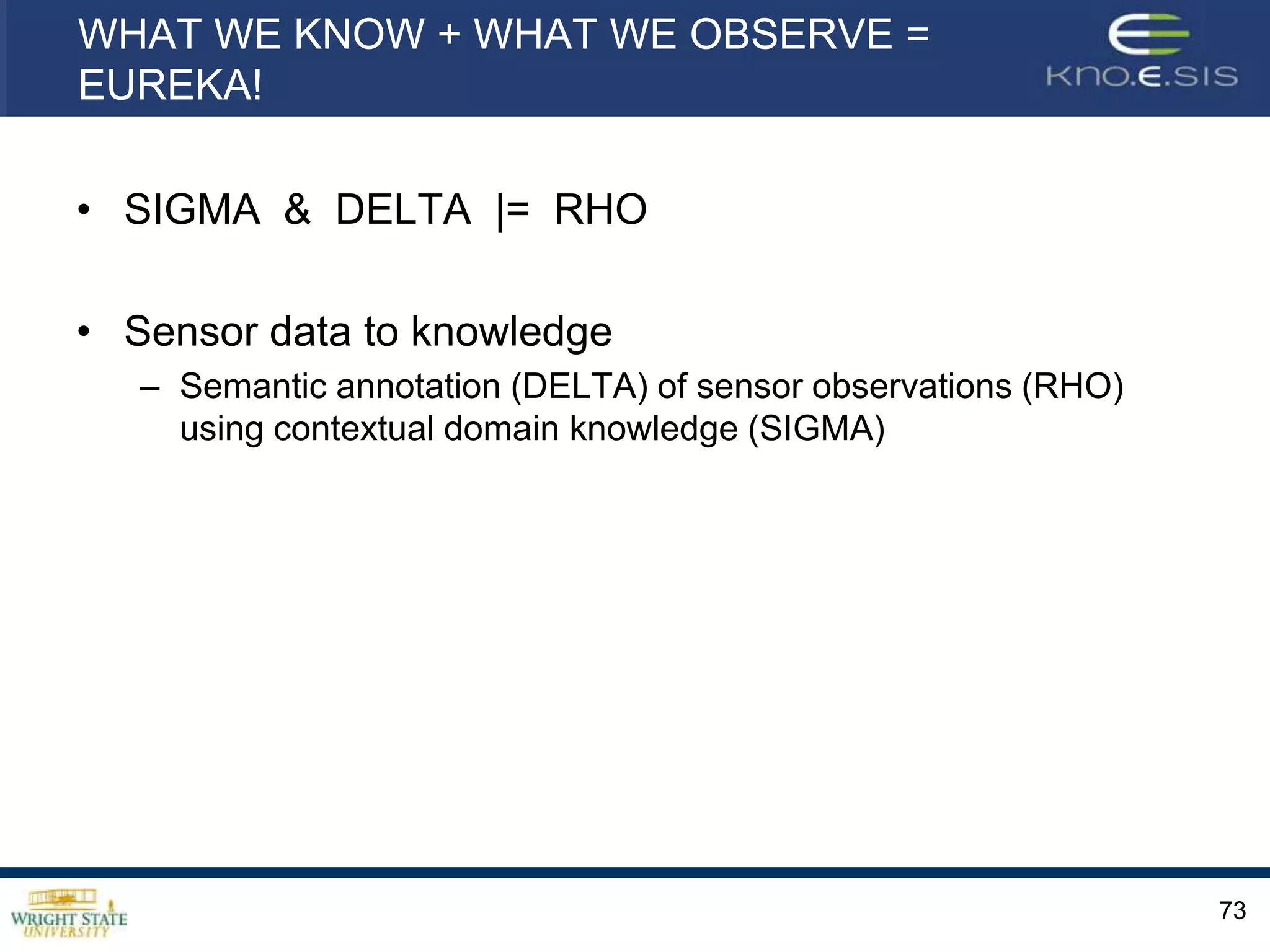
    WHAT WE KNOW+ WHAT WE OBSERVE = EUREKA!SIGMA & DELTA |= RHOSensor data to knowledgeSemantic annotation (DELTA) of sensor observations (RHO) using contextual domain knowledge (SIGMA)73
  • 90.
    WHAT WE KNOW+ WHAT WE OBSERVE = EUREKA!SIGMA & DELTA |= RHOUnderstanding casual textMeaning of (DELTA) slang sentiment expressions (RHO) using dictionaries (SIGMA)74
  • 91.
    WHAT WE KNOW+ WHAT WE OBSERVE = EUREKA!SIGMA & DELTA |= RHODiscovering undiscovered knowledgeConnecting (DELTA) seemingly unrelated text (RHO) using domain knowledge (SIGMA)75
  • 92.
    WHAT WE KNOW+ WHAT WE OBSERVE = EUREKA!SIGMA & DELTA |= RHOTaxonomy CreationSeed word (RHO) to hierarchy creation (DELTA) using Wikipedia (SIGMA)76
  • 93.
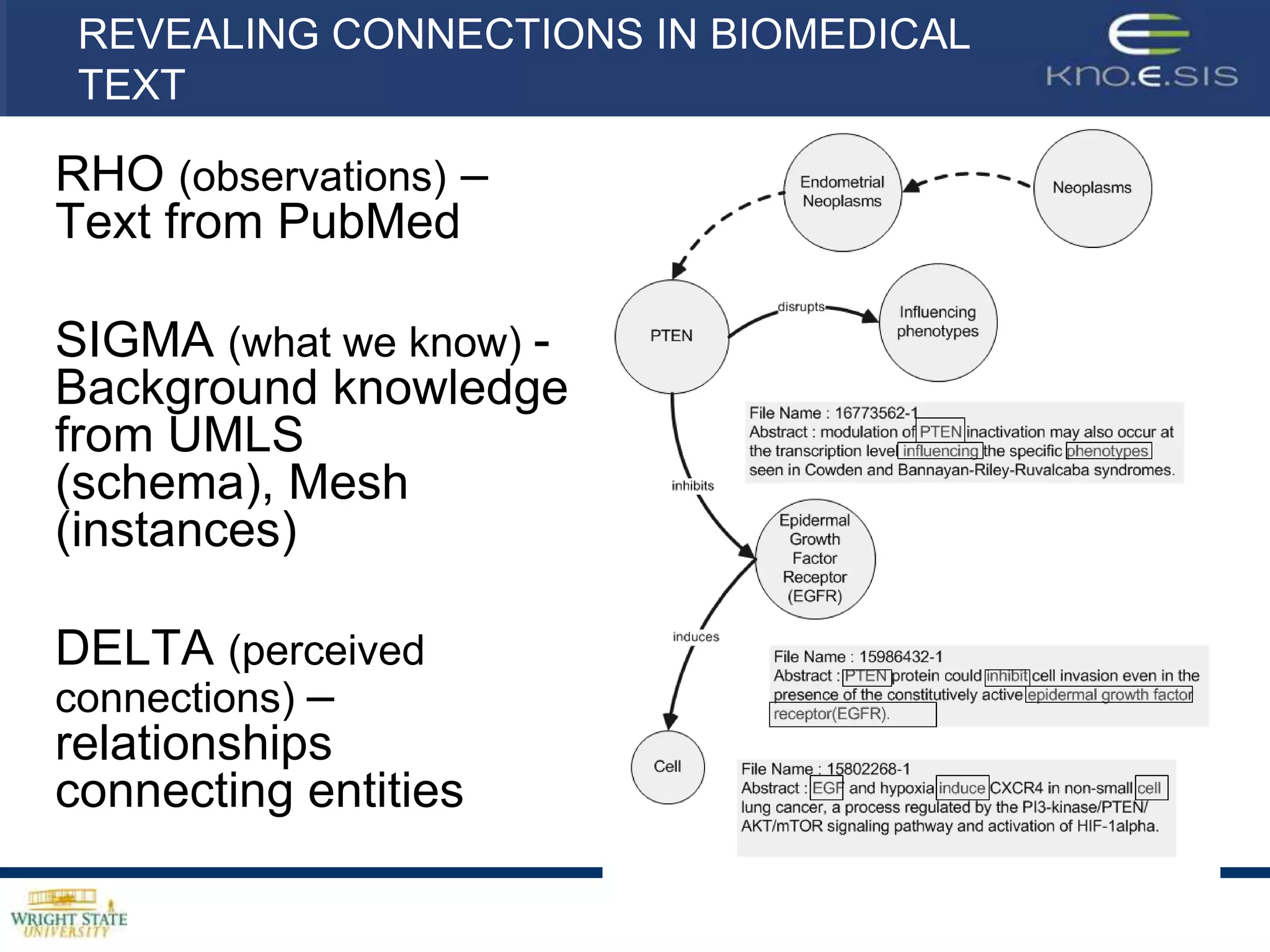
    REVEALING CONNECTIONS INBIOMEDICAL TEXTRHO (observations) – Text from PubMedSIGMA (what we know) - Background knowledge from UMLS (schema), Mesh (instances)DELTA (perceived connections) – relationships connecting entities
  • 94.
  • 95.
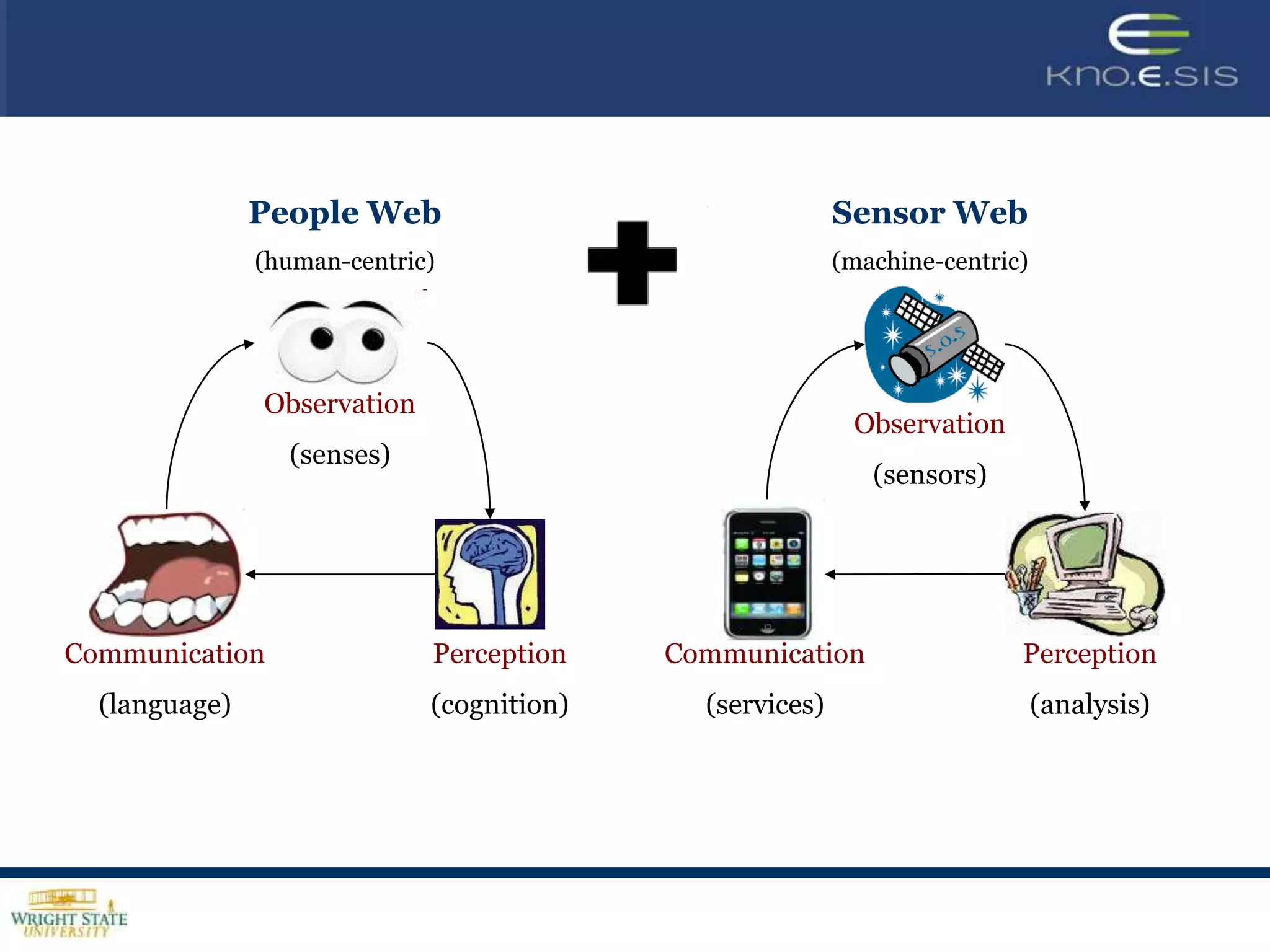
    Enhanced Experience (humans & machines working in harmony)ObservationPerceptionCommunicationSemantics for shared conceptualization and interoperability between machine and humanAbility to share common communication
  • 96.
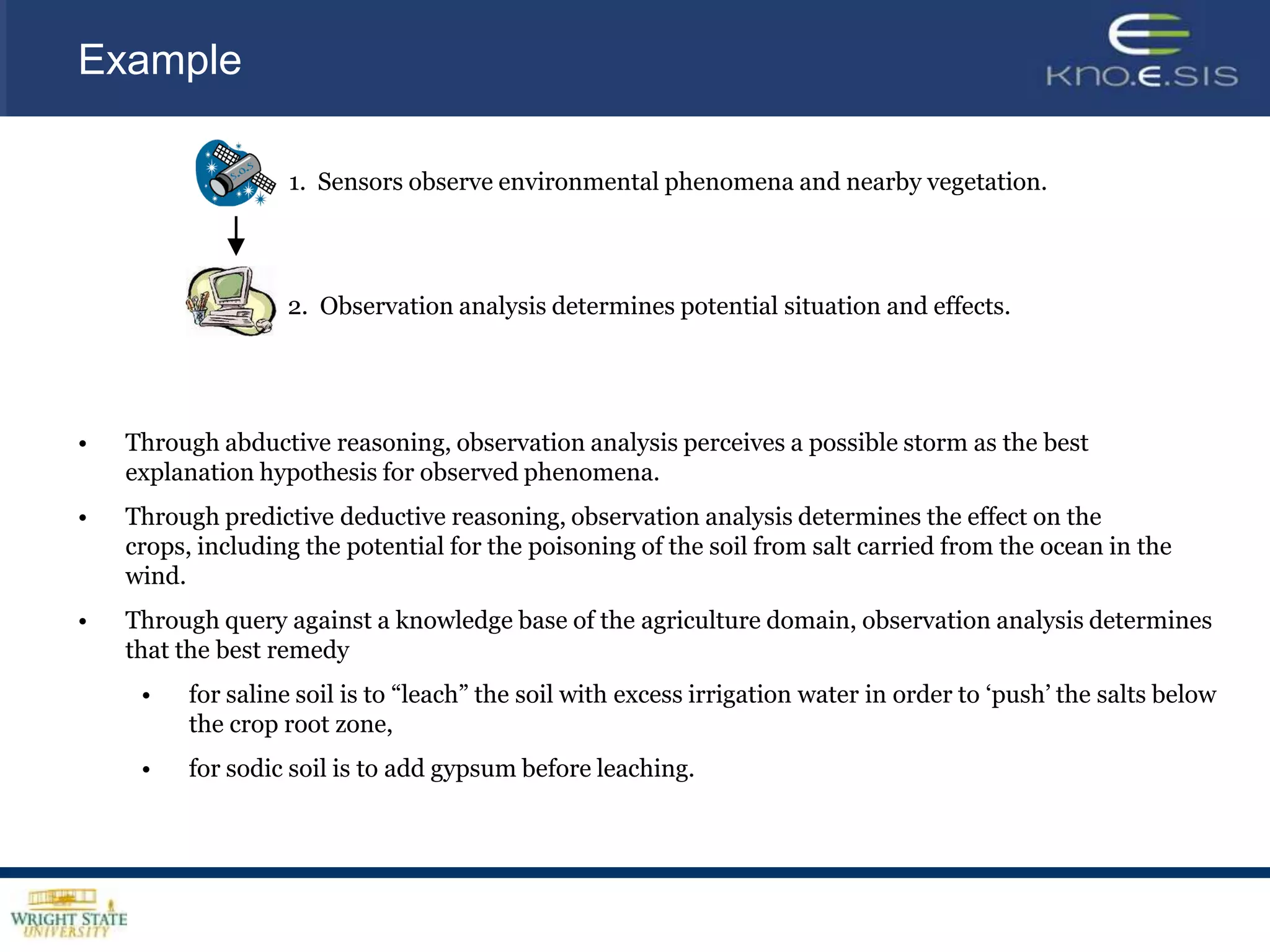
    Example 1. Sensors observe environmental phenomena and nearby vegetation. 2. Observation analysis determines potential situation and effects. Through abductive reasoning, observation analysis perceives a possible storm as the best explanation hypothesis for observed phenomena.
  • 97.
    Through predictive deductivereasoning, observation analysis determines the effect on the crops, including the potential for the poisoning of the soil from salt carried from the ocean in the wind.
  • 98.
    Through query againsta knowledge base of the agriculture domain, observation analysis determines that the best remedy
  • 99.
    for saline soilis to “leach” the soil with excess irrigation water in order to ‘push’ the salts below the crop root zone,
  • 100.
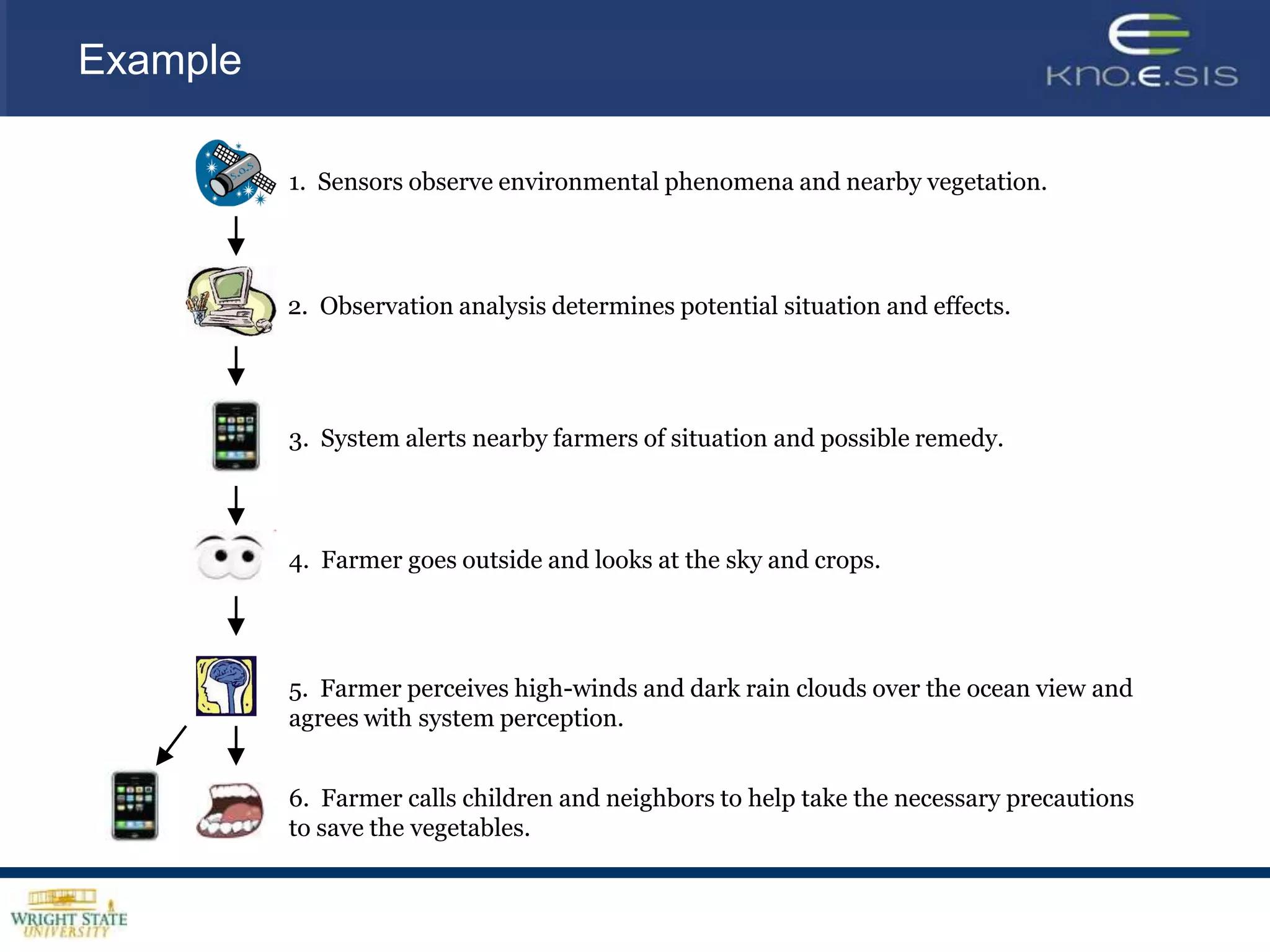
    for sodic soilis to add gypsum before leaching.Example 1. Sensors observe environmental phenomena and nearby vegetation. 2. Observation analysis determines potential situation and effects. 3. System alerts nearby farmers of situation and possible remedy.4. Farmer goes outside and looks at the sky and crops.5. Farmer perceives high-winds and dark rain clouds over the ocean view and agrees with system perception. 6. Farmer calls children and neighbors to help take the necessary precautions to save the vegetables.
  • 101.
    Sensing, Observation, Perception,Semantic, Social ExperientialPARADIGM SHIFT82
  • 102.
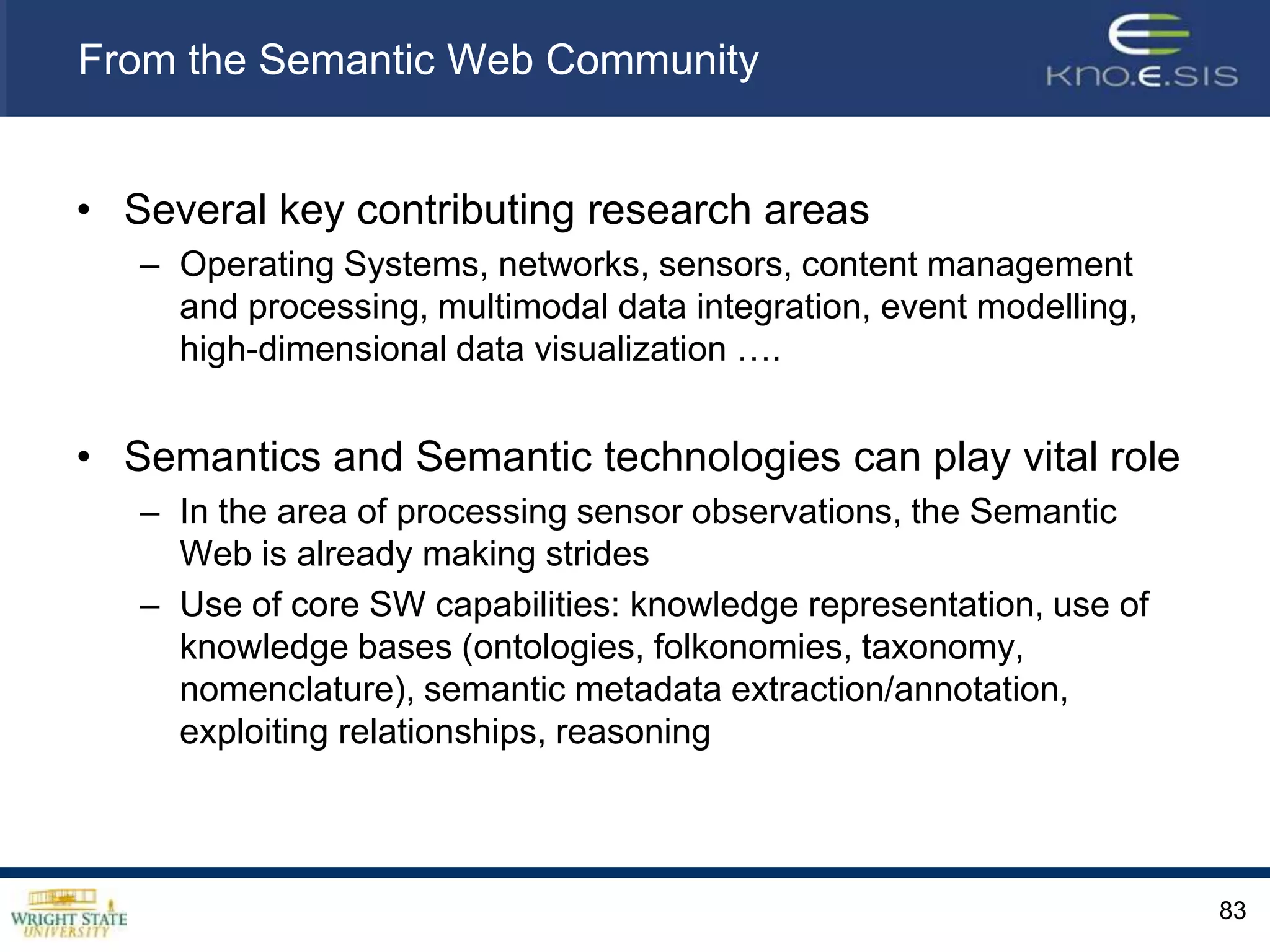
    From the SemanticWeb CommunitySeveral key contributing research areasOperating Systems, networks, sensors, content management and processing, multimodal data integration, event modelling, high-dimensional data visualization ….Semantics and Semantic technologies can play vital role In the area of processing sensor observations, the Semantic Web is already making stridesUse of core SW capabilities: knowledge representation, use of knowledge bases (ontologies, folkonomies, taxonomy, nomenclature), semantic metadata extraction/annotation, exploiting relationships, reasoning83
  • 103.
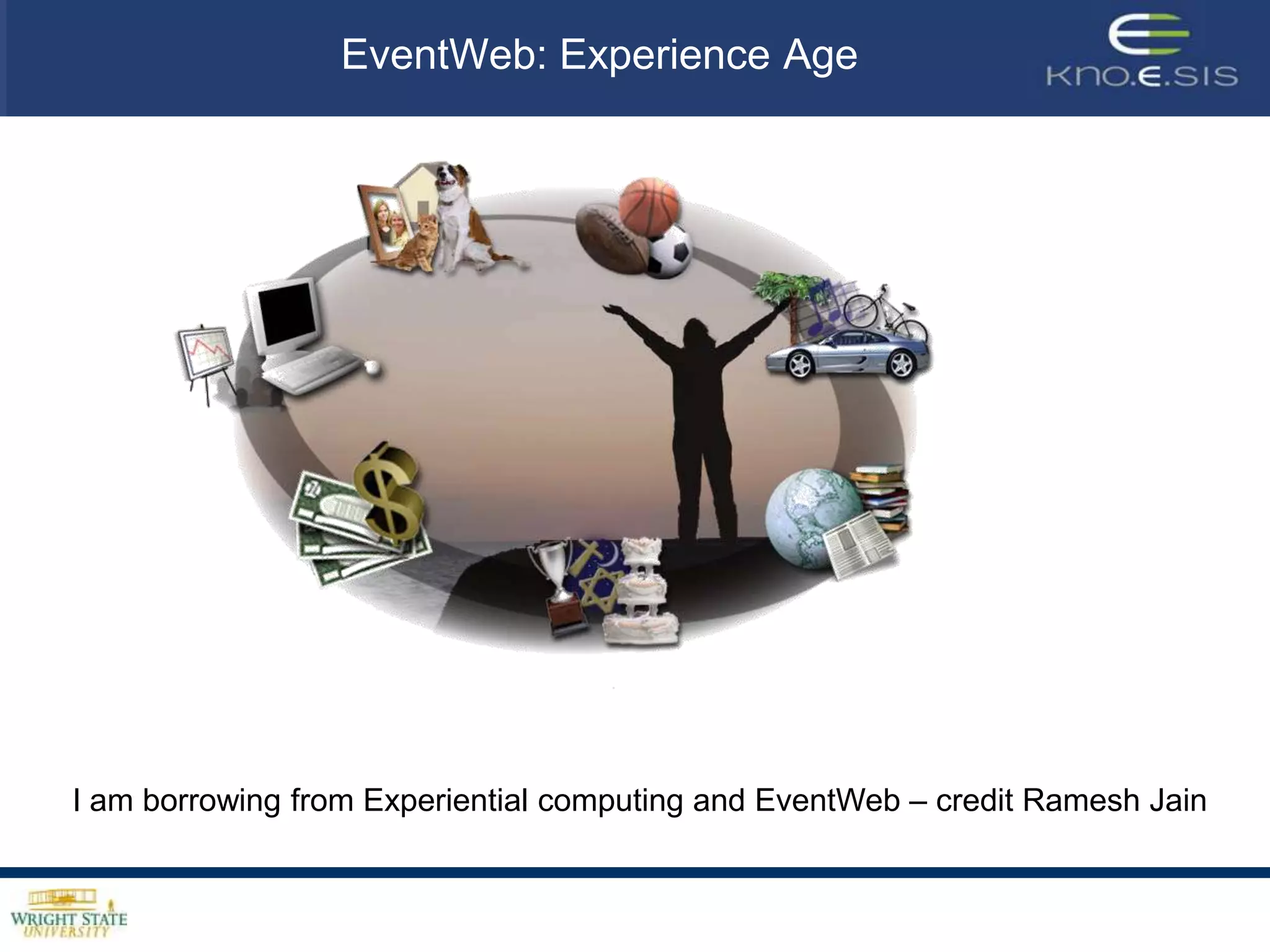
    EventWeb: Experience AgeFamilySportsFunOfficeFinanceKnowledgeIam borrowing from Experiential computing and EventWeb – credit Ramesh JainPersonal
  • 104.
    THERE IS MOREHAPPENING AT KNO.E.SIShttp://knoesis.org85Thanks: NSF (SemDis, Spatio-temporal-thematic), NIH, AFRL,and also Microsoft Research, HP Research, IBM Research. Seehttp://knoesis.wright.edu/projects/funding/
  • 105.
  • 106.
    Influential WorksV Bush, As We May Think, The Atlantic, July 1945. [Memex, trail blazing]Mark Weiser, The Computer for the Twenty-First Century, Scientific American, Sept 1991, 94-10. [The original vision paper on ubicomp. Expansive vision albeit technical aspects focused on HCI with networked tabs, pads and boards.]V. Kashyap and A. Sheth, Semantics-based information brokering. Third ACM Intl Conf on Information and Knowledge Management (CIKM94), Nov 29 - Dec 02, 1994. ACM, New York, NY. [semantics based query processing (involving multiple ontologies, context, semantic proximity) across a federated information sources across the Web]Abowd, Mynatt, Rodden, The Human Experience, Pervasive computing, 2002. [explores Mark Wisner’s original ubicomp vision]Jonathan Rossiter , Humanist Computing: Modelling with Words, Concepts, and Behaviours, in Modelling with Words, Springer, 2003, pp. 124-152 [modelling with words, concepts and behaviours defines a hierarchy of methods which extends from the low level data-driven modelling with words to the high level fusion of knowledge in the context of human behaviours]Ramesh Jain, Experiential computing. Commun. ACM 46, 7, Jul. 2003, 48-55. AmitSheth, Sanjeev Thacker, and Shuchi Patel, Complex Relationship and Knowledge Discovery Support in the InfoQuilt System, VLDB Journal, 12 (1), May 2003, 2–27. [complex semantic inter-domain (multi-ontology) relationships including causal relationships to enable human-assisted knowledge discovery and hypothesis testing over Web-accessible heterogeneous data]87
  • 107.
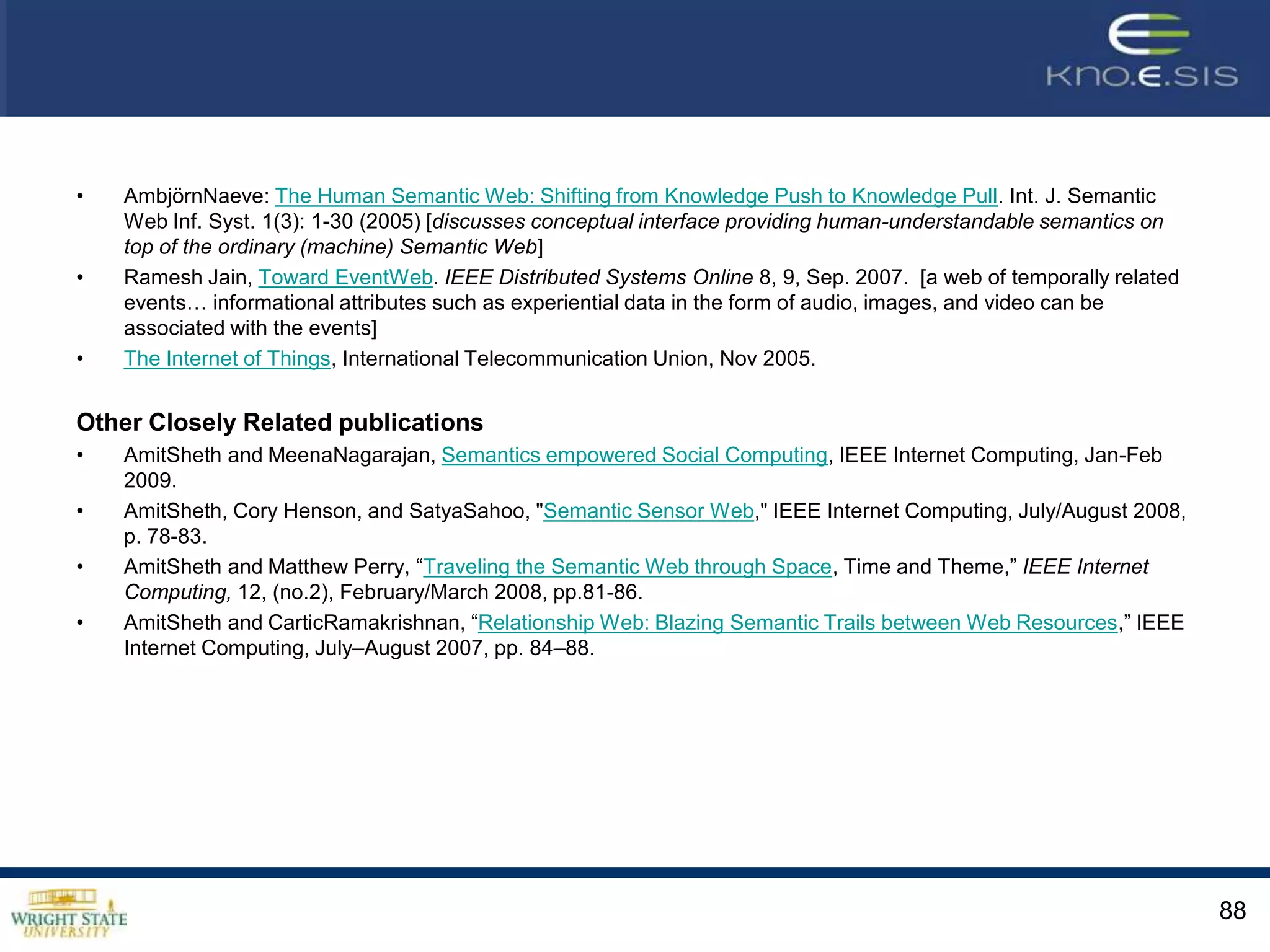
    AmbjörnNaeve: The HumanSemantic Web: Shifting from Knowledge Push to Knowledge Pull. Int. J. Semantic Web Inf. Syst. 1(3): 1-30 (2005) [discusses conceptual interface providing human-understandable semantics on top of the ordinary (machine) Semantic Web]Ramesh Jain, Toward EventWeb. IEEE Distributed Systems Online 8, 9, Sep. 2007. [a web of temporally related events… informational attributes such as experiential data in the form of audio, images, and video can be associated with the events]The Internet of Things, International Telecommunication Union, Nov 2005.Other Closely Related publicationsAmitSheth and MeenaNagarajan, Semantics empowered Social Computing, IEEE Internet Computing, Jan-Feb 2009.AmitSheth, Cory Henson, and SatyaSahoo, "Semantic Sensor Web," IEEE Internet Computing, July/August 2008, p. 78-83. AmitSheth and Matthew Perry, “Traveling the Semantic Web through Space, Time and Theme,” IEEE Internet Computing, 12, (no.2), February/March 2008, pp.81-86. AmitSheth and CarticRamakrishnan, “Relationship Web: Blazing Semantic Trails between Web Resources,” IEEE Internet Computing, July–August 2007, pp. 84–88.88

Editor's Notes

  • #15 Weiser’s human-centered vision of ubiquitous computing… new mode ofhuman–computer interaction.
  • #19 Humanist computing: combination of observed human behaviour and conventional computing as humanist computing (perception based fuzzy feature, …particle classification and facial feature discovery).Experential computing: Seeking insight from data, users experience, explore, and experiment, no longer limited to just generating lists of possible answers to simplistic queries.
  • #29 Going from syntactic to semantic metadata – Semantic Sensor MLInsert model references into tagsDomain Ontology e.g. people, companiesSpatial Ontology e.g. coordinate systems and coordinatesTemporal Ontology e.g. time units, time zones
  • #53 Video visor - So as you&apos;re walking down a busy city street you will be able to see reviews of shops and restaurants, adverts for services, other people who have similar interests to you, or whatever.
  • #56 Video visor - So as you&apos;re walking down a busy city street you will be able to see reviews of shops and restaurants, adverts for services, other people who have similar interests to you, or whatever.
  • #57 Video visor - So as you&apos;re walking down a busy city street you will be able to see reviews of shops and restaurants, adverts for services, other people who have similar interests to you, or whatever.Internet– connecting computers to mobile devices to sensors.