SOCIALIZATION AND
PERSONALITY
PRESENTED BY: RABIA JAVED IQBAL
Socialization
 Inducting an individual to a society is called socialization.
 Learning of different behaviors in different social situations is
the process of socialization.
 Man learns various social norms and techniques of social life
when interact with other with various social situations. If
means he learn to play his roles in new situation, this learning
of role playing is also called socialization.
Definition
 Peter Worsley explains socialization as the process of
transmission of culture, the process where by men learn the
rules and practices of social groups.
Method of socialization
 Cultural conditioning
Individual learns fundamental patterns of society in which they lives
It is the process of learning by repetition.
 Personal-social learning
Learning through experiences
Include early childhood experiences
It is called learning by reason
Individual as a social product
 To satisfy the needs of life one individual have to seek help
from the other
 The ‘give and take’ between man and man is a relationship
called interaction and they are now called a ‘social being’.
 That is why they are called social animals.
Sources/ Agencies Of Socialization
 The family
 Peers or age mates
 Social institutions
 Literature and mass media of communication
 The community
Functions of socialization
 Convert human from biological being to social being
 Contribute in personality development
 Help to become disciplined
 Help to perform different roles
 Establish knowledge and skills
 Contribute in the stability of social order
 Transmit culture from one to other generation
 Create right aspiration of social life.
The Self
 'Self' is not inherited but acquired by the individual in society.
 During the process of interaction, child learns that he has his existence
among others.
 He is familiar with the organs of his body, the environment in which he
lives, his parents, and playmates in the street.
 The child in this way discovers his position in his surrounding
environment and recognizes himself as called by his name.
 The idea of self-develops in his mind in relation to other things around
him
 During the process of socialization the child identifies the self of his
personality in relation to others.
Self and Personality
 The child may acquire inferiority feelings in certain acts which are due to
unfortunate experiences, and superiority feelings through excessive
praises in early childhood.
 Another pair of traits related to personality is conformity and
rebelliousness.
 On the other hand, there are children who do not want to please their
parents and the community members by accepting the socially approved
ways of behavior, but disobey them.
 The responsibility of this rebellious behavior falls upon unwise
administration of authority by parents.
The Self as I
 The rise of the self in the individual is the sum of his personality traits and
the total activity of his traits assign him the concept "I".
 George H. Mead has mentioned two stages in full development of the self.
1. In the first stage, the self of the individual is constituted by the
organization of particular attitudes of other individuals towards himself
and towards one another.
2. At this stage, the self is also constituted by an organization of the social
attitudes of the generalized other or social group or community to which
he belongs.
The Looking Glass Self
"Each to each a looking glass
Reflects the other that doth pass“
 The idea in self here involves three basic elements:
1. the imagination of our appearance to other person;
2. the imagination of his judgment about that appearance;
3. self feelings such as pride, inferiority or superiority.
Self is a product of socialization in groups
 The self is a product of interaction in a number of group situations.
 Group situations hold various degrees of reference(importance) upon an
individual.
 Members of the family, playmates, close relatives and friends may form a
group by interaction. This group, if most important of all others, bears a
lion's share in the emergence and development of his 'self. Such people in
the group, from whom his "self" is reflected, are members of his Reference
Group.
 The individual takes the role of society as a whole towards himself and
Mead calls this "taking the role of the generalized other". Generalized
other includes the folkways, mores, values and other normative elements
of culture.
SOCIALIZATION AND PERSONALITY
 The personality traits develop in the individual through
participation in social life. The individual plays different roles
in different social situations and gets experiences which
become apart of his personality. These experiences are stored
together from personality of the individual.
 The people of Saudi Arabia socialize their children in:
 Learning Arabic language,
 Wearing specially-designed Arabic dress
 Speaking truth in all dealings of life, offering prayer to Allah,
and other behaviors of social life with others.
 The Brahmans in India socialize their children in:
 Personality
 learning Hindi language,
 wearing 'Janue' - a long cotton thread around the neck
 taking bath in the water of the Ganges or the Jamna once a
week
 never eating meat of cow
 not sharing feed with Muslim
 praying for the sun and idols in the temples.
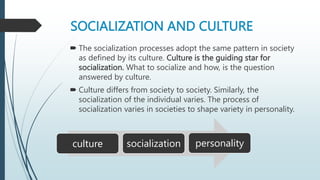
SOCIALIZATION AND CULTURE
 The socialization processes adopt the same pattern in society
as defined by its culture. Culture is the guiding star for
socialization. What to socialize and how, is the question
answered by culture.
 Culture differs from society to society. Similarly, the
socialization of the individual varies. The process of
socialization varies in societies to shape variety in personality.
culture socialization personality
Personality
 Ogburn and Nimkoff define it as the totality of sentiments,
attitudes, idea, habits, skills and behaviors of an individual.
Foundations or factors
of personality
development
Biological foundations
 Body structure
 Organs of the body
 The nervous system
 The glands
 The pituitary
 The thyroid
 The parathyroid
 The adrenal gland
 The thymus
 Sex glands
 Heredity
Heredity and personality
 Physical structure
 Intelligence
 Temperament
 Reflexes
 Innate drives
Environment
 Defined as forces, situations and stimuli which effect the
individual from outside.
 Natural environment: The natural environment encompasses
all naturally occurring things.
 Cultural environment: The cultural environments are molded
by human activities such as urban areas and cities, forests,
cultural landscapes
 It has 3 components:
1. Psycho-social
2. Physio-social
3. Physio- biological
Culture and personality
 Culture and personality interplay within each other. Culture
will lose its significant 'dynamic' characteristic if not modified,
changed or replaced by unique individual and experiences of
the people.
 This dynamic character of culture is fundamental for its
continuity and fulfillment of the needs of society for all times
and space. On the other hand, the personality of the
individual is framed in this or that frame of reference of
cultural environment.
Culture
What we receive as social heritage from our ancestors is
called our culture.
We make changes in it by performing our roles and leave it
for the coming generation. Culture is the guiding star of our
social life.
What we learn and how is our life is the answer of our
culture.
Culture teaches us how to behave and play certain role in a
certain social situation.
Bearing of Culture upon Personality
 We come across variety of people in daily life besides those who are
members of our family.
 This variety is so varied that none of them is the same in shape, voice
and other behaviors within the society.
 This vast aggregate of different people is the product of culture. These
people interrelating themselves in various cultural bonds following
various norms differ from the people of another culture.
 There are differences in all the walks of life due to the difference in
cultural conditions.
 Every culture has its own value-system oriented upon its people. The
language and gestures used in communication develop a special type
of mode in interaction.
Basic Personality Type (B.P.T)
 basic needs of feed, shelter and affection
 the discipline governing the behavior of the children in family.
Pueblos and Dobuans Cultures
1. Pueblo Indians are Apollonian: introvert in nature; have their
cultural configurations as soberness, inoffensiveness and
shyness
2. Dobuans are Dionysian: extrovert in nature and have
treachery, competitive hostility, lawlessness, and magic as their
cultural configurations. Wind blows and trees grow dueto
magic according to them. The basic personality traits of the
Pueblo Indians are sobriety, inoffensiveness and shyness as
their cultural configurations. These configurations are
organized into a collective effect that is 'introvert' which is the
core of culture
Normal and Abnormal Personalities
 The normal personality is the one whose activities are reliable and
predictable.
 The normal person is the one who plays the roles his group considers
appropriate for him. The personality is, therefore, considered normal or
abnormal on the basis of its conformity to the standards of a particular
culture at a particular time.
 The deviant is the person who departs from group norms and whose
behavior, therefore, cannot be adequately predicted.
 In its ‘normal' as well as its 'abnormal' behavior personality is the
reflection of culture.
Bearing of Personality on Culture
 Personality itself is a factor changing plastically. Anyhow
culture can be modified, though with slow process by certain
individual peculiarities.
 The individuals as members of the society add something
material and non-material into their culture with their unique
experiences.

SOCIALIZATION AND PERSONALITY & its factors

  • 1.
  • 2.
    Socialization  Inducting anindividual to a society is called socialization.  Learning of different behaviors in different social situations is the process of socialization.  Man learns various social norms and techniques of social life when interact with other with various social situations. If means he learn to play his roles in new situation, this learning of role playing is also called socialization.
  • 3.
    Definition  Peter Worsleyexplains socialization as the process of transmission of culture, the process where by men learn the rules and practices of social groups.
  • 5.
    Method of socialization Cultural conditioning Individual learns fundamental patterns of society in which they lives It is the process of learning by repetition.  Personal-social learning Learning through experiences Include early childhood experiences It is called learning by reason
  • 6.
    Individual as asocial product  To satisfy the needs of life one individual have to seek help from the other  The ‘give and take’ between man and man is a relationship called interaction and they are now called a ‘social being’.  That is why they are called social animals.
  • 7.
    Sources/ Agencies OfSocialization  The family  Peers or age mates  Social institutions  Literature and mass media of communication  The community
  • 8.
    Functions of socialization Convert human from biological being to social being  Contribute in personality development  Help to become disciplined  Help to perform different roles  Establish knowledge and skills  Contribute in the stability of social order  Transmit culture from one to other generation  Create right aspiration of social life.
  • 9.
    The Self  'Self'is not inherited but acquired by the individual in society.  During the process of interaction, child learns that he has his existence among others.  He is familiar with the organs of his body, the environment in which he lives, his parents, and playmates in the street.  The child in this way discovers his position in his surrounding environment and recognizes himself as called by his name.  The idea of self-develops in his mind in relation to other things around him  During the process of socialization the child identifies the self of his personality in relation to others.
  • 10.
    Self and Personality The child may acquire inferiority feelings in certain acts which are due to unfortunate experiences, and superiority feelings through excessive praises in early childhood.  Another pair of traits related to personality is conformity and rebelliousness.  On the other hand, there are children who do not want to please their parents and the community members by accepting the socially approved ways of behavior, but disobey them.  The responsibility of this rebellious behavior falls upon unwise administration of authority by parents.
  • 11.
    The Self asI  The rise of the self in the individual is the sum of his personality traits and the total activity of his traits assign him the concept "I".  George H. Mead has mentioned two stages in full development of the self. 1. In the first stage, the self of the individual is constituted by the organization of particular attitudes of other individuals towards himself and towards one another. 2. At this stage, the self is also constituted by an organization of the social attitudes of the generalized other or social group or community to which he belongs.
  • 12.
    The Looking GlassSelf "Each to each a looking glass Reflects the other that doth pass“  The idea in self here involves three basic elements: 1. the imagination of our appearance to other person; 2. the imagination of his judgment about that appearance; 3. self feelings such as pride, inferiority or superiority.
  • 13.
    Self is aproduct of socialization in groups  The self is a product of interaction in a number of group situations.  Group situations hold various degrees of reference(importance) upon an individual.  Members of the family, playmates, close relatives and friends may form a group by interaction. This group, if most important of all others, bears a lion's share in the emergence and development of his 'self. Such people in the group, from whom his "self" is reflected, are members of his Reference Group.  The individual takes the role of society as a whole towards himself and Mead calls this "taking the role of the generalized other". Generalized other includes the folkways, mores, values and other normative elements of culture.
  • 14.
    SOCIALIZATION AND PERSONALITY The personality traits develop in the individual through participation in social life. The individual plays different roles in different social situations and gets experiences which become apart of his personality. These experiences are stored together from personality of the individual.
  • 15.
     The peopleof Saudi Arabia socialize their children in:  Learning Arabic language,  Wearing specially-designed Arabic dress  Speaking truth in all dealings of life, offering prayer to Allah, and other behaviors of social life with others.
  • 16.
     The Brahmansin India socialize their children in:  Personality  learning Hindi language,  wearing 'Janue' - a long cotton thread around the neck  taking bath in the water of the Ganges or the Jamna once a week  never eating meat of cow  not sharing feed with Muslim  praying for the sun and idols in the temples.
  • 17.
    SOCIALIZATION AND CULTURE The socialization processes adopt the same pattern in society as defined by its culture. Culture is the guiding star for socialization. What to socialize and how, is the question answered by culture.  Culture differs from society to society. Similarly, the socialization of the individual varies. The process of socialization varies in societies to shape variety in personality. culture socialization personality
  • 18.
    Personality  Ogburn andNimkoff define it as the totality of sentiments, attitudes, idea, habits, skills and behaviors of an individual.
  • 19.
    Foundations or factors ofpersonality development
  • 20.
    Biological foundations  Bodystructure  Organs of the body  The nervous system  The glands  The pituitary  The thyroid  The parathyroid  The adrenal gland  The thymus  Sex glands  Heredity
  • 21.
    Heredity and personality Physical structure  Intelligence  Temperament  Reflexes  Innate drives
  • 22.
    Environment  Defined asforces, situations and stimuli which effect the individual from outside.  Natural environment: The natural environment encompasses all naturally occurring things.  Cultural environment: The cultural environments are molded by human activities such as urban areas and cities, forests, cultural landscapes  It has 3 components: 1. Psycho-social 2. Physio-social 3. Physio- biological
  • 23.
    Culture and personality Culture and personality interplay within each other. Culture will lose its significant 'dynamic' characteristic if not modified, changed or replaced by unique individual and experiences of the people.  This dynamic character of culture is fundamental for its continuity and fulfillment of the needs of society for all times and space. On the other hand, the personality of the individual is framed in this or that frame of reference of cultural environment.
  • 24.
    Culture What we receiveas social heritage from our ancestors is called our culture. We make changes in it by performing our roles and leave it for the coming generation. Culture is the guiding star of our social life. What we learn and how is our life is the answer of our culture. Culture teaches us how to behave and play certain role in a certain social situation.
  • 26.
    Bearing of Cultureupon Personality  We come across variety of people in daily life besides those who are members of our family.  This variety is so varied that none of them is the same in shape, voice and other behaviors within the society.  This vast aggregate of different people is the product of culture. These people interrelating themselves in various cultural bonds following various norms differ from the people of another culture.  There are differences in all the walks of life due to the difference in cultural conditions.  Every culture has its own value-system oriented upon its people. The language and gestures used in communication develop a special type of mode in interaction.
  • 27.
    Basic Personality Type(B.P.T)  basic needs of feed, shelter and affection  the discipline governing the behavior of the children in family.
  • 28.
    Pueblos and DobuansCultures 1. Pueblo Indians are Apollonian: introvert in nature; have their cultural configurations as soberness, inoffensiveness and shyness 2. Dobuans are Dionysian: extrovert in nature and have treachery, competitive hostility, lawlessness, and magic as their cultural configurations. Wind blows and trees grow dueto magic according to them. The basic personality traits of the Pueblo Indians are sobriety, inoffensiveness and shyness as their cultural configurations. These configurations are organized into a collective effect that is 'introvert' which is the core of culture
  • 29.
    Normal and AbnormalPersonalities  The normal personality is the one whose activities are reliable and predictable.  The normal person is the one who plays the roles his group considers appropriate for him. The personality is, therefore, considered normal or abnormal on the basis of its conformity to the standards of a particular culture at a particular time.  The deviant is the person who departs from group norms and whose behavior, therefore, cannot be adequately predicted.  In its ‘normal' as well as its 'abnormal' behavior personality is the reflection of culture.
  • 30.
    Bearing of Personalityon Culture  Personality itself is a factor changing plastically. Anyhow culture can be modified, though with slow process by certain individual peculiarities.  The individuals as members of the society add something material and non-material into their culture with their unique experiences.