Running Head: POLITICS AND HEALTH CASE SYSTEMS IN
US
POLITICS AND HEALTH CARE SYSTEM IN US.
5
Politics and Healthcare System in USComment by James A
Love: This is a good first outline. Please read the comments I
have inserted below, and let me know if you have questions.
Name
School/College
September 11, 2015
Outline
Title: Politics and Healthcare System in US
Thesis: The healthcare delivery system in the US has undergone
noticeable gradual improvements from the financing sector,
insurance sector, delivery and quality sector even though many
politicians politicize the gaps in healthcare for their own
benefits with the pretense of initiating reforms to the sector.
I. Introduction
A. Politics started intervening in the healthcare sector between
the years 1930 and 1960.Comment by James A Love: Were
politics not involved in healthcare prior to the 1930s and 1960s?
Be prepared to cite this assertion. What changed in the 1930s?
B. Thesis: The healthcare delivery system in the US has
undergone noticeable gradual improvements from the financing
sector, insurance sector, delivery and quality sector even though
many politicians politicize the gaps in healthcare for their own
benefits with the pretense of initiating reforms to the
sector.Comment by James A Love: This claim will need citing
for support.Comment by James A Love: This claim will need to
supported with specific citations.
II. Background Comment by James A Love: The ‘background’ is
appropriate here. It is essentially your ‘literature review’. I
think you can use either section title, but you should include
multiple citations of articles that discuss “politics in healthcare”
spanning history.
A. The aim is to discuss the association between politics and
healthcare and to try and find out the roles politics has played
in reforming the healthcare sector.
III. Formation of acts to offer medical securityComment by
James A Love: Section III, IV, and V seem like they should be
the major subsections within section II.
A. Formation of social security act of 1935
a. Provide unemployment compensationComment by James A
Love:
b. Provide old-age pensions
c. Other benefits
1. Provision of federal funds for hospital construction
B. Kerr-mills act of 1960
a. Federal matching payments
b. Elderly disabled and poor
IV. The election of some prominent leaders in the US
A. Kennedy, 1961
a. Kennedy kept the issue of elderly healthcare needs alive
B. Lyndon Johnson 1963
a. Initiated the Great Society’s War on Poverty Program
b. Medicare
C. Nixon
a. He signed various acts to extend community mental health
centers
b. National Health Insurance Partnership Act
1. Family Health Insurance Plan
i. Offers health insurance to low income families
2. National Health Insurance Standards Act
i. Developing Health Maintenance Organizations
D. Jimmy carter
a. Supported national health insurance program
E. Clinton
a. He made changes in health insurance coverage
b. Introduced National Health Reform
F. Harris Wofford
a. He formed democratic debates
b. He insisted on health insurance
G. Barrack Obama
a. Introduced the Affordable Care Act
1. The purpose is creating more tax revenue
2. Condemning citizens to vote for their health care services
V. Introduction of the managed care plan
A. A way of containing health care costs
· [INCLUDE FINDINGS, ANALYSIS, DISCUSSION
SECTIONS HERE]Comment by James A Love: After you give a
solid review, you will need some additional sections to add in
your “new” contributions to the existing literature. Basically,
try to find some meaning from all of the research your studied
to support your thesis. This is typically in the “findings”
section. You may need to revise your thesis if research
indicates something else. That is okay. It is part of iteration
process of making your paper better. Then, a separate
“discussion” section, will include your interpretation of the
findings.
These sections are the important contributions that make this
paper more than simply a review paper. You can choose to
make the paper a “literature review” paper, but you will need to
have many citations and still synthesize some meaning from the
review in a “findings” and “discussion” sections.
VI. ConclusionComment by James A Love: The conclusion will
end up being a summary of what all you did in the previous
sections.
Liberals and conservative are in constant conflicts and their
differences is the main cause of the failures and successes in the
health care sector
Abstract
It should be noted that the U.S health care delivery system is
constantly undergoing transformation through new legislation or
improvement and amendments of the existing legislations. Some
of the most common areas that are often improved concern the
financing sector, insurance sector, delivery sector and quality
sector. New laws are often introduced in these sectors with the
purpose of ensuring that the resultant health care is of high
quality and that it is cheaper and accessible to many.
Affordability is another crucial component of health care
delivery system. The four basic functional components of the
U.S. health care delivery system include financing, insurance,
delivery and quality would be discussed.
The paper will explore and analyze the association between the
politics and the health care reforms in the United States. The
analysis will try to find out the role of politics in the key
healthcare reforms such as Medicare, Medicaid, Managed care
and even the most current act called Affordable Care Act. The
paper will demonstrate that politicians have been using gaps in
the healthcare system to campaign for their consideration for
being elected as Congress or senators. It will also demonstrate
that some politicians such as Clinton plan to initiate reforms to
suit their political interest. The paper will conclude by
indicating how the politics and politicians manipulate the health
care reform as their campaign strategies of winning voters.
Politics and healthcare system in USA
A closer look at the health care reform in United States reveals
that any reform is politically orchestrated. In fact it is as if one
of the campaign strategies of most of the politicians is to come
up with a reform that can improve cost of care, quality of care
and access to care. A closer look at the history of the United
States reveals that politics started intervening in health care
between 1930s and 1960s (Patel & Rushefsky, 1999). During
this time, there was depression, unemployment insurance and
hence the government was in pressure to provide cheaper if not
free medical care or reimbursement for its cost (Patel &
Rushefsky, 1999).
In 1935, the Social Security Act of 1935 was formed to provide
for unemployment compensation, old-age pensions and other
benefits (Patel & Rushefsky, 1999). It should be noted that the
political party in leadership had to be careful on how it handles
the issue of health care lest it lose the confidence in people.
Before the idea of insurance was introduced, the American
Medical Association was strongly opposing it.
On the other hand, the politicians and the ruling political
government had to force it happen because that was the only
option in which politicians could help its citizens and possibly
get reelected. After World War II, the Truman administration
initiated the expansion of hospitals, increased support for public
health and federal aid for medical research and education. This
was reinforced by the passage of Hill-Burton Act in 1946,
which provided federal funds to subsidize construction of
hospitals in areas of bed shortages.
In 1960, Kerr-Mills Act, which is also known as Medical
Assistance Act was passed by Congress. This provided federal
matching payments to states and allowed the state to include
medically needy or vulnerable groups such as the elderly, the
disabled and the poor. However, the act failed to offer
significant relief for the substantial portion of the elderly
population. This is because it was found that only one percent
of the nation’s elderly received help under the program. The
program was curtailed by stringent eligibility rules and high
administrative costs of state government. The issue therefore
remained on political agenda.
When Kennedy became president in 1961, one of his political
agenda was to increase access to health care for millions of
Americans. However, it is indicated that Kennedy won a narrow
victory and was not in a position to push for a universal
insurance program. This is because he had a Congress that was
not very amenable to his legislative proposals. Kennedy’s key
achievement is that he was able to keep the issue of healthcare
needs of elderly alive and on political agenda.
However, his assassination in 1963 left the task of carrying on
the fight for Medicare to Lyndon Johnson, who adopted most of
Kennedy’s unfinished legislative proposals. He also initiated
the Great Society’s War on Poverty program (Patel, Rushefsky
& McFarlane, 2005). It should be noted that after civil rights,
Medicare was second in priority with the Johnson
administration.
Johnson recognizes Medicare as crucial part of his fight on
poverty. As a result, he won a landslide victory, which enabled
him carry out his political agendas successfully (Patel,
Rushefsky & McFarlane, 2005). It is also important that during
that time, the Democrats won major victories in congressional
elections. This means that the administration had enough votes
in the House and the Senate for the passage of its health care
proposals.
When Nixon took the leadership, he proposed moderate changes
in the health care programs (Patel, Rushefsky & McFarlane,
2005). He signed into law various acts meant to extend
community mental health centers, migrant health centers and
programs designed to support training of health care personnel
(Patel, Rushefsky & McFarlane, 2005). It should be noted that
Nixon was interested in vying for the president in 1972 again.
He felt compelled to respond to Kennedy’s political challenge
(Patel, Rushefsky & McFarlane, 2005).
Nixon proposed the National Health Insurance Partnership Act.
This comprises of the Family Health Insurance Plan, which is
federally financed to offer health insurance for all low-income
families. The second component of this act is the National
Health Insurance Standards Act. This act is financed by private
funds. Its goal is to set standards for employer health insurance
and expected coverage of employees.
Another one of Nixon’s proposal was to provide federal funds
for the development of health maintenance organizations (HMO)
(Patel, Rushefsky & McFarlane, 2005). In this system, enrollees
are allowed to pay a fixed fee in advance, and in return,
received a comprehensive set of health care services. Such
organizations promote competition with traditional health care
delivery system. This is because they create incentives for
shifting health services utilization from more costly impatient
services such as hospitals and skilled nursing facilities to less
costly outpatient services such as visits to doctor’s offices
(Patel, Rushefsky & McFarlane, 2005).
Jimmy Carter, on the other hand, pledged his support for a
comprehensive national health insurance program (Morone &
Belkin, 1994). This was a response to his opponent, who was
also seeking the Democratic Party’s nomination. However,
when he finally assumes the office in 1977, he could not meet
his pledges because he was hindered by financial constraints
(Morone & Belkin, 1994).
Roosevelt administration did not want to jeopardize the
enactment of Social Security Act. The 1980’s political
leadership; which was under the leadership of Reagan and Bush
healthcare system targeted mostly on the cost of health care
(Morone & Belkin, 1994). They use such to influence voters.
Ironically, during that time, the key reforms that were expected
especially by various experts and policy makers’ concerned
access to care and quality of care delivered. However, because
of the political influence, a number of legislation meant to cut
the cost of health care was passed (Morone & Belkin, 1994). In
fact it is during this period that the legislations related to the
Medicare and Medicaid programs were implemented. They both
focus on how to control rising health care costs. The impact of
this was positive because it is indicated that there was a
reduction in health care costs in 1990s (Shi & Singh, 2010).
When Clinton was elected as the present, the politics targeted at
ensuring access to health care insurance and health care
services. The Clinton administration really pushed for this. The
poll that was conducted in 1992 reveals that most of American
was in favor or reforming the health care system. George Bush
announced new health care initiatives. He proposed a series of
reforms. Under the proposal, the self-employed were to receive
a tax deduction equal to the size of the premiums and that small
business would receive tax inducement.
A closer look at Bush initiative reveals that it was in response
to the coming presidential election and was a way of assuring
Bill Clinton that he would offer a plan for comprehensive
reform of the U.S. healthcare system. The Bush government
and Clinton later endorsed managed care. The Clinton’s
administration was doing this as one of his pledges he made
during election. It is apparent that during the campaign of
1990s, the Clinton was convicted that health care was an issue
which could allow him go back to the White House for a
Democrat. During this time, the political analysts were certain
that health care was an aspect that could define a presidency
(Jacobs & Skocpol, 2012). In fact it has been established that it
is during the Clinton’s time when the United States experienced
a push for major health care reform. It was during this time
when the health care reform began to take shape seriously.
There are a number of politically motivated reforms that took
place during the Clinton’s time (Jacobs & Skocpol, 2012). The
first reform that is as a result of the political motivation is the
changes in health insurance coverage. Health insurance
coverage was one way of increasing the access to health care
services in the United States. Politicians were looking at every
possible way in which they can improve the healthcare system
in the United. For example, after the initiation of private
insurance, the problem of lack of healthcare of lack of health
insurance coverage became a problem of special groups such as
the aged, the poor, and more recently, the unemployed (Jacobs
& Skocpol, 2012).
A closer analysis of the health care system and reforms in the
United States reveals that the exact time when the healthcare
reform was politicized is in 1990s. It is during this time that
most of the trends such as the rising numbers of Americans
without health insurance and the rising fears of the middle class
about not having health insurance. The change started in 1991,
when Harris Wofford aired a television commercial during the
campaign that argued “if every criminal in America has the
right to a lawyer, then I think every working individuals or
citizens have the right to see a doctor when they are ill.
Using this as campaign strategy, Harris managed to defeat his
opponent. It is envisaged that it was during this time that the
Democratic Party started realizing that access to health care was
an issue on the minds of the public (Jacobs & Skocpol, 2012).
In fact during the following Democratic debates, health
insurance was one of the issues that were given a lot of weight.
The different candidate from the different states started
developing well-thought and comprehensive proposals related to
health reform (Jacobs & Skocpol, 2012). For example, history
shows that Senator Robert Kerry introduced a comprehensive
plan in mid-1991. Kerry proposed a government-financed and
government-run plan. However, other Democratic competitors
and contenders adopted less comprehensive reforms positions.
Paul Tsongas, for example pushed an approach which later
became publicly identified as the Jackson Hole Plan. This plan
was partly contributed by Paul Ellywood. It resembles the
managed care (Jacobs & Skocpol, 2012). It was proposed that
managed competition envisioned a health care system that relied
largely on market forces of supply and demand. It was during
this time that an agreement was made that it is better if
employers can pay a portion of their workers’ coverages, but
not necessarily pay the whole insurance amount (Jacobs &
Skocpol, 2012).
Another major significant reform took place when Clinton
became president. It is shown that President Clinton initiated a
reform led by the President’s Task Force on National Health
Reform. The goal of the reform was to make health care reform
legislation that could be submitted to Congress within 100 days
(In Selker & In Wasser, 2014).
The Task force was headed by Clinton’s wife. Clinton,
according to analysts, wanted to tackle the entire issue of health
care reform. He wanted a comprehensive proposal from the task
force (In Selker & In Wasser, 2014). The idea that Clinton
chooses his wife to head the task force is an indication of
political intentions. It is also shown that the way the
commission was created and the secrecy around its actions leave
a lot of questions related to the task force and the Clinton’s
administration (In Selker & In Wasser, 2014).
Medicare is another health care program that has some political
elements. It was initiated during the Clinton’s administration.
It should be noted that Medicare is a very crucial reform as far
as health care is concerned (In Mason, In Leavitt, & In Chaffee,
2014). This is because it currently serves more than 39 million
people, who get insurance and health care through Medicare (In
Selker & In Wasser, 2014).
Although Medicare is meant to reduce the cost of health care,
there is evidence that the Medicare costs have been growing
even faster than general health care costs since it was formed.
This is attributable to the increase in the share of population
over 65 years. It was agreed that the only way of reducing the
Medicare cost is to control the rate of growth in costs per
beneficiary (Faguet, 2013). It was also proposed that the cost
reduction can only be accomplished by a fundamental
restructuring of incentives for beneficiaries, and also adoption
of fee-for-service Medicare (In Selker & In Wasser, 2014). Two
key proposals were thus made. The first proposal is Breaux-
Frist proposal. This comprises of the Bi-Partisan Commission’s
plan and President Clinton’s plan.
Managed care plan is also envisaged to have some political
association. This plan was developed as a way of containing the
costs in 1970s and 1980w. This was the time when the health
care costs increased rapidly.
The last form of healthcare reform is the Affordable Care Act,
which was recently passed under the Obama administration
(Pratt, 2012). A closer look at the act reveals that it is a
political document. It is not a healthcare document (Pratt,
2012). In fact the main reason why the Act was initiated is to
create more tax revenue to support a bigger government, and to
create a large voting block dependent on government for their
healthcare services (Pratt, 2012). It is apparent that the public
dependency related to the act provides politicians enormous
political power (Pratt, 2012).
Depoliticizing the healthcare system can result in poor quality
reforms. This is because the politicians compete based on how
best they can improve the health care. However, care should be
taken to analyze any given policy before it is amended because
some policies such as Affordable Care Act may appear good
superficially, but is not actually good.
Solution
to the problem
As indicated in the foregoing discussion and analysis, it is clear
that the development of healthcare system is not always for the
interests of the people, but just a way of getting votes. Such
approach is always not good because it means that the
politicians are just to impress the voters. Let us consider the
healthcare system during Kennedy’s era.
As indicated earlier, when Kennedy became president in 1961,
one of his political agenda was to increase access to health care
for millions of Americans. However, it is indicated that
Kennedy won a narrow victory and was not in a position to push
for a universal insurance program. This is because he had a
Congress that was not very amenable to his legislative
proposals. This clearly indicates that politics may not always
deliver good thing because it requires that the issue of proposal
goes through the Congress. This means that even if the proposal
is good and the Congress is divided on whether to adopt or not,
such proposal may fail. This means that it is high time to have
independent body responsible for proposal and amendment of
healthcare system.
Another problem related to politicizing of healthcare system is
that some bills passed are appealing at the superficial level, yet
in reality, they are costly to the citizens. A good example is the
Affordable Care Act, which was proposed by President Barrack
Obama. When one looks at this act, it appears that it is indeed
affordable. However, the truth is that the act is controversial
and highly political. Ezekiel Emanuel, who is a professor of
medical ethics and health policy at the University of
Pennsylvania, refers it as a signature piece of legislation for
President Obama’s first term, and also a ball and chain for his
second. Principally, the act’s main aim is on providing more
Americans with access to affordable health insurance,
improving the quality of health care and health insurance,
regulating the health insurance industry and reducing health
care spending.
The research reveals that ACA is a political document. It is not
a healthcare document (Pratt, 2012). In fact the main reason
why the Act was initiated is to create more tax revenue to
support a bigger government, and to create a large voting block
dependent on government for their healthcare services (Pratt,
2012). The citizens or rather voters may be happy that their
healthcare services are taken care of, yet in reality, they are the
one taking care of them.
A solution to this problem is that the trusted bodies such as
Supreme Court should always be ready to defend the citizens by
providing right interpretation of the Acts passed. This means
that there is need of independent, neutral and accountable body
that can help interpret the bill before it is passed as a law. Such
bodies will enable the citizens/ voters make a sound decision
based on pro and cons of the bill. This is because most
politicians are very cunning such that they can easily coerced
the voters into believing that a given bill is right
Conclusion
It should be noted from the foregoing discussion that failure or
success to provide universal health insurance coverage can be
attributed to fundamental political ideological differences
between liberals and conservatives. The two are in conflict
about the role of the public and private sector in health care. It
is apparent that one of the factors that determine whether a
given candidate would become president is the nature and the
role of the health care act he or she initiates.
References
Top of Form
Top of Form
Faguet, G. B. (2013). The Affordable Care Act: A missed
opportunity, a better way forward. New York: Algora Pub.
Top of Form
Top of Form
In Mason, D. J., In Leavitt, J. K., & In Chaffee, M. W. (2014).
Policy & politics in nursing and health care.
In Selker, H. P., & In Wasser, J. S. (2014). The Affordable Care
Act as a National Experiment: Health Policy Innovations and
Lessons.
Jacobs, L. R., & Skocpol, T. (2012). Health care reform and
American politics: What everyone needs to know. New York:
Oxford University Press.
Morone, J. A., & Belkin, G. S. (1994). The politics of health
care reform: Lessons from the past, prospects for the future.
Durham: Duke University Press.
Patel, K., & Rushefsky, M. E. (1999). Health care politics and
policy in America. Armonk, NY [u.a.: M.E. Sharpe.
Top of Form
Patel, K., Rushefsky, M. E., & McFarlane, D. R. (2005). The
politics of public health in the United States. Armonk, N.Y:
M.E. Sharpe.
Top of Form
Top of Form
Top of Form
Pratt, L. L. (2012). Let's fix medicare, replace medicaid, and
repealthe affordable care act: Here is why and how.
Bloomington, Ind: AuthorHouse. Top of Form
Shi, L., & Singh, D. A. (2010). Essentials of the U.S. health
care system.
Bottom of Form
Bottom of Form
Bottom of Form
Bottom of Form
Bottom of Form
Bottom of Form
Bottom of Form
Bottom of Form
Bottom of Form
LSHSS
Research Article
Linguistic Feature Development Across
Grades and Genre in Elementary Writing
Shannon Hall-Millsa and Kenn Apela
Purpose: As children develop skills in writing across
academic contexts, clinicians and educators need to have
a fundamental understanding of typical writing development
as well as valid and reliable assessment methods. The
purpose of this study was to examine the progression of
linguistic elements in school-age children’s narrative and
expository writing development.
Method: Narrative and expository writing samples
produced by 89 children in Grades 2 through 4 were
analyzed at the microstructure and macrostructure levels.
Measures of receptive vocabulary, word-level reading, and
reading comprehension were obtained.
Results: Exploratory factor analyses revealed
4 microstructure factors (e.g., productivity, grammatical
complexity, grammatical accuracy, and lexical density)
and 1 macrostructure factor (e.g., a combination of
organization, text structure, and cohesion). Multivariate
analyses of covariance with reading comprehension as a
covariate showed that productivity and macrostructure
were sensitive to grade-level and genre differences and that
expository grammatical complexity was sensitive to grade-
level differences.
Conclusions: Findings are discussed in light of grade-level
standards for narrative and expository writing and
current practices in writing assessment. Multiple
suggestions are offered for clinical and educational
implications, and specific directions are provided for future
research.
S
peech-language pathologists (SLPs) working with
school-age children and adolescents have important
roles in prevention, identification, assessment, and
intervention for problems involving oral and written lan-
guage (American Speech-Language-Hearing Association
[ASHA], 2010). The school context is heavily influenced by
the established curricular standards, and SLPs contribute
their knowledge of language development to support stu-
dents who struggle with the prerequisite language skills to
achieve those standards. A majority of states have adopted
the Common Core State Standards (Common Core State
Standards Initiative, 2010), which include many rigorous
and integrated written language competencies across grade
levels and content areas. Given their specialized knowledge
base in the normal development of writing in the context
of the general education curriculum (ASHA, 2002), SLPs
can inform the assessment, instruction, and intervention of
children’s written discourse skills. There is a need to docu-
ment the nature of children’s written discourse skills across
the elementary grades when children are learning to write.
There is also a need for validated assessment methods to
elicit and analyze children’s writing products. Therefore,
the purpose of this study was to examine dimensions of
written language produced by children in Grades 2 through
4 with typical language development within two common
academic discourse genres (i.e., narrative, expository)
using multiple levels of analysis (i.e., microstructure and
macrostructure).
Academic Discourse Genres
Written discourse genres represent different forms and
styles of writing and reflect a range of purposes and contexts
for writing (e.g., Graham & Harris, 2003; Graham & Perin,
2007). In the school environment, narrative and expository
genres are the most commonly encountered discourse genres
in elementary grades (Donovan & Smolkin, 2006). A fre-
quently employed assessment method to elicit narrative and
expository writing from students in the elementary grades is
with predetermined topic prompts given by the teacher or
examiner. The majority of state writing assessment programs
aFlorida State University, Tallahassee
Correspondence to Shannon Hall-Mills: [email protected]
Kenn Apel is now at the University of South Carolina,
Columbia.
Editor: Marilyn Nippold
Associate Editor: Lynne Hewitt
Received April 5, 2014
Revision received August 21, 2014
Accepted April 6, 2015
DOI: 10.1044/2015_LSHSS-14-0043
Disclosure: The authors have declared that no competing
interests existed at the time
of publication.
Language, Speech, and Hearing Services in Schools • Vol. 46 •
242–255 • July 2015 • Copyright © 2015 American Speech-
Language-Hearing Association242
utilize this approach to eliciting student writing. In the basic
procedure, a set of writing prompts is provided to the stu-
dent. Students may have a choice of prompts for narrative,
expository, and persuasive discourse, depending on their
grade level. In some state writing assessment programs, only
one set of prompts is provided (i.e., no student choice). The
students have an established amount of time to write and
most often use paper and pencil to complete the task (with
the exception of allowable accommodations for students
with disabilities). The students’ written work is later evalu-
ated based on criteria established by the state education
agency, taking into account grade-level curricular standards
for writing and multiple features that are thought to reflect
writing proficiency. The prompt-based elicitation method
also has been infused in writing instruction in the classroom.
Therefore, writing prompts provided to elementary school-
age students frequently are intended to elicit either narrative
or expository texts.
Narrative discourse involves telling a story, often about
personal events or other life experiences (e.g., novels, personal
letters, and short stories). Expository discourse involves con-
veying facts or describing procedures, sharing basic informa-
tion, relating cause–effect relationships, or arguing a point of
view (e.g., essays, editorials). The ability to write proficiently
in both narrative and expository genres is a language skill
directly linked to academic success (e.g., Beers & Nagy,
2011; Nelson, Bahr, & Van Meter, 2004; Singer, 2007). By
the fourth grade, expository discourse is the principal genre
of instruction (Common Core State Standards Initiative,
2010; Nippold & Sun, 2010).
Knowledge of discourse genres is acquired in a devel-
opmental progression and is related to reading comprehen-
sion and writing achievement (e.g., Olinghouse & Graham,
2009; Shanahan, 2006). Awareness and use of narrative
discourse in written language typically develops first, often
through storytelling experiences (e.g., Nelson et al., 2004).
Compared with narrative discourse, expository discourse
structure typically is mastered later in the school years
and, as a consequence, is more difficult to produce and
comprehend for many students (Berman & Verhoeven,
2002). Much of the recent research regarding discourse
genres in written language has centered on text compre-
hension; in contrast, fewer studies have focused on text
production (i.e., writing). Furthermore, when researchers
have examined linguistic features at the discourse level in
written language, their investigations often have been re-
stricted to narrative discourse. There is a need, then, to ex-
amine students’ writing skills across additional discourse
genres, such as expository, especially considering that 60%
of writing assignments are expository in nature by the fourth
grade (Graham & Perin, 2007). In this study, we investigated
students’ developing written language skills in both narra-
tive and expository genres.
When examining students’ written language skills, re-
searchers have analyzed their writing samples for microstruc-
ture (i.e., the text base where the writer’s conveyance of
meaning is structured at the word, sentence, and discourse
levels) and macrostructure (i.e., the general idea of the
writer’s meaning at the discourse level reflected through
cohesion, organization, and genre structure). Both micro-
structure and macrostructure are important characteristics
to inspect because they reflect different levels of linguistic
prowess in the writing task. There are important implica-
tions from previous investigations. Herein, we present a
summary of the findings related to the development of
writing skills in school-age children.
Microstructure
Limited research on the development of narrative mi-
crostructure has revealed developmental changes in chil-
dren’s and adolescents’ use of literate words and complex
syntax in narrative discourse across age groups (Sun &
Nippold, 2012). Investigations of the development of expos-
itory microstructure have shown that commonly employed
measures such as mean length of T-unit (MLTU), type–
token ration (TTR), and Syntactic Density Score (T-unit
and clause length, number of subordinate clauses, embed-
dings, and verb expansions) were sensitive to differences
in grammatical complexity and lexical diversity between
successive age levels, beginning with children ages 9 years
and older (Morris & Crump, 1982). Furthermore, dev-
elopmental changes in writing productivity (e.g., total
words, total T-units) and syntax (e.g., MLTU) have been
detected between Grades 5 and 8; students in Grade 8 were
more likely to produce a greater number of subordinate
clauses and to embed subordinate clauses within other sub-
ordinate clauses in their sentences (Nippold & Sun, 2010).
In a comprehensive analysis of expository microstruc-
ture, Puranik, Lombardino, and Altmann (2008) examined
the development of expository writing of 120 children in
the third through sixth grade, targeting 13 variables of mi-
crostructure at the word, T-unit, sentence, and discourse
levels. Measures of productivity and grammatical complex-
ity increased with age. Significant differences were evident
between the third and fourth grade groups for total words,
total ideas, number of T-units, number of clauses, number
of sentences, sentence complexity, and number of different
words (NDW). In addition, factor analysis confirmed that
the 13 microstructure variables examined clustered into four
dimensions of written language microstructure: productiv-
ity, complexity, accuracy, and mechanics.
Investigators have examined microstructure perfor-
mance across more than one discourse genre. These studies
have revealed genre effects in favor of the narrative genre
across productivity and writing fluency measures when com-
pared with the expository genre (Scott & Windsor, 2000),
including a trend for children with a mean age of 11;5
(years;months) to include more clauses per T-unit in narra-
tive products but more words per T-unit in expository prod-
ucts. In a comparison of microstructure features across
four genres (narrative, descriptive, compare/contrast, per-
suasive), Beers and Nagy (2011) noted that children in the
third, fifth, and seventh grades produced more subordinate
clauses in persuasive products than in descriptive products,
and more words per clause in descriptive products than in
Hall-Mills & Apel: Writing Development, Genre 243
persuasive products. Compare/contrast texts were shorter
(in number of words) than persuasive texts at each grade
level, and narratives were shorter than persuasive texts at
Grades 5 and 7. Beers and Nagy’s (2011) study docu-
mented an important interaction between syntactic com-
plexity and genre, indicating that syntactic- and text-level
requirements vary by the genre structure.
In a cross-linguistic study of seven languages, includ-
ing English, comparing four age levels (Grades 4, 7, 11, and
adult), two genres (narrative and expository), and two mo-
dalities (spoken and written), Berman and Verhoeven (2002)
examined multiple aspects of the development of narrative
and expository microstructure. Measures included lexical di-
versity, productivity, and syntactic complexity. Like Morris
and Crump (1982), Berman and Verhoeven found that
measures of microstructure were sensitive to developmen-
tal change across elementary, middle, and high school
age levels. Furthermore, when considering the potential
influence of genre in the development of microstructure,
Berman and Verhoeven noted little to no effect of genre
on fourth grade narrative and expository lexical diversity,
a result that was similar to Scott and Windsor’s (2000)
findings for NDW.
In summary, analysis of elements of microstructure
in a written product can occur at the word, sentence, and
discourse levels. Microstructure analysis generally includes
measures of productivity (e.g., number of words, T-units, or
ideas), grammatical complexity (e.g., MLTU, clausal den-
sity [CD]), and lexical diversity (e.g., TTR, NDW; Nelson
et al., 2004; Puranik, Lombardino, & Altmann, 2007, 2008).
Taken together, the results of previous investigations sug-
gest that measures of productivity, grammatical complexity,
and lexical diversity are sensitive to age and grade-level dif-
ferences. However, less is known specifically about chil-
dren’s development of certain microstructure elements (e.g.,
productivity, grammatical complexity, lexical diversity) in
early grades (second through fourth), particularly across
genres (e.g., narrative, expository).
Macrostructure
In contrast to microstructure analysis, macrostructure
analysis occurs mainly at the discourse level (Scott, 2009).
Macrostructure is the “abstract representation of the global
meaning structure” which represents the “gist” of the text
(Sanders & Schilperood, 2006, p. 387). Macrostructure
analysis examines a writer’s expression of meaning at the
discourse level and may include measures of organization,
cohesion, and genre-specific text structure. Elements of
macrostructure often are included in qualitative writing
analyses, such as in holistic or analytic scoring systems, or
can be depicted quantitatively by counting cohesive ties or
genre-specific text structure elements present in a written
product (e.g., counting story grammar elements in a narra-
tive text, or marking whether an introduction, body, and
conclusion are present in an expository text).
Researchers have examined the development of ele-
ments of macrostructure in products written in either a
narrative or an expository genre. These studies revealed
the following:
• Approximately half of third and fourth grade students
exhibiting typical development produced complete
stories on the basis of story grammar analysis
(Laughton & Morris, 1989).
• There were no developmental differences between
scoring procedures for narrative macrostructure when
comparing a procedure for parsing and categorizing
propositions versus a holistic rating of cohesion,
organization, and episodic structure of the story
on a 5-point Likert scale (Montague, Maddux, &
Dereshiwsky, 1990).
• Fourth and fifth grade students were better able to
organize compare/contrast expository compositions
than explanation products and included a higher total
number of ideas in the explanation genre (Englert,
Raphael, Anderson, Gregg, & Anthony, 1989).
Due to the emphasis of curricular standards on
learning to write in a variety of academic discourse genres,
there is value in examining how macrostructure develops
in the writing produced by the same children across more
than one genre. When investigators have examined the
development of macrostructure features across more than
one discourse genre, they have found the following:
• Relations among reading performance and cohesion
in writing produced by students in the third and
fifth grades, grade effects for use of cohesive ties,
and genre effects in favor of the narrative genre for
developmental changes in cohesive harmony (i.e.,
reflection of functional relations through noun and
verb chains; Cox, Shanahan, & Sulzby, 1990)
• Possible age effects between students in the fifth and
eighth grades were detected by using a trait scoring
system for ideas, organization, sentence fluency,
and conventions for written narrative, imaginative,
persuasive, and expository products (Crawford,
Helwig, & Tindal, 2004)
Although it is important to consider students’ per-
formance in a variety of genres, looking solely at macro-
structure development across genres ignores the role of
microstructure features. In many instances, investigators
have sought to document developmental trends across
both microstructure and macrostructure variables within
a single genre (e.g., Gillam & Johnston, 1992; Mackie
& Dockrell, 2004; Nelson & Van Meter, 2007; Nodine,
Barenbaum, & Newcomer, 1985). The results revealed
differences between grade-level groups (e.g., Grades 1
and 2 vs. Grades 4 and 5) and nonadjacent grade-level
groups (e.g., Grades 4, 8, and 11) and suggested a rela-
tion among features of microstructure (e.g., productivity,
grammatical complexity, lexical diversity) and macrostruc-
ture (e.g., story grammar, coherence, cohesion). To date,
only one investigation has been conducted to examine the
development of linguistic features by using a combination
244 Language, Speech, and Hearing Services in Schools • Vol.
46 • 242–255 • July 2015
of microstructure and macrostructure measures across two
or more discourse genres. Koutsoftas and Gray (2012) mea-
sured microstructural elements (e.g., productivity, lexical
diversity, grammatical complexity, spelling accuracy) by
using an analytic scale within narrative and expository
writing samples of fourth and fifth grade students (30 stu-
dents exhibiting typical language development, 26 students
with language-learning disabilities). The researchers also
examined story grammar elements in the narrative sam-
ples (a measure of macrostructure). Significant differences
were found between the students with typical language
versus those with language-learning disabilities on mea-
surement type (e.g., analytic vs. holistic scales) as well as
genre (e.g., narrative vs. expository). Students with language-
learning disabilities received lower holistic scores in both
genres and lower scores on all six analytic measures used
for narrative and three of five analytic measures used for
expository writing. Results also reflected a significant rela-
tionship between analytic scores for productivity, sentence
complexity, and lexical diversity with overall holistic
scores. It is important to note that the analytic measures
for expository writing did not measure expository macro-
structure specifically. Therefore, macrostructure differences
could not be examined across genres, an important level
of analysis.
In our attempts to understand what is known about
children’s development of microstructure and macrostruc-
ture features in a variety of academic discourse genres, we
must consider some important limitations in the current
body of literature: examination of a limited range of vari-
ables, inclusion of small sample sizes, analysis on only one
level of the written product (microstructure vs. macrostruc-
ture), focus on one discourse genre, and examination of
linguistic features in students in upper grades only (fourth
grade and above). Current curricular standards reflect the
expectations for students in Grades 2 through 4 to develop a
range of foundational skills that will lead to more advanced
academic discourse skills in the later grades (Common Core
State Standards Initiative, 2010). Given the heightened focus
on academic discourse skills in the earlier grades, more infor-
mation is needed about how children develop various lin-
guistic features through their narrative and expository writing
during these years of school. In addition, the literature sug-
gests that an association exists between the development of
microstructure and macrostructure. However, few investi-
gators have explored this relation systematically across
multiple genres.
Thus, the purpose of this study was to document the
progression of linguistic elements of microstructure and
macrostructure that students in second, third, and fourth
grade use in their written narrative and expository compo-
sitions. The following research questions guided the present
study:
1. Are there differences among grades and between
genres in written linguistic microstructure elements?
2. Are there differences among grades and between
genres in written macrostructure elements?
3. To what degree is development of microstructure
elements related to development of macrostructure
elements?
We hypothesized that there would be grade-level dif-
ferences for narrative and expository productivity and gram-
matical complexity. Performance in the narrative genre was
anticipated to be superior to expository performance, espe-
cially for students in the second and third grades who gen-
erally possess less knowledge of and experience with the
expository genre (Duke, 2000). A grade effect was antici-
pated for narrative and expository macrostructure on the
basis of variables of organization, coherence, and text struc-
ture. Levels of macrostructure were expected to be superior
for the fourth grade students. The potential genre effects
were more difficult to anticipate given the range of findings
in previous investigations. However, we anticipated that
performance on macrostructure measures would be similar
in both genres for the oldest students (fourth grade), if the
assumption held true that experience and knowledge of var-
ious text structures and text cohesion increase with age.
Few researchers have directly examined the potential rela-
tion between microstructure and macrostructure. As such,
we expected that development of these elements would be re-
lated in the sense that increased productivity (more words
per written product) allows more opportunities for a writer
to incorporate the necessary text structure elements and
genre-specific organizational structure.
Method
Participants
Participants were recruited from a public elementary
school located in a mid-sized city, with a student body that
was representative of the state through the school’s use of
stratified sampling. Participants were recruited in conjunc-
tion with a larger investigation examining an experimen-
tal spelling intervention. Approval was obtained from
the University Institutional Review Board and the school
for the procedures and consent forms for this study. Consent
forms were sent home to all second, third, and fourth grade
students. Participants had to be monolingual English-
speaking, enrolled in general education, with no history of
sensory impairments as determined by school records. Con-
sultation between the first author and school administrators
confirmed whether participants with parental consent met
the inclusionary criteria. School records confirmed partici-
pants’ language status on the basis of the state-required
Home Language Survey (Florida Department of Education,
1990) and related language proficiency testing to identify
students who were bilingual or who were determined to be
English language learners.
A total of 93 participants enrolled in general educa-
tion were recruited, 89 of whom completed the writing
samples (e.g., four left due to transferring out of the school).
The final sample included 37 boys (41.6%) and 52 girls
(58.4%): 28 participants were in the second grade, 28 par-
ticipants were in the fourth grade, and 33 participants were
Hall-Mills & Apel: Writing Development, Genre 245
in the third grade. Participants ranged in age from 7;0 to
10;11 (M = 8;6, SD = 10;9) and represented a range of eth-
nic backgrounds, including 55% White, 20.2% African
American, 11.2% Hispanic, 3.4% Asian American, 7.9%
multiethnic, and 2.2% unreported ethnic backgrounds. The
participants had average receptive vocabulary skills (M =
101.10, SD = 14.14), as a proxy for general language skills,
as measured by the Peabody Picture Vocabulary Test–
Fourth Edition (PPVT-4; Dunn & Dunn, 2007).
Measures
Reading Task
The Group Reading Assessment and Diagnostic
Evaluation (GRADE; K. T. Williams, 2001) was adminis-
tered to obtain participants’ reading levels. The GRADE
is a norm-referenced assessment that may be administered
in groups. Grade-level forms of the Word Reading,
Sentence Comprehension, and Passage Comprehension
subtests were administered, and standard scores were cal-
culated. According to the test manual (Williams, 2001),
the GRADE has an internal consistency of .95 to .99
(coefficient alpha [a]), and test–retest reliability of .89 to .98.
Receptive Vocabulary Task
The PPVT-4 was administered to determine partici-
pants’ receptive vocabulary levels and to corroborate teacher
report of receptive language skills within typical limits. The
test manual indicates that the PPVT-4 has an internal consis-
tency (split-half reliability) of .94 and test–retest reliability of
.92 to .96 (M = .93).
Writing Tasks
Each participant produced one narrative and one ex-
pository writing sample (15 min each). Writing samples
were elicited during group sessions by the first author and
by trained research assistants. Prompts were selected in
accordance with parallel forms of the state-mandated writ-
ing assessment system protocol (Florida Comprehensive
Assessment Test [FCAT]; Florida Department of Educa-
tion, 2010) and the topical interests of the children enrolled
in the classrooms. The prompts provided for narrative and
expository genres, respectively, were as follows:
• Tell me about a time that someone surprised you and
what happened.
• Pretend you are a super hero and you are being
interviewed on the news. Tell everyone what special
powers you would have. Also, explain what you would
do with them to help the world.
Writing sample elicitation procedures mirrored those
of the state’s writing assessment program for elementary
grades (FCAT–Writing; Florida Department of Education,
2010), which follows a scripted, generated elicitation method.
The writing scale designed for this study, consisting of
nine items for microstructure and three for macrostructure,
had good internal consistency, with a Cronbach’s a coefficient
of .80.
Procedure
Reading (GRADE subtests) and writing tasks were
completed in two classroom-wide sessions, and receptive
vocabulary was measured per participant in one individual
session. Assessments were altogether completed in 6 weeks
in the fall of the academic year. Individual sessions were
completed first in a quiet testing room on the school cam-
pus and lasted approximately 20 min. Group sessions were
counterbalanced for writing genre (e.g., expository, narra-
tive). Evaluators were graduate students in speech-language
pathology who were trained for each task in small groups by
the authors.
Coding and Scoring
The first author transcribed the writing samples into
a computer database according to Systematic Analysis of
Language Transcript (SALT, Version 8; Miller & Chapman,
2005) conventions. The unit of segmentation was the T-unit,
as suggested by Nelson et al. (2004) and consistent with
previous investigations (e.g., Nelson & Van Meter, 2007;
Puranik et al., 2007, 2008; Scott & Windsor, 2000). A
T-unit contains one main clause and any subordinate
clauses. Examples of coded writing samples for narrative
and expository writing in all three grades are provided in
the Appendix.
Microstructure
Nine microstructure elements were calculated, rep-
resenting measures of productivity, grammatical complexity,
and lexical diversity. The microstructure productivity mea-
sures of number of total words and T-units were calculated
automatically in SALT, as was the microstructure gram-
matical complexity element of MLTU. Another measure
of grammatical complexity, the total number of clauses,
was calculated by the first author using SALT to compute
CD. Both measures have been used in previous examina-
tions of the written product (e.g., Puranik et al., 2007, 2008;
Scott & Windsor, 2000). CD was calculated by dividing
the total number of clauses (main and subordinate) in the
sample by the total number of T-units across the sample.
In addition, the number of clauses per sentence (CPS) was
measured to capture grammatical complexity at the sen-
tence level. Transcripts within the SALT program were
coded for sentence type (complex vs. simple, correct vs.
incorrect) and presence of grammatical errors. A simple
sentence consisted of one main clause and only one verb,
whereas a complex sentence included one main clause
plus one or more embedded/subordinate clauses, two main
clauses, or one main clause and a verb phrase joined by a
coordinating conjunction. Grammatical errors were de-
fined as errors occurring in verb or pronoun tense, agree-
ment or case, omitted or incorrect inflection, omitted or
substituted grammatical elements, and violated word order.
A sentence without any grammatical errors was considered
correct, whereas a sentence with one or more errors was
deemed incorrect.
246 Language, Speech, and Hearing Services in Schools • Vol.
46 • 242–255 • July 2015
Two final grammatical complexity measures calcu-
lated were the number of grammatical errors per T-unit
(GET) and percentage of grammatically correct sentences
(% GS; e.g., Mackie & Dockrell, 2004; Nelson & Van Meter,
2007; Puranik et al., 2007, 2008). The training manual for
coders included resources for identifying grammatical errors
that may have been attributable to nonstandard dialect use
so that considerations were made regarding the potential in-
fluence of participant dialect on calculation of grammatical
errors.
Two of the three microstructure elements representing
lexical diversity—the NDW in the written text and the TTR
(ratio of different word types to overall words)—were auto-
matically calculated by SALT. However, previous researchers
have suggested that NDW or TTR are most accurately inter-
preted when sample size is controlled for (Scott, 2009; Scott
& Windsor, 2000). For this reason, an additional related
measure of lexical properties was used that was not con-
founded by writing sample size. Lexical density (LXD) was
the proportion of content words (e.g., nouns, verbs, adjec-
tives) to total words (Scott, 2009). By taking a proportion of
content words to total words, each sample was then mea-
sured for LXD on the same scale regardless of overall sam-
ple length, thereby reducing the impact of sample size.
Macrostructure
Each writing sample was reviewed and scored for the
dependent measures related to macrostructure variables
(organization, genre-specific text structure, cohesion) on
the basis of an analytic scoring system (see Hall-Mills,
2010 for operational definitions and protocol). The opera-
tional definitions for examining levels of organization, text
structure, and cohesion were formed on the basis of key
features of informal writing inventories used in previous
investigations (Crawford et al., 2004; Moats, Foorman, &
Taylor, 2006; Nelson et al., 2004). Organization was exam-
ined within the introduction, body, and conclusion of the
product. Writing samples also were examined for use of an
appropriate text structure (genre-specific), and overall cohe-
sion. Each item (organization, genre-specific text structure,
cohesion) received a score ranging from 1 to 4. The indi-
vidual trait scores were combined for an overall macro-
structure composite score.
Reliability
Coding reliability of the microstructure and macro-
structure measures was established by using a randomly
selected subsample of writing samples equaling 25% of the
total number of samples collected, balanced across genre
and grade level. Percent agreement and Cohen’s kappa co-
efficients were calculated for the following variable charac-
teristics that required coding in SALT to produce the scores
for each of the dependent variables: T-unit segmentation,
clauses per T-unit, CPS, sentence codes to indicate gram-
matical complexity (simple vs. complex) and accuracy
(correct vs. incorrect) of the sentence structure, identifica-
tion of content words, and identification of grammatical
errors. Percent agreement ranged from 83% to 98% for
the microstructure variables, and from 84% to 93% for
macrostructure variables. Kappa coefficients of >.6 were
required to establish adequate reliability. Kappa values
may be interpreted as follows: .41 to .60 is fair, .61 to .80
is good, and > .80 is very good reliability among raters
(Warner, 2008). Kappas ranged from .80 to .98 for micro-
structure variables and from .72 to .90 for macrostructure
variables, thus indicating suitable reliability for all coded
dependent measures.
Results
In our preliminary analyses, we surveyed the data
for normality (including a search for outliers) and assump-
tions of the statistical models we employed to answer the
research questions. In particular, we considered conformity
with four assumptions for multivariate analysis of covari-
ance (MANCOVA) due to potential effects on Type I errors
rate and power (e.g., independent observations, multivariate
normal distribution in each group, covariance matrices for
all dependent variables, and homogeneity of regression slopes
(Field, 2005; Stevens, 1997). Multivariate normality could
not be checked in the Predictive Analytic Software (PASW)
program, so the assumption of univariate normality was
checked for each dependent variable by using the Shapiro–
Wilk test (Stevens, 1997). To determine whether the assump-
tion of homogeneity of covariance matrices was met, the
univariate tests of equality of variances between groups was
checked by using Levene’s test for each of the dependent
variables (Field, 2005). Due to unequal group sizes, the ho-
mogeneity of the variance–covariance matrices was checked
by using Box’s test (Field, 2005).
Two exploratory factor analyses (EFAs) were con-
ducted for the purposes of data reduction for the microstruc-
ture variables (nine variables) and macrostructure variables
(three variables) and to confirm a priori association of de-
pendent writing variables with factors that are conceptually
meaningful to clinicians. The resulting factor scores were
used in two separate MANCOVAs to address the research
questions. We used a principal component analysis factor
extraction method. Based on the scree plots and presence of
eigenvalues over 1.0, four factors were rotated by using di-
rect oblimin (d = 0), an oblique rotation technique, yielding
a four-factor solution for microstructure. The results for
the microstructure factors are reported in Table 1. For both
genres, three variables loaded on the first factor of produc-
tivity (total words, total T-units, NDW), three variables
loaded onto the second factor of grammatical complexity
(CD, CPS, MLTU), two variables loaded onto the third
factor of grammatical accuracy (percent grammatical sen-
tences, GET), and one variable loaded onto the fourth fac-
tor of lexical diversity (LXD). Two grammatical factors
(Factor 2, grammatical complexity; Factor 3, grammatical
accuracy) were identified. In comparison to previous re-
search, the second factor in the present analysis resembles
the accuracy factor (including variables of syntactic errors
per T-unit and % GS identified by the factor analysis re-
ported by Puranik et al. (2008). As such, it was determined
Hall-Mills & Apel: Writing Development, Genre 247
that the two grammatical variables loading onto the second
factor in the present study could actually serve as a fourth
factor measured within the microstructure measure. There-
fore, this fourth factor level was named grammatical
accuracy. The results also indicated that NDW, initially
proposed as a measure of lexical diversity, actually loaded
onto the first factor, with total words and total T-units as
measures of productivity.
The dependent variables for the macrostructure mea-
sure (organization, text structure, and cohesion) were se-
lected initially on the basis of review of previous research to
examine the macrostructure of written language. An EFA
utilizing a principal component analysis factor extraction
method resulted in the extraction of only one factor for
both genres. Examination of a bivariate correlation matrix
confirmed that each of the three macrostructure variables
was strongly intercorrelated; however, none were greater
than .90 where multicollinearity would be of concern. For
both genres, all three macrostructure variables loaded on
the identified macrostructure factor (organization, text
structure, and cohesion). The factor loadings aligned with
predictions that the macrostructure measure was in fact
unidimensional and yielded one factor measuring macro-
structure with three variables (range of narrative loadings =
.88–.92, range of expository loadings = .87–.89).
Effects of Grade and Genre on Microstructure
and Macrostructure
The GRADE Comprehension Composite scores, af-
ter being converted to z scores, were used as a covariate for
MANCOVA because reading comprehension is strongly
associated with writing skills (e.g., Cox et al., 1990; G. J.
Williams, Larkin, & Blaggan, 2013). A preliminary analysis
to evaluate the homogeneity of slopes assumption indicated
that the relationship between the covariate (z score for
GRADE Comprehension Composite) and the dependent
variables did not differ significantly as a function of the
independent variable (grade level) in either the narrative
genre, F(3, 82) = 0.25 to 1.6, p = .19 to .86, h2 = .01 to .06,
or the expository genre, F(3, 79) = 0.16 to 3.03, p = .03 to
.92, h2 = .01 to .10.
Two MANCOVAs were conducted to measure the
effects of grade level within each genre on the various
microstructure and macrostructure variables, controlling for
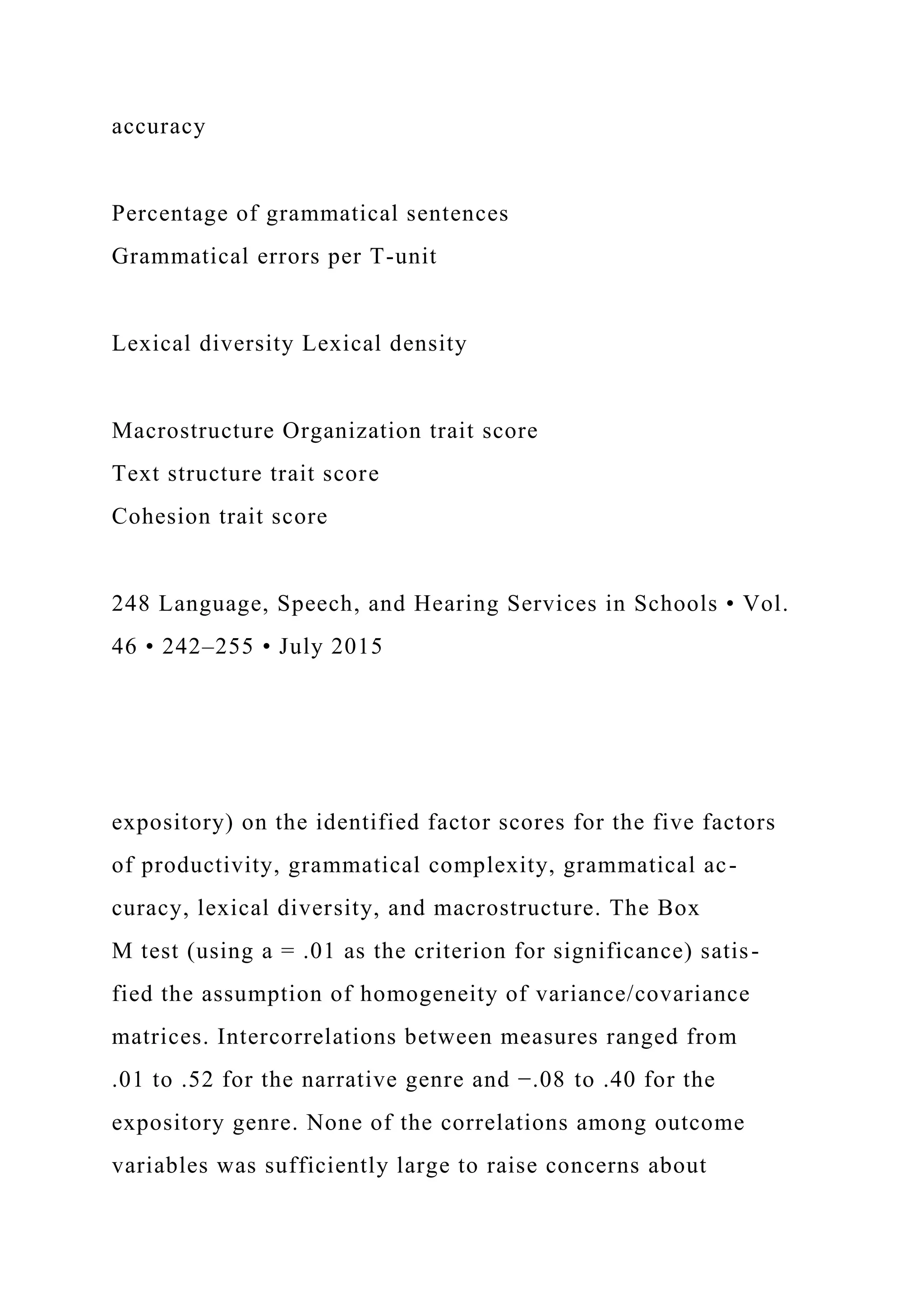
reading comprehension scores. Table 2 shows the final fac-
tors of analysis (i.e., resulting from EFA) with the respec-
tive dependent variables. Factor scores of productivity,
grammatical complexity, grammatical accuracy, lexical di-
versity, and macrostructure were examined in each genre
for differences between grade levels. Within the factor of
productivity, there were three variables (total words, total
T-units, NDW); the factor of grammatical complexity in-
cluded three variables (CD, CPS, and MLTU); grammatical
accuracy had two variables (percent grammatical sentences,
GET); lexical diversity was represented by one variable
(LXD); and macrostructure factor was represented by three
variables (organization, text structure, and cohesion).
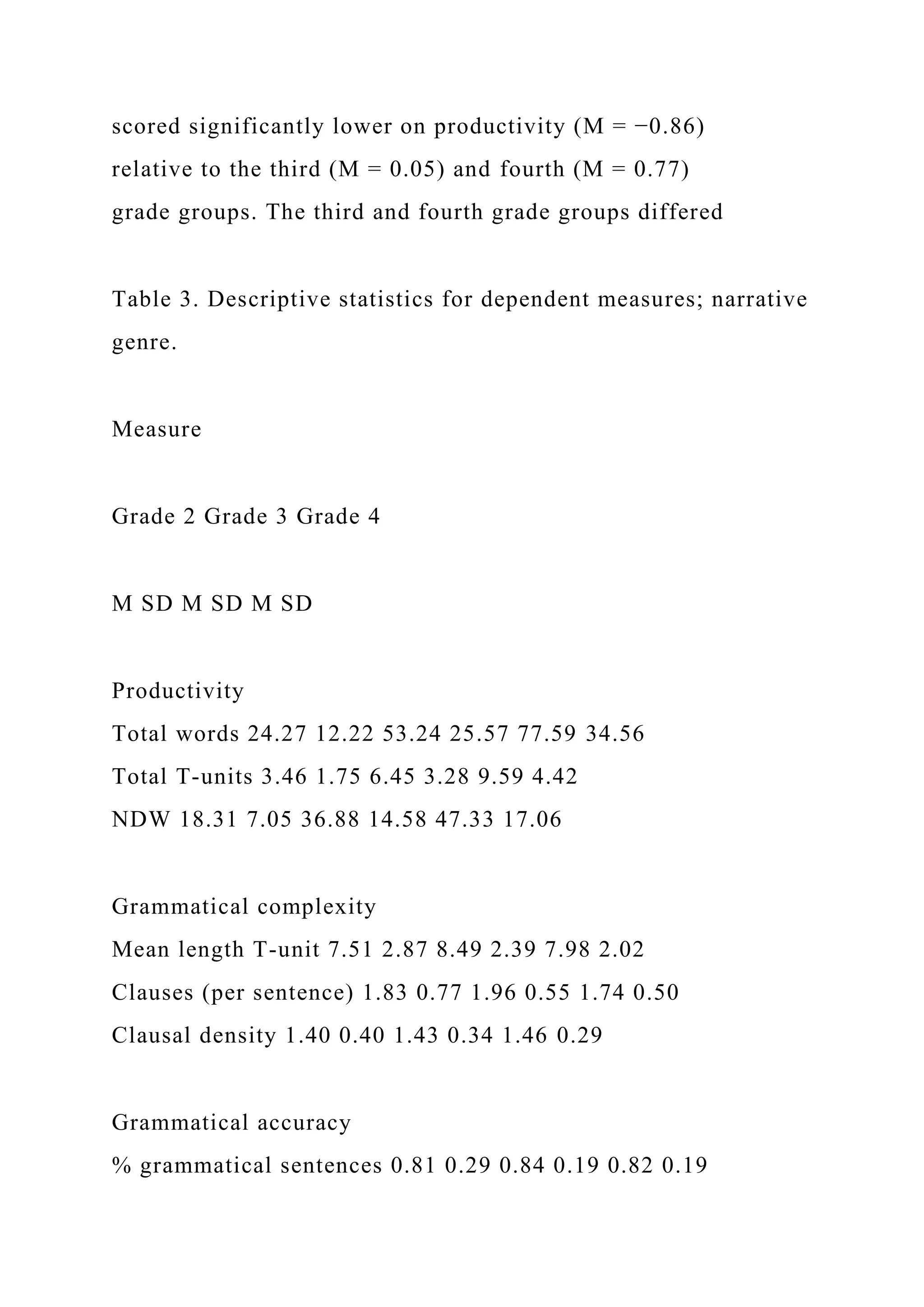
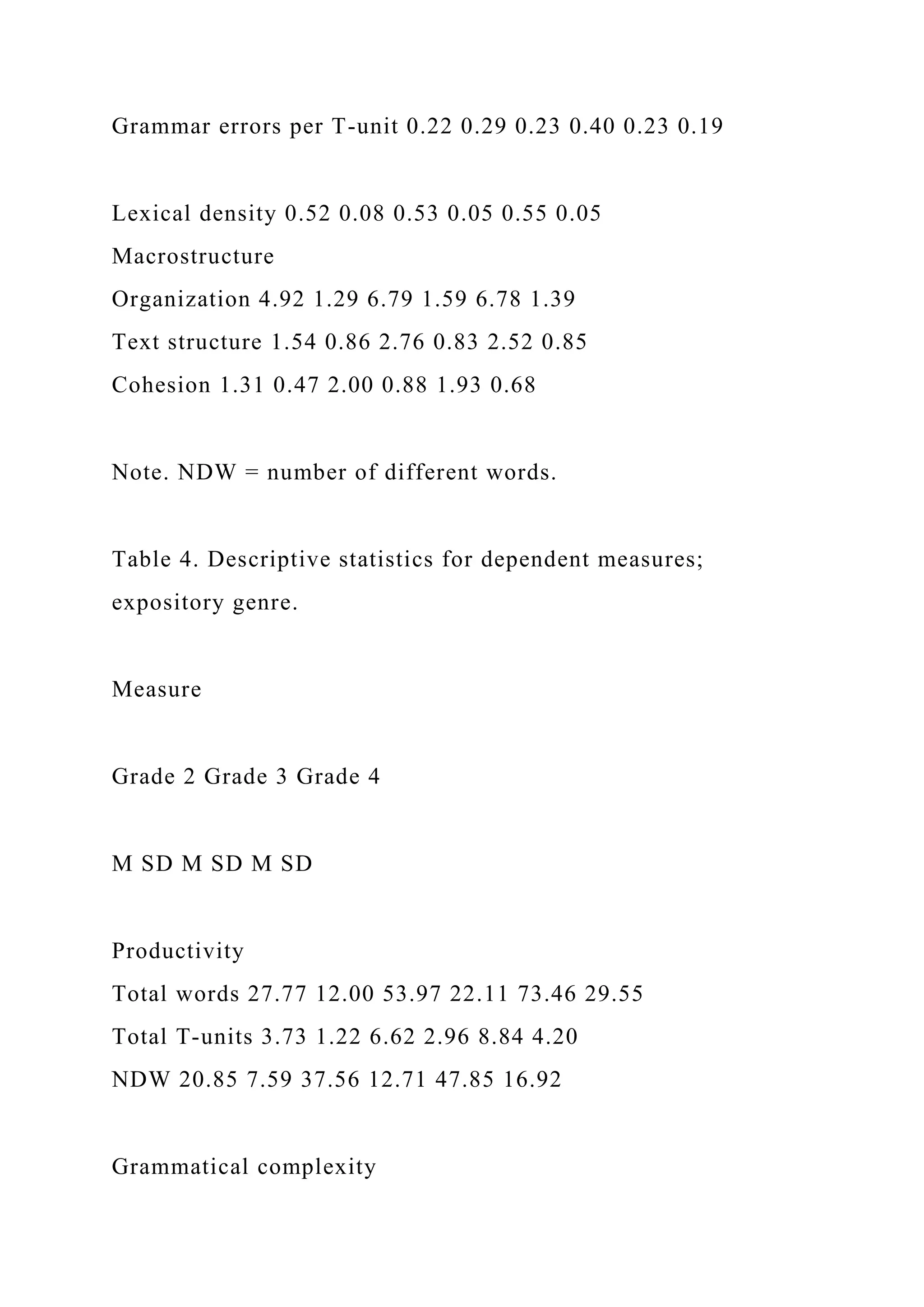
Tables 3 and 4 contain the grade-level means and stan-
dard deviation for the dependent measures for each genre.
Two separate, one-way MANCOVAs were conducted
to determine the effect of grade in both genres (narrative,
Table 1. Factor loadings for exploratory factor analysis with
oblique rotation.
Microstructure variables
Factor
1 2 3 4
Narrative, expository
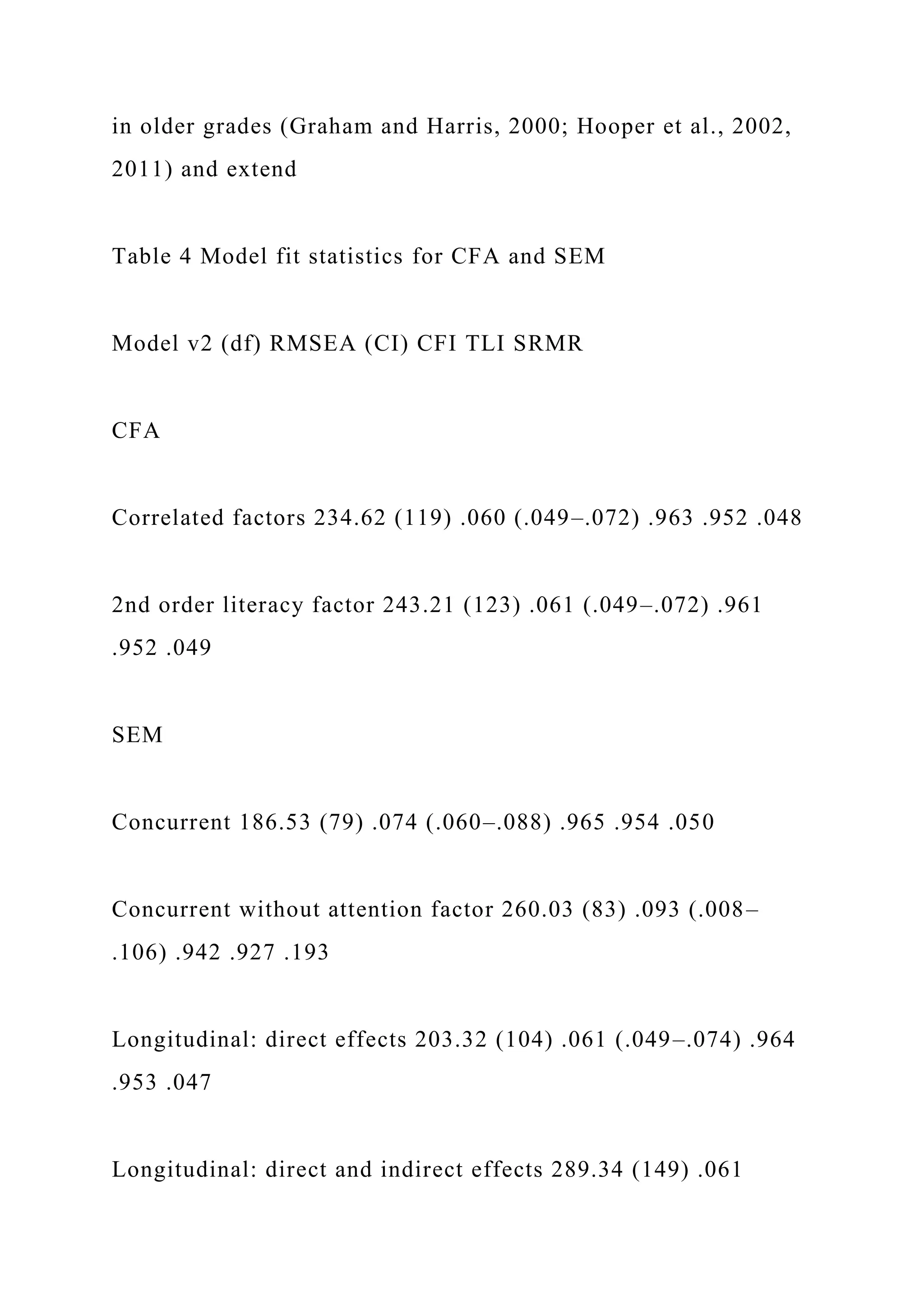
Total words .96, .98 .09, .12 −.01, .01 −.01, .05
Total T-units .97, .97 −.22, −.25 −.01, .04 −.02, −.06
Lexical density .02, −.39 .05, .24 −.13, −.03 .96, .84
Number of different words .96, .97 .12, .13 .01, −.03 .05, .02
Clausal density .02, .01 .92, .90 .02, −.01 .05, −.01
Clauses per sentence .02, .01 .72, .70 −.23, .02 −.42, −.34
Mean length of T-unit −.01, −.02 .86, .87 .21, −.04 .14, .21
Percent grammatical sentences .02, −.02 .05, −.05 −.92, .86 .11,
.19
Grammatical errors per T-unit −.01, −.02 .13, −.04 .92, −.94
−.01, .14
Note. Each variable (e.g., total words, total T-units, etc.) has
two scores: the narrative score and the expository score. Factor
loadings > .60
are in boldface. Factor 1 = productivity; Factor 2 = grammatical
complexity; Factor 3 = grammatical accuracy; Factor 4 = lexical
density.
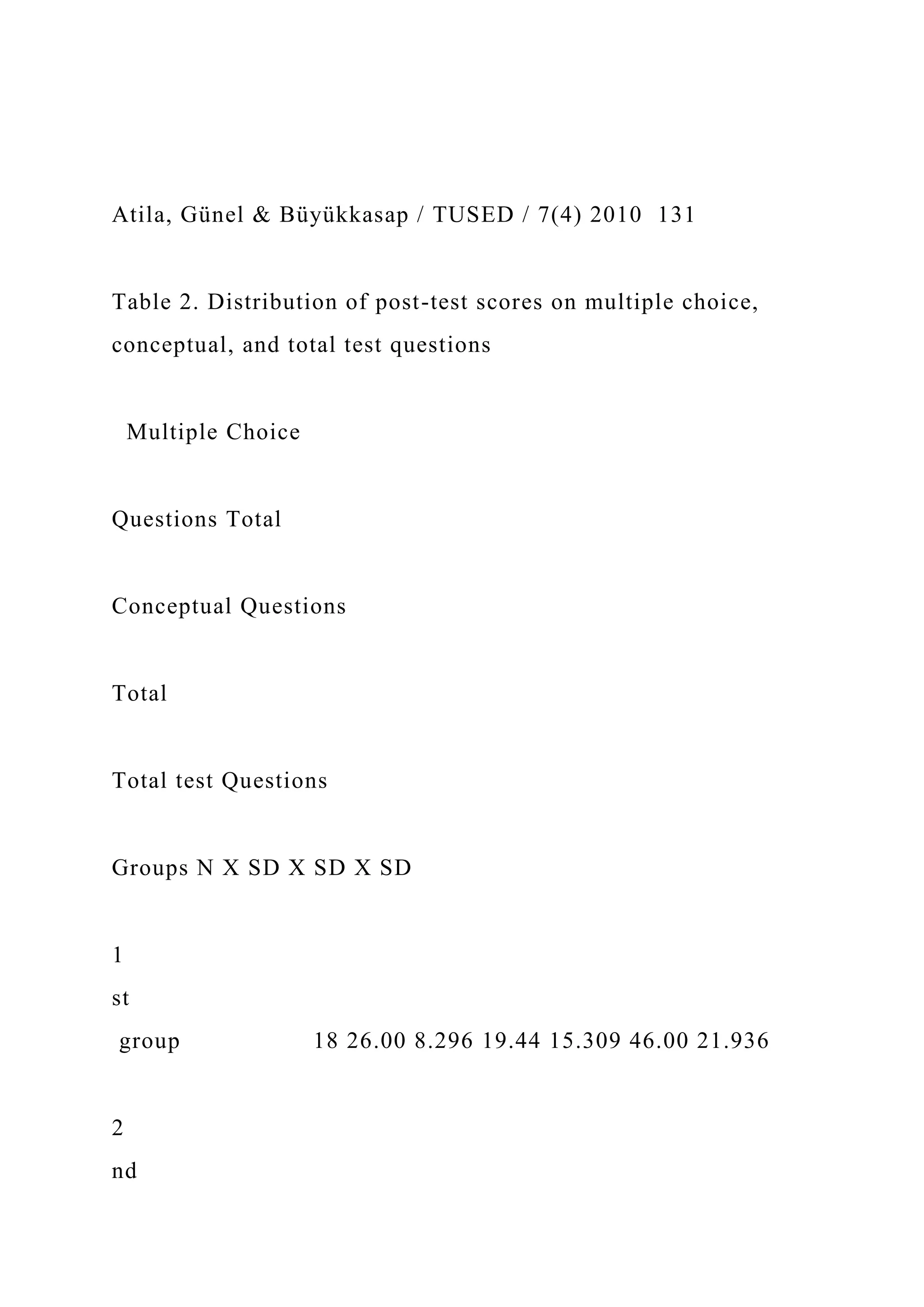
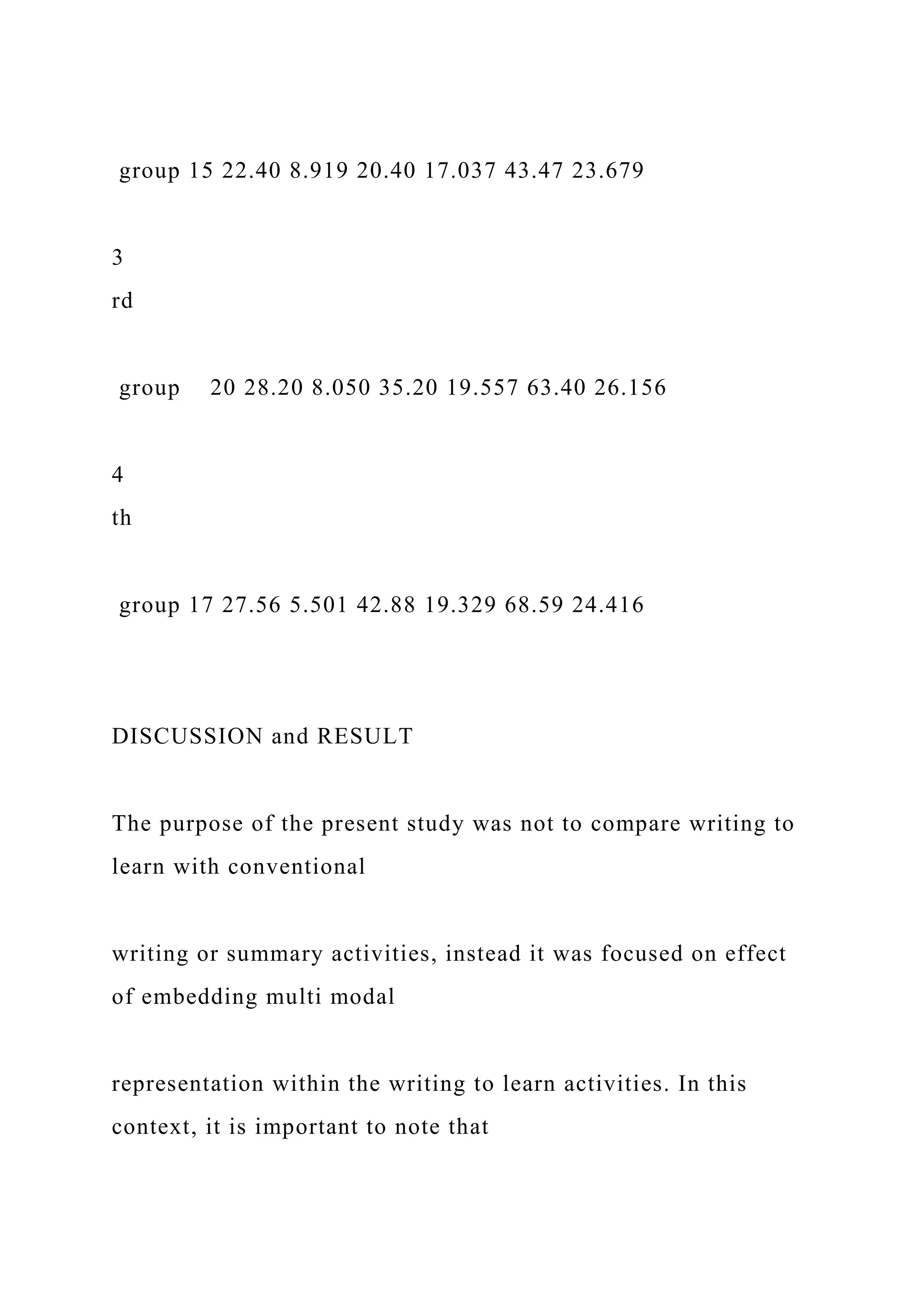
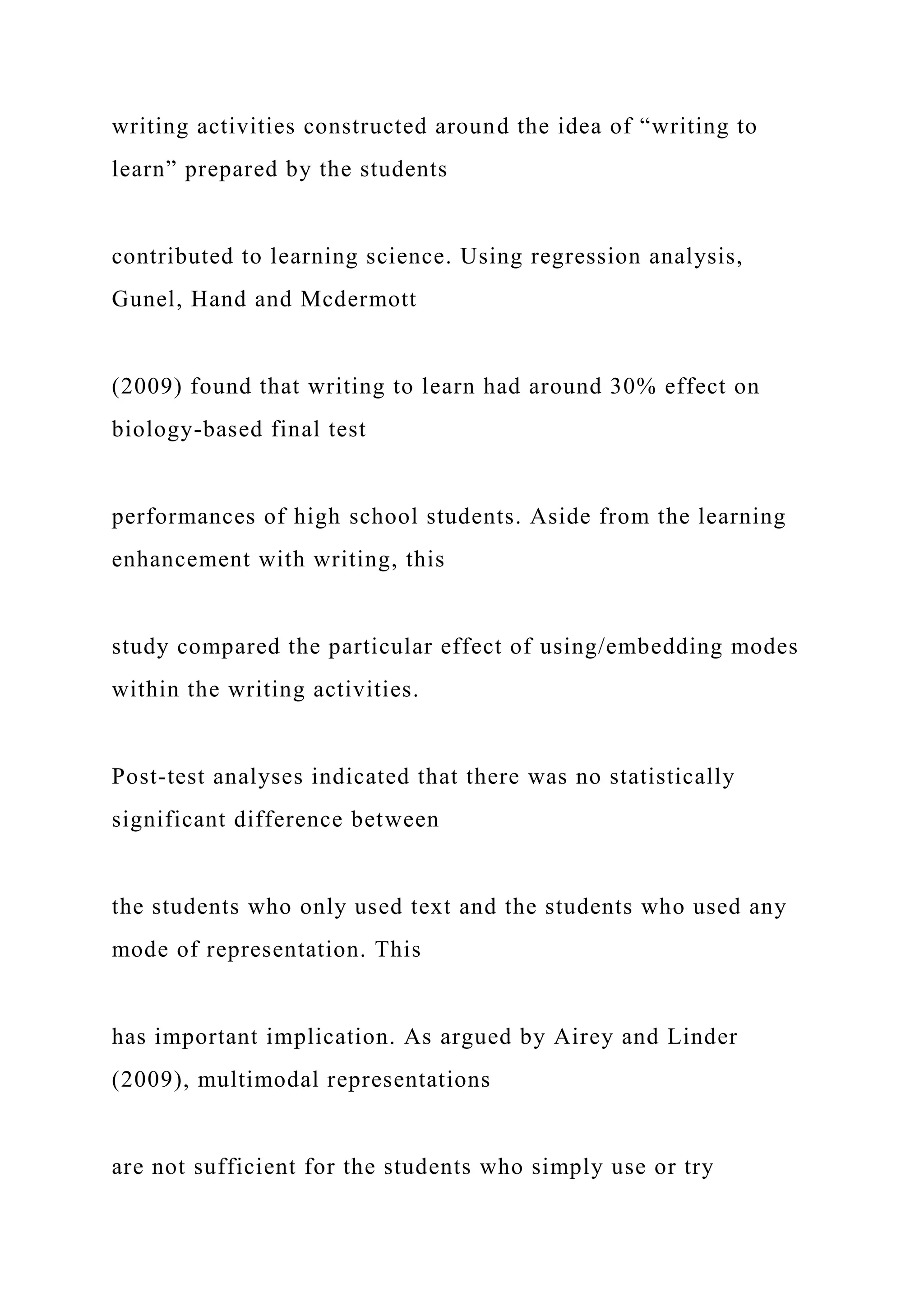
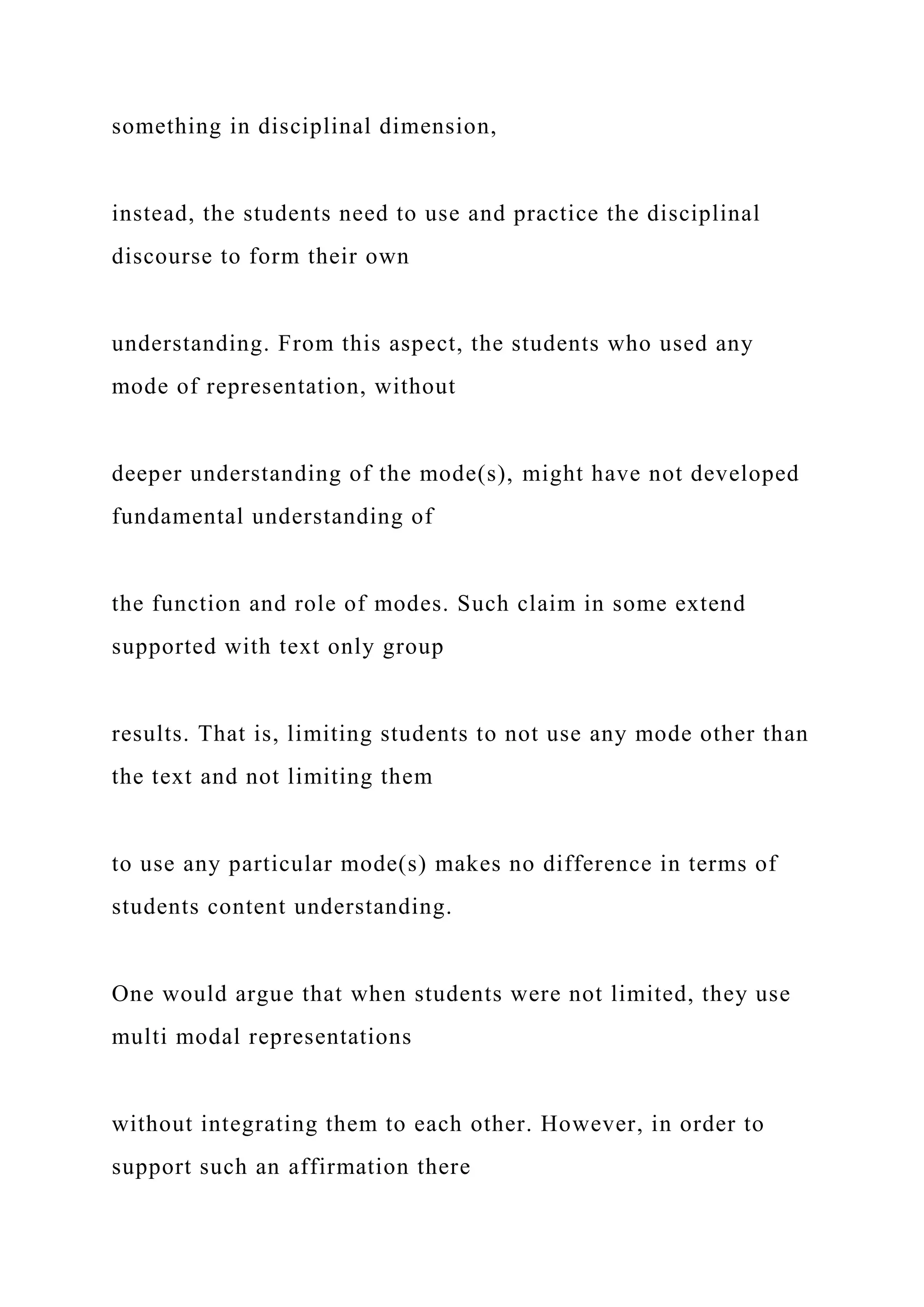
Table 2. Factors and respective dependent variables analyzed
via
multivariate analyses of covariance.
Factor Dependent measure
Productivity Total words
Total T-units
Number of different words
Grammatical
complexity
Mean length T-unit
Clauses per sentence
Clausal density (no. of clauses per T-unit)
Grammatical
accuracy
Percentage of grammatical sentences
Grammatical errors per T-unit
Lexical diversity Lexical density
Macrostructure Organization trait score
Text structure trait score
Cohesion trait score
248 Language, Speech, and Hearing Services in Schools • Vol.
46 • 242–255 • July 2015
expository) on the identified factor scores for the five factors
of productivity, grammatical complexity, grammatical ac-
curacy, lexical diversity, and macrostructure. The Box
M test (using a = .01 as the criterion for significance) satis-
fied the assumption of homogeneity of variance/covariance
matrices. Intercorrelations between measures ranged from
.01 to .52 for the narrative genre and −.08 to .40 for the
expository genre. None of the correlations among outcome
variables was sufficiently large to raise concerns about
multicollinearity. Pillai’s trace was selected as the multivar-
iate test statistic due to unequal group sizes (Field, 2005).
Pairwise comparisons were conducted to compare perfor-
mance across grades, utilizing an adjustment for multiple
comparisons and corrected for Type I error rate using a
Bonferroni correction (p < .003).
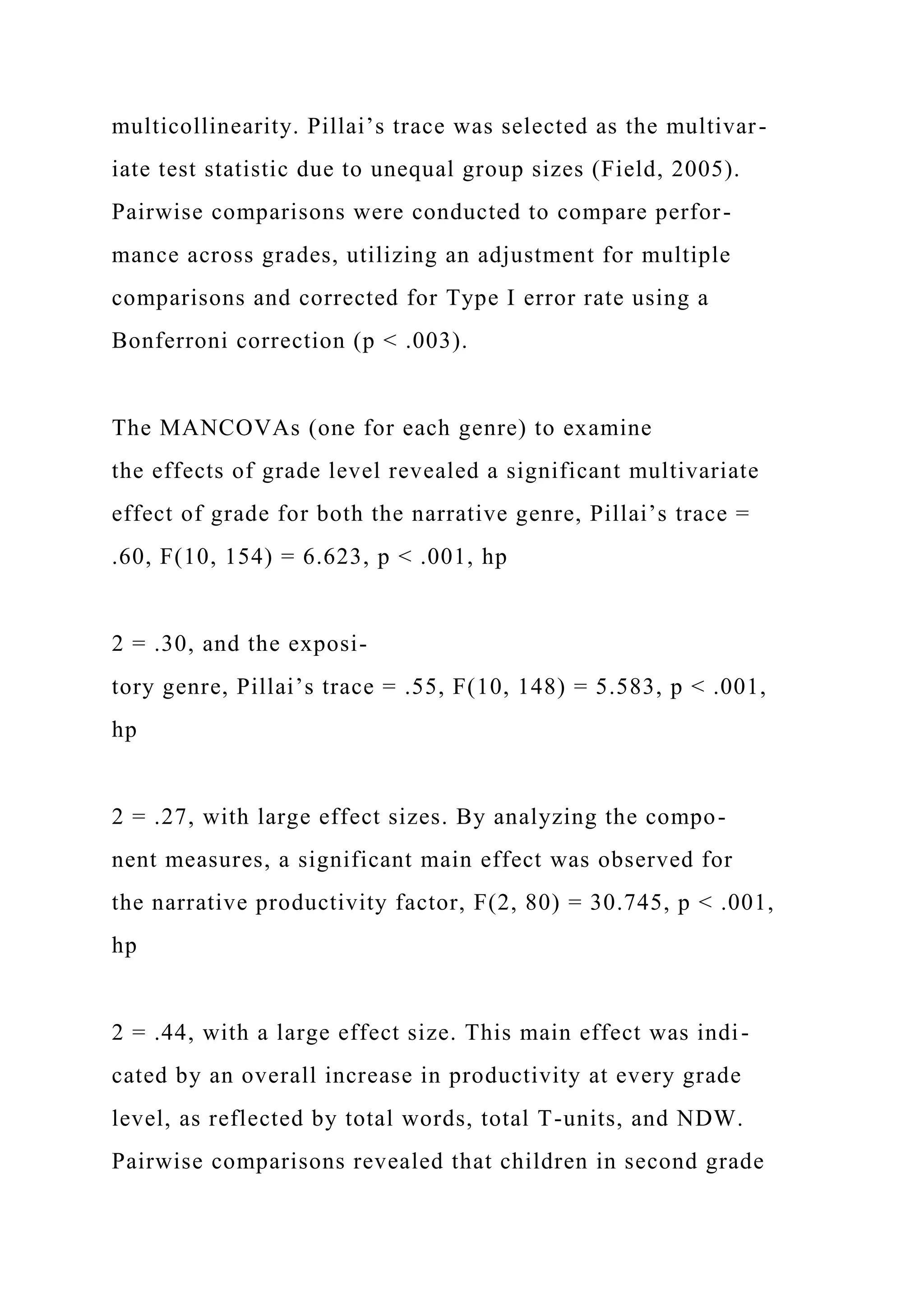
The MANCOVAs (one for each genre) to examine
the effects of grade level revealed a significant multivariate
effect of grade for both the narrative genre, Pillai’s trace =
.60, F(10, 154) = 6.623, p < .001, hp
2 = .30, and the exposi-
tory genre, Pillai’s trace = .55, F(10, 148) = 5.583, p < .001,
hp
2 = .27, with large effect sizes. By analyzing the compo-
nent measures, a significant main effect was observed for
the narrative productivity factor, F(2, 80) = 30.745, p < .001,
hp
2 = .44, with a large effect size. This main effect was indi-
cated by an overall increase in productivity at every grade
level, as reflected by total words, total T-units, and NDW.
Pairwise comparisons revealed that children in second grade
scored significantly lower on productivity (M = −0.86)
relative to the third (M = 0.05) and fourth (M = 0.77)
grade groups. The third and fourth grade groups differed
Table 3. Descriptive statistics for dependent measures; narrative
genre.
Measure
Grade 2 Grade 3 Grade 4
M SD M SD M SD
Productivity
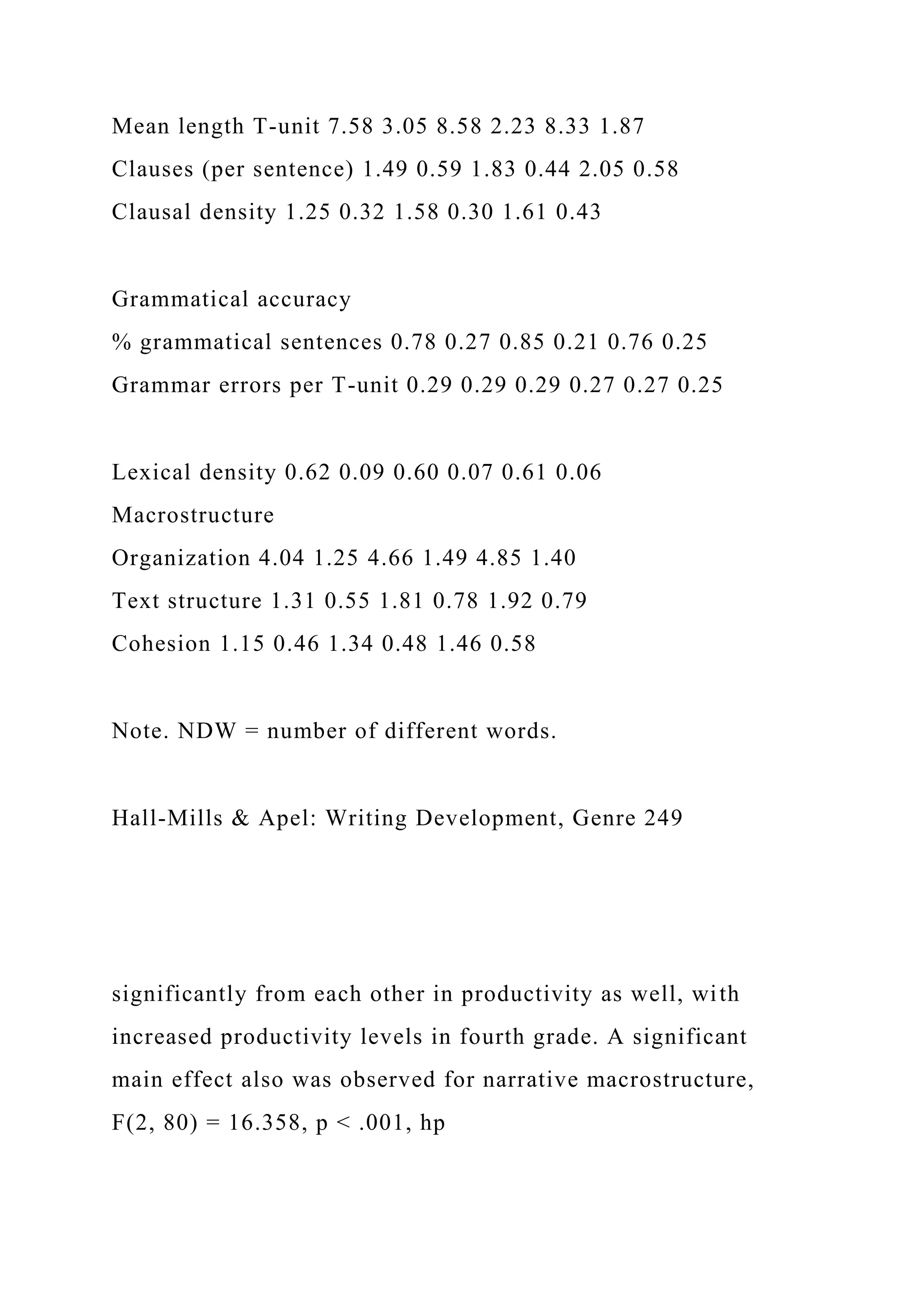
Total words 24.27 12.22 53.24 25.57 77.59 34.56
Total T-units 3.46 1.75 6.45 3.28 9.59 4.42
NDW 18.31 7.05 36.88 14.58 47.33 17.06
Grammatical complexity
Mean length T-unit 7.51 2.87 8.49 2.39 7.98 2.02
Clauses (per sentence) 1.83 0.77 1.96 0.55 1.74 0.50
Clausal density 1.40 0.40 1.43 0.34 1.46 0.29
Grammatical accuracy
% grammatical sentences 0.81 0.29 0.84 0.19 0.82 0.19
Grammar errors per T-unit 0.22 0.29 0.23 0.40 0.23 0.19
Lexical density 0.52 0.08 0.53 0.05 0.55 0.05
Macrostructure
Organization 4.92 1.29 6.79 1.59 6.78 1.39
Text structure 1.54 0.86 2.76 0.83 2.52 0.85
Cohesion 1.31 0.47 2.00 0.88 1.93 0.68
Note. NDW = number of different words.
Table 4. Descriptive statistics for dependent measures;
expository genre.
Measure
Grade 2 Grade 3 Grade 4
M SD M SD M SD
Productivity
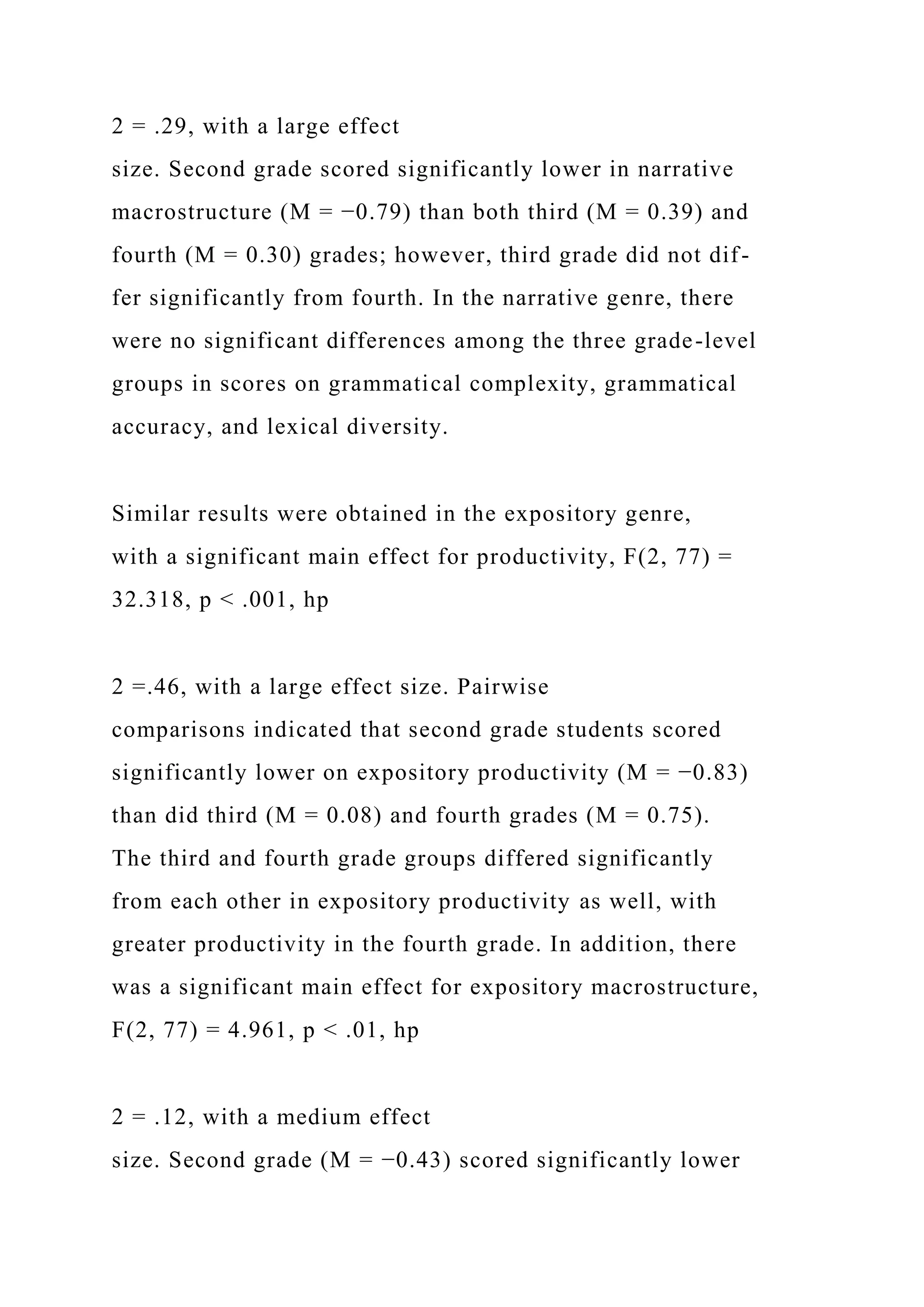
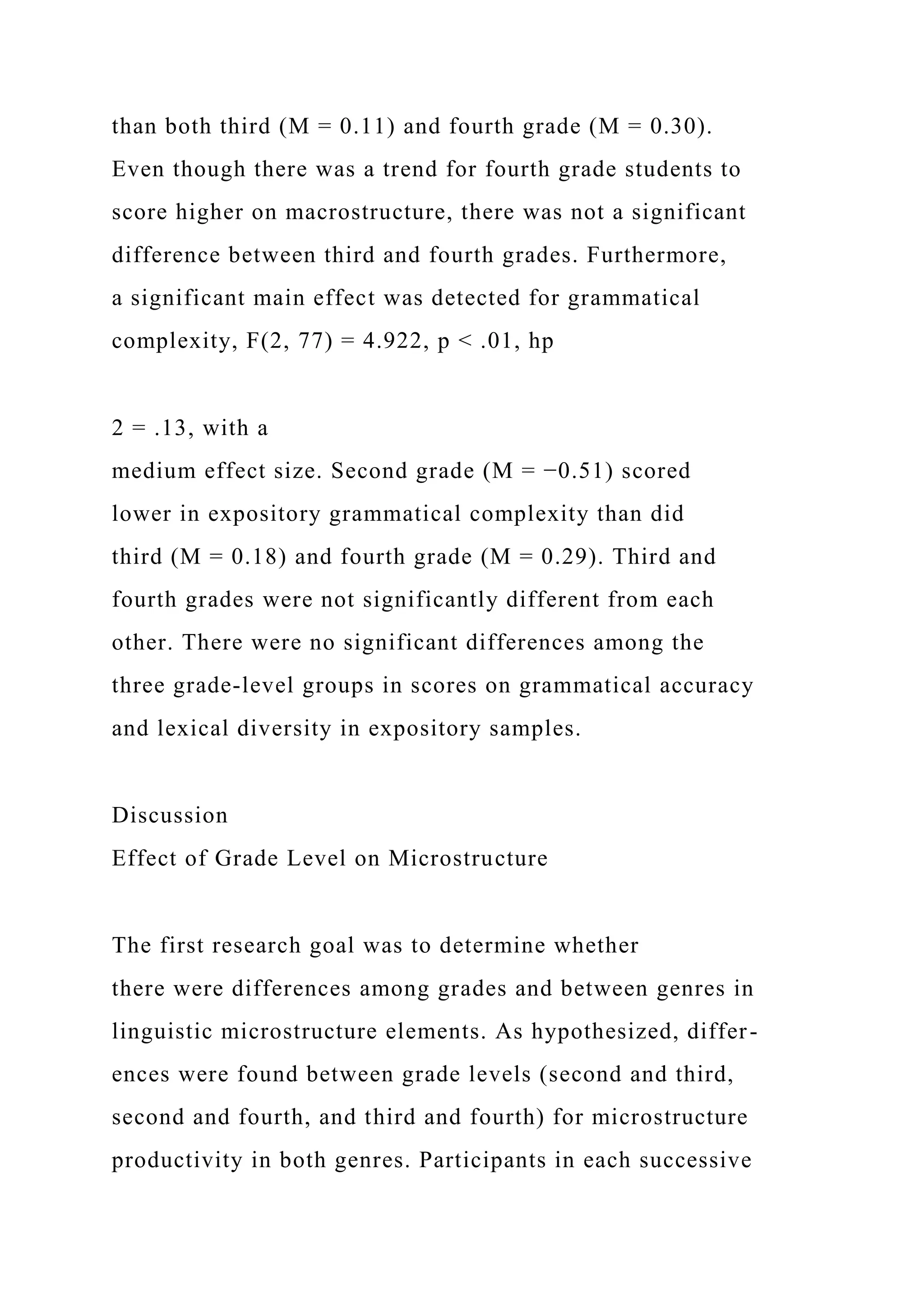
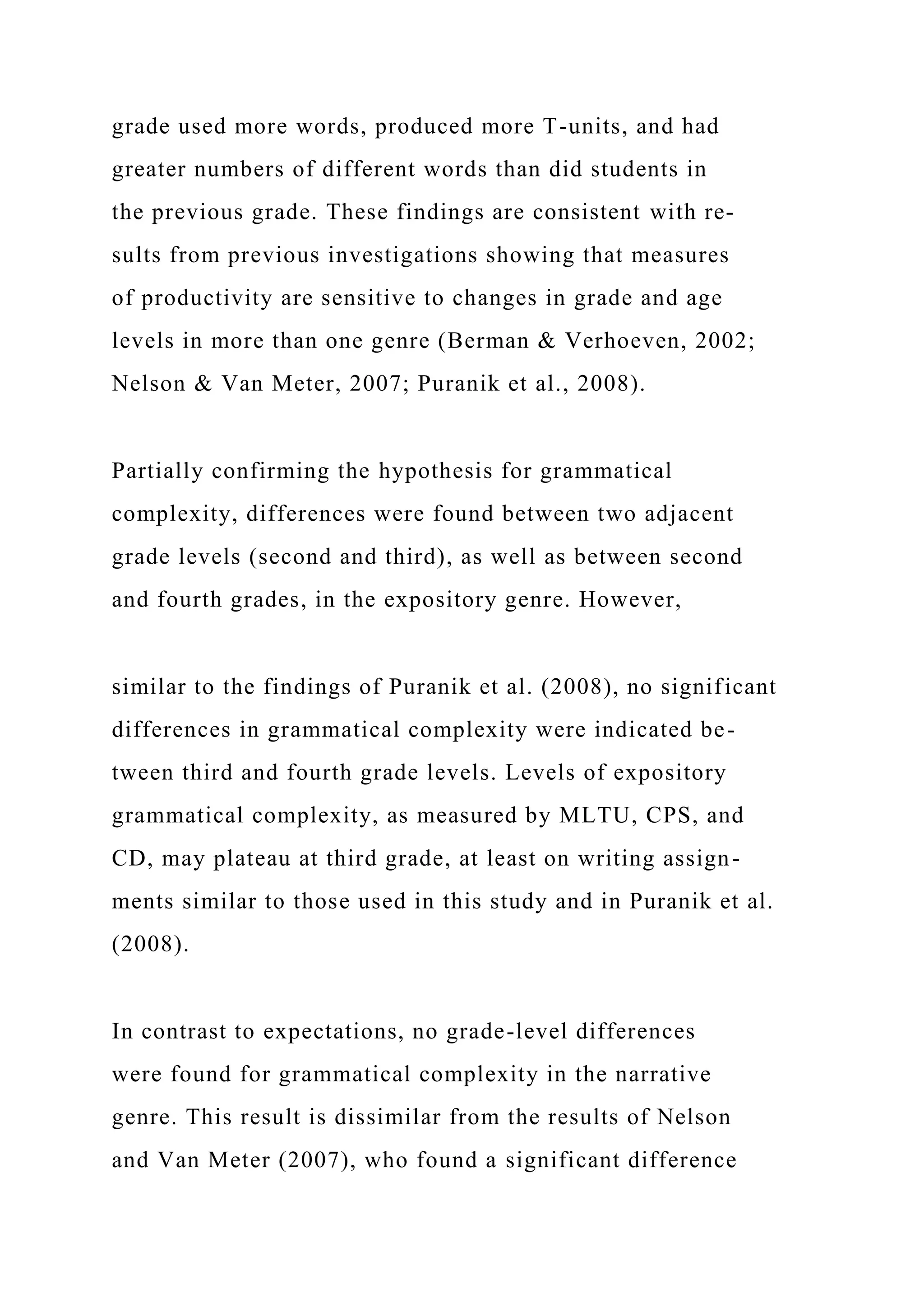
Total words 27.77 12.00 53.97 22.11 73.46 29.55
Total T-units 3.73 1.22 6.62 2.96 8.84 4.20
NDW 20.85 7.59 37.56 12.71 47.85 16.92
Grammatical complexity
Mean length T-unit 7.58 3.05 8.58 2.23 8.33 1.87
Clauses (per sentence) 1.49 0.59 1.83 0.44 2.05 0.58
Clausal density 1.25 0.32 1.58 0.30 1.61 0.43
Grammatical accuracy
% grammatical sentences 0.78 0.27 0.85 0.21 0.76 0.25
Grammar errors per T-unit 0.29 0.29 0.29 0.27 0.27 0.25
Lexical density 0.62 0.09 0.60 0.07 0.61 0.06
Macrostructure
Organization 4.04 1.25 4.66 1.49 4.85 1.40
Text structure 1.31 0.55 1.81 0.78 1.92 0.79
Cohesion 1.15 0.46 1.34 0.48 1.46 0.58
Note. NDW = number of different words.
Hall-Mills & Apel: Writing Development, Genre 249
significantly from each other in productivity as well, with
increased productivity levels in fourth grade. A significant
main effect also was observed for narrative macrostructure,
F(2, 80) = 16.358, p < .001, hp
2 = .29, with a large effect
size. Second grade scored significantly lower in narrative
macrostructure (M = −0.79) than both third (M = 0.39) and
fourth (M = 0.30) grades; however, third grade did not dif-
fer significantly from fourth. In the narrative genre, there
were no significant differences among the three grade-level
groups in scores on grammatical complexity, grammatical
accuracy, and lexical diversity.
Similar results were obtained in the expository genre,
with a significant main effect for productivity, F(2, 77) =
32.318, p < .001, hp
2 =.46, with a large effect size. Pairwise
comparisons indicated that second grade students scored
significantly lower on expository productivity (M = −0.83)
than did third (M = 0.08) and fourth grades (M = 0.75).
The third and fourth grade groups differed significantly
from each other in expository productivity as well, with
greater productivity in the fourth grade. In addition, there
was a significant main effect for expository macrostructure,
F(2, 77) = 4.961, p < .01, hp
2 = .12, with a medium effect
size. Second grade (M = −0.43) scored significantly lower
than both third (M = 0.11) and fourth grade (M = 0.30).
Even though there was a trend for fourth grade students to
score higher on macrostructure, there was not a significant
difference between third and fourth grades. Furthermore,
a significant main effect was detected for grammatical
complexity, F(2, 77) = 4.922, p < .01, hp
2 = .13, with a
medium effect size. Second grade (M = −0.51) scored
lower in expository grammatical complexity than did
third (M = 0.18) and fourth grade (M = 0.29). Third and
fourth grades were not significantly different from each
other. There were no significant differences among the
three grade-level groups in scores on grammatical accuracy
and lexical diversity in expository samples.
Discussion
Effect of Grade Level on Microstructure
The first research goal was to determine whether
there were differences among grades and between genres in
linguistic microstructure elements. As hypothesized, differ-
ences were found between grade levels (second and third,
second and fourth, and third and fourth) for microstructure
productivity in both genres. Participants in each successive
grade used more words, produced more T-units, and had
greater numbers of different words than did students in
the previous grade. These findings are consistent with re-
sults from previous investigations showing that measures
of productivity are sensitive to changes in grade and age
levels in more than one genre (Berman & Verhoeven, 2002;
Nelson & Van Meter, 2007; Puranik et al., 2008).
Partially confirming the hypothesis for grammatical
complexity, differences were found between two adjacent
grade levels (second and third), as well as between second
and fourth grades, in the expository genre. However,
similar to the findings of Puranik et al. (2008), no significant
differences in grammatical complexity were indicated be-
tween third and fourth grade levels. Levels of expository
grammatical complexity, as measured by MLTU, CPS, and
CD, may plateau at third grade, at least on writing assign-
ments similar to those used in this study and in Puranik et al.
(2008).
In contrast to expectations, no grade-level differences
were found for grammatical complexity in the narrative
genre. This result is dissimilar from the results of Nelson
and Van Meter (2007), who found a significant difference
on MLTU between second and third grades in a narrative
genre. Examination of grade-level means in Table 4 for
CD and CPS clearly indicates nearly the same scores across
the three grade levels. Therefore, it may be that CPS and
CD were not sensitive enough to detect differences between
subsequent grade levels in grammatical complexity in a
narrative genre. These values for CPS and CD may have
masked the effects of MLTU when these variables were
combined into one factor score that was subsequently used
in the MANCOVA to detect grade differences. However,
previous research with older students suggests that devel-
opment of CD in younger students consists of multiple
periods of slower, sometimes plateaued growth prior to the
eighth grade and may be a useful measure for detecting
grade effects in later years (Nippold, Ward-Lonergan, &
Fanning, 2005). It might be useful in future studies to com-
pare measures of grammatical complexity to determine
their utility for detecting significant differences among ele-
mentary grade-level groups.
No grade-level differences were found for either gram-
matical accuracy or lexical diversity. This finding is similar
to Puranik et al. (2008), although they utilized different
measures for this dimension of microstructure (percentage
of grammatically correct T-units, proportion of spelling
errors, conventions) and is in alignment with Nelson and
Van Meter’s (2007) finding for grammatical error rates
among Grades 1 through 5. In the present investigation,
grammatical accuracy was measured by the % GS and the
number of GET. Puranik et al. (2008) posited that older
children may attempt to produce more complex sentence
structures and as a result could generate more errors than
expected, making their grammatical accuracy scores more
parallel with those of younger participants. We did not find
a statistically significant pattern between grade levels in
grammatical accuracy. However, the nature of the rela-
tionship between grammatical accuracy and grade level
warrants further exploration. Therefore, future investiga-
tors may want to increase the number of items, or vari-
ables, measured for both grammatical complexity and
accuracy factors and compare the relations among them
under varying contexts and task demands.
Effect of Genre on Microstructure
In contrast to expectations, mean performance on
all four microstructure measures was rather stable within
grades and across genres. This finding initially appeared
250 Language, Speech, and Hearing Services in Schools • Vol.
46 • 242–255 • July 2015
different from previous studies that indicated greater pro-
ductivity and grammatical complexity in a narrative versus
an expository genre among elementary school children
(Berman & Verhoeven, 2002; Scott & Windsor, 2000);
however, a direct comparison to students in the present
study cannot be made to Berman and Verhoeven’s (2002)
and Scott and Windsor’s (2000) samples. The finding of
no genre effect for either lexical diversity or grammatical
accuracy is similar to previous findings for elementary
students (Berman & Verhoeven, 2002; Scott & Windsor
2000). The developmental progression of lexical diversity
and grammatical accuracy may be slower overall, regard-
less of genre, and therefore more challenging to detect
differences between subsequent elementary grades.
Effect of Grade Level on Macrostructure
As hypothesized, we found grade-level differences in
both genres for macrostructure between second and third
grades, and between second and fourth grades. Second
grade students scored lower on narrative and expository
organization, text structure, and cohesion than third and
fourth grade students. However, in contrast to expecta-
tions, third and fourth grade students did not differ signifi-
cantly from each other in either genre. In examining the
grade-level means in the narrative genre, a trend was noted
for the third grade mean to exceed fourth in text structure
and cohesion, although these differences were not statisti-
cally significant. In the expository genre, grade-level means
indicated a slight trend between third and fourth grades on
organization, text structure, and cohesion.
Upon further analysis, the grade-level trends in mac-
rostructure observed in the expository genre between sec-
ond and third, and second and fourth appear to be due to
text structure scores more so than organization or cohesion
scores. It may be that an expository writing sample could
be somewhat organized and cohesive yet not reflect the
targeted genre structure. This is understandable, especially
for second grade students, whose knowledge of expository
text structure is thought to be less established than for
older students (e.g., Berman & Verhoeven, 2002; Nelson
et al., 2004). A single second grade participant scored at a
Level 3 for expository text structure on the macrostructure
rubric, whereas the remaining second grade students scored
at Level 1 (n = 19) or Level 2 (n = 6). This was in contrast
to the number of third grade students (n = 5) and fourth grade
students (n = 5) scoring at a Level 3 or higher and also
was dissimilar from the number of students in the third and
fourth grades scoring at a Level 2 (third grade, n = 15;
fourth grade, n = 13). Thus, the grade-level trends appeared
to be impacted by floor effects for the second grade students
on measures of macrostructure. In the future, researchers
may want to develop more sensitive measures to examine
young children’s knowledge of genre-specific text structures
across grade levels, particularly their knowledge of text
structure requirements for the genres most commonly
assessed in the classroom, to help further define this devel-
opmental progression.
Effect of Genre on Macrostructure
In contrast to expectations, our results did not reveal
any cross-genre differences for performance on the macro-
structure measure. The mean macrostructure values were
very similar across genres for each grade level. The potential
genre effects on macrostructure were difficult to anticipate
given the range of findings in previous investigations. How-
ever, we had anticipated that performance on macrostruc-
ture measures would be similar in both genres for the oldest
students (fourth grade) on the basis of the assumption that
experience and knowledge of various text structures and text
cohesion increase with age.
The lack of significant differences in macrostructure
scores between the narrative and expository genres may be
due to the type of writing prompts utilized to elicit the
samples. It is possible that the prompts selected may not
have fully represented one genre versus another. With this
issue in mind, we conducted a post hoc analysis to deter-
mine the degree of match between intended text structure
on the basis of the prompts and the text structure produced
in the children’s writing samples. We recruited three
blind raters (i.e., blind to each other as well as the writing
prompts, previous transcription, coding, and scoring of
writing samples for this investigation) and asked them to
review a randomly selected subset of writing samples (25%
of the entire sample; equal proportions by genre and
grade) to identify which genre structure the sample most
closely resembled, given a set of standard definitions and fea-
tures for each genre. Raters were instructed to identify a
writing sample with the following features as having a nar-
rative text structure (e.g., telling a story, often about per-
sonal events or other life experiences; it may be fictional or
nonfictional and can include novels, personal stories, and
short stories), an expository text structure (e.g., conveying
facts, describing procedures, explaining something, sharing
basic information, relating cause–effect, compare/contrast,
problem–solution structures, and may include reports, term
papers, procedural documents, manuals, essays, and edito-
rials), or an ambiguous text structure (e.g., combination
of narrative and expository features, or cases where the text
structure cannot be readily identified given standard aca-
demic definitions of genre). The post hoc analysis with the
genre identification task revealed that 72% of the samples
were coded reliably, with consensus for genre type by three
naive raters (k = .67). Thus, it appears the majority of writ-
ing samples reflected their intended genre structure. When
coders did not reach consensus on some of the samples
reviewed (18%), they noted instances of “ambiguous struc-
tures.” On closer examination, the text structure ambiguity
in writing samples was observed equally across narrative
and expository topics and thus was not wholly attributable
to either the narrative or the expository prompt on the
analytic scale. Some children may have produced text in a
structure other than the elicited genre, and there are a vari-
ety of possible explanations for this occurrence. It may
be the case that these children utilized inconsistent or limited
genre structures in their writing as they were learning to
Hall-Mills & Apel: Writing Development, Genre 251
write. This issue is addressed further below among impor-
tant clinical and educational implications. It remains to be
determined within a larger sample of school-age students
whether writing that contains features of more than one
genre reflects maturity versus instability of academic dis-
course forms. The lack of significant differences in macro-
structure also may be due to the use of “hybrid” genres that
incorporate a variety of text structure features from one or
more genres. In situations such as this, the scoring rubric de-
signed for this investigation would need to be altered to bet-
ter capture occurrences of “mixed” or hybrid genres.
Further exploration is warranted to establish how adequately
writing prompts elicit the intended genre.
Limitations and Future Research
One potential limitation to our study was the method
used to elicit writing samples. In this investigation, a single
elicitation technique was incorporated (i.e., response to
writing prompt). Although this method reflects standard
educational practice, it is important to consider that grade
and genre effects may vary as a result of differences in
prompting procedures and targeted genre structure. More
work is needed in this area to compare the value of vari-
ous elicitation techniques to capture the possible relations
between elicitation method and writing outcomes. Fur-
thermore, the degree of the relations among elements of
microstructure and macrostructure may be shaped by the
actual genre structure produced. In our investigation, the
post hoc analysis revealed that a small portion of the writing
samples could not be characterized specifically as having a
narrative or expository text structure due to either mixed
text structure elements of both genres or an ambiguous
genre structure. Although the occurrence of mixed elements
can be expected to some degree in early writing develop-
ment, it is possible that the expository prompt may have
misled some students to compose a fictional narrative in-
stead. The central characteristics of the expository prompt
that would cue students to engage in expository discourse
were the key words tell and explain. The word pretend (e.g.,
pretend you are a superhero) may have steered students in
a different direction if they did not process the exposition cue
words. Given all of the data collectively, including the post
hoc analysis, we did not have enough evidence to state that it
was the nature of the prompts alone that attributed to the
occurrence of mixed genre features or ambiguous structures for
a small portion of the sample. Yet, the expository prompt we
selected warrants caution for use in future writing activities.
Prompt selection has important implications for re-
search and clinical or instructional practices. Investigators
planning future studies may elect to first establish the reli-
ability of selected prompts to elicit the intended genre and
plan in advance an analysis to verify the reliability of se-
lected prompts within their sample. Likewise, educators
and clinicians need to select prompts for writing assessment
carefully. As they plan and conduct writing assessments, they
should know the reliability of selected or created prompts
to elicit the genre of interest. Otherwise, the likelihood of
eliciting the appropriate genre and therefore the opportu-
nity to comprehensively evaluate the child’s writing perfor-
mance across microstructure and macrostructure features
may be compromised.
One controversy that remains in writing assessment
is the utility of holistic versus analytic measures of writing
performance. The fact that the macrostructure measure
was unidimensional (according to the EFA results) would
seem to be contradictory to some authors’ recommendations
against the use of holistic score ratings of writing performance
to inform instruction and monitor growth (Nelson & Van
Meter, 2007). However, as noted in the present investiga-
tion, a holistic rating scale for macrostructure was a useful
method to compare a particular student’s or grade level’s
performance in comparison to peers or comparison groups.
In contrast, EFA results indicated that the microstructure
measure consisted of four distinct factors. As such, micro-
structure, in contrast to macrostructure, would be best ex-
amined with an analytic scoring method, utilizing more
than one factor or score. Either way, the purpose for the
writing assessment, as well as the reliability of a particular
scale to fulfill that purpose (see Koutsoftas & Gray, 2012),
should be the focus at the outset. In some states, the state-
wide progress monitoring measure of writing in the elemen-
tary grades is administered multiple times per school year
and yields only a holistic score. Four factors often consid-
ered in the students’ text are focus, organization, support,
and conventions. Educators are first cautioned against
using this single score as the sole determinant of a student’s
writing proficiency and are encouraged to interpret this
score in light of the student’s performance in other writing
tasks and contexts.
A second limitation of our investigation is the lack of
an independent measure of participants’ dialect of speech.
The influence of cultural–linguistic factors on writing per-
formance (e.g., ethnicity and dialect) is important to con-
sider. We did not assess dialect directly in the present study.
We know from the participant demographics that there
were similar numbers of children across ethnic categories
within each grade in our sample. However, one must ac-
knowledge that ethnicity and dialect are not equivalent, and
each factor warrants separate consideration. Regardless of
reported ethnicity of participants, it is possible that dialectal
influences may have existed for individual children and
could have affected the outcome measures of grammatical
accuracy. The dialect-shifting–reading achievement hypoth-
esis suggests that students who successfully shift from non-
mainstream to standard dialectal forms in different literacy
tasks (including writing) demonstrate better reading out-

comes than students who do not make the shift as adequately
(Craig, Zhang, Hensel, & Quinn, 2009). Investigations
employing larger samples of participants with ethnically
diverse backgrounds, and incorporating distinct a priori
measures of dialect (e.g., dialect density measures), may
have better chances of detecting possible differences. If dif-
ferences are indeed detected in this manner, investigators
can recode the SALT files to capture features of a specific
dialect that has been observed in the sample. It would be
252 Language, Speech, and Hearing Services in Schools • Vol.
46 • 242–255 • July 2015
worthwhile to compare results for written grammatical
and lexical microstructure variables, as well as text struc-
ture influences, of dialectal speakers to capture the weight
of influence that dialectal differences may exert on depen-
dent writing measures for both microstructure and macro-
structure (Terry, 2006; Thompson, Craig, & Washington,
2004). Clinicians should utilize dialect coding procedures
as well.
Educational and Clinical Implications
Results of the present investigation extend findings
from previous studies and add to the existing literature re-
garding development of and relations among written mi-
crostructure and macrostructure features within and across
grade levels and genre types. Educators and clinicians are
encouraged to consider the lack of differences between grade
levels for some of the dependent measures in light of estab-
lished grade-level expectations that are reflected in state
standards for writing. For example, the Common Core
Standards for writing (Common Core State Standards Ini-
tiative, 2010) require second grade students to write in a va-

riety of genres, including expository and narrative forms.
Third and fourth grade students are expected to write rou-
tinely in multiple genres with increasing detail, genre-specific
organization, and cohesion. In reviewing the present data,
it is clear that not all of the writing samples that we collected
reflected mastery of the previous grade level’s standards for
writing. This raises the question: If the established grade-
level expectations are considered reasonable and the Common
Core State Standards are evidence based, then how well are
current assessment and instructional practices designed to
support student achievement of these standards?
The nature of the writing standards is a substantial
factor in how writing assignments and assessments are struc-
tured within the school context. In particular, the selection
of writing prompts and the method by which the examiner
chooses to evaluate the written product are influenced by
curricular standards for writing across grade levels. Prompts
to elicit writing from students often are crafted on the basis
of specific curricular standards for the grade level or grade-
level group of interest. For example, students in Grade 2 are
expected to “Write narratives in which they recount a well-
elaborated event or short sequence of events, include details
to describe actions, thoughts, and feelings, use temporal
words to signal event order, and provide a sense of closure”
(Common Core State Standards Initiative, 2010, CCSS.
ELA-Literacy.W.2.3). Therefore, a narrative writing prompt
for a second grade writing assessment would need to be
designed or selected to ensure that it would cue the students
to write a basic story. General assessment prompts provide
the topic and the basic purpose of the writing activity but
rarely include any additional instructions nor details or lists
of components to be included. For instructional or inter-
vention purposes, however, these additional details can be
included to provide a greater level of support to students
learning to write. For example, clinicians and educators
have found it useful to provide graphic organizers, story
grammar or exposition checklists, and related resources to
young writers to further support their efforts in incorporating
a variety of narrative and expository elements in their work.
The method by which the examiner evaluates the
written product is also influenced by curricular standards
for writing. In the example given above from a second grade
writing standard, there would need to be analysis of micro-
structure features (e.g., lexical properties such as words to
signal temporal relations among events) as well as macro-
structure features (e.g., story grammar elements: a plot
occurring in a sequence; details about characters’ actions,
thoughts, and feelings; and a resolution to provide a sense
of closure) to comprehensively measure a student’s mas-
tery of the standard. Not all writing assessment methods
are designed to measure both levels of children’s written
work. The risk is that there can be misalignment of stan-
dards, assessment techniques, and instructional or interven-
tion approaches implemented with the school-age population.
Clinicians and educators should be encouraged to make
these important alignment considerations in their practice
of supporting the development of writing proficiency among
their school-age students. Moreover, future research needs
to determine the extent to which writing instruction, assess-
ment, and progress monitoring adhere to grade-level stan-
dards for writing performance. In the meantime, state writing
standards that are being developed or revised need to be
research based, and educators, clinicians, researchers, and
policymakers need to work collaboratively to design assess-
ment and instruction that are reflective of research-based
standards for writing.
Acknowledgments
This research was partially funded by a grant from the
U.S. Department of Education, Office of Special Education and
Rehabilitative Services (H8435D030046), awarded to the first
author, and a Florida State University Dissertation Research
Grant, also awarded to the first author.
References
American Speech-Language-Hearing Association. (2002).
Knowl-
edge and skills needed by speech-language pathologists with
respect to reading and writing in children and adolescents
[Knowledge and skills]. Available from www.asha.org/policy
American Speech-Language-Hearing Association. (2010). Roles
and responsibilities of speech-language pathologists in schools
[Professional issues statement]. Available from www.asha.org/
policy
Beers, S. F., & Nagy, W. E. (2011). Writing development in
four
genres from grades three to seven: Syntactic complexity and
genre differentiation. Reading and Writing, 24, 183–202.
doi:10.1007s/11145-010-9264-9
Berman, R. A., & Verhoeven, L. (2002). Cross-linguistic
perspec-
tives on the development of text-production abilities: Speech
and writing. Written Language and Literacy, 5(1), 1–43.
doi:10.1075/wll.5.1.02ber
Common Core State Standards Initiative. (2010). Common Core
State Standards for English Language Arts. Retrieved from
www.corestandards.org
Hall-Mills & Apel: Writing Development, Genre 253
Cox, B. E., Shanahan, T., & Sulzby, E. (1990). Good and poor
elementary readers’ use of cohesion in writing. Reading
Research
Quarterly, 25(1), 47–65. doi:10.2307/747987
Craig, H. K., Zhang, L., Hensel, S. L., & Quinn, E. J. (2009).
African American English–speaking students: An examination
of the relationship between dialect shifting and reading out-
comes. Journal of Speech, Language, and Hearing Research, 52,
839–855. doi:10.1044/1092-4388(2009/08-0056)
Crawford, L., Helwig, R., & Tindal, G. (2004). Writing perfor-
mance assessments: How important is extended time? Journal
of Learning Disabilities, 37(2), 132–142. doi:10.1177/
00222194040370020401
Donovan, C. A., & Smolkin, L. B. (2006). Children’s
understand-
ing of genre and writing development. In C. A. MacArthur,
S. Graham, & J. Fitzgerald (Eds.), Handbook of writing re-
search (pp. 131–143). New York, NY: Guilford.
Duke, N. K. (2000). 3.6 minutes per day: The scarcity of
informational
texts in first grade. Reading Research Quarterly, 35(2), 202–
224.
Dunn, L. M., & Dunn, D. M. (2007). Peabody Picture
Vocabulary
Test–Fourth Edition. Minneapolis, MN: NCS Pearson
Assessments.
Englert, C. S., Raphael, T. E., Anderson, L. M., Gregg, S. L., &
Anthony, H. M. (1989). Exposition: Reading, writing, and
the metacognitive knowledge of learning disabled students.
Learning Disabilities Research, 5(1), 5–24. Retrieved from
http://eric.ed.gov/?id=EJ410341
Field, A. (2005). Discovering statistics using SPSS (2nd ed.).
London, United Kingdom: Sage.
Florida Department of Education. (1990). State Board of Educa-
tion Rules 6A-6.0900 to 6A-6.0909, F.A.C., Programs for
Limited English Proficient Students. Retrieved from http://
www.flrules.org
Florida Department of Education. (2010). Florida
Comprehensive
Assessment Test (FCAT): Writing. Tallahassee, FL: Author.
Gillam, R. B., & Johnston, J. R. (1992). Spoken and written lan-
guage relationships in language/learning-impaired and nor-
mally achieving school-age children. Journal of Speech and
Hearing Research, 35, 1303–1315. doi:10.1044/jshr.3506.1303
Graham, S., & Harris, K. R. (2003). Students with learning dis-
abilities and the process of writing: A meta-analysis of SRSD
studies. In H. L. Swanson, K. Harris, & S. Graham (Eds.),
Handbook of learning disabilities (pp. 323–344). New York,
NY: Guilford.
Graham, S., & Perin, D. (2007). Writing next: Effective
strategies
to improve writing of adolescents in middle and high schools–A
report to the Carnegie Corporation of New York. Washington,
DC: Alliance for Excellent Education.
Hall-Mills, S. (2010). Linguistic feature development in
elementary
writing: Analysis of microstructure and macrostructure features
in a narrative and an expository genre (Unpublished doctoral
dissertation). Florida State University, Tallahassee.
Koutsoftas, A. D., & Gray, S. (2012). Comparison of narrative
and expository writing in students with and without language-
learning disabilities. Language, Speech, and Hearing Services in
Schools, 43, 395–409. doi:10.1044/0161-1461(2012/11-0018)
Laughton, J., & Morris, N. (1989). Story grammar knowledge of
learn-
ing disabled students. Learning Disabilities Research, 4, 87–95.
Retrieved from http://psycnet.apa.org/psycinfo/1990-10014-001
Mackie, C., & Dockrell, J. E. (2004). The nature of written lan-
guage deficits in children with SLI. Journal of Speech, Lan-
guage, and Hearing Research, 47, 1469–1483. doi:1092-4388/
04/4706-1469
Miller, J., & Chapman, R. (2005). Systematic Analysis of
Language
Transcripts (Version 8). Madison, WI: University of Wisconsin–
Madison.
Moats, L., Foorman, B., & Taylor, P. (2006). How quality of
writ-
ing instruction impacts high-risk fourth graders’ writing. Read-
ing and Writing, 19, 363–391. doi:10.1007/s11145-005-4944-6
Montague, M., Maddux, C., & Dereshiwsky, M. (1990). Story
grammar and comprehension and production of narrative prose
by students with learning disabilities. Journal of Learning Dis-
abilities, 23, 190–196. doi:10.1177/002221949002300310
Morris, N., & Crump, W. (1982). Syntactic and vocabulary
devel-
opment in the written language of learning disabled and non-
disabled students at four age levels. Learning Disability
Quarterly,
5, 163–172. doi:10.2307/1510577
Nelson, N. W., Bahr, C. M., & Van Meter, A. M. (2004). The
writing lab approach to language instruction and intervention.
Baltimore, MD: Brookes.
Nelson, N. W., & Van Meter, A. M. (2007). Measuring written
lan-
guage ability in narrative samples. Reading and Writing
Quarterly,
23(3), 287–309. doi:10.1080/10573560701277807
Nippold, M. A., & Sun, L. (October, 2010). Expository writing
in children and adolescents: A classroom assessment tool.
SIG 1 Perspectives on Language Learning and Education, 17,
100–107. doi:10.1044/lle17.3.100
Nippold, M., Ward-Lonergan, J., & Fanning, J. (2005).
Persuasive
writing in children, adolescents, and adults: A study of syntac-
tic, semantic, and pragmatic development. Language, Speech,
and Hearing Services in Schools, 36, 125–138. doi:10.1044/
0161-1461(2005/012)
Nodine, B., Barenbaum, E., & Newcomer, P. (1985). Story
compo-
sition by learning disabled, reading disabled, and normal chil-
dren. Learning Disability Quarterly, 8, 167–179. Retrieved
from http://www.jstor.org/stable/1510891
Olinghouse, N. G., & Graham, S. (2009). The relationship
between
the discourse knowledge and the writing performance of
elementary-grade students. Journal of Educational Psychology,
101, 37–50. doi:10.1037/a0013462
Puranik, C., Lombardino, L. J., & Altmann, L. J. (2007).
Writing
through retellings: An exploratory study of language-impaired
and dyslexic populations. Reading and Writing, 20, 251–272.
doi:10.1007/s11145-006-9030-1
Puranik, C., Lombardino, L. J., & Altmann, L. J. (2008). Asses-
sing the microstructure of written language using a retelling
paradigm. American Journal of Speech Language Pathology,
17, 107–120. doi:10.1044/1058-0360(2008/012)
Sanders, T. J. M., & Schilperood, J. (2006). Text structure as a
window on the cognition of writing: How text analysis pro-
vides insights in writing products and writing processes. In
C. A. MacArthur, S. Graham, & J. Fitzgerald (Eds.), Handbook
of writing research (pp. 386–402). New York, NY: Guilford.
Scott, C. M. (2009). Language-based assessment of written ex-
pression. In G. A. Troia (Ed.), Instruction and assessment for
struggling writers: Evidence-based practices (pp. 358–385).
New York, NY: Guilford. doi:1092-4388/00/4302-0324
Scott, C., & Windsor, J. (2000). General language performance
mea-
sures in spoken and written narrative and expository discourse
of school-age children with language learning disabilities. Jour-
nal of Speech, Language, and Hearing Research, 43, 324–339.
Shanahan, T. (2006). Relations among oral language, reading,
and writing development. In C. A. MacArthur, S. Graham, &
J. Fitzgerald (Eds.), Handbook of writing research (pp. 171–
186).
New York, NY: Guilford.
Singer, B. D. (2007). Assessment of reading comprehension and
written expression in adolescents and adults. In A. G. Kamhi,
J. J. Masterson, & K. Apel (Eds.), Clinical decision making
in developmental language disorders (pp. 77–98). Baltimore,
MD:
Brookes.
254 Language, Speech, and Hearing Services in Schools • Vol.
46 • 242–255 • July 2015
Stevens, J. (1997). Applied multivariate statistics for the social
sci-
ences (3rd ed.). Mahwah, NJ: Erlbaum.
Sun, L., & Nippold, M. A. (2012). Narrative writing in children
and adolescents: Examining the literate lexicon. Language,
Speech, and Hearing Services in Schools, 43, 2–13.
doi:10.1044/
0161-1461(2011/10-0099)
Terry, N. P. (2006). Relations between dialect variation,
grammar,
and early spelling skills. Reading and Writing, 19, 907–931.
doi:10.1007/s11145-006-9023-0
Thompson, C. A., Craig, H. K., & Washington, J. A. (2004).
Variable production of African American English across
oracy and literacy contexts. Language, Speech, and Hearing
Services in Schools, 35, 269–282. doi:10.1044/0161-1461
(2004/025)
Warner, R. M. (2008). Applied statistics: From bivariate
through
multivariate techniques. Los Angeles, CA: Sage.
Williams, G. J., Larkin, R. F., & Blaggan, S. (2013). Written
language skills in children with specific language impairment.
International Journal of Language and Communication
Disorders,
48(20), 160–171. doi:10.1111/1460-6984.12010
Williams, K. T. (2001). Group Reading Assessment and
Diagnostic
Exam (GRADE). Circle Pines, MN: AGS.
Williams, K. T. (2001). Group Reading Assessment and
Diagnostic
Exam—Technical Manual. Circle Pines, MN: AGS.
Appendix
Narrative and Expository Writing Samples
Second Grade Narrative
Once my sister Lily scared me by hiding on the walls when I
was in the restroom[3CL][CC].
When I came out she went “ROAR”![2CL][CC].
It was scary.
and I screamed[2CL][CC].
Then I started to laugh so hard I fell on the ground[2CL][CC].
Third Grade Narrative
One day a man went to McDonald’s to get something to eat
through the drive through[3CL][CC].
When he got his lunch the bag started to shake[2CL][CC].
The hamburger popped out.
and the french fries popped out.
and they grow[GE] and grow[GE] until they became
humongous[4CL][CI].
They took over the world[1CL][SC].
But in a matter of time they shrunk.
and the man had his lunch[2CL][CC].
Fourth Grade Narrative
When I got surprised it was when my cousin told me she broke
her wrist[4CL][CC].
it really happened yesterday[1CL][SC].
she was playing soccer and running backwards and tripped on
grass.
and her hand caught her and broke[5CL][CC].
she is[GE] getting a light green cast[1CL][SI].
Judith wished she broke her other hand.
so she didn’t have to write[3CL][CC].
But she broke her left hand[1CL][SC].
Second Grade Expository
I am a superhero.
and I have super powers[2CL][CC].
My power is to turn into lava[1CL][SC].
I can also turn invisible[1CL][SC].
I can use my powers to help save the world[2CL][CC].
When I see a villain, I turn invisible.
and then I burn them up like they are on a grill[4CL][CC].
That is how I save the world[1CL][SC].
Third Grade Expository
Hi my name is Gardenia[1CL][SC].
I have the powers to make things grow right after I plant the
seeds[3CL][CC]!
I would like to help the Earth by turning landfills into beautiful
gardens[2CL][CC].
That’s all I have to say for today, bye[2CL][CC].
Fourth Grade Expository
I am a superhero named Superman[1CL][SC].
My special powers are that I am very strong.
and I can beat up everyone.
and I can fly[4CL][CC].
I will help the world by beating up evil villains and arresting
people[3CL][CC].
I will help elderly people cross the road and give money to
banks, homeless shelters, nursing homes, and
orphans[2CL][CC].
That is who I am and how I will help the world[2CL][CC].
Note. CC = complex correct sentence; CL = clause for number
of clauses; SC = simple correct sentence; SI = simple incorrect
sentence.
Hall-Mills & Apel: Writing Development, Genre 255
Copyright of Language, Speech & Hearing Services in Schools
is the property of American
Speech-Language-Hearing Association and its content may not
be copied or emailed to
multiple sites or posted to a listserv without the copyright
holder's express written permission.
However, users may print, download, or email articles for
individual use.
Using the articles you submitted through the bibliographic
database assignment and the Correct English software, write a 1
page synthesis of the information found in these articles.
Create a title page that follows APA requirements. Create a
running head for both the title page and the document as per
APA insturctions. Include a reference page following APA
guidlines.
So you should have three pages minimum
Title page
Main Docoument
References
I want you to used the Smarthinking Online Tutor to have your
paper checked before you submit it for grading.
Writing fluency and quality in kindergarten and first
grade: the role of attention, reading, transcription,
and oral language
Shawn Kent • Jeanne Wanzek • Yaacov Petscher •
Stephanie Al Otaiba • Young-Suk Kim
Published online: 1 September 2013
� Springer Science+Business Media Dordrecht 2013
Abstract In the present study, we examined the influence of
kindergarten compo-
nent skills on writing outcomes, both concurrently and
longitudinally to first grade.
Using data from 265 students, we investigated a model of
writing development
including attention regulation along with students’ reading,
spelling, handwriting
fluency, and oral language component skills. Results from
structural equation mod-
eling demonstrated that a model including attention was better
fitting than a model
with only language and literacy factors. Attention, a higher-
order literacy factor
related to reading and spelling proficiency, and automaticity in
letter-writing were
uniquely and positively related to compositional fluency in
kindergarten. Attention
and higher-order literacy factor were predictive of both
composition quality and flu-
ency in first grade, while oral language showed unique relations
with first grade writing
quality. Implications for writing development and instruction
are discussed.
Keywords Component skills � Beginning writing �
Kindergarten � First
grade � Writing development
S. Kent (&) � J. Wanzek � Y.-S. Kim
Florida Center for Reading Research and School of Teacher
Education, Florida State University,
2010 Levy Avenue, Suite 100, Tallahassee, FL 32310, USA
e-mail: [email protected]
Y. Petscher
Florida Center for Reading Research, Florida State University,
2010 Levy Avenue, Suite 100,
Tallahassee, FL 32310, USA
S. Al Otaiba
Simmons School of Education and Human Development,
Southern Methodist University, University
Park, TX, USA
123
Read Writ (2014) 27:1163–1188
DOI 10.1007/s11145-013-9480-1
Introduction
The act of writing is a vehicle for the expression of knowledge
and the transmission
of information across time and generations. Most would agree
that the ability to
write is critical for success throughout the school years and into
adulthood, where
poor writing skills can have a detrimental impact in the work
place (National
Commission on Writing, 2004). Students in the United States
have demonstrated
relatively poor writing ability over time (National Assessment
of Educational
Progress; Salahu-Din, Persky, & Miller, 2008). The most recent
National
Assessment of Education Performance writing test results
reported only 33 % of
eighth and 24 % of twelfth grade students exhibited proficient
writing skills, a result
essentially unchanged from 2002. While these data relate to
adolescents, Juel (1988)
found that students exhibiting difficulty in the area of writing as
early as the first
grade were highly likely to remain poor writers in the fourth
grade, suggesting that
problems in writing may begin in the early grades.
In recent years there has been a notable increase in expectations
for writing skills
of students, beginning in kindergarten and first grade. Among
the most recent
writing standards for kindergarten and first grade are
expectations for students to
write about experiences, stories, people, and events by
composing informational/
explanatory texts with a topic and relevant facts and writing
narratives that recount
events sequentially (Common Core State Standards Initiative,
2010). Thus, research
identifying the potential intractability of early writing
difficulties, coupled with
heightened expectations for writing, serves to emphasize the
need for examining
processes and components that influence writing development in
the early
elementary grades in order to provide possible targets of
instruction, intervention
and remediation. The present study sought to explore
component skills of writing in
the earliest years of schooling, kindergarten and first grade, by
specifically
investigating the relations of early literacy and language
abilities, as well as
attention, to the development of students’ compositional fluency
and quality.
Component skills in early writing development
Some researchers have posited that the ability to write consists
of attaining lower-
level, more rudimentary skills such as spelling and handwriting
(i.e., transcription
skills) while also being able to utilize higher-level proficiencies
such as creating,
organizing, and elaborating ideas (The Simple View of Writing;
Juel, Griffith, &
Gough, 1986). More recently, Berninger and colleagues’ Not-
So-Simple View of
Writing (Berninger & Winn, 2006) suggests three primary
components: (a) tran-
scription; (b) executive functions regulating focused attention,
inhibitory control,
and mental shifting during planning, reviewing, and revising of
text as well as
strategies for self-regulation; and (c) text generation, or
transformation of ideas to
language representations in writing. In addition, reading
component skills may also
impact early writing as the two have been called ‘‘two sides of
the same coin’’ (Ehri,
2000, p. 19). Thus, one may postulate that early developmental
differences in
transcription, language, or reading skills, or attention and self-
regulation, could
impact the development of writing.
1164 S. Kent et al.
123
Transcription skills
There is converging evidence that spelling and handwriting are
strong predictors of
writing fluency and to some degree, compositional quality as
students learn to write
in the primary grades (Graham, Berninger, Abbott, Abbott, &
Whitaker, 1997; Jones
& Christensen, 1999; Juel, 1988; Juel et al., 1986). Graham et
al. (1997) found that
together, spelling and handwriting accounted for 25 and 66 % of
the variance in
compositional quality and fluency, respectively, in Grades 1–3.
Individually, after
controlling for language ability, first grader’s spelling
accounted for 29 % of the
variance in story writing in comparison to only 10 % for
students in fourth grade
(Juel, 1988). Meanwhile, handwriting fluency has been shown
to account for just
over one-half of the variance in student’s quality of writing in
first grade, even after
accounting for reading (Jones & Christensen, 1999). In their
recent meta-analysis,
Graham, McKeown, Kiuhara, & Harris (2012) found that, on
average, elementary
students specifically taught transcription skills perform about
one-half of a standard
deviation (ES = .55) higher than comparison students on
measures of writing
quality. Most recently, Puranik and Al Otaiba (2012) found that
in kindergarten,
handwriting fluency and spelling added significant unique
variance in predicting
writing fluency after accounting for language, reading, and IQ.
Oral language
Investigating the contribution of oral language, primarily verbal
reasoning and fluency,
Abbott and Berninger (1993) found a statistically significant
association with writing
quality in first grade and compositional fluency in second and
third grade. The
structural relationships among the language systems of
expressive language and
writing have been found to generally change across
development in Grades 1–3 with
evidence suggesting strengthening relations over time
(Berninger et al., 2006).
However, 25 % of the variance in writing achievement was
accounted for by
expressive language ability. Specific to kindergarten, Hooper et
al. (2011) found that
expressive and receptive language proficiency longitudinally
predicted narrative
writing skill in later elementary grades (third to fifth grades).
Further, word and syntax-
level language skills in kindergarten have demonstrated unique
concurrent relations to
compositional fluency after accounting for other literacy skills
(Kim et al., 2011).
Reading
Given the multidimensional nature of both reading and writing
processes,
researchers have posited their important and reciprocal
relationship may be due
to shared knowledge (e.g., metaknowledge, knowledge of text
attributes) and
cognitive processes such as phonological and orthographic
systems and short and
long-term memory (Fitzgerald & Shanahan, 2000; Shanahan,
2006). It has been
demonstrated that word and sentence-level reading ability
contribute directly to
spelling, handwriting, and compositional quality in Grades 1–6
and to composi-
tional fluency in Grades 1–3, with the strongest relationship for
fluency evident in
first grade (Abbott & Berninger, 1993; Berninger, Abbott,
Abbott, Graham, &
Predictors of kindergarten and first grade writing 1165
123
Richards, 2002). Further, Abbott, Berninger, and Fayol (2010)
found a longitudinal
relationship between reading, specifically comprehension, and a
measure of fluency
and quality of writing across Grades 2–5.
Two recent studies have investigated several of these potential
component skills of
writing specifically for students in kindergarten (Kim et al.,
2011; Puranik & Al
Otaiba, 2012). Kim et al. (2011) findings supported a model of
oral language, spelling,
and letter-writing fluency, although reading had a non-
significant relation to writing
fluency after accounting for other skills. However, overall, only
33 % of the variance
in writing production was accounted for with these variables.
Similarly, Puranik and
Al Otaiba (2012) accounted for 39 % of the variance in writing
fluency with
handwriting, spelling, reading, oral language, as well as
cognitive and demographic
factors. Both findings suggest the need to examine other
component skills.
Regulation of attention
As theorized in the Not-so-Simple-View of writing, executive
functions, including
supervisory attention, goal setting and planning, reviewing and
revising, and
strategies for self-monitoring and regulation, are critical to
proficiency in text
generation and are posited to increase in importance throughout
development as the
complexity of writing increases in schooling (Berninger &
Winn, 2006). More
specifically, Berninger and Winn view the supervisory attention
system as
responsible for selective attention during writing tasks; namely,
focusing attention
on relevant aspects of the task while inhibiting attention to non-
relevant aspects,
allowing shifting between mental sets, remaining on task, and
metacognitive
awareness. Specific executive functions that contribute to
selective attention have
been identified including inhibitory control, set-shifting, and
updating of memory
(Lehto, Juuarvi, Kooistra, & Pulkkinen, 2003; Willcutt et al.,
2001). Similarly,
cognitive research from Happaney, Zelazo, and Stuss (2004)
identified cognitive
and attentional flexibility, and inhibitory control, along with
working memory, as
important to individual self-regulation. Hooper, Swartz,
Wakely, de Kruif, and
Montgomery (2002) have argued that problems with attentional
control may
particularly interfere with executive processes that coordinate
strategic writing-
planning, monitoring, and revising of writing. Barkley (1996)
has hypothesized that
inattention is a symptom of difficulty with self-regulation of
internal cognitive
processes. Given that the foundation for self-regulatory
behavior occurs early in life,
most often in the first 5 years (Blair, 2002), one would expect
to see the influence of
a self-regulatory skill such as attentional control, in the earliest
grades.
Several studies have demonstrated the impact of attention on
early academic
outcomes, such as reading and math achievement, in preschool
and early elementary
grades (Duncan et al., 2007; McClelland, Acock, Piccinin,
Rhea, & Stallings, 2013;
Rhoades, Warren, Domitrovich, & Greenberg, 2011). One might
argue that the ability
to regulate attention would also impact early writing, as it
allows students engaged in a
writing task to specifically attend to relevant tasks and keep
previous content written
in mind for use in subsequent composing, all while disregarding
extraneous
information. With regards to writing, Hooper et al. (2002) found
that less competent
writers in fourth and fifth grade, in comparison to more able
writers, demonstrated less
1166 S. Kent et al.
123
proficiency with initiating and sustaining attention, inhibitory
control, and set
shifting. Subsequently, Hooper et al. (2011) identified a model
of writing in first and
second grade, including attention, memory, and executive
functions, language, and
fine motor ability, that accounted for nearly 50 % of the
variance in outcomes on a
standardized measure of writing achievement.
Attention/executive function was the
only unique predictor of first grade writing while both language
and attention/
executive function uniquely predicted second grade writing.
Teacher ratings of
student attentiveness have also been shown to predict
substantive quality of writing
and writing convention as early as first grade (Kim, Al Otaiba,
Folsom, & Greulich,
2013). Meanwhile, Thomson et al. (2005) have suggested that
attention plays an
indirect role in writing via influence on orthographic coding and
rapid naming skills.
Intervention research has demonstrated that training student’s
attentional processes
(e.g., sustained, selective, and alternating attention), coupled
with writing instruction,
significantly improves compositional skills of students in fourth
through sixth
(Chenault, Thomson, Abbott, & Berninger, 2006). Further,
many self-regulatory
strategies utilized during writing, which focus student’s
attention on the task, have
been postulated including goal setting and planning, organizing,
self-monitoring, self-
verbalizing, and revising (Graham & Harris, 2000). The
potential importance of such
strategies during writing provided impetus for the development
of the self-regulated
strategy development approach, which subsequently has been
proven effective across
both grade and writing performance levels (e.g., Graham,
Harris, & McKeown, 2013;
Graham, McKeown, Kiuhara, & Harris, 2012; Graham & Perin,
2007).
Study purpose and research questions
Although research interest in the area of writing has grown, the
extant literature is
still sparse at early developmental levels; only a few have
specifically examined
students as young as kindergarten (Kim et al., 2011; Puranik &
Al Otaiba, 2012).
While several component skills involved in writing development
have been
investigated and their potential importance demonstrated, most
studies have
examined only one or two of these component skills rather than
the contribution
of multiple component skills on writing. Although recent
multivariate research of
component skills at the early grades is encouraging (Hooper et
al., 2011; Kim et al.,
2011, 2013; Puranik & Al Otaiba, 2012), no study has yet
examined the unique and
shared role of attention, transcription, reading, and language
ability in a model of
writing development at the kindergarten level nor has the
contribution of these skills
been examined longitudinally in kindergarten and first grade.
Given the importance of language and literacy and attention
skills to early
learning, the purpose of the present study was to build upon and
extend the extant
literature on early writing development by examining four
primary research
questions (RQ). First,
1. What are the shared and unique relations of component skills
of writing fluency in
kindergarten by including attention, reading, transcription, and
oral language skills?
2. Does a model of kindergarten writing development with an
attention factor fit
better than one without?
Predictors of kindergarten and first grade writing 1167
123
3. What are the longitudinal relations of kindergarten
component skills to writing
quality and fluency in first grade?
4. Do kindergarten component skills exhibit a direct effect on
writing quality and/
or fluency in first grade or are these relationships mediated by
kindergarten
writing fluency?
Method
Sample characteristics
The present study examined extant data from a larger, 5-year
project examining a
response to intervention framework for reading, including
examination of general
education classroom instruction for all students, within a school
setting (Al Otaiba
et al., 2011). Participants in the present analysis included one
cohort of students who
participated in the project in both kindergarten and first grade
(n = 265).
In kindergarten, students represented 10 schools and 31
classrooms with a range of
1–15 students per participating classroom. The mean age in fall
of kindergarten was
5.13 years of age. Sixty-one percent of the students qualified
for free or reduced lunch
programs, indicating a large proportion of the sample may be
classified as low socio-
economic status. The sample included 53.6 % male students.
Students represented a
diversity of races/ethnicities, with 54 % African American, 31
% Caucasian, 8 %
Hispanic, 4 % multi-racial, and 1 % of Asian or Native
American. Data on special
education status were available for 253/265 (95 %) students
with approximately 11 %
eligible for services; most (over 70 %) were identified with
either a speech or
language impairment. As demographic data was collected from
schools, we were
unable to obtain specific information relative to medical
diagnoses such as Attention-
Deficit Hyperactivity Disorder (ADHD). However, in this
representative sample of
students, only two (1 %) students were eligible for special
education as Other Health
Impairment, a category often comprised of students with
ADHD.
Measures
Transcription skills
Student’s spelling and letter writing automaticity/fluency
(accuracy and fluency in
writing individual letters) were both assessed. On the spelling
subtest from the WJ-III
students write the corresponding graphemic representation of
orally presented letters or
words. Responses are scored dichotomously (correct or
incorrect) on this measure.
Median split-half reliability is .90. On a separate, untimed
spelling measure students
were presented 10 decodable or high-frequency words (e.g.,
dog, man, one, come) and 4
nonwords (e.g., sut, frot) used in previous literacy research
(Byrne & Fielding-Barnsley,
1993). Using a standard protocol from Byrne et al. (2005),
examiners explained to the
students that some presented words were real and some were
nonwords. All real words
were presented orally, used in a sentence, and then repeated,
while nonwords were
1168 S. Kent et al.
123
repeated three times. Student performance on each word was
assigned a development
score ranging from 0 to 6 based on modification of a rubric
from Tangel and Blachman
(1992). A developmental score, in contrast to a dichotomous
score was chosen given the
age of the sample in order to capture differences in how
students orthographically
represented phonological word features. This scoring method
has been utilized in recent
studies with kindergarten students and in previous research
(Jones & Christensen, 1999;
Kim et al., 2011; Puranik & Al Otaiba, 2012). The following
guidelines were utilized: no
response or a random string of letters was assigned a 0,
providing at least one letter that
was related to the target spelling word phonetically was scored
as a 1 (e.g., writing an ‘‘o’’
or ‘‘g’’ for dog), writing the correct initial letter followed by
random letters was scored as
a 2, including more than one correct phoneme resulted in a
score of 3, a score of 4 was
given for words spelled with all letters represented and
phonetically correct (e.g.,
‘‘dawg’’ for dog), a 5 was assigned when all requirements of a
score of 4 were met and
student made an attempt to mark a long vowel (e.g., ‘‘bloo’’ for
blue), and a word
received a score of 6 when spelled correctly.
Student’s ability to access, retrieve, and automatically write
letter forms was also
measured. The task was modified from Berninger and Rutberg’s
(1992) task of
handwriting automaticity. Students were given 1 min to write,
quickly and
accurately, all lower case letters of the alphabet in order (Jones
& Christensen,
1999; Wagner et al., 2011). Consistent with prior research, the
letter writing fluency
(LWF) task was scored primarily on penmanship and correct
letter formation with a
score of 1.0 given for a letter that was correctly formed and
sequenced, .5 for letters
poorly formed yet recognizable and/or reversed, and 0 for
illegible letters, cursive
letters, letters written out of order, or uppercase letters.
Oral language
Student’s oral language ability was assessed using measures of
word and syntax
knowledge. Expressive vocabulary was assessed using the
Picture Vocabulary
subtest of the WJ-III (Woodcock, McGrew, & Mather, 2001).
Students were
presented with pictures of common objects and asked to say the
word depicted in the
picture. The reported median split-half reliability was .77.
Knowledge of syntax, or
grammar, was measured by the Grammatic Completion subtest
of the Test of
Language Development—Primary, third edition (TOLD-P: 3;
Newcomer & Hamill,
1997). This task, measures the ability to use various
morphological forms found in
English (e.g., ‘‘Here is a cat. Over there are four more ___.’’).
The Sentence
Imitation subtest of the TOLD-P: 3 (30 items), measuring
auditory short-term
memory and grammatical understanding, was also administered.
Students were
asked to repeat sentences that increase in length and
complexity. Reliability was
reported to be .90 and .91 respectively, for these subtests.
Reading skills
Three measures of letter and word reading and decoding were
utilized as indicators of
student’s reading ability in kindergarten. On the Woodcock-
Johnson (WJ-III) Letter-
Word Identification subtest (Woodcock, McGrew, & Mather,
2001), which includes
Predictors of kindergarten and first grade writing 1169
123
76 items increasing in difficulty, students were required to
name individual letters, as
well as decode and/or identify real words presented. Median
split-half reliability was
reported to be .94 for this measure. Decoding skill was
measured using the WJ-III
Word Attack subtest. Utilizing pseudowords, items proceed
from identification of a
few single letter sounds to decoding of complex letter
combinations. Reported median
split-half reliability was .87. The ability to decode phonetically
regular words fluently
and accurately was assessed using the Phonemic Decoding
Efficiency (PDE) subtest of
the Test of Word Reading Efficiency (TOWRE; Torgesen,
Wagner, & Rashotte,
1999). The PDE measures the number of pronounceable
nonwords accurately decoded
within 45 s. Reported test–retest reliability was .90.
Attention
Student’s attention regulation was assessed through teacher
report using the
Strengths and Weaknesses of ADHD-symptoms and Normal
behavior scale
(SWAN; Swanson et al., 2006). This 30-item scale, assessing
students’ attention-
based behavior was completed by classroom teachers. Some
example items include
‘‘Engage in tasks that require sustained mental effort’’ and
‘‘Remain focused on
task’’. Students are rated in comparison to their peers along a 7-
point continuum that
ranges from ‘‘far below’’ to ‘‘far above’’, based upon
observations made over the
past month (Swanson et al., 2006). The Diagnostic and
Statistical Manual (DSM-IV;
American Psychiatric Association, 1994) criteria used for
identifying individuals
with Attention Deficit Hyperactivity Disorder was utilized in
the development of the
SWAN. Although the SWAN is frequently used as one aspect in
an ADHD
evaluation, it also provides a direct measure of student’s
attention skills across a
continuum. Recent research (Saez, Folsom, Al Otaiba, &
Schatschneider, 2012) has
supported the items on the SWAN as representing three
separable factors of
selective attention, including attention-memory, attention-set
shifting, and attention-
inhibitory control, which align with the specific components of
self-regulation
described by previous research (Happaney et al., 2004; Lehto et
al., 2003; Willcutt
et al., 2001). The mean score across the items representing each
of these three
factors was calculated to form three indicators of selective
attention. Cronbach’s
alpha for this measure across all 30 items was .99.
Writing skills
In the spring of kindergarten, students were asked to compose a
writing sample in
response to an examiner-presented prompt. Examiners
introduced the task and
facilitated a brief group discussion to orient students to
expectations. Specifically,
examiners said, ‘‘You have been in kindergarten for almost a
whole year. Today we
are going to write about kindergarten. Let’s think about what
you enjoyed about
being in kindergarten. What did you learn in school? Did
anything special happen to
you in kindergarten?’’ These questions and student responses
were not written down
by examiners. Examiners also instructed students to write what
they had learned in
kindergarten until instructed to stop and that they could not
receive help with
spelling words. Students were allowed 15 min to complete the
task. This specific
1170 S. Kent et al.
123
researcher-developed task was developed in response to the lack
of validated
measures to assess students writing in kindergarten.
Students’ writing was scored for the number of words,
sentences, and ideas using
a coding scheme developed by Puranik, Lombardino, and
Altmann (2007). Due to
limited production, scoring of correct word sequences (CWS)
was not suitable in
kindergarten. All actual words, explicitly related to the prompt,
that students
composed were counted in the computation for the number of
words written (e.g.,
‘‘The end’’ was not counted), while number symbols and
random letters were not
counted. All complete sentences were counted in the total
number of sentences,
regardless of punctuation. When punctuation was absent, raters
broke the writing
into sentences with the criteria that a sentence had to express a
complete thought,
feeling, or idea and have an explicit or implied subject and
predicate with a verb
(e.g., ‘‘I eat and play [STOP] and go outside and laugh [STOP]
and draw pictures.’’
counted as three sentences). For calculating the number of ideas
in a student’s
writing sample, only ideas that could be identified in the
writing were counted, Ideas
required a subject and a predicate, but could use a common
subject/verb (e.g., ‘‘I
like playing’’ would be scored as one idea; ‘‘I like playing and
writing’’ would count
as two ideas). Repeated ideas were only counted once. These
scoring measures for
writing fluency (i.e., production) have been utilized in previous
studies with students
in the earliest grades (Kim et al., 2011, in press).
In the spring of first grade, students were asked to compose a
brief narrative text
when presented with a story prompt (i.e., One day when I got
home from school …)
developed by curriculum based writing researchers (McMaster,
Du, & Petursdorrir,
2009). Brief 5 min prompts are widely used in writing research
as global indicators
of writing performance in first grade and also through the
elementary grades
(Lembke, Deno, & Hall, 2003). Students’ writing was evaluated
in two different
ways. First, analytic scoring of student essays for the following
components was
completed: organization of text structure (e.g., beginning,
middle, and end), ideas
(e.g., development of main idea), word choice (e.g., use of
specific/interesting
words), and sentence fluency (e.g., grammatical use of
sentences and sentence flow).
These components of writing were adapted from the widely
utilized 6 ? 1 Traits of
Writing Rubric for Primary Grades (NREL, 2011). These four
components were
recently identified as representing a separable factor in
students’ writing, capturing
substantive quality (Kim et al., in press). Second, writing was
evaluated for the
number of CWS, a commonly used metric within curriculum-
based writing
measures; in the present study, CWS serves as a proxy for
writing fluency in first
grade. For writing quality each domain was assigned a score
from 1 (‘‘experiment-
ing’’) through 5 (‘‘experienced’’) based on the degree of
proficiency exhibited in the
writing. A score of 0 was assigned for each trait if the student’s
writing sample was
unscorable due to being illegible, the student did not produce
any writing, or the
student simply rewrote the prompt. For CWS, a word sequence
was defined as the
sequence between two adjacent words or between a word and
punctuation mark. For
a sequence to be scored as a CWS, the adjacent words must be
spelled correctly and
be syntactically and semantically correct within the writing
context. To take into
account the beginning and end of sentences, the beginning word
must be capitalized
and the end of the sentence properly punctuated in order to
receive a CWS for those
Predictors of kindergarten and first grade writing 1171
123
writing sequences. All CWS in the student’s writing were
summed to create a total
score.
Procedures
Reading, spelling, and letter writing fluency assessments for the
current study were
collected during spring of kindergarten as was the WJ-III
Picture Vocabulary
measure. The additional oral language measures from the
TOLD-P: 3 were part of
the fall of kindergarten assessment battery. Writing samples
were collected at the
end of both kindergarten and first grade. Trained research
assistants (RA) served as
examiners. Reading and oral language assessments were
administered individually,
whereas spelling and writing assessments were done in small
groups or entire
classrooms. Letter-writing fluency, spelling, and writing quality
were all scored by
trained research assistants using specific rubrics.
For LWF, spelling, and writing scoring, RAs were trained to use
each rubric on a
small subset of the sample through practice and discussion of
scoring issues. A
randomly selected 15 % of the complete data set for LWF and
spelling were scored
by each RA individually to calculate reliability. Kappa was .98
for letter-writing
fluency and .99 for spelling. For writing samples, interrater
reliability for each
variable coded was calculated on a random selection of 20 % of
writing samples.
For writing scoring in kindergarten, agreement averaged 88 %
for total number of
words, sentences, and ideas. For first grade samples, inter-rater
agreement was 92 %
for CWS and averaged 91 % across the quality components. All
discrepancies in
scoring were resolved through discussion.
Data analysis
Confirmatory factor analysis (CFA) and structural equation
modeling (SEM) were
utilized to answer the research questions. Initially, the
appropriateness of the
measurement model was established utilizing CFA including
latent factors of
reading, spelling, letter-writing fluency, oral language,
attention, and writing
production in kindergarten and writing quality in first grade.
While all observed
measures of most latent constructs were collected in spring,
students’ scores from
the TOLD-P: 3 subtests collected in fall of kindergarten were
utilized to create an
oral language factor. Correlations between the TOLD-P:3
subtests in fall and a
vocabulary measure in the spring ranged from .39 to .49 and
were statistically
significant. Next, a series of SEMs were specified to address the
research questions:
Model 1—Kindergarten component factors and a single-
indicator of letter writing
fluency predicting kindergarten writing fluency (research
question 1); Model 2—
Same as model 1 but with all covariances with, and direct paths
from, the attention
factor constrained to 0 (RQ 2); Model 3—Kindergarten
component skills predicting
first grade writing quality and writing fluency (RQ 3); and
Model 4—kindergarten
factors predicting kindergarten writing production and direct
and indirect effects on
first grade writing quality and fluency (RQ 4). Measurement
error for single
indicators of letter-writing fluency and the writing production
fluency in kinder-
garten was accounted for by fixing the residual variances of
each observed variable
1172 S. Kent et al.
123
(i.e., [1 - reliability] 9 r2). Multiple indices were evaluated to
assess model fit
including Chi square, root mean square error of approximation
(RMSEA),
comparative fit index (CFI), Tucker-Lewis Index (TLI), and
standardized root
mean square residuals (SRMR). Given that Chi square values
tend to be influenced
by sample size, RMSEA values below .085, CFI/TLI values
greater than .95, and
SRMR below .05 indicate excellent model fit (Kline, 2011).
To account for the non-independence of observations, cluster-
corrected standard
errors using CLUSTER option and TYPE = COMPLEX in Mplus
6.1 were derived.
This approach is an appropriate method for accounting for the
nested nature of data
without specifically answering questions about variance
components at different
levels (Asparouhov, 2006). However, for analyses purposes,
clusters (i.e.,
classrooms) with 5 students were removed resulting in removal
of seven clusters
and 10 students. There were no statistically significant
differences in sample means
for any variable with removal of these 10 cases.
As the extant data utilized in these analyses was collected on
students in school,
missing data was to be expected. Complete data were available
for 195 students, or
close to 75 % of participants. Missing data was treated as
missing at random, which
Mplus handles using full-information maximum likelihood
estimation.
Results
Descriptive statistics
Descriptive statistics are presented in Table 1 and where
available, standard scores
are provided in addition to raw scores. Students in the sample
demonstrated mean
scores within the average range for word reading, decoding,
spelling, and expressive
vocabulary, while grammar/syntax skills were low average to
below average.
Sample means for each area of attention were consistent (M =
4.59–4.69).
Kindergarten writing production averaged almost 13 words (0–
50). Approximately
one in five (22 %) kindergarten writing samples were either
unscorable due to
illegibility or the student was unable to compose any actual
words suggesting the
presence of a floor effect on this measure. In first grade,
students averaged 32 words
written (SD = 14.5) and 21 CWS (SD = 12.4) for the narrative
writing prompt.
Mean ratings on each of the first grade writing quality
components ranged from a
low of 2.45 on Word Choice to a high of 2.95 for Ideas with
only three prompts
deemed unscorable. Table 2 presents bivariate correlations
among observed
variables, all of which were statistically significant (p  .01).
Measurement model
Initial evaluation of the fit indices for the proposed
measurement model indicated
excellent data fit: v2 (119) = 234.62, p = .000; CFI = .963; TLI
= .952;
RMSEA = .060 (CI [.049, .072]); and SRMR = .048. All
predictor factors were
significantly and positively related to one another (.33 B r B
.95) and with writing
in kindergarten and first grade, with generally moderate
correlations (see Table 3).
Predictors of kindergarten and first grade writing 1173
123
Reading and spelling factors were very highly related (r = .95).
Given approxi-
mately 90 % of the variance in one factor was accounted for by
the other suggested
that the two constructs may be captured by a second-order
factor (e.g., global early
literacy skills). Previous research has suggested a unitary
language and literacy
construct at first grade (Mehta, Foorman, Branum-Martin, &
Taylor, 2005).
Table 1 Descriptive statistics
M SD Range
Kindergarten writing fluency
Total number of words
a
12.64 11.3 0–50
Total number of ideas
a
2.23 2.4 0–11
Total number of sentences
a
1.7 2.1 0–11
Writing quality
Ideas
b
2.95 .72 0–4
Structure
b
2.77 .66 0–4
Word choice
b
2.45 .73 0–4
Grammar
b
2.78 .62 0–4
First grade writing fluency
Correct writing sequences
c
20.80 12.4 1–61
Reading
Letter word identification-raw score
d
23.99 7.8 11–52
Letter word identification-standard score
d
108.81 14.2 80–149
Word attack-raw score
e
7.64 5.2 2–27
Word attack-standard score
e
112.25 13.0 78–141
Phonemic decoding efficiency-raw score
e
7.05 7.9 0–43
Spelling
WJ spelling-raw score
e
16.28 3.9 2–29
WJ spelling-standard score
e
104.92 14.6 31–137
Byrne spelling task
f
49.06 18.3 0–82
Letter writing fluency
g
10.46 5.5 .5–25
Oral language
Picture vocabulary-raw score
d
18.19 2.8 12–28
Picture vocabulary-standard score
d
101.41 9.7 76–140
TOLD sentence imitation-raw score
h
8.35 5.9 0–28
TOLD sentence imitation-standard score
h
8.29 3.0 2–20
TOLD grammatic completion-raw score
h
6.60 5.5 0–24
TOLD grammatic completion-std. score
h
7.61 2.9 1–17
Attention
SWAN-memory
i
4.59 1.6 1–7
SWAN-set shifting
i
4.70 1.7 1–7
SWAN-inhibitory control
i
4.49 1.6 1–7
a
n = 238,
b
n = 265,
c
n = 264,
d
n = 253,
e
n = 252,
f
n = 232,
g
n = 214,
h
n = 257,
i
n = 249
1174 S. Kent et al.
123
T
a
b
le
2
C
o
rr
e
la
ti
o
n
s
b
e
tw
e
e
n
o
b
se
rv
e
d
v
a
ri
a
b
le
s
1
2
3
4
5
6
7
8
9
1
0
1
1
1
2
1
3
1
4
1
5
1
6
1
7
1
8
1
9
2
0
R
e
a
d
in
g
1
.
L
W
ID
–
2
.
W
A
.8
1
–
3
.
P
D
E
.8
4
.8
4
–
T
ra
n
sc
ri
p
ti
o
n
4
.
W
J
sp
e
ll
in
g
.8
4
.7
5
.7
3
–
5
.
S
p
e
ll
in
g
:
in
fo
rm
a
l
.7
7
.6
9
.6
5
.7
7
–
6
.
L
W
F
.4
6
.4
1
.4
1
.5
0
.4
8
–
O
ra
l
la
n
g
u
a
g
e
7
.
P
V
.4
2
.4
7
.4
1
.3
7
.3
8
.2
4
–
8
.
T
O
L
D
-S
I
.3
6
.3
9
.3
6
.3
2
.4
0
.2
2
.3
9
–
9
.
T
O
L
D
-G
C
.4
2
.4
5
.3
8
.3
4
.4
2
.3
6
.4
9
.6
0
–
A
tt
e
n
ti
o
n
1
0
.
S
W
A
N
:
m
e
m
o
ry
.4
7
.4
2
.4
0
.4
4
.5
4
.4
6
.1
9
.2
6
.3
7
–
1
1
.
S
W
A
N
:
se
t
sh
if
t
.3
8
.3
3
.3
4
.3
2
.3
8
.3
2
.1
5
.1
8
.2
4
.7
1
–
1
2
.
S
W
A
N
:
in
h
ib
it
o
ry
c
o
n
tr
o
l
.3
7
.3
1
.3
1
.3
3
.4
4
.3
7
.1
5
.2
1
.3
0
.8
3
.8
3
–
K
fl
u
e
n
c
y
1
3
.
W
o
rd
s
.6
0
.5
0
.5
3
.5
9
.6
2
.4
8
.1
6
.2
9
.2
7
.4
4
.4
1
.3
9
–
1
4
.
S
e
n
t.
.4
4
.3
7
.4
0
.4
4
.5
1
.4
1
.1
5
.2
1
.2
6
.4
2
.3
7
.3
9
.8
2
–
1
5
.
Id
e
a
s
.5
2
.4
7
.4
9
.5
2
.5
8
.4
7
.2
0
.2
6
.2
9
.4
2
.3
6
.3
8
.8
7
.9
0
–
F
ir
st
g
ra
d
e
q
u
a
li
ty
1
6
.
Id
e
a
s
.2
8
.2
7
.2
6
.3
1
.3
4
.2
4
.1
7
.2
3
.2
4
.2
3
.1
6
.2
1
.2
6
.2
3
.2
5
–
1
7
.
S
tr
u
c
tu
re
.3
3
.2
6
.2
8
.3
4
.3
4
.2
0
.2
0
.1
5
.1
9
.2
7
.1
7
.2
6
.2
7
.2
0
.2
2
.5
6
–
1
8
.
W
o
rd
c
h
o
ic
e
.2
8
.2
7
.2
7
.3
3
.3
2
.2
1
.2
3
.2
0
.2
4
.2
6
.1
8
.2
6
.2
4
.2
3
.2
1
.5
0
.4
6
–
Predictors of kindergarten and first grade writing 1175
123
T
a
b
le
2
c
o
n
ti
n
u
e
d
1
2
3
4
5
6
7
8
9
1
0
1
1
1
2
1
3
1
4
1
5
1
6
1
7
1
8
1
9
2
0
1
9
.
G
ra
m
m
a
r
.3
9
.3
2
.3
5
.4
1
.4
4
.2
8
.1
7
.2
9
.3
5
.4
0
.2
9
.3
5
.3
3
.2
7
.3
0
.5
7
.6
1
.4
6
–
F
ir
st
g
ra
d
e
fl
u
e
n
c
y
2
0
.
C
W
S
.6
0
.4
4
.4
9
.5
4
.5
3
.3
3
.1
6
.3
0
.2
5
.4
6
.4
0
.4
2
.5
1
.4
6
.4
7
.3
7
.3
6
.2
7
.5
8
–
A
ll
c
o
e
ffi
c
ie
n
ts
a
re
st
a
ti
st
ic
a
ll
y
si
g
n
ifi
c
a
n
t
a
t
.0
5
le
v
e
l
L
W
ID
le
tt
e
r-
w
o
rd
id
e
n
ti
fi
c
a
ti
o
n
,
W
A
w
o
rd
a
tt
a
c
k
,
P
D
E
p
h
o
n
e
m
ic
d
e
c
o
d
in
g
e
ffi
c
ie
n
c
y
,
L
W
F
le
tt
e
r
w
ri
ti
n
g
fl
u
e
n
c
y
,
P
V
p
ic
tu
re
v
o
c
a
b
u
la
ry
,
T
O
L
D
-S
I
te
st
o
f
la
n
g
u
a
g
e
d
e
v
e
lo
p
m
e
n
t
se
n
te
n
c
e
im
it
a
ti
o
n
,
T
O
L
D
-G
C
te
st
o
f
la
n
g
u
a
g
e
d
e
v
e
lo
p
m
e
n
t
g
ra
m
m
a
ti
c
c
o
m
p
le
ti
o
n
,
C
W
S
c
o
rr
e
c
t
w
ri
ti
n
g
se
q
u
e
n
c
e
s
1176 S. Kent et al.
123
For this reason, CFA was used to examine whether an
alternative model with a
second-order ‘‘literacy’’ might better explain the data than the
existing correlated
factors model. The alternative model also demonstrated good fit
[v2 (123) = 243.21,
p = .000; CFI = .961; TLI = .952; RMSEA = .061 (CI [.049,
.072]); and
SRMR = .049]. Results from a Chi square difference test (Dv2 =
8.84, df = 4,
p = .065) suggest this more parsimonious model would be
preferred and thus, was
used in subsequent analyses.
1
Figure 1 displays factor loadings for each latent factor.
Research questions 1 and 2
The first research question addressed the unique and shared
relations of component
skills of writing fluency in kindergarten. Standardized
parameter estimates and
standard errors for the hypothesized SEM of writing production
in kindergarten, are
presented in Fig. 2a. Results suggested good model fit: v2 (79)
= 186.53, p = .000;
CFI = .965; TLI = .954; RMSEA = .076 (CI [.062, .090]); and
SRMR = .050.
Literacy (i.e., reading and spelling), letter-writing fluency, oral
language, and
attention were all positively related to one another (u range =
.35-.57, ps  .01).
Attention-related skills (c = .16, p = .001) exhibited a unique
and statistically
significant relation to kindergarten composition fluency after
controlling for
literacy, handwriting fluency, and oral language. Early literacy
skill in reading
and spelling (c = .58, p  .001), as well as letter-writing fluency
(c = .13,
p = .047) were also uniquely and positively related to students’
composition
fluency, while oral language (c = -.10, p = .237) demonstrated
no relationship
when accounting for the other factors. This model accounted for
approximately
49 % of the variance in compositional fluency in kindergarten.
For the second research question, we further sought to confirm
the appropriate-
ness of including attention in the model in comparison to a
model with only literacy,
Table 3 Correlations among reading, spelling, letter-writing
fluency, oral language, self-regulation, and
writing
Reading Spelling Letter-
writing
fluency
Oral
language
Attention K writing
production
First
writing
quality
Spelling .95 –
Letter-writing fluency .51 .54 –
Oral language .54 .57 .40 –
Attention .45 .47 .42 .35 –
K writing production .64 .67 .47 .35 .45 –
First writing quality .50 .53 .31 .42 .40 .37 –
First writing production .60 .64 .34 .33 .47 .52 .61
All coefficients are statistically significant at the .01 level
K kindergarten, First first grade
1
A CFA with a single factor ‘‘literacy’’ variable was also
conducted resulting in significantly worse fit
than either the correlated factor or higher-order factor model.
Predictors of kindergarten and first grade writing 1177
123
letter-writing fluency, and oral language as predictors of writing
production
(Fig. 2b). The model including attention had a statistically
significant better fit than
a model without this factor (Dv2 = 73.5, df = 4, p  .001)
supporting its inclusion.
Research question 3
The third research question considered the longitudinal relations
of kindergarten
component skills to first grade writing. As presented in Fig. 3, a
SEM predicting
compositional fluency and quality in first grade from
kindergarten component skills
exhibited excellent fit: v2 (104) = 203.32, p = .000; CFI = .964;
TLI = .953;
RMSEA = .061 (CI [.049, .074]); and SRMR = .047. In this
longitudinal model,
attention in kindergarten was uniquely related to both
compositional fluency
(c = .23, p  .001) and quality (c = .19, p = .001) in first grade
after accounting
for the other factors. Literacy skills in kindergarten were also
uniquely and
positively related to fluency (c = .60, p  .001) and quality (c =
.36, p  .001) of
writing in the spring of first grade, while kindergarten letter-
writing fluency
exhibited no statistically significant relationship to either first
grade outcome
(c = -.05 and -.03, ps [ .41). Oral language skills in kindergarten
were not
uniquely related to compositional fluency in first grade (c = -
.07 p = .50) but did
exhibit a unique relation to quality of writing in first grade (c =
.16 p = .05).
Compositional fluency and quality were moderately related (u =
.42, p  .001).
Overall, the model accounted for 33 and 45 % of the variance in
compositional
quality and fluency respectively, in first grade.
Fig. 1 Factor loadings for kindergarten and first grade latent
variables
1178 S. Kent et al.
123
Research question 4
The final question examined whether kindergarten component
skills had a direct or
indirect effect on first grade writing quality and fluency. The
resulting model (see
Fig. 4) again demonstrated excellent model-data fit: v2 (149) =
289.34, p = .000;
CFI = .962; TLI = .951; RMSEA = .061 (CI [.050, .071]); and
SRMR = .046.
After accounting for both compositional fluency in kindergarten
and all other
component skills, attention (c = .19, p  .01), literacy skills (c =
.36, p  .001)
Fig. 2 Standardized structural regression weights (standard
errors in parentheses) for SEM of
kindergarten component skills and writing (a) and model with
attention constrained to 0 (b). Solid
lines represent p  .01; dashed lines p [ .05; dotted lines
represent paths constrained at 0
Predictors of kindergarten and first grade writing 1179
123
and oral language (c = .16, p = .05) in kindergarten exhibited
statistically
significant direct paths to first grade writing quality. Direct
effects to first grade
compositional fluency were only statistically significant for
attention (c = .22,
p  .01) and early literacy (c = .53, p  .01), while oral language
had no unique
relation (c = -.06, p = .55). Letter-writing fluency demonstrated
no unique
Fig. 3 Standardized SEM coefficients (standard errors) for
kindergarten component skills predicting 1st
grade writing quality and fluency. Solid lines represent p  .01,
dashed lines represent p [ .05
Fig. 4 Full SEM with standardized structural regression weights
(standard errors) of direct and indirect
effects of kindergarten component skills on 1st grade writing
quality and fluency. Solid lines represent
p  .01, dashed lines represent p [ .05. Model separated by
outcome for presentation purposes
1180 S. Kent et al.
123
relationship with composition fluency or quality in this model.
Despite the moderate
factor correlations between fluency of written composition in
kindergarten and first
grade compositional quality (r = .37) and fluency (r = .52),
kindergarten writing
was not predictive of either writing quality (c = .00, p = .99) or
fluency (c = .12,
p = .24) in first grade, after accounting for the direct effects of
kindergarten
component skills. Thus, kindergarten writing fluency does not
appear to mediate the
relationship between kindergarten component skills and writing
quality or
production 1 year later. This model accounted for approximately
33 % of the
variance in writing quality and 45 % of the variance in first
grade writing
production. A summary of model-fit statistics for all CFA and
SEMs is presented in
Table 4.
Discussion
The present study provides preliminary findings regarding early
predictors of
writing development. Based on longitudinal data collected on a
diverse sample of
students in their kindergarten and first grade years, evidence
supports a model of
early writing including attention as a component factor given its
unique relation to
compositional fluency and quality above and beyond early
literacy and language
ability. An early literacy factor, related to word reading and
spelling proficiency,
accounted for statistically significant variation in concurrent
and future writing
outcomes. Student’s handwriting automaticity in kindergarten
showed a unique,
concurrent relation to fluency of composition but not to writing
quality and fluency
1 year later. Finally, after accounting for other component
skills, kindergarten oral
language was only related to quality of writing in first grade. Of
particular note, all
statistically significant relations of component skills, both
concurrently and
longitudinally, to writing outcomes were direct effects.
Substantiating the important role of attention, an aspect of self-
regulation, in
writing development serves to bolster previous research
findings of this relationship
in older grades (Graham and Harris, 2000; Hooper et al., 2002,
2011) and extend
Table 4 Model fit statistics for CFA and SEM
Model v2 (df) RMSEA (CI) CFI TLI SRMR
CFA
Correlated factors 234.62 (119) .060 (.049–.072) .963 .952 .048
2nd order literacy factor 243.21 (123) .061 (.049–.072) .961
.952 .049
SEM
Concurrent 186.53 (79) .074 (.060–.088) .965 .954 .050
Concurrent without attention factor 260.03 (83) .093 (.008–
.106) .942 .927 .193
Longitudinal: direct effects 203.32 (104) .061 (.049–.074) .964
.953 .047
Longitudinal: direct and indirect effects 289.34 (149) .061
(.050–.071) .962 .951 .046
RMSEA root mean square error of approximation, CFI
comparative fit index, TLI Tucker-Lewis index,
SRMR standardized root mean square residuals, CI confidence
interval
Predictors of kindergarten and first grade writing 1181
123
recent evidence with students at this young age (e.g., Kim et al.,
2013). Difficulties
in working memory and attention, both assessed in the present
analyses, have been
linked to poor writing outcomes in both lower and upper
elementary grades
(Chenault et al., 2006; Kim et al., 2013), and this study
provides emerging evidence
of this role in writing development as early as kindergarten. To
our knowledge, the
present results are the first to examine a component skill model
of early writing in
kindergarten, and longitudinally to first grade, that includes
attention with literacy
and language-related skills. Given constraints in self-regulatory
processes such as
attention during writing, novice writers have been previously
described as engaging
in ‘‘knowledge-telling’’, with a primary focus on the act of
putting thoughts to words
on paper (Bereiter & Scardamalia, 1987; McCutchen, 2000).
Our findings suggest
that higher levels of attention regulation at this emergent level
may free cognitive
resources to assist not only in efficient text production by
allowing students to
remain engaged, abstain from competing demands, and transfer
ideas and thoughts
to the written word, but also engage in self-regulatory strategies
during writing that
promote higher quality compositions. While strategies such as
goal-setting,
planning, and revising has been attributed to older and more
skilled writers
(Bereiter & Scardamalia, 1987), it is possible that students,
particularly those with
better attention skills, may begin to develop these strategies at
an earlier age.
The individual relations of reading and spelling could not be
modeled due to the
extreme overlap with these two factors. As previously stated,
this finding is not
without precedent at this age level (Mehta et al., 2005).
Nonetheless, the important
role of early literacy on kindergarten writing fluency, as well as
both composition
fluency and quality 1 year later, was clearly evident. Both
reading and spelling are
influenced by phonological, orthographic, and morphological
knowledge (Berninger
et al., 2002). One could reason that stronger knowledge in these
areas facilitates
access to written text via reading and subsequently, better
understanding of the
written language system, potentially aiding the generation of
written text. Further,
greater phonological, orthographic, and morphological
knowledge may allow
students to form a lexicon of letter/word forms that can be
accessed quickly and
accurately (Berninger et al., 2006) and thus, allows ideas to be
represented in text at
the word, sentence, and discourse levels through efficient
encoding.
Automaticity in handwriting also had a small, yet statistically
significant relation
to the efficient production of words, sentences, and ideas in
writing in kindergarten,
clearly supporting the extant research with students in the
earliest grades (Jones &
Christensen, 1999; Kim et al., 2011; Puranik & Al Otaiba,
2012). Although a
separable construct, letter-writing fluency, which was
moderately correlated with
spelling (u = .54), likely operates similarly to automaticity in
spelling skill in that
without automatic retrieval of letter forms, generating text
becomes slow and
effortful and the strategic thought processes required for writing
are impeded,
particularly on timed measures of writing (Graham et al., 1997;
McCutchen, 2000).
Of note was the absence of relation between handwriting
fluency in kindergarten
and writing outcomes 1 year later. Although evidence exists
supporting the role of
handwriting fluency on writing in first grade (e.g., Jones &
Christensen, 1999; Kim
et al., 2013), the present study did not include concurrent
measures of these skills in
first grade.
1182 S. Kent et al.
123
The relations of oral language to writing outcomes were mixed,
with a small, yet
statistically significant finding for writing quality but not
compositional fluency.
This supports research at the earliest grades demonstrating
individual differences in
oral language were not related to writing fluency when
accounting for other factors
(Abbott & Berninger, 1993; Puranik & Al Otaiba, 2012). Our
findings do however
differ from the Kim et al. (2011) finding of oral language as a
unique predictor of
writing fluency in kindergarten. The act of writing requires the
development and
elaboration of ideas and therefore, limitations in children’s
vocabulary and
knowledge of language structures may serve to constrain the
quality of text
generated (McCutchen, 2000). Prior research has established the
relations between
oral language and writing increase across the early grades
(Abbott & Berninger,
1993; Berninger et al., 2006), it is plausible that the importance
of oral language to
compositional quality grows across the grades much like it does
to reading
comprehension after the earliest grades (Storch & Whitehurst,
2002). Furthermore,
Juel (1988), Juel et al. (1986) have also found that student’s
ideation, likely related
to language ability, becomes more important to writing after
first grade. It may be
that larger relations are apparent after first grade because
writing production for
students becomes less constrained, and thus, individual
differences in language
skills are more evident in the quality of composition.
In general, findings suggest that students’ literacy and language
skills may work
in tandem with self-regulatory functions such as attention to
influence writing at this
early level. Our findings clearly dovetail with results from other
studies (Kim et al.,
2011, 2013; Puranik & Al Otaiba, 2012) demonstrating the role
of early component
skills of writing including language and literacy skills, as well
as regulation of
attention. However, the present study further adds to our
understanding of their
influence over time (i.e., longitudinally). So, while knowledge
of the writing system
(e.g., Fitzgerald & Shanahan, 2000), automaticity with
transcription, and oral
language proficiency appear necessary for early writing
development, they may not
be sufficient. Individual differences in level of attention also
play a role efficient text
production (fluency) and qualitative elements of writing such as
ideation,
organization, structure, and word choice for these early writers.
Berninger and
Winn’s (2006) view of text generation posits that executive
functions, particularly
supervisory attention, do play a role in beginning writing along
with transcription
skills, Thus, we believe that the results of this present study do
indeed lend support
to their theory at the stage of beginning writing. The Not-So-
Simple View
(Berninger & Winn, 2006) also stresses the increased role of
multiple, more
complex functions, such as the link between working memory
and long-term
memory and the reliance on strategies for self-monitoring and
self-regulation for
older students; however these particular executive functions
were not assessed in the
current study. This may represent an area of further exploration
at the younger
grades.
Despite the prevailing focus on early literacy skills in schools,
particularly in
kindergarten through third grade, concerns remain. Namely, the
amount of explicit
instruction in many of these component skills, as well as in
writing instruction, in
kindergarten may be lacking. Graham et al. (2012) have
recommended students in
kindergarten spend at least 30 min daily writing and developing
writing skills.
Predictors of kindergarten and first grade writing 1183
123
However, Kent, Wanzek, and Al Otaiba (2012) have observed
that only 10 %
(9 min) of an appropriated 90 min kindergarten literacy block
was allocated to
writing instruction, including spelling and handwriting
instruction and only 3 %
explicitly devoted to vocabulary and language development.
Additional observa-
tional research in kindergarten reported similar amounts of
writing instruction, with
the majority of time devoted to independent writing rather than
teacher instruction
such as modeling and group instruction (Puranik, Al Otaiba,
Folsom & Greulich, in
press). Further, handwriting instruction was observed for 2 min
across fall and
spring observations. If such skills have a clear link to writing
development (e.g.,
Graham et al., 2012), increased instructional attention would be
warranted at this
early level.
Limitations
Several limitations to the present study should be mentioned.
The sample for this
study comes from a single school district in the southeast.
Although relatively
diverse, there were few English Language Learners. In order to
have more
confidence in the conclusions drawn from these analyses, cross-
validation with a
different sample would be warranted. Second, although several
aspects of writing
were assessed, both within fluency and quality, this data was
drawn from only a
single writing sample in the spring of kindergarten and first
grade. Moreover, these
writing prompts and the time students were allowed to respond
differed. In
kindergarten, there was little research guidance to inform the
choice of prompt, but
for first grade, a CBM-W prompt used in prior research was
used. Kindergarten
students had more time to respond to the writing prompt.
Further, at kindergarten, it
was not possible to code correct word sequences; thus
differences in the prompts,
the time, or scoring methods could have impacted the
correlation between writing at
both times. The inclusion of multiple samples of student
writing, via both authentic
and direct assessment, may have increased measurement
reliability. Additionally,
the presence of a floor effect on the writing sample in
kindergarten (about 20 %
deemed unscorable), although attributable to developmental
constraints, may have
served to decrease the resulting relationships among component
skills and writing.
Third, only a teacher rating of attention/self-regulation was
included in the study.
Although the SWAN appears to capture distinct factors related
to attention
regulation (Saez et al., 2012) further research using additional,
more direct measures
of executive functioning and self-regulation and their
relationship to writing
production and quality would be warranted. This might include
direct observations
of student and teacher behavior during writing tasks (e.g.,
teacher scaffolding and
student planning, reviewing, revising) or the utilization of new
technology that
allows researchers to record student verbalizations (i.e., self-
talk) when engaged in
the process of writing which may reflect early attempts at self-
regulation.
Future directions
In the present study, a model of early components of writing
that included attention
as well as early literacy and language skills accounted for more
variance in writing
1184 S. Kent et al.
123
fluency than in studies without this component (Kim et al.,
2011; Puranik & Al
Otaiba, 2012). Nonetheless, there is still much unexplained
variance. It is possible
that early writing models could be advanced by examining the
role of instructional
factors alongside student-level factors. While Kim et al. (2013)
recently found that
instructional quality during reading and writing instruction in
first grade was not
uniquely predictive of writing outcomes after accounting for
student-level factors,
specific research has demonstrated that writing outcomes can be
influenced by time
allocated to writing instruction (Mehta et al., 2005) and quality
of instruction in
writing (Moats, Foorman, & Taylor, 2006). However, research
has also demon-
strated the relative dearth of time allocated to writing
instruction in the early grades
(Puranik et al., in press; Kent et al., 2012; Mehta et al., 2005).
Thus, there is a
continued need for research examining specific instructional
‘‘ingredients’’ that
promote early writing skills, particularly when examined in a
model accounting for
individual differences in student skills. The examination of
additional student-level
factors may also be warranted, such as student attitude or self-
efficacy regarding
writing. Given its’ complex nature, it reasons that individuals
who have greater
belief and judgment regarding their ability to complete given
writing tasks may
demonstrate increased willingness to engage in the task and be
more persistent. To
date, studies have shown the positive relationship of self-
efficacy to writing for
students in upper grades (Shell, Colvin, & Bruning, 1995) but
we know little about
the impact on writing at the earliest grade levels.
In conclusion, the results from the present study offer
preliminary findings
substantiating the role of attention, as well as early literacy and
language skills, in
the development of writing fluency and quality in the earliest
grades. While further
validation is necessary, these findings help provide additional
evidence as the field
moves toward a more complete understanding of writing
development and ways in
which such development can be promoted.
Acknowledgments This research was supported by Grant
P50HD052120 from the National Institute of
Child Health and Human Development, and Grant R305B04074
from the Institute of Education Sciences.
Dr. Petscher’s time was also supported by Grant R305F100005
from the Institute of Education Sciences.
The content is solely the responsibility of the authors and does
not necessarily represent the official views
of the National Institute of Child Health and Human
Development, the National Institutes of Health, or
the Institute of Education Sciences.
References
Abbott, R. D., & Berninger, V. W. (1993). Structural equation
modeling of relationships among
development skills and writing skills in primary- and
intermediate-grade writers. Journal of
Educational Psychology, 85, 478–508. doi:10.1037/0022-
0663.85.3.478.
Abbott, R. D., Berninger, V. W., & Fayol, M. (2010).
Longitudinal relationships of levels of language in
writing and between writing and reading in grades 1 to 7.
Journal of Educational Psychology,
102(2), 281–298. doi:10.1037/a0019318.
Al Otaiba, S., Connor, C. M., Folsom, J. S., Greulich, L.,
Meadows, J., & Li, Z. (2011). Assessment data-
informed guidance to individualize kindergarten reading
instruction: Findings from a cluster-
randomized control field trial. Elementary School Journal, 111,
535–560. doi:10.1086/659031.
American Psychiatric Association. (1994). Diagnostic and
statistical manual of mental disorders (4th
ed.). Washington, DC: American Psychiatric Association.
Predictors of kindergarten and first grade writing 1185
123
http://dx.doi.org/10.1037/0022-0663.85.3.478
http://dx.doi.org/10.1037/a0019318
http://dx.doi.org/10.1086/659031
Asparouhov, T. (2006). General multi-level modeling with
sampling weights. Communications in
Statistics: Theory and Methods, 35, 439–460.
Barkley, R. (1996). Linkages between attention and executive
functions. In G. R. Lyon & N. Krasnegor
(Eds.), Attention, memory, and executive functions (pp. 307–
326). Baltimore, MD: Brookes.
Bereiter, C., & Scardamalia, M. (1987). The psychology of
written composition. Hillsdale, NJ: Lawrence
Erlbaum.
Berninger, V. W., Abbott, R. D., Abbott, S. P., Graham, S., &
Richards, T. (2002). Writing and reading:
Connections between language by hand and language by eye.
Journal of Learning Disabilities, 35,
39–56. doi:10.1177/002221940203500104.
Berninger, V. W., Abbott, R., Jones, J., Wolf, B., Gould, L.,
Anderson-Youngstrom, M., et al. (2006).
Early development of language by hand: Composing, reading,
listening, and speaking connections;
three letter-writing modes; and fast mapping in spelling.
Developmental Neuropsychology, 29(1),
61–92. doi:10.1207/s15326942dn2901_5.
Berninger, V. W., & Rutberg, J. (1992). Relationship of finger
function to beginning writing: Application
to diagnosis of writing disabilities. Developmental Medicine
and Child Neurology, 34, 155–172.
doi:10.1111/j.1469-8749.1992.tb14993.x.
Berninger, V. W., & Winn, W. D. (2006). Implications of
advancements in brain research and technology
for writing development, writing instruction, and educational
evolution. In C. A. MacArthur, S.
Graham, & J. Fitzgerald (Eds.), Handbook of Writing Research
(pp. 96–114). New York, NY: The
Guilford Press.
Blair, C. (2002). School readiness: Integrating cognition and
emotion in a neurobiological conceptu-
alization of children’s functioning at school entry. American
Psychologist, 57(2), 111–127. doi:10.
1037/0003-066X.57.2.111.
Byrne, B., & Fielding-Barnsley, R. (1993). Evaluation of a
program to teach phonemic Awareness to
young children: A one year follow up. Journal of Educational
Psychology, 85, 104–111. doi:10.
1037/0022-0663.85.1.104.
Byrne, B., Wadsworth, S., Corley, R., Samuelsson, S., Quain,
P., DeFries, J., et al. (2005). Longitudinal
twin study of early literacy development: Preschool and
kindergarten phases. Scientific Studies of
Reading, 9, 219–235. doi:10.1207/s1532799xssr0903_3.
Chenault, B., Thomson, J., Abbott, R. D., & Berninger, V. W.
(2006). Effects of prior attention training
on child dyslexics’ response to composition instruction.
Developmental Neuropsychology, 29(1),
243–260. doi:10.1207/s15326942dn2901_12.
Common Core State Standards Initiative. (2010). Common core
state standards for English language arts
and literacy in history/social studies, science, and technical
subjects. Retrieved from http://www.
corestandards.org/assets/CCSSI_ELA%20Standards.pdf.
Duncan, G. J., Dowsett, C. J., Claessens, A., Magnuson, K.,
Huston, A. C., Klebanov, P., et al. (2007).
School readiness and later achievement. Developmental
Psychology, 43, 1428–1446. doi:10.1037/
0012-1649.43.6.1428.
Ehri, L. C. (2000). Learning to read and learning to spell: Two
sides of a coin. Topics in Language
Disorders, 20, 19–36. doi:10.1006/ceps.1999.1002.
Fitzgerald, J., & Shanahan, T. (2000). Reading and writing
relations and their development. Educational
Psychologist, 35, 39–50. doi:10.1207/S15326985EP3501_5.
Graham, S., Berninger, V. W., Abbott, R. D., Abbott, S. P., &
Whitaker, D. (1997). Role of mechanics in
composing of elementary school students: A new
methodological approach. Journal of Educational
Psychology, 89, 170–182. doi:10.1037/0022-0663.89.1.170.
Graham, S., Bollinger, A., Booth Olson, C., D’Aoust, C.,
MacArthur, C., McCutchen, D., et al. (2012a).
Teaching elementary school students to be effective writers: A
practice guide (NCEE 2012-4058).
Washington, DC: National Center for Education Evaluation and
Regional Assistance, Institute of
Education Sciences, US Department of Education. Retrieved
from http://ies.ed.gov/ncee/wwc/
publications_reviews.aspx#pubsearch.
Graham, S., & Harris, K. R. (2000). The role of self-regulation
and transcription skills in writing and
writing development. Educational Psychologist, 35, 3–12.
doi:10.1207/S15326985EP3501_2.
Graham, S., Harris, K. R., & McKeown, D. (2013). The writing
of students with learning disabilities,
meta-analysis of self-regulated strategy development writing
intervention studies, and future
directions: Redux. In L. Swanson, K. R. Harris, & S. Graham
(Eds.), Handbook of learning
disabilities (2nd ed., pp. 405–438). New York: Guilford Press.
1186 S. Kent et al.
123
http://dx.doi.org/10.1177/002221940203500104
http://dx.doi.org/10.1207/s15326942dn2901_5
http://dx.doi.org/10.1111/j.1469-8749.1992.tb14993.x
http://dx.doi.org/10.1037/0003-066X.57.2.111
http://dx.doi.org/10.1037/0022-0663.85.1.104
http://dx.doi.org/10.1207/s1532799xssr0903_3
http://dx.doi.org/10.1207/s15326942dn2901_12
http://www.corestandards.org/assets/CCSSI_ELA%20Standards.
pdf
http://www.corestandards.org/assets/CCSSI_ELA%20Standards.
pdf
http://dx.doi.org/10.1037/0012-1649.43.6.1428
http://dx.doi.org/10.1006/ceps.1999.1002
http://dx.doi.org/10.1207/S15326985EP3501_5
http://dx.doi.org/10.1037/0022-0663.89.1.170
http://ies.ed.gov/ncee/wwc/publications_reviews.aspx#pubsearc
h
http://ies.ed.gov/ncee/wwc/publications_reviews.aspx#pubsearc
h
http://dx.doi.org/10.1207/S15326985EP3501_2
Graham, S., McKeown, D., Kiuhara, S., & Harris, K. R.
(2012b). A meta-analysis of writing instruction
for students in the elementary grades. Journal of Educational
Psychology, 104, 879–896. doi:10.
1037/a0029185.
Graham, S., & Perin, D. (2007). A meta-analysis of writing
instruction for adolescent students. Journal of
Educational Psychology, 99, 445–476. doi:10.1037/0022-
0663.99.3.445.
Happaney, K., Zelazo, P. D., & Stuss, D. T. (2004).
Development of orbitofrontal function: Current
themes and future directions. Brain and Cognition, 55(1), 1–10.
doi:10.1016/j.bandc.2004.01.001.
Hooper, S. R., Costa, L., McBee, M., Anderson, K. L., Yerby,
D. C., Knuth, S. B., et al. (2011).
Concurrent and longitudinal neuropsychological contributors to
written language expression in first
and second grade students. Reading and Writing, 24, 221–252.
doi:10.1007/s11145-010-9263-x.
Hooper, S. R., Swartz, C. W., Wakely, M. B., de Kruif, R. E. L.,
& Montgomery, J. W. (2002). Executive
functions in elementary school children with and without
problems in written expression. Journal of
Learning Disabilities, 35(1), 57–68.
doi:10.1177/002221940203500105.
Jones, D., & Christensen, C. A. (1999). Relationship between
automaticity in handwriting and students’
ability to generate written text. Journal of Educational
Psychology, 91, 44–49. doi:10.1037/0022-
0663.91.1.44.
Juel, C. (1988). Learning to read and write: A longitudinal
study of 54 children from first through fourth
grades. Journal of Educational Psychology, 80, 437–447.
doi:10.1037/0022-0663.80.4.437.
Juel, C., Griffith, P. L., & Gough, P. B. (1986). Acquisition of
literacy: A longitudinal study of children in
first and second grade. Journal of Educational Psychology, 78,
243–255. doi:10.1037/0022-0663.78.
4.243.
Kent, S. C., Wanzek, J., & Al Otaiba, S. (2012). Print reading in
general education kindergarten
classrooms: What does it look like for students at-risk for
reading difficulties? Learning Disabilities
Research and Practice, 27(2), 56–65. doi:10.1111/j.1540-
5826.2012.00351.x.
Kim, Y.-S., Al Otaiba, S., Folsom, J. S., Folsom, J. S., &
Greulich, L. (2013). Language, literacy,
attentional behaviors, and instructional quality predictors of
written composition for first graders.
Early Childhood Research Quarterly, 28, 461–469.
doi:10.1016/j.ecrsq.2013.01.001.
Kim, Y.-S., Al Otaiba, S., Folsom, J. S., Greulich, L., &
Puranik, C. (in press). Evaluating the
dimensionality of first grade written composition. Journal of
Speech, Hearing, and Language
Research.
Kim, Y., Al Otaiba, S., Puranik, C., Folsom, J. S., Greulich, L.,
& Wagner, R. K. (2011). Componential
skills of beginning writing: An exploratory study. Learning and
Individual Differences, 21,
517–525. doi:10.1016/j.lindif.2011.06.004.
Kline, R. B. (2011). Principles and practice of structural
equation modeling (2nd ed.). New York, NY:
Guilford Press.
Lehto, J. E., Juuiärvi, P., Kooistra, L., & Pulkkinen, L. (2003).
Dimensions of executive functioning:
Evidence from children. British Journal of Developmental
Psychology, 21, 59–80. doi:10.1348/
026151003321164627.
Lembke, E., Deno, S. L., & Hall, K. (2003). Identifying an
indicator of growth in early writing
proficiency for elementary school students. Assessment for
Effective Intervention, 28, 23–35. doi:10.
1177/073724770302800304.
McClelland, M. M., Acock, A. C., Piccinin, A., Rhea, S. A., &
Stallings, M. C. (2013). Relations between
preschool attention span-persistence and age 25 educational
outcomes. Early Childhood Research
Quarterly, 28(2), 314–324. doi:10.1016/j.ecresq.2012.07.008.
McCutchen, D. (2000). Knowledge, processing, and working
memory: Implications for a theory of
writing. Educational Psychologist, 35, 13–23.
doi:10.1207/S15326985EP3501_3.
McMaster, K. L., Du, X., & Pestursdottir, A. L. (2009).
Technical features of curriculum-based measures
for beginning writers. Journal of Learning Disabilities, 42, 41–
60. doi:10.1177/0022219408326212.
Mehta, P. D., Foorman, B. R., Branum-Martin, L., & Taylor, W.
P. (2005). Literacy as a unidimensional
multilevel construct: Validation, sources of influence, and
implications in a longitudinal study in
grades 1 to 4. Scientific Studies of Reading, 9(2), 85–116.
doi:10.1207/s1532799xssr0902_1.
Moats, L., Foorman, B., & Taylor, P. (2006). How quality of
writing instruction impacts high-risk fourth
graders’ writing. Reading and Writing, 19(4), 363–391.
doi:10.1007/s11145-005-4944-6.
National Commission on Writing. (2004, September). Writing:
A ticket to work… Or a Ticket Out. New
York, NY: College Entrance Examination Board. Retrieved
from: http://www.collegeboard.com/
prod_downloads/writingcom/writing-ticket-to-work.pdf.
Newcomer, P. L., & Hamill, D. D. (1997). Test of language
development-primary (Vol. 3). Austin, TX:
Pro-Ed.
Predictors of kindergarten and first grade writing 1187
123
http://dx.doi.org/10.1037/a0029185
http://dx.doi.org/10.1037/0022-0663.99.3.445
http://dx.doi.org/10.1016/j.bandc.2004.01.001
http://dx.doi.org/10.1007/s11145-010-9263-x
http://dx.doi.org/10.1177/002221940203500105
http://dx.doi.org/10.1037/0022-0663.91.1.44
http://dx.doi.org/10.1037/0022-0663.80.4.437
http://dx.doi.org/10.1037/0022-0663.78.4.243
http://dx.doi.org/10.1111/j.1540-5826.2012.00351.x
http://dx.doi.org/10.1016/j.ecrsq.2013.01.001
http://dx.doi.org/10.1016/j.lindif.2011.06.004
http://dx.doi.org/10.1348/026151003321164627
http://dx.doi.org/10.1177/073724770302800304
http://dx.doi.org/10.1016/j.ecresq.2012.07.008
http://dx.doi.org/10.1207/S15326985EP3501_3
http://dx.doi.org/10.1177/0022219408326212
http://dx.doi.org/10.1207/s1532799xssr0902_1
http://dx.doi.org/10.1007/s11145-005-4944-6
http://www.collegeboard.com/prod_downloads/writingcom/writi
ng-ticket-to-work.pdf
http://www.collegeboard.com/prod_downloads/writingcom/writi
ng-ticket-to-work.pdf
Northwest Regional Educational Laboratory. (2011). 6 ? 1 Trait
�
Writing. Retrieved from http://
educationnorthwest.org/traits.
Puranik, C. S., & Al Otaiba, S. (2012). Examining the
contribution of handwriting and spelling to written
expression in kindergarten children. Reading and Writing: An
Interdisciplinary Journal, 25,
1523–1546. doi:10.1007/s11145-011-9331-x.
Puranik, C. S., Al Otaiba, S., Sidler, J. F., & Greulich, L. (in
press). Exploring the amount and type of
writing instruction during language arts instruction in
kindergarten classrooms. Reading and
Writing: An Interdisciplinary Journal. doi:10.1007/s11145-
9441-8.
Puranik, C. S., Lombardino, L. J., & Altmann, L. J. (2007).
Writing through retellings: An exploratory
study of language-impaired and dyslexic populations. Reading
and Writing: An Interdisciplinary
Journal, 20, 251–272. doi:10.1007/s11145-006-9030-1.
Rhoades, B. L., Warren, H. K., Domitrovich, C. E., &
Greenberg, M. T. (2011). Examining the link between
preschool social-emotional competence and first grade academic
achievement: The role of attention
skills. Early Childhood Research Quarterly, 26(2), 182–191.
doi:10.1016/j.ecresq.2010.07.003.
Saez, L., Folsom, J. S., Al Otaiba, S., & Schatschneider, C.
(2012). Relations among student attention
behaviors, teacher practices, and beginning word reading skill.
Journal of Learning Disabilities, 45,
418–432. doi:10.1177/0022219411431243.
Salahu-Din, D., Persky, H., & Miller, J. (2008). The nation’s
report card: Writing 2007 (NCES
2008–468). National Center for Education Statistics, Institute of
Education Sciences, U.S.
Department of Education, Washington, DC.
Shanahan, T. (2006). Relations among oral language, reading,
and writing development. In C.
A. MacArthur, S. Graham, & J. Fitzgerald (Eds.), Handbook of
writing research (pp. 83–95). New
York, NY: The Guilford Press.
Shell, D. F., Colvin, C., & Bruning, R. H. (1995). Self-efficacy,
attribution, and outcome expectancy
mechanisms in reading and writing achievement: Grade-level
and achievement-level differences.
Journal of Educational Psychology, 87(3), 386–398.
doi:10.1037/0022-0663.87.3.386.
Storch, S. A., & Whitehurst, G. J. (2002). Oral language and
code-related precursors to reading: Evidence
from a longitudinal structural model. Developmental
Psychology, 38(6), 934–947. doi:10.1037/
0012-1649.38.6.934.
Swanson, J., Shuck, S., Mann, M., Carlson, C., Hartman, K.,
Sergeant, J., et al. (2006). Categorical and
dimensional definitions and evaluations of symptoms of ADHD:
The SNAP and SWAN Rating
Scales. Unpublished manuscript. University of California
Irvine, CA.
Tangel, D. M., & Blachman, B. A. (1992). Effect of phoneme
awareness instruction on kindergarten
children’s invented spelling. Journal of Reading Behavior, 24,
233–261. doi:10.1080/
10862969209547774.
Thomson, J. B., Chenault, B., Abbott, R. D., Raskind, W. H.,
Richards, R., Aylward, E., et al. (2005).
Converging evidence for attentional influences on the
orthographic word form in child dyslexics.
Journal of Neurolinguistics, 18, 93–126.
doi:10.1016/j.jneuroling.2004.11.005.
Torgesen, J. K., Wagner, R. K., & Rashotte, C. A. (1999). Test
of word reading efficiency. Austin, TX:
Pro-Ed.
Wagner, R. K., Puranik, C. S., Foorman, B., Foster, E.,
Tschinkel, E., & Kantor, P. T. (2011). Modeling
the development of written language. Reading and Writing: An
Interdisciplinary Journal, 24,
203–220. doi:10.1007/s11145-010-9266-7.
Willcutt, E. G., Pennington, B. F., Boada, R., Ogline, J. S.,
Tunick, R. A., Chhabildas, N. A., et al. (2001).
A comparison of the cognitive deficits in reading disability and
attention-deficit/hyperactivity
disorder. Journal of Abnormal Psychology, 110, 157–172.
doi:10.1037/0021-843X.110.1.157.
Woodcock, R. W., McGrew, K. S., & Mather, N. (2001).
Woodcock-Johnson III tests of achievement.
Itasca, IL: Riverside Publishing.
1188 S. Kent et al.
123
http://educationnorthwest.org/traits
http://dx.doi.org/10.1007/s11145-011-9331-x
http://dx.doi.org/10.1007/s11145-9441-8
http://dx.doi.org/10.1007/s11145-006-9030-1
http://dx.doi.org/10.1016/j.ecresq.2010.07.003
http://dx.doi.org/10.1177/0022219411431243
http://dx.doi.org/10.1037/0022-0663.87.3.386
http://dx.doi.org/10.1037/0012-1649.38.6.934
http://dx.doi.org/10.1080/10862969209547774
http://dx.doi.org/10.1016/j.jneuroling.2004.11.005
http://dx.doi.org/10.1007/s11145-010-9266-7
http://dx.doi.org/10.1037/0021-843X.110.1.157
Copyright of Reading & Writing is the property of Springer
Science & Business Media B.V.
and its content may not be copied or emailed to multiple sites or
posted to a listserv without
the copyright holder's express written permission. However,
users may print, download, or
email articles for individual use.
Writing fluency and quality in kindergarten and first grade: the
role of attention, reading, transcription, and oral
languageAbstractIntroductionComponent skills in early writing
developmentTranscription skillsOral
languageReadingRegulation of attentionStudy purpose and
research questionsMethodSample
characteristicsMeasuresTranscription skillsOral
languageReading skillsAttentionWriting skillsProceduresData
analysisResultsDescriptive statisticsMeasurement
modelResearch questions 1 and 2Research question
3DiscussionLimitationsFuture
directionsAcknowledgmentsReferences
Atila, Günel & Büyükkasap / TUSED / 7(4) 2010 128
The Effect of Using Different Multi Modal Representations
within
Writing to Learn Activities on Learning Force and Motion Unit
at
the Middle School Setting
Muhammed Ertaç ATİLA
1
, Murat GÜNEL
, Erdoğan BÜYÜKKASAP
3
1
Research Asst., Erzincan University, Education Faculty, Dept.
of Primary Education, Erzincan-TURKEY
2
Assoc. Prof. Dr., Ahi Evran University, Education Faculty,
Dept. of Primary Education, Kırşehir -TURKEY
3
Prof. Dr., Erzincan University, Education Faculty, Dept. of
Primary Education, Erzincan-TURKEY
Received: 25.05.2009 Revised: 04.05.2010 Accepted:
17.05.2010
The original language of the article is Turkish (v.7, n.4,
December 2010, pp.113-127)
Key Words: Writing-to-Learn; Science Literacy; Multimodal
Representation; Elementary Science
Education.
SYNOPSIS
INTRODUCTION
Conventional writing strategies tend to support copying the
information rather than
re/representation of the information (Gunel, Hand, & Prain,
2007). However, it was stressed
that writing activities should be adapted to science courses in
such a way to help students to
understand fundamental ideas of science and the value of
writing in science (Holiday, Yore, &
Alverman, 1994). Since this activity and writing awareness
include and require internal
negotiation of the students about science, technology and
environmental issues and the
interaction of the students with different levels of the society,
the writing activity becomes
different from conventional forms of writing (Yore, Hand, &
Prain, 2002).
Prain and Hand (1996) devised a framework for the use of
writing to learn in science.
This framework provides opportunity to students to think deeply
and express their ideas of
science through use of writing. Aligned with the research
findings in their theoretical
framework, Prain and Hand concluded that in writing to learn
activities in the area of science,
writing should include five critical elements. These elements
include writing objectives,
writing types, the audience, subject matter containing concept
clusters and method of text
production (Hand & Prain, 2002). Critical combination of those
elements can yield
Corresponding Author email: [email protected] ©
ISSN:1304-6020
TÜRK FEN EĞİTİMİ DERGİSİ
Yıl 7, Sayı 4, Aralık 2010
Journal of
TURKISH SCIENCE EDUCATION
Volume 7, Issue 4, December 2010
http://www.tused.org
mailto:[email protected]
Atila, Günel & Büyükkasap / TUSED / 7(4) 2010 129
meaningful science learning. Further, they argued that language
especially writing has an
essential role in doing science as well as learning science.
Norris and Phillips (2003) reported that language has two main
roles in science literacy.
The first role is that reading and writing are not only simple
tools providing communication
and storage of information in science. As the fundamental
components of science, reading and
writing have an integrative role. These structures are among the
primary components that
form the whole. The second view about literacy is the
fundamental view of scientific literacy.
This fundamental view requires understanding, interpreting,
analyzing and criticizing a the
whole that makes science. Lemke (2004) reported that
“scientific literacy does not mean
understanding scientific phenomenon and concepts. Instead, it
means the ability of forming
collective meaning with visual representations, mathematical
relationships, manual or
technical operations and verbal concepts” (p.38). Hand, Gunel
and Ulu (2009) enhanced this
scientific literacy view with different modes of representation.
Since modes of representation
are not directly understood like reading and writing but are
integrated parts of reading and
writing, it is necessary to understand function of the modes. In
other words, science is not
only the perception of the written part of the text. Literature
includes a limited number of
studies on the use of multi modal representation within writing
to learn activities.
PURPOSE OF THE STUDY
The purpose of the present study is to investigate the effect of
embedding multi modal
representations within writing to learn activities on the unit
based science academic
achievement of primary education 6th grade students. In this
context, the following questions
were investigated with this study:
1. Is there a significant difference between the students who use
only textual mode of
representation and the students who use any mode of
representation in terms of the unit based
academic achievement?
2. Is there a significant difference between the students who
have to use a certain mode
of representation and the students who use any mode of
representation in terms of the unit
based academic achievement?
3. Is there a significant difference between the students who use
only textual mode of
representation and the students who have to use a certain mode
of representation with textual
mode of representation in terms of the unit based academic
achievement?
METHODOLOGY
A quasi-experimental research method was used in this study.
The sampling of the study
consisted of 74 sixth grade (4 classes) students enrolled in a
public school in Erzurum
province of Turkey. The study was conducted in the Science and
Technology course that is a
4-credit per-week course. At the beginning of the unit, the
students were administered a pre-
test about the unit “Force and Motion”. 6th grade students in 4
different classes all studied the
unit (force and motion) with the same lecturer using the same
method, strategy and materials,
and spending equal time on task. Upon completion of the unit,
those 4 classes were selected
into 4 random implementation groups. The first treatment group
(class A) wrote a letter to 5th
grade students including only text (other modes are not allowed)
for the representation (only
text); the second treatment group wrote a letter to 5th grade
students including text and any
other mode(s) of representation (any one or combination of
picture, graphic, and mathematical
modes of representation) (text + any mode); the third treatment
group (class C) wrote a letter
to 5th grade students including text and graphical modal
representation (text + graphic); the
Atila, Günel & Büyükkasap / TUSED / 7(4) 2010 130
fourth treatment group (class D) wrote a letter to 5th grade
students including text and
mathematical representation (text + mathematics). At the end of
the unit, prior to writing
activity all groups were given information and instructions
about writing a letter and mode of
representation by the researcher for 2 hours. Following this
stage of preparation, the students
prepared and handed in their letters in one week. The
assignment prepared by 6th grade
students were evaluated by 5th grade students under the control
of Science and Technology
teacher in a public school in the same school district. 5th grade
students evaluated the letters
according to a 4-item scale (weak to very good) in terms of
certain criteria such as explanation
of the topic, effective use of modes, and appropriateness of the
writing to the audience. 5th
grade students then marked their evaluations on a rubric and
attached it to the letter. Prior to
the evaluation, 5th grade students were informed about “Force
and Motion” unit and about the
ideas they should pay attention in their evaluations. After the
evaluation, the letters were
handed back to 6th grade students with the evaluations rubrics.
The students were asked to
make revisions in their letters according to the evaluations if
they feel to.
Under the overarching theme of “Force and Motion”, the
students wrote four different
letters about force unit. Two of those letters were about
“Force”; two were about
“speed/acceleration” subtopics. For each letter the same
evaluation and feedback procedure,
as described above, were followed Post-test was implemented
two weeks after the last letter
was handed in. The posttest consisted of a total of 22 questions,
16 of which were multiple-
choice, 6 of which were open-ended questions. The test was
used as pre-test and post-test.
Semi-structured interviews were conducted upon
implementation of the post-test. Pre-test and
post-test data were analyzed using One Way Analysis of
Variance (One Way ANOVA).
FINDINGS
a) Pre-Test Findings
Analysis of the pre-test findings indicated that there was no
statistical difference
among the groups p < 0.05 in terms of multiple choice questions
total, conceptual questions
total, and total test scores. The One Way ANOVA results were
as followed; open-ended
questions total was F(3, 68) = 0.525, p = 0.667, multiple choice
questions total was F(3, 70) =
0.926, p = 0.433, total test score was F(3, 70) = 0.904, p =
0.443.
b) Post-test Findings
Analysis of the post-test indicated that there were no statistical
difference among the
groups in terms of multiple-choice questions total F(3, 65) =
1.785, p = 0.159. However there
was a significant difference among the groups on conceptual
questions total F(3, 66) = 6.972,
p = 0.05 and total test scores F(3, 66) = 4.532, p = 0.006. In
order to investigate initial group
difference at significance the level of p < 0.05 LSD among
Post-Hoc test was used. The
analysis of the post-test conceptual questions yielded there were
significant differences among
3
rd
group (text + graphic), 1
st
group (only text) and 2
nd
group (text + any) in favor or the 3
rd
group. Further similar difference appeared among 4
th
group (text + mathematics), 1
st
group
and 2
nd
group in favor of the 4
th
group. When the post-test total scores were analyzed there
were several significant mean differences obtained among the
groups. First, there were
significant difference among the 3
rd
group, 1
st
group and 2
nd
group in favor of the 3
rd
group;
and there were significant difference among 4
th
group, 1
st
group and 2
nd
group in favor of the
4
th
group. Table 1 shows the distribution of mean scores (X) and
standard deviations (SD) on
post-test scores by the groups.
Atila, Günel & Büyükkasap / TUSED / 7(4) 2010 131
Table 2. Distribution of post-test scores on multiple choice,
conceptual, and total test questions
Multiple Choice
Questions Total
Conceptual Questions
Total
Total test Questions
Groups N X SD X SD X SD
1
st
group 18 26.00 8.296 19.44 15.309 46.00 21.936
2
nd
group 15 22.40 8.919 20.40 17.037 43.47 23.679
3
rd
group 20 28.20 8.050 35.20 19.557 63.40 26.156
4
th
group 17 27.56 5.501 42.88 19.329 68.59 24.416
DISCUSSION and RESULT
The purpose of the present study was not to compare writing to
learn with conventional
writing or summary activities, instead it was focused on effect
of embedding multi modal
representation within the writing to learn activities. In this
context, it is important to note that
writing activities constructed around the idea of “writing to
learn” prepared by the students
contributed to learning science. Using regression analysis,
Gunel, Hand and Mcdermott
(2009) found that writing to learn had around 30% effect on
biology-based final test
performances of high school students. Aside from the learning
enhancement with writing, this
study compared the particular effect of using/embedding modes
within the writing activities.
Post-test analyses indicated that there was no statistically
significant difference between
the students who only used text and the students who used any
mode of representation. This
has important implication. As argued by Airey and Linder
(2009), multimodal representations
are not sufficient for the students who simply use or try
something in disciplinal dimension,
instead, the students need to use and practice the disciplinal
discourse to form their own
understanding. From this aspect, the students who used any
mode of representation, without
deeper understanding of the mode(s), might have not developed
fundamental understanding of
the function and role of modes. Such claim in some extend
supported with text only group
results. That is, limiting students to not use any mode other than
the text and not limiting them
to use any particular mode(s) makes no difference in terms of
students content understanding.
One would argue that when students were not limited, they use
multi modal representations
without integrating them to each other. However, in order to
support such an affirmation there
is a need for research studies where the integration level of the
modes investigated with
limitations considered.
The second research question investigated in this study was “Is
there a significant
difference between the students who have to use a certain mode
of representation and the
students who use any mode of representation in terms of unit
based academic achievement?”
According to post-test analyses, it can be stated that unit based
academic achievement of the
students who have to use a certain mode of representation with
textual mode of representation
(text + mathematics and text + graphic) were higher than those
who used any mode of
representation. This result is consistent with previous studies.
Organizing and representing
ideas about science by means of multimodal model
representations are beneficial for students
to develop deeper science understanding (McDermott & Hand,
2009). Hand et al. (2009)
emphasized that multimodal representations in a text has a
critical importance in contributing
to the comprehension of the subject. When encouraged to use
two different modes of
representation (text + graphic or text + mathematics) together,
the students were more
successful that the non-restricted group (free group).
When the possible reason of the achievement gap was
investigated through interview
analysis it appears that being able to embed a particular mode
with more condensed internal
negotiation as the are writing helped students to conceptualize
the concept. Further, interview
analyses indicated that when students repeatedly used a
particular mode with the text, their
Atila, Günel & Büyükkasap / TUSED / 7(4) 2010 132
understanding about the function of the mode within the given
concept has been extended
Aligned with the suggestion stated above, the students in the
non-restricted group may have
thought of enriching their writing with different representations,
instead of providing
conceptual transition between different modes of representation.
Although they were free to
use all modes, their academic achievements were found to be
lower than the students who
used two modes.
The third research question was asked to analyze academic
achievements of the students
who only used textual mode of representation and the students
who have to use a certain mode
of representation with the text. Study results indicated that the
students who used a certain
mode of representation with the text had higher academic
achievement. Embedding a multi
modal representation into writing to learn activities is more
beneficial than using only the text
(Mcdermott & Hand, 2009). In addition to themes aroused with
research questions stated
above the authors would like to point out another important
outcome of this research study. In
general, writing in Turkish school setting used as in
“conventional” form. When writing is
shifted from conventional sense toward “writing-to-learn”,
teachers and researchers need to
pay special attention to modal representations to be used in
writing to learn activities. The
students need to conceptually understand and appropriately use
modes within writing
activities to learn science concepts. Although the students
constantly encounter different
modes of representation in different process and sources, they
do not feel the need of using
modes of representation, especially the ones that require
advanced cognitive skills (like
mathematical and graphical modes of representation); they
prefer not to use these modes as
they find them difficult to understand or they prefer to use the
modes without integrating with
the text to enrich the inventory.
SUGGESTIONS
Findings pointed out that there was no difference between
asking the students to use any
of the modes and asking the students not to use any text in
terms of academic achievement.
However, it can be stated that the students who have to use a
certain mode of representation
had higher academic achievement than those who used any of
the modes of representation and
those who used only textual mode of representation. Based on
these results, we can suggest
that the teachers need to encourage students to use modes of
representation they find difficult
to understand. Further students may use these modes of
representation under restrictions. In
addition, the teachers who want to practice writing to learn
activities in classroom
environment may need to be aware of the benefits and
restrictions of writing to learn
activities.
Atila, Günel & Büyükkasap / TUSED / 7(4) 2010 133
REFERENCES
Airey, J., & Linder, C. (2009). A disciplinary discourse
persperctive on university science
learning: Achieving fluency in a critical consellation of modes.
Journal of Research in
Science Teaching, 4(1), 27-49.
Gunel, M., Hand, B., & McDermott, M.A. (2009). Writing for
different audiences: Effects on
high school students’ conceptual understanding of biology.
Learning and Instruction,
19(4), 354-367.
Gunel, M., Hand, B., & Prain, V. (2007). Writing for learning in
science: A Secondary
analysis of six studies. International Journal of Science and
Mathematics Education,
4(5), 615-637.
Hand, B., Gunel, M., & Ulu, C. (2009). Sequencing embedded
multimodal representations in
a writing- to- learn approach to the teaching of electricity.
Journal of Research in
Science Teaching, 3(46), 225-247.
Hand, B., & Prain, V. (2002). Teachers implementing writing-
to-learn strategies in junior
secondary science: A case study. Science Education, 86(6), 737-
755.
Holiday,W.G., Yore, L., & Alverman, D.E. (1994). The reading
–science-learnig-writing
connection: breakthroughs, barries, and promises. Journal of
Research in Science
Teaching, 31(9), 877-893.
Lemke, J. (2004). The literacies of science. In E.W. Saul (Ed.),
Crossing borders in literacy
and science instruction (pp 33-47). Newark: International
Reading Association.
McDermott, M.A., & Hand, B. (2009, August). The impact of
embedding multiple modes of
representing science information in text on conceptual
understanding in chemistry.
Paper presented at the European Science Education Research
Association (ESERA),
İstanbul.
Norris, S. P., & Philips, L.M. (2003). How literacy in its
fundamental sense is central to
scientific literacy. Science Education, 87(2), 224-240.
Prain, V., & Hand, B. (1996). Writing for learning in the junior
secondary science classroom:
Issues arising from a case study. International Journal of
Science Education, 18(1),
117-128.
Yore, D.L., Hand, B.M., & Prain, V. (2002). Scientists as
writers. Science Education, 86(5),
672-692.
Copyright of Journal of Turkish Science Education (TUSED) is
the property of Journal of Turkish Science
Education and its content may not be copied or emailed to
multiple sites or posted to a listserv without the
copyright holder's express written permission. However, users
may print, download, or email articles for
individual use.
A written language intervention for at-risk second grade
students: a randomized controlled trial of the process
assessment of the learner lesson plans in a tier
2 response-to-intervention (RtI) model
Stephen R. Hooper & Lara-Jeane C. Costa &
Matthew McBee & Kathleen L. Anderson &
Donna Carlson Yerby & Amy Childress & Sean B. Knuth
Received: 10 November 2009 /Accepted: 11 July 2011
/Published online: 12 August 2011
# The International Dyslexia Association 2011
Abstract In a randomized controlled trial, 205 students were
followed from grades 1 to 3
with a focus on changes in their writing trajectories following
an evidence-based
intervention during the spring of second grade. Students were
identified as being at-risk
(n=138), and then randomized into treatment (n=68) versus
business-as-usual conditions
(n=70). A typical group also was included (n=67). The writing
intervention comprised
Lesson Sets 4 and 7 from the Process Assessment of the Learner
(PAL), and was conducted
via small groups (three to six students) twice a week for 12
weeks in accordance with a
response-to-intervention Tier 2 model. The primary outcome
was the Wechsler Individual
Achievement Test-II Written Expression Scale. Results
indicated modest support for the
Ann. of Dyslexia (2013) 63:44–64
DOI 10.1007/s11881-011-0056-y
S. R. Hooper (*)
Departments of Psychiatry, Psychology, Pediatrics, and
Education,
The Carolina Institute for Developmental Disabilities,
CB#7255,
University of North Carolina School of Medicine, Chapel Hill,
NC 27599-7255, USA
e-mail: [email protected]
L.-J. C. Costa : A. Childress: S. B. Knuth
School of Education, University of North Carolina-Chapel Hill,
Chapel Hill, NC, USA
M. McBee
Frank Porter Graham Child Development Institute, University of
North Carolina-Chapel Hill, Chapel
Hill, NC, USA
K. L. Anderson: D. C. Yerby
The Carolina Institute for Developmental Disabilities,
University of North Carolina School of Medicine,
Chapel Hill, NC, USA
PAL lesson plans, with an accelerated rate of growth in writing
skills following treatment.
There were no significant moderator effects, although there was
evidence that the most
globally impaired students demonstrated a more rapid rate of
growth following treatment.
These findings suggest the need for ongoing examination of
evidence-based treatments in
writing for young elementary students.
Keywords PAL lesson plans . Response-to-intervention in
written language . RtI . Writing
interventionmoderators . Writingsubtypes .
Writtenlanguage,writtenlanguageinterventionin
elementary school
Introduction
Writing problems for elementary school children in the USA are
significant, but they
are particularly apparent in this day of high-stakes testing and
heightened
accountability. Approximately 17 years ago, Hooper et al.
(1993) reported significantly
higher rates of text generation problems in a large
epidemiological sample of middle
school students, with rates ranging from 6% to 22% depending
on region of the country,
gender, and ethnic status. The National Center for Education
Statistics (NCES, 2003)
reported that only about 28% of fourth graders could write at a
proficient level or above,
58% wrote at a basic level, and 14% wrote below the basic
level. A more contemporary
epidemiological study of the prevalence of written language
problems, using a
population-based birth cohort of school-age children, found the
rate of written language
disorders, regardless of definition, to be at least as high as the
rate for reading disorders
(Katusic, Colligan, Weaver, & Barbaresi, 2009). Depending on
the definition, Katusic et
al. (2009) revealed a rate of 6.9% to 14.7%, with boys being
two to three times more
likely to be affected than girls. In this regard, writing
challenges appear to be at least as
prevalent as reading and math challenges. Despite these
findings, the current educational
reform policy, No Child Left Behind, gives minimal attention to
written expression
(Graham & Harris, 2005), and the recent report from the
National Center for Learning
Disabilities (Cortiella, 2009) on “The State of Learning
Disabilities” makes no mention of
written language disorders.
Given these concerns, educational changes are needed to
improve writing performance.
The National Commission on Writing for America’s Families,
Schools, and Colleges has
taken on the challenge of improving the writing skills of
students. This organization has
begun to examine the overall importance of writing, in addition
to increasing public
awareness and meeting with educators nationwide (National
Writing Project, 2009). Despite
these types of efforts, there is still an unmet need for the
development and implementation
of evidence-based written language instructional practices in the
schools before students
begin to fail in their writing endeavors (Baker, Chard, Ketterlin-
Geller, Apichatabutra, &
Doabler, 2009).
In order to assist students in moving through the early
developmental stages of
written expression, teachers will need to be able to implement a
variety of evidence-
based instructional strategies, particularly as writing demands
change across the school
years. While professional development for teachers in “best
practices” has been
noteworthy (Bradley-Johnson et al., 1989; Kulberg, 1993;
Lesiak, 1992), it appears that
writing achievement continues to receive less attention by
teachers (NCES, 2007).
Writing is an inherently challenging task for most children
because it requires the
coordination of numerous cognitive elements, physical
capabilities, and external demands
The process assessment of the learner lesson plans 45
in an ever-moving recursive process (Hayes, 2000). These
challenges demand quality,
evidence-based instruction in writing, but it may not be taking
place in many of
America’s classrooms (Graham & Harris, 2009; Troia, 2002).
This may be especially true
in elementary and middle schools where teachers struggle to
integrate writing process
instruction with writing skills instruction, while simultaneously
attending to the curricular
demands of numerous content areas (Troia & Graham, 2002)
and related high stakes
testing.
Evidence-based approaches to intervention in written language
To date, there have been a number of interventions proposed to
address the text generation
needs of student who may be at risk for writing problems. Many
of these interventions have
been devoted to the higher-order aspects of composing, such as
planning and revising
(Englert, 1990, 1992; MacArthur, Schwartz, & Graham, 1991;
Mercer & Mercer, 2001;
Wong, Butler, Ficzere, & Kuperis, 1997), organization and self-
monitoring (Isaacson,
1995), and metacognition and self-regulation strategies (Englert
et al., 2009; Graham,
Harris, & Mason, 2005; Harris, Graham, Mason, & Friedlander,
2008; Therrien, Hughes,
Kapelski, & Mokharti, 2009; Welch & Jensen, 1991). Other
studies have focused on the
linguistic aspects of composing such as spelling, capitalization,
syntax, and grammar
(Berninger et al., 2002; Bos & Vaughn, 1998). Specific teaching
practices, such as
providing frequent opportunities to write, focusing on the
writing process (e.g., the acts of
planning and revising), clarifying criteria for successful
writing, and taking a balanced
approach that includes an emphasis on mechanical correctness
and effective rhetoric
(Bromley, 1999; Gersten & Baker, 2001; Gleason & Isaacson,
2001; Troia & Graham,
2004), also have been linked to proficient writing achievement.
Further, for students with writing problems, explicit writing
instruction is essential
(Berninger, 2009; Gleason & Isaacson, 2001; Hooper, Knuth,
Yerby, & Anderson, 2009;
Troia, 2002). The use of explicit instruction appears to be
particularly important to
improving planning capabilities that have been shown to
improve the length, organization,
and quality of students’ compositions (Baker et al., 2009;
Graham & Harris, 2009; Harris &
Graham, 2009). Much less research has been done on explicit
teaching of revising a written
product, despite the fact that at-risk students engage in little
revision. In general, the
magnitude of the treatment effects has ranged from small
(Berninger et al., 1998, 2002) to
large (Englert et al., 2009; Graham & Perin, 2007), depending
on the outcome variables
used, instructional formats employed, the age of the students,
and the specific interventions
that were implemented.
Process assessment of the learner lesson plans Berninger and
Abbott (2003) have
presented a three-tier model of lesson plans devoted to the
development of written
expression via their Process Assessment of the Learner (PAL).
These three tiers are
associated with the intensity of the intervention such that Tier 1
is for the entire
classroom, Tier 2 is for students who are at risk for learning
difficulties in a particular
subject area, and Tier 3 is reserved for students with specific
learning deficits. Each of
these tiers has specific lesson plans to address the level of
instructional intensity. The
lesson plans associated with these tiers are commercially
available, manualized, and
developed using controlled instructional experiments (Berninger
et al., 1997, 1998, 2000,
2002, 1995). Findings for these lesson plans have been
significant, with effect sizes
falling within the small to large range for written composition
outcomes. Of importance
to this study is that none of these lesson plans has been
replicated in other randomized
46 S.R. Hooper et al.
control designs, nor have they been evaluated in conjunction
with the intention of
examining the possible moderating effects of specific cognitive
functions. This type of
methodology is critical to determining the effectiveness of these
lesson plans for
educational instruction in writing and facilitating instructional
pedagogy (Wong &
Berninger, 2009).
The response-to-intervention approach
Response-to-intervention (RtI) is a prevention oriented
approach to learning needs wherein
there are direct links from assessment to instruction,
particularly with respect to regular,
ongoing monitoring of a student’s progress. This use of direct
assessment strategies can
help inform teachers of how to instruct their students across
three different Tiers. These
include: early intervention for prevention of problems for all
learners (Tier 1), curriculum
modifications for at-risk learners (Tier 2), and instructional
treatment for students with
specific disabilities (Tier 3). Typically, Tier 1 interventions are
conducted in the regular
classroom setting, while Tier 2 interventions should occur in
small groups of at-risk
learners. Tier 3 is reserved for students with specific learning
challenges and interventions
typically occur in a one-on-one setting. It is important to note
that RtI is not an instructional
program but, rather, a framework for developing appropriate
supports for a student’s
learning needs; however, evidence-based interventions are a
central part of selecting
particular treatments for students with specific learning needs
(National Center on Response
to Intervention, 2010). Treatment programs that align with this
approach will provide
linkages to classroom settings where an RtI model is in use.
The current study
This study addresses several key questions with respect to
intervention in written language
for young, at-risk elementary school students using an RtI Tier
2 format. First, we examined
the use of the PAL lesson plans in second grade students at risk
for later writing problems,
and the subsequent developmental trajectory of overall writing
scores across multiple time
points from grades 1 through 3. These trajectories were
compared to typical and at-risk non-
treated comparisons groups, with the expectation that the rate of
change in writing skills
would be more rapid following exposure to the PAL treatment.
Second, we explored the
relationship of selected cognitive and reading variables with
response to treatment. To date,
little data exist that have examined the moderating effects of
cognitive or other educational
variables on response-to-treatment in written expression. Given
the influence of reading,
language, and executive functions in written expression, we
expected a significant
interaction of these variables with the treatment. Finally, we
questioned the possibility of
the presence of different subgroups in the at-risk group versus
the other groups as another
strategy for examining moderator effects on response-to-
treatment.
Method
Participants
Participants included 205 first grade students from seven
elementary schools in a single,
suburban–rural school district in the southeastern part of the
USA. A single school district
The process assessment of the learner lesson plans 47
was selected for recruitment in order to minimize potential
problems related to basic core
curriculum differences and different instructional philosophies
that can exist between
systems even with a statewide standard course of study. All of
the students were in a regular
classroom setting as the primary school placement and had
attended kindergarten. In
addition, all of the students had a functional understanding of
English. The total sample was
recruited in first grade via two cohorts in successive years:
cohort 1 (n=104) and cohort 2
(n=101), and the cohorts were combined for these analyses.
The sample consisted of 88 (42.9%) female and 117 (57.1%)
male students. At the first
assessment, the students ranged in age from 6.77 to 7.33 years;
at the second assessment,
the ages ranged from 7.0 to 8.25 years, and at the third
assessment 8.0 to 8.33 years. Three
fourths (n=154; 75.1%) of the students was European
American/white, 38 were African-
American/black (18.5%), two were Native American (1%), nine
students were multi-racial
(4.4%), and two were Asian American (1%). Twenty-five of the
students were Hispanic
(12.2%). The percentage of students who applied for the free
and reduced lunch program in
the target school district in the 2007–2008 school year was
31.9% (n=65). For maternal
education, 10.1% of the mothers reported not graduating from
high school, 10.1% received
their high school diploma or GED, 30.2% had some additional
college or technical training,
12.2% received an associate’s degree, and 37.4% graduated
from college. Across the entire
sample, 38 (18.5%) students were receiving special education
services at the time of the
second grade intervention; 19 (9.2%) students were
participating in additional tutoring
outside of their school programs, and 25 students were taking
some type of pharmacological
agent largely for attention problems or impulse control. For the
treatment group, attrition over
the 3 years of the study has been relatively minimal, with only
one student exiting the
intervention after 13 sessions.
Measures
The primary overall outcome for this study was the WIAT-II
Written Expression Subtest. At
grades 1 and 2, the Written Expression subtest consists of three
tasks: timed alphabet
writing, written word fluency, and sentence combining. The
student is given 15 s to write
the lower case letters of the alphabet, in order, and 60 s to write
words related to a topic.
Finally, the student is asked to combine a series of two simple
sentences into one well-
written sentence with the same meaning. The Spelling Subtest
includes items to
demonstrate knowledge of written letters, letter groups, and
words. At grade 3, the student
is asked to write a paragraph in accordance with a specific
writing prompt. The WIAT-II
Written Expression Subtest was administered to the entire
sample at each yearly
assessment, and at the beginning and ending of the treatment
trial for the designated at-
risk students. Past reported inter-item reliability for the WIAT
Written Expression and
Spelling subtests scores were strong ranging from .91 to .94
(Wechsler, 2002). The WIAT-II
was triple checked (as were all measures in this study) to ensure
that the scores were as
accurate as possible, and any disagreements in scoring were
resolved via consensus.
Cognitive and psychoeducational measures A variety of
cognitive and psychoeducational
measures were selected based on their empirical or theoretical
relationships with written
language. The measures were selected to examine the possible
moderating effects of
cognitive functions on response to intervention in the writing
process. Measures also were
selected based on their psychometric properties and availability
in the school setting in an
effort to facilitate translation into the educational setting. These
tasks included measures of
intellectual functioning (Wechsler Abbreviated Scale of
Intelligence Full-2 IQ, internal
48 S.R. Hooper et al.
consistency~.96), fine-motor speed and control (PAL-2 Finger
Succession, internal
consistency~.89), language-related functions (Peabody Picture
Vocabulary Test-4/Compre-
hensive Receptive and Expressive Vocabulary Test, internal
consistency~.91 to .94;
Comprehensive Test of Phonological Processing [CTOPP]
Elision Subtest, internal
consistency~.89 to .90; PAL-2 Rapid Automatized Naming
Letters/Digits, internal
consistency~.84 to .92; PAL-2 Word Choice, internal
consistency~.66 to .83), and
attention/executive functions (CTOPP Nonword
Repetition/WISC-IV-PI Digit Span,
WISC-IV-PI Spatial Span, internal consistency~.68 to .83; WJ-
III Planning, internal
consistency~.75; Vigil Continuous Performance Test Omissions
and Commissions,
temporal stability~.70). In addition, the WIAT-II Word Reading
Subtest (internal
consistency~.95) was employed as a possible moderator of
response to intervention,
particularly given findings suggesting a relatively strong
reading–writing connection (Bear,
Invernizzi, Templeton, & Johnston, 2003; Hooper, Roberts,
Nelson, Zeisel, & Kasambira
Fannin, 2010). Additional description of these measures and the
confirmatory model can be
found in Hooper et al. (2011).
Procedures
In accordance with RtI strategies, all children in first grade
were screened for their writing
skills using the WIAT-II Written Expression Subtest. Of the
consented students, grade-based
standard scores were used to place students into typical (n=67)
versus at-risk groups (n=
138). The at-risk group was defined as scores falling at or
below the 25th percentile for
their grade placement (i.e., a grade-based standard score ≤90).
The at-risk students were
then randomly assigned into treatment (n=69) versus non-
treatment groups (n=70) at the
school level. Once these groups were determined, a group of
typical students was randomly
selected at the school and classroom levels. Writing assessments
were conducted in the fall
of first, second, and third grade, while interventions were
conducted via small groups (i.e.,
three to six students) between February and May of the second
grade.
All students received written language instruction via the
regular classroom setting in a
business-as-usual (BAU) model. For all participants, classroom
instruction in written language
followed a statewide standard course of study. For second grade
writing skills, this BAU
curriculum included ongoing development of the alphabetic
principles, using vocabulary
effectively in written communication, composing written
sentences, planning and composing
narrative texts that are descriptive and creative, appropriate use
of capitalization, punctuation,
syntax, and grammar, and emergent revising of text skills.
These skills were embedded in daily
classroom activities, with little in the way of direct instruction
for written expression. Students
assigned to the treatment groups also received the PAL lesson
plans in a small group format in
accordance with a Tier 2 intervention model.
PAL lesson plans The intervention sequence employed the PAL
Reading and Writing
Lesson Sets 4 and 7 which comprised three sections: subword
level—Talking Letters, word
level—Spelling, and text level—Handwriting and Composition.
The PAL lessons were
designed to be administered on an individual or small group
basis in about 35–40 min, but
were modified for this study to meet the available time provided
by the school system and
scripted to ensure fidelity; however, the integrity of the PAL
lesson plans was preserved
with respect to scope, content, and sequence.
At the subword level, the PAL Talking Letters program has
been shown to be effective in
teaching the encoding of phonemes to spell words (Berninger &
Abbott, 2003). The
The process assessment of the learner lesson plans 49
children in this study readily participated in this activity,
stating the word for each visual
cue (picture icon) on their Talking Letters cards, sounding the
phoneme it represented, and
stating the associated letter or letter group. This task, conducted
at the beginning of each
lesson, engaged all students in a rapidly paced multi-sensory
exercise.
At the word level, students were taught to spell a set of
monosyllabic words representing
predictable spelling-sound correspondences. Eight words were
taught in each session.
Students were first asked to spell a word orally. If a response
was incorrect or the students
did not agree on the correct spelling, the instructor provided a
visual model (word card) and
three cues while spelling the word orally: (1) whole word-
naming all the letters and
pronouncing the word, (2) onset-rime-initial phoneme followed
by the remaining part of the
word, and (3) phoneme-spelling units in left-to-right sequence.
The students were instructed
to “quietly say the letters” as they wrote each word in their
personal dictionaries. Beginning
in Lesson 7, by which time the students were familiar with the
Talking Letters, they were
cued to refer to the phonemic strategies to help them spell the
words.
The tasks at the text level included composition (lessons 1–24)
and handwriting
instruction beginning at Lesson 7. Students were asked to write
for 5 min in response to a
specific prompt during each lesson. The instructors presented a
visual poster of the PAL
strategy, “What I think I can say, and what I say I can write,”
and the students stated the
strategy in unison. Each topic included six high frequency
words students could use in their
compositions. They entered these “target words” in their
personal dictionaries. Upon
completion of their compositions, the students shared what they
had written by reading
aloud to the group.
The ability to write legibly and quickly has been shown to be
the best predictor of
composition length and quality in the elementary grades
(Berninger, 2000, Berninger et al.,
1997). A feature of the process approach to handwriting
instruction is that children practice
handwriting before composing, in order to transfer their low-
level letter production skills to
high-level composing. These students would have received the
handwriting instruction had
there been a grade one intervention. Beginning in Lesson 7, a
modified version of the
handwriting lesson was introduced in order to provide the at-
risk second grade students
participating in the treatment protocol the opportunity to
complete the handwriting
instruction. Students looked at the model on their papers,
consisting of numbered arrow
cues for each letter, covered it and wrote the letter, compared
their letter to the model, and
rewrote as needed.
These lesson plans were utilized via a series of 24 interventions
scheduled over
12 weeks, with two 25-min sessions each week. The students
were taught in eight groups
ranging in size from three to six children. Each project-based
interventionist made
arrangements with the principal at his/her school regarding
when and where the
intervention lessons would take place, and parents and teachers
were contacted about the
arrangements. The 12 weeks of treatment were completed at
seven elementary schools
between February and May of 2008 (cohort 1) and 2009 (cohort
2).
Treatment fidelity Perhaps one of the biggest contaminants of
treatment efficacy relates to
how consistently the lesson plans were executed from one
session to the next. Therefore,
we established procedures to maintain high treatment fidelity.
First, training on the PAL
lesson plans occurred for all project personnel and they were
trained to keep record of
reliability for each component of the lesson plans. Second, the
lead interventionist for the
project discussed each of the individual lesson plans with the
project interventionists prior
to implementation in the groups. Further, she conducted random
observations of sessions
and provided follow-up via review of videotapes and audiotapes
of the sessions. The lead
50 S.R. Hooper et al.
interventionist also held weekly discussions regarding treatment
strategies and style, and
how well the project interventionists (i.e., research associates,
graduate students in
education and school psychology) were executing the specified
treatment plans. During
those times, any necessary adjustments were asserted. Third, all
of the interventionists
blogged after each treatment session in an effort to identify
areas of success, difficulty, or
concern. The blogging also facilitated establishing specific
scripts for prompting students in
a more consistent fashion across the different interventionists
and treatment sessions.
Fourth, each interventionist also completed a lesson checklist
regarding the compliance
with each treatment component after each session, thus
addressing fidelity of each lesson
and allowing a comparison to the videotape and audiotape
reviews. Taken together, these
procedures have contributed to a 94% fidelity rate for the
second grade intervention.
We also examined student attendance in the sessions. Across the
24 sessions, 58 (85.3%)
attended at least 75% (i.e., 18) of the sessions, with attendance
rates ranging from about
30% to 100%. For the data analyses, we examined the data with
and without the ten
students who did not attend at least 75% of the sessions, and
there were no differences in
findings in any of the research questions, so these students were
included in the analyses.
Data analysis
To address the first question pertaining to the effectiveness of
the PAL lesson plans for
second grade students at risk for later writing problems, a
multilevel growth model or
mixed linear model (Raudenbush & Bryk, 2002) was fit to the
WIAT-2 raw scores for the
three groups: typically developing (TD), at-risk untreated (AR),
and at-risk treatment (TX).
The multilevel model was selected because it correctly
accommodated the repeated-
measures structure of the data. Time was conceptualized as a
continuous variable indexing
grade based on the approximate time of assessment. For
example, an assessment occurring
approximately at the mid-point of the second grade year would
have time coded as 2.5.
Non-treatment participants (TD and AR) were measured at three
time points (time points
1.5, 2.0, 3.5). Treatment participants were measured at the same
three time points with one
two additional administrations being conducted during second
grade (pre-treatment at time
point 2.5, and post-treatment at time point 3.0). Therefore, the
growth trajectory of the
treated participants was measured more densely over time than
either comparison group,
but all subjects were measured over approximately the same
span.
For the second question, we explored the relationship of
selected cognitive variables and
reading with response to treatment. Previous research utilizing
this sample (Hooper et al.,
2010) has uncovered a factor structure to the cognitive
measures. A confirmatory factor
analysis was fit to the cognitive data measured at the initial
time point and included latent
variables for language and attention/executive functions, and
these latent variables were
employed in the analyses. Factor scores for language and
attention/executive function were
computed via the regression method as implemented in Mplus
version 5.21 and saved for
further analysis. Reading also was added to this model. These
analyses tested the
hypothesis that the treatment effect was moderated by reading,
attention/executive
functions, or language. A multilevel growth model was fit to the
data, with the AR group
selected as the reference group. The TD was not included in this
analysis. The model
included intercept, time, time-squared; time-by-language, time-
squared-by-language; time-
by-attention/executive function, time-squared-by-
attention/executive function; and time-by-
reading, time-squared-by-reading parameters for the AR group.
The main effect for the
treatment group and interactions of treatment with all the
remaining parameters also were
The process assessment of the learner lesson plans 51
examined. In this model, the time, attention/executive function,
language, and reading
variables are grand mean centered in order to reduce the
collinearity induced between the
product terms and the main effects.
For the third question, we examined the possibility of subgroup
differences in the at-risk
group versus the other groups on response-to-treatment. In these
analyses, we searched for
latent groups based on the cognitive data and examined whether
the treatment had
differential impact within those groups. Here, we examined the
baseline cognitive data for
evidence of latent classes in the at-risk untreated and treated
groups. The model utilized was
similar to the confirmatory factor analysis model described in
the second analysis, with
some additional variables included. In addition to the two latent
variables described earlier
(Attention/Executive Functions, Language), variables included
the WASI IQ, receptive
vocabulary (consisting of either the CREVT-2 receptive
vocabulary or the PPVT-4 standard
score), phonological processing (consisting of the CTOPP
Elision Subtest or PAL-2 Letters/
Digits standard scores), and fine-motor speed and control as
extracted from the latent
variable analysis of the assessment model (Hooper et al., 2010).
The latent class analysis
was performed in Mplus version 5.21. Variances of the latent
variables were fixed to one for
identification. Once latent classes were determined, we then
returned to the model used in
the second analysis to test the hypothesis that latent class
membership moderates response-
to-treatment. Evidence of differential treatment effect within
latent classes would indicate
moderation of the treatment effect.
Results
Overall treatment effects
Descriptive statistics for the outcomes by group can be seen in
Table 1. Using these
outcomes, a multilevel growth model or mixed linear model
(Raudenbush & Bryk, 2002)
was fit to the WIAT-II Written Expression raw scores for the
three groups. Non-treatment
participants were measured at three time points, while treatment
participants were measured
at the same three time points with two additional
administrations given at the beginning
(February) and ending (May) of treatment during the second
grade; therefore, the growth
trajectory of the treated participants was measured more densely
over time than the two
comparison groups, but all subjects were measured over the
same span. Although the
treatment was randomly assigned, we observed statistically
significant differences in the
scores on the initial round of assessments, which occurred after
randomization but before
treatment began, t (136)=2.25, p=.03; for this reason, we
focused our findings regarding
the treatment effects on the slopes. A treatment effect
conceptualized in this manner would
entail an improvement in the rate of change over time in the
acquisition of writing skills in
the treated group relative to the untreated at-risk group.
The mixed model regressed the WIAT-II written expression
scores on a set of three
dummy indicators for each group as well as a set of three group-
by-time interactions and a
set of three group-by-time-squared interactions. The overall
model intercept was sup-
pressed. Suppressing the intercept allowed the model to be
identified with indicators for all
three groups included. This rendered an inability to retrieve a
test of the treatment effect
directly from the model parameters; however, this approach did
simplify the construction of
post-estimation contrasts to provide tests of the treatment
effect. Due to evidence that the
growth trajectories were non-linear, the squared time
parameters were included so that
curvilinear trajectories could be modeled. The time index was
centered at the grand-mean
52 S.R. Hooper et al.
value for all analyses in order to reduce collinearity between the
linear and quadratic time
variables. The model was initially specified with a random
slope and a random intercept, but the
random slope was dropped due to estimation problems caused
by insufficient slope variance.
As can be seen in Table 2, all three of the groups demonstrated
growth in their writing skills
over time for both the linear and curvilinear trajectories. When
the contrasts between the three
groups are examined in Table 3, however, the treatment effect
was significant only on the
quadratic component of the slope (B Estimate=1.18, p<.006).
The quadratic component
represents an acceleration parameter, indicating that the
treatment induced acceleration in the
rate of writing skill acquisition for treated participants. The plot
in Fig. 1 illustrates the rate of
growth for each of the groups. As can be seen, the treatment
began in the middle of second
grade, with the acceleration following at the subsequent two
measurement time points. As
displayed in the plot, the growth rate for the treated group at
that point begins to accelerate
such that by the start of third grade, the growth rate for the
treated group has significantly
exceeded the rate for the untreated at-risk group (B
Estimate=2.79, p<.003).
Estimation of effect sizes for the treatment effect is complicated
by the curvilinear shape
of the trajectories as well as the initial differences in writing
pretest scores after
randomization. Contrast analysis of the model-implied means
for the treated and untreated
at-risk groups at the end of second grade/beginning of third
grade indicated that the treated
group mean (Mest=6.33) was lower than the untreated group
mean, (Mest=7.19), but this
Table 1 Descriptive statistics for WIAT-II Written Expression
Subtest by group and assessment
Group Grade n Mean Std Dev Min Max
Age-based standard score
Typical 1st 67 103.49 7.73 85.00 132.00
2nd 65 98.20 10.77 66.00 120.00
3rd 32 102.22 12.90 80.00 130.00
AR-untreated 1st 70 84.39 9.00 68.00 100.00
2nd 67 88.30 12.13 68.00 117.00
3rd 27 91.41 14.39 63.00 121.00
AR-treated 1st 68 81.68 6.61 67.00 94.00
2nd 68 83.26 8.74 65.00 104.00
2nd Pre 68 83.84 10.29 65 111
2nd Post 66 86.70 11.72 63.00 114.00
3rd 31 81.81 10.01 58.00 103.00
Raw Score
Typical 1st 67 6.72 1.98 3.00 14.00
2nd 65 7.46 2.95 0.00 14.00
3rd 32 17.28 4.91 8.00 28.00
AR-untreated 1st 70 2.51 1.60 0.00 5.00
2nd 67 4.85 3.02 1.00 13.00
3rd 27 12.67 6.02 1.00 26.00
AR-treated 1st 68 1.96 1.29 0.00 4.00
2nd 68 3.74 2.41 0.00 11.00
2nd Pre 66 4.70 2.88 0.00 12.00
2nd Post 68 3.51 2.03 0.00 9.00
3rd 31 8.84 3.83 0.00 16.00
The process assessment of the learner lesson plans 53
difference was not significant, t (478)=−1.77, p=.08, Cohen’s
d=−0.19. By the fall of third
grade, the treatment group (Mest=10.17) had caught up with the
untreated at-risk group
(Mest=9.93), but the comparison was not statistically
significant, t (478)=0.40, p=.69,
Cohen’s d=.05. However, these estimates are contaminated by
the initial difference in the
groups at the beginning of treatment and are therefore not
interpretable.
One solution to the problem of post-randomization, pre-
treatment differences in scores may
be addressed by adding a constant adjustment to the scores of
treated students in order to
equalize their writing scores with at-risk untreated group at the
beginning of treatment at the
midway point of second grade. This led to the following
adjusted contrasts and effect size
estimates for the treatment versus control comparisons. At the
end of second grade/beginning of
third grade, the adjusted model-implied mean for the treatment
group (Mest, adj=7.70) was
slightly larger than the mean for the at-risk untreated group
(Mest=7.19), and the comparison
was significant, tadj (478)=2.42, padj=.02, Cohen’s dadj=0.11.
In the fall of third grade, the
adjusted model-implied mean for the treatment group (Mest,
adj=11.54) was larger than the
mean for the untreated at-risk group (Mest=9.93), and the
comparison was statistically
significant, t (478)=2.89, p=.004, Cohen’s dadj=0.36. Both of
these effect sizes would be
characterized as small; however, the effect size is increasing
over time, consistent with the
finding of greater acceleration for the treated group.
Moderators of treatment effects
Specific cognitive variables Previous research utilizing this
sample has uncovered a factor
structure to the cognitive measures (Hooper et al., 2010). A
confirmatory factor analysis
Table 2 Fixed effects estimates for the PAL treatment effects
Effect B Estimate Std Err p
AR 4.999 0.389 <.0001
TD 7.412 0.392 <.0001
TX 3.626 0.285 <.0001
AR × time 3.788 0.279 <.0001
TD × time 3.940 0.282 <.0001
TX × time 4.207 0.236 <.0001
AR × time2 1.123 0.323 .001
TD × time2 3.013 0.357 <.0001
TX × time2 2.306 0.277 <.0001
AR at-risk untreated, TD typically developing, TX at-risk
treated
Table 3 Contrast analysis for the three groups
Effect B Estimate Std Err p
Linear growth rate contrast for AR vs TX 0.419 0.365 0.252
Quadratic growth rate contrast for AR vs TX 1.183 0.426 0.006
Growth rate for AR vs TX at grade=1.5 −1.939 0.930 0.038
Growth rate for AR vs TX at grade=2.5 0.428 0.365 0.242
Growth rate for AR vs TX at grade=3.5 2.794 0.923 0.003
AR at-risk untreated, TD typically developing, TX at-risk
treated
54 S.R. Hooper et al.
was fit to the cognitive data measured at the initial time point.
Given the literature on
cognitive components to written language (see Hooper et al.,
2010), two of those latent
variables were extracted for use as moderators in this analysis:
attention/executive functions
and language. The attention/executive function latent variable
had as indicators the
following variables: WISC-IV-PI Spatial Span forward and
backward scaled scores, WJ-III
Retrieval Fluency, WJ-III Planning, and the CTOPP Nonword
Repetition standard score
(cohort 1) or the WISC-IV-PI Digit Span forward and backward
scores (cohort 2). The
language-related latent variable was indicated by PAL Letters
and PAL Word Choice. For
these variables, the model fit was acceptable, χ2 (36)=43.01,
p=.01, CFI=.94, RMSEA=
0.05. Subsequently, factor scores for attention/executive
function and language were
computed via the regression method as implemented in Mplus
version 5.21. Given the
suspected reading–writing connection, the WIAT-II Reading
Recognition Subtest was
included as a third potential moderator. The analysis for this
second question tested the
hypothesis that the treatment effect was moderated by
attention/executive function,
language, and/or reading skills.
A multilevel growth model was fit to the data, and Table 4
provides the results of this
analysis. Unlike the model used in the first analysis, in this
model the parameters are
directly meaningful. The four TX-by-time-by-moderator and
TX-by-time2-by-moderator
terms provide direct tests of whether the treatment effect is
moderated by the designated
variables of attention/executive function, language, or reading.
As can be seen, none of the
interactions between the treatment group and the moderators
reached significance.
Cognitive latent classes The latent class analysis produced two
latent classes. Of the
available 138 participants with complete data sets, 90 second
grade students (58%) were
assigned to the first latent class and 58 (42%) were assigned to
the second latent class. The
average probability of class membership for the first group was
.93, and .93 for the second
group, indicating relative certainty in the assignment of
individuals to groups.
Examination of the descriptive information in Table 5, where all
scores are presented in
standardized z-score format, shows the first group to fall within
the average range on the
selected cognitive variables, with a relative strength being noted
in the attention/executive
function latent variable. In contrast, the second group shows
relatively lower cognitive
0
2
4
6
8
10
12
14
16
1.5 2 2.5 3 3.5
Grade
W
IA
T
-I
I
W
ri
tt
e
n
E
xp
re
ss
io
n
R
a
w
S
co
re
TD AR TX
Fig. 1 Model-implied trajecto-
ries for WIAT-II Written Expres-
sion Raw Score across the
typical, at-risk non-treatment, and
at-risk treatment groups
The process assessment of the learner lesson plans 55
abilities, with relative weaknesses in phonological processing,
receptive vocabulary, and
overall level of intellectual functioning. In general, the latent
class analysis suggested that
the first group was characterized by a specific deficit related to
writing performance, while
the second was characterized by somewhat lower functioning
overall (g). Therefore, we
Table 4 Fixed effects estimates for the cognitive and reading
moderators
Effect B Estimate Std Err p
Intercept 4.877 0.323 <.0001
time 1.916 0.365 <.0001
time2 −0.114 0.347 0.743
Language 0.160 0.803 0.842
Language × time 0.891 0.566 0.117
Language × time2 0.709 0.660 0.284
Att/Exec 0.898 0.758 0.238
Att/Exec × time −0.785 0.548 0.154
Att/Exec × time2 −1.126 0.684 0.101
Reading 0.071 0.023 0.003
Reading × time 0.108 0.018 <.0001
Reading × time2 0.060 0.020 0.003
TX −0.961 0.448 0.034
TX × time 0.711 0.547 0.195
TX × time2 1.073 0.539 0.048
TX × Language −0.009 1.131 0.994
TX × Language × time −1.415 0.872 0.107
TX × Language × time2 −1.948 1.052 0.066
TX × Att/Exec 0.027 0.932 0.977
TX × Att/Exec × time 1.200 0.686 0.082
TX × Att/Exec × time2 1.242 0.863 0.152
TX × Reading −0.041 0.033 0.217
TX × Reading × time −0.018 0.029 0.544
TX × Reading × time2 0.019 0.030 0.527
TX=treatment, Att/Exec=attention/executive function factor
Table 5 Results of latent class analysis (n=138)
Variable Means
Group 1 (n=80) Group 2 (n=58)
WASI IQ 0.03 −1.06
Receptive Language 0.108 −0.60
CTOPP Elision 0.19 −0.81
Fine Motor (latent) 0.11 0.00
Language (latent) 0.65 0.00
Attention/Executive Function (latent) 2.64 0.00
56 S.R. Hooper et al.
labeled the first latent class the “Specific Deficit” group and the
second latent class the
“Low g” group.
In accordance with our data analysis plan, we returned to the
model used in the first
analysis to test the hypothesis that latent class membership
could moderate response-to-
treatment. Based on our latent class groupings, the analysis is
now based on five groups:
TD, Specific-Deficit Untreated, Specific-Deficit Treated, Low-g
Untreated, and Low-g
Treated. As noted above, evidence of differential treatment
effects within latent classes
would indicate moderation of the treatment effect. As can be
seen in Table 6, the first two
contrasts test whether the strength of the treatment effect varies
across latent groups. These
findings indicated that there was significant change over time
on WIAT-II Written
Expression for all five of the participant groupings; however,
the linear and quadratic
components did not vary over the targeted latent classes.
As can be seen in Table 6, the second set of contrasts separately
examined evidence of
treatment effects within the two latent classes. Significant
treatment effects were observed
within both the Specific-Deficit and Low-g classes. For the
Specific-Deficit Class, the
treatment significantly affects only the quadratic component of
the trajectory (B=1.28,
p<.02), although the linear component of the growth trajectory
approached significance in
the expected direction (B=0.73, p<.10). In each instance, the
students in the treatment groups
showed a steeper slope than the untreated students. In the Low-
g Class, the treatment
positively and significantly affected both the linear component
(B=1.54, p<.01) and the
quadratic component (B=2.08, p<.002). As with the Specific-
Deficit Group, the Low-g
treated group showed a faster rate of gain on the WIAT-II
Written Expression score following
the intervention. The rates of growth in WIAT-II Written
Expression for the five classes are
illustrated in Figure 2.
Because the overall shape of a polynomial function is difficult
to envision from the
parameters, the next two sets of contrasts compare the growth
rates within strata at the
halfway points of grades one, two, and three. By the middle of
third grade, the treated
Table 6 Fixed effects estimates for the latent classes (n=205)
Effect B Estimate Std Err p
Specific-deficit untreated 5.694 0.445 <.0001
Low-g untreated 3.395 0.631 <.0001
TD 7.423 0.366 <.0001
Specific-deficit treated 4.404 0.364 <.0001
Low-g treated 2.785 0.361 <.0001
Specific-deficit untreated × time 4.332 0.319 <.0001
Low-g untreated × time 1.888 0.505 0.0002
TD × time 3.953 0.272 <.0001
Specific-deficit treated × time 5.065 0.327 <.0001
Low-g treated × time 3.430 0.319 <.0001
Specific-deficit untreated × time2 1.493 0.385 0.0001
Low-g untreated × time2 −0.062 0.548 0.9100
TD × time2 3.009 0.347 <.0001
Specific-deficit treated × time2 2.771 0.401 <.0001
Low-g treated × time2 2.017 0.365 <.0001
TD typically developing (untreated), TX treated
The process assessment of the learner lesson plans 57
groups are increasing significantly more rapidly within both the
Low-g (B=5.72, p<.0001)
and Specific-Deficit classes (B=3.30, p<.006). Although the rate
of increase appears to be
more rapid in the Low-g Class than in the Specific-Deficit
Class, the difference is not
statistically significant (Δ=2.41, p<.20) at this time.
We again performed contrast analysis and estimated effect sizes
for treatment versus
untreated cases within the latent classes at the end of second
grade/beginning of third grade
and the mid fall of third grade. Within the specific-deficit latent
class, at the end of
treatment the treated group mean (Mest=7.66) was lower than
the untreated group mean
(Mest=8.26), but the comparison was not statistically
significant, t (474)=−0.60, p=.30,
Cohen’s d=−0.12. By the fall of third grade, the mean score for
the treated group within the
specific-deficit latent class (Mest=12.28) was slightly larger
than the mean score for the
untreated specific-deficit group, (Mest=11.55), but the
comparison was not statistically
significant, t (474)=0.73, p=.30, Cohen’s d=0.15.
As in the initial analysis of the treatment effect, we noted that
within the specific-deficit latent
class, randomization failed to produce equivalence between the
treated (Mest=4.42) and
untreated groups (Mest=5.71) prior to treatment, t (474)=2.24,
p=.03. Therefore, the
previously presented comparisons are contaminated by initial
differences and are therefore
uninterpretable. We once again computed adjusted comparisons
and effect sizes by adding the
difference in means just prior to treatment to the model-
estimated outcomes at the end of
treatment and the fall of third grade for the treated group. At
the end of treatment, the adjusted
mean for the treated group (Mest, adj=8.95) was significantly
larger than the mean for the
untreated group, (Mest=7.66), t (474)=2.59, p=.01, Cohen’s
dadj=0.14. For the last
measurement point in third grade, the adjusted mean for the
treated group (Mest, adj=13.57)
was significantly larger than the mean for the untreated group
(Mest=11.55) by a larger margin,
t (474)=2.82, p=.005, with a small to moderate effect size being
present (Cohen’s dadj=0.42).
Within the Low-g latent class, the pre-treatment means for
treated (Mest=2.80) versus
untreated groups (Mest=3.40) were not significantly different, t
(474)=0.83, p=.41, so the
adjustment of scores was unnecessary. At the end of treatment,
the mean score for the
treatment group (Mest=5.02) was slightly larger than the mean
for the untreated group
0
2
4
6
8
10
12
14
16
1.5 2 2.5 3 3.5
Grade
W
IA
T
-I
I
W
ri
tt
e
n
E
xp
re
ss
io
n
R
a
w
S
co
re
TD
Specific-deficit untreated
Specific-deficit treated
Low-g untreated
Low-g treated
Fig. 2 Change over time for the
five latent groups on the WIAT-II
Written Expression Raw Score
58 S.R. Hooper et al.
(Mest=4.33), but the comparison was non-significant, t
(474)=0.91, p=.36, Cohen’s d=
0.19. For the fall of third grade, however, the treated group
(Mest=8.26) significantly
outscored the untreated group (Mest=5.23), t (474)=3.11,
p=.002, with a large effect size
being noted (Cohen’s d=0.83).
Discussion
This study examined three critical questions with respect to RtI
for young children at risk
for writing disorders: (1) Would the selected PAL lesson plans
contribute to a more rapid
growth rate in written language within the context of an RTI
model using a randomized
controlled treatment trial? (2) How do selected cognitive and
reading variables moderate the
treatment effects? (3) Would identifying specific subtypes of
writing problems in the at-risk
group moderate the treatment effects? As such, this study is one
of the few contemporary
efforts to address not only the efficacy of evidence-based
treatment for at-risk young
elementary school writers via a randomized controlled trial, but
also to examine the issues
of potential cognitive and academic moderators in the treatment
process. For our first
research question, findings from this study provided modest
support for the targeted PAL
lesson plans employed, with a more rapid rate of growth being
noted in the treated at-risk
group immediately following the intervention and at the third
grade follow-up time point.
Although the level of writing skills did not normalize following
this intervention, nor was it
necessarily expected to, the effect sizes were slightly higher
than the initial effect sizes
obtained by Berninger from the instructional experiments
documenting the utility of these
lesson plans for the improvement of composition skills in poor
writers in elementary school
(Berninger et al., 1998, 2002)—and the lesson plans were
conducted in a shorter amount of
instructional time. This rate of growth will continue to be
tracked as the sample moves
through the third and fourth grades, and it is suspected that
larger effect sizes may be
possible as the at-risk group continues to receive annual Tier 2
interventions; however, it is
unlikely that later effect sizes will approach the magnitude of
those achieved by the strategy
training efforts in written language with older students (Englert
et al., 2009; Graham &
Perin, 2007), which have been reported to be in the moderate to
large range.
With respect to the overall growth of written language
following treatment with the PAL
lesson plans, it is not surprising that 10 h of intervention
produced only modest effects. The
24 sessions at a length of about 25 min constituted a minimal
amount of time to address
what appears to be one of the most complex academic functions
that confronts students
throughout their schooling. What is remarkable is that the rate
of growth clearly shifted in a
positive direction following intervention, and it continued into
the fall of third grade
approximately 5 to 6 months later. These findings are consistent
with those reported by
Berninger et al. (2002) for spelling and composition where
efforts to improve both
composition and alphabetic skills contributed to the largest
gains in writing skills. The
current findings also would be consistent with Berninger et al.
(1995), who showed newly
learned writing skills to be maintained six months post-
treatment. Despite the numerous
concerns about RtI strategies raised by Reynolds and Shaywitz
(2009), these findings also
provide modest support for the utility of RTI Tier 2 efforts in
working with young
elementary school students at risk for problems in written
language.
The examination of the effect of specific moderators on
treatment response also provided
one of the first glimpses of other child variables that could
hinder or facilitate treatment. For
our second research question, no significant cognitive
moderator effects were noted when
language and attention/executive function variables were
examined. Cognitive variables
The process assessment of the learner lesson plans 59
clearly have separated good writers from poor writers (e.g.,
Hooper et al., 2002; Sandler et
al., 1992; Wakely et al., 2006), and they also have been deemed
important as early
kindergarten predictors of slower rates of growth in later
elementary school and potential
problems in written expression (Hooper et al., 2010); however,
in this study, their impact on
RtI was not significant. Further, our results would be consistent
with the findings by
Berninger et al. (1995) who examined the impact of Verbal IQ
on treatment effects and
reported no effects.
While we had expected that there would be potential moderating
effects from the cognitive
variables, what was surprising was that reading recognition
skills also did not moderate the
treatment effects. Given the reading–writing connections (e.g.,
Bear et al., 2003), and the
demonstrated early predictive power of pre-reading skills for
later written language growth in
the later elementary school grades (Hooper et al., 2010), it
would seem that reading skills
should have contributed to the treatment outcomes in a major
fashion. Indeed, having more
intact, or perhaps advanced, reading decoding skills likely
would contribute to automatic
retrieval of alphabetic principles and rules, spelling rules,
vocabulary usage, and content
knowledge which, in turn, would positively influence early
development of writing skills. In
this study, however, this was not the case for our second grade
students. Despite potentially
inherent reading–writing linkages, these findings support the
dissociation of the skills
associated with these two academic areas from an intervention
perspective, particularly with
respect to the impact of reading recognition skills on writing
interventions.
Finally, with respect to our third research question, there was
support for the most
cognitively impaired at-risk latent class subtype (Low-g) to
respond positively to treatment,
with effect sizes being in the large range. Without additional
intervention for writing, our
findings would suggest that the trajectory for the untreated at-
risk students portends
increasing risk for writing problems as they advance into the
later grades. More generally,
our preliminary findings here demonstrated that students with
different cognitive profiles
may respond differentially to an evidence-based intervention
such as the PAL. While lower
functioning students typically struggle in most of their
academic endeavors, these students
also tend to be the ones who can “fall through the cracks” of the
educational system. In fact,
they may be the types of students who may not benefit from the
early intervention efforts
espoused by the response-to-treatment initiatives, and may
require immediate referral for
in-depth cognitive and academic assessments (Reynolds &
Shaywitz, 2009). In fact, our
findings would suggest that more in-depth assessment might be
useful prior to certain
students moving into a Tier 2 intervention in an effort to
improve the outcomes from that
intervention. These efforts represent novel explorations in the
area of written language, but
suggest promise for further examination. Indeed, Hooper,
Wakely, de Kruif, and Swartz
(2006) found modest subtype-by-treatment interactions in their
metacognitive intervention
with fourth and fifth grades students, although such findings
have not been uncovered in
the reading literature (Fletcher, Lyon, Fuchs, & Barnes, 2007).
This approach to studying
response-to-treatment in writing warrants further scientific
study.
Study limitations
Within the confines of a randomized controlled trial, this study
has a number of strengths
that can guide future scientific inquiries into writing
interventions; however, there are a
number of limitations that could have affected the current
results. First, although we
identified other major educational interventions that students
were receiving, there could
have been other educational interventions that were unknown to
the investigators. It is
possible that some children in the untreated groups did receive
added benefits from other
60 S.R. Hooper et al.
in-class and/or extracurricular activities that were not
identified, such as a teacher who
placed more emphasis on writing.
Second, we recognize that our typical and untreated at-risk
groups did not have
corresponding assessments that framed the beginning and
ending of treatment. This
necessitated our use of corresponding time points at grades 1, 2,
and 3 that were similar for
all three of the groups. The growth curve methodology provided
a strategy for looking at
writing progress over time, and we did uncover the expected
accelerated rate of growth
following the treatment, but the precise mechanisms that
facilitated these changes remain
unknown at this time.
Third, we acknowledge that additional sources of clustering,
such as students nested
within classrooms and treatment students clustered within
treatment groups, existed and
were unmodeled in our analyses. The sample size for this study
was simply inadequate to
allow for the estimation of three-level or cross-classified
random effects models that would
accommodate these additional sources of clustering.
Finally, other possible limitations related to the execution of the
PAL lesson plans,
including the use of project-based interventionists as opposed to
classroom teachers.
Specifically, for the PAL lesson plans, a limit of 25 min of
instructional time was strictly
controlled in this study by our participating school system;
perhaps, additional time and
practice may have facilitated more gains in our groups or in
specific students (Berninger et
al., 2002). We also provided additional scaffolding for the PAL
lessons in order to
standardize the execution of the lessons across the different
interventionists and to address
issues of fidelity; however, these scaffolds may have modified
the PAL to an unknown
degree (e.g., limiting the number of prompts during treatment).
As for our use of project-
based interventionists, we acknowledge the potential limitation
of ecological validity with
this practice; however, this did allow us to monitor and
maintain treatment fidelity with a
greater degree of control than we may have been able to exert in
a classroom setting.
Summary and future research considerations
This study provides some of the first well controlled RtI data
addressing young elementary
school children at risk for writing disorders. The findings
reflected significant, but modest
gains in writing skills for second grade students at risk for
writing problems using the PAL
lesson plans, with indications that students with more pervasive
cognitive difficulties
responded most positively to the PAL instruction via a Tier 2
RtI format. These findings
contribute to the evolving scientific foundation for written
language interventions in
childhood and suggest a number of considerations for future
research endeavors.
It will be important for ongoing efforts to continue to examine
various treatments in the
area of written language for young children. For example,
explicit training in specific
strategies has not infiltrated this age range, but given the strong
results obtained with older
elementary and middle school students, it might prove useful to
examine a developmentally
appropriate downward extension of such strategies. Also,
interventions such as the PAL
lesson plans may show differential results if applied to an even
younger population. A
second consideration relates to our examination of specific
moderators. Although we did
not find evidence for the effects of specific cognitive functions
on treatment in our study,
there may be other cognitive variables (e.g., memory) and/or
ways to derive such variables
that could produce different results. The use of latent class
analysis might hold promise
here. Finally, any intervention with students presents a moving
target with respect to
tracking outcomes, and the application of longitudinal
methodologies to address treatment
efficacy should continue to be examined.
The process assessment of the learner lesson plans 61
Acknowledgment This project was completed with grant support
from the Department of Education
Institute of Education Sciences (R305H06042), Maternal Child
Health Bureau (#MCJ379154A), and the
Administration on Developmental Disabilities (#90DD043003).
The authors wish to extend their
appreciation to the Orange County School System in
Hillsborough, North Carolina for their cooperation
with this project, and to the parents and children who
participated.
References
Baker, S. K., Chard, D. J., Ketterlin-Geller, L. R.,
Apichatabutra, C., & Doabler, C. (2009). Teaching writing
to at-risk students: The quality of evidence for self-regulated
strategy development. Exceptional
Children, 75, 303–318.
Bear, D. R., Invernizzi, M., Templeton, S., & Johnston, F.
(2003). Words their way: Word study for phonics,
vocabulary, and spelling instruction. Columbus: Pearson.
Berninger, V. W. (2000). Development in language by hand and
its connections to language by ear, mouth,
and eye. Topics in Language Disorders, 20, 65–84.
Berninger, V. W. (2009). Highlights of programmatic,
interdisciplinary research on writing. Learning
Disabilities Research and Practice, 24, 69–80.
Berninger, V. W., & Abbott, S. P. (2003). Process assessment of
the learner (PAL) research-based reading and
writing lessons. San Antonio: Pearson.
Berninger, V., Abbott, R., Whitaker, D., Sylvester, L., & Nolen,
S. (1995). Integrating low-level skills and
high-level skills in treatment protocols for writing disabilities.
Learning Disability Quarterly, 18, 293–
309.
Berninger, V., Vaughan, K., Abbott, R., Abbott, S., Brooks, A.,
Rogan, L., et al. (1997). Treatment of
handwriting fluency problems in beginning writing: Transfer
from handwriting to composition. Journal
of Educational Psychology, 89, 652–666.
Berninger, V., Vaughan, K., Abbott, R., Begay, K., Byrd, K.,
Curtin, G., et al. (2002). Teaching spelling and
composition alone and together: Implications for the simple
view of writing. Journal of Educational
Psychology, 94, 291–304.
Berninger, V., Vaughan, K., Abbott, R., Brooks, A., Abbott, S.,
Reed, E., et al. (1998). Early intervention for
spelling problems: Teaching spelling units of varying size
within a multiple connections framework.
Journal of Educational Psychology, 90, 587–605.
Berninger, V., Vaughan, K., Abbott, R., Brooks, A., Begay, K.,
Curtin, G., et al. (2000). Language-based
spelling instruction: Teaching children to make multiple
connections between spoken and written words.
Learning Disability Quarterly, 23, 117–135.
Bos, C. S., & Vaughn, S. (1998). Strategies for teaching
students with learning and behavior problems (4th
ed.). Needham Heights: Allyn & Bacon.
Bradley-Johnson, S., & Lesiak, J. L. (1989). Problems in
written expression: Assessment and remediation.
New York: Guilford Press.
Bromley, K. (1999). Key components of sound writing
instruction. In L. B. Gambrell, L. M. Morrow, S. B.
Neuman, & M. Pressley (Eds.), Best practices in literacy
instruction (pp. 152–174). New York: Guilford.
Cortiella, C. (2009). The state of learning disabilities. New
York: The National Center for Learning
Disabilities.
Englert, C. S. (1990). Unraveling the mysteries of writing
through strategy instruction. In T. E. Scruggs
& B. Y. L. Wong (Eds.), Intervention research in learning
disabilities (pp. 186–223). New York:
Springer-Verlag.
Englert, C. S. (1992). Writing instruction from a sociocultural
perspective: The holistic, dialogic, and social
enterprise. Journal of Learning Disabilities, 25, 153–172.
Englert, C. S., Mariage, T. V., Okolo, C. M., Shankland, R. K.,
Moxley, K. D., Courtad, C. A., et al. (2009).
The learning-to-learn strategies of adolescent students with
disability. Highlighting, note taking,
planning, and writing expository texts. Assessment for Effective
Intervention, 34, 147–161.
Fletcher, J. M., Lyon, G. R., Fuchs, L. S., & Barnes, M. A.
(2007). Learning disabilities. From identification
to intervention. New York: The Guilford Press.
Gersten, R., & Baker, S. (2001). Teaching expressive writing to
students with learning disabilities: A meta-
analysis. The Elementary School Journal, 101, 251–272.
Gleason, M. M., & Isaacson, S. (2001). Using the new basals to
teach the writing process: Modifications for
students with learning problems. Reading & Writing Quarterly,
17, 75–92.
62 S.R. Hooper et al.
Graham, S., & Harris, K. R. (2005). Improving the writing
performance of young struggling writers:
Theoretical and programmatic research from the center on
accelerating student learning. The Journal of
Special Education, 39(1), 19–33.
Graham, S., & Harris, K. R. (2009). Almost 30 years of writing
research: Making sense of it all with The
Wrath of Khan. Learning Disabilities Research and Practice, 24,
58–68.
Graham, S., Harris, K. R., & Mason, L. (2005). Improving the
writing performance, knowledge, and self-
efficacy of struggling young writers: The effects of self-
regulated strategy development. Contemporary
Educational Psychology, 30, 207–241.
Graham, S., & Perin, D. (2007). A meta-analysis of writing
instruction for adolescent students. Journal of
Educational Psychology, 99, 445–476.
Harris, K. R., & Graham, S. (2009). Self-regulated strategy
development in writing: Premises, evolution, and
the future. Teaching and Learning Writing British Journal of
Educational Psychology Monograph Series
II, 6, 113–135.
Harris, K. R., Graham, S., Mason, L. H., & Friedlander, B.
(2008). Powerful writing strategies for all
students. Baltimore: Brookes.
Hayes, J. R. (2000). A new framework for understanding
cognition and affect in writing. In R. Indrisano & J.
R. Squire (Eds.), Perspectives on writing (pp. 6–44). Newark:
International Reading Association.
Hooper, S. R., Costa, L.-J., McBee, M., Anderson, K. L., Yerby,
D. C., Knuth, S. B., et al. (2011). Concurrent
and longitudinal neuropsychological contributors to written
language expression in first and second
grade students. Reading and Writing: An Interdisciplinary
Journal, 24, 221–252.
Hooper, S. R., Knuth, S. B., Yerby, D. C., & Anderson, K. L.
(2009). A review of science supported writing
instruction with implementation in mind. In V. W. Berninger &
S. Rosenfield (Eds.), Translating science-
supported instruction into evidence-based practice (pp. 49–83).
New York: Oxford University Press.
Hooper, S. R., Roberts, J. E., Nelson, L., Zeisel, S., &
Kasambira Fannin, D. (2010). Preschool predictors of
narrative writing skills in elementary school children. School
Psychology Quarterly, 25, 1–12.
Hooper, S. R., Swartz, C., Montgomery, J., Reed, M. S., Brown,
T., Wasileski, T., et al. (1993). Prevalence of
writing problems across three middle school samples. School
Psychology Review, 22, 608–620.
Hooper, S., Swartz, C., Wakely, M., de Kruif, R., &
Montgomery, J. (2002). Executive functions in
elementary school children with and without problems in
written expression. Journal of Learning
Disabilities, 35, 37–68.
Hooper, S., Wakely, M., de Kruif, R., & Swartz, C. (2006).
Aptitude-treatment interactions revisited: Effect of
metacognitive intervention on subtypes of written expression in
elementary school students.
Developmental Neuropsychology, 29(1), 217–241.
Isaacson, S. (1995). Written language. In P. J. Schloss, M. A.
Smith, & C. N. Schloss (Eds.), Instructional
methods for adolescents with learning and behavioral problems
(2nd ed., pp. 200–234). Boston: Allyn
& Bacon.
Katusic, S. K., Colligan, R. C., Weaver, A. L., & Barbaresi, W.
J. (2009). The forgotten learning disability:
epidemiology of written-language disorder in a population-
based birth cohort (1976–1982), Rochester,
Minnesota. Pediatrics, 123, 1306–1313.
Kulberg, J. M. (1993). What school psychologists need to know
about writing disabilities. School
Psychology Review, 22, 685–686.
Lesiak, J. (1992). The remediation of written expression
problems: “Best” practices for teaching composition
skills. Reading and Writing Quarterly: Overcoming Learning
Difficulties, 8, 5–24.
MacArthur, C., Schwartz, S., & Graham, S. (1991). Effects of
reciprocal peer revision strategy in special
education classrooms. Learning Disability Research and
Practice, 6, 201–210.
Mercer, C. D., & Mercer, A. R. (2001). Teaching students with
learning problems (6th ed.). Upper Saddle
River: Merrill/Prentice-Hall.
National Center for Educational Statistics. (2003). National
Assessment of Educational Progress (NAEP),
1998 and 2002 Writing Assessments. Washington: U.S.
Department of Education, Institute of Education
Sciences, National Center for Education Statistics.
National Center for Educational Statistics. (2007). National
Assessment of Educational Progress (NAEP),
2002 and 2006 Writing Assessments. Washington: U.S.
Department of Education, Institute of Education
Sciences, National Center for Education Statistics.
National Center on Response to Intervention. (2010). Essential
components of RTI—A closer look at
response to intervention. Washington: Department of Education,
Office of Special Education Programs,
National Center on Response to Intervention.
National Writing Project (2009, October 21). The National
Writing Project. Retrieved from http://www.nwp.
org/cs/public/print/resource/2846.
Raudenbush, S. W., & Bryk, A. S. (2002). Hierarchical linear
models: Applications and data analysis
methods (2nd ed.). Newbury Park: Sage.
The process assessment of the learner lesson plans 63
http://www.nwp.org/cs/public/print/resource/2846
Reynolds, C. R., & Shaywitz, A. E. (2009). Response to
intervention: Ready or not? Or, from wait-to-fail to
watch them fail. School Psychology Quarterly, 24, 130–145.
Sandler, A. D., Watson, T. E., Footo, M., Levine, M. D.,
Coleman, W. L., & Hooper, S. R. (1992).
Neurodevelopmental study of writing disorders in middle
childhood. Journal of Developmental and
Behavioral Pediatrics, 13, 17–23.
Therrien, W. J., Hughes, C., Kapelski, C., & Mokhtari, K.
(2009). Effectiveness of a test-taking strategy on
achievement in essay tests for students with learning
disabilities. Journal of Learning Disabilities, 42,
14–23.
Troia, G. A. (2002). Teaching writing strategies to children with
disabilities: Setting generalization as the
goal. Exceptionality, 10, 249–269.
Troia, G., & Graham, S. (2002). The effectiveness of a highly
explicit, teacher-directed strategy instruction
routine: Changing the writing performance of students with
learning disabilities. Journal of Learning
Disabilities, 35, 290–305.
Troia, G. A., & Graham, S. (2004). Students who are
exceptional and writing disabilities: Prevention,
practice, intervention, and assessment. Exceptionality, 12, 1–2.
Wakely, M. B., Swartz, C. W., de Kruif, R. E. L., Hooper, S. R.,
& Montgomery, J. W. (2006). Subtypes of
written expression: Studies of internal and external validity of
an outcome-based approach.
Developmental Neuropsychology, 29, 125–159.
Wechsler, D. (2002). Wechsler Individual Achievement Test-II.
San Antonio: Psychological Corporation.
Welch, M., & Jensen, J. B. (1991). Write, P.L.E.A.S.E: A
video-assisted strategic intervention to improve
written expression of inefficient learners. RASE: Remedial and
Special Education, 12, 37–47.
Wong, B. Y. L., & Berninger, V. W. (2009). Instructional
principles for composition in elementary, middle, and
high school: Merging process writing instruction with cognitive
processes of the writer and teacher. In B.
S. Schulman, K. Apel, B. Ehren, E. R. Silliman, & A. Stone
(Eds.), Handbook of language and literacy
development and disorders. New York: The Guilford Press.
Wong, B. Y. L., Butler, D. L., Ficzere, S. A., & Kuperis, S.
(1997). Teaching adolescents with learning
disabilities and low achievers to plan, write, and revise
compare-and-contrast essays. Learning
Disabilities Research and Practice, 12, 2–15.
64 S.R. Hooper et al.
Copyright of Annals of Dyslexia is the property of Springer
Science & Business Media B.V. and its content
may not be copied or emailed to multiple sites or posted to a
listserv without the copyright holder's express
written permission. However, users may print, download, or
email articles for individual use.
Instructional Science28: 199–226, 2000.
© 2000Kluwer Academic Publishers. Printed in the Netherlands.
199
Writing and conceptual change. What changes?
LUCIA MASON1 & PIETRO BOSCOLO2
1Department of Pedagogical, Psychological and Didactical
Sciences, University of Lecce,
Via Stampacchia 45, 73100 Lecce, Italy, e-mail:
[email protected];2Department of
Developmental and Socialization Psychology, University of
Padova, Via Venezia 8, 35131
Padova, Italy, e-mail: [email protected]
Received: 30 December 1997; in final form: 7 April 1999;
accepted: 24 June 1999
Abstract. This study was focused on elementary school
students’ processes of scientific
understanding within a classroom environment characterized as
a community of discourse.
In particular, it explored the role of written discourse both on
the plane of knowledge devel-
opment and the conceptualization and evaluation of the writing
activity itself. The purposes
of the study were: (a) to see whether students could use writing
as a means to express and
compare ideas, reason and reflect on them in the process of
scientific understanding; (b) to
see whether writing in the service of learning facilitated the
understanding of the new topic
through conceptual change; (c) to see whether writing affected
the conceptualization of the
writing activity itself. Thirty-six fourth graders divided in two
groups, experimental (writing)

and control (no-writing), were involved in the implementation
of curriculum units on plants,
whose target concept was photosynthesis. The findings show
that in the experimental group the
students reached a better conceptual understanding of the target
concept and more advanced
metaconceptual awareness of the changes in their own
knowledge structures. Moreover, the
conceptualization of the writing activity seemed to change as
well to some extent as writing
in a conceptual change process affected the ways learners
viewed some functions of it.
Keywords: conceptual change, writing-to-learn, writing in
science, writing perception
Introduction
This study is part of a wider research project on educational
contexts that
facilitate and support conceptual change in science domains. It
tries to relate
and combine the most recent research issues concerning
conceptual change
and writing for learning. Elementary school students’ processes
of scientific
understanding through conceptual change within classroom
environments
characterized as communities of discourse (Fish, 1980; Brown
& Campione,
1994) are analyzed. In particular, the role of written discourse
is inves-
tigated both on the plane of knowledge development and the
perception
and evaluation of the writing activity itself. Recent issues on
conceptual
change learning in science domains and writing-to-learn are to
be considered
here.
200
Science learning and conceptual change
Research on learning and instruction has shown that humans
construct indi-
vidual knowledge systems on the basis of their everyday
experience. When
confronted with scientific information about the physical and
natural world
students are not “empty vessels”. Nearly 3,000 investigations
into various
aspects of their conceptions (see Pfundt & Duit, 1994) testify a
great deal of
interest in this field of research. Often students’ personal
knowledge is incom-
patible with the scientific knowledge taught in school.
Therefore, classroom
learning requires re-organization of existing knowledge
structures, that is,
conceptual change learning (Carey, 1985; Driver, 1989; West &
Pines, 1985).
However, it has also been documented that students’ alternative
conceptions
are very resistant to change (e.g., Champagne et al., 1982;
McCloskey, 1985)
in spite of a great deal of classroom instruction aimed at
teaching the scientific
perspective.
The question of conceptual change has become one of the topics
most
investigated by cognitive and educational psychologists as well
as science
educators interested in the learning processes that take place
during the imple-
mentation of curriculum materials. Researchers have
investigated different
aspects of conceptual change. Theoretical and empirical studies
have pointed
out several aspects of this process. Particular emphasis has been
placed on
investigating the kind of conceptual change which occurs in the
learning of
scientific concepts and through what mechanisms it is achieved.
Controver-
sial interpretations have been proposed on these aspects that
entail different
educational implications (Caravita & Halldén, 1994; Carey,
1985; Chi, 1992,
1994; diSessa, 1988; Tiberghien, 1994; Vosniadou, 1994).
Despite their diver-
gences, researchers share a common view, that is, conceptual
change is rather
difficult to achieve as it entails a very sophisticated set of
cognitive and meta-
cognitive abilities. To bring about conceptual change some
researchers have
developed models, for example, Posner et al. (1982) have
pointed out the
characteristics necessary to scientific information in order to be
integrated in
learners’ conceptual structures and consequently the conditions
under which
conceptual change is more likely to occur. Specific curriculum
materials have
also been prepared to engage students in a process of knowledge
restructuring
(e.g. Roth, 1985). Moreover, many strategies have been
suggested for facilit-
ating conceptual change (e.g. Driver, 1989; Dykstra et al., 1992;
Guzzetti et
al., 1993; Roth et al., 1987; Smith, 1991; Smith et al., 1993).
It is interesting to note here the crucial importance of creating
an authen-
tic learning environment in the classroom where students can
make sense
of science and use science to make sense of the world. The
methods and
strategies used in such an environment should guide students
toward a genu-
ine understanding of science (Glynn & Duit, 1995). Influential
research has
201
highlighted that it is crucial to engage students’ interests,
attitudes and beliefs;
activate their existing mental models or representation systems;
encourage
them to pose their own questions and doubts, generate
hypotheses, explore
alternative solutions; stimulate them to think metacognitively,
reflecting on
their own and others’ ideas and beliefs. In the classroom a
community of
discourse (Fish, 1980; Brown & Campione, 1994) should be
created, which
values the practice of argumentative thinking to give students
the opportunity
to verbally express their conceptions and explanations, to
compare, question,
criticize and evaluate them. Within a community of discourse,
the study
reported below stresses in particular the relationship between
conceptual
change and writing for learning.
Writing for learning
Several studies have been conducted on the use of writing as a
means of
fostering learning and thinking. Langer and Applebee (1987), in
their seminal
study on writing-to-learn, argued that writing on a topic allows
the writer to
clarify his or her knowledge, organize the ideas to be written,
and reflect on
the learning experience.
In recent years the role of writing in scientific literacy, and
particularly in
conceptual change learning, has been stressed in several studies
(Ackerman,
1993; Glynn & Muth, 1994; Fellows, 1994; Keys, 1994; Mason,
1998), where
writing is mainly conceived and used as a recording tool
(Boscolo, 1995).
Subjects are requested to write about their beliefs on a topic,
the way(s) their
beliefs changed, what they understood about an experiment, and
so on. There-
fore, writing has two functions, one from the point of view of
the subject, the
other from the experimenter’s point of view. On the one hand, a
subject can
express and clarify his or her ideas, while on the other, the
experimenter can
analyze several aspects of conceptual change through writing.
Rivard (1994; Rivard & Straw, 1996) argued that studies on this
topic
are not always well designed and clearly reported. Particularly,
he pointed
out that the role of writing in effecting conceptual change has
not received
enough attention and more studies are needed on how students’
conceptual
frameworks are transformed by different types of writing tasks.
He also sug-
gested using writing tasks that require students to reflect upon
the differences
between their own conceptions and correct ones.
Few, if any, scholars seem to assign to writing the function
which Bereiter
(1980) called epistemic, i.e., when a writer uses what he or she
has written as
a tool for reflection. According to this view, a writer’s thoughts
are clarified
by writing and, by reflecting on writing, the writer is forced to
make his or
her thoughts more precise. Thus, thinking and writing interact
in that writing
202
is not only a mirror or “window” for thinking, but thinking is,
reciprocally,
influenced by writing. The use of writing as a “thoughtful”
activity is an
important aspect of intentional learning (Bereiter, 1990, 1994;
Bereiter &
Scardamalia, 1989). Intentional learning has knowledge as its
goal, and writ-
ing is conceived as a tool for stimulating and fostering
children’s ability to
organize their knowledge and reflect upon their own beliefs.
Of course, to make elementary school students view writing as
an epi-
stemic activity is an aim which is too ambitious, if not
unrealistic. However,
we think that it is possible to create the conditions for building
different
ideas about writing, and one of them could be a classroom
learning context
where students are deeply involved in making sense of new
concepts and
writing is used as an effective tool for thinking and reasoning in
the process
of developing understanding.
The main purpose of this study was to help elementary school
children
view writing in a science class not only as a way of recording
events and activ-
ities, but also as a meaningful activity, i.e., as a way of
expressing ideas in
order to reflect, reason and compare. Such uses of writing could
lead students
to a better conceptual understanding of the new scientific topic.
Moreover,
the use of writing in the service of learning could modify
children’s beliefs
on the functions of writing, which in elementary school is
generally used in
“canonical tasks” (essays, summaries, reports, free and personal
texts). Our
assumption was that giving children the opportunity to
experience different
writing functions would help them both to construct new
knowledge, which
requires conceptual change, and conceptualize writing in a
different way. If
this assumption is right, beside the fact that writing for learning
may be effec-
tive in sustaining a process of knowledge restructuring, a
change in children’s
attitudes toward writing could be expected, more specifically
those changes
described as follows.
1. Using writing in a meaningful context may make writing
more attractive
to children.
2. Children’s perceptions of the differences between oral and
written
expression in the classroom may change. Usually children view
cer-
tain school tasks as typically oral (e.g. answering teachers’
questions,
discussing, reflecting, displaying learned material) and others as
typic-
ally written (e.g. summaries, reports, essays). Using writing as a
way of
expressing and investigating ideas, and reflecting on a scientific
problem
could change children’s perceptions of this distinction.
3. A third change may regard the perceived usefulness of the
different forms
of writing to learning to write. In their school experience
children learn
to attribute different degrees of importance to the text types
they prac-
tice. Some are more, others are less valued, probably on the
basis of the
203
frequency with which the different writing tasks are performed
and the
teachers’ evaluations of those tasks.
Research questions
Relating crucial issues of the most recent research on
conceptual change and
writing for learning, five research questions are asked in the
present study:
1. Can fourth graders use writing to express ideas, reason and
reflect on
them, and communicate their developing understanding?
2. Does writing in the science class improve understanding of
the new topic
which implies conceptual change?
3. Does writing in the science class improve metaconceptual
awareness of
the changes occurring in one’s own conceptual structures?
4. Does writing in the science class affect the conceptualization
of the writ-
ing activity itself? In other words, does writing as a tool of
learning in a
conceptual change process also contribute to: (a) increasing
children’s
interest in the specific writing activities carried out in the
process of
scientific understanding; (b) changing their ways of
categorizing school
activities, i.e., the distinction between oral and written work in
the science
class; (c) changing their perception of the uselfuness of the
specific
writing activities performed in the science class?
Method
Participants. Thirty-six fourth graders (20 girls and 16 boys)
attending two
public elementary schools in the Padova area (Northern Italy)
were involved
in the study. They shared a homogeneous middle class social
background.
The experimental group was a class of 16 students in which the
writing
activity in the service of learning took place in science
education classes.
A class of 22 students in a different school comprised the
control group
who did not undertake the writing activity but did all other
activities. Two
students from the control group were dropped from the sample:
one because
of severe learning disabilities, the other because of frequent
non-attendance
at school because of illness. The control group was therefore
made up of 20
students.
Classroom context. The class teachers were two very
experienced and moti-
vated science teachers. We are aware of the fact that having two
groups of
students taught by two different teachers may be seen as a
weakness in this
study. However, given the constraints of the school organization
and the need
204
to work with teachers who were very motivated to cooperate, we
have done
our best to keep this variable, that could be a source of
variation in the results,
under control.
It should be said that the two teachers had been working for
many years
in the same grade in two different elementary schools of the
same district.
For years they have been used to planning their shared
classroom activities
collaboratively at monthly meetings. These activities included
establishing
purposes, contents, methods, tools, and material for each
curriculum unit.
Moreover, they have been used to meeting in order to evaluate
what had
been done in the classroom and to identify what had, or had not,
worked
in implementing the curriculum units. They were aware of the
importance
of the classroom learning environment in motivating and
supporting stu-
dents’ construction of their own knowledge. They were very
concerned
with promoting in the classrooms true dialogue between the
students them-
selves and between teachers and students. They have been used
to engaging
them in group discussions in order to facilitate and sustain
meaningful
learning.
Since the beginning of the collaboration with the researchers
(the authors)
and throughout the instructional intervention the teachers have
met weekly,
and always in the presence of the first author. This was to plan
each science
class activity to be carried out in the same way, and in
particular what, how
much, and through what procedures they had to “teach” the
students. The
first author was in the classroom as a participating observer in
each session
devoted to the curriculum units. She could check that these were
carried out
in exactly the same way, the only exception being the writing
activity, and
that the same kind of interpersonal relations between the
students themselves
and between the teacher and students characterized classroom
life.
In both groups all children were involved in the same
observations and
experiments as well as in lively discussions about the same
knowledge prob-
lems. In both conditions, writing and no-writing, large-group
discussions (the
whole class) took place in almost every weekly session devoted
to implement-
ing the curriculum units, which took about two and a half
months. In addition,
the same cards, prepared collaboratively by the teachers at the
meetings in the
presence of the first author, were used in both groups to
synthesize the newly
learned concepts.
We can say that the teachers overall applied a controlled
method and the
differences observed between the two groups are not due to a
better teaching
performance by the teacher of the experimental group or a
worse performance
by the control group teacher. Obviously, we cannot maintain
that two teachers
are the same as one, but that their classroom behavior was very
similar and the
205
same when considering how the instructional intervention was
implemented,
with the exception of the use of writing.
Only in the experimental condition was writing for learning
carried out
individually at certain points in the curriculum units
implemented with dif-
ferent aims. It is worth noting that the experimental group
teacher had never
used writing to assist learning in the science class, but had been
trained to do
it. She introduced the different functions of writing in the
science class both
by giving instructions on how to use writing and “modeling”,
i.e., showing the
children its various aims. In particular, the following procedure
was adopted
by the teacher.
a. From the beginning of the scientific activity she made the
children aware
that notetaking, commenting on, reasoning and reflecting upon
ideas,
expressing doubts, synthesizing what one has learned, could be
writing
activities.
b. At the end of the first session the children were invited to
write about
the scientific activity which had impressed them most. The
teacher
“modeled” the writing behavior by taking notes with children
and show-
ing the use of notes (recording, reflecting, expressing, etc.). The
children
were invited not to worry about the errors they made in writing.
If they
felt unable to express a thought or comment, the teacher would
help them
clarify their ideas.
c. At the beginning of each session the teacher and children
used what they
had written as a link with the previous session. The teacher
invited chil-
dren to gather ideas by reading their notes, which were
considered as a
personal way of reasoning and reflecting on a scientific
problem, and a
useful way of recording and communicating one’s own ideas.
Subject matter. Three curriculum units on plants were
implemented. The third
and target unit was on photosynthesis. The two previous ones
dealt with the
parts and functions of plants and plant respiration.
Tasks and scoring. In both groups conceptual understanding of
the target topic
was assessed by three tasks.
(a) Pre- (to identify the students’ prior knowledge) and post-
instruction ques-
tionnaires with 19 open-ended questions on plant nutrition and
growth
(e.g. “What do plants need to stay alive?”; “What is food for
plants?”;
“Where does a seed get nutrients to grow?”; “Why are leaves
green?”;
“What is the main difference between plants and animals?”;
“Could
animals live in a world without plants? Why?”; “Why are the
parks of a
city called ‘green lungs’?”). The answers to each question were
scored on
the basis on their correctness and completeness. For example,
the answers
206
to the question “Could animals live in a world without plants?”
“Why?”
received 1 point for “no” and 0 points for “yes” answers.
Moreover, the
justification “Because herbivorous animals would die” was
given 1 point
while the justification “Because all animals need oxygen
produced by
plants” was given 2 points.
(b) Post-instruction transfer questions (e.g. “Is a mushroom a
plant?”
“Why?”; “What would happen if there were fifty percent less
sunlight
per day?”) requiring application of the newly learned concept of
photo-
synthesis. In this case too, the answers were scored on the basis
of their
correctness and completeness. For example 1 point was given
for “no”
and 0 points for “yes” answers to the first question. Moreover,
the justifi-
cation “Because it is does not have chlorophyll” was given 1
point, while
the justification “Because it is not a producer, it cannot
photosynthesize”
was given 2 points.
(c) Three short post-instruction texts on plant nutrition,
respiration and kinds
of sap flowing in plants. They were scored by giving 1 or 2
points for each
item of correct information. For example in the text on plant
nutrition, 2
points were given for stating that photosynthesis is the process
of food
production which transforms raw material and that plants are
the only
living beings able to manufacture their own food (producers)
instead of
taking it from the environment. 1 point was given for
respectively men-
tioning, by explaining the process, light, chlorophyll which
captures light,
water and carbon dioxide as raw substances, the production of
carbo-
hydrates, the production of oxygen, that sap contains sugar and
flows
from the leaves to the non green parts of a plant. The maximum
score
was 10 points. An additive score was calculated for all three
short texts
for each student.
Moreover, five post-instruction questions were asked to
ascertain the stu-
dents’ metaconceptual awareness: “Do you think your ideas on
plant food
have changed?” If so, “What were your initial ideas?”; “Why
did you have
those ideas?”; “What are your current ideas?”; “Has changing
your previous
ideas been easy or difficult and what made it easy or difficult
for you”. The
“yes” answers scored 0 points when a student was not able to
express any
metaconceptual awareness while 1 point was given for
mentioning each of
the following aspects: initial ideas, why they had been changed,
current ideas,
the production of sugar as an energy-containing food as the
main idea, how
they managed to change previous ideas.
All scores were attributed separately by two independent
judges. Agree-
ment was very high (97%) and disagreements which only
concerned the
students’ metaconceptual awareness were resolved by
discussion in the
presence of the authors.
207
A qualitative analysis was also carried out on the experimental
group chil-
dren’s texts. In order to emphasize changes in writing, the
analysis focused
on each experimental group participant’s texts written at the
beginning
(November–December 1996) and at the end of the intervention
(February
1997) to see any change that could reasonably be ascribed to the
“new”
way of using writing: i.e. the transition from list-like to
“personal” writing,
and from narration to argumentation. The analysis was carried
out separ-
ately by the two independent judges. Their agreement was again
very high
(95%). Disagreements were resolved by discussion in the
presence of the
authors.
The effects of the science class writing activity on the
conceptualization
and evaluation of the activity itself was assessed in both groups
in three ways.
(a) Pre- and post-instruction “Do you like” questionnaire on
how much
they liked 25 different activities (e.g. “Drawing”, “Doing
experiments”;
“Studying the science textbook”) – among them different forms
of writ-
ing carried out in the science classes by the experimental group
(e.g.
“Writing on what has been discussed in the group”; “Writing
reflections
on the new things you are learning”) – to be rated on a 5-point
Likert-type
scale (1 = Not at all, 5 = Very much).
(b) Pre- and post-instruction questionnaire with 14 statements
for the attribu-
tion of several school activities, some of them crucial to the
science class
(e.g. “to discuss a topic”; “to reason and reflect on the new
things you are
learning”; “to report on a classroom discussion”), to the oral or
written
“category” to be rated on a 5-point Likert-type scale (1 = only
oral, 5 =
only written).
(c) Pre- and post-instruction task which asked the subjects as
the follow-
ing. “Imagine you are in a country where elementary school
children
can do some things (research, group work, arithmetic problems,
science,
history, etc.), but cannot write texts. If you had to help these
children
learn to write texts, which text types among those listed below
would
you consider most adequate, and why? Which would you not
choose?”
Each subject was given a list of 14 different writing types,
including those
carried out in the science class by the experimental group (e.g.
“To write a
report on a classroom discussion”; “To write reflections on the
new things
you are learning; “To write reflections on experiments”; “To
write on
what you are not able to understand”). Such a task allowed
verification of
whether the experimental group would value the specific types
of writing
done in the science class more and recognize them as useful for
learning
to write texts.
208
Results
Prior knowledge
First of all it is important to point out that a two-tailedt test
revealed no signi-
ficant differences between the experimental (writing) and
control (no-writing)
group in the pre-instruction questionnaire on plant nutrition and
growth, as
evidenced by a mean score of 13.87 (SD = 3.46) for the class
which made up
the writing group and 12.95 (SD = 4.33) for the control group
class. In both
groups the teachers had not yet introduced the concept of
photosynthesis,
but in previous school years the children had performed some
experiments in
the classroom to investigate the effects of the presence or
absence of water
and light on seed germination and plant growth. In both groups
the students
held the same alternative conceptions on plant nutrition
identified by previous
investigations on the topic of photosynthesis (e.g., Haslam &
Treagust, 1987;
Leach et al., 1996; Mason, 1994; Mintzes et al., 1991; Smith &
Anderson,
1984; Stavy et al., 1987; Wandersee, 1983; Wood-Robinson,
1991) defined
as “the most important biochemical process on earth” (Arnon,
1982). We
briefly report here some of the most interesting and challenging
prior con-
ceptions held by the students of both groups to illustrate the
initial conceptual
scenario.
The function of leaves. In identifying the main parts of a plant
most children
mentioned the leaves. Obviously, none of them referred to their
function in
the food production process. The most common statements
were: “Leaves are
to form the foliage of a plant”; “Leaves are for beauty”;
“Leaves are to absorb
water” (directly from the rain); “Leaves are to receive
sunlight”; “Leaves are
to make a tree colorful”.
The green color of leaves. None of the children referred to the
presence of
chlorophyll in leaves. The most common answers were: “The
plant keeps
the leaves green”; “It is by nature”; “Because the light makes
them green”;
“Because they are evergreen”.
The plant’s needs. Almost all children mentioned soil, water,
sunlight and
warmth as necessary elements for a plant to stay alive. Very few
added air
and people’s love.
The plant’s food. All children in both groups identified water
and minerals as
food for plants. Some added soil and fertilizers given by people.
209
Where a seed gets its nutrients. As expected, none of the
children referred to
the energy store inside a seed but most said that the nutrition of
a seed came
from the soil. A number added water as a source of food.
The main difference between plants and animals. As expected,
none of the
children referred to producers and consumers but mainly
pointed out that
animals move and plants do not (22 out of 36). Other recognized
differences
were: “Animals have a skeleton, plants do not; “Plants eat water
and soil,
instead animals are herbivores and carnivores”; “Animals take
in oxygen
whereas plants release it”. This last idea, very common among
the students of
both groups as evidenced by classroom discussions, revealed the
widespread
confusion between photosynthesis (although they did not name
the process,
just the release of oxygen) and respiration in plants. All
students initially
believed that plants breathed in the same way as humans only at
night, since
during the day the process was reversed.
Animals in a world without plants. All children in both groups
stated that
animals could not live in a world without plants. Their
justifications referred
to the fact that plants release oxygen which is indispensable to
all animals (16
out of 36) and the fact that herbivorous animals would soon die
(18 out of 36).
As pointed out above, the students who maintained that oxygen
came from
plants did not relate oxygen release to the carbohydrate
production process
but believed that plants breathe in a reverse way compared with
humans.
The parks of a city as “green lungs”.The most common idea (14
out of 36)
was apparently the correct one: “Because there are many plants
which give
oxygen”. Once again, as noted above, the students believed
plants breathe in
a reverse way. Other much less common ideas were not related
to oxygen
production: “Because there is plenty of grass and trees”;
“Because it is their
natural environment”.
The conceptual change required. All the researchers who have
studied chil-
dren’s ideas about plants nutrition have highlighted the
difficulty that the topic
poses to the learner, and the crucial importance of a meaningful
understanding
of such a topic to the elaboration of an integrated view of the
cycle of matter
and flow of energy in ecosystems (Eisen & Stavy, 1991). The
construction
of the essential concept of photosynthesis requires that the
children revise
their strong initial beliefs by changing their representation
about “food” as
material that all living organisms take in from the environment,
so water and
minerals, and in some cases also soil, air and light were
considered food
for plants. Viewing a plant as an entity capable of
manufacturing its own
food instead of taking it in from the outside implied a change in
the dis-
210
tinction between animals and plants. In Chi’s (1992; Chi et al.,
1994) terms,
the conceptual change requires a changewithin an ontological
category, the
“Matter” tree, in particular a changeacrossparallel categories,
“animals” and
“plants”,within the ontological “Matter” tree, one of the major
ontological
trees. In Vosniadou’s terms (1994), the change at the level of
the specific
theory, that is a plant does not live on water to energize itself
but produces its
own nutrients, implies a change at the level of the framework
theory, that is,
in the ontological distinction between animals and plants.
Toward the construction of new knowledge: talking and writing
for scientific
understanding
In both groups almost all class dialogue was a true dialogue
between
the students themselves and between the teacher and students.
Crucial
importance was attributed to the learners’ expression,
comparison,
questioning and critical evaluation of their own conceptions
through the
systematic use of collaborative discourse-reasoning in
classroom discussions
on knowledge problems. To give an example of the
argumentative talk
which developed between the teacher and learners, two
excerpts1 from the
first large-group discussion on what food for plants is, which
took place
in both classrooms, are introduced here. The first excerpt comes
from the
experimental group, the second from the control group.
Teacher: You’ve said that a plant consumes water. You’ve
already written
it at the beginning. Now you know that a plant has to carry on
many activities also, so I’m asking you “is it possible that
water’s
enough?”. Think of this question. Can an animal live on water
only?
Many: No, surely not.
Teacher: Now say, explain why you think that for a plant
water’s enough.
Elena: Because for the plant water’s to drink, it’s got water to
drink.
Alessia: Yes, ok, but the light?
Elena: A plant doesn’t eat it!
Silvia 1: We’re talking about food.
Elena: Yes, water’s to drink and mineral salts are to eat. When
they’re in
the leaves’ veins, it can eat them.
Giulia: I want to answer the question. Also for me water’s
enough, that is,
the plant isn’t able to eat anything else as it can’t eat solid
things,
absorb them. How could it do this? It can’t, instead it can
absorb
liquid things and mineral salts through root hair.
Teacher: And is water enough?
Giorgia: Uhm . . .
211
Rita: I believe that water contains many other elements,
substances as
food for plants. We call it water in general but if we begin to
list all
the things contained in water we take a long time. Moreover,
there
are carnivorous plants which eat small insects, there are also
those.
Teacher: When we go to visit the botanical garden, we’ll see the
carnivorous
plants so fascinating for you.
Ilaria : No, I believe that water isn’t enough. If we make a
comparison
. . . some time ago we said that the plant’s a living being, we’re
also
living beings. I’m making a comparison with men and women,
we
can’t live on water only, it’s not enough for us, we need many
more
things. Moreover, as Alessia’s said before, the plant also eats
light.
The light crosses it, I mean.
Alessia: I’m able to explain it. The light filters through the
plant and
warms it. In winter when it’s always cold, plants, like those
which
belonged to my neighbor, died because of the cold. I believe the
light’s as indispensable as water. With water and mineral salts a
plant eats but with the light it gets warm.
In this sequence we can see children who, on the basis of their
experience
of growing plants, held the strong belief that food for plants
was water
only, conceived by some as containing nutrients. Other children,
on the
basis of the analogy with animals’ food needs, maintained that
water could
not be enough. In trying to understand what besides water could
be food,
Alessia tried to make a connection between food and the light
which makes
a difference in plant growth. The teachers’ interventions are
noteworthy for
their scaffolding role. Without giving mere information,
cognitively relevant
questions were asked to call the children’s attention to the
crucial aspects of
the specific knowledge problem.
Teacher: Well, is food for plants only water with mineral salts
as you’ve
just said? Are water and mineral salts enough for the plant to do
all the things it has to do?
Dario: No, also air, oxygen and carbon dioxide to breathe.
Teacher: We’re talking about plant’s food at the moment.
Nicolò: Yes, water but also light.
Andrea: But the light isn’t useful to eat, the light lights.
Alessio: It makes plants grow.
Marco: We’ve done an experiment. The plant in the dark inside
a cup-
board turned yellow and it almost died, whereas the plant on
the window-sill was in good condition, alive. Then we changed
212
places and moved the plant which had stayed in the dark into
the
light and it recovered very well.
Alessandro: But the light isn’t food, the plant can’t eat it.
Alessio: I believe that the light’s useful for a plant to grow, but
not to eat.
Nicolò: Also air’s important to a plant.
Teacher: Plants are living beings like animals are, you’ve said
that before.
Think of this: “Can an animal live on water only?”
Many: No, no.
Teacher: Does water give energy?
Some: Yes.
Diego: If you’re thirsty, water. . . you.
Michele: Yes . . . try going on a water diet and then you’ll see. .
. !
In this sequence we can see the children’s effort to think of
something
else beside water as food for plants, that is light and air, easily
recognized as
important to grow but not to eat. The quality of the teacher
interventions are
also remarkable in this excerpt as they are mainly aimed at
posing questions
to lead the students to reason on the crucial aspects of the
specific knowledge
problem.
The only variable which differentiated the experimental from
the control
group was the use of writing to assist learning. The written
production showed
that the students in the experimental group were able to use
writing for the
different means which had been illustrated to them. More
specifically, there
were the following functions of children’s writing:
− to express doubts, reflections and surprise about teacher’s
explanations
and the results of experiments;
− to hypothesize and predict the results of an experiment;
− to argue about scientific questions (e.g. “is a mushroom a
plant?”);
− to summarize what they learned from teacher’s explanations
and experi-
ments.
− to compare and reflect on old ideas and new explanations
about scientific
phenomena.
Some examples of short texts written by the students within the
curriculum
units on respiration and photosynthesis are reported here as
evidence of their
use of writing in the service of learning. The first text
documents the concep-
tual difficulties experienced by a child engaged in
understanding how oxygen
is created by plants. The child made what was puzzling her
explicit.
I am not able to understand how oxygen is created. I think it
comes from
trees but I cannot find in my mind an explanation of how it
happens,
that is, I cannot figure out how a tree gives out oxygen and, at
the same
time, keeps a little for itself to live on. For example, my
questions are:
213
The smallest plants, how do they get oxygen? Are they like
trees? And in
what way do they also breathe oxygen for themselves? I am not
able to
find an answer to these questions; in short I have not yet
understood how
oxygen is created. (Gloria)
The next three examples of texts deal with the problem of food
for plants.
The learners wrote their ideas after the first classroom
discussion (an excerpt
is reported above) on the crucial question. Their written
reflections illustrate
how they could reason on their own and the ideas of others. On
the basis of
her experience, the first child expressed her strong belief that
water was the
only food. Reasoning by analogy, the second child doubted that
water was
everything for plants. The third child thinking that water was
not enough,
hypothesized that plants have a “special substance” from birth
to death.
My idea is that a plant eats water only because the plants I have
at home
take in water and nothing else. There are many new leaves on
one and
the other has got fat. When these plants were in my
grandmother’s house
they were almost dead but now in my home they are alive with
new
leaves. Animals cannot eat only water because they have more
appetite
and are like people. I feel I am very sure that plants eat water
only.
(Jessica)
Can plants stay alive only through water? This is the question.
In
my opinion they cannot live on water only because they also
need
sunlight and should be put outdoors. Yes, it is true that water
contains
many mineral salts but my idea is that plants need sunlight as it
warms
them and if they lived in the cold they would die. Jessica has
said that
she keeps a plant inside always. I think it is impossible for a
plant to stay
alive if it is always inside as it needs to stay in the air and
capture sunlight
not the artificial light of a room. All one of my neighbors’
plants died
because they did not have the true, natural, sunlight. I made a
comparison
with cactus. The cactus is a plant which lives in the desert. Yes,
I think it
needs water but above all warmth and sunlight; it is in the
desert, in fact.
Moreover, I have made another comparison: Can a human being
survive
only on water and stay in the artificial light of lamps? No, I do
not think
so as humans need other food and to breathe fresh air. My
conclusion is
that plants need many things just like humans. So far I am not
able to say
what these things are. (Alessia)
For many of my classmates water and mineral salts are food for
plants. On the other hand my idea is that water and mineral salts
like
calcium, magnesium, sodium, potassium, sulphur, etc., are not
enough
214
because I think that when the plant takes water to the leaves, a
special
substance produced from birth is put in it. Such a substance is
useful both
to the leaves and the stem. When this substance is used up, the
plant dies.
Moreover, my idea is that also sunlight is like a “nutrient” for
the plant. I
had my own plant, a small plant, and I used to give it water but
I kept it
in the dark and unfortunately after a week it dried up and died.
(Giulia)
The next two texts on the changes which occurred in one’s own
concep-
tual structures are examples of metaconceptual awareness
expressed by two
children who experienced a successful revision of prior
conceptions while
making sense of the scientific concepts.
I believed that leaves are green because God had created them
green but
I have understood that they are green because they contain
chlorophyll.
I believed that plants breathed only in the night: now I know
that they
always take oxygen in and give carbon dioxide out. At the
beginning I
thought that “photosynthesis” was the name of a new plant but
then I
understood that it is the mechanism by which the plant
manufactures its
own food without being helped by anybody else. Moreover, I
believed
that without sunlight a plant could grow the same but now I am
convinced
that without solar energy it dies since it cannot be a producer.
Before this
work I did not know that root hairs are special hairs which
absorb water
for the production of food. (Silvia)
I have understood everything that has been said here but I
cannot
imagine it. Before I believed that plants consume water and
mineral salts
but now I have figured out it is not that. Plants use water to
prepare
glucose and starch, but not only water, also carbon dioxide is
necessary.
Now I also know that trees keep stored food for winter and
periods of
drought. I believed that water was everything for a plant,
whereas it is
only a raw material that does not give energy. I knew that
oxygen came
from plants but the concept that oxygen is a by product of
photosynthesis
was not in my mind. The plant is a producer while we are
consumers but
it breathes oxygen twenty-four hours a day like us. (Rita)
The last text introduced here is an example of a report written
after a
classroom discussion by the only child who strongly expressed
her idea that
a mushroom is a plant. Interestingly, she finally referred to the
sophisticated
epistemological belief that not everything written in a textbook
is necessarily
true in order to support her alternative conception.
We had a very lively discussion. My first idea was that a
mushroom is a
plant whereas all my classmates said that it is not. I believe it is
a plant
215
Table 1. Means and standard deviations in pre- and post-
instruction open-ended
questionnaire
Group Pre-instruction questionnaire Post-instruction
questionnaire
M SD M SD
Experimental 13.87 3.46 30.62 8.51
Control 12.95 4.33 22.65 7.88
p < 0.001.
Table 2. Means and standard deviations in post-instruction
transfer questions, short texts,
and metaconceptual awareness
Group Transfer questions∗ ∗ ∗ Short texts∗ ∗ Metaconceptual
awareness∗
M SD M SD M SD
Experimental 3.37 1.02 9.50 3.09 3.50 1.15
Control 2.05 1.46 6.25 3.44 2.45 1.63
∗ p < 0.05;∗ ∗ p < 0.01;∗ ∗ ∗ p < 0.005.
because although it is red it can be a plant since there are red
trees, like the
red acer, that are plants. My classmates maintain that a
mushroom is not
a plant as it cannot produce its own food by itself. At home I
reflected on
this and I came to the conclusion that maybe it cannot be a plant
because it
does not have any seeds. However, I am still not sure that it
does not have
any seeds. Now I believe even more that a mushroom is a plant
because
Giulia has brought a book to school in which it is written that a
mushroom
does not contain chlorophyll. As my teacher has said many
times, even in
books there can be mistakes! (Ilaria ).
Conceptual understanding
Open-ended questions. As an effect of the instructional
intervention aimed at
stimulating and supporting conceptual change learning, the
students’ con-
structed new knowledge by revising their prior conceptions. An
ANOVA
for repeated measures indicated that both experimental and
control groups
improved their conceptual understanding as measured by the
questionnaire
with open-ended questions:F (1, 34) = 218.04,p < 0.001. The
ANOVA also
showed a significant “group× time” interaction. Indeed the
experimental
group reached a higher level on the post-instruction
questionnaire,F (1, 34)
= 14.04,p = 0.001 (see Table 1).
216
Transfer questions. A one-way ANOVA showed a significant
difference
between the experimental and control groups on the transfer
questions requir-
ing application of the newly learned concept of photosynthesis:
the former
outperformed the latter:F (1, 34) = 9.35,p < 0.005 (see Table 2).
Short texts. A one-way ANOVA also showed a higher
conceptual understand-
ing among the students of the experimental group in the short
texts on plant
nutrition, respiration and sap flowing in plants:F (1, 34) =
8.63,p < 0.01
(see Table 2).
Metaconceptual awareness.Concerning the students’ awareness
of the
changes which occurred in their conceptual structures, a one-
way ANOVA
showed significant differences between the two groups,F (1, 34)
= 4.69,p
< 0.05. In particular, it could be seen that only among students
in the control
group were there the lowest levels and only one of the highest
levels. Here
three high-level metaconceptual reflections are reported to
illustrate how the
children expressed self-regulated learning (see Table 2).
Even at the beginning I knew that plants ate but I believed that
their food
was water only and it gave them all they needed, but water does
not give
energy. Now I have changed my idea as I have understood that
plants
are the only living being producers. I have to say that the
change has
not been very easy but thanks to my classmates and the teacher
I have
managed to change my ideas. (Giorgia, experimental group)
I believed that plants were living beings. For me the word
“food”
meant bread, pasta, cookies, etc, so I believed that plants did
not eat.
I had that idea because I had never seen a plant eating bread,
pasta or
something like that. Now I have figured out that also plants eat
and that
they are the only living beings able to prepare their own food
instead
of taking it in already done. I changed my idea through
discussions and
experiments, but it has been difficult because my idea was very
strong.
(Alessia, experimental group)
Before I believed that plants only eat things taken from the soil:
water and mineral salts. I believed that because I knew that
plants had
roots underground, so they could take in food from the soil
only. Now I
know that plants take water from the soil but they also make
their own
food (sugar). The mechanism of sugar production by plants has
been
explained. It has been pretty easy to change my ideas as I have
read the
cards. (Michela, control group)
217
Written texts qualitative analysis
Although the present study was aimed at analyzing the effects
of the instruc-
tional intervention on children’s conceptions of writing, the
frequent writing
tasks during science class activities might have produced some
effects on
children’s writing competence. Unlike many instructional
interventions in
which is used to assess student learning, in the present study
writing has
been conceived as an activity closely connected to science
learning. The
experimental group children used writing during and
immediately after the
scientific activities in which they were involved. Therefore, not
only did chil-
dren learned new concepts about plants but they also
approached new uses of
writing. In other words, they were introduced to a new genre:
writing about
science learning.
The qualitative analysis focused of two text features whose
changes from
the beginning to the end of the intervention could reasonably be
ascribed to
the “new” way of using writing, i.e., the transition from list-like
to “personal”
writing, and from narration to argumentation. As matter of fact,
these two
features are closely linked in young children’s writing.
When required to write a report of a scientific activity
elementary school
children often adopt a “narrative” stance: e.g. they write a list
of what
happened during a classroom discussion or experiment, of what
they learned
or did not understand, etc. This way of using writing is usually
impersonal,
in that the writer tells “objectively” what happened in his/her
classroom,
without expressing any personal reflections or doubts. This
strategy is similar
to Bereiter & Scardamalia’s (1987) knowledge-telling, in that
the writer’s
main concern is with expressing what he/she remembers of an
activity or
event, with no transformation of topic knowledge. Instead, an
expert writer
elaborates his/her topic knowledge according to a writing plan.
The main
features of texts written according to the list-telling strategy are
chronological
order, the use of very simple cohesion links (then . . . , then . . .
, then . . . ), a
detailed list of “what has been done”, and the lack of a writer’s
point of view
about his/her experience, even if a very simple one.
Here are two examples of list-like reports written in the two
first weeks
of the instructional intervention. The first regards a classroom
discussion, the
second an experiment.
Today we talked about plants, how a plant lives, everyone said
some-
thing, for example that plants live on air and oxygen and water
especially
from the ground. After we talked about how oxygen enters the
plant for
example some people said that it comes from the leaves and
others from
the trees, and after we said other things, that for us the plant’s
heart is in
the trunk and at the end we wrote this text. (Jessica, 11
November 1996)
218
Today we talked about transpiration of the leaves and where the
little
droplets on green leaves come from. Giulia said that the brown
leaves are
dry and the green leaves will also become dry. Gaia asked a
question:
“What do plants eat?”. Rita said that they eat only water and
Gaia: “Only
water?”. Then we tasted the leaves a bit. Then we made some
observa-
tions. My friend Giulia made a comparison: that the green
leaves die after
and the brown ones before. (Alessandro, 23 November 1996)
Here are the same children’s written texts at the end of the
instructional
intervention.
Last Saturday we talked about mushrooms and my school-mates
and I
said that they are not plants, instead one of my class-mates said
that it is a
plant because they live on trees. But this reason is not enough
to say that
a mushroom is a plant. I think that a mushroom is not a plant
because
it cannot feed itself and to make sugar and it does not produce
oxygen.
(Jessica, 12 February 1997)
This experiment was carried out with two transparent
containers,
two green plants and two candles. A candle was put under a
container and
the other under the other container with the plant. The result:
the candle
under the container with the plants went out first, because the
plants had
consumed the oxygen by breathing both day and night. In this
way I was
able to understand that the leaves were making, that is emitting,
little
oxygen because they consume it. (Alessandro, 8 February
1997).
Although these texts can by no means be considered examples
of know-
ledge transforming strategy, a different way of using knowledge
emerges. In
Jessica’s text, after the setting (“Last Saturday”), the two
opposing positions
about mushrooms are presented, she argues to support her own.
Alessandro’s
text is also very concise, but no essential information is
omitted. In fact, there
is a description of the experiment and its effect on Alessandro’s
understanding
of the phenomenon.
The transition from a “narrative” to a more “argumentative”
way of
writing was apparent in 13 out of 16 children’s texts.
Writing and interest in writing in the science class
“Do you like” questionnaire. An ANOVA for repeated measures
was per-
formed for each writing task submitted to rating. Only a
tendency to signi-
ficance (p > 0.10) was found for the interaction group× time
regarding one
of the writing tasks carried out in the science class, that is,
“Writing on what
has been discussed in group”. At the end of the instructional
intervention,
219
Table 3. Means and standard deviations in pre- and
post-instruction oral/written ratings
Group Pre-instruction Post-instruction
“To reason and reflect on a phenomenon”∗
Experimental 2.43 1.03 2.93 1.06
Control 2.40 1.04 2.80 1.28
“To reason and reflect on new things you are learning”∗
Experimental 2.31 0.94 2.87 0.95
Control 3.05 1.09 2.40 1.18
“To express what you are not able to understand”∗ ∗
Experimental 2.00 1.09 2.31 1.19
Control 2.90 1.48 1.90 1.11
∗ p < 0.05;∗ ∗ p < 0.01
the experimental group children tended to rate more highly such
a form of
writing than the control group, that is, only the subjects who
used writing also
for recording, making comments and reasoning on what had
been discussed
in the classroom were more likely to increase their interest in
this type of
writing.
Attribution of science class activities to oral and written
“category”
Oral/written ratings. An ANOVA for repeated measures was
performed for
each activity submitted to rating. Significant effects and
interactions were
found for the following activities which were also performed in
written form
by the experimental group (see Table 3).
− “To reason and reflect on a phenomenon”, time variable,F (1,
34) =
4.64, p < 0.05. At the end of the science activities, both groups
rated
this activity as more “written” than at the beginning.
− “To reason and reflect on new things you are learning”,
“group× time”
interaction,F (1, 34) = 5.39,p < 0.05. While at the beginning of
the
science activities, the experimental group rated this activity as
mostly
oral and at the end as both oral and written, the control group
decreased
their rating showing they perceived the activity as mostly oral
at the end
of the instructional intervention.
− “To express what you are not able to understand”, “group×
time inter-
action”, F (1, 34) = 8.21,p < 0.01. The same change of
perception in
220
Table 4. Number of students who chose either as useful (yes) or
not useful (no) the writing
activities carried out in the science class before and after
instruction (McNemar test)
Group “To write reflections on new things “To write reflections
on
you are learning”∗ ∗ experiments”∗ ∗ ∗
Experimental Post-instruction Post-instruction
no yes no yes
Pre-instruction no 0 11 Pre-instruction no 2 9
yes 1 4 yes 0 5
Control Post-instruction Post-instruction
no yes no yes
Pre-instruction no 3 3 Pre-instruction no 0 3
yes 3 11 yes 5 12
“To write reflections on what you are “To write a report on a
classroom
not able to understand”∗ discussion”∗ ∗
Experimental Post-instruction Post-instruction
no yes no yes
Pre-instruction no 3 10 Pre-instruction no 1 8
yes 1 2 yes 0 7
Control Post-instruction Post-instruction
no yes no yes
Pre-instruction no 7 3 Pre-instruction no 4 4
yes 4 6 yes 2 10
∗ p < 0.05, two-tailed.
∗ ∗ p < 0.01, two-tailed.
∗ ∗ ∗ p < 0.005, two-tailed.
the two groups also emerged for this activity, in that at the end
of the
science activities the experimental group rated it less “oral”
than at the
beginning, whereas the control group rated it more “oral”.
In sum, after the science education experience, the experimental
group
children perceived two crucial activities carried out in the class,
that is
reflecting and expressing doubts, as activities which could also
be performed
through writing and not mainly orally as the control group did.
Perception of the usefulness of writing in the science class
Choice/rejection of different types of writing. A McNemar test
was performed
for each group to see whether at the end of the science
education experience
221
more subjects chose some specific types of writing. Concerning
the experi-
mental group only, the test revealed significant differences for
the four crucial
types of texts carried out in the science class. At the end of the
science activ-
ities more children who experienced different forms of writing
for learning
science concepts chose these forms of writing. In other words,
they found
such writing tasks as useful in teaching to write texts. No
differences emerged
for the control group (see Table 4).
Discussion
The first research question was to see whether fourth graders
could use
writing-to-learn as a tool to express and compare ideas, reflect
and reason
on them in the process of scientific understanding. The findings
indicate that
writing allowed the experimental group children to express their
current con-
ceptions about scientific phenomena in a form they could look
at and think
about. Writing acted as a means of reflecting on their previous
ideas and
experiencing the new conceptions they were led to understand
by changing
their former ideas. Moreover, through writing the learners could
also experi-
ence what they were puzzling over when trying to make sense of
developing
knowledge.
The second research question asked whether the use of writing
in the
service of learning improved understanding of the new topic
which implied
conceptual change. The data indicate that it contributed
significantly to a
better understanding of the photosynthesis topic as the
experimental group
reached a higher level on all three measures: the post-
instruction open-ended
questionnaire, transfer questions and short texts. These findings
support pre-
vious research studies on the effectiveness of writing as a
learning strategy
(e.g. Fellows, 1994; Langer & Applebee, 1987; Keys, 1994;
Rivard, 1994).
The third research question was to see whether writing-to-learn
in the
science class improved students’ metaconceptual awareness of
the changes
which occurred in their own conceptual structures. The findings
indicate
that writing also contributed significantly to creating or refining
students’
awareness of their initial and current conceptions as the
experimental group
expressed a higher level of metaconceptual awareness of the
path of know-
ledge they had passed through in the collaborative learning
context. These
data provide empirical evidence that students’ metaconceptual
awareness is
important in the process of conceptual change (Vosniadou,
1994).
The experimental group children’s written texts qualitative
analysis indi-
cate that in most of them there was a transition from a
“narrative” to a more
“argumentative” way of writing. While using writing as a tool
for learning
science the children could also learn a different way of using
knowledge. If
222
writing helped them to better understand the new topic and to
refine their
metaconceptual awareness of the changes occured in their own
conceptual
structures, this is to be related to the quality of what has been
written.
The four research question regarded if, and how, writing in the
science
class affected the children’s conceptualization of writing itself.
We hypothes-
ized that engaging learners in several writing activities related
to conceptual
change would produce a change in: (a) their interest in writing
those specific
text types; (b) their categorization of science-related activities,
based on the
traditional distinction between oral and written tasks; (c) their
perception of
the uselfuness of writing activities performed in the science
class. Regard-
ing interest in writing, the result did not support this
hypothesis, in that the
differences between pre- and post-instruction ratings of the
“Do-you-like?”
questionnaire were not significant for any writing task. Most
probably, the
children’s interest focused mainly on the different experiences
in the science
class, and therefore writing became a subsidiary activity. This
competitive
effect of interest is an aspect which should be examined in
greater depth.
Regarding the oral-written distinction, a change in the
children’s categori-
zation of science activities was apparent in their ratings of “To
reason and
reflect on a phenomenon”, “To reason and reflect on new things
you are
learning” and “To express what you are not able to understand”.
Only the
experimental group subjects perceived these three activities as
more “written”
at the end of the instructional intervention. Making children
view writing as
a way of reflecting and expressing doubts is certainly an
interesting result.
One wonders how long this effect may last, and what conditions
of science
instruction and teachers’ attitudes toward writing strengthen it.
Lastly, the children’s perception of the usefulness of several
writing tasks
involved in the science experience changed in the expected
direction. More
children in the experimental group perceived them as useful for
learning to
write texts at the end of the instructional intervention than at
the beginning.
In sum, giving writing in the science class a more important
role seems
to affect more the ways in which children view this activity –
or, at least,
some functions of it – while the effects on their interest in
writing are lim-
ited. Making writing a meaningful activity seems to be easier
than making
it an attractive one. This study has shown that it is possible to
reach the first
objective, but more research is needed to show how to reach the
second.
Implications
The study contributes to the field of research on the effects of
writing on
scientific learning in elementary school when writing is used to
assist a
knowledge construction process requiring conceptual change.
The study also
223
contributes to the opening of a new line of research to
investigate the inter-
dependence between writing and learning in a domain. Further
research on
different types of writing supporting knowledge restructuring
and the influ-
ence of writing itself on the conceptualization of the writing
functions and on
attitudes toward writing in the service of learning is needed.
From an educational point of view the study indicates that
writing can be
successfully introduced in the science class for knowledge
construction and
reconstruction processes. When it is not (or not only) used as a
tool for dis-
playing taught knowledge at different levels of complexity but
rather as a tool
to make sense of new concepts, that is, as a meaningful
instrument to be used
within a meaningful activity, it contributes to facilitating
students’ conceptual
understanding and leads them to perceive writing itself as a
more useful and
effective activity. In other words, representation of the
examined phenomena
as well as representation of the writing activity may change.
When students
write to learn and not to reproduce what teachers want them to
write, they
can think in their own language, with the opportunity to reason
and reflect on
their own representations. Such reasoning and reflection
processes contribute
to creating or refining their metaconceptual awareness, crucial
to knowledge
development. In that respect learning by conceptual change
which deeply
involves students in higher-order thinking processes represents
a particularly
suitable experience for the need of using writing meaningfully,
perceiving
and evaluating it as a powerful activity.
Acknowledgements
We wish to thank the class teachers, Maria Luisa Sartori and
Daniela
Anselmi, for their great interest and precious cooperation in this
study.
Moreover, special thanks to all the children.
Note
1. The children’s sentences in group discussions and written
texts were translated while
trying to maintain the same “tone” as in the original Italian
version.
References
Ackerman, J.M. (1993). The promise of writing to learn.Written
Communication10: 334–370.
Arnon, D.I. (1982). Sunlight, earth life. The grand design of
photosynthesis.The Science
22(7): 22–27.
224
Bereiter, C. (1980). Development in writing. In L.W. Gregg &
E.R. Steinberg, eds,Cognitive
Processes in Writing. Hillsdale, NJ: Laurence Erlbaum.
Bereiter, C. (1990). Aspects of an educational learning
theory.Review of Educational Research
60(4): 603–624.
Bereiter, C. (1994). Constructivism, socioculturalism, and
Popper’s World 3.Educational
Researcher23(7): 21–23.
Bereiter, C. & Scardamalia, M. (1989). Intentional learning as a
goal of instruction. In L.B.
Resnick, ed.,Knowing, Learning, and Instruction: Essays in
Honor of Robert Glaser,
pp. 361–392. Hillsdale, NJ: Erlbaum.
Boscolo, P. (1995). The cognitive approach to writing and
writing instruction: A contribution
to a critical appraisal.Cahiers de Psycologie Cognitive14(4):
343–366.
Brown, A.L. & Campione, J.C. (1990). Communities of learning
and thinking, or A context by
any other name. In D. Kuhn, ed.,Developmental Perspectives on
Teaching and Learning
Thinking Skills[Special issue].Contribution to Human
Development21: 108–126.
Brown, A.L. & Campione, J.C. (1994). Guided discovery in a
community of learners. In K.
McGilly, ed., Classroom Lessons: Integrating Cognitive Theory
and Classroom Practice,
pp. 229–270. Cambridge, MA: MIT Press/Bradford Books.
Caravita, S. & Halldén, O. (1994). Re-framing the problem of
conceptual change.Learning
and Instruction4(1): 89–111.
Carey, S. (1985).Conceptual Change in Childhood. Cambridge,
MA: MIT Press.
Champagne, A.B., Klopfer, L.E. & Gunstone, R.F. (1982).
Cognitive research and the design
of science instruction.Educational Psychologist17: 13–53.
Chi, M.T.H. (1992). Conceptual change within and across
ontological categories: Examples
from learning and discovery science. In R.N. Giere,
ed.,Cognitive Models of Science,
pp. 129–186. Minnesota studies in the Philosophy of Science.
Minneapolis, MI: University
of Minnesota Press.
Chi, M.T.H., Slotta, J. & de Leeuw, N. (1994). From things to
processes: A theory of
conceptual change for learning science concepts.Learning and
Instruction4(1): 27–43.
diSessa, A. (1988). Knowledge in pieces. In G. Forman & P.B.
Pufall, eds,Constructivism in
the Computer Age, pp. 49–70. Hillsdale, NJ: Laurence Erlbaum.
Driver, R. (1989). Students’ conceptions and the learning of
science.International Journal of
Science Education3(4): 383–396.
Dykstra, D.I., Boyle, C.F. & Monarch, I.A. (1992). Studying
conceptual change in learning
physics.Science Education76(6): 615–652.
Eisen, Y. & Stavy, R. (1991). Material cycles in nature: a new
approach to teaching pho-
tosynthesis in junior high school.International Journal of
Science Education12(5):
501–512.
Fellows, N. (1994). A window into thinking: Using student
writing to understand conceptual
change in science learning.Journal of Research in Science
Teaching31(9): 985–1001.
Fish, S. (1980).Is There a Text in This Class: The Authority of
Interpretive Communities.
Cambridge, MA: Harvard University Press.
Glynn, S.M. & Duit, R. (1995). Learning science meaningfully:
Constructing conceptual
models. In S.M. Glynn & R. Duit, eds,Learning Science in the
Schools. Research
Reforming Practice, pp. 3–33. Mahwah, NJ: Lawrence Erlbaum.
Glynn, S.M. & Muth, D.K. (1994). Reading and writing to learn
science: Achieving scientific
literacy.Journal of Research in Science Teaching31(9): 1057–
1073.
Guzzetti, B.L., Snyder, T.E. & Gamas, W.S. (1993). Promoting
conceptual change in science.
A comparative meta-analysis of instructional interventions from
reading education and
science education.Reading Research Quarterly28(2): 117–155.
225
Haslam, F. & Treagust, D.F. (1987). Diagnosing secondary
students’ misconceptions of pho-
tosynthesis and respiration in plants using a two-tier multiple
choice instrument.Journal
of Biological Education21: 203–211.
Keys, C.W. (1994). The development of scientific reasoning
skills in conjunction with collab-
orative writing assignments: An interpretive study of six ninth-
grade students.Journal of
Research in Science Teaching31(9): 1003–1022.
Langer, J.A. & Applebee, A.N. (1987).How Writing Shapes
Thinking. Urbana, IL: National
Council of Teachers of English.
Leach, J., Driver, R., Scott, P. & Wood-Robinson, C. (1996).
Children’s ideas about ecology
3: ideas found in children aged 5–16 about interdependency of
organisms.International
Journal of Science Education18(2): 129–141.
Mason, L. (1994). Analogy, metaconceptual awareness, and
conceptual change. A classroom
study.Educational Studies20(2): 267–291.
Mason, L. (1998). Sharing cognition to construct scientific
knowledge in school context: The
role of oral and written discourse.Instructional Science26(3):
359–389.
McCloskey, M. (1985). Fisica da cartoni animati (Cartoon
physics).Psicologia contempor-
anea69: 28–35 (In Italian).
Mintzes, J.J., Trowbridge, J.E., Arnaudin, M.W. & Wandersee,
J.H. (1991). Children’s bio-
logy: Studies on conceptual development in the life sciences. In
S.M. Glynn, R.H. Yeany
& B.K. Britton, eds, The Psychology of Learning Science, pp.
179–202. Hillsdale, NJ:
Erlbaum.
Pfund & Duit, R. (1994).Bibliography: Students’ nb
Frameworks and Science Education(4th
edn). Kiel: IPN.
Posner, G.J., Strike, K.A., Hewson, P.W. & Gertzog, W.A.
(1982). Accommodation of a
scientific conception: Toward a theory of conceptual
change.Science Education66(2):
211–227.
Rivard, L.P. (1994). A review of writing to learn in science:
Implications for practice and
research.Journal of Research in Science Teaching31(9): 969–
983.
Rivard, L.P. & Straw, S.B. (1996, April). The effect of talk and
writing, alone and combined,
on learning in science: An exploratory study. Paper presented at
the annual meeting of the
National Association for Research in Science Teaching, Saint
Louis (MO).
Roth, K.J. (1985). Food for plants: Tachers’ guide. Research
Series No. 153, Michigan
Institute for Research on Teaching, MI.
Roth, K.J., Anderson, C.W. & Smith, E.L. (1987). Curriculum
materials, tear. talk, and student
learning: Case studies in fifth-grade science teaching.Journal of
Curriculum Studies19:
527–548.
Smith, E.L. (1991). A conceptual change model of learning
science. In S.M. Glynn, R.H.
Yeany & B.K. Britton, eds,The Psychology of Learning Science,
pp. 43–63. Hillsdale, NJ:
Lawrence Erlbaum Associates.,
Smith, E.L. & Anderson, C.W. (1984). Plants as producers: A
case study of elementary science
yeaching.Journal of Research in Science Teaching21(7): 685–
698.
Smith, E.L., Blakeslee, T.D. & Anderson, C.W. (1993).
Teaching strategies associated with
conceptual change learning in science.Journal of Research in
Science Teaching(30)(2):
11–126.
Stavy, R., Eisen, Y. & Yaakoby, D. (1987). How students aged
13–15 understand photosyn-
thesis.International Journal of Science Education28: 305–313.
Tiberghien, A. (1994). Modeling as a basis for analyzing
teaching-learning situations.
Learning and Instruction4(1): 71–87.
226
Vosniadou, S. (1994). Capturing and modeling the process of
conceptual change.Learning
and Instruction4(1): 45–69.
Wandersee, J.H. (1983). Students’ misconceptions about
photosynthesis: A cross-age study.
In H. Helm & J.D. Novak, eds,Proceedings of the International
Seminar: Misconceptions
in Science and Mathematics, pp. 441–446. Ithaca, NY: Cornell
University.
West & Pines (1985).Cognitive Structure and Conceptual
Change. Orlando, FL: Academic
Press.
Wood-Robinson, C. (1991). Young people’s ideas about
plants.Studies in Science Education
19: 119–135.
Running Head POLITICS AND HEALTH CASE SYSTEMS IN USPOLITICS AND.docx

Running Head POLITICS AND HEALTH CASE SYSTEMS IN USPOLITICS AND.docx

  • 1.
    Running Head: POLITICSAND HEALTH CASE SYSTEMS IN US POLITICS AND HEALTH CARE SYSTEM IN US. 5 Politics and Healthcare System in USComment by James A Love: This is a good first outline. Please read the comments I have inserted below, and let me know if you have questions. Name School/College September 11, 2015 Outline Title: Politics and Healthcare System in US Thesis: The healthcare delivery system in the US has undergone noticeable gradual improvements from the financing sector, insurance sector, delivery and quality sector even though many politicians politicize the gaps in healthcare for their own benefits with the pretense of initiating reforms to the sector. I. Introduction A. Politics started intervening in the healthcare sector between the years 1930 and 1960.Comment by James A Love: Were politics not involved in healthcare prior to the 1930s and 1960s? Be prepared to cite this assertion. What changed in the 1930s? B. Thesis: The healthcare delivery system in the US has undergone noticeable gradual improvements from the financing sector, insurance sector, delivery and quality sector even though many politicians politicize the gaps in healthcare for their own benefits with the pretense of initiating reforms to the sector.Comment by James A Love: This claim will need citing
  • 2.
    for support.Comment byJames A Love: This claim will need to supported with specific citations. II. Background Comment by James A Love: The ‘background’ is appropriate here. It is essentially your ‘literature review’. I think you can use either section title, but you should include multiple citations of articles that discuss “politics in healthcare” spanning history. A. The aim is to discuss the association between politics and healthcare and to try and find out the roles politics has played in reforming the healthcare sector. III. Formation of acts to offer medical securityComment by James A Love: Section III, IV, and V seem like they should be the major subsections within section II. A. Formation of social security act of 1935 a. Provide unemployment compensationComment by James A Love: b. Provide old-age pensions c. Other benefits 1. Provision of federal funds for hospital construction B. Kerr-mills act of 1960 a. Federal matching payments b. Elderly disabled and poor IV. The election of some prominent leaders in the US A. Kennedy, 1961 a. Kennedy kept the issue of elderly healthcare needs alive B. Lyndon Johnson 1963 a. Initiated the Great Society’s War on Poverty Program b. Medicare C. Nixon a. He signed various acts to extend community mental health centers b. National Health Insurance Partnership Act 1. Family Health Insurance Plan i. Offers health insurance to low income families 2. National Health Insurance Standards Act
  • 3.
    i. Developing HealthMaintenance Organizations D. Jimmy carter a. Supported national health insurance program E. Clinton a. He made changes in health insurance coverage b. Introduced National Health Reform F. Harris Wofford a. He formed democratic debates b. He insisted on health insurance G. Barrack Obama a. Introduced the Affordable Care Act 1. The purpose is creating more tax revenue 2. Condemning citizens to vote for their health care services V. Introduction of the managed care plan A. A way of containing health care costs · [INCLUDE FINDINGS, ANALYSIS, DISCUSSION SECTIONS HERE]Comment by James A Love: After you give a solid review, you will need some additional sections to add in your “new” contributions to the existing literature. Basically, try to find some meaning from all of the research your studied to support your thesis. This is typically in the “findings” section. You may need to revise your thesis if research indicates something else. That is okay. It is part of iteration process of making your paper better. Then, a separate “discussion” section, will include your interpretation of the findings. These sections are the important contributions that make this paper more than simply a review paper. You can choose to make the paper a “literature review” paper, but you will need to have many citations and still synthesize some meaning from the review in a “findings” and “discussion” sections. VI. ConclusionComment by James A Love: The conclusion will end up being a summary of what all you did in the previous
  • 4.
    sections. Liberals and conservativeare in constant conflicts and their differences is the main cause of the failures and successes in the health care sector Abstract It should be noted that the U.S health care delivery system is constantly undergoing transformation through new legislation or improvement and amendments of the existing legislations. Some of the most common areas that are often improved concern the financing sector, insurance sector, delivery sector and quality sector. New laws are often introduced in these sectors with the purpose of ensuring that the resultant health care is of high quality and that it is cheaper and accessible to many. Affordability is another crucial component of health care delivery system. The four basic functional components of the U.S. health care delivery system include financing, insurance, delivery and quality would be discussed. The paper will explore and analyze the association between the politics and the health care reforms in the United States. The analysis will try to find out the role of politics in the key healthcare reforms such as Medicare, Medicaid, Managed care and even the most current act called Affordable Care Act. The
  • 5.
    paper will demonstratethat politicians have been using gaps in the healthcare system to campaign for their consideration for being elected as Congress or senators. It will also demonstrate that some politicians such as Clinton plan to initiate reforms to suit their political interest. The paper will conclude by indicating how the politics and politicians manipulate the health care reform as their campaign strategies of winning voters. Politics and healthcare system in USA A closer look at the health care reform in United States reveals that any reform is politically orchestrated. In fact it is as if one of the campaign strategies of most of the politicians is to come up with a reform that can improve cost of care, quality of care and access to care. A closer look at the history of the United States reveals that politics started intervening in health care between 1930s and 1960s (Patel & Rushefsky, 1999). During this time, there was depression, unemployment insurance and hence the government was in pressure to provide cheaper if not free medical care or reimbursement for its cost (Patel & Rushefsky, 1999). In 1935, the Social Security Act of 1935 was formed to provide for unemployment compensation, old-age pensions and other benefits (Patel & Rushefsky, 1999). It should be noted that the political party in leadership had to be careful on how it handles the issue of health care lest it lose the confidence in people. Before the idea of insurance was introduced, the American Medical Association was strongly opposing it. On the other hand, the politicians and the ruling political government had to force it happen because that was the only option in which politicians could help its citizens and possibly get reelected. After World War II, the Truman administration initiated the expansion of hospitals, increased support for public health and federal aid for medical research and education. This was reinforced by the passage of Hill-Burton Act in 1946, which provided federal funds to subsidize construction of hospitals in areas of bed shortages.
  • 6.
    In 1960, Kerr-MillsAct, which is also known as Medical Assistance Act was passed by Congress. This provided federal matching payments to states and allowed the state to include medically needy or vulnerable groups such as the elderly, the disabled and the poor. However, the act failed to offer significant relief for the substantial portion of the elderly population. This is because it was found that only one percent of the nation’s elderly received help under the program. The program was curtailed by stringent eligibility rules and high administrative costs of state government. The issue therefore remained on political agenda. When Kennedy became president in 1961, one of his political agenda was to increase access to health care for millions of Americans. However, it is indicated that Kennedy won a narrow victory and was not in a position to push for a universal insurance program. This is because he had a Congress that was not very amenable to his legislative proposals. Kennedy’s key achievement is that he was able to keep the issue of healthcare needs of elderly alive and on political agenda. However, his assassination in 1963 left the task of carrying on the fight for Medicare to Lyndon Johnson, who adopted most of Kennedy’s unfinished legislative proposals. He also initiated the Great Society’s War on Poverty program (Patel, Rushefsky & McFarlane, 2005). It should be noted that after civil rights, Medicare was second in priority with the Johnson administration. Johnson recognizes Medicare as crucial part of his fight on poverty. As a result, he won a landslide victory, which enabled him carry out his political agendas successfully (Patel, Rushefsky & McFarlane, 2005). It is also important that during that time, the Democrats won major victories in congressional elections. This means that the administration had enough votes in the House and the Senate for the passage of its health care proposals. When Nixon took the leadership, he proposed moderate changes in the health care programs (Patel, Rushefsky & McFarlane,
  • 7.
    2005). He signedinto law various acts meant to extend community mental health centers, migrant health centers and programs designed to support training of health care personnel (Patel, Rushefsky & McFarlane, 2005). It should be noted that Nixon was interested in vying for the president in 1972 again. He felt compelled to respond to Kennedy’s political challenge (Patel, Rushefsky & McFarlane, 2005). Nixon proposed the National Health Insurance Partnership Act. This comprises of the Family Health Insurance Plan, which is federally financed to offer health insurance for all low-income families. The second component of this act is the National Health Insurance Standards Act. This act is financed by private funds. Its goal is to set standards for employer health insurance and expected coverage of employees. Another one of Nixon’s proposal was to provide federal funds for the development of health maintenance organizations (HMO) (Patel, Rushefsky & McFarlane, 2005). In this system, enrollees are allowed to pay a fixed fee in advance, and in return, received a comprehensive set of health care services. Such organizations promote competition with traditional health care delivery system. This is because they create incentives for shifting health services utilization from more costly impatient services such as hospitals and skilled nursing facilities to less costly outpatient services such as visits to doctor’s offices (Patel, Rushefsky & McFarlane, 2005). Jimmy Carter, on the other hand, pledged his support for a comprehensive national health insurance program (Morone & Belkin, 1994). This was a response to his opponent, who was also seeking the Democratic Party’s nomination. However, when he finally assumes the office in 1977, he could not meet his pledges because he was hindered by financial constraints (Morone & Belkin, 1994). Roosevelt administration did not want to jeopardize the enactment of Social Security Act. The 1980’s political leadership; which was under the leadership of Reagan and Bush healthcare system targeted mostly on the cost of health care
  • 8.
    (Morone & Belkin,1994). They use such to influence voters. Ironically, during that time, the key reforms that were expected especially by various experts and policy makers’ concerned access to care and quality of care delivered. However, because of the political influence, a number of legislation meant to cut the cost of health care was passed (Morone & Belkin, 1994). In fact it is during this period that the legislations related to the Medicare and Medicaid programs were implemented. They both focus on how to control rising health care costs. The impact of this was positive because it is indicated that there was a reduction in health care costs in 1990s (Shi & Singh, 2010). When Clinton was elected as the present, the politics targeted at ensuring access to health care insurance and health care services. The Clinton administration really pushed for this. The poll that was conducted in 1992 reveals that most of American was in favor or reforming the health care system. George Bush announced new health care initiatives. He proposed a series of reforms. Under the proposal, the self-employed were to receive a tax deduction equal to the size of the premiums and that small business would receive tax inducement. A closer look at Bush initiative reveals that it was in response to the coming presidential election and was a way of assuring Bill Clinton that he would offer a plan for comprehensive reform of the U.S. healthcare system. The Bush government and Clinton later endorsed managed care. The Clinton’s administration was doing this as one of his pledges he made during election. It is apparent that during the campaign of 1990s, the Clinton was convicted that health care was an issue which could allow him go back to the White House for a Democrat. During this time, the political analysts were certain that health care was an aspect that could define a presidency (Jacobs & Skocpol, 2012). In fact it has been established that it is during the Clinton’s time when the United States experienced a push for major health care reform. It was during this time when the health care reform began to take shape seriously. There are a number of politically motivated reforms that took
  • 9.
    place during theClinton’s time (Jacobs & Skocpol, 2012). The first reform that is as a result of the political motivation is the changes in health insurance coverage. Health insurance coverage was one way of increasing the access to health care services in the United States. Politicians were looking at every possible way in which they can improve the healthcare system in the United. For example, after the initiation of private insurance, the problem of lack of healthcare of lack of health insurance coverage became a problem of special groups such as the aged, the poor, and more recently, the unemployed (Jacobs & Skocpol, 2012). A closer analysis of the health care system and reforms in the United States reveals that the exact time when the healthcare reform was politicized is in 1990s. It is during this time that most of the trends such as the rising numbers of Americans without health insurance and the rising fears of the middle class about not having health insurance. The change started in 1991, when Harris Wofford aired a television commercial during the campaign that argued “if every criminal in America has the right to a lawyer, then I think every working individuals or citizens have the right to see a doctor when they are ill. Using this as campaign strategy, Harris managed to defeat his opponent. It is envisaged that it was during this time that the Democratic Party started realizing that access to health care was an issue on the minds of the public (Jacobs & Skocpol, 2012). In fact during the following Democratic debates, health insurance was one of the issues that were given a lot of weight. The different candidate from the different states started developing well-thought and comprehensive proposals related to health reform (Jacobs & Skocpol, 2012). For example, history shows that Senator Robert Kerry introduced a comprehensive plan in mid-1991. Kerry proposed a government-financed and government-run plan. However, other Democratic competitors and contenders adopted less comprehensive reforms positions. Paul Tsongas, for example pushed an approach which later became publicly identified as the Jackson Hole Plan. This plan
  • 10.
    was partly contributedby Paul Ellywood. It resembles the managed care (Jacobs & Skocpol, 2012). It was proposed that managed competition envisioned a health care system that relied largely on market forces of supply and demand. It was during this time that an agreement was made that it is better if employers can pay a portion of their workers’ coverages, but not necessarily pay the whole insurance amount (Jacobs & Skocpol, 2012). Another major significant reform took place when Clinton became president. It is shown that President Clinton initiated a reform led by the President’s Task Force on National Health Reform. The goal of the reform was to make health care reform legislation that could be submitted to Congress within 100 days (In Selker & In Wasser, 2014). The Task force was headed by Clinton’s wife. Clinton, according to analysts, wanted to tackle the entire issue of health care reform. He wanted a comprehensive proposal from the task force (In Selker & In Wasser, 2014). The idea that Clinton chooses his wife to head the task force is an indication of political intentions. It is also shown that the way the commission was created and the secrecy around its actions leave a lot of questions related to the task force and the Clinton’s administration (In Selker & In Wasser, 2014). Medicare is another health care program that has some political elements. It was initiated during the Clinton’s administration. It should be noted that Medicare is a very crucial reform as far as health care is concerned (In Mason, In Leavitt, & In Chaffee, 2014). This is because it currently serves more than 39 million people, who get insurance and health care through Medicare (In Selker & In Wasser, 2014). Although Medicare is meant to reduce the cost of health care, there is evidence that the Medicare costs have been growing even faster than general health care costs since it was formed. This is attributable to the increase in the share of population over 65 years. It was agreed that the only way of reducing the Medicare cost is to control the rate of growth in costs per
  • 11.
    beneficiary (Faguet, 2013).It was also proposed that the cost reduction can only be accomplished by a fundamental restructuring of incentives for beneficiaries, and also adoption of fee-for-service Medicare (In Selker & In Wasser, 2014). Two key proposals were thus made. The first proposal is Breaux- Frist proposal. This comprises of the Bi-Partisan Commission’s plan and President Clinton’s plan. Managed care plan is also envisaged to have some political association. This plan was developed as a way of containing the costs in 1970s and 1980w. This was the time when the health care costs increased rapidly. The last form of healthcare reform is the Affordable Care Act, which was recently passed under the Obama administration (Pratt, 2012). A closer look at the act reveals that it is a political document. It is not a healthcare document (Pratt, 2012). In fact the main reason why the Act was initiated is to create more tax revenue to support a bigger government, and to create a large voting block dependent on government for their healthcare services (Pratt, 2012). It is apparent that the public dependency related to the act provides politicians enormous political power (Pratt, 2012). Depoliticizing the healthcare system can result in poor quality reforms. This is because the politicians compete based on how best they can improve the health care. However, care should be taken to analyze any given policy before it is amended because some policies such as Affordable Care Act may appear good superficially, but is not actually good. Solution to the problem As indicated in the foregoing discussion and analysis, it is clear
  • 12.
    that the developmentof healthcare system is not always for the interests of the people, but just a way of getting votes. Such approach is always not good because it means that the politicians are just to impress the voters. Let us consider the healthcare system during Kennedy’s era. As indicated earlier, when Kennedy became president in 1961, one of his political agenda was to increase access to health care for millions of Americans. However, it is indicated that Kennedy won a narrow victory and was not in a position to push for a universal insurance program. This is because he had a Congress that was not very amenable to his legislative proposals. This clearly indicates that politics may not always deliver good thing because it requires that the issue of proposal goes through the Congress. This means that even if the proposal is good and the Congress is divided on whether to adopt or not, such proposal may fail. This means that it is high time to have independent body responsible for proposal and amendment of healthcare system. Another problem related to politicizing of healthcare system is that some bills passed are appealing at the superficial level, yet in reality, they are costly to the citizens. A good example is the Affordable Care Act, which was proposed by President Barrack Obama. When one looks at this act, it appears that it is indeed affordable. However, the truth is that the act is controversial and highly political. Ezekiel Emanuel, who is a professor of
  • 13.
    medical ethics andhealth policy at the University of Pennsylvania, refers it as a signature piece of legislation for President Obama’s first term, and also a ball and chain for his second. Principally, the act’s main aim is on providing more Americans with access to affordable health insurance, improving the quality of health care and health insurance, regulating the health insurance industry and reducing health care spending. The research reveals that ACA is a political document. It is not a healthcare document (Pratt, 2012). In fact the main reason why the Act was initiated is to create more tax revenue to support a bigger government, and to create a large voting block dependent on government for their healthcare services (Pratt, 2012). The citizens or rather voters may be happy that their healthcare services are taken care of, yet in reality, they are the one taking care of them. A solution to this problem is that the trusted bodies such as Supreme Court should always be ready to defend the citizens by providing right interpretation of the Acts passed. This means that there is need of independent, neutral and accountable body that can help interpret the bill before it is passed as a law. Such bodies will enable the citizens/ voters make a sound decision based on pro and cons of the bill. This is because most politicians are very cunning such that they can easily coerced the voters into believing that a given bill is right
  • 14.
    Conclusion It should benoted from the foregoing discussion that failure or success to provide universal health insurance coverage can be attributed to fundamental political ideological differences between liberals and conservatives. The two are in conflict about the role of the public and private sector in health care. It is apparent that one of the factors that determine whether a given candidate would become president is the nature and the role of the health care act he or she initiates. References Top of Form Top of Form Faguet, G. B. (2013). The Affordable Care Act: A missed opportunity, a better way forward. New York: Algora Pub. Top of Form Top of Form In Mason, D. J., In Leavitt, J. K., & In Chaffee, M. W. (2014). Policy & politics in nursing and health care. In Selker, H. P., & In Wasser, J. S. (2014). The Affordable Care Act as a National Experiment: Health Policy Innovations and Lessons. Jacobs, L. R., & Skocpol, T. (2012). Health care reform and American politics: What everyone needs to know. New York:
  • 15.
    Oxford University Press. Morone,J. A., & Belkin, G. S. (1994). The politics of health care reform: Lessons from the past, prospects for the future. Durham: Duke University Press. Patel, K., & Rushefsky, M. E. (1999). Health care politics and policy in America. Armonk, NY [u.a.: M.E. Sharpe. Top of Form Patel, K., Rushefsky, M. E., & McFarlane, D. R. (2005). The politics of public health in the United States. Armonk, N.Y: M.E. Sharpe. Top of Form Top of Form Top of Form Pratt, L. L. (2012). Let's fix medicare, replace medicaid, and repealthe affordable care act: Here is why and how. Bloomington, Ind: AuthorHouse. Top of Form Shi, L., & Singh, D. A. (2010). Essentials of the U.S. health care system. Bottom of Form Bottom of Form Bottom of Form
  • 16.
    Bottom of Form Bottomof Form Bottom of Form Bottom of Form Bottom of Form Bottom of Form LSHSS Research Article Linguistic Feature Development Across Grades and Genre in Elementary Writing Shannon Hall-Millsa and Kenn Apela
  • 17.
    Purpose: As childrendevelop skills in writing across academic contexts, clinicians and educators need to have a fundamental understanding of typical writing development as well as valid and reliable assessment methods. The purpose of this study was to examine the progression of linguistic elements in school-age children’s narrative and expository writing development. Method: Narrative and expository writing samples produced by 89 children in Grades 2 through 4 were analyzed at the microstructure and macrostructure levels. Measures of receptive vocabulary, word-level reading, and reading comprehension were obtained. Results: Exploratory factor analyses revealed 4 microstructure factors (e.g., productivity, grammatical complexity, grammatical accuracy, and lexical density) and 1 macrostructure factor (e.g., a combination of organization, text structure, and cohesion). Multivariate analyses of covariance with reading comprehension as a covariate showed that productivity and macrostructure were sensitive to grade-level and genre differences and that expository grammatical complexity was sensitive to grade- level differences. Conclusions: Findings are discussed in light of grade-level standards for narrative and expository writing and
  • 18.
    current practices inwriting assessment. Multiple suggestions are offered for clinical and educational implications, and specific directions are provided for future research. S peech-language pathologists (SLPs) working with school-age children and adolescents have important roles in prevention, identification, assessment, and intervention for problems involving oral and written lan- guage (American Speech-Language-Hearing Association [ASHA], 2010). The school context is heavily influenced by the established curricular standards, and SLPs contribute their knowledge of language development to support stu- dents who struggle with the prerequisite language skills to achieve those standards. A majority of states have adopted the Common Core State Standards (Common Core State Standards Initiative, 2010), which include many rigorous and integrated written language competencies across grade levels and content areas. Given their specialized knowledge base in the normal development of writing in the context of the general education curriculum (ASHA, 2002), SLPs can inform the assessment, instruction, and intervention of
  • 19.
    children’s written discourseskills. There is a need to docu- ment the nature of children’s written discourse skills across the elementary grades when children are learning to write. There is also a need for validated assessment methods to elicit and analyze children’s writing products. Therefore, the purpose of this study was to examine dimensions of written language produced by children in Grades 2 through 4 with typical language development within two common academic discourse genres (i.e., narrative, expository) using multiple levels of analysis (i.e., microstructure and macrostructure). Academic Discourse Genres Written discourse genres represent different forms and styles of writing and reflect a range of purposes and contexts for writing (e.g., Graham & Harris, 2003; Graham & Perin, 2007). In the school environment, narrative and expository genres are the most commonly encountered discourse genres in elementary grades (Donovan & Smolkin, 2006). A fre- quently employed assessment method to elicit narrative and expository writing from students in the elementary grades is with predetermined topic prompts given by the teacher or examiner. The majority of state writing assessment programs
  • 20.
    aFlorida State University,Tallahassee Correspondence to Shannon Hall-Mills: [email protected] Kenn Apel is now at the University of South Carolina, Columbia. Editor: Marilyn Nippold Associate Editor: Lynne Hewitt Received April 5, 2014 Revision received August 21, 2014 Accepted April 6, 2015 DOI: 10.1044/2015_LSHSS-14-0043 Disclosure: The authors have declared that no competing interests existed at the time of publication. Language, Speech, and Hearing Services in Schools • Vol. 46 • 242–255 • July 2015 • Copyright © 2015 American Speech- Language-Hearing Association242 utilize this approach to eliciting student writing. In the basic
  • 21.
    procedure, a setof writing prompts is provided to the stu- dent. Students may have a choice of prompts for narrative, expository, and persuasive discourse, depending on their grade level. In some state writing assessment programs, only one set of prompts is provided (i.e., no student choice). The students have an established amount of time to write and most often use paper and pencil to complete the task (with the exception of allowable accommodations for students with disabilities). The students’ written work is later evalu- ated based on criteria established by the state education agency, taking into account grade-level curricular standards for writing and multiple features that are thought to reflect writing proficiency. The prompt-based elicitation method also has been infused in writing instruction in the classroom. Therefore, writing prompts provided to elementary school- age students frequently are intended to elicit either narrative or expository texts. Narrative discourse involves telling a story, often about personal events or other life experiences (e.g., novels, personal letters, and short stories). Expository discourse involves con- veying facts or describing procedures, sharing basic informa- tion, relating cause–effect relationships, or arguing a point of view (e.g., essays, editorials). The ability to write proficiently in both narrative and expository genres is a language skill
  • 22.
    directly linked toacademic success (e.g., Beers & Nagy, 2011; Nelson, Bahr, & Van Meter, 2004; Singer, 2007). By the fourth grade, expository discourse is the principal genre of instruction (Common Core State Standards Initiative, 2010; Nippold & Sun, 2010). Knowledge of discourse genres is acquired in a devel- opmental progression and is related to reading comprehen- sion and writing achievement (e.g., Olinghouse & Graham, 2009; Shanahan, 2006). Awareness and use of narrative discourse in written language typically develops first, often through storytelling experiences (e.g., Nelson et al., 2004). Compared with narrative discourse, expository discourse structure typically is mastered later in the school years and, as a consequence, is more difficult to produce and comprehend for many students (Berman & Verhoeven, 2002). Much of the recent research regarding discourse genres in written language has centered on text compre- hension; in contrast, fewer studies have focused on text production (i.e., writing). Furthermore, when researchers have examined linguistic features at the discourse level in written language, their investigations often have been re- stricted to narrative discourse. There is a need, then, to ex- amine students’ writing skills across additional discourse genres, such as expository, especially considering that 60%
  • 23.
    of writing assignmentsare expository in nature by the fourth grade (Graham & Perin, 2007). In this study, we investigated students’ developing written language skills in both narra- tive and expository genres. When examining students’ written language skills, re- searchers have analyzed their writing samples for microstruc- ture (i.e., the text base where the writer’s conveyance of meaning is structured at the word, sentence, and discourse levels) and macrostructure (i.e., the general idea of the writer’s meaning at the discourse level reflected through cohesion, organization, and genre structure). Both micro- structure and macrostructure are important characteristics to inspect because they reflect different levels of linguistic prowess in the writing task. There are important implica- tions from previous investigations. Herein, we present a summary of the findings related to the development of writing skills in school-age children. Microstructure Limited research on the development of narrative mi- crostructure has revealed developmental changes in chil- dren’s and adolescents’ use of literate words and complex
  • 24.
    syntax in narrativediscourse across age groups (Sun & Nippold, 2012). Investigations of the development of expos- itory microstructure have shown that commonly employed measures such as mean length of T-unit (MLTU), type– token ration (TTR), and Syntactic Density Score (T-unit and clause length, number of subordinate clauses, embed- dings, and verb expansions) were sensitive to differences in grammatical complexity and lexical diversity between successive age levels, beginning with children ages 9 years and older (Morris & Crump, 1982). Furthermore, dev- elopmental changes in writing productivity (e.g., total words, total T-units) and syntax (e.g., MLTU) have been detected between Grades 5 and 8; students in Grade 8 were more likely to produce a greater number of subordinate clauses and to embed subordinate clauses within other sub- ordinate clauses in their sentences (Nippold & Sun, 2010). In a comprehensive analysis of expository microstruc- ture, Puranik, Lombardino, and Altmann (2008) examined the development of expository writing of 120 children in the third through sixth grade, targeting 13 variables of mi- crostructure at the word, T-unit, sentence, and discourse levels. Measures of productivity and grammatical complex- ity increased with age. Significant differences were evident between the third and fourth grade groups for total words,
  • 25.
    total ideas, numberof T-units, number of clauses, number of sentences, sentence complexity, and number of different words (NDW). In addition, factor analysis confirmed that the 13 microstructure variables examined clustered into four dimensions of written language microstructure: productiv- ity, complexity, accuracy, and mechanics. Investigators have examined microstructure perfor- mance across more than one discourse genre. These studies have revealed genre effects in favor of the narrative genre across productivity and writing fluency measures when com- pared with the expository genre (Scott & Windsor, 2000), including a trend for children with a mean age of 11;5 (years;months) to include more clauses per T-unit in narra- tive products but more words per T-unit in expository prod- ucts. In a comparison of microstructure features across four genres (narrative, descriptive, compare/contrast, per- suasive), Beers and Nagy (2011) noted that children in the third, fifth, and seventh grades produced more subordinate clauses in persuasive products than in descriptive products, and more words per clause in descriptive products than in Hall-Mills & Apel: Writing Development, Genre 243
  • 26.
    persuasive products. Compare/contrasttexts were shorter (in number of words) than persuasive texts at each grade level, and narratives were shorter than persuasive texts at Grades 5 and 7. Beers and Nagy’s (2011) study docu- mented an important interaction between syntactic com- plexity and genre, indicating that syntactic- and text-level requirements vary by the genre structure. In a cross-linguistic study of seven languages, includ- ing English, comparing four age levels (Grades 4, 7, 11, and adult), two genres (narrative and expository), and two mo- dalities (spoken and written), Berman and Verhoeven (2002) examined multiple aspects of the development of narrative and expository microstructure. Measures included lexical di- versity, productivity, and syntactic complexity. Like Morris and Crump (1982), Berman and Verhoeven found that measures of microstructure were sensitive to developmen- tal change across elementary, middle, and high school age levels. Furthermore, when considering the potential influence of genre in the development of microstructure, Berman and Verhoeven noted little to no effect of genre on fourth grade narrative and expository lexical diversity, a result that was similar to Scott and Windsor’s (2000) findings for NDW.
  • 27.
    In summary, analysisof elements of microstructure in a written product can occur at the word, sentence, and discourse levels. Microstructure analysis generally includes measures of productivity (e.g., number of words, T-units, or ideas), grammatical complexity (e.g., MLTU, clausal den- sity [CD]), and lexical diversity (e.g., TTR, NDW; Nelson et al., 2004; Puranik, Lombardino, & Altmann, 2007, 2008). Taken together, the results of previous investigations sug- gest that measures of productivity, grammatical complexity, and lexical diversity are sensitive to age and grade-level dif- ferences. However, less is known specifically about chil- dren’s development of certain microstructure elements (e.g., productivity, grammatical complexity, lexical diversity) in early grades (second through fourth), particularly across genres (e.g., narrative, expository). Macrostructure In contrast to microstructure analysis, macrostructure analysis occurs mainly at the discourse level (Scott, 2009). Macrostructure is the “abstract representation of the global meaning structure” which represents the “gist” of the text (Sanders & Schilperood, 2006, p. 387). Macrostructure analysis examines a writer’s expression of meaning at the
  • 28.
    discourse level andmay include measures of organization, cohesion, and genre-specific text structure. Elements of macrostructure often are included in qualitative writing analyses, such as in holistic or analytic scoring systems, or can be depicted quantitatively by counting cohesive ties or genre-specific text structure elements present in a written product (e.g., counting story grammar elements in a narra- tive text, or marking whether an introduction, body, and conclusion are present in an expository text). Researchers have examined the development of ele- ments of macrostructure in products written in either a narrative or an expository genre. These studies revealed the following: • Approximately half of third and fourth grade students exhibiting typical development produced complete stories on the basis of story grammar analysis (Laughton & Morris, 1989). • There were no developmental differences between scoring procedures for narrative macrostructure when comparing a procedure for parsing and categorizing propositions versus a holistic rating of cohesion,
  • 29.
    organization, and episodicstructure of the story on a 5-point Likert scale (Montague, Maddux, & Dereshiwsky, 1990). • Fourth and fifth grade students were better able to organize compare/contrast expository compositions than explanation products and included a higher total number of ideas in the explanation genre (Englert, Raphael, Anderson, Gregg, & Anthony, 1989). Due to the emphasis of curricular standards on learning to write in a variety of academic discourse genres, there is value in examining how macrostructure develops in the writing produced by the same children across more than one genre. When investigators have examined the development of macrostructure features across more than one discourse genre, they have found the following: • Relations among reading performance and cohesion in writing produced by students in the third and fifth grades, grade effects for use of cohesive ties, and genre effects in favor of the narrative genre for developmental changes in cohesive harmony (i.e., reflection of functional relations through noun and verb chains; Cox, Shanahan, & Sulzby, 1990)
  • 30.
    • Possible ageeffects between students in the fifth and eighth grades were detected by using a trait scoring system for ideas, organization, sentence fluency, and conventions for written narrative, imaginative, persuasive, and expository products (Crawford, Helwig, & Tindal, 2004) Although it is important to consider students’ per- formance in a variety of genres, looking solely at macro- structure development across genres ignores the role of microstructure features. In many instances, investigators have sought to document developmental trends across both microstructure and macrostructure variables within a single genre (e.g., Gillam & Johnston, 1992; Mackie & Dockrell, 2004; Nelson & Van Meter, 2007; Nodine, Barenbaum, & Newcomer, 1985). The results revealed differences between grade-level groups (e.g., Grades 1 and 2 vs. Grades 4 and 5) and nonadjacent grade-level groups (e.g., Grades 4, 8, and 11) and suggested a rela- tion among features of microstructure (e.g., productivity, grammatical complexity, lexical diversity) and macrostruc- ture (e.g., story grammar, coherence, cohesion). To date, only one investigation has been conducted to examine the development of linguistic features by using a combination
  • 31.
    244 Language, Speech,and Hearing Services in Schools • Vol. 46 • 242–255 • July 2015 of microstructure and macrostructure measures across two or more discourse genres. Koutsoftas and Gray (2012) mea- sured microstructural elements (e.g., productivity, lexical diversity, grammatical complexity, spelling accuracy) by using an analytic scale within narrative and expository writing samples of fourth and fifth grade students (30 stu- dents exhibiting typical language development, 26 students with language-learning disabilities). The researchers also examined story grammar elements in the narrative sam- ples (a measure of macrostructure). Significant differences were found between the students with typical language versus those with language-learning disabilities on mea- surement type (e.g., analytic vs. holistic scales) as well as genre (e.g., narrative vs. expository). Students with language- learning disabilities received lower holistic scores in both genres and lower scores on all six analytic measures used for narrative and three of five analytic measures used for expository writing. Results also reflected a significant rela- tionship between analytic scores for productivity, sentence
  • 32.
    complexity, and lexicaldiversity with overall holistic scores. It is important to note that the analytic measures for expository writing did not measure expository macro- structure specifically. Therefore, macrostructure differences could not be examined across genres, an important level of analysis. In our attempts to understand what is known about children’s development of microstructure and macrostruc- ture features in a variety of academic discourse genres, we must consider some important limitations in the current body of literature: examination of a limited range of vari- ables, inclusion of small sample sizes, analysis on only one level of the written product (microstructure vs. macrostruc- ture), focus on one discourse genre, and examination of linguistic features in students in upper grades only (fourth grade and above). Current curricular standards reflect the expectations for students in Grades 2 through 4 to develop a range of foundational skills that will lead to more advanced academic discourse skills in the later grades (Common Core State Standards Initiative, 2010). Given the heightened focus on academic discourse skills in the earlier grades, more infor- mation is needed about how children develop various lin- guistic features through their narrative and expository writing during these years of school. In addition, the literature sug-
  • 33.
    gests that anassociation exists between the development of microstructure and macrostructure. However, few investi- gators have explored this relation systematically across multiple genres. Thus, the purpose of this study was to document the progression of linguistic elements of microstructure and macrostructure that students in second, third, and fourth grade use in their written narrative and expository compo- sitions. The following research questions guided the present study: 1. Are there differences among grades and between genres in written linguistic microstructure elements? 2. Are there differences among grades and between genres in written macrostructure elements? 3. To what degree is development of microstructure elements related to development of macrostructure elements? We hypothesized that there would be grade-level dif- ferences for narrative and expository productivity and gram- matical complexity. Performance in the narrative genre was
  • 34.
    anticipated to besuperior to expository performance, espe- cially for students in the second and third grades who gen- erally possess less knowledge of and experience with the expository genre (Duke, 2000). A grade effect was antici- pated for narrative and expository macrostructure on the basis of variables of organization, coherence, and text struc- ture. Levels of macrostructure were expected to be superior for the fourth grade students. The potential genre effects were more difficult to anticipate given the range of findings in previous investigations. However, we anticipated that performance on macrostructure measures would be similar in both genres for the oldest students (fourth grade), if the assumption held true that experience and knowledge of var- ious text structures and text cohesion increase with age. Few researchers have directly examined the potential rela- tion between microstructure and macrostructure. As such, we expected that development of these elements would be re- lated in the sense that increased productivity (more words per written product) allows more opportunities for a writer to incorporate the necessary text structure elements and genre-specific organizational structure. Method Participants
  • 35.
    Participants were recruitedfrom a public elementary school located in a mid-sized city, with a student body that was representative of the state through the school’s use of stratified sampling. Participants were recruited in conjunc- tion with a larger investigation examining an experimen- tal spelling intervention. Approval was obtained from the University Institutional Review Board and the school for the procedures and consent forms for this study. Consent forms were sent home to all second, third, and fourth grade students. Participants had to be monolingual English- speaking, enrolled in general education, with no history of sensory impairments as determined by school records. Con- sultation between the first author and school administrators confirmed whether participants with parental consent met the inclusionary criteria. School records confirmed partici- pants’ language status on the basis of the state-required Home Language Survey (Florida Department of Education, 1990) and related language proficiency testing to identify students who were bilingual or who were determined to be English language learners. A total of 93 participants enrolled in general educa- tion were recruited, 89 of whom completed the writing samples (e.g., four left due to transferring out of the school). The final sample included 37 boys (41.6%) and 52 girls
  • 36.
    (58.4%): 28 participantswere in the second grade, 28 par- ticipants were in the fourth grade, and 33 participants were Hall-Mills & Apel: Writing Development, Genre 245 in the third grade. Participants ranged in age from 7;0 to 10;11 (M = 8;6, SD = 10;9) and represented a range of eth- nic backgrounds, including 55% White, 20.2% African American, 11.2% Hispanic, 3.4% Asian American, 7.9% multiethnic, and 2.2% unreported ethnic backgrounds. The participants had average receptive vocabulary skills (M = 101.10, SD = 14.14), as a proxy for general language skills, as measured by the Peabody Picture Vocabulary Test– Fourth Edition (PPVT-4; Dunn & Dunn, 2007). Measures Reading Task The Group Reading Assessment and Diagnostic Evaluation (GRADE; K. T. Williams, 2001) was adminis- tered to obtain participants’ reading levels. The GRADE is a norm-referenced assessment that may be administered in groups. Grade-level forms of the Word Reading,
  • 37.
    Sentence Comprehension, andPassage Comprehension subtests were administered, and standard scores were cal- culated. According to the test manual (Williams, 2001), the GRADE has an internal consistency of .95 to .99 (coefficient alpha [a]), and test–retest reliability of .89 to .98. Receptive Vocabulary Task The PPVT-4 was administered to determine partici- pants’ receptive vocabulary levels and to corroborate teacher report of receptive language skills within typical limits. The test manual indicates that the PPVT-4 has an internal consis- tency (split-half reliability) of .94 and test–retest reliability of .92 to .96 (M = .93). Writing Tasks Each participant produced one narrative and one ex- pository writing sample (15 min each). Writing samples were elicited during group sessions by the first author and by trained research assistants. Prompts were selected in accordance with parallel forms of the state-mandated writ- ing assessment system protocol (Florida Comprehensive Assessment Test [FCAT]; Florida Department of Educa- tion, 2010) and the topical interests of the children enrolled
  • 38.
    in the classrooms.The prompts provided for narrative and expository genres, respectively, were as follows: • Tell me about a time that someone surprised you and what happened. • Pretend you are a super hero and you are being interviewed on the news. Tell everyone what special powers you would have. Also, explain what you would do with them to help the world. Writing sample elicitation procedures mirrored those of the state’s writing assessment program for elementary grades (FCAT–Writing; Florida Department of Education, 2010), which follows a scripted, generated elicitation method. The writing scale designed for this study, consisting of nine items for microstructure and three for macrostructure, had good internal consistency, with a Cronbach’s a coefficient of .80. Procedure Reading (GRADE subtests) and writing tasks were completed in two classroom-wide sessions, and receptive vocabulary was measured per participant in one individual
  • 39.
    session. Assessments werealtogether completed in 6 weeks in the fall of the academic year. Individual sessions were completed first in a quiet testing room on the school cam- pus and lasted approximately 20 min. Group sessions were counterbalanced for writing genre (e.g., expository, narra- tive). Evaluators were graduate students in speech-language pathology who were trained for each task in small groups by the authors. Coding and Scoring The first author transcribed the writing samples into a computer database according to Systematic Analysis of Language Transcript (SALT, Version 8; Miller & Chapman, 2005) conventions. The unit of segmentation was the T-unit, as suggested by Nelson et al. (2004) and consistent with previous investigations (e.g., Nelson & Van Meter, 2007; Puranik et al., 2007, 2008; Scott & Windsor, 2000). A T-unit contains one main clause and any subordinate clauses. Examples of coded writing samples for narrative and expository writing in all three grades are provided in the Appendix. Microstructure Nine microstructure elements were calculated, rep-
  • 40.
    resenting measures ofproductivity, grammatical complexity, and lexical diversity. The microstructure productivity mea- sures of number of total words and T-units were calculated automatically in SALT, as was the microstructure gram- matical complexity element of MLTU. Another measure of grammatical complexity, the total number of clauses, was calculated by the first author using SALT to compute CD. Both measures have been used in previous examina- tions of the written product (e.g., Puranik et al., 2007, 2008; Scott & Windsor, 2000). CD was calculated by dividing the total number of clauses (main and subordinate) in the sample by the total number of T-units across the sample. In addition, the number of clauses per sentence (CPS) was measured to capture grammatical complexity at the sen- tence level. Transcripts within the SALT program were coded for sentence type (complex vs. simple, correct vs. incorrect) and presence of grammatical errors. A simple sentence consisted of one main clause and only one verb, whereas a complex sentence included one main clause plus one or more embedded/subordinate clauses, two main clauses, or one main clause and a verb phrase joined by a coordinating conjunction. Grammatical errors were de- fined as errors occurring in verb or pronoun tense, agree- ment or case, omitted or incorrect inflection, omitted or
  • 41.
    substituted grammatical elements,and violated word order. A sentence without any grammatical errors was considered correct, whereas a sentence with one or more errors was deemed incorrect. 246 Language, Speech, and Hearing Services in Schools • Vol. 46 • 242–255 • July 2015 Two final grammatical complexity measures calcu- lated were the number of grammatical errors per T-unit (GET) and percentage of grammatically correct sentences (% GS; e.g., Mackie & Dockrell, 2004; Nelson & Van Meter, 2007; Puranik et al., 2007, 2008). The training manual for coders included resources for identifying grammatical errors that may have been attributable to nonstandard dialect use so that considerations were made regarding the potential in- fluence of participant dialect on calculation of grammatical errors. Two of the three microstructure elements representing lexical diversity—the NDW in the written text and the TTR (ratio of different word types to overall words)—were auto- matically calculated by SALT. However, previous researchers
  • 42.
    have suggested thatNDW or TTR are most accurately inter- preted when sample size is controlled for (Scott, 2009; Scott & Windsor, 2000). For this reason, an additional related measure of lexical properties was used that was not con- founded by writing sample size. Lexical density (LXD) was the proportion of content words (e.g., nouns, verbs, adjec- tives) to total words (Scott, 2009). By taking a proportion of content words to total words, each sample was then mea- sured for LXD on the same scale regardless of overall sam- ple length, thereby reducing the impact of sample size. Macrostructure Each writing sample was reviewed and scored for the dependent measures related to macrostructure variables (organization, genre-specific text structure, cohesion) on the basis of an analytic scoring system (see Hall-Mills, 2010 for operational definitions and protocol). The opera- tional definitions for examining levels of organization, text structure, and cohesion were formed on the basis of key features of informal writing inventories used in previous investigations (Crawford et al., 2004; Moats, Foorman, & Taylor, 2006; Nelson et al., 2004). Organization was exam- ined within the introduction, body, and conclusion of the product. Writing samples also were examined for use of an
  • 43.
    appropriate text structure(genre-specific), and overall cohe- sion. Each item (organization, genre-specific text structure, cohesion) received a score ranging from 1 to 4. The indi- vidual trait scores were combined for an overall macro- structure composite score. Reliability Coding reliability of the microstructure and macro- structure measures was established by using a randomly selected subsample of writing samples equaling 25% of the total number of samples collected, balanced across genre and grade level. Percent agreement and Cohen’s kappa co- efficients were calculated for the following variable charac- teristics that required coding in SALT to produce the scores for each of the dependent variables: T-unit segmentation, clauses per T-unit, CPS, sentence codes to indicate gram- matical complexity (simple vs. complex) and accuracy (correct vs. incorrect) of the sentence structure, identifica- tion of content words, and identification of grammatical errors. Percent agreement ranged from 83% to 98% for the microstructure variables, and from 84% to 93% for macrostructure variables. Kappa coefficients of >.6 were required to establish adequate reliability. Kappa values
  • 44.
    may be interpretedas follows: .41 to .60 is fair, .61 to .80 is good, and > .80 is very good reliability among raters (Warner, 2008). Kappas ranged from .80 to .98 for micro- structure variables and from .72 to .90 for macrostructure variables, thus indicating suitable reliability for all coded dependent measures. Results In our preliminary analyses, we surveyed the data for normality (including a search for outliers) and assump- tions of the statistical models we employed to answer the research questions. In particular, we considered conformity with four assumptions for multivariate analysis of covari- ance (MANCOVA) due to potential effects on Type I errors rate and power (e.g., independent observations, multivariate normal distribution in each group, covariance matrices for all dependent variables, and homogeneity of regression slopes (Field, 2005; Stevens, 1997). Multivariate normality could not be checked in the Predictive Analytic Software (PASW) program, so the assumption of univariate normality was checked for each dependent variable by using the Shapiro– Wilk test (Stevens, 1997). To determine whether the assump- tion of homogeneity of covariance matrices was met, the univariate tests of equality of variances between groups was
  • 45.
    checked by usingLevene’s test for each of the dependent variables (Field, 2005). Due to unequal group sizes, the ho- mogeneity of the variance–covariance matrices was checked by using Box’s test (Field, 2005). Two exploratory factor analyses (EFAs) were con- ducted for the purposes of data reduction for the microstruc- ture variables (nine variables) and macrostructure variables (three variables) and to confirm a priori association of de- pendent writing variables with factors that are conceptually meaningful to clinicians. The resulting factor scores were used in two separate MANCOVAs to address the research questions. We used a principal component analysis factor extraction method. Based on the scree plots and presence of eigenvalues over 1.0, four factors were rotated by using di- rect oblimin (d = 0), an oblique rotation technique, yielding a four-factor solution for microstructure. The results for the microstructure factors are reported in Table 1. For both genres, three variables loaded on the first factor of produc- tivity (total words, total T-units, NDW), three variables loaded onto the second factor of grammatical complexity (CD, CPS, MLTU), two variables loaded onto the third factor of grammatical accuracy (percent grammatical sen- tences, GET), and one variable loaded onto the fourth fac- tor of lexical diversity (LXD). Two grammatical factors
  • 46.
    (Factor 2, grammaticalcomplexity; Factor 3, grammatical accuracy) were identified. In comparison to previous re- search, the second factor in the present analysis resembles the accuracy factor (including variables of syntactic errors per T-unit and % GS identified by the factor analysis re- ported by Puranik et al. (2008). As such, it was determined Hall-Mills & Apel: Writing Development, Genre 247 that the two grammatical variables loading onto the second factor in the present study could actually serve as a fourth factor measured within the microstructure measure. There- fore, this fourth factor level was named grammatical accuracy. The results also indicated that NDW, initially proposed as a measure of lexical diversity, actually loaded onto the first factor, with total words and total T-units as measures of productivity. The dependent variables for the macrostructure mea- sure (organization, text structure, and cohesion) were se- lected initially on the basis of review of previous research to examine the macrostructure of written language. An EFA utilizing a principal component analysis factor extraction
  • 47.
    method resulted inthe extraction of only one factor for both genres. Examination of a bivariate correlation matrix confirmed that each of the three macrostructure variables was strongly intercorrelated; however, none were greater than .90 where multicollinearity would be of concern. For both genres, all three macrostructure variables loaded on the identified macrostructure factor (organization, text structure, and cohesion). The factor loadings aligned with predictions that the macrostructure measure was in fact unidimensional and yielded one factor measuring macro- structure with three variables (range of narrative loadings = .88–.92, range of expository loadings = .87–.89). Effects of Grade and Genre on Microstructure and Macrostructure The GRADE Comprehension Composite scores, af- ter being converted to z scores, were used as a covariate for MANCOVA because reading comprehension is strongly associated with writing skills (e.g., Cox et al., 1990; G. J. Williams, Larkin, & Blaggan, 2013). A preliminary analysis to evaluate the homogeneity of slopes assumption indicated that the relationship between the covariate (z score for GRADE Comprehension Composite) and the dependent variables did not differ significantly as a function of the
  • 48.
    independent variable (gradelevel) in either the narrative genre, F(3, 82) = 0.25 to 1.6, p = .19 to .86, h2 = .01 to .06, or the expository genre, F(3, 79) = 0.16 to 3.03, p = .03 to .92, h2 = .01 to .10. Two MANCOVAs were conducted to measure the effects of grade level within each genre on the various microstructure and macrostructure variables, controlling for reading comprehension scores. Table 2 shows the final fac- tors of analysis (i.e., resulting from EFA) with the respec- tive dependent variables. Factor scores of productivity, grammatical complexity, grammatical accuracy, lexical di- versity, and macrostructure were examined in each genre for differences between grade levels. Within the factor of productivity, there were three variables (total words, total T-units, NDW); the factor of grammatical complexity in- cluded three variables (CD, CPS, and MLTU); grammatical accuracy had two variables (percent grammatical sentences, GET); lexical diversity was represented by one variable (LXD); and macrostructure factor was represented by three variables (organization, text structure, and cohesion). Tables 3 and 4 contain the grade-level means and stan- dard deviation for the dependent measures for each genre.
  • 49.
    Two separate, one-wayMANCOVAs were conducted to determine the effect of grade in both genres (narrative, Table 1. Factor loadings for exploratory factor analysis with oblique rotation. Microstructure variables Factor 1 2 3 4 Narrative, expository Total words .96, .98 .09, .12 −.01, .01 −.01, .05 Total T-units .97, .97 −.22, −.25 −.01, .04 −.02, −.06 Lexical density .02, −.39 .05, .24 −.13, −.03 .96, .84 Number of different words .96, .97 .12, .13 .01, −.03 .05, .02 Clausal density .02, .01 .92, .90 .02, −.01 .05, −.01 Clauses per sentence .02, .01 .72, .70 −.23, .02 −.42, −.34 Mean length of T-unit −.01, −.02 .86, .87 .21, −.04 .14, .21 Percent grammatical sentences .02, −.02 .05, −.05 −.92, .86 .11, .19 Grammatical errors per T-unit −.01, −.02 .13, −.04 .92, −.94 −.01, .14
  • 50.
    Note. Each variable(e.g., total words, total T-units, etc.) has two scores: the narrative score and the expository score. Factor loadings > .60 are in boldface. Factor 1 = productivity; Factor 2 = grammatical complexity; Factor 3 = grammatical accuracy; Factor 4 = lexical density. Table 2. Factors and respective dependent variables analyzed via multivariate analyses of covariance. Factor Dependent measure Productivity Total words Total T-units Number of different words Grammatical complexity Mean length T-unit Clauses per sentence Clausal density (no. of clauses per T-unit) Grammatical
  • 51.
    accuracy Percentage of grammaticalsentences Grammatical errors per T-unit Lexical diversity Lexical density Macrostructure Organization trait score Text structure trait score Cohesion trait score 248 Language, Speech, and Hearing Services in Schools • Vol. 46 • 242–255 • July 2015 expository) on the identified factor scores for the five factors of productivity, grammatical complexity, grammatical ac- curacy, lexical diversity, and macrostructure. The Box M test (using a = .01 as the criterion for significance) satis- fied the assumption of homogeneity of variance/covariance matrices. Intercorrelations between measures ranged from .01 to .52 for the narrative genre and −.08 to .40 for the expository genre. None of the correlations among outcome variables was sufficiently large to raise concerns about
  • 52.
    multicollinearity. Pillai’s tracewas selected as the multivar- iate test statistic due to unequal group sizes (Field, 2005). Pairwise comparisons were conducted to compare perfor- mance across grades, utilizing an adjustment for multiple comparisons and corrected for Type I error rate using a Bonferroni correction (p < .003). The MANCOVAs (one for each genre) to examine the effects of grade level revealed a significant multivariate effect of grade for both the narrative genre, Pillai’s trace = .60, F(10, 154) = 6.623, p < .001, hp 2 = .30, and the exposi- tory genre, Pillai’s trace = .55, F(10, 148) = 5.583, p < .001, hp 2 = .27, with large effect sizes. By analyzing the compo- nent measures, a significant main effect was observed for the narrative productivity factor, F(2, 80) = 30.745, p < .001, hp 2 = .44, with a large effect size. This main effect was indi- cated by an overall increase in productivity at every grade level, as reflected by total words, total T-units, and NDW. Pairwise comparisons revealed that children in second grade
  • 53.
    scored significantly loweron productivity (M = −0.86) relative to the third (M = 0.05) and fourth (M = 0.77) grade groups. The third and fourth grade groups differed Table 3. Descriptive statistics for dependent measures; narrative genre. Measure Grade 2 Grade 3 Grade 4 M SD M SD M SD Productivity Total words 24.27 12.22 53.24 25.57 77.59 34.56 Total T-units 3.46 1.75 6.45 3.28 9.59 4.42 NDW 18.31 7.05 36.88 14.58 47.33 17.06 Grammatical complexity Mean length T-unit 7.51 2.87 8.49 2.39 7.98 2.02 Clauses (per sentence) 1.83 0.77 1.96 0.55 1.74 0.50 Clausal density 1.40 0.40 1.43 0.34 1.46 0.29 Grammatical accuracy % grammatical sentences 0.81 0.29 0.84 0.19 0.82 0.19
  • 54.
    Grammar errors perT-unit 0.22 0.29 0.23 0.40 0.23 0.19 Lexical density 0.52 0.08 0.53 0.05 0.55 0.05 Macrostructure Organization 4.92 1.29 6.79 1.59 6.78 1.39 Text structure 1.54 0.86 2.76 0.83 2.52 0.85 Cohesion 1.31 0.47 2.00 0.88 1.93 0.68 Note. NDW = number of different words. Table 4. Descriptive statistics for dependent measures; expository genre. Measure Grade 2 Grade 3 Grade 4 M SD M SD M SD Productivity Total words 27.77 12.00 53.97 22.11 73.46 29.55 Total T-units 3.73 1.22 6.62 2.96 8.84 4.20 NDW 20.85 7.59 37.56 12.71 47.85 16.92 Grammatical complexity
  • 55.
    Mean length T-unit7.58 3.05 8.58 2.23 8.33 1.87 Clauses (per sentence) 1.49 0.59 1.83 0.44 2.05 0.58 Clausal density 1.25 0.32 1.58 0.30 1.61 0.43 Grammatical accuracy % grammatical sentences 0.78 0.27 0.85 0.21 0.76 0.25 Grammar errors per T-unit 0.29 0.29 0.29 0.27 0.27 0.25 Lexical density 0.62 0.09 0.60 0.07 0.61 0.06 Macrostructure Organization 4.04 1.25 4.66 1.49 4.85 1.40 Text structure 1.31 0.55 1.81 0.78 1.92 0.79 Cohesion 1.15 0.46 1.34 0.48 1.46 0.58 Note. NDW = number of different words. Hall-Mills & Apel: Writing Development, Genre 249 significantly from each other in productivity as well, with increased productivity levels in fourth grade. A significant main effect also was observed for narrative macrostructure, F(2, 80) = 16.358, p < .001, hp
  • 56.
    2 = .29,with a large effect size. Second grade scored significantly lower in narrative macrostructure (M = −0.79) than both third (M = 0.39) and fourth (M = 0.30) grades; however, third grade did not dif- fer significantly from fourth. In the narrative genre, there were no significant differences among the three grade-level groups in scores on grammatical complexity, grammatical accuracy, and lexical diversity. Similar results were obtained in the expository genre, with a significant main effect for productivity, F(2, 77) = 32.318, p < .001, hp 2 =.46, with a large effect size. Pairwise comparisons indicated that second grade students scored significantly lower on expository productivity (M = −0.83) than did third (M = 0.08) and fourth grades (M = 0.75). The third and fourth grade groups differed significantly from each other in expository productivity as well, with greater productivity in the fourth grade. In addition, there was a significant main effect for expository macrostructure, F(2, 77) = 4.961, p < .01, hp 2 = .12, with a medium effect size. Second grade (M = −0.43) scored significantly lower
  • 57.
    than both third(M = 0.11) and fourth grade (M = 0.30). Even though there was a trend for fourth grade students to score higher on macrostructure, there was not a significant difference between third and fourth grades. Furthermore, a significant main effect was detected for grammatical complexity, F(2, 77) = 4.922, p < .01, hp 2 = .13, with a medium effect size. Second grade (M = −0.51) scored lower in expository grammatical complexity than did third (M = 0.18) and fourth grade (M = 0.29). Third and fourth grades were not significantly different from each other. There were no significant differences among the three grade-level groups in scores on grammatical accuracy and lexical diversity in expository samples. Discussion Effect of Grade Level on Microstructure The first research goal was to determine whether there were differences among grades and between genres in linguistic microstructure elements. As hypothesized, differ- ences were found between grade levels (second and third, second and fourth, and third and fourth) for microstructure productivity in both genres. Participants in each successive
  • 58.
    grade used morewords, produced more T-units, and had greater numbers of different words than did students in the previous grade. These findings are consistent with re- sults from previous investigations showing that measures of productivity are sensitive to changes in grade and age levels in more than one genre (Berman & Verhoeven, 2002; Nelson & Van Meter, 2007; Puranik et al., 2008). Partially confirming the hypothesis for grammatical complexity, differences were found between two adjacent grade levels (second and third), as well as between second and fourth grades, in the expository genre. However, similar to the findings of Puranik et al. (2008), no significant differences in grammatical complexity were indicated be- tween third and fourth grade levels. Levels of expository grammatical complexity, as measured by MLTU, CPS, and CD, may plateau at third grade, at least on writing assign- ments similar to those used in this study and in Puranik et al. (2008). In contrast to expectations, no grade-level differences were found for grammatical complexity in the narrative genre. This result is dissimilar from the results of Nelson and Van Meter (2007), who found a significant difference
  • 59.
    on MLTU betweensecond and third grades in a narrative genre. Examination of grade-level means in Table 4 for CD and CPS clearly indicates nearly the same scores across the three grade levels. Therefore, it may be that CPS and CD were not sensitive enough to detect differences between subsequent grade levels in grammatical complexity in a narrative genre. These values for CPS and CD may have masked the effects of MLTU when these variables were combined into one factor score that was subsequently used in the MANCOVA to detect grade differences. However, previous research with older students suggests that devel- opment of CD in younger students consists of multiple periods of slower, sometimes plateaued growth prior to the eighth grade and may be a useful measure for detecting grade effects in later years (Nippold, Ward-Lonergan, & Fanning, 2005). It might be useful in future studies to com- pare measures of grammatical complexity to determine their utility for detecting significant differences among ele- mentary grade-level groups. No grade-level differences were found for either gram- matical accuracy or lexical diversity. This finding is similar to Puranik et al. (2008), although they utilized different measures for this dimension of microstructure (percentage of grammatically correct T-units, proportion of spelling
  • 60.
    errors, conventions) andis in alignment with Nelson and Van Meter’s (2007) finding for grammatical error rates among Grades 1 through 5. In the present investigation, grammatical accuracy was measured by the % GS and the number of GET. Puranik et al. (2008) posited that older children may attempt to produce more complex sentence structures and as a result could generate more errors than expected, making their grammatical accuracy scores more parallel with those of younger participants. We did not find a statistically significant pattern between grade levels in grammatical accuracy. However, the nature of the rela- tionship between grammatical accuracy and grade level warrants further exploration. Therefore, future investiga- tors may want to increase the number of items, or vari- ables, measured for both grammatical complexity and accuracy factors and compare the relations among them under varying contexts and task demands. Effect of Genre on Microstructure In contrast to expectations, mean performance on all four microstructure measures was rather stable within grades and across genres. This finding initially appeared 250 Language, Speech, and Hearing Services in Schools • Vol.
  • 61.
    46 • 242–255• July 2015 different from previous studies that indicated greater pro- ductivity and grammatical complexity in a narrative versus an expository genre among elementary school children (Berman & Verhoeven, 2002; Scott & Windsor, 2000); however, a direct comparison to students in the present study cannot be made to Berman and Verhoeven’s (2002) and Scott and Windsor’s (2000) samples. The finding of no genre effect for either lexical diversity or grammatical accuracy is similar to previous findings for elementary students (Berman & Verhoeven, 2002; Scott & Windsor 2000). The developmental progression of lexical diversity and grammatical accuracy may be slower overall, regard- less of genre, and therefore more challenging to detect differences between subsequent elementary grades. Effect of Grade Level on Macrostructure As hypothesized, we found grade-level differences in both genres for macrostructure between second and third grades, and between second and fourth grades. Second grade students scored lower on narrative and expository
  • 62.
    organization, text structure,and cohesion than third and fourth grade students. However, in contrast to expecta- tions, third and fourth grade students did not differ signifi- cantly from each other in either genre. In examining the grade-level means in the narrative genre, a trend was noted for the third grade mean to exceed fourth in text structure and cohesion, although these differences were not statisti- cally significant. In the expository genre, grade-level means indicated a slight trend between third and fourth grades on organization, text structure, and cohesion. Upon further analysis, the grade-level trends in mac- rostructure observed in the expository genre between sec- ond and third, and second and fourth appear to be due to text structure scores more so than organization or cohesion scores. It may be that an expository writing sample could be somewhat organized and cohesive yet not reflect the targeted genre structure. This is understandable, especially for second grade students, whose knowledge of expository text structure is thought to be less established than for older students (e.g., Berman & Verhoeven, 2002; Nelson et al., 2004). A single second grade participant scored at a Level 3 for expository text structure on the macrostructure rubric, whereas the remaining second grade students scored at Level 1 (n = 19) or Level 2 (n = 6). This was in contrast
  • 63.
    to the numberof third grade students (n = 5) and fourth grade students (n = 5) scoring at a Level 3 or higher and also was dissimilar from the number of students in the third and fourth grades scoring at a Level 2 (third grade, n = 15; fourth grade, n = 13). Thus, the grade-level trends appeared to be impacted by floor effects for the second grade students on measures of macrostructure. In the future, researchers may want to develop more sensitive measures to examine young children’s knowledge of genre-specific text structures across grade levels, particularly their knowledge of text structure requirements for the genres most commonly assessed in the classroom, to help further define this devel- opmental progression. Effect of Genre on Macrostructure In contrast to expectations, our results did not reveal any cross-genre differences for performance on the macro- structure measure. The mean macrostructure values were very similar across genres for each grade level. The potential genre effects on macrostructure were difficult to anticipate given the range of findings in previous investigations. How- ever, we had anticipated that performance on macrostruc- ture measures would be similar in both genres for the oldest students (fourth grade) on the basis of the assumption that
  • 64.
    experience and knowledgeof various text structures and text cohesion increase with age. The lack of significant differences in macrostructure scores between the narrative and expository genres may be due to the type of writing prompts utilized to elicit the samples. It is possible that the prompts selected may not have fully represented one genre versus another. With this issue in mind, we conducted a post hoc analysis to deter- mine the degree of match between intended text structure on the basis of the prompts and the text structure produced in the children’s writing samples. We recruited three blind raters (i.e., blind to each other as well as the writing prompts, previous transcription, coding, and scoring of writing samples for this investigation) and asked them to review a randomly selected subset of writing samples (25% of the entire sample; equal proportions by genre and grade) to identify which genre structure the sample most closely resembled, given a set of standard definitions and fea- tures for each genre. Raters were instructed to identify a writing sample with the following features as having a nar- rative text structure (e.g., telling a story, often about per- sonal events or other life experiences; it may be fictional or nonfictional and can include novels, personal stories, and short stories), an expository text structure (e.g., conveying
  • 65.
    facts, describing procedures,explaining something, sharing basic information, relating cause–effect, compare/contrast, problem–solution structures, and may include reports, term papers, procedural documents, manuals, essays, and edito- rials), or an ambiguous text structure (e.g., combination of narrative and expository features, or cases where the text structure cannot be readily identified given standard aca- demic definitions of genre). The post hoc analysis with the genre identification task revealed that 72% of the samples were coded reliably, with consensus for genre type by three naive raters (k = .67). Thus, it appears the majority of writ- ing samples reflected their intended genre structure. When coders did not reach consensus on some of the samples reviewed (18%), they noted instances of “ambiguous struc- tures.” On closer examination, the text structure ambiguity in writing samples was observed equally across narrative and expository topics and thus was not wholly attributable to either the narrative or the expository prompt on the analytic scale. Some children may have produced text in a structure other than the elicited genre, and there are a vari- ety of possible explanations for this occurrence. It may be the case that these children utilized inconsistent or limited genre structures in their writing as they were learning to Hall-Mills & Apel: Writing Development, Genre 251
  • 66.
    write. This issueis addressed further below among impor- tant clinical and educational implications. It remains to be determined within a larger sample of school-age students whether writing that contains features of more than one genre reflects maturity versus instability of academic dis- course forms. The lack of significant differences in macro- structure also may be due to the use of “hybrid” genres that incorporate a variety of text structure features from one or more genres. In situations such as this, the scoring rubric de- signed for this investigation would need to be altered to bet- ter capture occurrences of “mixed” or hybrid genres. Further exploration is warranted to establish how adequately writing prompts elicit the intended genre. Limitations and Future Research One potential limitation to our study was the method used to elicit writing samples. In this investigation, a single elicitation technique was incorporated (i.e., response to writing prompt). Although this method reflects standard educational practice, it is important to consider that grade and genre effects may vary as a result of differences in
  • 67.
    prompting procedures andtargeted genre structure. More work is needed in this area to compare the value of vari- ous elicitation techniques to capture the possible relations between elicitation method and writing outcomes. Fur- thermore, the degree of the relations among elements of microstructure and macrostructure may be shaped by the actual genre structure produced. In our investigation, the post hoc analysis revealed that a small portion of the writing samples could not be characterized specifically as having a narrative or expository text structure due to either mixed text structure elements of both genres or an ambiguous genre structure. Although the occurrence of mixed elements can be expected to some degree in early writing develop- ment, it is possible that the expository prompt may have misled some students to compose a fictional narrative in- stead. The central characteristics of the expository prompt that would cue students to engage in expository discourse were the key words tell and explain. The word pretend (e.g., pretend you are a superhero) may have steered students in a different direction if they did not process the exposition cue words. Given all of the data collectively, including the post hoc analysis, we did not have enough evidence to state that it was the nature of the prompts alone that attributed to the occurrence of mixed genre features or ambiguous structures for a small portion of the sample. Yet, the expository prompt we
  • 68.
    selected warrants cautionfor use in future writing activities. Prompt selection has important implications for re- search and clinical or instructional practices. Investigators planning future studies may elect to first establish the reli- ability of selected prompts to elicit the intended genre and plan in advance an analysis to verify the reliability of se- lected prompts within their sample. Likewise, educators and clinicians need to select prompts for writing assessment carefully. As they plan and conduct writing assessments, they should know the reliability of selected or created prompts to elicit the genre of interest. Otherwise, the likelihood of eliciting the appropriate genre and therefore the opportu- nity to comprehensively evaluate the child’s writing perfor- mance across microstructure and macrostructure features may be compromised. One controversy that remains in writing assessment is the utility of holistic versus analytic measures of writing performance. The fact that the macrostructure measure was unidimensional (according to the EFA results) would seem to be contradictory to some authors’ recommendations against the use of holistic score ratings of writing performance to inform instruction and monitor growth (Nelson & Van
  • 69.
    Meter, 2007). However,as noted in the present investiga- tion, a holistic rating scale for macrostructure was a useful method to compare a particular student’s or grade level’s performance in comparison to peers or comparison groups. In contrast, EFA results indicated that the microstructure measure consisted of four distinct factors. As such, micro- structure, in contrast to macrostructure, would be best ex- amined with an analytic scoring method, utilizing more than one factor or score. Either way, the purpose for the writing assessment, as well as the reliability of a particular scale to fulfill that purpose (see Koutsoftas & Gray, 2012), should be the focus at the outset. In some states, the state- wide progress monitoring measure of writing in the elemen- tary grades is administered multiple times per school year and yields only a holistic score. Four factors often consid- ered in the students’ text are focus, organization, support, and conventions. Educators are first cautioned against using this single score as the sole determinant of a student’s writing proficiency and are encouraged to interpret this score in light of the student’s performance in other writing tasks and contexts. A second limitation of our investigation is the lack of an independent measure of participants’ dialect of speech. The influence of cultural–linguistic factors on writing per-
  • 70.
    formance (e.g., ethnicityand dialect) is important to con- sider. We did not assess dialect directly in the present study. We know from the participant demographics that there were similar numbers of children across ethnic categories within each grade in our sample. However, one must ac- knowledge that ethnicity and dialect are not equivalent, and each factor warrants separate consideration. Regardless of reported ethnicity of participants, it is possible that dialectal influences may have existed for individual children and could have affected the outcome measures of grammatical accuracy. The dialect-shifting–reading achievement hypoth- esis suggests that students who successfully shift from non- mainstream to standard dialectal forms in different literacy tasks (including writing) demonstrate better reading out- comes than students who do not make the shift as adequately (Craig, Zhang, Hensel, & Quinn, 2009). Investigations employing larger samples of participants with ethnically diverse backgrounds, and incorporating distinct a priori measures of dialect (e.g., dialect density measures), may have better chances of detecting possible differences. If dif- ferences are indeed detected in this manner, investigators can recode the SALT files to capture features of a specific dialect that has been observed in the sample. It would be 252 Language, Speech, and Hearing Services in Schools • Vol.
  • 71.
    46 • 242–255• July 2015 worthwhile to compare results for written grammatical and lexical microstructure variables, as well as text struc- ture influences, of dialectal speakers to capture the weight of influence that dialectal differences may exert on depen- dent writing measures for both microstructure and macro- structure (Terry, 2006; Thompson, Craig, & Washington, 2004). Clinicians should utilize dialect coding procedures as well. Educational and Clinical Implications Results of the present investigation extend findings from previous studies and add to the existing literature re- garding development of and relations among written mi- crostructure and macrostructure features within and across grade levels and genre types. Educators and clinicians are encouraged to consider the lack of differences between grade levels for some of the dependent measures in light of estab- lished grade-level expectations that are reflected in state standards for writing. For example, the Common Core Standards for writing (Common Core State Standards Ini-
  • 72.
    tiative, 2010) requiresecond grade students to write in a va- riety of genres, including expository and narrative forms. Third and fourth grade students are expected to write rou- tinely in multiple genres with increasing detail, genre-specific organization, and cohesion. In reviewing the present data, it is clear that not all of the writing samples that we collected reflected mastery of the previous grade level’s standards for writing. This raises the question: If the established grade- level expectations are considered reasonable and the Common Core State Standards are evidence based, then how well are current assessment and instructional practices designed to support student achievement of these standards? The nature of the writing standards is a substantial factor in how writing assignments and assessments are struc- tured within the school context. In particular, the selection of writing prompts and the method by which the examiner chooses to evaluate the written product are influenced by curricular standards for writing across grade levels. Prompts to elicit writing from students often are crafted on the basis of specific curricular standards for the grade level or grade- level group of interest. For example, students in Grade 2 are expected to “Write narratives in which they recount a well- elaborated event or short sequence of events, include details to describe actions, thoughts, and feelings, use temporal
  • 73.
    words to signalevent order, and provide a sense of closure” (Common Core State Standards Initiative, 2010, CCSS. ELA-Literacy.W.2.3). Therefore, a narrative writing prompt for a second grade writing assessment would need to be designed or selected to ensure that it would cue the students to write a basic story. General assessment prompts provide the topic and the basic purpose of the writing activity but rarely include any additional instructions nor details or lists of components to be included. For instructional or inter- vention purposes, however, these additional details can be included to provide a greater level of support to students learning to write. For example, clinicians and educators have found it useful to provide graphic organizers, story grammar or exposition checklists, and related resources to young writers to further support their efforts in incorporating a variety of narrative and expository elements in their work. The method by which the examiner evaluates the written product is also influenced by curricular standards for writing. In the example given above from a second grade writing standard, there would need to be analysis of micro- structure features (e.g., lexical properties such as words to signal temporal relations among events) as well as macro- structure features (e.g., story grammar elements: a plot
  • 74.
    occurring in asequence; details about characters’ actions, thoughts, and feelings; and a resolution to provide a sense of closure) to comprehensively measure a student’s mas- tery of the standard. Not all writing assessment methods are designed to measure both levels of children’s written work. The risk is that there can be misalignment of stan- dards, assessment techniques, and instructional or interven- tion approaches implemented with the school-age population. Clinicians and educators should be encouraged to make these important alignment considerations in their practice of supporting the development of writing proficiency among their school-age students. Moreover, future research needs to determine the extent to which writing instruction, assess- ment, and progress monitoring adhere to grade-level stan- dards for writing performance. In the meantime, state writing standards that are being developed or revised need to be research based, and educators, clinicians, researchers, and policymakers need to work collaboratively to design assess- ment and instruction that are reflective of research-based standards for writing. Acknowledgments This research was partially funded by a grant from the U.S. Department of Education, Office of Special Education and
  • 75.
    Rehabilitative Services (H8435D030046),awarded to the first author, and a Florida State University Dissertation Research Grant, also awarded to the first author. References American Speech-Language-Hearing Association. (2002). Knowl- edge and skills needed by speech-language pathologists with respect to reading and writing in children and adolescents [Knowledge and skills]. Available from www.asha.org/policy American Speech-Language-Hearing Association. (2010). Roles and responsibilities of speech-language pathologists in schools [Professional issues statement]. Available from www.asha.org/ policy Beers, S. F., & Nagy, W. E. (2011). Writing development in four genres from grades three to seven: Syntactic complexity and genre differentiation. Reading and Writing, 24, 183–202. doi:10.1007s/11145-010-9264-9 Berman, R. A., & Verhoeven, L. (2002). Cross-linguistic perspec-
  • 76.
    tives on thedevelopment of text-production abilities: Speech and writing. Written Language and Literacy, 5(1), 1–43. doi:10.1075/wll.5.1.02ber Common Core State Standards Initiative. (2010). Common Core State Standards for English Language Arts. Retrieved from www.corestandards.org Hall-Mills & Apel: Writing Development, Genre 253 Cox, B. E., Shanahan, T., & Sulzby, E. (1990). Good and poor elementary readers’ use of cohesion in writing. Reading Research Quarterly, 25(1), 47–65. doi:10.2307/747987 Craig, H. K., Zhang, L., Hensel, S. L., & Quinn, E. J. (2009). African American English–speaking students: An examination of the relationship between dialect shifting and reading out- comes. Journal of Speech, Language, and Hearing Research, 52, 839–855. doi:10.1044/1092-4388(2009/08-0056) Crawford, L., Helwig, R., & Tindal, G. (2004). Writing perfor- mance assessments: How important is extended time? Journal
  • 77.
    of Learning Disabilities,37(2), 132–142. doi:10.1177/ 00222194040370020401 Donovan, C. A., & Smolkin, L. B. (2006). Children’s understand- ing of genre and writing development. In C. A. MacArthur, S. Graham, & J. Fitzgerald (Eds.), Handbook of writing re- search (pp. 131–143). New York, NY: Guilford. Duke, N. K. (2000). 3.6 minutes per day: The scarcity of informational texts in first grade. Reading Research Quarterly, 35(2), 202– 224. Dunn, L. M., & Dunn, D. M. (2007). Peabody Picture Vocabulary Test–Fourth Edition. Minneapolis, MN: NCS Pearson Assessments. Englert, C. S., Raphael, T. E., Anderson, L. M., Gregg, S. L., & Anthony, H. M. (1989). Exposition: Reading, writing, and the metacognitive knowledge of learning disabled students. Learning Disabilities Research, 5(1), 5–24. Retrieved from http://eric.ed.gov/?id=EJ410341
  • 78.
    Field, A. (2005).Discovering statistics using SPSS (2nd ed.). London, United Kingdom: Sage. Florida Department of Education. (1990). State Board of Educa- tion Rules 6A-6.0900 to 6A-6.0909, F.A.C., Programs for Limited English Proficient Students. Retrieved from http:// www.flrules.org Florida Department of Education. (2010). Florida Comprehensive Assessment Test (FCAT): Writing. Tallahassee, FL: Author. Gillam, R. B., & Johnston, J. R. (1992). Spoken and written lan- guage relationships in language/learning-impaired and nor- mally achieving school-age children. Journal of Speech and Hearing Research, 35, 1303–1315. doi:10.1044/jshr.3506.1303 Graham, S., & Harris, K. R. (2003). Students with learning dis- abilities and the process of writing: A meta-analysis of SRSD studies. In H. L. Swanson, K. Harris, & S. Graham (Eds.), Handbook of learning disabilities (pp. 323–344). New York, NY: Guilford. Graham, S., & Perin, D. (2007). Writing next: Effective strategies
  • 79.
    to improve writingof adolescents in middle and high schools–A report to the Carnegie Corporation of New York. Washington, DC: Alliance for Excellent Education. Hall-Mills, S. (2010). Linguistic feature development in elementary writing: Analysis of microstructure and macrostructure features in a narrative and an expository genre (Unpublished doctoral dissertation). Florida State University, Tallahassee. Koutsoftas, A. D., & Gray, S. (2012). Comparison of narrative and expository writing in students with and without language- learning disabilities. Language, Speech, and Hearing Services in Schools, 43, 395–409. doi:10.1044/0161-1461(2012/11-0018) Laughton, J., & Morris, N. (1989). Story grammar knowledge of learn- ing disabled students. Learning Disabilities Research, 4, 87–95. Retrieved from http://psycnet.apa.org/psycinfo/1990-10014-001 Mackie, C., & Dockrell, J. E. (2004). The nature of written lan- guage deficits in children with SLI. Journal of Speech, Lan- guage, and Hearing Research, 47, 1469–1483. doi:1092-4388/ 04/4706-1469
  • 80.
    Miller, J., &Chapman, R. (2005). Systematic Analysis of Language Transcripts (Version 8). Madison, WI: University of Wisconsin– Madison. Moats, L., Foorman, B., & Taylor, P. (2006). How quality of writ- ing instruction impacts high-risk fourth graders’ writing. Read- ing and Writing, 19, 363–391. doi:10.1007/s11145-005-4944-6 Montague, M., Maddux, C., & Dereshiwsky, M. (1990). Story grammar and comprehension and production of narrative prose by students with learning disabilities. Journal of Learning Dis- abilities, 23, 190–196. doi:10.1177/002221949002300310 Morris, N., & Crump, W. (1982). Syntactic and vocabulary devel- opment in the written language of learning disabled and non- disabled students at four age levels. Learning Disability Quarterly, 5, 163–172. doi:10.2307/1510577 Nelson, N. W., Bahr, C. M., & Van Meter, A. M. (2004). The writing lab approach to language instruction and intervention. Baltimore, MD: Brookes.
  • 81.
    Nelson, N. W.,& Van Meter, A. M. (2007). Measuring written lan- guage ability in narrative samples. Reading and Writing Quarterly, 23(3), 287–309. doi:10.1080/10573560701277807 Nippold, M. A., & Sun, L. (October, 2010). Expository writing in children and adolescents: A classroom assessment tool. SIG 1 Perspectives on Language Learning and Education, 17, 100–107. doi:10.1044/lle17.3.100 Nippold, M., Ward-Lonergan, J., & Fanning, J. (2005). Persuasive writing in children, adolescents, and adults: A study of syntac- tic, semantic, and pragmatic development. Language, Speech, and Hearing Services in Schools, 36, 125–138. doi:10.1044/ 0161-1461(2005/012) Nodine, B., Barenbaum, E., & Newcomer, P. (1985). Story compo- sition by learning disabled, reading disabled, and normal chil- dren. Learning Disability Quarterly, 8, 167–179. Retrieved from http://www.jstor.org/stable/1510891
  • 82.
    Olinghouse, N. G.,& Graham, S. (2009). The relationship between the discourse knowledge and the writing performance of elementary-grade students. Journal of Educational Psychology, 101, 37–50. doi:10.1037/a0013462 Puranik, C., Lombardino, L. J., & Altmann, L. J. (2007). Writing through retellings: An exploratory study of language-impaired and dyslexic populations. Reading and Writing, 20, 251–272. doi:10.1007/s11145-006-9030-1 Puranik, C., Lombardino, L. J., & Altmann, L. J. (2008). Asses- sing the microstructure of written language using a retelling paradigm. American Journal of Speech Language Pathology, 17, 107–120. doi:10.1044/1058-0360(2008/012) Sanders, T. J. M., & Schilperood, J. (2006). Text structure as a window on the cognition of writing: How text analysis pro- vides insights in writing products and writing processes. In C. A. MacArthur, S. Graham, & J. Fitzgerald (Eds.), Handbook of writing research (pp. 386–402). New York, NY: Guilford. Scott, C. M. (2009). Language-based assessment of written ex- pression. In G. A. Troia (Ed.), Instruction and assessment for
  • 83.
    struggling writers: Evidence-basedpractices (pp. 358–385). New York, NY: Guilford. doi:1092-4388/00/4302-0324 Scott, C., & Windsor, J. (2000). General language performance mea- sures in spoken and written narrative and expository discourse of school-age children with language learning disabilities. Jour- nal of Speech, Language, and Hearing Research, 43, 324–339. Shanahan, T. (2006). Relations among oral language, reading, and writing development. In C. A. MacArthur, S. Graham, & J. Fitzgerald (Eds.), Handbook of writing research (pp. 171– 186). New York, NY: Guilford. Singer, B. D. (2007). Assessment of reading comprehension and written expression in adolescents and adults. In A. G. Kamhi, J. J. Masterson, & K. Apel (Eds.), Clinical decision making in developmental language disorders (pp. 77–98). Baltimore, MD: Brookes. 254 Language, Speech, and Hearing Services in Schools • Vol. 46 • 242–255 • July 2015
  • 84.
    Stevens, J. (1997).Applied multivariate statistics for the social sci- ences (3rd ed.). Mahwah, NJ: Erlbaum. Sun, L., & Nippold, M. A. (2012). Narrative writing in children and adolescents: Examining the literate lexicon. Language, Speech, and Hearing Services in Schools, 43, 2–13. doi:10.1044/ 0161-1461(2011/10-0099) Terry, N. P. (2006). Relations between dialect variation, grammar, and early spelling skills. Reading and Writing, 19, 907–931. doi:10.1007/s11145-006-9023-0 Thompson, C. A., Craig, H. K., & Washington, J. A. (2004). Variable production of African American English across oracy and literacy contexts. Language, Speech, and Hearing Services in Schools, 35, 269–282. doi:10.1044/0161-1461 (2004/025) Warner, R. M. (2008). Applied statistics: From bivariate
  • 85.
    through multivariate techniques. LosAngeles, CA: Sage. Williams, G. J., Larkin, R. F., & Blaggan, S. (2013). Written language skills in children with specific language impairment. International Journal of Language and Communication Disorders, 48(20), 160–171. doi:10.1111/1460-6984.12010 Williams, K. T. (2001). Group Reading Assessment and Diagnostic Exam (GRADE). Circle Pines, MN: AGS. Williams, K. T. (2001). Group Reading Assessment and Diagnostic Exam—Technical Manual. Circle Pines, MN: AGS. Appendix Narrative and Expository Writing Samples Second Grade Narrative Once my sister Lily scared me by hiding on the walls when I was in the restroom[3CL][CC]. When I came out she went “ROAR”![2CL][CC].
  • 86.
    It was scary. andI screamed[2CL][CC]. Then I started to laugh so hard I fell on the ground[2CL][CC]. Third Grade Narrative One day a man went to McDonald’s to get something to eat through the drive through[3CL][CC]. When he got his lunch the bag started to shake[2CL][CC]. The hamburger popped out. and the french fries popped out. and they grow[GE] and grow[GE] until they became humongous[4CL][CI]. They took over the world[1CL][SC]. But in a matter of time they shrunk. and the man had his lunch[2CL][CC]. Fourth Grade Narrative When I got surprised it was when my cousin told me she broke her wrist[4CL][CC]. it really happened yesterday[1CL][SC]. she was playing soccer and running backwards and tripped on grass. and her hand caught her and broke[5CL][CC]. she is[GE] getting a light green cast[1CL][SI]. Judith wished she broke her other hand.
  • 87.
    so she didn’thave to write[3CL][CC]. But she broke her left hand[1CL][SC]. Second Grade Expository I am a superhero. and I have super powers[2CL][CC]. My power is to turn into lava[1CL][SC]. I can also turn invisible[1CL][SC]. I can use my powers to help save the world[2CL][CC]. When I see a villain, I turn invisible. and then I burn them up like they are on a grill[4CL][CC]. That is how I save the world[1CL][SC]. Third Grade Expository Hi my name is Gardenia[1CL][SC]. I have the powers to make things grow right after I plant the seeds[3CL][CC]! I would like to help the Earth by turning landfills into beautiful gardens[2CL][CC]. That’s all I have to say for today, bye[2CL][CC]. Fourth Grade Expository I am a superhero named Superman[1CL][SC]. My special powers are that I am very strong. and I can beat up everyone.
  • 88.
    and I canfly[4CL][CC]. I will help the world by beating up evil villains and arresting people[3CL][CC]. I will help elderly people cross the road and give money to banks, homeless shelters, nursing homes, and orphans[2CL][CC]. That is who I am and how I will help the world[2CL][CC]. Note. CC = complex correct sentence; CL = clause for number of clauses; SC = simple correct sentence; SI = simple incorrect sentence. Hall-Mills & Apel: Writing Development, Genre 255 Copyright of Language, Speech & Hearing Services in Schools is the property of American Speech-Language-Hearing Association and its content may not be copied or emailed to multiple sites or posted to a listserv without the copyright holder's express written permission. However, users may print, download, or email articles for individual use.
  • 89.
    Using the articlesyou submitted through the bibliographic database assignment and the Correct English software, write a 1 page synthesis of the information found in these articles. Create a title page that follows APA requirements. Create a running head for both the title page and the document as per APA insturctions. Include a reference page following APA guidlines. So you should have three pages minimum Title page Main Docoument References I want you to used the Smarthinking Online Tutor to have your paper checked before you submit it for grading. Writing fluency and quality in kindergarten and first grade: the role of attention, reading, transcription, and oral language
  • 90.
    Shawn Kent •Jeanne Wanzek • Yaacov Petscher • Stephanie Al Otaiba • Young-Suk Kim Published online: 1 September 2013 � Springer Science+Business Media Dordrecht 2013 Abstract In the present study, we examined the influence of kindergarten compo- nent skills on writing outcomes, both concurrently and longitudinally to first grade. Using data from 265 students, we investigated a model of writing development including attention regulation along with students’ reading, spelling, handwriting fluency, and oral language component skills. Results from structural equation mod- eling demonstrated that a model including attention was better fitting than a model
  • 91.
    with only languageand literacy factors. Attention, a higher- order literacy factor related to reading and spelling proficiency, and automaticity in letter-writing were uniquely and positively related to compositional fluency in kindergarten. Attention and higher-order literacy factor were predictive of both composition quality and flu- ency in first grade, while oral language showed unique relations with first grade writing quality. Implications for writing development and instruction are discussed. Keywords Component skills � Beginning writing � Kindergarten � First grade � Writing development S. Kent (&) � J. Wanzek � Y.-S. Kim Florida Center for Reading Research and School of Teacher Education, Florida State University,
  • 92.
    2010 Levy Avenue,Suite 100, Tallahassee, FL 32310, USA e-mail: [email protected] Y. Petscher Florida Center for Reading Research, Florida State University, 2010 Levy Avenue, Suite 100, Tallahassee, FL 32310, USA S. Al Otaiba Simmons School of Education and Human Development, Southern Methodist University, University Park, TX, USA 123 Read Writ (2014) 27:1163–1188 DOI 10.1007/s11145-013-9480-1
  • 93.
    Introduction The act ofwriting is a vehicle for the expression of knowledge and the transmission of information across time and generations. Most would agree that the ability to write is critical for success throughout the school years and into adulthood, where poor writing skills can have a detrimental impact in the work place (National Commission on Writing, 2004). Students in the United States have demonstrated relatively poor writing ability over time (National Assessment of Educational Progress; Salahu-Din, Persky, & Miller, 2008). The most recent National Assessment of Education Performance writing test results
  • 94.
    reported only 33% of eighth and 24 % of twelfth grade students exhibited proficient writing skills, a result essentially unchanged from 2002. While these data relate to adolescents, Juel (1988) found that students exhibiting difficulty in the area of writing as early as the first grade were highly likely to remain poor writers in the fourth grade, suggesting that problems in writing may begin in the early grades. In recent years there has been a notable increase in expectations for writing skills of students, beginning in kindergarten and first grade. Among the most recent writing standards for kindergarten and first grade are expectations for students to
  • 95.
    write about experiences,stories, people, and events by composing informational/ explanatory texts with a topic and relevant facts and writing narratives that recount events sequentially (Common Core State Standards Initiative, 2010). Thus, research identifying the potential intractability of early writing difficulties, coupled with heightened expectations for writing, serves to emphasize the need for examining processes and components that influence writing development in the early elementary grades in order to provide possible targets of instruction, intervention and remediation. The present study sought to explore component skills of writing in the earliest years of schooling, kindergarten and first grade, by
  • 96.
    specifically investigating the relationsof early literacy and language abilities, as well as attention, to the development of students’ compositional fluency and quality. Component skills in early writing development Some researchers have posited that the ability to write consists of attaining lower- level, more rudimentary skills such as spelling and handwriting (i.e., transcription skills) while also being able to utilize higher-level proficiencies such as creating, organizing, and elaborating ideas (The Simple View of Writing; Juel, Griffith, & Gough, 1986). More recently, Berninger and colleagues’ Not- So-Simple View of
  • 97.
    Writing (Berninger &Winn, 2006) suggests three primary components: (a) tran- scription; (b) executive functions regulating focused attention, inhibitory control, and mental shifting during planning, reviewing, and revising of text as well as strategies for self-regulation; and (c) text generation, or transformation of ideas to language representations in writing. In addition, reading component skills may also impact early writing as the two have been called ‘‘two sides of the same coin’’ (Ehri, 2000, p. 19). Thus, one may postulate that early developmental differences in transcription, language, or reading skills, or attention and self- regulation, could impact the development of writing.
  • 98.
    1164 S. Kentet al. 123 Transcription skills There is converging evidence that spelling and handwriting are strong predictors of writing fluency and to some degree, compositional quality as students learn to write in the primary grades (Graham, Berninger, Abbott, Abbott, & Whitaker, 1997; Jones & Christensen, 1999; Juel, 1988; Juel et al., 1986). Graham et al. (1997) found that together, spelling and handwriting accounted for 25 and 66 % of the variance in compositional quality and fluency, respectively, in Grades 1–3.
  • 99.
    Individually, after controlling forlanguage ability, first grader’s spelling accounted for 29 % of the variance in story writing in comparison to only 10 % for students in fourth grade (Juel, 1988). Meanwhile, handwriting fluency has been shown to account for just over one-half of the variance in student’s quality of writing in first grade, even after accounting for reading (Jones & Christensen, 1999). In their recent meta-analysis, Graham, McKeown, Kiuhara, & Harris (2012) found that, on average, elementary students specifically taught transcription skills perform about one-half of a standard deviation (ES = .55) higher than comparison students on measures of writing
  • 100.
    quality. Most recently,Puranik and Al Otaiba (2012) found that in kindergarten, handwriting fluency and spelling added significant unique variance in predicting writing fluency after accounting for language, reading, and IQ. Oral language Investigating the contribution of oral language, primarily verbal reasoning and fluency, Abbott and Berninger (1993) found a statistically significant association with writing quality in first grade and compositional fluency in second and third grade. The structural relationships among the language systems of expressive language and writing have been found to generally change across development in Grades 1–3 with
  • 101.
    evidence suggesting strengtheningrelations over time (Berninger et al., 2006). However, 25 % of the variance in writing achievement was accounted for by expressive language ability. Specific to kindergarten, Hooper et al. (2011) found that expressive and receptive language proficiency longitudinally predicted narrative writing skill in later elementary grades (third to fifth grades). Further, word and syntax- level language skills in kindergarten have demonstrated unique concurrent relations to compositional fluency after accounting for other literacy skills (Kim et al., 2011). Reading Given the multidimensional nature of both reading and writing processes,
  • 102.
    researchers have positedtheir important and reciprocal relationship may be due to shared knowledge (e.g., metaknowledge, knowledge of text attributes) and cognitive processes such as phonological and orthographic systems and short and long-term memory (Fitzgerald & Shanahan, 2000; Shanahan, 2006). It has been demonstrated that word and sentence-level reading ability contribute directly to spelling, handwriting, and compositional quality in Grades 1–6 and to composi- tional fluency in Grades 1–3, with the strongest relationship for fluency evident in first grade (Abbott & Berninger, 1993; Berninger, Abbott, Abbott, Graham, &
  • 103.
    Predictors of kindergartenand first grade writing 1165 123 Richards, 2002). Further, Abbott, Berninger, and Fayol (2010) found a longitudinal relationship between reading, specifically comprehension, and a measure of fluency and quality of writing across Grades 2–5. Two recent studies have investigated several of these potential component skills of writing specifically for students in kindergarten (Kim et al., 2011; Puranik & Al Otaiba, 2012). Kim et al. (2011) findings supported a model of oral language, spelling, and letter-writing fluency, although reading had a non- significant relation to writing
  • 104.
    fluency after accountingfor other skills. However, overall, only 33 % of the variance in writing production was accounted for with these variables. Similarly, Puranik and Al Otaiba (2012) accounted for 39 % of the variance in writing fluency with handwriting, spelling, reading, oral language, as well as cognitive and demographic factors. Both findings suggest the need to examine other component skills. Regulation of attention As theorized in the Not-so-Simple-View of writing, executive functions, including supervisory attention, goal setting and planning, reviewing and revising, and strategies for self-monitoring and regulation, are critical to
  • 105.
    proficiency in text generationand are posited to increase in importance throughout development as the complexity of writing increases in schooling (Berninger & Winn, 2006). More specifically, Berninger and Winn view the supervisory attention system as responsible for selective attention during writing tasks; namely, focusing attention on relevant aspects of the task while inhibiting attention to non- relevant aspects, allowing shifting between mental sets, remaining on task, and metacognitive awareness. Specific executive functions that contribute to selective attention have been identified including inhibitory control, set-shifting, and updating of memory
  • 106.
    (Lehto, Juuarvi, Kooistra,& Pulkkinen, 2003; Willcutt et al., 2001). Similarly, cognitive research from Happaney, Zelazo, and Stuss (2004) identified cognitive and attentional flexibility, and inhibitory control, along with working memory, as important to individual self-regulation. Hooper, Swartz, Wakely, de Kruif, and Montgomery (2002) have argued that problems with attentional control may particularly interfere with executive processes that coordinate strategic writing- planning, monitoring, and revising of writing. Barkley (1996) has hypothesized that inattention is a symptom of difficulty with self-regulation of internal cognitive
  • 107.
    processes. Given thatthe foundation for self-regulatory behavior occurs early in life, most often in the first 5 years (Blair, 2002), one would expect to see the influence of a self-regulatory skill such as attentional control, in the earliest grades. Several studies have demonstrated the impact of attention on early academic outcomes, such as reading and math achievement, in preschool and early elementary grades (Duncan et al., 2007; McClelland, Acock, Piccinin, Rhea, & Stallings, 2013; Rhoades, Warren, Domitrovich, & Greenberg, 2011). One might argue that the ability to regulate attention would also impact early writing, as it allows students engaged in a writing task to specifically attend to relevant tasks and keep
  • 108.
    previous content written inmind for use in subsequent composing, all while disregarding extraneous information. With regards to writing, Hooper et al. (2002) found that less competent writers in fourth and fifth grade, in comparison to more able writers, demonstrated less 1166 S. Kent et al. 123 proficiency with initiating and sustaining attention, inhibitory control, and set shifting. Subsequently, Hooper et al. (2011) identified a model of writing in first and second grade, including attention, memory, and executive functions, language, and
  • 109.
    fine motor ability,that accounted for nearly 50 % of the variance in outcomes on a standardized measure of writing achievement. Attention/executive function was the only unique predictor of first grade writing while both language and attention/ executive function uniquely predicted second grade writing. Teacher ratings of student attentiveness have also been shown to predict substantive quality of writing and writing convention as early as first grade (Kim, Al Otaiba, Folsom, & Greulich, 2013). Meanwhile, Thomson et al. (2005) have suggested that attention plays an indirect role in writing via influence on orthographic coding and rapid naming skills.
  • 110.
    Intervention research hasdemonstrated that training student’s attentional processes (e.g., sustained, selective, and alternating attention), coupled with writing instruction, significantly improves compositional skills of students in fourth through sixth (Chenault, Thomson, Abbott, & Berninger, 2006). Further, many self-regulatory strategies utilized during writing, which focus student’s attention on the task, have been postulated including goal setting and planning, organizing, self-monitoring, self- verbalizing, and revising (Graham & Harris, 2000). The potential importance of such strategies during writing provided impetus for the development of the self-regulated strategy development approach, which subsequently has been
  • 111.
    proven effective across bothgrade and writing performance levels (e.g., Graham, Harris, & McKeown, 2013; Graham, McKeown, Kiuhara, & Harris, 2012; Graham & Perin, 2007). Study purpose and research questions Although research interest in the area of writing has grown, the extant literature is still sparse at early developmental levels; only a few have specifically examined students as young as kindergarten (Kim et al., 2011; Puranik & Al Otaiba, 2012). While several component skills involved in writing development have been investigated and their potential importance demonstrated, most studies have
  • 112.
    examined only oneor two of these component skills rather than the contribution of multiple component skills on writing. Although recent multivariate research of component skills at the early grades is encouraging (Hooper et al., 2011; Kim et al., 2011, 2013; Puranik & Al Otaiba, 2012), no study has yet examined the unique and shared role of attention, transcription, reading, and language ability in a model of writing development at the kindergarten level nor has the contribution of these skills been examined longitudinally in kindergarten and first grade. Given the importance of language and literacy and attention skills to early learning, the purpose of the present study was to build upon and extend the extant
  • 113.
    literature on earlywriting development by examining four primary research questions (RQ). First, 1. What are the shared and unique relations of component skills of writing fluency in kindergarten by including attention, reading, transcription, and oral language skills? 2. Does a model of kindergarten writing development with an attention factor fit better than one without? Predictors of kindergarten and first grade writing 1167 123 3. What are the longitudinal relations of kindergarten component skills to writing
  • 114.
    quality and fluencyin first grade? 4. Do kindergarten component skills exhibit a direct effect on writing quality and/ or fluency in first grade or are these relationships mediated by kindergarten writing fluency? Method Sample characteristics The present study examined extant data from a larger, 5-year project examining a response to intervention framework for reading, including examination of general education classroom instruction for all students, within a school setting (Al Otaiba et al., 2011). Participants in the present analysis included one
  • 115.
    cohort of studentswho participated in the project in both kindergarten and first grade (n = 265). In kindergarten, students represented 10 schools and 31 classrooms with a range of 1–15 students per participating classroom. The mean age in fall of kindergarten was 5.13 years of age. Sixty-one percent of the students qualified for free or reduced lunch programs, indicating a large proportion of the sample may be classified as low socio- economic status. The sample included 53.6 % male students. Students represented a diversity of races/ethnicities, with 54 % African American, 31 % Caucasian, 8 % Hispanic, 4 % multi-racial, and 1 % of Asian or Native American. Data on special
  • 116.
    education status wereavailable for 253/265 (95 %) students with approximately 11 % eligible for services; most (over 70 %) were identified with either a speech or language impairment. As demographic data was collected from schools, we were unable to obtain specific information relative to medical diagnoses such as Attention- Deficit Hyperactivity Disorder (ADHD). However, in this representative sample of students, only two (1 %) students were eligible for special education as Other Health Impairment, a category often comprised of students with ADHD. Measures Transcription skills Student’s spelling and letter writing automaticity/fluency
  • 117.
    (accuracy and fluencyin writing individual letters) were both assessed. On the spelling subtest from the WJ-III students write the corresponding graphemic representation of orally presented letters or words. Responses are scored dichotomously (correct or incorrect) on this measure. Median split-half reliability is .90. On a separate, untimed spelling measure students were presented 10 decodable or high-frequency words (e.g., dog, man, one, come) and 4 nonwords (e.g., sut, frot) used in previous literacy research (Byrne & Fielding-Barnsley, 1993). Using a standard protocol from Byrne et al. (2005), examiners explained to the students that some presented words were real and some were nonwords. All real words
  • 118.
    were presented orally,used in a sentence, and then repeated, while nonwords were 1168 S. Kent et al. 123 repeated three times. Student performance on each word was assigned a development score ranging from 0 to 6 based on modification of a rubric from Tangel and Blachman (1992). A developmental score, in contrast to a dichotomous score was chosen given the age of the sample in order to capture differences in how students orthographically represented phonological word features. This scoring method has been utilized in recent
  • 119.
    studies with kindergartenstudents and in previous research (Jones & Christensen, 1999; Kim et al., 2011; Puranik & Al Otaiba, 2012). The following guidelines were utilized: no response or a random string of letters was assigned a 0, providing at least one letter that was related to the target spelling word phonetically was scored as a 1 (e.g., writing an ‘‘o’’ or ‘‘g’’ for dog), writing the correct initial letter followed by random letters was scored as a 2, including more than one correct phoneme resulted in a score of 3, a score of 4 was given for words spelled with all letters represented and phonetically correct (e.g., ‘‘dawg’’ for dog), a 5 was assigned when all requirements of a score of 4 were met and student made an attempt to mark a long vowel (e.g., ‘‘bloo’’ for
  • 120.
    blue), and aword received a score of 6 when spelled correctly. Student’s ability to access, retrieve, and automatically write letter forms was also measured. The task was modified from Berninger and Rutberg’s (1992) task of handwriting automaticity. Students were given 1 min to write, quickly and accurately, all lower case letters of the alphabet in order (Jones & Christensen, 1999; Wagner et al., 2011). Consistent with prior research, the letter writing fluency (LWF) task was scored primarily on penmanship and correct letter formation with a score of 1.0 given for a letter that was correctly formed and sequenced, .5 for letters
  • 121.
    poorly formed yetrecognizable and/or reversed, and 0 for illegible letters, cursive letters, letters written out of order, or uppercase letters. Oral language Student’s oral language ability was assessed using measures of word and syntax knowledge. Expressive vocabulary was assessed using the Picture Vocabulary subtest of the WJ-III (Woodcock, McGrew, & Mather, 2001). Students were presented with pictures of common objects and asked to say the word depicted in the picture. The reported median split-half reliability was .77. Knowledge of syntax, or grammar, was measured by the Grammatic Completion subtest of the Test of
  • 122.
    Language Development—Primary, thirdedition (TOLD-P: 3; Newcomer & Hamill, 1997). This task, measures the ability to use various morphological forms found in English (e.g., ‘‘Here is a cat. Over there are four more ___.’’). The Sentence Imitation subtest of the TOLD-P: 3 (30 items), measuring auditory short-term memory and grammatical understanding, was also administered. Students were asked to repeat sentences that increase in length and complexity. Reliability was reported to be .90 and .91 respectively, for these subtests. Reading skills Three measures of letter and word reading and decoding were utilized as indicators of
  • 123.
    student’s reading abilityin kindergarten. On the Woodcock- Johnson (WJ-III) Letter- Word Identification subtest (Woodcock, McGrew, & Mather, 2001), which includes Predictors of kindergarten and first grade writing 1169 123 76 items increasing in difficulty, students were required to name individual letters, as well as decode and/or identify real words presented. Median split-half reliability was reported to be .94 for this measure. Decoding skill was measured using the WJ-III Word Attack subtest. Utilizing pseudowords, items proceed from identification of a few single letter sounds to decoding of complex letter
  • 124.
    combinations. Reported median split-halfreliability was .87. The ability to decode phonetically regular words fluently and accurately was assessed using the Phonemic Decoding Efficiency (PDE) subtest of the Test of Word Reading Efficiency (TOWRE; Torgesen, Wagner, & Rashotte, 1999). The PDE measures the number of pronounceable nonwords accurately decoded within 45 s. Reported test–retest reliability was .90. Attention Student’s attention regulation was assessed through teacher report using the Strengths and Weaknesses of ADHD-symptoms and Normal behavior scale (SWAN; Swanson et al., 2006). This 30-item scale, assessing
  • 125.
    students’ attention- based behaviorwas completed by classroom teachers. Some example items include ‘‘Engage in tasks that require sustained mental effort’’ and ‘‘Remain focused on task’’. Students are rated in comparison to their peers along a 7- point continuum that ranges from ‘‘far below’’ to ‘‘far above’’, based upon observations made over the past month (Swanson et al., 2006). The Diagnostic and Statistical Manual (DSM-IV; American Psychiatric Association, 1994) criteria used for identifying individuals with Attention Deficit Hyperactivity Disorder was utilized in the development of the SWAN. Although the SWAN is frequently used as one aspect in an ADHD
  • 126.
    evaluation, it alsoprovides a direct measure of student’s attention skills across a continuum. Recent research (Saez, Folsom, Al Otaiba, & Schatschneider, 2012) has supported the items on the SWAN as representing three separable factors of selective attention, including attention-memory, attention-set shifting, and attention- inhibitory control, which align with the specific components of self-regulation described by previous research (Happaney et al., 2004; Lehto et al., 2003; Willcutt et al., 2001). The mean score across the items representing each of these three factors was calculated to form three indicators of selective attention. Cronbach’s
  • 127.
    alpha for thismeasure across all 30 items was .99. Writing skills In the spring of kindergarten, students were asked to compose a writing sample in response to an examiner-presented prompt. Examiners introduced the task and facilitated a brief group discussion to orient students to expectations. Specifically, examiners said, ‘‘You have been in kindergarten for almost a whole year. Today we are going to write about kindergarten. Let’s think about what you enjoyed about being in kindergarten. What did you learn in school? Did anything special happen to you in kindergarten?’’ These questions and student responses were not written down
  • 128.
    by examiners. Examinersalso instructed students to write what they had learned in kindergarten until instructed to stop and that they could not receive help with spelling words. Students were allowed 15 min to complete the task. This specific 1170 S. Kent et al. 123 researcher-developed task was developed in response to the lack of validated measures to assess students writing in kindergarten. Students’ writing was scored for the number of words, sentences, and ideas using a coding scheme developed by Puranik, Lombardino, and Altmann (2007). Due to
  • 129.
    limited production, scoringof correct word sequences (CWS) was not suitable in kindergarten. All actual words, explicitly related to the prompt, that students composed were counted in the computation for the number of words written (e.g., ‘‘The end’’ was not counted), while number symbols and random letters were not counted. All complete sentences were counted in the total number of sentences, regardless of punctuation. When punctuation was absent, raters broke the writing into sentences with the criteria that a sentence had to express a complete thought, feeling, or idea and have an explicit or implied subject and predicate with a verb
  • 130.
    (e.g., ‘‘I eatand play [STOP] and go outside and laugh [STOP] and draw pictures.’’ counted as three sentences). For calculating the number of ideas in a student’s writing sample, only ideas that could be identified in the writing were counted, Ideas required a subject and a predicate, but could use a common subject/verb (e.g., ‘‘I like playing’’ would be scored as one idea; ‘‘I like playing and writing’’ would count as two ideas). Repeated ideas were only counted once. These scoring measures for writing fluency (i.e., production) have been utilized in previous studies with students in the earliest grades (Kim et al., 2011, in press). In the spring of first grade, students were asked to compose a brief narrative text
  • 131.
    when presented witha story prompt (i.e., One day when I got home from school …) developed by curriculum based writing researchers (McMaster, Du, & Petursdorrir, 2009). Brief 5 min prompts are widely used in writing research as global indicators of writing performance in first grade and also through the elementary grades (Lembke, Deno, & Hall, 2003). Students’ writing was evaluated in two different ways. First, analytic scoring of student essays for the following components was completed: organization of text structure (e.g., beginning, middle, and end), ideas (e.g., development of main idea), word choice (e.g., use of specific/interesting words), and sentence fluency (e.g., grammatical use of
  • 132.
    sentences and sentenceflow). These components of writing were adapted from the widely utilized 6 ? 1 Traits of Writing Rubric for Primary Grades (NREL, 2011). These four components were recently identified as representing a separable factor in students’ writing, capturing substantive quality (Kim et al., in press). Second, writing was evaluated for the number of CWS, a commonly used metric within curriculum- based writing measures; in the present study, CWS serves as a proxy for writing fluency in first grade. For writing quality each domain was assigned a score from 1 (‘‘experiment- ing’’) through 5 (‘‘experienced’’) based on the degree of proficiency exhibited in the
  • 133.
    writing. A scoreof 0 was assigned for each trait if the student’s writing sample was unscorable due to being illegible, the student did not produce any writing, or the student simply rewrote the prompt. For CWS, a word sequence was defined as the sequence between two adjacent words or between a word and punctuation mark. For a sequence to be scored as a CWS, the adjacent words must be spelled correctly and be syntactically and semantically correct within the writing context. To take into account the beginning and end of sentences, the beginning word must be capitalized and the end of the sentence properly punctuated in order to receive a CWS for those
  • 134.
    Predictors of kindergartenand first grade writing 1171 123 writing sequences. All CWS in the student’s writing were summed to create a total score. Procedures Reading, spelling, and letter writing fluency assessments for the current study were collected during spring of kindergarten as was the WJ-III Picture Vocabulary measure. The additional oral language measures from the TOLD-P: 3 were part of the fall of kindergarten assessment battery. Writing samples were collected at the
  • 135.
    end of bothkindergarten and first grade. Trained research assistants (RA) served as examiners. Reading and oral language assessments were administered individually, whereas spelling and writing assessments were done in small groups or entire classrooms. Letter-writing fluency, spelling, and writing quality were all scored by trained research assistants using specific rubrics. For LWF, spelling, and writing scoring, RAs were trained to use each rubric on a small subset of the sample through practice and discussion of scoring issues. A randomly selected 15 % of the complete data set for LWF and spelling were scored by each RA individually to calculate reliability. Kappa was .98 for letter-writing
  • 136.
    fluency and .99for spelling. For writing samples, interrater reliability for each variable coded was calculated on a random selection of 20 % of writing samples. For writing scoring in kindergarten, agreement averaged 88 % for total number of words, sentences, and ideas. For first grade samples, inter-rater agreement was 92 % for CWS and averaged 91 % across the quality components. All discrepancies in scoring were resolved through discussion. Data analysis Confirmatory factor analysis (CFA) and structural equation modeling (SEM) were utilized to answer the research questions. Initially, the appropriateness of the
  • 137.
    measurement model wasestablished utilizing CFA including latent factors of reading, spelling, letter-writing fluency, oral language, attention, and writing production in kindergarten and writing quality in first grade. While all observed measures of most latent constructs were collected in spring, students’ scores from the TOLD-P: 3 subtests collected in fall of kindergarten were utilized to create an oral language factor. Correlations between the TOLD-P:3 subtests in fall and a vocabulary measure in the spring ranged from .39 to .49 and were statistically significant. Next, a series of SEMs were specified to address the research questions:
  • 138.
    Model 1—Kindergarten componentfactors and a single- indicator of letter writing fluency predicting kindergarten writing fluency (research question 1); Model 2— Same as model 1 but with all covariances with, and direct paths from, the attention factor constrained to 0 (RQ 2); Model 3—Kindergarten component skills predicting first grade writing quality and writing fluency (RQ 3); and Model 4—kindergarten factors predicting kindergarten writing production and direct and indirect effects on first grade writing quality and fluency (RQ 4). Measurement error for single indicators of letter-writing fluency and the writing production fluency in kinder- garten was accounted for by fixing the residual variances of
  • 139.
    each observed variable 1172S. Kent et al. 123 (i.e., [1 - reliability] 9 r2). Multiple indices were evaluated to assess model fit including Chi square, root mean square error of approximation (RMSEA), comparative fit index (CFI), Tucker-Lewis Index (TLI), and standardized root mean square residuals (SRMR). Given that Chi square values tend to be influenced by sample size, RMSEA values below .085, CFI/TLI values greater than .95, and SRMR below .05 indicate excellent model fit (Kline, 2011). To account for the non-independence of observations, cluster-
  • 140.
    corrected standard errors usingCLUSTER option and TYPE = COMPLEX in Mplus 6.1 were derived. This approach is an appropriate method for accounting for the nested nature of data without specifically answering questions about variance components at different levels (Asparouhov, 2006). However, for analyses purposes, clusters (i.e., classrooms) with 5 students were removed resulting in removal of seven clusters and 10 students. There were no statistically significant differences in sample means for any variable with removal of these 10 cases. As the extant data utilized in these analyses was collected on students in school, missing data was to be expected. Complete data were available
  • 141.
    for 195 students,or close to 75 % of participants. Missing data was treated as missing at random, which Mplus handles using full-information maximum likelihood estimation. Results Descriptive statistics Descriptive statistics are presented in Table 1 and where available, standard scores are provided in addition to raw scores. Students in the sample demonstrated mean scores within the average range for word reading, decoding, spelling, and expressive vocabulary, while grammar/syntax skills were low average to below average. Sample means for each area of attention were consistent (M =
  • 142.
    4.59–4.69). Kindergarten writing productionaveraged almost 13 words (0– 50). Approximately one in five (22 %) kindergarten writing samples were either unscorable due to illegibility or the student was unable to compose any actual words suggesting the presence of a floor effect on this measure. In first grade, students averaged 32 words written (SD = 14.5) and 21 CWS (SD = 12.4) for the narrative writing prompt. Mean ratings on each of the first grade writing quality components ranged from a low of 2.45 on Word Choice to a high of 2.95 for Ideas with only three prompts deemed unscorable. Table 2 presents bivariate correlations among observed
  • 143.
    variables, all ofwhich were statistically significant (p .01). Measurement model Initial evaluation of the fit indices for the proposed measurement model indicated excellent data fit: v2 (119) = 234.62, p = .000; CFI = .963; TLI = .952; RMSEA = .060 (CI [.049, .072]); and SRMR = .048. All predictor factors were significantly and positively related to one another (.33 B r B .95) and with writing in kindergarten and first grade, with generally moderate correlations (see Table 3). Predictors of kindergarten and first grade writing 1173 123
  • 144.
    Reading and spellingfactors were very highly related (r = .95). Given approxi- mately 90 % of the variance in one factor was accounted for by the other suggested that the two constructs may be captured by a second-order factor (e.g., global early literacy skills). Previous research has suggested a unitary language and literacy construct at first grade (Mehta, Foorman, Branum-Martin, & Taylor, 2005). Table 1 Descriptive statistics M SD Range Kindergarten writing fluency Total number of words a 12.64 11.3 0–50
  • 145.
    Total number ofideas a 2.23 2.4 0–11 Total number of sentences a 1.7 2.1 0–11 Writing quality Ideas b 2.95 .72 0–4 Structure b 2.77 .66 0–4 Word choice b
  • 146.
    2.45 .73 0–4 Grammar b 2.78.62 0–4 First grade writing fluency Correct writing sequences c 20.80 12.4 1–61 Reading Letter word identification-raw score d 23.99 7.8 11–52 Letter word identification-standard score d
  • 147.
    108.81 14.2 80–149 Wordattack-raw score e 7.64 5.2 2–27 Word attack-standard score e 112.25 13.0 78–141 Phonemic decoding efficiency-raw score e 7.05 7.9 0–43 Spelling WJ spelling-raw score e 16.28 3.9 2–29 WJ spelling-standard score
  • 148.
    e 104.92 14.6 31–137 Byrnespelling task f 49.06 18.3 0–82 Letter writing fluency g 10.46 5.5 .5–25 Oral language Picture vocabulary-raw score d 18.19 2.8 12–28 Picture vocabulary-standard score d 101.41 9.7 76–140
  • 149.
    TOLD sentence imitation-rawscore h 8.35 5.9 0–28 TOLD sentence imitation-standard score h 8.29 3.0 2–20 TOLD grammatic completion-raw score h 6.60 5.5 0–24 TOLD grammatic completion-std. score h 7.61 2.9 1–17 Attention SWAN-memory i
  • 150.
    4.59 1.6 1–7 SWAN-setshifting i 4.70 1.7 1–7 SWAN-inhibitory control i 4.49 1.6 1–7 a n = 238, b n = 265, c n = 264, d n = 253,
  • 151.
    e n = 252, f n= 232, g n = 214, h n = 257, i n = 249 1174 S. Kent et al. 123 T a b
  • 152.
  • 153.
  • 154.
  • 155.
  • 156.
  • 157.
  • 158.
  • 159.
  • 160.
  • 161.
  • 162.
  • 163.
  • 164.
  • 165.
  • 166.
  • 167.
  • 168.
  • 169.
  • 170.
  • 171.
  • 172.
  • 173.
  • 174.
  • 175.
  • 176.
  • 177.
  • 178.
  • 179.
  • 180.
  • 181.
  • 182.
  • 183.
  • 184.
  • 185.
  • 186.
  • 187.
    3 .2 1 .5 0 .4 6 – Predictors of kindergartenand first grade writing 1175 123 T a b le
  • 188.
  • 189.
  • 190.
  • 191.
  • 192.
  • 193.
  • 194.
  • 195.
  • 196.
  • 197.
  • 198.
  • 199.
  • 200.
  • 201.
  • 202.
  • 203.
  • 204.
  • 205.
  • 206.
  • 207.
  • 208.
  • 209.
  • 210.
    For this reason,CFA was used to examine whether an alternative model with a second-order ‘‘literacy’’ might better explain the data than the existing correlated factors model. The alternative model also demonstrated good fit [v2 (123) = 243.21, p = .000; CFI = .961; TLI = .952; RMSEA = .061 (CI [.049, .072]); and SRMR = .049]. Results from a Chi square difference test (Dv2 = 8.84, df = 4, p = .065) suggest this more parsimonious model would be preferred and thus, was used in subsequent analyses. 1 Figure 1 displays factor loadings for each latent factor. Research questions 1 and 2 The first research question addressed the unique and shared
  • 211.
    relations of component skillsof writing fluency in kindergarten. Standardized parameter estimates and standard errors for the hypothesized SEM of writing production in kindergarten, are presented in Fig. 2a. Results suggested good model fit: v2 (79) = 186.53, p = .000; CFI = .965; TLI = .954; RMSEA = .076 (CI [.062, .090]); and SRMR = .050. Literacy (i.e., reading and spelling), letter-writing fluency, oral language, and attention were all positively related to one another (u range = .35-.57, ps .01). Attention-related skills (c = .16, p = .001) exhibited a unique and statistically significant relation to kindergarten composition fluency after controlling for literacy, handwriting fluency, and oral language. Early literacy skill in reading
  • 212.
    and spelling (c= .58, p .001), as well as letter-writing fluency (c = .13, p = .047) were also uniquely and positively related to students’ composition fluency, while oral language (c = -.10, p = .237) demonstrated no relationship when accounting for the other factors. This model accounted for approximately 49 % of the variance in compositional fluency in kindergarten. For the second research question, we further sought to confirm the appropriate- ness of including attention in the model in comparison to a model with only literacy, Table 3 Correlations among reading, spelling, letter-writing fluency, oral language, self-regulation, and writing Reading Spelling Letter-
  • 213.
    writing fluency Oral language Attention K writing production First writing quality Spelling.95 – Letter-writing fluency .51 .54 – Oral language .54 .57 .40 – Attention .45 .47 .42 .35 –
  • 214.
    K writing production.64 .67 .47 .35 .45 – First writing quality .50 .53 .31 .42 .40 .37 – First writing production .60 .64 .34 .33 .47 .52 .61 All coefficients are statistically significant at the .01 level K kindergarten, First first grade 1 A CFA with a single factor ‘‘literacy’’ variable was also conducted resulting in significantly worse fit than either the correlated factor or higher-order factor model. Predictors of kindergarten and first grade writing 1177 123 letter-writing fluency, and oral language as predictors of writing production
  • 215.
    (Fig. 2b). Themodel including attention had a statistically significant better fit than a model without this factor (Dv2 = 73.5, df = 4, p .001) supporting its inclusion. Research question 3 The third research question considered the longitudinal relations of kindergarten component skills to first grade writing. As presented in Fig. 3, a SEM predicting compositional fluency and quality in first grade from kindergarten component skills exhibited excellent fit: v2 (104) = 203.32, p = .000; CFI = .964; TLI = .953; RMSEA = .061 (CI [.049, .074]); and SRMR = .047. In this longitudinal model, attention in kindergarten was uniquely related to both compositional fluency
  • 216.
    (c = .23,p .001) and quality (c = .19, p = .001) in first grade after accounting for the other factors. Literacy skills in kindergarten were also uniquely and positively related to fluency (c = .60, p .001) and quality (c = .36, p .001) of writing in the spring of first grade, while kindergarten letter- writing fluency exhibited no statistically significant relationship to either first grade outcome (c = -.05 and -.03, ps [ .41). Oral language skills in kindergarten were not uniquely related to compositional fluency in first grade (c = - .07 p = .50) but did exhibit a unique relation to quality of writing in first grade (c = .16 p = .05). Compositional fluency and quality were moderately related (u = .42, p .001). Overall, the model accounted for 33 and 45 % of the variance in compositional
  • 217.
    quality and fluencyrespectively, in first grade. Fig. 1 Factor loadings for kindergarten and first grade latent variables 1178 S. Kent et al. 123 Research question 4 The final question examined whether kindergarten component skills had a direct or indirect effect on first grade writing quality and fluency. The resulting model (see Fig. 4) again demonstrated excellent model-data fit: v2 (149) = 289.34, p = .000; CFI = .962; TLI = .951; RMSEA = .061 (CI [.050, .071]); and SRMR = .046. After accounting for both compositional fluency in kindergarten
  • 218.
    and all other componentskills, attention (c = .19, p .01), literacy skills (c = .36, p .001) Fig. 2 Standardized structural regression weights (standard errors in parentheses) for SEM of kindergarten component skills and writing (a) and model with attention constrained to 0 (b). Solid lines represent p .01; dashed lines p [ .05; dotted lines represent paths constrained at 0 Predictors of kindergarten and first grade writing 1179 123 and oral language (c = .16, p = .05) in kindergarten exhibited statistically significant direct paths to first grade writing quality. Direct effects to first grade compositional fluency were only statistically significant for attention (c = .22,
  • 219.
    p .01)and early literacy (c = .53, p .01), while oral language had no unique relation (c = -.06, p = .55). Letter-writing fluency demonstrated no unique Fig. 3 Standardized SEM coefficients (standard errors) for kindergarten component skills predicting 1st grade writing quality and fluency. Solid lines represent p .01, dashed lines represent p [ .05 Fig. 4 Full SEM with standardized structural regression weights (standard errors) of direct and indirect effects of kindergarten component skills on 1st grade writing quality and fluency. Solid lines represent p .01, dashed lines represent p [ .05. Model separated by outcome for presentation purposes 1180 S. Kent et al. 123 relationship with composition fluency or quality in this model. Despite the moderate
  • 220.
    factor correlations betweenfluency of written composition in kindergarten and first grade compositional quality (r = .37) and fluency (r = .52), kindergarten writing was not predictive of either writing quality (c = .00, p = .99) or fluency (c = .12, p = .24) in first grade, after accounting for the direct effects of kindergarten component skills. Thus, kindergarten writing fluency does not appear to mediate the relationship between kindergarten component skills and writing quality or production 1 year later. This model accounted for approximately 33 % of the variance in writing quality and 45 % of the variance in first grade writing production. A summary of model-fit statistics for all CFA and
  • 221.
    SEMs is presentedin Table 4. Discussion The present study provides preliminary findings regarding early predictors of writing development. Based on longitudinal data collected on a diverse sample of students in their kindergarten and first grade years, evidence supports a model of early writing including attention as a component factor given its unique relation to compositional fluency and quality above and beyond early literacy and language ability. An early literacy factor, related to word reading and spelling proficiency, accounted for statistically significant variation in concurrent
  • 222.
    and future writing outcomes.Student’s handwriting automaticity in kindergarten showed a unique, concurrent relation to fluency of composition but not to writing quality and fluency 1 year later. Finally, after accounting for other component skills, kindergarten oral language was only related to quality of writing in first grade. Of particular note, all statistically significant relations of component skills, both concurrently and longitudinally, to writing outcomes were direct effects. Substantiating the important role of attention, an aspect of self- regulation, in writing development serves to bolster previous research findings of this relationship
  • 223.
    in older grades(Graham and Harris, 2000; Hooper et al., 2002, 2011) and extend Table 4 Model fit statistics for CFA and SEM Model v2 (df) RMSEA (CI) CFI TLI SRMR CFA Correlated factors 234.62 (119) .060 (.049–.072) .963 .952 .048 2nd order literacy factor 243.21 (123) .061 (.049–.072) .961 .952 .049 SEM Concurrent 186.53 (79) .074 (.060–.088) .965 .954 .050 Concurrent without attention factor 260.03 (83) .093 (.008– .106) .942 .927 .193 Longitudinal: direct effects 203.32 (104) .061 (.049–.074) .964 .953 .047 Longitudinal: direct and indirect effects 289.34 (149) .061
  • 224.
    (.050–.071) .962 .951.046 RMSEA root mean square error of approximation, CFI comparative fit index, TLI Tucker-Lewis index, SRMR standardized root mean square residuals, CI confidence interval Predictors of kindergarten and first grade writing 1181 123 recent evidence with students at this young age (e.g., Kim et al., 2013). Difficulties in working memory and attention, both assessed in the present analyses, have been linked to poor writing outcomes in both lower and upper elementary grades (Chenault et al., 2006; Kim et al., 2013), and this study provides emerging evidence
  • 225.
    of this rolein writing development as early as kindergarten. To our knowledge, the present results are the first to examine a component skill model of early writing in kindergarten, and longitudinally to first grade, that includes attention with literacy and language-related skills. Given constraints in self-regulatory processes such as attention during writing, novice writers have been previously described as engaging in ‘‘knowledge-telling’’, with a primary focus on the act of putting thoughts to words on paper (Bereiter & Scardamalia, 1987; McCutchen, 2000). Our findings suggest that higher levels of attention regulation at this emergent level may free cognitive
  • 226.
    resources to assistnot only in efficient text production by allowing students to remain engaged, abstain from competing demands, and transfer ideas and thoughts to the written word, but also engage in self-regulatory strategies during writing that promote higher quality compositions. While strategies such as goal-setting, planning, and revising has been attributed to older and more skilled writers (Bereiter & Scardamalia, 1987), it is possible that students, particularly those with better attention skills, may begin to develop these strategies at an earlier age. The individual relations of reading and spelling could not be modeled due to the extreme overlap with these two factors. As previously stated,
  • 227.
    this finding isnot without precedent at this age level (Mehta et al., 2005). Nonetheless, the important role of early literacy on kindergarten writing fluency, as well as both composition fluency and quality 1 year later, was clearly evident. Both reading and spelling are influenced by phonological, orthographic, and morphological knowledge (Berninger et al., 2002). One could reason that stronger knowledge in these areas facilitates access to written text via reading and subsequently, better understanding of the written language system, potentially aiding the generation of written text. Further, greater phonological, orthographic, and morphological knowledge may allow
  • 228.
    students to forma lexicon of letter/word forms that can be accessed quickly and accurately (Berninger et al., 2006) and thus, allows ideas to be represented in text at the word, sentence, and discourse levels through efficient encoding. Automaticity in handwriting also had a small, yet statistically significant relation to the efficient production of words, sentences, and ideas in writing in kindergarten, clearly supporting the extant research with students in the earliest grades (Jones & Christensen, 1999; Kim et al., 2011; Puranik & Al Otaiba, 2012). Although a separable construct, letter-writing fluency, which was moderately correlated with
  • 229.
    spelling (u =.54), likely operates similarly to automaticity in spelling skill in that without automatic retrieval of letter forms, generating text becomes slow and effortful and the strategic thought processes required for writing are impeded, particularly on timed measures of writing (Graham et al., 1997; McCutchen, 2000). Of note was the absence of relation between handwriting fluency in kindergarten and writing outcomes 1 year later. Although evidence exists supporting the role of handwriting fluency on writing in first grade (e.g., Jones & Christensen, 1999; Kim et al., 2013), the present study did not include concurrent measures of these skills in first grade.
  • 230.
    1182 S. Kentet al. 123 The relations of oral language to writing outcomes were mixed, with a small, yet statistically significant finding for writing quality but not compositional fluency. This supports research at the earliest grades demonstrating individual differences in oral language were not related to writing fluency when accounting for other factors (Abbott & Berninger, 1993; Puranik & Al Otaiba, 2012). Our findings do however differ from the Kim et al. (2011) finding of oral language as a unique predictor of writing fluency in kindergarten. The act of writing requires the
  • 231.
    development and elaboration ofideas and therefore, limitations in children’s vocabulary and knowledge of language structures may serve to constrain the quality of text generated (McCutchen, 2000). Prior research has established the relations between oral language and writing increase across the early grades (Abbott & Berninger, 1993; Berninger et al., 2006), it is plausible that the importance of oral language to compositional quality grows across the grades much like it does to reading comprehension after the earliest grades (Storch & Whitehurst, 2002). Furthermore, Juel (1988), Juel et al. (1986) have also found that student’s ideation, likely related
  • 232.
    to language ability,becomes more important to writing after first grade. It may be that larger relations are apparent after first grade because writing production for students becomes less constrained, and thus, individual differences in language skills are more evident in the quality of composition. In general, findings suggest that students’ literacy and language skills may work in tandem with self-regulatory functions such as attention to influence writing at this early level. Our findings clearly dovetail with results from other studies (Kim et al., 2011, 2013; Puranik & Al Otaiba, 2012) demonstrating the role of early component skills of writing including language and literacy skills, as well
  • 233.
    as regulation of attention.However, the present study further adds to our understanding of their influence over time (i.e., longitudinally). So, while knowledge of the writing system (e.g., Fitzgerald & Shanahan, 2000), automaticity with transcription, and oral language proficiency appear necessary for early writing development, they may not be sufficient. Individual differences in level of attention also play a role efficient text production (fluency) and qualitative elements of writing such as ideation, organization, structure, and word choice for these early writers. Berninger and Winn’s (2006) view of text generation posits that executive functions, particularly
  • 234.
    supervisory attention, doplay a role in beginning writing along with transcription skills, Thus, we believe that the results of this present study do indeed lend support to their theory at the stage of beginning writing. The Not-So- Simple View (Berninger & Winn, 2006) also stresses the increased role of multiple, more complex functions, such as the link between working memory and long-term memory and the reliance on strategies for self-monitoring and self-regulation for older students; however these particular executive functions were not assessed in the current study. This may represent an area of further exploration at the younger
  • 235.
    grades. Despite the prevailingfocus on early literacy skills in schools, particularly in kindergarten through third grade, concerns remain. Namely, the amount of explicit instruction in many of these component skills, as well as in writing instruction, in kindergarten may be lacking. Graham et al. (2012) have recommended students in kindergarten spend at least 30 min daily writing and developing writing skills. Predictors of kindergarten and first grade writing 1183 123 However, Kent, Wanzek, and Al Otaiba (2012) have observed that only 10 %
  • 236.
    (9 min) ofan appropriated 90 min kindergarten literacy block was allocated to writing instruction, including spelling and handwriting instruction and only 3 % explicitly devoted to vocabulary and language development. Additional observa- tional research in kindergarten reported similar amounts of writing instruction, with the majority of time devoted to independent writing rather than teacher instruction such as modeling and group instruction (Puranik, Al Otaiba, Folsom & Greulich, in press). Further, handwriting instruction was observed for 2 min across fall and spring observations. If such skills have a clear link to writing development (e.g., Graham et al., 2012), increased instructional attention would be
  • 237.
    warranted at this earlylevel. Limitations Several limitations to the present study should be mentioned. The sample for this study comes from a single school district in the southeast. Although relatively diverse, there were few English Language Learners. In order to have more confidence in the conclusions drawn from these analyses, cross- validation with a different sample would be warranted. Second, although several aspects of writing were assessed, both within fluency and quality, this data was drawn from only a single writing sample in the spring of kindergarten and first
  • 238.
    grade. Moreover, these writingprompts and the time students were allowed to respond differed. In kindergarten, there was little research guidance to inform the choice of prompt, but for first grade, a CBM-W prompt used in prior research was used. Kindergarten students had more time to respond to the writing prompt. Further, at kindergarten, it was not possible to code correct word sequences; thus differences in the prompts, the time, or scoring methods could have impacted the correlation between writing at both times. The inclusion of multiple samples of student writing, via both authentic and direct assessment, may have increased measurement reliability. Additionally,
  • 239.
    the presence ofa floor effect on the writing sample in kindergarten (about 20 % deemed unscorable), although attributable to developmental constraints, may have served to decrease the resulting relationships among component skills and writing. Third, only a teacher rating of attention/self-regulation was included in the study. Although the SWAN appears to capture distinct factors related to attention regulation (Saez et al., 2012) further research using additional, more direct measures of executive functioning and self-regulation and their relationship to writing production and quality would be warranted. This might include direct observations
  • 240.
    of student andteacher behavior during writing tasks (e.g., teacher scaffolding and student planning, reviewing, revising) or the utilization of new technology that allows researchers to record student verbalizations (i.e., self- talk) when engaged in the process of writing which may reflect early attempts at self- regulation. Future directions In the present study, a model of early components of writing that included attention as well as early literacy and language skills accounted for more variance in writing 1184 S. Kent et al. 123
  • 241.
    fluency than instudies without this component (Kim et al., 2011; Puranik & Al Otaiba, 2012). Nonetheless, there is still much unexplained variance. It is possible that early writing models could be advanced by examining the role of instructional factors alongside student-level factors. While Kim et al. (2013) recently found that instructional quality during reading and writing instruction in first grade was not uniquely predictive of writing outcomes after accounting for student-level factors, specific research has demonstrated that writing outcomes can be influenced by time allocated to writing instruction (Mehta et al., 2005) and quality of instruction in
  • 242.
    writing (Moats, Foorman,& Taylor, 2006). However, research has also demon- strated the relative dearth of time allocated to writing instruction in the early grades (Puranik et al., in press; Kent et al., 2012; Mehta et al., 2005). Thus, there is a continued need for research examining specific instructional ‘‘ingredients’’ that promote early writing skills, particularly when examined in a model accounting for individual differences in student skills. The examination of additional student-level factors may also be warranted, such as student attitude or self- efficacy regarding writing. Given its’ complex nature, it reasons that individuals who have greater belief and judgment regarding their ability to complete given
  • 243.
    writing tasks may demonstrateincreased willingness to engage in the task and be more persistent. To date, studies have shown the positive relationship of self- efficacy to writing for students in upper grades (Shell, Colvin, & Bruning, 1995) but we know little about the impact on writing at the earliest grade levels. In conclusion, the results from the present study offer preliminary findings substantiating the role of attention, as well as early literacy and language skills, in the development of writing fluency and quality in the earliest grades. While further validation is necessary, these findings help provide additional evidence as the field
  • 244.
    moves toward amore complete understanding of writing development and ways in which such development can be promoted. Acknowledgments This research was supported by Grant P50HD052120 from the National Institute of Child Health and Human Development, and Grant R305B04074 from the Institute of Education Sciences. Dr. Petscher’s time was also supported by Grant R305F100005 from the Institute of Education Sciences. The content is solely the responsibility of the authors and does not necessarily represent the official views of the National Institute of Child Health and Human Development, the National Institutes of Health, or the Institute of Education Sciences. References Abbott, R. D., & Berninger, V. W. (1993). Structural equation modeling of relationships among
  • 245.
    development skills andwriting skills in primary- and intermediate-grade writers. Journal of Educational Psychology, 85, 478–508. doi:10.1037/0022- 0663.85.3.478. Abbott, R. D., Berninger, V. W., & Fayol, M. (2010). Longitudinal relationships of levels of language in writing and between writing and reading in grades 1 to 7. Journal of Educational Psychology, 102(2), 281–298. doi:10.1037/a0019318. Al Otaiba, S., Connor, C. M., Folsom, J. S., Greulich, L., Meadows, J., & Li, Z. (2011). Assessment data- informed guidance to individualize kindergarten reading instruction: Findings from a cluster- randomized control field trial. Elementary School Journal, 111, 535–560. doi:10.1086/659031. American Psychiatric Association. (1994). Diagnostic and
  • 246.
    statistical manual ofmental disorders (4th ed.). Washington, DC: American Psychiatric Association. Predictors of kindergarten and first grade writing 1185 123 http://dx.doi.org/10.1037/0022-0663.85.3.478 http://dx.doi.org/10.1037/a0019318 http://dx.doi.org/10.1086/659031 Asparouhov, T. (2006). General multi-level modeling with sampling weights. Communications in Statistics: Theory and Methods, 35, 439–460. Barkley, R. (1996). Linkages between attention and executive functions. In G. R. Lyon & N. Krasnegor (Eds.), Attention, memory, and executive functions (pp. 307– 326). Baltimore, MD: Brookes. Bereiter, C., & Scardamalia, M. (1987). The psychology of
  • 247.
    written composition. Hillsdale,NJ: Lawrence Erlbaum. Berninger, V. W., Abbott, R. D., Abbott, S. P., Graham, S., & Richards, T. (2002). Writing and reading: Connections between language by hand and language by eye. Journal of Learning Disabilities, 35, 39–56. doi:10.1177/002221940203500104. Berninger, V. W., Abbott, R., Jones, J., Wolf, B., Gould, L., Anderson-Youngstrom, M., et al. (2006). Early development of language by hand: Composing, reading, listening, and speaking connections; three letter-writing modes; and fast mapping in spelling. Developmental Neuropsychology, 29(1), 61–92. doi:10.1207/s15326942dn2901_5. Berninger, V. W., & Rutberg, J. (1992). Relationship of finger function to beginning writing: Application
  • 248.
    to diagnosis ofwriting disabilities. Developmental Medicine and Child Neurology, 34, 155–172. doi:10.1111/j.1469-8749.1992.tb14993.x. Berninger, V. W., & Winn, W. D. (2006). Implications of advancements in brain research and technology for writing development, writing instruction, and educational evolution. In C. A. MacArthur, S. Graham, & J. Fitzgerald (Eds.), Handbook of Writing Research (pp. 96–114). New York, NY: The Guilford Press. Blair, C. (2002). School readiness: Integrating cognition and emotion in a neurobiological conceptu- alization of children’s functioning at school entry. American Psychologist, 57(2), 111–127. doi:10. 1037/0003-066X.57.2.111.
  • 249.
    Byrne, B., &Fielding-Barnsley, R. (1993). Evaluation of a program to teach phonemic Awareness to young children: A one year follow up. Journal of Educational Psychology, 85, 104–111. doi:10. 1037/0022-0663.85.1.104. Byrne, B., Wadsworth, S., Corley, R., Samuelsson, S., Quain, P., DeFries, J., et al. (2005). Longitudinal twin study of early literacy development: Preschool and kindergarten phases. Scientific Studies of Reading, 9, 219–235. doi:10.1207/s1532799xssr0903_3. Chenault, B., Thomson, J., Abbott, R. D., & Berninger, V. W. (2006). Effects of prior attention training on child dyslexics’ response to composition instruction. Developmental Neuropsychology, 29(1), 243–260. doi:10.1207/s15326942dn2901_12. Common Core State Standards Initiative. (2010). Common core
  • 250.
    state standards forEnglish language arts and literacy in history/social studies, science, and technical subjects. Retrieved from http://www. corestandards.org/assets/CCSSI_ELA%20Standards.pdf. Duncan, G. J., Dowsett, C. J., Claessens, A., Magnuson, K., Huston, A. C., Klebanov, P., et al. (2007). School readiness and later achievement. Developmental Psychology, 43, 1428–1446. doi:10.1037/ 0012-1649.43.6.1428. Ehri, L. C. (2000). Learning to read and learning to spell: Two sides of a coin. Topics in Language Disorders, 20, 19–36. doi:10.1006/ceps.1999.1002. Fitzgerald, J., & Shanahan, T. (2000). Reading and writing relations and their development. Educational Psychologist, 35, 39–50. doi:10.1207/S15326985EP3501_5.
  • 251.
    Graham, S., Berninger,V. W., Abbott, R. D., Abbott, S. P., & Whitaker, D. (1997). Role of mechanics in composing of elementary school students: A new methodological approach. Journal of Educational Psychology, 89, 170–182. doi:10.1037/0022-0663.89.1.170. Graham, S., Bollinger, A., Booth Olson, C., D’Aoust, C., MacArthur, C., McCutchen, D., et al. (2012a). Teaching elementary school students to be effective writers: A practice guide (NCEE 2012-4058). Washington, DC: National Center for Education Evaluation and Regional Assistance, Institute of Education Sciences, US Department of Education. Retrieved from http://ies.ed.gov/ncee/wwc/ publications_reviews.aspx#pubsearch. Graham, S., & Harris, K. R. (2000). The role of self-regulation and transcription skills in writing and
  • 252.
    writing development. EducationalPsychologist, 35, 3–12. doi:10.1207/S15326985EP3501_2. Graham, S., Harris, K. R., & McKeown, D. (2013). The writing of students with learning disabilities, meta-analysis of self-regulated strategy development writing intervention studies, and future directions: Redux. In L. Swanson, K. R. Harris, & S. Graham (Eds.), Handbook of learning disabilities (2nd ed., pp. 405–438). New York: Guilford Press. 1186 S. Kent et al. 123 http://dx.doi.org/10.1177/002221940203500104 http://dx.doi.org/10.1207/s15326942dn2901_5 http://dx.doi.org/10.1111/j.1469-8749.1992.tb14993.x http://dx.doi.org/10.1037/0003-066X.57.2.111 http://dx.doi.org/10.1037/0003-066X.57.2.111 http://dx.doi.org/10.1037/0022-0663.85.1.104 http://dx.doi.org/10.1037/0022-0663.85.1.104
  • 253.
    http://dx.doi.org/10.1207/s1532799xssr0903_3 http://dx.doi.org/10.1207/s15326942dn2901_12 http://www.corestandards.org/assets/CCSSI_ELA%20Standards. pdf http://www.corestandards.org/assets/CCSSI_ELA%20Standards. pdf http://dx.doi.org/10.1037/0012-1649.43.6.1428 http://dx.doi.org/10.1037/0012-1649.43.6.1428 http://dx.doi.org/10.1006/ceps.1999.1002 http://dx.doi.org/10.1207/S15326985EP3501_5 http://dx.doi.org/10.1037/0022-0663.89.1.170 http://ies.ed.gov/ncee/wwc/publications_reviews.aspx#pubsearc h http://ies.ed.gov/ncee/wwc/publications_reviews.aspx#pubsearc h http://dx.doi.org/10.1207/S15326985EP3501_2 Graham, S., McKeown,D., Kiuhara, S., & Harris, K. R. (2012b). A meta-analysis of writing instruction for students in the elementary grades. Journal of Educational Psychology, 104, 879–896. doi:10. 1037/a0029185.
  • 254.
    Graham, S., &Perin, D. (2007). A meta-analysis of writing instruction for adolescent students. Journal of Educational Psychology, 99, 445–476. doi:10.1037/0022- 0663.99.3.445. Happaney, K., Zelazo, P. D., & Stuss, D. T. (2004). Development of orbitofrontal function: Current themes and future directions. Brain and Cognition, 55(1), 1–10. doi:10.1016/j.bandc.2004.01.001. Hooper, S. R., Costa, L., McBee, M., Anderson, K. L., Yerby, D. C., Knuth, S. B., et al. (2011). Concurrent and longitudinal neuropsychological contributors to written language expression in first and second grade students. Reading and Writing, 24, 221–252. doi:10.1007/s11145-010-9263-x. Hooper, S. R., Swartz, C. W., Wakely, M. B., de Kruif, R. E. L., & Montgomery, J. W. (2002). Executive
  • 255.
    functions in elementaryschool children with and without problems in written expression. Journal of Learning Disabilities, 35(1), 57–68. doi:10.1177/002221940203500105. Jones, D., & Christensen, C. A. (1999). Relationship between automaticity in handwriting and students’ ability to generate written text. Journal of Educational Psychology, 91, 44–49. doi:10.1037/0022- 0663.91.1.44. Juel, C. (1988). Learning to read and write: A longitudinal study of 54 children from first through fourth grades. Journal of Educational Psychology, 80, 437–447. doi:10.1037/0022-0663.80.4.437. Juel, C., Griffith, P. L., & Gough, P. B. (1986). Acquisition of literacy: A longitudinal study of children in first and second grade. Journal of Educational Psychology, 78, 243–255. doi:10.1037/0022-0663.78.
  • 256.
    4.243. Kent, S. C.,Wanzek, J., & Al Otaiba, S. (2012). Print reading in general education kindergarten classrooms: What does it look like for students at-risk for reading difficulties? Learning Disabilities Research and Practice, 27(2), 56–65. doi:10.1111/j.1540- 5826.2012.00351.x. Kim, Y.-S., Al Otaiba, S., Folsom, J. S., Folsom, J. S., & Greulich, L. (2013). Language, literacy, attentional behaviors, and instructional quality predictors of written composition for first graders. Early Childhood Research Quarterly, 28, 461–469. doi:10.1016/j.ecrsq.2013.01.001. Kim, Y.-S., Al Otaiba, S., Folsom, J. S., Greulich, L., & Puranik, C. (in press). Evaluating the dimensionality of first grade written composition. Journal of
  • 257.
    Speech, Hearing, andLanguage Research. Kim, Y., Al Otaiba, S., Puranik, C., Folsom, J. S., Greulich, L., & Wagner, R. K. (2011). Componential skills of beginning writing: An exploratory study. Learning and Individual Differences, 21, 517–525. doi:10.1016/j.lindif.2011.06.004. Kline, R. B. (2011). Principles and practice of structural equation modeling (2nd ed.). New York, NY: Guilford Press. Lehto, J. E., Juuiärvi, P., Kooistra, L., & Pulkkinen, L. (2003). Dimensions of executive functioning: Evidence from children. British Journal of Developmental Psychology, 21, 59–80. doi:10.1348/ 026151003321164627.
  • 258.
    Lembke, E., Deno,S. L., & Hall, K. (2003). Identifying an indicator of growth in early writing proficiency for elementary school students. Assessment for Effective Intervention, 28, 23–35. doi:10. 1177/073724770302800304. McClelland, M. M., Acock, A. C., Piccinin, A., Rhea, S. A., & Stallings, M. C. (2013). Relations between preschool attention span-persistence and age 25 educational outcomes. Early Childhood Research Quarterly, 28(2), 314–324. doi:10.1016/j.ecresq.2012.07.008. McCutchen, D. (2000). Knowledge, processing, and working memory: Implications for a theory of writing. Educational Psychologist, 35, 13–23. doi:10.1207/S15326985EP3501_3. McMaster, K. L., Du, X., & Pestursdottir, A. L. (2009). Technical features of curriculum-based measures
  • 259.
    for beginning writers.Journal of Learning Disabilities, 42, 41– 60. doi:10.1177/0022219408326212. Mehta, P. D., Foorman, B. R., Branum-Martin, L., & Taylor, W. P. (2005). Literacy as a unidimensional multilevel construct: Validation, sources of influence, and implications in a longitudinal study in grades 1 to 4. Scientific Studies of Reading, 9(2), 85–116. doi:10.1207/s1532799xssr0902_1. Moats, L., Foorman, B., & Taylor, P. (2006). How quality of writing instruction impacts high-risk fourth graders’ writing. Reading and Writing, 19(4), 363–391. doi:10.1007/s11145-005-4944-6. National Commission on Writing. (2004, September). Writing: A ticket to work… Or a Ticket Out. New York, NY: College Entrance Examination Board. Retrieved from: http://www.collegeboard.com/ prod_downloads/writingcom/writing-ticket-to-work.pdf.
  • 260.
    Newcomer, P. L.,& Hamill, D. D. (1997). Test of language development-primary (Vol. 3). Austin, TX: Pro-Ed. Predictors of kindergarten and first grade writing 1187 123 http://dx.doi.org/10.1037/a0029185 http://dx.doi.org/10.1037/a0029185 http://dx.doi.org/10.1037/0022-0663.99.3.445 http://dx.doi.org/10.1016/j.bandc.2004.01.001 http://dx.doi.org/10.1007/s11145-010-9263-x http://dx.doi.org/10.1177/002221940203500105 http://dx.doi.org/10.1037/0022-0663.91.1.44 http://dx.doi.org/10.1037/0022-0663.91.1.44 http://dx.doi.org/10.1037/0022-0663.80.4.437 http://dx.doi.org/10.1037/0022-0663.78.4.243 http://dx.doi.org/10.1037/0022-0663.78.4.243 http://dx.doi.org/10.1111/j.1540-5826.2012.00351.x http://dx.doi.org/10.1016/j.ecrsq.2013.01.001 http://dx.doi.org/10.1016/j.lindif.2011.06.004 http://dx.doi.org/10.1348/026151003321164627 http://dx.doi.org/10.1348/026151003321164627
  • 261.
    http://dx.doi.org/10.1177/073724770302800304 http://dx.doi.org/10.1177/073724770302800304 http://dx.doi.org/10.1016/j.ecresq.2012.07.008 http://dx.doi.org/10.1207/S15326985EP3501_3 http://dx.doi.org/10.1177/0022219408326212 http://dx.doi.org/10.1207/s1532799xssr0902_1 http://dx.doi.org/10.1007/s11145-005-4944-6 http://www.collegeboard.com/prod_downloads/writingcom/writi ng-ticket-to-work.pdf http://www.collegeboard.com/prod_downloads/writingcom/writi ng-ticket-to-work.pdf Northwest Regional EducationalLaboratory. (2011). 6 ? 1 Trait � Writing. Retrieved from http:// educationnorthwest.org/traits. Puranik, C. S., & Al Otaiba, S. (2012). Examining the contribution of handwriting and spelling to written expression in kindergarten children. Reading and Writing: An Interdisciplinary Journal, 25,
  • 262.
    1523–1546. doi:10.1007/s11145-011-9331-x. Puranik, C.S., Al Otaiba, S., Sidler, J. F., & Greulich, L. (in press). Exploring the amount and type of writing instruction during language arts instruction in kindergarten classrooms. Reading and Writing: An Interdisciplinary Journal. doi:10.1007/s11145- 9441-8. Puranik, C. S., Lombardino, L. J., & Altmann, L. J. (2007). Writing through retellings: An exploratory study of language-impaired and dyslexic populations. Reading and Writing: An Interdisciplinary Journal, 20, 251–272. doi:10.1007/s11145-006-9030-1. Rhoades, B. L., Warren, H. K., Domitrovich, C. E., & Greenberg, M. T. (2011). Examining the link between preschool social-emotional competence and first grade academic achievement: The role of attention
  • 263.
    skills. Early ChildhoodResearch Quarterly, 26(2), 182–191. doi:10.1016/j.ecresq.2010.07.003. Saez, L., Folsom, J. S., Al Otaiba, S., & Schatschneider, C. (2012). Relations among student attention behaviors, teacher practices, and beginning word reading skill. Journal of Learning Disabilities, 45, 418–432. doi:10.1177/0022219411431243. Salahu-Din, D., Persky, H., & Miller, J. (2008). The nation’s report card: Writing 2007 (NCES 2008–468). National Center for Education Statistics, Institute of Education Sciences, U.S. Department of Education, Washington, DC. Shanahan, T. (2006). Relations among oral language, reading, and writing development. In C. A. MacArthur, S. Graham, & J. Fitzgerald (Eds.), Handbook of writing research (pp. 83–95). New
  • 264.
    York, NY: TheGuilford Press. Shell, D. F., Colvin, C., & Bruning, R. H. (1995). Self-efficacy, attribution, and outcome expectancy mechanisms in reading and writing achievement: Grade-level and achievement-level differences. Journal of Educational Psychology, 87(3), 386–398. doi:10.1037/0022-0663.87.3.386. Storch, S. A., & Whitehurst, G. J. (2002). Oral language and code-related precursors to reading: Evidence from a longitudinal structural model. Developmental Psychology, 38(6), 934–947. doi:10.1037/ 0012-1649.38.6.934. Swanson, J., Shuck, S., Mann, M., Carlson, C., Hartman, K., Sergeant, J., et al. (2006). Categorical and dimensional definitions and evaluations of symptoms of ADHD: The SNAP and SWAN Rating
  • 265.
    Scales. Unpublished manuscript.University of California Irvine, CA. Tangel, D. M., & Blachman, B. A. (1992). Effect of phoneme awareness instruction on kindergarten children’s invented spelling. Journal of Reading Behavior, 24, 233–261. doi:10.1080/ 10862969209547774. Thomson, J. B., Chenault, B., Abbott, R. D., Raskind, W. H., Richards, R., Aylward, E., et al. (2005). Converging evidence for attentional influences on the orthographic word form in child dyslexics. Journal of Neurolinguistics, 18, 93–126. doi:10.1016/j.jneuroling.2004.11.005. Torgesen, J. K., Wagner, R. K., & Rashotte, C. A. (1999). Test of word reading efficiency. Austin, TX: Pro-Ed.
  • 266.
    Wagner, R. K.,Puranik, C. S., Foorman, B., Foster, E., Tschinkel, E., & Kantor, P. T. (2011). Modeling the development of written language. Reading and Writing: An Interdisciplinary Journal, 24, 203–220. doi:10.1007/s11145-010-9266-7. Willcutt, E. G., Pennington, B. F., Boada, R., Ogline, J. S., Tunick, R. A., Chhabildas, N. A., et al. (2001). A comparison of the cognitive deficits in reading disability and attention-deficit/hyperactivity disorder. Journal of Abnormal Psychology, 110, 157–172. doi:10.1037/0021-843X.110.1.157. Woodcock, R. W., McGrew, K. S., & Mather, N. (2001). Woodcock-Johnson III tests of achievement. Itasca, IL: Riverside Publishing. 1188 S. Kent et al.
  • 267.
    123 http://educationnorthwest.org/traits http://educationnorthwest.org/traits http://dx.doi.org/10.1007/s11145-011-9331-x http://dx.doi.org/10.1007/s11145-9441-8 http://dx.doi.org/10.1007/s11145-006-9030-1 http://dx.doi.org/10.1016/j.ecresq.2010.07.003 http://dx.doi.org/10.1177/0022219411431243 http://dx.doi.org/10.1037/0022-0663.87.3.386 http://dx.doi.org/10.1037/0012-1649.38.6.934 http://dx.doi.org/10.1037/0012-1649.38.6.934 http://dx.doi.org/10.1080/10862969209547774 http://dx.doi.org/10.1080/10862969209547774 http://dx.doi.org/10.1016/j.jneuroling.2004.11.005 http://dx.doi.org/10.1007/s11145-010-9266-7 http://dx.doi.org/10.1037/0021-843X.110.1.157 Copyright of Reading& Writing is the property of Springer Science & Business Media B.V. and its content may not be copied or emailed to multiple sites or posted to a listserv without the copyright holder's express written permission. However, users may print, download, or
  • 268.
    email articles forindividual use. Writing fluency and quality in kindergarten and first grade: the role of attention, reading, transcription, and oral languageAbstractIntroductionComponent skills in early writing developmentTranscription skillsOral languageReadingRegulation of attentionStudy purpose and research questionsMethodSample characteristicsMeasuresTranscription skillsOral languageReading skillsAttentionWriting skillsProceduresData analysisResultsDescriptive statisticsMeasurement modelResearch questions 1 and 2Research question 3DiscussionLimitationsFuture directionsAcknowledgmentsReferences Atila, Günel & Büyükkasap / TUSED / 7(4) 2010 128 The Effect of Using Different Multi Modal Representations within
  • 269.
    Writing to LearnActivities on Learning Force and Motion Unit at the Middle School Setting Muhammed Ertaç ATİLA 1 , Murat GÜNEL , Erdoğan BÜYÜKKASAP 3 1 Research Asst., Erzincan University, Education Faculty, Dept. of Primary Education, Erzincan-TURKEY 2 Assoc. Prof. Dr., Ahi Evran University, Education Faculty, Dept. of Primary Education, Kırşehir -TURKEY
  • 270.
    3 Prof. Dr., ErzincanUniversity, Education Faculty, Dept. of Primary Education, Erzincan-TURKEY Received: 25.05.2009 Revised: 04.05.2010 Accepted: 17.05.2010 The original language of the article is Turkish (v.7, n.4, December 2010, pp.113-127) Key Words: Writing-to-Learn; Science Literacy; Multimodal Representation; Elementary Science Education. SYNOPSIS INTRODUCTION Conventional writing strategies tend to support copying the information rather than
  • 271.
    re/representation of theinformation (Gunel, Hand, & Prain, 2007). However, it was stressed that writing activities should be adapted to science courses in such a way to help students to understand fundamental ideas of science and the value of writing in science (Holiday, Yore, & Alverman, 1994). Since this activity and writing awareness include and require internal negotiation of the students about science, technology and environmental issues and the interaction of the students with different levels of the society, the writing activity becomes different from conventional forms of writing (Yore, Hand, & Prain, 2002). Prain and Hand (1996) devised a framework for the use of writing to learn in science. This framework provides opportunity to students to think deeply
  • 272.
    and express theirideas of science through use of writing. Aligned with the research findings in their theoretical framework, Prain and Hand concluded that in writing to learn activities in the area of science, writing should include five critical elements. These elements include writing objectives, writing types, the audience, subject matter containing concept clusters and method of text production (Hand & Prain, 2002). Critical combination of those elements can yield Corresponding Author email: [email protected] © ISSN:1304-6020 TÜRK FEN EĞİTİMİ DERGİSİ Yıl 7, Sayı 4, Aralık 2010
  • 273.
    Journal of TURKISH SCIENCEEDUCATION Volume 7, Issue 4, December 2010 http://www.tused.org mailto:[email protected] Atila, Günel & Büyükkasap / TUSED / 7(4) 2010 129 meaningful science learning. Further, they argued that language especially writing has an essential role in doing science as well as learning science. Norris and Phillips (2003) reported that language has two main roles in science literacy.
  • 274.
    The first roleis that reading and writing are not only simple tools providing communication and storage of information in science. As the fundamental components of science, reading and writing have an integrative role. These structures are among the primary components that form the whole. The second view about literacy is the fundamental view of scientific literacy. This fundamental view requires understanding, interpreting, analyzing and criticizing a the whole that makes science. Lemke (2004) reported that “scientific literacy does not mean understanding scientific phenomenon and concepts. Instead, it means the ability of forming collective meaning with visual representations, mathematical relationships, manual or technical operations and verbal concepts” (p.38). Hand, Gunel
  • 275.
    and Ulu (2009)enhanced this scientific literacy view with different modes of representation. Since modes of representation are not directly understood like reading and writing but are integrated parts of reading and writing, it is necessary to understand function of the modes. In other words, science is not only the perception of the written part of the text. Literature includes a limited number of studies on the use of multi modal representation within writing to learn activities. PURPOSE OF THE STUDY The purpose of the present study is to investigate the effect of embedding multi modal representations within writing to learn activities on the unit based science academic
  • 276.
    achievement of primaryeducation 6th grade students. In this context, the following questions were investigated with this study: 1. Is there a significant difference between the students who use only textual mode of representation and the students who use any mode of representation in terms of the unit based academic achievement? 2. Is there a significant difference between the students who have to use a certain mode of representation and the students who use any mode of representation in terms of the unit based academic achievement? 3. Is there a significant difference between the students who use only textual mode of
  • 277.
    representation and thestudents who have to use a certain mode of representation with textual mode of representation in terms of the unit based academic achievement? METHODOLOGY A quasi-experimental research method was used in this study. The sampling of the study consisted of 74 sixth grade (4 classes) students enrolled in a public school in Erzurum province of Turkey. The study was conducted in the Science and Technology course that is a 4-credit per-week course. At the beginning of the unit, the students were administered a pre- test about the unit “Force and Motion”. 6th grade students in 4 different classes all studied the unit (force and motion) with the same lecturer using the same
  • 278.
    method, strategy andmaterials, and spending equal time on task. Upon completion of the unit, those 4 classes were selected into 4 random implementation groups. The first treatment group (class A) wrote a letter to 5th grade students including only text (other modes are not allowed) for the representation (only text); the second treatment group wrote a letter to 5th grade students including text and any other mode(s) of representation (any one or combination of picture, graphic, and mathematical modes of representation) (text + any mode); the third treatment group (class C) wrote a letter to 5th grade students including text and graphical modal representation (text + graphic); the
  • 279.
    Atila, Günel &Büyükkasap / TUSED / 7(4) 2010 130 fourth treatment group (class D) wrote a letter to 5th grade students including text and mathematical representation (text + mathematics). At the end of the unit, prior to writing activity all groups were given information and instructions about writing a letter and mode of representation by the researcher for 2 hours. Following this stage of preparation, the students prepared and handed in their letters in one week. The assignment prepared by 6th grade students were evaluated by 5th grade students under the control of Science and Technology teacher in a public school in the same school district. 5th grade students evaluated the letters according to a 4-item scale (weak to very good) in terms of
  • 280.
    certain criteria suchas explanation of the topic, effective use of modes, and appropriateness of the writing to the audience. 5th grade students then marked their evaluations on a rubric and attached it to the letter. Prior to the evaluation, 5th grade students were informed about “Force and Motion” unit and about the ideas they should pay attention in their evaluations. After the evaluation, the letters were handed back to 6th grade students with the evaluations rubrics. The students were asked to make revisions in their letters according to the evaluations if they feel to. Under the overarching theme of “Force and Motion”, the students wrote four different letters about force unit. Two of those letters were about “Force”; two were about
  • 281.
    “speed/acceleration” subtopics. Foreach letter the same evaluation and feedback procedure, as described above, were followed Post-test was implemented two weeks after the last letter was handed in. The posttest consisted of a total of 22 questions, 16 of which were multiple- choice, 6 of which were open-ended questions. The test was used as pre-test and post-test. Semi-structured interviews were conducted upon implementation of the post-test. Pre-test and post-test data were analyzed using One Way Analysis of Variance (One Way ANOVA). FINDINGS a) Pre-Test Findings Analysis of the pre-test findings indicated that there was no
  • 282.
    statistical difference among thegroups p < 0.05 in terms of multiple choice questions total, conceptual questions total, and total test scores. The One Way ANOVA results were as followed; open-ended questions total was F(3, 68) = 0.525, p = 0.667, multiple choice questions total was F(3, 70) = 0.926, p = 0.433, total test score was F(3, 70) = 0.904, p = 0.443. b) Post-test Findings Analysis of the post-test indicated that there were no statistical difference among the groups in terms of multiple-choice questions total F(3, 65) = 1.785, p = 0.159. However there was a significant difference among the groups on conceptual questions total F(3, 66) = 6.972,
  • 283.
    p = 0.05and total test scores F(3, 66) = 4.532, p = 0.006. In order to investigate initial group difference at significance the level of p < 0.05 LSD among Post-Hoc test was used. The analysis of the post-test conceptual questions yielded there were significant differences among 3 rd group (text + graphic), 1 st group (only text) and 2 nd group (text + any) in favor or the 3 rd group. Further similar difference appeared among 4 th
  • 284.
    group (text +mathematics), 1 st group and 2 nd group in favor of the 4 th group. When the post-test total scores were analyzed there were several significant mean differences obtained among the groups. First, there were significant difference among the 3 rd group, 1 st group and 2 nd group in favor of the 3
  • 285.
    rd group; and there weresignificant difference among 4 th group, 1 st group and 2 nd group in favor of the 4 th group. Table 1 shows the distribution of mean scores (X) and standard deviations (SD) on post-test scores by the groups.
  • 286.
    Atila, Günel &Büyükkasap / TUSED / 7(4) 2010 131 Table 2. Distribution of post-test scores on multiple choice, conceptual, and total test questions Multiple Choice Questions Total Conceptual Questions Total Total test Questions Groups N X SD X SD X SD 1 st group 18 26.00 8.296 19.44 15.309 46.00 21.936 2 nd
  • 287.
    group 15 22.408.919 20.40 17.037 43.47 23.679 3 rd group 20 28.20 8.050 35.20 19.557 63.40 26.156 4 th group 17 27.56 5.501 42.88 19.329 68.59 24.416 DISCUSSION and RESULT The purpose of the present study was not to compare writing to learn with conventional writing or summary activities, instead it was focused on effect of embedding multi modal representation within the writing to learn activities. In this context, it is important to note that
  • 288.
    writing activities constructedaround the idea of “writing to learn” prepared by the students contributed to learning science. Using regression analysis, Gunel, Hand and Mcdermott (2009) found that writing to learn had around 30% effect on biology-based final test performances of high school students. Aside from the learning enhancement with writing, this study compared the particular effect of using/embedding modes within the writing activities. Post-test analyses indicated that there was no statistically significant difference between the students who only used text and the students who used any mode of representation. This has important implication. As argued by Airey and Linder (2009), multimodal representations are not sufficient for the students who simply use or try
  • 289.
    something in disciplinaldimension, instead, the students need to use and practice the disciplinal discourse to form their own understanding. From this aspect, the students who used any mode of representation, without deeper understanding of the mode(s), might have not developed fundamental understanding of the function and role of modes. Such claim in some extend supported with text only group results. That is, limiting students to not use any mode other than the text and not limiting them to use any particular mode(s) makes no difference in terms of students content understanding. One would argue that when students were not limited, they use multi modal representations without integrating them to each other. However, in order to support such an affirmation there
  • 290.
    is a needfor research studies where the integration level of the modes investigated with limitations considered. The second research question investigated in this study was “Is there a significant difference between the students who have to use a certain mode of representation and the students who use any mode of representation in terms of unit based academic achievement?” According to post-test analyses, it can be stated that unit based academic achievement of the students who have to use a certain mode of representation with textual mode of representation (text + mathematics and text + graphic) were higher than those who used any mode of representation. This result is consistent with previous studies.
  • 291.
    Organizing and representing ideasabout science by means of multimodal model representations are beneficial for students to develop deeper science understanding (McDermott & Hand, 2009). Hand et al. (2009) emphasized that multimodal representations in a text has a critical importance in contributing to the comprehension of the subject. When encouraged to use two different modes of representation (text + graphic or text + mathematics) together, the students were more successful that the non-restricted group (free group). When the possible reason of the achievement gap was investigated through interview analysis it appears that being able to embed a particular mode with more condensed internal
  • 292.
    negotiation as theare writing helped students to conceptualize the concept. Further, interview analyses indicated that when students repeatedly used a particular mode with the text, their Atila, Günel & Büyükkasap / TUSED / 7(4) 2010 132 understanding about the function of the mode within the given concept has been extended Aligned with the suggestion stated above, the students in the non-restricted group may have thought of enriching their writing with different representations, instead of providing conceptual transition between different modes of representation. Although they were free to use all modes, their academic achievements were found to be lower than the students who
  • 293.
    used two modes. Thethird research question was asked to analyze academic achievements of the students who only used textual mode of representation and the students who have to use a certain mode of representation with the text. Study results indicated that the students who used a certain mode of representation with the text had higher academic achievement. Embedding a multi modal representation into writing to learn activities is more beneficial than using only the text (Mcdermott & Hand, 2009). In addition to themes aroused with research questions stated above the authors would like to point out another important outcome of this research study. In general, writing in Turkish school setting used as in
  • 294.
    “conventional” form. Whenwriting is shifted from conventional sense toward “writing-to-learn”, teachers and researchers need to pay special attention to modal representations to be used in writing to learn activities. The students need to conceptually understand and appropriately use modes within writing activities to learn science concepts. Although the students constantly encounter different modes of representation in different process and sources, they do not feel the need of using modes of representation, especially the ones that require advanced cognitive skills (like mathematical and graphical modes of representation); they prefer not to use these modes as they find them difficult to understand or they prefer to use the modes without integrating with
  • 295.
    the text toenrich the inventory. SUGGESTIONS Findings pointed out that there was no difference between asking the students to use any of the modes and asking the students not to use any text in terms of academic achievement. However, it can be stated that the students who have to use a certain mode of representation had higher academic achievement than those who used any of the modes of representation and those who used only textual mode of representation. Based on these results, we can suggest that the teachers need to encourage students to use modes of representation they find difficult to understand. Further students may use these modes of
  • 296.
    representation under restrictions.In addition, the teachers who want to practice writing to learn activities in classroom environment may need to be aware of the benefits and restrictions of writing to learn activities. Atila, Günel & Büyükkasap / TUSED / 7(4) 2010 133 REFERENCES Airey, J., & Linder, C. (2009). A disciplinary discourse persperctive on university science learning: Achieving fluency in a critical consellation of modes. Journal of Research in
  • 297.
    Science Teaching, 4(1),27-49. Gunel, M., Hand, B., & McDermott, M.A. (2009). Writing for different audiences: Effects on high school students’ conceptual understanding of biology. Learning and Instruction, 19(4), 354-367. Gunel, M., Hand, B., & Prain, V. (2007). Writing for learning in science: A Secondary analysis of six studies. International Journal of Science and Mathematics Education, 4(5), 615-637. Hand, B., Gunel, M., & Ulu, C. (2009). Sequencing embedded multimodal representations in a writing- to- learn approach to the teaching of electricity. Journal of Research in Science Teaching, 3(46), 225-247.
  • 298.
    Hand, B., &Prain, V. (2002). Teachers implementing writing- to-learn strategies in junior secondary science: A case study. Science Education, 86(6), 737- 755. Holiday,W.G., Yore, L., & Alverman, D.E. (1994). The reading –science-learnig-writing connection: breakthroughs, barries, and promises. Journal of Research in Science Teaching, 31(9), 877-893. Lemke, J. (2004). The literacies of science. In E.W. Saul (Ed.), Crossing borders in literacy and science instruction (pp 33-47). Newark: International Reading Association. McDermott, M.A., & Hand, B. (2009, August). The impact of embedding multiple modes of representing science information in text on conceptual
  • 299.
    understanding in chemistry. Paperpresented at the European Science Education Research Association (ESERA), İstanbul. Norris, S. P., & Philips, L.M. (2003). How literacy in its fundamental sense is central to scientific literacy. Science Education, 87(2), 224-240. Prain, V., & Hand, B. (1996). Writing for learning in the junior secondary science classroom: Issues arising from a case study. International Journal of Science Education, 18(1), 117-128. Yore, D.L., Hand, B.M., & Prain, V. (2002). Scientists as writers. Science Education, 86(5), 672-692.
  • 300.
    Copyright of Journalof Turkish Science Education (TUSED) is the property of Journal of Turkish Science Education and its content may not be copied or emailed to multiple sites or posted to a listserv without the copyright holder's express written permission. However, users may print, download, or email articles for individual use. A written language intervention for at-risk second grade students: a randomized controlled trial of the process assessment of the learner lesson plans in a tier 2 response-to-intervention (RtI) model Stephen R. Hooper & Lara-Jeane C. Costa & Matthew McBee & Kathleen L. Anderson & Donna Carlson Yerby & Amy Childress & Sean B. Knuth
  • 301.
    Received: 10 November2009 /Accepted: 11 July 2011 /Published online: 12 August 2011 # The International Dyslexia Association 2011 Abstract In a randomized controlled trial, 205 students were followed from grades 1 to 3 with a focus on changes in their writing trajectories following an evidence-based intervention during the spring of second grade. Students were identified as being at-risk (n=138), and then randomized into treatment (n=68) versus business-as-usual conditions (n=70). A typical group also was included (n=67). The writing intervention comprised Lesson Sets 4 and 7 from the Process Assessment of the Learner (PAL), and was conducted via small groups (three to six students) twice a week for 12 weeks in accordance with a response-to-intervention Tier 2 model. The primary outcome was the Wechsler Individual Achievement Test-II Written Expression Scale. Results indicated modest support for the Ann. of Dyslexia (2013) 63:44–64
  • 302.
    DOI 10.1007/s11881-011-0056-y S. R.Hooper (*) Departments of Psychiatry, Psychology, Pediatrics, and Education, The Carolina Institute for Developmental Disabilities, CB#7255, University of North Carolina School of Medicine, Chapel Hill, NC 27599-7255, USA e-mail: [email protected] L.-J. C. Costa : A. Childress: S. B. Knuth School of Education, University of North Carolina-Chapel Hill, Chapel Hill, NC, USA M. McBee Frank Porter Graham Child Development Institute, University of North Carolina-Chapel Hill, Chapel Hill, NC, USA K. L. Anderson: D. C. Yerby The Carolina Institute for Developmental Disabilities, University of North Carolina School of Medicine, Chapel Hill, NC, USA
  • 303.
    PAL lesson plans,with an accelerated rate of growth in writing skills following treatment. There were no significant moderator effects, although there was evidence that the most globally impaired students demonstrated a more rapid rate of growth following treatment. These findings suggest the need for ongoing examination of evidence-based treatments in writing for young elementary students. Keywords PAL lesson plans . Response-to-intervention in written language . RtI . Writing interventionmoderators . Writingsubtypes . Writtenlanguage,writtenlanguageinterventionin elementary school Introduction Writing problems for elementary school children in the USA are significant, but they are particularly apparent in this day of high-stakes testing and heightened accountability. Approximately 17 years ago, Hooper et al. (1993) reported significantly
  • 304.
    higher rates oftext generation problems in a large epidemiological sample of middle school students, with rates ranging from 6% to 22% depending on region of the country, gender, and ethnic status. The National Center for Education Statistics (NCES, 2003) reported that only about 28% of fourth graders could write at a proficient level or above, 58% wrote at a basic level, and 14% wrote below the basic level. A more contemporary epidemiological study of the prevalence of written language problems, using a population-based birth cohort of school-age children, found the rate of written language disorders, regardless of definition, to be at least as high as the rate for reading disorders (Katusic, Colligan, Weaver, & Barbaresi, 2009). Depending on the definition, Katusic et al. (2009) revealed a rate of 6.9% to 14.7%, with boys being two to three times more likely to be affected than girls. In this regard, writing challenges appear to be at least as prevalent as reading and math challenges. Despite these findings, the current educational reform policy, No Child Left Behind, gives minimal attention to
  • 305.
    written expression (Graham &Harris, 2005), and the recent report from the National Center for Learning Disabilities (Cortiella, 2009) on “The State of Learning Disabilities” makes no mention of written language disorders. Given these concerns, educational changes are needed to improve writing performance. The National Commission on Writing for America’s Families, Schools, and Colleges has taken on the challenge of improving the writing skills of students. This organization has begun to examine the overall importance of writing, in addition to increasing public awareness and meeting with educators nationwide (National Writing Project, 2009). Despite these types of efforts, there is still an unmet need for the development and implementation of evidence-based written language instructional practices in the schools before students begin to fail in their writing endeavors (Baker, Chard, Ketterlin- Geller, Apichatabutra, & Doabler, 2009).
  • 306.
    In order toassist students in moving through the early developmental stages of written expression, teachers will need to be able to implement a variety of evidence- based instructional strategies, particularly as writing demands change across the school years. While professional development for teachers in “best practices” has been noteworthy (Bradley-Johnson et al., 1989; Kulberg, 1993; Lesiak, 1992), it appears that writing achievement continues to receive less attention by teachers (NCES, 2007). Writing is an inherently challenging task for most children because it requires the coordination of numerous cognitive elements, physical capabilities, and external demands The process assessment of the learner lesson plans 45 in an ever-moving recursive process (Hayes, 2000). These challenges demand quality, evidence-based instruction in writing, but it may not be taking place in many of
  • 307.
    America’s classrooms (Graham& Harris, 2009; Troia, 2002). This may be especially true in elementary and middle schools where teachers struggle to integrate writing process instruction with writing skills instruction, while simultaneously attending to the curricular demands of numerous content areas (Troia & Graham, 2002) and related high stakes testing. Evidence-based approaches to intervention in written language To date, there have been a number of interventions proposed to address the text generation needs of student who may be at risk for writing problems. Many of these interventions have been devoted to the higher-order aspects of composing, such as planning and revising (Englert, 1990, 1992; MacArthur, Schwartz, & Graham, 1991; Mercer & Mercer, 2001; Wong, Butler, Ficzere, & Kuperis, 1997), organization and self- monitoring (Isaacson, 1995), and metacognition and self-regulation strategies (Englert et al., 2009; Graham, Harris, & Mason, 2005; Harris, Graham, Mason, & Friedlander,
  • 308.
    2008; Therrien, Hughes, Kapelski,& Mokharti, 2009; Welch & Jensen, 1991). Other studies have focused on the linguistic aspects of composing such as spelling, capitalization, syntax, and grammar (Berninger et al., 2002; Bos & Vaughn, 1998). Specific teaching practices, such as providing frequent opportunities to write, focusing on the writing process (e.g., the acts of planning and revising), clarifying criteria for successful writing, and taking a balanced approach that includes an emphasis on mechanical correctness and effective rhetoric (Bromley, 1999; Gersten & Baker, 2001; Gleason & Isaacson, 2001; Troia & Graham, 2004), also have been linked to proficient writing achievement. Further, for students with writing problems, explicit writing instruction is essential (Berninger, 2009; Gleason & Isaacson, 2001; Hooper, Knuth, Yerby, & Anderson, 2009; Troia, 2002). The use of explicit instruction appears to be particularly important to improving planning capabilities that have been shown to improve the length, organization,
  • 309.
    and quality ofstudents’ compositions (Baker et al., 2009; Graham & Harris, 2009; Harris & Graham, 2009). Much less research has been done on explicit teaching of revising a written product, despite the fact that at-risk students engage in little revision. In general, the magnitude of the treatment effects has ranged from small (Berninger et al., 1998, 2002) to large (Englert et al., 2009; Graham & Perin, 2007), depending on the outcome variables used, instructional formats employed, the age of the students, and the specific interventions that were implemented. Process assessment of the learner lesson plans Berninger and Abbott (2003) have presented a three-tier model of lesson plans devoted to the development of written expression via their Process Assessment of the Learner (PAL). These three tiers are associated with the intensity of the intervention such that Tier 1 is for the entire classroom, Tier 2 is for students who are at risk for learning difficulties in a particular subject area, and Tier 3 is reserved for students with specific
  • 310.
    learning deficits. Eachof these tiers has specific lesson plans to address the level of instructional intensity. The lesson plans associated with these tiers are commercially available, manualized, and developed using controlled instructional experiments (Berninger et al., 1997, 1998, 2000, 2002, 1995). Findings for these lesson plans have been significant, with effect sizes falling within the small to large range for written composition outcomes. Of importance to this study is that none of these lesson plans has been replicated in other randomized 46 S.R. Hooper et al. control designs, nor have they been evaluated in conjunction with the intention of examining the possible moderating effects of specific cognitive functions. This type of methodology is critical to determining the effectiveness of these lesson plans for educational instruction in writing and facilitating instructional
  • 311.
    pedagogy (Wong & Berninger,2009). The response-to-intervention approach Response-to-intervention (RtI) is a prevention oriented approach to learning needs wherein there are direct links from assessment to instruction, particularly with respect to regular, ongoing monitoring of a student’s progress. This use of direct assessment strategies can help inform teachers of how to instruct their students across three different Tiers. These include: early intervention for prevention of problems for all learners (Tier 1), curriculum modifications for at-risk learners (Tier 2), and instructional treatment for students with specific disabilities (Tier 3). Typically, Tier 1 interventions are conducted in the regular classroom setting, while Tier 2 interventions should occur in small groups of at-risk learners. Tier 3 is reserved for students with specific learning challenges and interventions typically occur in a one-on-one setting. It is important to note that RtI is not an instructional
  • 312.
    program but, rather,a framework for developing appropriate supports for a student’s learning needs; however, evidence-based interventions are a central part of selecting particular treatments for students with specific learning needs (National Center on Response to Intervention, 2010). Treatment programs that align with this approach will provide linkages to classroom settings where an RtI model is in use. The current study This study addresses several key questions with respect to intervention in written language for young, at-risk elementary school students using an RtI Tier 2 format. First, we examined the use of the PAL lesson plans in second grade students at risk for later writing problems, and the subsequent developmental trajectory of overall writing scores across multiple time points from grades 1 through 3. These trajectories were compared to typical and at-risk non- treated comparisons groups, with the expectation that the rate of change in writing skills would be more rapid following exposure to the PAL treatment.
  • 313.
    Second, we exploredthe relationship of selected cognitive and reading variables with response to treatment. To date, little data exist that have examined the moderating effects of cognitive or other educational variables on response-to-treatment in written expression. Given the influence of reading, language, and executive functions in written expression, we expected a significant interaction of these variables with the treatment. Finally, we questioned the possibility of the presence of different subgroups in the at-risk group versus the other groups as another strategy for examining moderator effects on response-to- treatment. Method Participants Participants included 205 first grade students from seven elementary schools in a single, suburban–rural school district in the southeastern part of the USA. A single school district
  • 314.
    The process assessmentof the learner lesson plans 47 was selected for recruitment in order to minimize potential problems related to basic core curriculum differences and different instructional philosophies that can exist between systems even with a statewide standard course of study. All of the students were in a regular classroom setting as the primary school placement and had attended kindergarten. In addition, all of the students had a functional understanding of English. The total sample was recruited in first grade via two cohorts in successive years: cohort 1 (n=104) and cohort 2 (n=101), and the cohorts were combined for these analyses. The sample consisted of 88 (42.9%) female and 117 (57.1%) male students. At the first assessment, the students ranged in age from 6.77 to 7.33 years; at the second assessment, the ages ranged from 7.0 to 8.25 years, and at the third assessment 8.0 to 8.33 years. Three fourths (n=154; 75.1%) of the students was European
  • 315.
    American/white, 38 wereAfrican- American/black (18.5%), two were Native American (1%), nine students were multi-racial (4.4%), and two were Asian American (1%). Twenty-five of the students were Hispanic (12.2%). The percentage of students who applied for the free and reduced lunch program in the target school district in the 2007–2008 school year was 31.9% (n=65). For maternal education, 10.1% of the mothers reported not graduating from high school, 10.1% received their high school diploma or GED, 30.2% had some additional college or technical training, 12.2% received an associate’s degree, and 37.4% graduated from college. Across the entire sample, 38 (18.5%) students were receiving special education services at the time of the second grade intervention; 19 (9.2%) students were participating in additional tutoring outside of their school programs, and 25 students were taking some type of pharmacological agent largely for attention problems or impulse control. For the treatment group, attrition over the 3 years of the study has been relatively minimal, with only one student exiting the
  • 316.
    intervention after 13sessions. Measures The primary overall outcome for this study was the WIAT-II Written Expression Subtest. At grades 1 and 2, the Written Expression subtest consists of three tasks: timed alphabet writing, written word fluency, and sentence combining. The student is given 15 s to write the lower case letters of the alphabet, in order, and 60 s to write words related to a topic. Finally, the student is asked to combine a series of two simple sentences into one well- written sentence with the same meaning. The Spelling Subtest includes items to demonstrate knowledge of written letters, letter groups, and words. At grade 3, the student is asked to write a paragraph in accordance with a specific writing prompt. The WIAT-II Written Expression Subtest was administered to the entire sample at each yearly assessment, and at the beginning and ending of the treatment trial for the designated at- risk students. Past reported inter-item reliability for the WIAT
  • 317.
    Written Expression and Spellingsubtests scores were strong ranging from .91 to .94 (Wechsler, 2002). The WIAT-II was triple checked (as were all measures in this study) to ensure that the scores were as accurate as possible, and any disagreements in scoring were resolved via consensus. Cognitive and psychoeducational measures A variety of cognitive and psychoeducational measures were selected based on their empirical or theoretical relationships with written language. The measures were selected to examine the possible moderating effects of cognitive functions on response to intervention in the writing process. Measures also were selected based on their psychometric properties and availability in the school setting in an effort to facilitate translation into the educational setting. These tasks included measures of intellectual functioning (Wechsler Abbreviated Scale of Intelligence Full-2 IQ, internal 48 S.R. Hooper et al.
  • 318.
    consistency~.96), fine-motor speedand control (PAL-2 Finger Succession, internal consistency~.89), language-related functions (Peabody Picture Vocabulary Test-4/Compre- hensive Receptive and Expressive Vocabulary Test, internal consistency~.91 to .94; Comprehensive Test of Phonological Processing [CTOPP] Elision Subtest, internal consistency~.89 to .90; PAL-2 Rapid Automatized Naming Letters/Digits, internal consistency~.84 to .92; PAL-2 Word Choice, internal consistency~.66 to .83), and attention/executive functions (CTOPP Nonword Repetition/WISC-IV-PI Digit Span, WISC-IV-PI Spatial Span, internal consistency~.68 to .83; WJ- III Planning, internal consistency~.75; Vigil Continuous Performance Test Omissions and Commissions, temporal stability~.70). In addition, the WIAT-II Word Reading Subtest (internal consistency~.95) was employed as a possible moderator of response to intervention, particularly given findings suggesting a relatively strong
  • 319.
    reading–writing connection (Bear, Invernizzi,Templeton, & Johnston, 2003; Hooper, Roberts, Nelson, Zeisel, & Kasambira Fannin, 2010). Additional description of these measures and the confirmatory model can be found in Hooper et al. (2011). Procedures In accordance with RtI strategies, all children in first grade were screened for their writing skills using the WIAT-II Written Expression Subtest. Of the consented students, grade-based standard scores were used to place students into typical (n=67) versus at-risk groups (n= 138). The at-risk group was defined as scores falling at or below the 25th percentile for their grade placement (i.e., a grade-based standard score ≤90). The at-risk students were then randomly assigned into treatment (n=69) versus non- treatment groups (n=70) at the school level. Once these groups were determined, a group of typical students was randomly selected at the school and classroom levels. Writing assessments were conducted in the fall
  • 320.
    of first, second,and third grade, while interventions were conducted via small groups (i.e., three to six students) between February and May of the second grade. All students received written language instruction via the regular classroom setting in a business-as-usual (BAU) model. For all participants, classroom instruction in written language followed a statewide standard course of study. For second grade writing skills, this BAU curriculum included ongoing development of the alphabetic principles, using vocabulary effectively in written communication, composing written sentences, planning and composing narrative texts that are descriptive and creative, appropriate use of capitalization, punctuation, syntax, and grammar, and emergent revising of text skills. These skills were embedded in daily classroom activities, with little in the way of direct instruction for written expression. Students assigned to the treatment groups also received the PAL lesson plans in a small group format in accordance with a Tier 2 intervention model.
  • 321.
    PAL lesson plansThe intervention sequence employed the PAL Reading and Writing Lesson Sets 4 and 7 which comprised three sections: subword level—Talking Letters, word level—Spelling, and text level—Handwriting and Composition. The PAL lessons were designed to be administered on an individual or small group basis in about 35–40 min, but were modified for this study to meet the available time provided by the school system and scripted to ensure fidelity; however, the integrity of the PAL lesson plans was preserved with respect to scope, content, and sequence. At the subword level, the PAL Talking Letters program has been shown to be effective in teaching the encoding of phonemes to spell words (Berninger & Abbott, 2003). The The process assessment of the learner lesson plans 49 children in this study readily participated in this activity, stating the word for each visual
  • 322.
    cue (picture icon)on their Talking Letters cards, sounding the phoneme it represented, and stating the associated letter or letter group. This task, conducted at the beginning of each lesson, engaged all students in a rapidly paced multi-sensory exercise. At the word level, students were taught to spell a set of monosyllabic words representing predictable spelling-sound correspondences. Eight words were taught in each session. Students were first asked to spell a word orally. If a response was incorrect or the students did not agree on the correct spelling, the instructor provided a visual model (word card) and three cues while spelling the word orally: (1) whole word- naming all the letters and pronouncing the word, (2) onset-rime-initial phoneme followed by the remaining part of the word, and (3) phoneme-spelling units in left-to-right sequence. The students were instructed to “quietly say the letters” as they wrote each word in their personal dictionaries. Beginning in Lesson 7, by which time the students were familiar with the Talking Letters, they were
  • 323.
    cued to referto the phonemic strategies to help them spell the words. The tasks at the text level included composition (lessons 1–24) and handwriting instruction beginning at Lesson 7. Students were asked to write for 5 min in response to a specific prompt during each lesson. The instructors presented a visual poster of the PAL strategy, “What I think I can say, and what I say I can write,” and the students stated the strategy in unison. Each topic included six high frequency words students could use in their compositions. They entered these “target words” in their personal dictionaries. Upon completion of their compositions, the students shared what they had written by reading aloud to the group. The ability to write legibly and quickly has been shown to be the best predictor of composition length and quality in the elementary grades (Berninger, 2000, Berninger et al., 1997). A feature of the process approach to handwriting instruction is that children practice
  • 324.
    handwriting before composing,in order to transfer their low- level letter production skills to high-level composing. These students would have received the handwriting instruction had there been a grade one intervention. Beginning in Lesson 7, a modified version of the handwriting lesson was introduced in order to provide the at- risk second grade students participating in the treatment protocol the opportunity to complete the handwriting instruction. Students looked at the model on their papers, consisting of numbered arrow cues for each letter, covered it and wrote the letter, compared their letter to the model, and rewrote as needed. These lesson plans were utilized via a series of 24 interventions scheduled over 12 weeks, with two 25-min sessions each week. The students were taught in eight groups ranging in size from three to six children. Each project-based interventionist made arrangements with the principal at his/her school regarding when and where the intervention lessons would take place, and parents and teachers
  • 325.
    were contacted aboutthe arrangements. The 12 weeks of treatment were completed at seven elementary schools between February and May of 2008 (cohort 1) and 2009 (cohort 2). Treatment fidelity Perhaps one of the biggest contaminants of treatment efficacy relates to how consistently the lesson plans were executed from one session to the next. Therefore, we established procedures to maintain high treatment fidelity. First, training on the PAL lesson plans occurred for all project personnel and they were trained to keep record of reliability for each component of the lesson plans. Second, the lead interventionist for the project discussed each of the individual lesson plans with the project interventionists prior to implementation in the groups. Further, she conducted random observations of sessions and provided follow-up via review of videotapes and audiotapes of the sessions. The lead 50 S.R. Hooper et al.
  • 326.
    interventionist also heldweekly discussions regarding treatment strategies and style, and how well the project interventionists (i.e., research associates, graduate students in education and school psychology) were executing the specified treatment plans. During those times, any necessary adjustments were asserted. Third, all of the interventionists blogged after each treatment session in an effort to identify areas of success, difficulty, or concern. The blogging also facilitated establishing specific scripts for prompting students in a more consistent fashion across the different interventionists and treatment sessions. Fourth, each interventionist also completed a lesson checklist regarding the compliance with each treatment component after each session, thus addressing fidelity of each lesson and allowing a comparison to the videotape and audiotape reviews. Taken together, these procedures have contributed to a 94% fidelity rate for the second grade intervention.
  • 327.
    We also examinedstudent attendance in the sessions. Across the 24 sessions, 58 (85.3%) attended at least 75% (i.e., 18) of the sessions, with attendance rates ranging from about 30% to 100%. For the data analyses, we examined the data with and without the ten students who did not attend at least 75% of the sessions, and there were no differences in findings in any of the research questions, so these students were included in the analyses. Data analysis To address the first question pertaining to the effectiveness of the PAL lesson plans for second grade students at risk for later writing problems, a multilevel growth model or mixed linear model (Raudenbush & Bryk, 2002) was fit to the WIAT-2 raw scores for the three groups: typically developing (TD), at-risk untreated (AR), and at-risk treatment (TX). The multilevel model was selected because it correctly accommodated the repeated- measures structure of the data. Time was conceptualized as a continuous variable indexing
  • 328.
    grade based onthe approximate time of assessment. For example, an assessment occurring approximately at the mid-point of the second grade year would have time coded as 2.5. Non-treatment participants (TD and AR) were measured at three time points (time points 1.5, 2.0, 3.5). Treatment participants were measured at the same three time points with one two additional administrations being conducted during second grade (pre-treatment at time point 2.5, and post-treatment at time point 3.0). Therefore, the growth trajectory of the treated participants was measured more densely over time than either comparison group, but all subjects were measured over approximately the same span. For the second question, we explored the relationship of selected cognitive variables and reading with response to treatment. Previous research utilizing this sample (Hooper et al., 2010) has uncovered a factor structure to the cognitive measures. A confirmatory factor analysis was fit to the cognitive data measured at the initial time point and included latent
  • 329.
    variables for languageand attention/executive functions, and these latent variables were employed in the analyses. Factor scores for language and attention/executive function were computed via the regression method as implemented in Mplus version 5.21 and saved for further analysis. Reading also was added to this model. These analyses tested the hypothesis that the treatment effect was moderated by reading, attention/executive functions, or language. A multilevel growth model was fit to the data, with the AR group selected as the reference group. The TD was not included in this analysis. The model included intercept, time, time-squared; time-by-language, time- squared-by-language; time- by-attention/executive function, time-squared-by- attention/executive function; and time-by- reading, time-squared-by-reading parameters for the AR group. The main effect for the treatment group and interactions of treatment with all the remaining parameters also were The process assessment of the learner lesson plans 51
  • 330.
    examined. In thismodel, the time, attention/executive function, language, and reading variables are grand mean centered in order to reduce the collinearity induced between the product terms and the main effects. For the third question, we examined the possibility of subgroup differences in the at-risk group versus the other groups on response-to-treatment. In these analyses, we searched for latent groups based on the cognitive data and examined whether the treatment had differential impact within those groups. Here, we examined the baseline cognitive data for evidence of latent classes in the at-risk untreated and treated groups. The model utilized was similar to the confirmatory factor analysis model described in the second analysis, with some additional variables included. In addition to the two latent variables described earlier (Attention/Executive Functions, Language), variables included the WASI IQ, receptive vocabulary (consisting of either the CREVT-2 receptive
  • 331.
    vocabulary or thePPVT-4 standard score), phonological processing (consisting of the CTOPP Elision Subtest or PAL-2 Letters/ Digits standard scores), and fine-motor speed and control as extracted from the latent variable analysis of the assessment model (Hooper et al., 2010). The latent class analysis was performed in Mplus version 5.21. Variances of the latent variables were fixed to one for identification. Once latent classes were determined, we then returned to the model used in the second analysis to test the hypothesis that latent class membership moderates response- to-treatment. Evidence of differential treatment effect within latent classes would indicate moderation of the treatment effect. Results Overall treatment effects Descriptive statistics for the outcomes by group can be seen in Table 1. Using these outcomes, a multilevel growth model or mixed linear model (Raudenbush & Bryk, 2002)
  • 332.
    was fit tothe WIAT-II Written Expression raw scores for the three groups. Non-treatment participants were measured at three time points, while treatment participants were measured at the same three time points with two additional administrations given at the beginning (February) and ending (May) of treatment during the second grade; therefore, the growth trajectory of the treated participants was measured more densely over time than the two comparison groups, but all subjects were measured over the same span. Although the treatment was randomly assigned, we observed statistically significant differences in the scores on the initial round of assessments, which occurred after randomization but before treatment began, t (136)=2.25, p=.03; for this reason, we focused our findings regarding the treatment effects on the slopes. A treatment effect conceptualized in this manner would entail an improvement in the rate of change over time in the acquisition of writing skills in the treated group relative to the untreated at-risk group. The mixed model regressed the WIAT-II written expression
  • 333.
    scores on aset of three dummy indicators for each group as well as a set of three group- by-time interactions and a set of three group-by-time-squared interactions. The overall model intercept was sup- pressed. Suppressing the intercept allowed the model to be identified with indicators for all three groups included. This rendered an inability to retrieve a test of the treatment effect directly from the model parameters; however, this approach did simplify the construction of post-estimation contrasts to provide tests of the treatment effect. Due to evidence that the growth trajectories were non-linear, the squared time parameters were included so that curvilinear trajectories could be modeled. The time index was centered at the grand-mean 52 S.R. Hooper et al. value for all analyses in order to reduce collinearity between the linear and quadratic time variables. The model was initially specified with a random
  • 334.
    slope and arandom intercept, but the random slope was dropped due to estimation problems caused by insufficient slope variance. As can be seen in Table 2, all three of the groups demonstrated growth in their writing skills over time for both the linear and curvilinear trajectories. When the contrasts between the three groups are examined in Table 3, however, the treatment effect was significant only on the quadratic component of the slope (B Estimate=1.18, p<.006). The quadratic component represents an acceleration parameter, indicating that the treatment induced acceleration in the rate of writing skill acquisition for treated participants. The plot in Fig. 1 illustrates the rate of growth for each of the groups. As can be seen, the treatment began in the middle of second grade, with the acceleration following at the subsequent two measurement time points. As displayed in the plot, the growth rate for the treated group at that point begins to accelerate such that by the start of third grade, the growth rate for the treated group has significantly exceeded the rate for the untreated at-risk group (B
  • 335.
    Estimate=2.79, p<.003). Estimation ofeffect sizes for the treatment effect is complicated by the curvilinear shape of the trajectories as well as the initial differences in writing pretest scores after randomization. Contrast analysis of the model-implied means for the treated and untreated at-risk groups at the end of second grade/beginning of third grade indicated that the treated group mean (Mest=6.33) was lower than the untreated group mean, (Mest=7.19), but this Table 1 Descriptive statistics for WIAT-II Written Expression Subtest by group and assessment Group Grade n Mean Std Dev Min Max Age-based standard score Typical 1st 67 103.49 7.73 85.00 132.00 2nd 65 98.20 10.77 66.00 120.00 3rd 32 102.22 12.90 80.00 130.00
  • 336.
    AR-untreated 1st 7084.39 9.00 68.00 100.00 2nd 67 88.30 12.13 68.00 117.00 3rd 27 91.41 14.39 63.00 121.00 AR-treated 1st 68 81.68 6.61 67.00 94.00 2nd 68 83.26 8.74 65.00 104.00 2nd Pre 68 83.84 10.29 65 111 2nd Post 66 86.70 11.72 63.00 114.00 3rd 31 81.81 10.01 58.00 103.00 Raw Score Typical 1st 67 6.72 1.98 3.00 14.00 2nd 65 7.46 2.95 0.00 14.00 3rd 32 17.28 4.91 8.00 28.00
  • 337.
    AR-untreated 1st 702.51 1.60 0.00 5.00 2nd 67 4.85 3.02 1.00 13.00 3rd 27 12.67 6.02 1.00 26.00 AR-treated 1st 68 1.96 1.29 0.00 4.00 2nd 68 3.74 2.41 0.00 11.00 2nd Pre 66 4.70 2.88 0.00 12.00 2nd Post 68 3.51 2.03 0.00 9.00 3rd 31 8.84 3.83 0.00 16.00 The process assessment of the learner lesson plans 53 difference was not significant, t (478)=−1.77, p=.08, Cohen’s d=−0.19. By the fall of third grade, the treatment group (Mest=10.17) had caught up with the untreated at-risk group (Mest=9.93), but the comparison was not statistically
  • 338.
    significant, t (478)=0.40,p=.69, Cohen’s d=.05. However, these estimates are contaminated by the initial difference in the groups at the beginning of treatment and are therefore not interpretable. One solution to the problem of post-randomization, pre- treatment differences in scores may be addressed by adding a constant adjustment to the scores of treated students in order to equalize their writing scores with at-risk untreated group at the beginning of treatment at the midway point of second grade. This led to the following adjusted contrasts and effect size estimates for the treatment versus control comparisons. At the end of second grade/beginning of third grade, the adjusted model-implied mean for the treatment group (Mest, adj=7.70) was slightly larger than the mean for the at-risk untreated group (Mest=7.19), and the comparison was significant, tadj (478)=2.42, padj=.02, Cohen’s dadj=0.11. In the fall of third grade, the adjusted model-implied mean for the treatment group (Mest, adj=11.54) was larger than the mean for the untreated at-risk group (Mest=9.93), and the
  • 339.
    comparison was statistically significant,t (478)=2.89, p=.004, Cohen’s dadj=0.36. Both of these effect sizes would be characterized as small; however, the effect size is increasing over time, consistent with the finding of greater acceleration for the treated group. Moderators of treatment effects Specific cognitive variables Previous research utilizing this sample has uncovered a factor structure to the cognitive measures (Hooper et al., 2010). A confirmatory factor analysis Table 2 Fixed effects estimates for the PAL treatment effects Effect B Estimate Std Err p AR 4.999 0.389 <.0001 TD 7.412 0.392 <.0001 TX 3.626 0.285 <.0001 AR × time 3.788 0.279 <.0001
  • 340.
    TD × time3.940 0.282 <.0001 TX × time 4.207 0.236 <.0001 AR × time2 1.123 0.323 .001 TD × time2 3.013 0.357 <.0001 TX × time2 2.306 0.277 <.0001 AR at-risk untreated, TD typically developing, TX at-risk treated Table 3 Contrast analysis for the three groups Effect B Estimate Std Err p Linear growth rate contrast for AR vs TX 0.419 0.365 0.252 Quadratic growth rate contrast for AR vs TX 1.183 0.426 0.006 Growth rate for AR vs TX at grade=1.5 −1.939 0.930 0.038 Growth rate for AR vs TX at grade=2.5 0.428 0.365 0.242
  • 341.
    Growth rate forAR vs TX at grade=3.5 2.794 0.923 0.003 AR at-risk untreated, TD typically developing, TX at-risk treated 54 S.R. Hooper et al. was fit to the cognitive data measured at the initial time point. Given the literature on cognitive components to written language (see Hooper et al., 2010), two of those latent variables were extracted for use as moderators in this analysis: attention/executive functions and language. The attention/executive function latent variable had as indicators the following variables: WISC-IV-PI Spatial Span forward and backward scaled scores, WJ-III Retrieval Fluency, WJ-III Planning, and the CTOPP Nonword Repetition standard score (cohort 1) or the WISC-IV-PI Digit Span forward and backward scores (cohort 2). The language-related latent variable was indicated by PAL Letters and PAL Word Choice. For
  • 342.
    these variables, themodel fit was acceptable, χ2 (36)=43.01, p=.01, CFI=.94, RMSEA= 0.05. Subsequently, factor scores for attention/executive function and language were computed via the regression method as implemented in Mplus version 5.21. Given the suspected reading–writing connection, the WIAT-II Reading Recognition Subtest was included as a third potential moderator. The analysis for this second question tested the hypothesis that the treatment effect was moderated by attention/executive function, language, and/or reading skills. A multilevel growth model was fit to the data, and Table 4 provides the results of this analysis. Unlike the model used in the first analysis, in this model the parameters are directly meaningful. The four TX-by-time-by-moderator and TX-by-time2-by-moderator terms provide direct tests of whether the treatment effect is moderated by the designated variables of attention/executive function, language, or reading. As can be seen, none of the interactions between the treatment group and the moderators
  • 343.
    reached significance. Cognitive latentclasses The latent class analysis produced two latent classes. Of the available 138 participants with complete data sets, 90 second grade students (58%) were assigned to the first latent class and 58 (42%) were assigned to the second latent class. The average probability of class membership for the first group was .93, and .93 for the second group, indicating relative certainty in the assignment of individuals to groups. Examination of the descriptive information in Table 5, where all scores are presented in standardized z-score format, shows the first group to fall within the average range on the selected cognitive variables, with a relative strength being noted in the attention/executive function latent variable. In contrast, the second group shows relatively lower cognitive 0 2
  • 344.
    4 6 8 10 12 14 16 1.5 2 2.53 3.5 Grade W IA T -I
  • 345.
  • 346.
    re TD AR TX Fig.1 Model-implied trajecto- ries for WIAT-II Written Expres- sion Raw Score across the typical, at-risk non-treatment, and at-risk treatment groups The process assessment of the learner lesson plans 55 abilities, with relative weaknesses in phonological processing, receptive vocabulary, and overall level of intellectual functioning. In general, the latent class analysis suggested that the first group was characterized by a specific deficit related to writing performance, while the second was characterized by somewhat lower functioning overall (g). Therefore, we Table 4 Fixed effects estimates for the cognitive and reading moderators
  • 347.
    Effect B EstimateStd Err p Intercept 4.877 0.323 <.0001 time 1.916 0.365 <.0001 time2 −0.114 0.347 0.743 Language 0.160 0.803 0.842 Language × time 0.891 0.566 0.117 Language × time2 0.709 0.660 0.284 Att/Exec 0.898 0.758 0.238 Att/Exec × time −0.785 0.548 0.154 Att/Exec × time2 −1.126 0.684 0.101 Reading 0.071 0.023 0.003 Reading × time 0.108 0.018 <.0001 Reading × time2 0.060 0.020 0.003 TX −0.961 0.448 0.034
  • 348.
    TX × time0.711 0.547 0.195 TX × time2 1.073 0.539 0.048 TX × Language −0.009 1.131 0.994 TX × Language × time −1.415 0.872 0.107 TX × Language × time2 −1.948 1.052 0.066 TX × Att/Exec 0.027 0.932 0.977 TX × Att/Exec × time 1.200 0.686 0.082 TX × Att/Exec × time2 1.242 0.863 0.152 TX × Reading −0.041 0.033 0.217 TX × Reading × time −0.018 0.029 0.544 TX × Reading × time2 0.019 0.030 0.527 TX=treatment, Att/Exec=attention/executive function factor Table 5 Results of latent class analysis (n=138) Variable Means Group 1 (n=80) Group 2 (n=58)
  • 349.
    WASI IQ 0.03−1.06 Receptive Language 0.108 −0.60 CTOPP Elision 0.19 −0.81 Fine Motor (latent) 0.11 0.00 Language (latent) 0.65 0.00 Attention/Executive Function (latent) 2.64 0.00 56 S.R. Hooper et al. labeled the first latent class the “Specific Deficit” group and the second latent class the “Low g” group. In accordance with our data analysis plan, we returned to the model used in the first analysis to test the hypothesis that latent class membership could moderate response-to- treatment. Based on our latent class groupings, the analysis is now based on five groups: TD, Specific-Deficit Untreated, Specific-Deficit Treated, Low-g Untreated, and Low-g
  • 350.
    Treated. As notedabove, evidence of differential treatment effects within latent classes would indicate moderation of the treatment effect. As can be seen in Table 6, the first two contrasts test whether the strength of the treatment effect varies across latent groups. These findings indicated that there was significant change over time on WIAT-II Written Expression for all five of the participant groupings; however, the linear and quadratic components did not vary over the targeted latent classes. As can be seen in Table 6, the second set of contrasts separately examined evidence of treatment effects within the two latent classes. Significant treatment effects were observed within both the Specific-Deficit and Low-g classes. For the Specific-Deficit Class, the treatment significantly affects only the quadratic component of the trajectory (B=1.28, p<.02), although the linear component of the growth trajectory approached significance in the expected direction (B=0.73, p<.10). In each instance, the students in the treatment groups showed a steeper slope than the untreated students. In the Low-
  • 351.
    g Class, thetreatment positively and significantly affected both the linear component (B=1.54, p<.01) and the quadratic component (B=2.08, p<.002). As with the Specific- Deficit Group, the Low-g treated group showed a faster rate of gain on the WIAT-II Written Expression score following the intervention. The rates of growth in WIAT-II Written Expression for the five classes are illustrated in Figure 2. Because the overall shape of a polynomial function is difficult to envision from the parameters, the next two sets of contrasts compare the growth rates within strata at the halfway points of grades one, two, and three. By the middle of third grade, the treated Table 6 Fixed effects estimates for the latent classes (n=205) Effect B Estimate Std Err p Specific-deficit untreated 5.694 0.445 <.0001 Low-g untreated 3.395 0.631 <.0001
  • 352.
    TD 7.423 0.366<.0001 Specific-deficit treated 4.404 0.364 <.0001 Low-g treated 2.785 0.361 <.0001 Specific-deficit untreated × time 4.332 0.319 <.0001 Low-g untreated × time 1.888 0.505 0.0002 TD × time 3.953 0.272 <.0001 Specific-deficit treated × time 5.065 0.327 <.0001 Low-g treated × time 3.430 0.319 <.0001 Specific-deficit untreated × time2 1.493 0.385 0.0001 Low-g untreated × time2 −0.062 0.548 0.9100 TD × time2 3.009 0.347 <.0001 Specific-deficit treated × time2 2.771 0.401 <.0001 Low-g treated × time2 2.017 0.365 <.0001
  • 353.
    TD typically developing(untreated), TX treated The process assessment of the learner lesson plans 57 groups are increasing significantly more rapidly within both the Low-g (B=5.72, p<.0001) and Specific-Deficit classes (B=3.30, p<.006). Although the rate of increase appears to be more rapid in the Low-g Class than in the Specific-Deficit Class, the difference is not statistically significant (Δ=2.41, p<.20) at this time. We again performed contrast analysis and estimated effect sizes for treatment versus untreated cases within the latent classes at the end of second grade/beginning of third grade and the mid fall of third grade. Within the specific-deficit latent class, at the end of treatment the treated group mean (Mest=7.66) was lower than the untreated group mean (Mest=8.26), but the comparison was not statistically significant, t (474)=−0.60, p=.30,
  • 354.
    Cohen’s d=−0.12. Bythe fall of third grade, the mean score for the treated group within the specific-deficit latent class (Mest=12.28) was slightly larger than the mean score for the untreated specific-deficit group, (Mest=11.55), but the comparison was not statistically significant, t (474)=0.73, p=.30, Cohen’s d=0.15. As in the initial analysis of the treatment effect, we noted that within the specific-deficit latent class, randomization failed to produce equivalence between the treated (Mest=4.42) and untreated groups (Mest=5.71) prior to treatment, t (474)=2.24, p=.03. Therefore, the previously presented comparisons are contaminated by initial differences and are therefore uninterpretable. We once again computed adjusted comparisons and effect sizes by adding the difference in means just prior to treatment to the model- estimated outcomes at the end of treatment and the fall of third grade for the treated group. At the end of treatment, the adjusted mean for the treated group (Mest, adj=8.95) was significantly larger than the mean for the untreated group, (Mest=7.66), t (474)=2.59, p=.01, Cohen’s
  • 355.
    dadj=0.14. For thelast measurement point in third grade, the adjusted mean for the treated group (Mest, adj=13.57) was significantly larger than the mean for the untreated group (Mest=11.55) by a larger margin, t (474)=2.82, p=.005, with a small to moderate effect size being present (Cohen’s dadj=0.42). Within the Low-g latent class, the pre-treatment means for treated (Mest=2.80) versus untreated groups (Mest=3.40) were not significantly different, t (474)=0.83, p=.41, so the adjustment of scores was unnecessary. At the end of treatment, the mean score for the treatment group (Mest=5.02) was slightly larger than the mean for the untreated group 0 2 4 6
  • 356.
    8 10 12 14 16 1.5 2 2.53 3.5 Grade W IA T -I I W ri tt
  • 357.
  • 358.
    Specific-deficit treated Low-g untreated Low-gtreated Fig. 2 Change over time for the five latent groups on the WIAT-II Written Expression Raw Score 58 S.R. Hooper et al. (Mest=4.33), but the comparison was non-significant, t (474)=0.91, p=.36, Cohen’s d= 0.19. For the fall of third grade, however, the treated group (Mest=8.26) significantly outscored the untreated group (Mest=5.23), t (474)=3.11, p=.002, with a large effect size being noted (Cohen’s d=0.83). Discussion This study examined three critical questions with respect to RtI
  • 359.
    for young childrenat risk for writing disorders: (1) Would the selected PAL lesson plans contribute to a more rapid growth rate in written language within the context of an RTI model using a randomized controlled treatment trial? (2) How do selected cognitive and reading variables moderate the treatment effects? (3) Would identifying specific subtypes of writing problems in the at-risk group moderate the treatment effects? As such, this study is one of the few contemporary efforts to address not only the efficacy of evidence-based treatment for at-risk young elementary school writers via a randomized controlled trial, but also to examine the issues of potential cognitive and academic moderators in the treatment process. For our first research question, findings from this study provided modest support for the targeted PAL lesson plans employed, with a more rapid rate of growth being noted in the treated at-risk group immediately following the intervention and at the third grade follow-up time point. Although the level of writing skills did not normalize following this intervention, nor was it
  • 360.
    necessarily expected to,the effect sizes were slightly higher than the initial effect sizes obtained by Berninger from the instructional experiments documenting the utility of these lesson plans for the improvement of composition skills in poor writers in elementary school (Berninger et al., 1998, 2002)—and the lesson plans were conducted in a shorter amount of instructional time. This rate of growth will continue to be tracked as the sample moves through the third and fourth grades, and it is suspected that larger effect sizes may be possible as the at-risk group continues to receive annual Tier 2 interventions; however, it is unlikely that later effect sizes will approach the magnitude of those achieved by the strategy training efforts in written language with older students (Englert et al., 2009; Graham & Perin, 2007), which have been reported to be in the moderate to large range. With respect to the overall growth of written language following treatment with the PAL lesson plans, it is not surprising that 10 h of intervention produced only modest effects. The
  • 361.
    24 sessions ata length of about 25 min constituted a minimal amount of time to address what appears to be one of the most complex academic functions that confronts students throughout their schooling. What is remarkable is that the rate of growth clearly shifted in a positive direction following intervention, and it continued into the fall of third grade approximately 5 to 6 months later. These findings are consistent with those reported by Berninger et al. (2002) for spelling and composition where efforts to improve both composition and alphabetic skills contributed to the largest gains in writing skills. The current findings also would be consistent with Berninger et al. (1995), who showed newly learned writing skills to be maintained six months post- treatment. Despite the numerous concerns about RtI strategies raised by Reynolds and Shaywitz (2009), these findings also provide modest support for the utility of RTI Tier 2 efforts in working with young elementary school students at risk for problems in written language.
  • 362.
    The examination ofthe effect of specific moderators on treatment response also provided one of the first glimpses of other child variables that could hinder or facilitate treatment. For our second research question, no significant cognitive moderator effects were noted when language and attention/executive function variables were examined. Cognitive variables The process assessment of the learner lesson plans 59 clearly have separated good writers from poor writers (e.g., Hooper et al., 2002; Sandler et al., 1992; Wakely et al., 2006), and they also have been deemed important as early kindergarten predictors of slower rates of growth in later elementary school and potential problems in written expression (Hooper et al., 2010); however, in this study, their impact on RtI was not significant. Further, our results would be consistent with the findings by Berninger et al. (1995) who examined the impact of Verbal IQ on treatment effects and
  • 363.
    reported no effects. Whilewe had expected that there would be potential moderating effects from the cognitive variables, what was surprising was that reading recognition skills also did not moderate the treatment effects. Given the reading–writing connections (e.g., Bear et al., 2003), and the demonstrated early predictive power of pre-reading skills for later written language growth in the later elementary school grades (Hooper et al., 2010), it would seem that reading skills should have contributed to the treatment outcomes in a major fashion. Indeed, having more intact, or perhaps advanced, reading decoding skills likely would contribute to automatic retrieval of alphabetic principles and rules, spelling rules, vocabulary usage, and content knowledge which, in turn, would positively influence early development of writing skills. In this study, however, this was not the case for our second grade students. Despite potentially inherent reading–writing linkages, these findings support the dissociation of the skills associated with these two academic areas from an intervention
  • 364.
    perspective, particularly with respectto the impact of reading recognition skills on writing interventions. Finally, with respect to our third research question, there was support for the most cognitively impaired at-risk latent class subtype (Low-g) to respond positively to treatment, with effect sizes being in the large range. Without additional intervention for writing, our findings would suggest that the trajectory for the untreated at- risk students portends increasing risk for writing problems as they advance into the later grades. More generally, our preliminary findings here demonstrated that students with different cognitive profiles may respond differentially to an evidence-based intervention such as the PAL. While lower functioning students typically struggle in most of their academic endeavors, these students also tend to be the ones who can “fall through the cracks” of the educational system. In fact, they may be the types of students who may not benefit from the early intervention efforts espoused by the response-to-treatment initiatives, and may
  • 365.
    require immediate referralfor in-depth cognitive and academic assessments (Reynolds & Shaywitz, 2009). In fact, our findings would suggest that more in-depth assessment might be useful prior to certain students moving into a Tier 2 intervention in an effort to improve the outcomes from that intervention. These efforts represent novel explorations in the area of written language, but suggest promise for further examination. Indeed, Hooper, Wakely, de Kruif, and Swartz (2006) found modest subtype-by-treatment interactions in their metacognitive intervention with fourth and fifth grades students, although such findings have not been uncovered in the reading literature (Fletcher, Lyon, Fuchs, & Barnes, 2007). This approach to studying response-to-treatment in writing warrants further scientific study. Study limitations Within the confines of a randomized controlled trial, this study has a number of strengths that can guide future scientific inquiries into writing
  • 366.
    interventions; however, thereare a number of limitations that could have affected the current results. First, although we identified other major educational interventions that students were receiving, there could have been other educational interventions that were unknown to the investigators. It is possible that some children in the untreated groups did receive added benefits from other 60 S.R. Hooper et al. in-class and/or extracurricular activities that were not identified, such as a teacher who placed more emphasis on writing. Second, we recognize that our typical and untreated at-risk groups did not have corresponding assessments that framed the beginning and ending of treatment. This necessitated our use of corresponding time points at grades 1, 2, and 3 that were similar for all three of the groups. The growth curve methodology provided
  • 367.
    a strategy forlooking at writing progress over time, and we did uncover the expected accelerated rate of growth following the treatment, but the precise mechanisms that facilitated these changes remain unknown at this time. Third, we acknowledge that additional sources of clustering, such as students nested within classrooms and treatment students clustered within treatment groups, existed and were unmodeled in our analyses. The sample size for this study was simply inadequate to allow for the estimation of three-level or cross-classified random effects models that would accommodate these additional sources of clustering. Finally, other possible limitations related to the execution of the PAL lesson plans, including the use of project-based interventionists as opposed to classroom teachers. Specifically, for the PAL lesson plans, a limit of 25 min of instructional time was strictly controlled in this study by our participating school system; perhaps, additional time and
  • 368.
    practice may havefacilitated more gains in our groups or in specific students (Berninger et al., 2002). We also provided additional scaffolding for the PAL lessons in order to standardize the execution of the lessons across the different interventionists and to address issues of fidelity; however, these scaffolds may have modified the PAL to an unknown degree (e.g., limiting the number of prompts during treatment). As for our use of project- based interventionists, we acknowledge the potential limitation of ecological validity with this practice; however, this did allow us to monitor and maintain treatment fidelity with a greater degree of control than we may have been able to exert in a classroom setting. Summary and future research considerations This study provides some of the first well controlled RtI data addressing young elementary school children at risk for writing disorders. The findings reflected significant, but modest gains in writing skills for second grade students at risk for writing problems using the PAL
  • 369.
    lesson plans, withindications that students with more pervasive cognitive difficulties responded most positively to the PAL instruction via a Tier 2 RtI format. These findings contribute to the evolving scientific foundation for written language interventions in childhood and suggest a number of considerations for future research endeavors. It will be important for ongoing efforts to continue to examine various treatments in the area of written language for young children. For example, explicit training in specific strategies has not infiltrated this age range, but given the strong results obtained with older elementary and middle school students, it might prove useful to examine a developmentally appropriate downward extension of such strategies. Also, interventions such as the PAL lesson plans may show differential results if applied to an even younger population. A second consideration relates to our examination of specific moderators. Although we did not find evidence for the effects of specific cognitive functions on treatment in our study,
  • 370.
    there may beother cognitive variables (e.g., memory) and/or ways to derive such variables that could produce different results. The use of latent class analysis might hold promise here. Finally, any intervention with students presents a moving target with respect to tracking outcomes, and the application of longitudinal methodologies to address treatment efficacy should continue to be examined. The process assessment of the learner lesson plans 61 Acknowledgment This project was completed with grant support from the Department of Education Institute of Education Sciences (R305H06042), Maternal Child Health Bureau (#MCJ379154A), and the Administration on Developmental Disabilities (#90DD043003). The authors wish to extend their appreciation to the Orange County School System in Hillsborough, North Carolina for their cooperation with this project, and to the parents and children who participated.
  • 371.
    References Baker, S. K.,Chard, D. J., Ketterlin-Geller, L. R., Apichatabutra, C., & Doabler, C. (2009). Teaching writing to at-risk students: The quality of evidence for self-regulated strategy development. Exceptional Children, 75, 303–318. Bear, D. R., Invernizzi, M., Templeton, S., & Johnston, F. (2003). Words their way: Word study for phonics, vocabulary, and spelling instruction. Columbus: Pearson. Berninger, V. W. (2000). Development in language by hand and its connections to language by ear, mouth, and eye. Topics in Language Disorders, 20, 65–84. Berninger, V. W. (2009). Highlights of programmatic, interdisciplinary research on writing. Learning Disabilities Research and Practice, 24, 69–80. Berninger, V. W., & Abbott, S. P. (2003). Process assessment of the learner (PAL) research-based reading and writing lessons. San Antonio: Pearson. Berninger, V., Abbott, R., Whitaker, D., Sylvester, L., & Nolen,
  • 372.
    S. (1995). Integratinglow-level skills and high-level skills in treatment protocols for writing disabilities. Learning Disability Quarterly, 18, 293– 309. Berninger, V., Vaughan, K., Abbott, R., Abbott, S., Brooks, A., Rogan, L., et al. (1997). Treatment of handwriting fluency problems in beginning writing: Transfer from handwriting to composition. Journal of Educational Psychology, 89, 652–666. Berninger, V., Vaughan, K., Abbott, R., Begay, K., Byrd, K., Curtin, G., et al. (2002). Teaching spelling and composition alone and together: Implications for the simple view of writing. Journal of Educational Psychology, 94, 291–304. Berninger, V., Vaughan, K., Abbott, R., Brooks, A., Abbott, S., Reed, E., et al. (1998). Early intervention for spelling problems: Teaching spelling units of varying size within a multiple connections framework. Journal of Educational Psychology, 90, 587–605. Berninger, V., Vaughan, K., Abbott, R., Brooks, A., Begay, K., Curtin, G., et al. (2000). Language-based
  • 373.
    spelling instruction: Teachingchildren to make multiple connections between spoken and written words. Learning Disability Quarterly, 23, 117–135. Bos, C. S., & Vaughn, S. (1998). Strategies for teaching students with learning and behavior problems (4th ed.). Needham Heights: Allyn & Bacon. Bradley-Johnson, S., & Lesiak, J. L. (1989). Problems in written expression: Assessment and remediation. New York: Guilford Press. Bromley, K. (1999). Key components of sound writing instruction. In L. B. Gambrell, L. M. Morrow, S. B. Neuman, & M. Pressley (Eds.), Best practices in literacy instruction (pp. 152–174). New York: Guilford. Cortiella, C. (2009). The state of learning disabilities. New York: The National Center for Learning Disabilities. Englert, C. S. (1990). Unraveling the mysteries of writing through strategy instruction. In T. E. Scruggs & B. Y. L. Wong (Eds.), Intervention research in learning disabilities (pp. 186–223). New York:
  • 374.
    Springer-Verlag. Englert, C. S.(1992). Writing instruction from a sociocultural perspective: The holistic, dialogic, and social enterprise. Journal of Learning Disabilities, 25, 153–172. Englert, C. S., Mariage, T. V., Okolo, C. M., Shankland, R. K., Moxley, K. D., Courtad, C. A., et al. (2009). The learning-to-learn strategies of adolescent students with disability. Highlighting, note taking, planning, and writing expository texts. Assessment for Effective Intervention, 34, 147–161. Fletcher, J. M., Lyon, G. R., Fuchs, L. S., & Barnes, M. A. (2007). Learning disabilities. From identification to intervention. New York: The Guilford Press. Gersten, R., & Baker, S. (2001). Teaching expressive writing to students with learning disabilities: A meta- analysis. The Elementary School Journal, 101, 251–272. Gleason, M. M., & Isaacson, S. (2001). Using the new basals to teach the writing process: Modifications for students with learning problems. Reading & Writing Quarterly, 17, 75–92.
  • 375.
    62 S.R. Hooperet al. Graham, S., & Harris, K. R. (2005). Improving the writing performance of young struggling writers: Theoretical and programmatic research from the center on accelerating student learning. The Journal of Special Education, 39(1), 19–33. Graham, S., & Harris, K. R. (2009). Almost 30 years of writing research: Making sense of it all with The Wrath of Khan. Learning Disabilities Research and Practice, 24, 58–68. Graham, S., Harris, K. R., & Mason, L. (2005). Improving the writing performance, knowledge, and self- efficacy of struggling young writers: The effects of self- regulated strategy development. Contemporary Educational Psychology, 30, 207–241. Graham, S., & Perin, D. (2007). A meta-analysis of writing instruction for adolescent students. Journal of Educational Psychology, 99, 445–476.
  • 376.
    Harris, K. R.,& Graham, S. (2009). Self-regulated strategy development in writing: Premises, evolution, and the future. Teaching and Learning Writing British Journal of Educational Psychology Monograph Series II, 6, 113–135. Harris, K. R., Graham, S., Mason, L. H., & Friedlander, B. (2008). Powerful writing strategies for all students. Baltimore: Brookes. Hayes, J. R. (2000). A new framework for understanding cognition and affect in writing. In R. Indrisano & J. R. Squire (Eds.), Perspectives on writing (pp. 6–44). Newark: International Reading Association. Hooper, S. R., Costa, L.-J., McBee, M., Anderson, K. L., Yerby, D. C., Knuth, S. B., et al. (2011). Concurrent and longitudinal neuropsychological contributors to written language expression in first and second grade students. Reading and Writing: An Interdisciplinary Journal, 24, 221–252. Hooper, S. R., Knuth, S. B., Yerby, D. C., & Anderson, K. L. (2009). A review of science supported writing
  • 377.
    instruction with implementationin mind. In V. W. Berninger & S. Rosenfield (Eds.), Translating science- supported instruction into evidence-based practice (pp. 49–83). New York: Oxford University Press. Hooper, S. R., Roberts, J. E., Nelson, L., Zeisel, S., & Kasambira Fannin, D. (2010). Preschool predictors of narrative writing skills in elementary school children. School Psychology Quarterly, 25, 1–12. Hooper, S. R., Swartz, C., Montgomery, J., Reed, M. S., Brown, T., Wasileski, T., et al. (1993). Prevalence of writing problems across three middle school samples. School Psychology Review, 22, 608–620. Hooper, S., Swartz, C., Wakely, M., de Kruif, R., & Montgomery, J. (2002). Executive functions in elementary school children with and without problems in written expression. Journal of Learning Disabilities, 35, 37–68. Hooper, S., Wakely, M., de Kruif, R., & Swartz, C. (2006). Aptitude-treatment interactions revisited: Effect of metacognitive intervention on subtypes of written expression in elementary school students.
  • 378.
    Developmental Neuropsychology, 29(1),217–241. Isaacson, S. (1995). Written language. In P. J. Schloss, M. A. Smith, & C. N. Schloss (Eds.), Instructional methods for adolescents with learning and behavioral problems (2nd ed., pp. 200–234). Boston: Allyn & Bacon. Katusic, S. K., Colligan, R. C., Weaver, A. L., & Barbaresi, W. J. (2009). The forgotten learning disability: epidemiology of written-language disorder in a population- based birth cohort (1976–1982), Rochester, Minnesota. Pediatrics, 123, 1306–1313. Kulberg, J. M. (1993). What school psychologists need to know about writing disabilities. School Psychology Review, 22, 685–686. Lesiak, J. (1992). The remediation of written expression problems: “Best” practices for teaching composition skills. Reading and Writing Quarterly: Overcoming Learning Difficulties, 8, 5–24. MacArthur, C., Schwartz, S., & Graham, S. (1991). Effects of reciprocal peer revision strategy in special
  • 379.
    education classrooms. LearningDisability Research and Practice, 6, 201–210. Mercer, C. D., & Mercer, A. R. (2001). Teaching students with learning problems (6th ed.). Upper Saddle River: Merrill/Prentice-Hall. National Center for Educational Statistics. (2003). National Assessment of Educational Progress (NAEP), 1998 and 2002 Writing Assessments. Washington: U.S. Department of Education, Institute of Education Sciences, National Center for Education Statistics. National Center for Educational Statistics. (2007). National Assessment of Educational Progress (NAEP), 2002 and 2006 Writing Assessments. Washington: U.S. Department of Education, Institute of Education Sciences, National Center for Education Statistics. National Center on Response to Intervention. (2010). Essential components of RTI—A closer look at response to intervention. Washington: Department of Education, Office of Special Education Programs, National Center on Response to Intervention.
  • 380.
    National Writing Project(2009, October 21). The National Writing Project. Retrieved from http://www.nwp. org/cs/public/print/resource/2846. Raudenbush, S. W., & Bryk, A. S. (2002). Hierarchical linear models: Applications and data analysis methods (2nd ed.). Newbury Park: Sage. The process assessment of the learner lesson plans 63 http://www.nwp.org/cs/public/print/resource/2846 http://www.nwp.org/cs/public/print/resource/2846 Reynolds, C. R., & Shaywitz, A. E. (2009). Response to intervention: Ready or not? Or, from wait-to-fail to watch them fail. School Psychology Quarterly, 24, 130–145. Sandler, A. D., Watson, T. E., Footo, M., Levine, M. D., Coleman, W. L., & Hooper, S. R. (1992). Neurodevelopmental study of writing disorders in middle childhood. Journal of Developmental and Behavioral Pediatrics, 13, 17–23. Therrien, W. J., Hughes, C., Kapelski, C., & Mokhtari, K.
  • 381.
    (2009). Effectiveness ofa test-taking strategy on achievement in essay tests for students with learning disabilities. Journal of Learning Disabilities, 42, 14–23. Troia, G. A. (2002). Teaching writing strategies to children with disabilities: Setting generalization as the goal. Exceptionality, 10, 249–269. Troia, G., & Graham, S. (2002). The effectiveness of a highly explicit, teacher-directed strategy instruction routine: Changing the writing performance of students with learning disabilities. Journal of Learning Disabilities, 35, 290–305. Troia, G. A., & Graham, S. (2004). Students who are exceptional and writing disabilities: Prevention, practice, intervention, and assessment. Exceptionality, 12, 1–2. Wakely, M. B., Swartz, C. W., de Kruif, R. E. L., Hooper, S. R., & Montgomery, J. W. (2006). Subtypes of written expression: Studies of internal and external validity of an outcome-based approach. Developmental Neuropsychology, 29, 125–159.
  • 382.
    Wechsler, D. (2002).Wechsler Individual Achievement Test-II. San Antonio: Psychological Corporation. Welch, M., & Jensen, J. B. (1991). Write, P.L.E.A.S.E: A video-assisted strategic intervention to improve written expression of inefficient learners. RASE: Remedial and Special Education, 12, 37–47. Wong, B. Y. L., & Berninger, V. W. (2009). Instructional principles for composition in elementary, middle, and high school: Merging process writing instruction with cognitive processes of the writer and teacher. In B. S. Schulman, K. Apel, B. Ehren, E. R. Silliman, & A. Stone (Eds.), Handbook of language and literacy development and disorders. New York: The Guilford Press. Wong, B. Y. L., Butler, D. L., Ficzere, S. A., & Kuperis, S. (1997). Teaching adolescents with learning disabilities and low achievers to plan, write, and revise compare-and-contrast essays. Learning Disabilities Research and Practice, 12, 2–15. 64 S.R. Hooper et al.
  • 383.
    Copyright of Annalsof Dyslexia is the property of Springer Science & Business Media B.V. and its content may not be copied or emailed to multiple sites or posted to a listserv without the copyright holder's express written permission. However, users may print, download, or email articles for individual use. Instructional Science28: 199–226, 2000. © 2000Kluwer Academic Publishers. Printed in the Netherlands. 199 Writing and conceptual change. What changes? LUCIA MASON1 & PIETRO BOSCOLO2 1Department of Pedagogical, Psychological and Didactical Sciences, University of Lecce, Via Stampacchia 45, 73100 Lecce, Italy, e-mail: [email protected];2Department of
  • 384.
    Developmental and SocializationPsychology, University of Padova, Via Venezia 8, 35131 Padova, Italy, e-mail: [email protected] Received: 30 December 1997; in final form: 7 April 1999; accepted: 24 June 1999 Abstract. This study was focused on elementary school students’ processes of scientific understanding within a classroom environment characterized as a community of discourse. In particular, it explored the role of written discourse both on the plane of knowledge devel- opment and the conceptualization and evaluation of the writing activity itself. The purposes of the study were: (a) to see whether students could use writing as a means to express and compare ideas, reason and reflect on them in the process of scientific understanding; (b) to see whether writing in the service of learning facilitated the understanding of the new topic through conceptual change; (c) to see whether writing affected the conceptualization of the writing activity itself. Thirty-six fourth graders divided in two groups, experimental (writing) and control (no-writing), were involved in the implementation
  • 385.
    of curriculum unitson plants, whose target concept was photosynthesis. The findings show that in the experimental group the students reached a better conceptual understanding of the target concept and more advanced metaconceptual awareness of the changes in their own knowledge structures. Moreover, the conceptualization of the writing activity seemed to change as well to some extent as writing in a conceptual change process affected the ways learners viewed some functions of it. Keywords: conceptual change, writing-to-learn, writing in science, writing perception Introduction This study is part of a wider research project on educational contexts that facilitate and support conceptual change in science domains. It tries to relate and combine the most recent research issues concerning conceptual change and writing for learning. Elementary school students’ processes of scientific
  • 386.
    understanding through conceptualchange within classroom environments characterized as communities of discourse (Fish, 1980; Brown & Campione, 1994) are analyzed. In particular, the role of written discourse is inves- tigated both on the plane of knowledge development and the perception and evaluation of the writing activity itself. Recent issues on conceptual change learning in science domains and writing-to-learn are to be considered here. 200 Science learning and conceptual change Research on learning and instruction has shown that humans construct indi- vidual knowledge systems on the basis of their everyday experience. When confronted with scientific information about the physical and
  • 387.
    natural world students arenot “empty vessels”. Nearly 3,000 investigations into various aspects of their conceptions (see Pfundt & Duit, 1994) testify a great deal of interest in this field of research. Often students’ personal knowledge is incom- patible with the scientific knowledge taught in school. Therefore, classroom learning requires re-organization of existing knowledge structures, that is, conceptual change learning (Carey, 1985; Driver, 1989; West & Pines, 1985). However, it has also been documented that students’ alternative conceptions are very resistant to change (e.g., Champagne et al., 1982; McCloskey, 1985) in spite of a great deal of classroom instruction aimed at teaching the scientific perspective. The question of conceptual change has become one of the topics most investigated by cognitive and educational psychologists as well as science
  • 388.
    educators interested inthe learning processes that take place during the imple- mentation of curriculum materials. Researchers have investigated different aspects of conceptual change. Theoretical and empirical studies have pointed out several aspects of this process. Particular emphasis has been placed on investigating the kind of conceptual change which occurs in the learning of scientific concepts and through what mechanisms it is achieved. Controver- sial interpretations have been proposed on these aspects that entail different educational implications (Caravita & Halldén, 1994; Carey, 1985; Chi, 1992, 1994; diSessa, 1988; Tiberghien, 1994; Vosniadou, 1994). Despite their diver- gences, researchers share a common view, that is, conceptual change is rather difficult to achieve as it entails a very sophisticated set of cognitive and meta- cognitive abilities. To bring about conceptual change some researchers have developed models, for example, Posner et al. (1982) have
  • 389.
    pointed out the characteristicsnecessary to scientific information in order to be integrated in learners’ conceptual structures and consequently the conditions under which conceptual change is more likely to occur. Specific curriculum materials have also been prepared to engage students in a process of knowledge restructuring (e.g. Roth, 1985). Moreover, many strategies have been suggested for facilit- ating conceptual change (e.g. Driver, 1989; Dykstra et al., 1992; Guzzetti et al., 1993; Roth et al., 1987; Smith, 1991; Smith et al., 1993). It is interesting to note here the crucial importance of creating an authen- tic learning environment in the classroom where students can make sense of science and use science to make sense of the world. The methods and strategies used in such an environment should guide students toward a genu- ine understanding of science (Glynn & Duit, 1995). Influential research has
  • 390.
    201 highlighted that itis crucial to engage students’ interests, attitudes and beliefs; activate their existing mental models or representation systems; encourage them to pose their own questions and doubts, generate hypotheses, explore alternative solutions; stimulate them to think metacognitively, reflecting on their own and others’ ideas and beliefs. In the classroom a community of discourse (Fish, 1980; Brown & Campione, 1994) should be created, which values the practice of argumentative thinking to give students the opportunity to verbally express their conceptions and explanations, to compare, question, criticize and evaluate them. Within a community of discourse, the study reported below stresses in particular the relationship between conceptual
  • 391.
    change and writingfor learning. Writing for learning Several studies have been conducted on the use of writing as a means of fostering learning and thinking. Langer and Applebee (1987), in their seminal study on writing-to-learn, argued that writing on a topic allows the writer to clarify his or her knowledge, organize the ideas to be written, and reflect on the learning experience. In recent years the role of writing in scientific literacy, and particularly in conceptual change learning, has been stressed in several studies (Ackerman, 1993; Glynn & Muth, 1994; Fellows, 1994; Keys, 1994; Mason, 1998), where writing is mainly conceived and used as a recording tool (Boscolo, 1995). Subjects are requested to write about their beliefs on a topic, the way(s) their beliefs changed, what they understood about an experiment, and
  • 392.
    so on. There- fore,writing has two functions, one from the point of view of the subject, the other from the experimenter’s point of view. On the one hand, a subject can express and clarify his or her ideas, while on the other, the experimenter can analyze several aspects of conceptual change through writing. Rivard (1994; Rivard & Straw, 1996) argued that studies on this topic are not always well designed and clearly reported. Particularly, he pointed out that the role of writing in effecting conceptual change has not received enough attention and more studies are needed on how students’ conceptual frameworks are transformed by different types of writing tasks. He also sug- gested using writing tasks that require students to reflect upon the differences between their own conceptions and correct ones. Few, if any, scholars seem to assign to writing the function which Bereiter
  • 393.
    (1980) called epistemic,i.e., when a writer uses what he or she has written as a tool for reflection. According to this view, a writer’s thoughts are clarified by writing and, by reflecting on writing, the writer is forced to make his or her thoughts more precise. Thus, thinking and writing interact in that writing 202 is not only a mirror or “window” for thinking, but thinking is, reciprocally, influenced by writing. The use of writing as a “thoughtful” activity is an important aspect of intentional learning (Bereiter, 1990, 1994; Bereiter & Scardamalia, 1989). Intentional learning has knowledge as its goal, and writ- ing is conceived as a tool for stimulating and fostering children’s ability to organize their knowledge and reflect upon their own beliefs.
  • 394.
    Of course, tomake elementary school students view writing as an epi- stemic activity is an aim which is too ambitious, if not unrealistic. However, we think that it is possible to create the conditions for building different ideas about writing, and one of them could be a classroom learning context where students are deeply involved in making sense of new concepts and writing is used as an effective tool for thinking and reasoning in the process of developing understanding. The main purpose of this study was to help elementary school children view writing in a science class not only as a way of recording events and activ- ities, but also as a meaningful activity, i.e., as a way of expressing ideas in order to reflect, reason and compare. Such uses of writing could lead students to a better conceptual understanding of the new scientific topic. Moreover, the use of writing in the service of learning could modify
  • 395.
    children’s beliefs on thefunctions of writing, which in elementary school is generally used in “canonical tasks” (essays, summaries, reports, free and personal texts). Our assumption was that giving children the opportunity to experience different writing functions would help them both to construct new knowledge, which requires conceptual change, and conceptualize writing in a different way. If this assumption is right, beside the fact that writing for learning may be effec- tive in sustaining a process of knowledge restructuring, a change in children’s attitudes toward writing could be expected, more specifically those changes described as follows. 1. Using writing in a meaningful context may make writing more attractive to children. 2. Children’s perceptions of the differences between oral and written
  • 396.
    expression in theclassroom may change. Usually children view cer- tain school tasks as typically oral (e.g. answering teachers’ questions, discussing, reflecting, displaying learned material) and others as typic- ally written (e.g. summaries, reports, essays). Using writing as a way of expressing and investigating ideas, and reflecting on a scientific problem could change children’s perceptions of this distinction. 3. A third change may regard the perceived usefulness of the different forms of writing to learning to write. In their school experience children learn to attribute different degrees of importance to the text types they prac- tice. Some are more, others are less valued, probably on the basis of the 203
  • 397.
    frequency with whichthe different writing tasks are performed and the teachers’ evaluations of those tasks. Research questions Relating crucial issues of the most recent research on conceptual change and writing for learning, five research questions are asked in the present study: 1. Can fourth graders use writing to express ideas, reason and reflect on them, and communicate their developing understanding? 2. Does writing in the science class improve understanding of the new topic which implies conceptual change? 3. Does writing in the science class improve metaconceptual awareness of the changes occurring in one’s own conceptual structures? 4. Does writing in the science class affect the conceptualization of the writ-
  • 398.
    ing activity itself?In other words, does writing as a tool of learning in a conceptual change process also contribute to: (a) increasing children’s interest in the specific writing activities carried out in the process of scientific understanding; (b) changing their ways of categorizing school activities, i.e., the distinction between oral and written work in the science class; (c) changing their perception of the uselfuness of the specific writing activities performed in the science class? Method Participants. Thirty-six fourth graders (20 girls and 16 boys) attending two public elementary schools in the Padova area (Northern Italy) were involved in the study. They shared a homogeneous middle class social background. The experimental group was a class of 16 students in which the writing activity in the service of learning took place in science
  • 399.
    education classes. A classof 22 students in a different school comprised the control group who did not undertake the writing activity but did all other activities. Two students from the control group were dropped from the sample: one because of severe learning disabilities, the other because of frequent non-attendance at school because of illness. The control group was therefore made up of 20 students. Classroom context. The class teachers were two very experienced and moti- vated science teachers. We are aware of the fact that having two groups of students taught by two different teachers may be seen as a weakness in this study. However, given the constraints of the school organization and the need 204
  • 400.
    to work withteachers who were very motivated to cooperate, we have done our best to keep this variable, that could be a source of variation in the results, under control. It should be said that the two teachers had been working for many years in the same grade in two different elementary schools of the same district. For years they have been used to planning their shared classroom activities collaboratively at monthly meetings. These activities included establishing purposes, contents, methods, tools, and material for each curriculum unit. Moreover, they have been used to meeting in order to evaluate what had been done in the classroom and to identify what had, or had not, worked in implementing the curriculum units. They were aware of the importance of the classroom learning environment in motivating and supporting stu-
  • 401.
    dents’ construction oftheir own knowledge. They were very concerned with promoting in the classrooms true dialogue between the students them- selves and between teachers and students. They have been used to engaging them in group discussions in order to facilitate and sustain meaningful learning. Since the beginning of the collaboration with the researchers (the authors) and throughout the instructional intervention the teachers have met weekly, and always in the presence of the first author. This was to plan each science class activity to be carried out in the same way, and in particular what, how much, and through what procedures they had to “teach” the students. The first author was in the classroom as a participating observer in each session devoted to the curriculum units. She could check that these were carried out in exactly the same way, the only exception being the writing
  • 402.
    activity, and that thesame kind of interpersonal relations between the students themselves and between the teacher and students characterized classroom life. In both groups all children were involved in the same observations and experiments as well as in lively discussions about the same knowledge prob- lems. In both conditions, writing and no-writing, large-group discussions (the whole class) took place in almost every weekly session devoted to implement- ing the curriculum units, which took about two and a half months. In addition, the same cards, prepared collaboratively by the teachers at the meetings in the presence of the first author, were used in both groups to synthesize the newly learned concepts. We can say that the teachers overall applied a controlled method and the differences observed between the two groups are not due to a
  • 403.
    better teaching performance bythe teacher of the experimental group or a worse performance by the control group teacher. Obviously, we cannot maintain that two teachers are the same as one, but that their classroom behavior was very similar and the 205 same when considering how the instructional intervention was implemented, with the exception of the use of writing. Only in the experimental condition was writing for learning carried out individually at certain points in the curriculum units implemented with dif- ferent aims. It is worth noting that the experimental group teacher had never used writing to assist learning in the science class, but had been trained to do it. She introduced the different functions of writing in the
  • 404.
    science class both bygiving instructions on how to use writing and “modeling”, i.e., showing the children its various aims. In particular, the following procedure was adopted by the teacher. a. From the beginning of the scientific activity she made the children aware that notetaking, commenting on, reasoning and reflecting upon ideas, expressing doubts, synthesizing what one has learned, could be writing activities. b. At the end of the first session the children were invited to write about the scientific activity which had impressed them most. The teacher “modeled” the writing behavior by taking notes with children and show- ing the use of notes (recording, reflecting, expressing, etc.). The children were invited not to worry about the errors they made in writing. If they
  • 405.
    felt unable toexpress a thought or comment, the teacher would help them clarify their ideas. c. At the beginning of each session the teacher and children used what they had written as a link with the previous session. The teacher invited chil- dren to gather ideas by reading their notes, which were considered as a personal way of reasoning and reflecting on a scientific problem, and a useful way of recording and communicating one’s own ideas. Subject matter. Three curriculum units on plants were implemented. The third and target unit was on photosynthesis. The two previous ones dealt with the parts and functions of plants and plant respiration. Tasks and scoring. In both groups conceptual understanding of the target topic was assessed by three tasks. (a) Pre- (to identify the students’ prior knowledge) and post-
  • 406.
    instruction ques- tionnaires with19 open-ended questions on plant nutrition and growth (e.g. “What do plants need to stay alive?”; “What is food for plants?”; “Where does a seed get nutrients to grow?”; “Why are leaves green?”; “What is the main difference between plants and animals?”; “Could animals live in a world without plants? Why?”; “Why are the parks of a city called ‘green lungs’?”). The answers to each question were scored on the basis on their correctness and completeness. For example, the answers 206 to the question “Could animals live in a world without plants?” “Why?” received 1 point for “no” and 0 points for “yes” answers. Moreover, the justification “Because herbivorous animals would die” was
  • 407.
    given 1 point whilethe justification “Because all animals need oxygen produced by plants” was given 2 points. (b) Post-instruction transfer questions (e.g. “Is a mushroom a plant?” “Why?”; “What would happen if there were fifty percent less sunlight per day?”) requiring application of the newly learned concept of photo- synthesis. In this case too, the answers were scored on the basis of their correctness and completeness. For example 1 point was given for “no” and 0 points for “yes” answers to the first question. Moreover, the justifi- cation “Because it is does not have chlorophyll” was given 1 point, while the justification “Because it is not a producer, it cannot photosynthesize” was given 2 points. (c) Three short post-instruction texts on plant nutrition, respiration and kinds
  • 408.
    of sap flowingin plants. They were scored by giving 1 or 2 points for each item of correct information. For example in the text on plant nutrition, 2 points were given for stating that photosynthesis is the process of food production which transforms raw material and that plants are the only living beings able to manufacture their own food (producers) instead of taking it from the environment. 1 point was given for respectively men- tioning, by explaining the process, light, chlorophyll which captures light, water and carbon dioxide as raw substances, the production of carbo- hydrates, the production of oxygen, that sap contains sugar and flows from the leaves to the non green parts of a plant. The maximum score was 10 points. An additive score was calculated for all three short texts for each student. Moreover, five post-instruction questions were asked to
  • 409.
    ascertain the stu- dents’metaconceptual awareness: “Do you think your ideas on plant food have changed?” If so, “What were your initial ideas?”; “Why did you have those ideas?”; “What are your current ideas?”; “Has changing your previous ideas been easy or difficult and what made it easy or difficult for you”. The “yes” answers scored 0 points when a student was not able to express any metaconceptual awareness while 1 point was given for mentioning each of the following aspects: initial ideas, why they had been changed, current ideas, the production of sugar as an energy-containing food as the main idea, how they managed to change previous ideas. All scores were attributed separately by two independent judges. Agree- ment was very high (97%) and disagreements which only concerned the students’ metaconceptual awareness were resolved by discussion in the
  • 410.
    presence of theauthors. 207 A qualitative analysis was also carried out on the experimental group chil- dren’s texts. In order to emphasize changes in writing, the analysis focused on each experimental group participant’s texts written at the beginning (November–December 1996) and at the end of the intervention (February 1997) to see any change that could reasonably be ascribed to the “new” way of using writing: i.e. the transition from list-like to “personal” writing, and from narration to argumentation. The analysis was carried out separ- ately by the two independent judges. Their agreement was again very high (95%). Disagreements were resolved by discussion in the presence of the authors.
  • 411.
    The effects ofthe science class writing activity on the conceptualization and evaluation of the activity itself was assessed in both groups in three ways. (a) Pre- and post-instruction “Do you like” questionnaire on how much they liked 25 different activities (e.g. “Drawing”, “Doing experiments”; “Studying the science textbook”) – among them different forms of writ- ing carried out in the science classes by the experimental group (e.g. “Writing on what has been discussed in the group”; “Writing reflections on the new things you are learning”) – to be rated on a 5-point Likert-type scale (1 = Not at all, 5 = Very much). (b) Pre- and post-instruction questionnaire with 14 statements for the attribu- tion of several school activities, some of them crucial to the science class (e.g. “to discuss a topic”; “to reason and reflect on the new
  • 412.
    things you are learning”;“to report on a classroom discussion”), to the oral or written “category” to be rated on a 5-point Likert-type scale (1 = only oral, 5 = only written). (c) Pre- and post-instruction task which asked the subjects as the follow- ing. “Imagine you are in a country where elementary school children can do some things (research, group work, arithmetic problems, science, history, etc.), but cannot write texts. If you had to help these children learn to write texts, which text types among those listed below would you consider most adequate, and why? Which would you not choose?” Each subject was given a list of 14 different writing types, including those carried out in the science class by the experimental group (e.g. “To write a report on a classroom discussion”; “To write reflections on the new things
  • 413.
    you are learning;“To write reflections on experiments”; “To write on what you are not able to understand”). Such a task allowed verification of whether the experimental group would value the specific types of writing done in the science class more and recognize them as useful for learning to write texts. 208 Results Prior knowledge First of all it is important to point out that a two-tailedt test revealed no signi- ficant differences between the experimental (writing) and control (no-writing) group in the pre-instruction questionnaire on plant nutrition and growth, as evidenced by a mean score of 13.87 (SD = 3.46) for the class
  • 414.
    which made up thewriting group and 12.95 (SD = 4.33) for the control group class. In both groups the teachers had not yet introduced the concept of photosynthesis, but in previous school years the children had performed some experiments in the classroom to investigate the effects of the presence or absence of water and light on seed germination and plant growth. In both groups the students held the same alternative conceptions on plant nutrition identified by previous investigations on the topic of photosynthesis (e.g., Haslam & Treagust, 1987; Leach et al., 1996; Mason, 1994; Mintzes et al., 1991; Smith & Anderson, 1984; Stavy et al., 1987; Wandersee, 1983; Wood-Robinson, 1991) defined as “the most important biochemical process on earth” (Arnon, 1982). We briefly report here some of the most interesting and challenging prior con- ceptions held by the students of both groups to illustrate the initial conceptual
  • 415.
    scenario. The function ofleaves. In identifying the main parts of a plant most children mentioned the leaves. Obviously, none of them referred to their function in the food production process. The most common statements were: “Leaves are to form the foliage of a plant”; “Leaves are for beauty”; “Leaves are to absorb water” (directly from the rain); “Leaves are to receive sunlight”; “Leaves are to make a tree colorful”. The green color of leaves. None of the children referred to the presence of chlorophyll in leaves. The most common answers were: “The plant keeps the leaves green”; “It is by nature”; “Because the light makes them green”; “Because they are evergreen”. The plant’s needs. Almost all children mentioned soil, water, sunlight and warmth as necessary elements for a plant to stay alive. Very few
  • 416.
    added air and people’slove. The plant’s food. All children in both groups identified water and minerals as food for plants. Some added soil and fertilizers given by people. 209 Where a seed gets its nutrients. As expected, none of the children referred to the energy store inside a seed but most said that the nutrition of a seed came from the soil. A number added water as a source of food. The main difference between plants and animals. As expected, none of the children referred to producers and consumers but mainly pointed out that animals move and plants do not (22 out of 36). Other recognized differences were: “Animals have a skeleton, plants do not; “Plants eat water and soil,
  • 417.
    instead animals areherbivores and carnivores”; “Animals take in oxygen whereas plants release it”. This last idea, very common among the students of both groups as evidenced by classroom discussions, revealed the widespread confusion between photosynthesis (although they did not name the process, just the release of oxygen) and respiration in plants. All students initially believed that plants breathed in the same way as humans only at night, since during the day the process was reversed. Animals in a world without plants. All children in both groups stated that animals could not live in a world without plants. Their justifications referred to the fact that plants release oxygen which is indispensable to all animals (16 out of 36) and the fact that herbivorous animals would soon die (18 out of 36). As pointed out above, the students who maintained that oxygen came from plants did not relate oxygen release to the carbohydrate
  • 418.
    production process but believedthat plants breathe in a reverse way compared with humans. The parks of a city as “green lungs”.The most common idea (14 out of 36) was apparently the correct one: “Because there are many plants which give oxygen”. Once again, as noted above, the students believed plants breathe in a reverse way. Other much less common ideas were not related to oxygen production: “Because there is plenty of grass and trees”; “Because it is their natural environment”. The conceptual change required. All the researchers who have studied chil- dren’s ideas about plants nutrition have highlighted the difficulty that the topic poses to the learner, and the crucial importance of a meaningful understanding of such a topic to the elaboration of an integrated view of the cycle of matter and flow of energy in ecosystems (Eisen & Stavy, 1991). The
  • 419.
    construction of the essentialconcept of photosynthesis requires that the children revise their strong initial beliefs by changing their representation about “food” as material that all living organisms take in from the environment, so water and minerals, and in some cases also soil, air and light were considered food for plants. Viewing a plant as an entity capable of manufacturing its own food instead of taking it in from the outside implied a change in the dis- 210 tinction between animals and plants. In Chi’s (1992; Chi et al., 1994) terms, the conceptual change requires a changewithin an ontological category, the “Matter” tree, in particular a changeacrossparallel categories, “animals” and “plants”,within the ontological “Matter” tree, one of the major
  • 420.
    ontological trees. In Vosniadou’sterms (1994), the change at the level of the specific theory, that is a plant does not live on water to energize itself but produces its own nutrients, implies a change at the level of the framework theory, that is, in the ontological distinction between animals and plants. Toward the construction of new knowledge: talking and writing for scientific understanding In both groups almost all class dialogue was a true dialogue between the students themselves and between the teacher and students. Crucial importance was attributed to the learners’ expression, comparison, questioning and critical evaluation of their own conceptions through the systematic use of collaborative discourse-reasoning in classroom discussions on knowledge problems. To give an example of the argumentative talk
  • 421.
    which developed betweenthe teacher and learners, two excerpts1 from the first large-group discussion on what food for plants is, which took place in both classrooms, are introduced here. The first excerpt comes from the experimental group, the second from the control group. Teacher: You’ve said that a plant consumes water. You’ve already written it at the beginning. Now you know that a plant has to carry on many activities also, so I’m asking you “is it possible that water’s enough?”. Think of this question. Can an animal live on water only? Many: No, surely not. Teacher: Now say, explain why you think that for a plant water’s enough. Elena: Because for the plant water’s to drink, it’s got water to drink. Alessia: Yes, ok, but the light? Elena: A plant doesn’t eat it!
  • 422.
    Silvia 1: We’retalking about food. Elena: Yes, water’s to drink and mineral salts are to eat. When they’re in the leaves’ veins, it can eat them. Giulia: I want to answer the question. Also for me water’s enough, that is, the plant isn’t able to eat anything else as it can’t eat solid things, absorb them. How could it do this? It can’t, instead it can absorb liquid things and mineral salts through root hair. Teacher: And is water enough? Giorgia: Uhm . . . 211 Rita: I believe that water contains many other elements, substances as food for plants. We call it water in general but if we begin to list all
  • 423.
    the things containedin water we take a long time. Moreover, there are carnivorous plants which eat small insects, there are also those. Teacher: When we go to visit the botanical garden, we’ll see the carnivorous plants so fascinating for you. Ilaria : No, I believe that water isn’t enough. If we make a comparison . . . some time ago we said that the plant’s a living being, we’re also living beings. I’m making a comparison with men and women, we can’t live on water only, it’s not enough for us, we need many more things. Moreover, as Alessia’s said before, the plant also eats light. The light crosses it, I mean. Alessia: I’m able to explain it. The light filters through the plant and warms it. In winter when it’s always cold, plants, like those which
  • 424.
    belonged to myneighbor, died because of the cold. I believe the light’s as indispensable as water. With water and mineral salts a plant eats but with the light it gets warm. In this sequence we can see children who, on the basis of their experience of growing plants, held the strong belief that food for plants was water only, conceived by some as containing nutrients. Other children, on the basis of the analogy with animals’ food needs, maintained that water could not be enough. In trying to understand what besides water could be food, Alessia tried to make a connection between food and the light which makes a difference in plant growth. The teachers’ interventions are noteworthy for their scaffolding role. Without giving mere information, cognitively relevant questions were asked to call the children’s attention to the crucial aspects of the specific knowledge problem. Teacher: Well, is food for plants only water with mineral salts
  • 425.
    as you’ve just said?Are water and mineral salts enough for the plant to do all the things it has to do? Dario: No, also air, oxygen and carbon dioxide to breathe. Teacher: We’re talking about plant’s food at the moment. Nicolò: Yes, water but also light. Andrea: But the light isn’t useful to eat, the light lights. Alessio: It makes plants grow. Marco: We’ve done an experiment. The plant in the dark inside a cup- board turned yellow and it almost died, whereas the plant on the window-sill was in good condition, alive. Then we changed 212 places and moved the plant which had stayed in the dark into the light and it recovered very well. Alessandro: But the light isn’t food, the plant can’t eat it. Alessio: I believe that the light’s useful for a plant to grow, but
  • 426.
    not to eat. Nicolò:Also air’s important to a plant. Teacher: Plants are living beings like animals are, you’ve said that before. Think of this: “Can an animal live on water only?” Many: No, no. Teacher: Does water give energy? Some: Yes. Diego: If you’re thirsty, water. . . you. Michele: Yes . . . try going on a water diet and then you’ll see. . . ! In this sequence we can see the children’s effort to think of something else beside water as food for plants, that is light and air, easily recognized as important to grow but not to eat. The quality of the teacher interventions are also remarkable in this excerpt as they are mainly aimed at posing questions to lead the students to reason on the crucial aspects of the
  • 427.
    specific knowledge problem. The onlyvariable which differentiated the experimental from the control group was the use of writing to assist learning. The written production showed that the students in the experimental group were able to use writing for the different means which had been illustrated to them. More specifically, there were the following functions of children’s writing: − to express doubts, reflections and surprise about teacher’s explanations and the results of experiments; − to hypothesize and predict the results of an experiment; − to argue about scientific questions (e.g. “is a mushroom a plant?”); − to summarize what they learned from teacher’s explanations and experi- ments. − to compare and reflect on old ideas and new explanations about scientific
  • 428.
    phenomena. Some examples ofshort texts written by the students within the curriculum units on respiration and photosynthesis are reported here as evidence of their use of writing in the service of learning. The first text documents the concep- tual difficulties experienced by a child engaged in understanding how oxygen is created by plants. The child made what was puzzling her explicit. I am not able to understand how oxygen is created. I think it comes from trees but I cannot find in my mind an explanation of how it happens, that is, I cannot figure out how a tree gives out oxygen and, at the same time, keeps a little for itself to live on. For example, my questions are:
  • 429.
    213 The smallest plants,how do they get oxygen? Are they like trees? And in what way do they also breathe oxygen for themselves? I am not able to find an answer to these questions; in short I have not yet understood how oxygen is created. (Gloria) The next three examples of texts deal with the problem of food for plants. The learners wrote their ideas after the first classroom discussion (an excerpt is reported above) on the crucial question. Their written reflections illustrate how they could reason on their own and the ideas of others. On the basis of her experience, the first child expressed her strong belief that water was the only food. Reasoning by analogy, the second child doubted that water was everything for plants. The third child thinking that water was not enough, hypothesized that plants have a “special substance” from birth
  • 430.
    to death. My ideais that a plant eats water only because the plants I have at home take in water and nothing else. There are many new leaves on one and the other has got fat. When these plants were in my grandmother’s house they were almost dead but now in my home they are alive with new leaves. Animals cannot eat only water because they have more appetite and are like people. I feel I am very sure that plants eat water only. (Jessica) Can plants stay alive only through water? This is the question. In my opinion they cannot live on water only because they also need sunlight and should be put outdoors. Yes, it is true that water contains many mineral salts but my idea is that plants need sunlight as it warms them and if they lived in the cold they would die. Jessica has
  • 431.
    said that she keepsa plant inside always. I think it is impossible for a plant to stay alive if it is always inside as it needs to stay in the air and capture sunlight not the artificial light of a room. All one of my neighbors’ plants died because they did not have the true, natural, sunlight. I made a comparison with cactus. The cactus is a plant which lives in the desert. Yes, I think it needs water but above all warmth and sunlight; it is in the desert, in fact. Moreover, I have made another comparison: Can a human being survive only on water and stay in the artificial light of lamps? No, I do not think so as humans need other food and to breathe fresh air. My conclusion is that plants need many things just like humans. So far I am not able to say what these things are. (Alessia) For many of my classmates water and mineral salts are food for plants. On the other hand my idea is that water and mineral salts
  • 432.
    like calcium, magnesium, sodium,potassium, sulphur, etc., are not enough 214 because I think that when the plant takes water to the leaves, a special substance produced from birth is put in it. Such a substance is useful both to the leaves and the stem. When this substance is used up, the plant dies. Moreover, my idea is that also sunlight is like a “nutrient” for the plant. I had my own plant, a small plant, and I used to give it water but I kept it in the dark and unfortunately after a week it dried up and died. (Giulia) The next two texts on the changes which occurred in one’s own concep- tual structures are examples of metaconceptual awareness expressed by two
  • 433.
    children who experienceda successful revision of prior conceptions while making sense of the scientific concepts. I believed that leaves are green because God had created them green but I have understood that they are green because they contain chlorophyll. I believed that plants breathed only in the night: now I know that they always take oxygen in and give carbon dioxide out. At the beginning I thought that “photosynthesis” was the name of a new plant but then I understood that it is the mechanism by which the plant manufactures its own food without being helped by anybody else. Moreover, I believed that without sunlight a plant could grow the same but now I am convinced that without solar energy it dies since it cannot be a producer. Before this work I did not know that root hairs are special hairs which absorb water for the production of food. (Silvia)
  • 434.
    I have understoodeverything that has been said here but I cannot imagine it. Before I believed that plants consume water and mineral salts but now I have figured out it is not that. Plants use water to prepare glucose and starch, but not only water, also carbon dioxide is necessary. Now I also know that trees keep stored food for winter and periods of drought. I believed that water was everything for a plant, whereas it is only a raw material that does not give energy. I knew that oxygen came from plants but the concept that oxygen is a by product of photosynthesis was not in my mind. The plant is a producer while we are consumers but it breathes oxygen twenty-four hours a day like us. (Rita) The last text introduced here is an example of a report written after a classroom discussion by the only child who strongly expressed her idea that
  • 435.
    a mushroom isa plant. Interestingly, she finally referred to the sophisticated epistemological belief that not everything written in a textbook is necessarily true in order to support her alternative conception. We had a very lively discussion. My first idea was that a mushroom is a plant whereas all my classmates said that it is not. I believe it is a plant 215 Table 1. Means and standard deviations in pre- and post- instruction open-ended questionnaire Group Pre-instruction questionnaire Post-instruction questionnaire M SD M SD Experimental 13.87 3.46 30.62 8.51
  • 436.
    Control 12.95 4.3322.65 7.88 p < 0.001. Table 2. Means and standard deviations in post-instruction transfer questions, short texts, and metaconceptual awareness Group Transfer questions∗ ∗ ∗ Short texts∗ ∗ Metaconceptual awareness∗ M SD M SD M SD Experimental 3.37 1.02 9.50 3.09 3.50 1.15 Control 2.05 1.46 6.25 3.44 2.45 1.63 ∗ p < 0.05;∗ ∗ p < 0.01;∗ ∗ ∗ p < 0.005. because although it is red it can be a plant since there are red trees, like the red acer, that are plants. My classmates maintain that a mushroom is not a plant as it cannot produce its own food by itself. At home I
  • 437.
    reflected on this andI came to the conclusion that maybe it cannot be a plant because it does not have any seeds. However, I am still not sure that it does not have any seeds. Now I believe even more that a mushroom is a plant because Giulia has brought a book to school in which it is written that a mushroom does not contain chlorophyll. As my teacher has said many times, even in books there can be mistakes! (Ilaria ). Conceptual understanding Open-ended questions. As an effect of the instructional intervention aimed at stimulating and supporting conceptual change learning, the students’ con- structed new knowledge by revising their prior conceptions. An ANOVA for repeated measures indicated that both experimental and control groups improved their conceptual understanding as measured by the questionnaire
  • 438.
    with open-ended questions:F(1, 34) = 218.04,p < 0.001. The ANOVA also showed a significant “group× time” interaction. Indeed the experimental group reached a higher level on the post-instruction questionnaire,F (1, 34) = 14.04,p = 0.001 (see Table 1). 216 Transfer questions. A one-way ANOVA showed a significant difference between the experimental and control groups on the transfer questions requir- ing application of the newly learned concept of photosynthesis: the former outperformed the latter:F (1, 34) = 9.35,p < 0.005 (see Table 2). Short texts. A one-way ANOVA also showed a higher conceptual understand- ing among the students of the experimental group in the short texts on plant nutrition, respiration and sap flowing in plants:F (1, 34) =
  • 439.
    8.63,p < 0.01 (seeTable 2). Metaconceptual awareness.Concerning the students’ awareness of the changes which occurred in their conceptual structures, a one- way ANOVA showed significant differences between the two groups,F (1, 34) = 4.69,p < 0.05. In particular, it could be seen that only among students in the control group were there the lowest levels and only one of the highest levels. Here three high-level metaconceptual reflections are reported to illustrate how the children expressed self-regulated learning (see Table 2). Even at the beginning I knew that plants ate but I believed that their food was water only and it gave them all they needed, but water does not give energy. Now I have changed my idea as I have understood that plants are the only living being producers. I have to say that the change has
  • 440.
    not been veryeasy but thanks to my classmates and the teacher I have managed to change my ideas. (Giorgia, experimental group) I believed that plants were living beings. For me the word “food” meant bread, pasta, cookies, etc, so I believed that plants did not eat. I had that idea because I had never seen a plant eating bread, pasta or something like that. Now I have figured out that also plants eat and that they are the only living beings able to prepare their own food instead of taking it in already done. I changed my idea through discussions and experiments, but it has been difficult because my idea was very strong. (Alessia, experimental group) Before I believed that plants only eat things taken from the soil: water and mineral salts. I believed that because I knew that plants had roots underground, so they could take in food from the soil only. Now I
  • 441.
    know that plantstake water from the soil but they also make their own food (sugar). The mechanism of sugar production by plants has been explained. It has been pretty easy to change my ideas as I have read the cards. (Michela, control group) 217 Written texts qualitative analysis Although the present study was aimed at analyzing the effects of the instruc- tional intervention on children’s conceptions of writing, the frequent writing tasks during science class activities might have produced some effects on children’s writing competence. Unlike many instructional interventions in which is used to assess student learning, in the present study writing has been conceived as an activity closely connected to science
  • 442.
    learning. The experimental groupchildren used writing during and immediately after the scientific activities in which they were involved. Therefore, not only did chil- dren learned new concepts about plants but they also approached new uses of writing. In other words, they were introduced to a new genre: writing about science learning. The qualitative analysis focused of two text features whose changes from the beginning to the end of the intervention could reasonably be ascribed to the “new” way of using writing, i.e., the transition from list-like to “personal” writing, and from narration to argumentation. As matter of fact, these two features are closely linked in young children’s writing. When required to write a report of a scientific activity elementary school children often adopt a “narrative” stance: e.g. they write a list of what
  • 443.
    happened during aclassroom discussion or experiment, of what they learned or did not understand, etc. This way of using writing is usually impersonal, in that the writer tells “objectively” what happened in his/her classroom, without expressing any personal reflections or doubts. This strategy is similar to Bereiter & Scardamalia’s (1987) knowledge-telling, in that the writer’s main concern is with expressing what he/she remembers of an activity or event, with no transformation of topic knowledge. Instead, an expert writer elaborates his/her topic knowledge according to a writing plan. The main features of texts written according to the list-telling strategy are chronological order, the use of very simple cohesion links (then . . . , then . . . , then . . . ), a detailed list of “what has been done”, and the lack of a writer’s point of view about his/her experience, even if a very simple one. Here are two examples of list-like reports written in the two
  • 444.
    first weeks of theinstructional intervention. The first regards a classroom discussion, the second an experiment. Today we talked about plants, how a plant lives, everyone said some- thing, for example that plants live on air and oxygen and water especially from the ground. After we talked about how oxygen enters the plant for example some people said that it comes from the leaves and others from the trees, and after we said other things, that for us the plant’s heart is in the trunk and at the end we wrote this text. (Jessica, 11 November 1996) 218 Today we talked about transpiration of the leaves and where the little droplets on green leaves come from. Giulia said that the brown
  • 445.
    leaves are dry andthe green leaves will also become dry. Gaia asked a question: “What do plants eat?”. Rita said that they eat only water and Gaia: “Only water?”. Then we tasted the leaves a bit. Then we made some observa- tions. My friend Giulia made a comparison: that the green leaves die after and the brown ones before. (Alessandro, 23 November 1996) Here are the same children’s written texts at the end of the instructional intervention. Last Saturday we talked about mushrooms and my school-mates and I said that they are not plants, instead one of my class-mates said that it is a plant because they live on trees. But this reason is not enough to say that a mushroom is a plant. I think that a mushroom is not a plant because it cannot feed itself and to make sugar and it does not produce oxygen.
  • 446.
    (Jessica, 12 February1997) This experiment was carried out with two transparent containers, two green plants and two candles. A candle was put under a container and the other under the other container with the plant. The result: the candle under the container with the plants went out first, because the plants had consumed the oxygen by breathing both day and night. In this way I was able to understand that the leaves were making, that is emitting, little oxygen because they consume it. (Alessandro, 8 February 1997). Although these texts can by no means be considered examples of know- ledge transforming strategy, a different way of using knowledge emerges. In Jessica’s text, after the setting (“Last Saturday”), the two opposing positions about mushrooms are presented, she argues to support her own. Alessandro’s
  • 447.
    text is alsovery concise, but no essential information is omitted. In fact, there is a description of the experiment and its effect on Alessandro’s understanding of the phenomenon. The transition from a “narrative” to a more “argumentative” way of writing was apparent in 13 out of 16 children’s texts. Writing and interest in writing in the science class “Do you like” questionnaire. An ANOVA for repeated measures was per- formed for each writing task submitted to rating. Only a tendency to signi- ficance (p > 0.10) was found for the interaction group× time regarding one of the writing tasks carried out in the science class, that is, “Writing on what has been discussed in group”. At the end of the instructional intervention,
  • 448.
    219 Table 3. Meansand standard deviations in pre- and post-instruction oral/written ratings Group Pre-instruction Post-instruction “To reason and reflect on a phenomenon”∗ Experimental 2.43 1.03 2.93 1.06 Control 2.40 1.04 2.80 1.28 “To reason and reflect on new things you are learning”∗ Experimental 2.31 0.94 2.87 0.95 Control 3.05 1.09 2.40 1.18 “To express what you are not able to understand”∗ ∗ Experimental 2.00 1.09 2.31 1.19 Control 2.90 1.48 1.90 1.11
  • 449.
    ∗ p <0.05;∗ ∗ p < 0.01 the experimental group children tended to rate more highly such a form of writing than the control group, that is, only the subjects who used writing also for recording, making comments and reasoning on what had been discussed in the classroom were more likely to increase their interest in this type of writing. Attribution of science class activities to oral and written “category” Oral/written ratings. An ANOVA for repeated measures was performed for each activity submitted to rating. Significant effects and interactions were found for the following activities which were also performed in written form by the experimental group (see Table 3). − “To reason and reflect on a phenomenon”, time variable,F (1, 34) =
  • 450.
    4.64, p <0.05. At the end of the science activities, both groups rated this activity as more “written” than at the beginning. − “To reason and reflect on new things you are learning”, “group× time” interaction,F (1, 34) = 5.39,p < 0.05. While at the beginning of the science activities, the experimental group rated this activity as mostly oral and at the end as both oral and written, the control group decreased their rating showing they perceived the activity as mostly oral at the end of the instructional intervention. − “To express what you are not able to understand”, “group× time inter- action”, F (1, 34) = 8.21,p < 0.01. The same change of perception in 220
  • 451.
    Table 4. Numberof students who chose either as useful (yes) or not useful (no) the writing activities carried out in the science class before and after instruction (McNemar test) Group “To write reflections on new things “To write reflections on you are learning”∗ ∗ experiments”∗ ∗ ∗ Experimental Post-instruction Post-instruction no yes no yes Pre-instruction no 0 11 Pre-instruction no 2 9 yes 1 4 yes 0 5 Control Post-instruction Post-instruction no yes no yes Pre-instruction no 3 3 Pre-instruction no 0 3 yes 3 11 yes 5 12
  • 452.
    “To write reflectionson what you are “To write a report on a classroom not able to understand”∗ discussion”∗ ∗ Experimental Post-instruction Post-instruction no yes no yes Pre-instruction no 3 10 Pre-instruction no 1 8 yes 1 2 yes 0 7 Control Post-instruction Post-instruction no yes no yes Pre-instruction no 7 3 Pre-instruction no 4 4 yes 4 6 yes 2 10 ∗ p < 0.05, two-tailed. ∗ ∗ p < 0.01, two-tailed. ∗ ∗ ∗ p < 0.005, two-tailed.
  • 453.
    the two groupsalso emerged for this activity, in that at the end of the science activities the experimental group rated it less “oral” than at the beginning, whereas the control group rated it more “oral”. In sum, after the science education experience, the experimental group children perceived two crucial activities carried out in the class, that is reflecting and expressing doubts, as activities which could also be performed through writing and not mainly orally as the control group did. Perception of the usefulness of writing in the science class Choice/rejection of different types of writing. A McNemar test was performed for each group to see whether at the end of the science education experience 221
  • 454.
    more subjects chosesome specific types of writing. Concerning the experi- mental group only, the test revealed significant differences for the four crucial types of texts carried out in the science class. At the end of the science activ- ities more children who experienced different forms of writing for learning science concepts chose these forms of writing. In other words, they found such writing tasks as useful in teaching to write texts. No differences emerged for the control group (see Table 4). Discussion The first research question was to see whether fourth graders could use writing-to-learn as a tool to express and compare ideas, reflect and reason on them in the process of scientific understanding. The findings indicate that writing allowed the experimental group children to express their current con- ceptions about scientific phenomena in a form they could look
  • 455.
    at and think about.Writing acted as a means of reflecting on their previous ideas and experiencing the new conceptions they were led to understand by changing their former ideas. Moreover, through writing the learners could also experi- ence what they were puzzling over when trying to make sense of developing knowledge. The second research question asked whether the use of writing in the service of learning improved understanding of the new topic which implied conceptual change. The data indicate that it contributed significantly to a better understanding of the photosynthesis topic as the experimental group reached a higher level on all three measures: the post- instruction open-ended questionnaire, transfer questions and short texts. These findings support pre- vious research studies on the effectiveness of writing as a learning strategy
  • 456.
    (e.g. Fellows, 1994;Langer & Applebee, 1987; Keys, 1994; Rivard, 1994). The third research question was to see whether writing-to-learn in the science class improved students’ metaconceptual awareness of the changes which occurred in their own conceptual structures. The findings indicate that writing also contributed significantly to creating or refining students’ awareness of their initial and current conceptions as the experimental group expressed a higher level of metaconceptual awareness of the path of know- ledge they had passed through in the collaborative learning context. These data provide empirical evidence that students’ metaconceptual awareness is important in the process of conceptual change (Vosniadou, 1994). The experimental group children’s written texts qualitative analysis indi- cate that in most of them there was a transition from a
  • 457.
    “narrative” to amore “argumentative” way of writing. While using writing as a tool for learning science the children could also learn a different way of using knowledge. If 222 writing helped them to better understand the new topic and to refine their metaconceptual awareness of the changes occured in their own conceptual structures, this is to be related to the quality of what has been written. The four research question regarded if, and how, writing in the science class affected the children’s conceptualization of writing itself. We hypothes- ized that engaging learners in several writing activities related to conceptual change would produce a change in: (a) their interest in writing those specific
  • 458.
    text types; (b)their categorization of science-related activities, based on the traditional distinction between oral and written tasks; (c) their perception of the uselfuness of writing activities performed in the science class. Regard- ing interest in writing, the result did not support this hypothesis, in that the differences between pre- and post-instruction ratings of the “Do-you-like?” questionnaire were not significant for any writing task. Most probably, the children’s interest focused mainly on the different experiences in the science class, and therefore writing became a subsidiary activity. This competitive effect of interest is an aspect which should be examined in greater depth. Regarding the oral-written distinction, a change in the children’s categori- zation of science activities was apparent in their ratings of “To reason and reflect on a phenomenon”, “To reason and reflect on new things you are
  • 459.
    learning” and “Toexpress what you are not able to understand”. Only the experimental group subjects perceived these three activities as more “written” at the end of the instructional intervention. Making children view writing as a way of reflecting and expressing doubts is certainly an interesting result. One wonders how long this effect may last, and what conditions of science instruction and teachers’ attitudes toward writing strengthen it. Lastly, the children’s perception of the usefulness of several writing tasks involved in the science experience changed in the expected direction. More children in the experimental group perceived them as useful for learning to write texts at the end of the instructional intervention than at the beginning. In sum, giving writing in the science class a more important role seems to affect more the ways in which children view this activity – or, at least,
  • 460.
    some functions ofit – while the effects on their interest in writing are lim- ited. Making writing a meaningful activity seems to be easier than making it an attractive one. This study has shown that it is possible to reach the first objective, but more research is needed to show how to reach the second. Implications The study contributes to the field of research on the effects of writing on scientific learning in elementary school when writing is used to assist a knowledge construction process requiring conceptual change. The study also 223 contributes to the opening of a new line of research to investigate the inter- dependence between writing and learning in a domain. Further
  • 461.
    research on different typesof writing supporting knowledge restructuring and the influ- ence of writing itself on the conceptualization of the writing functions and on attitudes toward writing in the service of learning is needed. From an educational point of view the study indicates that writing can be successfully introduced in the science class for knowledge construction and reconstruction processes. When it is not (or not only) used as a tool for dis- playing taught knowledge at different levels of complexity but rather as a tool to make sense of new concepts, that is, as a meaningful instrument to be used within a meaningful activity, it contributes to facilitating students’ conceptual understanding and leads them to perceive writing itself as a more useful and effective activity. In other words, representation of the examined phenomena as well as representation of the writing activity may change. When students
  • 462.
    write to learnand not to reproduce what teachers want them to write, they can think in their own language, with the opportunity to reason and reflect on their own representations. Such reasoning and reflection processes contribute to creating or refining their metaconceptual awareness, crucial to knowledge development. In that respect learning by conceptual change which deeply involves students in higher-order thinking processes represents a particularly suitable experience for the need of using writing meaningfully, perceiving and evaluating it as a powerful activity. Acknowledgements We wish to thank the class teachers, Maria Luisa Sartori and Daniela Anselmi, for their great interest and precious cooperation in this study. Moreover, special thanks to all the children. Note
  • 463.
    1. The children’ssentences in group discussions and written texts were translated while trying to maintain the same “tone” as in the original Italian version. References Ackerman, J.M. (1993). The promise of writing to learn.Written Communication10: 334–370. Arnon, D.I. (1982). Sunlight, earth life. The grand design of photosynthesis.The Science 22(7): 22–27. 224 Bereiter, C. (1980). Development in writing. In L.W. Gregg & E.R. Steinberg, eds,Cognitive Processes in Writing. Hillsdale, NJ: Laurence Erlbaum. Bereiter, C. (1990). Aspects of an educational learning theory.Review of Educational Research
  • 464.
    60(4): 603–624. Bereiter, C.(1994). Constructivism, socioculturalism, and Popper’s World 3.Educational Researcher23(7): 21–23. Bereiter, C. & Scardamalia, M. (1989). Intentional learning as a goal of instruction. In L.B. Resnick, ed.,Knowing, Learning, and Instruction: Essays in Honor of Robert Glaser, pp. 361–392. Hillsdale, NJ: Erlbaum. Boscolo, P. (1995). The cognitive approach to writing and writing instruction: A contribution to a critical appraisal.Cahiers de Psycologie Cognitive14(4): 343–366. Brown, A.L. & Campione, J.C. (1990). Communities of learning and thinking, or A context by any other name. In D. Kuhn, ed.,Developmental Perspectives on Teaching and Learning Thinking Skills[Special issue].Contribution to Human Development21: 108–126. Brown, A.L. & Campione, J.C. (1994). Guided discovery in a
  • 465.
    community of learners.In K. McGilly, ed., Classroom Lessons: Integrating Cognitive Theory and Classroom Practice, pp. 229–270. Cambridge, MA: MIT Press/Bradford Books. Caravita, S. & Halldén, O. (1994). Re-framing the problem of conceptual change.Learning and Instruction4(1): 89–111. Carey, S. (1985).Conceptual Change in Childhood. Cambridge, MA: MIT Press. Champagne, A.B., Klopfer, L.E. & Gunstone, R.F. (1982). Cognitive research and the design of science instruction.Educational Psychologist17: 13–53. Chi, M.T.H. (1992). Conceptual change within and across ontological categories: Examples from learning and discovery science. In R.N. Giere, ed.,Cognitive Models of Science, pp. 129–186. Minnesota studies in the Philosophy of Science. Minneapolis, MI: University of Minnesota Press. Chi, M.T.H., Slotta, J. & de Leeuw, N. (1994). From things to
  • 466.
    processes: A theoryof conceptual change for learning science concepts.Learning and Instruction4(1): 27–43. diSessa, A. (1988). Knowledge in pieces. In G. Forman & P.B. Pufall, eds,Constructivism in the Computer Age, pp. 49–70. Hillsdale, NJ: Laurence Erlbaum. Driver, R. (1989). Students’ conceptions and the learning of science.International Journal of Science Education3(4): 383–396. Dykstra, D.I., Boyle, C.F. & Monarch, I.A. (1992). Studying conceptual change in learning physics.Science Education76(6): 615–652. Eisen, Y. & Stavy, R. (1991). Material cycles in nature: a new approach to teaching pho- tosynthesis in junior high school.International Journal of Science Education12(5): 501–512. Fellows, N. (1994). A window into thinking: Using student writing to understand conceptual change in science learning.Journal of Research in Science
  • 467.
    Teaching31(9): 985–1001. Fish, S.(1980).Is There a Text in This Class: The Authority of Interpretive Communities. Cambridge, MA: Harvard University Press. Glynn, S.M. & Duit, R. (1995). Learning science meaningfully: Constructing conceptual models. In S.M. Glynn & R. Duit, eds,Learning Science in the Schools. Research Reforming Practice, pp. 3–33. Mahwah, NJ: Lawrence Erlbaum. Glynn, S.M. & Muth, D.K. (1994). Reading and writing to learn science: Achieving scientific literacy.Journal of Research in Science Teaching31(9): 1057– 1073. Guzzetti, B.L., Snyder, T.E. & Gamas, W.S. (1993). Promoting conceptual change in science. A comparative meta-analysis of instructional interventions from reading education and science education.Reading Research Quarterly28(2): 117–155.
  • 468.
    225 Haslam, F. &Treagust, D.F. (1987). Diagnosing secondary students’ misconceptions of pho- tosynthesis and respiration in plants using a two-tier multiple choice instrument.Journal of Biological Education21: 203–211. Keys, C.W. (1994). The development of scientific reasoning skills in conjunction with collab- orative writing assignments: An interpretive study of six ninth- grade students.Journal of Research in Science Teaching31(9): 1003–1022. Langer, J.A. & Applebee, A.N. (1987).How Writing Shapes Thinking. Urbana, IL: National Council of Teachers of English. Leach, J., Driver, R., Scott, P. & Wood-Robinson, C. (1996). Children’s ideas about ecology 3: ideas found in children aged 5–16 about interdependency of organisms.International Journal of Science Education18(2): 129–141. Mason, L. (1994). Analogy, metaconceptual awareness, and
  • 469.
    conceptual change. Aclassroom study.Educational Studies20(2): 267–291. Mason, L. (1998). Sharing cognition to construct scientific knowledge in school context: The role of oral and written discourse.Instructional Science26(3): 359–389. McCloskey, M. (1985). Fisica da cartoni animati (Cartoon physics).Psicologia contempor- anea69: 28–35 (In Italian). Mintzes, J.J., Trowbridge, J.E., Arnaudin, M.W. & Wandersee, J.H. (1991). Children’s bio- logy: Studies on conceptual development in the life sciences. In S.M. Glynn, R.H. Yeany & B.K. Britton, eds, The Psychology of Learning Science, pp. 179–202. Hillsdale, NJ: Erlbaum. Pfund & Duit, R. (1994).Bibliography: Students’ nb Frameworks and Science Education(4th edn). Kiel: IPN. Posner, G.J., Strike, K.A., Hewson, P.W. & Gertzog, W.A.
  • 470.
    (1982). Accommodation ofa scientific conception: Toward a theory of conceptual change.Science Education66(2): 211–227. Rivard, L.P. (1994). A review of writing to learn in science: Implications for practice and research.Journal of Research in Science Teaching31(9): 969– 983. Rivard, L.P. & Straw, S.B. (1996, April). The effect of talk and writing, alone and combined, on learning in science: An exploratory study. Paper presented at the annual meeting of the National Association for Research in Science Teaching, Saint Louis (MO). Roth, K.J. (1985). Food for plants: Tachers’ guide. Research Series No. 153, Michigan Institute for Research on Teaching, MI. Roth, K.J., Anderson, C.W. & Smith, E.L. (1987). Curriculum materials, tear. talk, and student learning: Case studies in fifth-grade science teaching.Journal of Curriculum Studies19:
  • 471.
    527–548. Smith, E.L. (1991).A conceptual change model of learning science. In S.M. Glynn, R.H. Yeany & B.K. Britton, eds,The Psychology of Learning Science, pp. 43–63. Hillsdale, NJ: Lawrence Erlbaum Associates., Smith, E.L. & Anderson, C.W. (1984). Plants as producers: A case study of elementary science yeaching.Journal of Research in Science Teaching21(7): 685– 698. Smith, E.L., Blakeslee, T.D. & Anderson, C.W. (1993). Teaching strategies associated with conceptual change learning in science.Journal of Research in Science Teaching(30)(2): 11–126. Stavy, R., Eisen, Y. & Yaakoby, D. (1987). How students aged 13–15 understand photosyn- thesis.International Journal of Science Education28: 305–313. Tiberghien, A. (1994). Modeling as a basis for analyzing teaching-learning situations.
  • 472.
    Learning and Instruction4(1):71–87. 226 Vosniadou, S. (1994). Capturing and modeling the process of conceptual change.Learning and Instruction4(1): 45–69. Wandersee, J.H. (1983). Students’ misconceptions about photosynthesis: A cross-age study. In H. Helm & J.D. Novak, eds,Proceedings of the International Seminar: Misconceptions in Science and Mathematics, pp. 441–446. Ithaca, NY: Cornell University. West & Pines (1985).Cognitive Structure and Conceptual Change. Orlando, FL: Academic Press. Wood-Robinson, C. (1991). Young people’s ideas about plants.Studies in Science Education 19: 119–135.