INTERNATIONAL
LABOUR
ORGANIZATION
The International Labour Organization
(ILO) is a United Nations agency dealing with labour
issues, particularly international labour standards and
decent work for all. 185 of the 193 UN member states are
members of the ILO
In 1969, the organization received the
Nobel Peace Prize for improving peace among classes,
pursuing justice for workers, and providing technical
assistance to other developing nations.
HISTORY
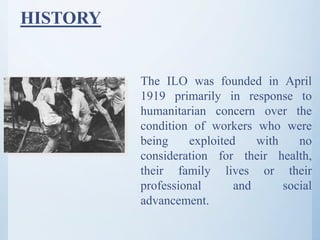
The ILO was founded in April
1919 primarily in response to
humanitarian concern over the
condition of workers who were
being exploited with no
consideration for their health,
their family lives or their
professional and social
advancement.
The ILO Constitution
“WHERE AS
UNIVERSAL AND
LASTING PEACE
CAN BE
ESTABLISHED
ONLY IF IT IS
BASED UPON
SOCIAL
JUSTICE…”
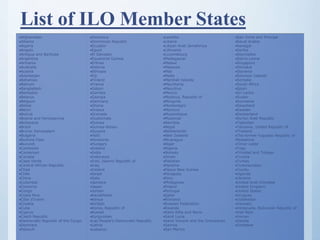
List of ILO Member States
Afghanistan
Albania
Algeria
Angola
Antigua and Barbuda
Argentina
Armenia
Australia
Austria
Azerbaijan
Bahamas
Bahrain
Bangladesh
Barbados
Belarus
Belgium
Belize
Benin
Bolivia
Bosnia and Herzegovina
Botswana
Brazil
Brunei Darussalam
Bulgaria
Burkina Faso
Burundi
Cambodia
Cameroon
Canada
Cape Verde
Central African Republic
Chad
Chile
China
Colombia
Comoros
Congo
Costa Rica
Côte d'Ivoire
Croatia
Cuba
Cyprus
Czech Republic
Democratic Republic of the Congo
Denmark
Djibouti
Dominica
Dominican Republic
Ecuador
Egypt
El Salvador
Equatorial Guinea
Eritrea
Estonia
Ethiopia
Fiji
Finland
France
Gabon
Gambia
Georgia
Germany
Ghana
Greece
Grenada
Guatemala
Guinea
Guinea-Bissau
Guyana
Haiti
Honduras
Hungary
Iceland
India
Indonesia
Iran, Islamic Republic of
Iraq
Ireland
Israel
Italy
Jamaica
Japan
Jordan
Kazakhstan
Kenya
Kiribati
Korea, Republic of
Kuwait
Kyrgyzstan
Lao People’s Democratic Republic
Latvia
Lebanon
Lesotho
Liberia
Libyan Arab Jamahiriya
Lithuania
Luxembourg
Madagascar
Malawi
Malaysia
Mali
Malta
Marshall Islands
Mauritania
Mauritius
Mexico
Moldova, Republic of
Mongolia
Montenegro
Morocco
Mozambique
Myanmar
Namibia
Nepal
Netherlands
New Zealand
Nicaragua
Niger
Nigeria
Norway
Oman
Pakistan
Panama
Papua New Guinea
Paraguay
Peru
Philippines
Poland
Portugal
Qatar
Romania
Russian Federation
Rwanda
Saint Kitts and Nevis
Saint Lucia
Saint Vincent and the Grenadines
Samoa
San Marino
Sao Tome and Principe
Saudi Arabia
Senegal
Serbia
Seychelles
Sierra Leone
Singapore
Slovakia
Slovenia
Solomon Islands
Somalia
South Africa
Spain
Sri Lanka
Sudan
Suriname
Swaziland
Sweden
Switzerland
Syrian Arab Republic
Tajikistan
Tanzania, United Republic of
Thailand
The former Yugoslav Republic of
Macedonia
Timor-Leste
Togo
Trinidad and Tobago
Tunisia
Turkey
Turkmenistan
Tuvalu
Uganda
Ukraine
United Arab Emirates
United Kingdom
United States
Uruguay
Uzbekistan
Vanuatu
Venezuela, Bolivarian Republic of
Viet Nam
Yemen
Zambia
Zimbabwe
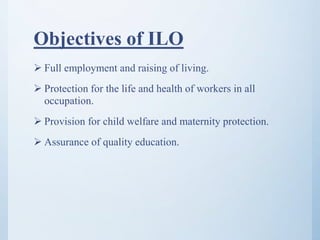
Objectives of ILO
 Full employment and raising of living.
 Protection for the life and health of workers in all
occupation.
 Provision for child welfare and maternity protection.
 Assurance of quality education.
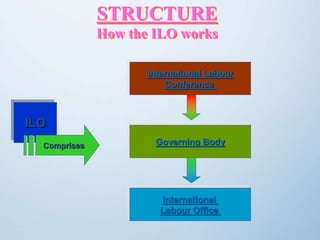
ILO
Comprises
STRUCTURE
How the ILO works
International Labour
Conference
Governing Body
International
Labour Office
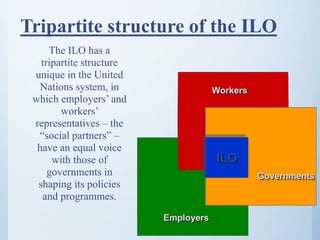
Employers
Tripartite structure of the ILO
The ILO has a
tripartite structure
unique in the United
Nations system, in
which employers’ and
workers’
representatives – the
“social partners” –
have an equal voice
with those of
governments in
shaping its policies
and programmes.
Workers
Governments
ILO
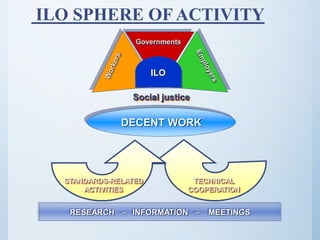
ILO SPHERE OF ACTIVITY
Governments
ILO
DECENT WORK
Social justice
TECHNICAL
COOPERATION
STANDARDS-RELATED
ACTIVITIES
RESEARCH – INFORMATION – MEETINGS
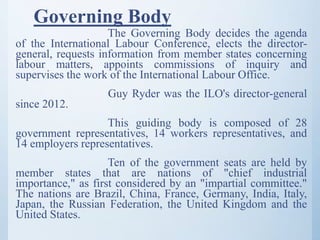
Governing Body
The Governing Body decides the agenda
of the International Labour Conference, elects the director-
general, requests information from member states concerning
labour matters, appoints commissions of inquiry and
supervises the work of the International Labour Office.
Guy Ryder was the ILO's director-general
since 2012.
This guiding body is composed of 28
government representatives, 14 workers representatives, and
14 employers representatives.
Ten of the government seats are held by
member states that are nations of "chief industrial
importance," as first considered by an "impartial committee."
The nations are Brazil, China, France, Germany, India, Italy,
Japan, the Russian Federation, the United Kingdom and the
United States.
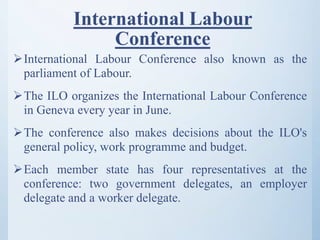
International Labour
Conference
International Labour Conference also known as the
parliament of Labour.
The ILO organizes the International Labour Conference
in Geneva every year in June.
The conference also makes decisions about the ILO's
general policy, work programme and budget.
Each member state has four representatives at the
conference: two government delegates, an employer
delegate and a worker delegate.
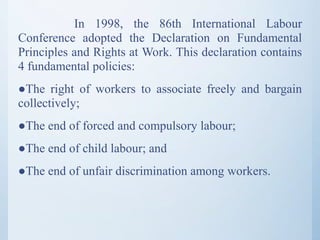
In 1998, the 86th International Labour
Conference adopted the Declaration on Fundamental
Principles and Rights at Work. This declaration contains
4 fundamental policies:
●The right of workers to associate freely and bargain
collectively;
●The end of forced and compulsory labour;
●The end of child labour; and
●The end of unfair discrimination among workers.
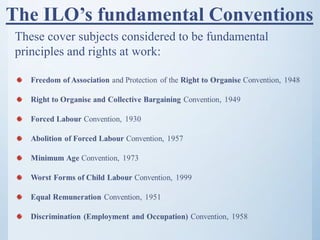
These cover subjects considered to be fundamental
principles and rights at work:
The ILO’s fundamental Conventions
ILO Issues
ILO fight against:
Fight against forced labour
To protect the right of labours for
fixing minimum wage
 Rights of migrant workers
Migrant workers refer to those who moves from
place to place to do their job
Securities of ILO
Social securities:
Workmen’s Compensation
Sickness insurance
Old age insurance
Employment for Women:
Maternity protection
Night work
Equal process
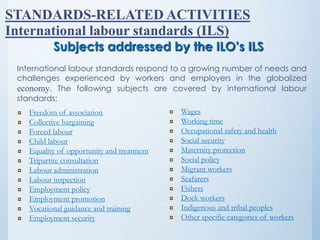
Subjects addressed by the ILO’s ILS
International labour standards respond to a growing number of needs and
challenges experienced by workers and employers in the globalized
economy. The following subjects are covered by international labour
standards:
Wages
Working time
Occupational safety and health
Social security
Maternity protection
Social policy
Migrant workers
Seafarers
Fishers
Dock workers
Indigenous and tribal peoples
Other specific categories of workers
STANDARDS-RELATED ACTIVITIES
International labour standards (ILS)
Freedom of association
Collective bargaining
Forced labour
Child labour
Equality of opportunity and treatment
Tripartite consultation
Labour administration
Labour inspection
Employment policy
Employment promotion
Vocational guidance and training
Employment security
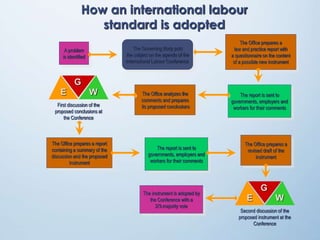
How an international labour
standard is adopted
A problem
is identified
The Governing Body puts
the subject on the agenda of the
International Labour Conference
The Office prepares a
law and practice report with
a questionnaire on the content
of a possible new instrument
The report is sent to
governments, employers and
workers for their comments
The Office analyzes the
comments and prepares
its proposed conclusions
WE
G
First discussion of the
proposed conclusions at
the Conference
The Office prepares a report
containing a summary of the
discussion and the proposed
instrument
The report is sent to
governments, employers and
workers for their comments
The Office prepares a
revised draft of the
instrument
WE
G
Second discussion of the
proposed instrument at the
Conference
The instrument is adopted by
the Conference with a
2/3-majority vote
THE END

International Labour Organization(ILO)

  • 1.
  • 2.
    The International LabourOrganization (ILO) is a United Nations agency dealing with labour issues, particularly international labour standards and decent work for all. 185 of the 193 UN member states are members of the ILO In 1969, the organization received the Nobel Peace Prize for improving peace among classes, pursuing justice for workers, and providing technical assistance to other developing nations.
  • 3.
    HISTORY The ILO wasfounded in April 1919 primarily in response to humanitarian concern over the condition of workers who were being exploited with no consideration for their health, their family lives or their professional and social advancement.
  • 4.
    The ILO Constitution “WHEREAS UNIVERSAL AND LASTING PEACE CAN BE ESTABLISHED ONLY IF IT IS BASED UPON SOCIAL JUSTICE…”
  • 5.
    List of ILOMember States Afghanistan Albania Algeria Angola Antigua and Barbuda Argentina Armenia Australia Austria Azerbaijan Bahamas Bahrain Bangladesh Barbados Belarus Belgium Belize Benin Bolivia Bosnia and Herzegovina Botswana Brazil Brunei Darussalam Bulgaria Burkina Faso Burundi Cambodia Cameroon Canada Cape Verde Central African Republic Chad Chile China Colombia Comoros Congo Costa Rica Côte d'Ivoire Croatia Cuba Cyprus Czech Republic Democratic Republic of the Congo Denmark Djibouti Dominica Dominican Republic Ecuador Egypt El Salvador Equatorial Guinea Eritrea Estonia Ethiopia Fiji Finland France Gabon Gambia Georgia Germany Ghana Greece Grenada Guatemala Guinea Guinea-Bissau Guyana Haiti Honduras Hungary Iceland India Indonesia Iran, Islamic Republic of Iraq Ireland Israel Italy Jamaica Japan Jordan Kazakhstan Kenya Kiribati Korea, Republic of Kuwait Kyrgyzstan Lao People’s Democratic Republic Latvia Lebanon Lesotho Liberia Libyan Arab Jamahiriya Lithuania Luxembourg Madagascar Malawi Malaysia Mali Malta Marshall Islands Mauritania Mauritius Mexico Moldova, Republic of Mongolia Montenegro Morocco Mozambique Myanmar Namibia Nepal Netherlands New Zealand Nicaragua Niger Nigeria Norway Oman Pakistan Panama Papua New Guinea Paraguay Peru Philippines Poland Portugal Qatar Romania Russian Federation Rwanda Saint Kitts and Nevis Saint Lucia Saint Vincent and the Grenadines Samoa San Marino Sao Tome and Principe Saudi Arabia Senegal Serbia Seychelles Sierra Leone Singapore Slovakia Slovenia Solomon Islands Somalia South Africa Spain Sri Lanka Sudan Suriname Swaziland Sweden Switzerland Syrian Arab Republic Tajikistan Tanzania, United Republic of Thailand The former Yugoslav Republic of Macedonia Timor-Leste Togo Trinidad and Tobago Tunisia Turkey Turkmenistan Tuvalu Uganda Ukraine United Arab Emirates United Kingdom United States Uruguay Uzbekistan Vanuatu Venezuela, Bolivarian Republic of Viet Nam Yemen Zambia Zimbabwe
  • 6.
    Objectives of ILO Full employment and raising of living.  Protection for the life and health of workers in all occupation.  Provision for child welfare and maternity protection.  Assurance of quality education.
  • 7.
    ILO Comprises STRUCTURE How the ILOworks International Labour Conference Governing Body International Labour Office
  • 8.
    Employers Tripartite structure ofthe ILO The ILO has a tripartite structure unique in the United Nations system, in which employers’ and workers’ representatives – the “social partners” – have an equal voice with those of governments in shaping its policies and programmes. Workers Governments ILO
  • 9.
    ILO SPHERE OFACTIVITY Governments ILO DECENT WORK Social justice TECHNICAL COOPERATION STANDARDS-RELATED ACTIVITIES RESEARCH – INFORMATION – MEETINGS
  • 10.
    Governing Body The GoverningBody decides the agenda of the International Labour Conference, elects the director- general, requests information from member states concerning labour matters, appoints commissions of inquiry and supervises the work of the International Labour Office. Guy Ryder was the ILO's director-general since 2012. This guiding body is composed of 28 government representatives, 14 workers representatives, and 14 employers representatives. Ten of the government seats are held by member states that are nations of "chief industrial importance," as first considered by an "impartial committee." The nations are Brazil, China, France, Germany, India, Italy, Japan, the Russian Federation, the United Kingdom and the United States.
  • 11.
    International Labour Conference International LabourConference also known as the parliament of Labour. The ILO organizes the International Labour Conference in Geneva every year in June. The conference also makes decisions about the ILO's general policy, work programme and budget. Each member state has four representatives at the conference: two government delegates, an employer delegate and a worker delegate.
  • 12.
    In 1998, the86th International Labour Conference adopted the Declaration on Fundamental Principles and Rights at Work. This declaration contains 4 fundamental policies: ●The right of workers to associate freely and bargain collectively; ●The end of forced and compulsory labour; ●The end of child labour; and ●The end of unfair discrimination among workers.
  • 13.
    These cover subjectsconsidered to be fundamental principles and rights at work: The ILO’s fundamental Conventions
  • 14.
    ILO Issues ILO fightagainst: Fight against forced labour To protect the right of labours for fixing minimum wage  Rights of migrant workers Migrant workers refer to those who moves from place to place to do their job
  • 15.
    Securities of ILO Socialsecurities: Workmen’s Compensation Sickness insurance Old age insurance Employment for Women: Maternity protection Night work Equal process
  • 16.
    Subjects addressed bythe ILO’s ILS International labour standards respond to a growing number of needs and challenges experienced by workers and employers in the globalized economy. The following subjects are covered by international labour standards: Wages Working time Occupational safety and health Social security Maternity protection Social policy Migrant workers Seafarers Fishers Dock workers Indigenous and tribal peoples Other specific categories of workers STANDARDS-RELATED ACTIVITIES International labour standards (ILS) Freedom of association Collective bargaining Forced labour Child labour Equality of opportunity and treatment Tripartite consultation Labour administration Labour inspection Employment policy Employment promotion Vocational guidance and training Employment security
  • 17.
    How an internationallabour standard is adopted A problem is identified The Governing Body puts the subject on the agenda of the International Labour Conference The Office prepares a law and practice report with a questionnaire on the content of a possible new instrument The report is sent to governments, employers and workers for their comments The Office analyzes the comments and prepares its proposed conclusions WE G First discussion of the proposed conclusions at the Conference The Office prepares a report containing a summary of the discussion and the proposed instrument The report is sent to governments, employers and workers for their comments The Office prepares a revised draft of the instrument WE G Second discussion of the proposed instrument at the Conference The instrument is adopted by the Conference with a 2/3-majority vote
  • 18.